Branicks: 10.7 Billion Euros Under Management — and No Audited Accounts for 2025
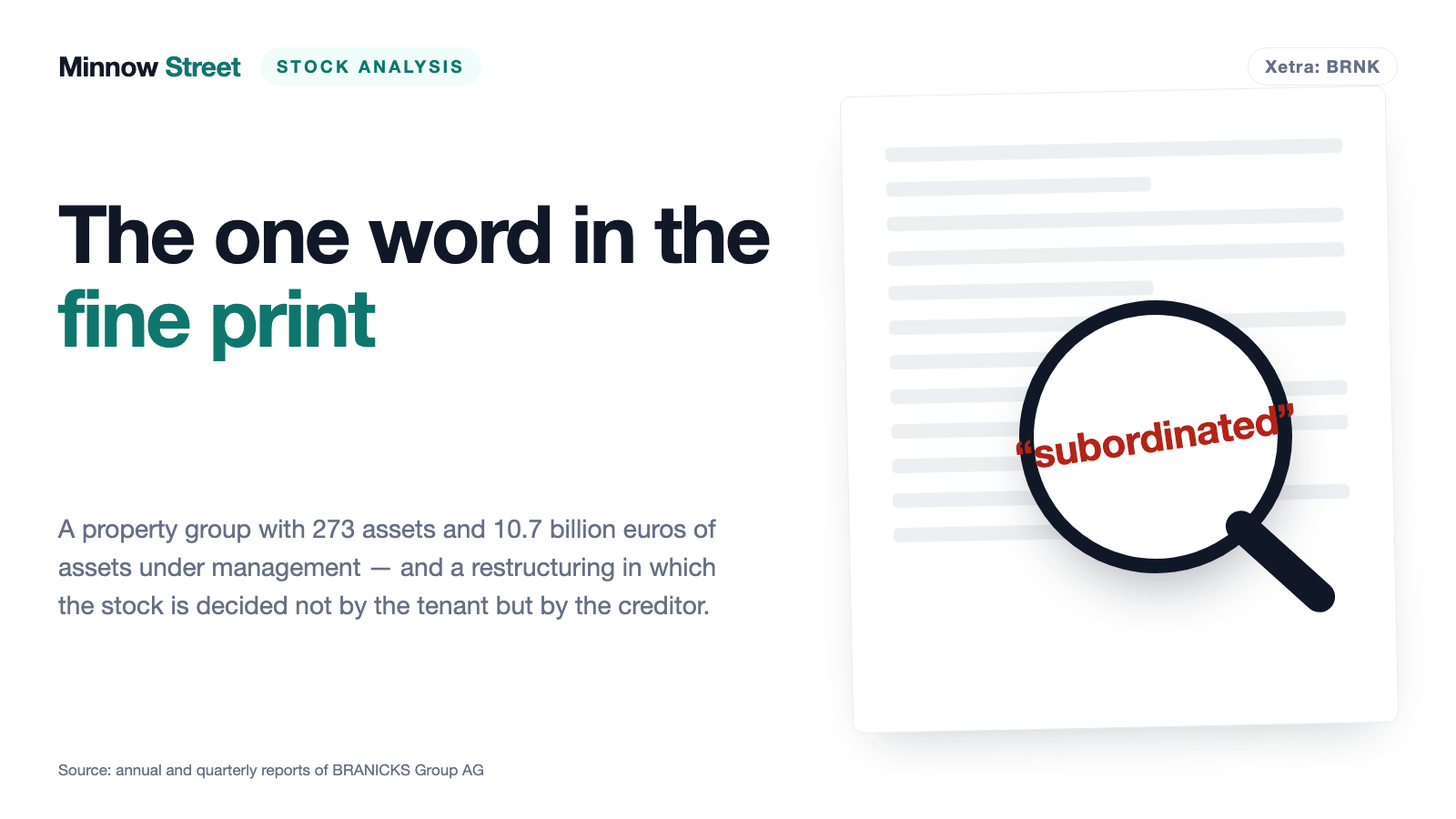
Property stocks come with a stubborn comfort: there are buildings behind this. At BRANICKS Group AG (Xetra: BRNK, formerly DIC Asset AG) there really are — 273 assets carrying EUR 10.7 billion of assets under management as of September 30, 2025. And yet this stock is not decided by the tenant right now, but by the creditor. The audited 2025 accounts were still missing on August 4, 2026, postponed four times. Unsecured notes of EUR 400 million came due on September 22, 2026 and go to a bondholder vote starting August 15, 2026. EUR 219.5 million of debt is to be subordinated — due 2038, carrying 15 percent. Not investment advice — just the question of who really owns a property group once the creditors write the timetable.
 Thomas Mücke
Founder & Publisher
Thomas Mücke
Founder & Publisher
Chart
Interactive price chart (TradingView).
Note: pure fact-based analysis, not investment advice and not a solicitation to buy or sell. All figures without guarantee.
There is one investor weakness that fires especially reliably with property stocks: faith in substance. A software house can go worthless overnight, a biotech compound can fail — but an office building in Frankfurt stays an office building. There are buildings behind this. That sentence is soothing, and that is exactly why almost nobody checks who economically owns the buildings. So let us make a deal: at BRANICKS Group AG (Xetra: BRNK, formerly DIC Asset AG) we will read together only what the company itself has reported — the last audited annual report, the last quarterly statement and every mandatory disclosure up to July 31, 2026.
That names the central tension of this analysis, and it runs through every chapter: the letting business works, rents are rising, the assets are standing — and yet this stock is currently decided not by the tenant but by the creditor. The calendar everything hangs on is not written in Frankfurt but in the lock-up agreements of an ad hoc group of bondholders.
What Branicks actually does
Branicks is a German property group with two legs. In the Commercial Portfolio segment the buildings belong to the company itself: it collects the rents, manages the assets and sells when the timing fits. In the Institutional Business segment the buildings belong to others — insurers, pension schemes, funds — and Branicks earns fees for structuring and managing them. In everyday terms: landlord on one side, property manager for other landlords on the other.
As of September 30, 2025 the platform comprised 273 assets with a market value of EUR 10,713.0 million — 125 assets held on its own balance sheet (EUR 2,343.7 million) and 148 assets in the third-party business (EUR 8,369.3 million). Lettable space came to roughly 3.7 million square meters, with the focus on office and logistics properties; they accounted for 81 percent of the market value. The group includes the separately listed VIB Vermögen AG, in which Branicks held 68.75 percent as of December 31, 2024. The parent company itself is lean: 266 employees at the end of 2024, down from 300 a year earlier.
The name is new, the company is not. Until 2023 it traded as DIC Asset AG; that is also the name under which the six corporate bonds since 2011 were issued, including the one at the center of this story. Anyone reading older filings should keep that in mind — it is the same company.
How the stock landed on our desk
Not through a scanner hit, but through other people's attention: on August 4, 2026 Branicks appeared on the wallstreet-online forum rankings among the most discussed stocks held by German retail investors. That is not a buy signal, it is a sign that a lot of people have the same question. With a company whose annual accounts have been outstanding for months and whose bondholders vote in August 2026, the question is an obvious one.
The shares trade in the Prime Standard of the Frankfurt Stock Exchange (ISIN DE000A1X3XX4, ticker BRNK), plus on several regional exchanges and in Luxembourg. There are 83,565,510 registered no-par shares outstanding. The shareholder structure as of March 31, 2026: Deutsche Immobilien Chancen AG & Co. KGaA 24.91 percent, Yannick Patrick Heller 10.10 percent, RAG-Stiftung 10.01 percent, FMR LLC 1.61 percent, free float 53.37 percent.
The numbers over the years — what actually carries
Start with what works, because in this story it easily gets buried. The letting business is doing fine. In the first nine months of 2025, letting performance rose 18 percent to 256,500 square meters (prior year: 218,000) — 113,900 square meters of new lettings and 142,600 square meters of renewals. Average rent in the own portfolio climbed to EUR 10.34 per square meter from EUR 9.63 a year earlier, and like-for-like rental growth came in at 1.0 percent. Funds from operations — the sector's operating metric, roughly the rental surplus before disposals and depreciation — reached EUR 33.4 million after minorities.
Deleveraging also went to plan in 2025: all promissory note loans maturing in 2025, together more than EUR 293 million, were repaid — EUR 225 million in the first half and a further EUR 68 million at the end of July 2025. Read those lines alone and you see a group doing its homework.
The second line reads differently. The net loss for the first nine months of 2025 came to EUR 160.5 million (prior-year period: EUR 153.2 million), earnings per share to minus EUR 1.63. Full-year 2024 closed with a net loss of EUR 365.5 million, after a loss of EUR 70.7 million in 2023 and still a profit of EUR 42.9 million in 2022. No dividend was proposed for 2023 or 2024; before that it was EUR 0.75 per share. The losses come overwhelmingly from write-downs on the property holdings — and those feed straight into net asset value.
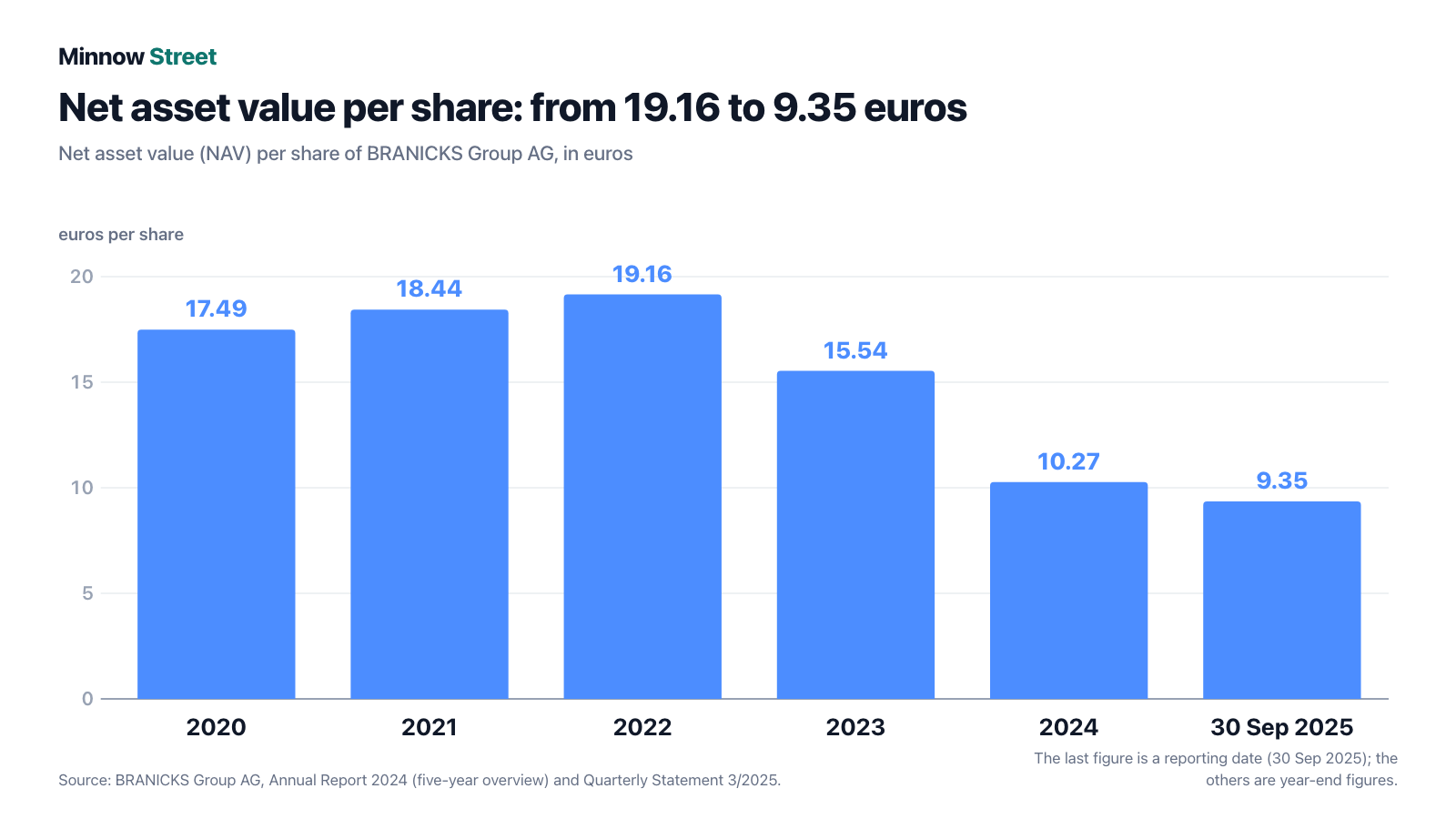
Net asset value per share — put simply, what would be left on paper if you sold every property at market value and repaid every debt — stood at EUR 19.16 in 2022. As of September 30, 2025 it was EUR 9.35, with the adjusted figure including the full value of the Institutional Business at EUR 11.64. Over the same stretch, book equity fell from EUR 1,664.1 million (end of 2022) to EUR 950.8 million as of September 30, 2025. The equity ratio last stood at 31.1 percent, slightly above year-end 2024 (30.2 percent) — because the balance sheet total shrank in parallel, from EUR 3,741.6 million to EUR 3,057.5 million.
Remember this for the rest of the piece: at a highly leveraged landlord, the property value is only one half of the sum — the other half belongs to the bank.
Uncomfortable truth no. 1: there are no audited figures for 2025
The last audited accounts of BRANICKS Group AG are the Annual Report 2024, published on March 12, 2025. BDO AG Wirtschaftsprüfungsgesellschaft issued an unqualified opinion at the time, with no emphasis on a material uncertainty about the ability to continue as a going concern. The most recent periodic report is Quarterly Statement 3/2025 of November 6, 2025 — unaudited, as quarterly statements always are.
For the full 2025 financial year, nothing audited existed on August 4, 2026. The chronology of the delays reads like this:
- December 23, 2025: guidance for 2025 revised; the annual report would be published "as planned on April 29, 2026".
- April 28, 2026: postponed. Reason: ongoing negotiations over term sheets for refinancing the financial liabilities due in 2026. New target: by June 30, 2026.
- June 24, 2026: a firmer date. New target: July 27, 2026, together with the quarterly statement for the first quarter of 2026.
- July 21, 2026: that date falls too. The auditors report that they cannot complete the audit procedures by July 27.
"As the auditors consider the outcome of these negotiations and their implementation to be of material significance for the final assessment, the audit cannot be finalised until these details are available."
— BRANICKS Group AG, ad-hoc release under Article 17 MAR, July 21, 2026
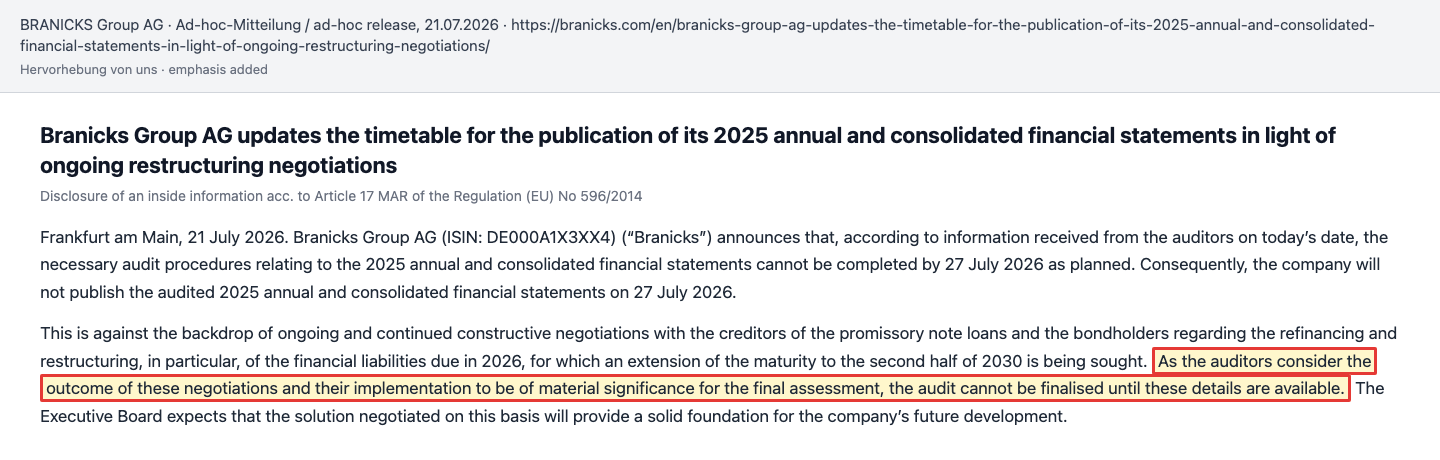
In plain language: an auditor has to judge whether a company can pay its bills over the coming year. As long as it is open whether and on what terms EUR 579.5 million of debt gets extended, that judgment cannot honestly be made. The missing report is therefore not sloppiness — it is an accurate reflection of the situation.
How far the gap reaches shows in the company's own financial calendar. On August 4, 2026 it listed four items — the 2025 annual report, the Q1 2026 statement, the H1 2026 report and the Q3 2026 statement — all carrying the same placeholder date, 31.12.2026. The 2026 annual general meeting is entered as "still open". A listed company thus has no reliable date for a full financial year and three reporting periods. Whoever buys this stock buys a company whose numbers date from November 2025.
Uncomfortable truth no. 2: the creditors' calendar
On September 30, 2025 the group carried financial debt of EUR 1,838.7 million (including IFRS 5) after EUR 2,307.7 million at year-end 2024. Leverage, measured in this sector as loan-to-value, stood at 60.1 percent, at 56.1 percent on an adjusted basis and at 63.4 percent under the EPRA definition. Cash and bank balances: EUR 97.1 million, down from EUR 250.7 million at year-end 2024.
Two blocks of that turned into a problem in 2026. The first: promissory note loans of EUR 87.0 million maturing in March and April 2026. On March 9, 2026 Branicks said it was deepening talks about a short-term extension; on March 31, 2026 standstill agreements were reached through the end of June 2026, and on July 1, 2026 they were extended to July 27, 2026. A standstill means the money is due and the creditor is, for now, choosing not to demand it. Since July 31, 2026 these instruments have been covered by the lock-up agreements; the scheduled interest payment on the promissory notes of EUR 2.2 million was made in cash on July 27, 2026.
The second block: the unsecured green corporate bond of EUR 400 million (ISIN XS2388910270), issued on September 22, 2021 with a coupon of 2.250 percent and a term running to September 22, 2026. It is listed on the Euro MTF market of the Luxembourg Stock Exchange with a denomination of EUR 100,000 per note — 4,000 notes in total, held by institutions. In Quarterly Statement 3/2025 it shows up where such an instrument belongs once maturity approaches: the green bond, carried at EUR 398.0 million, was reclassified from non-current to current financial debt.
On March 31, 2026 the management board decided to bring the bondholders into the talks as well. At that point it was no longer about a refinancing but about a restructuring.
The bond's factsheet lists covenants of loan-to-value no higher than 60 percent, secured loan-to-value no higher than 45 percent and an interest coverage ratio of at least 1.80. The loan-to-value reported by Branicks stood at 60.1 percent as of September 30, 2025 — the definitions in the terms and conditions and the group metric need not be identical, and the same quarterly statement expressly reports full compliance with the covenants. More telling is what the Annual Report 2024 said a year earlier:
"All covenants were met in the 2024 financial year. We expect no covenant violations in 2025."
— BRANICKS Group AG, Annual Report 2024, Reporting on risk management, page 155

What is remarkable is not the sentence itself but its neighborhood. In the same annual report the management board writes about financing risk: "Nevertheless, financing risk remains a high-risk position", and classifies it as "(H) HIGH" both as of December 31, 2023 and as of December 31, 2024. Covenants met and still high risk — that is not a contradiction, it is the description of a company that fails not on running metrics but on dates. If you want a parallel: at Gerresheimer the same mechanism ended with an auditor writing a dedicated going-concern section into the audit opinion.
Uncomfortable truth no. 3: what EUR 579.5 million is meant to become
On July 30, 2026 Branicks announced that it had signed lock-up agreements — contracts in which creditors commit to support a restructuring. The parties were an ad hoc group of bondholders holding 60.4 percent of the outstanding note principal and holders of the promissory note loans and registered notes representing more than 90 percent of that principal. At 17:34 on July 31, 2026 the agreements became fully effective; by then more than 50 percent of bondholders and 100 percent of promissory note and registered note holders had signed.
The key terms were independently verified by FTI-Andersch in a restructuring opinion under the German IDW S6 standard. That detail carries a signal: an IDW S6 opinion is not commissioned for routine refinancings but to demonstrate that a company can be restructured back to viability.
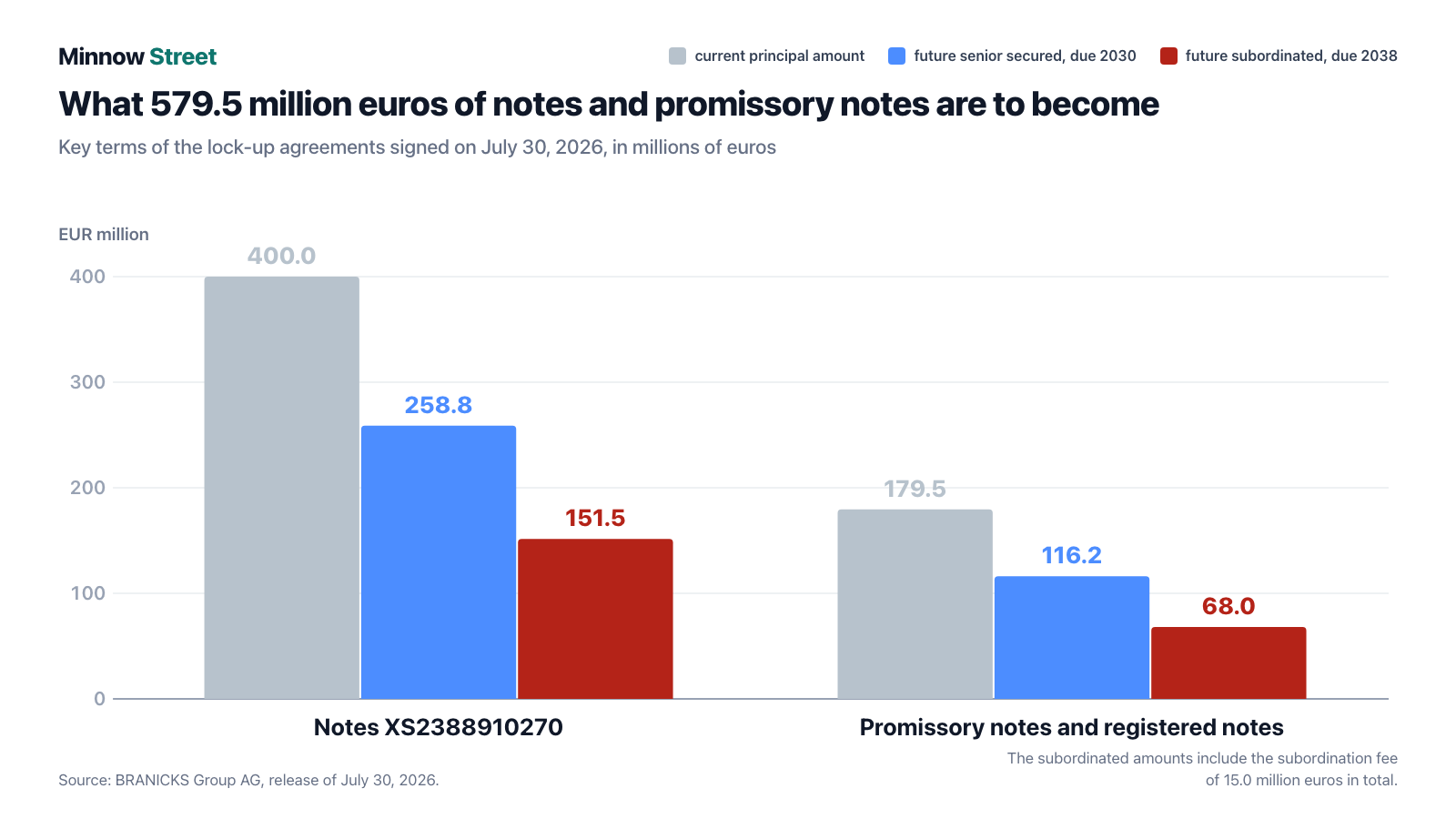
The mechanics in numbers. The EUR 400.0 million of notes become senior secured notes of EUR 258.8 million; the promissory note loans and registered notes of EUR 179.5 million become senior secured instruments of EUR 116.2 million. Together EUR 375.0 million, maturing on September 30, 2030 and bearing 7.5 percent interest in cash.
The remainder does not vanish — it moves to the back of the queue. Bondholders receive new unsecured subordinated notes of EUR 151.5 million, promissory note holders subordinated instruments of EUR 68.0 million. Together with a subordination fee of EUR 15 million that adds up to EUR 219.5 million at closing, maturing on September 30, 2038 and bearing 15 percent — with Branicks free to pay interest in kind, increasing the principal instead of paying cash. Twelve years and 15 percent: that is the price for leaving the principal amount uncut.
"The Subordinated Principal Instruments will be subordinated pursuant to section 39(2) of the German Insolvency Code (Insolvenzordnung – InsO) and will thus be subordinated to all non-subordinated liabilities of Branicks, including the New Money and the Senior Secured Principal Instruments, but rank senior to equity."
— BRANICKS Group AG, release of July 30, 2026, section "Ranking and Security"
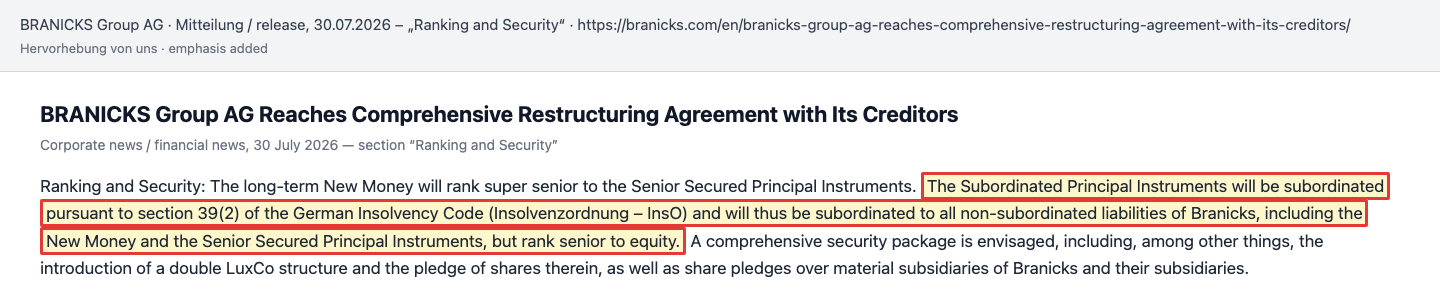
For shareholders that sentence carries the good and the bad news at once. The good: "rank senior to equity" means the shares are not cancelled and not swapped for debt — no debt-to-equity swap is part of the transaction. The bad: there are now three layers of debt ahead of the equity instead of one. At the top the new money with super senior status — EUR 35 million at Branicks level and EUR 60 million at VIB level, grown to EUR 36.1 million and EUR 61.9 million on day one through a capitalized backstop fee, bearing 10.0 percent and maturing on September 30, 2029. Below that the secured instruments, plus a security package including a double Luxembourg holding structure and share pledges over material subsidiaries. Only then come the subordinated instruments — and only then the stock.
On top come fees that tend to get lost in a press release: a 50 basis point extension fee at closing, a one-time 200 basis points on any senior secured or new money principal still outstanding on December 31, 2028, and a 100 basis point exit fee on repayment or refinancing. And the company commits to preparing and implementing a plan to sell further assets. Translated: the portfolio will keep shrinking — not because the board thinks it right, but because it is in the contract.
Uncomfortable truth no. 4: the creditors also write the personnel list
How far the shift in power reaches shows in the governance section of the agreement. Three conditions had to be satisfied by July 31, 2026 for the lock-up agreements to become effective at all: accession by holders of 100 percent of the promissory note loans and registered notes, the appointment of Josef Schultheis as Chief Restructuring Officer to the management board — and the departure of the chairman of the supervisory board.
All three were met. The chairman resigned on July 31, 2026. He had been elected on October 10, 2025 — it is Prof. Dr. Gerhard Schmidt, at the same time an indirect major shareholder through Deutsche Immobilien Chancen AG & Co. KGaA with 24.91 percent. In the release of July 30, 2026 he appears only as a shareholder and expressly supports the transaction. Chief executive Sonja Wärntges, in office since October 1, 2017, continues to run the business and will resign, per the same release, no later than December 31, 2026.
Take it soberly: a chief restructuring officer is not a vote of no confidence in individuals, it is market standard in situations like this. But the finding stands — the largest shareholder had to vacate the supervisory board chair because creditors made it a condition. Buying a share normally buys you a say. Here the say has just changed hands.
The date everything runs toward: August 15 to 17, 2026
Alongside the effectiveness announcement on July 31, 2026, Branicks invited bondholders to the first vote without a meeting under section 18 of the German Bonds Act. The voting period runs from Saturday, August 15, 2026, 00:00, to Monday, August 17, 2026, 24:00, with Frankfurt notary Dr. Christiane Mühe presiding.
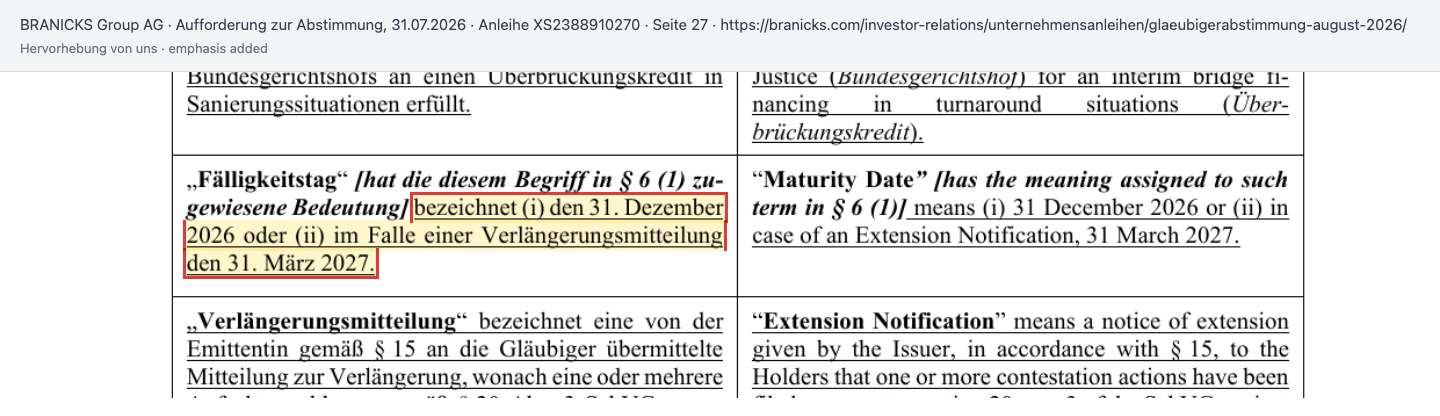
This first vote is not yet the big restructuring — its main purpose is to defer the notes so that the second step has a stable platform. The central change sits in the amended terms and conditions. On the term "Maturity Date" they will read:
"… means (i) 31 December 2026 or (ii) in case of an Extension Notification, 31 March 2027."
— BRANICKS Group AG, invitation to vote dated July 31, 2026, resolution 3 (amendment of the terms and conditions)
The deferral is not free. The 2.250 percent coupon applies only until September 22, 2026; from that day the notes bear interest until the new maturity date at the statutory default rate — five percentage points above the base rate published by the Deutsche Bundesbank. That interest is not paid in cash but capitalized and added to the principal of the subordinated instrument.
And the vote is no formality. It is quorate only if at least 50 percent of the outstanding principal takes part; the material resolutions then need a qualified majority of 75 percent of the votes cast. If the quorum is missed, the company already flags a second, physical bondholder meeting — where 25 percent of the outstanding principal suffices. The ad hoc group holds 60.4 percent and has contractually committed to support the deal; even so, a resolution is only safe once it has been passed and implemented under section 21 of the German Bonds Act. Contestation actions are explicitly anticipated: that is exactly what the extension notification to March 31, 2027 is for.
What the stock costs — and what we cannot say here
This is where the analysis deliberately stays incomplete, and that is not an oversight. No reliable price source was available for this piece. We therefore quote no current market capitalization and no ratio derived from one — an estimated figure would be particularly dangerous in the middle of a restructuring. What can be sourced are the company's own dated disclosures.
The investor relations page on the share still shows 2024 as the most recent year: Xetra year-end price EUR 2.23 (2023: EUR 3.38), 52-week high EUR 3.41, 52-week low EUR 0.90, and a market capitalization on that basis of EUR 186 million (2023: EUR 282 million). At the same reporting date net asset value per share was EUR 10.27. At the end of 2024 the market was therefore paying roughly 22 percent of book net asset value. That this table still ends in 2024 in August 2026 is itself a finding: there simply are no audited annual figures for 2025.
For a sense of proportion: against that EUR 186 million of market value at the end of 2024 stood financial debt of EUR 1,838.7 million and a property book value of EUR 2,223.9 million as of September 30, 2025. Put differently, the equity slice of this company, measured by market value, is a thin strip on a very large picture. That is why the share price reacts so violently to any financing news — and why, with names like this, every metric carrying market capitalization in the denominator deserves caution.
There is a dilution risk on top, and it has nothing to do with the notes. The extraordinary general meeting of February 13, 2026 resolved a Conditional Capital 2026 of up to EUR 50,139,306 — 60 percent of the then share capital, according to the company. It exists to compensate outside shareholders of VIB Vermögen AG with Branicks shares under the domination and profit transfer agreement, at a ratio of 4.18 Branicks shares per VIB share. If everyone accepts, new shares equal to a maximum of roughly 51.7 percent of the then share capital would be issued. Dilution means your slice of the cake gets smaller without the cake getting bigger. Filing that agreement for registration is explicitly part of the restructuring transaction of July 30, 2026.
For completeness: according to the company's rating page, Standard & Poor's last left the issuer rating unchanged at "CCC" with a negative outlook in December 2024. No newer rating actions were shown on the page on August 4, 2026. For comparison, in February 2021 it still read "BB+". As with commercial real estate lender Walker & Dunlop, the lesson holds: looking at rents and buildings alone does not explain the stock.
Opportunities and risks at a glance
Opportunities
- The operating business carries: 256,500 square meters of letting performance in the first nine months of 2025 (up 18 percent), average rent up to EUR 10.34 per square meter, funds from operations after minorities of EUR 33.4 million. A landlord with let office and logistics assets has recurring income regardless of how the balance sheet looks.
- The restructuring is signed, not merely negotiated: the lock-up agreements have been effective since July 31, 2026, with 100 percent of promissory note and registered note holders and more than 50 percent of bondholders as parties. The key terms were independently verified under IDW S6.
- No haircut and no debt-to-equity swap: the subordinated instruments expressly rank senior to equity. Shareholders are not expropriated in this transaction.
- Fresh money is committed: EUR 95 million of new money, EUR 35 million of it at Branicks level, fully backstopped. Maturities move from 2026 out to 2029, 2030 and 2038.
- The valuation already carries a great deal of skepticism: at the end of 2024 the market value of EUR 186 million equated to roughly 22 percent of book net asset value. If the turnaround works, the leverage cuts both ways.
Risks
- There are no audited figures for the whole of 2025. The accounts were postponed four times; the 2025 annual report, Q1, H1 and Q3 2026 all sit in the financial calendar under the placeholder 31.12.2026, and the 2026 annual general meeting under "still open".
- The auditors can only finalise once the outcome of the restructuring negotiations and their implementation are available. What the opinion will eventually look like — with or without an emphasis on a material going-concern uncertainty — was open on August 4, 2026.
- The deferral of the notes has not been resolved yet. It needs a quorum of 50 percent and a majority of 75 percent in the vote from August 15 to 17, 2026; a second vote on the actual restructuring follows. Contestation actions are explicitly built into the terms.
- The cost of capital jumps: 10.0 percent on the new money, 7.5 percent on the secured instruments and 15 percent on EUR 219.5 million of subordinated instruments — against 2.250 percent on the old notes. Extension, one-time and exit fees come on top.
- Substance is melting: net asset value per share down from EUR 19.16 (2022) to EUR 9.35 (September 30, 2025), equity from EUR 1,664.1 million to EUR 950.8 million, net losses of EUR 365.5 million (2024) and EUR 160.5 million (nine months of 2025). The EPRA vacancy rate rose from 7.4 to 9.8 percent.
- Additional dilution of up to roughly 51.7 percent from the Conditional Capital 2026 if all outside VIB shareholders accept the share compensation.
- The company is contractually committed to further asset sales — in a market where disposals recently proved harder than planned: instead of EUR 600 million to EUR 800 million of sales volume, only about EUR 453 million was expected for 2025 as of December 23, 2025.
A human conclusion
We started with faith in substance — the reassuring thought that behind a property stock there are, at least, buildings. The buildings really are there. 273 assets, roughly 3.7 million square meters, tenants who pay on time and an average rent that has been rising. What that does not answer is the question that matters for a share: who economically owns those buildings?
The answer sits in the releases of July 30 and 31, 2026. Ahead of shareholders will stand EUR 98.0 million of new money with super senior status — the EUR 35 million and EUR 60 million plus the backstop fee capitalized on day one — along with EUR 375.0 million of secured instruments and EUR 219.5 million of subordinated debt — secured through a Luxembourg holding structure and pledges over the material subsidiaries. The supervisory board chair has been vacated at the creditors' request, a chief restructuring officer sits on the management board, further disposals are contractually promised. This stock is therefore not a bet on Frankfurt office rents. It is a bet on three dates: the vote from August 15 to 17, 2026, the new maturity date of December 31, 2026, and the day an audited set of accounts finally appears.
If you say "too murky for me", you have read the situation correctly. If you say "precisely why", you have read it correctly too — just with a different appetite for risk, and knowing that three layers of debt sit between you and the buildings. Both are legitimate. What would not be legitimate is treating "there are buildings behind this" as a substitute for reading the terms and conditions. What you make of it is your decision. And that is exactly as it should be.
You will find more deep dives in our research section.
Sources
- BRANICKS Group AG — Annual Report 2024, published March 12, 2025 (German and English editions): key figures at a glance, report on expected developments, risks and opportunities, reporting on risk management, unqualified audit opinion of BDO AG Wirtschaftsprüfungsgesellschaft, five-year overview (page 187)
- BRANICKS Group AG — Quarterly Statement 3/2025, published November 6, 2025: portfolio, assets and financial position, key figures, loan-to-value calculation, EPRA metrics
- BRANICKS Group AG — ad-hoc releases under Article 17 MAR: October 10, 2025 (election of the supervisory board chairman), December 23, 2025 (2025 guidance revision), January 2, 2026 (domination and profit transfer agreement, compensation, conditional capital), March 9 and 31, 2026 (promissory notes due March/April), April 28, June 24 and July 21, 2026 (postponement of the 2025 accounts), July 1, 2026 (extension of the standstill agreements), July 30 and 31, 2026 (lock-up agreements)
- BRANICKS Group AG — corporate news, including February 13, 2026 (resolutions of the extraordinary general meeting) and July 30, 2026 (full wording of the restructuring agreement including statements)
- BRANICKS Group AG — bondholder vote August 2026: invitation to vote dated July 31, 2026, existing and amended terms and conditions of notes XS2388910270
- BRANICKS Group AG — corporate bonds: factsheet of the 2021 green corporate bond (volume, coupon, term, covenants)
- BRANICKS Group AG — financial calendar, as of August 4, 2026
- BRANICKS Group AG — share information, shareholder structure (as of March 31, 2026) and rating
- Hook: wallstreet-online forum rankings of the most discussed stocks among German retail investors, as of August 4, 2026
This analysis is a journalistic contextualization of publicly available information. It is not investment advice, not a solicitation to buy or sell securities and not a personal recommendation. Shares can lose substantial value, and a total loss of the capital invested is possible. Every figure carries the reporting date of its source; the last audited accounts cover the 2024 financial year, the most recent unaudited figures the nine months to September 30, 2025. No audited figures for the 2025 financial year existed on August 4, 2026. No current market capitalization is quoted because none could be sourced for this piece. Positions held by the operator are disclosed daily; where one exists, it appears as a notice at the top of this deep dive.
Our Bottom Line at a Glance
- Operating letting business positive
- The base works: in the first nine months of 2025 letting performance rose 18 percent to 256,500 square meters, average rent in the own portfolio from EUR 9.63 to EUR 10.34 per square meter, and like-for-like rental growth came in at 1.0 percent. Funds from operations after minorities reached EUR 33.4 million (prior-year period: EUR 36.1 million). Office and logistics assets account for 81 percent of market value.
- Reporting and data basis negative
- There were no audited figures for the whole of the 2025 financial year on August 4, 2026. The date was pushed back on April 28, June 24 and July 21, 2026; the financial calendar lists the 2025 annual report, Q1 2026, H1 2026 and Q3 2026 all under the placeholder 31.12.2026, and the 2026 annual general meeting as "still open". The last audited accounts cover 2024, the most recent periodic report the nine months to September 30, 2025.
- Leverage and maturities negative
- As of September 30, 2025 financial debt of EUR 1,838.7 million stood against equity of EUR 950.8 million, with loan-to-value at 60.1 percent. Promissory note loans of EUR 87.0 million maturing in March and April 2026 were kept open only through standstill agreements from March 31, 2026 onward; the unsecured notes of EUR 400 million came due on September 22, 2026 and are now being put up for deferral.
- Restructuring agreement neutral
- The lock-up agreements of July 30, 2026 have been effective since July 31, 2026, with 100 percent of promissory note and registered note holders and more than 50 percent of bondholders as parties, and the key terms verified by FTI-Andersch under IDW S6. There is no haircut and no debt-to-equity swap. The price: EUR 375.0 million becomes secured (7.5 percent, 2030), EUR 219.5 million subordinated (15 percent, 2038), plus EUR 95 million of new money at 10.0 percent ranking super senior.
- Net asset value per share negative
- Net asset value per share fell from EUR 19.16 (December 31, 2022) through EUR 15.54 and EUR 10.27 to EUR 9.35 as of September 30, 2025; the adjusted figure stood at EUR 11.64. Over the same period equity fell from EUR 1,664.1 million to EUR 950.8 million. The EPRA vacancy rate rose from 7.4 percent (December 31, 2024) to 9.8 percent.
- Governance and control negative
- The lock-up agreements only became effective once the supervisory board chairman elected on October 10, 2025 had left — he resigned on July 31, 2026 — and Josef Schultheis had been appointed Chief Restructuring Officer. Chief executive Sonja Wärntges will resign no later than December 31, 2026. On top of that, the company is contractually committed to a plan for further asset disposals.
Branicks is faith in substance in its purest form: 273 assets, roughly 3.7 million square meters of lettable space, rising average rents and EUR 33.4 million of funds from operations in nine months of 2025 — sitting under a capital structure the company no longer steers itself. No audited figures for the 2025 financial year existed on August 4, 2026 because the auditors are waiting for the outcome of the restructuring negotiations. EUR 400 million of notes and EUR 179.5 million of promissory notes are to become EUR 375.0 million of senior secured instruments (2030, 7.5 percent) and EUR 219.5 million of subordinated instruments (2038, 15 percent), plus EUR 95 million of new money ranking super senior at 10.0 percent. Shareholders are not expropriated — the subordinated paper expressly ranks senior to equity — but they now sit behind three layers of debt. Not investment advice.
What Our Rating Means
Substance risk
We found at least one documented issue that threatens the company itself — regardless of how the stock is currently valued.
Red here does not stand for a fallen share price or an optically cheap valuation but for documented substance risk. First: the auditors state that they can only finalise the 2025 annual and consolidated financial statements once the outcome of the restructuring negotiations and their implementation are available — so an entire financial year has no audited figures. Second: promissory note loans of EUR 87.0 million fell due in March and April 2026 and were kept open only by standstill agreements until July 27, 2026; since July 31, 2026 they have been covered by the lock-up agreements. The unsecured notes of EUR 400 million came due on September 22, 2026 and are deferred only by a bondholder vote held from August 15 to 17, 2026. Third: the key terms were verified in a restructuring opinion under IDW S6, the creditors made the departure of the supervisory board chairman and a chief restructuring officer on the management board a condition, and Standard & Poor's has carried the issuer rating at "CCC" with a negative outlook since March 2024 according to the company's rating page. The absence of a haircut and of a debt-to-equity swap, the working letting business and the accession of 100 percent of promissory note holders all soften the picture — but they do not lift it while closing is still outstanding. Yellow would apply once the restructuring is completed and audited accounts without a going-concern emphasis have been published. The decision is yours.
A journalistic assessment by our editorial team at the time of the deep dive, based on public sources — not investment advice and not a solicitation to buy or sell. Your personal circumstances (investment goals, risk capacity, taxes) cannot be taken into account. What our levels mean, how verdicts are formed, and what conflicts of interest exist →
Worth Noting
- Branicks reached our research list through the wallstreet-online forum rankings of the most discussed stocks among German retail investors, as of August 4, 2026 — not a scanner hit and not a buy signal, but an attention signal.
- Data basis and recency: the last audited accounts are the Annual Report 2024 (published March 12, 2025, unqualified opinion by BDO AG Wirtschaftsprüfungsgesellschaft). The most recent periodic report is the unaudited Quarterly Statement 3/2025 of November 6, 2025. Every disclosure through July 31, 2026 was reviewed; the latest ad-hoc release is dated July 31, 2026 and the latest corporate news July 30, 2026. No audited figures exist for the 2025 financial year.
- Deliberate gap: this analysis quotes no current market capitalization and no metric derived from one, because no sourceable price feed was available. It uses only the company's own dated disclosures, notably the Xetra year-end 2024 price of EUR 2.23 and the market capitalization of EUR 186 million derived from it.
- On the name history: the company traded as DIC Asset AG until 2023. Older releases, the documentation of the 2021/2026 notes and parts of the investor relations pages still carry that name — it is the same company (ISIN DE000A1X3XX4).
The full analysis as a PDF for later
We will send you this analysis as a PDF — to print, file away, and read at your own pace.
Frequently Asked Questions
Branicks (formerly DIC Asset AG) is a Frankfurt-based property group focused on German office and logistics real estate. In the Commercial Portfolio segment it owns assets on its own balance sheet and collects the rents; in the Institutional Business segment it manages property for institutional investors and earns fees. As of September 30, 2025 the platform comprised 273 assets with a market value of EUR 10,713.0 million. The group includes the separately listed VIB Vermögen AG (68.75 percent as of December 31, 2024).
Because the auditors are waiting for the outcome of the restructuring negotiations. In the ad-hoc release of July 21, 2026 they state that the outcome of those negotiations and their implementation are of material significance for the final assessment, and that the audit cannot be finalised until then. The date moved from April 29, 2026 to June 30 and July 27, 2026 and then into the open. On August 4, 2026 the financial calendar listed the 2025 annual report and the Q1, H1 and Q3 2026 reports all under the placeholder 31.12.2026.
As of September 30, 2025 financial debt including IFRS 5 stood at EUR 1,838.7 million by the company's own account, down from EUR 2,307.7 million at year-end 2024. Loan-to-value was 60.1 percent, 56.1 percent on an adjusted basis and 63.4 percent under the EPRA definition. Cash and bank balances amounted to EUR 97.1 million after EUR 250.7 million at year-end 2024. The balance sheet total fell from EUR 3,741.6 million to EUR 3,057.5 million and equity from EUR 1,128.5 million to EUR 950.8 million.
The unsecured green corporate bond of EUR 400 million (ISIN XS2388910270, coupon 2.250 percent) matured on September 22, 2026. Under the lock-up agreements signed on July 30, 2026 it is to be split into senior secured notes of EUR 258.8 million (due September 30, 2030, 7.5 percent) and subordinated notes of EUR 151.5 million (due September 30, 2038, 15 percent). Before that, holders vote from August 15 to 17, 2026 on a deferral to December 31, 2026.
Not by the restructuring itself: no debt-to-equity swap is planned, and the subordinated instruments expressly rank senior to equity per the release of July 30, 2026. Dilution threatens from another direction. The extraordinary general meeting of February 13, 2026 resolved a Conditional Capital 2026 of up to EUR 50,139,306 to compensate outside VIB shareholders with Branicks shares. On full acceptance, new shares equal to a maximum of roughly 51.7 percent of the then share capital would be issued.
Formally the creditors. The lock-up agreements became effective on July 31, 2026 once more than 50 percent of bondholders and 100 percent of promissory note and registered note holders had acceded. A further condition was that Josef Schultheis be appointed Chief Restructuring Officer on the management board and that the chairman of the supervisory board depart — he resigned on July 31, 2026. The terms and conditions of the notes can only be amended by a bondholder resolution carried with a 75 percent majority.
As of September 30, 2025 net asset value per share stood at EUR 9.35, and the figure adjusted for the full value of the Institutional Business at EUR 11.64. At December 31, 2024 the numbers were EUR 10.27 and EUR 12.55, and at the end of 2022 still EUR 19.16. The series comes from the five-year overview in the Annual Report 2024 and from Quarterly Statement 3/2025. There are 83,565,510 shares outstanding. No newer values exist because no audited 2025 accounts have been published.
According to the company's rating page, Standard & Poor's last left the issuer rating unchanged at "CCC" with a negative outlook in December 2024; no newer actions were shown on the page on August 4, 2026. The downgrades came in steps: "BB+" in February 2021 and February 2022, "BB" in March 2023, "BB-" in July 2023, "B+" in November 2023, "CCC+" in January 2024 and "CCC" in March 2024. A rating in the CCC range signals substantial default risk.
Found an error?
Did you spot a factual error, an outdated number, or a typo in this deep dive? Let us know briefly — your report goes straight to the editorial team.