Gerresheimer: 160 Years of Corporate History — and One Paragraph in the Auditor's Report That Changes Everything
Gerresheimer is one of those names you never bother to check: in business since 1864, vials and syringes for half the pharmaceutical industry, headquartered in Duesseldorf, listed in the Prime Standard. Which is exactly why the Annual Report 2025 is worth opening — because the auditor added a section of its own: "Material Uncertainty about the Ability to Continue as a Going Concern." Behind it sit EUR 2,012.9 million of net financial debt, leverage of 4.95x against a ceiling of 4.75x that returns on November 30, 2026, two examinations by the German financial regulator BaFin, and consolidated accounts that had to be prepared twice within four weeks. A good deal has happened since: the first quarterly figures of fiscal 2026, a chief executive who walked after ten months, a deferred discharge — and a large shareholder buying through all of it. Not investment advice — just the question of what an auditor's sentence is worth when almost nobody reads it to the end.
 Thomas Mücke
Founder & Publisher
Thomas Mücke
Founder & Publisher
Chart
Interactive price chart (TradingView).
Note: pure fact-based analysis, not investment advice and not a solicitation to buy or sell. All figures without guarantee.
There is an investor weakness that works far more quietly than greed: trust in age. A company that has existed since 1864, whose vials sit in every medicine cabinet and whose name has been on an exchange for decades, surely cannot get into real trouble — the thought arrives almost by itself, which is why hardly anyone checks. So let us make a deal: we will read Gerresheimer AG's (Xetra: GXI) Annual Report 2025 together all the way to the end — including the part nobody reads, the independent auditor's report. Since June 29, 2026 it has contained a section of its own, headed "Material Uncertainty about the Ability to Continue as a Going Concern."
That names the central tension of this analysis, and it runs through every chapter: the operating business is real, it has grown, and it sits in a market that is growing — but the balance sheet above it has become so heavy that the auditor was no longer willing to sign off on the company's continuation without a warning. And the way out that management has found consists of selling the highest-margin piece.
What Gerresheimer Actually Does
Gerresheimer is not a pharmaceutical company; it is the supplier no pharmaceutical company can do without. The group, headquartered in Duesseldorf, describes itself in the annual report as a systems and solutions provider to the pharma, biotech and cosmetics industries. Translated into everyday terms: if a drug is the content, Gerresheimer builds the packaging, the dosing aid and the device that gets the content into a human being.
The portfolio ranges from injection vials, cartridges and ampoules through tablet containers and infusion, dropper and syrup bottles to syringes, pens, autoinjectors, inhalers and drug pumps. As of November 30, 2025, 13,528 people worked there (prior year: 12,142). The fiscal year does not end on December 31 but on November 30 — fiscal 2025 therefore covers December 1, 2024 through November 30, 2025. Anyone comparing Gerresheimer quarters with those of other suppliers is comparing shifted periods.
From fiscal 2026 the group reports in three divisions: Containment & Delivery Systems (comprising Primary Packaging Plastics, Centor, Medical Systems and Advanced Technologies), Primary Injectable Solutions and Moulded Glass. That structure matters immediately — because the sale now underway comes out of the first and largest of the three.
How the Stock Landed on Our Desk
No scanner hook this time, but other people's attention: on August 4, 2026 Gerresheimer appeared on the wallstreet-online forum ranking of the most discussed stocks among German retail investors. That is not a buy signal; it is a sign that a lot of people have the same question — and for a company that had to postpone its annual accounts three times, dropped out of the SDAX index and then produced two versions of the same consolidated statements within four weeks, the question is an obvious one.
The shares trade in the Prime Standard segment of the Frankfurt Stock Exchange (ISIN DE000A0LD6E6). With around 34.54 million shares outstanding, market capitalization as of the August 4, 2026 data date was in the region of just under EUR 1 billion — roughly 0.4 times annual revenue and about 0.9 times book value. Ratios like that look cheap. Whether they are depends on whether book value holds. That is what the rest of this analysis is about.
The Numbers Over the Years — What Genuinely Impresses
Start with what is actually good. Revenue has risen more or less without interruption over five years: from EUR 1,498.0 million (2021) through EUR 1,817.1 million (2022), EUR 1,983.2 million (2023) and EUR 1,991.3 million (2024, restated) to EUR 2,320.9 million in fiscal 2025 — up 16.6 percent, and 17.8 percent on a currency-adjusted basis to EUR 2,361.9 million. The main driver was the Bormioli Pharma acquisition. Headcount grew from 10,447 (2021) to 13,528.
And the market behind it is no fad. The annual report expects volume-based growth in biopharmaceuticals averaging 4.1 percent a year from 2025 to 2030, and 5.1 percent in North America. If you make syringes and autoinjectors for biologic drugs, you are structurally on the right side of that trend.
Except that revenue is one line. The chart below shows the other.
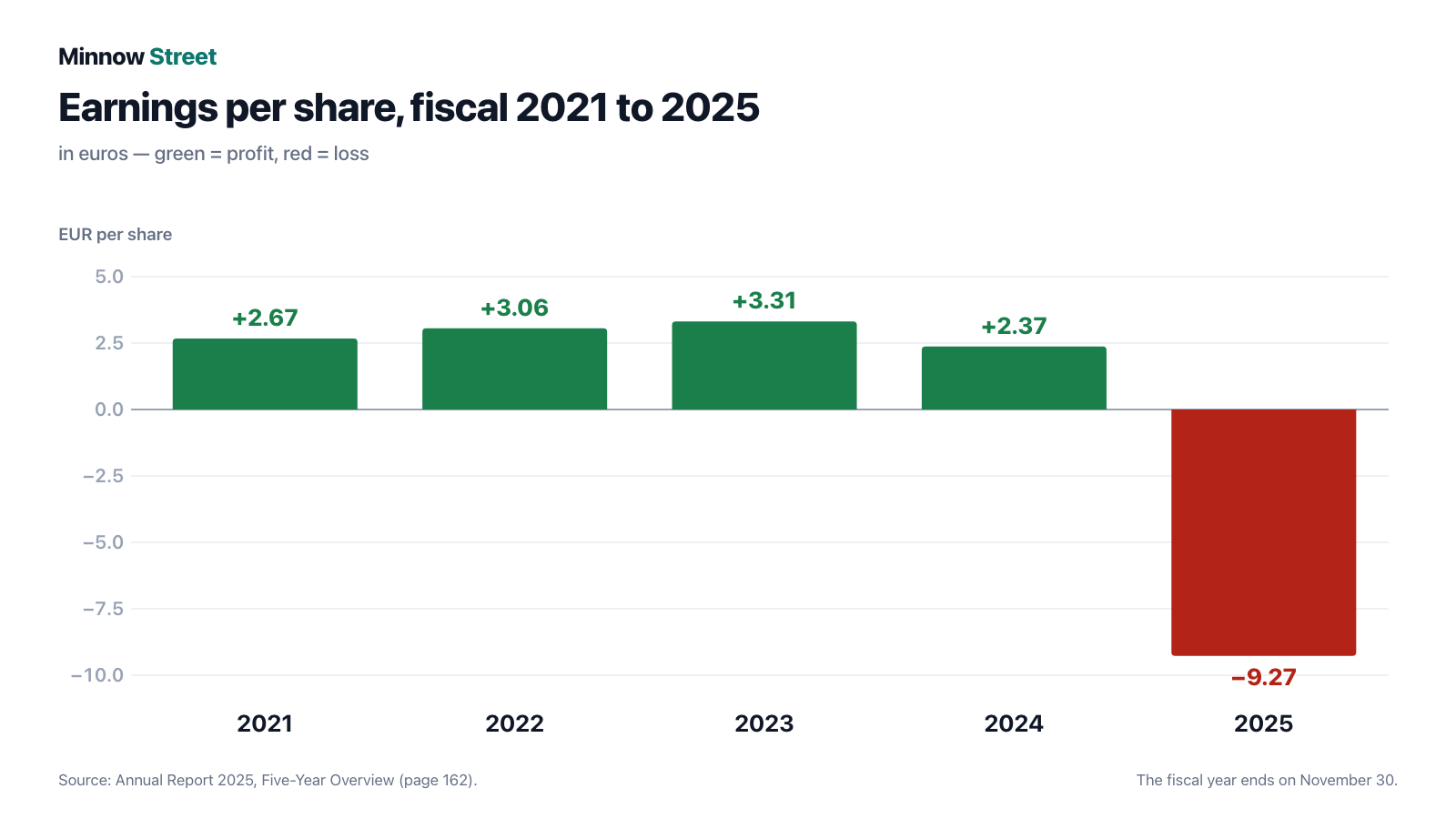
Up to that point the earnings per share series reads calmly: EUR 2.67 (2021), EUR 3.06 (2022), EUR 3.31 (2023), EUR 2.37 (2024, restated) — and then minus EUR 9.27 in fiscal 2025.
Fiscal 2025 ended with a net loss of EUR 318.7 million after a profit of EUR 84.3 million in the restated prior year. Even on an adjusted basis — excluding one-off effects, amortization on purchase price allocations and restructuring — a loss of EUR 63.0 million remained, against a profit of EUR 140.8 million a year earlier. Adjusted EBITDA, the group's preferred operating measure, slipped from EUR 388.0 million to EUR 384.0 million; because revenue rose sharply at the same time, the adjusted EBITDA margin fell from 19.5 to 16.5 percent. No dividend is proposed for fiscal 2025; the prior year paid EUR 0.04 per share — after EUR 1.25 in each of the three years before that.
That combination — revenue up, earnings down — is familiar from other work of ours: at Standard Motor Products a large acquisition story lifted revenue by 22 percent without the income statement following. The difference here is the balance sheet underneath, and that is where we go next.
Uncomfortable Truth No. 1: The Auditor Writes About Continuation
An auditor's report is normally a form. The auditor confirms that the accounts comply with the rules, and that is that. When an additional section shows up, it is not a formality but a message. In the Annual Report 2025, KPMG did exactly that.
"… these events and conditions indicate material uncertainty that could cast significant doubt on the ability of Gerresheimer AG as Parent Company and on the ability of the Gerresheimer Group to continue as a going concern and which represent a going concern risk within the meaning of Section 322 (2) sentence 3 HGB."
— KPMG AG Wirtschaftsprüfungsgesellschaft, Gerresheimer AG, Annual Report 2025, Independent Auditor's Report (revised version dated July 23, 2026)
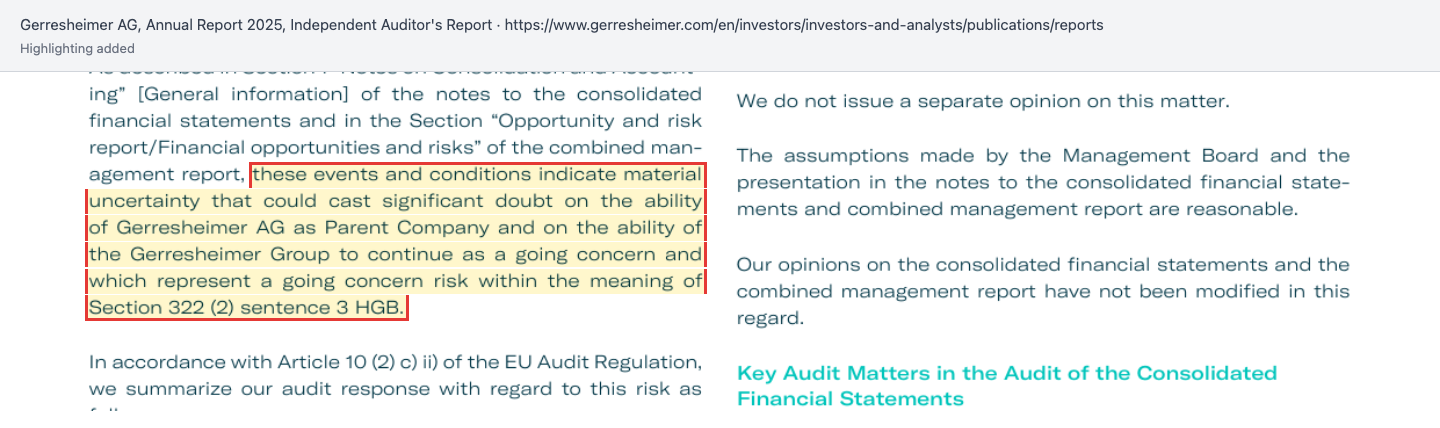
What does that mean in plain language? A set of annual accounts is normally prepared on the assumption that the company will still exist next year — accountants call it the going concern assumption. Every value in the balance sheet rests on it: machines are carried at what they are worth in ongoing operations, not at what a forced sale would fetch. When the auditor says there is material uncertainty about that assumption, the plain reading is: the numbers in this book hold only if a number of things go right.
Important for the record, in both directions: the auditor did not withhold the opinion. It states explicitly that the assumptions made by the Management Board and the presentation in the notes are reasonable, and that the audit opinions were not modified in this regard. The Management Board considers the going concern assumption appropriate — chiefly because the plans show sufficient headroom against the contractual limits given expected operating performance, and because the sale of Centor is expected. So this kind of paragraph is not an insolvency filing. It is a documented statement, shared by the statutory auditor, that the substance depends on conditions.
Uncomfortable Truth No. 2: The Covenant Calendar Runs Out
Which conditions those are appears in the annual report a few chapters ahead of the auditor's report — and they are worth knowing. There are two credit conditions — covenants. A covenant is a promise to the lender: as long as a given metric stays inside the agreed limit, the loan runs on. Break the limit, and the bank may call the loan.
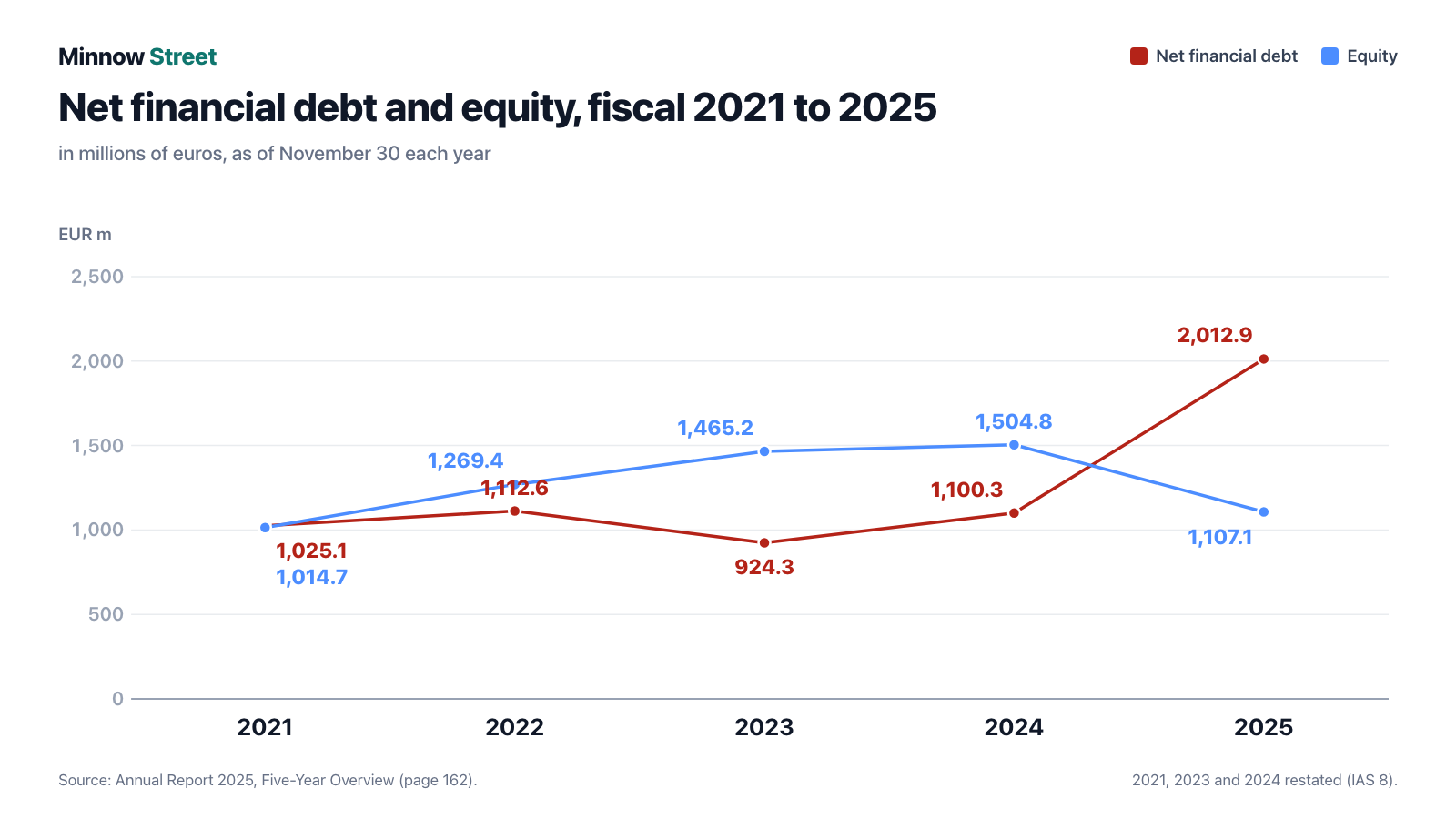
The chart shows two series that moved in parallel for years and then diverged. Net financial debt stood at EUR 1,025.1 million (2021), EUR 1,112.6 million (2022), EUR 924.3 million (2023) and EUR 1,100.3 million (2024, restated) — four years inside a narrow band. Over the same period equity climbed from EUR 1,014.7 million through EUR 1,269.4 million and EUR 1,465.2 million to EUR 1,504.8 million. In fiscal 2025 both tip at once: debt to EUR 2,012.9 million, equity to EUR 1,107.1 million.
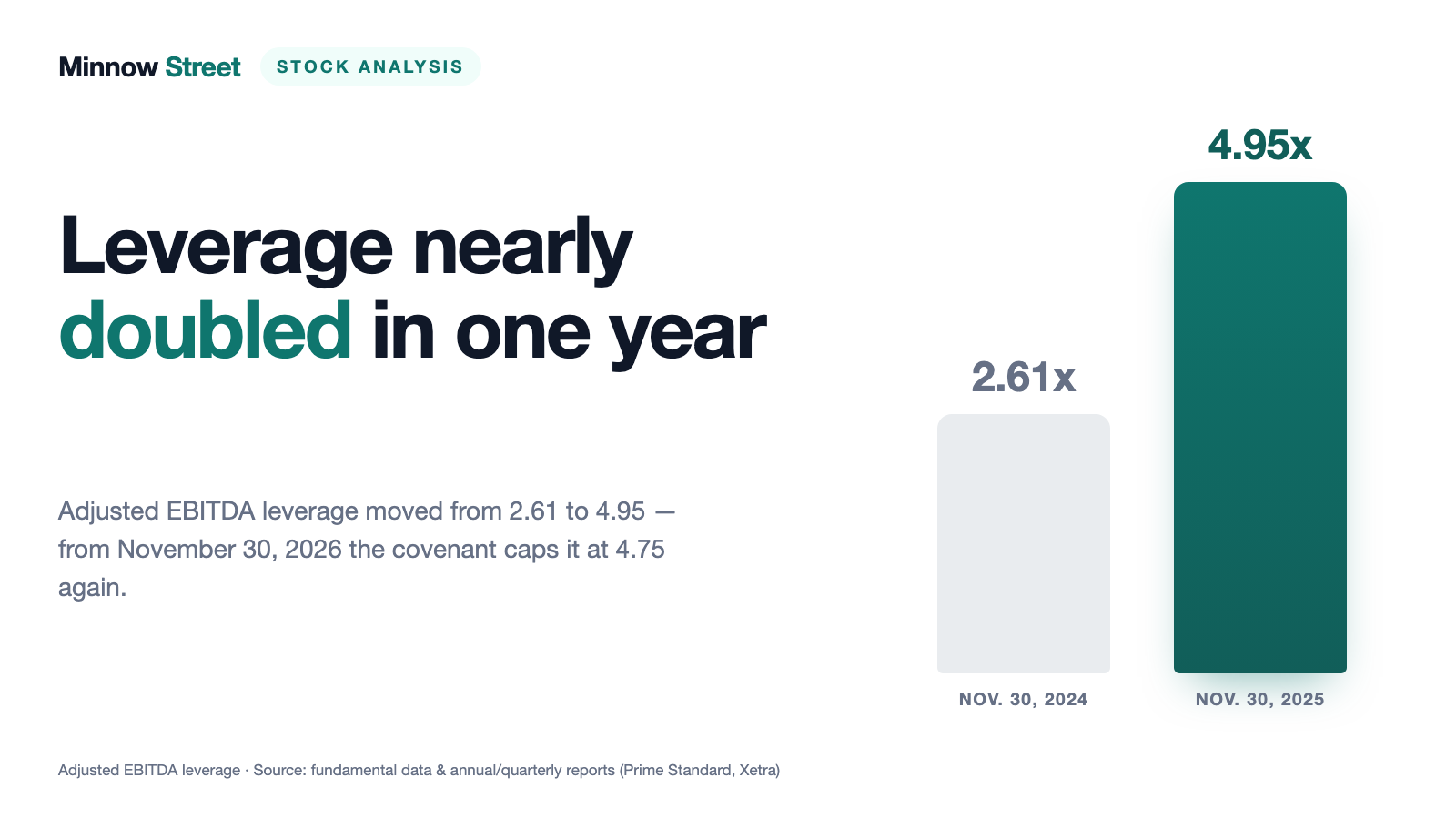
The decisive metric is adjusted EBITDA leverage, the ratio of net financial debt to operating earnings of the last twelve months. Put simply: how many years of earnings would the company need to pay off its debt? As of November 30, 2024 the answer was 2.61 — as of November 30, 2025 it was 4.95. Over the same period net financial debt rose from EUR 1,100.3 million to EUR 2,012.9 million, as financial debt climbed from EUR 1,286.7 million to EUR 2,189.1 million while cash fell from EUR 186.4 million to EUR 176.2 million.
"Gerresheimer is not required to comply with any financial covenants as of the reporting dates November 30, 2025, February 28, 2026, May 31, 2026 and August 31, 2026. As of November 30, 2026, the financial covenant, based on adjusted EBITDA leverage, may not exceed 4.75x."
— Gerresheimer AG, Annual Report 2025, Report on the Economic Position
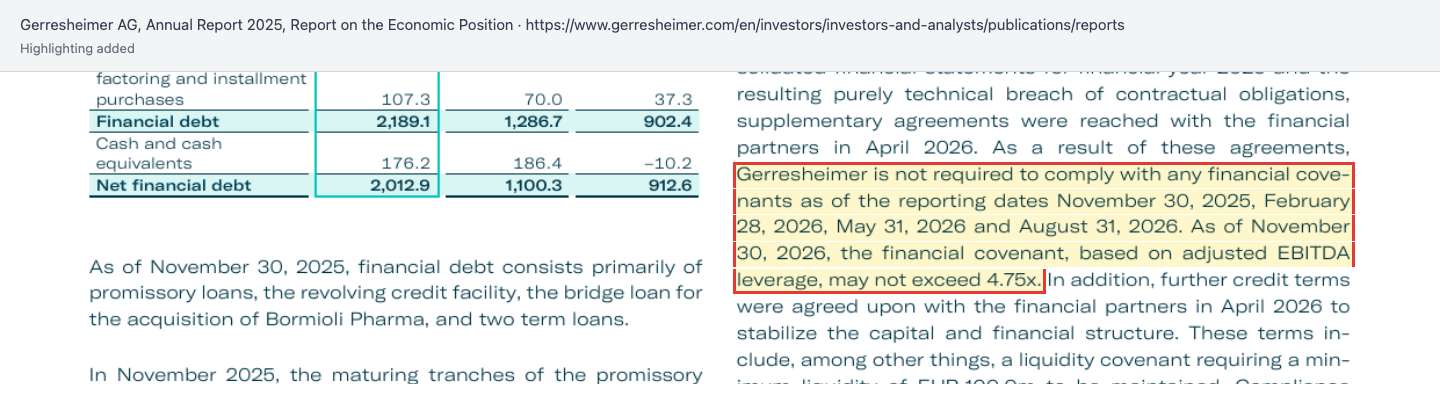
Work it through soberly. Actual value at the last reporting date: 4.95. Permitted value at November 30, 2026: 4.75 at most. The gap is 0.20 points — and it has to be closed within a fiscal year in which the group itself expects a free cash outflow of EUR 50 million to EUR 100 million. There are exactly two levers: operating earnings must rise, or debt must fall. The Apax sale is the second lever, and we come to it shortly.
On top of that sits the second condition, which gets less attention and may well bite sooner: a liquidity covenant requiring minimum liquidity of EUR 100.0 million, tested at least monthly. The annual report is blunt about what a breach would mean: a violation of the financial covenant or the liquidity covenant may lead the participating lenders to accelerate the obligations — which applies indirectly to the term loans as well.
A line worth keeping: a covenant is not a risk in the future; it is a date in the calendar. The next one reads November 30, 2026.
Uncomfortable Truth No. 3: BaFin Twice — and EUR 44.6 Million of Revenue That Was Not There
In September 2025 the German financial regulator BaFin opened an examination of the published consolidated financial statements as of November 30, 2024. The subject: orders for which so-called bill and hold agreements totaling EUR 28 million were concluded with customers in the final third of fiscal 2024. Bill and hold means the customer buys the goods but they stay in the seller's warehouse for the time being. The question is then whether revenue may already be booked.
"The first subject of the audit concerns revenue recognition from bill and hold agreements totaling approximately EUR 28m. An audit by an independent law firm revealed that the requirements for revenue recognition were not met."
— Gerresheimer AG, Annual Report 2025, Corporate Governance Statement
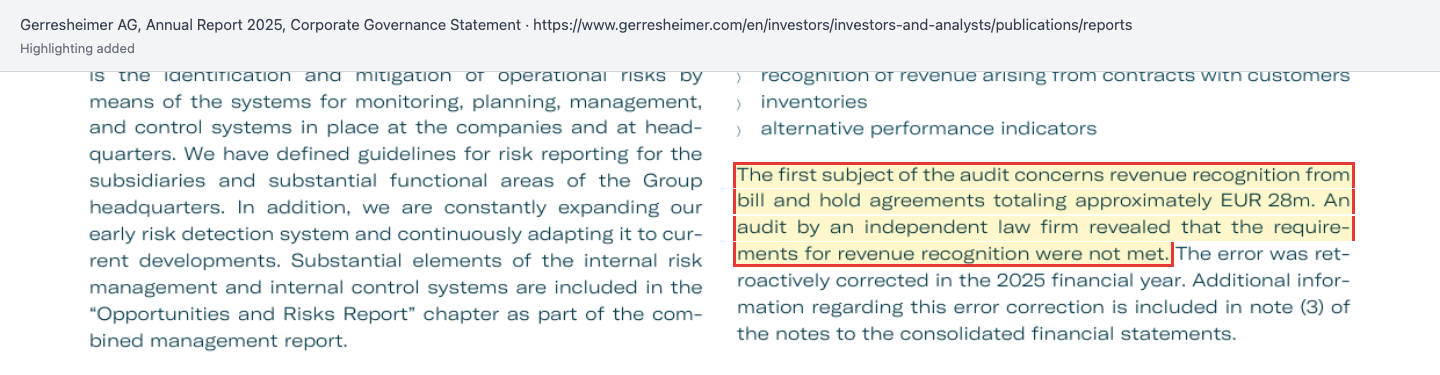
The consequence was a retroactive error correction under accounting standard IAS 8: prior-year revenue fell by a total of EUR 44.6 million. That is why the comparative figures for 2021, 2023 and 2024 in the Annual Report 2025 carry the word "restated" — the numbers investors read in earlier years were in part different from the ones that apply today.
It did not stop at one examination. In March 2026 BaFin opened a second special examination, this time of the interim accounts as of May 31, 2025, and simultaneously extended the ongoing examination of fiscal 2024 to three further points: the presentation of lease liabilities, the useful lives of capitalized development costs, and the recoverability of the assets of the Advanced Technologies division. Neither examination was concluded when the accounts were prepared. After the examination was opened, Gerresheimer commissioned an external, independent law firm and a second audit firm to carry out independent investigations.
Uncomfortable Truth No. 4: The Accounts Had to Be Prepared Twice
The 2025 consolidated financial statements were prepared by the Management Board and approved by the Supervisory Board on June 29, 2026. Four weeks later they were no longer the valid ones.
"After the consolidated financial statements were originally prepared by the Management Board and approved by the Supervisory Board on June 29, 2026, the Management Board reviewed them and restated them in amended form on July 23, 2026."
— Gerresheimer AG, Annual Report 2025, page 2 and note (1) "General Information"
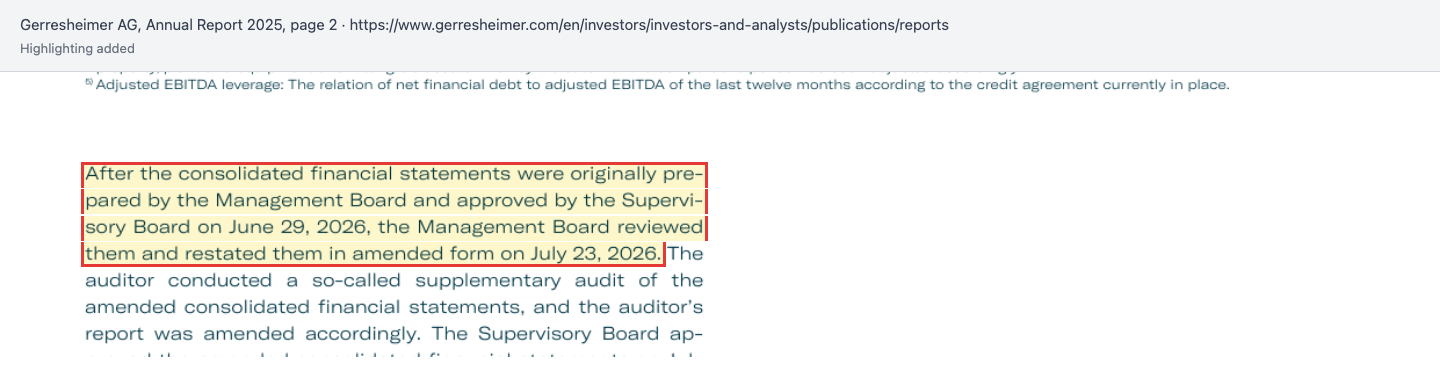
Precision matters more than drama here, so the finding in plain terms: the amendments related exclusively to the presentation and disclosure of segment information — specifically the allocation of an impairment loss to goodwill and the correction of carryover errors in the reconciliation of the segments' adjusted EBITDA to consolidated net income. The report states expressly that this had no impact on the group's financial position, results of operations, or cash flows. The auditor conducted a supplementary audit and amended the auditor's report accordingly; the Supervisory Board approved the amended accounts on July 23, 2026 and found no objections.
So the numbers did not move. What it does show is something else: a group that had already filed its annual accounts months late then needed a second attempt to get the segment presentation right. Anyone assessing the reliability of the reporting should know about this episode — and anyone inflating it into a scandal has not read the report.
What Changed on July 29, 2026: The Apax Sale
Six days after the second preparation came the news that shifts the picture. On July 29, 2026 Gerresheimer announced, via ad-hoc release, definitive agreements with an affiliate of funds advised by Apax Partners LLP to sell Centor US Holding Inc. and the global Primary Packaging Plastics business.
The key terms from the release: the purchase price is based on a combined enterprise value of approximately EUR 1.5 billion. Besides the Centor site in the United States, the transaction covers a total of 15 production sites for primary plastic packaging in nine countries — 16 sites in all, with around 2,400 employees and combined revenue of roughly EUR 570 million in 2025. The Centor sale is expected to close by the end of fiscal 2026, the plastics business in the first half of fiscal 2027. Both transactions are subject to customary closing conditions and approvals and will close independently of one another.
Uwe Röhrhoff, then interim chief executive — he ended his mandate four weeks later, on August 24, 2026 — called it regaining "strategic flexibility"; CFO Wolf Lehmann said the expected cash inflows would be used to accelerate debt reduction and, together with a planned comprehensive refinancing, to reduce interest expense significantly. Measured against the starting position, that is the plausible route — EUR 1.5 billion of enterprise value stands against EUR 2,012.9 million of net financial debt.
Three things belong beside it nonetheless. First: what is being sold comes out of Containment & Delivery Systems, the division with the highest margin — a pro forma adjusted EBITDA margin of 22.9 percent on EUR 1,172 million of 2025 revenue, against 15.3 percent at Primary Injectable Solutions and 12.8 percent at Moulded Glass. Deleveraging by disposal is not a free move: it also shrinks the earnings against which leverage is measured. Second: the fiscal 2026 guidance in the annual report is expressly stated before M&A and refinancing activities — it does not yet reflect the sale. Third: a contract is not a cash receipt. Until closing, the balance sheet is what it is.
Update: What Has Happened Since August 2026
This analysis originally rested on the Annual Report 2025 and the Apax announcement of July 29, 2026. Four things have happened since, and they push the picture in different directions. In order, with dates.
One: the first quarterly figures of fiscal 2026
On August 27, 2026 Gerresheimer published preliminary figures for the first quarter of fiscal 2026 — the period from December 1, 2025 to February 28, 2026. These are the first quarterly numbers since the delayed annual accounts, and they tell two stories at once.
The good one: the cash outflow has shrunk substantially. Free cash flow before M&A came in at EUR −32 million against EUR −141 million a year earlier — an improvement of roughly EUR 109 million and, according to the company, the best first-quarter figure since 2019. The improvement comes almost entirely from two levers: net capital expenditure was halved from EUR 113 million to EUR 56 million — EUR 57 million on its own — and inventory build-up fell from EUR 46 million to EUR 5 million, another EUR 41 million. Together EUR 98 million of the EUR 109 million.
The uncomfortable one: that improvement was paid for with earnings power. Revenue rose only slightly, from EUR 519 million to EUR 524 million (organically, that is currency-adjusted, +4.4 percent). Adjusted EBITDA fell from EUR 81 million to EUR 66 million, the margin from 15.7 percent to 12.6 percent. The reason sits openly in the presentation: to keep cash inside the company, production was halted temporarily and inventories were run down — which leaves plant capacity underused and feeds straight through to earnings.
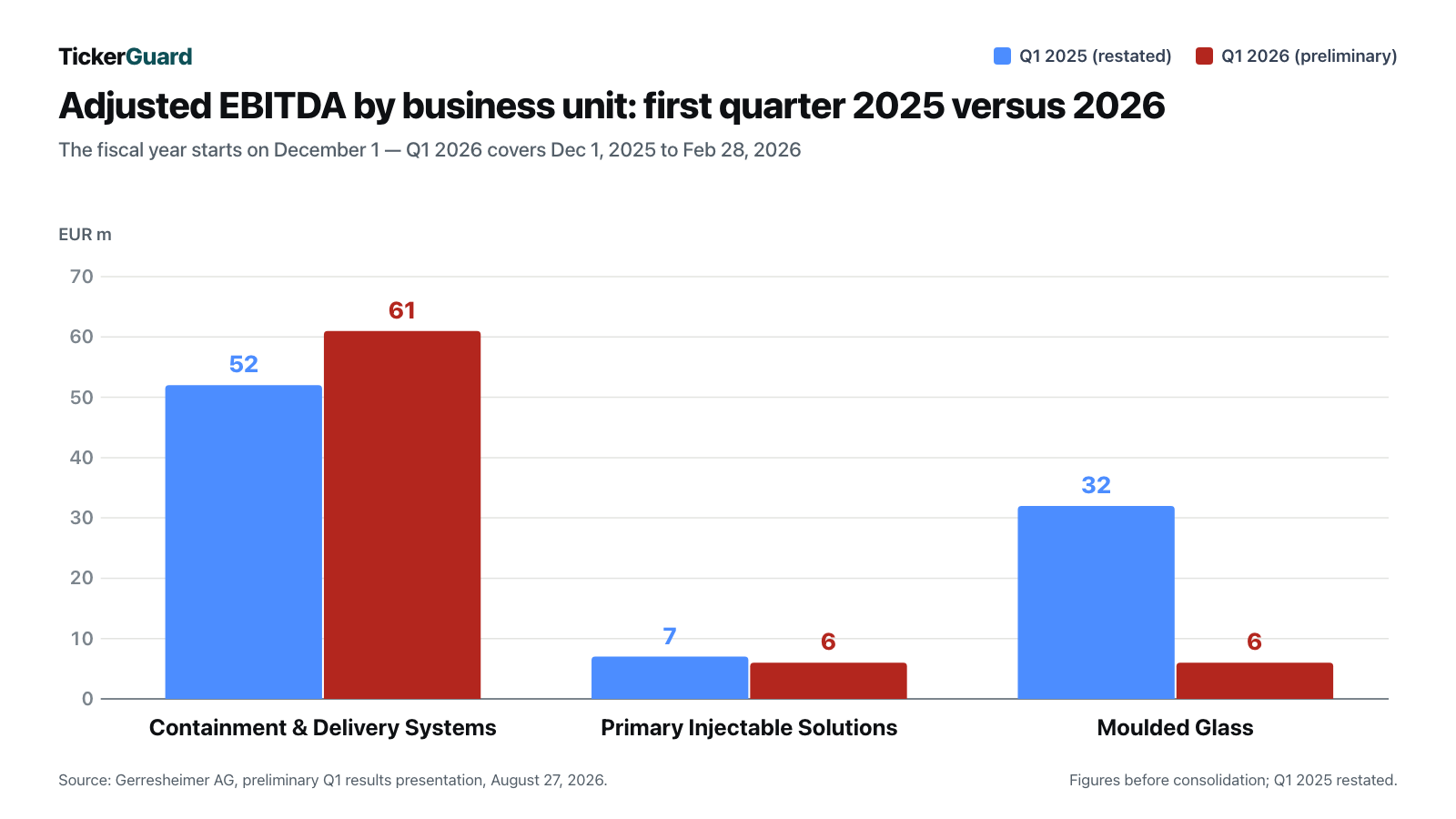
The chart shows why the group number alone misleads. Containment & Delivery Systems — the unit being sold out of — grew revenue from EUR 281 million to EUR 296 million and adjusted EBITDA from EUR 52 million to EUR 61 million; its margin rose from 18.5 percent to 20.6 percent, carried by the ramp-up of the Peachtree site in the US. Primary Injectable Solutions grew revenue from EUR 94 million to EUR 101 million but lost ground on earnings (EUR 7 million to EUR 6 million, margin 7.0 to 5.7 percent) because tubular glass in Europe and Asia is weak. And Moulded Glass fell from EUR 160 million to EUR 144 million in revenue and from EUR 32 million to EUR 6 million in adjusted EBITDA — margin 20.1 percent to 4.5 percent. Gerresheimer is closing the US Chicago Heights plant there, with completion targeted for the end of September.
Put differently: the group currently earns its money almost entirely in the unit it is in the middle of taking apart and partly selling.
Two: debt did not fall — liquidity did
For the calendar described in the previous chapter, one table matters most. Net financial debt stood at EUR 1,955 million as of February 28, 2026 — after EUR 1,920 million on November 30, 2025 and EUR 1,919 million a year before that. This figure is not identical to the EUR 2,012.9 million in the annual report: the presentation excludes lease liabilities of up to EUR 93 million. What matters is the direction, and it reads: sideways, slightly up. A first quarter without any debt reduction is not a neutral result on this timetable.
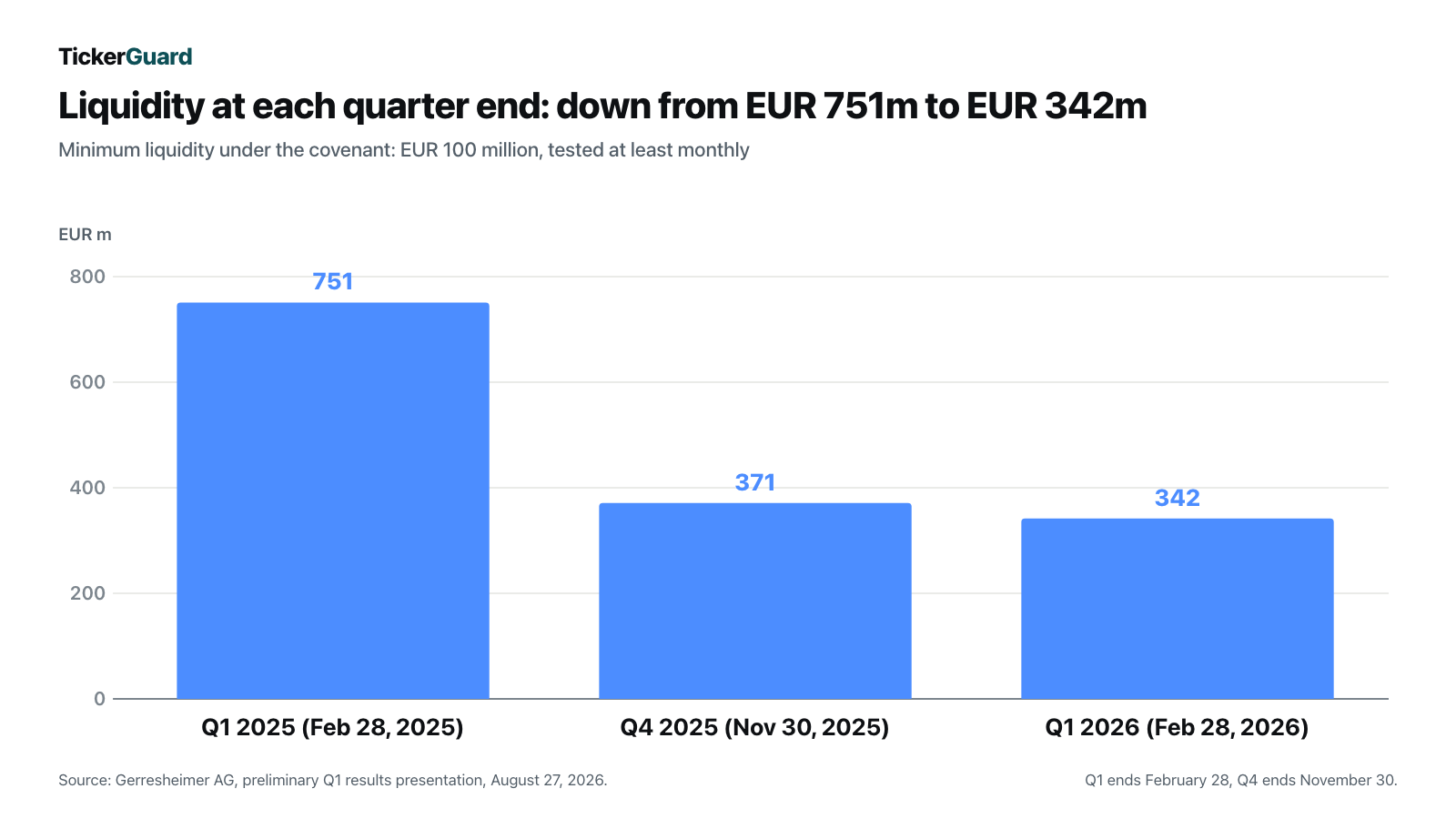
Liquidity is the second window into the same room. It stood at EUR 342 million on February 28, 2026, after EUR 371 million at the fiscal year end and EUR 751 million a year earlier. The distance to the EUR 100 million minimum liquidity covenant, tested at least monthly, is therefore still comfortable — but the buffer has more than halved within twelve months. The presentation gives an average interest cost of 4.4 percent on average gross debt of roughly EUR 2.2 billion including leases. Roughly calculated, that would be around EUR 97 million of interest a year. Actually paid in the first quarter was EUR 16 million of net interest — against adjusted EBITDA of EUR 66 million. Just under a quarter of operating earnings therefore goes to creditors before anyone else sees anything.
And then there is the sentence on the same slide that confirms the calendar from the previous chapter.
"Solid liquidity in Q1 2026; leverage covenant suspended up and including Q3; fulsome debt refinancing at <3x leverage in process aligned with timing of Centor & PPP closing."
— Gerresheimer AG, preliminary Q1 2026 results presentation, August 27, 2026, slide "Financing as of Prel. Q1 2026"
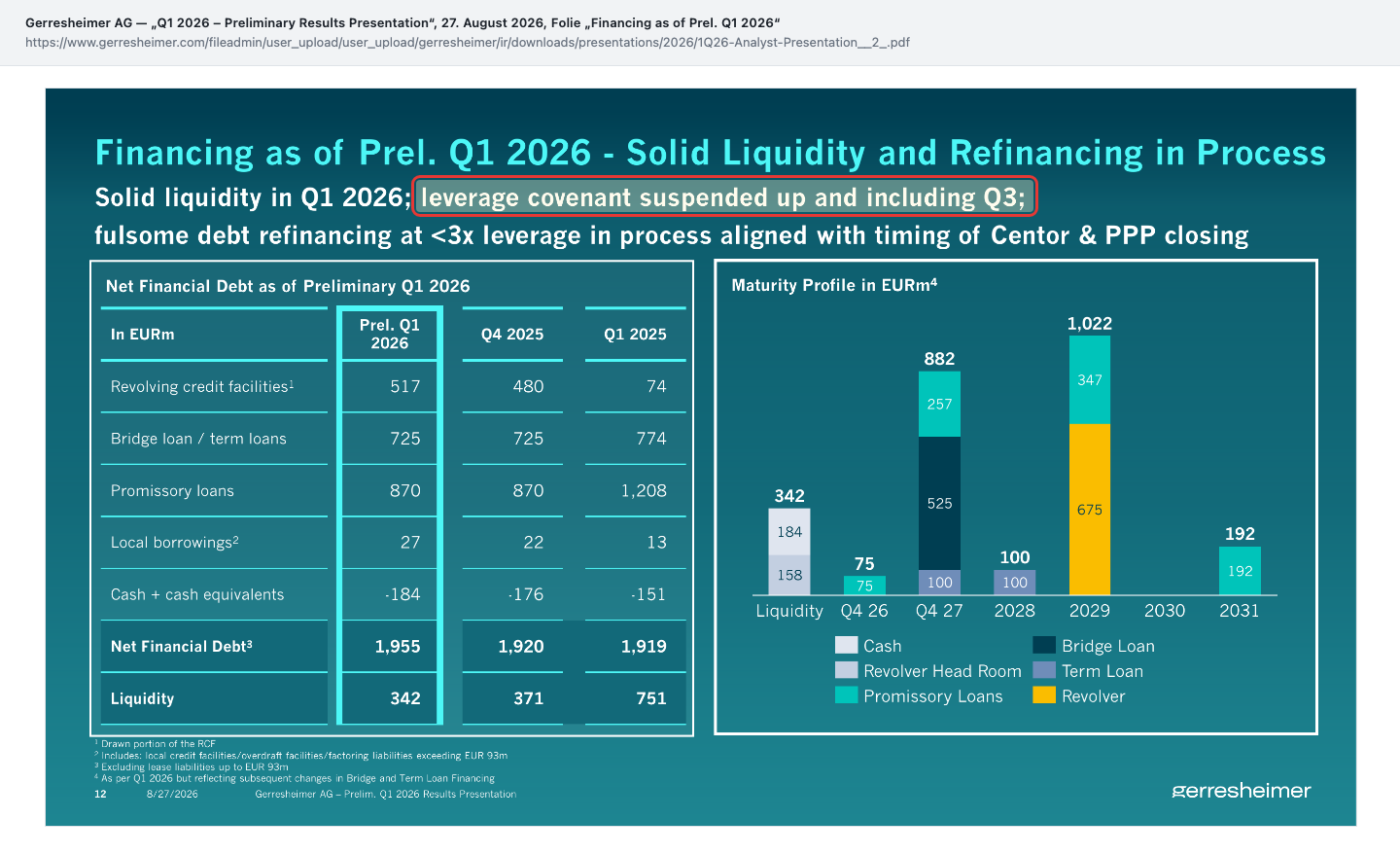
The third quarter of fiscal 2026 ended on August 31, 2026. The suspension has therefore run out — the next reporting date on which the covenant applies again remains November 30, 2026. Nothing about that finding has changed since the original version of this analysis, except that it has moved closer.
Two further points from the presentation belong alongside it. The transformation program is meant to deliver EUR 50 million to EUR 70 million of adjusted EBITDA improvement, split roughly evenly across fiscal 2026 and 2027, with full effect only from 2028. And after Centor and the plastics business, Gerresheimer is preparing a third divestment: in the portfolio overview the Moulded Glass unit sits under "Sell." That is precisely the unit whose quarterly earnings have just fallen to EUR 6 million. Anyone offering a business in that condition is not negotiating from strength.
Three: the earnings call — and an answer that names a gap
On the call covering these numbers on August 27, 2026, CFO Wolf Lehmann and management board member Achim Schalk spoke. Three statements matter for the assessment.
First, management explicitly framed the quarter as the low point — "Q1 is our lowest quarter in 2026" — and confirmed guidance unchanged. Second, Schalk described the Apax sale as "an opportunistic play that was offered by Apax". That is a remarkably open formulation: it describes the central deleveraging step not as the outcome of a planned sale process but as a response to an offer that came in.
Third — and this carries the most information — came the question about the search for a new chief executive. Lehmann answered that it was "not in the management board's hands, but in the supervisory board's hands, and we will hear from them going forward." A management board that has to point at another body when asked about its own leadership has no date to give at that moment. Analysts also asked whether the cash-preservation drive is costing market share and how the fragmented European tubular glass footprint is to be restructured.
Four: no chief executive, a deferred discharge — and a large shareholder buying
Three days before the quarterly figures, on August 24, 2026, Gerresheimer announced by ad-hoc release that Uwe Röhrhoff was ending his mandate as interim chief executive at his own request. He had taken on the role on November 1, 2025; the mandate would have run until October 2026 at the latest. The release states that Wolf Lehmann, CFO, and Achim Schalk, member of the management board, are taking over his duties until further notice. No successor was named. Since that day, then, two board members have been running a group that has to sell two businesses, prepare a third, execute a refinancing of more than EUR 2 billion and manage two regulatory examinations — without a chief executive. For completeness: it is already the second change at the top in less than a year.
The annual general meeting on September 1, 2026 was held virtually. All of the company's proposed resolutions passed by majority, but only 41.59 percent of share capital was represented. Markus Sieger became the new chairman of the supervisory board, and KPMG was again appointed auditor for fiscal 2026. The point that mattered was deferred — proposed by the company and carried by a majority: the discharge of former management board members Dietmar Siemssen, Dr. Lukas Burkhardt and Dr. Bernd Metzner, as well as the discharge of the supervisory board, were deferred — the company wants to await the regulators' final assessments. Discharge is shareholders' annual vote of confidence in the leadership. Deferred means shareholders have not decided yet — neither granted nor refused. Ahead of the meeting, according to press reports of August 24, 2026, the German shareholder association DSW had announced a special audit request, called for discharge to be refused outright, and demanded a change of auditor; the company did not follow that call but had the deferral resolved instead.
And finally the movement in the shareholder register. In a voting rights notification dated September 14, 2026 (threshold touched on September 11), Klaus Röhrig reported that 14.96 percent of voting rights are attributed to him — 5,166,594 of a total 34,540,000 shares, up from 13.67 percent. Adding the reported instruments of 3.18 percent, the notification states a total of 18.14 percent. Those instruments are cash-settled options — they are not delivered in shares, so the 18.14 percent cannot simply become 18.14 percent of voting rights. Behind it stands the investment firm Active Ownership through a chain comprising Active Ownership Corporation S.à r.l., Active Ownership Fund SICAV SIF SCS and AOC Gecko S.à r.l.; the reported instruments are options maturing through December 2026 and June and December 2027.
This is an unusual constellation, and it deserves a sober reading. Röhrig also sits on the supervisory board; he had been appointed there by court order in 2025 and was re-elected as a shareholder representative at the annual general meeting on September 1, 2026. The increase falls in the months ahead of the November 30, 2026 covenant date. What intention lies behind it is not known — and as a member of a governing body, his own-account dealings fall under the notification and closed-period rules of Article 19 of the Market Abuse Regulation; that is precisely why the purchases are on the public record. What can be stated factually: the stock increasingly belongs to an owner whose goals are not automatically those of the free float. That is not a signal for anyone's own investment decision.
What that adds up to
The update does not change the structure of this analysis; it sharpens it. On the credit side: the company has proved it can steer cash outflow when it has to — a EUR 109 million improvement in a single quarter is no accident. On the debit side: it spent earnings power to get there, debt has not fallen, liquidity has halved, the chief executive's chair is empty, discharge is deferred and the regulatory examinations are running. And the next hard date, November 30, 2026, still sits in the calendar.
One note on the timeline, because it easily confuses: Gerresheimer's fiscal year ends on November 30. Because the annual accounts were late, the 2026 reporting calendar has shifted too. The final first-quarter figures are announced for September 2026 — including an impairment assessment the company itself describes as non-cash. The half-year financial report and the quarterly statement for the third quarter are both scheduled for November 2026. Anyone waiting on third-quarter numbers is waiting until then.
What the Stock Costs
Deliberately as an order of magnitude and explicitly dated, because daily prices are not an argument: with around 34.54 million shares outstanding, market capitalization as of the August 4, 2026 data date was just under EUR 1 billion. That implies a price-to-sales ratio of roughly 0.4 on 2025 revenue of EUR 2,320.9 million and a price-to-book ratio of about 0.9 on equity of EUR 1,107.1 million as of November 30, 2025. A price-to-earnings ratio cannot be formed — 2025 was a loss year.
The more meaningful measure here is enterprise value, market capitalization plus net debt: it sits in the region of EUR 2.9 billion, roughly seven times adjusted EBITDA of EUR 384.0 million. Put differently: economically, two thirds of this company belongs to the creditors, not the shareholders. That is precisely why the share price depends unusually heavily on the balance sheet and unusually little on revenue — anyone looking only at the price-to-sales ratio of a heavily indebted company is measuring the wrong slice.
For fiscal 2026, and before disposals and refinancing, Gerresheimer expects revenue in the lower half of the EUR 2,300 million to EUR 2,400 million range, an adjusted EBITDA margin of around 17 to 18 percent, and free cash flow of minus EUR 50 million to minus EUR 100 million. All three were cut in June 2026; the previous guidance was an 18 to 19 percent margin and a "moderately positive" cash inflow.
Opportunities and Risks at a Glance
Opportunities
- The end market grows structurally: the annual report expects volume-based growth in biopharmaceuticals averaging 4.1 percent a year to 2030, and 5.1 percent in North America. Syringes, pens and autoinjectors for biologic drugs are the right side of that trend.
- The Apax sale is signed, not merely planned: roughly EUR 1.5 billion of enterprise value against EUR 2,012.9 million of net financial debt — a deleveraging step of the right order of magnitude, with Centor closing expected by the end of fiscal 2026.
- Operationally the base is intact: EUR 2,320.9 million of revenue (2025), EUR 384.0 million adjusted EBITDA, EUR 209.5 million of operating cash flow and 13,528 employees. Capital expenditure for 2026 is planned well below the prior year (2025: EUR 308.3 million in cash terms).
- The valuation already carries a lot of skepticism: roughly 0.4 times annual revenue and about 0.9 times book value (data as of August 4, 2026). If deleveraging succeeds, the leverage works in both directions.
Risks
- The auditor's report identifies a going concern risk within the meaning of Section 322 (2) sentence 3 HGB. That is not sentiment; it is an audited finding.
- The November 30, 2026 date: leverage has to come back from 4.95x to no more than 4.75x, while a liquidity covenant of EUR 100.0 million is tested at least monthly. A breach may trigger acceleration — indirectly for the term loans too.
- The maturity wall: EUR 881.5 million of financial debt falls due in fiscal 2027 and EUR 1,021.5 million in fiscal 2029; the Bormioli Pharma bridge loan stood at EUR 525.0 million at the reporting date and runs to September 2027.
- Two BaFin examinations were unfinished when the accounts were prepared. The outcome is open; the report says expenses or income above or below the provisions recognized cannot be ruled out.
- Management explicitly does not rule out further impairment losses — against equity that has already fallen from EUR 1,504.8 million to EUR 1,107.1 million. The company has announced the next impairment assessment together with the final Q1 2026 figures in September 2026, describing it as non-cash.
- Deleveraging made no progress in the first quarter of fiscal 2026: net financial debt stood at EUR 1,955 million on February 28, 2026, after EUR 1,920 million at the balance sheet date (both excluding lease liabilities of up to EUR 93 million), and liquidity fell from EUR 751 million to EUR 342 million within twelve months.
- Since August 24, 2026 the group has had no chief executive; CFO Wolf Lehmann and management board member Achim Schalk are running it on an interim basis. The annual general meeting of September 1, 2026 deferred the discharge of three former management board members and of the supervisory board pending the outcome of the regulatory examinations.
- The company's own 2026 guidance calls for a free cash outflow of EUR 50 million to EUR 100 million, partly because the financial partners cut the factoring volumes.
A Human Conclusion
We started with trust in age — with the feeling that a name dating from 1864 comes with a kind of airbag. The Annual Report 2025 shows what that airbag is worth: it holds the business, but not the balance sheet. Gerresheimer still makes products that are needed, in a market that is growing, with 13,528 people and EUR 2.3 billion of revenue. And in the very same book sits a paragraph a statutory auditor only writes when there is no alternative.
What follows from that is not a recommendation but a structure: this stock is not a bet on syringes and vials. It is a bet on a calendar — on closing the Centor sale by the end of fiscal 2026, on leverage below 4.75x at November 30, 2026, on a refinancing ahead of the EUR 881.5 million wall in fiscal 2027. If the calendar works out, a valuation of roughly 0.4 times revenue would look cheap in hindsight. If it does not, the outcome is decided not by margin but by a bank.
The first quarter of fiscal 2026 did not change that structure; it sharpened it. It showed that the company can slow the cash bleed when it wants to — and what that slowing costs: EUR 15 million less operating profit in a single quarter, because furnaces stood still and inventories were emptied. You can carry a company through a calendar on a low flame for a while. You cannot run it that way indefinitely — and since the end of August there has been no chief executive to decide when to stop.
Anyone who reads this analysis and says "too uncertain" has understood the report correctly. Anyone who says "precisely for that reason" has understood it correctly too — with a different appetite for risk. Both are legitimate. What would not be legitimate is skipping the paragraph on the closing pages because the name sounds so familiar. What you do with it is your decision. And that is exactly as it should be.
More deep dives are collected in our research section.
Sources
- Gerresheimer AG — Annual Report 2025 (English edition, 163 pages), published June 29, 2026, revised version dated July 23, 2026: independent auditor's report, report on the economic position, forecast report, corporate governance statement, notes (1), (3) and (17), subsequent events, Five-Year Overview (page 162). The reports page marks the file as "Revised version as of July 23, 2026."
- Gerresheimer AG — Geschäftsbericht 2025 (German edition), the authoritative original of the German-language passages
- Gerresheimer AG — corporate news: "Gerresheimer is selling Centor and its global Primary Packaging Plastics business to Apax Funds", July 29, 2026
- Gerresheimer AG — ad-hoc announcements, including July 29, 2026 (sale of Centor and Primary Packaging Plastics) and June 2026 (publication of the 2025 annual accounts, annual general meeting on September 1, 2026, adjustment of the 2026 guidance)
- Gerresheimer AG — "Q1 2026 – Preliminary Results Presentation", August 27, 2026 (16 slides): preliminary first-quarter figures, segment data, financing overview (slide 12), portfolio and calendar overview — the basis for the update chapters and the marked exhibit
- Gerresheimer AG — corporate news release "Gerresheimer Reports Slight Revenue Growth in Q1 2026 and a Strong Focus on Free Cash Flow," August 27, 2026, and the earnings call of the same day (Wolf Lehmann, Achim Schalk)
- Gerresheimer AG — ad-hoc release "Uwe Röhrhoff Steps Down as Interim CEO," August 24, 2026
- Gerresheimer AG — corporate news release on the annual general meeting of September 1, 2026 (41.59 percent of share capital represented; discharge of former management board members and of the supervisory board deferred; Rainer Beaujean, Markus Sieger and Eva van Pelt elected to the supervisory board, Klaus Röhrig — appointed there by court order in 2025 — re-elected, Markus Sieger subsequently elected chairman of the supervisory board; KPMG appointed auditor for fiscal 2026)
- Börsen-Zeitung, "Auf Gerresheimer kommt neuer Ärger zu," August 24, 2026 — source for the demands made by the German shareholder association DSW ahead of the annual general meeting: application for a special audit, refusal of discharge, change of auditor
- Gerresheimer AG — voting rights notification under Section 40(1) WpHG dated September 14, 2026 (notifying party Klaus Röhrig, threshold touched September 11, 2026: 14.96 percent of voting rights, 3.18 percent instruments, total 18.14 percent, total voting rights 34,540,000)
- Gerresheimer AG — financial calendar, as of September 16, 2026: Q1 2026 quarterly statement in September 2026, 2026 half-year financial report and Q3 2026 quarterly statement both in November 2026, Annual Report 2026 in March 2027
- Fundamental data: market capitalization, share count, trailing twelve-month ratios; data as of August 4, 2026
First published August 4, 2026; updated September 16, 2026 with the preliminary first-quarter 2026 figures, the change at the top of the management board, the annual general meeting and the voting rights notification of September 14, 2026. This analysis is journalistic commentary based on publicly available documents. It is not investment advice, not a solicitation to buy or sell securities, and not a personal recommendation. Shares can lose substantial value, and a total loss of the capital invested is possible. Every figure carries the reporting date of its source; market data carry the August 4, 2026 data date and may have changed since. Positions held by the operator are disclosed daily; where one exists, it appears as a notice at the top of this deep dive.
Our Bottom Line at a Glance
- Business model and end market positive
- Primary packaging and drug delivery systems for pharma and biotech form a regulated market with high switching hurdles and structural tailwind: the Annual Report 2025 expects volume-based growth in biopharmaceuticals averaging 4.1 percent a year to 2030 (North America 5.1 percent). Revenue rose five years in a row, from EUR 1,498.0 million (2021) to EUR 2,320.9 million (2025), and headcount from 10,447 to 13,528.
- Balance sheet and leverage negative
- Net financial debt rose to EUR 2,012.9 million as of November 30, 2025 (prior year restated: EUR 1,100.3 million) and leverage from 2.61x to 4.95x. At the same time equity fell from EUR 1,504.8 million to EUR 1,107.1 million and the equity ratio from 39.9 to 24.6 percent. For the first time in the five-year series, net debt sits well above equity. The first quarter of fiscal 2026 brought no relief: as of February 28, 2026 net financial debt stood at EUR 1,955 million after EUR 1,920 million at the balance sheet date (both excluding lease liabilities of up to EUR 93 million), and liquidity had fallen from EUR 751 million to EUR 342 million within twelve months.
- Going concern and covenants negative
- The auditor's report in the Annual Report 2025 contains a section on material uncertainty about the ability to continue as a going concern and names a going concern risk within the meaning of Section 322 (2) sentence 3 HGB. The financial covenant is waived for four reporting dates through August 31, 2026; from November 30, 2026 a ceiling of 4.75x applies again against an actual value of 4.95x. A breach may lead to acceleration, the report says.
- Reporting, leadership and ownership negative
- Two BaFin special examinations (September 2025 and March 2026) were unfinished when the accounts were prepared; an IAS 8 error correction retroactively cut 2024 revenue by EUR 44.6 million. The 2025 consolidated statements had to be prepared a second time on July 23, 2026 — the amendments concerned segment presentation only and had no impact on the financial position, results of operations or cash flows, but they show the strain on the reporting process. The annual general meeting of September 1, 2026 deferred the discharge of three former management board members and of the supervisory board until the regulatory proceedings have been finally assessed. Since August 24, 2026 the group has also had no chief executive — interim CEO Uwe Röhrhoff ended his mandate at his own request and no successor has been named. In parallel, Active Ownership around supervisory board member Klaus Röhrig has been building: 14.96 percent of voting rights and 18.14 percent including instruments (notification of September 14, 2026). An anchor shareholder of that size can stabilize — but its goals need not coincide with those of the free float.
- Deleveraging plan neutral
- The sale of Centor and the Primary Packaging Plastics business to Apax Funds, signed on July 29, 2026, carries a combined enterprise value of approximately EUR 1.5 billion and is therefore of the right order of magnitude. But it costs earning power: what is sold comes out of the highest-margin division, Containment & Delivery Systems (pro forma adjusted EBITDA margin of 22.9 percent in 2025). Closing is expected only by the end of fiscal 2026 (Centor) and in the first half of fiscal 2027.
- Cash flow and guidance negative
- For fiscal 2026 Gerresheimer expects free cash flow before M&A activities of minus EUR 50 million to minus EUR 100 million, after minus EUR 85.5 million in fiscal 2025 — partly because the financial partners reduced the factoring volumes. Revenue and margin guidance were cut in June 2026 and confirmed on August 27, 2026; no dividend is proposed for 2025. The first quarter of fiscal 2026 shows that the steering works and what it costs: free cash flow improved from minus EUR 141 million to minus EUR 32 million, because net capital expenditure was halved from EUR 113 million to EUR 56 million and inventory build-up cut from EUR 46 million to EUR 5 million — in return, adjusted EBITDA fell from EUR 81 million to EUR 66 million and the margin from 15.7 to 12.6 percent.
Gerresheimer is the trusted-name trap in its purest form: a working business in a growing market — EUR 2,320.9 million of revenue, EUR 384.0 million of adjusted EBITDA, 13,528 employees — sitting under a balance sheet the statutory auditor was no longer willing to sign off without a warning. The auditor's report in the Annual Report 2025 names a going concern risk within the meaning of Section 322 (2) sentence 3 HGB; behind it are EUR 2,012.9 million of net financial debt, leverage of 4.95x against a ceiling of 4.75x returning on November 30, 2026, a liquidity covenant of EUR 100.0 million, two ongoing BaFin examinations, and consolidated accounts that had to be prepared twice within four weeks. The sale to Apax Funds at roughly EUR 1.5 billion of enterprise value is the plausible way out — but it is signed, not closed, and it costs the highest-margin division. The preliminary first-quarter 2026 figures of August 27, 2026 confirm both sides: the cash outflow shrank from EUR 141 million to EUR 32 million while operating earnings fell from EUR 81 million to EUR 66 million; net financial debt edged up to EUR 1,955 million and liquidity fell from EUR 751 million to EUR 342 million within twelve months. On top sits a chief executive's chair empty since August 24, 2026, a discharge deferred at the annual general meeting — and a large shareholder who has built to 18.14 percent. Not investment advice.
What Our Rating Means
Substance risk
We found at least one documented issue that threatens the company itself — regardless of how the stock is currently valued.
Red here does not stand for an expensive stock or weak price action, but for a documented risk to substance: in the Annual Report 2025 the statutory auditor inserted a dedicated section on the ability to continue as a going concern and expressly named a going concern risk within the meaning of Section 322 (2) sentence 3 HGB. Under the rules governing these analyses, a going concern paragraph is red on its own — and here it comes with leverage up from 2.61x to 4.95x against a ceiling of 4.75x returning on November 30, 2026, a liquidity covenant of EUR 100.0 million tested at least monthly, EUR 881.5 million of maturities in fiscal 2027, and the company's own guidance of negative free cash flow. That the auditor did not withhold the opinion, that it considers management's assumptions reasonable, and that a deleveraging step worth roughly EUR 1.5 billion of enterprise value has been signed with Apax all soften the picture — but they do not remove it while closing is still pending. The rating would move to yellow if the going concern paragraph disappeared and leverage returned inside the contractual limit. The update of September 16, 2026 changes none of that: the preliminary first-quarter 2026 figures do show a much smaller cash outflow, but no reduction in net financial debt (EUR 1,955 million after EUR 1,920 million), liquidity halved from EUR 751 million to EUR 342 million, adjusted EBITDA lower by EUR 15 million — and alongside that a chief executive's chair vacant since August 24, 2026 and a discharge deferred at the annual general meeting. Whether the stock is cheap at roughly 0.4 times revenue and 0.9 times book value belongs to the price question and does not drive this rating. The decision is yours.
A journalistic assessment by our editorial team at the time of the deep dive, based on public sources — not investment advice and not a solicitation to buy or sell. Your personal circumstances (investment goals, risk capacity, taxes) cannot be taken into account. What our levels mean, how verdicts are formed, and what conflicts of interest exist →
Worth Noting
- Gerresheimer reached our research list via the wallstreet-online forum ranking of the most discussed stocks among German retail investors, as of August 4, 2026 — not a scanner hit and not a buy signal, but an attention signal.
- Data date and currency of information (update of September 16, 2026): the most recent audited periodic report remains the Annual Report 2025 for the fiscal year ended November 30, 2025, published on June 29, 2026 and in amended form on July 23, 2026. Added since: the preliminary first-quarter 2026 figures (August 27, 2026, covering December 1, 2025 to February 28, 2026), the ad-hoc release on the interim CEO stepping down (August 24, 2026), the annual general meeting release (September 1, 2026) and the voting rights notification on Active Ownership (September 14, 2026). The final Q1 figures are announced for September 2026; the half-year financial report and the Q3 2026 quarterly statement follow only in November 2026 per the financial calendar — so as of September 16, 2026 no third-quarter statement exists yet.
- On the fiscal year: Gerresheimer reports from December 1 to November 30. Comparisons with calendar-year companies involve shifted periods. The comparative figures for 2021, 2023 and 2024 are marked "restated" in the Annual Report 2025 (IAS 8 error correction).
- Market capitalization is used deliberately only as an order of magnitude: the share count of around 34.54 million comes from the Annual Report 2025 (weighted average shares for the period) and matches market data as of August 4, 2026. All ratios derived from it are rounded orders of magnitude, not daily values.
The full analysis as a PDF for later
We will send you this analysis as a PDF — to print, file away, and read at your own pace.
Frequently Asked Questions
Gerresheimer, headquartered in Duesseldorf, Germany, supplies the pharmaceutical, biotech and cosmetics industries. The group makes primary packaging for medicines — injection vials, cartridges, ampoules, tablet containers, bottles and closures — as well as drug delivery systems and medical devices such as syringes, pens, autoinjectors, inhalers and drug pumps. As of November 30, 2025 it employed 13,528 people and reported revenue of EUR 2,320.9 million.
Auditor KPMG added a dedicated section to the independent auditor's report titled "Material Uncertainty about the Ability to Continue as a Going Concern" and refers to a "going concern risk within the meaning of Section 322 (2) sentence 3 HGB." The opinion was not withheld and the audit opinions were not modified: the auditor considers management's assumptions reasonable. The paragraph means the carrying values depend on conditions — above all on compliance with the credit covenants and on the completion of planned disposals.
As of November 30, 2025 net financial debt stood at EUR 2,012.9 million, after EUR 1,100.3 million in the restated prior year; adjusted EBITDA leverage rose from 2.61x to 4.95x. No financial covenant has to be met for the reporting dates November 30, 2025 and February 28, May 31 and August 31, 2026. As of November 30, 2026 a ceiling of 4.75x applies again. In addition there is a liquidity covenant requiring minimum liquidity of EUR 100.0 million, tested at least monthly.
BaFin opened a special examination of the consolidated financial statements as of November 30, 2024 in September 2025. The trigger was bill and hold agreements totaling roughly EUR 28 million, where an independent law firm concluded that the requirements for revenue recognition were not met. In March 2026 a second examination followed, covering the interim accounts as of May 31, 2025 and extending to lease liabilities, useful lives of capitalized development costs and the recoverability of the Advanced Technologies assets. Neither examination was concluded when the accounts were prepared.
On July 29, 2026 Gerresheimer entered into definitive agreements to sell Centor US Holding Inc. and its global Primary Packaging Plastics business to funds advised by Apax Partners. The purchase price is based on a combined enterprise value of approximately EUR 1.5 billion. The deal covers 16 production sites in nine countries with around 2,400 employees and combined 2025 revenue of roughly EUR 570 million. Centor is expected to close by the end of fiscal 2026 and the plastics business in the first half of fiscal 2027. The proceeds are earmarked for debt reduction.
The preliminary figures for the first quarter of fiscal 2026 — the period from December 1, 2025 to February 28, 2026 — were published on August 27, 2026. Revenue rose slightly from EUR 519 million to EUR 524 million (organically up 4.4 percent), adjusted EBITDA fell from EUR 81 million to EUR 66 million and the margin from 15.7 to 12.6 percent. Free cash flow before M&A, by contrast, improved sharply from minus EUR 141 million to minus EUR 32 million, because net capital expenditure was halved from EUR 113 million to EUR 56 million and inventory build-up cut from EUR 46 million to EUR 5 million. The company attributes the earnings decline to temporary production halts and inventory reduction, which leave plant capacity underused. The steepest drop was in Moulded Glass: its adjusted EBITDA fell from EUR 32 million to EUR 6 million, the margin from 20.1 to 4.5 percent. Guidance for fiscal 2026 was confirmed unchanged: before disposals, acquisitions and refinancing, revenue in the lower half of the EUR 2,300 million to EUR 2,400 million range, an adjusted EBITDA margin of around 17 to 18 percent and free cash flow of minus EUR 50 million to minus EUR 100 million, together with the expectation of a stronger second half. Those figures had been cut in June 2026; the Apax sale is not reflected in them.
In November 2026, according to the financial calendar — together with the 2026 half-year financial report. The entire reporting calendar has shifted back because the 2025 annual accounts only became available on June 29, 2026 and in amended form on July 23, 2026. The final quarterly statement for the first quarter of 2026 is announced for September 2026, including an impairment assessment the company describes as non-cash. Because the fiscal year ends on November 30, the third quarter of fiscal 2026 covers June 1 to August 31, 2026.
Since August 24, 2026 Gerresheimer has had no chief executive: interim CEO Uwe Röhrhoff ended his mandate at his own request and no successor was named. CFO Wolf Lehmann and management board member Achim Schalk are taking over his duties until further notice. Markus Sieger has chaired the supervisory board since the annual general meeting of September 1, 2026. The largest reported shareholder is the investment firm Active Ownership around supervisory board member Klaus Röhrig: the voting rights notification of September 14, 2026 shows 14.96 percent of voting rights (5,166,594 of 34,540,000 shares); together with the reported instruments of 3.18 percent the notification states a total of 18.14 percent. Those instruments are cash-settled options — they are not delivered in shares and therefore do not automatically increase voting rights.
Found an error?
Did you spot a factual error, an outdated number, or a typo in this deep dive? Let us know briefly — your report goes straight to the editorial team.