Ucore Rare Metals: The Rare Earth Plant Now Costs $135 Million — and Still Has No Customer Under Contract
Ucore Rare Metals (TSXV: UCU, OTCQX: UURAF) wants to separate rare earths in Louisiana, the metals the West still gets almost entirely from China. The Pentagon is co-funding it, politicians cheer it on, and in October 2025 the stock closed at C$11.71. On September 30, 2026, it closed at C$2.72. In between sits an MD&A that lifts the cost of the first build-out stage from $65 million to $135 million, pushes production readiness to 2027 and states that there is no contractually committed customer yet. An important mission is not the same as a good business — here is where the gap sits.
 Thomas Mücke
Founder & Publisher
Thomas Mücke
Founder & Publisher
Chart
Interactive price chart (TradingView).
Note: pure fact-based analysis, not investment advice and not a solicitation to buy or sell. All figures without guarantee.
There is one investor weakness that feels particularly noble: we treat something as a good investment because it is important. A company that wants to free the West from its dependence on China, co-funded by the Pentagon and backed by two governments — surely that has to pay off. Call it the importance trap: we confuse the significance of a mission with the economics of a business. The world can urgently need a product, and waiting for it can still be expensive for the shareholder.
Ucore Rare Metals Inc. is a textbook case. The story is true: China dominates rare earth separation, the United States wants its own capacity, and Ucore wants to build it in Louisiana. In October 2025, in the middle of the excitement over China’s export controls, the stock closed at C$11.71. On September 30, 2026, it closed at C$2.72. So let’s make a deal: we set the headlines aside for a moment and read the MD&A for the period ended June 30, 2026, the annual financial statements and the news releases that followed. At the end, you decide.

What Ucore actually does
Rare earths are seventeen metals without which hardly any strong permanent magnet works — in electric motors, wind turbines, robots and guided missiles. The hard part is less the mining than the separation: the metals always occur together in the ore and are chemically so similar that they have to be pulled apart in hundreds of steps. Picture a bucket holding seventeen kinds of nearly identical grains of sand that you have to sort by type. Today, almost only China has mastered that sorting.
Ucore wants to step in at exactly this point, in the so-called midstream between the mine and the magnet factory. Its tool is RapidSX, an accelerated form of conventional solvent extraction developed by subsidiary Innovation Metals Corp., which Ucore acquired on May 8, 2020. Since 2023, a 52-stage demonstration plant has been running in Kingston, Ontario. The first commercial plant, the Louisiana Strategic Metals Complex, is taking shape in an 80,800-square-foot building at the former England Air Force Base, now England Airpark, in Alexandria. It is meant to start with a “Machine A” for about 600 tonnes a year and later grow to roughly 9,600 tonnes of rare earth oxide a year.
Ucore also controls 100 percent of the Bokan-Dotson Ridge deposit on Prince of Wales Island, Alaska. At C$41.5 million, it is the largest item on the balance sheet (June 30, 2026), but by the company’s own plan it will only be developed in the latter half of the decade. What does the company earn money on today? Nothing — and the MD&A says so:
“The Company has no operating revenues.”
— Ucore Rare Metals Inc., MD&A for the period ended June 30, 2026, Results of Operations
So far the money has come from three sources: share issues, U.S. defense funding (the Department of Defense, which since 2025 also styles itself the “Department of War”) and Canadian programs. The U.S. agency paid for and accepted a first award of $4.0 million and raised a second one to $23.0 million — $27.0 million in total (as of September 14, 2026).
Company history for investors
-
2020
Acquisition of Innovation Metals
The May 8, 2020, purchase brought RapidSX in-house. The Alaska explorer became a technology and processing story — with all the opportunity and cost of a fresh start.
-
2022
Louisiana chosen for the first plant
On Oct. 17, 2022, Ucore announced its commitment with the state. For shareholders, the moment the company started being measured against a concrete construction project.
-
2023
First U.S. defense award
The $4.0M agreement of June 2, 2023, brought milestone-based money and credibility — it was accepted as complete on April 7, 2026.
-
2024
Cash nearly gone, auditor warns
At Dec. 31, 2024, Ucore had C$627,522 in cash; KPMG flagged a material uncertainty about going concern. The rescue came in 2025 through new shares and warrant exercises.
-
2025
$18.4M for the first machine
The award amendment signed in June 2025 is meant to co-fund Machine A in Louisiana. In October 2025 the stock closed at C$11.71 — the highest close in the twelve months to Sept. 30, 2026.
-
2026
Cost estimate doubled, cash refilled
On May 28, 2026, the estimate rose to $135M; on Aug. 13, 2026, C$69.0M came in at C$2.80 per share. Since Sept. 4, 2026, Ucore has been debt-free.
Why there is no annual report with the U.S. securities regulator
One point up front, because it shapes the evidence: there is no annual report on Form 10-K and no quarterly report on Form 10-Q from Ucore. The company does not report to the U.S. securities regulator, the SEC. Under its identifier 0001495651, the SEC holds only so-called Form D notices about private placements, most recently an amendment dated July 2, 2026 — filings without financial statements. For a Canadian company with a home listing, that is normal and not a warning sign.
Ucore reports under Canadian rules (National Instrument 51-102) and International Financial Reporting Standards (IFRS), in Canadian dollars: audited consolidated financial statements with an MD&A as of December 31, and quarterly statements with their own MD&A, all on SEDAR+ and on the company’s website. Every number in this analysis therefore carries “Source: fundamental data & the company’s annual and quarterly reports.” We had no earnings call transcripts for Ucore; instead we worked from the MD&As, which are more detailed than many conference calls.
Two quirks are worth knowing. First, the stock trades on the TSX Venture Exchange, the growth tier of the Toronto exchange, under the symbol UCU. As the MD&A itself notes, companies listed there do not have to certify the effectiveness of their internal controls the way companies on the main board or in the United States do. Second, the auditor changed. KPMG resigned effective August 8, 2025, without modified opinions or reportable events; PricewaterhouseCoopers has audited the company since September 23, 2025.
How the stock landed on our desk
To be honest: Ucore is not a hit from our in-house stock scanner, and it cannot be. The scanner works with revenue, earnings, margins and balance sheet ratios — a company without revenue fails every one of those filters. The stock made our research list through the forum hot list of wallstreet-online, the ranking of the most discussed stocks among German retail investors (as of October 1, 2026), under the U.S. symbol UURAF. That is a signal of attention, not of quality.
UURAF is the same stock as UCU in Toronto. The U.S. venue OTCQX is explicitly not a registered U.S. exchange but an over-the-counter market; price discovery happens in Toronto, in Canadian dollars. Anyone buying in the United States therefore also carries the moves of the Canadian dollar.
On timeliness: after the MD&A of August 26, 2026, Ucore announced three things that change the picture — the full repayment of the loans from major shareholder Orca (September 4), Orca’s exercise of 10,268,165 warrants (September 9) and an additional $4.6 million of U.S. funding (September 14). All three are reflected here, as is Johnson’s own early warning release on his holding (September 10). No newer release had appeared by October 1, 2026.
The numbers over the years — given their due
Let’s start with what is genuinely impressive — and at Ucore, that is the distance between the end of 2024 and today. On December 31, 2024, the company had C$627,522 in cash. KPMG’s audit report at the time flagged a material uncertainty about the company’s ability to continue as a going concern. A year later the cash balance was C$26.1 million, and the new auditor PwC signed off on the 2025 statements on March 18, 2026, without any such paragraph.
More money has arrived since. On August 13, 2026, Ucore closed an offering for gross proceeds of C$69.0 million (24,644,500 shares at C$2.80), September 9 added C$8.5 million from warrants, and on September 4 the company repaid all of its loans. In its own words: “The Company currently has no outstanding loans or debt.” Rolling the June 30, 2026, cash balance (C$19.9 million) forward with these inflows and outflows — minus the C$4.1 million underwriting fee, plus smaller proceeds from exercised employee stock options — gives a calculated balance of roughly C$85 million — before third-quarter operating spending. That is our back-of-the-envelope figure, not a company disclosure.
On the technical side, too, Ucore delivered what it had promised. The U.S. defense agency accepted the first award’s final reports on April 7, 2026. Across seven campaigns between December 18, 2023, and January 24, 2026, the demonstration plant ran for a total of 5,726 hours and separated five heavy and two light rare earths. In June 2026, Ucore shipped NdPr oxide samples to magnet makers; in July it announced 99.9 percent dysprosium oxide as qualification material for customers in Japan, South Korea and the United States.
Now the other half of the picture, the income statement. There was no revenue in any year. Net losses:
- 2021: C$5.51 million
- 2022: C$5.47 million
- 2023: C$7.61 million
- 2024: C$13.47 million
- 2025: C$39.26 million — of which C$21.74 million was a non-cash fair value loss on the convertible debentures, whose value rose with the share price
- First half of 2026: C$12.84 million (prior-year period C$8.76 million)
What leaves the bank account matters more than the loss. Cash used in operations was about C$5.7 million in 2024, about C$13.3 million in 2025 and about C$6.5 million in the first half of 2026. On top of that came C$3.4 million of equipment purchases in the first half, mostly for Louisiana. Gross research and development spending reached C$11.2 million in the half-year; after C$2.6 million of U.S. funding, C$2.0 million from the Canadian program and smaller tax credits, C$6.5 million remained. That is the rhythm of a company moving from the lab to the construction site.
What the filings say — the uncomfortable truths
Now come the passages you won’t find on the cover of an investor deck. All of them come from the company’s own documents.
Uncomfortable truth No. 1: The plant is a plan, and there is no customer under contract
In the risk section of its latest MD&A, Ucore describes its most important project with remarkable candor:
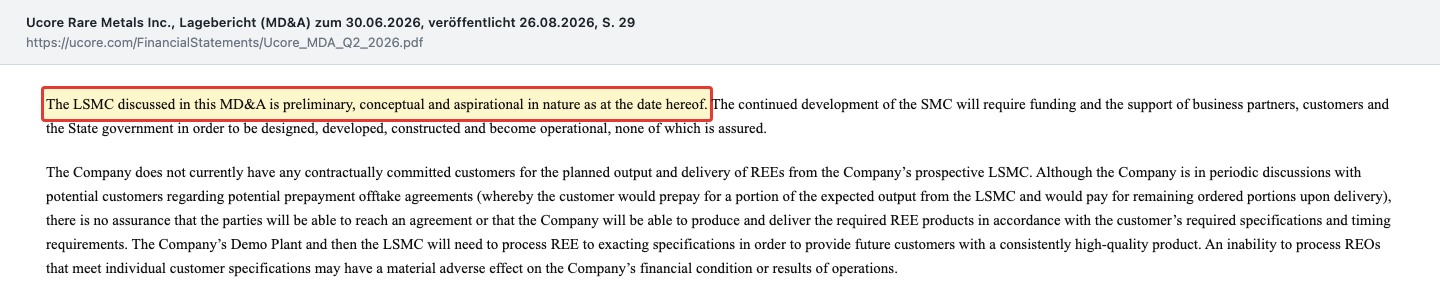
“The LSMC discussed in this MD&A is preliminary, conceptual and aspirational in nature as at the date hereof.”
— Ucore Rare Metals Inc., MD&A for the period ended June 30, 2026, Technology-Specific Risks, p. 29
The very next paragraph contains the sentence that weighs even more for a would-be producer:
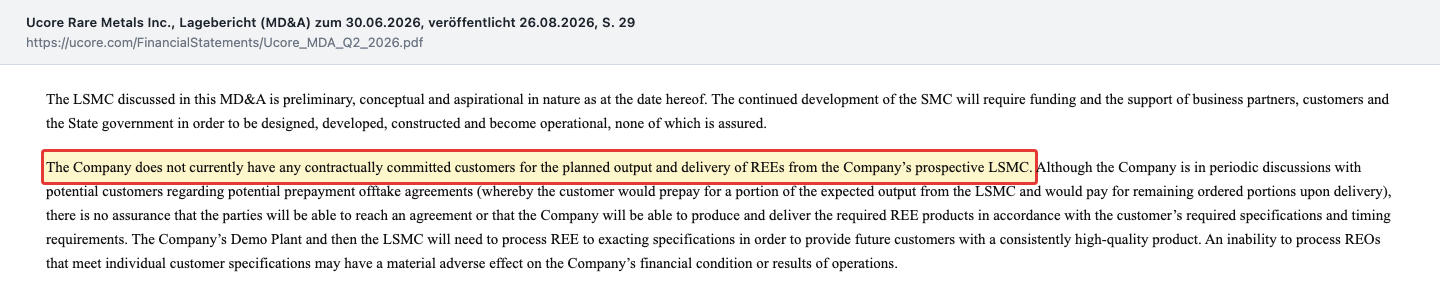
“The Company does not currently have any contractually committed customers for the planned output and delivery of REEs from the Company’s prospective LSMC.”
— Ucore Rare Metals Inc., MD&A for the period ended June 30, 2026, p. 29
What does exist are memoranda of understanding and letters of intent — plenty of them. Thyssenkrupp Materials Trading (April 2022, at least 1,000 tonnes of carbonate a year as a supplier), Meteoric Resources (August 2024), ABx Group (September 2024), Critical Metals (August 2025), Wyloo and Hastings (October 2025), Vacuumschmelze and eVAC Magnetics as potential buyers (November 2025) and a collaboration with Sumitomo Corporation of Americas (June 2026). A memorandum of understanding is a handshake, not a contract. In Vacuumschmelze’s case, uranium producer Energy Fuels announced a deal to acquire it on June 23, 2026, and Ucore itself writes that it is not yet known how that will affect the memorandum.
Uncomfortable truth No. 2: The price tag has more than doubled, and the date has slipped repeatedly
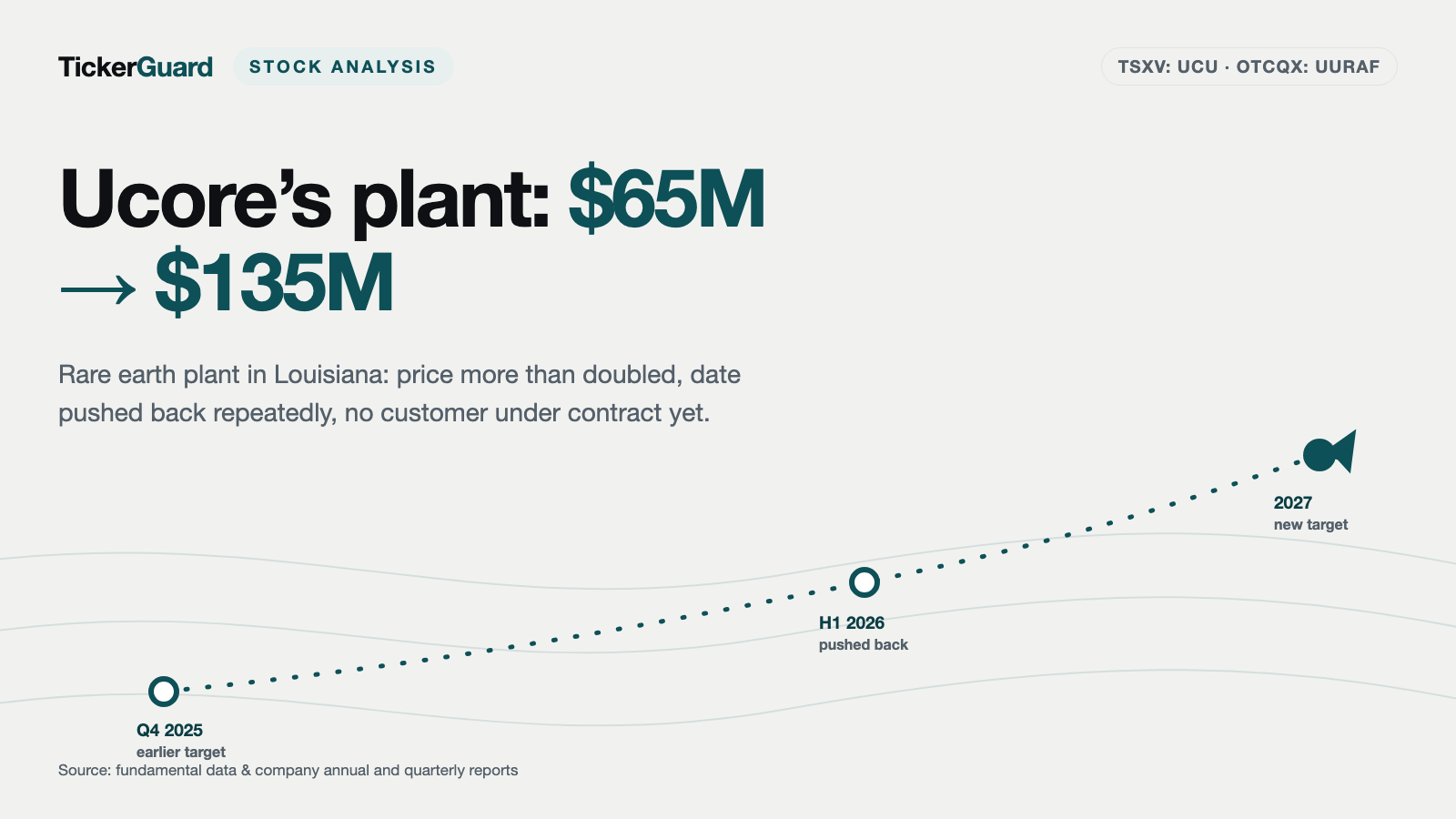
The MD&A for fiscal 2024, dated April 29, 2025, put the first build-out stage in Louisiana at $65 million and targeted production readiness for the first half of 2026 — “extended from Q4-2025,” so already pushed back once. The MD&A for the period ended June 30, 2026, does the math again:
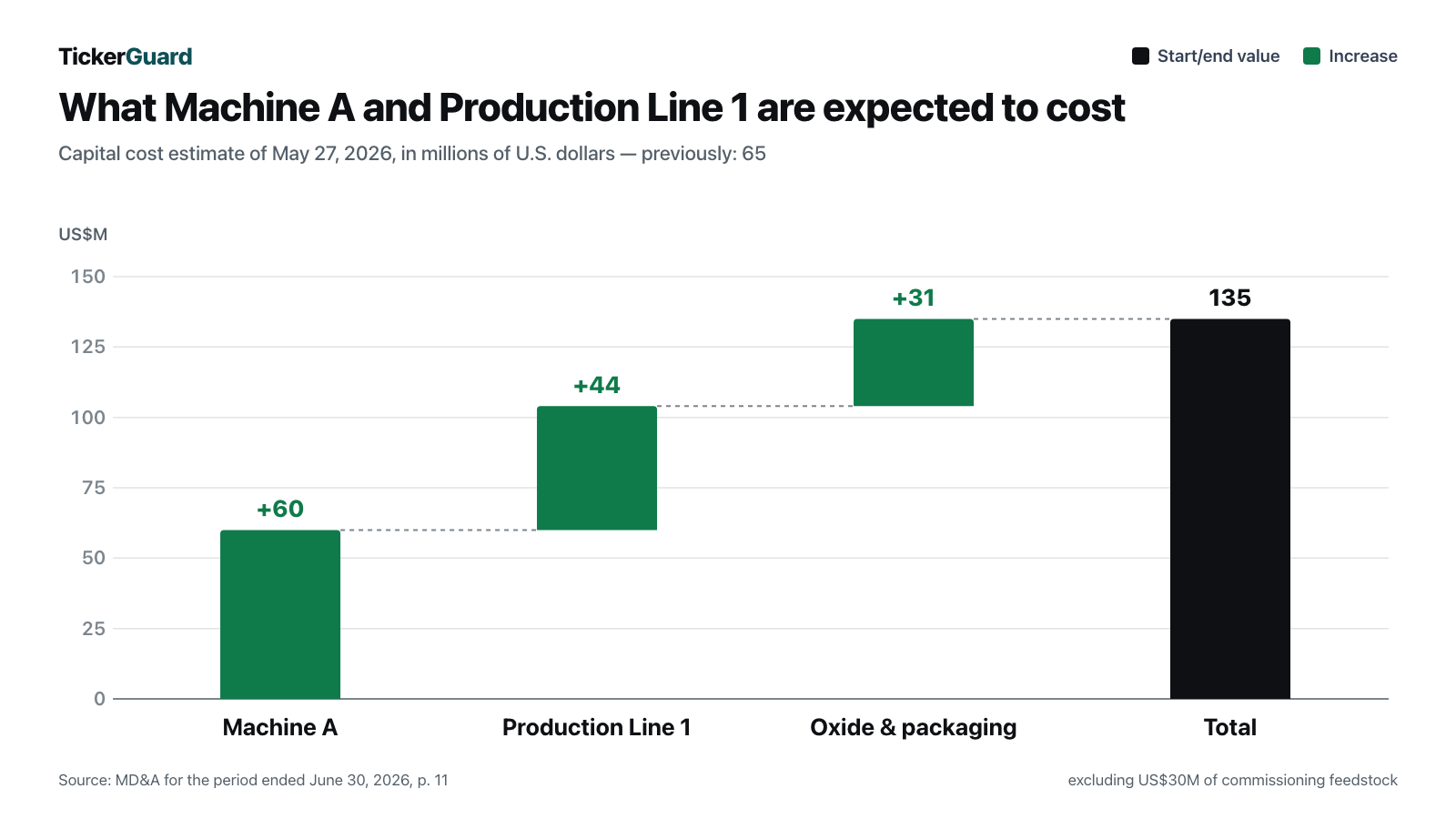
“In addition, lessons learned with the Demo Plant and improvements to design and construction details for the LSMC, as well as inflation, anticipated feedstock costs, and under-estimated costs have resulted in an update to the total capital expenditure (“CAPEX”) of Machine A, Production Line 1 (previously referred to as Stage 1 of the LSMC) from US$65 million to US$135 million, excluding commissioning feedstock of US$30 million (which is not CAPEX and can become saleable goods).”
— Ucore Rare Metals Inc., MD&A for the period ended June 30, 2026, The LSMC Program, p. 11

According to the Orbital Engineering report dated May 27, 2026, the new total breaks down into three blocks:
In fairness, Ucore attributes part of the increase to a deliberate choice. Machine A was enlarged from 64 to about 118 stages so it can produce several oxides directly; in exchange, one of four production lines drops out of the full build-out. More expensive up front, cheaper to run — that is management’s reading. The date has moved anyway: “early production readiness” is now scheduled for 2027, with Machine A installed in the first half of 2027 — and explicitly “subject to the availability of commercial feedstock.”
Uncomfortable truth No. 3: The share count has more than doubled — and the next raise is already announced
The cash in the bank today was paid for by shareholders, with their stake in the company. Dilution simply means your slice of the pie gets smaller because more people are eating from the same pie.
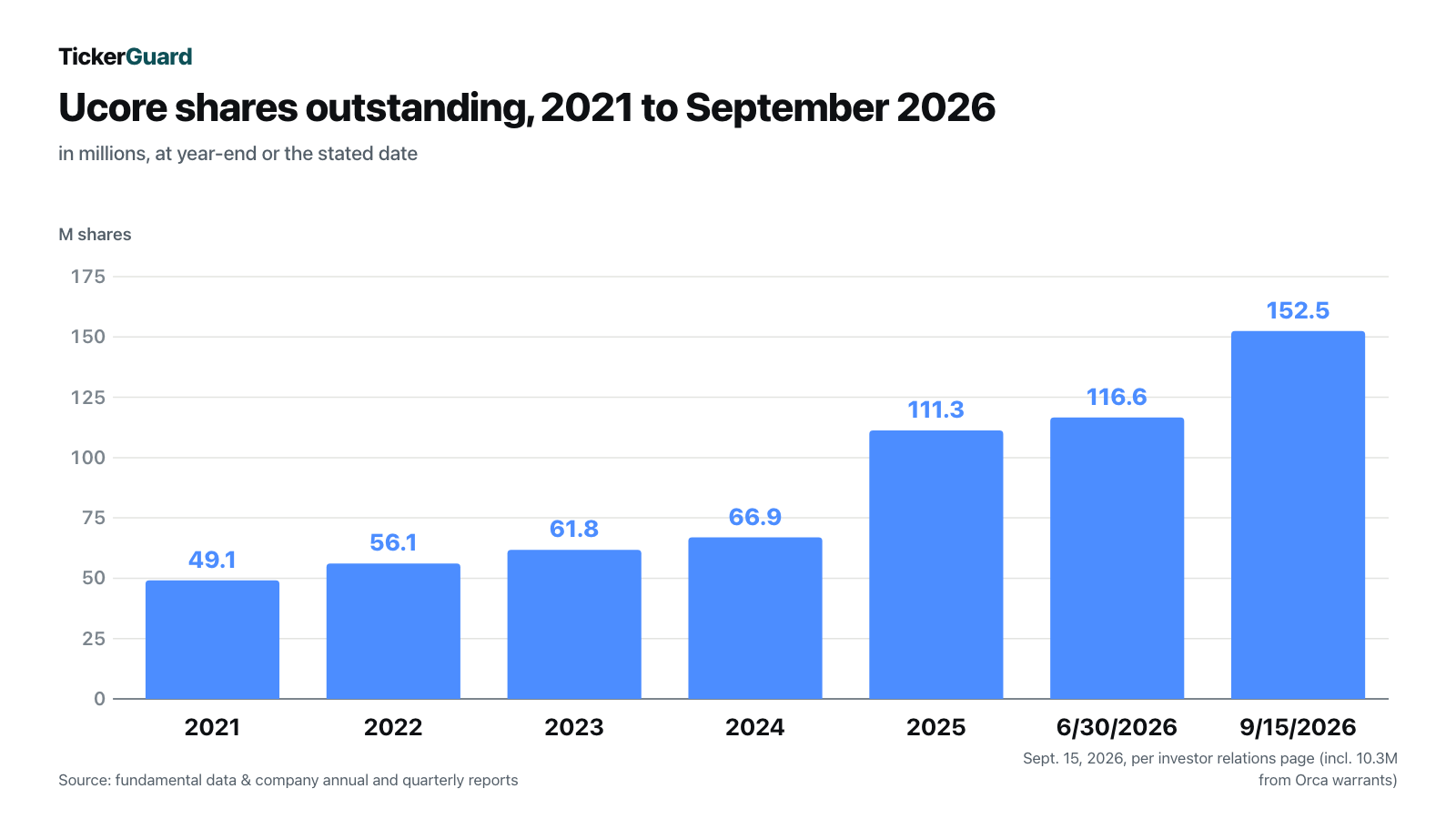
In 2025 alone, 44.5 million shares were added: 19.3 million from warrant exercises, 18.5 million from private placements, 3.9 million from debenture conversions and the rest from options and share units. In 2026, another roughly 41.2 million followed through September 15. From the end of 2024 to mid-September 2026, the share count therefore rose by about 128 percent. According to the investor relations page (as of September 15, 2026), there are also 7,168,334 stock options, 865,624 warrants, 320,000 restricted share units and 25,710 deferred share units — 160,877,119 shares fully diluted.
And the end is explicitly not in sight:
“The Company will also need to raise further financing within the next two years to execute its strategic plan and meet its objectives.”
— Ucore Rare Metals Inc., MD&A for the period ended June 30, 2026, Liquidity and Capital Resources, p. 24

The math behind it is quick. Using the exchange rate implied in the MD&A itself (C$2,589,981 equals $1,899,867, or about 1.36), Machine A and Production Line 1 cost about C$184 million. Against that stand a calculated roughly C$85 million of cash, plus $21.1 million of U.S. funding not yet earned and up to $15 million of Louisiana incentives that sit in a non-binding letter of intent and are tied to at least $75 million of investment by the end of 2027. The up to C$36.3 million conditionally approved by Ottawa is for a different facility in Kingston and had no definitive agreement as of August 26, 2026. Even if everything flows, the first stage is still short by tens of millions of dollars — before the $30 million (about C$41 million) of commissioning feedstock and before Production Lines 2 and 3.
Uncomfortable truth No. 4: The lender sat on the board
From the conversion of the last convertible debentures in 2025 until September 2026, Ucore had exactly one lender: Orca Holdings, a company wholly owned by director Randy Johnson (on the board since October 6, 2020). The credit line carried 10.0 percent interest and the term loan 9.0 percent, secured by a first charge on the company’s assets. The loans came with 8.9 million warrants at C$0.75 and C$0.89, which Orca received in late 2023 and mid-2024 as consideration for extensions and increases of the loans.
On September 4, 2026, Ucore repaid the loans early, including interest: C$8,709,268. Five days later, Orca exercised warrants for 10,268,165 shares and paid C$8,485,123.75 — about C$0.83 per share on average. According to Johnson’s early warning release of September 10, 2026, 8.9 million of them came from the three loan agreements; the remaining 1,368,165 at C$0.75 were due to expire on November 14, 2026, and belong to the November 2024 private placement. The offering a month earlier had priced at C$2.80. The repayment and the exercise proceeds nearly offset each other; the new shares equal about 6.7 percent of the shares reported as of September 15, 2026. According to the same release, Johnson held, directly and indirectly, about 7.0 percent of the shares immediately before the exercise and 20,279,901 shares, or about 13.3 percent, afterwards. That follows the contracts and was approved by the board without Johnson; under Canadian exemptions, no formal valuation or minority shareholder approval was required. The exercise prices of the loan warrants had been fixed by contract since late 2023 or mid-2024 (2025 MD&A). For you as a shareholder, it still means that whoever helped early with loans now holds a large block of shares at exercise prices far below the offering price.
Two smaller points belong in the same chapter. CEO Pat Ryan is also chairman of the board, so the usual separation between management and its oversight is missing. And the law firm Miller Thomson, where a director is a partner, received C$424,572 in fees in the first half of 2026. In June 2026, the board did at least set up a dedicated committee to oversee the Louisiana project’s budget, schedule and risks.
Uncomfortable truth No. 5: The demonstration plant proves the chemistry, not the factory
The final report to the U.S. defense agency reads well: 5.4 times less mixing time than conventional solvent extraction, up to 60 percent less floor space, a 34 percent lower capital cost. Two numbers from the same table are more sobering. Operating cost is almost identical at $2.2 per kilogram of feedstock versus $2.3 for the conventional process. And over 5,726 hours, the demonstration plant processed 1.76 tonnes of rare earth oxide equivalent. Machine A is supposed to handle about 600 tonnes a year — more than three hundred times what the demo plant processed in two years combined.
The company says so itself: RapidSX “has yet to be proven at a commercial scale in a large REE purification and processing facility” (MD&A for the period ended June 30, 2026, Technology-Specific Risks). Patent protection is also still open: applications have been pending since 2023. Anyone who sees RapidSX as a moat should know that it uses the same chemistry as the standard process, just executed faster.
Valuation: What the market pays for a plant that does not exist yet
With 152,497,451 shares (as of September 15, 2026, per the investor relations page) and a closing price of C$2.72 on September 30, 2026, Ucore is valued at about C$415 million. Subtract the calculated cash of roughly C$85 million — there have been no loans since September 4 — and about C$330 million remains. That is what the market pays for RapidSX, the half-finished building in Louisiana, the demonstration plant and the Alaska deposit.
A price-to-earnings or price-to-sales ratio cannot be calculated, because there are neither earnings nor sales. That leaves book value. Shareholders’ equity stood at C$66.6 million on June 30, 2026; adding the net proceeds of the offering and the warrants gives a calculated figure of about C$140 million. The market is therefore paying just under three times what the balance sheet shows — and that book value consists largely of capitalized Alaska exploration costs (C$41.5 million) and cash.
There is hardly a professional consensus for a stock this size. According to the investor relations page, four firms cover Ucore: Red Cloud Securities, Raymond James, B. Riley Securities and Lucid Capital Partners. Two of them, Red Cloud and B. Riley, co-led the August 2026 offering and received fees for it — both therefore have a potential conflict of interest, and their research should be read with that in mind. We deliberately do not quote price targets here.
How much hope is in the price shows in the range of the past twelve months: between C$2.47 and C$11.71 per share (as of September 30, 2026). Anyone who bought near the high in October 2025 is down more than three quarters. Anyone who took part in the August 2026 offering at C$2.80 is slightly under water. The company’s finances got better over that period, not worse: by its own account it is debt-free, and management considers the next twelve months funded. What got worse were the cost estimate and the schedule — and above all, the mood. That is the point of the importance trap: the price followed the headline, not the construction site.
We worked through a similar pattern — a strategically important raw material, government backing, but financing that is not yet in place — in our NioCorp analysis. For a company developing rare earths as a side business next to a running operation, see our Ramaco Resources analysis.
Upside and risks at a glance
What speaks for the company:
- By our calculation, cash is higher than at any year-end from 2021 to 2025. Debt-free since September 4, 2026, roughly C$85 million available by our calculation, 2025 statements without a going concern paragraph — year-end cash from 2021 to 2025 ranged between C$0.25 million and C$26.1 million, with C$627,522 at the end of 2024.
- The government is paying — against milestones. $27.0 million of U.S. defense commitments (as of September 14, 2026), the first award accepted on April 7, 2026; plus a C$4.28 million Canadian program and a conditional approval for up to C$36.3 million.
- Demand is backed by regulation. From January 1, 2027, U.S. procurement rules (DFARS) for certain magnets also exclude separation in countries such as China, subject to exceptions (news release of September 14, 2026). The U.S. Geological Survey lists samarium and gadolinium among the commodities with the highest supply chain risk.
- The technology works at demonstration scale. 5,726 operating hours, seven separation campaigns, purity and recovery equal to or better than the standard process in 11 and 13 of 14 comparisons respectively; NdPr and dysprosium oxide samples are with customers.
- The site is secured. A long-term lease in Alexandria since January 2024, a signed property tax exemption from the State of Louisiana and a promised expedited permitting pathway.
What speaks against it:
- No revenue, no customer under contract. The company itself calls its plant “preliminary, conceptual and aspirational”; all it has are non-binding memoranda.
- Costs are up, the date has slipped. $65 million to $135 million for the first stage, production readiness pushed back repeatedly, most recently from the first half of 2026 to 2027 — and dependent on feedstock being available.
- More dilution is announced. The share count has more than doubled since the end of 2024, and the MD&A calls for further financing within two years.
- Commercial scale is unproven. Between 1.76 tonnes of demo throughput in two years and Machine A’s 600 tonnes of annual capacity lies a factor of more than three hundred.
- Dependence on politics and feedstock. Government funding, tariffs between Canada and the United States (additional U.S. tariffs from August 22, 2026, additional Canadian counter-tariffs from September 8, 2026) and the availability of carbonate from Western mines are beyond the company’s control.
- Governance with close ties. The CEO is also chairman, a director who was the sole lender from 2025 until September 2026 holds shares from warrants priced at C$0.75 to C$0.89, and a law firm where another director is a partner collects fees.
A human conclusion
Remember the importance trap from the beginning? The MD&A does not sugarcoat: it states in plain sentences that the plant is a concept, that there is no customer under contract, that costs have risen and that more money is needed. It is all there. The trap is not in the report but in us: we read “Pentagon” and “China” and fill in a running factory with full order books.
The mission is real, and so is the backing. North America will probably have rare earth separation plants in a few years. Whether Ucore runs one of them will not be decided by headlines but by three sober questions: Will Machine A run at scale in 2027 the way the Kingston plant did? Will a buyer sign a real contract with volumes and prices? And at what price will the next financing have to be done?
What you do with this is your decision. And that is how it should be.
Sources and data as of
- MD&A for the six months ended June 30, 2026, dated August 26, 2026
- Unaudited interim financial statements as at June 30, 2026, approved by the board on August 26, 2026
- 2025 consolidated financial statements with PricewaterhouseCoopers’ audit report dated March 18, 2026, and the 2025 MD&A
- 2024 consolidated financial statements with KPMG’s audit report and the 2024 MD&A dated April 29, 2025
- Consolidated financial statements for 2022 and 2023 (share counts and annual results for 2021 to 2023)
- News releases: NdPr samples to magnet makers (June 22, 2026), 99.9 percent dysprosium oxide (July 7, 2026), Louisiana engineering report (May 28, 2026), closing of the offering (August 13, 2026), Orca warrants and debt repayment (September 9, 2026), Randy Johnson’s early warning release (September 10, 2026), additional U.S. funding (September 14, 2026)
- SEC entry CIK 0001495651 (Form D notices only)
- Ucore investor relations page: share count, options and warrants as of September 15, 2026, list of covering analysts
- Price and market value data: source fundamental data, as of September 30, 2026
Data as of: company figures as of June 30, 2026, or the date stated; debt and funding through September 14, 2026, share count as of September 15, 2026; prices as of September 30, 2026. The company’s news page was last checked on October 1, 2026. The reporting currency is the Canadian dollar (C$); U.S. dollar amounts are marked with a plain $ sign. Calculated values (cash after the September announcements, market and enterprise value, conversion of the construction cost) are our own estimates and labeled as such.
Disclaimer: This article is journalistic commentary and not investment advice. It is not a recommendation or a solicitation to buy or sell securities. Shares of companies without revenue are especially volatile; a total loss of the capital invested is possible. Positions held by the operator are disclosed daily; where one exists, it appears as a notice at the top of this deep dive.
Our Bottom Line at a Glance
- Financial position positive
- After the C$69.0 million gross offering (August 13, 2026) and full repayment of the Orca loans (September 4, 2026), Ucore is debt-free; by our calculation roughly C$85 million was available. At the end of 2024 it had C$627,522 and a going concern paragraph from its auditor.
- Government support positive
- The U.S. defense department had committed a total of $27.0 million by September 14, 2026, and accepted the first award on April 7, 2026. Only $5.9 million had been earned by August 26, 2026; funds flow only against completed milestones (5 of 20 in Phase 2).
- Business model and customers negative
- No revenue in any reporting year, no contractually committed buyers, only non-binding memoranda. The MD&A for the period ended June 30, 2026, itself calls the Louisiana plant preliminary, conceptual and aspirational.
- Project cost and schedule negative
- The capex estimate for Machine A and Production Line 1 rose from $65 million to $135 million (May 27, 2026). The 2024 MD&A targeted production readiness for the first half of 2026 (previously Q4 2025); the current plan says 2027.
- Dilution negative
- The share count rose from 66.9 million (December 31, 2024) to 152.5 million (September 15, 2026), up about 128 percent. The MD&A announces further financing within two years; construction cost of about C$184 million exceeds the funds available.
- Technology and governance neutral
- RapidSX ran for 5,726 hours at demonstration scale with results on par with the standard process but is, by the company’s own account, unproven at commercial scale. The CEO is also chairman; a director who was the sole lender from 2025 until September 2026 received 10,268,165 shares at about C$0.83 on average in September 2026.
Ucore wants to separate rare earths in Louisiana and has government backing: $27.0 million of U.S. defense commitments, a debt-free balance sheet and roughly C$85 million by our calculation after the August 2026 offering. Against that stand a company with no revenue and no customer under contract, a cost estimate for the first build-out stage that has doubled to $135 million, production readiness pushed to 2027 and a share count that has more than doubled since the end of 2024. At the C$2.72 close on September 30, 2026, Ucore was worth about C$415 million. Not investment advice.
What Our Rating Means
Open questions
The business works in principle, but one material question is open. As long as it stays open, our findings do not carry a quality verdict.
Yellow is not about the share price here. Red would be wrong: Ucore has been debt-free since September 4, 2026, has roughly C$85 million available after the offering by our calculation, its 2025 statements no longer carry a going concern paragraph, and management considers the next twelve months funded — by its own account including planned capital spending, which it would scale back if necessary. Green would be just as wrong, because the decisive operating question is open: there is no revenue, no buyer under contract and no proof that RapidSX works at scale — the demo plant processed 1.76 tonnes in two years, Machine A is meant to handle 600 tonnes a year. The cost estimate has doubled, the date has slipped repeatedly and money for the first stage is still missing. The outcome hinges on a single event — Machine A starting up in 2027. That is exactly what the yellow level describes. Anyone watching the stock should look at three things in every report: capitalized construction cost against plan, signed offtake contracts and the share count. The decision is yours.
A journalistic assessment by our editorial team at the time of the deep dive, based on public sources — not investment advice and not a solicitation to buy or sell. Your personal circumstances (investment goals, risk capacity, taxes) cannot be taken into account. What our levels mean, how verdicts are formed, and what conflicts of interest exist →
Worth Noting
- This analysis was triggered by the U.S. OTCQX symbol UURAF on the wallstreet-online forum hot list (as of October 1, 2026); the company is carried under its home listing UCU (TSX Venture Exchange) as UCU.TO. There is no hit from our in-house stock scanner and there cannot be one: the company has neither revenue nor earnings. Classic metrics such as P/E or P/S cannot be calculated; the assessment focuses on cash, project cost and dilution.
- Ucore is not an SEC reporting company (CIK 0001495651, Form D notices only). All company figures come from the Canadian disclosure documents: consolidated financial statements 2022 to 2025, interim statements and MD&A as at June 30, 2026 (August 26, 2026), and the news releases of May 28, June 22, July 7, August 13, September 9 and September 14, 2026. No earnings call transcripts were available.
- Calculated values are our own estimates: cash after the September announcements (cash at June 30, 2026, plus the offering net of the underwriting fee, plus option and warrant proceeds, minus the loan repayment, before third-quarter operating spending), the market value from the share count on the investor relations page as of September 15, 2026 (152,497,451) times the September 30, 2026, close and the conversion of the construction cost at the rate of about C$1.36 per U.S. dollar implied in the MD&A.
- Since 2025 the U.S. Department of Defense has also styled itself the “Department of War”; Ucore uses the abbreviation DoW in recent releases. Both refer to the same agency and the same agreement with the U.S. Army Contracting Command-Orlando.
The full analysis as a PDF for later
We will send you this analysis as a PDF — to print, file away, and read at your own pace.
Frequently Asked Questions
Ucore is developing a plant that separates rare earths from one another — the step between the mine and the magnet factory that almost only China masters today. Its RapidSX technology has been running in a demonstration plant in Kingston, Ontario, since 2023. The first commercial plant is being built in Alexandria, Louisiana. Ucore also owns the Bokan-Dotson Ridge deposit in Alaska. It has no revenue so far.
According to the MD&A for the period ended June 30, 2026, the first machine (“Machine A,” about 600 tonnes a year) is to be installed in the first half of 2027, with production readiness planned for 2027 — subject to feedstock being available. The 2024 MD&A still targeted the first half of 2026, before that the fourth quarter of 2025.
About $135 million under the engineering report dated May 27, 2026: $60 million for Machine A, $44 million for Production Line 1 and $31 million for oxide production and packaging. Another $30 million is needed for commissioning feedstock. Ucore had previously cited $65 million.
Not anymore. On September 4, 2026, Ucore repaid all loans from major shareholder Orca Holdings, including interest (C$8,709,268). Since then the company reports no loans or debt. In August 2026, it had raised gross proceeds of C$69.0 million through new shares.
Because Ucore is not a U.S. reporting company. It is incorporated in Alberta, listed on the TSX Venture Exchange in Toronto and reports under Canadian rules (National Instrument 51-102) in Canadian dollars under IFRS — audited annual statements, quarterly statements and MD&As on SEDAR+. Under identifier 0001495651, the SEC only holds Form D notices without financial statements.
It is the same stock. UCU is the symbol on the home exchange, the TSX Venture Exchange in Toronto, where prices are set in Canadian dollars. UURAF is the symbol on the U.S. OTCQX market, an over-the-counter venue that is not a registered U.S. exchange. On TickerGuard, the stock is carried as UCU.TO.
Ucore had 66.9 million shares at the end of 2024 and 152.5 million on September 15, 2026 — an increase of about 128 percent. New shares came from warrants, offerings (most recently 24.6 million at C$2.80 in August 2026) and debenture conversions. The MD&A for the period ended June 30, 2026, says further financing will be needed within two years.
Found an error?
Did you spot a factual error, an outdated number, or a typo in this deep dive? Let us know briefly — your report goes straight to the editorial team.