NioCorp Raised $466 Million — the Plan That Money Is Meant to Fund Still Runs on 2019 Prices
NioCorp is developing the Elk Creek niobium-scandium-titanium deposit in southeastern Nebraska — a resource project that sounds like critical minerals, national security and independence from China. In nine months the company raised $466.0 million in fresh equity and held $419.2 million in cash on March 31, 2026. The catch: in 39 years of corporate history there has never been a dollar of operating revenue, the mine is costed at $1,141.0 million, and almost two thirds of the planned revenue rests on scandium priced at $3,674 per kilogram — while the same annual report puts the 2024 market price at $1,200. We read what actually sits between the map and the mine.
 Thomas Mücke
Founder & Publisher
Thomas Mücke
Founder & Publisher
As of Today
As of: September 17, 2026
- Closing price
- 3.70 $ +4.30%
- Market Capitalisation
- 0.5 $B
- AAQS
- 1/10
Price change since September 8, 2026: -10.2%
This analysis has a cut-off date. The Stock Guard tells you when something material changes in the numbers. Reserve your free spot
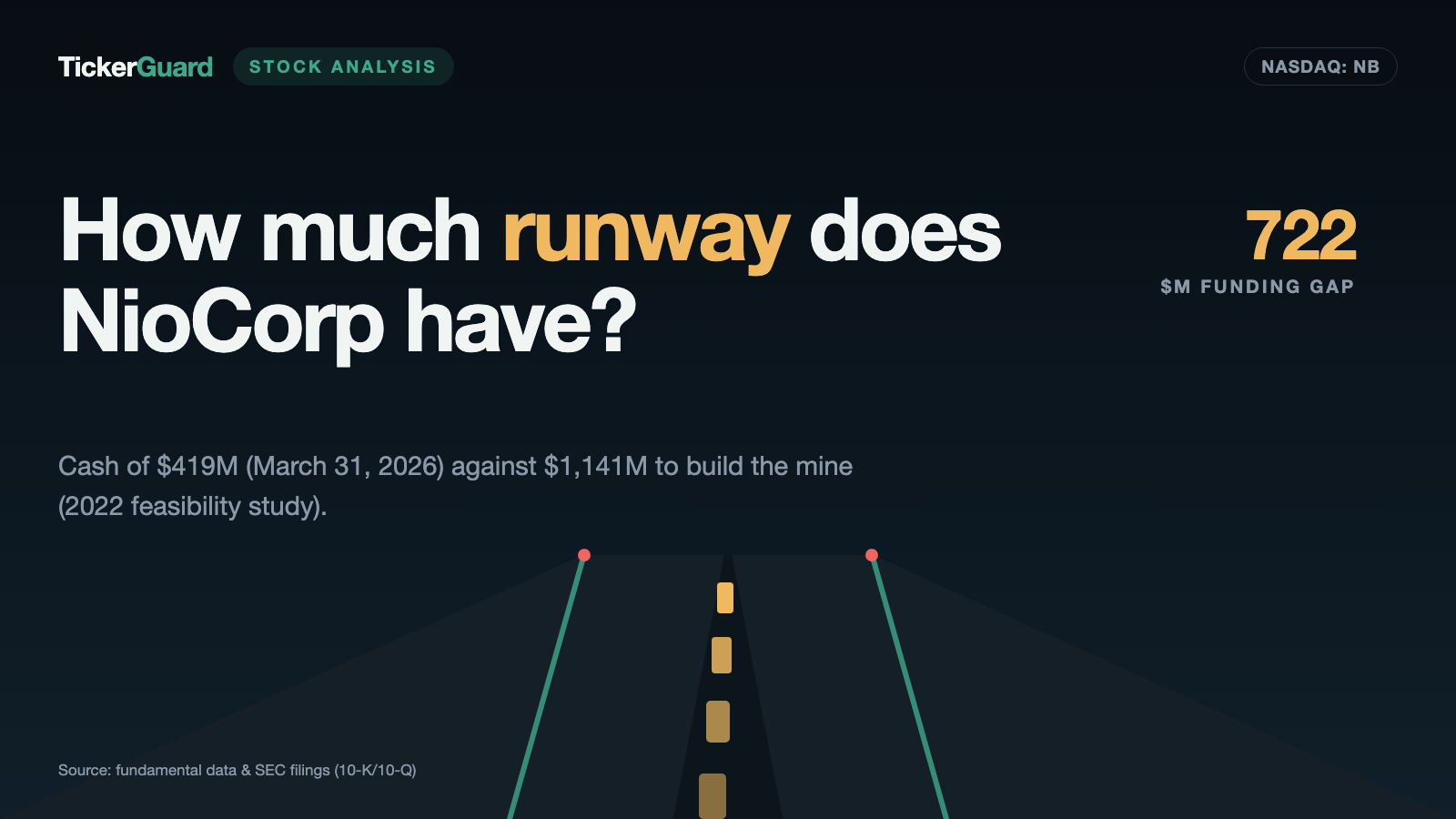
Chart
Interactive price chart (TradingView).
52-week range: 3.50 $ to 11.70 $ · Last price: 3.70 $ (As of: September 17, 2026)
Note: pure fact-based analysis, not investment advice and not a solicitation to buy or sell. All figures without guarantee.
There is an investor trap that catches well-informed people precisely because it feels like foresight: the treasure map trap. It works like this. You read about a deposit in the ground — niobium, scandium, titanium, all on the official critical minerals list, all currently sourced mostly from Brazil and China. You see a map with a marked square in Nebraska. And your brain fills in the rest by itself: “that has to be worth billions eventually.” The investment thesis is complete before a single number has been read. The catch: a treasure map is not treasure. Between the deposit and the first kilogram sold lie a permitting process, a billion-dollar loan, four years of construction — and the question of whether the prices used in the calculation still hold by then.
NioCorp Developments Ltd. (NASDAQ: NB) is exactly that case, in its most interesting form: the company suddenly has real money. Over nine months it raised $466.0 million gross in fresh equity and held $419.2 million in cash at March 31, 2026 — up from $25.6 million nine months earlier. So let us make a deal: before you decide whether this is the breakthrough or merely a larger waiting room, we will read together what NioCorp itself reported to the U.S. securities regulator, the SEC — the quarterly report (10-Q) for March 31, 2026 and the annual report (10-K) for fiscal 2025. An SEC filing is honest under penalty of law. And this one tells of a full treasury, a costing from 2019 and a loan that has been under review for three years. In the end, you decide.
What NioCorp actually is: a hole in Nebraska that is not a hole yet
NioCorp was incorporated on February 27, 1987 in the Canadian province of British Columbia and was formerly named Quantum Rare Earth Developments Corp.; its principal executive offices are now in Centennial, Colorado. The shares have traded on Nasdaq since March 17, 2023 — not through a conventional IPO but through a business combination with the blank-check company GX Acquisition Corp. II, a SPAC. Remember that, because it comes back later: warrants and special rights from that transaction still sit on the balance sheet today.
The entire company consists, at its core, of one project: Elk Creek in southeastern Nebraska, a deposit containing niobium, scandium and titanium, plus rare earth resources whose economic extraction is still being evaluated. What those metals are needed for is explained in the filing itself. Niobium makes steel stronger and lighter — it goes into bridges, pipelines, cars and into superalloys for aircraft turbines. Scandium combined with aluminum yields high-strength, corrosion-resistant alloys and is a component of solid oxide fuel cells. Titanium is used in aerospace, armor, medical implants and as a white pigment in paint and paper.
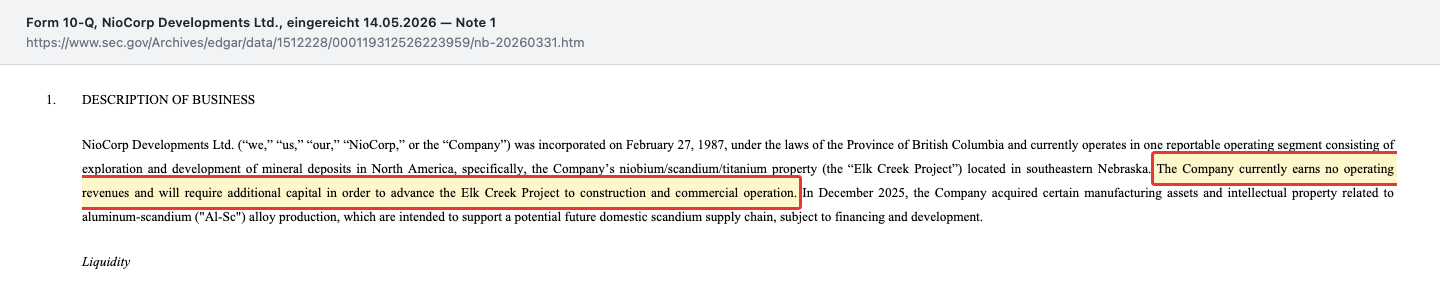
The business model in everyday terms: NioCorp is not currently a mining operation but a builder before the groundbreaking — someone who owns the land, collects permits, commissions drawings and waits for the bank to commit. The quarterly report says so with unusual clarity:
“The Company currently earns no operating revenues and will require additional capital in order to advance the Elk Creek Project to construction and commercial operation.”
— NioCorp Developments Ltd., SEC quarterly report 10-Q for March 31, 2026, Note 1 “Description of Business”
That frames the central tension of this analysis, and it runs through every chapter: for the first time in its history NioCorp has enough money to work seriously — but the plan that money is meant to fund comes from a 2022 study, is stated in early-2019 dollars and rests almost two thirds on a metal price that has collapsed since. How many people are meant to carry that workload is also in the filing: as of June 30, 2025 there were seven full-time employees and one contract employee. The quarterly report nine months later gives no updated figure but does mention additional corporate hiring — the team has grown, we simply do not yet know by how much.
Company history for investors
-
1987
Incorporated in British Columbia
Incorporated February 27, 1987, later renamed from Quantum Rare Earth Developments Corp. Still without a single dollar of operating revenue.
-
2022
Feasibility study puts build cost at $1,141 million
The study is stated in early-2019 dollars, assumes a 38-year life and named 2025 as the production start — a date that has since passed.
-
2023
Nasdaq listing via a SPAC
Business combination with GX Acquisition Corp. II on March 17, 2023. The deal left 15.7 million warrants at $11.50 running until 2028.
-
2023
EXIM application for up to $800 million
Filed June 6, 2023. First of three committee reviews cleared in October 2023, non-binding term sheet in April 2024 — still no commitment as of March 31, 2026.
-
2025
Capital flood and a move into scandium processing
Four placements between July and October 2025 at $3.25 to $9.34; on December 4 the FEA Materials assets were bought for $8.4 million. The share count doubles.
-
2026
Construction starts on the mine portal
On February 26, 2026 work began on the main access, budgeted at $44.6 million. About $1.8 million was incurred through March 31, 2026 — the first visible groundbreaking.
How this stock reached our desk
NioCorp is not a hit from our value or momentum filters — with no revenue and no earnings the classic ratios cannot even be computed. It reached the research list through the Reddit mention component of our in-house stock scanner, which ranks names by how often they are discussed in investor forums (as of September 9, 2026). That is not a quality signal but an attention signal — and that is precisely what makes it interesting: resource projects tied to critical minerals and national security reliably generate enthusiasm long before a single tonne is mined.
For a company without revenue you therefore reach for different tools. Instead of a price-to-earnings ratio, three questions matter: Is there enough money? Does the calculation the plan rests on hold? And: How much of your slice survives until it is done? We will take them in that order. If you want to see the same questions applied to another explorer, our Southern Cross Gold analysis makes the comparison; for the contrast with a miner that actually produces and earns, see our Agnico Eagle analysis.
The numbers over the years, honestly credited
First what genuinely impresses, and in fiscal 2026 that is quite a lot. NioCorp pulled off a capital markets run few explorers manage. In the nine months from July 2025 to March 2026 the company placed new shares five times: 13.85 million shares at $3.25 on July 18, 2025 (net $41.2 million), 10.0 million at $5.00 on September 19 (net $45.9 million), 7.0 million at $6.15 plus pre-funded warrants on September 29 (net $55.3 million), 10.2 million at $9.34 plus pre-funded warrants on October 15 (net $139.1 million) and 17.4 million at $5.00 on February 25, 2026 (net $93.4 million). Those five placements raised $405.2 million gross; a further $60.8 million came from warrant and option exercises and draws on an equity facility. The total: $466.0 million of gross equity inflow, less $30.1 million of issuance costs and $0.7 million of deferred financing costs — $435.3 million net.
The result is a balance sheet unrecognizable from nine months earlier. At March 31, 2026: cash of $419.2 million plus $2.1 million restricted, working capital of $409.9 million, total assets of $469.0 million and shareholders' equity of $435.4 million. Nine months before, at June 30, 2025, those lines read $25.6 million and $28.3 million. The company has no debt — of the $34.6 million in total liabilities, $25.0 million are fair value items for warrants and earnout shares, that is accounting values rather than borrowings.
And the money is being put to work rather than parked. Exploration expenditures rose from $0.9 million to $13.4 million over nine months; a drilling program ran from April to September 2025. On February 26, 2026 the company announced the start of construction on the mine portal — the main access to the future underground operation, budgeted at $44.6 million, with roughly $1.8 million incurred through March 31, 2026. On December 4, 2025 a subsidiary bought the manufacturing assets and intellectual property of FEA Materials, a producer of aluminum-scandium master alloys, for $8.4 million; and since August 4, 2025 an agreement with Advanced Technology International, acting on behalf of the Defense Industrial Base Consortium under the authority of the U.S. Department of Defense, provides for reimbursements of up to roughly $10.0 million on achievement of project milestones. That is real, documented movement — for the first time backed by a treasury that can pay for it.
Now the other side of the same coin — the price existing shareholders paid for it:
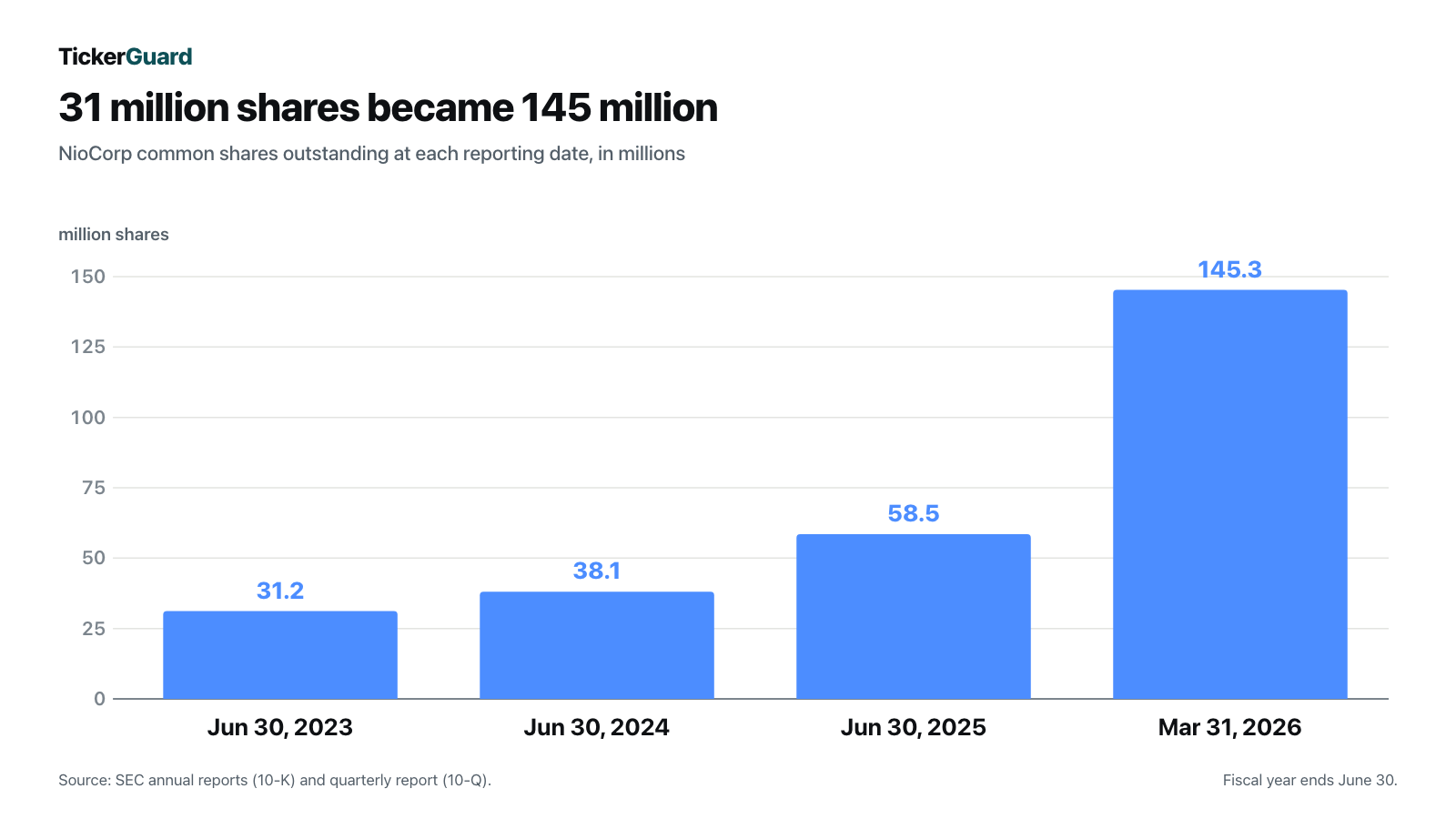
Dilution in everyday terms: the cake does not get smaller, but it is cut into ever more slices. An investor who owned one percent in June 2023 and never bought more now owns roughly 0.21 percent. In exchange, a great deal of money that was not there before has landed inside the company — that is the fair side of the trade. Whether it was worth it turns on one question: will the mine actually get built? And that is where the uncomfortable truths begin.
What the filings say: the uncomfortable truths
Uncomfortable truth no. 1: almost two thirds of the projected revenue rests on a metal whose price has fallen by two thirds since the assumption was made
Everything said about the value of Elk Creek ultimately traces back to one calculation: the 2022 feasibility study, filed as a technical report summary under the SEC's S-K 1300 rules with the fiscal 2022 annual report. It assumes a mine life of 38 years at 2,764 tonnes of ore per day and arrives at gross revenue of $21.9 billion over the full period, of which $14.7 billion is operating margin before depreciation and $12.5 billion operating cash flow. Impressive numbers. But take the study apart using its own figures and you see what that revenue depends on:
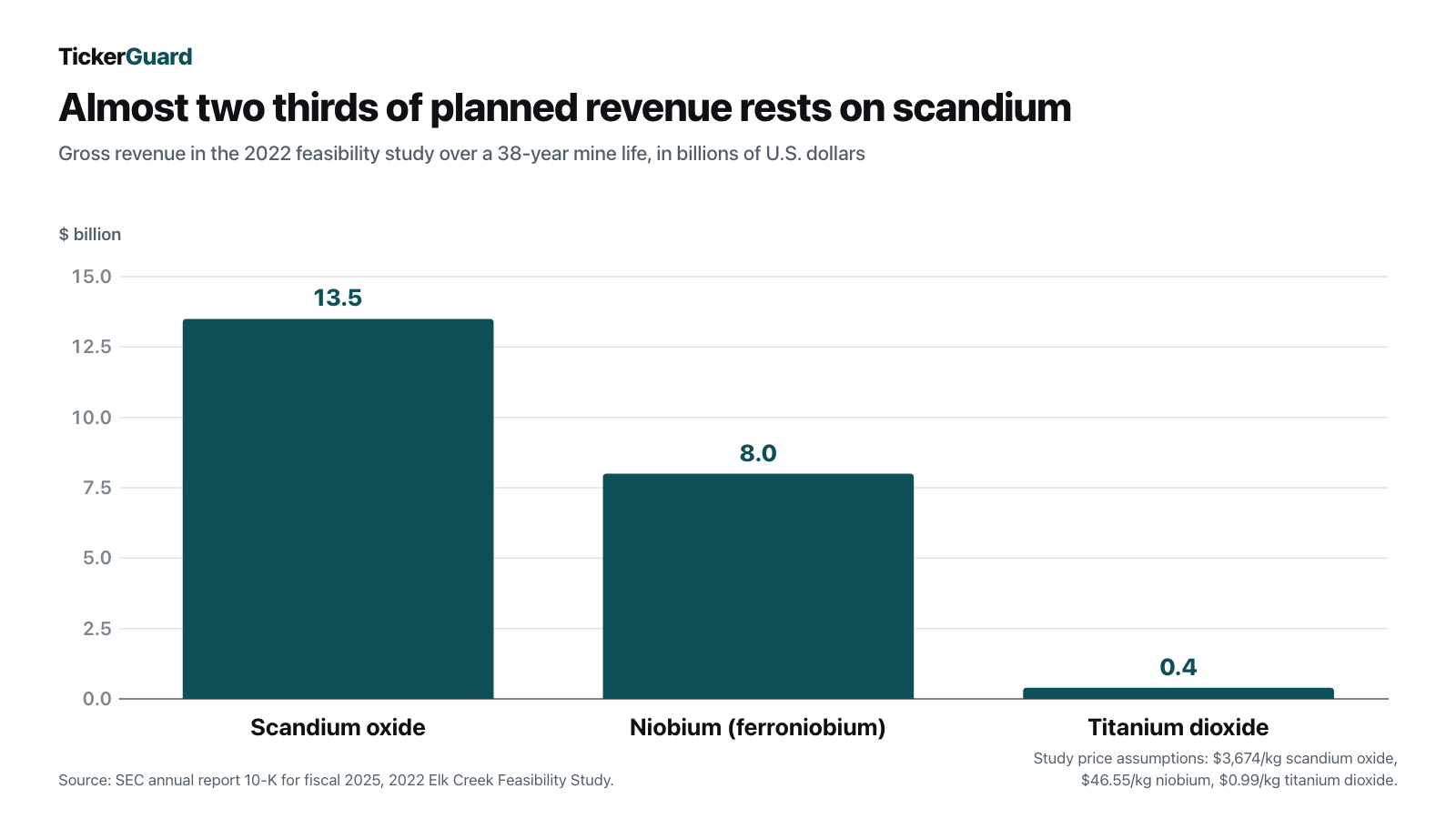
The arithmetic behind it is simple and checkable: over the mine life the study plans 3,676 tonnes of scandium oxide at an assumed price of $3,674 per kilogram — that is $13.5 billion. Add 171,140 tonnes of niobium at $46.55 per kilogram ($8.0 billion) and 431,793 tonnes of titanium dioxide at $0.99 per kilogram ($0.4 billion). Together that is exactly the study's $21.9 billion. Scandium, in other words, is not the by-product you would assume from the label "niobium project" but the main line item.
And here is the part worth reading twice. In the same annual report that summarizes the study, a table lists actual market prices for the past five calendar years. For scandium oxide it gives, citing the U.S. Geological Survey: $1,200 per kilogram for 2024 — after $2,100 (2022), $2,200 (2021) and $3,800 (2020). The study's price assumption is therefore roughly three times the most recent market price disclosed in a filing. For niobium ($46) and titanium dioxide ($1.31) assumption and market line up well — the gap sits precisely on the item carrying 62 percent.
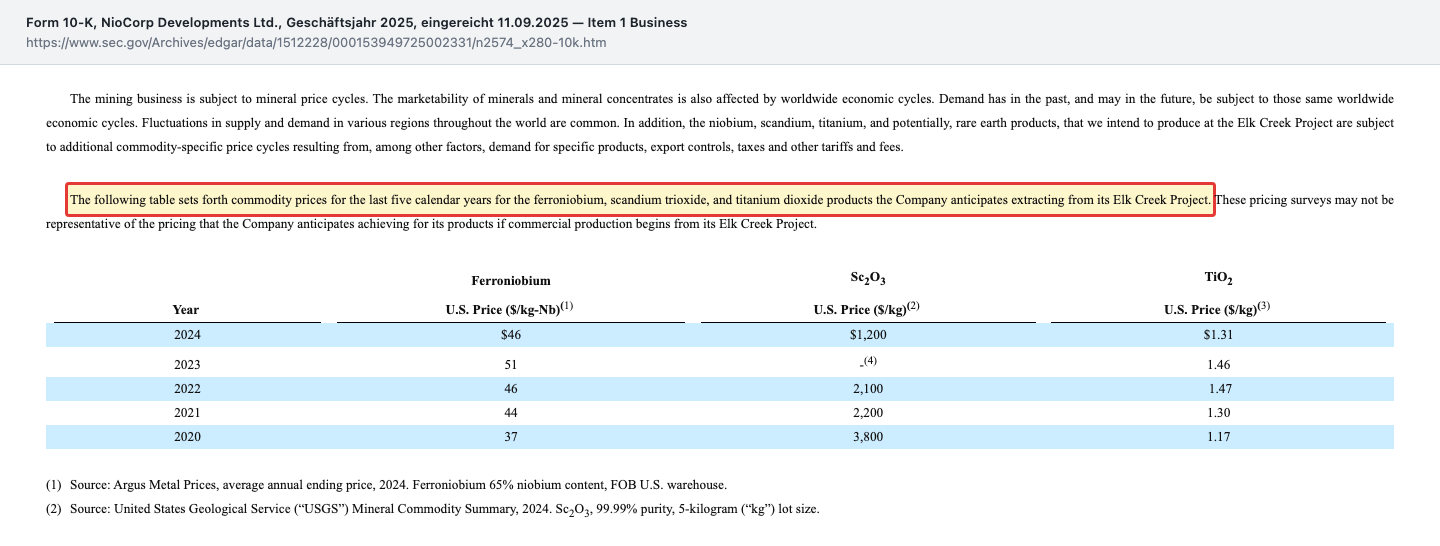
In fairness, NioCorp does not hide these figures — it prints them and adds its own caveat:
“These pricing surveys may not be representative of the pricing that the Company anticipates achieving for its products if commercial production begins from its Elk Creek Project.”
— NioCorp Developments Ltd., SEC annual report 10-K for fiscal 2025, Item 1 “Business”
The objection is legitimate, and it cuts both ways. The scandium market is tiny — the USGS quotation refers to five-kilogram lots at 99.99 percent purity, not to offtake contracts running for decades. A large new supplier can just as easily energize such a market as flood it. Which is exactly why the important news of the coming months is not the share price but the updated feasibility study NioCorp is preparing: the scandium price it adopts decides the single largest line item in the entire project calculation.
A second timestamp on the same study is equally telling: it is stated in first-quarter 2019 constant dollars and named 2025 as the year of commercial production. Both have been overtaken — the portal was only broken in February 2026, and on the study's own schedule 39 months elapse from authorization to proceed until mechanical completion, plus roughly six months of commissioning. Keep the image: we are valuing a 2019 price list and a timetable that has already missed its own starting date.
Uncomfortable truth no. 2: the quarterly profit appeared because the share price fell
In the third quarter of fiscal 2026 (January through March 2026) NioCorp reported its first positive result in a long while: $0.3 million before taxes, $0.7 million attributable to the company, or $0.01 per share. Read only the bottom line and you would think a corner had been turned. The origin of that profit sits one line above — and it is remarkable.
Operating expenses for the quarter were $7.3 million. Against them stood two blocks of income: $2.8 million of interest income on the money market account holding the newly raised millions — and $4.8 million of fair value gains on warrants ($2.2 million) and earnout shares ($2.7 million). Such items arise when obligations that depend on the share price are remeasured. If the price falls, those obligations are worth less — and that shows up in the income statement as a gain. The filing puts it this way itself:
“The declines in fair value for the three-month period in 2026 as compared to 2025 primarily reflect decreases in the Company’s Common Share price used in the Black-Scholes valuation of outstanding Warrant liabilities.”
— NioCorp Developments Ltd., SEC quarterly report 10-Q for March 31, 2026, management's discussion and analysis
Translated into everyday terms: imagine you promised a friend something that only becomes expensive if your house appreciates. If the house loses value, your promise gets cheaper — and you book that saving as income. You are not any richer. That is precisely what happened here: the share price used in the valuation model dropped to $4.46 at March 31, 2026 from the prior quarter, and a book gain fell out of it. Across the full nine months the same mechanism ran the other way: fair value losses of $21.3 million pushed the nine-month loss to $44.4 million. Remember the sentence: at NioCorp the bottom line measures the share price, not the business. The business shows up in the cash flow statement — and there the operating outflow was $11.9 million over nine months.
Uncomfortable truth no. 3: a roughly $722 million gap sits between the cash and the build cost
The $419.2 million in the bank is a lot — measured against the task it is a start. The feasibility study puts the initial capital expenditure at $1,141.0 million (including a ten percent contingency), plus $422 million of sustaining capital over the mine life and $44 million for closure and reclamation. Subtract the cash from the initial capex and roughly $722 million still has to be raised — and that in 2019 dollars.
How that is supposed to happen is stated openly: about two thirds of the build cost is to come from debt, chiefly an application to the Export-Import Bank of the United States for up to $800 million. That application has been pending since June 6, 2023. On October 2, 2023 it cleared the first of three reviews by the relevant committee; in April 2024 a non-binding term sheet arrived together with a list of additional work for NioCorp to complete — including an updated mine plan and updated capital costs. What happens next is described in the quarterly report as follows:
“We are currently unable to estimate how long the application process may take, and there can be no assurances that we will be able to successfully negotiate a final commitment of debt financing from EXIM.”
— NioCorp Developments Ltd., SEC quarterly report 10-Q for March 31, 2026, “Liquidity and Capital Resources”
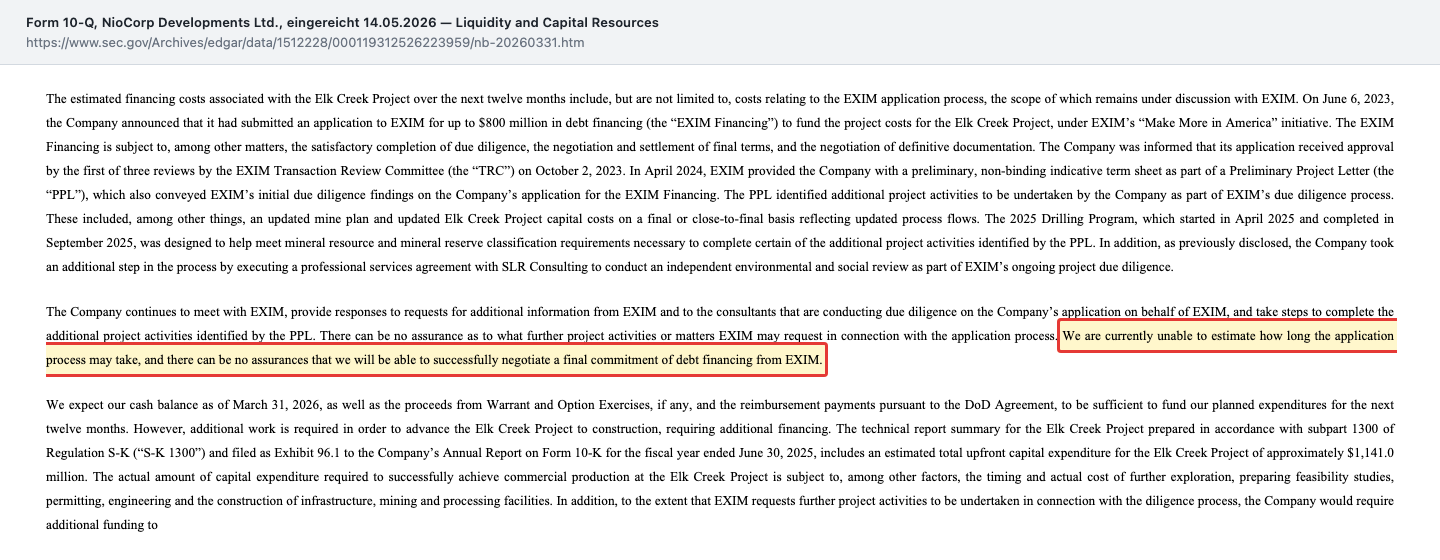
This is not a rejection but an open process — state export credit agencies move slowly, and NioCorp delivered what was asked for with the drilling program and the independent environmental and social review. But the sober reading is this: three years after the application there is no loan commitment, and the company itself states that apart from possible option and warrant exercises it has no further funding commitments or arrangements. At least the time pressure is gone: NioCorp plans expenditures of $65 million to $75 million over the next twelve months, so the cash lasts several years on paper. It simply does not build a $1,141 million mine out of $419 million.
Uncomfortable truth no. 4: internal financial controls have been rated ineffective since fiscal 2023
There is one finding that has nothing to do with commodity prices and still weighs heavily. NioCorp's chief executive and chief financial officer state in every filing that internal control over financial reporting is not effective. That is not a formality: it means a material misstatement in the accounts would not be reliably prevented or detected in time.
“Management concluded that the material weaknesses disclosed in the Company’s Annual Report on Form 10-K for the fiscal year ended June 30, 2025, continued to exist as of March 31, 2026.”
— NioCorp Developments Ltd., SEC quarterly report 10-Q for March 31, 2026, Item 4 “Controls and Procedures”
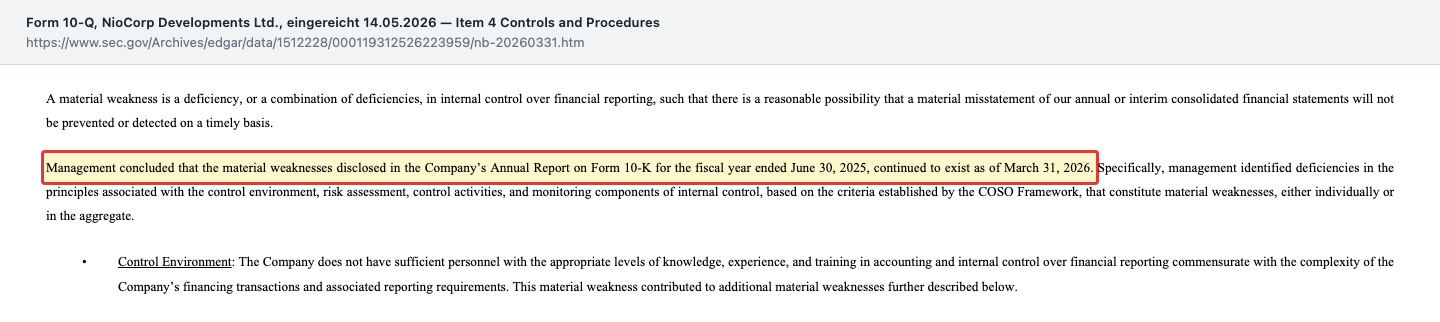
These weaknesses were first disclosed in the annual report for fiscal 2023 — so they have persisted for roughly three years. The filing names four areas: insufficient personnel with the accounting expertise the complexity of the company's financing transactions demands, no formal risk assessment process, inadequate controls over the work of third-party specialists, over the valuation of complex financial instruments and over vendor banking information, and inadequate monitoring. The consequences are not theoretical: according to the filing the same weaknesses caused the restatement of the fiscal 2021 and 2022 financial statements and five interim periods. And on February 14, 2025 the company became aware of unauthorized third-party access to its systems that resulted in misdirected vendor payments — to date, the filing says, without material impact. NioCorp is working on remediation and has engaged outside specialists. But for you as an investor the implication is this: the numbers this entire analysis rests on come from a house whose own controls do not pass their audit.
Valuation: what do you pay for a hole that is not a hole yet?
There is no price-to-earnings ratio here — there are no earnings. There is no price-to-sales ratio either — there is no revenue. What remains is the comparison of market value and substance. For the anchor: on September 8, 2026 the stock closed at $4.12; on 145,587,048 shares outstanding (as of May 14, 2026) that is a market capitalization of roughly $600 million.
Against that stands $435.4 million of equity, $419.2 million of which is simply cash. Strip the cash out and the market is valuing everything else — the deposit, the land, the permits, the started portal, the scandium alloy technology, the agency relationships — at a little over $180 million. That is roughly one sixth of what building the mine alone is supposed to cost, and less than two percent of the operating cash flow the study projects over 38 years.
You can read that number two ways, and both are honest. Optimistically: if Elk Creek ever runs the way the study describes, today's price is absurdly low — the market is paying barely more than land value for an option on a mine. Soberly: this is exactly how a market prices a project whose financing is two thirds unresolved, whose costing dates from 2019 and whose principal revenue driver has lost two thirds of its market price since that costing. The discount is not an oversight but the priced-in probability that the mine will not be built, not built this way, or not built this decade. Whoever buys here is not buying a company but a probability — and their own judgement on whether the market has set it too low.
Upside and risks at a glance
What speaks for NioCorp:
- The treasury has never been fuller: $419.2 million in cash at March 31, 2026 against $25.6 million at June 30, 2025, with working capital of $409.9 million — against planned expenditures of $65 million to $75 million for the next twelve months, that funds several years of operation on paper.
- No debt: of $34.6 million in liabilities, $25.0 million are pure fair value items for warrants and earnout shares. There are no loans, no interest burden and no covenants to snap shut in a weak phase.
- Visible progress rather than announcements: construction on the mine portal began February 26, 2026 (budget $44.6 million, $1.8 million incurred), a drilling program ran April to September 2025, exploration spending rose from $0.9 million to $13.4 million over nine months, and land purchases totalled roughly $14.6 million.
- Government backing in principle: the August 4, 2025 agreement with Advanced Technology International, acting on behalf of the U.S. Department of Defense, provides reimbursements of up to roughly $10.0 million on achievement of project milestones, running through 2028 with an option to extend to 2033.
- A second leg under construction: the December 4, 2025 purchase of FEA Materials' manufacturing assets and intellectual property for $8.4 million brings aluminum-scandium master alloy technology in house — an attempt to turn the raw material into a product rather than merely selling it.
What speaks against it:
- No revenue in 39 years of corporate history, an accumulated deficit of $221.9 million at March 31, 2026 and an operating cash outflow of $11.9 million over nine months — the company's only meaningful income at present is $5.8 million of interest on its own cash.
- A funding gap of roughly $722 million between the cash and the $1,141.0 million initial capital expenditure; two thirds is meant to come from debt, the EXIM application for up to $800 million has been pending since June 6, 2023 without a commitment, and the company cannot estimate the remaining duration.
- Roughly 62 percent of the study's projected gross revenue rests on scandium oxide at an assumed $3,674 per kilogram — the USGS market price for 2024 given in the same annual report is $1,200. The study is also stated in early-2019 dollars and named 2025 as the production start.
- Heavy dilution with more in reserve: 31.2 million shares (June 30, 2023) became 145.3 million (March 31, 2026); on top sit 19.1 million warrants (the largest tranche converts into 1.12 shares each), 4.4 million options and 3.5 million exchangeable subsidiary shares, together close to a fifth of the count — under articles that authorize an unlimited number of further shares.
- A governance finding: material weaknesses in internal financial control disclosed since the fiscal 2023 annual report still existed at March 31, 2026 and caused the restatement of two fiscal years and five interim periods. Add the February 14, 2025 cyber incident with misdirected vendor payments.
A human conclusion
Back to the treasure map trap. Its core is not that the map is forged — Elk Creek is real, the ore is there, the permits are advancing, the portal is being dug, and with $419 million in the bank NioCorp has for the first time in nearly four decades the means to work seriously. Its core is that the map lets you believe the hard part was the finding. It was not. The hard part is the calculation underneath: $722 million still missing. A lender that has been reviewing for three years. A scandium price assumption three times the most recent market price disclosed in a filing — for the metal carrying 62 percent of projected revenue. And a control function that has failed its own audit for three years running.
It can still all work out. If the updated study carries defensible scandium prices, if EXIM commits, if construction begins, then today's roughly $600 million market value for a project with a 38-year life may look absurdly small. Except that is a chain of three ifs — and in a chain the weakest link is always the one that decides. So the honest question is not "is Elk Creek a good deposit?" but: are you prepared to wait three to five years, during which your shares can be diluted further, for an outcome that depends on a credit decision and a metal price you cannot influence? If yes, you have a thesis. If no, you had a map. What you make of it is your decision. And that is exactly as it should be.
Sources
Every original document used in this analysis — read it yourself:
- NioCorp Developments Ltd. — SEC quarterly report 10-Q for March 31, 2026 (filed May 14, 2026)
- NioCorp Developments Ltd. — SEC annual report 10-K for the fiscal year ended June 30, 2025 (filed September 11, 2025)
- NioCorp Developments Ltd. — SEC current report 8-K dated December 4, 2025 (purchase of FEA Materials LLC assets)
- NioCorp Developments Ltd. — SEC current report 8-K dated February 25, 2026 (February 2026 equity offering)
- NioCorp Developments Ltd. — SEC current report 8-K dated July 8, 2026 (fiscal 2026 incentive program)
- Complete SEC filing history for NioCorp Developments Ltd.: EDGAR overview (sec.gov)
- Fundamental data (market capitalization, share count, price series; as of September 8, 2026), reconciled against the SEC filings.
- Trigger: Reddit mentions via our in-house stock scanner (as of September 9, 2026).
Transparency & disclaimer: this analysis is journalistic commentary on publicly available information. It is not investment advice, not a regulated financial analysis and not a solicitation to buy or sell securities. Equity investments carry substantial risk up to total loss. All information is provided without warranty; the as-of date for each figure is noted in the text. Positions held by the operator are disclosed daily; where one exists, it appears as a notice at the top of this analysis.
Key figures at a glance
All monetary figures in millions of $; earnings per share as reported.
| Metric | 2021 | 2022 | 2023 | 2024 | 2025 |
|---|---|---|---|---|---|
| Revenue | 0.0 | 0.0 | 0.0 | 0.0 | 0.0 |
| Operating Income (EBIT) | -4.1 | -7.8 | -37.4 | -13.8 | -12.0 |
| Net Income | -4.8 | -10.9 | -40.1 | -11.4 | -16.3 |
| Earnings Per Share | -0.20 $ | -0.41 $ | -1.40 $ | -0.33 $ | -0.36 $ |
Source: fundamental data & SEC filings (annual and quarterly reports, 10-K/10-Q)
Our Bottom Line at a Glance
- Financial strength and balance sheet positive
- At March 31, 2026 the company held $419.2 million in cash (June 30, 2025: $25.6 million), with working capital of $409.9 million and shareholders' equity of $435.4 million. There is no debt: of $34.6 million in liabilities, $25.0 million are pure fair value items. Against planned expenditures of $65 million to $75 million over twelve months, ongoing operations are funded for years.
- Business model and earning power negative
- In 39 years of corporate history there has never been a dollar of operating revenue; the accumulated deficit stands at $221.9 million (March 31, 2026). Operating cash outflow was $11.9 million over nine months, and the only meaningful income is $5.8 million of interest on the company's own cash. The reported quarterly profit of $0.3 million arose from fair value effects because the share price fell — not from the business.
- Robustness of the project economics negative
- The 2022 feasibility study is stated in first-quarter 2019 constant dollars and named 2025 as the production start — both overtaken. Roughly 62 percent of the $21.9 billion gross revenue it projects over 38 years comes from scandium oxide at an assumed $3,674 per kilogram; the USGS market price for 2024 cited in the same annual report is $1,200. An updated study is announced but not yet published.
- Funding the build negative
- A gap of roughly $722 million sits between the $419.2 million of cash and the estimated initial capital expenditure of $1,141.0 million. Two thirds is meant to come from debt, chiefly the EXIM application for up to $800 million filed June 6, 2023. Nearly three years on, the company states it cannot estimate the duration and that apart from possible option exercises it has no further funding commitments.
- Dilution negative
- Shares outstanding rose from 31.2 million (June 30, 2023) to 145.3 million (March 31, 2026); fiscal 2026 alone brought five placements at prices between $3.25 and $9.34. A further 28.9 million shares could emerge from 19.1 million warrants (the largest tranche converts into 1.12 shares each), 4.4 million options and 3.5 million exchangeable subsidiary shares — close to a fifth of the count, under articles authorizing unlimited capital.
- Governance and controls negative
- The chief executive and chief financial officer declare internal control over financial reporting ineffective. The material weaknesses were first disclosed in the fiscal 2023 annual report and still existed at March 31, 2026; they caused the restatement of the fiscal 2021 and 2022 accounts plus five interim periods. The February 14, 2025 cyber incident with misdirected vendor payments comes on top.
NioCorp is the treasure map trap in pure form: the Nebraska deposit is real, the portal is being dug, and with $419.2 million in the bank the company has for the first time in 39 years the means to work seriously. But between the map and the mine sit a funding gap of roughly $722 million, an EXIM application pending without commitment since June 6, 2023, and a 2022 feasibility study stated in 2019 dollars that rests roughly 62 percent on a scandium price set three times higher than the most recent market price disclosed in a filing. On top, the company has reported material weaknesses in its internal financial controls since the fiscal 2023 annual report, and they still existed at March 31, 2026. Not investment advice.
What Our Rating Means
Substance risk
We found at least one documented issue that threatens the company itself — regardless of how the stock is currently valued.
The light is not red because the stock is expensive — measured against the cash pile it is strikingly cheap. It is red because several documented findings go to the substance of the company itself: no revenue in 39 years alongside persistently negative operating cash flow, while a quarterly bottom line shows a profit that came from fair value effects; an ineffectiveness of internal financial control disclosed since the fiscal 2023 annual report and still present at March 31, 2026, which has already forced the restatement of two fiscal years and five interim periods; and a corporate purpose whose fulfilment hangs on a credit decision outstanding since June 6, 2023. Anyone who invests anyway should check three things in every filing: what scandium price does the updated feasibility study adopt? Is there a binding EXIM commitment? And how many shares are outstanding now? The decision is yours.
A journalistic assessment by our editorial team at the time of the deep dive, based on public sources — not investment advice and not a solicitation to buy or sell. Your personal circumstances (investment goals, risk capacity, taxes) cannot be taken into account. What our levels mean, how verdicts are formed, and what conflicts of interest exist →
Worth Noting
- NioCorp reached our research list through the Reddit mention component of our in-house stock scanner (as of September 9, 2026) — an attention signal, not a quality signal. Classic ratios such as price-to-earnings or price-to-sales cannot be computed for a company without revenue or earnings, so the assessment rests on the cash position, the robustness of the project economics and dilution.
- As-of dates: balance sheet, income and cash flow figures come from the 10-Q for March 31, 2026 (filed May 14, 2026); project, employee and commodity price data come from the 10-K for fiscal 2025 (filed September 11, 2025). All filings from May 14, 2026 onward were reviewed; the most recent company filing (8-K of July 8, 2026 on the incentive program) does not change the picture, and the most recent EDGAR submission of any kind is a third-party ownership report (Schedule 13G of July 29, 2026). The annual report for fiscal 2026, ended June 30, 2026, had not been filed as of September 9, 2026.
- The revenue split of the feasibility study (roughly 62 percent scandium) is not a company disclosure but our own calculation from its table: payable tonnages times assumed prices, summing to the $21.9 billion gross revenue reported there. Not to be confused: NB is NioCorp Developments, not NIOBW, the company's separately listed warrant.
Stock Watch
This analysis is as of September 9, 2026. Stock Watch will tell you what's changed at NB since then.
Later $1 a month per stock — signing up is free, and you'll be the first to know when it launches.
The full analysis as a PDF for later
We will send you this analysis as a PDF — to print, file away, and read at your own pace. And we will add you to the free Stock Watch list for NioCorp Developments Ltd. (NB), so you hear about it when something material in this analysis changes.
Frequently Asked Questions
NioCorp Developments Ltd. (NASDAQ: NB) is developing the Elk Creek project in southeastern Nebraska — a deposit containing niobium, scandium and titanium plus rare earth resources. It mines nothing so far and earns no operating revenues; the quarterly report for March 31, 2026 states this explicitly. The company was incorporated in British Columbia on February 27, 1987 and its offices are in Centennial, Colorado. As of June 30, 2025 it had seven full-time employees and one contract employee.
At March 31, 2026 the company held $419.2 million in cash plus $2.1 million restricted, with working capital of $409.9 million. For the following twelve months it plans expenditures of $65 million to $75 million, including roughly $11.6 million of corporate overhead. On paper the cash therefore funds several years of ongoing operations. It does not fund the mine: the feasibility study puts the initial capital expenditure at $1,141.0 million.
The 2022 feasibility study projects gross revenue of $21.9 billion over 38 years. Roughly $13.5 billion of that — about 62 percent — comes from 3,676 tonnes of scandium oxide at an assumed $3,674 per kilogram. The same fiscal 2025 annual report lists the USGS market price for 2024 at $1,200 per kilogram, down from $3,800 in 2020. The company itself notes that these surveys may not be representative of the prices it would actually realize.
NioCorp applied to the Export-Import Bank of the United States on June 6, 2023 for debt financing of up to $800 million. On October 2, 2023 the application cleared the first of three committee reviews, and in April 2024 a non-binding term sheet followed with a list of additional work. In the quarterly report for March 31, 2026 the company states it cannot estimate the remaining duration and that a final debt commitment cannot be assured. About two thirds of the build cost is meant to come from debt.
Shares outstanding rose from 31.2 million at June 30, 2023 to 38.1 million (2024), 58.5 million (2025) and 145.3 million at March 31, 2026 — nearly fivefold in under three years. On top sit 19.1 million warrants, 4.4 million employee options and 3.5 million exchangeable shares in the project subsidiary, together about 28.9 million potential new shares or close to a fifth of the count. The articles authorize an unlimited number of further shares.
The $0.3 million pre-tax profit ($0.7 million attributable to the company, $0.01 per share) did not come from the business. Against $7.3 million of operating expenses stood $2.8 million of interest income on the company's own cash and $4.8 million of fair value gains on warrants and earnout shares. Those gains arose because the share price used in the valuation fell. Over nine months the same mechanism ran in reverse and contributed $21.3 million to the $44.4 million loss.
The chief executive and chief financial officer state that internal control over financial reporting is not effective. The material weaknesses were first disclosed in the fiscal 2023 annual report and, per the quarterly report, still existed at March 31, 2026. They affect the control environment, risk assessment, control activities and monitoring, and caused the restatement of the fiscal 2021 and 2022 accounts plus five interim periods. On February 14, 2025 unauthorized system access resulted in misdirected vendor payments.
NioCorp gives no firm date. The 2022 feasibility study had assumed 2025 as the year of commercial production — that date has passed. On the study's schedule, 39 months elapse from authorization to proceed until mechanical completion, plus roughly six months of commissioning, within a four-year pre-production period. Authorization depends on financing; what began on February 26, 2026 was only the mine portal, budgeted at $44.6 million.
Found an error?
Did you spot a factual error, an outdated number, or a typo in this deep dive? Let us know briefly — your report goes straight to the editorial team.