Southern Cross Gold: C$3.25 Billion for a Gold Deposit That Is Officially Not Yet a Resource
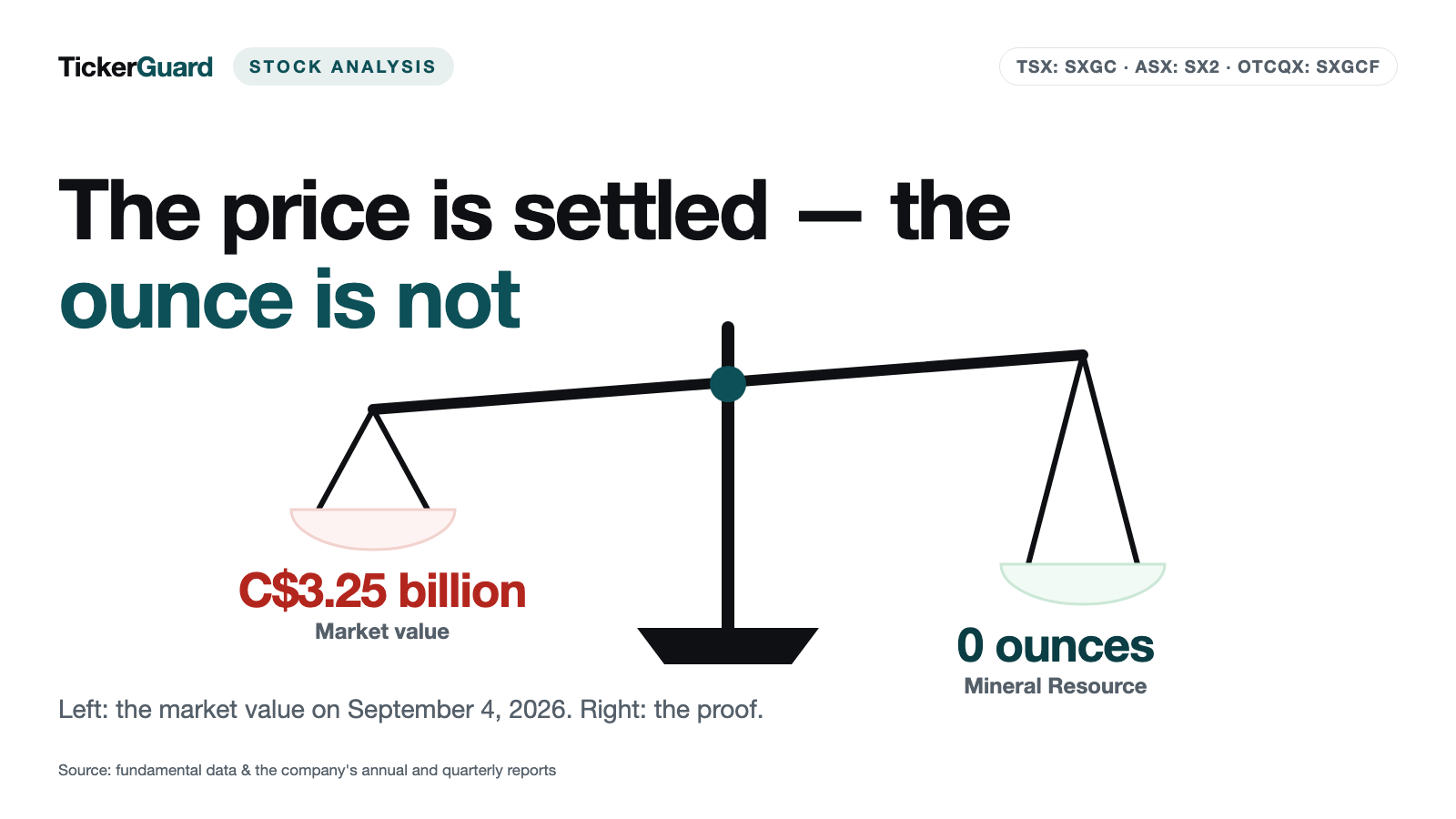
Southern Cross Gold Consolidated (TSX: SXGC, ASX: SX2, OTCQX: SXGCF) has been pulling spectacular gold grades out of Sunday Creek north of Melbourne for years — 278 drill holes, 134,534 meters, 96 intercepts above 100 grams of gold per tonne (as at August 25, 2026). What the company still does not have sits in its own annual report of August 27, 2026: no Mineral Resource, no reserve, no economic study and not one dollar of revenue. The market values all of it at roughly C$3.25 billion anyway. That is the finished-in-your-head trap in its purest form. We read the audited financial statements, the MD&A and every release since, and worked out what you are paying per ounce that does not officially exist yet.
 Thomas Mücke
Founder & Publisher
Thomas Mücke
Founder & Publisher
Chart
Interactive price chart (TradingView).
Note: pure fact-based analysis, not investment advice and not a solicitation to buy or sell. All figures without guarantee.
There is an investor weakness that is unusually hard to spot, because it feels like optimism: we are handed half a picture and finish painting it in our heads. A drill core with 972 grams of gold per tonne, a map with a red line running twelve kilometers, a tunnel biting into a hillside — within seconds our mind turns that into a mine. Call it the finished-in-your-head trap: you pay today for a picture you completed yourself.
Southern Cross Gold Consolidated Ltd. is a textbook case of it. The company has delivered drill results for years that impress even seasoned geologists. And in its own audited annual report of August 27, 2026 it states in plain words what it does not yet have: no revenue, no proven resource, no reserve. So let us make a deal: we read the consolidated financial statements as at May 31, 2026, the MD&A and the releases that followed — and put the drill core and the cash book side by side. You decide at the end.

What Southern Cross Gold actually owns
Southern Cross Gold Consolidated Ltd. was incorporated on March 10, 2004 in British Columbia and has only carried that name since January 10, 2025. Before that it was Mawson Gold Limited, a Canadian explorer that spent time looking for gold in Finland. The group keeps its books in Canadian dollars, runs its executive office out of Vancouver and its entire operating team out of Melbourne. The fiscal year ends on May 31 — an oddity worth remembering when you compare numbers.
The centerpiece is the Sunday Creek gold-antimony project, roughly 60 kilometers north of Melbourne in the Australian state of Victoria. The company owns it outright, it sits inside 16,900 hectares of granted exploration licences plus a retention licence, and around it the company has since bought 2,296 hectares of freehold land (as at September 2, 2026; as at August 25, 2026 it was still 1,392 hectares). Geologically it is an epizonal, Fosterville-style gold deposit — the mineralization sits in vein packages the company calls the "Golden Ladder" because of the way they stack.
Alongside it comes the smaller Redcastle project, 110 kilometers north of Melbourne, three licences covering 7,500 hectares in total. That one is fully owned as well: the company earned 70 percent by 2021 and bought Nagambie Resources' remaining 30 percent in October 2024 for A$250,000. Redcastle sits seven kilometers along strike from Alkane Resources' Costerfield mine and 24 kilometers east of Agnico Eagle's Fosterville mine — two producing operations the Southern Cross Gold geologists benchmark against. Historically, ore from Sunday Creek really was processed at Costerfield during the First World War, 54 kilometers away.
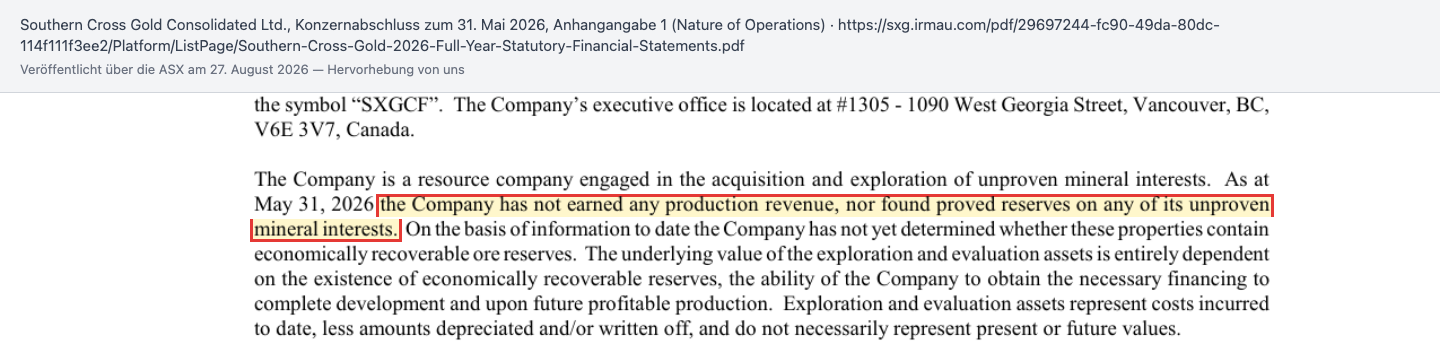
So how does the company make money? It does not. And that is not a rhetorical flourish but a verbatim statement from the audited accounts:
"The Company is a resource company engaged in the acquisition and exploration of unproven mineral interests. As at May 31, 2026 the Company has not earned any production revenue, nor found proved reserves on any of its unproven mineral interests."
— Southern Cross Gold Consolidated Ltd., consolidated financial statements as at May 31, 2026, Note 1 (Nature of Operations)
Company history for investors
-
2020
Sunday Creek bought for A$528,880
Today's core project cost A$528,880 in cash plus 315,514 shares on March 24, 2020 — a fraction of one percent of today's market value.
-
2025
Restructuring into Southern Cross Gold Consolidated
Share consolidation of one for 3.169432, ASX listing, purchase of the rest of the Australian subsidiary for 125,041,031 shares — heavily diluting existing holders.
-
2025
Placement of C$143.1 million
31,800,078 shares at C$4.50 raised the money the company still lives on. Anyone who subscribed then is well ahead at the September 4, 2026 price.
-
2025
Victoria approves the exploration decline
The work plan approval of November 26, 2025 turned a drilling project into a project with underground access — the key permitting step of the year.
-
2026
C$700 million base shelf prospectus
Since April 8, 2026 the company can issue shares or debt worth a fifth of its market value at any time. Nothing had been drawn as at August 25, 2026.
-
2026
Exploration Target raised to 3.0-4.6 Moz
The release of August 4, 2026 widened the target to five prospects. It is still not a Mineral Resource — the maiden estimate is due in the first quarter of 2027.
Why there is no annual report at the U.S. securities regulator
One point up front, because it shapes the whole evidence chain: there is no 10-K and no 10-Q for Southern Cross Gold. The company is not a U.S. reporting issuer. The database of the U.S. securities regulator, the SEC, does carry an entry under CIK 0001622629, but underneath it sit Form D notices only — short filings about private placements that contain no financial statements. For a Canadian company with a home listing that is entirely normal and not a red flag.
Reporting runs under Canadian law instead, specifically National Instrument 51-102. That produces two document types, both available in full: the audited consolidated financial statements as at May 31 together with the MD&A (Management's Discussion and Analysis), and the quarterly financial statements with their own MD&A. Both go to the public through the Canadian filing platform SEDAR+ and additionally through the Australian Securities Exchange, because depositary interests over the shares have traded there since January 15, 2025.
For a reader that is an advantage rather than a drawback. The Canadian MD&A is far more talkative than a U.S. quarterly report: it lists milestones with a status, breaks out what the money was spent on quarter by quarter, and even quantifies the planned outflow rate for the coming quarters. Every figure in this analysis therefore carries the label "Source: fundamental data & the company's annual and quarterly reports" — not the U.S. form numbers, which simply do not exist here. For another Australian gold company where we drew the same line between reported ounces and money actually earned, see our Matsa Resources analysis.
And because three currencies meet here, let it be said once: the balance sheet is in Canadian dollars (C$), the shares trade in Canadian dollars in Toronto, in Australian dollars (A$) in Sydney and in U.S. dollars in the United States. Every figure in this text carries its currency. We convert only where a comparison requires it — at the September 4, 2026 rate of one U.S. dollar to 1.3840 Canadian dollars.
How the stock landed on our desk
Honestly: Southern Cross Gold is not a hit from our in-house stock scanner. That tool works with profit, margin and balance-sheet ratios — and a company without a single dollar of revenue fails every one of those filters. The scanner showing nothing here is not a bug; it is the correct answer.
The stock reached our research list through the U.S. ticker SXGCF, the symbol under which it shows up in retail investor forums. That is exactly where a second look pays off, because four tickers hide the same share across four very different venues: SXGC on the Toronto Stock Exchange — the home listing, where the price is actually made — SX2 on the ASX in Sydney (as a depositary interest, a CHESS Depositary Interest or CDI), SXGCF on the U.S. OTCQX market and MV3 in Frankfurt. The OTCQX is explicitly not a regulated U.S. exchange but an over-the-counter venue with lighter admission requirements.
September 4, 2026 shows just how differently thick the order books are: 231,375 shares changed hands in Toronto that day (close C$12.05), 205,696 depositary interests in Sydney (A$12.27), and only 48,700 shares on the OTCQX (US$8.72). That is no argument against the stock, but it is a practical warning: an unlimited order in a thin book can fill at a price you never wanted. Currency is the second stumbling block — buy in euros in Frankfurt and you carry the Canadian dollar's moves as well, without a single drill hole being involved.
The recency check belongs here, and it comes out clean: after the annual report of August 27, 2026 there was exactly one price-sensitive release, the drill results of September 2, 2026, plus three administrative filings on September 4 covering 3,193 new depositary interests and 250,000 options that lapsed on August 15, 2026. None of it changes the picture on cash, debt or level of proof. Everything stated in the present tense in this analysis rests on May 31, 2026 or later.
The numbers over the years — honestly appraised
Let us start with what genuinely impresses. As at May 31, 2026 Southern Cross Gold held C$119,129,501 in cash, current assets of C$121.1 million against current liabilities of just C$6.6 million, total assets of C$275.6 million and equity of C$266.9 million. The equity ratio is roughly 97 percent. There is no financial debt. Auditor D&H Group LLP of Vancouver issued an unqualified opinion on August 25, 2026, with no material uncertainty related to going concern.
For an explorer that is an unusually clean starting position. Anyone who has read a small mining company's accounts knows the usual setup: thin cash, an expensive loan from the major shareholder, a going-concern paragraph in the audit report. None of that is here. The money came from a fiscal 2025 placement: 31,800,078 shares at C$4.50, gross proceeds of C$143,100,351.
Now the other half of the picture. In fiscal 2026 the company earned no revenue — the "Revenues" line in the MD&A reads "Nil" for 2026, 2025 and 2024 alike. The reported net loss was C$5,475,812, after C$8,074,009 the year before. The loss looks small for two reasons, and both are instructive. First, the large cash pile earned C$4,674,154 in interest, offsetting nearly half of the C$9,963,080 of expenses. Second — and this matters more — drilling and decline costs at an explorer do not land in the income statement at all; they are capitalized as an asset.
How big that difference is shows up in the cash position:
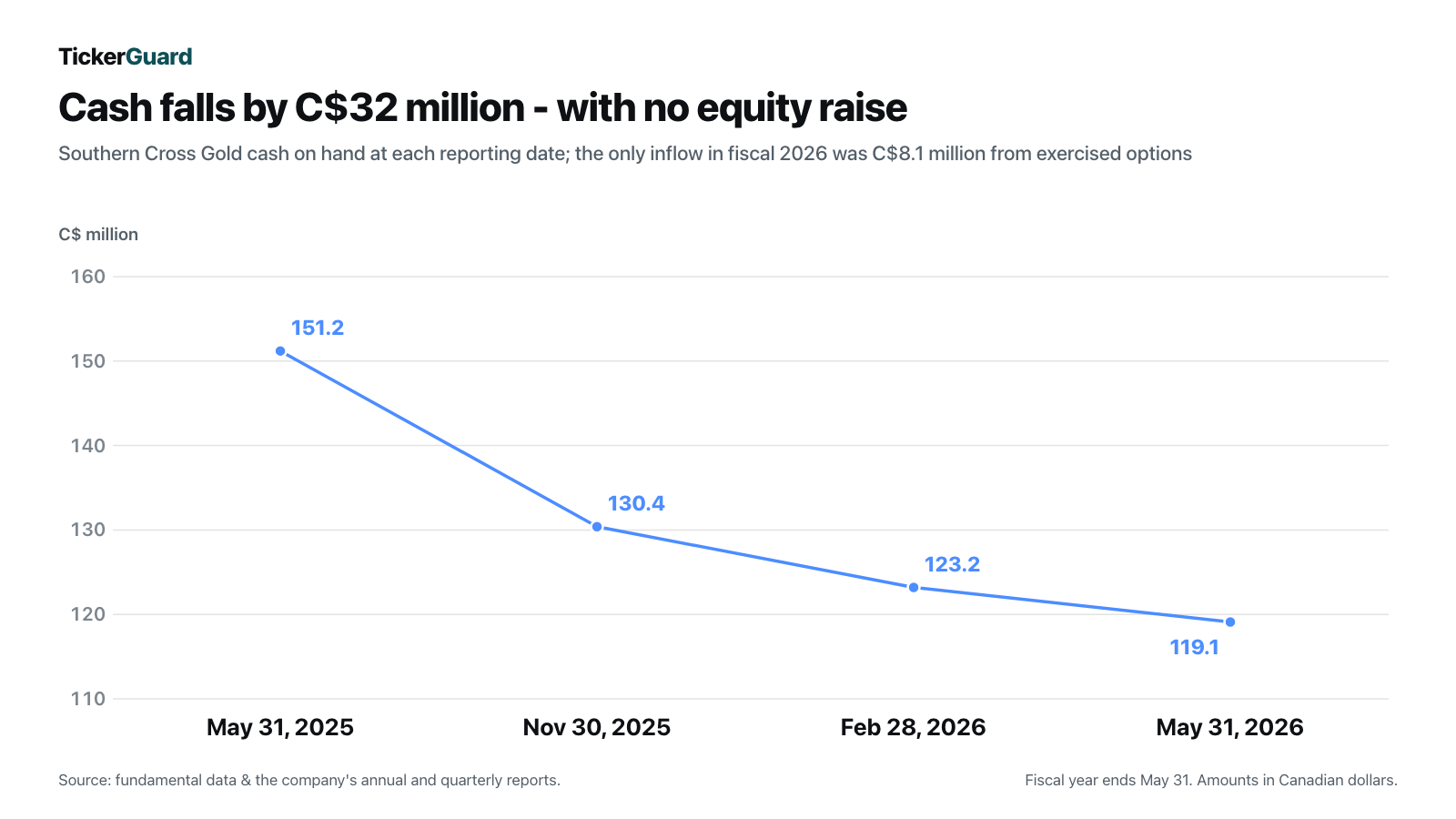
C$32.1 million net flowed out in fiscal 2026 while the income statement shows only C$5.5 million of loss. The MD&A lists item by item where the money went — and that breakdown is the most honest look into the engine room an explorer can offer:
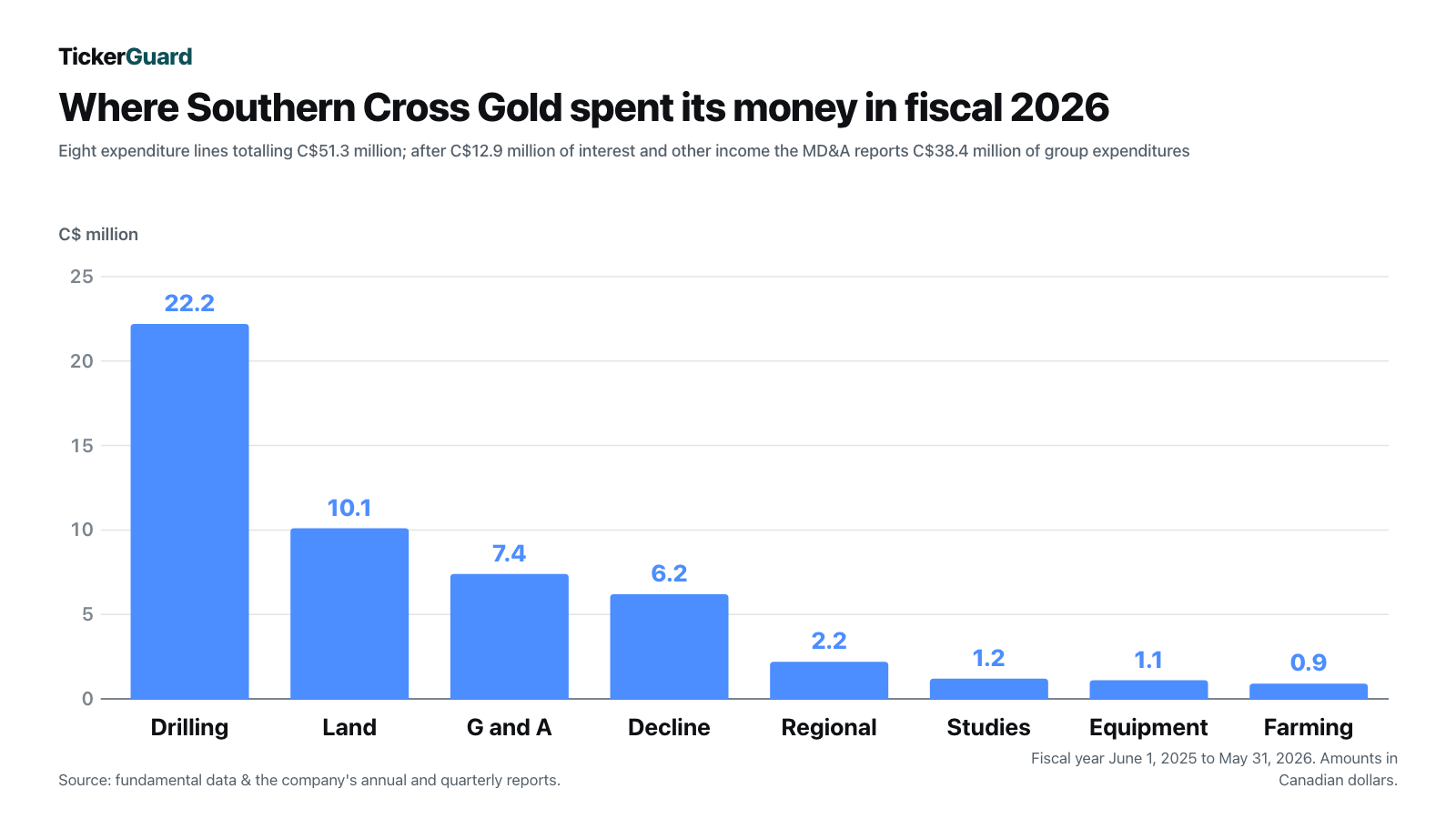
So you can follow the path from C$51.3 million down to C$32.1 million, here is the bridge the MD&A itself draws: C$51.3 million of expenditures less C$12.9 million of interest and other income gives the C$38.4 million of group expenditures. Add C$1.8 million posted as security for the rehabilitation obligation and you reach C$40.2 million. Running the other way were C$8.1 million of working capital and foreign exchange adjustments. What remains is the C$32.1 million of net expenditures by which the cash position actually shrank.
Two numbers from that breakdown deserve context. The 60,913 meters drilled during the year cost A$283 per meter on a drilling-only basis and C$364 per meter all in — for a diamond drilling program at this depth that is a normal to cheap figure. And the C$10.1 million for land is not a luxury but insurance: anyone who wants to build a mine later needs the ground around it, and it does not get cheaper once the drill success is in the newspapers.
What the filings say — the uncomfortable truths
Now to the passages you rarely find on the title slide of a presentation. All five come from the company's own documents.
Uncomfortable truth no. 1: the Exploration Target is explicitly not a resource
On August 4, 2026 Southern Cross Gold reported an updated Exploration Target for Sunday Creek: 10.4 to 11.9 million tonnes at 8.9 to 12.1 grams of gold equivalent per tonne, or 3.0 to 4.6 million ounces. The range covers five prospects — Christina, Golden Dyke, Rising Sun, Apollo and Apollo East.
What an Exploration Target is and is not sits in the fine print of the same release, and the JORC and NI 43-101 codes prescribe that sentence word for word:
"The potential quantity and grade of the Exploration Target is conceptual in nature and therefore is an approximation. There has been insufficient exploration to estimate a Mineral Resource and it is uncertain if further exploration will result in the estimation of a Mineral Resource."
— Southern Cross Gold Consolidated Ltd., MD&A for the fiscal year ended May 31, 2026
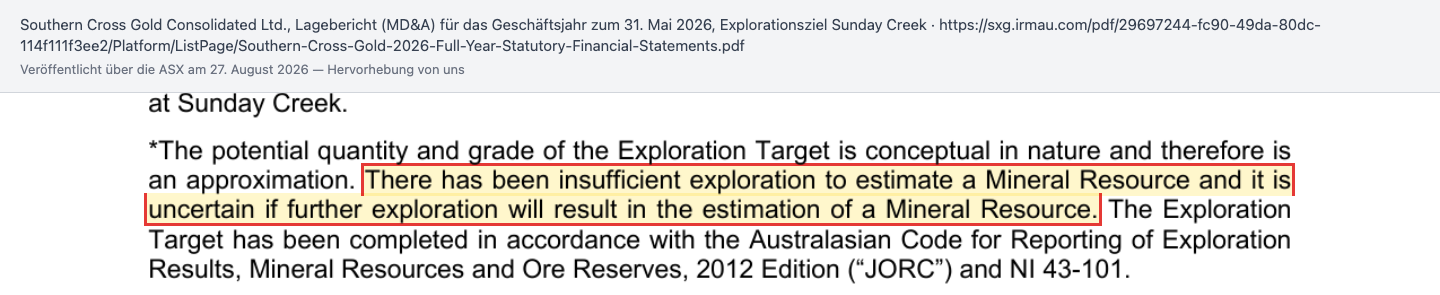
The distinction is not a formality; it is half the investment case. A Mineral Resource is an estimate backed by enough drill data to state tonnage and grade with defined confidence. A reserve is the portion of that for which a study has shown it can actually be mined at the assumed costs and prices. An Exploration Target sits one step further back: a geologically reasoned expectation, explicitly labelled an approximation. So Southern Cross Gold has neither reserve nor resource — the maiden estimate is announced for the first quarter of 2027, a preliminary economic study for the second.
Uncomfortable truth no. 2: the burn rate triples — and the money lasts to the study, not to the mine
In fiscal 2026 C$32.1 million flowed out net, an average of a little over C$8 million per quarter. For the coming quarters management names a different order of magnitude — and names it refreshingly plainly:
"Based on expected deployment rates of approximately $25 million per quarter, for the next two quarters before reverting to approximately $10 million per quarter, the Company has sufficient cash to fund operations through resource establishment (Q1 CY2027) and PEA completion (by Q2 CY2027)."
— Southern Cross Gold Consolidated Ltd., MD&A as at May 31, 2026, section 5 Liquidity
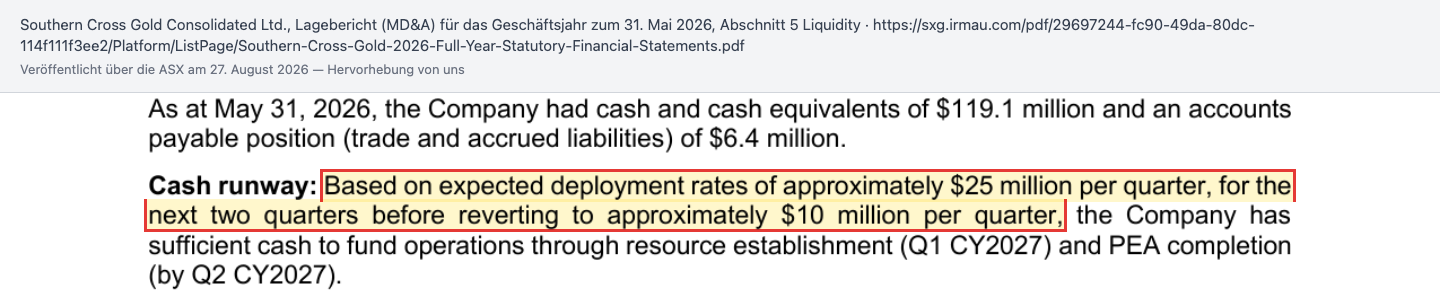
Two things sit inside that sentence. First, spending roughly triples against last year's average — the next two quarters alone are meant to cost about C$50 million, a good 40 percent of the cash at May 31, 2026. Second, and this is easy to skim past: the commitment reaches the preliminary economic assessment, or PEA. A PEA is the first, roughest economic calculation of a mining project. Between it and a finished mine sit further studies, permits and a capital outlay that for an underground operation of this size typically runs into the hundreds of millions. That number appears nowhere in the report — and it is not in the bank account either.
Uncomfortable truth no. 3: a C$700 million shelf of stock sits ready
The company has prepared for exactly that gap. In the third quarter of fiscal 2026 it filed a C$700 million base shelf prospectus with the regulators of British Columbia, Alberta and Ontario (release of April 8, 2026). A base shelf prospectus is pre-approval held in reserve: it permits the issue of shares, warrants, debt securities, subscription receipts or units at any time over 25 months without running the full admission process again.
"The Company has no immediate plans to issue securities under the base shelf prospectus, and may never issue any securities under the base shelf prospectus."
— Southern Cross Gold Consolidated Ltd., MD&A as at May 31, 2026, Financings section
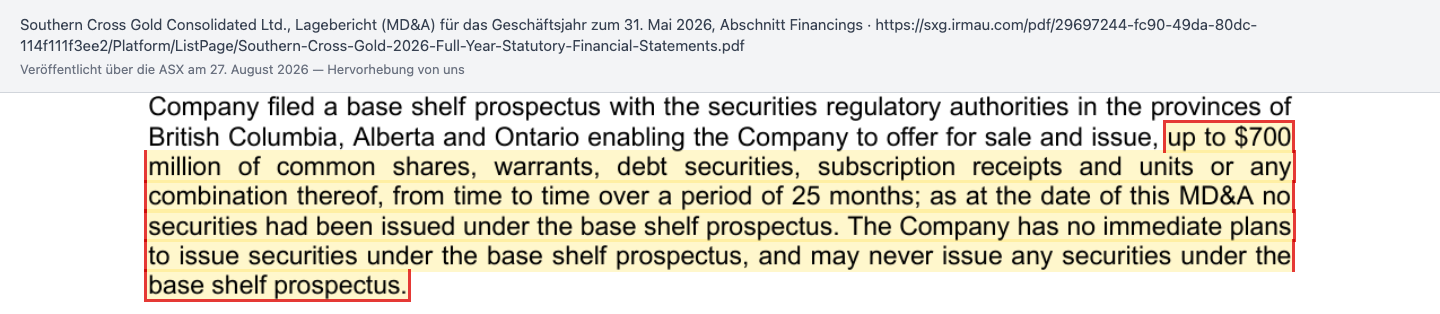
You have to read that sentence twice, because it says both things. The shelf is unused so far — that is good. And it is set up — that is the message. C$700 million is roughly one fifth of today's market value. Dilution means something simple for you as a shareholder: your slice of the cake gets smaller because more people are eating from the same cake. Whether and at what price that happens is the central open question of this investment — and it will not be answered by the geology but by the capital market.
Uncomfortable truth no. 4: the antimony story has halved in price
Sunday Creek is often told as the West's answer to China's antimony export controls, and the story has a real core: antimony is a critical raw material for munitions, semiconductors and flame retardants, and in August 2024 China announced export controls that took effect on September 15, 2024.
The price at the center of that story, however, has already retraced. The MD&A gives a spot price of CNY 92,000 per tonne on August 7, 2026 (roughly US$13,600) — down 43.2 percent year to date and 50.8 percent over twelve months. Against the 2025 peak of roughly CNY 240,000 that is a little over a third. The company handles this fairly: it expects roughly 80 percent of recoverable value to come from gold and treats antimony as an addition, not a foundation. For you that means the strategic story is real, but it rests on a price that has halved in a year.
One detail deserves a second look, because it feeds straight into the ounce number. The Exploration Target is stated in gold equivalent, and the formula used for it — gold in grams per tonne plus 2.39 times antimony in percent — comes from the neighboring Costerfield mine's calculation for 2024. It assumes a gold price of $2,500 per ounce and an antimony price of $19,000 per tonne. Both assumptions are off today, and in opposite directions: gold traded at roughly $4,380 on August 11, 2026, antimony at roughly $13,600 on August 7. The conversion factor therefore weights antimony rather too heavily and gold rather too lightly. That does not invalidate the number — the formula is disclosed and industry standard — but it is a reminder that even the Exploration Target itself rests on price assumptions, not only on geology.
Uncomfortable truth no. 5: one project, one segment, one country
The notes to the financial statements are unambiguous here: the company runs a single reportable segment, the exploration of unproven mineral interests. Of the C$275.6 million of total assets, C$238.3 million sit in Australia and C$37.3 million in Canada — the latter essentially the cash. Of the C$119.6 million of capitalized exploration costs, C$116.7 million belong to Sunday Creek and only C$2.9 million to Redcastle.
On top of that come commitments few people ever read: to keep its licences the company must spend, on its own schedule, A$20,101,792 within one year and a further A$9,057,829 over the four years after that. At this cash level that is no threat, but it is not optional either: fail the minimum expenditure and you risk the licence. The rehabilitation provision for the infrastructure already built sits at C$1,553,313 on the balance sheet, undiscounted A$2,078,330, estimated to fall due in December 2031.
Valuation: what you pay per ounce that is not yet a resource
Now let us add it up. As at August 25, 2026 there were 269,653,562 shares outstanding, plus 850,000 options and 163,499 share units — so dilution from employee programs runs below half a percent and is negligible here.
On September 4, 2026 the stock closed at C$12.05 in Toronto, A$12.27 in Sydney and US$8.72 on the OTCQX. All three produce the same market value: roughly C$3.25 billion (about $2.35 billion). Deduct the C$119.1 million of cash and an enterprise value of roughly C$3.13 billion remains. That is what the market is paying for Sunday Creek and Redcastle.
Divide it by the Exploration Target and you get the number this whole piece is really about:
- At the top end of the target (4.6 million ounces of gold equivalent): roughly C$680 per ounce.
- At the bottom end (3.0 million ounces): roughly C$1,043 per ounce.
For context, the MD&A puts the gold price at roughly $4,540 per ounce at the fiscal year end (May 31, 2026) and roughly $4,380 on August 11, 2026 — a good C$6,060 converted. So the market is paying roughly 11 to 17 percent of the price of an ounce you can actually hold in your hand for an ounce that is not yet a resource, before a single dollar has been spent on mining, processing and smelting. Whether that is a lot or a little hangs on exactly one question: how much of the conceptual target survives the maiden estimate in the first quarter of 2027?
And in fairness: this yardstick has a built-in weakness you should know about. At an explorer with a resource you divide enterprise value by an audited number. Here we divide it by a number the company itself labels an approximation — and by a range whose top end sits a good half above its bottom end. So the value per ounce says less about whether the stock is expensive than about how much trust sits in the price: trust that the approximation becomes an estimate, and that the estimate later becomes mineable ore.
The second yardstick is starker still. Book equity as at May 31, 2026 was C$266.9 million. The market pays a good twelve times that. For a company without revenue the price-to-book ratio says little about quality — but it says very precisely how much advance credit sits in the price.
If you want a comparison with another Australian explorer where the ounces in the ground and the money in the bank sit similarly far apart, you will find it in our Strickland Metals analysis. There is no conventional price-to-earnings ratio at Southern Cross Gold because there are no earnings, and no price-to-sales ratio because there is no revenue. Neither is a data error here; it is the thing itself.
Opportunities and risks at a glance
What speaks for the company:
- The drill results are exceptional. As at August 25, 2026 there were 278 drill holes over 134,534 meters, including 96 intercepts above 100 grams of gold per tonne (up to 3,511 grams over 0.7 meters) and 110 intercepts above 10 percent antimony (up to 47.5 percent over 0.6 meters). On September 2, 2026, 0.6 meters at 972 grams of gold per tonne were added.
- The balance sheet is debt-free and liquid. C$119.1 million of cash, C$114.5 million of working capital, no financial liabilities, an unqualified audit opinion without a going-concern paragraph (August 25, 2026).
- The permitting path works. Victoria approved the work plan for the exploration decline on November 26, 2025; the decline stood at 123.1 meters at the end of July 2026, has run on a 24-hour basis since July and is meant to reach roughly 1,100 meters by December 2026.
- The metallurgy has been tested. Stage 2 test work (August 2025) produced 92 to 96 percent gold recovery and a low-arsenic antimony-gold concentrate — not a given with antimony-bearing ore.
- The stock has arrived in the indices. Inclusion in the S&P/ASX 300 and the FTSE Russell Global Small Cap indices in the first quarter of fiscal 2026 (June to August 2025), in the GDXJ and the FTSE Canada All Cap effective March 20, 2026, and in the S&P/TSX Composite on June 22, 2026 — that brings institutional demand which does not depend on the next drill release.
What speaks against it:
- There is no resource and no reserve. The entire C$119.6 million carrying value of the exploration assets rests on something economically recoverable eventually coming out of them. The auditor lists exactly that assessment as a key audit matter.
- The money lasts to the preliminary study, not to the mine. The burn rate rises to roughly C$25 million per quarter for two quarters; for construction itself no financing is described.
- The C$700 million base shelf stands ready. It is unused, but it is there — and as things stand it is the obvious source of construction capital, as long as no other financing is described.
- Everything hangs on one project. One segment, one country, C$116.7 million of the C$119.6 million of capitalized costs in Sunday Creek. A geological, regulatory or technical setback has no counterweight.
- The antimony price has halved (down 50.8 percent over twelve months to August 7, 2026), and the gold price at fiscal year end, roughly $4,540, was historically high (up about 40 percent year on year) but around a fifth below the record of roughly $5,600 set in late January 2026 — the valuation assumes both metal prices on the favorable side.
- Trading on the OTCQX is thin. On September 4, 2026, 48,700 shares changed hands there against 231,375 in Toronto. Price formation happens in Toronto and Sydney; the Frankfurt quotation is a secondary listing with no price formation of its own. Buy anywhere other than the two home exchanges and you carry the spread and the currency risk on top.
A human conclusion
Remember the finished-in-your-head trap from the opening? Southern Cross Gold is not a case of glossy communication. Quite the opposite: rarely has a company drawn the line between what it has found and what it cannot yet prove so cleanly. The mandatory caveat that exploration is insufficient for a resource estimate appears in every document. The burn rate for the coming quarters is written out. The base shelf is named, together with the truth that it may never be drawn.
So the trap does not sit in the report; it sits in our heads. We read "972 grams of gold per tonne" and automatically add a mine that nobody has yet permitted, costed or paid for. Between the drill core and the first bar sold sit a resource estimate, a preliminary economic assessment, a feasibility study, further permits, a construction contract and several hundred million dollars that today are neither in the bank nor in a credit agreement. Some explorers walk that road to the end. Many do not.
What sets Southern Cross Gold apart from most is the starting position: debt-free, with C$119 million in the bank, with an approved underground access and with 96 reported intercepts above 100 grams of gold per tonne. What it shares with all of them is the rest of the road. The next hard test even has a date: the first quarter of 2027, when the conceptual target is supposed to become an estimated resource — or not.
What you make of it is your decision. And that is exactly as it should be.
Sources and data cut-off
- Consolidated financial statements and MD&A for the fiscal year ended May 31, 2026, audit report by D&H Group LLP dated August 25, 2026, released through the ASX on August 27, 2026
- Appendix 4G, Corporate Governance Statement and Shareholder Information as at August 25, 2026 (ASX, August 27, 2026)
- Updated Exploration Target, Sunday Creek (ASX, August 4, 2026)
- Drill results, Apollo and Apollo East (ASX, September 2, 2026)
- The company's complete announcement archive, including the quarterly financial statements and MD&A as at February 28, 2026 (April 13, 2026) and the administrative filings of September 4, 2026
- Price, volume and exchange-rate data: source fundamental data, as of September 4, 2026
Data cut-off: company figures as at May 31, 2026 or the date stated in each line; price, market-value and conversion figures as of September 4, 2026 (one U.S. dollar to 1.3840 Canadian dollars). The announcement archive was last checked on September 7, 2026; the most recent release remains September 4, 2026. The reporting currency is the Canadian dollar; Australian and U.S. dollar figures are labelled as such.
Disclaimer: This article is a journalistic contextualization of publicly available information and is not investment advice. It contains no buy or sell recommendation and is not a solicitation to buy or sell securities. Shares in exploration companies without revenue are especially volatile; a total loss of the capital invested is possible. Any position held by the publisher is disclosed on the day; where one exists, it appears as a note at the top of this analysis.
Our Bottom Line at a Glance
- Balance sheet and financial strength positive
- As at May 31, 2026 there was C$119,129,501 in cash, working capital of C$114,497,878 and no financial debt. Auditor D&H Group LLP issued an unqualified opinion on August 25, 2026 with no material uncertainty related to going concern.
- Evidence behind the drill results positive
- As at August 25, 2026 there were 278 drill holes over 134,534 meters, including 96 intercepts above 100 grams of gold per tonne and 110 intercepts above 10 percent antimony. Metallurgical tests from August 2025 produced 92 to 96 percent gold recovery.
- Level of proof of the deposit negative
- There is no Mineral Resource, no reserve and no economic study. The Exploration Target of August 4, 2026 is conceptual by mandatory caveat, and the C$119,617,908 carrying value of capitalized exploration costs depends entirely on something economically recoverable coming out of it.
- Cash burn and financing need negative
- The MD&A as at May 31, 2026 plans roughly C$25 million of outflow per quarter for two quarters, then about C$10 million. That funds the road to the preliminary economic assessment in the second quarter of 2027 — not the construction of a mine. A C$700 million base shelf prospectus has stood ready since April 8, 2026 and was unused as at August 25, 2026.
- Valuation negative
- With 269,653,562 shares and a September 4, 2026 close of C$12.05, the company costs roughly C$3.25 billion. After deducting cash that is about C$680 to C$1,043 per conceptual gold-equivalent ounce and a good twelve times the C$266.9 million of book equity.
- Concentration risk and market backdrop negative
- One segment, one country, one project: C$116.7 million of the C$119.6 million of capitalized costs sit in Sunday Creek. The antimony spot price stood at CNY 92,000 per tonne on August 7, 2026, 50.8 percent below its level twelve months earlier; the gold price at roughly $4,540 per ounce on May 31, 2026 was up about 40 percent year on year but around a fifth below the record of roughly $5,600 set in late January 2026.
Southern Cross Gold has been drilling exceptional gold grades at Sunday Creek for years — 278 holes, 134,534 meters, 96 intercepts above 100 grams per tonne as at August 25, 2026 — and stands debt-free with C$119.1 million in the bank. What is missing, the company names itself: no Mineral Resource, no reserve, no economic study and no revenue. The market pays roughly C$3.25 billion for that, about C$680 to C$1,043 per ounce of an explicitly conceptual Exploration Target. The next hard test has a date: the first quarter of 2027, when it is meant to become an estimated resource. Not investment advice.
What Our Rating Means
Open questions
The business works in principle, but one material question is open. As long as it stays open, our findings do not carry a quality verdict.
Yellow is not about the share price here, ambitious as it is. Red would be wrong: the company is debt-free, holds C$119.1 million in cash, carries an unqualified audit opinion of August 25, 2026 with no going-concern paragraph, and on its own plan has money for well over four quarters. Green would be equally wrong, because the decisive operational question is unanswered: to this day there is no Mineral Resource and no economic study. The entire enterprise value rests on an Exploration Target that the JORC and NI 43-101 codes require to be labelled conceptual. Add a single project with no counterweight, a burn rate about to triple, and a financing need for mine construction that is neither quantified nor covered. A holder is betting that the maiden estimate in the first quarter of 2027 confirms the target; a new buyer is paying for that confirmation in advance. The decision is yours.
A journalistic assessment by our editorial team at the time of the deep dive, based on public sources — not investment advice and not a solicitation to buy or sell. Your personal circumstances (investment goals, risk capacity, taxes) cannot be taken into account. What our levels mean, how verdicts are formed, and what conflicts of interest exist →
Worth Noting
- The trigger for this analysis was the U.S. OTCQX ticker SXGCF, under which the stock shows up in retail investor forums; we track the company under its home listing SXGC on the Toronto Stock Exchange. There is no hit from our in-house stock scanner and there cannot be one: the company has no revenue and no profit and fails every quality filter.
- Southern Cross Gold is not an SEC reporting issuer. All company figures come from the Canadian and Australian mandatory documents: consolidated financial statements and MD&A as at May 31, 2026 (ASX release August 27, 2026), Appendix 4G and shareholder information as at August 25, 2026, quarterly financial statements as at February 28, 2026 (April 13, 2026) and the releases of August 4, September 2 and September 4, 2026.
- Three currencies: the balance sheet is in Canadian dollars, the licence commitments and the rehabilitation provision in Australian dollars, and share prices in Canadian, Australian or U.S. dollars depending on the venue. We convert only where a comparison demands it — at the September 4, 2026 rate of one U.S. dollar to 1.3840 Canadian dollars.
- Risk of confusion: Southern Cross Gold Pty Ltd. ("SXG AUS") was the Australian subsidiary; today's Southern Cross Gold Consolidated Ltd. acquired its remaining shares on January 23, 2025 for 125,041,031 of its own shares. Prices from before that are not comparable with today's: the company traded as Mawson Gold Limited until January 10, 2025 and consolidated its shares one new for 3.169432 old on the same day.
The full analysis as a PDF for later
We will send you this analysis as a PDF — to print, file away, and read at your own pace.
Frequently Asked Questions
The company owns 100 percent of the Sunday Creek gold-antimony project roughly 60 kilometers north of Melbourne (16,900 hectares of exploration licences plus 2,296 hectares of freehold land, as at September 2, 2026) and, also outright, the smaller Redcastle project covering 7,500 hectares. There is no production: as at May 31, 2026 the company had neither revenue nor proved reserves.
No, and the difference is decisive. An Exploration Target is a geologically reasoned expectation and must be labelled conceptual under the JORC and NI 43-101 codes. A Mineral Resource is a defensible estimate built on sufficient drill density; a reserve is the economically mineable part of it. Southern Cross Gold has only the Exploration Target so far; the maiden resource estimate is announced for the first quarter of 2027.
Because Southern Cross Gold is not a U.S. reporting issuer. The company is incorporated in British Columbia, listed on the Toronto Stock Exchange and the ASX, and reports under Canadian law (National Instrument 51-102): audited annual financial statements with MD&A plus quarterly financial statements with MD&A, published through SEDAR+ and the ASX. Under CIK 0001622629 the SEC holds Form D notices only, with no financial statements.
It is a legacy of the predecessor company, Mawson Gold Limited, and permitted in Canada. In practice: fiscal 2026 runs from June 1, 2025 to May 31, 2026, and the quarter ends fall on August 31, November 30 and February 28 or 29. Anyone comparing these figures with other mining companies has to allow for that shift.
They are the same share on four venues. SXGC is the Toronto Stock Exchange listing and the home market, SX2 the Australian listing via depositary interests (CHESS Depositary Interests), SXGCF the ticker on the U.S. OTCQX market and MV3 the Frankfurt quotation. The OTCQX is not a regulated U.S. exchange; price formation happens in Toronto and Sydney.
As at May 31, 2026 there was C$119.1 million in cash and no financial debt. Management plans roughly C$25 million of outflow per quarter for two quarters, then about C$10 million. By its own account that lasts through the maiden resource estimate (first quarter of 2027) and the preliminary economic assessment (second quarter of 2027) — explicitly not through building a mine.
Gold equivalent converts the antimony grade into gold so both metals sit in one number. Southern Cross Gold uses the formula gold equivalent equals gold in grams per tonne plus 2.39 times antimony in percent. It comes from the neighboring Costerfield mine calculation for 2024 and assumes a gold price of $2,500 per ounce, an antimony price of $19,000 per tonne and recoveries of 91 and 92 percent.
As at August 25, 2026 the company names exactly one holder at five percent or more: Darren J Morcombe with 31,368,201 shares, or 11.64 percent. Of the 269,653,562 shares, 156,003,428 exist as Australian depositary interests held by 3,297 CDI holders; there are only 38 registered shareholders because the rest is held through custodians.
Found an error?
Did you spot a factual error, an outdated number, or a typo in this deep dive? Let us know briefly — your report goes straight to the editorial team.