Matsa Resources: 949,000 Ounces of Gold in the Ground — and 0.89 Quarters of Cash in the Till
Matsa Resources Limited (ASX: MAT) reports a 949,000-ounce gold resource at its Lake Carey project in Western Australia and has been sending spectacular drill results to the market for months. Its own quarterly report for the period ended June 30, 2026, carries a number that made no headline: 0.89 — the number of quarters the available funding will last, by the company's own calculation. The Devon mine cost about A$72.7 million in fiscal 2026 and brought in A$48.3 million. The money for the gap comes from the largest shareholder, whose associate had tried to take the company over a year earlier — at 25 percent interest, secured by mortgages over the best gold ground. We read the quarterly report, the half-year accounts and the annual report so you can put the grams in the drill core next to the dollars in the cash book.
 Thomas Mücke
Founder & Publisher
Thomas Mücke
Founder & Publisher
A drill core with visible gold is one of the most persuasive images the stock market has to offer. It glitters, it is real, and it photographs well. A cash book never glitters. Call this investor weakness the gold-speck blind spot: we see the grams in the core and immediately run the arithmetic in our heads — ounces times gold price, and the number gets big. What we do not see is the question of who pays for the drill rig while not a single one of those grams has been sold.
At Matsa Resources Limited the two pictures sit unusually close together. On August 4, 2026, the company reported an intercept of 26.6 metres at 4.48 grams of gold per tonne from its Fortitude North prospect in Western Australia, including 10.3 metres at 6.24 grams — numbers the exploration industry calls very good. Four days earlier, the same company had lodged a different figure in the appendix to its quarterly report: 0.89. That is how many quarters the available funding will last, by Matsa's own calculation. So let us make a deal: we read the quarterly report for the period ended June 30, 2026, the half-year accounts to December 31, 2025, and the fiscal 2025 annual report together — and we put the grams in the drill core next to the dollars in the cash book. What you make of it is up to you.
What Matsa Resources Actually Does — a Mine, a Drill Program and an Option Agreement
Matsa Resources Limited (ASX: MAT, ABN 48 106 732 487) is based in Perth, has been listed on the Australian Securities Exchange since April 20, 2005, and has been run by Paul Poli since 2009, today as Executive Chairman. The same share also trades in Germany under the ticker KB2 (ISIN AU000000MAT8) — which is why it turns up in German retail forums even though the entire operating business sits on the other side of the world.
The centrepiece is the Lake Carey Gold Project south of Laverton in Western Australia, in a district where neighbours such as AngloGold Ashanti's Sunrise Dam and Gold Fields' Granny Smith have produced millions of ounces for decades. Three things run there in parallel, and it pays to keep them apart:
- The operating mine. Ore is mined in an open pit at Devon Pit and trucked to somebody else's processing plant — the FMR Greenfields mill. This arrangement is called toll milling: Matsa owns no processing plant of its own and instead books campaign-by-campaign capacity from a neighbour. That saves a nine-figure capital investment but makes revenue lumpy — money only arrives while a campaign is running.
- The exploration project. Fortitude North sits immediately north of the 489,000-ounce Fortitude deposit, on a shear structure traced for more than 40 kilometres. A diamond drilling program of an initial 10,000 metres has been running there since April 2026.
- The option agreement. Since February 27, 2025, AngloGold Ashanti has held an option to acquire the majority of the Lake Carey Gold Project — more on that shortly, because this contract matters more to the company's financial position than any drill hole.
On top of that come tenements in Thailand (Kanchanaburi and Ratchaburi) that Matsa describes as prospective for lithium and base metals. In the quarterly report to June 30, 2026, they appear only in the tenement schedule and in a single combined line item — "general project review and evaluation (Australia and Thailand), A$182,000." Operationally, very little is happening there.
The reported mineral resource for the whole project stands at 949,000 ounces of gold at 2.5 grams per tonne (last published April 30, 2026, confirmed unchanged in the June 30, 2026 quarterly report): Red October 244,000 ounces, Fortitude together with Gallant and Bindah 553,000 ounces, Devon together with Olympic and Hill East 145,000 ounces, plus 6,000 ounces in stockpiles.
Company history for investors
-
2005
ASX listing
Matsa Resources has been listed on the Australian Securities Exchange since April 20, 2005 — more than twenty years on the market, mostly as an explorer without production.
-
2025
AngloGold Ashanti secures an option
On February 27, 2025, Matsa signed an option agreement worth up to A$101 million over the majority of the Lake Carey Gold Project — the first external yardstick of value for shareholders.
-
2025
Failed takeover bid at 4.5 cents
From February 10, 2025, Patronus Resources — an associate of major shareholder Deutsche Balaton per the annual report — bid A$0.045 per share. The offer closed on April 21, 2025, without a single acceptance.
-
2025
First processing campaign at Devon Pit
In the half-year to December 31, 2025, A$11,726,000 of gold sale proceeds arrived for the first time — while the half-year loss climbed to A$25,626,986.
-
2026
A$17.5 million from the largest shareholder at 25 percent
The debt facility of February 12, 2026, secured the funding — at the price of 25 percent interest and mortgages over Devon Pit, Red October and Fortitude North.
-
2026
Board overhaul and 0.89 quarters
Three new non-executive directors joined on June 30, 2026; a month later the Appendix 5B reported a funding runway of 0.89 quarters.
Why There Is No SEC Filing Here — and Where the Numbers Come From Instead
One point up front, because it shapes the entire evidence base: there is no 10-K and no 10-Q for Matsa Resources. The company is not a U.S. reporting issuer, and the database of the U.S. securities regulator, the SEC, does not know it. That is not a flaw but a consequence of the listing: Matsa reports under the ASX Listing Rules, which demand something different and, in one respect, rather more.
Three document types exist. First, the annual financial report to June 30, audited by an independent firm — in Matsa's case Nexia Perth Audit Services Pty Ltd. Second, the half-year report to December 31, reviewed rather than audited by the same firm (a lighter procedure, explicitly narrower in scope than the annual audit). Third — and this is the Australian speciality — the quarterly activities report with an Appendix 5B: a standardised cash flow statement every mining and exploration entity must lodge every three months. It ends with a field that has no equivalent in any U.S. quarterly report: the number of quarters the entity's own funding is estimated to last. That is where the 0.89 comes from.
Every figure in this analysis therefore carries the line "Source: fundamental data & ASX filings (annual, half-year and quarterly reports incl. Appendix 5B)." Another company where we drew the same line between reported ounces and earned money is our analysis of Skeena Resources, a project that has never sold a single ounce. And since every amount here is in Australian dollars, let it be said once and then not repeated: every dollar figure in this text is an A$.
How the Stock Landed on Our Desk
Honestly: Matsa Resources is not a hit from our in-house stock scanner. That scanner works with profit, margin and balance sheet ratios — and it filters out a company that has reported almost no revenue and near-continuous losses in recent years. The scanner showing nothing here is not a bug; it is the correct answer.
The stock reached our research list through its German ticker KB2, under which it is discussed in retail investor forums. That is no argument for or against anything — but it is a good reason to check what a European investor actually buys when paying a few cents in Frankfurt for an Australian share. So we pulled the original documents from the ASX announcement archive: the quarterly report of July 31, 2026, the half-year report of March 16, 2026, the annual report of October 27, 2025, and the individual releases in between.
One practical note first, which has nothing to do with the company and everything to do with the venue: the home listing is the ASX, where practically all of the turnover happens. The same share trades in Frankfurt and on Xetra under KB2, but as a penny stock with a thin order book. How tight the market is even on the home exchange shows in the August 18, 2026, snapshot: bid A$0.042, ask A$0.047 — a spread of roughly eleven percent against a last price of A$0.046. With books like that, an unlimited order can fill at a price you never intended; a limit order here is basic equipment, not a refinement. Add the currency mismatch: the accounts and filings are in Australian dollars, while the Frankfurt quote is in euros.
The recency check belongs to that work: after the quarterly report of July 31, 2026, exactly one further price-sensitive release followed — the drill results of August 4, 2026. It changes the exploration picture, not the financial one. Everything stated in the present tense in this analysis about cash, debt and deadlines rests on June 30, 2026, or later.
The Numbers Over the Years — Honestly Credited
Start with what genuinely worked. In 2025, Matsa achieved something many exploration companies never do: gold actually came out of the ground, and it was sold. After years without meaningful revenue, the Devon mine delivered 141,000 tonnes of ore at 2.06 grams per tonne to the FMR mill over the twelve months to June 30, 2026; 8,000 ounces were sold and 10,100 ounces mined. Total project gold sales reached A$52 million by that date. And the plant performed better than budgeted: recovery rose from a budgeted 83 percent through 86.16 percent in the second campaign to 89.6 percent in the May/June 2026 campaign.
The second achievement is equally real: the agreement with AngloGold Ashanti signed February 27, 2025, had brought Matsa A$9.5 million in cash by June 30, 2026 — money for which the company did not have to mine a single ounce. And AngloGold drills at its own expense: 44 holes for 12,089 metres on tenement M39/599, with individual assays up to 12.61 grams per tonne and an interpreted gold trend running roughly two kilometres.
So much for the income side. Now the counter-calculation, straight from the Appendix 5B to June 30, 2026 — the cash flow statement covering the twelve months of fiscal 2026.
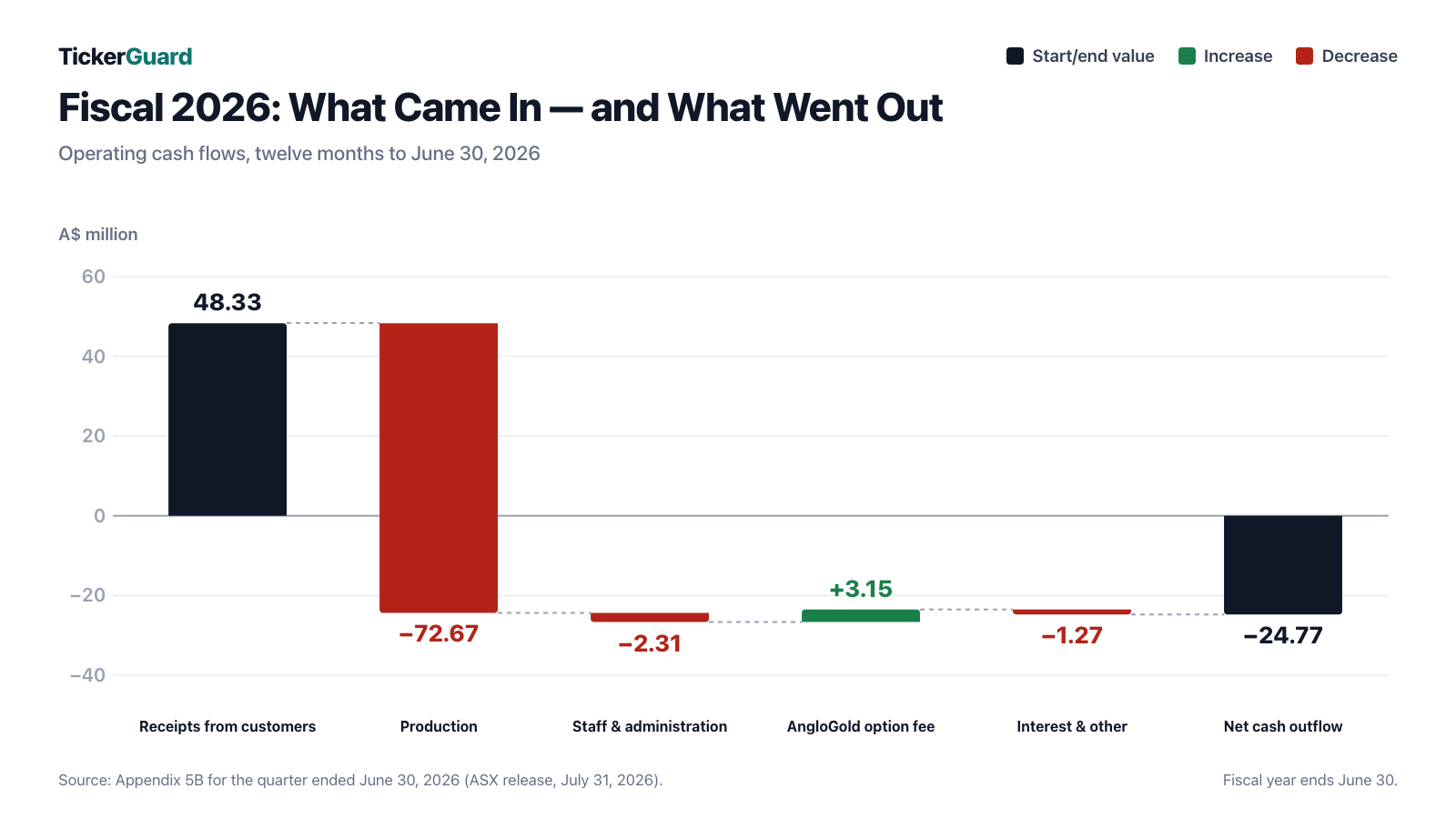
Remember this ratio, because it is the heart of the story: for every dollar that came in from gold sales, roughly one and a half dollars went out for production. The half-year accounts to December 31, 2025, show the same picture on an accounting rather than a cash basis, and there it is starker still: revenue A$11,731,223, mining operations expense A$34,701,257, depreciation and amortisation A$1,434,593 — a loss from mining operations of A$24,404,627. The net loss for the half-year was A$25,626,986, against A$1,541,748 in the prior-year period. Net assets fell over the same six months from A$20,537,904 to A$11,431,827.
And what about fiscal 2025, the year that ended in a profit? It deserves an honest look too. Matsa reported a net profit of A$1,431,049 for the twelve months to June 30, 2025, after a loss of A$4,603,386 the year before. The catch: that income statement contains no revenue line at all. The entire income consisted of "other income" of A$6,052,581 — of which A$5,000,000 came from the AngloGold option agreement (a A$500,000 non-refundable deposit plus a A$4,500,000 option fee) and A$725,823 was a research and development tax incentive refund. The only annual profit in recent company history came not from selling gold but from selling an option over its own gold ground.
What the Filings Say — the Uncomfortable Truths
Five things appear in the ASX documents that do not show up with the same clarity in the drill releases.
Uncomfortable Truth No. 1: The Company Calculates Its Own Runway — and Gets 0.89 Quarters
The Appendix 5B ends with a block designed for exactly this purpose. Item 8.3 adds up the relevant outgoings of a quarter, item 8.6 the available funding, item 8.7 divides one by the other. For the quarter ended June 30, 2026, the arithmetic looks like this:
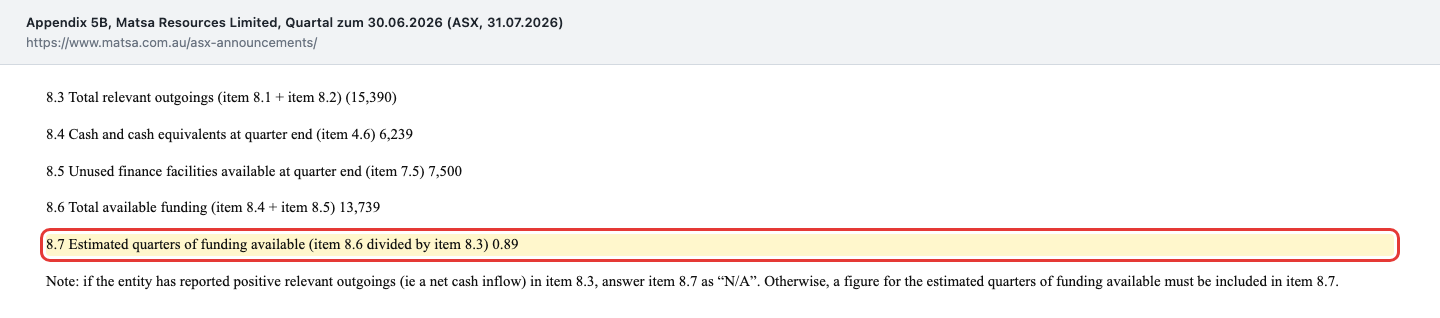
Because that figure is below two, the ASX form requires three mandatory answers. Matsa replies that the balance of the proceeds from Campaign 3 arrived after quarter end, that Campaign 4 started on July 29, 2026, and should generate "significantly more revenue" in the September quarter, and that it is in discussion with "a number of alternate financiers" on competitive terms — "as well as the need to raise additional capital." That is a remarkably candid formulation from a company about itself.
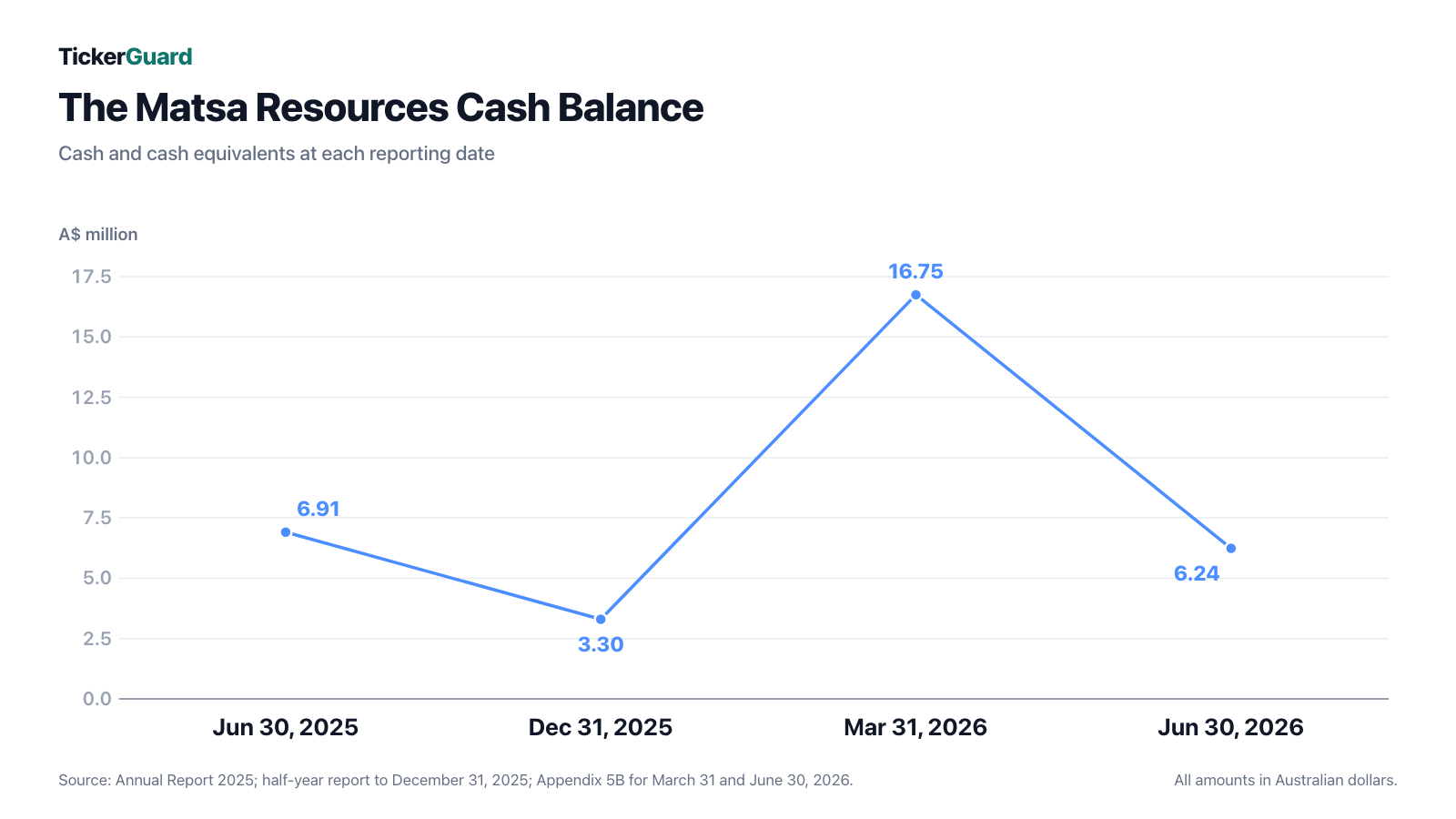
Fairness requires the counterweight: 0.89 is a snapshot, and toll milling makes revenue lumpy by design. At June 30, 2026, run-of-mine ore stockpiles worth an estimated A$5.65 million sat on site (at a spot price of A$5,781 per ounce), and 1,948.6 ounces were credited from the mint after quarter end. The cash balance itself shows that lumpiness clearly:
Uncomfortable Truth No. 2: The Auditor Flagged Going Concern — Twice in a Row
A going concern paragraph is not a bankruptcy filing. It means the auditor considers the accounts correct but points out expressly that a material uncertainty exists about the entity's ability to keep operating. In everyday terms: the auditor signs the balance sheet and staples a yellow note beside it. At Matsa that note is attached to two consecutive sets of accounts — the annual accounts to June 30, 2025, and the half-year accounts to December 31, 2025.
"As stated in Note 2(f), these events or conditions, along with other matters as set forth in Note 2(f), indicate that a material uncertainty exists that may cast significant doubt on the Group's ability to continue as a going concern. Our conclusion is not modified in respect of this matter."
— Nexia Perth Audit Services Pty Ltd, independent review report on the Matsa Resources half-year accounts to December 31, 2025, signed March 16, 2026 (ASX)

The working capital deficiency is the number that bites hardest. It describes how far the bills falling due within a year exceed what should come in over the same period. It rose ninefold in six months, from A$1,222,450 to A$11,105,660.
Uncomfortable Truth No. 3: The Lifebuoy Comes From the Shareholder Who Tried to Buy the Company — at 25 Percent
This story has to be told in order. On February 10, 2025, Patronus Resources Limited launched an on-market takeover bid for all Matsa shares at A$0.045 each. According to the annual report, Patronus is an associate of Matsa's largest shareholder, Deutsche Balaton Aktiengesellschaft of Heidelberg, Germany, which held 19.57 percent at the time. Matsa's board advised shareholders to take no action and formally rejected the offer in a target statement on February 24, 2025. The bid closed on April 21, 2025 — without a single acceptance.
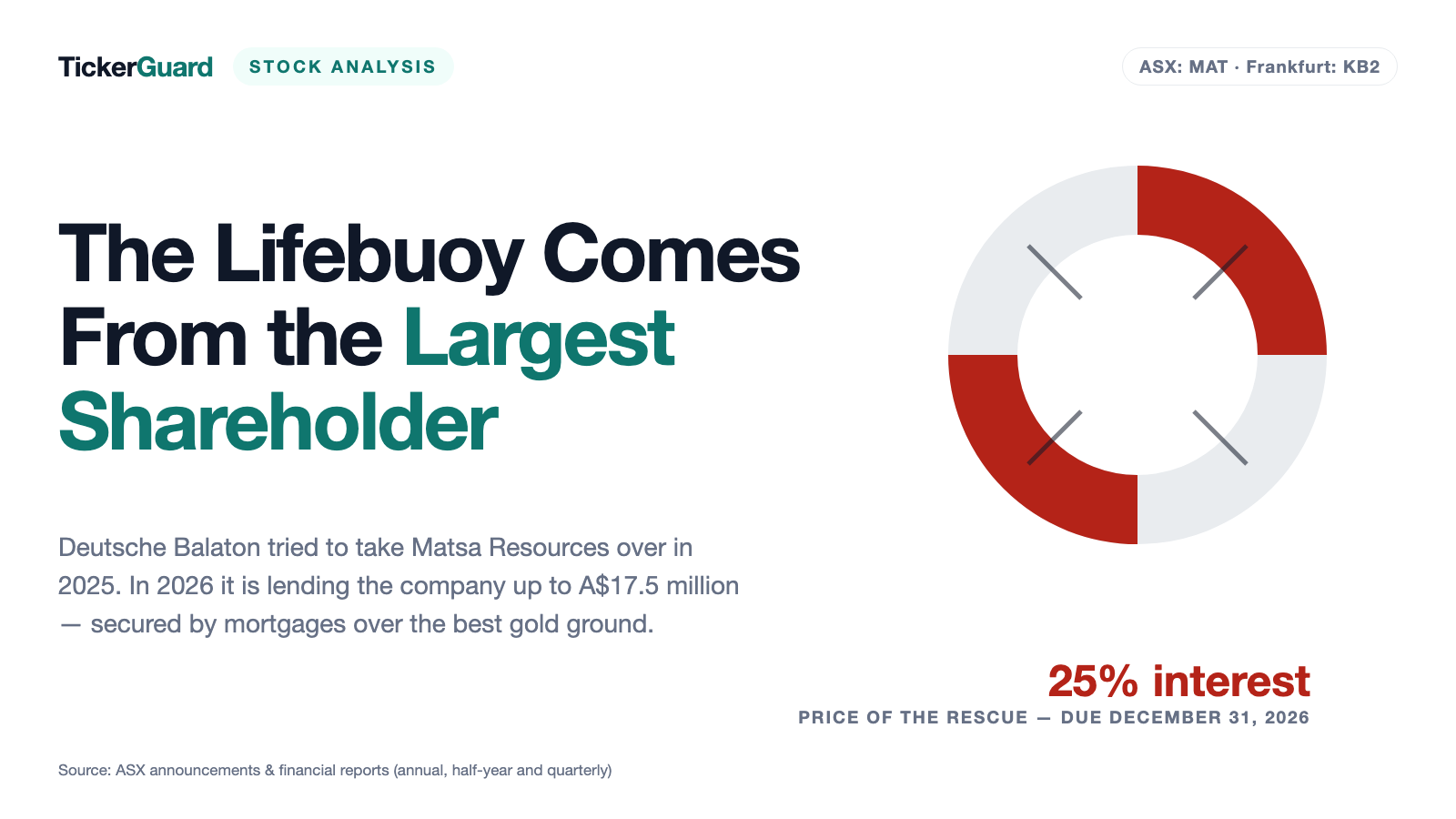
Barely a year later, on February 12, 2026, Matsa announced a debt facility of up to A$17.5 million. The lender: the same Deutsche Balaton, by then holding 21.96 percent. The terms are stated verbatim in the ASX release:
"The Debt Facility has an interest rate of 25% on all amounts outstanding. […] The Debt Facility can be repaid to Deutsche Balaton at its election as follows: […] In gold bullion at the prevailing gold price at the time of repayment, however the gold price is capped at A$5,750 per ounce if the gold price is above A$5,750 per ounce."
— Matsa Resources Limited, ASX release of February 12, 2026, terms of the A$17.5 million debt facility
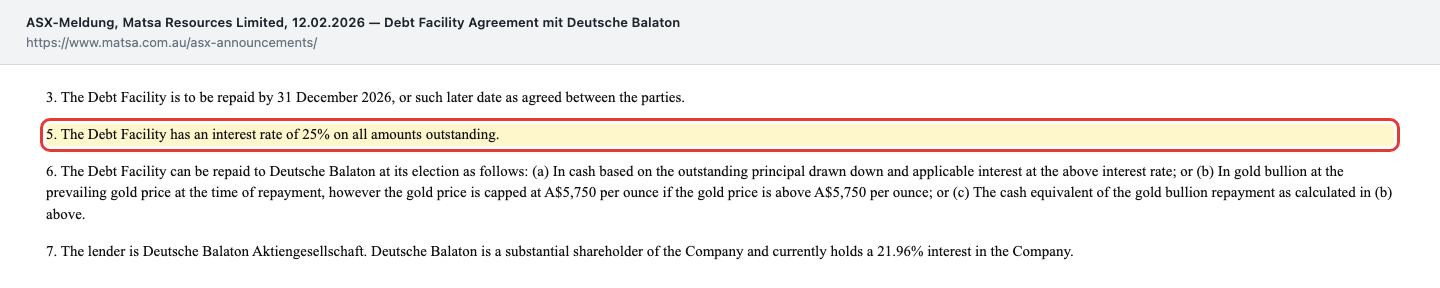
Three things here matter to you as a shareholder. First, the rate. Twenty-five percent is not a bank loan; that is rescue financing — by comparison, the older A$4 million loan signed in 2022 with two other parties runs at 12 percent. Second, the security. The facility is secured by mortgages over Devon Pit and Red October tenements together with a general security deed over the subsidiaries Matsa Gold Pty Ltd and Red October Gold Pty Ltd. On May 29, 2026, Matsa additionally reported that a second mortgage over the Fortitude North tenement had been lodged for Tranche 2 — the total security package was unchanged, only its order was rearranged. For granting that security to a related party, the ASX issued a waiver from Listing Rule 10.1 on February 11, 2026 — so no shareholder vote was required.
Third, the gold cap. Deutsche Balaton may take repayment in gold bullion, but at no more than A$5,750 per ounce. If the gold price runs above that, the lender buys Matsa's gold below the market. And this cap is no longer theoretical: in the quarterly report to June 30, 2026, Matsa itself cites a spot price of A$5,781 per ounce and an average realised price after quarter end of A$5,861 per ounce. The cap already sits below the market.
At June 30, 2026, two of three tranches had been drawn, A$10 million in total. Together with the old A$4 million loan, A$14 million of A$21.5 million in total facilities was drawn and A$7.5 million remained available. Both loans fall due in the same month: the Balaton facility on December 31, 2026, the older loan by December 20, 2026 at the latest — the same day the AngloGold option period ends. Three deadlines in one month, against a market capitalisation of roughly A$45 million.
One detail from the board overhaul of June 30, 2026, belongs here, because it pulls the threads together: Matsa describes the three new directors in that release expressly as "Non-Executive Directors" — non-executive, not independent. And in the same release, Graham Ascough's biography states that he is, among other roles, a Non-Executive Director of Patronus Resources Limited — precisely the company that launched the 2025 takeover bid for Matsa out of the Deutsche Balaton camp and that still held 16,121,645 shares (2.09 percent) on the register at September 16, 2025. That is disclosed and is no accusation in itself: overlapping directorships are common across the Australian exploration sector. It simply means that reading the board reinforcement as a counterweight to the major shareholder would be a misreading.
Uncomfortable Truth No. 4: Forty Percent of the Material Mined Was Not Planned
Why did the Devon mine cost so much more than it earned? The quarterly report answers that itself, and the answer is technical. Devon Pit was mined underground in the past, leaving voids into which waste rock now collapses during open-pit mining. This is called dilution: more material is moved and processed than actually contains gold, and every tonne of it costs explosives, diesel, haulage and mill time.

That number explains the gap between expectation and outcome better than any market move: over the twelve months to June 30, 2026, 10,100 ounces were mined but only 8,000 sold, and the delivered ore arrived at 2.06 grams per tonne — well below the 4.6 grams at which the Devon reserve was calculated. The encouraging part is that the mill absorbs some of it. But no recovery improvement offsets 40 percent unplanned dilution.
Uncomfortable Truth No. 5: Of 949,000 Ounces, 104,000 Are Proven as Reserve
The 949,000 ounces appear in every presentation. The second figure sits in the ASX additional information section of the annual report and is rarely quoted. The difference between a resource and a reserve is the difference between "probably in the ground" and "demonstrably extractable at a profit." At June 30, 2025, Matsa reported an ore reserve under the JORC Code of just 104,000 ounces: Fortitude 58,000 ounces (1,029 kilotonnes at 1.8 grams) and Devon Pit 46,000 ounces (309 kilotonnes at 4.6 grams), both in the weaker of the two reserve categories, Probable.
Roughly 89 percent of the reported ounces therefore lack that proof. That is not unusual for an exploration company, but it is precisely why you cannot simply multiply ounces by the gold price. For Fortitude North, the current flagship, the quarterly report states expressly that drilling density is not yet sufficient for a JORC-compliant resource estimate. For a nearby illustration of how expensive the road from "ounces in the ground" to "ounces in the vault" really is, see our analysis of Solaris Resources.
Two further points are worth knowing. First, the 949,000-ounce resource has, per a footnote in the quarterly report, not yet been depleted for material already mined — Matsa estimates Devon Pit depletion across three quarters at roughly 10,000 ounces. Second, the share count has grown sharply: from 769,856,402 in the register at September 16, 2025, to 971,192,178 in the Appendix 2A of July 3, 2026 — 201,335,776 additional shares, or 26.2 percent, in a little over nine months.
Roughly half of that traces back to a single day. On October 1, 2025, Matsa announced a A$15 million funding package: A$10 million from a placement of 100,000,000 new shares at A$0.10 each plus A$5 million from a debt facility. The release names two cornerstone investors, the Collins Street Gold Fund and the FiftyOne Capital High Conviction Fund, which per the release is associated with FiftyOne Capital and with existing substantial shareholder Flagship Fund; major shareholder Deutsche Balaton maintained its pro rata holding through the Delphi and Sparta entities. The issue price sat 13 percent below the closing price of A$0.115 on September 26, 2025. On top of that, 22,895,719 unquoted options struck at A$0.13 and expiring September 30, 2028 went to the placement arranger FiftyOne Capital, which per the same release also received a 6 percent fee on the capital it raised — exactly the option block still outstanding today.
The remainder of the increase did arrive in small slices spread across many weeks: in the half-year to December 31, 2025, alone, 111,810,429 unquoted options were exercised for A$7,224,361 — a half-year that starts before our comparison date — and across fiscal 2026 A$8.693 million flowed in from option exercises. For an existing shareholder one number matters more than the rest: the placement was priced at A$0.10 per share. On August 18, 2026, the share traded at A$0.046 — anyone who subscribed in October 2025 is down more than half less than a year later. And the supply is not exhausted: 118,554,956 unquoted options remain open.
Valuation: A$45 Million for 949,000 Ounces — and What Sits on the Other Side
There is no analyst consensus to quote for Matsa; the company is too small and is not covered regularly by any large house. So we do the arithmetic ourselves, in orders of magnitude and with the basis disclosed.
At a price of A$0.046 (ASX, August 18, 2026) and 971,192,178 shares, the market capitalisation is roughly A$44.7 million. Add the A$14 million of debt drawn at June 30, 2026, and subtract the A$6.239 million of cash, and the enterprise value comes to roughly A$52 million. Spread across the reported resource, that is about A$55 per ounce in the ground — spread across the proven reserve of 104,000 ounces, about A$500 per ounce. Both numbers are correct, and the distance between them is exactly the question at issue.
There is a third yardstick, and it comes not from us but from a buyer with a technical department. The AngloGold option agreement of February 27, 2025, provides for total consideration of up to A$101 million for the majority of the Lake Carey Gold Project, assuming a gold price of A$4,500 per ounce. The exercise price is not fixed but linked to the gold price: 1.875 percent of the gold price multiplied by an agreed resource of 936,000 ounces, less A$6 million of option fees already paid; at A$4,500 per ounce that works out at roughly A$72.975 million, plus deferred consideration of up to A$20 million. Substituting the spot price of A$5,781 per ounce that the company itself cites for June 30, 2026, into the same formula would produce a materially larger figure — the option has become more valuable as gold has risen.
Which means the decisive question is not "how many ounces?" but a date. December 20, 2026 is the day on which it becomes clear whether AngloGold exercises. If it does, Matsa receives a multiple of today's market capitalisation — the funding question is settled overnight and shareholders hold a company with a large cash pile and whatever remains of the project. If it does not, two loans fall due in the same month, secured on precisely the ground in question. Anyone buying this share today is buying a bet on that date rather than on 949,000 ounces.
Upside and Risks at a Glance
What speaks for Matsa Resources:
- The AngloGold option is documented external validation: a global producer has contracted for the right to the majority of the project for up to A$101 million (at an assumed gold price of A$4,500 per ounce) and had already paid A$9.5 million non-refundably by June 30, 2026 — against a market capitalisation of roughly A$44.7 million on August 18, 2026.
- The Fortitude North drill results are real and documented: 26.6 metres at 4.48 grams per tonne including 10.3 metres at 6.24 grams (release of August 4, 2026), plus 5.1 metres at 9.68 grams. The anomaly is defined over 1.7 kilometres and, per the release of August 4, 2026, remains open in both directions along strike.
- The Devon mine is running and generating cash: A$52 million in total project sales to June 30, 2026, mill recovery above plan at 89.6 percent instead of 83, and an average realised price after quarter end of A$5,861 per ounce.
- The board was strengthened on June 30, 2026, with three new non-executive directors (Graham Ascough, Robert Ryan and Leonard Lau), giving Matsa a majority non-executive board for the first time; an exploration manager and a technical consultant joined in parallel.
- The gold price is working in the company's favour: the A$5,781 spot price cited in the quarterly report sits well above the A$4,500 assumed when the AngloGold contract was written in 2025.
What speaks against it:
- The company itself reports a funding runway of 0.89 quarters in the Appendix 5B to June 30, 2026, and in the same mandatory answer expressly names the need to raise additional capital.
- The auditor identified a material uncertainty about going concern in both the annual accounts to June 30, 2025, and the half-year accounts to December 31, 2025; the working capital deficiency rose from A$1,222,450 to A$11,105,660 in six months.
- The mine consumed more cash than it produced in fiscal 2026: A$48.327 million of receipts against A$72.675 million of production payments, for a net operating outflow of A$24.775 million — driven mainly by unplanned mining dilution of roughly 40 percent.
- The rescue financing costs 25 percent interest, falls due December 31, 2026, is secured by mortgages over the best tenements and may be called in gold bullion at a price capped at A$5,750 per ounce — a cap that already sits below the market. The lender, Deutsche Balaton, is the same major shareholder whose associate launched the failed A$0.045 takeover bid in 2025.
- Of the 949,000-ounce resource, only 104,000 ounces are proven as an ore reserve (as at June 30, 2025); Fortitude North has no JORC-compliant resource estimate at all.
- The share count rose 26.2 percent in a little over nine months to 971,192,178, and 118,554,956 unquoted options remain outstanding — existing shareholders are diluted continuously in the background.
A Human Verdict
Back to the gold-speck blind spot. Its point is not that the drill results are dressed up — by everything in the filings they are genuine and good, and the Devon mine really does produce gold. Its point is that our minds run a different calculation when looking at a drill core than the accountants do. Matsa's accounts say, for the twelve months to June 30, 2026: for every dollar received, roughly one and a half went out. They also say the auditor flagged going concern twice in a row, that the money for the gap costs 25 percent, and that the security for it sits on precisely the ground whose drill results are being celebrated.
Both are true at the same time, and both belong in the same analysis. So the honest question is not "are 26.6 metres at 4.48 grams a good drill hole?" — the answer to that is yes. It is: are you prepared to wait for December 20, 2026, when it becomes clear whether AngloGold Ashanti exercises its option — knowing that two loans fall due in the same month and that the company itself speaks of the need to raise additional capital? What you make of that is your decision. And that is exactly as it should be.
Sources
Every original document used in this analysis, available through the Matsa Resources ASX announcement archive:
- Matsa Resources Limited — Quarterly Activities Report to June 30, 2026, including Appendix 5B (ASX, July 31, 2026) — most recent periodic report
- Matsa Resources Limited — Half-year report to December 31, 2025, with the independent review report by Nexia Perth Audit Services (ASX, March 16, 2026)
- Matsa Resources Limited — Annual Report to shareholders for fiscal 2025 (ASX, October 27, 2025; accounts signed September 30, 2025)
- Matsa Resources Limited — ASX release "Fortitude North Drilling to Commence" with the terms of the A$17.5 million debt facility (February 12, 2026) and "Amendment to $17.5M Facility Agreement" (May 29, 2026)
- Matsa Resources Limited — ASX release "$15M Funding Package to Fund Matsa's Growth Ambitions" (October 1, 2025) — placement of 100 million shares at A$0.10
- Matsa Resources Limited — "Board and Management Team Changes to Focus on Lake Carey" (June 30, 2026), Appendix 2A of July 3, 2026 and "Further High-Grade Gold Intercepts" (August 4, 2026)
- Matsa Resources Limited — project overview for Lake Carey and Thailand (retrieved August 18, 2026)
- Fundamental data and price data from the Australian Securities Exchange (retrieved August 18, 2026), reconciled with the share count in the Appendix 2A of July 3, 2026.
Transparency & disclaimer: This analysis is journalistic commentary on publicly available information. It is not investment advice, not a regulated investment recommendation and not a solicitation to buy or sell securities. Equity investments carry substantial risk up to and including total loss; for an exploration company carrying a going concern paragraph that risk is particularly pronounced. All amounts are in Australian dollars and all information is provided without warranty; the date of each data point is noted in the text. Positions held by the operator are disclosed daily; where one exists, it appears as a notice at the top of this deep dive.
Our Bottom Line at a Glance
- Liquidity and funding runway negative
- In the Appendix 5B to June 30, 2026, Matsa itself reports a funding runway of 0.89 quarters: A$13.739 million of available funding against A$15.390 million of quarterly outgoings. In the same mandatory answer it names the need to raise additional capital.
- Going concern and balance sheet negative
- Auditor Nexia Perth identified a material uncertainty related to going concern for both June 30, 2025, and December 31, 2025. The working capital deficiency rose from A$1,222,450 to A$11,105,660 in six months, and net assets fell from A$20,537,904 to A$11,431,827.
- Devon mine operations negative
- In fiscal 2026, receipts of A$48.327 million faced production payments of A$72.675 million, for a net outflow of A$24.775 million. The quarterly report cites unplanned mining dilution of roughly 40 percent from voids left by historical underground mining.
- Fortitude North exploration positive
- The diamond drilling program running since April 2026 is delivering documented high grades: 26.6 metres at 4.48 grams per tonne including 10.3 metres at 6.24 grams (release of August 4, 2026), plus 5.1 metres at 9.68 grams. There is, however, still no JORC-compliant resource estimate for Fortitude North.
- The AngloGold option agreement positive
- Since February 27, 2025, AngloGold Ashanti has held a contractual right to the majority of the Lake Carey Gold Project for up to A$101 million at an assumed gold price of A$4,500 per ounce, and had paid A$9.5 million non-refundably by June 30, 2026. The option period ends December 20, 2026.
- Financing terms and governance negative
- The A$17.5 million facility from major shareholder Deutsche Balaton costs 25 percent interest, falls due December 31, 2026, is secured by mortgages over the best tenements and may be called in gold bullion at a price capped at A$5,750 per ounce — against a spot price of A$5,781 cited in the quarterly report.
Matsa Resources reports a 949,000-ounce resource at its Lake Carey Gold Project but had only 104,000 ounces proven as an ore reserve at June 30, 2025. The operating Devon mine cost about A$72.7 million in fiscal 2026 and brought in A$48.3 million; the auditor flagged a material uncertainty about going concern twice in a row, and the company puts its own funding runway at 0.89 quarters. The money for the gap costs 25 percent interest and comes from the largest shareholder, whose associate had launched a failed takeover bid a year earlier. The decisive question is December 20, 2026, when the AngloGold option expires. Not investment advice.
What Our Rating Means
Substance risk
We found at least one documented issue that threatens the company itself — regardless of how the stock is currently valued.
Red here is not about the share price or the valuation — the Fortitude North drill results are documented and good, and the AngloGold agreement is a serious external yardstick for the value of the project. Red is about several documented threats to the substance of the business that exist at the same time. The auditor identified a material uncertainty related to going concern for both June 30, 2025, and December 31, 2025. The company itself reports a funding runway of 0.89 quarters in the Appendix 5B to June 30, 2026, and expressly names the need to raise additional capital in the mandatory answer that follows. Operating cash flow for the whole of fiscal 2026 was clearly negative at minus A$24.775 million even though the mine was producing. And the refinancing costs 25 percent interest, falls due December 31, 2026, and is secured by mortgages over precisely the tenements that make up the value of the company. Any one of these alone would be an amber signal; together they describe a threat to substance. Anyone investing here should understand they are betting on a date — December 20, 2026 — rather than on 949,000 ounces in the ground. The decision is yours.
A journalistic assessment by our editorial team at the time of the deep dive, based on public sources — not investment advice and not a solicitation to buy or sell. Your personal circumstances (investment goals, risk capacity, taxes) cannot be taken into account. What our levels mean, how verdicts are formed, and what conflicts of interest exist →
Worth Noting
- This analysis was prompted by the German ticker KB2, under which Matsa Resources is discussed in retail investor forums. There is no scanner hit: the company meets none of the quality conditions of our in-house stock scanner, because it has reported near-continuous losses in recent years.
- Matsa Resources is not an SEC filer. All company figures come from ASX filings: the quarterly report with Appendix 5B to June 30, 2026 (July 31, 2026), the half-year report to December 31, 2025 (March 16, 2026), the fiscal 2025 annual report (October 27, 2025) and the individual releases of February 12, May 29, June 30, July 3 and August 4, 2026. Price and valuation data as of August 18, 2026.
- All amounts in this analysis are Australian dollars. The share trades in euros in Germany under KB2; comparing prices between the two venues requires a currency conversion at the prevailing rate, which is deliberately not attempted here.
- Possible confusion: on the ASX, "MAT" is Matsa Resources; on Nasdaq the same three letters belong to a U.S. toy manufacturer. And the substantial holding notice on the register is lodged in the name of Sparta AG, a company in the Deutsche Balaton group; the ASX release of February 12, 2026, states 21.96 percent for Deutsche Balaton itself.
The full analysis as a PDF for later
We will send you this analysis as a PDF — to print, file away, and read at your own pace.
Frequently Asked Questions
Matsa Resources Limited of Perth is an Australian gold company built around the Lake Carey Gold Project near Laverton in Western Australia. Ore is mined in an open pit at Devon Pit and processed at a third-party plant, while a drill program runs at the Fortitude North exploration prospect. The company also holds lithium and base-metal tenements in Thailand.
It appears in item 8.7 of the Appendix 5B for the quarter ended June 30, 2026, and is the company's own estimate of its funding runway in quarters: A$13.739 million of available funding divided by A$15.390 million of relevant quarterly outgoings. When that figure falls below two, ASX rules require the entity to explain how it intends to fund itself.
Yes. KB2 is the German ticker for Matsa Resources Limited on the Frankfurt and Xetra exchanges (ISIN AU000000MAT8). The home listing is the Australian Securities Exchange under the ticker MAT. The reporting currency is the Australian dollar; in Germany the share trades in euros.
Because Matsa is not a U.S. reporting issuer. It reports under the ASX Listing Rules: audited annual accounts to June 30, auditor-reviewed half-year accounts to December 31, and quarterly activities and cash flow reports (Appendix 5B). Those quarterly filings contain disclosures U.S. reports do not require, including the entity's own funding runway calculation.
A mineral resource describes gold that geologists believe sits in the ground. An ore reserve is the portion for which a study has demonstrated it can be mined at the assumed costs and prices. At Matsa, only 104,000 of the reported ounces were carried as a reserve at June 30, 2025 — roughly 11 percent.
Deutsche Balaton Aktiengesellschaft of Heidelberg, Germany, is Matsa's largest shareholder (21.96 percent per the ASX release of February 12, 2026) and also the lender behind the A$17.5 million facility at 25 percent interest. An associate, Patronus Resources, launched a takeover bid at A$0.045 per share in February 2025 that lapsed in April 2025 without a single acceptance.
That date ends the option period under the agreement with AngloGold Ashanti signed February 27, 2025, which gives the producer the right to acquire the majority of the Lake Carey Gold Project. The same date caps the extended repayment deadline of the older A$4 million loan; the Deutsche Balaton facility falls due eleven days later.
The net profit of A$1,431,049 for the twelve months to June 30, 2025, did not come from gold sales — the income statement contains no revenue line at all. It came from other income of A$6,052,581, including A$5,000,000 under the AngloGold option agreement (a A$500,000 non-refundable deposit plus a A$4,500,000 option fee) and A$725,823 of research and development tax incentive refunds.
Found an error?
Did you spot a factual error, an outdated number, or a typo in this deep dive? Let us know briefly — your report goes straight to the editorial team.