German Tech Holding: A Fifth of Book Value, EUR 201,000 in Cash and a Going-Concern Warning
EUR 1.03 of equity per share, a EUR 0.184 share price on September 30, 2026 — and just EUR 201,000 in the bank at the end of 2025. The former The Payments Group Holding has been called German Tech Holding since August 2026 and is betting on artificial intelligence. Its 2025 annual report shows what sits behind the discount: a going-concern warning from the auditor and management pay equal to about half the market value of September 30, 2026. Here is why a discount is not yet a bargain.
 Thomas Mücke
Founder & Publisher
Thomas Mücke
Founder & Publisher
Chart
Interactive price chart (TradingView).
Note: pure fact-based analysis, not investment advice and not a solicitation to buy or sell. All figures without guarantee.
You know the bargain bin at the department store? A red sign, “80 percent off,” and suddenly people grab things they were not even looking for five minutes earlier. The discount itself becomes the argument. Let us call it the bargain-bin reflex: the bigger the markdown, the less we ask why something is so cheap. Yet the bin holds not only last season’s stock but also the shirt with the stain you only notice at home.
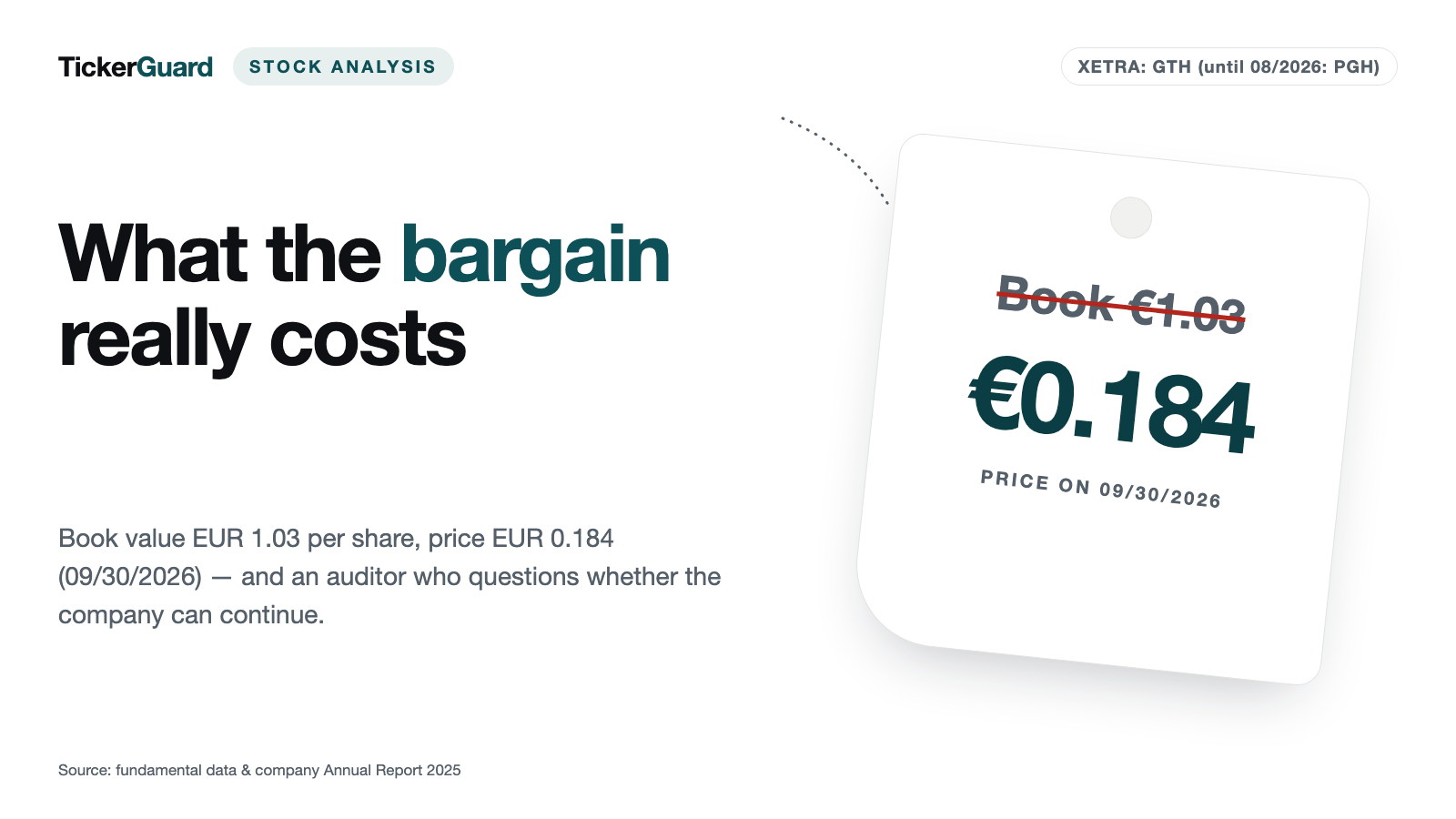
The stock market has bargain bins too. Since August 19, 2026, one of them has been called German Tech Holding GmbH & Co. KGaA (Xetra: GTH, until August 2026 PGH). According to its 2025 annual report, every outstanding share is backed by equity of EUR 1.03. On September 30, 2026, the stock cost EUR 0.184 on Xetra — less than a fifth of that. The company even calculates that its receivables from a former major shareholder alone are worth 54 cents per share. So let us make a deal: before you even think about buying, we turn the shirt inside out together and look for the stain. Our basis is exclusively what the company itself has published — above all the audited 2025 annual report of June 30, 2026.
A word up front, because it shapes the whole evidence base: German Tech Holding files no reports with the U.S. Securities and Exchange Commission (SEC). The stock trades in the Scale segment of the Frankfurt Stock Exchange, an open-market segment for smaller companies. According to the supervisory board report, the group accounts were audited “without a statutory audit requirement”; half-year reports are unaudited. All reports are published in German only, so every quote below is our translation of the German original. The 2026 half-year report is scheduled for October 2026 and had not been published when this analysis went to press on October 1, 2026.
What German Tech Holding actually does
German Tech Holding is an investment holding company: it makes nothing and sells almost nothing. It owns stakes in young companies and hopes to sell them later at a higher price. Think of it less as a store and more as a collector whose wealth sits in a display case — it only becomes money once someone pays for it.
The company has changed its face several times in a few years. As German Startups Group, it was an active venture capital investor after listing on November 11, 2015; by its own account it held stakes in companies such as Delivery Hero, Chrono24, MisterSpex and Scalable Capital. As SGT German Private Equity, it brought in a private equity fund manager together with SGT Capital LLC from 2021; in return SGT Capital LLC received shares and became the majority shareholder. That business slid into losses in 2023 and was shut down in February 2024. As The Payments Group Holding, the company set out in August 2024 to buy payment service providers — and withdrew from the deal in March 2026. Since the annual general meeting of August 19, 2026, it has been called German Tech Holding and wants to invest in young companies again, with a focus on artificial intelligence and biotech.
At December 31, 2025, the group held ten active minority stakes; according to the annual report, the two focus holdings accounted for 72 percent of their value. The largest is AuctionTech (stake of about 36 percent), a Berlin software provider for digital bidding processes in real estate sales that works with the RE/MAX broker network. The second is Softmax AI (32 percent since 2026), a so-called company builder that develops AI applications and spins them off as separate firms. Through Softmax, the holding indirectly owns 23 percent of Cognicare AI, which offers AI assistance systems for nursing homes. In August 2026, both holdings published financial targets for the first time: AuctionTech expects “revenues of several million euros” by 2030, Cognicare aims for an annual revenue run rate of EUR 5 million by the end of 2029. Those are the holdings’ own targets, not audited figures.
The legal form matters for everything that follows. A KGaA (a German partnership limited by shares) has two kinds of partners: the shareholders, who put up the money, and a general partner with unlimited liability that runs the business. Here that is the former The Payments Group Management GmbH, now German Tech Management GmbH; its managing director is founder Christoph Gerlinger. We explained how such a structure works at a much larger company in our TKMS analysis.
Company history for investors
-
2015
Listing as German Startups Group
On November 11, 2015, the venture capital investor lists in Frankfurt — at the time a way to own a slice of German start-ups with small amounts.
-
2021
SGT Capital becomes majority shareholder
In exchange for bringing in a private equity fund manager, SGT Capital LLC receives new shares. Existing shareholders become a minority; the business model changes.
-
2023
Group net loss of EUR 81.5 million
The private equity business slides into losses, with EUR 74.4m of impairments. Most of the book value of the time is gone.
-
2024
February: SGT returns 36.7 million shares
Separation from the major shareholder. The returned shares have since sat in treasury — a reserve that can dilute the free float at any time.
-
2026
March: withdrawal from The Payments Group deal
The 2024 takeover of payment providers collapses. Shareholders are spared a large share issuance, but also lose the plan for an operating business.
-
2026
August: renamed German Tech Holding
The AGM approves the new name as well as new authorized and conditional capital of up to 23.15m shares each — the third restart in five years.
How the stock landed on our desk
Honestly: not through a metric. The stock showed up on the list of most-searched stocks at the German retail portal wallstreet-online — still under its old name, The Payments Group Holding. That is an attention signal and not a reason to buy. It does not appear in our in-house stock scanner; Scale-segment small caps of this size are not yet covered there.
The curiosity is understandable all the same. In late summer 2026, the company issued several press releases with big words: AI spin-offs, financial targets with EBITDA margins of around 50 percent, court wins against its former major shareholder, and the sentence that the value of AuctionTech and of Cognicare AI could each “in perspective” clearly exceed the current market capitalization. That is exactly what the bargain-bin reflex feeds on. How far self-set company goals and the price targets derived from them can sit from the reported numbers is something we worked through in our analysis of The Platform Group, another stock from the Scale segment.
The numbers over the years — honestly appraised
First, what genuinely speaks for the company. The balance sheet is simple: at December 31, 2025, total assets of EUR 13.1 million stood against equity of EUR 11.8 million, an equity ratio of 90 percent. There were no bank loans or bonds at the reporting date; liabilities of EUR 1.35 million consisted entirely of short-term payables, provisions and other items.
The loss is shrinking, too. In 2023 the group booked a net loss of EUR 81.5 million, almost entirely from impairments of EUR 74.4 million in the wake of the failed private equity business. In 2024 the loss was EUR 4.3 million, in 2025 EUR 1.8 million — right inside the EUR 1 million to 2 million range management had predicted. The investment business even turned positive in 2025: value gains and disposals netted EUR 521,000 after a loss of EUR 1.87 million the year before. In March 2025, the subsidiary German Startups Group VC sold a holding at four times its acquisition cost, according to the report. For 2026, management expects a group profit of up to EUR 1 million.
But a profit on paper and money in the bank are two different things. The first chart shows it.
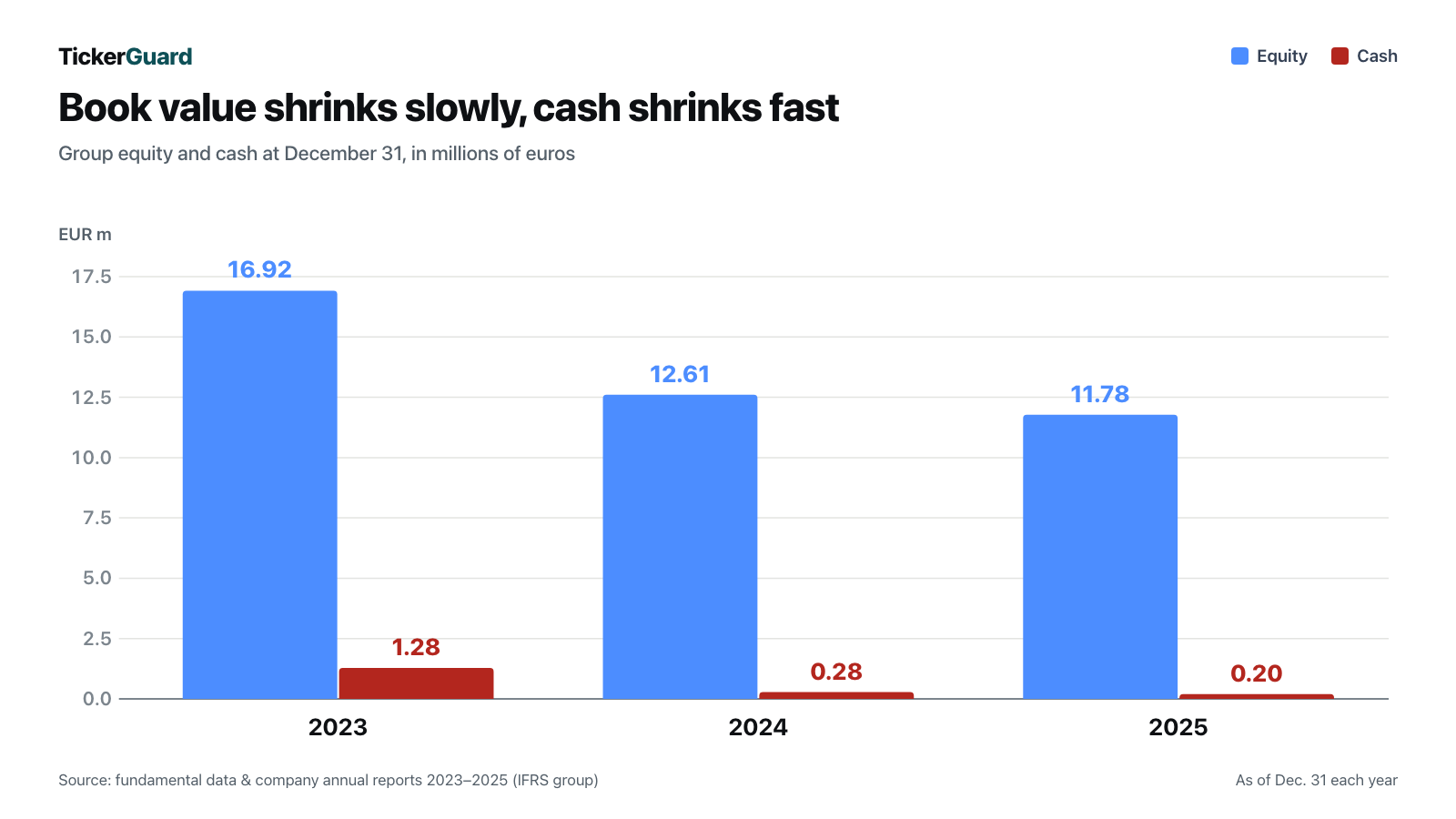
The reason: the ongoing business has been burning money for years. Net cash used in operating activities was EUR 2.68 million in 2023, EUR 4.38 million in 2024 and EUR 2.41 million in 2025. In 2025 that was covered by the sale of a holding (EUR 1.89 million) and the sale of treasury shares (EUR 1.0 million). At year-end, EUR 201,000 was left in the bank. Remember that number — it is the stain on the shirt.
Uncomfortable truth No. 1: The auditor flags a material uncertainty about the going concern
When an auditor writes a separate paragraph about whether a company can continue as a going concern, it is a bit like a car inspector handing you the sticker and adding: “You may drive — but take a look at the brakes.” The auditor’s report by Wedding & Cie. GmbH Wirtschaftsprüfungsgesellschaft on the 2025 group accounts contains exactly such a paragraph:
“These circumstances show that a material uncertainty exists that may cast significant doubt on the company’s ability to continue as a going concern and that constitutes risks threatening the company’s existence within the meaning of Section 322 (2) sentence 3 of the German Commercial Code (HGB).”
— The Payments Group Holding GmbH & Co. KGaA, Annual Report 2025, independent auditor’s report, page 66 (our translation of the German original)
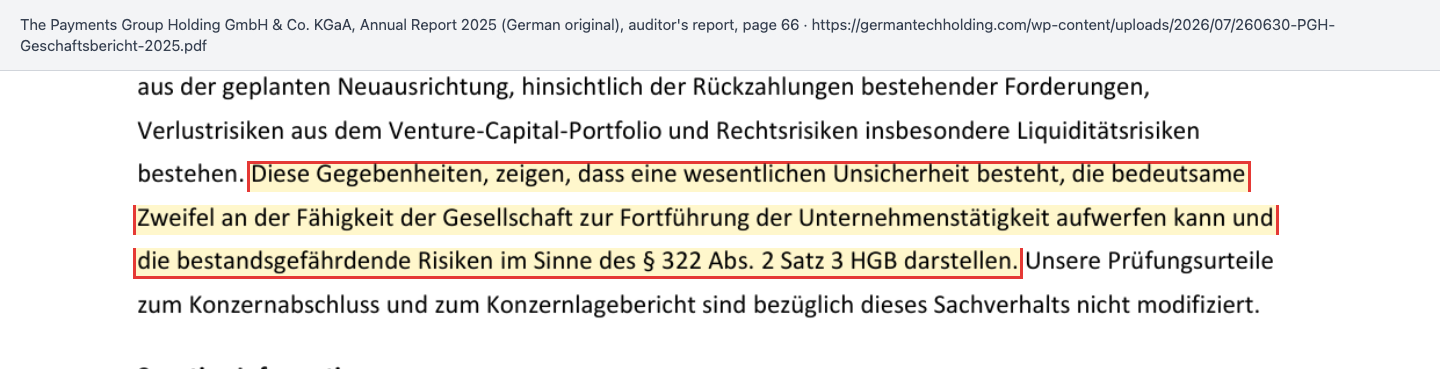
The auditor did not qualify the opinion; it considers the accounts properly prepared. But the report explicitly points to liquidity risks, open receivables, loss risks in the investment portfolio and legal risks, and management itself calls these risks “threatening the company’s existence” in the management report. The math behind it is simple: on top of the EUR 201,000 in cash at year-end came EUR 507,000 from a convertible bond in February 2026, together about EUR 708,000. For 2026, the holding company itself expects a loss of “a good EUR 100 thousand per month” — that applies to the parent company only, not to the group, whose operating business used EUR 2.41 million of cash in 2025. Without new inflows, the money would therefore have lasted only until about the end of July 2026 — with the short-term liabilities still unpaid. The liquidity planning in the report puts those liabilities at about EUR 682,000 (pages 45 and 63); the balance sheet shows as much as EUR 1.35 million at the reporting date, including EUR 544,000 of provisions (page 17). The report does not explain which items the planning leaves out. On top of that come other current assets of EUR 2.44 million, mostly receivables — money that still has to come in.
Management sees it differently: according to the management report, existing liquidity and planned inflows, including from receivables, are sufficient under its liquidity planning to cover the short-term liabilities and running costs (page 63). With the total proceeds of the convertible bond, financing is “secured for the time being according to current planning” (page 25) — although by the time the report was issued only EUR 507,000 of up to EUR 2.28 million had been subscribed. That planning therefore relies on inflows that have yet to arrive.
The company’s releases up to September 16, 2026, give no new figures on cash, further bond subscriptions or incoming payments; on June 30, 2026, it said it held an “unchanged” 34,901,800 treasury shares. Where the money has come from since the turn of the year will only show in the half-year report. So the money to keep operating has to come from outside: collected receivables, sales of holdings or sales of shares. Remember: EUR 11.8 million of equity pays not a single bill until it is turned into cash.
Uncomfortable truth No. 2: Receivables worth about half the book value — owed by a former major shareholder it is fighting in court
Besides the holdings, the assets consist mainly of a bundle of receivables. According to the press release of August 27, 2026, German Tech Holding has receivables of about EUR 6.1 million against the SGT group — the very former majority shareholder it separated from in February 2024 and has been in dispute with ever since: a EUR 4.2 million loan to SGT Capital LLC, EUR 0.5 million against SGT Beteiligungsberatung and EUR 1.4 million in expense reimbursements against an SGT fund. The 2025 annual report states the same total of EUR 6.1 million (page 64). That is about half of equity and almost three times the market value: per outstanding share, the company puts it at 54 cents — against a share price of 18.4 cents on September 30, 2026. The catch is in the management report:
“With regard to all three of PGH’s receivables mentioned above, the SGT group has claimed a set-off against the counterclaims it has raised (clawbacks).”
— The Payments Group Holding GmbH & Co. KGaA, Annual Report 2025, group management report, opportunities and risks report, page 64 (our translation of the German original)
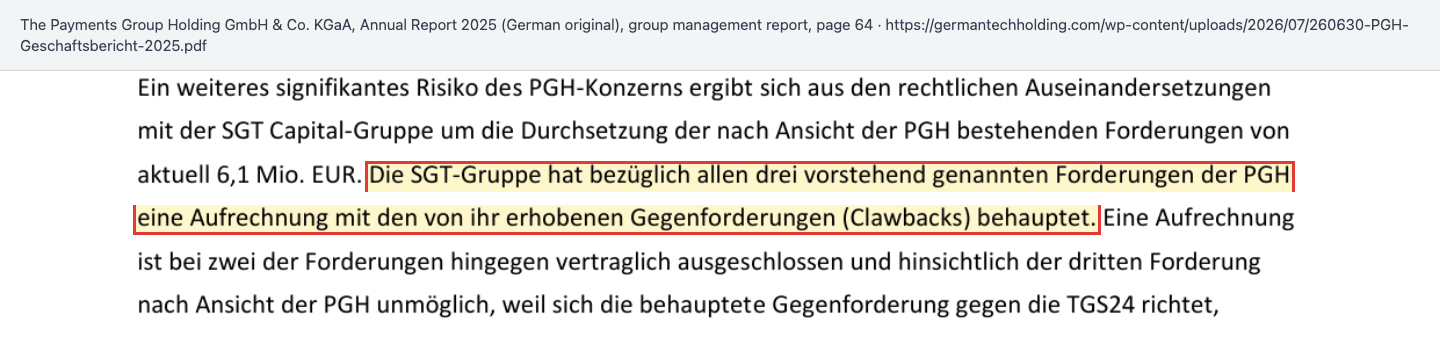
German Tech Holding considers that set-off contractually excluded or impossible. It says it prevailed in four of five summary proceedings in which the SGT side sought to bar statements by the holding; according to its release of September 11, 2026, two of them are still on appeal. In the fifth, the SGT side had initially obtained a preliminary injunction against a passage of a press release; the holding removed the passage. According to the same release, the SGT side withdrew its application entirely at the oral hearing before the Higher Regional Court of Frankfurt am Main on September 10, 2026, so the injunction has lapsed; the holding considers that it won this case too on the point that mattered to it. None of these proceedings decided the receivables themselves. The money itself is contested too, though: according to the release of August 27, 2026, the company has filed a claim for a EUR 0.5 million portion of the expense reimbursement with the liquidator of the Luxembourg vehicle of the SGT fund; it had reported no outcome by September 16, 2026.
But the truth also includes what it writes about its own debtor: the SGT group would “probably not currently be able” to meet its payment obligations in full; in the company’s assessment, its ability to pay “apparently” depends “predominantly” on the sale of its stake in security software maker Utimaco. According to the annual report, the receivables are due; only a EUR 2.9 million portion of the loan, including interest, does not fall due until December 31, 2027 at the latest. In the company’s view, almost half of the EUR 6.1 million has been overdue for some time. Even so, the holding has said it is willing in principle to extend the term of part of the loan by almost a year and a half. Settlement talks that began in March 2026 were “suspended until further notice,” according to the release of September 11, 2026. Even so, it expects EUR 0.5 million to 1 million in payments in 2026 and the rest by early summer 2029. In everyday terms: you lent a friend money, the two of you are in a dispute, you are already suing for part of the money, nothing has been decided yet, and you suspect he can only pay once he sells his house. The money is not gone — but you would not count it as cash either.
Uncomfortable truth No. 3: Three times as many shares sit in the basement as in circulation
Of the company’s 46,301,800 shares, only 11,400,000 are outstanding. The remaining 34,901,800 are held by the company itself — the remainder of the 36.7 million shares SGT Capital LLC handed back free of charge in February 2024. Treasury shares are like slices of cake held back in the kitchen: as long as they stay there, the guests share the cake on the table. Once they are served, every slice on the table gets smaller. The annual report is very open about what this reserve is for:
“However, the company also has the option at any time to place treasury shares it holds, in order to improve its liquidity, at a price at which buyers can be found for them, and/or to place further units of its mandatory convertible bond issued in February.”
— The Payments Group Holding GmbH & Co. KGaA, Annual Report 2025, notes, liquidity and financing risk, page 45 (our translation of the German original)
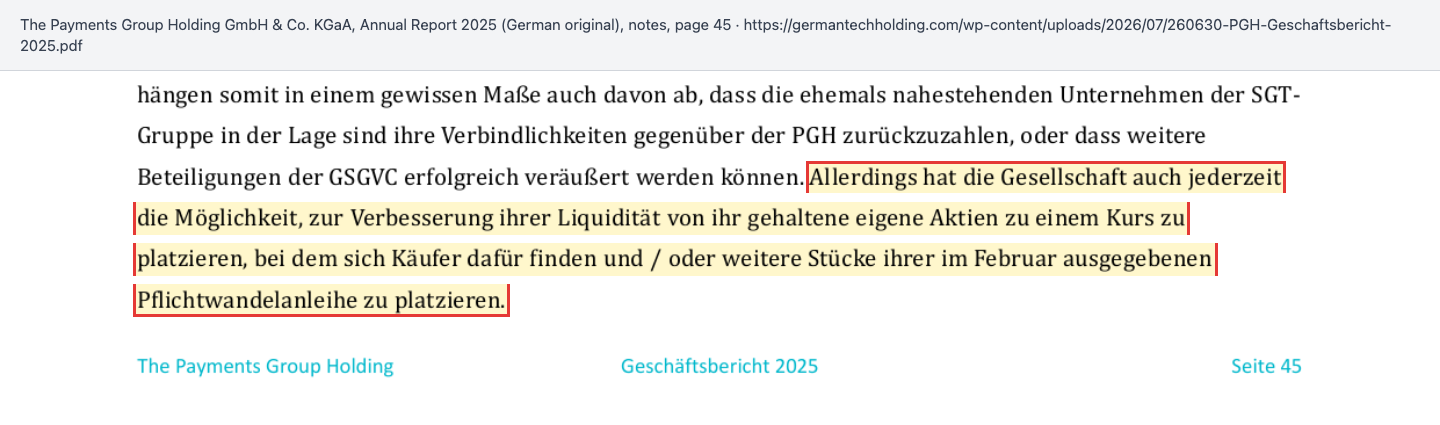
This is not theory. In July 2025, the company sold 1,813,000 treasury shares to an investor at EUR 0.55 each — a good two-fifths of the book value of EUR 1.32 per share at the end of 2024; the difference of EUR 815,850 to the notional value of EUR 1 per share was offset against the capital reserve. In January 2026 came a 2026/29 mandatory convertible bond with a 10 percent coupon. Its terms provide that on February 1, 2029, it can be converted at EUR 0.20 per share into shares taken from the treasury stock (sections 6 and 9 of the bond terms). The “mandatory” in the name binds only the bondholders: whether the bond is converted is the company’s choice on the maturity date; if it does not convert, it repays the principal in cash (section 3.2). By February 2026, bonds worth EUR 507,000 had been subscribed; that equals 2,535,000 shares, a good fifth of those outstanding today. If the full EUR 2.28 million were placed, it would be 11.4 million shares — as many as are in circulation today. And at the request of Gerlinger & Partner GmbH, whose managing shareholder is Christoph Gerlinger, and GG Beteiligungen UG, the annual general meeting of August 19, 2026, additionally created authorized and conditional capital of up to 23,150,900 new shares each. A thought experiment shows the scale: if all 34.9 million treasury shares were placed at EUR 0.20, about EUR 7.0 million would flow in. Equity per share would then come to about EUR 0.41 instead of EUR 1.03, because it would be spread over 46.3 million shares instead of 11.4 million. Remember: when 11.4 million shares share the table and 34.9 million wait in the basement, ask at every price how many more guests are coming to dinner.
Uncomfortable truth No. 4: Management fees for 2025 equaled about half the market value on September 30, 2026
A holding company without its own business has one big cost block: its own management. At German Tech Holding, this compensation goes to the general partner, whose managing director is Christoph Gerlinger. The notes put a figure on it for 2025:
“The management and liability compensation incurred in the fiscal year amounts, deviating from the amount stated above, to EUR 1,070 thousand, of which EUR 193 thousand results from the occurrence in 2025 of the condition subsequent of a waiver of compensation by the general partner from 2024.”
— The Payments Group Holding GmbH & Co. KGaA, Annual Report 2025, notes, related party disclosures, page 51 (our translation of the German original)
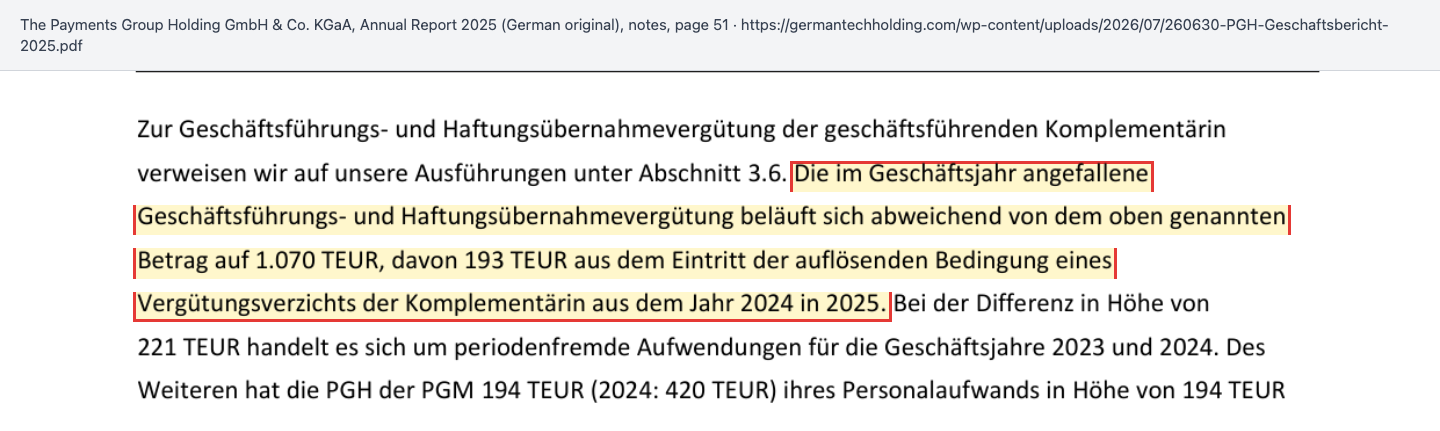
For context: EUR 1.07 million is a good third of total other operating expenses of EUR 2.87 million — and about half the market value of roughly EUR 2.1 million on September 30, 2026. It consists of fixed pay of EUR 603,000, a variable reimbursement of expenses of EUR 273,000 and EUR 193,000 from a waiver granted in 2024 whose condition subsequent occurred in 2025. The overview of related-party transactions even shows EUR 1.29 million; according to the notes, the difference of EUR 221,000 is prior-period expenses for 2023 and 2024. Conversely, according to the notes, the company recharged EUR 194,000 of its own personnel expense to the general partner, so it did not bear that cost itself. On top comes a claim to 25 percent of any future statutory profit after offsetting losses carried forward; because of the accumulated losses, the general partner was entitled to nothing in 2025. In fairness: according to the investor relations page, Gerlinger, his family and their vehicles own 7.1 percent of the outstanding shares — he is in the same boat. But the ratio remains striking — even without the EUR 273,000 of expense reimbursement, the fixed and catch-up pay would still come to about EUR 800,000.
Uncomfortable truth No. 5: The annual report contradicts itself
For a company whose value rests on valuations and receivables, care in the details matters. The 2025 annual report shows gaps here. When did the company withdraw from buying The Payments Group? According to management’s foreword “on February 27, 2026,” according to the supervisory board report “on March 27, 2026” (the notes say “as of March 30, 2026,” which may be the effective date). How high was revenue? The statement of comprehensive income shows revenue of EUR 201,690.56 — while the notes state:
“No revenue was realized in the fiscal year.”
— The Payments Group Holding GmbH & Co. KGaA, Annual Report 2025, notes 1.6.11, page 36 (our translation of the German original)
And the foreword cites a loss of “0.16 cents per share” — apparently meaning EUR 0.16 per outstanding share; the income statement shows minus EUR 0.18 based on the average share count. None of these contradictions changes total assets. But they show that the report is not properly reconciled in several places — and this very report is the basis for valuing holdings whose worth nobody can read off a stock exchange.
What the stock costs
At EUR 0.184 (Xetra close on September 30, 2026) and 11,400,000 shares outstanding, the market value is about EUR 2.1 million. The company itself cited “less than EUR 3 million” on August 6, 2026. Comparing that with the balance sheet shows how large the discount is:
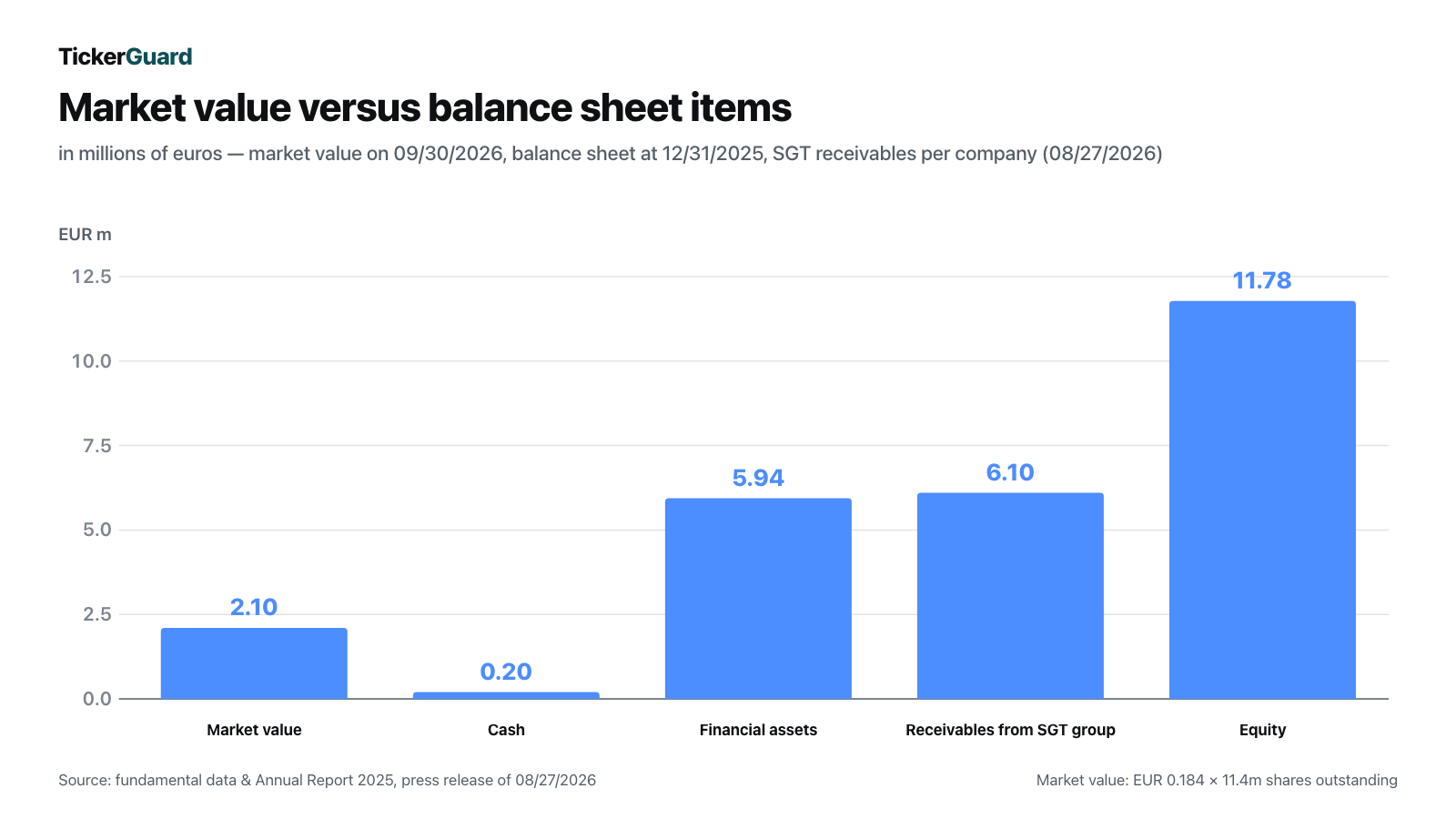
- Against book value: EUR 0.184 versus EUR 1.03 of equity per outstanding share — a price-to-book ratio of about 0.18. The market values the stock at barely a fifth of book equity.
- Against the company’s own math: management estimates net asset value including off-balance-sheet items at “more than EUR 1.50” per share. That is its own estimate, not an audited figure.
- Against earnings: there is no price-to-earnings ratio — 2025 showed a loss of EUR 0.18 per share. The guidance of “up to EUR 1 million” profit for 2026 assumes a positive after-tax result of EUR 2.0 million from the investment portfolio (page 64).
The only research coverage listed on the investor relations page is mwb research: buy rating, price target EUR 1.03 (cut from EUR 1.24 on July 2, 2026, confirmed on August 10, 2026); in November 2024 the target still stood at EUR 3.00. That is a third-party view, not a TickerGuard recommendation. Trading is very thin: on the morning of October 1, 2026, the Xetra order book showed a bid of EUR 0.161 and an ask of EUR 0.226 — the ask was about 40 percent above the bid. Anyone who buys and has to sell again right away loses a lot of money on that gap alone.
Upside and risks at a glance
What speaks for German Tech Holding:
- A large discount to balance sheet values. The price is about 0.18 times equity per share (EUR 1.03 at 12/31/2025); financial assets alone are EUR 5.94 million against a EUR 2.1 million market value.
- No bank debt. Equity ratio of 90 percent, no financing liabilities at the reporting date; if the company opts to convert the convertible, the principal is not repaid in cash (otherwise it must be repaid in cash in 2029); the 10 percent interest, however, is payable in cash annually on February 1, starting in 2027 (§ 2.1 of the terms) — about EUR 51,000 a year on the EUR 507,000 placed so far.
- Shrinking loss, positive guidance. From minus EUR 81.5 million (2023) to minus EUR 4.3 million (2024) and minus EUR 1.8 million (2025); management expects up to EUR 1 million of profit for 2026.
- Secured receivables. According to the company, the EUR 4.2 million loan to SGT Capital LLC is secured by payout claims from an SGT fund.
- Possible value levers. A sale of AuctionTech, progress at Cognicare AI or a settlement with the SGT group would weigh heavily against a EUR 2.1 million market value. The annual report does not name values for individual holdings; the largest holding, unnamed, is carried at EUR 3.91 million (page 40); together, AuctionTech and Softmax AI account for 72 percent of the value of the ten active holdings.
What speaks against it:
- Going-concern risk. The auditor sees a material uncertainty about the ability to continue; EUR 201,000 cash at 12/31/2025 against EUR 2.41 million of operating cash outflow in 2025.
- Disputed receivables. EUR 6.1 million owed by an opponent in litigation whose ability to pay, in the company’s assessment, apparently hinges on the sale of a single holding; settlement talks suspended until further notice according to the release of 09/11/2026.
- Dilution. 34.9 million treasury shares (three times those outstanding) can be sold at any achievable price; conversion price of the mandatory convertible EUR 0.20; new authorized and conditional capital of up to 23.15 million shares each.
- High management cost. EUR 1.07 million paid to the general partner in 2025, a good third of other operating expenses.
- Thin, hard-to-trade market. Group accounts audited without a statutory audit requirement according to the supervisory board, unaudited half-year reports, ask about 40 percent above the bid on October 1, 2026.
A human conclusion
Back to the bargain bin. The red sign is real: the stock costs a fifth of its book value, and the company owns stakes and receivables that could be worth more than the entire company on the stock market. That is no fairy tale.
But we turned the shirt inside out and found the stain. At the end of 2025 the bank accounts held just EUR 201,000, the auditor flags a material uncertainty about the going concern, receivables worth about half the book value are owed by a debtor that claims a set-off against counterclaims, 34.9 million shares sit in the basement ready to be served at any time, and management pay for 2025 equals about half of what the market paid for the whole company on September 30, 2026. In our view, the discount is less a market mistake than a plausible response to exactly these stains.
So the honest question for you is not “Is this cheap?” but: Do you believe receivables and holdings turn into cash faster than the holding company burns it — and that until then not so many new shares hit the market that your share of the discount disappears? The first test is the 2026 half-year report in October: it has to show where the money has come from since the summer, given that the cash on paper only lasted until about the end of July. The second is the announced payment from the SGT dispute. What you make of it is your decision. And that is how it should be.
Sources and notes
- The Payments Group Holding GmbH & Co. KGaA, Annual Report 2025 (German) — published June 30, 2026: IFRS group accounts, notes, management report, auditor’s report (page 66), opportunities and risks report (page 64), liquidity risk (page 45), general partner compensation (pages 48 and 51), revenue (page 36)
- Annual Report 2024 (German) — comparatives for 2023, return of 36.7 million shares by SGT Capital LLC in February 2024
- Annual Report 2023 (German) — group net loss of EUR 81.5 million including impairments of EUR 74.4 million
- Terms of the 2026/29 mandatory convertible bond and subscription offer of January 12, 2026 — conversion price EUR 0.20, delivery from treasury shares
- Agenda supplement request for the AGM (July 24, 2026) and voting results of the AGM of August 19, 2026
- Press releases on germantechholding.com of March 27, May 27, June 30, July 31, August 6, August 7, August 27, September 11 and September 16, 2026; investor relations page (shareholder structure, research) and company profile (September 2026)
- Price and market value: fundamental data and Xetra price of September 30, 2026 (EUR 0.184). Starting point: wallstreet-online list of most-searched stocks (not a data source for company figures)
Note: This article is journalistic analysis and expressly not investment advice, not a solicitation to buy or sell securities and not a recommendation. Stocks can lose their entire value; a total loss is possible. All figures come from the original reports linked above and are given with their respective reporting dates. We disclose the publisher’s own positions on a daily basis; if one exists, it appears as a note at the top of this analysis.
Our Bottom Line at a Glance
- Balance sheet values and discount positive
- Equity of EUR 11.78 million (EUR 1.03 per outstanding share) and financial assets of EUR 5.94 million at 12/31/2025 against a market value of about EUR 2.1 million on 09/30/2026; no bank debt.
- Liquidity and going concern negative
- EUR 201,000 in cash at 12/31/2025 against EUR 2.41 million of operating cash outflow in 2025; the auditor flags a material going-concern uncertainty, and management speaks of risks threatening the company’s existence.
- Receivables from the SGT group negative
- About EUR 6.1 million owed by the former major shareholder, which claims a set-off; in the company’s assessment, its ability to pay apparently depends predominantly on the Utimaco sale; settlement talks suspended until further notice according to the release of 09/11/2026.
- Dilution negative
- 34.9 million treasury shares against 11.4 million outstanding, saleable at any achievable price per the annual report; mandatory convertible at EUR 0.20 per share; new authorized and conditional capital of up to 23.15 million shares each (AGM 08/19/2026).
- Cost and governance negative
- General partner compensation 2025: EUR 1.07 million, about half the market value of 09/30/2026; plus a 25% profit preference; the annual report gives two withdrawal dates, contradicts itself on revenue and says “cents” instead of euros for loss per share.
- Earnings trend and holdings neutral
- Group net loss from −EUR 81.5 million (2023) to −EUR 4.3 million (2024) and −EUR 1.8 million (2025); investment result 2025 +EUR 0.52 million; 2026 guidance of up to EUR 1 million profit depends on a EUR 2.0 million after-tax result from the investment portfolio.
German Tech Holding owns stakes and receivables that on paper amount to several times its market value, and it has no bank debt. The reports also offer possible explanations for why the market pays only a fifth of book value: EUR 201,000 in cash, a going-concern paragraph from the auditor, EUR 6.1 million of disputed receivables, 34.9 million treasury shares ready for sale and management compensation of EUR 1.07 million in 2025. Not investment advice.
What Our Rating Means
Substance risk
We found at least one documented issue that threatens the company itself — regardless of how the stock is currently valued.
Red here reflects a documented threat to the company’s substance, not the low share price: the auditor flags a material going-concern uncertainty in the 2025 annual report, management itself speaks of risks threatening the company’s existence, and year-end cash of EUR 201,000 falls far short of four quarters at the 2025 operating cash outflow of EUR 2.41 million. Whether the company keeps running depends on payments from a debtor that claims a set-off against counterclaims, on sales of holdings or on selling treasury shares at any achievable price. The deep discount to book value is a price argument and does not change this rating. The decision is yours.
A journalistic assessment by our editorial team at the time of the deep dive, based on public sources — not investment advice and not a solicitation to buy or sell. Your personal circumstances (investment goals, risk capacity, taxes) cannot be taken into account. What our levels mean, how verdicts are formed, and what conflicts of interest exist →
Worth Noting
- The starting point is the list of most-searched stocks at wallstreet-online, where the stock still appeared under its old name The Payments Group Holding — an attention signal, not a data source.
- Data as of October 1, 2026. Company figures from the 2025 annual report (06/30/2026) and prior-year reports; press releases reviewed through 09/16/2026. The 2026 half-year report is scheduled for October 2026 and has not yet been evaluated.
- Technically, this analysis is still linked to the old exchange symbol PGH.DE (price and data feed); since the renaming on 08/19/2026, Xetra trades the stock as GTH. ISIN DE000A1MMEV4 and WKN A1MMEV are unchanged.
- German Tech Holding is not an SEC filer and trades on the open market (Scale); half-year reports are unaudited, the group accounts were audited voluntarily. All reports are in German; quotes are our translation.
- Statements on receivables, litigation and the holdings’ financial targets come from the company’s releases and reflect its view; the opposing side (SGT group) does not speak in these documents.
The full analysis as a PDF for later
We will send you this analysis as a PDF — to print, file away, and read at your own pace.
Frequently Asked Questions
Yes. The Payments Group Holding GmbH & Co. KGaA renamed itself German Tech Holding GmbH & Co. KGaA at its annual general meeting on August 19, 2026; the Xetra symbol changed from PGH to GTH. ISIN (DE000A1MMEV4) and WKN (A1MMEV) stayed the same. Earlier names were SGT German Private Equity and German Startups Group.
It is an investment holding company based in Frankfurt am Main. At December 31, 2025, it held ten active minority stakes, above all about 36 percent of AuctionTech (software for digital real estate bidding) and 32 percent of AI company builder Softmax AI, through which it indirectly owns 23 percent of Cognicare AI. It also has receivables of about EUR 6.1 million from the SGT group.
On September 30, 2026, the stock cost EUR 0.184; equity at December 31, 2025, was EUR 1.03 per share. The 2025 annual report points to possible reasons: only EUR 201,000 in cash, a going-concern paragraph from the auditor, disputed receivables of EUR 6.1 million from the SGT group and 34.9 million treasury shares that can be sold.
Auditor Wedding & Cie. issued an unqualified opinion on the 2025 group accounts but added a separate paragraph on a material uncertainty that may cast significant doubt on the company’s ability to continue as a going concern. It cites liquidity risks, open receivables, loss risks in the investment portfolio and legal risks.
A big one. The company holds 34,901,800 treasury shares against only 11,400,000 outstanding and, according to its annual report, can place them at a price at which buyers can be found. At the issuer’s option, the 2026/29 mandatory convertible can be converted into shares from that stock at EUR 0.20 per share on February 1, 2029 (§§ 6.1 and 9 of the terms); otherwise it is repaid in cash (§ 3.2). The AGM of August 19, 2026, also created authorized and conditional capital of up to 23,150,900 shares each.
The company is listed only in the Scale segment of the Frankfurt Stock Exchange and is not registered with the U.S. Securities and Exchange Commission. The relevant sources are the voluntarily audited IFRS group accounts, unaudited half-year reports and the releases on germantechholding.com, all in German. The 2026 half-year report is scheduled for October 2026.
Found an error?
Did you spot a factual error, an outdated number, or a typo in this deep dive? Let us know briefly — your report goes straight to the editorial team.