TKMS: EUR 20 Billion in the Order Book — Worked Off Over as Many as 14 Years
TKMS builds submarines and frigates and reports a record order backlog of EUR 20.1 billion — almost four times its market value. The notes to its annual report show how slowly that money arrives: only 45 percent of the September 2025 backlog turns into revenue within five years, the adjusted margin stood at 5.8 percent after nine months, and free cash flow swung to minus EUR 204 million. We worked out how slowly, and at what margin, the record reaches shareholders.
 Thomas Mücke
Founder & Publisher
Thomas Mücke
Founder & Publisher
Chart
Interactive price chart (TradingView).
Note: pure fact-based analysis, not investment advice and not a solicitation to buy or sell. All figures without guarantee.
Picture yourself in the control room of a submarine, sending a sonar ping into the water. The ping is loud, clear and immediate. What actually tells you where you are, though, is the echo — and the echo comes back later, fainter and sometimes distorted. Record announcements on the stock market work the same way: you hear “record order backlog,” and within seconds your brain translates it into “money that is already there.” Let us call it the echo trap: we mistake the loud ping for the echo. An order backlog is not wealth; it is a list of work that still has to be done, paid for and closed out at a profit — and the first and last items on that list can be many years apart.
Few stocks in Frankfurt send out a ping as loud as TKMS AG & Co. KGaA (XETRA: TKMS), the Kiel naval shipbuilder that thyssenkrupp spun off in October 2025. As of June 30, 2026, its order book held EUR 20.1 billion — almost four times what the entire company was worth on the stock market on September 25, 2026. So here is the deal: we listen for the echo together and count how much of that record comes back, when it comes back and to whom. Our only sources are the reports TKMS itself has published: the quarterly statement for the first nine months of fiscal 2025/26 of August 12, 2026, the half-year financial report of May 11, 2026 and the voluntary annual report 2024/25 of December 2025.
One point up front, because it shapes the entire evidence base: TKMS files nothing with the U.S. securities regulator, the SEC. The company is listed in the Prime Standard of the Frankfurt Stock Exchange and reports under European capital-markets law. TKMCY, the U.S. symbol under which the stock landed on our desk, is an over-the-counter depositary receipt without its own reporting duty — the SEC's EDGAR database lists neither TKMS nor TKMCY. Every number here is therefore sourced to “fundamental data & reports of TKMS AG & Co. KGaA.” The fiscal year runs from October 1 to September 30, so “2025/26” means October 2025 through September 2026.
What TKMS Actually Does — Submarines, Frigates and Underwater Electronics
TKMS is what used to appear in thyssenkrupp's annual report as the Marine Systems segment. Headquartered operationally in Kiel, the group employed the equivalent of 9,115 full-time staff as of June 30, 2026 and reports three businesses. Submarines builds conventional submarines — TKMS describes itself as the leading supplier in that class, with the 209, 212 and 214 families. Surface Vessels builds MEKO frigates, corvettes and special ships such as the new Polarstern research icebreaker. Atlas Electronics supplies sonar, command and weapon-control systems, torpedoes and mine countermeasures — the nervous system and the weapons of the ships.
An everyday picture helps. Building a submarine is like building a house where the owner transfers an installment every few months — except that the house costs roughly one billion euros, takes many years to hand over and is then maintained for decades. That is why a shipyard's numbers look different from an ordinary manufacturer's: revenue is booked as construction progresses, customer money often arrives in advance, and the true profit on a contract is only locked in at the end.
The customers are governments. In the first half of fiscal 2025/26, 35 percent of revenue came from Germany, 27 percent from Norway, 25 percent from Brazil and 13 percent from Israel — four countries that each contributed more than a tenth. Since the spin-off, thyssenkrupp has held 51 percent of the shares through a subsidiary, and the Alfried Krupp von Bohlen und Halbach Foundation reported 10.26 percent at the listing. We took the parent apart in our thyssenkrupp analysis — and for TKMS shareholders the parent is no sideshow, as uncomfortable truth number three shows.
Company history for investors
-
2020
Order backlog of EUR 6.0 billion
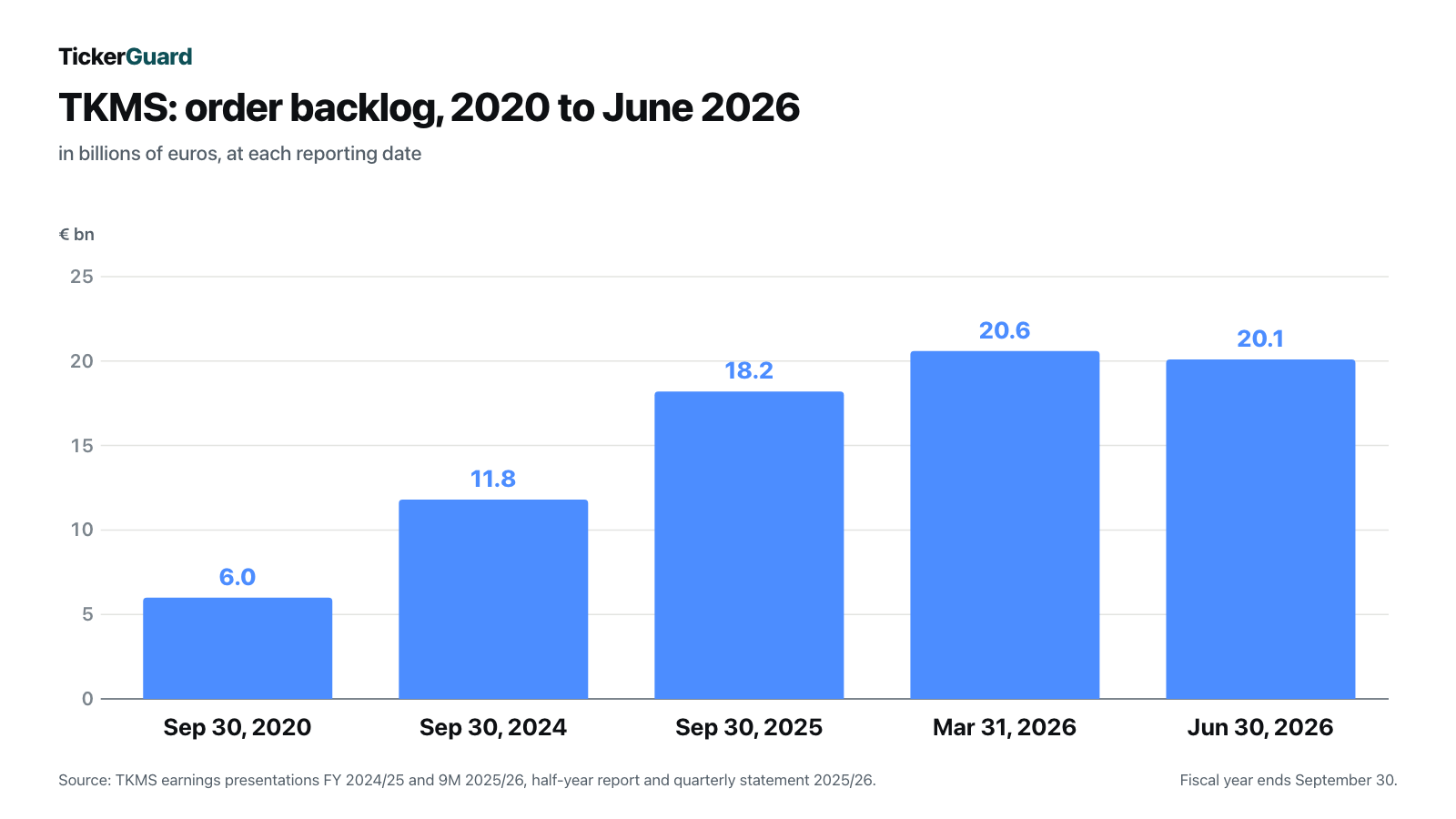
Starting point of the growth story: as of September 30, 2020 the naval division had a backlog of EUR 6.0 billion — less than a third of the June 2026 level.
-
2025
Record order intake of EUR 8.8 billion
In fiscal 2024/25 Germany ordered four submarines and a Southeast Asian customer two. The advances drove free cash flow to EUR 784 million.
-
2025
October: listed as a standalone KGaA
First trading day October 20, 2025. thyssenkrupp keeps 51% of the shares and the entire managing entity — shareholders get a profit share but no steering.
-
2026
January: Norway orders two more submarines
The Royal Norwegian Navy raises its 212CD order from four to six boats. The order shapes the EUR 3.6 billion of intake in the first nine months of 2025/26.
-
2026
July: MEKO frigates and Canada
Contract for four MEKO frigates for the German Navy signed; Canada picks TKMS as preferred submarine supplier. Neither is in the backlog as of June 30, 2026.
-
2026
August: guidance raised a second time
Adjusted EBIT for 2025/26 now EUR 130 million to EUR 160 million. At the same time the backlog fell from EUR 20.6 billion to EUR 20.1 billion in the third quarter on just EUR 208 million of new orders.
How the Stock Landed on Our Desk
Honestly: not through a metric, but through other investors' curiosity. Since August 4, 2026, TKMS has appeared on the most-searched list of the German investor portal wallstreet-online — under the U.S. symbol TKMCY. That is an attention signal and explicitly not a reason to buy. A stock gets searched because people are talking about it, and in the summer of 2026 people talked about TKMS a lot: its selection in Canada's submarine program, the largest frigate contract in its history and a record high in the share price.
That mix is exactly what makes the echo trap dangerous. When you look up a stock because of big headlines, the headline is already in your head before you have read the first line of the balance sheet. The headlines are accurate — the question is what they mean for you as a shareholder, and when.
The Numbers Over the Years — Given Their Due
First, what genuinely impresses, and there is plenty. The order backlog grew from EUR 6.0 billion (September 30, 2020) to EUR 11.8 billion (September 30, 2024), EUR 18.2 billion (September 30, 2025) and EUR 20.6 billion as of March 31, 2026, and stood at EUR 20.1 billion on June 30, 2026. In fiscal 2024/25 TKMS booked EUR 8.8 billion of orders, led by four 212CD-class submarines for Germany and two boats for a customer in Southeast Asia. In January 2026, Norway ordered two more 212CD boats. One point matters when comparing defense stocks: TKMS says it only counts orders reflected in current contractual agreements — not hoped-for business of the kind some companies count as “soft” backlog.
Execution is picking up, too. Revenue rose from EUR 1,987 million (2023/24) to EUR 2,171 million (2024/25); adjusted EBIT — operating profit excluding special items such as spin-off costs — went from EUR 86 million to EUR 131 million, and the adjusted margin from 4.3 to 6.0 percent. In the first nine months of 2025/26, revenue grew 19 percent to EUR 1,890 million and adjusted EBIT 13 percent to EUR 110 million. The submarine business made the biggest jump: its adjusted EBIT climbed from EUR 11 million to EUR 46 million as three boats from legacy contracts were delivered and higher-margin new builds ramped up. In August 2026 TKMS raised its full-year guidance for the second time and now expects revenue growth of 10 to 12 percent and adjusted EBIT of EUR 130 million to EUR 160 million.
And the balance sheet: as of June 30, 2026, TKMS held EUR 1,218 million in cash and no meaningful bank debt; after lease and pension obligations, net financial assets came to EUR 834 million. In the words of its own earnings presentation, the shipbuilder is debt free. So far, a success story. The echo trap only snaps shut when you ask when and how much of all this reaches the shareholder.
Uncomfortable Truth No. 1: The Record Backlog Is Work for up to 14 Years
The most important number in this analysis is not in a press release but in the notes to the 2024/25 annual report, under the unassuming heading “Remaining performance obligations.” There TKMS explains that the majority of the backlog will turn into revenue over the next 1 to 14 years. Then comes the split:
“As of September 30, 2025, an amount of €8,229 million (September 30, 2024: €7,138 million) of the order backlog is expected to be satisfied within the next 5 years after the respective balance sheet date while the remaining balance is expected to be satisfied in subsequent years, i.e. after more than 5 years after the respective balance sheet date.”
— TKMS AG & Co. KGaA, Annual Report 2024/25, notes to the combined financial statements, p. 78
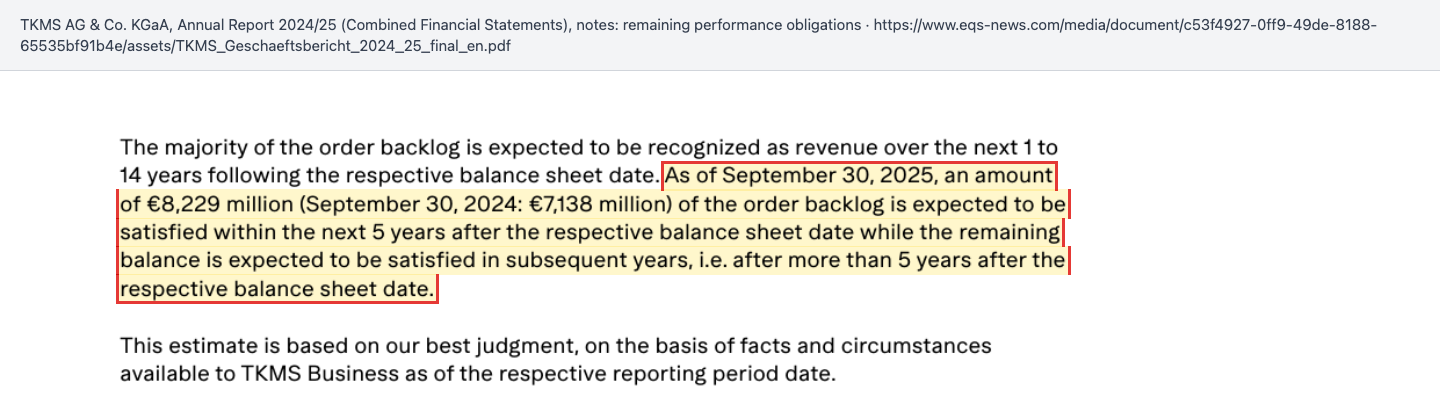
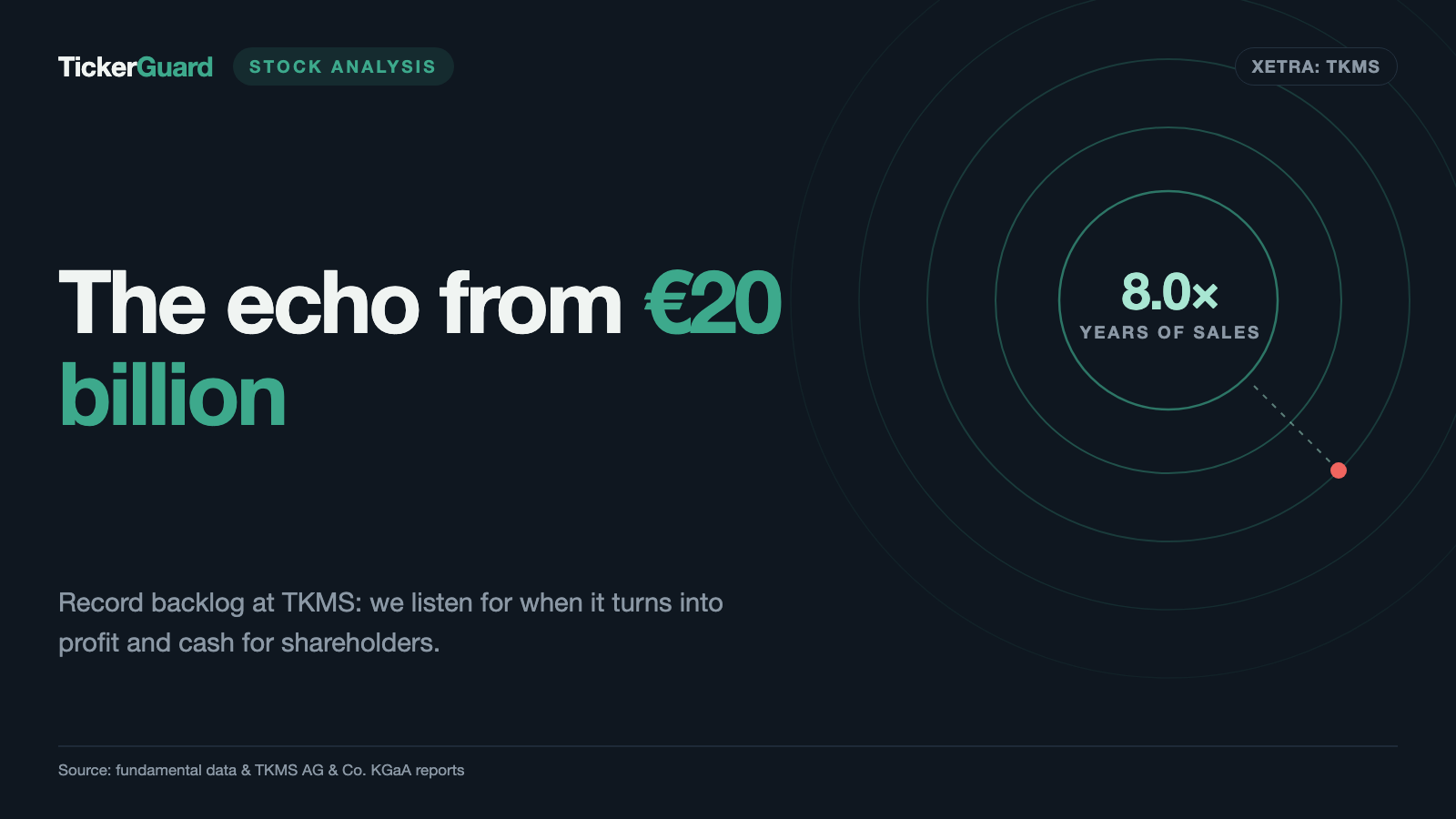
Do the math: EUR 8,229 million out of EUR 18,232 million is 45 percent. More than half of that record — roughly EUR 10 billion — only becomes revenue after September 2030. TKMS expresses the same thing with its own metric, sales coverage: backlog divided by revenue projected over twelve months. As of June 30, 2026 it stood at 8.0. In plain terms: at today's pace, the work in the book covers eight years of revenue.
That is planning security, no question. For valuation, though, it means something different from what the big number suggests. At an adjusted margin of 5.8 percent (nine months of 2025/26), one euro of backlog produces just under six cents of operating profit — spread over a decade, before taxes, before interest and before everything that can go wrong in ten years of shipbuilding. Provisions for expected losses on ongoing contracts already exist: EUR 88 million stood on the balance sheet as of September 30, 2025, and EUR 137 million was added in fiscal 2024/25. A second, easily overlooked number fits the picture: in the third quarter of 2025/26 TKMS booked only EUR 208 million in new orders, versus EUR 3,001 million a year earlier, while revenue came to EUR 722 million. That is why the backlog fell from EUR 20.6 billion to EUR 20.1 billion. The contract for four MEKO frigates signed in July 2026 — about EUR 5 billion according to the earnings presentation — will only be booked in the fourth quarter.
Bottom line: an order backlog is not a bank balance but a timetable. What matters is not its size but the pace and margin at which it is worked off.
Uncomfortable Truth No. 2: Much of the Cash Belongs to the Customers
EUR 1,218 million in cash sounds like a fortress. But shipyards work with their customers' money: governments pay advances at signing and as construction progresses, long before the ship is finished. On the balance sheet these prepayments sit as contract liabilities — EUR 2,286 million as of June 30, 2026. Netted against TKMS's own advances to suppliers and work performed but not yet billed, net advance payments received came to EUR 1,125 million. That is more than all of the EUR 834 million in net financial assets. In everyday terms: much of the money in the builder's account is the owner's installment for work still to come.
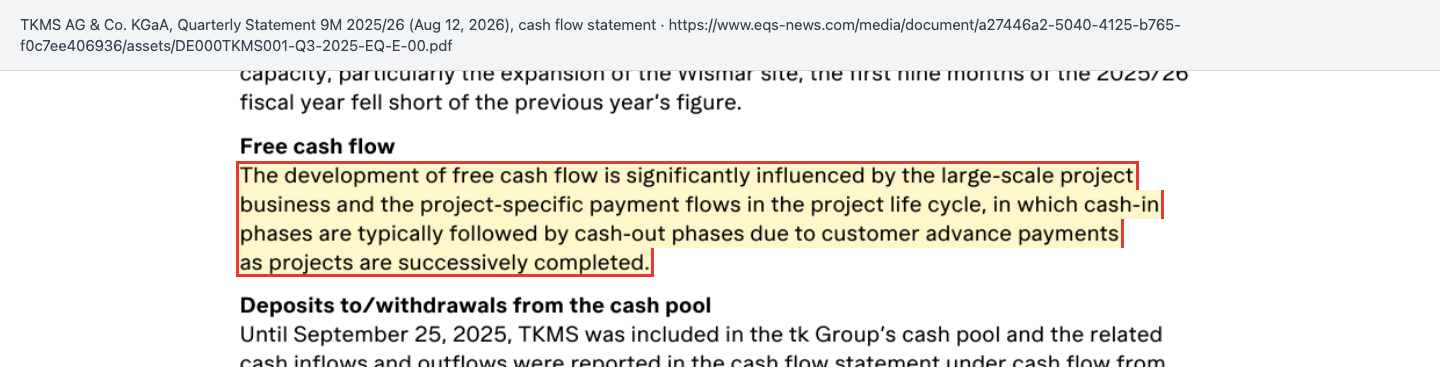
That is why free cash flow swings so hard. It was EUR 180 million in 2022/23, EUR 355 million in 2023/24 and EUR 784 million in 2024/25 — mainly because large advances for the German-Norwegian 212CD submarine program arrived at the end of 2024. In the first nine months of 2025/26 the figure turned to minus EUR 204 million. TKMS describes the mechanism itself in the quarterly statement:
“The development of free cash flow is significantly influenced by the large-scale project business and the project-specific payment flows in the project life cycle, in which cash-in phases are typically followed by cash-out phases due to customer advance payments as projects are successively completed.”
— TKMS AG & Co. KGaA, Quarterly Statement 9M 2025/26, p. 12
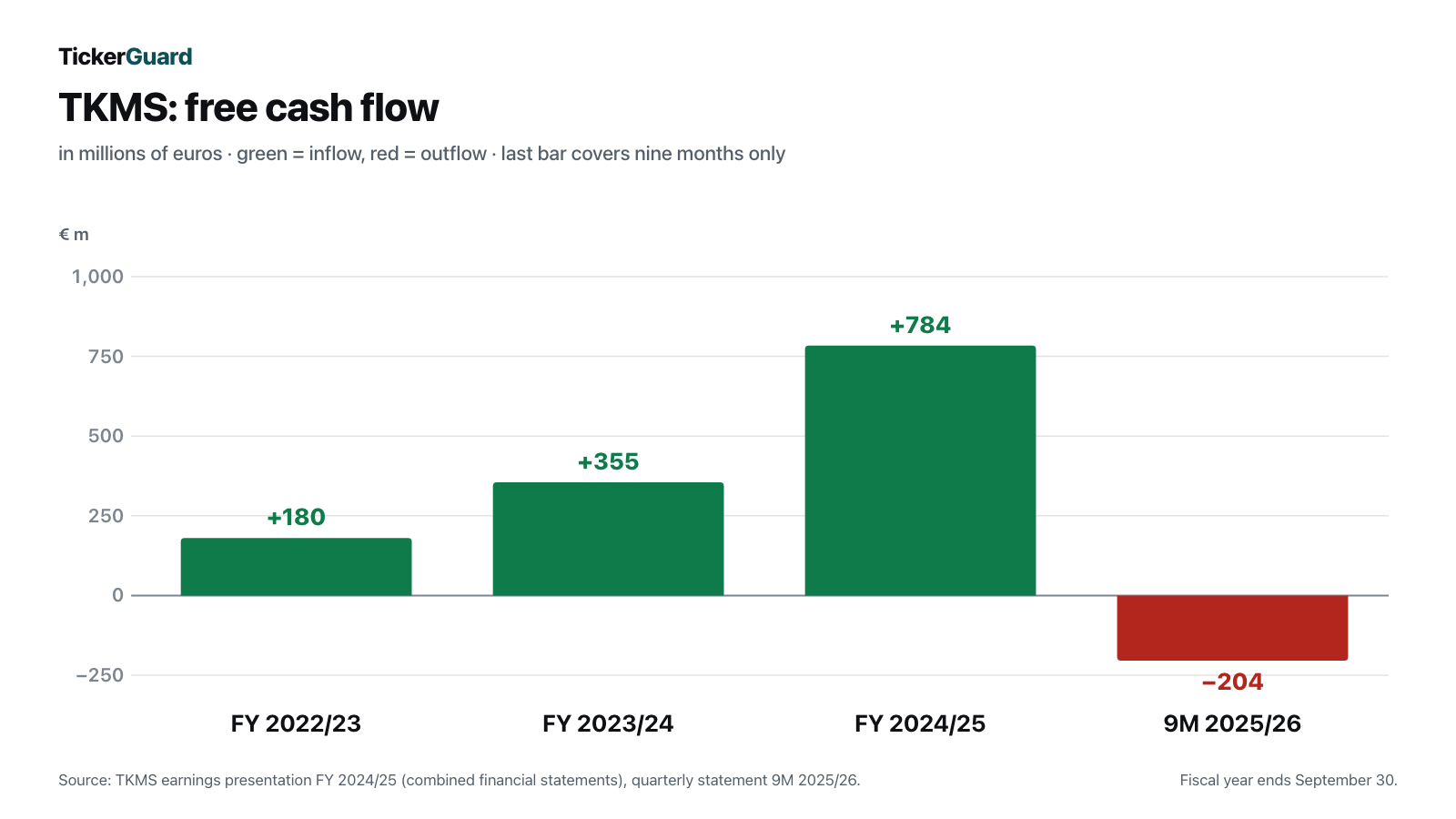
On top of that came payments to the former parent: as part of the legal reorganization before the spin-off, TKMS repaid a EUR 276 million purchase-price liability to thyssenkrupp, and buying out minority stakes in three subsidiaries for EUR 108 million reduced equity. That is one reason net financial assets fell from EUR 1,313 million (September 30, 2025) to EUR 834 million. For the full year, TKMS expects free cash flow to be positive again, and over three years a cumulative figure above EUR 400 million. Bottom line: at a shipyard, cash is a pass-through item. What matters more than the balance is whether more comes out than goes in over a full project cycle.
Uncomfortable Truth No. 3: You Are a Co-Owner, Not a Co-Decider
The “& Co. KGaA” in the name is not a formality. A German partnership limited by shares has two kinds of partners: the shareholders, who provide the capital, and a general partner with unlimited liability that runs the business. At TKMS, that general partner is TKMS Management AG. The half-year report spells out who owns it:
“The general partner has made no capital contribution to the company, holds no shares in the company and participates neither in its assets nor in its profits and losses. It is solely entrusted with the management of the Company. The General Partner is not included in the scope of consolidation. tk AG indirectly holds 100% of the shares in the General Partner.”
— TKMS AG & Co. KGaA, Half-Year Financial Report 2025/26, note 7, p. 42
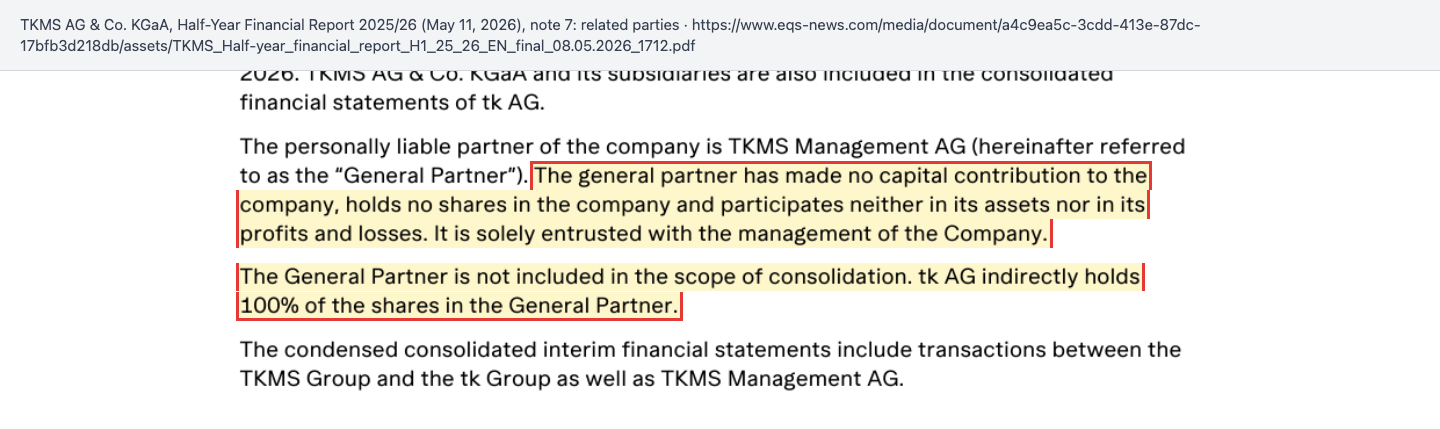
In plain terms: in this structure, the people who run the company are not chosen by the TKMS shareholders' meeting but by the owner of TKMS Management AG — which is 100 percent thyssenkrupp, the same company that holds 51 percent of the shares. The general partner is reimbursed for its expenses; in the first half of 2025/26 that came to EUR 3.4 million, including management and supervisory board pay. This is no scandal but a common German legal form for companies with a dominant owner. It does mean, though, that the free-floating shareholders — just under 39 percent once the Krupp Foundation is excluded — ride along; they do not steer.
The link to the parent reaches further, right into the customer contracts. For ongoing TKMS projects, thyssenkrupp stands behind the customers with parent company guarantees and letters of indemnity totaling EUR 10,410 million (March 31, 2026) — ten times TKMS's equity of EUR 1,031 million as of June 30, 2026. TKMS pays a fixed fee per guarantee that rises year by year; in the first half the guarantees cost EUR 6.7 million. Then comes the sentence that matters for the next big contracts:
“While existing PCGs will remain in place after the spin-off, it is not intended to make use of new PCGs with respect to new contracts entered into by TKMS Group after the spin-off.”
— TKMS AG & Co. KGaA, Half-Year Financial Report 2025/26, note 7, p. 45
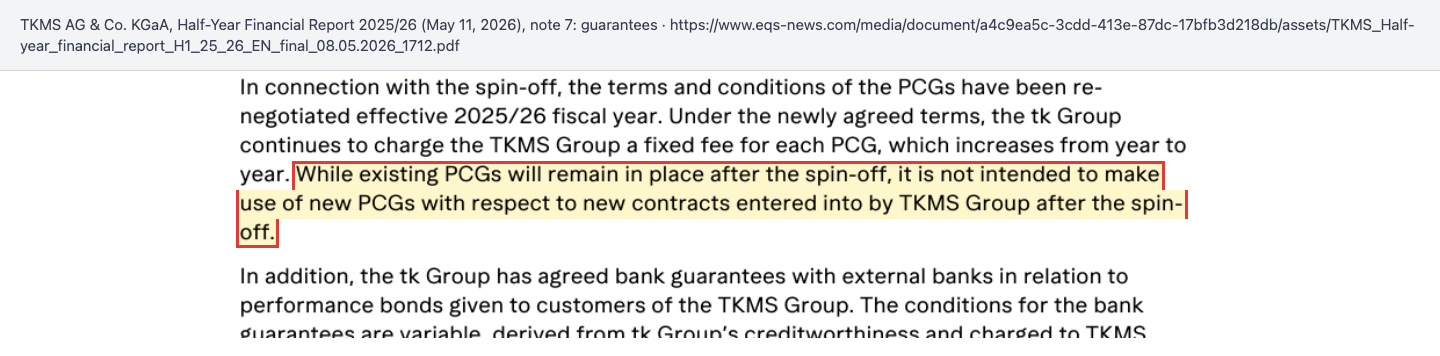
The frigates for the German Navy and the potential Canadian program are exactly such new contracts. How TKMS will provide the security for them on its own — through bank guarantees, its own credit lines or escrow arrangements — is not described in the reports so far. The answer should appear in the first full consolidated financial statements on December 7, 2026 at the latest. Bottom line: with TKMS you buy a piece of the shipyard — thyssenkrupp keeps the keys.
Uncomfortable Truth No. 4: More Revenue, Less Profit at the Bottom Line
Revenue up 19 percent, adjusted EBIT up 13 percent — and yet net income for the first nine months of 2025/26 fell 25 percent to EUR 56 million. EUR 49 million of that was attributable to TKMS AG & Co. KGaA shareholders, and earnings per share fell from EUR 1.15 (pro forma, prior-year period) to EUR 0.77. Three things ate up the gain.
First, the cost of independence: general and administrative expenses rose 33 percent to EUR 129 million; TKMS attributes EUR 21 million of that increase directly to the spin-off — its own legal, reporting and compliance functions plus one-off consulting fees. Second, lower net interest: with fewer customer advances sitting in the bank, net financial income fell from EUR 29 million to EUR 20 million. Third, taxes. They rose from EUR 39 million to EUR 62 million; on pre-tax income of EUR 118 million that is a rate of roughly 53 percent. The quarterly statement names the reason:
“The higher tax expense compared to the same period of the previous year is largely due to the payment of Brazilian withholding taxes, which are incurred as expected but irregularly in terms of the timing of payments.”
— TKMS AG & Co. KGaA, Quarterly Statement 9M 2025/26, p. 9
That is the price of the export business: Brazil contributed a quarter of first-half revenue, and the withholding taxes incurred there weigh on group earnings. For balance: adjusted EBIT is the number TKMS asks to be measured by and the one its guidance hangs on. Earnings per share is the number a dividend is supposed to come from starting in 2027 — TKMS intends to pay out 30 to 50 percent of net income, for the first time for fiscal 2025/26. Bottom line: between adjusted EBIT and your share of the profit at TKMS sit spin-off costs, interest and foreign taxes — and they do not move in lockstep.
What the Stock Costs
On September 25, 2026, one TKMS share cost EUR 84.00 on XETRA (fundamental data). With 63,523,647 shares, that is a market value of about EUR 5.34 billion; subtracting EUR 834 million in net financial assets leaves an enterprise value of roughly EUR 4.5 billion. For comparison, the quarterly statement itself cited EUR 74.60 and a market value of EUR 4,739 million as of June 30, 2026.
- Against operating profit: for fiscal 2025/26 TKMS expects adjusted EBIT of EUR 130 million to EUR 160 million. Enterprise value is therefore about 28 to 35 times that figure. In plain terms: at a constant profit, the business would need roughly three decades to earn its current price — the market is paying not for today's earnings but for the backlog and the hope of higher margins.
- Against earnings: net income attributable to shareholders in 2024/25 — at the time still entirely thyssenkrupp — was EUR 105.0 million, or EUR 1.65 per share on paper based on today's share count. That implies a price-to-earnings ratio of about 51. The key-figures box shown automatically on this page comes from the fundamental data and uses its own earnings basis and cut-off date, which is why its figure differs; our 51 refers explicitly to 2024/25 earnings.
- Against revenue: 10 to 12 percent growth on EUR 2,171 million implies about EUR 2.39 billion to EUR 2.43 billion of revenue in 2025/26, for a price-to-sales ratio of around 2.2.
All three yardsticks rest on the same assumption: that the backlog really does turn into margins above 7 percent in the coming years, as TKMS targets for the medium term. In plain terms: today you are paying for a very loud ping. Whether the echo comes back as strong as the price implies will take years to show, not quarters.
Opportunities and Risks at a Glance
The case for TKMS:
- The backlog is contractual. EUR 20.1 billion as of June 30, 2026, plus the four MEKO frigates signed in July (about EUR 5 billion according to the earnings presentation, to be booked in the fourth quarter) with an option for four more.
- More large programs in the final stretch. Canada selected TKMS in July 2026 as preferred supplier for up to twelve submarines; TKMS puts the potential value at more than EUR 15 billion and expects the contract signature by the end of 2026. Final negotiations are under way with India for six submarines with an option for three more, and a TKMS-led joint venture is the sole bidder for the F127 air-defense frigate.
- Margins rise as legacy work runs out. Orders from before July 2021, which TKMS classifies as legacy contracts, are being worked off: three such boats were delivered in the first nine months of 2025/26, and the submarine business lifted adjusted EBIT from EUR 11 million to EUR 46 million. In September 2026 TKMS also completed Israel's Dolphin AIP program when INS DRAKON, the third and final boat, left Kiel.
- Atlas Electronics is growing fast and profitably. Revenue up 28 percent to EUR 612 million and a 9.6 percent adjusted margin in nine months; in September 2026 it added a British contract for a submarine torpedo countermeasure system.
- No meaningful financial debt. EUR 834 million in net financial assets as of June 30, 2026, an undrawn EUR 300 million credit facility from thyssenkrupp and guidance raised twice.
The case against:
- Thin margin, long haul. A 5.8 percent adjusted margin after nine months, a medium-term target above 7 percent — and only 45 percent of the September 2025 backlog becomes revenue within five years.
- Negative cash flow. Minus EUR 204 million in nine months; cash follows the rhythm of customer advances.
- Control sits with thyssenkrupp. 51 percent of the shares and 100 percent of the managing entity belong to the parent; it backs ongoing projects with EUR 10.4 billion in guarantees, but not new contracts.
- Few, political customers. Four governments each account for more than a tenth of revenue. Export orders depend on preliminary inquiries to the German government; TKMS itself flags the risk that a positive decision may have to be withdrawn over a long contract life.
- Little tangible equity. Goodwill (EUR 1,047 million) and other intangible assets (EUR 271 million) together exceed equity of EUR 1,031 million (June 30, 2026).
- Execution risk in the build-out. About EUR 200 million of investment in fiscal 2025/26, mainly for the new yard in Wismar; TKMS also reports increasing attacks on its IT and trade secrets.
An Honest Conclusion
Back to the sonar room. We listened for the echo, and it does come back — clearly audible. TKMS has EUR 20.1 billion of contracted work, is profitable, carries no meaningful financial debt and is improving its margin year after year as difficult legacy contracts run out. That is considerably more than many defense stories on the stock market can show.
But the echo returns in installments: less than half of the backlog turns into revenue over the next five years, each euro of revenue currently yields just under six cents of adjusted operating profit, much of the cash belongs to the customers, and thyssenkrupp sits at the controls of management. The echo trap is mistaking the ping for the echo — the record backlog for money already earned, and the share price for a discount on it.
The next solid data points are the booking of the MEKO frigates in the fourth quarter, the signature of the Canadian contract and the first full consolidated financial statements on December 7, 2026, which must also show how TKMS secures new large contracts without its parent's guarantees. What you do with this is your decision. And that is how it should be.
Sources and Notes
- TKMS AG & Co. KGaA, Quarterly Statement 9M 2025/26 (October 1, 2025 to June 30, 2026) — published August 12, 2026: key figures, results of operations, net working capital, cash flow statement, segments, forecast, opportunity and risk report, events after the reporting date
- TKMS, 9M 2025/26 earnings presentation of August 12, 2026 — quarterly overview, backlog since 2020, new orders, medium-term targets and dividend policy
- TKMS, press release on the nine-month results of August 12, 2026 — guidance increase and new major orders
- TKMS AG & Co. KGaA, Half-Year Financial Report 2025/26 — published May 11, 2026, reviewed: revenue by customer country, risk report, note 7 (related parties, general partner, parent company guarantees)
- TKMS AG & Co. KGaA, voluntary condensed Annual Report 2024/25 with combined financial statements — December 2025: revenue and earnings 2023/24 and 2024/25, note on remaining performance obligations (p. 78) and provisions
- TKMS, FY 2024/25 earnings presentation of December 8, 2025 — adjusted EBIT and free cash flow 2022/23 to 2024/25
- TKMS AG & Co. KGaA, Q1 2025/26 quarterly statement of February 11, 2026 — MDAX inclusion, agreements in Canada
- Voting rights notification of the Alfried Krupp von Bohlen und Halbach Foundation — threshold crossed on October 20, 2025: 10.26 percent, total voting rights 63,523,647
- TKMS press releases on tkmsgroup.com of July 6, 2026 (Canada), July 8, 2026 (Bundestag budget committee, MEKO A-200 DEU), September 1, 2026 (handover of INS DRAKON, MoU with Fincantieri, F127 design status) and September 17, 2026 (Next Generation Countermeasure contract for the Royal Navy)
- Price and market value: fundamental data, XETRA price of September 25, 2026 (EUR 84.00). Hook: wallstreet-online most-searched list, first on August 4, 2026 (not a source for company figures)
Note: This article is journalistic commentary and expressly not investment advice, not a solicitation to buy or sell securities and not a recommendation. Stocks can lose their entire value. All figures come from the original reports linked above and are given with their respective reporting dates. Positions held by the operator are disclosed daily; where one exists, it appears as a notice at the top of this deep dive.
Our Bottom Line at a Glance
- Order situation positive
- Backlog of EUR 20.1 billion as of June 30, 2026, up from EUR 6.0 billion in September 2020, contractual orders only; four MEKO frigates (about EUR 5 billion per the earnings presentation) were added in July 2026, to be booked in the fourth quarter of 2025/26.
- Pace and margin of execution negative
- Only 45 percent of the September 30, 2025 backlog was expected to become revenue within five years (Annual Report 2024/25, p. 78). The adjusted margin stood at 5.8 percent after nine months of 2025/26; the target above 7 percent is medium-term.
- Earnings trend neutral
- Revenue +19 percent and adjusted EBIT +13 percent in nine months of 2025/26; net income, by contrast, fell 25 percent to EUR 56 million because of spin-off costs, lower interest income and Brazilian withholding taxes (tax rate about 53 percent).
- Balance sheet and cash flow neutral
- Net financial assets of EUR 834 million and no meaningful financial debt (June 30, 2026). Free cash flow was −EUR 204 million in nine months; net advance payments received of EUR 1,125 million exceed net financial assets.
- Governance and reliance on thyssenkrupp negative
- thyssenkrupp holds 51 percent of the shares and 100 percent of the managing TKMS Management AG; its parent company guarantees and letters of indemnity for ongoing projects came to EUR 10,410 million (March 31, 2026), and no new ones are intended for new contracts.
- Valuation neutral
- At EUR 84.00 (September 25, 2026), about EUR 5.34 billion in market value, roughly 28 to 35 times expected adjusted EBIT for 2025/26 on an enterprise-value basis and a P/E of about 51 on 2024/25 earnings.
TKMS has EUR 20.1 billion of contracted orders, grows at double digits, has raised its guidance and carries no meaningful financial debt. The reports also show how slowly, and at what margin, that becomes profit: 45 percent of the backlog within five years, a 5.8 percent adjusted margin, negative cash flow over nine months and management that sits entirely with thyssenkrupp. Not investment advice.
What Our Rating Means
Open questions
The business works in principle, but one material question is open. As long as it stays open, our findings do not carry a quality verdict.
The business works: a contractually backed backlog of EUR 20.1 billion, profitable in every reported year, no meaningful financial debt, no going-concern flag in the risk report and guidance raised twice. What is missing for green is proof on the key operating question: whether the 5.8 percent margin really rises above 7 percent while a backlog spanning up to 14 years is worked off and free cash flow stands at minus EUR 204 million after nine months. Add the reliance on thyssenkrupp as majority shareholder, owner of management and guarantor, and a small set of government customers. None of this is a documented threat to the substance of the company, so it is yellow rather than red. The decision is yours.
A journalistic assessment by our editorial team at the time of the deep dive, based on public sources — not investment advice and not a solicitation to buy or sell. Your personal circumstances (investment goals, risk capacity, taxes) cannot be taken into account. What our levels mean, how verdicts are formed, and what conflicts of interest exist →
Worth Noting
- The hook is wallstreet-online's most-searched list, where TKMS has appeared under the U.S. symbol TKMCY since August 4, 2026 — an attention signal, not a data source.
- Data as of September 26, 2026. Company figures from the Quarterly Statement 9M 2025/26 (August 12, 2026), the Half-Year Financial Report 2025/26 (May 11, 2026) and the voluntary Annual Report 2024/25 with combined financial statements (December 2025). The first full IFRS consolidated financial statements are due on December 7, 2026.
- All regulatory and press releases from August 12 to September 26, 2026 were reviewed: no ad hoc release, no guidance change, no capital measure. Included are the handover of INS DRAKON (September 1, 2026), the MoU with Fincantieri (September 1, 2026) and the British torpedo countermeasure contract (September 17, 2026).
- TKMS is not an SEC filer; neither TKMS nor TKMCY appears in the EDGAR database. The relevant listing is the Prime Standard of the Frankfurt Stock Exchange under TKMS.
- The parent thyssenkrupp AG is a separate issuer with its own analysis. Figures for the Marine Systems segment in thyssenkrupp reports can differ from TKMS figures because TKMS derives its historical values from the combined financial statements with changed accounting policies.
The full analysis as a PDF for later
We will send you this analysis as a PDF — to print, file away, and read at your own pace.
Frequently Asked Questions
TKMS AG & Co. KGaA is thyssenkrupp's former naval division, based in Kiel, Germany. It builds submarines, frigates and naval electronics. The shares have traded in the Prime Standard of the Frankfurt Stock Exchange since October 20, 2025 and joined the MDAX shortly afterwards. thyssenkrupp still holds 51 percent of the shares.
As of June 30, 2026 the backlog was EUR 20.1 billion, after EUR 20.6 billion on March 31, 2026 and EUR 18.2 billion on September 30, 2025. TKMS only counts contractually agreed orders. The contract for four MEKO frigates signed in July 2026 will only be booked in the fourth quarter of fiscal 2025/26.
According to the 2024/25 annual report, most of it turns into revenue over the next 1 to 14 years. Of the EUR 18,232 million backlog as of September 30, 2025, EUR 8,229 million — 45 percent — was expected to be satisfied within five years. Sales coverage stood at 8.0 years of revenue as of June 30, 2026.
Shipyards receive large customer advances at the start of big programs and spend the money during construction. In 2024/25 free cash flow was plus EUR 784 million, mainly because of advances for the 212CD submarine program. In the first nine months of 2025/26 it was minus EUR 204 million. TKMS expects a positive figure again for the full year.
In a German partnership limited by shares, a general partner runs the business. At TKMS this is TKMS Management AG, which according to the half-year report is indirectly 100 percent owned by thyssenkrupp and holds no shares itself. Other shareholders participate in profits but do not choose management.
Not yet. According to its August 2026 earnings presentation, TKMS intends to pay out 30 to 50 percent of net income attributable to shareholders, subject to sufficient free cash flow. The first payment is planned for 2027, based on the fiscal year ending September 30, 2026.
TKMS is listed only on the Frankfurt Stock Exchange and reports under European capital-markets law. The U.S. symbol TKMCY is an over-the-counter depositary receipt without its own reporting duty; the SEC's EDGAR database lists neither TKMS nor TKMCY. The relevant documents are the annual report, the half-year report and the quarterly statements.
Found an error?
Did you spot a factual error, an outdated number, or a typo in this deep dive? Let us know briefly — your report goes straight to the editorial team.