SK hynix: 60 Trillion Won of Operating Profit in Three Months — and No Order Backlog Behind It
In the second quarter of 2026, SK hynix kept 76 percent of its revenue as operating profit. Net income even exceeded revenue, thanks to 53 trillion won of valuation gains. Three years earlier the same company was losing money. We sorted out which part of the record comes from selling memory chips and which part exists only on paper.
 Thomas Mücke
Founder & Publisher
Thomas Mücke
Founder & Publisher
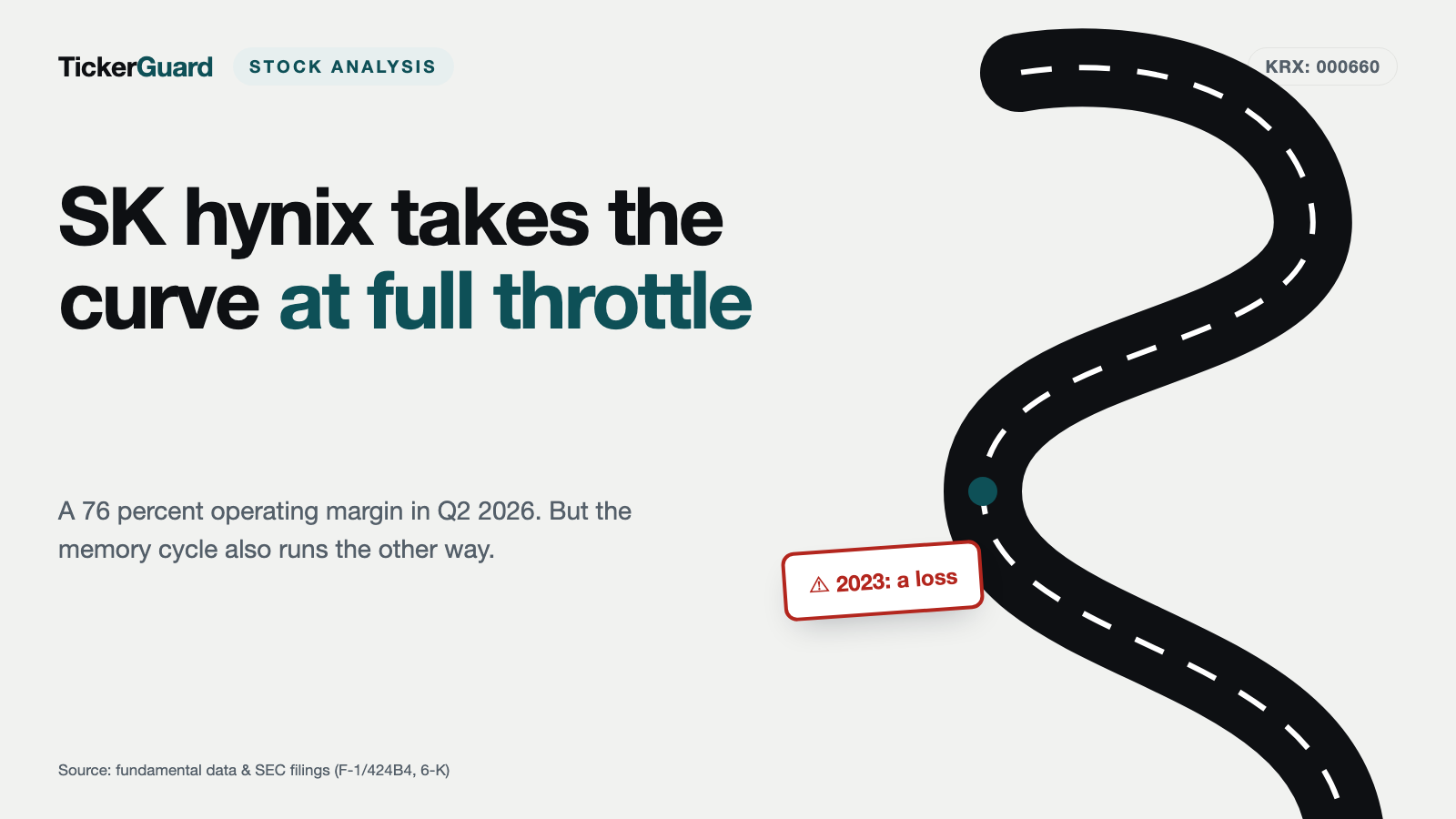
There is a calculation the brain performs all by itself the moment a company reports a record quarter: it multiplies by four. Three great months, so the whole year will be great, and the next one too. Call it the times-four trap. With SK hynix it is especially tempting. In the second quarter of 2026 the South Korean memory maker earned 60.5 trillion won in operating profit. Times four, that is 242 trillion won a year — more than double the revenue SK hynix booked in all of 2025.
The catch: the times-four trap only works if the future looks like last quarter. In few industries has that been as rare as in memory chips. The same company posted a net loss of 9.1 trillion won in 2023. So here is the deal for this piece: we look not only at the record quarter, but at what the filings say about how durable that record is.
For scale: at the July 14, 2026 exchange rate of 1,504.90 won per U.S. dollar (from the company's report on the share issuance), one trillion won was worth about $665 million. The 60.5 trillion won of second-quarter operating profit is therefore a little over $40 billion — in three months.
What SK hynix actually does — the memory behind AI data centers
SK hynix makes almost nothing but memory chips, in two flavors. DRAM is a computer's short-term memory: lightning fast, but forgetful the moment the power goes off. NAND flash is long-term memory, found in smartphones, memory cards and solid-state drives, and it keeps data without power. According to the IPO prospectus, DRAM accounted for 77.1 percent of revenue in 2025 and NAND flash for 21.3 percent; in the first quarter of 2026 the split was 77.3 and 22.0 percent.
The star of the lineup is HBM (high bandwidth memory). Picture a high-rise of DRAM chips stacked on top of one another and connected by tiny vertical wires, so data reaches the processor much faster. That is exactly what the graphics processors used to train and run AI models need. Citing the research firm IDC, the prospectus says SK hynix was the world's largest HBM supplier in the first quarter of 2026 with a 56.4 percent market share. In DRAM overall it ranked second with 29.1 percent, and in NAND flash also second with 18.5 percent. SK hynix does not name its largest AI chip customer; for the other side of this business, see our NVIDIA analysis.
“In recent years, we have substantially increased our sales of HBMs. HBMs are advanced memory semiconductors designed to deliver fast data transfers while using less power, making them especially useful in high-performance applications such as GPUs, AI and high-performance computing.”
— SK hynix Inc., IPO prospectus (Form 424B4) of July 10, 2026, “Summary”
Production runs in the company's own fabs in Icheon and Cheongju (South Korea) and in Wuxi and Dalian (China); packaging and testing take place in Icheon, Cheongju and Chongqing. As of June 30, 2026, the parent company employed 36,150 people. The NAND business was strengthened by the purchase of Intel's NAND unit, completed in March 2025 and now operating as Solidigm. The largest shareholder is the holding company SK Square with 20.5 percent (as of June 30, 2026).
On the listing side: the shares have traded on the Korea Exchange under the code 000660 since December 1996. Since July 2026 there are also American Depositary Shares on Nasdaq under the ticker SKHY — depositary receipts where ten ADSs equal one Korean share. Because SK hynix is now registered with the U.S. securities regulator, the SEC, it files English-language reports on Form 6-K; an annual report on Form 20-F does not exist yet. The fiscal year matches the calendar year.
That defines the central tension of this analysis, and it runs through every section: SK hynix is selling one of the most sought-after components of the AI boom at record prices — but in an industry where prices reset every month and where every boom so far has been followed by oversupply.
Company history for investors
-
2012
Hynix Semiconductor becomes SK hynix (March)
The former Hyundai chipmaker has carried the SK group name ever since; the largest shareholder today is the holding company SK Square with 20.5 percent.
-
2018
Investment in Kioxia (June)
As part of a Bain Capital-led consortium, SK hynix invests indirectly in the Japanese memory maker. In Q1 2026, the stake brought mainly 9.9 trillion won of valuation gains and about 4.0 trillion won of dividends, per the prospectus.
-
2023
Loss year in the memory downturn
After prices collapsed from fall 2022, the company posts a net loss of 9.1 trillion won. For shareholders, a reminder of how fast the memory business can turn.
-
2025
Intel NAND deal closed, record year (March to December)
The purchase of Intel's NAND unit (now Solidigm) is completed in March. The year ends with 97.1 trillion won of revenue and 47.2 trillion won of operating profit.
-
2026
$26.5 billion Nasdaq listing (July)
177.9 million ADSs at $149 each under the ticker SKHY, backed by 17.79 million new shares. The money is earmarked for fabs and lithography tools.
-
2026
Record quarter and 40 trillion won buyback (July/August)
Second-quarter operating profit of 60.5 trillion won at a 76 percent margin; on August 19 the board approves buying back and cancelling about 40 trillion won of its own shares.
How the stock landed on our desk
SK hynix reached us through the rankings on the German investor portal wallstreet-online: in September 2026 the Nasdaq ticker SKHY was among the names German investors were talking about most. No surprise — a $26.5 billion listing, a record quarter and a share price that swung sharply in between make for plenty of conversation.
Chatter is not a valuation. But it is a good reason to read the new English-language documents SK hynix has been filing with the SEC since July: the IPO prospectus with three full fiscal years and the 2026 half-year report. If you want to read along, every document is linked in the source list at the end.
The numbers over the years — credit where it is due
Let's start with what is genuinely impressive, because there is a lot. Revenue nearly tripled from 32.8 trillion won in 2023 to 97.1 trillion won in 2025. The first half of 2026 alone brought in 131.9 trillion won — more than all of the prior year. Operating profit swung from a loss of 7.7 trillion won (2023) to 23.5 trillion (2024), 47.2 trillion (2025) and 98.2 trillion won in the first half of 2026.
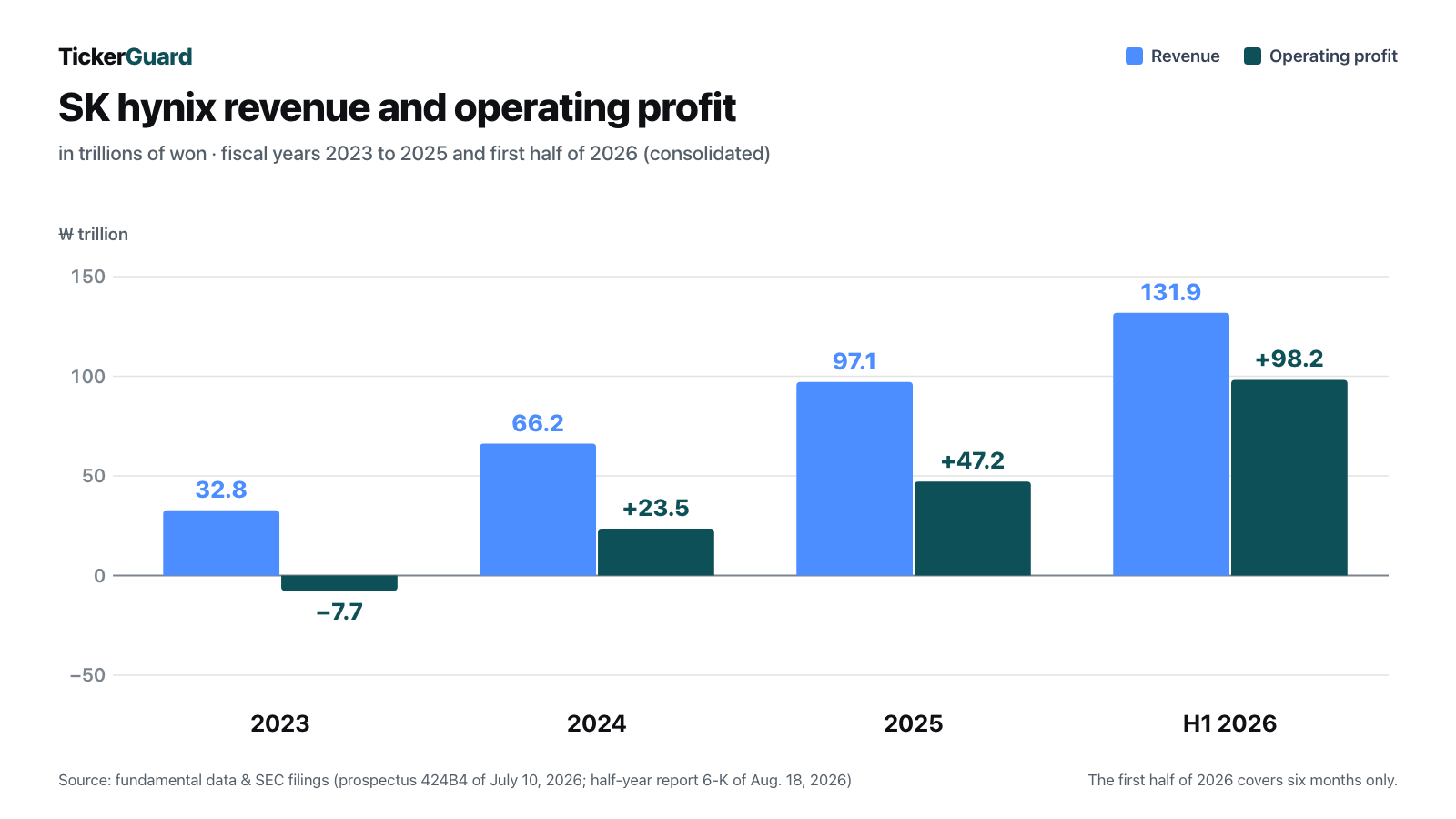
The second quarter of 2026 topped even that: 79.3 trillion won of revenue, up 51 percent from the prior quarter and 257 percent from a year earlier. Operating profit came to 60.5 trillion won, an operating margin of 76 percent. In other words, after manufacturing, overhead and research costs, 76 won of every 100 won of revenue remained as operating profit. That is a software-company margin, not the kind you expect from someone running fabs.
Where it comes from, the half-year report says itself: mostly prices. In the second quarter, the average DRAM selling price rose from the prior quarter by an amount “in the mid-30% range,” NAND flash “in the mid-50% range” — with DRAM volumes only slightly higher. In the first quarter of 2026, according to the prospectus, DRAM prices had already risen by a “mid-60%” amount. The company's explanation:
“In the second quarter of 2026, price increases continued due to strong demand conditions driven by the expansion of AI infrastructure investment and the continuation of a constrained supply environment.”
— SK hynix Inc., Half-year report for the first half of 2026 (Form 6-K of August 18, 2026), Section II.1.C
Cash generation is impressive too. In the first half of 2026, operations brought in 91.7 trillion won; after capital expenditures on property and equipment (18.3 trillion) and intangibles (0.7 trillion), roughly 72.7 trillion won of free cash flow remained. As of June 30, 2026, cash, short-term financial instruments and short-term investments totaled 88.0 trillion won against just 18.6 trillion won of borrowings — net cash of roughly 69 trillion won. Moody's upgraded its rating to A3 on August 3, 2026. And the Nasdaq listing added another 39.9 trillion won in July.
What the filings say — the uncomfortable truths
Uncomfortable truth #1: record-quarter net income exceeded revenue — because of valuation gains
Here is the first trap for anyone reading earnings figures off a database. In the second quarter of 2026 SK hynix reported net income of 93.9 trillion won on 79.3 trillion won of revenue — a net margin of 118 percent. That is not a typo; it is an accounting question.
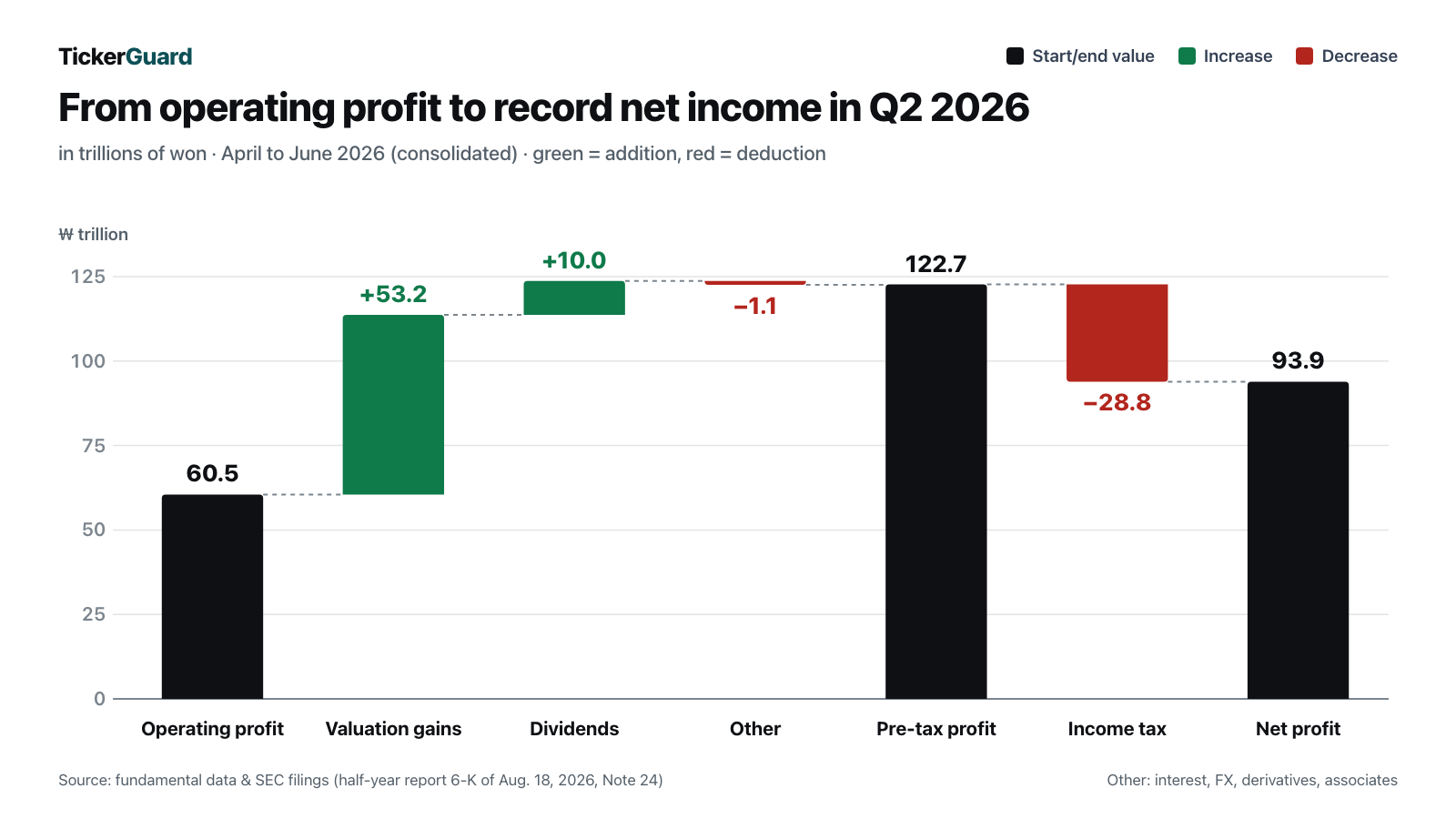
Note 24 of the half-year report breaks down the quarter's finance income: 53.2 trillion won of “gain on valuation of financial instruments” and 10.0 trillion won of dividend income. Together, those two items made up roughly half of the 122.7 trillion won of pre-tax profit. Everything else below operating profit (interest, currency effects, derivatives, equity-accounted investees and other income) netted to minus 1.1 trillion won. For the first quarter of 2026, the prospectus explains where such gains came from: “primarily to our stake in Kioxia,” the Japanese memory maker SK hynix invested in indirectly in 2018 through a consortium led by Bain Capital, and whose market value, according to the prospectus, rose significantly in the first quarter of 2026. One of the two investment vehicles sold all of its remaining Kioxia shares in June 2026, the prospectus adds. For the second quarter, the half-year report gives no breakdown by individual holding.
This is not an accounting trick; it is required. Under the accounting rules these holdings are carried at market value, and changes in value run through the income statement. But it means a large part of the record profit depends on another company's share price — and can come back as a valuation loss in a weak quarter. Anyone who computes a price-to-earnings ratio from this net income is counting securities gains. The more reliable yardstick for the memory business is operating profit.
A counterexample belongs here too: in the first half of 2026, SK hynix booked a 4.0 trillion won loss on derivatives because holders of exchangeable bonds issued in 2023 swapped them into shares as the stock rose. According to the report of August 14, 2026, no cash left the company, and the effect on equity was small because a gain on the disposal of treasury shares offset it. That, too, is bookkeeping, not business.
Uncomfortable truth #2: no order backlog — prices are renegotiated every month
Multiplying a record quarter by four assumes that prices hold. What the half-year report says on that point is a single, sober sentence:
“The Company determines supply volumes and prices on a monthly and quarterly basis by mutual agreement with major customers, and there is no order backlog based on long term supply contracts.”
— SK hynix Inc., Half-year report for the first half of 2026 (Form 6-K of August 18, 2026), Section II.5.B “Order Status”

To be fair: in its earnings release of July 29, 2026, SK hynix wrote that it had finalized long-term agreements with around ten customers, including key strategic partners. How those agreements fix volumes and prices is not disclosed there. The official half-year report, filed three weeks later, still describes monthly and quarterly volumes and prices with no backlog. For investors, that means record prices are not a contractually secured book of business; they are today's market price.
And how that market behaves, SK hynix describes in its own prospectus:
“From time to time, the memory semiconductor industry has experienced significant and sometimes prolonged periods of oversupply and weak prices.”
— SK hynix Inc., IPO prospectus (Form 424B4) of July 10, 2026, Risk Factors

This is not theory. According to the prospectus, memory prices fell starting in the third quarter of 2022, and SK hynix posted a net loss of 9.1 trillion won in 2023. In the first quarter of 2023, DRAM prices dropped from the prior quarter by a “high-teen%” amount. Three years later, in the first quarter of 2026, they rose by a “mid-60%” amount in a single quarter. Those swings are the nature of the business. SK hynix counters that HBM, server DRAM and data-center SSDs soften the cycle — whether that holds will only be proven in the next downturn. For how another memory maker answers the same question, see our Micron analysis.
A second risk factor belongs right here, because it hits the AI business itself. In the prospectus, SK hynix warns that new technologies that need less memory or bandwidth for AI workloads could dampen demand for HBM and server DRAM. So the boom depends not only on AI growing, but on AI staying this hungry for memory.
Uncomfortable truth #3: two customers, more than a quarter of revenue
“Our two largest customers represented 14.8% and 12.4%, respectively, of our total revenue in the first quarter of 2026 and our largest customer represented 23.9% of our total revenue in 2025.”
— SK hynix Inc., IPO prospectus (Form 424B4) of July 10, 2026, Risk Factors
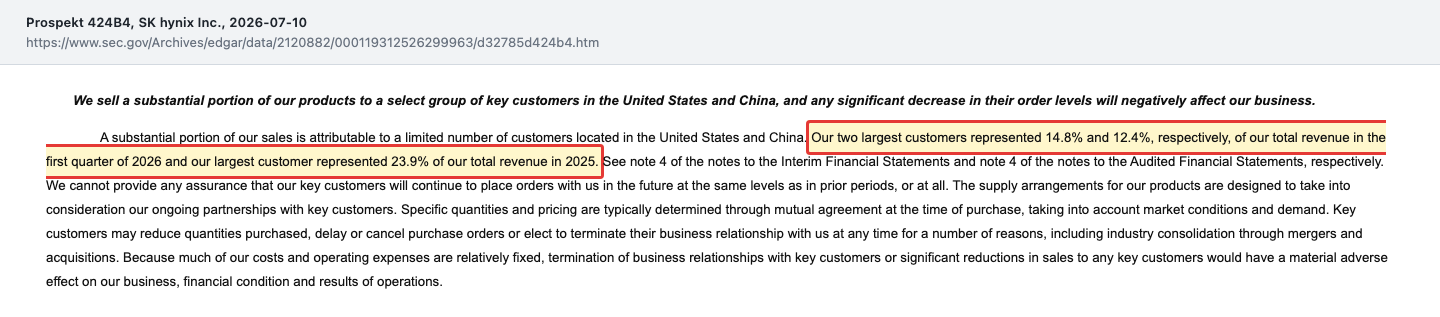
23.9 percent of 97.1 trillion won is roughly 23.2 trillion won of revenue from a single buyer in 2025. The prospectus names no names. On top of that comes geographic concentration: in 2025, 68.8 percent of revenue went through the sales subsidiaries in the United States and 19.7 percent through China; in the first quarter of 2026 the figures were 64.7 and 24.3 percent. The two countries are locked in a trade dispute, and SK hynix has to comply with U.S. export rules — according to the prospectus, it has not sold to Huawei since September 2020.
With net cash of roughly 69 trillion won, this concentration is not a threat to the company's survival. But it shifts bargaining power: when prices are negotiated monthly and a quarter of revenue depends on one customer, that customer holds the stronger hand as soon as supply catches up.
Uncomfortable truth #4: first raise money, then buy back stock — while approving 54 trillion won of new fabs
In July 2026, SK hynix issued 17.79 million new shares for its Nasdaq listing at 2,242,301 won per share ($149 per ADS). According to the prospectus, the 39.9 trillion won of proceeds is earmarked for fab construction in Korea (45.5 trillion won planned) and EUV lithography tools (about 11.9 trillion won). Five weeks later, on August 19, 2026, the board decided something that at first glance points the other way:
“The Company considers its recent share price to be undervalued relative to the Company’s intrinsic value and has therefore decided to acquire and cancel treasury shares in the amount of approximately Won 40 trillion in order to achieve efficient capital reallocation and enhance shareholder value.”
— SK hynix Inc., Form 6-K of August 19, 2026, “Shareholder Return Policy”

At the August 18, 2026 closing price of 1,662,000 won, that equals 24.07 million shares, to be bought on the open market by November 19, 2026 and all cancelled. Economically, there is a friendly reading: SK hynix sold shares at 2.24 million won and — as long as the price stays below that — buys them back cheaper, funded by 72.7 trillion won of free cash flow in the first half alone. The critical reading is the question of why a company needs $26.5 billion of fresh capital for fabs in July and hands the same amount back to shareholders in August. The company's answer: the buyback is part of its return policy, under which more than half of cumulative free cash flow from 2025 to 2027 is to be returned.
At the same time, a construction wave is getting under way. On August 7, 2026, the board approved two new fabs in a single day at a combined 54.3 trillion won: the M17 fab in Cheongju (19.1 trillion won, running to April 2031) and phases 1 through 6 of the second fab at the Yongin semiconductor cluster (35.2 trillion won, running to October 2031). On July 22 it had already raised the investment amount for the P&T7 advanced packaging plant in Cheongju (report: 7.1 trillion won) to pull its opening forward. Contractual capital expenditure commitments not yet recognized on the balance sheet rose from 6.7 trillion won at the end of 2025 to 61.5 trillion won as of June 30, 2026. That is exactly the mechanism the prospectus describes behind past downturns: the whole industry builds during the boom, the fabs are finished years later — and may meet different demand.
Valuation — what a market value of about 1,360 trillion won prices in
First the basis: 730,492,365 shares issued according to the report of August 19, 2026, times the September 23, 2026 closing price of 1,862,000 won, gives a market value of about 1,360 trillion won — a little over $900 billion at the July 14, 2026 exchange rate. The ongoing buyback will reduce the share count further by November. For context on the price: on July 9, 2026, the day the Nasdaq offering was priced, the stock closed in Seoul at 2,186,000 won; on August 18 it closed at 1,662,000 won.
- Price-to-earnings ratio of about 8.4 on trailing twelve-month net income attributable to shareholders (second half of 2025 plus first half of 2026, about 162.0 trillion won). That sounds cheap, but it includes 63.2 trillion won of pre-tax valuation gains from the first half of 2026. Roughly adjusted for those first-half 2026 gains after tax, the multiple would be closer to 12.
- Market value about 10.6 times trailing twelve-month operating profit (128.7 trillion won). Subtracting net cash of roughly 69 trillion won as of June 30, 2026, the multiple is slightly lower.
- Price-to-sales ratio of about 7.2 on 189.2 trillion won of trailing twelve-month revenue.
- Price-to-book ratio of about 5.2 on 262.4 trillion won of shareholders' equity as of June 30, 2026 — before the 39.9 trillion won raised in July.
- Dividend: a fixed 1,500 won per share per year, paid in four installments of 375 won. At the September 23, 2026 price, that is a yield of about 0.08 percent. At SK hynix, cash goes back to shareholders mainly through buybacks, not dividends.
Now the times-four trap, by the numbers: multiply second-quarter operating profit by four (242 trillion won) and SK hynix trades at just 5.6 times that. Multiply second-quarter net income by four and the P/E drops below 4. Both figures assume that prices which more than doubled within a year and are renegotiated monthly stay at record levels for a full year — and that the Kioxia valuation does not turn. Use 2023 as the yardstick instead and there is no P/E at all, because the company lost money. The truth lies somewhere in between, and that is exactly where investors are arguing. Our fundamental data does not carry an analyst consensus for the Korean shares, so we deliberately give no number.
Upside and risks at a glance
The case for:
- World's largest HBM supplier with a 56.4 percent market share in the first quarter of 2026 (IDC, per the prospectus); according to the July 29, 2026 earnings release, HBM4 mass shipments began in the second quarter.
- Record results: 79.3 trillion won of revenue and 60.5 trillion won of operating profit in the second quarter of 2026, a 76 percent operating margin.
- Strong balance sheet: roughly 69 trillion won of net cash as of June 30, 2026, an equity ratio of about 75 percent, Moody's rating of A3 since August 3, 2026; plus 39.9 trillion won from the July listing.
- High free cash flow (72.7 trillion won in the first half of 2026) and a return policy targeting more than half of free cash flow from 2025 to 2027; a 40 trillion won buyback with cancellation runs through November 19, 2026.
- Long-term agreements with around ten customers, per the earnings release — a step away from pure month-to-month business, if they actually bind volumes and prices.
The case against:
- Memory is a cyclical business: 2023 brought a net loss of 9.1 trillion won; per the half-year report there is no order backlog from long-term contracts, and prices are agreed monthly and quarterly.
- Roughly half of second-quarter 2026 pre-tax profit came from valuation gains (53.2 trillion won) and dividends (10.0 trillion won) on financial investments — not from the chip business.
- Customer concentration: the largest customer accounted for 23.9 percent of 2025 revenue, the two largest for a combined 27.2 percent in the first quarter of 2026; 88.5 percent of 2025 revenue ran through the United States and China.
- Investment wave: two new fabs worth 54.3 trillion won approved on August 7, 2026, capital expenditure commitments of 61.5 trillion won as of June 30, 2026 — precisely the mechanism that, per the prospectus, triggered past oversupply.
- DRAM market share per IDC fell from 34.8 percent (2025) to 29.1 percent in the first quarter of 2026; plus the prospectus risk of memory-saving AI technologies.
A human conclusion
Back to the times-four trap from the start. At SK hynix, the record quarter is real: 60.5 trillion won of operating profit in three months, a balance sheet with net cash, leadership in the most important memory of the AI boom. That is not a story but documented substance, and it deserves respect.
The trap, though, assumes a world where June happens twelve times a year. The filings describe a different one: prices renegotiated every month, two customers with a quarter of revenue, an industry that builds fabs during the boom, and net income that stems in large part from the rising value of an investment. 2023 is only three years back.
If you anchor your expectations not to the best quarter but to three lines in the coming reports — the average selling prices for DRAM and NAND, operating profit without finance income, and total capital expenditure commitments — you will see the bend in the road sooner. What you make of it is your call. And that is exactly how it should be.
Sources and notes
- Half-year report for the first half of 2026 (Form 6-K), filed August 18, 2026 — accession number 0001193125-26-354777, with consolidated interim financial statements as of June 30, 2026 (Note 24 finance income, Note 29 commitments)
- Preliminary second-quarter 2026 results (Form 6-K) of July 29, 2026
- IPO prospectus (Form 424B4) of July 10, 2026 — financial statements 2023 through 2025, first quarter of 2026, risk factors, use of proceeds
- Form 6-K of August 19, 2026 — shareholder return policy; plus the treasury share acquisition and cancellation filed the same day
- Form 6-K of July 15, 2026 — results of the share issuance underlying the ADSs
- Investment decisions on Form 6-K: P&T7 of July 22, 2026, M17 of August 7, 2026, Yongin Y2 of August 7, 2026
- Form 6-K of August 14, 2026 — derivative loss on the 2023 exchangeable bonds
- Form 6-K of August 7, 2026 — quarterly dividend of 375 won
- Clarifications of press reports (Form 6-K) of July 22, August 6, August 10, August 21, September 4, September 9 and September 18, 2026 — none with a decision on the reported plans
- SK hynix Newsroom: second-quarter 2026 results of July 29, 2026 (HBM4, long-term agreements)
- EDGAR filing history for CIK 0002120882
- Price as of September 23, 2026: public closing price data from the Korea Exchange. Source for all other figures: fundamental data & SEC filings (IPO prospectus 424B4, Form 6-K reports)
Disclosure: This article is journalistic analysis of publicly available documents. It is not investment advice, not a recommendation to buy or sell, and not a solicitation to buy or sell securities. Share prices can move sharply; a total loss of invested capital is possible. Buyers of the Nasdaq ADSs also carry the currency risk between the won and the U.S. dollar. All figures are taken from the original documents linked above and carry the reporting date stated there. Positions held by the operator are disclosed daily; where one exists, it appears as a notice at the top of this deep dive.
Our Bottom Line at a Glance
- Position in AI memory positive
- With a 56.4 percent HBM market share in the first quarter of 2026 (IDC, per the July 10, 2026 prospectus), SK hynix is the most important supplier of the memory AI accelerators need. According to the July 29, 2026 earnings release, HBM4 mass shipments began in the second quarter.
- Earnings power positive
- In the second quarter of 2026, SK hynix generated 79.3 trillion won of revenue and 60.5 trillion won of operating profit, a 76 percent margin; operations brought in 91.7 trillion won of cash in the first half. Per the half-year report, the driver was mainly sharply higher prices.
- Balance sheet positive
- As of June 30, 2026, 88.0 trillion won of cash and short-term investments faced 18.6 trillion won of borrowings, net cash of roughly 69 trillion won. Moody's upgraded the rating to A3 on August 3, 2026. The Nasdaq listing added 39.9 trillion won in July.
- Cycle and price visibility negative
- Per the half-year report of August 18, 2026, volumes and prices are agreed monthly and quarterly, with no order backlog based on long-term contracts. 2023 brought a net loss of 9.1 trillion won. On August 7, 2026 the board approved two new fabs worth 54.3 trillion won.
- Earnings quality and customer concentration neutral
- Roughly half of second-quarter 2026 pre-tax profit came from valuation gains (53.2 trillion won) and dividends (10.0 trillion won) on financial investments. The largest customer accounted for 23.9 percent of 2025 revenue, the two largest for 27.2 percent in the first quarter of 2026.
SK hynix is the leading maker of the AI memory HBM and posted the best quarter in its history in the second quarter of 2026, with 60.5 trillion won of operating profit and a 76 percent margin; the balance sheet shows roughly 69 trillion won of net cash. Against that stand a cyclical business with no order backlog from long-term contracts, net income with a large share of valuation gains, customer concentration and new fabs worth 54.3 trillion won. Not investment advice.
What Our Rating Means
Quality confirmed
Business model, numbers and balance sheet hold up to our review. Whether the current price supports an entry is a separate question — it hangs on the price, not on the company.
Green because the documented strengths clearly dominate: leadership in the AI memory HBM, a 76 percent operating margin in the second quarter of 2026, 72.7 trillion won of free cash flow in the first half and roughly 69 trillion won of net cash as of June 30, 2026, with investment-grade ratings. No going-concern risk, no existential dependence, no accounting break. The open flank is the memory cycle: prices are negotiated monthly, 2023 was a loss year, and the industry is adding capacity on a large scale. That is a reason not to multiply the record quarter by four — but not a quality flaw of the company. The decision is yours.
A journalistic assessment by our editorial team at the time of the deep dive, based on public sources — not investment advice and not a solicitation to buy or sell. Your personal circumstances (investment goals, risk capacity, taxes) cannot be taken into account. What our levels mean, how verdicts are formed, and what conflicts of interest exist →
Worth Noting
- SK hynix made our research list through the rankings on wallstreet-online in September 2026, listed there under the Nasdaq ticker SKHY. The article ticker is the home listing 000660 on the Korea Exchange; ten Nasdaq ADSs (SKHY) equal one share. Under the same identifier, the SEC also lists the over-the-counter ticker HXSCL.
- Recency: the most recent periodic report reviewed is the half-year report on Form 6-K of August 18, 2026 (as of June 30, 2026). All filings from that day through September 24, 2026 were reviewed: buyback, cancellation and return policy (August 19), transfer of 82 treasury shares to independent directors (August 21), and clarifications without decisions regarding Solidigm, the Chongqing packaging plant and a possible site in Japan. There is no annual report on Form 20-F yet; annual figures come from the IPO prospectus.
- Data: the September 23, 2026 price comes from public Korea Exchange closing price data. Market value uses the share count from the August 19, 2026 report; a cross-check against fundamental data from August 7, 2026 showed a gap of less than 1 percent. U.S. dollar figures use the July 14, 2026 exchange rate (1,504.90 won per dollar) from the share issuance report.
- Do not confuse: SK hynix is not Samsung Electronics, the other large Korean memory maker, nor the holding company SK Square or SK Inc., which have their own listed shares as shareholder or group parent.
The full analysis as a PDF for later
We will send you this analysis as a PDF — to print, file away, and read at your own pace.
Frequently Asked Questions
SK hynix Inc. of Icheon, South Korea, makes memory chips: DRAM (77.1 percent of 2025 revenue) and NAND flash and SSDs (21.3 percent). In AI memory (HBM) it led the world in the first quarter of 2026 with a 56.4 percent market share, according to IDC. Revenue was 97.1 trillion won in 2025 and 131.9 trillion won in the first half of 2026.
SK hynix shares have traded on the Korea Exchange under the code 000660 since 1996. Since July 2026 there are also American Depositary Shares on Nasdaq under the ticker SKHY; ten of these ADSs equal one Korean share. The listing sold 177.9 million ADSs at $149 each, $26.5 billion in total.
Because finance income included 53.2 trillion won of valuation gains on financial instruments and 10.0 trillion won of dividend income. Operating profit was 60.5 trillion won on 79.3 trillion won of revenue; net income after tax was 93.9 trillion won. For the first quarter of 2026, SK hynix attributed such valuation gains primarily to its stake in Kioxia.
Only to a limited extent. According to the half-year report of August 18, 2026, volumes and prices are agreed with major customers monthly and quarterly, and there is no order backlog based on long-term supply contracts. In its July 29, 2026 earnings release, SK hynix cites long-term agreements with around ten customers without disclosing how they bind prices and volumes.
On August 19, 2026 the board approved a buyback of about 40 trillion won, with all shares to be cancelled, because it considers the share price undervalued relative to intrinsic value. At the August 18 price that is 24.07 million shares through November 19, 2026. In July, SK hynix had issued 17.79 million new shares for 39.9 trillion won.
Because the documented strengths clearly dominate: HBM market leadership, a 76 percent operating margin in the second quarter of 2026, roughly 69 trillion won of net cash as of June 30, 2026 and a Moody's rating of A3. The memory cycle, with the 2023 loss year, remains the open flank. The rating judges the company, not the share price.
Found an error?
Did you spot a factual error, an outdated number, or a typo in this deep dive? Let us know briefly — your report goes straight to the editorial team.