Boeing: a $715 billion backlog and $6.1 billion of equity
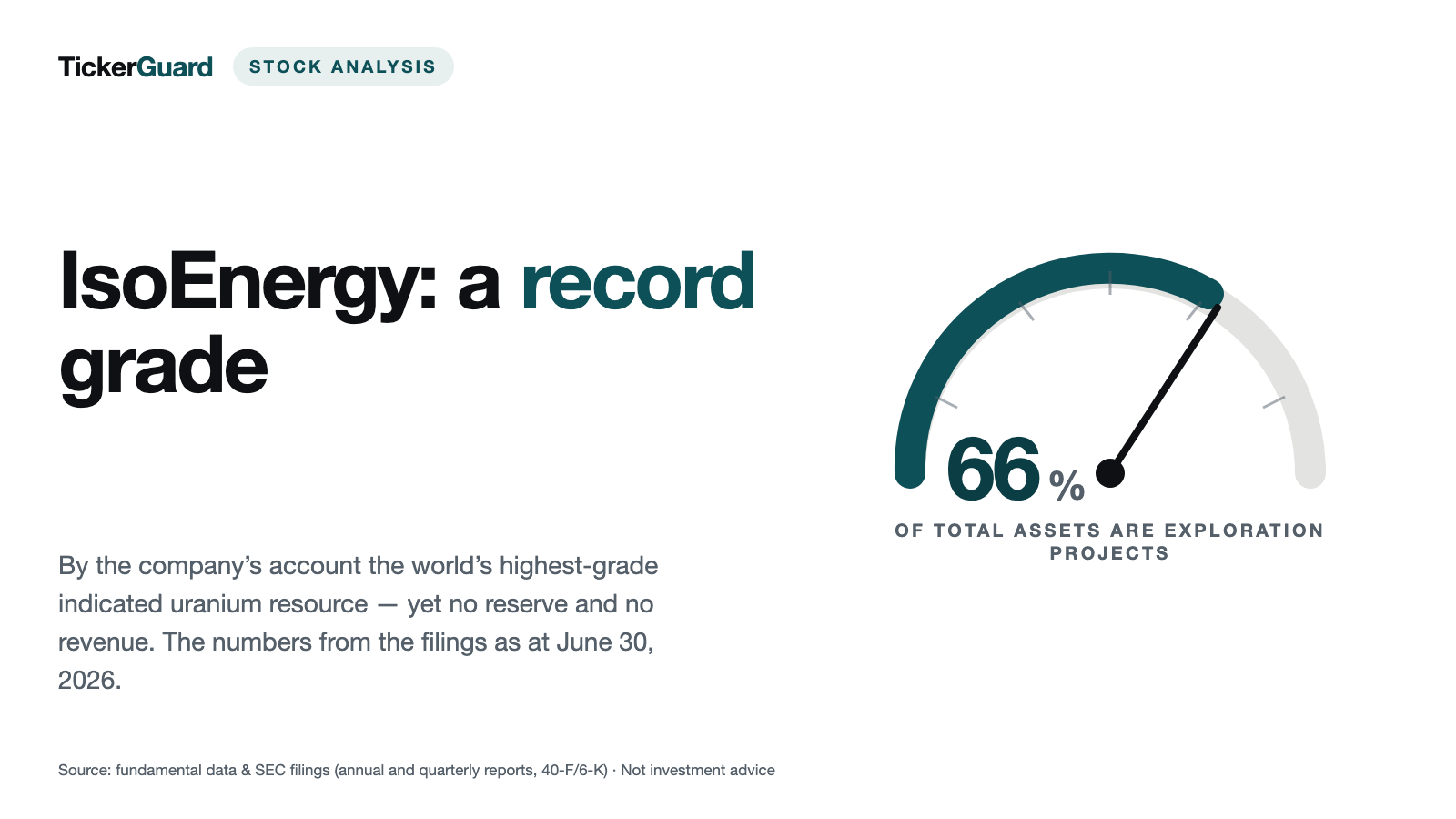
As of June 30, 2026, Boeing carried $715 billion in orders against just $6.1 billion of shareholders’ equity. And its first annual profit since 2018 was bought, not flown — the filings with the U.S. securities regulator show which sale paid for it.
 Thomas Mücke
Founder & Publisher
Thomas Mücke
Founder & Publisher
As of Today
As of: September 23, 2026
- Closing price
- 199.90 $ +1.10%
- Market Capitalisation
- 157.6 $B
- P/E
- 79.8
- Growth Score
- 2/10
- AAQS
- 3/10
Price change since September 22, 2026: +1.1%
This analysis has a cut-off date. The Stock Guard tells you when something material changes in the numbers. Reserve your free spot
Chart
Interactive price chart (TradingView).
52-week range: 179.10 $ to 252.20 $ · Last price: 199.90 $ (As of: September 23, 2026)
Note: pure fact-based analysis, not investment advice and not a solicitation to buy or sell. All figures without guarantee.
There is an investor trap that strikes hardest at the most famous companies — call it the halo trap. It works like this: you stand at an airport window, watch a 737 lift off, some eighty tons of aircraft behaving as if physics were negotiable, and your brain adds a second sentence nobody has checked: “a company that builds this cannot fail.” Skill in the air vouches for the balance sheet on the ground. With Boeing (NYSE: BA) the short circuit is especially tempting, because both halves are true and neither implies the other. The aircraft are in demand as never before — as of June 30, 2026 the order book stood at $715 billion, the largest in company history. And the same report shows shareholders’ equity of $6,100 million, which is 3.7 percent of total assets. So let us make a deal: before you trust the halo, we read together what Boeing has told the U.S. securities regulator, the SEC — the annual report (10-K) for 2025, the quarterly report (10-Q) as of June 30, 2026 and every current report (8-K) filed since. Those documents are certified under penalty of law. They describe a profit that was bought, costs that are pushed into the future, and banks that wrote a new number into the credit agreement in August 2026. What you make of it is up to you.

What Boeing actually does — three companies under one roof
Boeing is not an aircraft manufacturer. It is three very different businesses sharing one balance sheet. The first, Commercial Airplanes, builds the 737, 767, 777 and 787 families. In 2025 it produced $41,494 million of revenue, almost half the group total — and lost $7,079 million doing so. The second, Defense, Space & Security, supplies tankers, fighter structures, drones, satellites and the presidential aircraft; 2025 revenue was $27,234 million with a loss of $128 million. The third, Global Services, sells spare parts, maintenance, training and software to airlines and armed forces: $20,923 million of revenue — and the only reliable profit centre in the group.
To understand Boeing you need one term: program accounting. A normal manufacturer settles each order on its own: what did this unit cost, what did it bring in? For commercial aircraft Boeing accounts across an entire program instead — across an estimated total quantity stretching over decades. Picture a bakery that sells its first thousand loaves at a loss because the new oven still stutters, and books that loss not as a loss but as an advance investment in the next ten thousand loaves, which are supposed to be cheaper. As long as those ten thousand are actually baked and sold, the maths works. If only five thousand materialise, the advance was a loss — just one that surfaces years later.
The method is permitted and standard in the industry. It does, however, explain why Boeing’s balance sheet looks the way it does: as of June 30, 2026 inventories stood at $88,388 million, more than fourteen times shareholders’ equity. It also explains why the delivery count matters more at Boeing than at almost any other company: every aircraft handed over recovers part of that advance. In 2025 Boeing delivered 600 aircraft, up from 348 in 2024 and 528 in 2023 — the recovery is real, and it is the reason the stock has a story at all.
A second term belongs here: customer advances. Airlines pay for their aircraft in instalments, long before delivery. As of June 30, 2026 those advances and progress billings amounted to $64,059 million — money Boeing may use but does not own. It is interest-free financing from its own customers, more than ten times shareholders’ equity. If you want to know what holds this balance sheet together, that is the number.
Company history for investors
-
2020
Dividend suspended, equity at minus $18.3 billion
Boeing suspends its common stock dividend; as of the Form 10-Q for June 30, 2026 it has not returned. At year-end 2020 shareholders’ equity hits its low point of minus $18,316 million.
-
2024
A 53-day strike and an $11.8 billion annual loss
More than 30,000 employees in Washington state halt production. Deliveries fall to 348 aircraft and revenue to $66,517 million. For shareholders it is the costliest year since 2020.
-
2024
A capital raise of roughly $23.8 billion (October 30/31)
Boeing issues 129,375,000 common shares for $18,181 million net and, a day later, 5,750,000 preferred shares carrying 6.00 percent for $5,651 million net. The price: common stock now ranks behind the preferred securities — and will be diluted again in 2027.
-
2025
Agreement with the U.S. Department of Justice (May 29)
Boeing pays a $244 million fine and sets aside $445 million for relatives of the crash victims. The court approves dismissal of the criminal case on November 6, 2025; a petition against it is denied in March 2026.
-
2025
Sale of Jeppesen and ForeFlight (October 31)
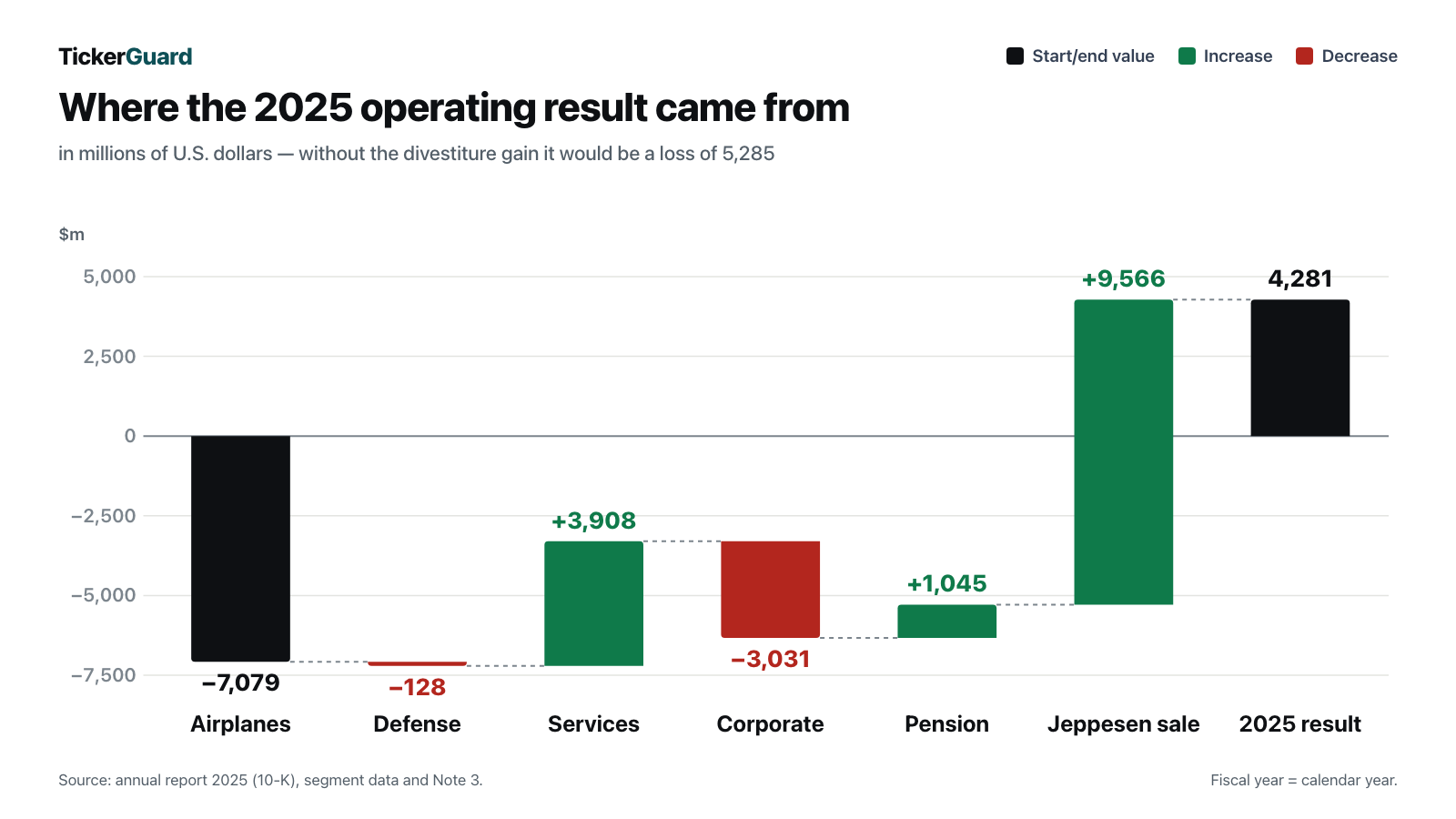
The high-margin flight data business goes to Thoma Bravo for $10,550 million, with a book gain of $9,566 million. That single item turns an annual loss into the first reported profit since 2018.
-
2025
Spirit AeroSystems acquired (December 8)
Boeing acquires the fuselage maker for $8,389 million; the underlying merger agreement dates from June 30, 2024. The balance sheet gains provisional goodwill of $10,278 million — more than the purchase price.
-
2026
Lenders impose a liquidity floor (August 24)
A minimum liquidity requirement of $5.0 billion is written into all three credit facilities. For shareholders that is the new yardstick: part of the $20 billion cash pile is now contractually committed.
How this stock reached our desk
Not through a screener. Boeing arrived through the SEC filing stream: on August 28, 2026 the company filed a current report (8-K) containing a new contractual condition — Boeing must henceforth maintain liquidity of at least $5.0 billion. Banks do not write clauses like that out of boredom. It was the prompt to look at the balance sheet behind them.
The valuation anchor of this analysis is the closing price of September 22, 2026: $197.70. Multiplied by the 790,370,020 shares outstanding on July 21, 2026 according to the cover page of the quarterly report, that gives a market capitalisation of roughly $156.3 billion. Fundamental data report $155.8 billion — the two routes differ by three tenths of a percent, so the basis is solid. Everything else in this piece is dated and remains verifiable, even if you read it a year from now.
For context: Boeing is not an obscure small cap. Institutional investors hold roughly 76.8 percent of the shares according to fundamental data (as of September 18, 2026), and 27 analysts cover the stock. The question is not whether anyone has looked — but at what.
The numbers over the years — honestly credited
Start with what genuinely impresses. Revenue rose by a third in 2025: from $66,517 million to $89,463 million. That is not an accounting trick but the consequence of 600 rather than 348 aircraft delivered. The path there, for comparison: $62,286 million (2021), $66,608 million (2022), $77,794 million (2023), $66,517 million (2024) — the dip in 2024 was caused in part by a 53-day strike involving more than 30,000 employees in Washington state.
The first half of 2026 points the same way: $46,777 million of revenue, up 11 percent year over year, on 314 deliveries versus 280. In the second quarter of 2026 revenue was $24,560 million (up 8 percent) on 171 aircraft. Operating earnings more than doubled: $604 million in the half year after $285 million a year earlier — and in the second quarter of 2026 alone plus $156 million after minus $176 million. Operating cash flow — the money that actually came in — was positive $1,185 million after negative $1,389 million. In the second quarter alone it was positive $1,364 million. Boeing also cut debt: from $54.1 billion on December 31, 2025 to $45.9 billion on June 30, 2026.
The order book grew alongside: from $521,336 million (December 31, 2024) to $682,207 million (December 31, 2025) and on to $715 billion as of June 30, 2026 — $597 billion of it in Commercial Airplanes, $85 billion in Defense, $33 billion in Global Services. More than 6,200 commercial aircraft are on order. At a delivery rate of 600 a year that is, arithmetically, ten years of work.
Now the other half of the truth. Net earnings were negative in four of the past five years: minus $4,202 million (2021), minus $4,935 million (2022), minus $2,222 million (2023), minus $11,817 million (2024) — and plus $2,235 million in 2025. That single positive figure is why the stock carries a price-to-earnings ratio again in 2026. Where it came from is the subject of the next chapter.
What the filings say — the uncomfortable truths
Uncomfortable truth no. 1: the 2025 profit was bought, not flown
On October 31, 2025 Boeing sold parts of its Digital Aviation Solutions business to the private equity firm Thoma Bravo — the navigation data brand Jeppesen, the pilot software ForeFlight, the fleet data service AerData and the Australian charting service OzRunways. The price: $10,550 million in cash. The book gain is stated verbatim in the annual report:
“The sale included Jeppesen, ForeFlight, AerData and OzRunways assets and liabilities and resulted in a gain of $9,566 recorded in Gain on dispositions, net in the Consolidated Statements of Operations.”
— The Boeing Company, SEC annual report 10-K for 2025, Note 3

Run the numbers. Global Services reports 2025 operating earnings of $13,474 million. Strip out the gain and $3,908 million remains — a solid but ordinary result, close to the prior year’s $3,618 million. At group level: reported operating earnings of plus $4,281 million become a loss of $5,285 million without the sale. Net earnings of plus $2,235 million become a loss of roughly $7.3 billion (own calculation; per the tax note the divestiture triggered no U.S. federal tax expense because it was offset by a decrease in the valuation allowance).
This is not a criticism of the accounting, which is correct and clearly disclosed. It is a warning about a shortcut: anyone filing 2025 away as “the year Boeing made money again” is filing the wrong note. And the sale carries a price that only shows up later. Jeppesen was a high-margin data business. In the second quarter of 2026 the Global Services margin fell from 19.9 to 18.1 percent — Boeing itself names the impact of that divestiture as one reason. A high-margin piece of the only reliably profitable segment is gone.
Uncomfortable truth no. 2: equity does not cover four weeks of revenue
As of June 30, 2026 total assets of $165,870 million faced total liabilities of $159,755 million. What remains is $6,115 million of total equity, $6,100 million of it attributable to Boeing shareholders and $15 million to noncontrolling interests — 3.7 percent of total assets (own calculation). Measured against first-half 2026 revenue, that is just under 24 days of business. As a rough rule of thumb, an equity ratio of 30 to 40 percent counts as solid for an industrial company and anything below 10 percent as very thin.
The path there is remarkable in both directions. From 2019 through 2024 equity was negative every single year, bottoming at minus $18,316 million on December 31, 2020. That it is positive again today is owed to the October 2024 capital raise and the 2025 divestiture gain — not to the operating business. That capital raise had two legs, and the larger one is usually overlooked: on October 30, 2024 Boeing issued 129,375,000 common shares out of treasury for $18,181 million net, and a day later added the 5,750,000 preferred shares for $5,651 million net. Together roughly $23.8 billion of fresh money — more than three times what stands as equity on the balance sheet today.
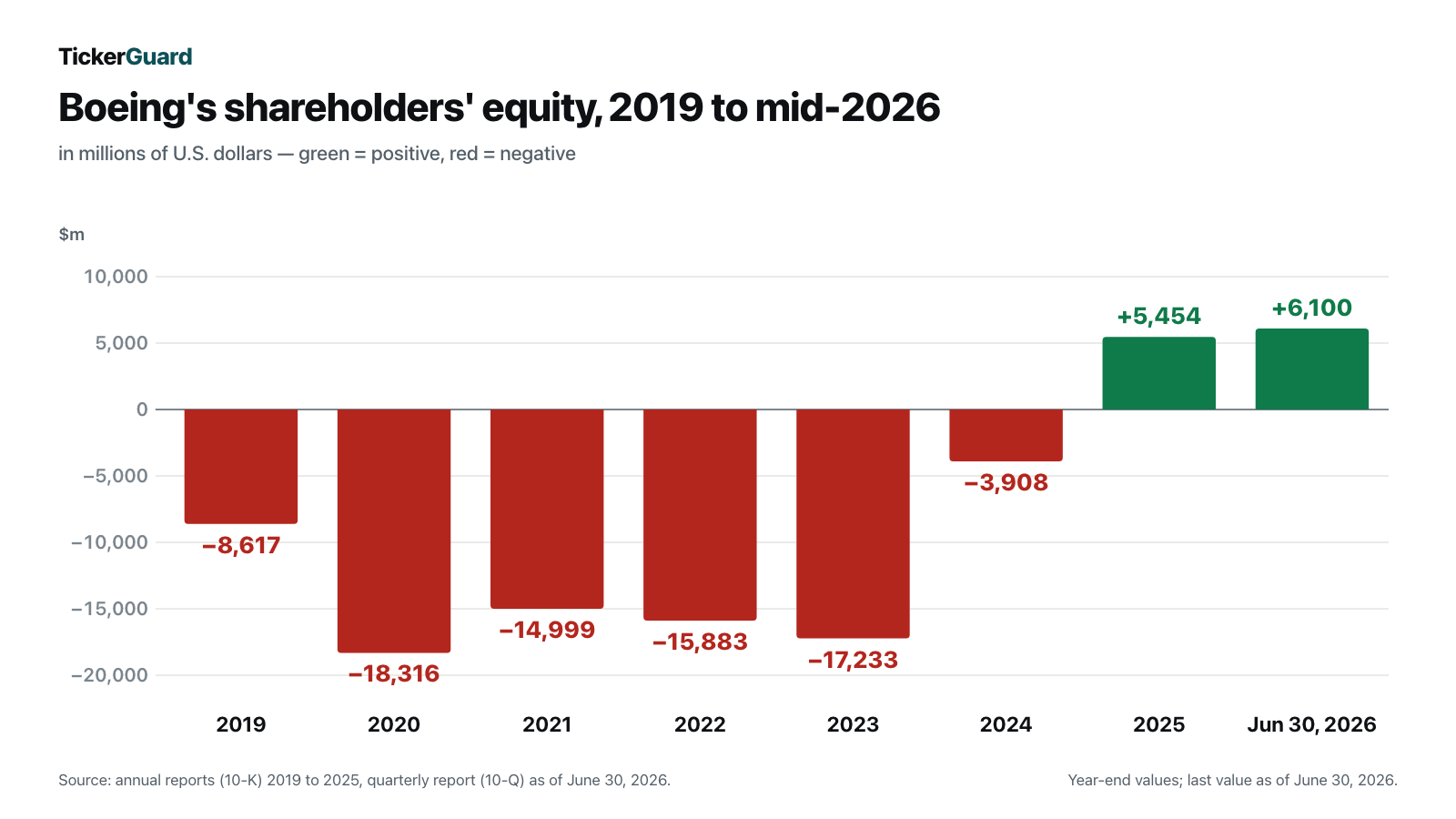
Two figures make the cushion thinner than it looks. First, the $6,100 million of equity sits alongside $17,554 million of goodwill from acquisitions — almost three times as much. Goodwill is not an asset you can sell; it is the premium Boeing paid above net asset value. Deduct it and the remaining intangibles and tangible equity comes to roughly minus $13,000 million (own calculation). Second, common shareholders do not have first claim on those $6,100 million. The preferred stock issued in 2024 carries a liquidation preference of $5,750 million — 94 percent of total equity. How that works and when it changes the share count is set out in detail in our side finds.
Uncomfortable truth no. 3: some costs are waiting for orders that do not exist yet
Back to program accounting. The quarterly report as of June 30, 2026 quantifies deferred production costs by program: $13,081 million for the 737 (up from $11,777 million at December 31, 2025), $14,428 million for the 787 (up from $13,859 million), and $1,659 million sitting in 777X work in process (up from $651 million — more than a doubling in six months). These are costs already incurred but not yet in the income statement, because they are allocated to future deliveries.
What matters is which deliveries. For the 787 Boeing writes:
“At June 30, 2026, $13,596 of 787 deferred production costs, unamortized tooling and other non-recurring costs are expected to be recovered from units included in the program accounting quantity that have firm orders, and $2,148 are expected to be recovered from units included in the program accounting quantity that represent expected future orders.”
— The Boeing Company, SEC quarterly report 10-Q as of June 30, 2026, Note 6

In plain terms: $2,148 million of money already spent depends on 787s that nobody has ordered. That is 35 percent of total shareholders’ equity. For the 737 the picture is far better — only $31 million. The figure is neither a scandal nor an accounting breach; it is disclosed and compliant. But it is the price of a result that rests on an assumption: that demand holds. A $715 billion order book makes the assumption plausible. It does not make it certain — the annual report itself warns that Boeing “may experience reductions to backlog and/or significant order cancellations,” citing delivery delays and the pending entry into service of the 777X, 737-7 and 737-10. In 2025 alone, orders worth $11,094 million were cancelled.
Uncomfortable truth no. 4: the fixed-price defense contracts keep bleeding
A fixed-price contract is convenient for the customer and dangerous for the manufacturer: if development costs more than planned, the manufacturer pays. Boeing has a whole series of them, and every report adds new losses. The list in the quarterly report as of June 30, 2026 reads like a chronicle: the presidential aircraft VC-25B (a roughly $4 billion program, an additional $280 million loss in the second quarter of 2026; according to the quarterly report, schedule and requirements are only due to be reset with the contract terms in the third quarter of 2026), the KC-46A tanker ($714 million of additional loss in 2025), the MQ-25 drone, the T-7A trainer and the Starliner capsule, whose next uncrewed mission is now expected no earlier than the fourth quarter of 2026.
“During the three months ended June 30, 2026, we increased the reach-forward loss by $280 due to higher estimated costs required to complete structural and wiring installation and to satisfy air worthiness certification requirements.”
— The Boeing Company, SEC quarterly report 10-Q as of June 30, 2026, Note 10, VC-25B
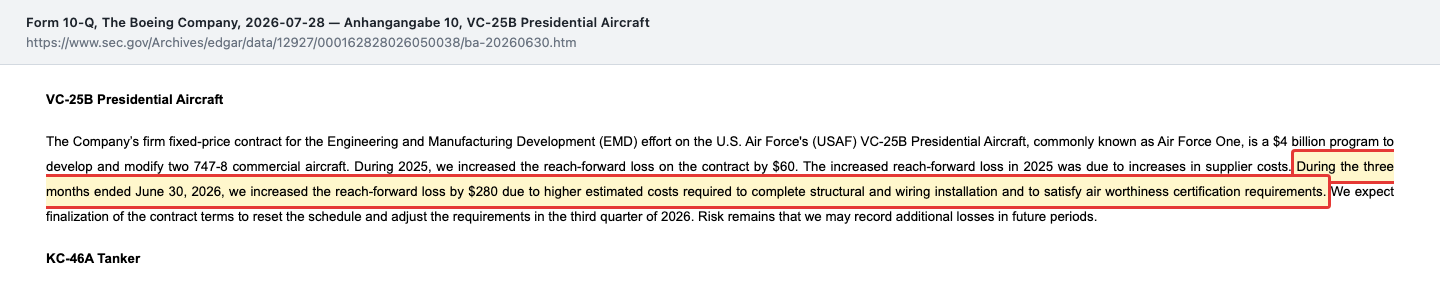
Five times in that single note the same sentence appears: “Risk remains that we may record additional losses in future periods.” That is not boilerplate but an accounting warning: any one of these contracts can swing a quarter on its own. In the second quarter of 2026 the VC-25B charge pushed the entire defense segment from plus $110 million a year earlier to minus $15 million.
The largest single hole, however, comes from the civil side. The 777X program, whose first delivery was pushed back again in the third quarter of 2025 and is now scheduled for 2027, produced additional reach-forward losses of $4.9 billion in 2025 after $3.5 billion in 2024. Together with the 767 that was $5,283 million in 2025 — the reason Commercial Airplanes posted a $7,079 million loss despite 600 deliveries. The segment is not out of the red in 2026 either: it posted a half-year loss of $885 million, after $1,094 million a year earlier — the direction is right, the sign is not. The 777-8 passenger aircraft, per the quarterly report, is not expected before 2030. And one technical issue was still open at the balance sheet date:
“We continue to work with our supplier and the FAA to incorporate and certify their solution related to the engine durability issue identified in 2025.”
— The Boeing Company, SEC quarterly report 10-Q as of June 30, 2026, MD&A, 777X section
Meanwhile production continues: as of June 30, 2026, unfinished 777X aircraft sat in inventory at $6,366 million, up from $4,313 million at year-end 2025, plus $2,048 million of unamortized tooling and other non-recurring costs. Together that is roughly $8.4 billion — more than total shareholders’ equity. We traced how delays of that magnitude work their way through the supply chain at a direct Boeing supplier in our analysis of CPI Aerostructures.
Uncomfortable truth no. 5: in August 2026 the banks pulled in a new line
On August 24, 2026 Boeing signed a new $3,000 million, 364-day credit facility and extended both existing five-year facilities, sized at $4,000 million and $3,000 million. The same new condition was written into all three — a minimum liquidity requirement. In the new 364-day agreement it sits at the end of the covenant passage:
“The 364-Day Credit Agreement contains customary terms and conditions, including covenants restricting Boeing’s ability to permit consolidated debt (as defined in the 364-Day Credit Agreement) in excess of 60% of Boeing’s total capital (as defined in the 364-Day Credit Agreement), to incur liens, and to merge or consolidate with another entity and a covenant requiring Boeing to maintain liquidity (as defined in the 364-Day Credit Agreement) of at least $5.0 billion.”
— The Boeing Company, SEC current report 8-K of August 28, 2026, Item 1.01
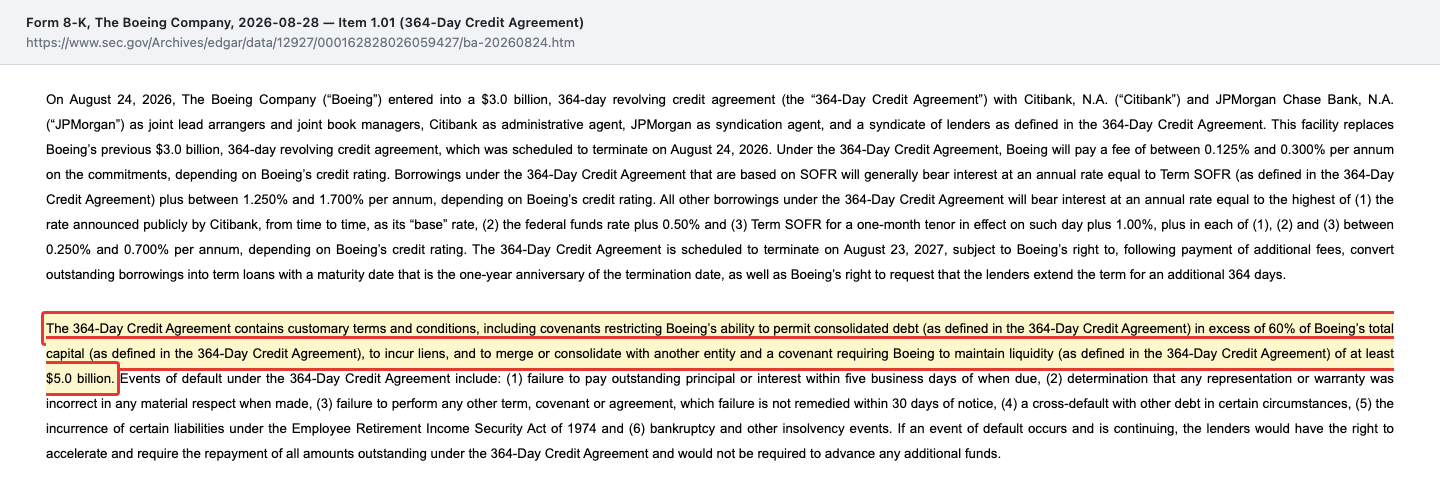
For context: Boeing held roughly $20,022 million of cash and short-term investments as of June 30, 2026. The threshold is not an immediate danger. What is notable is that it is new — the annual report for 2025 lists as most restrictive covenants only limits on mortgage debt, sale-and-leaseback transactions and consolidated debt as a percentage of total capital. A minimum liquidity requirement does not appear there. Banks that impose a cash floor on an investment-grade borrower are watching that borrower’s cash.
And the ratings themselves sit right at the edge: Fitch and Standard & Poor’s rate Boeing BBB−, Moody’s rates it Baa3 — in all three cases the lowest rung still considered investment grade. Per the quarterly report as of June 30, 2026, S&P and Moody’s carry a stable outlook, while Fitch revised its outlook from stable to positive in June 2026. The annual report itself says the company cannot be assured of maintaining an investment grade rating.
Uncomfortable truth no. 6: interest costs more than the business earns
Perhaps the hardest number in this analysis is not in a note but in the income statement. In the first half of 2026 Boeing earned $604 million from operations — and paid $1,216 million in interest and debt expense over the same period. Interest coverage, operating earnings divided by interest expense, therefore stands at 0.50 (own calculation). In the second quarter alone it was $156 million against $600 million, or 0.26.
A figure below one means simply this: the operating business does not earn its own interest. The gap is bridged from cash, from customer advances or from new borrowing. Looking back does not help: in 2024 operating earnings of minus $10,707 million faced $2,725 million of interest, in 2023 minus $773 million against $2,459 million. And 2025? Coverage computes to 1.55 — but only with the Jeppesen gain. Without it, 2025 was negative too. Since 2019 Boeing has not once paid its interest out of operating earnings — excluding the one-off divestiture gain booked in 2025.
Valuation — what $156 billion of market value says about $6.1 billion of equity
Measured against the September 22, 2026 anchor ($197.70 per share, roughly $156.3 billion of market capitalisation), the orders of magnitude look like this. The price-to-sales ratio is around 1.7, based on trailing twelve-month revenue of roughly $94 billion. For a thin-margin industrial that is no bargain, but no extreme either.
The price-to-earnings ratio is where it gets awkward. Fundamental data show roughly 71 — a figure that rests on trailing twelve-month earnings, and those earnings contain the Jeppesen sale. Without it there are no earnings and therefore no meaningful price-to-earnings ratio. Valuing Boeing on its P/E means applying a multiple of ongoing profit to a one-off disposal gain. That is the most elegant way to fool yourself.
The price-to-book ratio is around 26 — every dollar of book equity is paid for with 26 dollars. For software companies that is normal, because their value never sat on the balance sheet anyway. For a group with $16,321 million of property, plant and equipment and $88,388 million of inventories, the number says something else: the market is paying for the order book and the market position, not for the substance. Strip out goodwill and tangible book value is negative — at which point a price-to-book ratio cannot be computed at all.
And the professionals? The stock is covered by 27 analysts whose average price target is roughly $274.85 according to fundamental data (as of September 18, 2026), roughly 39 percent above the anchor price. A word on what that means: an average is the sum of all targets spread evenly across all analysts — a few very optimistic or very pessimistic estimates pull it noticeably up or down, and it says nothing about how tightly the estimates cluster. The share price itself moved between $176.77 and $254.35 in the twelve months to September 18, 2026. There is no dividend: Boeing suspended its common stock dividend in 2020 and has not reinstated it — the 6.00 percent dividend on the preferred stock, by contrast, continues to be paid.
What explicitly does not belong in the valuation is the question of whether a company with 182,000 employees and a duopoly behind it is “too expensive.” The decisive question is a different one: how many years does the business need to build, under its own power, enough equity that one bad year cannot wipe it out again? With half-year operating earnings of $604 million against $1,216 million of interest, that number cannot be computed today. How the same calculation looks at a specialised supplier is shown in our analysis of Astronics.
Upside and risks at a glance
What argues in favour:
- A $715 billion order book as of June 30, 2026, $597 billion of it in Commercial Airplanes and more than 6,200 aircraft on order — at 600 deliveries a year, arithmetically ten years of work.
- Deliveries are measurably recovering: 600 aircraft in 2025 after 348 in 2024; 314 in the first half of 2026 after 280. The 737 program began transitioning from a rate of 42 to 47 aircraft per month in the first half of 2026.
- Cash flow has turned: positive $1,185 million from operations in the first half of 2026 after negative $1,389 million a year earlier. The swing was carried mainly by customer advances and progress billings, which alone contributed $4,660 million while inventories absorbed $3,859 million. After $2,008 million of capital expenditure, however, free cash flow is still negative at minus $823 million. Debt fell over the same period from $54.1 billion to $45.9 billion.
- A duopoly with high barriers to entry: outside China there are exactly two serious suppliers of large commercial aircraft. Roughly 85 percent of the Commercial Airplanes backlog, in dollar terms, sat with airlines outside the United States as of December 31, 2025 — demand is global.
- Services carry the group: an 18.1 percent margin in the second quarter of 2026 on $5,344 million of revenue, with its own $33 billion backlog. It is the stable counterweight to aircraft manufacturing.
- Access to capital: $20,022 million of cash and short-term investments as of June 30, 2026, plus $10,000 million of credit facilities that remain entirely undrawn, and an investment grade rating at all three agencies.
What argues against:
- The 2025 profit came from a sale: without the $9,566 million gain on the Jeppesen transaction, an operating loss of $5,285 million instead of earnings of $4,281 million.
- Interest coverage below one: $604 million of operating earnings against $1,216 million of interest expense in the first half of 2026 (0.50). Since 2019 Boeing has not once paid its interest out of the operating business — excluding the one-off 2025 divestiture gain.
- Equity at 3.7 percent of total assets — and $17,554 million of goodwill inside it. On a tangible basis, equity is negative.
- Fixed-price contracts with no floor: VC-25B (a further $280 million charge in the second quarter of 2026 alone), KC-46A, T-7A, MQ-25, Starliner — Boeing states for every one of them that additional losses are possible. For the 777X it was $4.9 billion in 2025.
- Pending certifications: the 737-7, 737-10 and 777X have yet to be delivered; Boeing still anticipates certification of both 737 variants in 2026 and had roughly 40 of them in inventory as of June 30, 2026; the earnings release of July 28, 2026 points to first delivery of both variants in 2027. First delivery of the 777-9 is scheduled for 2027. The pace is not Boeing’s alone to set either: since the January 2024 door plug accident, the 737 program may only raise production rates with the concurrence of the FAA, and the new 737 production line that began low-rate production in July 2026 must be production-certified by the FAA before its first delivery. Every further slip costs money and can make orders terminable.
- Dilution with a date: on October 15, 2027 the preferred stock converts automatically into 33.5 to 40.2 million new common shares — the lower the price, the more shares.
- Labor disputes as a recurring risk: a 53-day strike in Washington state in 2024, a 101-day strike in the St. Louis area in 2025 — both despite a tentative agreement having been reached beforehand. The next date is in the Form 10-K for 2025 and the 10-Q for the quarter ended June 30, 2026: two contracts with the engineers’ union SPEEA, covering roughly 16,000 employees in Washington state, expire on October 6, 2026; according to the 10-Q, Boeing was negotiating successor agreements, and no SEC filing through September 24, 2026 reported a deal. Roughly 72,000 of the 182,000 employees are union members.
- Open litigation: claims and investigations arising from the two 737 MAX accidents and the January 2024 door plug accident are still pending; Boeing states it cannot reasonably estimate a range of loss beyond amounts already accrued.
A human conclusion
Remember the halo from the opening? The 737 lifting off, and the thought that a company able to do that cannot fail? After reading the filings, the first half of that thought survives intact. Boeing can do it. Six hundred aircraft a year, more than 6,200 on order, an order book of $715 billion — a record, according to the earnings release of July 28, 2026. Capability is not the open question.
The open question is the second sentence our brains append automatically. Because the balance sheet knows nothing of halos. It knows that of $165,870 million of assets, $159,755 million belongs to someone else. That interest in the first half of 2026 was twice operating earnings. That last year’s profit came into being the moment a high-margin data business changed hands. And that in August 2026 the banks wrote a number into the credit agreement that had not been there before.
This is not a story of collapse. A company with this market position, this order book and $20 billion in the bank is not going under tomorrow. It is a story about the order in which things must happen: first aircraft manufacturing has to stop losing money. Then interest has to be paid out of the operating business. Then equity can build. Whoever buys today is not buying the $715 billion in the order book — that still belongs to the customers. They are buying the bet that this sequence will be respected, and respected faster than the next fixed-price program tears a new hole.
Whether that bet is worth the price is not something anyone can decide for you. What you should take away is the reflex: separate what a company can do from what its balance sheet can absorb. One of those is in the sky; the other is in a filing with the SEC. What you make of it is your decision. And that is exactly as it should be.
Sources and notes
- Form 10-Q as of June 30, 2026, filed July 28, 2026 (SEC EDGAR, CIK 0000012927) — balance sheet and Notes 2, 3, 6, 10, 12, 15 and 18
- Form 10-K for 2025, filed January 30, 2026 — segment data, Note 3, disclosures on employees, credit ratings and debt covenants
- Form 10-K for 2024, filed February 3, 2025
- Form 8-K of July 28, 2026, Item 2.02 with the second quarter 2026 earnings release (Exhibit 99.1)
- Form 8-K of August 28, 2026, Items 1.01 and 2.03 — new credit agreements with the minimum liquidity covenant
- Form 8-K of August 21, 2026, Item 5.02 — appointment of Ryan L. Shedd as Controller
- Forms 10-Q as of March 31, 2026, September 30, 2025 and June 30, 2025, plus SEC XBRL company facts for revenue, earnings, operating income, shareholders’ equity and operating cash flow, 2018 through 2025
- Source: fundamental data & SEC filings (annual and quarterly reports, 10-K/10-Q) — price and market capitalisation as of September 22, 2026, price history and analyst consensus as of September 18, 2026
Note: This article is journalistic analysis. It is not investment advice, not a recommendation to buy or sell, and not a solicitation to buy or sell securities. Share prices can move sharply; a total loss of the capital invested is possible. All figures come from the original sources linked above and carry the reporting date stated there. Positions held by the operator are disclosed daily; where one exists, it appears as a notice at the top of this deep dive.
Key figures at a glance
All monetary figures in millions of $; earnings per share as reported.
| Metric | 2021 | 2022 | 2023 | 2024 | 2025 |
|---|---|---|---|---|---|
| Revenue | 62,286.0 | 66,608.0 | 77,794.0 | 66,517.0 | 89,463.0 |
| Operating Income (EBIT) | -2,870.0 | -3,509.0 | -773.0 | -10,824.0 | -5,416.0 |
| Net Income | -4,202.0 | -4,935.0 | -2,222.0 | -11,817.0 | 2,235.0 |
| Net Margin | -6.7% | -7.4% | -2.9% | -17.8% | 2.5% |
| Earnings Per Share | -7.15 $ | -8.29 $ | -3.67 $ | -18.27 $ | 2.93 $ |
Source: fundamental data & SEC filings (annual and quarterly reports, 10-K/10-Q)
Our Bottom Line at a Glance
- Market position and backlog positive
- As of June 30, 2026 orders worth $715 billion sat in the books — the highest in company history, $597 billion of it in Commercial Airplanes and more than 6,200 aircraft. Outside China there are only two serious suppliers of large commercial aircraft; roughly 85 percent of the Commercial Airplanes backlog, in dollar terms, was with customers outside the United States as of December 31, 2025.
- Operational recovery positive
- 600 aircraft delivered in 2025 after 348 in 2024, and 314 in the first half of 2026 after 280. Revenue rose 34.5 percent in 2025 to $89,463 million, operating earnings more than doubled in the first half of 2026 to $604 million from $285 million a year earlier, and operating cash flow swung to plus $1,185 million from minus $1,389 million. Debt fell over the same period from $54.1 billion to $45.9 billion.
- Quality of earnings negative
- The first annual profit since 2018 came from a disposal: a $9,566 million book gain on the October 31, 2025 sale of Jeppesen, ForeFlight, AerData and OzRunways. Without it, 2025 operating earnings would have stayed deeply negative at minus $5,285 million. At the same time the margin of the remaining services business fell from 19.9 to 18.1 percent in the second quarter of 2026 — Boeing itself names the divestiture as one reason.
- Balance sheet and equity negative
- As of June 30, 2026 total assets of $165,870 million faced $159,755 million of liabilities — $6,115 million of total equity, $6,100 million of it attributable to shareholders: 3.7 percent of total assets (own calculation). Goodwill of $17,554 million sits inside that figure, almost three times as much; on a tangible basis equity is negative at roughly minus $13,000 million. From 2019 through 2024 even reported book equity was negative throughout.
- Interest coverage and funding negative
- In the first half of 2026, operating earnings of $604 million faced interest and debt expense of $1,216 million — interest coverage of 0.50 (own calculation), and 0.26 in the second quarter alone. Since 2019 interest has not once been covered by operating earnings, excluding the one-off 2025 divestiture gain. Since August 24, 2026 all three credit facilities require minimum liquidity of $5,000 million; the annual report for 2025 did not yet know that covenant.
- Fixed-price programs and program accounting negative
- The 777X program produced additional reach-forward losses of $4.9 billion in 2025 after $3.5 billion a year earlier; the VC-25B presidential aircraft cost a further $280 million in the second quarter of 2026 alone. For five programs Boeing states verbatim that additional losses are possible. At the same time $2,148 million of deferred 787 costs hang on aircraft nobody has ordered.
- Share count and preference neutral
- 790,370,020 common shares were outstanding as of July 21, 2026 (cover page of the quarterly report), against a weighted average of 756.6 million in the second quarter of 2025. On October 15, 2027 the 5,750,000 preferred shares convert automatically into 33.5 to 40.2 million further common shares — dilution of 4.2 to 5.1 percent depending on the price. Their $5,750 million liquidation preference equals 94 percent of total equity, and the common stock ranks behind it.
Boeing is selling aircraft better than it has in years: 600 deliveries in 2025 after 348, an order book of $715 billion as of June 30, 2026 and operating cash flow back in positive territory in the first half of 2026. The first annual profit since 2018, however, did not come from the factory but from the sale of the Jeppesen business: without that $9,566 million book gain, an operating loss of $5,285 million instead of earnings of $4,281 million. Underneath sits a very thin balance sheet: $6,100 million of equity against $165,870 million of total assets, $17,554 million of it goodwill, and interest coverage of 0.50 in the first half of 2026. Since August 24, 2026 the credit agreements require minimum liquidity of $5 billion. Not investment advice.
What Our Rating Means
Substance risk
We found at least one documented issue that threatens the company itself — regardless of how the stock is currently valued.
Red, because interest coverage is below one: in the first half of 2026, operating earnings of $604 million faced $1,216 million of interest expense (0.50), and since 2019 Boeing has never earned its interest from ongoing operations — the 1.55 for 2025 exists only because of the Jeppesen divestiture gain. Backlog, deliveries and cash argue for yellow, which would be reached once coverage stays above one for a full reporting period without one-off items. The decision is yours.
A journalistic assessment by our editorial team at the time of the deep dive, based on public sources — not investment advice and not a solicitation to buy or sell. Your personal circumstances (investment goals, risk capacity, taxes) cannot be taken into account. What our levels mean, how verdicts are formed, and what conflicts of interest exist →
Worth Noting
- Boeing reached our research list through the SEC filing stream: the current report (8-K) of August 28, 2026 introduced, for the first time, a minimum liquidity covenant of $5.0 billion in all three credit facilities. No screener hit and no price signal — a change of contract was the reason to look.
- Currency of the data: the most recent periodic report evaluated is the Form 10-Q as of June 30, 2026, filed July 28, 2026, together with the earnings release (Form 8-K, Item 2.02) of the same day. Every filing made since has been reviewed: four insider reports (Form 4) dated August 12, 18 and 19 and September 1, 2026, the current report of August 21, 2026 on the appointment of a new Controller, and the current report of August 28, 2026 on the credit agreements. No Form 15, no Form 25, no securities registrations. Review completed September 24, 2026.
- On the legal situation: the Form 10-Q as of June 30, 2026 records that the appeals court denied a petition by representatives of certain family members on March 31, 2026 and that those representatives had until late August 2026 to decide on any further appeal. As of the filing review on September 24, 2026 Boeing had made no further disclosure on the matter; the outcome is not apparent from the filings. Claims arising from the two accidents and from the January 2024 door plug accident remain pending, and Boeing states it cannot reasonably estimate a range of loss beyond amounts already accrued.
- On the data basis: all financial figures in this analysis come from SEC filings and the SEC XBRL series. Fundamental data were used only for market capitalisation, price, price history and analyst consensus (price and market capitalisation as of September 22, 2026, other values as of September 18, 2026). Market capitalisation cross-check: 790,370,020 shares from the cover page of the quarterly report times $197.70 gives $156.3 billion against $155.8 billion from fundamental data — a difference of 0.3 percent. The platform’s price and key-figure modules carry their own automatically maintained data date; the article itself works throughout from the balance sheet as of June 30, 2026.
- Risk of confusion: the ticker BA stands for The Boeing Company on the New York Stock Exchange, but for BAE Systems on the London Stock Exchange. The second Boeing security listed on the NYSE, BA-PRA, is neither a stock split nor a second class of common stock but a depositary share representing a one-twentieth interest in a 6.00 percent preferred share.
Stock Watch
This analysis is as of September 24, 2026. Stock Watch will tell you what's changed at BA since then.
Later $1 a month per stock — signing up is free, and you'll be the first to know when it launches.
The full analysis as a PDF for later
We will send you this analysis as a PDF — to print, file away, and read at your own pace. And we will add you to the free Stock Watch list for The Boeing Company (BA), so you hear about it when something material in this analysis changes.
Frequently Asked Questions
The Boeing Company (NYSE: BA) builds commercial aircraft, military hardware and space systems, and sells spare parts, maintenance and training. It reports in three segments: Commercial Airplanes with the 737, 767, 777 and 787 families ($41,494 million of 2025 revenue), Defense, Space & Security with tankers, drones, satellites and the presidential aircraft ($27,234 million), and Global Services ($20,923 million). Headquarters are in Arlington, Virginia; as of December 31, 2025 the company employed roughly 182,000 people.
As reported, yes: net earnings of $2,235 million, the first annual profit since 2018. It rests on a one-off item, however. On October 31, 2025 Boeing sold parts of its Digital Aviation Solutions business for $10,550 million to Thoma Bravo and booked a gain of $9,566 million. Without that sale, reported operating earnings of $4,281 million would have been a loss of $5,285 million, and the bottom line would have shown roughly $7.3 billion of loss.
As of June 30, 2026 total assets of $165,870 million faced total liabilities of $159,755 million — of the remainder, $6,100 million was equity attributable to Boeing shareholders and $15 million noncontrolling interests. Those $6,100 million are 3.7 percent of total assets. That figure includes $17,554 million of goodwill from acquisitions; strip out goodwill and other intangibles and tangible equity is negative at roughly minus $13,000 million. From 2019 through 2024, reported book equity itself was negative every year.
For commercial aircraft Boeing does not account unit by unit but across an entire program with an estimated total quantity. Costs of the early, expensive units are spread across later, cheaper units and carried in inventory as deferred production costs until then. As of June 30, 2026 that was $13,081 million for the 737 and $14,428 million for the 787. If fewer aircraft are eventually built than assumed, those costs must be recognised as a loss after the fact.
As things stand, the 777X program is scheduled to deliver its first aircraft in 2027; Boeing pushed that date back again in the third quarter of 2025. Because development, certification and production slipped repeatedly while labour and supplier costs rose, Boeing had to record reach-forward losses: $3.5 billion in 2024 and $4.9 billion in 2025. Together with the 767 program that came to $5,283 million in 2025 — the main reason Commercial Airplanes posted a segment loss of $7,079 million.
Not on the common stock. Boeing suspended the common dividend in 2020 and had not reinstated it as of the quarterly report for June 30, 2026. The preferred stock issued in 2024 is being paid: 5,750,000 shares carrying 6.00 percent on a $1,000 liquidation preference each, roughly $345 million a year. In the first half of 2026 that cost $172 million; the common stock ranks behind it for dividends and on liquidation.
It converts automatically into common stock. Each preferred share becomes 5.8280 common shares if the applicable market value exceeds $171.5854, and up to 6.9940 if it falls below $142.9797. With 5,750,000 preferred shares that means between 33.5 and 40.2 million new common shares — dilution of 4.2 to 5.1 percent measured against the 790,370,020 shares outstanding on July 21, 2026 (cover page of the Form 10-Q). The lower the price, the more new shares are created.
More secure than a letter of intent, but no guarantee. Backlog only includes firm orders where Boeing believes it is probable it will collect the consideration; options and unilaterally terminable orders are excluded. Even so, the annual report for 2025 explicitly warns of reductions and significant cancellations, citing delivery delays and pending entry into service for the 777X, 737-7 and 737-10. In 2025 alone, orders worth $11,094 million were cancelled.
Found an error?
Did you spot a factual error, an outdated number, or a typo in this deep dive? Let us know briefly — your report goes straight to the editorial team.