Deutsche Bank: The Discount Is Gone, the Return Is Not Yet Here
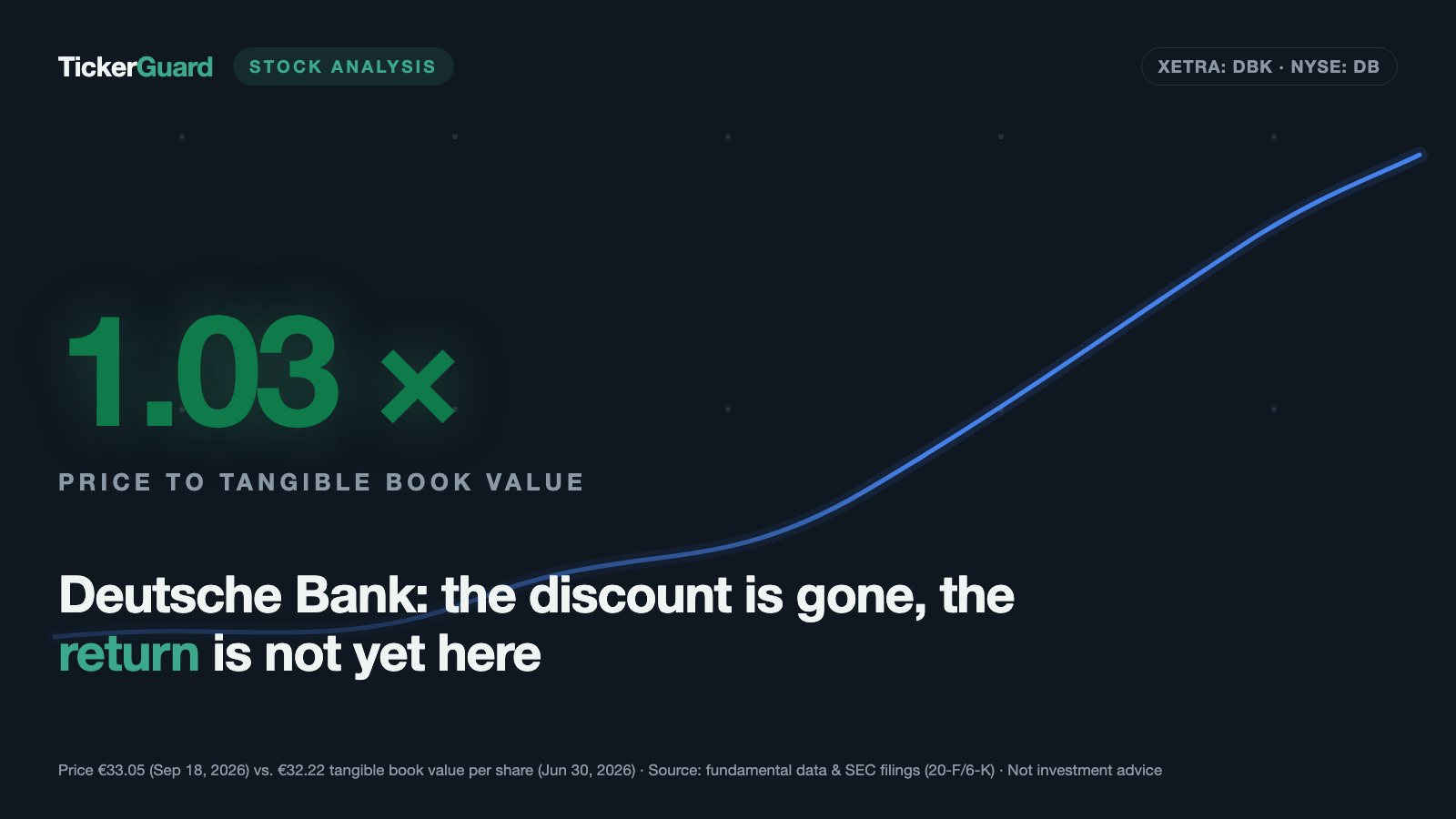
For a decade Deutsche Bank was the textbook cheap stock: a fraction of book value, and a bottomless pit. That era is over. Tangible book value stood at €32.22 per share on 30 June 2026; the shares closed at €33.05 on 18 September 2026. The discount that used to be the entire argument has been used up. Return on tangible equity in the first half of 2026 was 11.1 percent against the bank's own 2028 target of above 13. We read the annual report (20-F) and the interim report (6-K) line by line to see who is supposed to close that gap.
 Thomas Mücke
Founder & Publisher
Thomas Mücke
Founder & Publisher
Chart
Interactive price chart (TradingView).
Note: pure fact-based analysis, not investment advice and not a solicitation to buy or sell. All figures without guarantee.
There is one investor weakness that is especially stubborn, because it feels like experience: the memory trap. You saw a price once — low, embarrassing, a wreck — and that price becomes your permanent yardstick. Everything above it feels expensive, everything below it feels like a bargain. But your memory has an awkward property: it stores prices, not numbers. And while you were remembering the price, the company behind it changed. Sometimes for the worse. Sometimes, and this is the harder case, for the better.
Few stocks fit that trap as neatly as Deutsche Bank. For a decade it was the standard example of “optically cheap and dangerous anyway”: it traded far below the value its own balance sheet reported, and it got cheaper year after year. That has changed. On 18 September 2026 the shares closed at €33.05 in Xetra trading. Tangible book value per share stood at €32.22 on 30 June 2026. The discount that was the whole argument for years has been used up.
So here is the deal: we read the primary documents — the annual report filed with the U.S. securities regulator, the SEC, on Form 20-F dated 12 March 2026 and the interim report as of 30 June 2026 on Form 6-K dated 29 July 2026 — and redo the arithmetic ourselves. Not whether the stock looks cheap. What the bank earns, where it earns it, and how far it still is from its own targets.
What Deutsche Bank actually does
Deutsche Bank Aktiengesellschaft, headquartered at Taunusanlage 12 in Frankfurt am Main, has called its strategy Global Hausbank for years. That is not marketing language but a fairly precise self-description: it wants to be the first address for German and European companies — and to follow those companies around the world when they export, acquire or raise money.
The bank reports in four business segments. Their revenues in the first half of 2026 say more about the firm than any strategy slide:
- Investment Bank — €6,558 million. Trading in bonds, currencies and rates, financing, and advisory on takeovers and listings. The largest revenue contributor and the most volatile one.
- Private Bank — €5,133 million. Retail customers in Germany under the Deutsche Bank and Postbank brands, plus the global wealth management franchise.
- Corporate Bank — €3,722 million. Payments, trade finance and lending for corporate clients — the dullest and most dependable business.
- Asset Management — €1,558 million. The listed fund subsidiary DWS, which has minority shareholders of its own.
On top of that sits the residual segment Corporate & Other, which contributed just €13 million in the first half of 2026. Group revenues came to €16,985 million, up 3 percent. As of 30 June 2026 the group employed 89,742 people on a full-time-equivalent basis, after 89,879 at the end of 2025.
And then there is the balance sheet. It is the real character trait of this company: €1,526 billion of total assets at 30 June 2026, after €1,440 billion at the end of 2025. Against that stand €68.6 billion of shareholders' equity. Put differently: for every euro of genuine equity there are roughly 22 euros of balance sheet. That is exactly why a bank is not judged on return on assets but on capital ratios — more on those in a moment.
Company history for investors
-
2010
Takeover offer for Postbank at €25 per share
Roughly 48.2 million Postbank shares are tendered. For Deutsche Bank shareholders this became a legal dispute that charged €1.3 billion against profit 14 years later.
-
2021
Earnings trough: €3,518m before tax
After the group restructuring, €2,595m of after-tax profit remains. Buyers back then paid a fraction of book value — the safety cushion that no longer exists today.
-
2024
€1.3 billion provision for the Postbank litigation
After a signal from the Higher Regional Court of Cologne the bank books the provision in the second quarter. After-tax profit falls from €6,452m to €4,481m — a legal problem, not a business one.
-
2025
Best pre-tax profit in years, dividend at €1.00
Pre-tax profit reaches €9,069m and the dividend rises within two years from €0.45 to €1.00 per share. Revenues, meanwhile, stay at the 2023 level.
-
2026
Two buyback programmes, an 11.1 percent half-year return and new AT1 capital
The €1 billion buyback runs from 26 February to 21 August; the second programme of €500 million starts on 25 August. Return on tangible equity reaches 11.1 percent in the half-year. On 21 September the bank issues €1.25 billion of AT1 capital at 7.000 percent.
Why there is a 20-F here and no 10-K
One point up front, because it shapes the entire evidence base and because it is regularly reported wrongly. Deutsche Bank is registered with the SEC — unlike, for example, Commerzbank, whose analysis we built entirely from German statutory reports. Its identifier is CIK 0001159508, and it files regularly.
It simply files different documents. As a foreign private issuer it does not submit an annual report on Form 10-K or quarterly reports on Form 10-Q, but an annual report on Form 20-F and interim reports on Form 6-K. Search EDGAR for a Deutsche Bank 10-Q and you find nothing — and occasionally draw the wrong conclusion that there is no SEC reporting at all. There is; it just has a different name. Every figure in this analysis therefore carries the line “Source: fundamental data & SEC filings (annual report 20-F, interim report 6-K)”.
A second clarification, and this one surprises many investors: what trades on the New York Stock Exchange under the symbol DB is not a depositary receipt. The cover page of the annual report lists “Ordinary shares, no par value | DB | The New York Stock Exchange” among the registered securities, and the securities item says so explicitly:
“Deutsche Bank’s ordinary shares are not represented by American Depositary Receipts and accordingly no information is required to be provided pursuant to Item 12.D.3 and Item 12.D.4.”
— Deutsche Bank Aktiengesellschaft, annual report on Form 20-F for 2025, Item 12 (filed 12 March 2026)

One research caveat: alongside DB, the SEC submissions record also lists the symbols DGP, DGZ and DZZ on a New York exchange. Those are gold-linked exchange-traded notes issued under the bank's programme, not shares. Confusing one of them with the stock means measuring something entirely different.
How the stock landed on our desk
Being honest means saying this plainly: there was no scanner hit behind this one. Deutsche Bank sits on our editorial watchlist of German blue chips, and what genuinely surprised us while checking the evidence base was its filing profile with the SEC.
The number, as of 21 September 2026: of the 1,003 most recent documents in the bank's EDGAR archive (covering 15 October 2024 to 18 September 2026), 953 are pricing supplements on Form 424B2 — 95 percent. In 2026 alone, through 18 September, it was 352 out of 370. Company reports over the same span numbered just 23: two annual reports on Form 20-F and 21 reports on Form 6-K — only six of them quarterly or interim reports, the rest earnings releases, annual general meeting documents and quarter-end updates.
A pricing supplement is, in one sentence, the price tag for a single structured note sold to U.S. investors. With the American regulator, in other words, Deutsche Bank is visible mostly as an issuance machine. The other side of that shows up on the balance sheet: financial liabilities designated at fair value through profit or loss rose 26 percent in the first half of 2026 to €144,434 million. That is neither a scandal nor a warning sign — but it is a useful reminder that this bank is far more capital markets than the word “Hausbank” suggests.
One more note that fits the character. The standard ratios investors use to screen stocks do not work here. The Altman Z-score, enterprise value and the price-to-sales ratio were built for industrial companies. A bank has, by its nature, a vast balance sheet of loans and deposits; in those formulas it either fails outright or looks grotesquely cheap. We therefore do not use them at all. Four other measures matter: the CET 1 ratio (how much genuine equity stands behind the risks?), the leverage ratio (how much capital stands behind the balance sheet as a whole?), the cost/income ratio (how much expense does a euro of revenue cost?) and the return on tangible equity.
The numbers over the years, honestly credited
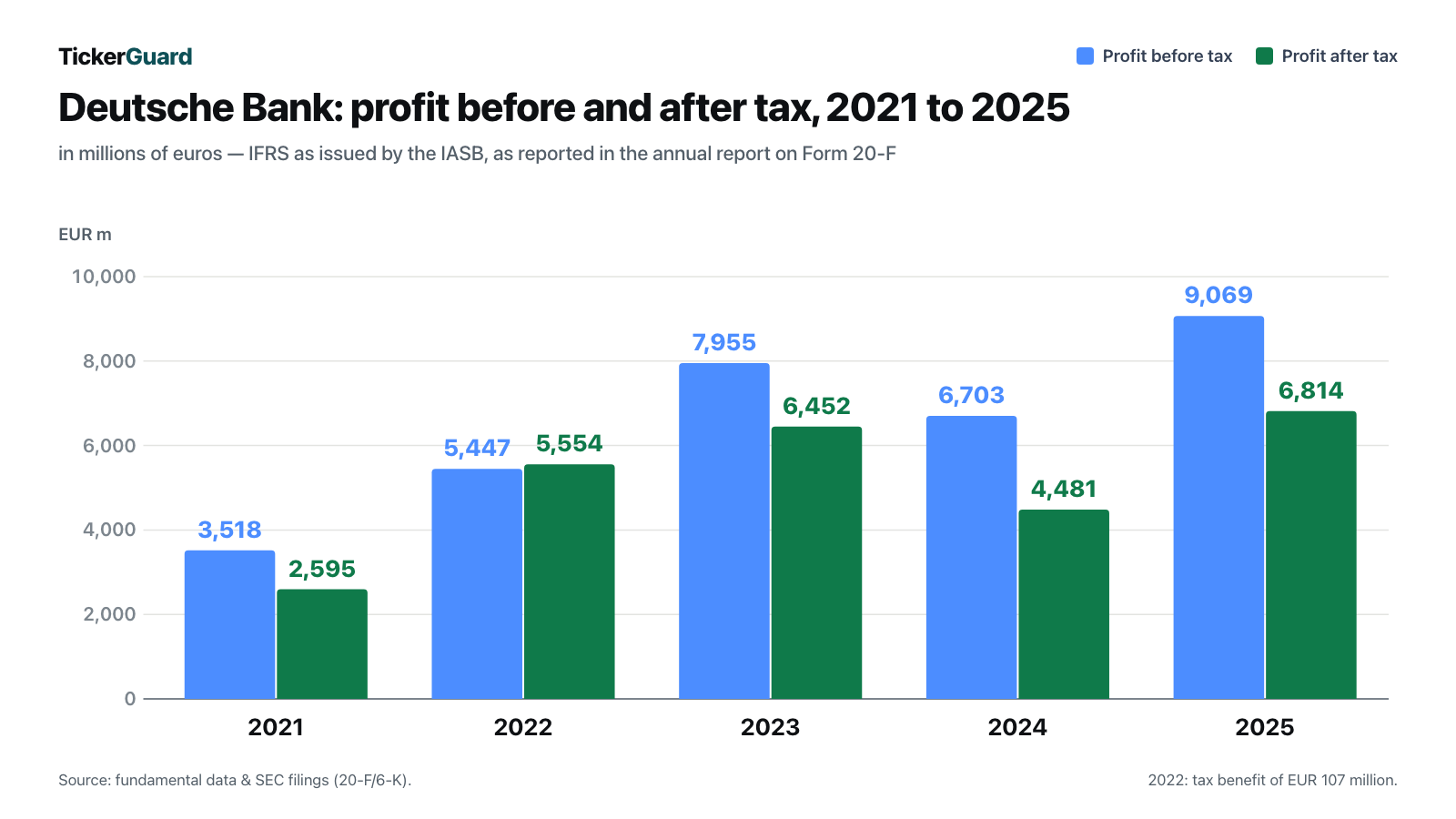
First the part that genuinely impresses. Deutsche Bank is climbing out of a very deep hole, and the annual reports document the route well. Profit before tax, on the basis used in the SEC filings:
- 2021: €3,518 million before tax, €2,595 million after tax
- 2022: €5,447 million before tax, €5,554 million after tax — after-tax profit was higher here because a tax benefit of €107 million was recognised
- 2023: €7,955 million before tax, €6,452 million after tax
- 2024: €6,703 million before tax, €4,481 million after tax
- 2025: €9,069 million before tax, €6,814 million after tax
And 2026 added more. In the first half, revenues rose 3 percent to €16,985 million, profit before tax 3 percent to €5,555 million and profit after tax 3 percent to €3,960 million. The second quarter was distinctly stronger than the first: €9,168 million of revenues (up 10 percent), €3,368 million of pre-tax profit (up 14 percent), a cost/income ratio of 58.2 percent and a return on tangible equity of 14.0 percent — at least on the basis used in the SEC filing. Why the bank itself reports distinctly weaker figures for the same quarter is the first uncomfortable truth further down.
The balance sheet is a different animal today as well. At 30 June 2026 the CET 1 ratio stood at 13.9 percent — €51,099 million of common equity tier 1 capital against €367 billion of risk-weighted assets. The leverage ratio was 4.5 percent (€63.1 billion of tier 1 capital against a €1,400.0 billion exposure measure). The liquidity coverage ratio in the second quarter of 2026 was 140 percent, exceeding the regulatory minimum by €67.9 billion, with €237.4 billion of high-quality liquid assets on hand.
One addition arrived after the balance-sheet date. On 21 September 2026 the bank issued new Additional Tier 1 (AT1) capital instruments worth €1.25 billion, carrying a fixed coupon of 7.000 percent and a first call date of 30 October 2033. The bank says the issue supports its leverage ratio and its tier 1 and total capital ratios. What it expressly does not support is the CET 1 ratio: AT1 paper counts as additional tier 1 capital, not as common equity tier 1 — the 13.9 percent is untouched by it.
This is routine rather than a distress signal: in the first half of 2026 the bank had already issued €1.25 billion of such instruments and redeemed €801 million (£650 million). That layer of capital is not free, though. At 30 June 2026, €11,967 million of AT1 instruments counted towards regulatory capital (the balance-sheet line shows €12,144 million), and the first half of 2026 alone carried €796 million of coupons on them. Those coupons do not belong to shareholders, and the bank expressly deducts them before it calculates the return on tangible equity. The 11.1 percent for the first half therefore already sits after that deduction — and the new tranche on its own costs roughly €88 million of coupons a year.
Then there is what shareholders feel most directly. The dividend rose from €0.45 per share for 2023 to €0.68 for 2024 and €1.00 for 2025 — more than doubling in two years. Then come buybacks. A €1 billion programme ran from 26 February to 21 August 2026; by 30 June 2026 the bank had bought 25.4 million shares under it, and by the end, according to its completion release of 24 August 2026, 35.7 million shares at an average of €28.00 — 1.87 percent of share capital. A second programme of €500 million started on 25 August 2026 and ends no later than 11 December 2026; by 18 September 2026 it had bought 8.36 million shares at an average of €34.24, roughly €286 million in total. The two belong to different years: the €1 billion programme is, per the annual report, a distribution in respect of financial year 2025; only the €500 million programme counts towards the goal of distributing 60 percent of profit from financial year 2026 onwards — according to the interim report it is funded from 2026 net profit and fully covered by existing capital deductions.
What the filings say: the uncomfortable truths
Uncomfortable truth no. 1: there are two accounting bases, and the targets are measured on the EU version
This one rewards close reading. Deutsche Bank publishes its figures in two versions. For Europe it reports under the international accounting standards as endorsed by the European Union, applying a special rule that permits hedge accounting for interest-rate risk on core deposits. For the SEC it reports without that rule. Both versions are permitted and prepared to the same standards — they simply do not produce the same result. The interim report labels its own figures unaudited; it is the annual accounts that carry an audit opinion.
In everyday terms: you keep two household ledgers using two permitted methods. Both are correct, and each shows a different number at year end. And when you set yourself a savings target, one of the two ledgers is the one you measure against.
Deutsche Bank says exactly that, in one dry sentence:
“The IASB IFRS financial results may materially differ from the EU-IFRS results as Deutsche Bank applies hedge accounting under the EU carve-out. Deutsche Bank does not use the IASB IFRS financial results as a basis for measuring the bank’s progress towards its financial targets or capital objectives.”
— Deutsche Bank AG, interim report as of 30 June 2026, section “Group results” (Exhibit 99.1 to Form 6-K filed 29 July 2026)

How large is the difference? The bank quantifies it itself, quarter by quarter. In the second quarter of 2026 the special rule cut profit before tax by €688 million and profit after tax by €496 million — roughly one fifth of a €3,368 million pre-tax quarter. Over the first half of 2026 the sign flipped: there the effect was a positive €166 million. On the CET 1 ratio the cumulative impact at 30 June 2026 was about minus 53 basis points, after about minus 75 basis points a year earlier.
“The application of the EU carve out version of IAS 39 had a negative impact of € 688 million on profit before tax and of € 496 million on profit after tax for the three-month period ended June 30, 2026, compared to a negative impact of € 535 million on profit before tax and of € 383 million on profit after tax for the three-month period ended June 30, 2025.”
— Deutsche Bank AG, interim report as of 30 June 2026, section “Basis of preparation”

What does that mean for you? Nothing dramatic, but something very practical: never compare a number from a press release with a number from an SEC filing without checking the accounting basis first. For earnings and the balance sheet this analysis uses the SEC figures throughout — including where they make the bank look worse. The report itself names one exception: the regulatory capital ratios, including the 13.9 percent CET 1 ratio and the leverage ratio, are stated on the EU basis even in the SEC filing (“The Group’s regulatory capital and ratios thereof are also reported on the basis of the EU carve out version of IAS 39”).
How far apart the two can be shows in the second quarter of 2026. The SEC filing states a return on tangible equity of 14.0 percent and a cost/income ratio of 58.2 percent — both would sit inside the 2028 targets. The bank's press release of 29 July 2026, prepared on the EU basis, gives 11.0 percent and 63.0 percent for the same quarter. The bank is measured on the second set. And for the half-year: on 23 September 2026 chief financial officer Raja Akram put the first-half return at “close to 12%” at a Bank of America investor conference, according to a published transcript; the SEC filing shows 11.1 percent. Both are right — they are just not the same calculation.
Uncomfortable truth no. 2: revenues have been flat for three years
The profit jump from 2024 to 2025 looks like growth. It is not. Group revenues were €31,155 million in 2023, €31,504 million in 2024 and €31,434 million in 2025. Over three years that is a sideways line — 2025 actually came in marginally below 2024.
So where did the profit come from? Two places. First, costs: general and administrative expenses fell noticeably in 2025 because the previous year's legal charges did not recur. Second, tax: the effective rate was 25 percent in 2025 after 33 percent the year before, helped among other things by German tax reform. Both are genuine, legitimate sources of profit — they just do not repeat indefinitely.
For 2026 the bank points to revenues of around €33 billion. After €16,985 million in the first half that is within reach, but it would be the first real revenue increase in three years. Anyone resting the valuation on growth is resting it on that single number.
Where would it come from? The first half of 2026 shows how narrow the base is. Of the €513 million of additional revenue against the prior-year period, the Investment Bank contributed €509 million, the Private Bank €324 million and Asset Management €103 million. The Corporate Bank lost €40 million, and the Corporate & Other residual collapsed by €382 million to just €13 million. Put differently: all of the growth comes from trading and advisory work and from clients building wealth — precisely the two areas most exposed to market sentiment and capital-markets activity. The steady corporate franchise that carries the “Global Hausbank” strategy shrank slightly over the same period.
And the single most important revenue line, net interest income — what the bank earns on loans and investments over what it pays on deposits? It was €16,122 million (2023), €15,161 million (2024) and €15,673 million (2025), and €8,382 million in the first half of 2026 against €7,727 million a year earlier, up 8 percent. This is the engine the €33 billion mark depends on — and it is deliberately damped. The bank does not park rate-insensitive deposits short term; it invests them in staggered tranches over years:
“To protect the net interest income of rate‑insensitive deposits, Deutsche Bank undertakes interest rate hedging by investing these deposits over a medium‑term horizon, predominantly through structures with a typical 10‑year tractor profile.”
— Deutsche Bank AG, Interim Report as of June 30, 2026, section “Net interest income in the key banking book segments”
Think of a ladder of ten fixed-term deposits where only the bottom rung is renewed at new rates each year. According to the report, the net interest income of these deposits depends mainly on reinvestment, which represents roughly a tenth of the portfolio and is exposed to movements in 10-year rates. That makes net interest income predictable — on the way down and on the way up. A sudden jump from this source is therefore not to be expected. And these very hedges are what the EU carve-out from truth no. 1 accounts for differently.
On 23 September 2026 chief financial officer Raja Akram put both points in context at the Bank of America conference, according to a published transcript. On net interest income, he said the benefit arrives “gradually over the outer years, as the hedges roll over and we reset them at a higher rate” — with a bigger upside in 2027 and a bigger one again in 2028. And on fixed income and currencies (FIC), the core of the investment bank that delivered almost all of the first-half revenue gain, he expects third-quarter 2026 revenues, measured against that business's strongest third quarter on record, to be “either flattish or slightly down.” Whether the €33 billion mark holds will show in the earnings report as of 30 September 2026, which the bank has scheduled for 28 October 2026.
Uncomfortable truth no. 3: the largest single provision of 2024 came from 2010
In October 2010 Deutsche Bank offered the shareholders of Deutsche Postbank AG €25 per share; roughly 48.2 million shares were tendered. Former Postbank shareholders sued, arguing the offer had been too low: the bank should have made a mandatory offer for all shares as early as 2009, and €57.25 per share would have been appropriate — in some claims even €64.25. The payment claims originally totalled almost €700 million, interest excluded.
At the end of April 2024 the Higher Regional Court of Cologne indicated in a hearing that it might find those claims valid in a later ruling. The consequence appeared on the balance sheet one quarter later:
“As a consequence, Deutsche Bank recognized a provision of € 1.3 billion in the second quarter of 2024 to provide for the amount of all pending claims and cumulative interest.”
— Deutsche Bank Aktiengesellschaft, annual report on Form 20-F for 2025, Note 27 “Provisions”

In the provisions table this becomes a line worth seeing: the group recognised €2,201 million of new civil-litigation provisions during 2024, against an opening balance of €1,124 million. That, and not the business, is why profit after tax fell from €6,452 million to €4,481 million in 2024.
The good news: the matter is largely worked through. By the second quarter of 2025 the bank had settled 90 percent of the claims by value; at 31 December 2025 residual claims of €112 million were fully provisioned. It is not closed, though: on 23 October 2024 the Higher Regional Court of Cologne handed down its judgment in the remaining lead case and fully granted the plaintiffs' claims, without granting leave to appeal to the Federal Court of Justice; the bank filed a complaint against that denial on 19 November 2024. The underlying legal question — whether a mandatory offer was due in 2009 — therefore still sits with the Federal Court of Justice. The uncomfortable news sits right beside it. At the same date, civil-litigation provisions still stood at €1,192 million, plus €921 million of contingent liabilities — cases where an outflow is possible but not probable enough for a provision. A year earlier that figure was roughly €0.6 billion. This position is growing.
Uncomfortable truth no. 4: the cost ratio still has two years to travel
The cost/income ratio says how much expense a euro of revenue costs. At Deutsche Bank it was 69.6 percent in 2023, 72.9 percent in 2024, 65.7 percent in 2025 and 61.5 percent in the first half of 2026. The direction is unambiguous. The 2028 target is below 60 percent, with a return on tangible equity above 13 percent — the first half of 2026 delivered 11.1 percent on the SEC basis. On the EU basis the bank measures itself against, it was “close to 12%” according to the CFO: the gap is smaller there, but it is not closed there either.
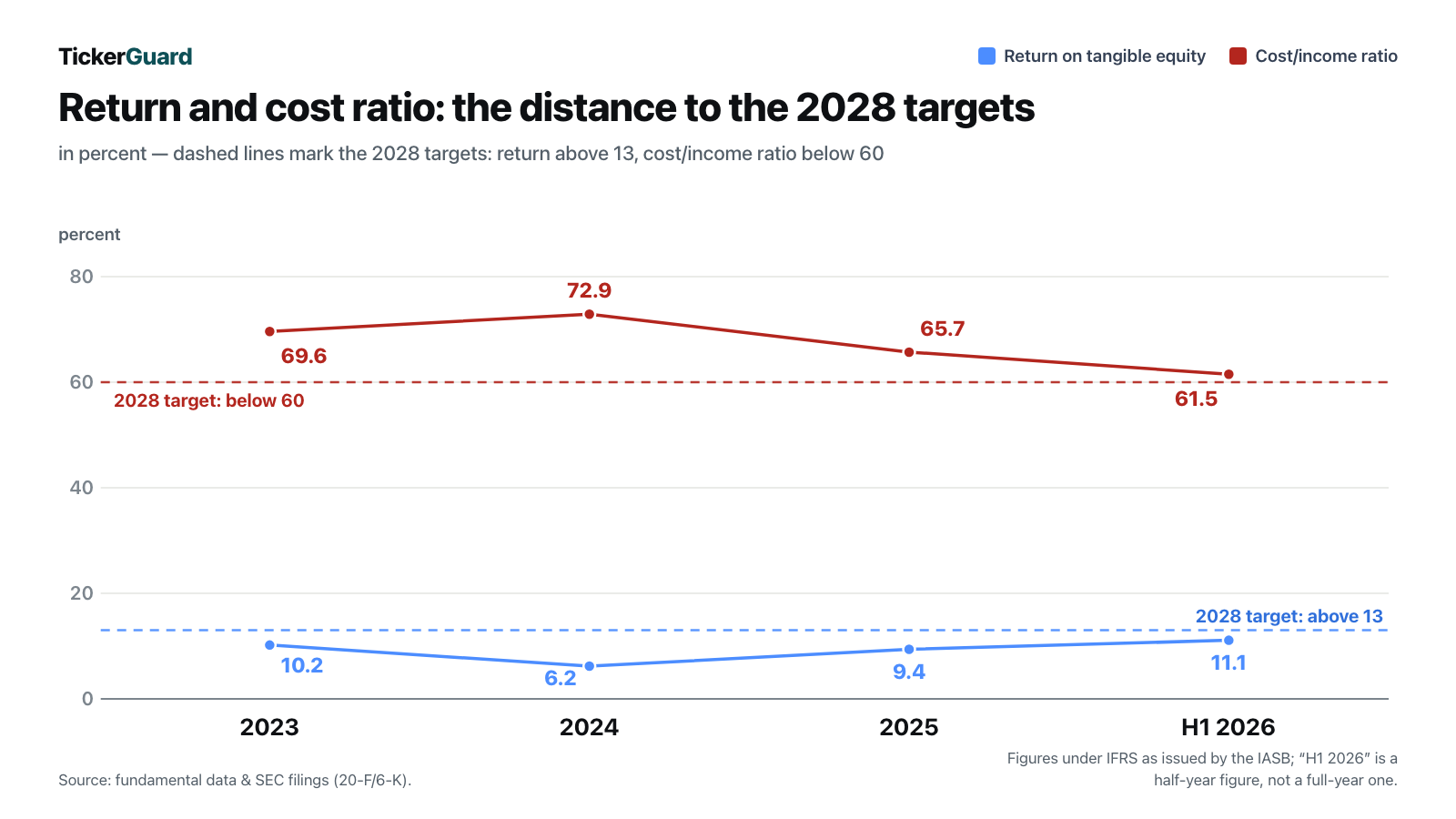
The catch is in the bank's own outlook. For 2026 it guides to noninterest expenses of slightly above €21 billion — more than in 2025, because roughly €900 million of a €1.5 billion incremental investment package running to 2028 falls due this year. And for the cost ratio it names a markedly softer mark for 2026 than for 2028:
“For 2026, the bank expects the cost/income ratio to remain below 65%.”
— Deutsche Bank AG, interim report as of 30 June 2026, section “Outlook”

Translated: getting from 61.5 to below 60 percent is not the hard part — the hard part is staying there while the investments ramp up. The bank counts on at least €2 billion of operating efficiencies by 2028 to more than offset them. That is a plan, not a fact.
Uncomfortable truth no. 5: credit provisions are rising, and the outlook keeps a back door open
Provision for credit losses came to €979 million in the first half of 2026, 9 percent more than in the prior-year period (€894 million), equal to 40 basis points of average loans. For full-year 2025 the figure was €1,707 million. For a bank this size that is not an alarm level, but the direction is the wrong one.
The outlook alongside it is notable. The bank expects provisions in 2026 to be slightly lower than in 2025 — and adds in the same paragraph that it may sell selected non-performing loans, which would then push provisions slightly higher after all. Such sales are capital-accretive and sensible in substance; for the reader of the guidance it still means that the stated direction is subject to the bank's own decisions.
Valuation: what the market pays for the bank today
Back to the question from the opening. On 18 September 2026 the shares closed at €33.05 in Xetra trading. At 30 June 2026, 1,879.0 million shares were outstanding; since then the bank has, according to its buyback reports, repurchased roughly 18.7 million more through 18 September 2026. With roughly 1,860 million shares, that gives a market capitalisation of roughly €61.5 billion — within one percent of what the fundamental data show (€62.1 billion).
Three yardsticks, all on that date:
- Tangible book value: €32.22 per share at 30 June 2026. The price therefore sits at roughly 1.03 times tangible book. Reported book value per share is €35.94; against that the multiple is about 0.92.
- Earnings: nine to ten times, depending on the denominator. The fundamental data show a trailing twelve-month price/earnings ratio of about 10; annualising the first half of 2026 (€3,433 million attributable to Deutsche Bank shareholders) puts it near 9.
- Distributions: the €1.00 dividend for 2025 equals roughly 3.0 percent of the share price. On top comes the €500 million buyback running since 25 August 2026, roughly 0.8 percent of market capitalisation. The goal is a total payout ratio of 60 percent from financial year 2026.
How thin that edge is takes one line of arithmetic: at €32.22 — roughly 2.5 percent below the 18 September 2026 close — the shares cost exactly their tangible book value. On 23 September 2026, after the chief financial officer's conference appearance, the stock slid 4.3 percent in pre-open trading, according to Investing.com. Whether the price happens to sit just above or just below tangible book value does not change the point: there is no meaningful discount left.
By these yardsticks the stock is not expensively valued. But it is no longer the stock that lay around at half of book value either. The difference matters: someone buying in 2019 at a fraction of book value was betting on sheer survival with an enormous margin of safety. Someone buying today pays roughly book value for the tangible equity and is betting on the return — on 11.1 percent turning into more than 13 by 2028. For comparison, Commerzbank reported 12.6 percent on the same measure in the first half of 2026, although on the EU accounting basis and therefore not directly comparable.
Opportunities and risks at a glance
What argues for the bank:
- Earnings power is back: €9,069 million of pre-tax profit in 2025 and €5,555 million in the first half of 2026.
- Capital is comfortable: a CET 1 ratio of 13.9 percent, a leverage ratio of 4.5 percent and a liquidity coverage ratio of 140 percent at 30 June 2026.
- Distributions are visibly rising: a dividend of €0.45 (2023), €0.68 (2024) and €1.00 per share (2025), plus two buyback programmes in 2026 worth €1.5 billion combined.
- The second quarter of 2026 was the strongest of the half-year: €9,168 million of revenues (up 10 percent) and €3,368 million of pre-tax profit (up 14 percent) on the SEC-filing basis.
- The Postbank legacy is settled for 90 percent of claims by value; the residual €112 million is fully provisioned.
What argues against it:
- Revenues have been flat for three years (€31,155 / €31,504 / €31,434 million); the growth still has to arrive.
- Full-year figures sit below the targets: a 9.4 percent return and a 65.7 percent cost ratio in 2025 against above 13 and below 60 percent for 2028.
- Legal risk is not a closed chapter: €1,192 million of civil-litigation provisions and €921 million of contingent liabilities at 31 December 2025, the latter up year on year.
- Credit provisions are rising (€979 million in the first half of 2026, up 9 percent), and the outlook explicitly leaves room for an increase through loan sales.
- The balance sheet remains vast and market-driven: €1,526 billion of total assets, including €260,170 million of negative market values from derivatives. Positions like that move very fast in a crisis.
- The valuation discount that served as a cushion for years is gone at 1.03 times tangible book value.
A human conclusion
Back to the memory trap. If you still file Deutsche Bank under “wreck”, the numbers say otherwise: this bank earns money again, it is soundly capitalised, and it pays out more than it has in years. If you file it under “fully repaired”, the numbers say otherwise too: revenues are not growing, the full-year return sits below the bank's own target, and civil-litigation provisions remain a four-digit million figure.
The unpleasant thing about the memory trap is that it snaps shut in both directions. The old price makes the stock look expensive and cheap — depending on which price your memory stored. The only way out is the usual one: forget the price and read the numbers. And here they say fairly clearly what this is about. No longer survival. It is about the last one to two percentage points of return by 2028 — depending on which of the two calculations you apply — and about whether revenues will finally play along.
What you make of that is your decision. And that is exactly as it should be.
Sources
Every primary document used in this analysis, so you can read it yourself:
- Deutsche Bank AG — interim report as of 30 June 2026 (Exhibit 99.1 to Form 6-K filed 29 July 2026) — the latest periodic filing; source of all 2026 half-year and quarterly figures, the capital and liquidity data, the outlook and the reconciliation of the two accounting bases
- Deutsche Bank Aktiengesellschaft — annual report on Form 20-F for financial year 2025 (filed 12 March 2026) — group figures for 2025, 2024 and 2023, Note 27 “Provisions”, the Postbank takeover litigation, the dividend history and Item 12 on registered securities
- Deutsche Bank Aktiengesellschaft — annual report on Form 20-F for financial year 2023 (filed 14 March 2024) — group figures for 2022 and 2021 used in the five-year series
- Deutsche Bank AG — Form 6-K filed 29 July 2026 (cover document and list of exhibits)
- Deutsche Bank AG — release of 21 September 2026 announcing the issuance of Additional Tier 1 (AT1) capital instruments — also published as an ad-hoc disclosure under Article 17 of the EU Market Abuse Regulation; source for the purpose and the first call date
- Deutsche Bank AG — release of 21 September 2026 on the completion of that issuance — source for the size (€1.25 billion), the coupon (7.000 percent) and the 30 October 2033 first call date
- U.S. Securities and Exchange Commission — submissions record for CIK 0001159508 — filer type, symbol and exchange mapping, and the completeness check of every filing made on or after 29 July 2026
- Deutsche Bank AG — press release of 29 July 2026 on second-quarter results — quarterly figures on the EU basis (11.0 percent return, 63.0 percent cost/income ratio) for comparing the two accounting bases
- Deutsche Bank AG — release of 24 August 2026 on completing the €1 billion buyback and starting the €500 million programme and the buyback overview on the investor relations site (purchases through 18 September 2026, accessed 23 September 2026)
- Transcript of chief financial officer Raja Akram's appearance at the Bank of America financials conference on 23 September 2026, published by Investing.com (third-party transcript, accessed 23 September 2026) — source of the three quoted statements on half-year return, net interest income and the investment bank
- Investing.com — report of 23 September 2026 on the share-price reaction to the conference appearance (down 4.3 percent in pre-open trading; accessed 24 September 2026)
- Fundamental data (share price, market capitalisation, price/earnings ratio; price as of 18 September 2026, ratios as of 20 September 2026), reconciled against the share-count and equity disclosures in the interim report as of 30 June 2026.
Transparency & disclaimer: this analysis is journalistic commentary on publicly available information. It is not investment advice, not investment research within the meaning of financial regulation, and not a solicitation to buy or sell securities. Equity investments carry substantial risk up to total loss. All information without warranty; the date of each data point is stated in the text, and the overall status of this version is 24 September 2026. Positions held by the operator are disclosed daily; where one exists, it appears as a notice at the top of this analysis.
Our Bottom Line at a Glance
- Earnings power positive
- Profit before tax rose from €3,518 million (2021) to €9,069 million (2025), and profit after tax from €2,595 million to €6,814 million. The first half of 2026 added €5,555 million before tax, with €3,368 million in the second quarter alone. Return on tangible equity in that quarter was 14.0 percent on the SEC basis but only 11.0 percent on the EU basis the bank measures its targets against.
- Revenue growth negative
- Revenues have been virtually unchanged for three years at €31,155 million (2023), €31,504 million (2024) and €31,434 million (2025). The 2025 profit jump came from lower legal charges and an effective tax rate of 25 percent instead of 33. The bank's own 2026 mark is around €33 billion.
- Capital and liquidity positive
- At 30 June 2026 the CET 1 ratio stood at 13.9 percent (€51,099 million of CET 1 capital against €367 billion of risk-weighted assets), the leverage ratio at 4.5 percent and the second-quarter liquidity coverage ratio at 140 percent — €67.9 billion above the regulatory minimum.
- Target attainment neutral
- For 2028 the bank targets a return on tangible equity above 13 percent and a cost/income ratio below 60 percent. It delivered 9.4 and 65.7 percent in 2025, and 11.1 and 61.5 percent in the first half of 2026. For 2026 the bank itself guides only to a cost/income ratio below 65 percent.
- Legal risk negative
- During 2024 the group recognised €2,201 million of new civil-litigation provisions, including €1.3 billion for the Postbank takeover litigation dating from 2010. At 31 December 2025 the books still carried €1,192 million of provisions and €921 million of contingent liabilities; the latter stood at roughly €0.6 billion a year earlier.
- Distributions positive
- The dividend rose from €0.45 per share (2023) to €0.68 (2024) and €1.00 (2025). Two buyback programmes worth €1.5 billion combined run in 2026: the first ended on 21 August 2026 with 35.7 million shares repurchased, and the second had bought 8.36 million shares by 18 September 2026. The €1 billion programme is the distribution in respect of 2025; the €500 million one counts towards the 60 percent payout ratio targeted from financial year 2026.
Deutsche Bank delivered its highest pre-tax profit in five years in 2025 at €9,069 million and is soundly capitalised with a 13.9 percent CET 1 ratio. Revenues, however, have been flat for three years, the full-year 2025 return on tangible equity of 9.4 percent sat well below the 2028 target of above 13 percent, and civil-litigation provisions still amount to €1,192 million. At the €33.05 close on 18 September 2026, tangible equity is priced at roughly 1.03 times book — the discount of earlier years has been used up. Not investment advice.
What Our Rating Means
Open questions
The business works in principle, but one material question is open. As long as it stays open, our findings do not carry a quality verdict.
Yellow here explicitly does not reflect a solvency risk. The balance sheet at 30 June 2026 carries its weight: a 13.9 percent CET 1 ratio, a 4.5 percent leverage ratio, a 140 percent liquidity coverage ratio with a €67.9 billion buffer above the minimum, €68.6 billion of shareholders' equity, no indication of capital or liquidity trouble, no accounting or governance breach and no going-concern qualification. Earnings power is demonstrably back: €9,069 million of pre-tax profit in 2025 after €3,518 million in 2021, and €5,555 million in the first half of 2026. Yellow stands because two operating questions remain open. First, growth: revenues have hovered around €31.2 to €31.5 billion for three years and came in marginally below 2024 in 2025. The 2025 profit jump came from legal charges that did not recur and an effective tax rate that fell from 33 to 25 percent — both genuine, neither indefinitely repeatable. Second, target attainment: on a full-year basis the 2025 return of 9.4 percent and cost/income ratio of 65.7 percent sat well away from the 2028 marks of above 13 and below 60 percent, and for 2026 the bank guides only to a cost/income ratio below 65 percent on noninterest expenses slightly above €21 billion. Legal risk remains a standing item on top: €2,201 million of new civil-litigation provisions during 2024 alone, and at 31 December 2025 still €1,192 million of provisions plus €921 million of contingent liabilities, the latter up year on year. On valuation, which expressly does not determine this rating: at the €33.05 close on 18 September 2026 tangible equity is priced at roughly 1.03 times book, so the former discount is gone. The next verifiable checkpoint is the next interim report on Form 6-K. The decision is yours.
A journalistic assessment by our editorial team at the time of the deep dive, based on public sources — not investment advice and not a solicitation to buy or sell. Your personal circumstances (investment goals, risk capacity, taxes) cannot be taken into account. What our levels mean, how verdicts are formed, and what conflicts of interest exist →
Worth Noting
- This analysis did not start from a scanner hit but from the bank's filing profile with the U.S. securities regulator: of the 1,003 most recent documents in its EDGAR archive (15 October 2024 to 18 September 2026), 953 are pricing supplements on Form 424B2 from the structured-notes programme; in 2026 through 18 September it was 352 out of 370. Periodic filings over that span numbered 23 (two 20-F, 21 6-K).
- Accounting basis: every income-statement and balance-sheet figure in this analysis comes from the SEC filings and therefore follows IFRS as issued by the IASB. The report itself names one exception: the regulatory capital ratios (CET 1 ratio, leverage ratio) are reported on the EU basis even in the SEC document. The bank also publishes a full EU version applying a special hedge-accounting rule, and it expressly measures its targets against that second version. The difference ran both ways: in the second quarter of 2026 pre-tax profit under the EU version was €688 million lower than under the version filed with the SEC, while over the first half of 2026 it was €166 million higher. Figures taken from the bank's press releases are therefore not directly comparable with those quoted here.
- Share count and market capitalisation were cross-checked: the interim report as of 30 June 2026 states 1,910.6 million shares issued, 31.5 million treasury shares and 1,879.0 million shares outstanding. Since then the bank has, according to its buyback reports, repurchased roughly 18.7 million more shares through 18 September 2026 (roughly 10.3 million from the first programme, completed in late August, and 8.36 million from the second); shares issued to employees are not included. Roughly 1,860 million shares times the €33.05 Xetra close on 18 September 2026 gives roughly €61.5 billion — within one percent of the €62.1 billion from the fundamental data. No closing price more recent than 18 September 2026 was available when this edition was completed. Book-value comparisons use the interim report figures (€35.94 book value and €32.22 tangible book value per share) rather than diverging feed values that include equity outside the shareholders' portion.
- Standard industrial ratios such as the Altman Z-score, price-to-sales or enterprise value carry no meaning for a bank and were therefore not used at all. The relevant measures are the CET 1 ratio, the leverage ratio, the liquidity coverage ratio, the cost/income ratio and the return on tangible equity.
- Risk of confusion: the ticker DBK.DE used in this analysis refers to the Xetra listing (ISIN DE0005140008, WKN 514000). The same share trades on the New York Stock Exchange as DB — expressly without depositary receipts, per Item 12 of the annual report. The symbols DGP, DGZ and DZZ that also appear in the SEC submissions record belong to the bank's gold-linked exchange-traded notes on NYSE Arca, not to the stock.
The full analysis as a PDF for later
We will send you this analysis as a PDF — to print, file away, and read at your own pace.
Frequently Asked Questions
Deutsche Bank AG of Frankfurt am Main is a universal bank with four business segments. In the first half of 2026 the Investment Bank generated €6,558 million of revenues, the Private Bank €5,133 million, the Corporate Bank €3,722 million and Asset Management €1,558 million. As of 30 June 2026 the group employed 89,742 people on a full-time-equivalent basis, with total assets of €1,526 billion.
Because it is registered with the SEC as a foreign private issuer. Instead of an annual report on Form 10-K it files one on Form 20-F, and instead of quarterly reports on Form 10-Q it files interim reports on Form 6-K. Its identifier is CIK 0001159508. The latest annual report is dated 12 March 2026 and the latest interim report 29 July 2026, covering the position as of 30 June 2026.
No. The cover page of the annual report lists “Ordinary shares, no par value” with the trading symbol DB on the New York Stock Exchange, and Item 12 states explicitly that the ordinary shares are not represented by American Depositary Receipts. The NYSE line is the same share that trades in Xetra under DBK. The symbols DGP, DGZ and DZZ belong to gold-linked exchange-traded notes issued by the bank, not to the stock.
Revenues rose 3 percent to €16,985 million, profit before tax 3 percent to €5,555 million and profit after tax 3 percent to €3,960 million. Return on tangible equity was 11.1 percent and the cost/income ratio 61.5 percent. The second quarter was distinctly stronger: €9,168 million of revenues and €3,368 million of pre-tax profit; the quarterly return of 14.0 percent holds only on the SEC basis, on the EU basis it was 11.0 percent.
Because two permitted accounting bases sit side by side. For Europe the bank reports under EU-endorsed IFRS with a special hedge-accounting rule; for the SEC it reports without that rule. In the second quarter of 2026 pre-tax profit under the EU version was €688 million lower, and over the first half of 2026 €166 million higher. The bank states itself that it does not measure its targets against the SEC figures.
Deutsche Bank offered €25 per Postbank share in 2010; roughly 48.2 million shares were tendered. Plaintiffs argued €57.25 was the appropriate price. After the Higher Regional Court of Cologne indicated in April 2024 that it might find those claims valid, the bank booked a €1.3 billion provision in the second quarter of 2024. It has since settled 90 percent of the claims by value; residual claims of €112 million were fully provisioned at 31 December 2025.
Yes, and it is rising sharply. The dividend was €0.45 per share for financial year 2023 and €0.68 for 2024; after the annual general meeting of 28 May 2026 it paid €1.00 per share for 2025, roughly €1.9 billion in total. Buybacks come on top: a €1 billion programme from 26 February to 21 August 2026 — the distribution in respect of 2025 — and a second one of €500 million running since 25 August 2026, which already counts towards the 60 percent payout ratio targeted from financial year 2026 onwards.
On the capital metrics, comfortable. At 30 June 2026 the CET 1 ratio was 13.9 percent (€51,099 million of common equity tier 1 capital against €367 billion of risk-weighted assets), the leverage ratio 4.5 percent and the second-quarter liquidity coverage ratio 140 percent — €67.9 billion above the regulatory minimum. Provision for credit losses did rise 9 percent in the half-year to €979 million.
Found an error?
Did you spot a factual error, an outdated number, or a typo in this deep dive? Let us know briefly — your report goes straight to the editorial team.