AT&S Is Building Its AI Factories With Its Customers' Money — and That Is the Risk
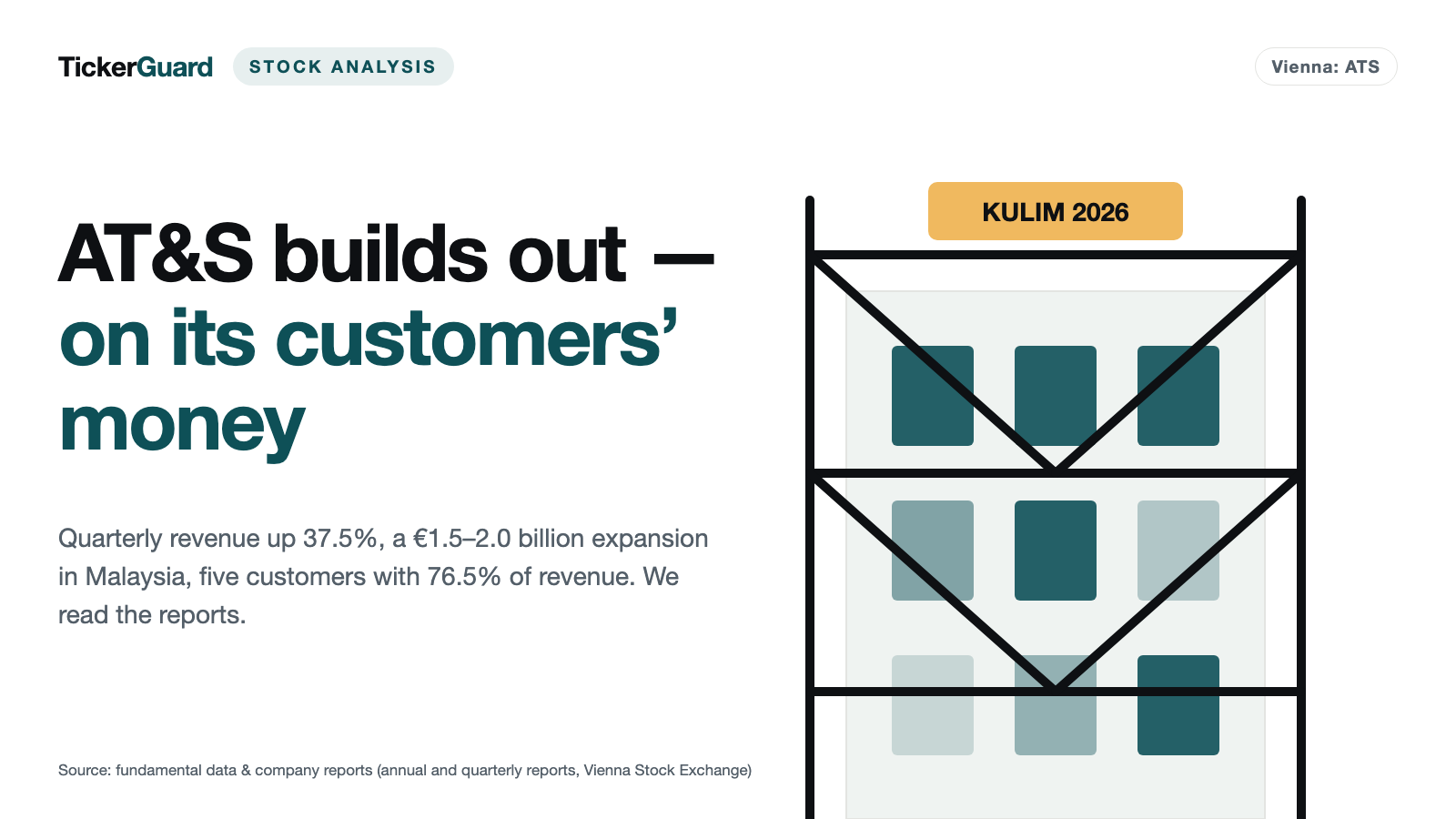
Austrian substrate maker AT&S grew revenue 37.5 percent to €548.7 million in the first quarter of fiscal 2026/27, and EBITDA more than doubled. According to the Vienna Stock Exchange, the stock is up roughly sixfold since January. Much of the expansion is paid for by customers: €907.2 million of prepayments sit on the balance sheet as a liability, and five customers bring in 76.5 percent of revenue. We read the annual and quarterly reports to work out who these factories really belong to.
 Thomas Mücke
Founder & Publisher
Thomas Mücke
Founder & Publisher
Chart
Interactive price chart (TradingView).
Note: pure fact-based analysis, not investment advice and not a solicitation to buy or sell. All figures without guarantee.
Our brains take a shortcut without asking permission: when a big name vouches for something, we stop doing the math. A product a global giant buys must be good. A supplier a chip heavyweight advances money to must be safe. Psychologists call it the halo effect — the glow of a famous name rubs off on everything standing next to it, including the numbers we then stop checking.
At AT&S the halo is unusually bright. The Austrian maker of circuit boards and chip substrates, based in Leoben in the province of Styria, names AMD as a customer in its regulatory announcements; in September 2026 it named Marvell Technology as the second partner in its Malaysian expansion, and the customers are helping to pay for that expansion. The market has rewarded the story with a rocket ride: according to the Vienna Stock Exchange, the stock stood 505.6 percent above its level at the start of the year on September 24, 2026. So let's do what the halo does not want us to do — read the reports before we get dazzled. The tension running through this analysis is simple: the customers are paying for the new factories, and that is exactly why AT&S depends on this handful of customers more than the revenue figure alone suggests.
What AT&S actually does — the base plate under the AI chip
AT&S Austria Technologie & Systemtechnik AG, founded in 1987 and headquartered in Leoben, makes two things. The first is highly complex printed circuit boards — the green boards that wire up the components inside smartphones, cars, industrial equipment and medical devices. That is the Electronics Solutions segment. The second, and the one the market cares about, is IC substrates, made in the Microelectronics segment. Think of it this way: a modern processor is a tiny piece of silicon with thousands of hair-thin connections. You cannot solder it straight onto a regular board; you need an adapter plate that fans the chip's fine connections out to the board's coarser grid. That adapter is the substrate. The bigger and more powerful the chip, the larger, thicker and harder to make the substrate becomes — and the biggest chips in the world right now are artificial-intelligence accelerators.
The mix has shifted accordingly. In the first quarter of fiscal 2026/27 (April through June 2026), Microelectronics delivered €343.7 million of external revenue, up 89.9 percent, while Electronics Solutions brought in €205.0 million, down 5.9 percent. Substrates therefore account for roughly 63 percent of group revenue of €548.7 million. Production sites are in Leoben and Fehring (Austria), Shanghai and Chongqing (China), Kulim (Malaysia) and Nanjangud (India); as of June 30, 2026, the group employed 14,939 people including contract staff. The plant in Ansan, South Korea, was sold in fiscal 2024/25.
One point matters for every number in this piece: AT&S's fiscal year ends on March 31. “2025/26” means April 2025 through March 2026; “Q1 2026/27” means April through June 2026. And AT&S does not report to the U.S. securities regulator, the SEC. The U.S. symbol ASAAF is merely a secondary over-the-counter quote with no reporting obligation; the stock's home is the Vienna Stock Exchange under the ticker ATS, where it is a member of the ATX index. All evidence in this analysis therefore comes from the company's own reports — the audited Annual Financial Report 2025/26, the interim report for the first quarter of 2026/27 and the announcements required under EU market-abuse rules.
Company history for investors
-
2022
€350 million hybrid bond
Placed in January 2022 at 5.0 percent and booked as equity. Callable after five years — otherwise the spread jumps to 9.942 percentage points over the swap rate.
-
2023
Highest capex in the ten-year overview
€996.2M of net capex and minus €519.8M of operating free cash flow in 2022/23. For shareholders, the start of three years with a combined €1.21B shortfall.
-
2025
Ansan plant sold
Selling the Korean subsidiary brought €324.8M of income in 2024/25 and with it a positive annual result — without it, the EBITDA margin was 17.7 percent.
-
2026
June: Kulim expansion and guidance raise
A €1.5–2.0B expansion with AMD and another customer, guidance raised to 45–55 percent growth. The customer commitments were still subject to final signing.
-
2026
June: €400 million hybrid convertible bond
2.5 percent coupon, convertible at €254.2514 per share. Full conversion would add a little over 4 percent new shares; hybrid capital rose to €744.7M.
-
2026
August: strongest quarter in recent reports
Q1 2026/27 with €548.7M of revenue and a 30.1 percent EBITDA margin, guidance confirmed. For shareholders, the first evidence of a turnaround — after a loss-making 2025/26.
-
2026
September: Marvell as second Kulim customer
AT&S announces a long-term agreement with Marvell Technology. One of the two Kulim partners is now publicly confirmed; customer concentration broadens but stays high.
How the stock landed on our desk
Through the forum ranking of the German finance portal wallstreet-online — the list of stocks German retail investors discuss most — as of September 24, 2026, where it appeared under its U.S. symbol ASAAF. A list like that measures attention, not quality. The reason for the attention is easy to find, though. On March 31, 2026, the last day of the fiscal year, the stock closed at €51.70. On June 30, 2026, two companies that, according to the regulatory filings, are closely associated with supervisory board members sold shares at €200 apiece. On September 24, 2026, the stock closed in Vienna at €195.00 — close to a fourfold gain in six months.
Three announcements in quick succession set it off. On May 20, 2026, AT&S announced an expansion in Chongqing, financed through long-term customer agreements. On June 13, 2026, it followed with a €1.5 billion to €2.0 billion expansion in Kulim, Malaysia, together with a dramatically raised outlook. And on September 22, 2026, it announced an expanded collaboration with Marvell Technology. We looked at the same wave — the build-out of data centers for artificial intelligence — from the chip side in our Nvidia stock analysis. AT&S sits one step further down that chain, at the plate the chip sits on.
The numbers over the years — given their due
First, what is genuinely impressive: the first quarter of 2026/27. Revenue rose 37.5 percent to €548.7 million, or 39.7 percent at constant currency. EBITDA — earnings before interest, taxes, depreciation and amortization, roughly what the day-to-day business throws off before the machines are written down — rose from €70.6 million to €165.0 million, lifting the margin from 17.7 to 30.1 percent. Operating profit (EBIT) swung from minus €16.3 million to plus €73.4 million, which the company says already exceeds the figure for the entire previous fiscal year. Net profit came to €40.8 million, or €0.93 per share, versus a loss of €1.55 per share a year earlier. In Microelectronics alone, the EBITDA margin climbed to 42.3 percent.
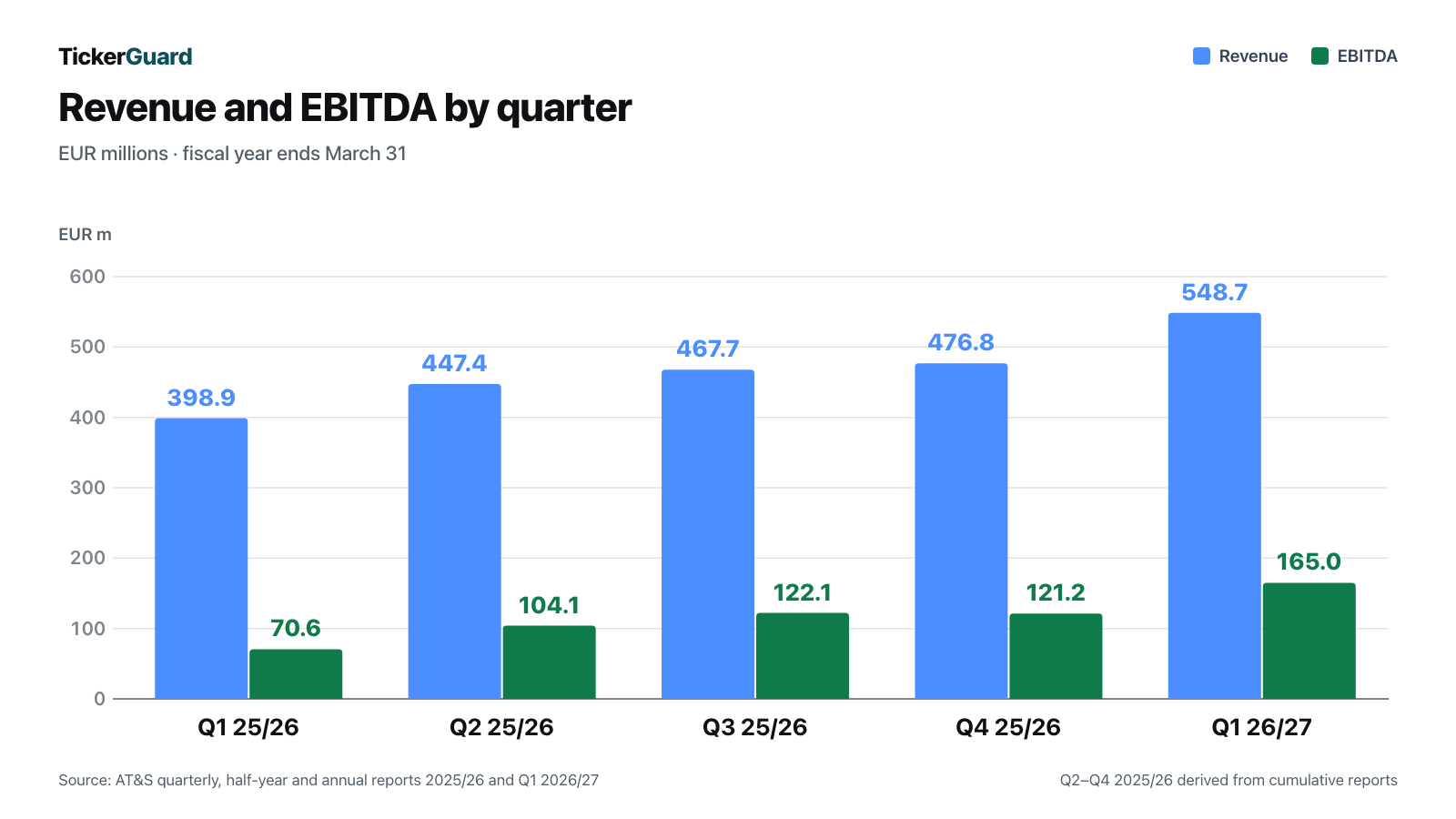
Now the multi-year view that puts the quarter in context. Revenue was €1,791.3 million in fiscal 2022/23, fell to €1,549.8 million in 2023/24 and only returned to that level in 2025/26 at €1,790.8 million — three years of going sideways. Net income: €136.6 million (2022/23), minus €36.7 million (2023/24), plus €89.7 million (2024/25) and minus €25.6 million (2025/26). The profit in 2024/25 was not earning power: that year AT&S booked €324.8 million from selling its Ansan plant. Excluding the sale, the company puts the 2024/25 EBITDA margin at 17.7 percent instead of the reported 38.1 percent; on the same comparison it cites 23.9 percent for 2025/26 (reported: 23.3 percent). Earnings per share for 2025/26 were minus €1.11. There was no dividend for 2025/26 — the annual general meeting on July 9, 2026, decided not to pay one; the last dividend, €0.40 per share, was paid for fiscal 2022/23.
Rule of thumb: a strong quarter is the start of a turnaround, not proof of one. Q1 2026/27 is the best of the recent reports, but it is exactly one quarter. Management expects both growth and margin to keep rising in the second quarter and to reach the full-year guidance range — something we can check with the half-year results on November 5, 2026.
Uncomfortable truth No. 1: five customers, three quarters of revenue
AT&S does not sell to many customers; it sells to a few. The notes to the consolidated financial statements say so in a single sentence:
“76.5% of total revenue (previous year: 71.3%) is attributable to the five largest customers in terms of revenue, where the range is between 3% and 31% (previous year: 2% and 29%).”
— AT&S, Annual Financial Report 2025/26, notes, information by region, p. 29

Let's translate the range. The single largest customer accounted for up to 31 percent of revenue in fiscal 2025/26, or roughly €555 million. The top five together accounted for just over three quarters. And the concentration is rising, not falling — a year earlier it was 71.3 percent. The regional split tells the same story from another angle: customers headquartered in the Americas generated 81.2 percent of revenue in 2025/26, and in the first quarter of 2026/27 it was €457.2 million out of €548.7 million, or 83.3 percent. Buying AT&S essentially means buying the order books of a handful of U.S. semiconductor companies.
The company knows this and says so with remarkable candor in its risk report. Right after noting that relying on a few major customers creates vulnerability, it adds:
“Currently, the end market for AI infrastructure, the main growth driver, represents the potentially biggest risk.”
— AT&S, Annual Financial Report 2025/26, group management report, risk report, p. 219

That is the heart of the matter: at AT&S, the growth driver and the biggest risk are the same thing. As long as data-center operators keep investing, the concentration is an advantage — the plants run full and prices rise, as they visibly began to again in June 2026. If one of the big customers trims orders, qualifies a second supplier or delays a chip generation, it does not hit one leg among many; it hits up to a third of revenue. AMD, whose own numbers we went through in our AMD stock analysis, is therefore less a name on AT&S's customer list than part of its business model.
Uncomfortable truth No. 2: the customers pay for the factories — and that sits on the balance sheet as a debt
This is what makes AT&S unusual. Substrate plants are extremely expensive, and no manufacturer wants to carry that risk alone. So the big customers sign agreements in which they pay part of the investment up front and lock in capacity in return. In the notes these amounts are called contract liabilities:
“Current and non-current contract liabilities totaling € 885,892 thousand (previous year: € 911,096 thousand) include payments from bilateral agreements for the financing of new production facilities.”
— AT&S, Annual Financial Report 2025/26, notes, Note 16 “Contract liabilities”, p. 53

An everyday picture: a regular customer gives the baker money for a second oven and is promised the first loaves out of it. The money does not belong to the baker; he owes it back in bread — and if the bread does not come, in cash. That is how AT&S accounts for it. As of June 30, 2026, contract liabilities stood at €907.2 million (€733.2 million non-current, €174.0 million current). That is more than shareholders' equity excluding hybrid capital — more on that shortly. Because these prepayments contain a financing element, AT&S even accrues interest on them: €36.9 million in fiscal 2025/26. The Q1 presentation sketches the sequence: in 2026/27 mainly customer payments, in 2027/28 customer payments and sales, and in 2028/29 “mainly sales incl. first repayments.”
The next and biggest step is Kulim. And there, the financing was not fully negotiated, as the June 13, 2026, announcement itself says:
“As of now, the € 1.5 to 2.0 billion investments required for this are fully supported and financed by long-term customer commitments, which remain subject to final negotiation and execution.”
— AT&S, ad hoc announcement under Art. 17 MAR, June 13, 2026
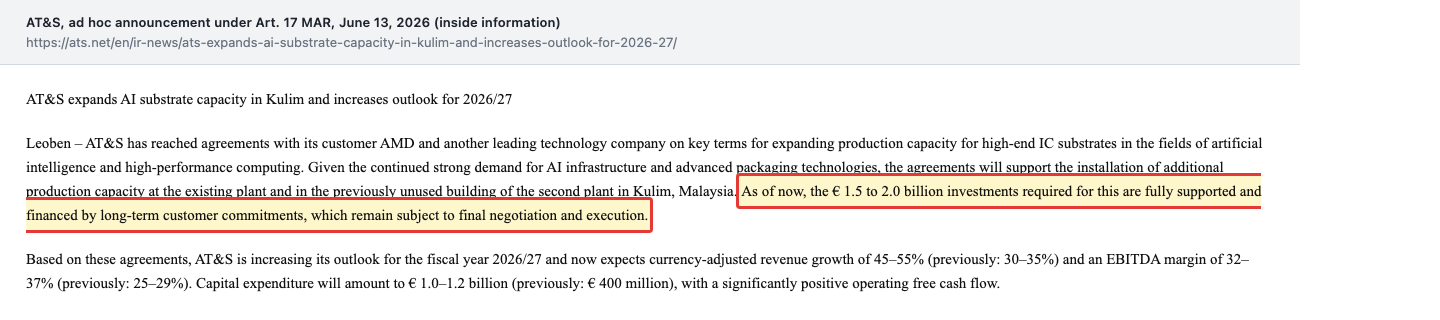
In other words, the June 13, 2026, guidance raise — revenue growth of 45 to 55 percent instead of 30 to 35 percent, an EBITDA margin of 32 to 37 percent instead of 25 to 29 percent — rested on agreements that were at the key-terms stage at the time. For one of the two partners there is now clarity: on September 22, 2026, AT&S announced a long-term agreement with Marvell Technology and identified Marvell as the additional customer in the Kulim expansion. We found no separate announcement of a signed AMD agreement in the company's releases through September 24, 2026. The first quarter also shows how much cash flow depends on customer money: operating cash flow fell to €39.9 million, and after net capex just €5.1 million of operating free cash flow remained — despite €165.0 million of EBITDA. The cash went into higher receivables (up €129.0 million) and inventories (up €54.1 million). The outlook expects positive operating free cash flow for the full year, “supported by the operating business and expected customer payments.”
Uncomfortable truth No. 3: ten years of investing, a €1.18 billion shortfall
For this question, the ten-year overview in the annual report is the most revealing document. It shows what building the substrate business has cost. Operating free cash flow — what is left of operating cash flow after net capital expenditure — was negative in six of ten fiscal years. In the three build-out years from 2022/23 to 2024/25, the combined shortfall was €1,211.1 million. Across all ten years from 2016/17 to 2025/26, operating free cash flow adds up to minus €1,181.9 million.
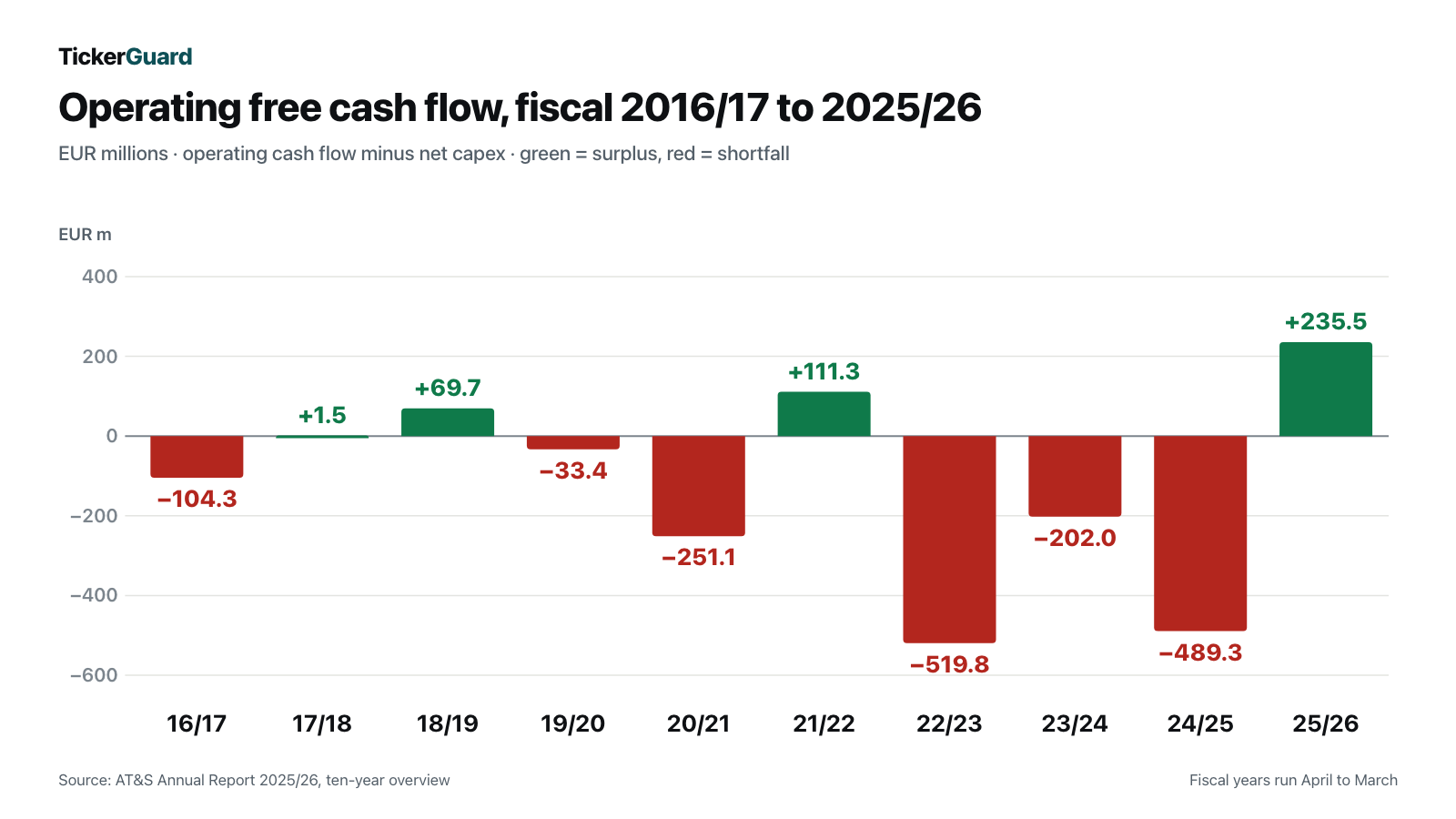
That gap was filled with debt and hybrid capital. Net debt rose from €211.6 million (March 2022) to €1,491.4 million (March 2025) and stood at €1,332.1 million in March 2026. Interest costs recently exceeded operating profit: in fiscal 2025/26, EBIT of €65.6 million faced interest expense on bank loans and bonds of €92.3 million — operating profit covered only a little over two thirds of the interest bill. The first quarter of 2026/27 turned that around: €73.4 million of EBIT against €25.6 million of gross interest expense. Net debt fell to €954.0 million as of June 30, 2026, and net debt to EBITDA dropped from 3.2 to 1.9, according to the presentation.
And the next investment wave is already here. For 2026/27, AT&S plans net capex of roughly €1.0 billion to €1.2 billion — after €178.3 million the year before, and at least as much as the €996.2 million of 2022/23, the highest figure in the ten-year overview. For Kulim alone, the presentation cites €1.5 billion to €2.0 billion through early fiscal 2028/29. The difference from 2022/23: this time the customers are supposed to pay most of it up front. Whether that really protects cash flow is precisely the question truth No. 2 leaves open.
Uncomfortable truth No. 4: almost half of equity is hybrid capital
As of June 30, 2026, AT&S reported equity of €1,520.4 million and an equity ratio of 29.0 percent. That includes €744.7 million of hybrid capital — 49 percent. Hybrid capital consists of bonds with no fixed maturity that count as equity under international accounting rules, because the company never has to repay them or pay interest unless it chooses to. Economically they still behave like debt: they carry interest, and the market expects them to be redeemed at the first call date.
There are two of them. The first, €350 million, was placed in January 2022 with a 5.0 percent coupon. According to Note 24, AT&S can call it after five years; if it does not, the coupon resets to the five-year swap rate plus 9.942 percentage points. The second, €400 million, came in June 2026 as a hybrid convertible bond with a 2.5 percent coupon, convertible at €254.2514 per share — 30 percent above the reference price of €195.578 on June 16, 2026. If the whole bond were converted, that would create roughly 1.57 million new shares, a little over 4 percent of the 38.85 million shares outstanding. Among the stated uses of proceeds was refinancing existing debt.
Strip out the hybrid capital and shareholders are left with €775.6 million of equity as of June 30, 2026 — less than the €907.2 million customers have on the balance sheet as prepayments. The Q1 presentation itself shows that excluding the 2022 hybrid bond, the equity ratio would be 23.9 percent and net debt €1,304 million. That is not a hidden number, but it is not the one in the “29.0 percent equity ratio” headline either.
One detail on ownership belongs here. According to the Annual Financial Report, the two largest shareholders are the Dörflinger-Privatstiftung with 18.13 percent and the Androsch Privatstiftung with 17.55 percent (March 31, 2026). On June 30, 2026, AIC Androsch International Management Consulting GmbH sold 277,346 shares and Dörflinger Management & Beteiligungs GmbH sold 290,000 shares, each at €200 off-exchange; according to the filings, both companies are closely associated with supervisory board members (Georg Riedl and Georg Hansis, respectively). Together that is 567,346 shares, or about 1.5 percent of the share capital, for roughly €113 million. That is not an exit — but it is a sale at the level where the stock still trades three months later.
What the stock costs
At the closing price of €195.00 on September 24, 2026, and 38.85 million shares, AT&S has a market value of roughly €7.58 billion. For comparison, the annual report put it at €2.01 billion on March 31, 2026. Adding net debt of €954.0 million (with hybrid capital counted as equity, as on the balance sheet) gives an enterprise value of roughly €8.5 billion.
Apply the company's own guidance for 2026/27 — revenue growth of 45 to 55 percent on the €1,790.8 million base, or roughly €2.6 billion to €2.8 billion, and an EBITDA margin of 32 to 37 percent — and you get EBITDA of roughly €0.83 billion to €1.03 billion. The enterprise value therefore equals about 8 to 10 times expected EBITDA; counting both hybrid bonds as debt, about 9 to 11 times. Note that the growth guidance is at constant currency, and a weaker U.S. dollar reduces revenue in euros. On 2025/26 revenue, the price-to-sales ratio is about 4.2; on guided revenue, about 2.7 to 2.9.
Two yardsticks show how much future is priced in. First, earnings: simply annualizing first-quarter EPS of €0.93 gives a price-to-earnings ratio of about 52 — for the fiscal year just ended there is none, because of the loss. Taking the last four reported quarters instead (roughly €1.37 per share: €0.44 from the second through fourth quarters of 2025/26 plus €0.93 from the first quarter of 2026/27), the P/E is a little over 140; that is also the basis for the “As of Today” data box above. Second, book value: measured against equity excluding hybrid capital of €775.6 million, the market pays almost 10 times book. Both are price arguments, not quality judgments — but they show that the share price already treats the guidance as largely delivered.
Opportunities and risks at a glance
What speaks for AT&S:
- The first quarter of 2026/27 shows the operating leverage of full plants: revenue up 37.5 percent, EBITDA up 134 percent, an EBITDA margin of 30.1 percent and 42.3 percent in Microelectronics.
- The expansion is tied to customers who commit long term and pay up front — with AMD and Marvell Technology, two named players in AI infrastructure.
- Prices are rising again: according to the presentation, June 2026 brought the first positive pricing effects, after the annual report had already described easing price pressure in the substrate market.
- Liquidity is comfortable: €1,184.1 million of cash and €91.0 million of unused credit lines as of June 30, 2026; net debt to EBITDA fell to 1.9, according to the presentation.
What speaks against AT&S:
- Five customers account for 76.5 percent of revenue, the largest for up to 31 percent; the company itself calls the AI infrastructure market its potentially biggest risk.
- €907.2 million of customer prepayments are a liability that has to be settled in product or cash; the Kulim commitments were still subject to final negotiation in June 2026.
- Ten years with a combined minus €1,181.9 million of operating free cash flow, and 2026/27 brings €1.0 billion to €1.2 billion of net capex — at least as much as the peak year of the ten-year overview.
- The 2022 hybrid bond reaches its first call date five years after issuance; if it stays outstanding, the spread jumps to 9.942 percentage points over the swap rate.
- The share price largely assumes the guidance: roughly 10 times book value excluding hybrid capital and roughly 52 times annualized quarterly earnings.
A human conclusion
Remember the halo from the beginning? At AT&S it is real. AMD and Marvell are not names you make up, and a quarter with a 30 percent EBITDA margin is no accident. But the halo has a back side that no photo shows: the same customers who supply the glow also hold the strings. They bring in three quarters of revenue, they have €907 million sitting on the balance sheet, and their chip generations decide whether the plants in Kulim run full or half empty. Management writes that into its own risk report.
None of this makes AT&S a bad company. It makes it a dependent one — and one whose turnaround, after three years of flat revenue and a loss-making year, is exactly one quarter old. The next test comes on November 5, 2026, with the half-year results: does revenue keep growing toward 45 to 55 percent, does the margin hold above 30 percent, and does the Kulim financing with AMD get signed? Anyone who sees only the big name until then has stopped doing the math. What you make of it is up to you. The decision is yours.
Sources
- AT&S — Interim Report First Quarter 2026/27 (published August 4, 2026; latest periodic report)
- AT&S — Conference call presentation Q1 2026/27 (August 4, 2026)
- AT&S — Annual Financial Report 2025/26 (IFRS consolidated financial statements, Deloitte Audit opinion dated May 20, 2026)
- AT&S — Annual Report 2025/26 (ten-year overview)
- AT&S — Half-Year Financial Report 2025/26 and third-quarter report 2025/26 (for the quarterly figures)
- Ad hoc announcement of June 13, 2026 (Kulim, guidance raise) and of May 20, 2026 (Chongqing)
- Releases on the hybrid convertible bond, June 16, 2026 (terms, conversion price)
- Corporate news of September 22, 2026 (Marvell Technology)
- Managers' transactions (sales of June 30, 2026) and results of the annual general meeting of July 9, 2026
- Vienna Stock Exchange — AT&S quote page (ISIN AT0000969985), closing price of September 24, 2026
- Source: fundamental data & company reports (annual and quarterly reports, Vienna Stock Exchange)
This analysis is a journalistic assessment based on publicly available company reports. It is not investment advice and not a solicitation to buy or sell securities. Stocks can lose value, up to a total loss. All figures carry the date of their source; share prices are dated snapshots. Positions held by the operator are disclosed daily; where one exists, it appears as a notice at the top of this analysis.
Our Bottom Line at a Glance
- Current business positive
- In Q1 2026/27, revenue rose 37.5 percent to €548.7 million, EBITDA from €70.6 million to €165.0 million (a 30.1 percent margin) and EBIT from minus €16.3 million to plus €73.4 million. The substrate segment reached a 42.3 percent EBITDA margin; according to the presentation, June 2026 brought the first positive pricing effects.
- Customer dependence negative
- The five largest customers accounted for 76.5 percent of 2025/26 revenue (prior year 71.3 percent), the largest for up to 31 percent. Customers headquartered in the Americas generated 83.3 percent in Q1 2026/27. The risk report calls the AI infrastructure market the potentially biggest risk.
- Funding the expansion neutral
- Customers have prepaid €907.2 million (June 30, 2026), carried as contract liabilities. Per the June 13, 2026, ad hoc announcement, the €1.5 billion to €2.0 billion Kulim investment was backed by customer commitments still subject to final negotiation and execution; AT&S announced Marvell on September 22, 2026.
- Cash-flow track record negative
- Operating free cash flow was negative in six of ten fiscal years and adds up to minus €1,181.9 million from 2016/17 through 2025/26. Q1 2026/27 left just €5.1 million despite €165.0 million of EBITDA; net capex of €1.0 billion to €1.2 billion is planned for 2026/27.
- Balance sheet and interest burden neutral
- €1,184.1 million of cash and net debt down to €954.0 million (June 30, 2026) stand against equity of which €744.7 million out of €1,520.4 million is hybrid capital. In fiscal 2025/26, interest expense on loans and bonds of €92.3 million exceeded EBIT of €65.6 million; in Q1 2026/27, EBIT covered interest almost three times.
AT&S is riding the AI data-center boom into an operational turnaround: revenue up 37.5 percent and a 30.1 percent EBITDA margin in Q1 2026/27, with guidance for 45 to 55 percent growth. It rests on very few customers, who bring in 76.5 percent of revenue and co-finance the expansion with €907.2 million of prepayments. After ten years with a combined minus €1.18 billion of operating free cash flow, up to €1.2 billion of capex is planned for 2026/27. The stock has risen roughly sixfold in 2026 and largely prices the guidance as delivered. Not investment advice.
What Our Rating Means
Open questions
The business works in principle, but one material question is open. As long as it stays open, our findings do not carry a quality verdict.
Yellow here reflects an open operating question, not a threat to the company's substance. Liquidity is good as of June 30, 2026: €1,184.1 million of cash, €91.0 million of unused credit lines, net debt down to €954.0 million and no going-concern warning in the audited accounts. AT&S did brush against a red-flag criterion in fiscal 2025/26, though: interest expense on loans and bonds of €92.3 million exceeded EBIT of €65.6 million, and the year ended with a €25.6 million loss. Q1 2026/27 reversed that with €73.4 million of EBIT against €25.6 million of interest expense — but only for one quarter. The open question is whether the turnaround holds, and it hinges on something AT&S does not control: five customers with 76.5 percent of revenue, €907.2 million of customer prepayments on the balance sheet and a €1.5 billion to €2.0 billion Kulim expansion whose financing was still being finalized in June 2026. On top of that, half of equity is hybrid capital. The price of €195.00 (September 24, 2026) equals roughly 10 times equity excluding hybrid capital — a price argument that does not set the traffic-light color, but it shows how much success is already priced in. The next checkpoint is the half-year report on November 5, 2026. The decision is yours.
A journalistic assessment by our editorial team at the time of the deep dive, based on public sources — not investment advice and not a solicitation to buy or sell. Your personal circumstances (investment goals, risk capacity, taxes) cannot be taken into account. What our levels mean, how verdicts are formed, and what conflicts of interest exist →
Worth Noting
- The hook for this analysis is the forum ranking of wallstreet-online (the stocks German retail investors discuss most) as of September 24, 2026, where the stock appeared under its U.S. symbol ASAAF. The thread running through it is the halo effect: big customer names like AMD and Marvell tempt investors to stop checking how dependent the company is on exactly those customers.
- On the evidence: AT&S is not an SEC filer; the U.S. symbol ASAAF is an over-the-counter secondary quote without reporting obligations (no SEC CIK, checked September 24, 2026). All company figures come from the audited Annual Financial Report 2025/26, the Annual Report 2025/26, the interim report for Q1 2026/27 and announcements under Art. 17 and Art. 19 MAR on ats.net. The fiscal year runs April 1 to March 31.
- Our own calculations: quarterly figures for Q2 through Q4 2025/26 (differences of cumulative reports), the ten-year sum of operating free cash flow (minus €1,181.9 million), equity excluding hybrid capital (€775.6 million), enterprise value (market value plus net debt of €954.0 million) and the 2026/27 EBITDA range (€0.83 billion to €1.03 billion from guided growth and margin on the €1,790.8 million base, at constant currency).
- Price and market value: closing price of €195.00 on the Vienna Stock Exchange on September 24, 2026 (Vienna Stock Exchange quote page, showing +505.59 percent year to date). Market-value cross-check: 38,850,000 shares times €195.00 equals €7,575.75 million; fundamental data as of August 11, 2026, showed the same share count at €143.60.
- Do not confuse: AT&S (Leoben, Austria) has nothing to do with ATS Corporation (Canada, automation), which also trades as ATS in Toronto. The ticker ATS.VI used here denotes the Vienna listing.
The full analysis as a PDF for later
We will send you this analysis as a PDF — to print, file away, and read at your own pace.
Frequently Asked Questions
AT&S Austria Technologie & Systemtechnik AG, based in Leoben, Austria, makes high-end printed circuit boards and IC substrates. Substrates are the carrier plates that route a processor's fine connections onto a circuit board — in high demand for AI accelerators. In the first quarter of fiscal 2026/27, €343.7 million of €548.7 million in revenue came from this substrate business.
Strongly. From April to June 2026, revenue rose 37.5 percent to €548.7 million and EBITDA rose 134 percent to €165.0 million, a 30.1 percent margin. EBIT swung from minus €16.3 million to plus €73.4 million, and EPS from minus €1.55 to plus €0.93. Operating free cash flow was only €5.1 million because of higher receivables and inventories.
AT&S uses a fiscal year running from April 1 to March 31. Fiscal 2025/26 covers April 2025 through March 2026, and the first quarter of 2026/27 covers April through June 2026. According to its financial calendar, AT&S reports half-year results for 2026/27 on November 5, 2026, and full-year results on June 10, 2027.
Very. According to the Annual Financial Report 2025/26, the five largest customers accounted for 76.5 percent of revenue, the largest for up to 31 percent. Customers headquartered in the Americas generated 81.2 percent of revenue in 2025/26 and 83.3 percent in Q1 2026/27. The risk report itself calls the AI infrastructure end market the potentially biggest risk.
They are customer prepayments under agreements that finance new plants. The money does not belong to AT&S; it is offset against future deliveries or repaid, and AT&S even accrues interest on it (€36.9 million in fiscal 2025/26). The balance was €907.2 million on June 30, 2026, and €885.9 million on March 31, 2026.
In June 2026 AT&S issued a €400 million deeply subordinated perpetual bond with a 2.5 percent coupon. It counts as equity and is convertible into shares for a limited time at an initial €254.2514 per share. Full conversion would mean roughly 1.57 million new shares, a little over 4 percent of the 38.85 million shares outstanding.
Not currently. The annual general meeting on July 9, 2026, decided not to pay a dividend for fiscal 2025/26, a year that ended with a loss of €25.6 million. The last dividend was €0.40 per share for fiscal 2022/23; none has been paid since.
Found an error?
Did you spot a factual error, an outdated number, or a typo in this deep dive? Let us know briefly — your report goes straight to the editorial team.