Plug Power: The Margin Is Turning, the Cash Is Not — Who Pays for the Bridge to Breakeven?
In the second quarter of 2026 Plug Power's products cost roughly as much to make as they brought in — a year earlier they cost almost a third more. In the same quarter operations used $94 million of cash, against $162 million of unrestricted cash on hand. The $1.66 billion federal loan guarantee has been terminated, and authorized shares were doubled to three billion. We did the math on how far the cash reaches — and on who ends up paying for the stretch to breakeven.
 Thomas Mücke
Founder & Publisher
Thomas Mücke
Founder & Publisher
As of Today
As of: September 23, 2026
- Closing price
- 2.00 $ -3.30%
- Market Capitalisation
- 2.8 $B
- Growth Score
- 2/10
- AAQS
- 3/10
This analysis has a cut-off date. The Stock Guard tells you when something material changes in the numbers. Reserve your free spot
Chart
Interactive price chart (TradingView).
52-week range: 1.80 $ to 4.10 $ · Last price: 2.00 $ (As of: September 23, 2026)
Note: pure fact-based analysis, not investment advice and not a solicitation to buy or sell. All figures without guarantee.
There is a trap that snaps shut with particular reliability on beaten-down stocks: the anchoring trap. You remember an old, high share price, you look at today's low one — and your brain does the math on its own: surely there is plenty of room to the upside. Plug Power is the textbook case. Over five years the stock has lost roughly 93 percent (data as of September 24, 2026). That feels like a bargain.
The catch with the anchor is that it compares prices, not slices. If a company more than quadruples its share count since the end of 2019 — and makes it roughly 2.4 times as large over the last five years alone — a low share price is not a discount — often it is simply a smaller slice of the same pie. So the deal for this piece is: we ignore the old share price and look at what the company's filings with the U.S. securities regulator, the SEC, say today — margin, cash, share count.
What Plug Power actually does — forklifts, electrolyzers, hydrogen
Plug Power has three legs, and it pays to keep them apart, because they work in completely different ways.
First: fuel cells for forklifts. This is the oldest and most solid business. Instead of a lead-acid battery, the truck carries a fuel cell called GenDrive that turns hydrogen into electricity. The advantage for large warehouses: refueling takes minutes, and battery swaps and charging rooms disappear. According to the earnings release of August 10, 2026, Plug has deployed more than 76,000 GenDrive systems at more than 280 sites, including 1,666 units in the second quarter of 2026 alone, up from 739 a year earlier. Service contracts and hydrogen supply come with them — money that comes back every month.
Second: electrolyzers. An electrolyzer is essentially a giant kettle that uses electricity to split water into hydrogen and oxygen; if the power comes from wind or solar, the result is called “green hydrogen.” Plug sells these systems in 5- and 10-megawatt blocks under the GenEco name. It is a project business: few, large orders, long lead times, and revenue is recognized when equipment is delivered and accepted. That is why electrolyzer revenue fell by $31.7 million in the second quarter of 2026 versus the prior-year quarter — “due to timing of deployments,” according to the quarterly report (10-Q).
Third: its own hydrogen. Plug produces liquid hydrogen at plants in Georgia, Tennessee and Louisiana, about 40 tons a day combined. That is the fuel for its own forklift customers — and so far the business that loses the most money: in the second quarter of 2026 every dollar of fuel revenue cost about $1.48 to produce and deliver.
All in, that added up to $709.9 million of revenue in 2025. According to the annual report (10-K), the largest customer was Walmart at 24.2 percent of revenue; a second customer not named there accounted for 14.3 percent. At the end of 2025, Plug had 2,582 employees, 238 of them temporary.
That names the central tension of this analysis, and it runs through every chapter: the business is getting measurably better right now — but the cash is shrinking faster than the improvement takes hold. Who pays for the stretch to breakeven decides what every single share is worth.
Company history for investors
-
2025
$1.66 billion federal loan guarantee (January 16)
The Department of Energy commits to a loan guarantee for up to six hydrogen plants. For shareholders, the prospect of cheap money instead of new shares — it was never drawn.
-
2025
Equity raise with warrants (March 20)
46.5 million shares, 138.9 million pre-funded warrants and 185.4 million warrants at $2.00: one of the rounds in which the share count more than doubled within two years.
-
2025
New warrants at $7.75 (October 8)
The holder exercises the $2.00 warrants, Plug receives $354.7 million net and issues 185.4 million new warrants at $7.75. Cash now, dilution if the share price rises sharply.
-
2025
$431.25 million convertible notes (November 21)
6.75 percent interest, conversion at about $3.00 per share, maturity in 2033. In the same month Plug suspends the projects planned under the federal loan guarantee.
-
2026
Authorized shares doubled (February 12)
Shareholders allow up to 3.0 billion shares instead of 1.5 billion. That creates room for warrants, conversions and equity sale programs.
-
2026
Gross profit near zero, guarantee terminated (August)
Second-quarter gross profit near zero after minus $53.5 million a year earlier; on August 4 the department terminates the guarantee, on August 7 $40.0 million arrives from Texas.
How this stock landed on our desk
Plug Power reached us through the forum rankings of wallstreet-online, Germany's large retail investor portal: in September 2026 the stock was among the names German investors were discussing most. Discussion is not a valuation — but it is a good reason to check what sits behind the noise.
Our in-house stock scanner was more explicit than any forum thread. As of September 24, 2026, Plug Power appeared in eight scanner strategies, including three warning scanners. Two of them target the cash position: the Insolvency Radar and the Going Concern (Distress Proxy) scanner. Both measure essentially the same thing: how long the cash on hand lasts at the current burn rate. A hit there is not a verdict, but it is a question that has to be answered before anyone talks about hydrogen.
If you want to retrace it yourself: open the scanner overview, go to the risk section, click the scanner and look for the ticker PLUG in the results. Scanners marked in red are warning signals — showing up there is no seal of approval.
The numbers over the years — given their due
Let us start with what is genuinely impressive, because there is something. In the second quarter of 2026 Plug Power got its costs under noticeably better control. Revenue came to $178.3 million, versus $174.0 million a year earlier. Gross profit — revenue minus direct costs — was minus $1.7 million. A year earlier it was minus $53.5 million. Put differently: a year ago each dollar of sales cost about $1.31 to produce; now it costs about a dollar.
Individual lines show movement, too. Service revenue rose 82 percent to $29.8 million at a 27 percent gross margin. For its own hydrogen, gross margin improved from about minus 91 percent to about minus 48 percent, according to the company. And total operating expenses — R&D, SG&A, restructuring and impairments — fell from $123.5 million to $62.4 million per quarter.
Two things belong in the picture, though, because they help shape the pretty number. Gross profit includes a $15.7 million benefit from releasing reserves for loss-making service contracts. And SG&A fell as sharply as it did partly because $39.7 million of recoveries on previously impaired assets were booked against it — $37.0 million of that from settling a contract dispute. Those are real payments, but not ones that recur every quarter.
The zero is not entirely new, though, and honesty requires saying so: the fourth quarter of 2025 already closed with gross profit of plus $5.5 million by calculation (the full-year figure from the annual report minus the first three quarters), before the first quarter of 2026 slipped back to minus $21.6 million. The direction is right; a stable line it is not yet. The view over five full years shows why even that direction stands out:
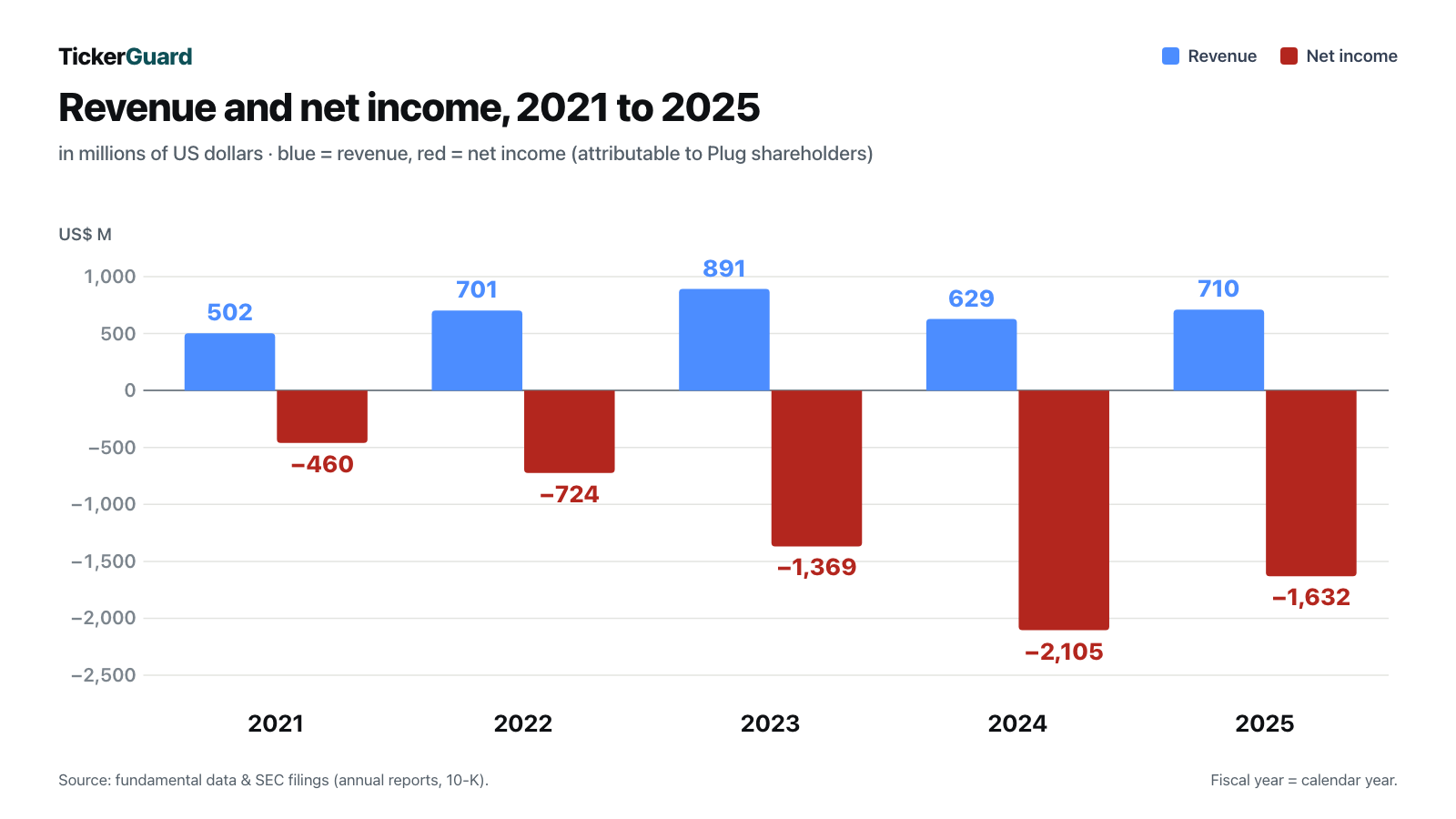
Revenue did not explode over that stretch; it swung: $502 million in 2021, a peak of $891 million in 2023, a drop to $629 million in 2024, then $710 million in 2025. The losses, on the other hand, were huge every year. Part of that is impairments and fair-value effects that cost no cash. But cash left the building every year as well: operations used $358 million in 2021, $829 million in 2022, $1,107 million in 2023, $729 million in 2024 and $536 million in 2025.
On August 10, the company raised its 2026 guidance: revenue is expected to grow 15 to 16 percent, to roughly $816 million to $823 million. The first half brought in $341.8 million, so the second half would need to deliver about $475 million to $482 million — well above the first. The company points to the usual second-half weighting of its business and to its backlog. It also targets positive EBITDAS — earnings before interest, taxes, depreciation, amortization and stock-based compensation — in the fourth quarter of 2026, a metric calculated on the company's own definition and not breakeven in the usual sense.
What the filings say — the uncomfortable truths
Uncomfortable truth no. 1: at the current pace, unrestricted cash lasts less than two quarters
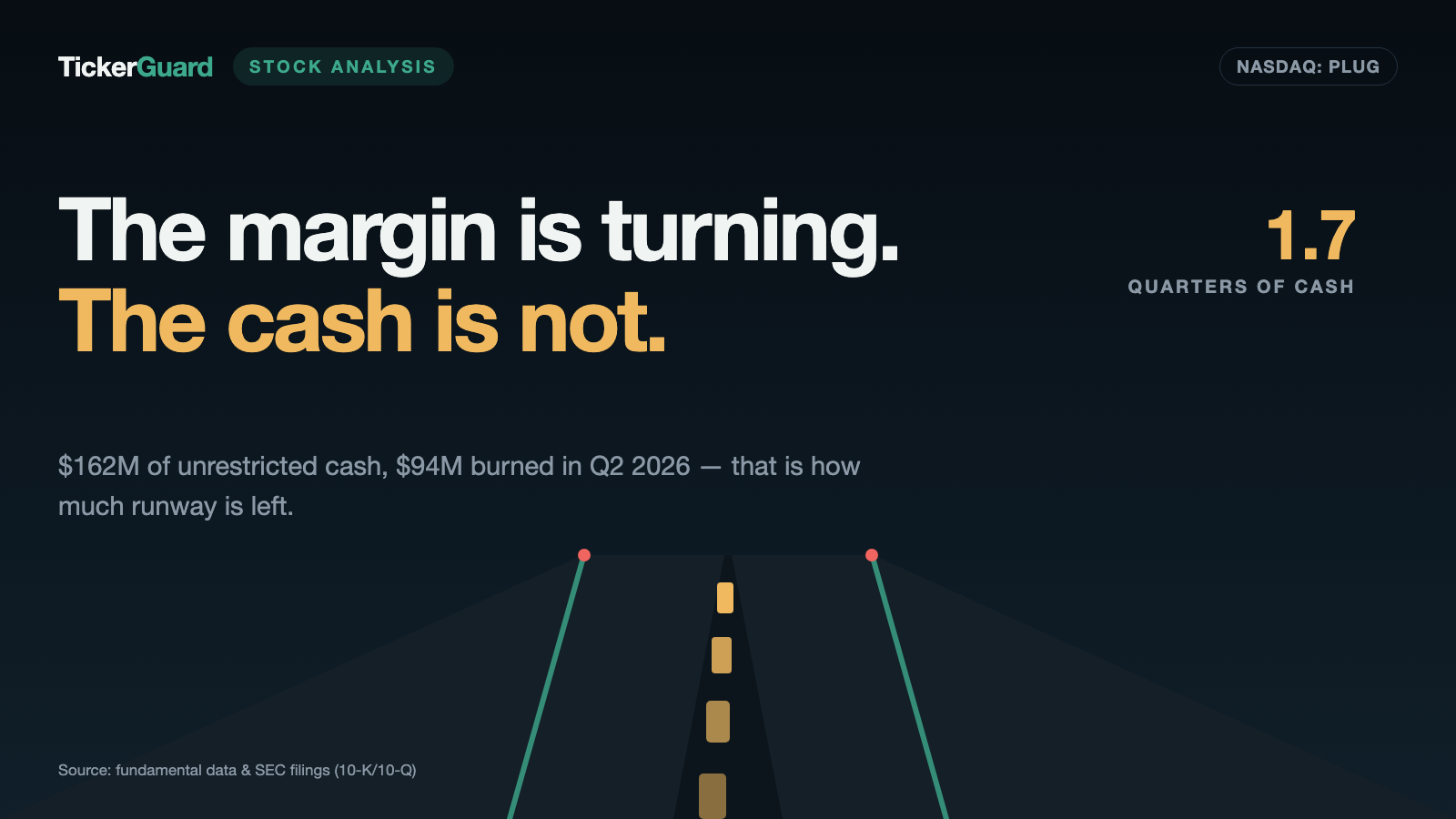
As of June 30, 2026 Plug Power had $161.9 million of unrestricted cash. Six months earlier it had $368.5 million. In the first half of 2026 operations used $244.1 million — $150.0 million in the first quarter and $94.1 million in the second. That looks like a clear improvement, but according to the quarterly report the second quarter includes a one-time $50.0 million payment from the resolution of a contract dispute with a customer. Without it, cash used would have been about $144 million, barely less than in the first quarter. At the reported second-quarter pace, unrestricted cash covers roughly 1.7 quarters; at the adjusted pace, just over one.
Plug does have more money than that figure shows. Another $509.6 million sits on the balance sheet as restricted cash. According to the annual report it “consists primarily of cash that serves as support for leasing arrangements” — Plug sold many of its customer installations to financial institutions and leased them back, and had to post cash for that. It is released over time, but not on demand. After quarter-end, about $47 million also came in from released escrow funds and the sale of power assets in Texas.
So let us be deliberately generous: unrestricted cash ($161.9 million) plus the roughly $47 million received after quarter-end plus the $155.5 million of restricted cash classified as current — about $364 million in total. At the adjusted burn of about $144 million per quarter, that lasts roughly two and a half quarters; with a completed sale of the New York site ($142.0 million), roughly three and a half. It only gets past four quarters if cash burn stays at the second-quarter level that the one-time payment pushed down and the sale goes through.
How the company itself secures the next twelve months is spelled out in the notes to the quarterly report — and this is the most important passage in the entire document:
“The Company believes that its working capital, cash position and restricted cash to be released over the next 12 months, and amortization requirements of the Company’s finance obligations, together with other key assumptions, support the Company’s conclusion that it has sufficient capital to fund its ongoing operations for a period of at least 12 months subsequent to the issuance of the accompanying unaudited interim condensed consolidated financial statements. Key assumptions are based on factors such as forecasted sales and costs, the Company’s right to direct B. Riley and Yorkville to purchase shares from the Company under the ‘at-the-market’ equity offering program, and the Company’s right to direct Yorkville to purchase shares from the Company under the SEPA.”
— Plug Power Inc., SEC quarterly report 10-Q for the quarter ended June 30, 2026, Note 1 “Liquidity and Capital Resources”

In plain English: there is no going-concern warning because Plug may sell new shares at any time. The at-the-market program covers up to $1.0 billion, of which $944.1 million remained available as of June 30, 2026, through August 15, 2027. The standby equity purchase agreement with Yorkville adds up to another $1.0 billion, up to $10 million per trading day, through February 10, 2027. In the first half of 2026 Plug sold not a single share under either program. That is the good news. The bridge is standing ready all the same — and if it is used, today's shareholders pay the toll with their ownership stake.
Uncomfortable truth no. 2: the $1.66 billion federal loan guarantee is history
In January 2025 Plug announced a commitment on which many shareholders pinned their hopes: a loan guarantee from the U.S. Department of Energy (DOE) of up to $1.66 billion for as many as six green hydrogen plants. In November 2025 Plug itself suspended the projects. On August 4, 2026 the department drew the line:
“On August 4, 2026, the Company and the Borrower Parties received a notification letter […] from the DOE exercising its right under Section 2.02(c) of the Loan Guarantee Agreement to terminate that agreement because the Initial First Advance had not occurred by the Initial First Advance Longstop Date […], consistent with the Company's previously disclosed decision, announced in November 2025, to suspend activities related to the projects that were to be financed under the Loan Guarantee Agreement.”
— Plug Power Inc., SEC quarterly report 10-Q for the quarter ended June 30, 2026, Part II Item 5
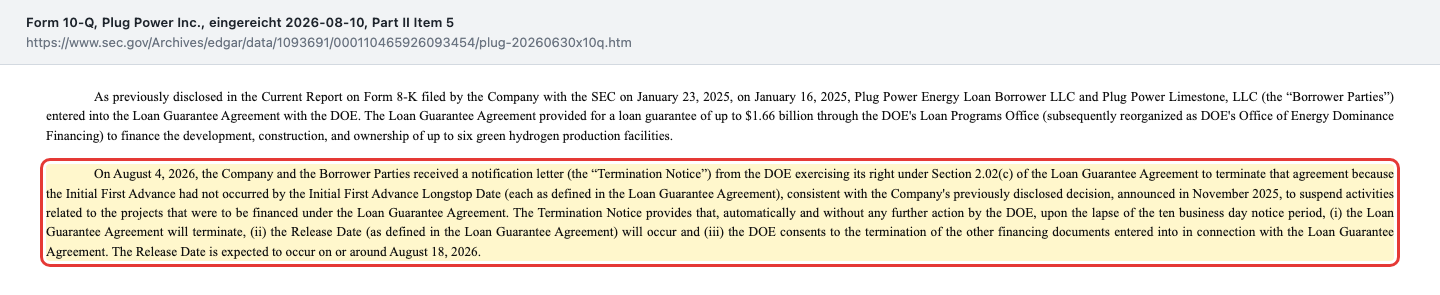
The immediate damage is small, and the company says so plainly: nothing was ever drawn, so nothing has to be repaid.
“No amounts were advanced or drawn under the Loan Guarantee Agreement.”
— Plug Power Inc., SEC quarterly report 10-Q for the quarter ended June 30, 2026, Part II Item 5
The strategic damage is larger. With the guarantee gone, so is the prospect of cheap federal money for expanding Plug's own hydrogen production. The sites earmarked for it are now being sold — to a data center developer. The New York site alone carries a $142.0 million price in the contract, with an outside closing date of March 31, 2027. The hydrogen vision is turning into a real estate sale meant to refill the till. That is sensible. But it is the opposite of the story told in 2025. How another fuel cell pioneer handles the same basic question is covered in our analysis of the Canadian manufacturer Ballard Power.
Uncomfortable truth no. 3: the share count has more than quadrupled since 2019 — and the reserve is enormous
This brings us back to the anchor from the opening. Anyone looking at the old share price overlooks how many shares exist today.
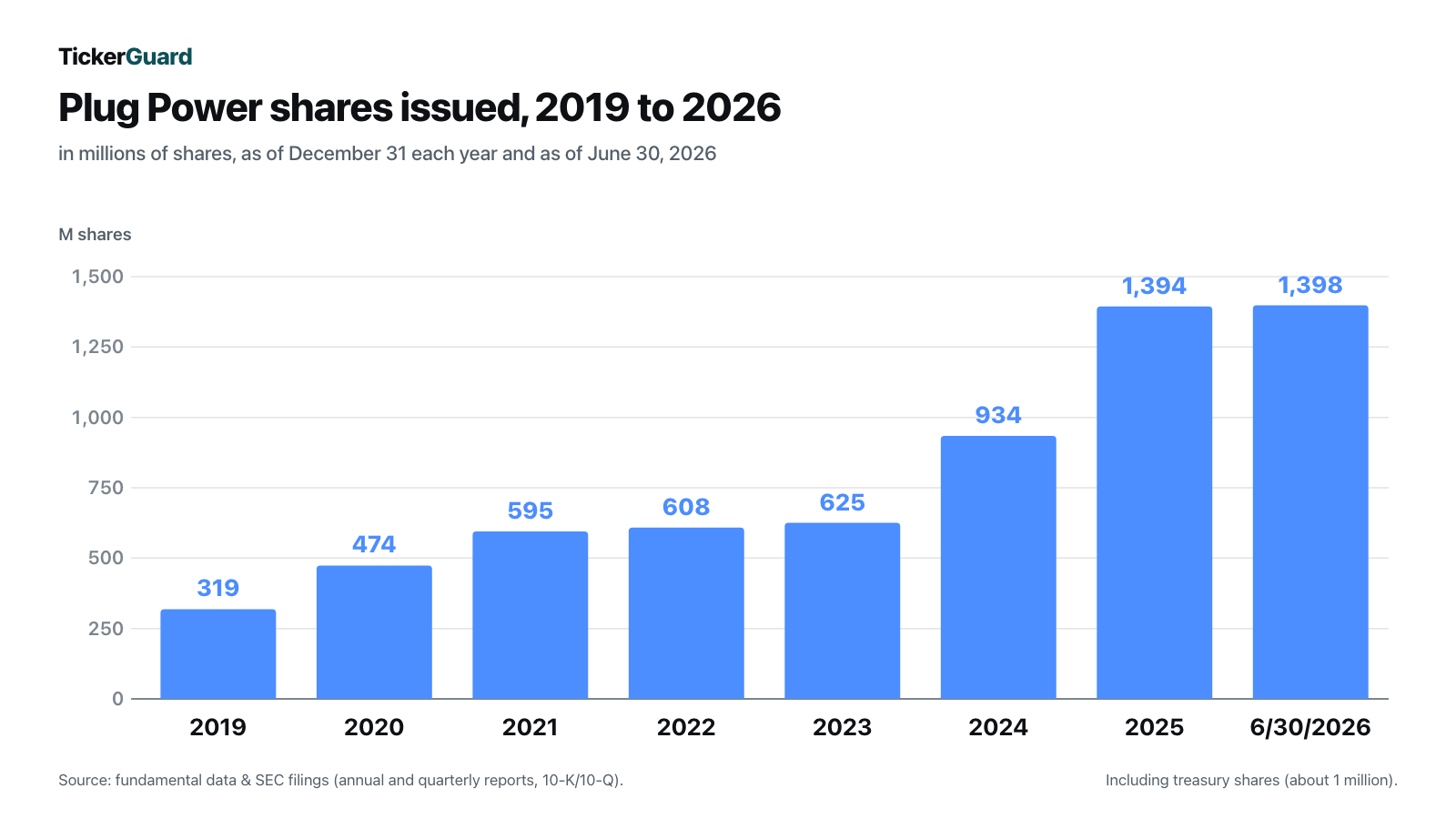
At the end of 2019, 318.6 million shares had been issued; as of June 30, 2026 the figure is 1,397.9 million (including about 1 million treasury shares that Plug holds itself). That is 4.4 times as many. Anyone who owned a share in 2019 now owns less than a quarter of the stake in the company they had back then — without selling a single share. That is dilution: your slice of the pie shrinks because new guests keep sitting down at the table.
And the table is not full yet. The quarterly report also lists the shares that have already been promised by contract:
“As of June 30, 2026 and 2025, the Company had potentially dilutive securities outstanding, consisting of stock options, restricted stock units, warrants and other equity instruments, representing shares of common stock totaling 440,501,973 and 340,788,077, respectively, on an as-converted basis.”
— Plug Power Inc., SEC quarterly report 10-Q for the quarter ended June 30, 2026, Note 15 “Earnings Per Share”

440.5 million is roughly 32 percent of the 1,397.2 million shares outstanding on August 6, 2026. The biggest pieces are known: 185.4 million warrants with a $7.75 exercise price (exercisable since February 28, 2026, expiring March 20, 2028). They are the price of a swap in October 2025: an investor exercised old warrants at $2.00 in return for an inducement, Plug received net proceeds of $354.7 million according to the annual report — and issued the same number of new warrants as an inducement, booked as a $196.5 million charge. Then there are $431.25 million of convertible notes carrying 6.75 percent interest, convertible at about $3.00 per share into up to 143.75 million shares. Both only dilute if the share price rises substantially, though — at the $2.00 close of September 23, 2026, both are out of the money.
To make room for all of it, shareholders doubled the authorized share count on February 12, 2026:
“[…] the Company’s stockholders approved an amendment […] to increase the number of authorized shares of the Company’s common stock from 1,500,000,000 shares to 3,000,000,000 shares.”
— Plug Power Inc., SEC current report 8-K of February 13, 2026, Item 5.03

Add up what has been issued (1,397.2 million) and what has already been promised (440.5 million), and about 1.16 billion shares of headroom remain under the new ceiling — enough for any equity program the cash position may call for. There was one piece of good news, too: at the end of December 2025, under a new license agreement, none other than its largest customer, Walmart, gave up its warrant from 2017, eliminating up to 42.2 million potential new shares.
Uncomfortable truth no. 4: the bottom-line loss is more than twice the operating loss
In the second quarter of 2026 the operating loss was $64.1 million. At the bottom line, however, the net loss attributable to Plug shareholders was $188.2 million. Most of the difference sits in two fair-value items: $74.2 million because the convertible notes became more valuable, and $29.3 million because the warrants did. On top came $16.9 million of interest expense.
The paradox: these fair-value losses arise when the share price goes up. The higher the price, the more the lenders' conversion and purchase rights are worth — and the larger Plug's book loss. That costs no cash at first. But it shows how much of any potential share-price gain has already been promised to others. The convertible notes sit on the balance sheet at $578.0 million even though only $431.25 million was borrowed; the warrants at $136.3 million.
Interest coverage in the usual sense — operating income divided by interest — cannot be meaningfully calculated with an operating loss; it is below zero. Interest is currently being paid out of the company's substance.
Valuation — what roughly $2.8 billion of market value prices in
First, the basis for the math: 1,397,195,278 shares as of August 6, 2026 according to the cover page of the quarterly report, times the $2.00 close of September 23, 2026, equals roughly $2.8 billion of market value. As a cross-check, an insider filing (Form 4) documents a sale at $2.1415 on September 18, 2026; on that basis the figure would be about $3.0 billion. The two are close.
- Price-to-sales of about 3.8. Calculated on trailing twelve-month revenue through June 30, 2026 of about $744 million. For a company whose gross profit is hovering around zero, that is a high valuation — the market is paying for hope in future margins.
- Price-to-book of about 4.8 on $581.8 million of equity attributable to Plug shareholders as of June 30, 2026. Equity is positive but shrinking fast: at the end of 2025 it was still $978.1 million. The accumulated deficit since inception stands at $8.66 billion.
- No price-to-earnings ratio. Without earnings there is none. The first half of 2026 brought a $433.5 million loss.
The professionals' view: according to fundamental data (as of September 24, 2026), 20 analysts cover the stock; the majority of 12 rate it hold, 5 strong buy and 3 strong sell. The average price target is $3.55, and expected 2026 revenue is $819 million — squarely within the company's guidance. In context: a hold rating with such a wide spread mostly means the professionals do not agree. And a price target is always also an assumption about the share count: $3.55 on the 1,397.2 million shares of August 6, 2026 would equal about $5.0 billion of market value. If Plug has to close its cash gap with new shares, the same company value is spread across more slices — and the per-share target moves further away, even if the business performs exactly as hoped.
If you want to compare Plug with another hydrogen and fuel cell company, FuelCell Energy raises the same basic question in a different form: how long does the cash last before the business can carry itself?
Upside and risks at a glance
In favor:
- Gross margin rose from about minus 31 percent to about zero in the second quarter of 2026; even without the $15.7 million benefit from service reserves, that would be a clear improvement.
- The forklift business is growing: 1,666 fuel cells deployed in the second quarter of 2026 versus 739, service revenue up 82 percent at a 27 percent gross margin. According to the company, two large customers plan to refresh more than 20,000 units over three years.
- Operating expenses were cut in half within a year ($62.4 million versus $123.5 million per quarter), and reported cash used in operations fell from $150.0 million in the first quarter to $94.1 million in the second quarter of 2026 (including a one-time $50.0 million payment from a settled contract dispute).
- The sales to Stream US Data Centers are contracted at up to roughly $218 million (New York $142.0 million, Texas $50.0 million plus an earnout of up to $26.5 million) — money without new shares; $40.0 million already arrived on August 7, 2026. The company's total target for asset monetization and non-dilutive financing is $275 million.
- The $431.25 million convertible notes run until 2033, and holders can first demand repayment on December 6, 2029 — there is no large maturity wall in the next three years.
Against:
- Unrestricted cash of $161.9 million covers less than two quarters at the second-quarter burn rate; according to the 10-Q, the twelve-month funding conclusion explicitly rests on the right to sell new shares.
- The share count has more than quadrupled since 2019, another 440.5 million shares are promised, and the authorized share count has been doubled to 3.0 billion.
- The Department of Energy guarantee of $1.66 billion has been terminated; expansion of Plug's own hydrogen production now lacks cheap federal financing.
- The hydrogen fuel business is still deeply unprofitable (about minus 48 percent gross margin in the second quarter of 2026), and the electrolyzer business swings sharply with individual projects.
- Two customers — Walmart at 24.2 percent and an unnamed one at 14.3 percent — accounted for a combined 38.5 percent of 2025 revenue. Add several pending shareholder lawsuits (10-Q, Part II Item 1), including a securities action over earlier statements about the federal loan — allegations that have not been decided — and the announced departure of the chief operating officer effective October 23, 2026.
A human bottom line
Back to the anchoring trap from the opening. At Plug Power, the old, high share price is no longer a yardstick, because behind every share from the end of 2019 there are now more than four — and behind every share from five years ago almost two and a half. Anyone dreaming of a “93 percent discount” is comparing two different pies.
That does not mean nothing is moving. More is moving than in years: production now costs barely more than it brings in, operating expenses have been cut in half within a year (helped by one-time recoveries), forklift customers keep ordering. That is real work, and it deserves credit. But the question has shifted — from “does hydrogen work?” to “who pays for the time until it pays off?” The quarterly report itself gives the answer: if need be, the shareholders, through new shares.
Whether this becomes a turnaround or the next round of dilution will show up on three lines of the coming reports: cash used in operations, the number of shares issued, and the closing of the New York land sale. Anyone who hangs their anchor on those three lines rather than on an old share price is standing on firmer ground. What you make of that is your decision. And that is exactly as it should be.
Sources and disclosures
- Quarterly report (Form 10-Q) for the quarter ended June 30, 2026, filed August 10, 2026 — accession number 0001104659-26-093454
- Second-quarter 2026 earnings release (Exhibit 99.1 to the Form 8-K of August 10, 2026, Items 2.02 and 9.01)
- Quarterly report (Form 10-Q) for the quarter ended March 31, 2026, filed May 11, 2026
- Annual report (Form 10-K) for 2025, filed March 2, 2026
- Current report (Form 8-K) of September 23, 2026, Item 5.02 — resignation of the chief operating officer effective October 23, 2026
- Current report (Form 8-K) of July 13, 2026, Items 1.01, 2.02 and 7.01 — sales of the New York and Texas sites to Stream US Data Centers, preliminary cash as of June 30, 2026
- Current report (Form 8-K) of June 15, 2026, Item 5.07 — annual meeting, 25 million shares added to the equity incentive plan
- Current report (Form 8-K) of February 26, 2026, Item 1.01 — purchase and sale agreement for the New York site
- Current report (Form 8-K) of February 13, 2026, Items 5.03 and 5.07 — authorized shares increased from 1.5 billion to 3.0 billion
- Current report (Form 8-K) of January 6, 2026, Item 1.01 — license agreement with Walmart, cancellation of the warrant
- Current report (Form 8-K) of November 21, 2025, Items 1.01, 1.02, 2.03 and 3.02 — $431.25 million of 6.75 percent convertible senior notes due 2033
- Insider filing (Form 4) of September 22, 2026 — sale at $2.1415 on September 18, 2026 (market value cross-check)
- Multi-year series for revenue, earnings, cash flow and share count: XBRL data filed with the U.S. securities regulator for the same annual reports, EDGAR filing history for CIK 0001093691
- Source: fundamental data & SEC filings (annual and quarterly reports, 10-K/10-Q)
Disclosure: This article is journalistic analysis of publicly available documents. It is not investment advice, not a recommendation to buy or sell, and not a solicitation to buy or sell securities. Share prices can move sharply; a total loss of invested capital is possible. All figures are taken from the original documents linked above and carry the reporting date stated there. Positions held by the operator are disclosed daily; where one exists, it appears as a notice at the top of this deep dive.
Key figures at a glance
All monetary figures in millions of $; earnings per share as reported.
| Metric | 2021 | 2022 | 2023 | 2024 | 2025 |
|---|---|---|---|---|---|
| Revenue | 502.3 | 701.4 | 891.3 | 628.8 | 709.9 |
| Operating Income (EBIT) | -437.3 | -679.6 | -1,343.5 | -2,019.8 | -679.6 |
| Net Income | -460.0 | -724.0 | -1,368.8 | -2,104.7 | -1,631.6 |
| Net Margin | -91.6% | -103.2% | -153.6% | -334.7% | -229.8% |
| Earnings Per Share | -0.82 $ | -1.25 $ | -2.30 $ | -2.45 $ | -1.41 $ |
Source: fundamental data & SEC filings (annual and quarterly reports, 10-K/10-Q)
Our Bottom Line at a Glance
- Operational turnaround positive
- In the second quarter of 2026 gross profit was minus $1.7 million on $178.3 million of revenue, after minus $53.5 million a year earlier; operating expenses fell from $123.5 million to $62.4 million. The forklift business grew to 1,666 fuel cells deployed versus 739, and service revenue rose 82 percent. Caveat: a $15.7 million benefit from service reserves and $39.7 million of one-time recoveries helped.
- Cash and cash burn negative
- Unrestricted cash fell from $368.5 million at the end of 2025 to $161.9 million as of June 30, 2026. Operations used $244.1 million in the first half of 2026, $94.1 million of it in the second quarter, including a one-time $50.0 million payment; at that pace unrestricted cash lasts about 1.7 quarters, adjusted just over one. $509.6 million is restricted as collateral and is released only gradually.
- Funding and dilution negative
- According to the 10-Q for the quarter ended June 30, 2026, the twelve-month funding conclusion explicitly relies on the right to sell new shares through an at-the-market program ($944.1 million available) and a purchase agreement with Yorkville (up to $1.0 billion). The share count has risen 4.4-fold since the end of 2019, another 440.5 million shares are promised, and authorized shares were doubled to 3.0 billion on February 12, 2026.
- Hydrogen strategy negative
- The Department of Energy guarantee of up to $1.66 billion for as many as six hydrogen plants was terminated on August 4, 2026, after Plug had itself suspended the projects in November 2025. The New York ($142.0 million) and Texas sites are being sold to a data center developer. The hydrogen fuel business ran at about minus 48 percent gross margin in the second quarter of 2026.
- Debt and maturities neutral
- The $431.25 million of 6.75 percent convertible notes run until December 1, 2033; holders can first put them on December 6, 2029. The remainder of the old 7 percent notes was repaid by June 2026. There is no large maturity in the next three years — but there are $213.9 million of finance obligations and $243.6 million of leases, of which $123.4 million combined falls due within twelve months.
Plug Power is making real operational progress: in the second quarter of 2026 gross profit was close to zero after minus $53.5 million a year earlier, operating expenses were cut in half within a year, and the forklift business is growing. At the same time, unrestricted cash of $161.9 million covers less than two quarters at the second-quarter burn rate, the $1.66 billion federal loan guarantee has been terminated, and funding for the next twelve months relies, according to the quarterly report, on the right to sell new shares — with a share count that has already more than quadrupled since 2019. Not investment advice.
What Our Rating Means
Substance risk
We found at least one documented issue that threatens the company itself — regardless of how the stock is currently valued.
Red because there is a documented substance risk, not because the stock has fallen: unrestricted cash of $161.9 million covers about 1.7 quarters at the second-quarter 2026 burn rate, and adjusted for a one-time $50.0 million payment just over one — and even a generous calculation including post-quarter inflows, restricted cash released in the short term and the pending New York land sale does not reach four quarters at the adjusted burn rate. The company itself attributes the absence of a going-concern warning to its right to sell new shares; by its own account, the gap will therefore likely be closed by shareholders. The operational turnaround, with gross profit near zero and operating expenses halved, is real but not yet a stable line. Yellow would come into consideration once cash, released collateral and completed land sales cover at least four quarters without new shares. The decision is yours.
A journalistic assessment by our editorial team at the time of the deep dive, based on public sources — not investment advice and not a solicitation to buy or sell. Your personal circumstances (investment goals, risk capacity, taxes) cannot be taken into account. What our levels mean, how verdicts are formed, and what conflicts of interest exist →
Worth Noting
- Plug Power made our research list through the forum rankings of wallstreet-online in September 2026; as of September 24, 2026 our in-house stock scanner also listed the stock in the warning scanners Insolvency Radar and Going Concern (Distress Proxy). A reason to look something up is not a verdict.
- Recency: the latest periodic report reviewed is the quarterly report (10-Q) for the quarter ended June 30, 2026, filed on August 10, 2026, together with the earnings release (8-K, Item 2.02) of the same day. All filings from that day through September 24, 2026 were reviewed: insider filings (Form 4 and Form 144) and the departure of the chief operating officer (8-K, Item 5.02, September 23, 2026). No new 424B prospectus supplement, no new S-3, no Form 15 or 25. Whether shares were sold under the two equity programs after June 30, 2026 will only become visible with the next quarterly report.
- Data: market value calculated with the $2.00 close of September 23, 2026 from fundamental data and cross-checked against the $2.1415 sale price documented in an insider filing on September 18, 2026 (gap of about 7 percent). All other figures come from the original SEC documents; multi-year series from their XBRL data.
- Name confusion: Plug Power (PLUG, New York) is not the Canadian fuel cell maker Ballard Power Systems (BLDP) and not FuelCell Energy (FCEL) of Connecticut. The three are often mentioned in the same breath but have different business models and balance sheets.
Stock Watch
This analysis is as of September 24, 2026. Stock Watch will tell you what's changed at PLUG since then.
Later $1 a month per stock — signing up is free, and you'll be the first to know when it launches.
The full analysis as a PDF for later
We will send you this analysis as a PDF — to print, file away, and read at your own pace. And we will add you to the free Stock Watch list for Plug Power Inc (PLUG), so you hear about it when something material in this analysis changes.
Frequently Asked Questions
Plug Power Inc. (NASDAQ: PLUG), based in Slingerlands, New York, sells hydrogen fuel cells for forklifts (GenDrive), electrolyzers for producing hydrogen (GenEco), fueling and cryogenic equipment, and service. It also produces liquid hydrogen at its own plants in Georgia, Tennessee and Louisiana, about 40 tons a day combined. Revenue was $709.9 million in 2025.
As of June 30, 2026 Plug Power had $161.9 million of unrestricted cash plus $509.6 million of restricted cash posted as collateral. Operations used $94.1 million in the second quarter of 2026; at that pace, unrestricted cash covers about 1.7 quarters. The company considers itself funded for twelve months, but according to its quarterly report that conclusion explicitly relies on its right to sell new shares under two programs.
The U.S. Department of Energy loan guarantee of up to $1.66 billion, signed on January 16, 2025, has been terminated. Plug suspended the related hydrogen projects itself in November 2025; on August 4, 2026 the department sent a termination notice because the first advance never took place. Since no money was ever drawn, the company expects no repayment or termination-fee obligation.
Shares issued rose from 318.6 million at the end of 2019 to 1,397.9 million as of June 30, 2026 — 4.4 times as many. Another 440.5 million shares are promised in options, warrants and convertible notes. Authorized shares were doubled from 1.5 billion to 3.0 billion on February 12, 2026. No new shares were sold under the equity programs in the first half of 2026.
No. In the second quarter of 2026 gross profit was minus $1.7 million, close to zero, after minus $53.5 million a year earlier; the fourth quarter of 2025 was slightly positive by calculation at plus $5.5 million, the first quarter of 2026 negative again at minus $21.6 million. The operating loss was $64.1 million and the net loss attributable to shareholders $188.2 million. The company targets positive EBITDAS — earnings before interest, taxes, depreciation, amortization and stock-based compensation — in the fourth quarter of 2026, on its own definition rather than net income.
Because there is a documented substance risk: unrestricted cash of $161.9 million covers less than two quarters at the second-quarter 2026 burn rate, cash used in operations was negative in every year from 2021 through 2025, and the twelve-month funding conclusion in the quarterly report rests on selling new shares. The rating assesses the company, not the share price.
Found an error?
Did you spot a factual error, an outdated number, or a typo in this deep dive? Let us know briefly — your report goes straight to the editorial team.