IsoEnergy Touts the World's Highest-Grade Uranium — and Has Not One Dollar of Revenue
By its own account, IsoEnergy owns the highest-grade indicated uranium resource in the world, in Canada's Athabasca Basin: 48.6 million pounds at 34.5 percent. The filings with the U.S. securities regulator, the SEC, add zero revenue, no reserve and 46 percent more shares since the end of 2024 — and the U.S. mines with which the company still described itself as a near-term producer in February 2026 have, since August, sat in a new company of which it owns only a third. A record in the ground is a geological fact; whether it becomes a business is written in the footnotes.
 Thomas Mücke
Founder & Publisher
Thomas Mücke
Founder & Publisher
Chart
Interactive price chart (TradingView).
Note: pure fact-based analysis, not investment advice and not a solicitation to buy or sell. All figures without guarantee.
There is an investor weakness that reliably strikes in commodity stocks: the superlative trap. It works like this: a company owns something that is demonstrably a world record — the largest find, the purest grade, the deepest hole — and in the reader's head that record quietly turns into a business. At IsoEnergy Ltd. (TSX: ISO, NYSE American: ISOU) the superlative reads: the Hurricane deposit in Canada's Athabasca Basin holds, by the company's own account, the world's highest-grade published indicated uranium resource — 48.6 million pounds of uranium oxide at an average grade of 34.5 percent, contained in just 63,800 tonnes of rock. For comparison: the Tony M mine in Utah, which IsoEnergy owned itself until August 2026, grades 0.28 percent according to the annual report. Here, roughly a third of the rock is uranium oxide.
And now the sentence that sits in the same filings: the company has no revenue, no mineral reserves and no production decision. That tension — a world record in the ground against zero revenue in the income statement — runs through this entire piece. To examine it we read the mandatory filings IsoEnergy submits to the U.S. securities regulator, the SEC: the annual report (Form 40-F) for 2025 and the interim reports (Form 6-K) through September 8, 2026. What you make of it is your decision.
What IsoEnergy actually does
IsoEnergy is an exploration and development company — in everyday terms: a firm that drills holes in the ground to prove something valuable is down there, and that has never sold any of it. Founded in 2016 as a subsidiary of uranium developer NexGen Energy, it is based in Toronto, exists under the laws of Ontario, and as at February 26, 2026 employed exactly 24 people plus 18 contractors. Philip Williams is CEO, Graham du Preez is CFO.
The portfolio has three legs. Canada: the Larocque East project in the Athabasca Basin with the Hurricane deposit — 48.6 million pounds of uranium oxide indicated at 34.5 percent, plus 2.7 million pounds inferred at 2.2 percent; the deposit lies about 40 kilometres northwest of the McClean Lake mill. The effective date of that resource estimate, however, is July 8, 2022 — the drilling of the years since is not yet included. There is also a 50 percent interest in a joint venture with Purepoint Uranium. United States: until August 2026 a cluster of permitted, past-producing mines in Utah — more on that in its own chapter — plus the Coles Hill project in Virginia. Australia: since June 25, 2026 the Wiluna project in Western Australia, acquired with Toro Energy; it carries a historical estimate of 69.1 million pounds of uranium oxide that the company expressly does not treat as a current mineral resource.
Two technical terms have to be kept apart here, because the whole difference between geology and business hangs on them. A mineral resource is a reasoned estimate of how much material sits in the ground. A mineral reserve is the portion of it that somebody has demonstrated can be mined economically at today's costs and prices. IsoEnergy has resources. It has no reserves, by its own statement — and without a reserve there is no credible plan for when 48.6 million pounds in the ground turn into money in the bank.
Company history for investors
-
2016
Founded as a NexGen subsidiary
IsoEnergy is created on February 2, 2016 as a subsidiary of NexGen Energy to hold its exploration assets — the root of the large shareholder that still dominates the register.
-
2025
1-for-4 consolidation and U.S. listing
On March 20, 2025 four shares become one, and on May 5, 2025 trading starts on the NYSE American. For existing holders the value did not change, only the number of shares.
-
2026
C$250 million base shelf and a capital raise
January 13, 2026 brings the framework for C$250 million of issuance, January 27 a C$57.5 million placement at C$15.00 plus C$25.0 million from NexGen — growth paid for in ownership.
-
2026
Acquisition of Toro Energy
On June 25, 2026 Toro Energy is acquired for 4.4 million of its own shares, adding the Australian Wiluna project — and diluting even the large shareholder NexGen in the process.
-
2026
U.S. mines move into DISA Uranium
On August 19, 2026 IsoEnergy hands all five Utah projects to the new DISA Uranium Corporation and keeps about 33 percent — owned mines become a stake without a market price.
-
2026
Summer drill program completed
On September 8, 2026 the company reports 10,159 metres in 26 holes and the strongest radioactivity yet along the Hurricane South Trend; laboratory results are still pending.
How this stock reached our desk
No scanner hit this time, but an attention signal: in late summer 2026 IsoEnergy appeared under its U.S. symbol ISOU on the hot list of the most-discussed stocks in wallstreet-online, one of Germany's largest retail investor forums — the place where German private investors are talking loudest about a stock at any given moment. The company had supplied the talking points itself: on August 4, 2026 the announcement that it would move its U.S. mines into a new company, on August 19 the closing, and on September 8 the completion of the summer drill program. Attention spikes are never a buy argument for us — they are a question: what exactly is moving people here, and does it survive contact with the original filings?
The uranium sector supplies the backdrop: demand from the nuclear build-out, political support for domestic supply chains in the United States, and a wave of takeovers among smaller explorers. IsoEnergy is an unusually pure case in that setting, because nothing distracts from the underlying question — there is no operating business. If you want to see how a company without revenue is valued, this is a textbook. We saw the same pattern in our analysis of Oklo, the small-reactor developer with a full treasury and no paying customer. And for what the far end of that journey looks like — mines, revenue, dividend — see our analysis of Barrick Mining.
The cake grows, your slice shrinks: the numbers over the years
Start with what genuinely impresses, because there is plenty. IsoEnergy has raised money like a much larger company: total assets grew from C$340.8 million (December 31, 2024) to C$417.0 million (December 31, 2025) and C$562.5 million as at June 30, 2026. Equity rose over the same period from C$303.2 million to C$542.2 million. Debt is almost negligible: C$20.3 million of total liabilities as at June 30, 2026, including C$6.0 million for a US$4 million convertible debenture. And the treasury is full: C$122.9 million in cash plus C$43.0 million in shares of other mining companies.
The second impressive point: since mid-2024 the company has kept reshaping its portfolio rather than merely drilling. It sold its Argentine projects in July 2024 and, in 2025, the Mountain Lake property and a bundle of royalty rights — each time mainly for shares in the buyer. Those disposals are precisely why the income statement looks so erratic: in fiscal 2025 the bottom line showed a loss of only C$1.1 million despite C$19.4 million of administrative costs, because gains on disposals and interest income offset almost all of it. In 2024 the same company reported a C$42.1 million loss, including C$40.0 million of disposals and write-downs — mostly from contributing properties to the joint venture with Purepoint. In the first half of 2026 the loss was C$8.2 million, even after a C$4.5 million disposal gain.
A look at the detail shows how much the income statement leans on such one-offs. The C$1.1 million loss for 2025 contains C$13.44 million of gains on the sale of the Mountain Lake property and certain royalty assets; without those sales the year would arithmetically have shown a shortfall of roughly C$14.6 million (our own calculation, before tax effects). The first quarter of 2025 alone, with C$5.11 million of net income, included C$10.37 million from the Mountain Lake sale. Those sales were mostly paid not in cash but in shares of smaller resource companies — and their prices move: in the first half of 2026 the equity portfolio lost C$15.9 million of market value, booked outside profit and loss in other comprehensive income. At the same time running costs are rising: in the second quarter of 2026 general and administrative costs climbed 86 percent to C$7.34 million, and investor relations spending quadrupled from C$0.30 million to C$1.20 million — according to the interim report mainly for marketing in the United States, Europe and Asia and an investor site tour at the Tony M mine. On the positive side: auditor KPMG signed off on the 2025 financial statements without flagging any material uncertainty about the company’s ability to continue as a going concern.
And now the number to look at first in any explorer — the share count:
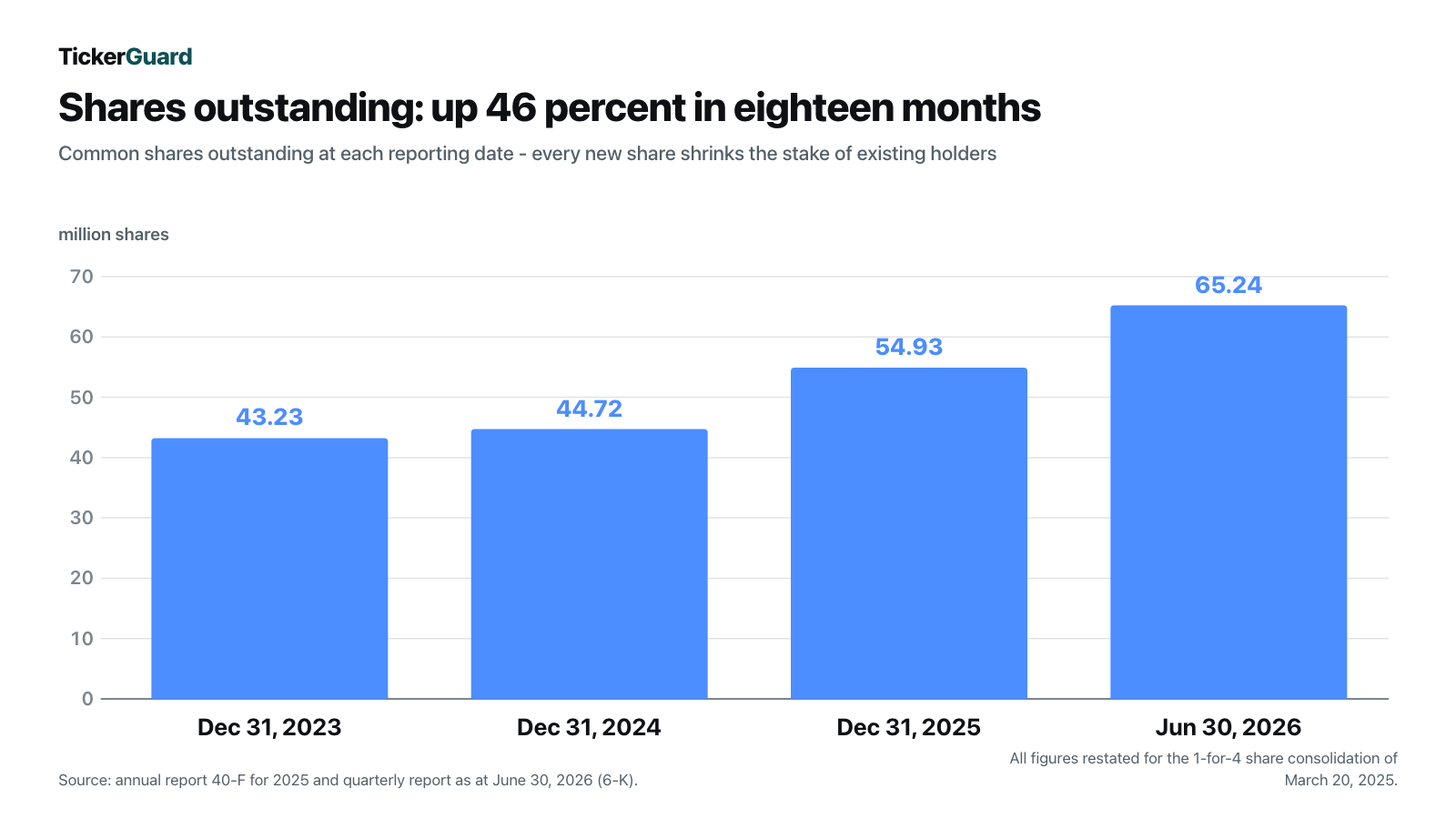
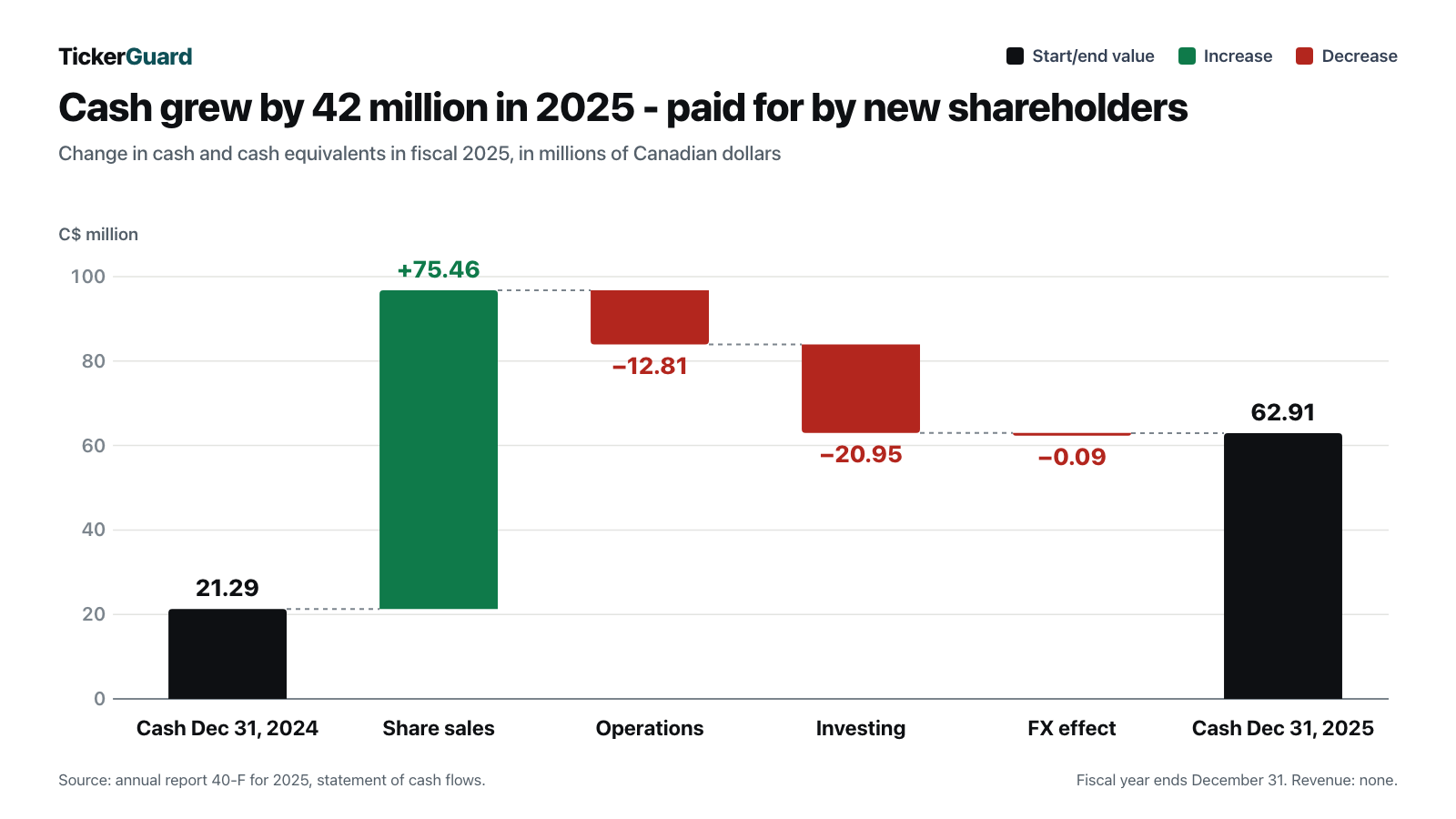
Dilution, in plain language: your slice of the cake gets smaller, even as the cake grows. An investor who owned one percent of IsoEnergy in early 2024 and never bought more owns about 0.66 percent today. In exchange the cake is bigger — more projects, more cash. Whether that was a good trade only becomes clear once the projects turn into income. The second chart shows where the cash actually comes from:
What the filings say — the uncomfortable truths
Uncomfortable truth no. 1: no revenue, no reserves, no production decision
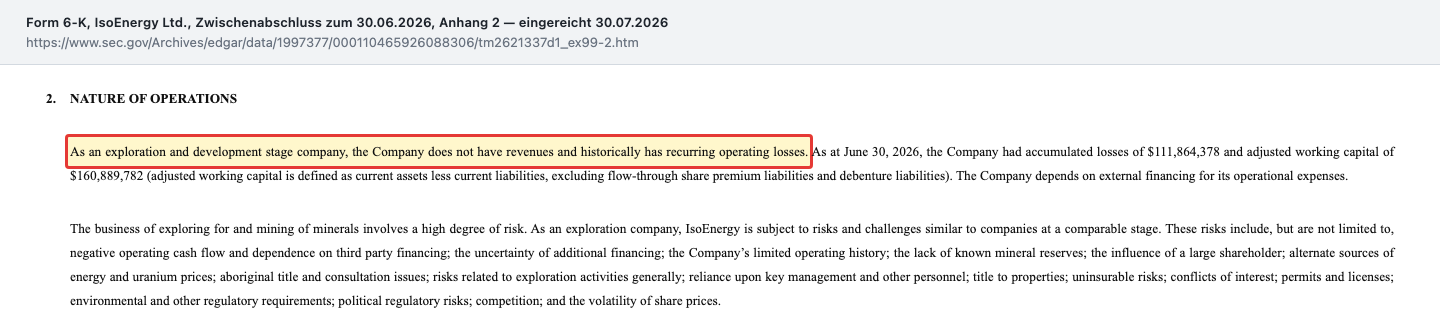
The interim financial statements as at June 30, 2026 open their section on the nature of operations with a sentence that sorts out every price fantasy:
“As an exploration and development stage company, the Company does not have revenues and historically has recurring operating losses. […] The Company depends on external financing for its operational expenses.”
— IsoEnergy Ltd., Form 6-K of July 30, 2026, interim financial statements as at June 30, 2026, note 2
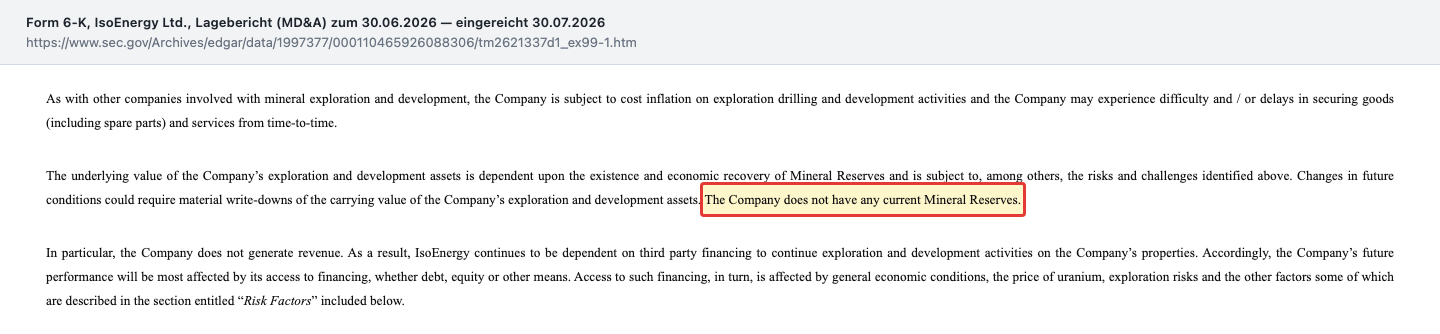
The MD&A filed the same day carries the second half of the finding, and for valuation purposes it matters just as much:
“The Company does not have any current Mineral Reserves.”
— IsoEnergy Ltd., Form 6-K of July 30, 2026, MD&A as at June 30, 2026
What does that mean in practice? An indicated resource is a geological statement, not an economic one. At the Tony M mine in Utah, IsoEnergy did take a first step in 2026: it completed a bulk sample program and started a preliminary economic assessment that, in the words of the MD&A, is meant to establish "an incentive uranium price for potential production." Note the direction of that sentence: the plan does not come first with the price following, the price has to be high enough before a plan makes sense at all.
Uncomfortable truth no. 2: every drill hole is paid for by new shareholders
In 2025 IsoEnergy took in C$77.5 million from share issuances, across three placements: on February 28, 2025 it placed 1,333,825 so-called flow-through shares at C$15.00 (C$20.0 million); the same day its largest shareholder NexGen subscribed for 625,000 ordinary shares at C$10.00 (C$6.3 million) to maintain its stake; and on June 24, 2025 another 5,121,500 shares followed at C$10.00 (C$51.2 million). Flow-through shares are a Canadian tax instrument: the buyer pays a premium to the market price and in return receives the tax deductions for the exploration spending the money triggers — while the company must actually spend the amount on Canadian exploration, in the case of the February 2025 round by December 31, 2026. On January 27, 2026 came the next round: 3,833,410 shares at C$15.00 (C$57.5 million), alongside a private placement of 1,666,667 shares to its largest shareholder NexGen (C$25.0 million).
Then there are the instruments not yet exercised: 5,531,283 stock options at a weighted average exercise price of C$13.40 and 145,833 restricted share units as at June 30, 2026 — together about 8.7 percent of shares outstanding that would be created on top. And the framework for future rounds already exists: a base shelf prospectus for C$250 million (filed January 13, 2026, valid for 25 months) plus an at-the-market program for C$50 million running to February 29, 2028, which lets the company sell shares straight into the market at any time.
In fairness: this is exactly how exploration works. Nobody drills out of operating cash flow when there is none. The question is not whether dilution happens but at what price — and the numbers hold a concrete clue: ordinary shares went out at C$10.00 both in February and in June 2025, then at C$15.00 in January 2026. The C$15.00 paid for the February 2025 flow-through shares is no fair comparison: that price includes the tax premium, since NexGen paid C$10.00 for ordinary shares on the same day. The higher the price in a round, the fewer new shares the company needs for the same amount — which is why, for an explorer, the share price is not just a valuation but also a financing condition.
Uncomfortable truth no. 3: NexGen sits at the table with a good quarter of the shares
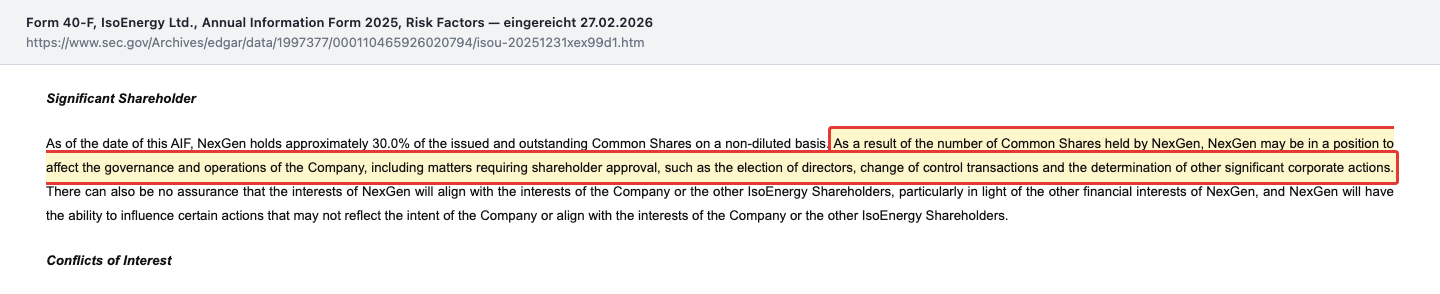
IsoEnergy was created in 2016 as a subsidiary of NexGen Energy, and NexGen is still the largest single shareholder: 30.0 percent per the annual report of February 26, 2026, 27.8 percent per the interim report as at June 30, 2026. The annual report treats this as a risk factor in its own right:
“As a result of the number of Common Shares held by NexGen, NexGen may be in a position to affect the governance and operations of the Company, including matters requiring shareholder approval, such as the election of directors, change of control transactions and the determination of other significant corporate actions.”
— IsoEnergy Ltd., Form 40-F 2025, Annual Information Form, risk factor "Significant Shareholder"
On top of that, the two boards overlap in membership: IsoEnergy’s vice-chair is Leigh Curyer, founder and chief executive of NexGen; director Christopher McFadden chairs NexGen’s board; and IsoEnergy’s chair, Richard Patricio, in turn sits on NexGen’s board. That is why the interim statements list NexGen explicitly as a related party. The second-largest reported holder is a financial investor: Van Eck Associates reported 4,566,386 shares, or 7.5 percent, as at June 30, 2026 in a Schedule 13G ownership filing of August 14, 2026, of which 3,504,991 sit in the VanEck uranium and nuclear exchange-traded fund. For retail holders this cuts both ways: a large, expert anchor shareholder that subscribes to every capital round stabilizes funding. At the same time, every vote is effectively co-decided by a shareholder whose own interests lie in the same commodity.
Uncomfortable truth no. 4: part of the portfolio may not legally be mined
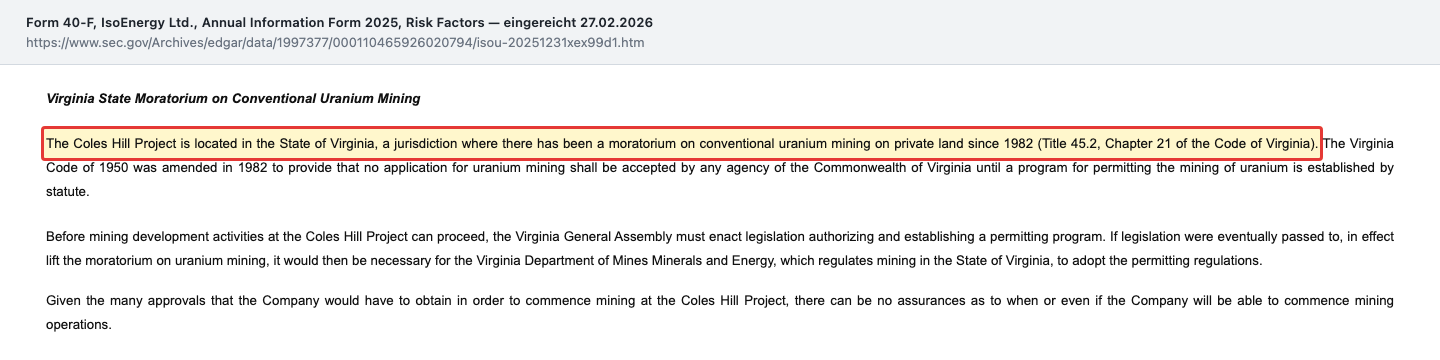
The Coles Hill project sits in the U.S. state of Virginia. Conventional uranium mining on private land has been banned there by statute since 1982:
“The Coles Hill Project is located in the State of Virginia, a jurisdiction where there has been a moratorium on conventional uranium mining on private land since 1982 […]. Before mining development activities at the Coles Hill Project can proceed, the Virginia General Assembly must enact legislation authorizing and establishing a permitting program.”
— IsoEnergy Ltd., Form 40-F 2025, Annual Information Form, risk factor "Virginia State Moratorium on Conventional Uranium Mining"
The same report names a second prohibition: in Queensland, where several of the Australian projects sit, the state government has as a matter of policy granted no mining leases for uranium since 2014 and permits no processing in the state; the new government elected in October 2024 has not changed that line so far. So two jurisdictions in which the company holds projects do not permit mining at all, regardless of geology or the uranium price. That does not make the projects worthless — but their value hangs on political decisions rather than drill results.
The August 19, 2026 restructuring: the U.S. business is now a minority stake
Well into the summer of 2026, IsoEnergy marketed a second leg: a cluster of permitted, past-producing mines in Utah — Tony M, Daneros, Rim, plus the Sage Plain and Flatiron projects — with toll milling agreements in place with Energy Fuels. The February 2026 annual report put that right into the first sentence of its business overview:
“IsoEnergy is a globally diversified uranium company with near-term production, development and exploration projects in top-tier jurisdictions, anchored by the world’s highest grade indicated uranium resource located in Canada’s Athabasca Basin and fully-permitted, conventional uranium mines in the U.S. ready for restart.”
— IsoEnergy Ltd., Form 40-F 2025, Annual Information Form, section “Overview of the Business”
Even the MD&A as at June 30, 2026, published on July 30, describes those mines as standing by for a potential restart, “positioning IsoEnergy as a near-term uranium producer.”
On August 4, 2026, the company announced it would hand exactly that portfolio over, and on August 19, 2026 the swap closed: all of the Utah mines went into the newly formed DISA Uranium Corporation, and IsoEnergy received 1,677,350 shares of that company in exchange. In parallel, DISA Uranium raised US$105 million from investors including Tembo Capital, BHP Ventures and Halliburton Labs; IsoEnergy itself subscribed US$33 million of that round. The stated result: roughly 33 percent of DISA Uranium on a fully diluted basis, largest single shareholder, two seats on a seven-member board. The company put the implied equity value of the new entity, based on the financing commitments, at roughly US$505 million.
For shareholders this shifts the picture in two directions. On the positive side, the Utah mines gain capital and technology — DISA contributes a processing method called HPSA (High-Pressure Slurry Ablation, a high-pressure process meant to upgrade mineralized feedstock before processing and reduce waste volumes — with, according to the announcement, the potential to cut operating costs significantly) and, by its own account, the only U.S. licence to recover uranium from legacy waste across multiple abandoned mine sites. Soberly stated, though: what used to be an owned mine is now a minority stake in a privately held company — no daily price, no control, and the road to production now runs through another management team's decisions. How the swap will appear in the accounts is visible in no filing yet; as at June 30, 2026 the U.S. assets — Utah together with Coles Hill, which was not contributed — stood in the books at C$167.9 million, about 30 percent of total assets.
And the pivot cost cash. At the June 30, 2026 exchange rate (C$1.4201 per U.S. dollar) the US$33 million equals roughly C$47 million — roughly 40 percent of the C$117.3 million of cash that the MD&A reported as of July 29, 2026. The same MD&A’s statement that all planned programs are “fully funded” to December 31, 2026 was written before that payment. How much cash is actually left will only be shown by the interim report as at September 30, 2026.
Valuation: what the market pays for pounds in the ground
For a company with no revenue and no profit there is neither a price-to-earnings nor a price-to-sales ratio — both would have a zero in the denominator. What remains are three magnitudes, each with its own date.
First, market capitalization. According to the fundamental data, the stock closed at C$13.80 in Toronto on September 23, 2026; with 65,256,428 shares outstanding (per the MD&A of July 29, 2026) that gives a market capitalization of roughly C$900 million. The cross-check against a price documented in a filing holds: the interim statements use a share price of C$14.14 as at June 30, 2026, which would give about C$923 million — a little over 2 percent more. Up to that data date, the stock’s 52-week range ran from C$10.60 to C$18.10.
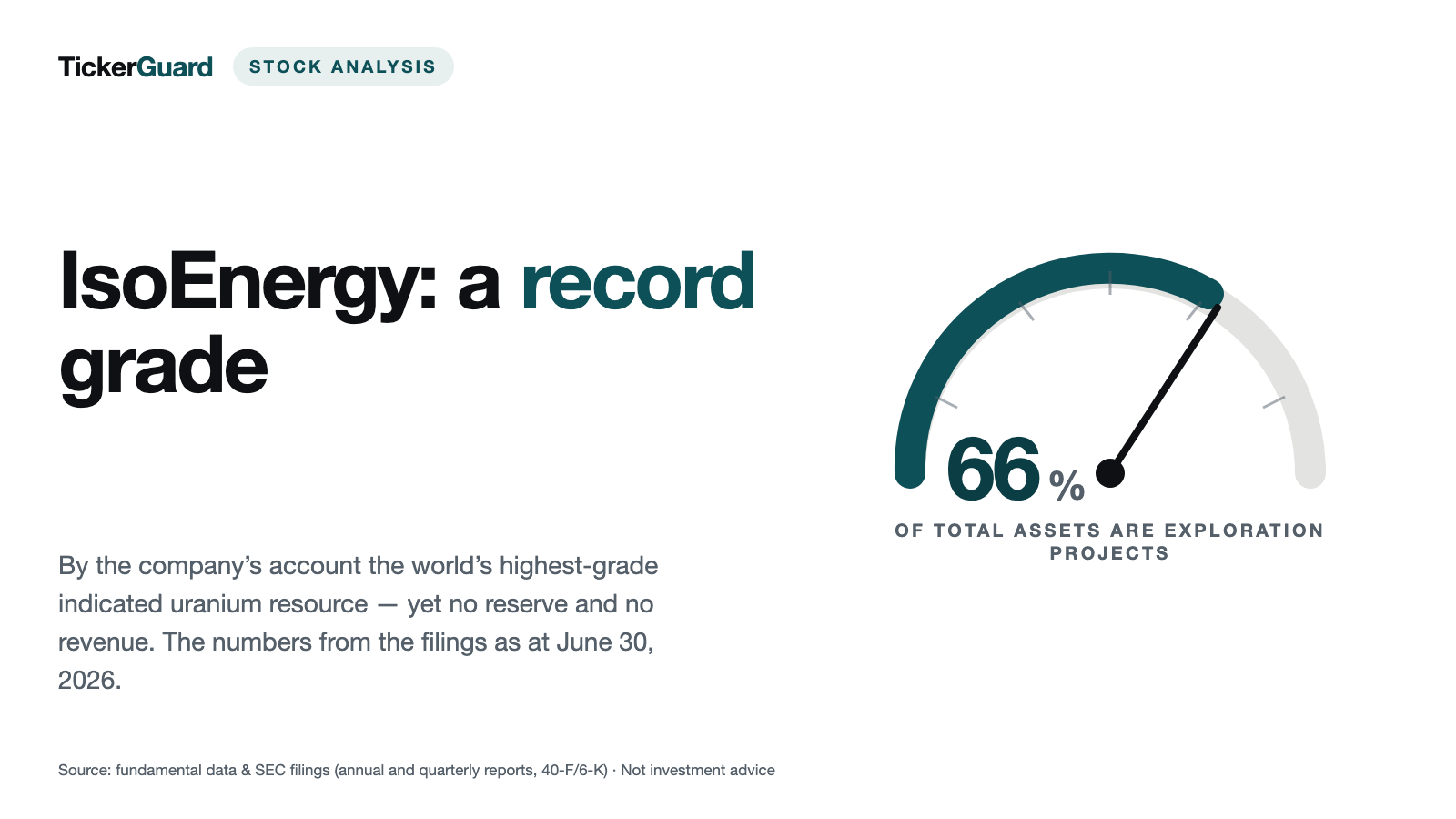
Second, the relation to book value. Equity stood at C$542.2 million as at June 30, 2026, or about C$8.31 per share. At C$13.80 the stock therefore trades at a little over 1.6 times book — not extreme for an explorer without revenue, but a visible premium. Worth noting: 66 percent of total assets are exploration and evaluation assets (C$373.8 million of C$562.5 million), in other words capitalized search and drilling costs — not a market price, but the sum of what the company has spent.
Third, the price per pound in the ground. Deduct cash and marketable securities from the market capitalization (as at the MD&A date of July 29, 2026: C$117.3 million of cash and C$41.8 million of securities) and add back the convertible debenture (fair value C$6.0 million as at June 30, 2026), and roughly C$747 million remain as what the market assigns to the projects themselves — our own calculation. Because the DISA investment only left this cash pile in August, the new stake is included in that figure. Spread across the company's only directly held current resource, Hurricane's 48.6 million pounds, that is about C$15 per pound. Include the historical Wiluna estimate of 69.1 million pounds and the figure drops to roughly C$6 per pound — except that this estimate is expressly not to be treated as a current resource. The gap between those two numbers is the real valuation question in this stock.
The professional view is considerably more optimistic: the average analyst price target stood at about C$23 on September 23, 2026. For explorers, such targets almost always rest on modelled assumptions about future uranium prices and future production — an opinion about the future, not a finding from the books.
Upside and risks at a glance
What speaks for IsoEnergy:
- The grade: 48.6 million pounds of uranium oxide at 34.5 percent in the indicated category — by the company's account the highest published grade of any indicated uranium resource worldwide, 40 kilometres from an existing mill.
- A balance sheet without pressure: C$122.9 million in cash plus C$43.0 million of securities against only C$20.3 million of total liabilities (June 30, 2026); adjusted working capital of C$160.9 million.
- A portfolio spread across three established mining countries (Canada, the United States, Australia) rather than a single project — though mining is barred in two of the sub-jurisdictions (Virginia, Queensland) — plus holdings in eight other resource companies worth C$43.0 million.
- A management team that acts: between July 2024 and August 2026 it sold the Argentine projects, Mountain Lake and its royalty rights, acquired Toro Energy for its own shares, and moved the U.S. portfolio into a capitalized platform. The disposals and the Toro deal cost almost no cash; the stake in DISA Uranium, however, took US$33 million.
- A deep-pocketed anchor shareholder: NexGen Energy holds a good quarter of the company and subscribed pro rata to the two private placements of February 28, 2025 and January 27, 2026, most recently for C$25.0 million.
What speaks against it:
- No revenue, no mineral reserves, no production decision — every reported gain in recent years came from selling projects and royalty rights and from interest, not from the business.
- Continuous dilution: shares up 46 percent since the end of 2024, plus 5.53 million options outstanding and room for a further C$300 million of issuance (base shelf and at-the-market program).
- A finite funding horizon: the company calls its programs fully funded only to December 31, 2026 — written before the roughly C$47 million cash investment in DISA Uranium — and a binding commitment requires it to spend a further C$5.5 million of flow-through money on Canadian exploration by that same date.
- Two jurisdictions with mining bans: Virginia (since 1982) and Queensland (policy since 2014) — project values that hang on legislative change.
- The U.S. leg has been, since August 19, 2026, only a one-third stake in a privately held company whose value cannot be read off a screen.
- A cost base without an offset: C$12.9 million of administrative costs in the first half of 2026, C$5.4 million of it share-based compensation — against zero revenue.
A human conclusion
Back to the superlative trap. The world record is real: 34.5 percent uranium is a geological outlier, and in a few years the company has turned it into a portfolio on three continents, a full treasury and a seat at every negotiating table in the sector. But a world record in the ground is not a business model — it is a raw material with every single step still ahead of it: reserve statement, permitting, financing, construction, mining, sales. Until then the company funds itself by selling slices of its own cake — and the cake belongs a little less each year to those who were early.
That is not an accusation, it is the description of an asset class. Anyone buying an explorer is buying a bet on the uranium price, on politics and on time, not on profits. So the honest question is not "is IsoEnergy a good company?" but: are you willing to pay for a geological exception for which there is, to date, no reserve, no production plan and no revenue — and which costs you a slice of your ownership year after year in the meantime? If the answer is yes, the superlative is a good argument. If not, it is just a pretty number. What you make of it is your decision. And that is exactly as it should be.
Sources
Every original document used in this analysis — for your own reading:
- IsoEnergy Ltd. — Form 40-F for fiscal 2025 (filed February 27, 2026)
- IsoEnergy Ltd. — Annual Information Form 2025 (exhibit 99.1 to the Form 40-F, February 27, 2026)
- IsoEnergy Ltd. — Form 6-K of July 30, 2026, MD&A for the three and six months ended June 30, 2026
- IsoEnergy Ltd. — Form 6-K of July 30, 2026, unaudited interim financial statements as at June 30, 2026
- IsoEnergy Ltd. — Form 6-K of August 4, 2026, announcement of the formation of DISA Uranium
- IsoEnergy Ltd. — Form 6-K of August 19, 2026, closing of the DISA Uranium transaction
- IsoEnergy Ltd. — Form 6-K of September 8, 2026, completion of the Larocque East summer drill program
- Complete SEC filing history for IsoEnergy Ltd.: EDGAR overview (sec.gov)
- Van Eck Associates Corporation — Schedule 13G ownership filing of August 14, 2026 (as at June 30, 2026)
- Fundamental data (price, market capitalization, 52-week range, analyst price target; data as at September 23, 2026), reconciled against the SEC filings.
- No transcripts of analyst calls were available for IsoEnergy; instead we reviewed the annual report, both 2026 interim reports and every ad-hoc disclosure since July 30, 2026.
Transparency & disclaimer: This analysis is a journalistic assessment of publicly available information and does not constitute investment advice, a regulated financial analysis, or a solicitation to buy or sell securities. Equity investments carry substantial risk, including total loss. All information is provided without guarantee; the data date is noted throughout the text. Positions held by the operator are disclosed daily; where one exists, it appears as a notice at the top of this deep dive.
Our Bottom Line at a Glance
- Resource base positive
- By the company's own account the Hurricane deposit carries the highest published grade of any indicated uranium resource worldwide: 48.6 million pounds of U3O8 at 34.5 percent, 40 kilometres from an existing mill (as at the 2025 annual report and the MD&A for June 30, 2026).
- Balance sheet & liquidity positive
- C$122.9 million of cash and C$43.0 million of securities against only C$20.3 million of total liabilities as at June 30, 2026; adjusted working capital of C$160.9 million. No refinancing pressure from debt; in August 2026, however, roughly C$47 million went into the DISA stake.
- Earnings power negative
- No revenue, no mineral reserves, no production decision; a C$8.19 million loss in the first half of 2026 on C$12.92 million of administrative costs. The positive earnings contributions of 2025 and 2026 came from selling projects and royalty rights and from interest.
- Dilution negative
- Shares up 46 percent between December 31, 2024 and June 30, 2026 (44.72 to 65.24 million), plus 5.53 million options outstanding and headroom of C$250 million (base shelf) and C$50 million (at-the-market program) for further issuance.
- Legal framework negative
- In Virginia (Coles Hill) conventional uranium mining on private land has been barred by statute since 1982; in Queensland the state government has granted no uranium mining leases since 2014 — both findings appear verbatim in the risk factors of the 2025 annual report.
- Portfolio restructuring neutral
- Since August 19, 2026 the entire U.S. mine portfolio sits in DISA Uranium Corporation, in which IsoEnergy holds roughly 33 percent. That brings capital and technology to the Utah projects but converts owned mines into a minority stake in a privately held company.
IsoEnergy owns a genuine geological outlier in Hurricane and a balance sheet without debt pressure: C$122.9 million of cash against C$20.3 million of liabilities as at June 30, 2026. Against that stands a company with no revenue, no mineral reserves and no production decision, which pays for every drill hole with new shares — up 46 percent in count since the end of 2024. Anyone investing here is buying a bet on the uranium price, on permits and on time, not on earnings power. Not investment advice.
What Our Rating Means
Open questions
The business works in principle, but one material question is open. As long as it stays open, our findings do not carry a quality verdict.
The substance is documented — a high-grade resource, a full treasury, barely any debt, no indication of a threat to the company's continued existence. What remains open is the decisive operating question: there is no mineral reserve, no production decision and therefore no demonstrated path from 48.6 million pounds in the ground to revenue. As long as that holds, the business funds itself by issuing new shares, and dilution is not an accident but the business model of the exploration phase. Whether a premium of a little over 60 percent to book value is appropriate depends on assumptions about the uranium price and about time — no traffic light settles that. The decision is yours.
A journalistic assessment by our editorial team at the time of the deep dive, based on public sources — not investment advice and not a solicitation to buy or sell. Your personal circumstances (investment goals, risk capacity, taxes) cannot be taken into account. What our levels mean, how verdicts are formed, and what conflicts of interest exist →
Worth Noting
- Data date: balance sheet, income and cash flow figures as at June 30, 2026 (interim statements in the Form 6-K of July 30, 2026) and December 31, 2025 (Form 40-F of February 27, 2026); price, market capitalization, 52-week range and analyst target per fundamental data as at September 23, 2026 (closing price), share count per the MD&A of July 29, 2026. All SEC filings through September 24, 2026 have been reviewed; the most recent is dated September 8, 2026.
- All amounts in Canadian dollars unless stated otherwise — IsoEnergy reports in CAD, while the ISOU secondary listing on the NYSE American trades in U.S. dollars. A price-to-earnings or price-to-sales ratio cannot be formed because neither profit nor revenue exists.
- The contribution of the U.S. portfolio to DISA Uranium Corporation (August 19, 2026) falls after the latest reporting date; its accounting treatment will become visible for the first time in the interim statements as at September 30, 2026.
- The Wiluna estimate of 69.1 million pounds of U3O8 is expressly carried by the company as a historical estimate and not treated as a current mineral resource; it enters the valuation figures of this analysis only as a clearly labelled alternative calculation.
The full analysis as a PDF for later
We will send you this analysis as a PDF — to print, file away, and read at your own pace.
Frequently Asked Questions
IsoEnergy Ltd. (TSX: ISO, NYSE American: ISOU, based in Toronto) explores for and develops uranium projects in Canada, the United States and Australia. Its most important asset is the Larocque East project in the Athabasca Basin with the Hurricane deposit: 48.6 million pounds of uranium oxide in the indicated category at a grade of 34.5 percent. The company mines nothing and earns no revenue; as at February 26, 2026 it had 24 employees and 18 contractors.
No. The interim financial statements as at June 30, 2026 state explicitly that the company does not have revenues and historically has recurring operating losses. The loss for the first half of 2026 was C$8.2 million; for full-year 2025 it was C$1.1 million — that low only because gains on disposals and interest income largely offset C$19.4 million of administrative costs.
A mineral resource is an estimate of how much material sits in the ground; a mineral reserve is the portion whose economic extraction has been demonstrated in a study. IsoEnergy has resources, but according to its own MD&A as at June 30, 2026 no current reserves. At the Tony M mine a preliminary economic assessment began in 2026 that is meant first to establish the uranium price at which mining would make sense at all.
IsoEnergy contributed its five Utah projects (Tony M, Daneros, Rim, Sage Plain, Flatiron) to the newly formed DISA Uranium Corporation in exchange for 1,677,350 shares. It also invested US$33 million in DISA's US$105 million financing round. Since then IsoEnergy holds roughly 33 percent of DISA Uranium on a fully diluted basis and is its largest shareholder — its own mines no longer appear on the balance sheet.
Shares outstanding rose from 43.23 million (December 31, 2023) to 65.24 million (June 30, 2026) — up 46 percent since the end of 2024 alone, all restated for the 1-for-4 share consolidation of March 20, 2025. On top of that sit 5.53 million options outstanding and 145,833 restricted share units. A C$250 million base shelf prospectus and a C$50 million at-the-market program stand ready for further issuance.
As at June 30, 2026 the company held C$122.9 million in cash and C$43.0 million in marketable securities; by the MD&A of July 29, 2026 those figures were about C$117.3 million and C$41.8 million. The company describes its planned programs as fully funded to December 31, 2026. After that, in August 2026, US$33 million (roughly C$47 million) went into the stake in DISA Uranium. In the first half of 2026, operations and exploration together consumed roughly C$16.4 million.
NexGen Energy created IsoEnergy as a subsidiary in 2016 and remains its largest shareholder: 30.0 percent per the annual report of February 26, 2026, 27.8 percent as at June 30, 2026. The annual report lists this as a separate risk factor because NexGen can influence governance, director elections and change-of-control matters. NexGen subscribed pro rata to the placements of February 2025 and January 2026, most recently for C$25.0 million.
ISO on the Toronto Stock Exchange is the home listing; ISOU on the NYSE American is the secondary listing of the same share, trading since May 5, 2025. The company reports in Canadian dollars under IFRS accounting standards, and with the U.S. securities regulator, the SEC, it files as a Canadian foreign issuer on Form 40-F and Form 6-K rather than on Form 10-K and Form 10-Q.
Found an error?
Did you spot a factual error, an outdated number, or a typo in this deep dive? Let us know briefly — your report goes straight to the editorial team.