A Government Seized the Mine, the CEO Left Without a Word — Barrick Still Earned More Than Ever
You know the name Barrick, you know the ticker ABX — and that familiarity is exactly the trap. Since May 2025 the company is called Barrick Mining Corporation, not Barrick Gold. That same year, Mali seized one of its most important mines and confiscated three tonnes of gold, the CEO resigned nine months later without a stated reason, and joint-venture partner Newmont accused the company of diverting resources from their shared Nevada operation for six years. At the same time, Barrick earned more in 2025 than ever before and now sits on more cash than debt. We read what the filings to the U.S. Securities and Exchange Commission actually say — filing by filing, quote by quote. Not investment advice, just a look behind the familiar name.
 Thomas Mücke
Founder & Publisher
Thomas Mücke
Founder & Publisher
Chart
Interactive price chart (TradingView).
Note: pure fact-based analysis, not investment advice and not a solicitation to buy or sell. All figures without guarantee.
There is a kind of mistake that has nothing to do with math and everything to do with recognition. You see a name you have known for years — Barrick, the world's biggest gold miner, the ticker ABX, a stock that generations of investors have held — and your brain says: I know this, I understand this, it is what it always was. Behavioral economists call this the familiarity trap: a known name feels safer than an unknown one, regardless of whether anything behind the name has actually changed. In Barrick's case, a great deal changed.
Since May 6, 2025, the company has no longer been called Barrick Gold Corporation but Barrick Mining Corporation. That same year, it temporarily lost control of one of its most important mines to the government of Mali, its CEO resigned without a stated reason, and its most important joint-venture partner, Newmont, accused it of running the shared operation to its own benefit for six years. At the same time, Barrick earned more money in 2025 than at any point in its history. Anyone looking only at the familiar name sees neither of those things.
We read what Barrick itself — in press releases furnished to the U.S. Securities and Exchange Commission, because the company is registered there as a Canadian "Foreign Private Issuer" — wrote about these twelve months. What follows is not a buy recommendation; it is an attempt to look past the name.
What Barrick Mining Actually Does — From Gold Miner to a Gold-and-Copper Company
Barrick Mining Corporation mines gold, copper and silver across 18 countries on five continents. The company describes itself as operating six of the world's Tier One gold mines — an industry term for exceptionally large, long-life, low-cost deposits — and as the largest gold producer in the United States. The current structure dates to the 2019 merger with Africa-focused rival Randgold Resources, which is also where Mark Bristow came from; he remained CEO until September 2025 (more on that below). That same year, 2019, Barrick and U.S. rival Newmont formed the Nevada Gold Mines (NGM) — with ten underground and twelve open-pit mines, the largest gold complex in the world, in which Barrick holds 61.5% and operates the venture while Newmont holds 38.5%.
The rename from "Barrick Gold" to "Barrick Mining," effective May 6, 2025, is more than cosmetic. It is meant to signal that the company no longer sees itself purely as a gold miner but increasingly as a copper player too — the metal driving the energy transition and electrification. The most visible project for that ambition is Reko Diq in Pakistan's Balochistan province, one of the largest undeveloped copper-gold deposits in the world (more on that in the third uncomfortable truth). Along with the name, the New York Stock Exchange ticker changed too — from GOLD to B — while the home exchange in Toronto kept trading under ABX.
Company history for investors
-
2019
Merger with Randgold Resources
The merger creates today's leadership structure; Mark Bristow (formerly Randgold's CEO) takes over Barrick. The same year, the Nevada Gold Mines JV with Newmont (61.5/38.5%) launches.
-
2025
Mali seizes gold, operations suspended
On January 11, 2025, the government confiscates roughly three tonnes of gold from Loulo-Gounkoto; three days later Barrick suspends operations — the start of a nearly year-long loss of control.
-
2025
Renamed Barrick Mining Corporation
Effective May 6, 2025, "Barrick Gold" becomes "Barrick Mining Corporation," and the NYSE ticker switches from GOLD to B — a signal that copper now counts too.
-
2025
Loss of control over Loulo-Gounkoto
From June 16, 2025, the Malian state administers the mine; Barrick must deconsolidate it and books a $1,035 million loss in the second quarter.
-
2025
CEO exits without a stated reason
On September 29, 2025, Mark Bristow resigns and Mark Hill takes over on an interim basis — in the middle of what the company itself calls a strong quarter.
-
2025
Mali settlement, control restored
On November 24, 2025, Barrick and Mali reach a settlement; by December 16, 2025, Barrick regains operational control of Loulo-Gounkoto.
-
2026
Newmont settlement clears the path for the spin-off
In August 2026, Newmont pays Barrick $1.95 billion, all NGM disputes are resolved — and Newmont consents to the planned North American separation.
How This Stock Landed on Our Desk
The trigger for this analysis was a contradiction that does not resolve on its own. On one hand, Barrick reported the most profitable year in its history for 2025. On the other, that same year's headlines read as if they belonged to a different company: a government occupying a mine; a CEO leaving without a word; a dispute with its own joint-venture partner that escalated all the way to formal default notices. That combination — record profit and a leadership crisis in the same calendar year — is what made us want to look closer instead of relying on the familiar brand.
The Numbers Over the Years — Assessed Honestly
Revenue and profit over the past five years show just how closely Barrick's results track the gold price. In 2021, the company generated $11,985 million in revenue and earned $2,022 million. In 2022, profit collapsed to $432 million on nearly unchanged revenue ($11,013 million) as higher energy and input costs squeezed margins. 2023 and 2024 brought a slow recovery ($1,272 million and $2,144 million in net income, respectively), before 2025 clearly surpassed both prior years with $16,956 million in revenue and $4,993 million in net income. For a look at how much a high gold price can drive a miner's numbers — and the risks gold companies take on when they hedge against falling prices — see our analysis of Endeavour Mining.
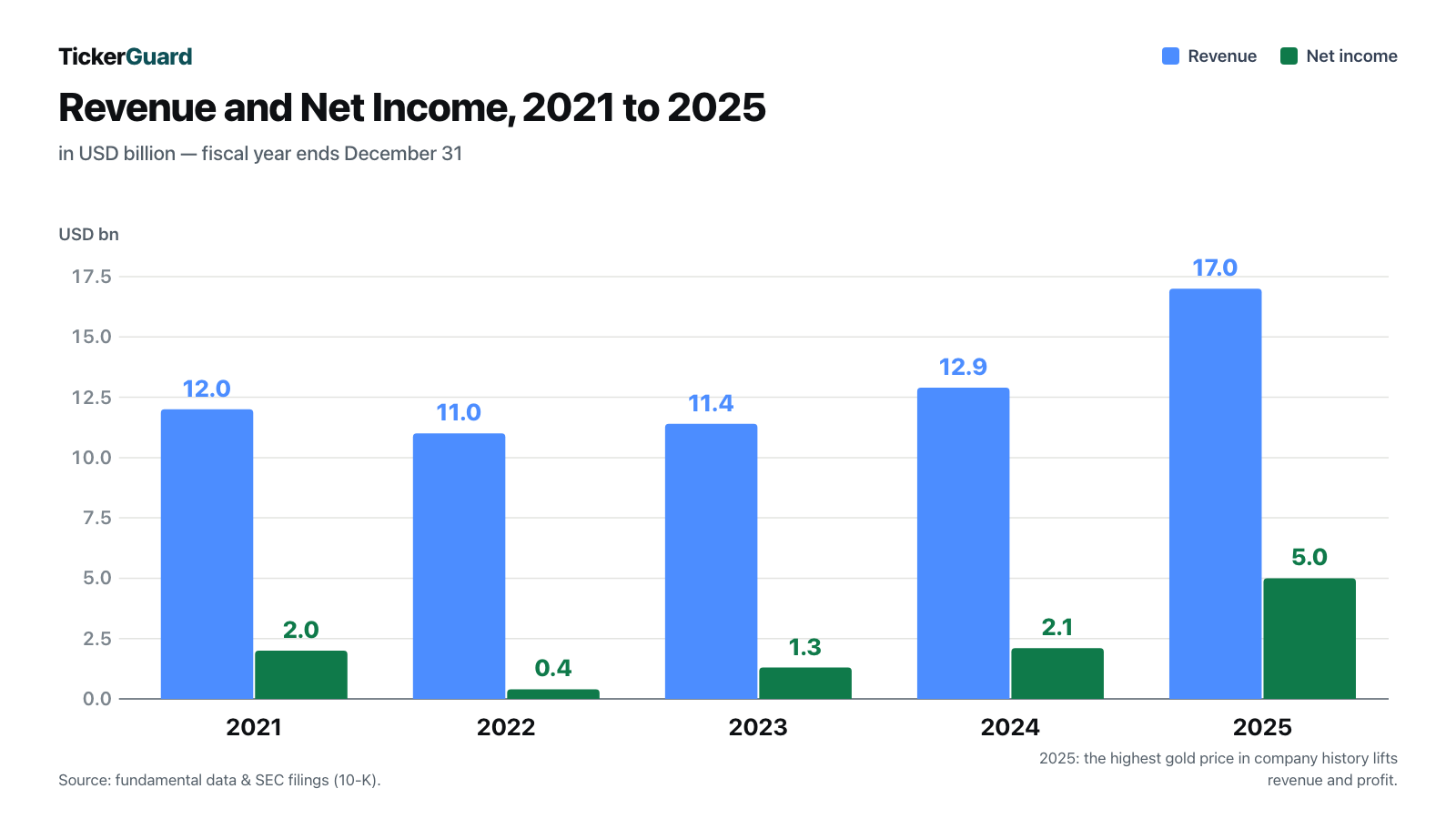
The balance sheet has changed just as sharply. At the end of 2024, Barrick still carried $1,182 million of net debt; a year later, at the end of 2025, the company held $1,952 million of net cash — an improvement of roughly $3.1 billion within a single year. Cash and equivalents rose from $4,074 million to $6,694 million, while financial debt (mostly long-term, about $5,065 million) stayed nearly flat; the gap to the reported net-cash figure reflects other balance-sheet items not broken out here, such as short-term investments. That shift was powered by operating cash flow that nearly doubled, from $4,491 million (2024) to $8,082 million (2025), and free cash flow that more than tripled, from $1,317 million to $4,194 million.
That strength showed up in capital returns too. In February 2025, the board approved a $1.0 billion share buyback program with a twelve-month term. It was fully used up by September 30, 2025 — after just over seven months — prompting the board to expand it by another $500 million on November 10, 2025. In parallel, Barrick raised its base dividend by 25% in the third quarter of 2025 and added a performance-based top-up; together, that has meant $0.175 per share per quarter ever since. In the second quarter of 2026 alone, $1.5 billion flowed back to shareholders — $1.2 billion through buybacks and the rest through dividends — up 242% from the prior-year quarter.
What Management Said — and What Came of It
No verified transcripts of Barrick's earnings calls exist. We checked the internal transcript database (as of 08/30/2026): zero hits for ABX.TO. What we could analyze instead are verbatim quotes from the furnished earnings releases of the past four quarters — prepared management statements, but without the analyst question-and-answer session of an actual conference call, where sharper follow-up questions often surface the real story. We are stating that limitation openly rather than glossing over it: where a Q&A session often carries the real news, all we have for Barrick is what the company chose to write and publish itself.
Within that limit, the evolution of the quotes is still telling. In the third-quarter 2025 report — six weeks after his surprise appointment as interim CEO — Mark Hill wrote: "Since assuming interim CEO responsibilities at the end of September, I have met with our teams across the globe to review performance and assess what we can do differently at Barrick." A new chief executive announcing, within six weeks, that he is reviewing "what we can do differently" implicitly says more about the state of the company before his arrival than any press release states explicitly.
By the second-quarter 2026 report — after three consecutive strong quarters — Hill sounds notably more confident: "We achieved an historic agreement with Newmont. […] Through this agreement with our joint venture partner, we have substantially extended the asset base, and provided greater flexibility and value." At the same time, he repeatedly emphasizes safety — "with special emphasis on improving our safety performance across the business, including $90 million invested in safety technology this year" — a topic that, absent the prior year's three fatalities (third uncomfortable truth), would likely have taken up less space in the release.
Uncomfortable Truth No. 1: The Mali Storm Cost More Than a Billion Dollars
The dispute over the Loulo-Gounkoto mine, one of Barrick's largest and most profitable, runs from September 2024 to December 2025 and is the costliest of the three shocks. It was triggered by Mali's new 2023 mining code, designed to give the government a larger share of gold revenue — a politically rewarding cause at record gold prices for the military junta that has governed since 2021.
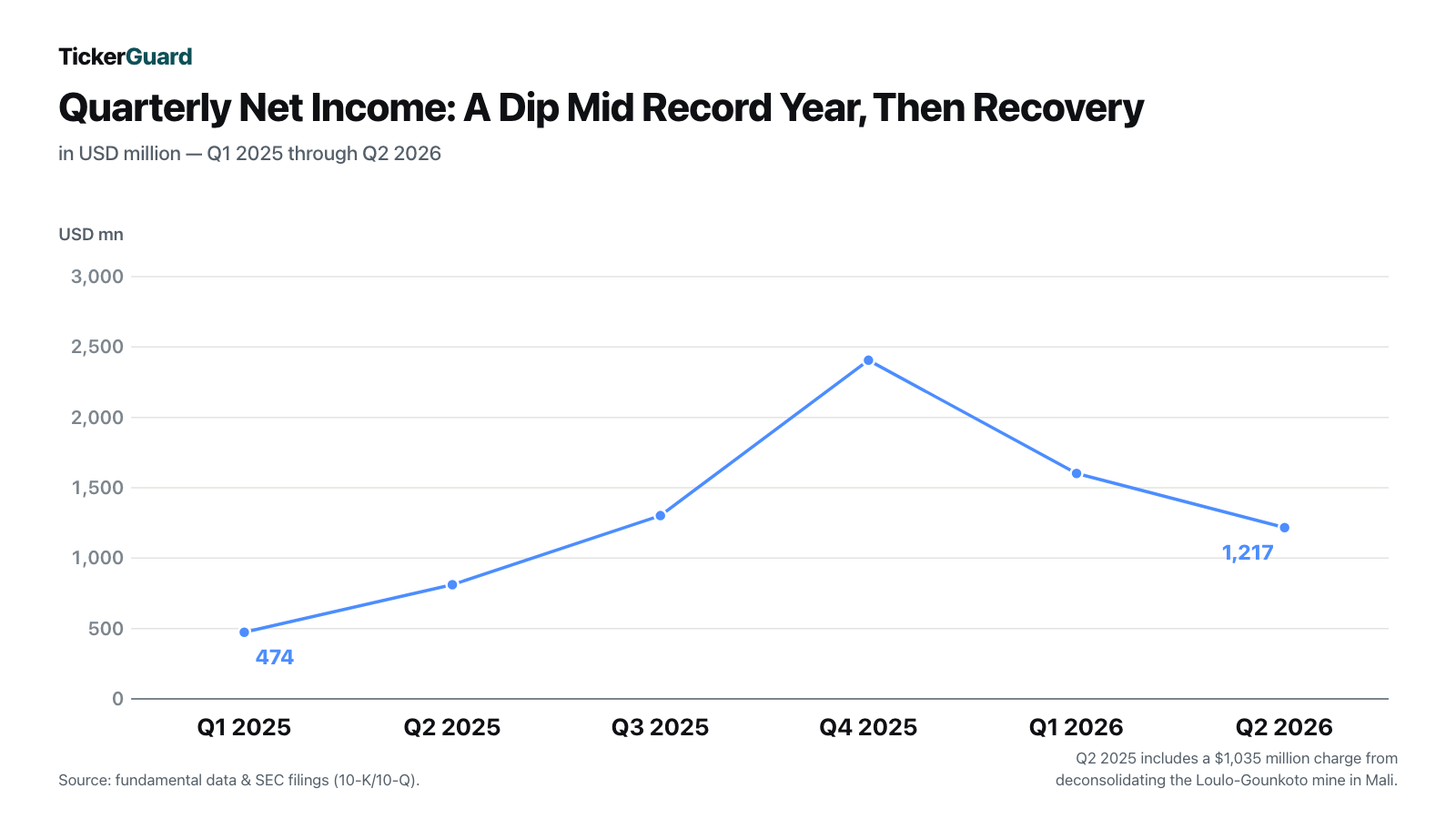
The escalation followed a clear sequence. In September 2024, Malian police briefly detained four senior mine employees and issued an arrest warrant for the general manager, Cheick Abass Coulibaly. In December 2024, the government blocked gold exports from the complex. On January 11, 2025, it confiscated roughly three tonnes of gold worth about $245 million; three days later, on January 14, 2025, Barrick suspended operations at the mine. The decisive break came on June 16, 2025: Mali placed Loulo-Gounkoto under a temporary state administration. For accounting purposes, that meant a loss of control — Barrick had to deconsolidate the 80%-owned mine and instead account for it at fair value.
"… resulting in a Q2 2025 net loss of $1,035 million following the change of control after it was placed under a temporary provisional administration on June 16, 2025."
— Barrick Mining Corporation, 6-K (Q3 2025 report), 11/10/2025

On November 24, 2025, Barrick announced a comprehensive settlement with the government of Mali: all charges against the company, its subsidiaries and employees were dropped, legal steps toward releasing the four detained employees were initiated, the ICSID arbitration was withdrawn — and the temporary administration ended. Effective December 16, 2025, Barrick formally regained operational control of the mine. Barrick's own press release discloses no payment figure; independent reporting, including Canada's Globe and Mail, puts the settlement at roughly $430 million. The second-quarter 2026 report additionally mentions, without a separate dollar figure, further costs tied to the "retrospective application of the 2023 Mining Code to Loulo-Gounkoto for 2024 and 2025" as well as remobilization costs at the site. In total, the dispute cost Barrick at least the booked $1,035 million loss plus an unquantified settlement and back-payment amount — a concrete illustration of what country risk actually means on a balance sheet once it materializes.
Uncomfortable Truth No. 2: Two CEOs in One Year — and an Accusation From Its Own Partner
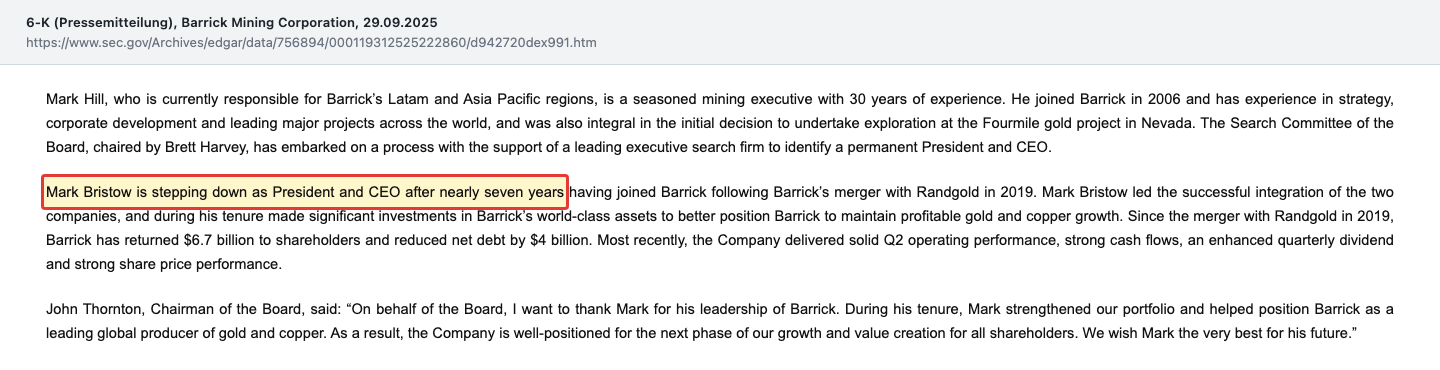
While the Mali crisis was still unfolding, Barrick's leadership changed unexpectedly. On September 29, 2025, the company announced the resignation of CEO Mark Bristow — after nearly seven years in the role, dating back to the 2019 Randgold merger. The press release credits his "leadership" and thanks him, but at no point states a reason for his departure. Chairman John Thornton is quoted: "On behalf of the Board, I want to thank Mark for his leadership of Barrick. During his tenure, Mark strengthened our portfolio and helped position Barrick as a leading global producer of gold and copper. […] We wish Mark the very best for his future."
Successor Mark Hill, with the company since 2006 and most recently regional head for Latin America and Asia Pacific, took over on an interim basis immediately and was confirmed permanently as President and CEO in February 2026. Yet the second-quarter 2026 report already contains the next break: once the planned separation of the North American gold business closes, targeted for year-end 2026, Hill is set to become CEO of the new, spun-off company. For the remaining, internationally focused Barrick Mining Corporation — with mines in Mali, Tanzania, the Dominican Republic and the Reko Diq copper project — that would mean a second change at the top within twelve months. Who will lead that company going forward had not been named as of this analysis's data cutoff.
Layered on top of the leadership turmoil was a serious accusation from Barrick's most important partner. Barrick and Newmont have jointly operated the Nevada Gold Mines since 2019 — Barrick holds 61.5% and runs the operation, Newmont holds 38.5%. In February 2026, Newmont filed a formal notice of default, alleging that Barrick, as operator, had let NGM's operating performance degrade over six years while diverting resources toward its own, wholly owned Fourmile project — the very project Barrick itself promotes as "one of this century's most significant gold discoveries." In August 2026 the two companies settled:
"Newmont will pay Barrick a top-up payment of $1.95 billion cash within thirty days."
— Barrick Mining Corporation, 6-K (Q2 2026 report), 08/10/2026

Financially, this is a good outcome for Barrick — $1.95 billion in cash, a larger shared mining complex, and Newmont's consent to Barrick's own spin-off. Substantively, the settlement remains uncomfortable: a settlement does not establish whether the original allegation was justified, it simply ends the argument over it. That the operator of a joint venture it does not wholly own stands accused of favoring its own, wholly owned project is a conflict of interest baked into the structure of such a partnership — regardless of how this particular case concluded.
Uncomfortable Truth No. 3: Three Fatalities and a Billion-Dollar Project on Ice
The third uncomfortable truth concerns the core operating business itself — safety and major projects. In its third-quarter 2025 report, Barrick writes:
"After nearly twelve months fatality free, unfortunately three of our colleagues lost their lives in recent months."
— Barrick Mining Corporation, 6-K (Q3 2025 report), 11/10/2025
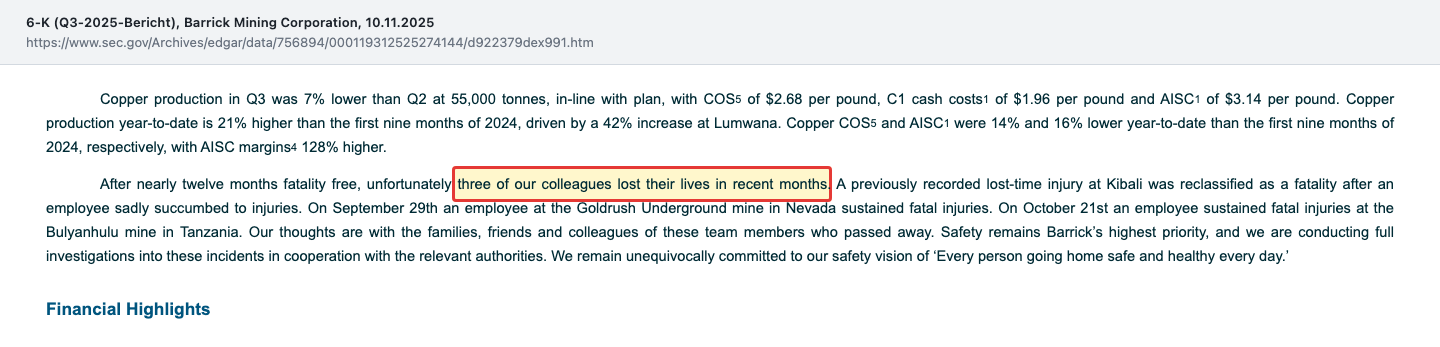
A previously recorded lost-time injury at the Kibali mine (Democratic Republic of Congo) was reclassified as a fatality after the employee later succumbed to injuries. On September 29, 2025, an employee died at the Goldrush underground mine in Nevada; on October 21, 2025, another died at the Bulyanhulu mine in Tanzania — three different countries, three different operations, eight weeks. In its second-quarter 2026 report, Barrick reiterates that it has invested $90 million in safety technology, without publishing a consistent, quarterly safety metric that would let outsiders track progress objectively.
In parallel, Barrick slowed its biggest growth project outside of gold. Reko Diq in Balochistan, one of the largest undeveloped copper-gold deposits in the world, had been budgeted at $5.6 to $6.0 billion for the first phase and $3.3 to $3.6 billion for the second, with first production originally targeted for late 2028. In March 2026, Barrick slowed development over security concerns tied to the escalating Middle East conflict and its spillover into the region; the review period was extended to mid-2027, with the company warning that "significant increases" to budget and schedule were possible. The long-term figures Barrick has publicly cited — more than $70 billion of free cash flow and more than $90 billion of operating cash flow over a 37-year mine life — predate this delay and any final construction decision; they are a projection, not a commitment. For a look at how record prices are already showing up in the balance sheet of a different copper miner, see our analysis of Freeport-McMoRan.
What the Stock Costs
Barrick trades on its home exchange in Toronto in Canadian dollars but reports its financial results in U.S. dollars — a detail that is easy to overlook when sizing up the stock. On August 28, 2026, the shares closed in Toronto at C$63.50, equal to roughly $46.01 or roughly €39.73 (same-day exchange rates: 1 USD ≈ 1.38 CAD, 1 EUR ≈ 1.158 USD). Market capitalization stood at roughly C$104.6 billion, equal to roughly $75.8 billion or roughly €65.5 billion.
On standard valuation metrics, Barrick is neither an obvious bargain nor obviously expensive: the trailing twelve-month P/E ratio reported by the data provider stands at 11.9, with a forward P/E of 13.1 — implying the market expects a somewhat lower profit than the 2025 record year, which seems plausible given the higher per-ounce production costs already seen in the second quarter of 2026. The price-to-book ratio is 2.9, and enterprise value to EBITDA is 5.2. The trailing twelve-month dividend yield is about 1.0%; based on the higher quarterly dividend of $0.175 in effect since the third quarter of 2025 (an annualized $0.70), the running yield is somewhat higher.
Opportunities and Risks at a Glance
The opportunities lie in the financial starting point: a balance sheet that flipped from net debt to net cash, high free cash flow, aggressive and actually executed capital returns, a growing copper leg, and a project — Fourmile — already billed as "one of the most significant gold discoveries of the century." The planned North American spin-off could create two more focused, more easily valued companies, assuming it closes as announced by year-end 2026.
The risks sit exactly where this article's three uncomfortable truths do: country risk in politically unstable mining jurisdictions (Mali is resolved, but the underlying pattern — governments demanding a larger share at record prices — is not confined to Mali); a leadership structure that has changed twice within a year with succession for the remaining company still unresolved; a financially settled but substantively uncomfortable allegation from partner Newmont; a cluster of safety incidents; and a multi-billion-dollar copper project whose dream numbers date from before a security-driven delay.
A Human Conclusion
The familiarity trap from the start of this article works so well precisely because it does not feel like a mistake. No one consciously decides to take a name at face value — it just happens, because the name has been right so often before. In Barrick's case, that shortcut would have obscured several important things at once in 2025: that a government occupied one of the company's most important mines, that its CEO left without explanation, that its own partner leveled a serious accusation — and that all of this happened alongside the most profitable year in company history, not instead of it.
Both things are true, and both belong in the same assessment. A company can be thriving financially and still have open leadership questions; one fact does not cancel out the other. Anyone looking at Barrick Mining today is not looking at the same company that traded under the same ticker as recently as 2024 — not just because of the new name, but because of what happened in the twelve months in between. Whether that is enough for an investment is a decision every reader has to make on their own. Looking closer when you recognize a name, instead of relying on that recognition, is already the most important step. Not investment advice.
Sources
Barrick Mining Corporation, 6-K "Barrick Announces Leadership Transition," 09/29/2025 (SEC EDGAR, accession 0001193125-25-222860). Barrick Mining Corporation, 6-K Q3 2025 report, 11/10/2025 (accession 0001193125-25-274144). Barrick Mining Corporation, 6-K on the buyback program increase, 11/10/2025 (accession 0001193125-25-274146). Barrick Mining Corporation, 6-K Q2 2026 report, 08/10/2026 (accession 0001193125-26-343857). Barrick Mining Corporation, press release "Barrick Announces Resolution of its Disputes with Mali," 11/24/2025 (barrick.com). SEC `submissions` database, CIK 0000756894. Fundamental data, as of 08/28-29/2026.
Disclosure: This article is journalistic research and not investment advice. It is based on publicly available sources as of the stated date and does not replace individual financial advice.
Our Bottom Line at a Glance
- Earnings power positive
- In fiscal 2025, revenue rose 31.2% to $16,956 million and net income rose 132.9% to $4,993 million — driven by the highest gold price in company history, but also by lower production costs. Operating cash flow of $8,082 million comfortably covered capital expenditures of $3,888 million.
- Balance sheet and capital returns positive
- The balance sheet flipped from $1,182 million of net debt (end of 2024) to $1,952 million of net cash (end of 2025). A buyback program originally set at $1.0 billion was fully used within seven months and expanded by $500 million in November 2025; in the second quarter of 2026 alone, $1.5 billion flowed back to shareholders through dividends and buybacks.
- Country risk negative
- Between September 2024 and December 2025, Barrick temporarily lost control of the Loulo-Gounkoto mine to the government of Mali — including employee detentions, a roughly $245 million gold confiscation, and a $1,035 million book loss in the second quarter of 2025 alone. The November 24, 2025 settlement resolved the acute conflict, but the underlying issue — a new mining code giving Mali a larger share of gold revenue — remains a template that could recur elsewhere in West Africa.
- Leadership and governance negative
- CEO Mark Bristow resigned on 09/29/2025 without a publicly stated reason. Successor Mark Hill was confirmed permanently in February 2026 but, per the report dated 08/10/2026, is set to lead the NEW company once the planned North American separation (targeted year-end 2026) closes — a second leadership change at the remaining Barrick Mining Corp within a year appears likely. On top of that, partner Newmont alleged that Barrick diverted resources from the shared Nevada Gold Mines toward its own Fourmile project for six years — a dispute settled favorably for Barrick financially in August 2026, but not resolved on the merits.
- Growth projects neutral
- The planned Reko Diq copper mine in Pakistan was slowed in March 2026 over regional security concerns, with the review period extended to mid-2027; the long-term figures the company cites (more than $70 billion of free cash flow over a 37-year mine life) predate this delay and any final construction decision. The Fourmile gold discovery in Nevada, by contrast, is billed by the company as one of the most significant gold discoveries of the century — yet it is also the very project at the center of the Newmont dispute.
- Safety negative
- After nearly twelve accident-free months, three employees died between September and October 2025 across three different countries. The company cites a $90 million investment in safety technology for 2026 without publishing a consistent, quarterly safety metric.
Barrick Mining is financially about as strong as it has ever been: record profit, record cash flow, a balance sheet that flipped from net debt to net cash, and aggressive capital returns to shareholders. Set against that strength is an unusual cluster of open leadership questions: an unexplained CEO departure, a second leadership change likely within a year, a settled but uncomfortable self-dealing allegation from its own joint-venture partner, and a Mali country-risk episode that took a year and more than a billion dollars to resolve. Anyone looking only at the name "Barrick" and the ticker ABX misses how much has changed in a year. Not investment advice.
What Our Rating Means
Open questions
The business works in principle, but one material question is open. As long as it stays open, our findings do not carry a quality verdict.
The operating business is unquestionably strong — record revenue, record profit, a healthy, net-cash balance sheet and capital returns that stand out. What keeps this from green is an unresolved, material question about the company's leadership: within twelve months the CEO changed once without explanation and, by the company's own disclosure, is set to change again once the North American unit is spun off — who will then run the remaining international company has not been named as of this analysis's data cutoff. Add to that a financially favorable but substantively uncomfortable allegation from joint-venture partner Newmont, and a Mali country-risk episode that took a year and over a billion dollars to resolve. None of this is a solvency risk — the balance sheet is too healthy for that — but these are real open operating and governance questions, and when in doubt we apply the more cautious rating.
A journalistic assessment by our editorial team at the time of the deep dive, based on public sources — not investment advice and not a solicitation to buy or sell. Your personal circumstances (investment goals, risk capacity, taxes) cannot be taken into account. What our levels mean, how verdicts are formed, and what conflicts of interest exist →
Worth Noting
- Possible confusion: until May 6, 2025 the company was named "Barrick Gold Corporation." The Toronto ticker ABX stayed the same; the New York ticker changed from GOLD to B. Some data providers still list the old name.
- ABX.TO does not file under U.S. domestic fiscal-year forms: Barrick reports as a Canadian Foreign Private Issuer via Form 40-F (annual report) and Form 6-K (interim disclosures), not 10-K/10-Q.
- No verified analyst-call transcripts were available for Barrick (checked against our transcript database, as of 08/30/2026, 0 hits). The analysis of management commentary relies on verbatim quotes from the furnished earnings releases of the last four quarters.
- Financial figures are reported in U.S. dollars, while the stock trades on its home exchange in Canadian dollars. The price anchor (C$63.50, 08/28/2026) equals roughly $46.01 or roughly €39.73 at that day's exchange rates.
The full analysis as a PDF for later
We will send you this analysis as a PDF — to print, file away, and read at your own pace.
Frequently Asked Questions
Barrick Mining Corporation. The rename from "Barrick Gold Corporation" took effect on May 6, 2025 and is recorded as a `formerNames` entry in the SEC's `submissions` database. The home-exchange ticker on the Toronto Stock Exchange (ABX) stayed the same; on the New York Stock Exchange it changed from GOLD to B. The new name is meant to convey that the company is increasingly focused on copper alongside gold — chiefly the Reko Diq project in Pakistan. Some data providers and older articles still list the previous name.
The dispute began in September 2024 with the temporary detention of four senior employees and an arrest warrant for the mine's general manager. In December 2024, Mali's transitional government blocked gold exports; on January 11, 2025, it confiscated roughly three tonnes of gold worth about $245 million, and three days later Barrick suspended operations. On June 16, 2025, the state placed the mine under a temporary administration — a loss of control for Barrick that removed the mine from the consolidated balance sheet and drove a $1,035 million book loss in the second quarter of 2025. On November 24, 2025, both sides reached a comprehensive settlement: charges were dropped, arbitration proceedings withdrawn, and operational control was returned to Barrick effective December 16, 2025. Independent reporting (including the Globe and Mail) puts the settlement payment at roughly $430 million; Barrick's own press release does not disclose a figure.
Barrick and Newmont have jointly operated the Nevada Gold Mines (NGM) since 2019 — Barrick holds 61.5% and runs the operation, Newmont holds 38.5%. In February 2026, Newmont filed a formal notice of default, alleging that Barrick had let NGM's operating performance degrade over six years while diverting resources toward its own, wholly owned Fourmile project in Nevada. In August 2026 the two companies reached a comprehensive settlement: Newmont pays Barrick a $1.95 billion top-up payment, both sides vend previously excluded properties into the JV early (Barrick: Fourmile; Newmont: Mike and Fiberline), creating a complex with nearly 100 million ounces of gold — and Newmont consents to Barrick's planned separation of its North American assets.
Mark Bristow stepped down as President and CEO on September 29, 2025 after nearly seven years in the role; Barrick's press release does not give a reason. Mark Hill, with the company since 2006 and previously responsible for the Latin America and Asia Pacific regions, took over on an interim basis immediately and was confirmed permanently in February 2026. According to the report for the second quarter of 2026 (August 10, 2026), however, Hill is set to become CEO of the new, spun-off company once the planned separation of the North American gold business (targeted for year-end 2026) closes — which would mean a second leadership change at the remaining, internationally focused Barrick Mining Corp within a year. Who will lead that company had not been named as of this analysis's data cutoff.
Substantially. Revenue rose from $11,397 million (2023) through $12,922 million (2024) to $16,956 million (2025), and net income over the same period rose from $1,272 million through $2,144 million to $4,993 million. Barrick itself cites the highest gold price in company history as the main driver, alongside lower production costs. The flip side shows up in the quarterly comparison: in the second quarter of 2026, gold cost of sales per ounce rose to $1,993 (from $1,654 a year earlier) on lower ore grades and higher fuel costs — net income fell from $1,602 million in the first quarter to $1,217 million in the second quarter of 2026, even though the gold price stayed high.
Reko Diq, in Pakistan's Balochistan province, is considered one of the largest undeveloped copper-gold deposits in the world; Barrick has cited a capital cost of $5.6 to $6.0 billion for the first phase. In March 2026 the company slowed development over security concerns tied to the escalating regional conflict and extended its review period to mid-2027, warning of possible "significant increases" to budget and schedule. The long-term figures Barrick has cited — more than $70 billion of free cash flow over a 37-year mine life — predate this delay and any final construction decision.
None were available for this analysis. A check against the internal transcript database (as of 08/30/2026) returned zero available transcripts for ABX.TO. The analysis of management commentary in this article therefore relies on verbatim, verified quotes from the furnished earnings releases (Exhibit 99.1 to Form 6-K) of the past four quarters — prepared remarks, but without the analyst question-and-answer session of an actual call, which we are therefore unable to evaluate.
Financially: clearly yes, based on the numbers available. 2025 was the most profitable year in company history, the balance sheet flipped from net debt to net cash, and shareholder capital returns rose sharply. On leadership, open questions remain: an unexplained CEO departure, a likely second change within a year, a financially resolved but substantively uncomfortable allegation from partner Newmont, and a Mali country-risk episode that, while resolved, took a year and more than a billion dollars to settle. Whether that is enough for an investment is a decision every reader has to make on their own — this is not investment advice.
Found an error?
Did you spot a factual error, an outdated number, or a typo in this deep dive? Let us know briefly — your report goes straight to the editorial team.