GoldMining: Why the Free-Projects Math Stopped Adding Up After June
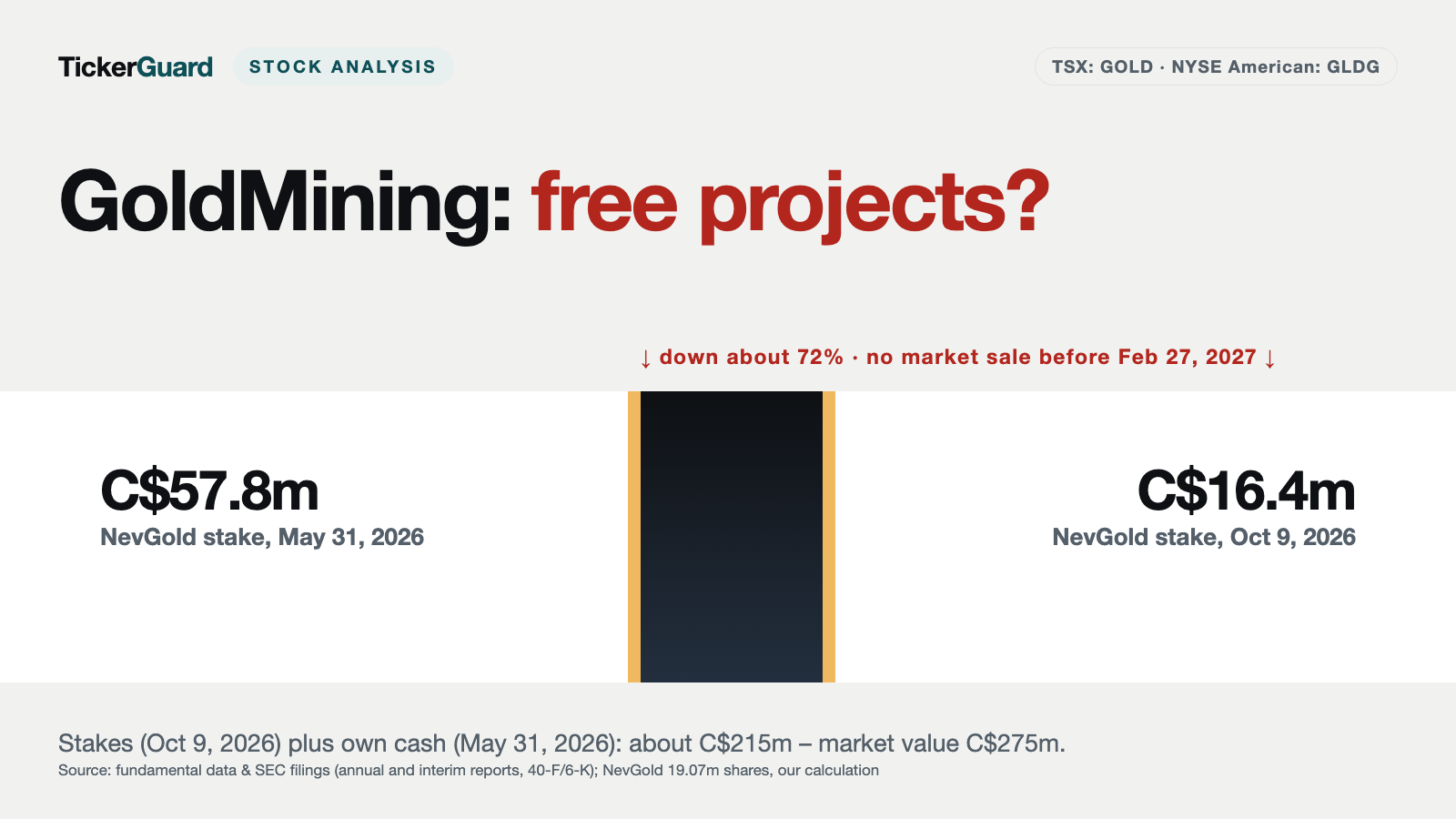
Cash and stock stakes almost equal the entire market value, GoldMining (TSX: GOLD, NYSE American: GLDG) writes in its mid-year letter — so the projects come nearly for free. We checked the math: the value of the NevGold stake alone shrank by about 72 percent to C$16.4 million between May 31 and October 9, 2026, and GoldMining cannot sell it through a stock exchange before February 27, 2027. It is free-bonus math our brains love to fall for — so we add up every drawer.
 Thomas Mücke
Founder & Publisher
Thomas Mücke
Founder & Publisher
As of Today
As of: October 13, 2026
- Closing price
- 1.30 C$ 0.00%
- Market Capitalisation
- 0.3 C$B
Price change since October 9, 2026: +1.6%
This analysis has a cut-off date. The Stock Guard tells you when something material changes in the numbers. Reserve your free spot
Chart
Interactive price chart (TradingView).
Last price: 1.30 C$ (As of: October 13, 2026)
Note: pure fact-based analysis, not investment advice and not a solicitation to buy or sell. All figures without guarantee.
You know the feeling when a store sign says “buy two, get the third free”? The third item feels like a gift, even though its price is baked into the first two. Behavioral economist Richard Thaler calls this mental accounting: we sort money into separate drawers in our heads and add up each drawer on its own. Let’s call it the free-bonus trap.
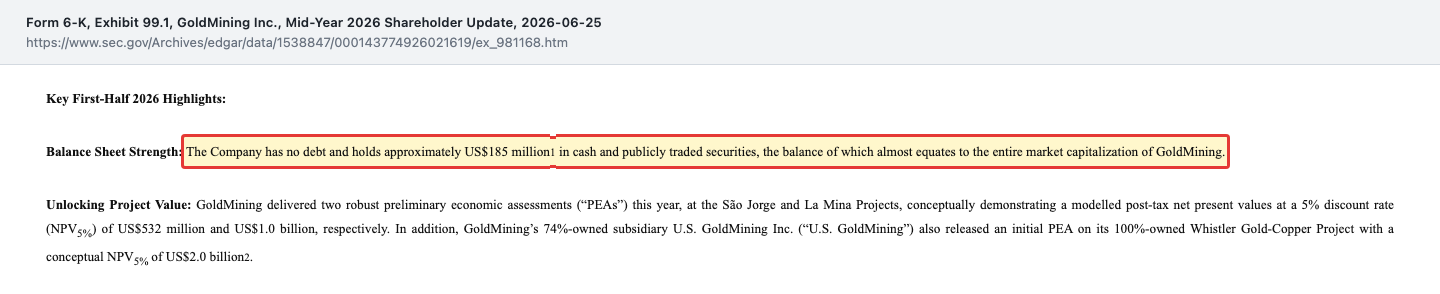
GoldMining practically invites this math. In its mid-year letter to shareholders of June 25, 2026, right at the top under “Balance Sheet Strength,” it says:
“The Company has no debt and holds approximately US$185 million in cash and publicly traded securities, the balance of which almost equates to the entire market capitalization of GoldMining.”
— GoldMining Inc., Form 6-K of June 25, 2026, Exhibit 99.1: Mid-Year 2026 Shareholder Update
The message: buy the stock and you get the cash and the stakes at a fair price — plus about 13 million gold-equivalent ounces in Brazil, Colombia, Peru and Canada almost for free. That is the central tension of this analysis: is GoldMining a holding company trading at a discount, or an explorer that burns cash and issues shares? Let’s read the filings with the U.S. securities regulator, the SEC, together. In the end, you decide.
What GoldMining actually does
GoldMining is an explorer based in Vancouver: it acquires and advances gold and gold-copper projects in the Americas, but it produces nothing and has no revenue. It was founded in 2009 as Cor Resources, operated as Brazil Resources from 2010 to 2016 and has carried its current name since December 6, 2016. As of November 30, 2025, it had 43 full-time employees — 11 in Canada and 32 in Brazil and Colombia. The annual report spells out the business model itself: acquire and advance projects, look for partners, spin out or sell assets.
The portfolio has two halves:
- Its own projects. The most important are São Jorge (Pará state, Brazil), La Mina and Titiribi (Antioquia, Colombia). Then there are Yarumalito (Colombia), Cachoeira (Brazil), Crucero (Peru) and Yellowknife (Canada). According to the annual report for fiscal 2025, measured and indicated resources add up to 13.15 million gold-equivalent ounces, with another 9.02 million inferred. Gold equivalent means copper, silver and antimony are converted into gold at assumed prices.
- Stock stakes. As of May 31, 2026, GoldMining held 10,000,751 shares of U.S. GoldMining (Nasdaq: USGO), which owns the Whistler project in Alaska, plus 21,533,125 shares of Gold Royalty (NYSE American: GROY), 19,073,350 shares of NevGold (TSX Venture Exchange: NAU) and 84,429,563 shares of Australian Mines (ASX: AUZ). There is also a tiny position of 100,000 Galleon Gold shares (about C$0.1 million), which we leave out of the math. Australian Mines can earn up to 80 percent of the Brazilian Boa Vista project through spending, payments and a feasibility study.
A resource is not a reserve: it describes how much metal geologists estimate is in the ground, not how much can be mined profitably. GoldMining reports no reserves for any project.
Company history for investors
-
2009
Founded as Cor Resources
Incorporated on 09/09/2009 in British Columbia, operating as Brazil Resources from 2010. For shareholders, the start of a project collector focused on Brazil.
-
2016
New name: GoldMining
GoldMining Inc. under Canadian federal law since 12/06/2016. The new name dropped the Brazil label; today the portfolio reaches Colombia, Peru, Canada and Alaska.
-
2023
U.S. GoldMining IPO
On 04/24/2023, subsidiary U.S. GoldMining (Whistler, Alaska) listed on the Nasdaq. GoldMining kept the majority — and with it a second explorer risk.
-
2025
Boa Vista and NevGold
Earn-in deal with Australian Mines for Boa Vista (July 2025); NevGold stake cut to 16.7%, with market sales of the remaining shares barred until 02/27/2027.
-
2026
Studies and restatement
Studies for Whistler (03/02), La Mina (04/28) and São Jorge (06/11/2026); in the 07/14/2026 interim report, a correction of how the subsidiary’s warrants are accounted for.
How the stock landed on our desk
This one did not come from a hit in our in-house stock scanner. It made our research list through the forum rankings of wallstreet-online, which show the stocks German retail investors are discussing most (as of October 13, 2026). That is a signal of attention, not of quality.
The home exchange is the Toronto Stock Exchange, where GoldMining trades as GOLD in Canadian dollars. In the U.S., the stock trades on the NYSE American as GLDG, and in Frankfurt as BSR. Watch out: the U.S. symbol GOLD belongs to a different company, the precious-metals dealer Gold.com — we cover it in a separate analysis of Gold.com.
GoldMining is registered with the SEC but reports under the simplified Canadian system: its annual report is Form 40-F, which contains the Canadian Annual Information Form, the MD&A (management’s discussion and analysis) and the audited financial statements. Interim reports are furnished on Form 6-K. The accounts follow IFRS in Canadian dollars and are audited by PricewaterhouseCoopers. The fiscal year ends November 30, so the “second quarter of 2026” in the reports covers March through May 2026.
The latest periodic report covers the period ended May 31, 2026, and was filed on July 14, 2026. Only two filings followed: the technical report for the São Jorge study (July 22) and the first drill results from Yarumalito (October 6, 2026: 399.9 meters at 0.45 grams of gold equivalent per tonne from surface). The report for the period ended August 31, 2026, had not been filed as of October 13, 2026; last year, the equivalent report came out on October 10.
The numbers over the years — honestly assessed
An explorer has no revenue to praise. What can be praised is output: in 2026, GoldMining put out three economic studies (La Mina, São Jorge and, through U.S. GoldMining, Whistler). A first economic study — a preliminary economic assessment, or PEA — came out for São Jorge (June 11) and an updated one for La Mina (April 28), and U.S. GoldMining had already published one for Whistler on March 2. São Jorge saw its largest exploration program to date in 2025, with 9,533 meters of drilling, and GoldMining has no long-term debt, according to its MD&A. Shareholders’ equity stood at C$226.6 million on May 31, 2026.
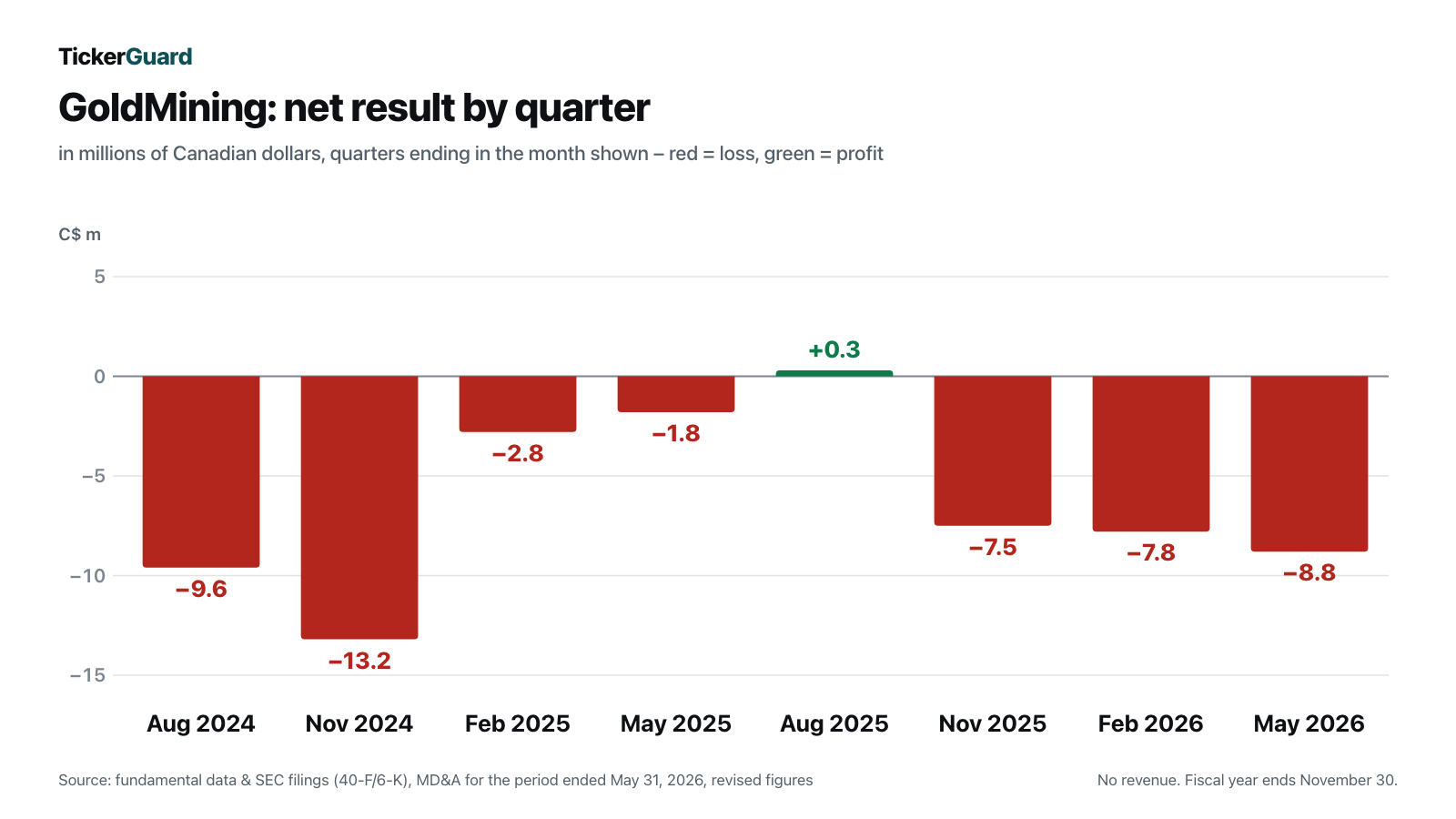
The flip side shows up in the bottom line. It swings widely, because tax effects on the stakes and fair-value changes hit the income statement on top of exploration and overhead.
Cash flow says more than the loss. Operating cash outflow was C$22.5 million in fiscal 2024, C$23.2 million in fiscal 2025 and C$12.6 million in the six months ended May 31, 2026. Exploration spending in the half year rose from C$1.6 million to C$4.7 million, mainly for São Jorge (C$1.4 million) and for Whistler at U.S. GoldMining (C$2.2 million). On May 31, 2026, cash stood at C$21.4 million — C$8.2 million of it at U.S. GoldMining.
One detail from the interim report deserves a mention: in the quarter ended May 2026, GoldMining corrected how it accounts for the warrants U.S. GoldMining issued at its 2023 IPO. According to the MD&A, they should have been carried as a liability at fair value from the start, not as equity. All prior periods were revised. As a result, the fiscal 2025 loss shrinks from C$15.3 million to about C$11.8 million (the sum of the four revised quarters), while the loss for the quarter ended November 2024 grows from C$9.4 million to C$13.2 million. The amounts are small — but the correction came three years after the IPO.
What the filings say — the uncomfortable truths
Now let’s set the free-bonus math aside and read the fine print. What follows is not from the investor presentation but from the reports GoldMining files with the SEC.
Uncomfortable truth No. 1: “Almost the entire market value” is not cash
Only a small part of the US$185 million in the mid-year letter is actual cash. The letter takes cash as of February 28, 2026, and values the stakes at June 24, 2026, prices. According to the MD&A as of May 31, 2026, the biggest item was the majority stake in U.S. GoldMining — itself an explorer without revenue, whose value hinges on a single project in Alaska. And its cash is off-limits to GoldMining:
“Cash and cash equivalents of $8.2 million and other current assets of $0.5 million held by U.S. GoldMining are solely for the operations of U.S. GoldMining and are not available for use by GoldMining or its subsidiaries.”
— GoldMining Inc., Form 6-K of July 14, 2026, Exhibit 99.2: MD&A for the period ended May 31, 2026, Liquidity and Capital Resources
Since the letter, the prices of the stakes have moved a lot. We multiplied the share counts from the MD&A as of May 31, 2026, by the October 9, 2026, closing prices (U.S. dollar values at C$1.4257 per US$):
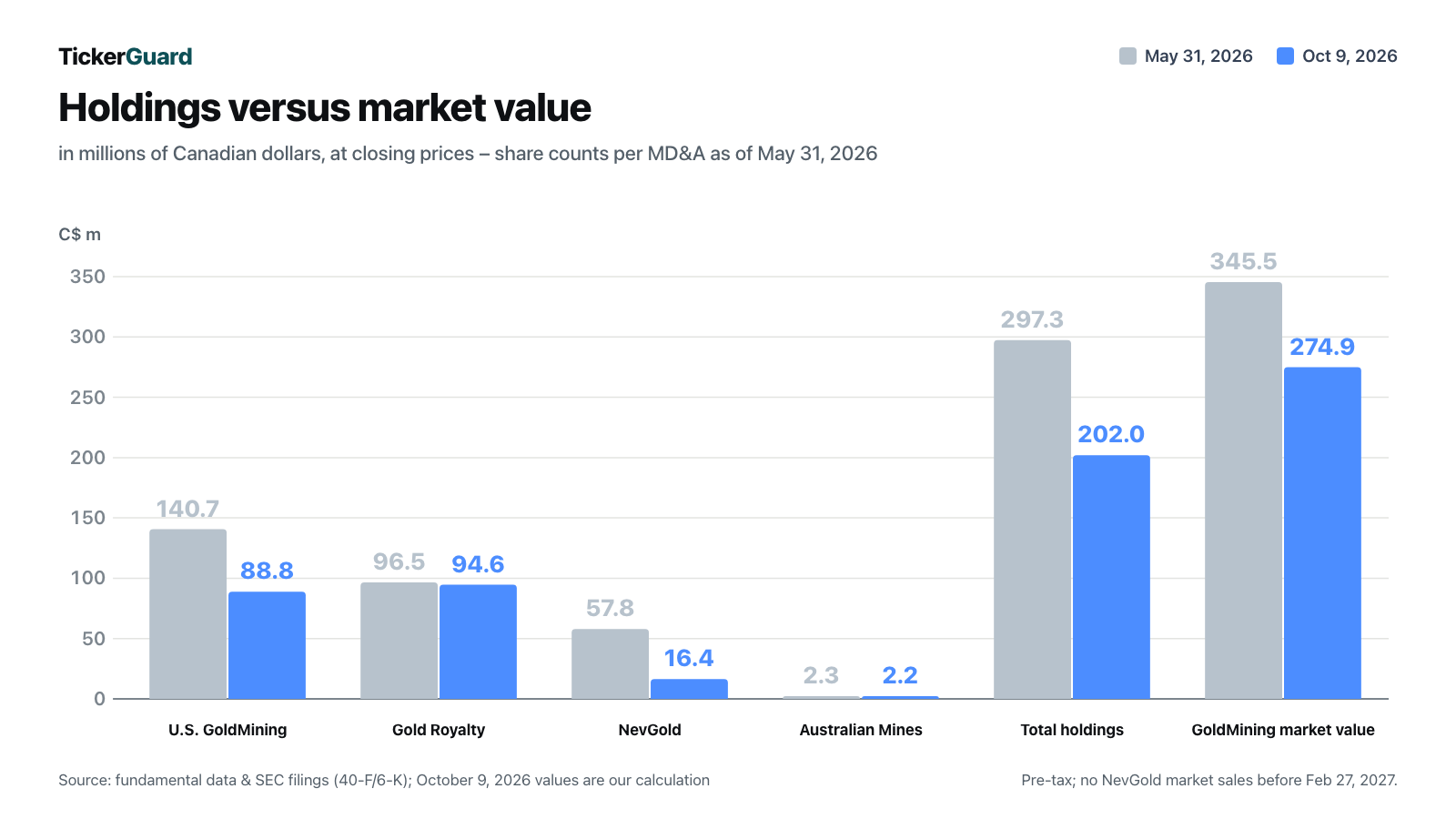
Stake by stake: U.S. GoldMining fell from C$140.7 million to C$88.8 million, Gold Royalty from C$96.5 million to C$94.6 million, NevGold from C$57.8 million to C$16.4 million (down about 72 percent) and Australian Mines from C$2.3 million to C$2.2 million. That leaves about C$202 million against a market value of about C$275 million — a difference of about C$73 million. Add GoldMining’s own cash, as the letter does (C$13.3 million as of May 31, 2026: consolidated cash of C$21.44 million minus C$8.17 million held at U.S. GoldMining), and it is about C$215 million, still about C$60 million short of the market value. To be fair: by the letter’s own math, its statement held on June 24, 2026 (US$185 million versus US$191 million); the gap opened mainly because the stakes lost value afterward. Even that is generous: under an agreement of August 27, 2025, GoldMining cannot sell its NevGold shares on the market until February 27, 2027. Stakes this size would also be hard to sell on the market without a discount — GoldMining owns roughly 71 percent of all U.S. GoldMining shares by our math. And gains are taxable: the May 31, 2026, balance sheet carries a C$9.9 million deferred tax liability that, according to the MD&A, stems from remeasuring the investments. Counting the stakes as cash is exactly the drawer math from the beginning.
Uncomfortable truth No. 2: About 60 percent of the resources sit in a municipality that restricts mining
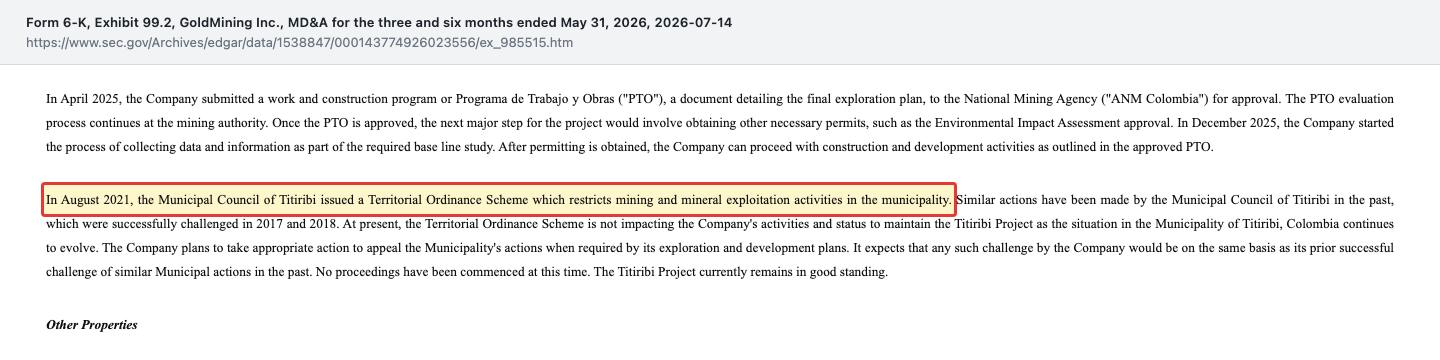
The 13.15 million ounces of measured and indicated resources are spread unevenly. According to the annual report, Titiribi in Colombia alone accounts for 1.69 million gold-equivalent ounces measured and 6.20 million indicated — about 60 percent combined. And the MD&A says this about Titiribi:
“In August 2021, the Municipal Council of Titiribi issued a Territorial Ordinance Scheme which restricts mining and mineral exploitation activities in the municipality.”
— GoldMining Inc., Form 6-K of July 14, 2026, Exhibit 99.2: MD&A for the period ended May 31, 2026, Titiribi Gold-Copper Project
To be fair, here is what comes right after: GoldMining successfully challenged similar measures in 2017 and 2018, the ordinance does not currently affect its work, and the project remains in good standing. But GoldMining has not started any proceedings so far, and the Titiribi work plan has been awaiting approval by the mining agency since April 2025. Then there is the age of the numbers: the Titiribi resource comes from a technical report with an effective date of June 14, 2021, Yellowknife’s from 2019 and Cachoeira’s from 2013. A large part of the 13 million ounces rests on estimates that are several years old.
Uncomfortable truth No. 3: A closely tied company holds the future royalties
If a project ever becomes a mine, a royalty comes off the top of every dollar of revenue. At GoldMining, part of that belongs to Gold Royalty: according to the annual report, 2 percent on La Mina, 2 percent on Titiribi (the only one there besides government royalties), 1 percent on São Jorge (plus another 1 percent for Osisko Gold Royalties and 1.5 percent for Brazil’s mining agency) and 1 percent on Whistler (plus 2.75 percent for Osisko Mining (USA) and a 2.0 percent net proceeds royalty for Sandstorm Gold). Gold Royalty is not a stranger. Its CEO, David Garofalo, is also co-chairman of GoldMining’s board, and the annual report describes the web of roles itself:
“As a result of their positions with GRC, they may have a potential conflict of interest with respect to the royalty purchase agreement between the Company and GRC and ongoing matters relating to GRC's royalties and other interests on properties owned by the Company and its other subsidiaries.”
— GoldMining Inc., Form 40-F of February 27, 2026, Exhibit 99.1: Annual Information Form, Risk Factors, Possible Conflicts of Interest of Directors and Officers of GoldMining
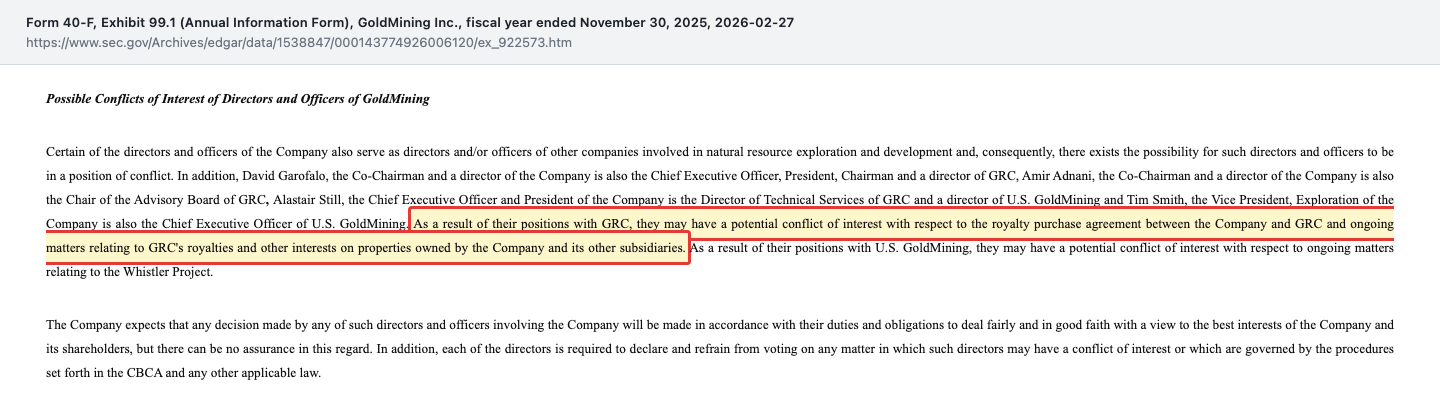
The list of dual roles is long. Co-chairman Amir Adnani founded and runs Uranium Energy Corp. and, with 6,873,919 shares, holds the largest stake among directors and officers. CFO Pat Obara has also been Senior Vice President at Uranium Energy since October 2024, and two more directors sit on Uranium Energy’s board. For shareholders, that means key people split their time among several listed companies. CEO Alastair Still is a director of U.S. GoldMining, and exploration chief Tim Smith is its CEO. And Blender Media, the agency that handles the website and videos, is controlled by a family member of the co-chairmen, according to the MD&A; the amounts are small. Directors and officers together owned 4.3 percent of the shares, per the annual report. According to the annual report, each director is required to declare a possible conflict of interest and refrain from voting on the matter concerned (so says the risk factors section; the conflicts of interest section says affected directors may be required to abstain). For shareholders, that means: in contracts with Gold Royalty, some of the same people sit on both sides, exactly as the annual report itself describes as a possible conflict of interest.
Uncomfortable truth No. 4: Someone else would have to pay for the mines
The two new studies sound big. For São Jorge, GoldMining cites an after-tax net present value of US$532 million; for La Mina, US$1.0 billion. Net present value (NPV, here discounted at 5 percent) is today’s value of all future surplus cash from a hypothetical mine after subtracting the investment. Both studies assume US$3,500 per ounce of gold, and both partly rely on inferred resources, which the company itself calls too speculative geologically to be turned into reserves. At La Mina, the NPV rose 265 percent versus the previous study, according to the April 28, 2026, release — which the company attributes to current costs and higher metal prices.
The decisive number sits further down in the releases: initial capital of US$202 million for São Jorge and US$523 million for La Mina, together US$725 million. GoldMining’s entire market value was about US$193 million on October 9, 2026. Where the money would come from, the MD&A answers only in general terms:
“The Company's growth and success is dependent on external sources of financing, which may not be available on acceptable terms or at all.”
— GoldMining Inc., Form 6-K of July 14, 2026, Exhibit 99.2: MD&A for the period ended May 31, 2026, Liquidity and Capital Resources
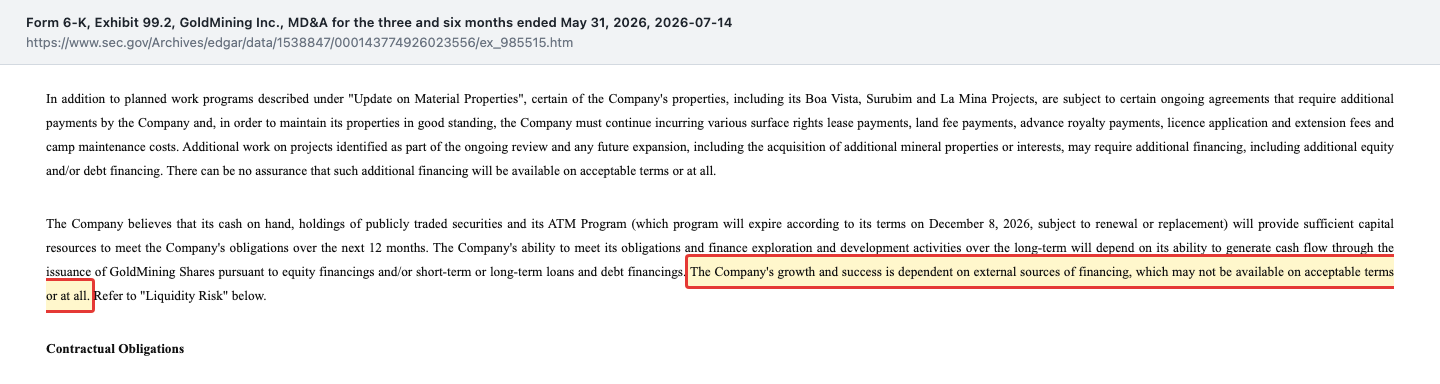
So far, shareholders foot the bill. Through the at-the-market program, which sells new shares on the exchange continuously, GoldMining raised C$21.3 million from 13,033,493 shares in fiscal 2025 and C$10.1 million from 4,770,576 shares in the six months ended May 31, 2026. The share count rose from 183.3 million (November 30, 2023) to 214.8 million (July 14, 2026), an increase of just over 17 percent, plus 15.3 million options outstanding. For a mine, that is pocket change. GoldMining could only build a mine with a partner, with debt or with a great many new shares — or it sells the project, which its own strategy expressly allows.
Valuation: What the market pays for the projects
With 214,799,168 shares (as of July 14, 2026) and a TSX close of C$1.28 on October 9, 2026, GoldMining is worth about C$275 million (all prices in this article are as of October 9, 2026; the metric tiles above show the current values). The highest close of the past twelve months was C$2.92 (January 26, 2026), the lowest C$1.16 (July 16, 2026). At the end of June 2025, a good year before that low, the stock was at C$0.98.
Classic metrics like the price-to-earnings ratio don’t exist for an explorer. As a rough guide, here is the sum-of-the-parts math: market value of C$274.9 million, minus about C$202.0 million for the stakes (October 9, 2026), minus GoldMining’s own cash excluding U.S. GoldMining of C$13.3 million (C$21.44 million minus C$8.17 million, May 31, 2026). That leaves about C$60 million that the market assigns to all of GoldMining’s own projects combined — less than a tenth of the NPVs the studies cite for São Jorge and La Mina alone. Subtract the C$9.9 million deferred tax liability as well, and it is just under C$50 million. That is the optimistic reading. Explorers are also commonly measured by the price paid per ounce in the ground: by our math, about C$60 million for 13.15 million ounces of measured and indicated resources works out to roughly C$4.50 per ounce (inferred ounces not counted; Whistler is not included, it sits inside the U.S. GoldMining stake). Such a low price fits the findings above: Titiribi, the funding gap, and the royalties that would come off the top of any revenue. The cautious reading: the stakes are counted before taxes, partly barred from market sales or not sellable without a discount, and the study values assume someone invests US$725 million. The price-to-book ratio is about 1.2 (shareholders’ equity of C$226.6 million as of May 31, 2026).
For a neighbor in the same Colombian gold belt that drills heavily, see our analysis of Collective Mining — its Guayabales project lies about 10 kilometers from Yarumalito, according to GoldMining. For what it looks like when gold is actually being produced in Pará state, see the analysis of Serabi Gold.
Opportunities and risks at a glance
What speaks for the company:
- No debt. No long-term debt, according to the MD&A; shareholders’ equity of C$226.6 million (May 31, 2026).
- Large resource base. 13.15 million gold-equivalent ounces measured and indicated, 9.02 million inferred, plus Whistler through U.S. GoldMining.
- Tradable stakes. Shares of U.S. GoldMining, Gold Royalty, NevGold and Australian Mines, worth about C$202 million combined on October 9, 2026.
- New studies. NPVs of US$532 million (São Jorge) and US$1.0 billion (La Mina) at US$3,500 gold; São Jorge with a comparatively low initial capital of US$202 million.
- News flow. Remaining Yarumalito assays, drilling at São Jorge, preparation of a more detailed pre-feasibility study for São Jorge.
What speaks against it:
- No revenue. C$12.6 million operating cash outflow in the six months ended May 31, 2026, funded by continuous share sales.
- Stakes are not cash. U.S. GoldMining is itself an explorer, NevGold cannot be sold on the market until February 27, 2027, and gains are taxable.
- Titiribi. About 60 percent of measured and indicated resources sit in a municipality with mining restrictions since 2021.
- Entanglements. Gold Royalty holds royalties on the main projects, and its CEO is co-chairman of GoldMining; close ties to Uranium Energy.
- Funding gap. US$725 million in initial capital for São Jorge and La Mina, almost four times the market value.
- Countries and prices. Projects in Brazil, Colombia and Peru; every study value depends on the gold price.
A human conclusion
Remember the free-bonus trap from the beginning? GoldMining really has built value over the years: four significant listed stakes, a large resource base and, in 2026, two studies of its own plus one from its subsidiary for Whistler. There is no debt. For an explorer, that is a remarkable starting position.
But the projects don’t come free in the box. The U.S. GoldMining stake, the biggest in June, is itself an explorer, another cannot be sold on the market until February 2027, and about 60 percent of the measured and indicated ounces sit where the municipal council restricts mining. Gold Royalty, whose CEO sits on GoldMining’s own board, holds royalties on the main projects La Mina, Titiribi, São Jorge and Whistler that would come off the top of any production. To be fair: with 21.5 million Gold Royalty shares, GoldMining itself shares in the value of those rights. And before studies become mines, someone has to find hundreds of millions of dollars. The milestones are clear: the interim report for the period ended August 31, 2026, the fate of the at-the-market program after December 8, 2026, the remaining Yarumalito assays and the end of the NevGold lock-up on February 27, 2027. Feel free to count in drawers — but add them all up at the end.
What you make of it is your decision. And that is how it should be.
Sources and data cutoff
- MD&A for the period ended May 31, 2026 and interim financial statements as of May 31, 2026 (Form 6-K of July 14, 2026)
- Annual report for the fiscal year ended November 30, 2025 (Form 40-F of February 27, 2026): Annual Information Form, MD&A, consolidated financial statements (audited by PricewaterhouseCoopers LLP)
- Releases (Form 6-K): mid-year shareholder letter (June 25, 2026), São Jorge study (June 11, 2026), La Mina study (April 28, 2026), São Jorge technical report (July 22, 2026), Yarumalito drill results (October 6, 2026), renewal of the at-the-market program (December 8, 2025), 2026 management information circular
- U.S. GoldMining Inc.: quarterly report (10-Q) of August 12, 2026 (14,035,736 shares as of August 12, 2026)
- All GoldMining filings with the SEC (CIK 1538847)
- Price and market-value data for GoldMining, U.S. GoldMining, Gold Royalty, NevGold and Australian Mines as well as exchange rates: source fundamental data, as of October 9, 2026
Data cutoff: Company figures as of May 31, 2026, or the date stated; share count as of July 14, 2026; SEC filings through October 6, 2026, last checked on October 13, 2026 — the interim report for the period ended August 31, 2026, was not yet available. The reporting and trading currency is the Canadian dollar (C$); the studies are in U.S. dollars. The fiscal year ends November 30. Calculated values (value of the stakes on October 9, 2026, at unchanged share counts, sum-of-the-parts math, market value in U.S. dollars, revised fiscal 2025 loss as the sum of the quarters, Titiribi’s share of resources) are our estimates and labeled as such. GoldMining puts its U.S. GoldMining stake at about 74.1 percent as of May 31, 2026; after U.S. GoldMining’s June 2026 placement, it is about 71 percent by our math. The metric tiles on this page show the current database values with their own rounding and may differ from the figures used here.
Note: This article is journalistic analysis, not investment advice and not a solicitation to buy or sell securities. Shares of exploration companies without revenue are especially volatile and depend on drill results, metal prices, financing and country risk; a total loss of the capital invested is possible. Positions held by the operator are disclosed daily; where one exists, it appears as a notice at the top of this deep dive.
Our Bottom Line at a Glance
- Balance sheet and stakes positive
- No long-term debt, shareholders’ equity of C$226.6 million (May 31, 2026); four significant listed stakes worth about C$202 million on October 9, 2026.
- Projects and studies neutral
- 13.15 million gold-equivalent ounces measured and indicated, new studies for São Jorge and La Mina (2026). About 60 percent of resources sit at Titiribi, where the municipality has restricted mining since 2021; no reserves.
- Cash and funding negative
- C$12.6 million operating cash outflow in the six months ended May 31, 2026; own cash excluding U.S. GoldMining C$13.3 million. Funded by continuous share sales; the program expires December 8, 2026.
- Entanglements negative
- Gold Royalty holds royalties on La Mina, Titiribi, São Jorge and Whistler; its CEO is co-chairman of GoldMining, and the annual report flags possible conflicts of interest.
- Path to a mine negative
- US$725 million in initial capital for São Jorge and La Mina per the studies, almost four times the market value on October 9, 2026; the MD&A says growth depends on external financing.
GoldMining is a gold explorer without revenue, with a large resource base, no debt and four significant listed stakes. The mid-year letter’s statement that cash and securities cover almost the entire market value holds up only partly as of October 9, 2026: the U.S. GoldMining stake, the biggest in June, is itself an explorer, another cannot be sold on the market until February 2027, and their value has dropped sharply since June 2026. At the October 9, 2026, close of C$1.28, the company is worth about C$275 million. Not investment advice.
What Our Rating Means
Open questions
The business works in principle, but one material question is open. As long as it stays open, our findings do not carry a quality verdict.
Yellow here is not about the share price, nor about the balance sheet, which is solid for an explorer with no debt and tradable stakes. Red would be wrong: there is no going-concern warning, the auditor issued a clean opinion, and management sees the next twelve months covered by cash, securities and the at-the-market program. What remains open is the core operating question: whether 13 million ounces ever become a mine depends on Titiribi and its mining restriction and on US$725 million of investment that GoldMining does not have. On top come the ties to Gold Royalty, which holds royalties on the main projects and would share in any production. Green would only be possible with secured funding for one project and clarity at Titiribi. The decision is yours.
A journalistic assessment by our editorial team at the time of the deep dive, based on public sources — not investment advice and not a solicitation to buy or sell. Your personal circumstances (investment goals, risk capacity, taxes) cannot be taken into account. What our levels mean, how verdicts are formed, and what conflicts of interest exist →
Worth Noting
- This analysis was triggered by the forum rankings of wallstreet-online (as of October 13, 2026); we track the company under its home listing GOLD (Toronto Stock Exchange) as GOLD.TO. It was not a hit in our in-house stock scanner. The U.S. symbol GOLD belongs to Gold.com, not GoldMining.
- GoldMining is an SEC filer under the Canadian MJDS (CIK 1538847): annual report on Form 40-F, interim reports on Form 6-K. We reviewed the annual report of 02/27/2026 and the interim report as of 05/31/2026 (6-K of 07/14/2026) plus all filings through 10/06/2026. The interim report as of 08/31/2026 was not yet available on 10/13/2026.
- Calculated values are our estimates: value of the stakes on 10/09/2026 from share counts as of 05/31/2026 times closing price (U.S. values at C$1.4257 per US$, Australian Mines at C$0.99 per A$), before taxes; market value from 214,799,168 shares times C$1.28; sum-of-the-parts C$274.9M minus C$202.0M minus C$13.3M.
- Study values (after-tax NPV at a 5 percent discount rate) are company figures from preliminary economic assessments that partly rely on inferred resources; they are neither reserves nor a forecast.
Stock Watch
This analysis is as of October 13, 2026. Stock Watch will tell you what's changed at GOLD.TO since then.
Later $1 a month per stock — signing up is free, and you'll be the first to know when it launches.
The full analysis as a PDF for later
We will send you this analysis as a PDF — to print, file away, and read at your own pace. And we will add you to the free Stock Watch list for GoldMining Inc (GOLD.TO), so you hear about it when something material in this analysis changes.
Frequently Asked Questions
GoldMining is a Canadian explorer based in Vancouver. It owns gold and gold-copper projects in Brazil, Colombia, Peru and Canada and holds a majority stake in U.S. GoldMining, which owns the Whistler project in Alaska. It also holds stakes in Gold Royalty, NevGold and Australian Mines. It has no revenue and no production.
GLDG is GoldMining’s symbol on the NYSE American; on its home exchange in Toronto, the stock trades as GOLD, and in Frankfurt as BSR. Careful: the U.S. symbol GOLD belongs to a different company, the precious-metals dealer Gold.com. TickerGuard tracks GoldMining as GOLD.TO.
U.S. GoldMining is a GoldMining subsidiary that has traded on the Nasdaq as USGO since its April 2023 IPO. It owns the Whistler gold-copper project in Alaska. GoldMining held about 74.1 percent as of May 31, 2026 (about 71 percent by our math after the subsidiary’s June 2026 placement) and fully consolidates it; according to the MD&A, GoldMining may not use its cash.
According to the MD&A for the period ended May 31, 2026, GoldMining has no long-term debt. Cash stood at C$21.4 million, C$8.2 million of it at U.S. GoldMining. The company funds operations by continuously selling new shares on the exchange and through its stakes in other listed companies.
According to the annual report, Gold Royalty holds royalties on La Mina and Titiribi (2 percent each) and on São Jorge and Whistler (1 percent each). GoldMining owns 21.5 million Gold Royalty shares. Gold Royalty CEO David Garofalo is co-chairman of GoldMining; the annual report flags possible conflicts of interest.
In August 2021, the municipal council of Titiribí, Colombia, issued a territorial ordinance that restricts mining. GoldMining successfully challenged similar measures in 2017 and 2018; according to the MD&A, the ordinance does not currently affect its work. Titiribi accounts for about 60 percent of measured and indicated resources.
The fiscal year ends November 30. The annual report is filed with the SEC on Form 40-F, interim reports on Form 6-K. The second quarter of fiscal 2026 covers March through May 2026; the report for the third quarter ended August 31, 2026, had not been filed as of October 13, 2026.
Found an error?
Did you spot a factual error, an outdated number, or a typo in this deep dive? Let us know briefly — your report goes straight to the editorial team.