Southland Holdings: a bridge builder with a $1.7 billion backlog — and a balance sheet the sureties now own
Southland builds bridges, tunnels and treatment plants across North America. As of June 30, 2026, its equity stood at minus $248.2 million, its sureties — Berkshire Hathaway Specialty among them — had advanced $209.8 million, and NYSE American has formally notified the company of noncompliance — a plan is due by October 23, 2026. We read the filings to find out who really owns this business today — and what is left for common stockholders.
 Thomas Mücke
Founder & Publisher
Thomas Mücke
Founder & Publisher
As of Today
As of: October 13, 2026
- Closing price
- 0.8063 $ -16.00%
- Market Capitalisation
- 43.0 $M
- Growth Score
- 2/10
- AAQS
- 1/10
Price change since October 12, 2026: -16.0%
This analysis has a cut-off date. The Stock Guard tells you when something material changes in the numbers. Reserve your free spot
Chart
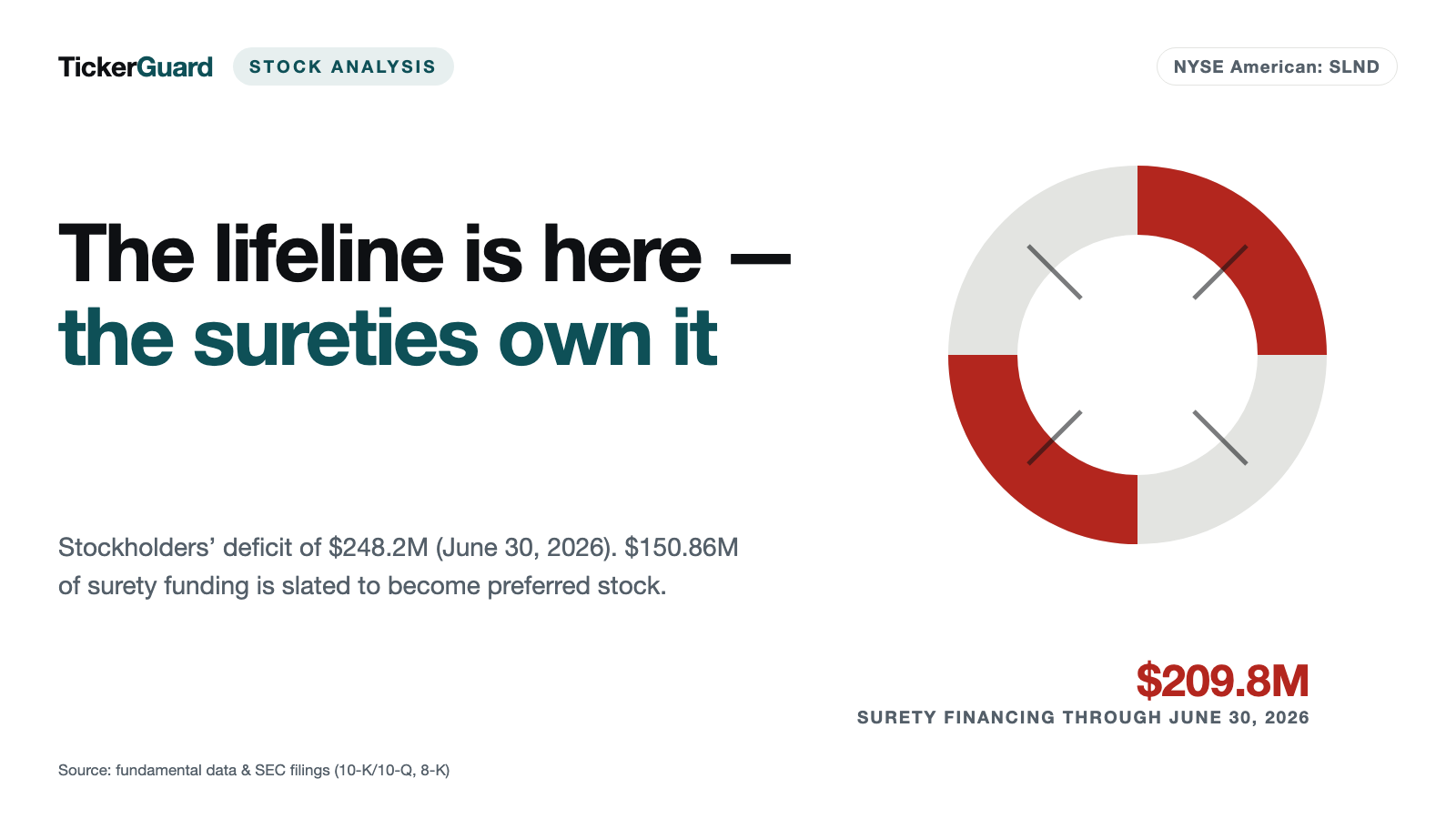
Interactive price chart (TradingView).
52-week range: 0.536 $ to 4.80 $ · Last price: 0.8063 $ (As of: October 13, 2026)
Note: pure fact-based analysis, not investment advice and not a solicitation to buy or sell. All figures without guarantee.
Do you know the feeling when a price tag reads “under one dollar”? Something inside you says: it can hardly go much lower. Behavioral economists call this unit bias: a low share price feels cheap, even though it says nothing about what a company is worth. A stock at 96 cents can be more expensive than one at $500 — it depends on what stands behind it. That is exactly the question at Southland Holdings (NYSE American: SLND) of Grapevine, Texas. Before the merger closed on February 14, 2023, the shares of the blank-check company Legato Merger Corp. II traded at around $10 (closing price on February 1, 2023: $10.26); the Southland stock closed at $0.96 on October 12, 2026, roughly 91 percent lower. On that day alone it jumped 23 percent. Here is the deal: before you let the price tag guide you, let us read together what Southland itself has reported to the U.S. securities regulator, the SEC — the annual reports (10-K) for 2024 and 2025, the quarterly reports (10-Q) through June 30, 2026, and the current reports (8-K) through October 6, 2026. At the end, the decision is yours.
What Southland actually does — bridges, tunnels and water
Southland is a specialist for difficult infrastructure. The holding company owns six subsidiaries with roots going back to 1900: Johnson Bros., American Bridge, Oscar Renda Contracting, Southland Contracting, Mole Constructors and Heritage Materials. The business has two parts. The Civil segment builds water pipelines, pump stations, water and wastewater treatment plants and tunnels. The Transportation segment builds bridges, roads, marine facilities and specialty structures — according to the annual report “many of the most recognizable bridges, convention centers, sports stadiums, marine facilities, and Ferris wheels in the world.” According to the annual report, customers are a mixture of public and private entities — on the public side, for example, state departments of transportation, cities and utilities. Southland had about 1,800 employees as of December 31, 2025.
One detail of the construction business matters for everything that follows: to win public contracts, a contractor needs surety bonds. An insurer guarantees the project owner that the job will be finished, even if the contractor fails. Without these sureties, there are no large public contracts. Think of the sureties as the co-signer on every construction contract. That defines the central tension of this analysis: Southland has a $1.68 billion backlog and a working construction business — but losses from legacy disputes have wiped out its equity, and since then the sureties have been keeping the company alive. Who really owns this business today?
Company history for investors
-
2023
Listing via Legato Merger Corp. II
In February 2023, Southland merges with a blank-check company whose shares had traded at about $10. The same year it exits large-scale concrete and asphalt production; loss of $19.3 million.
-
2024
Loss of $105.4 million
First full-year gross loss since the listing ($63.0 million). For stockholders, this means construction itself now costs more than it brings in. Equity at year-end 2024: $175.4 million.
-
2025
Seattle ruling against American Bridge
In December, the subsidiary loses the convention center dispute, with a judgment of about $89.1 million. Full-year loss of $306.5 million; equity turns negative.
-
2026
March: the sureties take over the loan
The sureties buy $110.0 million of the bank loan, waive defaults and defer interest. Since then they have funded day-to-day operations.
-
2026
August/September: preferred stock and exchange notice
Financial assistance agreement with planned preferred stock of $150.86 million; on September 23, NYSE American notifies Southland of noncompliance over the negative equity.
How the stock landed on our desk
Through our in-house Reddit hype scanner, which flags small U.S. stocks that investor forums are talking about unusually often. Southland was on its list on October 13, 2026. The trading of the previous day shows why: on October 12, 2026, 4.15 million Southland shares changed hands according to fundamental data. The median of the 20 trading days from September 12 to October 9 was about 215,000 shares — that is the typical day, with half of the days above and half below. So roughly 19 times the usual volume traded, and the price rose from $0.78 to $0.96. There was no new SEC filing that day. Attention is a signal, not evidence. A comparison from the same industry helps: our analysis of Everus Construction covers a contractor whose backlog grew 16 percent to $3.23 billion in 2025, on net income of $201.8 million. At Southland, the backlog is shrinking, and there has been no profitable year since 2023.
The numbers over the years — given their due
First, what genuinely impresses: size and skill. Southland generated revenue of $1,161.4 million in 2022 and a virtually unchanged $1,160.4 million in 2023, with net income of $60.5 million in 2022. As of June 30, 2026, its backlog stood at $1.68 billion ($602.5 million in Civil, $1.07 billion in Transportation) — more than two years of revenue at today’s level. In July 2026, Southland announced a new award for the North End Sewage Treatment Plant in Winnipeg. A company that can build bridges and tunnels of this size has capabilities that cannot be copied overnight. The chart shows the flip side:
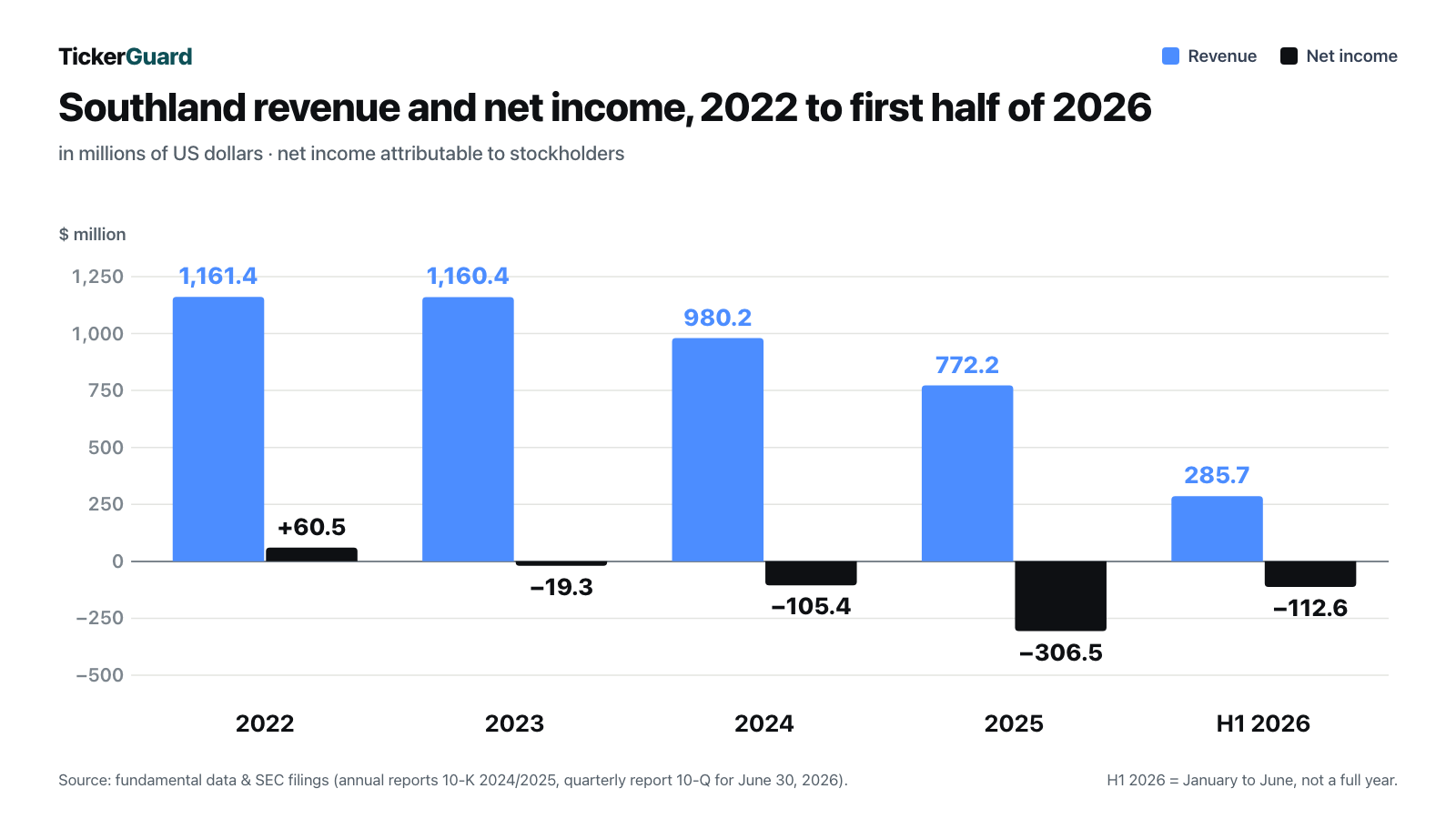
Since going public, Southland has only reported losses: $19.3 million (2023), $105.4 million (2024), $306.5 million (2025) and $112.6 million in the first half of 2026 alone. That adds up to $543.8 million in three and a half years. In 2025, the gross loss was $155.3 million; on top of that came $56.5 million in income tax expense, because Southland recorded a $95.9 million valuation allowance against its deferred tax assets — future tax savings from losses. In other words, the company itself does not expect to offset them against profits any time soon. Backlog shrank from $2.03 billion to $1.68 billion in the first half of 2026; new contracts, change orders and adjustments across both segments added up to minus $68.7 million. Keep in mind: the construction business is large, but it has not made money in a single year since 2023 — and the backlog is being worked off, not refilled.
Uncomfortable truth No. 1: the equity is gone — and the exchange has noticed
Stockholders’ equity is the part of the assets that belongs to the shareholders after all debts are paid. Think of a house worth $300,000 with a $200,000 mortgage — your stake is $100,000. At Southland, the mortgage is now larger than the house. As of June 30, 2026, total assets of $784.7 million faced total liabilities of $1,032.9 million. The chart shows how fast it happened:
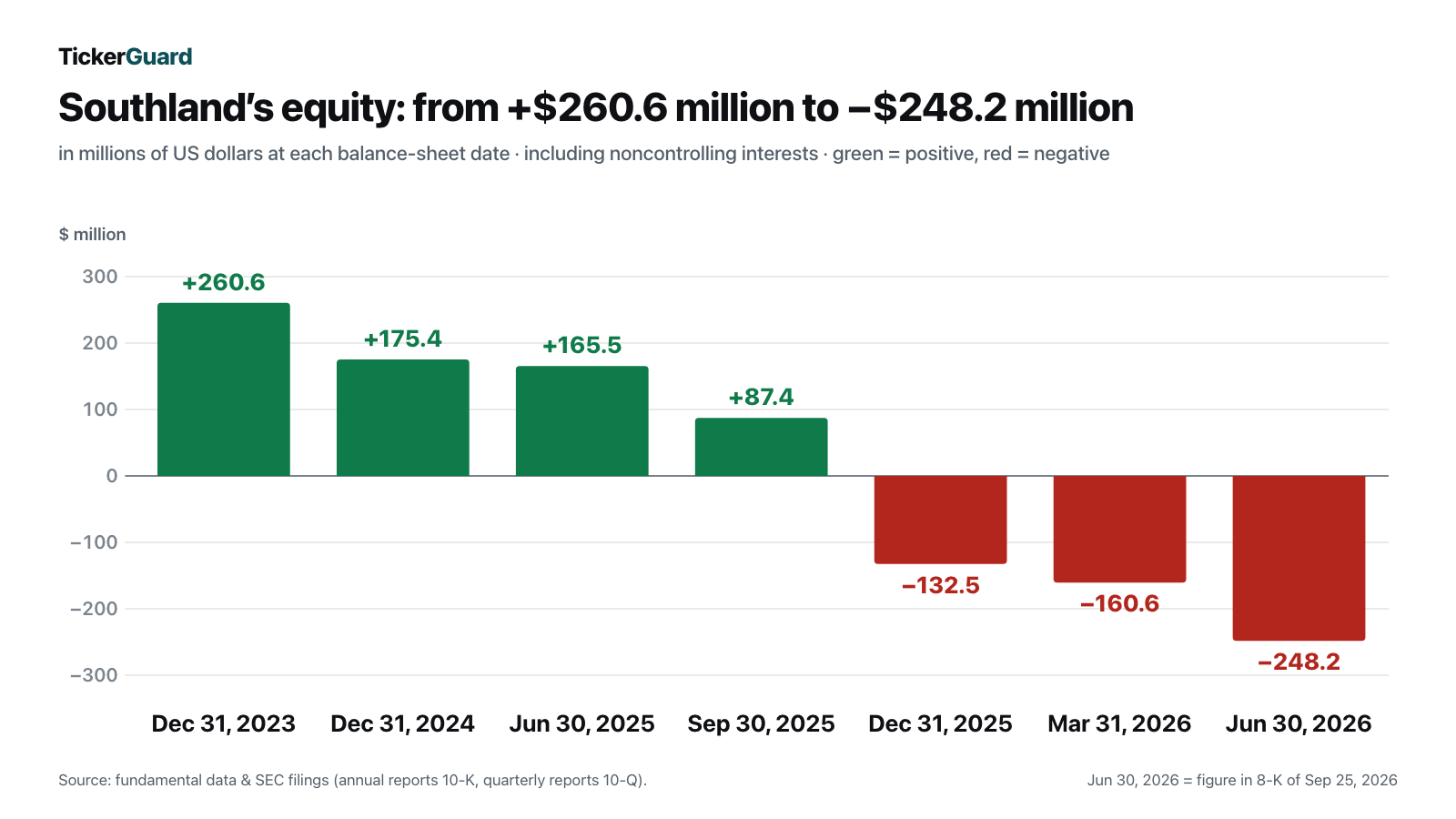
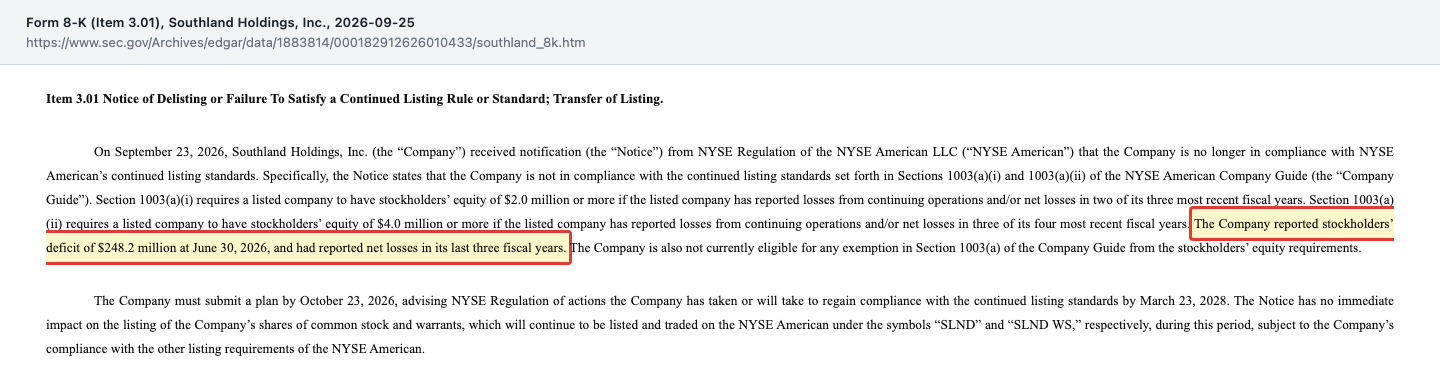
As of December 31, 2024, equity was still $175.4 million, $165.5 million on June 30, 2025, and $87.4 million on September 30, 2025. Then came the fourth quarter of 2025 with a loss of about $216 million (full-year figure minus the first nine months): equity ended 2025 at −$132.5 million and stood at −$160.6 million at the end of March 2026. NYSE American requires companies with losses in three of their four most recent fiscal years to have at least $4.0 million in stockholders’ equity. On September 23, 2026, Southland therefore received an official notice. The current report on it states:
“The Company reported stockholders’ deficit of $248.2 million at June 30, 2026, and had reported net losses in its last three fiscal years.”
— Southland Holdings, SEC current report 8-K of September 25, 2026, Item 3.01
What this means in practice: Southland must submit a plan to the exchange by October 23, 2026 showing how its equity will get back above the threshold by March 23, 2028. If the exchange rejects the plan or Southland does not follow it, delisting proceedings will commence, according to the report. Until then, the stock keeps trading normally. Keep in mind: getting from minus $248 million to plus $4 million in equity is a long way — one good quarter will not do it.
Uncomfortable truth No. 2: the claims are shrinking — and $306 million is still on the books
Where do the losses come from? In 2025 and the second quarter of 2026, mainly from disputes over old projects, as the filings themselves state. That is common in the industry: when the owner changes the plans or the crew hits unexpected ground conditions, the contractor files claims. Southland books such claims as revenue before they are paid — allowed under accounting rules as long as a later reversal is considered unlikely. Think of writing an invoice into your household ledger before the customer has agreed to it. If the customer does not pay, you have to strike it again. That is what happened in December 2025: a court in Washington State ruled against subsidiary American Bridge in the dispute over the Seattle convention center (WSCC), with a judgment of about $89.1 million including fees and interest. And in the second quarter of 2026, Southland reassessed its claims on several projects, including substantially completed ones:
“As a result of this reassessment, the Company reduced the estimated value of certain claims and recorded a cumulative catch-up adjustment, which negatively impacted revenue for the quarter by $102.3 million.”
— Southland Holdings, SEC quarterly report 10-Q as of June 30, 2026, Item 2, section “Revenue”

That is why second-quarter 2026 revenue fell to $113.3 million (prior-year quarter: $215.4 million), the gross loss came to $71.2 million and the net loss to $84.3 million, or $1.55 per share. According to the quarterly report, the hits included a project in the Southeast (gross profit contribution down $31.9 million year over year), two materials-and-paving projects in the Southwest (down $13.3 million) and several water projects. The uncomfortable part: even after these write-downs, $306.4 million of such unresolved contract modifications were still on the books as of June 30, 2026 (end of 2025: $382.3 million). That is almost six times the entire market value. Every further reassessment hits earnings directly — conversely, every dispute won or settled on good terms would strengthen equity directly. The open claims are both the risk and the only real lever. Keep in mind: at Southland, the future is decided not by the next contract award but by the outcome of old disputes.
Uncomfortable truth No. 3: the sureties are at the wheel
After the ruling in December 2025, Southland was in trouble. According to the annual report, a potential event of default under the term loan arose, and availability under the undrawn delayed-draw facility dropped to zero. The company was rescued by its sureties — the insurers that stand behind Southland’s construction contracts, according to the quarterly report among them Berkshire Hathaway Specialty, Markel, Zurich and Hartford. On March 17, 2026, they bought $110.0 million of the bank loan and waived all defaults. Since then, Southland pays 4 percent on the remaining term loan ($96.4 million as of June 30, 2026) instead of 7.25 percent plus a reference rate with a 3 percent floor — and even that interest is added to principal rather than paid in cash. The sureties also advanced money for ongoing projects. In the first half of 2026, operating activities used $171.9 million in cash; $195.7 million came in from the sureties ($14.1 million had already been advanced in 2025 — together the $209.8 million of financial assistance). Without them, the cash balance — $34.9 million as of June 30, 2026 — would have run dry long ago. Repayment is only postponed:
“The sureties have agreed to forbear from seeking repayment of these amounts until at least August 13, 2027.”
— Southland Holdings, SEC quarterly report 10-Q as of June 30, 2026, Note 2 and Item 2, section “Liquidity”

The sureties’ claims thus rose from $103.2 million to $298.9 million in six months: $209.8 million of financial assistance plus $89.1 million stemming from the Seattle judgment, part of which the sureties have already paid and part of which they still have to pay. On August 13, 2026, both sides put the rules into a financial assistance agreement. It provides for deposit account control agreements that let the sureties sweep cash upon a default, restricts bonuses and extraordinary payments to the personally liable shareholders, and allows the sureties to declare everything immediately due if the agreement is breached. And it contains the sentence that matters most for every stockholder in this analysis: the sureties have no obligation to provide additional funding, and any further assistance is at their discretion. Keep in mind: Southland depends on a lender that can say no at any time — and that it cannot replace anyway, because without bonds there are no public contracts.
Uncomfortable truth No. 4: preferred holders now stand ahead of common stockholders
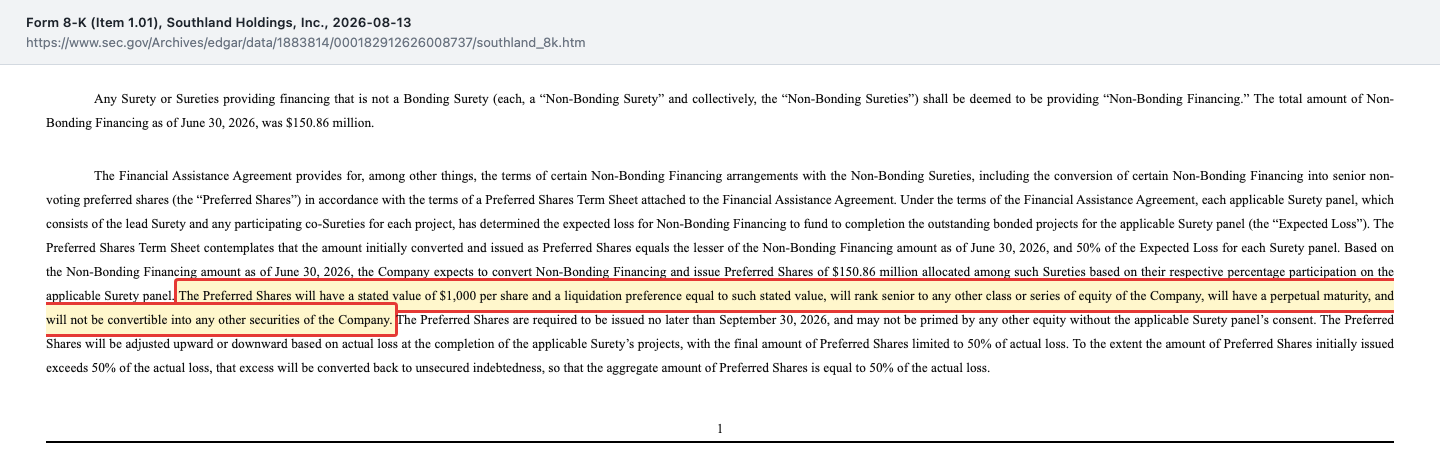
Under the financial assistance agreement, the largest part of the assistance, $150.86 million, is not to remain a loan but to be converted into preferred stock for the sureties. That sounds like relief, because debt turns into equity. For you as a common stockholder, it is a new layer above you. Picture the checkout line: someone with $150 million steps in right in front of you. The terms are in the current report of August 13, 2026:
“The Preferred Shares will have a stated value of $1,000 per share and a liquidation preference equal to such stated value, will rank senior to any other class or series of equity of the Company, will have a perpetual maturity, and will not be convertible into any other securities of the Company.”
— Southland Holdings, SEC current report 8-K of August 13, 2026, Item 1.01
The shares were supposed to be issued by September 30, 2026; on September 30, the deadline was extended to November 13, 2026 (current report of October 6, 2026). The final amount will be trued up to the sureties’ actual losses and capped at half of them. Holders can demand redemption upon specified restructuring or change-of-control events. On paper, the swap would improve equity by up to $150.86 million — but by our own calculation it would still be about −$97 million (−$248.2 million plus $150.86 million). Whether the shares will even count as equity, given those redemption rights, will only become clear in the next report. One more thing: certain shareholders are personally liable to the sureties — the report calls them “Shareholder Indemnitors” without naming them. Provided no default exists and the sureties have forgiven their unsecured assistance, they are released once they pay at least $10.0 million to the holders of that assistance or all preferred shares have been redeemed. A separate finding from the proxy statement of April 2026 shows the balance of power: 51.4 percent of the shares are attributed to CEO Frank Renda, 17.0 percent to executive Rudy Renda, and 73.4 percent to all directors and officers combined. Frank Renda, Rudy Renda and executive Tim Winn each receive an annual personal guarantee fee of $150,000 from Southland. Keep in mind: according to the filing, the personally liable shareholders can be released — provided no default exists and the sureties have forgiven their unsecured assistance — once they pay at least $10.0 million or all preferred shares have been redeemed. Their position therefore differs from that of a pure common stockholder — the interests need not be the same.
Valuation: what is a stock with negative equity worth?
At the closing price of $0.96 (October 12, 2026) and 54,435,257 shares (August 4, 2026, cover of the quarterly report), Southland’s market value comes to roughly $52 million. Southland itself cites closing prices in its filings: $0.92 on March 20, 2026 (annual report 10-K), $1.18 on May 1, 2026, and $0.60 on August 4, 2026 (quarterly reports 10-Q). At the price in the most recent report, the market value would have been roughly $33 million; the gap to the $52 million of October 12 is purely the share price move, and the share count matches the fundamental data. A price-to-earnings ratio does not exist for lack of earnings, and neither does a price-to-book ratio, because book value is negative. The ranking of claims says more: as of June 30, 2026, ahead of you stand $206.8 million of debt ($58.0 million of it due within twelve months) and $298.9 million of surety payables, together $505.7 million — almost ten times the market value. Once the preferred stock is issued, $150.86 million of that becomes paper that is no longer debt but still ranks ahead of you. On top of that, there are 14,385,500 warrants from the merger with an exercise price of $11.50, which play no role at today’s price.
There are bright spots, too. On August 26, 2026, Southland settled with surety Liberty Mutual: in exchange for a $5 million payment, about $36.4 million of losses from the Seattle project are resolved. Southland expects this to improve income before taxes by about $29 million in the third quarter of 2026, but calls the estimate preliminary. Negotiations with surety Zurich over the rest are ongoing. Management writes in the quarterly report that liquidity is sufficient for at least the next twelve months; the report contains no express going-concern doubt. That assessment, however, rests on the deferral and support of the sureties — which have no obligation to keep helping. According to fundamental data, only three analysts cover the stock (data as of October 13, 2026); when they last updated their price targets cannot be told from the data — which is why we do not cite them here.
Upside and risks at a glance
What speaks for Southland:
- Large backlog: $1.68 billion as of June 30, 2026, including work for transportation and water agencies.
- Specialized capabilities in bridge, tunnel and water construction, with businesses whose roots go back to 1900.
- The sureties have advanced $209.8 million so far, deferred interest and principal, and postponed repayment until at least August 13, 2027.
- The Liberty Mutual settlement is expected to improve third-quarter 2026 income before taxes by about $29 million.
- A new award in Winnipeg (July 2026) shows that Southland is still winning work despite the crisis.
What speaks against it:
- Negative equity of $248.2 million (June 30, 2026) and losses in every year since 2023, totaling $543.8 million.
- Noncompliance notice from NYSE American over insufficient equity; without an accepted plan, delisting proceedings will commence.
- Existential dependence on the sureties, which have no obligation to provide further funding.
- $150.86 million of preferred stock is slated to rank ahead of common stockholders by November 13, 2026.
- $306.4 million of unresolved claims still on the books — every reassessment can bring new losses.
A human conclusion
Back to the price tag under one dollar. Unit bias whispers that not much more can happen here. The filings tell a different story: Southland is a real construction company with real bridges and a large order book, but losses from old disputes have consumed its entire equity. Since March 2026, the sureties have kept the company running — with money they want back and with preferred stock that stands ahead of you in line. The exchange has formally notified Southland over its equity, and certain shareholders are personally liable to the sureties — a different position from yours as a pure common stockholder. The construction business can survive this crisis — what remains open is how much of it will still belong to today’s common stockholders. So the honest question for you is not “Is the stock cheap?” but: What is left for a common share once banks, sureties and preferred holders have been paid? What you make of it is your decision. And that is how it should be.
Sources
All original documents used in this analysis — for you to check yourself:
- Southland Holdings, Inc. — SEC quarterly report 10-Q as of June 30, 2026 (filed August 12, 2026)
- Southland Holdings, Inc. — earnings release for the second quarter of 2026, 8-K Item 2.02 with Exhibit 99.1 (August 12, 2026)
- Southland Holdings, Inc. — current report 8-K on the financial assistance agreement with the sureties and the second credit amendment (August 13, 2026)
- Southland Holdings, Inc. — current report 8-K on the Liberty Mutual settlement (August 27, 2026)
- Southland Holdings, Inc. — current report 8-K, Item 3.01, on the NYSE American notice (September 25, 2026)
- Southland Holdings, Inc. — current report 8-K on the extended preferred-share deadline (October 6, 2026)
- Southland Holdings, Inc. — SEC quarterly report 10-Q as of March 31, 2026 (filed May 12, 2026)
- Southland Holdings, Inc. — SEC quarterly report 10-Q as of September 30, 2025 (filed November 12, 2025)
- Southland Holdings, Inc. — SEC annual report 10-K for 2025 (filed March 26, 2026)
- Southland Holdings, Inc. — SEC annual report 10-K for 2024 (filed March 4, 2025)
- Southland Holdings, Inc. — proxy statement DEF 14A for the 2026 annual meeting (April 23, 2026)
- Complete SEC filing history: EDGAR overview (sec.gov) — reviewed after the quarterly report through October 13, 2026, including nine insider filings (Form 4) of August 17 and 18, 2026 (grants and conversions of stock units; none of them an open-market purchase)
- Fundamental data (prices, trading volume, analyst count; data as of October 13, 2026), checked against the SEC filings.
- Hook: in-house Reddit hype scanner, flagged on October 13, 2026 (not a data source for company figures).
Transparency & disclaimer: This analysis is a journalistic assessment of publicly available information. It is not investment advice, not a financial analysis in the regulatory sense and not a solicitation to buy or sell securities. Investing in stocks involves substantial risk, up to and including total loss. All information without guarantee; the data date is noted in the text. Positions held by the operator are disclosed daily; where one exists, it appears as a notice at the top of this deep dive.
Key figures at a glance
All monetary figures in millions of $; earnings per share as reported.
| Metric | 2021 | 2022 | 2023 | 2024 | 2025 |
|---|---|---|---|---|---|
| Revenue | 1,279.2 | 1,161.4 | 1,160.4 | 980.2 | 772.2 |
| Operating Income (EBIT) | 56.1 | 82.7 | -31.4 | -126.3 | -216.9 |
| Net Income | 38.7 | 60.5 | -19.3 | -105.4 | -306.5 |
| Net Margin | 3.0% | 5.2% | -1.7% | -10.7% | -39.7% |
| Earnings Per Share | 1.08 $ | 1.69 $ | -0.41 $ | -2.19 $ | -5.67 $ |
Source: fundamental data & SEC filings (annual and quarterly reports, 10-K/10-Q)
Our Bottom Line at a Glance
- Backlog and capabilities positive
- $1.68 billion backlog as of 06/30/2026, public and private customers; specialized capabilities in bridge, tunnel and water construction, new award in Winnipeg in July 2026.
- Earnings negative
- Losses in every year since 2023, a combined $543.8 million through 06/30/2026; Q2 2026 gross loss of $71.2 million after claims write-downs cut revenue by $102.3 million.
- Balance sheet negative
- Equity of −$248.2 million as of 06/30/2026; NYSE American notice of 09/23/2026, plan due by 10/23/2026. Still $306.4 million of unresolved claims on the books.
- Dependence on the sureties negative
- $298.9 million of surety payables, deferred until at least 08/13/2027; further assistance is at the sureties’ discretion. Without bonds there are no public construction contracts.
- Position of common stockholders negative
- $150.86 million of senior preferred stock planned by 11/13/2026; certain shareholders (not named in the filing) are personally liable to the sureties; separately, 51.4% of the shares are attributed to Frank Renda (DEF 14A, April 2026).
- Settlements as a bright spot neutral
- The Liberty Mutual settlement of 08/26/2026 is expected to improve Q3 2026 pre-tax income by about $29 million (preliminary); talks with Zurich continue.
Southland is a real construction company with a $1.68 billion backlog, but losses from legacy disputes have pushed its equity down to −$248.2 million. Since March 2026 the sureties have funded operations, $150.86 million of their assistance is slated to become senior preferred stock, and NYSE American has notified the company of noncompliance with its equity standards. Not investment advice.
What Our Rating Means
Substance risk
We found at least one documented issue that threatens the company itself — regardless of how the stock is currently valued.
Red, because several substantive risks are documented: negative equity of $248.2 million as of June 30, 2026, an existential dependence on sureties that have no obligation to keep funding, and an NYSE American notice for financial reasons. The construction business itself, with a $1.68 billion backlog, can survive this — whether anything is left for today’s common stock depends on the sureties and on old disputes. The decision is yours.
A journalistic assessment by our editorial team at the time of the deep dive, based on public sources — not investment advice and not a solicitation to buy or sell. Your personal circumstances (investment goals, risk capacity, taxes) cannot be taken into account. What our levels mean, how verdicts are formed, and what conflicts of interest exist →
Worth Noting
- Edition of October 13, 2026, based on the quarterly report 10-Q as of June 30, 2026, and current reports 8-K through October 6, 2026; insider filings (Form 4) through October 13, 2026, were considered. The quarterly report as of September 30, 2026, was not yet available. The hook is our in-house Reddit hype scanner (flagged on October 13, 2026) — an attention signal, not a data source.
- Not to be confused: Southland Holdings (SLND) has nothing to do with Southern Copper (SCCO) or other “Southern” names. Until February 2023, CIK 0001883814 carried the name Legato Merger Corp. II, the blank-check company through which Southland went public.
- Equity in the chart and text includes noncontrolling interests (−$248.2 million as of 06/30/2026, as cited in the 8-K of 09/25/2026); the portion attributable to Southland stockholders was −$253.5 million. The fourth-quarter 2025 loss, the market value, the sum of losses and the pro-forma equity after the preferred conversion (about −$97 million) are our own calculations from the sources cited.
Stock Watch
This analysis is as of October 13, 2026. Stock Watch will tell you what's changed at SLND since then.
Later $1 a month per stock — signing up is free, and you'll be the first to know when it launches.
The full analysis as a PDF for later
We will send you this analysis as a PDF — to print, file away, and read at your own pace. And we will add you to the free Stock Watch list for Southland Holdings, Inc. (SLND), so you hear about it when something material in this analysis changes.
Frequently Asked Questions
Southland Holdings (NYSE American: SLND) of Grapevine, Texas, is a specialty infrastructure contractor. Six subsidiaries, including American Bridge and Johnson Bros., build bridges, tunnels, roads, marine facilities and water and wastewater plants across North America. Its backlog was $1.68 billion as of June 30, 2026, and it had about 1,800 employees at the end of 2025.
Southland has lost a combined $543.8 million since 2023, mainly through written-down claims on old construction projects and a lost lawsuit over the Seattle convention center with a judgment of about $89.1 million. As a result, its stockholders’ equity stood at minus $248.2 million as of June 30, 2026.
NYSE American notified Southland on September 23, 2026, that it no longer meets the equity standards. Southland must submit a plan by October 23, 2026, and regain compliance by March 23, 2028. If the plan is rejected or not followed, delisting proceedings will commence. Until then, the stock trades normally.
The sureties are insurers that guarantee Southland’s construction contracts. Since March 2026 they hold most of the term loan, have provided $209.8 million in financial assistance and are deferring $298.9 million of claims until at least August 13, 2027. They have expressly no obligation to provide further funding.
Southland plans to convert $150.86 million of surety assistance into preferred stock by November 13, 2026. These shares rank senior to all other equity, are perpetual and carry a liquidation preference of $1,000 each. For common stockholders, this means the preferred holders are paid first in a sale or liquidation.
At the closing price of $0.96 on October 12, 2026, and 54.4 million shares, Southland’s market value is about $52 million. As of June 30, 2026, it faced $206.8 million of debt and $298.9 million of surety payables — together almost ten times the market value.
Found an error?
Did you spot a factual error, an outdated number, or a typo in this deep dive? Let us know briefly — your report goes straight to the editorial team.