Antimony Resources: High-Grade Antimony, No Resource and C$11.5 Million in Share-Based Pay
Antimony Resources (CSE: ATMY, OTCQB: ATMYF) wants to fill North America’s antimony gap and repeats two lines in almost every release: 2.7 million tonnes of potential and the highest-grade antimony deposit in North America. There is no resource — the company clarified that in March 2026 after a review by the British Columbia Securities Commission. In early 2026, it also signed contracts with three marketing and media agencies and disclosed them in a release. We read what sits between the repetitions.
 Thomas Mücke
Founder & Publisher
Thomas Mücke
Founder & Publisher
As of Today
As of: October 13, 2026
- Closing price
- 0.209 € +2.96%
- Market Capitalisation
- 25.6 €M
This analysis has a cut-off date. The Stock Guard tells you when something material changes in the numbers. Reserve your free spot
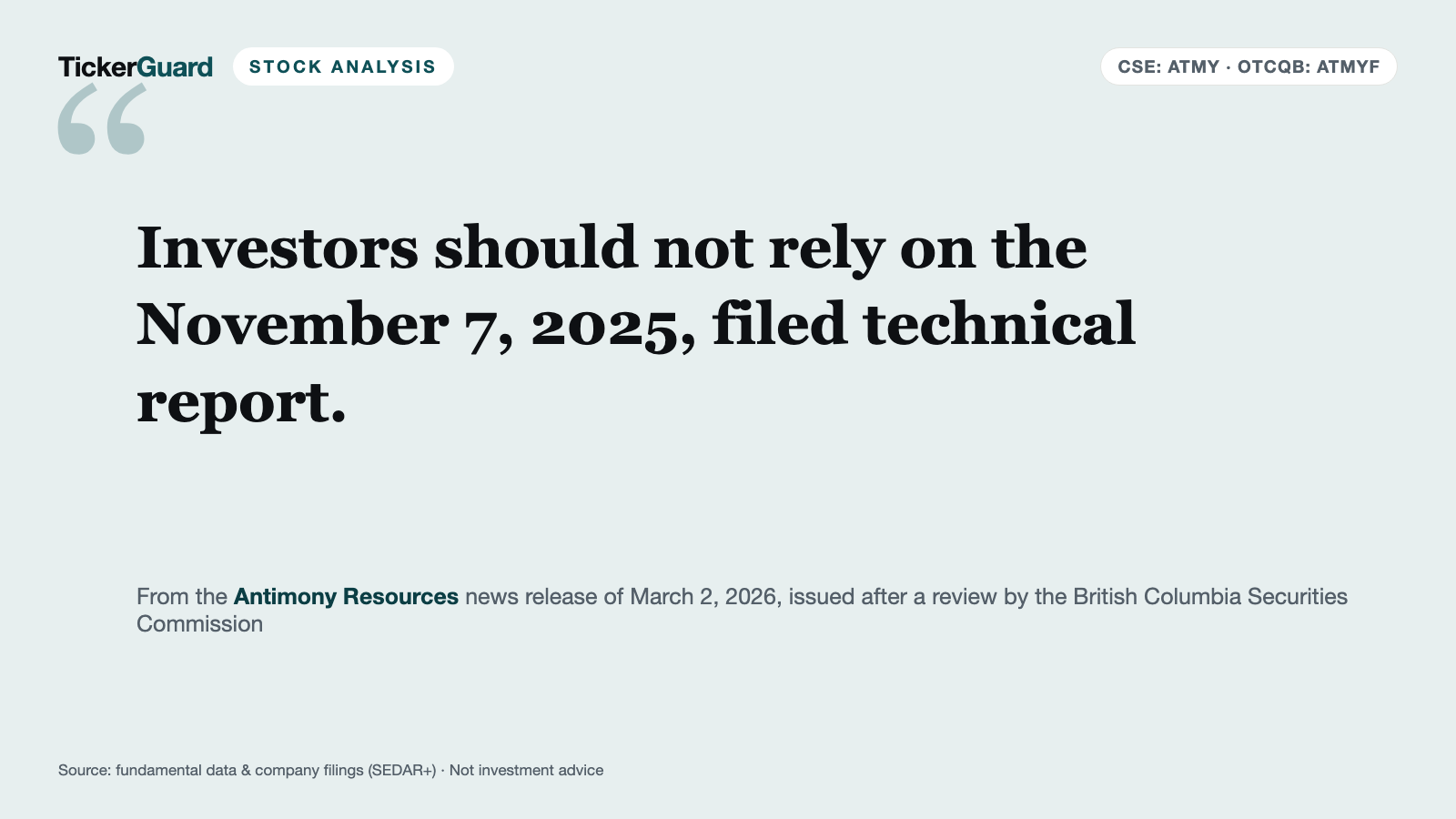
Chart
Too few trading days on record for a price history - here are the key figures.
Last price: 0.209 € (As of: October 13, 2026)
Note: pure fact-based analysis, not investment advice and not a solicitation to buy or sell. All figures without guarantee.
Do you know the feeling? Hear a sentence often enough and at some point you take it as true — simply because it sounds familiar. Psychologists call this the illusory truth effect: in our heads, repetition replaces checking.
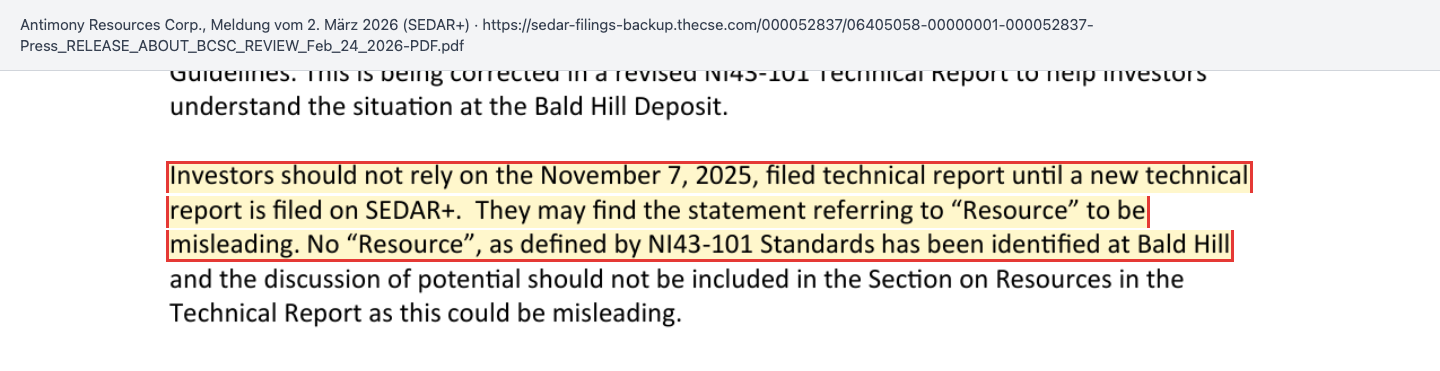
With Antimony Resources, it pays to keep this effect in mind. For months, almost every release from the Canadian explorer has carried two lines: assays indicate that Bald Hill is “the highest-grade antimony deposit in North America,” and a technical report puts the potential at roughly 2.7 million tonnes grading 3% to 4% antimony. On March 2, 2026, however, a company release also contained this:
“Investors should not rely on the November 7, 2025, filed technical report until a new technical report is filed on SEDAR+. They may find the statement referring to ‘Resource’ to be misleading. No ‘Resource’, as defined by NI43-101 Standards has been identified at Bald Hill […]”
— Antimony Resources Corp., release of March 2, 2026, following a review by the British Columbia Securities Commission
The tension in this analysis: antimony is a scarce, strategically sought-after metal, and Bald Hill does deliver high-grade drill intercepts. At the same time, the company has no resource and no revenue, and it books more expense for share-based pay and marketing than goes into exploration. Let’s read the filings together. In the end, the decision is yours.
What Antimony Resources Actually Does
Antimony Resources is a pure explorer: it searches for antimony but mines and sells nothing. Antimony goes into flame retardants, batteries, semiconductors and ammunition. A large share of world output comes from China; in December 2024, Beijing banned antimony exports to the United States (Reuters, December 3, 2024). That gap is the company’s story: “Unlocking North America’s Antimony Potential,” as its website puts it.
The company was incorporated in British Columbia on October 18, 2020, and is based in Surrey near Vancouver. Until March 2025 it was called Big Red Mining and explored for copper in Ontario; it has since abandoned and written off that property and a second antimony option. One project remains:
- Bald Hill (New Brunswick, Canada) — a known antimony occurrence, discovered in 2008. On January 10, 2025, the company secured an option from Globex Mining Enterprises: 100% in exchange for a total of C$2 million in cash, 1.1 million shares and C$5 million of exploration spending over four years. So far, C$225,000 and 500,000 shares have been paid; C$150,000 is due on the second anniversary, C$500,000 on the third and C$1.125 million on the fourth.
There is a lot of drilling. According to the release of May 7, 2026 (misdated April 7 in its header), the company had drilled 77 holes totaling more than 25,000 meters since April 2025. It describes the Main Zone as more than 600 meters long and at least 350 meters deep, with average widths of 4 to 5 meters grading 3% to 4% antimony. Some intercepts are very rich indeed, such as 27.3% antimony over 0.3 meters (release of September 11, 2026). Since June 2026, the company has also reported gold in drill core and, by its own account, the use of artificial intelligence to analyze its drill database.
Company history for investors
-
2021
Listing as Big Red Mining
Trading started on the CSE in November 2021 under RED, then a copper explorer in Ontario. For shareholders, the start of a micro-cap without an antimony project.
-
2025
Bald Hill and a new name
Bald Hill option (January), renamed Antimony Resources (March), technical report with 2.3M to 3.1M tonnes of potential (November), C$9.5M placement at C$0.45 (December).
-
2026
Clarification after a regulatory review
On 3/2/2026 the company concedes Bald Hill has no resource. Highest close C$1.60 on 3/17, 13.3M new shares from RSUs on 5/11, flow-through at C$0.47 in October.
How the Stock Landed on Our Desk
The trigger was not a hit from our in-house stock scanner. The stock made our research list via the hot list of wallstreet-online, the ranking of the stocks most followed by German retail investors (as of October 13, 2026), where it appears under its Frankfurt symbol K8J0. That is a signal of attention, not of quality.
The home exchange is the Canadian Securities Exchange (CSE) in Toronto, a venue for small companies, where the stock trades as ATMY in Canadian dollars. Since November 2025 it has traded over the counter in the US as ATMYF (OTCQB market tier) and in Frankfurt as K8J0. The company is not registered with the SEC. Its mandatory reports are filed under Canadian rules on SEDAR+: interim financial statements with management’s discussion and analysis (MD&A), audited annual statements and technical reports under the NI 43-101 standard. It reports under IFRS in Canadian dollars. The fiscal year ends August 31, so the “nine months” in the latest report run from September 2025 to May 2026.
The latest periodic report is the interim statements as of May 31, 2026, with an MD&A dated July 23, 2026. On July 28, 2026, the company refiled the interim statements because “errors were noted”; we used the corrected version. Since then there have been drilling and gold releases (July 30, August 6 and 14, September 11), an airborne survey of the property (August 28) and a C$5 million flow-through placement (announced September 29, closed October 2, reported October 5, Form 45-106F1 dated October 9, 2026). The annual statements as of August 31, 2026, had not been filed as of October 13, 2026; they are due by the end of December.
The Numbers Over the Years — Credit Where It Is Due
An explorer has no revenue to credit. What can be credited is something else: in two years, a small copper company with C$0.9 million of equity (August 31, 2024) has become one that runs up to three drill rigs at once and has won investors in Canada and the US. In December 2025, it raised C$9.5 million through two New York placement agents, Dominari Securities and Revere Securities, at C$0.45 per unit (a share plus a warrant at C$0.75). There is no bank debt; on May 31, 2026, equity stood at C$12.0 million, of which C$6.6 million was capitalized exploration at Bald Hill.
The flip side is the loss. In fiscal 2024 (ended August 31) it was C$0.3 million, in fiscal 2025 C$3.0 million and in the nine months ended May 31, 2026, C$15.0 million. Drilling costs hardly appear in it: Antimony Resources capitalizes its exploration spending on the balance sheet instead of expensing it. The loss therefore consists almost entirely of overhead — above all of one item. Besides C$11.46 million of share-based pay and C$2.30 million of marketing, only about C$1.17 million went to management fees, legal and professional fees, travel and office costs.
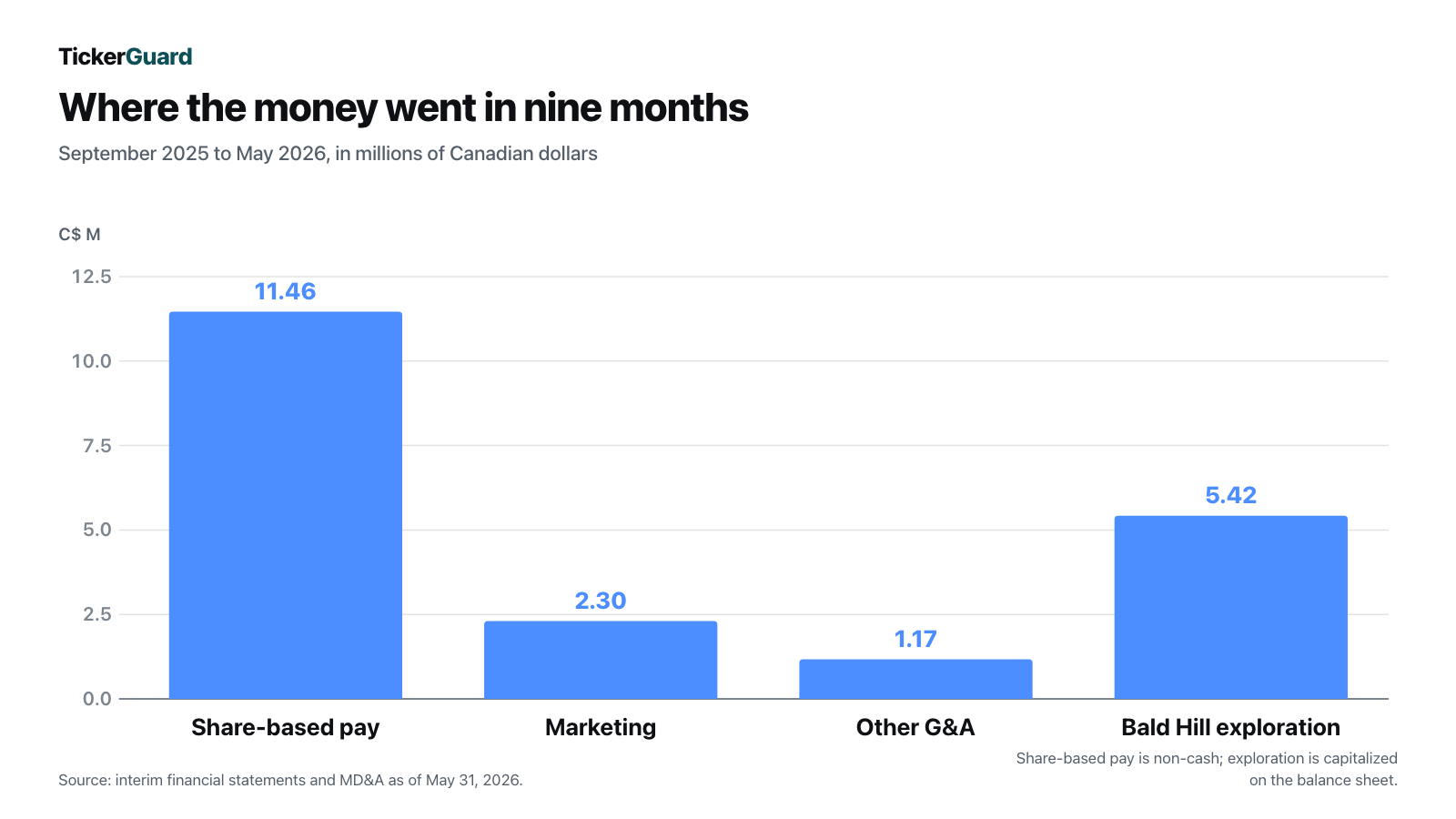
In cash terms, C$4.83 million flowed out of operations and C$4.70 million into exploration over the nine months, C$9.53 million in total. C$12.64 million came in from new shares, warrants and options. On May 31, 2026, cash stood at C$4.86 million, almost all of it in a guaranteed investment certificate.
What the Filings Say — the Uncomfortable Truths
Now let’s set the scarce metal aside and read the fine print. What follows is not in the corporate presentation but in the financial statements, MD&As and releases on SEDAR+.
Uncomfortable Truth No. 1: The Potential Grew — Then the Regulator Stepped In
When Big Red Mining announced the Bald Hill option on January 22, 2025, it cited a potential from a 2010 technical report: 725,000 to 1 million tonnes grading 4.11% to 5.32% antimony, about 30,000 to 40,000 tonnes of metal. Since the technical report of November 2025, a new estimate applies; the revised version dated March 2, 2026, gives 2.33 to 3.09 million tonnes grading 3% to 4% antimony, or roughly 70,000 to 124,000 tonnes of metal (Table 1-3). The company’s releases summarize that as “approximately 2.7 million tonnes” with about 81,000 to 108,000 tonnes of antimony (November 26 and December 30, 2025). According to the report, the new estimate was prepared by Orix Geoscience on the company’s behalf, as is usual for technical reports.
The difference between a potential and a resource matters. A resource under NI 43-101 is a vetted estimate of how much metal lies in the ground with reasonable confidence. An “exploration target” is an order of magnitude that still has to be proven by drilling. On November 26, 2025, the company announced its C$10 million placement — with the 2.7-million-tonne figure among the highlights but without noting that it is merely conceptual. Only the placement’s closing release of December 30, 2025, carried that caveat (the November 4, 2025, release on the filing of the report already had it). On March 2, 2026, after the British Columbia Securities Commission’s review, came the clarification quoted at the top of this article; on March 4, 2026, the company filed the revised technical report (dated March 2). Chapter 14 of it states plainly that there are currently no defined NI 43-101 mineral resources or reserves on the property.
The number has stayed anyway. The releases of September and October 2026 still cite the 2.7 million tonnes, now with a caveat. And 16 releases, first on April 30 and most recently on October 5, 2026, carry the line that assays indicate Bald Hill is “the highest-grade antimony deposit in North America.” In January 2026, the company said it hoped to complete resource calculations “later in 2026 or early 2027,” and in March 2026 it hired the consultancy SRK. On May 7, 2026, it changed course: the focus would now be on “Expansion Drilling not Definition Drilling” — growing the deposit rather than measuring it. As of October 13, 2026, no resource has been published.
Uncomfortable Truth No. 2: C$11.5 Million of Share-Based Pay, RSUs to Insiders and Consultants
In the nine months ended May 31, 2026, Antimony Resources booked C$11.46 million of share-based compensation — 77% of all operating expenses and more than twice the amount that went into exploring Bald Hill. The MD&A explains the jump as follows:
“This variance is primarily attributable to non-cash share-based compensation following the grant of options and the issuance of Restricted Share Units (RSUs) to officers and consultants. Additionally, the Company expanded its marketing initiatives to support capital-raising efforts”
— Antimony Resources Corp., MD&A for the period ended May 31, 2026, section 4 b
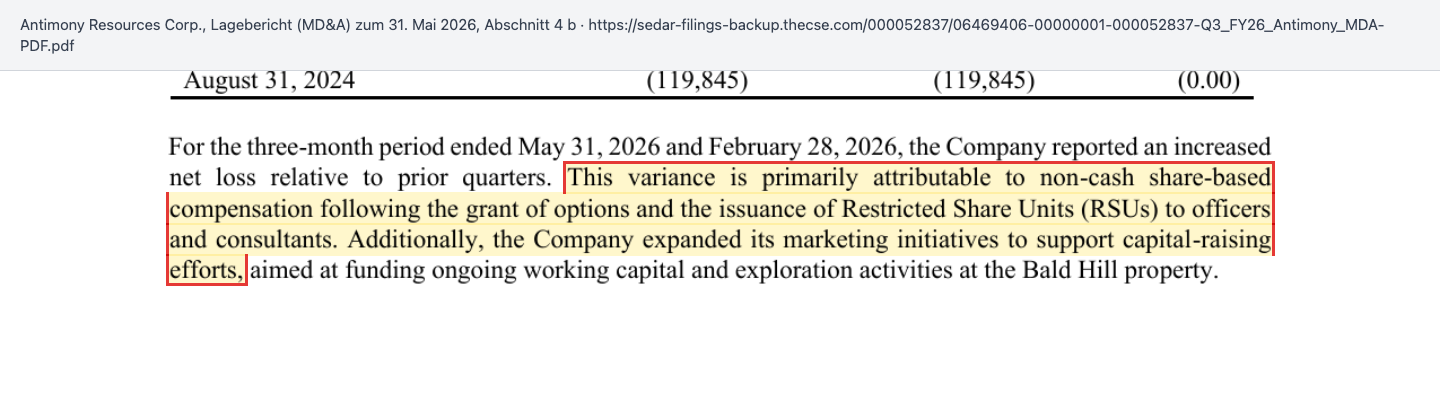
Restricted share units (RSUs) are promises of free shares that turn into actual shares after a waiting period. According to Note 7 of the interim statements, the company granted 13,347,000 RSUs to “insiders and consultants” during the nine months, vesting after four months. On May 11, 2026, they became 13,347,000 new shares valued at C$7.21 million — almost 11% of all shares outstanding at the end of May. How the C$7.10 million of RSU expense splits between directors and officers on the one hand and consultants on the other cannot be determined from the reports: Note 6 gives C$0.67 million for directors and officers for the nine months to May, while the report as of February 28, 2026, gives C$3.29 million for just six months. The reports name no recipients. On top of that came C$3.61 million for stock options and C$0.75 million for warrants issued to placement agents.
For you as a shareholder, this means: almost a quarter of the shares issued in the nine months (13.3 of about 58.7 million) were not issued for drill meters but as compensation for insiders and consultants.
Uncomfortable Truth No. 3: Some of the Attention Was Paid For — Including in Germany
Marketing expense rose from C$0.20 million in the prior-year nine months to C$2.30 million, C$1.58 million of it in the December 2025 to February 2026 quarter alone. The release of January 14, 2026, explains part of it: the company agreed with Apaton Finance of Hanover, Germany, on editorial and video content in German and English for €75,000 for one month, with the US agency i2i Marketing on campaigns for US$250,000 over three months — and this:
“ATMY has entered into a digital marketing agreement (the ‘BorsenBlick Agreement’) with BorsenBlick, a European-based marketing agency, to support investor awareness and strengthen its brand visibility. Under the agreement, BorsenBlick will provide online marketing and awareness services for an initial budget of up to 105,000 Euros for a 2 month term.”
— Antimony Resources Corp., release of January 14, 2026, section Marketing Agreements

Together that is €180,000 and US$250,000, well below the C$1.58 million of marketing expense in the quarter to February 2026; the reports do not break down what the rest was spent on. Paid stock promotion is legal, and the company disclosed the contracts. But it is evidence of reach, not of quality.
Uncomfortable Truth No. 4: A Going-Concern Warning and Cash for a Few Months
An explorer without revenue depends on the capital markets giving it money again and again. Antimony Resources puts this as an explicit warning in its interim statements:
“Further, the Company has no source of operating cash flows, and there is no assurance that sufficient funding (including adequate financing) will be available to conduct required exploration and development of its mineral property projects. These factors indicate that a material uncertainty exists that may cast significant doubt on the Company’s ability to continue as a going concern.”
— Antimony Resources Corp., interim statements as of May 31, 2026 (refiled July 28, 2026), Note 1 Nature of operations and going concern
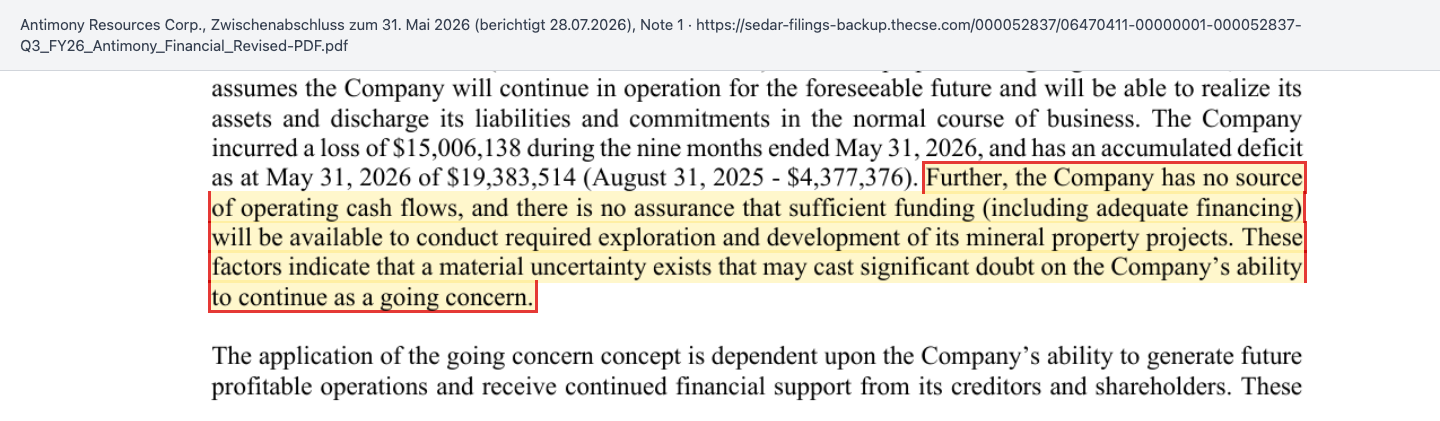
The same warning appears as a separate section in the auditor’s report by Buckley Dodds on the annual statements as of August 31, 2025. To be fair: such warnings are common for explorers without revenue. Here, though, the arithmetic adds to it. On May 31, 2026, cash stood at C$4.86 million, and in the nine months before, a little over C$1 million a month flowed out on average — operations and capitalized drilling combined; excluding drilling, it was a little over C$0.5 million a month. At that pace, the May cash would have lasted until about mid-October, by our arithmetic. In October, gross proceeds of C$5.0 million from the flow-through placement came in, about C$4.75 million after commission. In Canada, however, flow-through money is tied to exploration spending — in return, buyers can deduct that spending for tax purposes. Overhead, marketing and the payments to Globex have to come from other funds. The MD&A itself is cautious: it says the May 31 cash will be sufficient for the company to become “operational,” after which it will need more working capital and may raise it through private placements.
Uncomfortable Truth No. 5: Contradictory Figures in the Mandatory Reports
Small errors in reports are not unusual. But they say something about the care with which a company puts its numbers together. In the latest report, we noticed:
- The interim statements as of May 31, 2026, were refiled on July 28, 2026, because errors had been noted. In the first version, the balance sheet column was headed “February 28, 2026” instead of “May 31, 2026.”
- The quarterly table in the MD&A shows a loss of C$10.33 million for the quarter ended February 2026. That is the six-month loss; the quarter alone cost C$9.84 million according to the interim statements.
- Share-based compensation is stated as C$11,546,663 in the MD&A and as C$11,456,663 in the financial statements.
- In the warrant table of the financial statements, the individual lines add up to 26.85 million warrants, while the total line says 28.09 million.
- The text of Note 7 cites 7,207,380 newly granted RSUs — that is the dollar amount; the table in the same note shows 13,347,000 units.
- Note 6 puts RSU expense for directors and officers at C$671,657 for the nine months to May 2026 but at C$3,288,269 for the six months to February 2026 — a nine-month figure cannot be smaller than a six-month figure.
None of these errors changes the overall picture. Together with the corrected technical report, though, they show that with this company it pays to check every number at the source.
Valuation: What the Market Pays for Bald Hill
With at least 132.5 million shares (121,841,281 on May 31 and July 23, 2026, plus 10,637,808 flow-through shares issued on October 2, 2026) and a close of C$0.36 on October 9, 2026, Antimony Resources is valued at about C$48 million. In Frankfurt, the stock traded at €0.209 on October 12, 2026. Fully diluted, i.e. including all warrants, options and RSUs, there were 157.2 million shares on July 23, 2026, and about 168 million including the new flow-through shares and agent warrants.
Classic metrics such as the price-to-earnings ratio do not exist for an explorer. As a rough proxy: subtracting from the market value the May 31 cash and the net proceeds of the flow-through placement, at most about C$9.6 million combined (spending since June not deducted), the market values Bald Hill at no less than about C$38 million. On the balance sheet, the project stands at C$6.6 million. So investors are paying for a project with no resource, no economic study and no permit — according to the May 7, 2026, release, the company plans to file its permit application in the fourth quarter of 2026 or the first quarter of 2027.
As for the share price: on December 30, 2025, the stock closed at C$0.53 on the CSE. It reached its highest close of C$1.60 on March 17, 2026, the day the company announced work on a maiden resource estimate, two weeks after the March 2 clarification. At C$0.36 on October 9, 2026, it trades below the C$0.45 price of the December 2025 placement, and the warrants issued with it at C$0.75 are far out of the money.
What an antimony company that already mines and sells looks like is shown in our analysis of United States Antimony. How long the road from a Canadian resource project with a strategic label to production can be, in our analysis of Ucore Rare Metals.
Upside and Risks at a Glance
What speaks for the company:
- Sought-after metal. Antimony is scarce; China banned exports to the US in December 2024, and North America is looking for its own sources.
- High-grade intercepts. Drilling shows some very rich intervals, such as 27.3% antimony over 0.3 meters or 2.28% over 9.12 meters (September 11, 2026), plus gold in the drill core.
- Lots of drilling. More than 25,000 meters in 77 holes since April 2025 (as of May 7, 2026), and an airborne survey of the 37-square-kilometer property in August 2026.
- No bank debt. Funding comes solely from equity; in October 2026, gross proceeds of C$5.0 million for exploration were added.
- Infrastructure. According to the company, good road access, power and a deep-sea port about 45 kilometers away; drilling is possible year-round.
What speaks against it:
- No resource. There is no NI 43-101 resource at Bald Hill; the 2.7-million-tonne potential is a conceptual exploration target that the company clarified after a regulatory review.
- Going-concern warning. Material uncertainty according to the interim statements and the auditor; without new placements, unrestricted cash lasts only a few months.
- Share-based pay. C$11.46 million in nine months, including RSUs for 13.3 million shares for insiders and consultants.
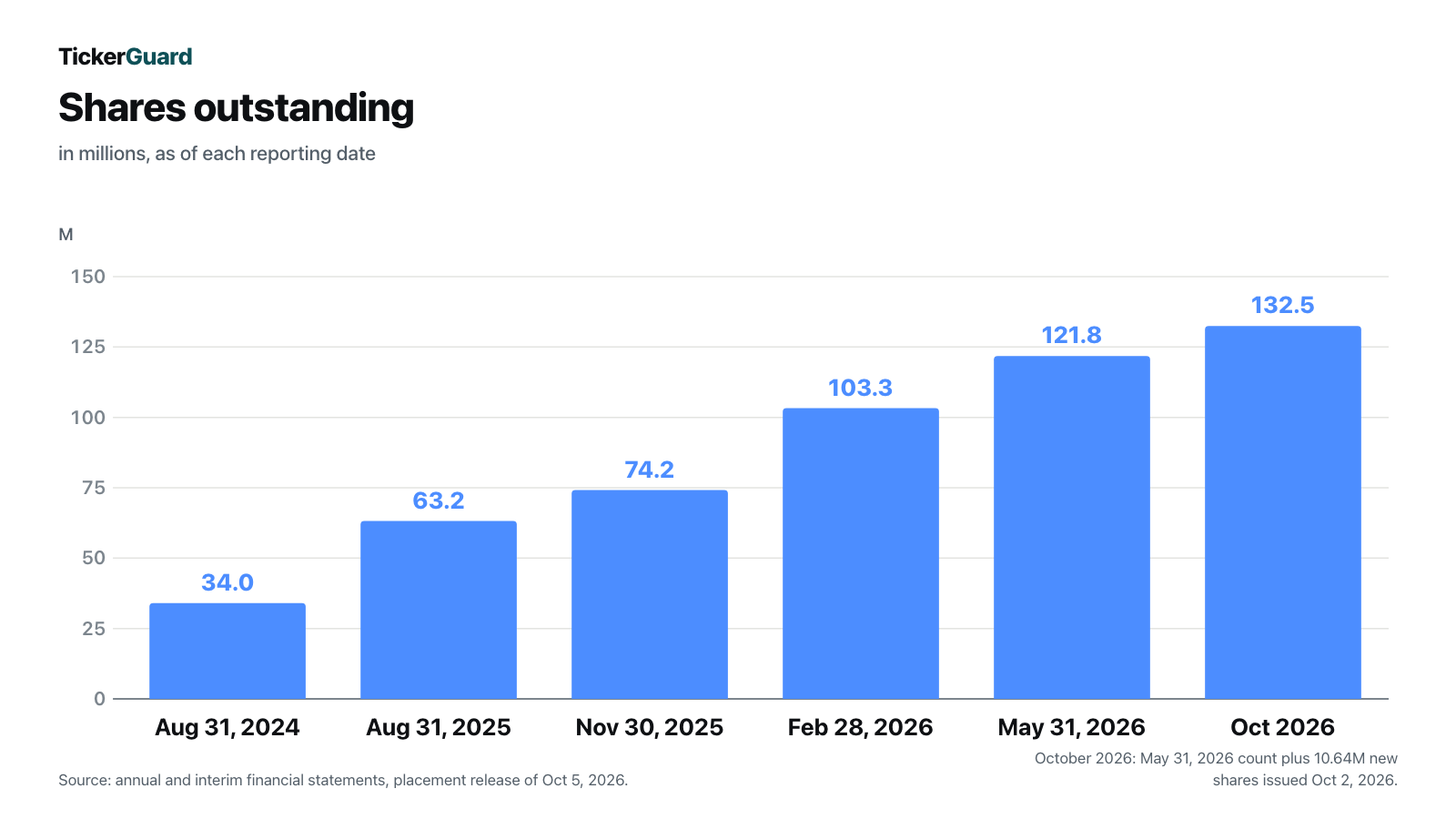
- Dilution. Almost four times as many shares as at the end of August 2024, about 168 million fully diluted.
- Paid reach. C$2.30 million of marketing in nine months, through three disclosed agency contracts in Europe and the US.
- Reporting care. Refiled interim statements and several inconsistent figures in the latest report.
A Human Conclusion
Remember the illusory truth effect from the beginning? With Antimony Resources, you hear two lines over and over: the highest-grade deposit in North America, 2.7 million tonnes of potential. Both sound substantial. But one number is a conceptual target that the regulator questioned, and the other line is a self-description, not a vetted resource. To be fair, too: the metal is in demand, the drill core shows real antimony, and the company really is drilling.
Turning drill core into a deposit takes a resource, an economic study and a permit — and a lot of money until then. Over the past nine months, the company booked more for share-based pay and advertising than it put into exploration. The next milestones are clear: the annual statements as of August 31, 2026, a maiden resource estimate if it comes, and the end of the hold period on the flow-through shares in early February 2027. When a sentence crosses your path for the tenth time, ask yourself whether you have ever read it checked.
What you make of it is your decision. And that is how it should be.
Sources and Data Cut-Off
- Interim financial statements as of May 31, 2026, refiled July 28, 2026 and MD&A for the period ended May 31, 2026 (dated July 23, 2026)
- Interim financial statements as of February 28, 2026 and the related MD&A
- Annual financial statements as of August 31, 2025 (audited by Buckley Dodds CPA, report dated October 17, 2025) and the related MD&A
- NI 43-101 technical report on Bald Hill, revised version dated March 2, 2026
- Releases: clarification after the BCSC review (March 2, 2026), 2026 plans and marketing agreements (January 14, 2026), announcement of the C$10 million placement (November 26, 2025), closing of the first tranche (December 30, 2025), work on a resource estimate (March 17, 2026), next exploration phase (May 7, 2026, misdated April 7 in its header)
- Releases after the interim report: drill results (July 30, 2026), drill results and use of AI (August 6, 2026), visible gold (August 14, 2026), airborne survey (August 28, 2026), drill results (September 11, 2026), announcement (September 29, 2026) and closing of the flow-through placement (October 5, 2026), Form 45-106F1 dated October 9, 2026
- Canadian Securities Exchange listing profile and the company website
- Price and market value data: fundamental data, as of October 9, 2026 (CSE) and October 12, 2026 (Frankfurt)
Data cut-off: Company figures as of May 31, 2026, or the date stated; share count as of July 23, 2026, plus the flow-through shares issued on October 2, 2026; releases through October 5, 2026, and Form 45-106F1 dated October 9, 2026; prices as of October 9, 2026 (CSE; October 12 was a Canadian holiday) and October 12, 2026 (Frankfurt). We last checked the SEDAR+ document list on October 13, 2026; the annual statements as of August 31, 2026, had not been filed yet. Antimony Resources is not registered with the SEC; this analysis relies on its Canadian mandatory reports. Reporting and home-market currency is the Canadian dollar; the Frankfurt listing we track is quoted in euros. The fiscal year ends August 31. Calculated values (market value, monthly outflows, project valuation, percentages) are our own rough calculations and labeled as such. The key-figure tiles on this page show the current database values of the Frankfurt listing in euros with their own share count and may differ from the values used here (C$0.36, 132.5 million shares).
Note: This article is journalistic commentary and not investment advice. It contains no recommendation to buy or sell and is not a solicitation to buy or sell securities. Shares of exploration companies without revenue are particularly volatile and depend on drill results, metal prices and financings; a total loss of the capital invested is possible. Positions held by the operator are disclosed daily; where one exists, it appears as a notice at the top of this analysis.
Our Bottom Line at a Glance
- Project and metal positive
- Antimony is scarce and strategically sought after; Bald Hill delivers high-grade drill intercepts and gold as a by-product. There is no NI 43-101 resource.
- Disclosure negative
- After a review by the British Columbia Securities Commission, the company clarified in March 2026 that its November 2025 technical report contains no resource; interim statements refiled in July 2026.
- Cash and going concern negative
- No revenue, C$4.86 million of cash on May 31, 2026, against a little over C$1 million of outflows per month; material uncertainty about the going concern according to the statements and the auditor.
- Pay and marketing negative
- C$11.46 million of share-based pay and C$2.30 million of marketing in nine months — together more than twice the exploration spending of C$5.42 million.
- Dilution negative
- Share count up from 34.0 million (August 31, 2024) to at least 132.5 million (October 2026), about 168 million fully diluted.
Antimony Resources is an antimony explorer without revenue, with one project in New Brunswick that shows high-grade drill intercepts but no resource. In the nine months to May 2026, the company booked more expense for share-based pay and marketing than went into exploration, the statements carry a going-concern warning, and the share count has almost quadrupled in just over two years. At the October 9, 2026, close of C$0.36, the company is valued at about C$48 million. Not investment advice.
What Our Rating Means
Substance risk
We found at least one documented issue that threatens the company itself — regardless of how the stock is currently valued.
Red reflects documented findings in the company’s own reports, not the metal or the share price: the interim statements and the auditor flag a material uncertainty about the going concern, the unrestricted May cash lasted only a few months at the pace of the past nine months (the October 2026 money is tied to exploration), and after a regulatory review the company corrected its resource disclosure. Yellow would only be possible with a reliable resource estimate and funding that carries overhead and the project without a steady stream of new shares.
A journalistic assessment by our editorial team at the time of the deep dive, based on public sources — not investment advice and not a solicitation to buy or sell. Your personal circumstances (investment goals, risk capacity, taxes) cannot be taken into account. What our levels mean, how verdicts are formed, and what conflicts of interest exist →
Worth Noting
- The trigger for this analysis was the wallstreet-online hot list (as of October 13, 2026), where the stock appeared under its Frankfurt symbol K8J0; we track it as K8J0.DE. It was not a hit from our in-house stock scanner.
- Antimony Resources is not registered with the SEC. This analysis relies on its Canadian filings on SEDAR+ (profile 000052837), retrieved via the CSE document mirror: interim statements and MD&As as of 11/30/2025, 2/28 and 5/31/2026, annual statements as of 8/31/2025, the technical report dated 3/2/2026, releases through 10/5/2026 and Form 45-106F1 dated 10/9/2026.
- Calculated values are our own rough calculations: market value from 132,479,089 shares times the 10/9/2026 close; outflows from C$4.83M (operations) plus C$4.70M (exploration) over nine months; project valuation after deducting at most C$9.6M of cash and net flow-through proceeds, without deducting spending since June.
- Where the MD&A and the interim statements differ (share-based pay, quarterly loss to February 2026, warrant total), we use the figures from the interim statements in the version refiled on 7/28/2026.
Stock Watch
This analysis is as of October 13, 2026. Stock Watch will tell you what's changed at K8J0.DE since then.
Later $1 a month per stock — signing up is free, and you'll be the first to know when it launches.
The full analysis as a PDF for later
We will send you this analysis as a PDF — to print, file away, and read at your own pace. And we will add you to the free Stock Watch list for Antimony Resources Corp. (K8J0.DE), so you hear about it when something material in this analysis changes.
Frequently Asked Questions
Antimony Resources is a Canadian mineral explorer based in Surrey, British Columbia. It is exploring the Bald Hill antimony project in New Brunswick, in which it can earn 100% through an option from Globex Mining. The company has no revenue. Until March 2025 it was called Big Red Mining.
It is the same stock. ATMY is the symbol on the home exchange, the Canadian Securities Exchange, in Canadian dollars; ATMYF is the over-the-counter US listing on the OTCQB; K8J0 is the Frankfurt symbol. TickerGuard tracks the stock as K8J0.DE.
No. After a review by the British Columbia Securities Commission, the company clarified on March 2, 2026, that no resource under the Canadian NI 43-101 standard has been identified at Bald Hill. The frequently cited figure of about 2.7 million tonnes grading 3% to 4% antimony is a conceptual exploration target. As of October 13, 2026, no maiden resource estimate had been published.
Net loss was C$15.0 million in the nine months ended May 31, 2026. Of that, C$11.46 million was share-based compensation (options, restricted share units for insiders and consultants, warrants for placement agents) and C$2.30 million marketing. Exploration spending of C$5.42 million, by contrast, is carried as an asset on the balance sheet.
Antimony Resources has no revenue and depends on new equity. That is why the interim statements as of May 31, 2026, and the auditor of the fiscal 2025 statements flag a material uncertainty about its ability to continue as a going concern. Cash stood at C$4.86 million on May 31, 2026; the money from the October 2026 placement is tied to exploration spending.
The share count rose from 34.0 million on August 31, 2024, to at least 132.5 million in October 2026. Fully diluted, including warrants, options and restricted share units, there are about 168 million shares.
Found an error?
Did you spot a factual error, an outdated number, or a typo in this deep dive? Let us know briefly — your report goes straight to the editorial team.