Neo Performance: A Hafnium Record That Has Yet to Bring In Cash
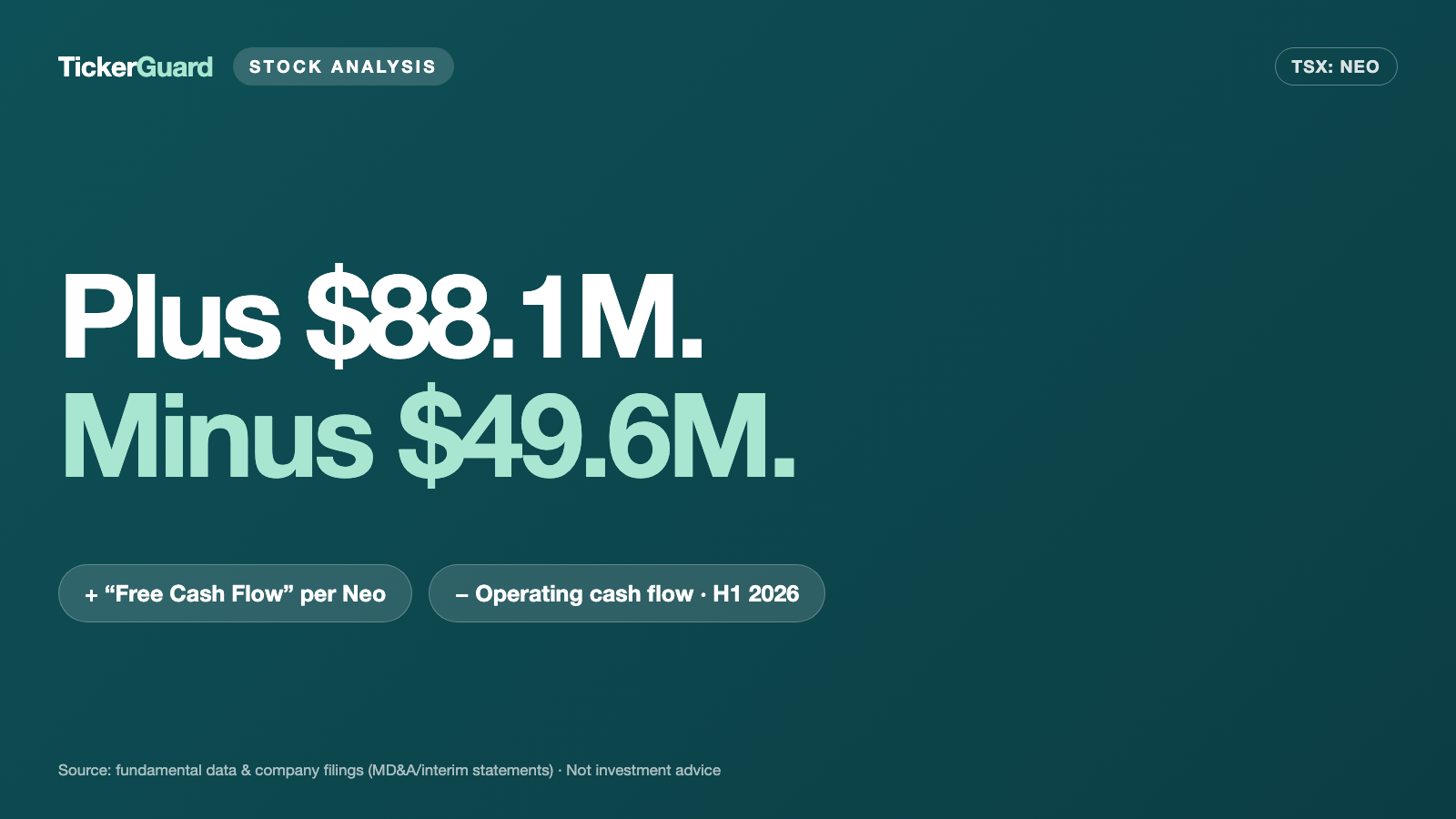
Neo Performance Materials (TSX: NEO, OTCQX: NOPMF) reports “Free Cash Flow” of plus $88.1 million for the first half of 2026. In the same six months, its operations consumed $49.6 million in cash. Both are true — and in the record quarter, with $57 million of adjusted EBITDA, 70 percent of segment EBITDA came from rare metals such as hafnium, which makes alloys for jet engines heat-resistant, not from the magnets the stock is known for. Most of it is sitting in $71.5 million of additional inventory.
 Thomas Mücke
Founder & Publisher
Thomas Mücke
Founder & Publisher
As of Today
As of: October 13, 2026
- Closing price
- 27.50 C$ -1.47%
- Market Capitalisation
- 1.3 C$B
- P/E
- 2,750.0
This analysis has a cut-off date. The Stock Guard tells you when something material changes in the numbers. Reserve your free spot
Chart
Interactive price chart (TradingView).
Last price: 27.50 C$ (As of: October 13, 2026)
Note: pure fact-based analysis, not investment advice and not a solicitation to buy or sell. All figures without guarantee.
Picture a baker who hangs a sign in the window: “Record sales!” What the sign leaves out: the basement holds a full year’s worth of flour, partly bought on credit, and the cafeteria across the street pays its bills two months late. Nothing on the sign is false — it is just a selection. Psychologists call this the framing effect: which number is chosen and how it is packaged decides how it feels. Let’s call it the shop-sign trap. In the stock market, the sign often says “adjusted” — and sometimes it says “free cash flow,” even though only part of the cash flows is in it: whatever is tied up in inventory, unpaid customer invoices, taxes and interest is missing.
Neo Performance Materials is a good example precisely because it says openly how it calculates. Its management’s discussion and analysis states:
“‘Free Cash Flow’ is defined as Adjusted EBITDA less capital expenditures.”
— Neo Performance Materials Inc., MD&A as of June 30, 2026, section 3 Non-IFRS Financial Measures
EBITDA is earnings before interest, taxes, depreciation and amortization; “adjusted” means it also leaves out items the company considers non-recurring. Neo’s version deducts only capital expenditures. That is the tension running through this analysis: Neo reports a record quarter for adjusted EBITDA, 70 percent of it from a single segment enjoying record prices — while its operations are consuming cash. Let’s read the filings together. In the end, the decision is yours.
What Neo Performance Materials actually does
Neo processes raw materials that rarely make headlines but end up in a huge range of products. It does not mine anything itself; it separates, refines, recycles and shapes. As of June 30, 2026, Neo had 1,532 employees at plants in Canada, China, Estonia, Germany, Thailand and the United Kingdom. The group has three segments:
- Magnequench — powders for bonded neodymium-iron-boron magnets, plus finished magnets. A bonded magnet is magnetic powder pressed together with a polymer, much like particle board made from wood chips: weaker than a sintered magnet, but it can be molded into almost any shape. Customers include auto suppliers, pump and motor makers and, lately in particular, makers of cooling fans for servers in AI data centers. New is a plant for high-performance sintered magnets in Narva, Estonia, for example for electric vehicle motors.
- Chemicals & Oxides — mixed oxides for emission catalysts, rare earth products for water treatment and rare earth separation at the Silmet plant in Estonia. Neo sold two Chinese separation facilities in March 2025; the segment still runs one plant in China (Zibo).
- Rare Metals — recycling and refining of tantalum, niobium, hafnium and rhenium for high-temperature alloys in jet engines and gas turbines, and of gallium and indium for electronics. The plants are in Sillamäe (Estonia), Peterborough (Canada) and Sagard (Germany) at the Buss & Buss subsidiary.
Neo likes to tell its stock story through magnets and rare earths: a Western supplier, independent of China. In 2026, the numbers tell a different story, and that is the one we follow here.
Company history for investors
-
2017
IPO in Toronto
Today’s company was incorporated on 09/12/2017 and went public in December 2017, with financial investor Oaktree selling shares. For investors, the start of a specialist with roots dating back to 1994.
-
2025
Sale of the Chinese separation plants
In March 2025, Neo sold two separation plants in China. Revenue held almost flat at $478.8M (+0.6%), exposure to rare earth prices fell; net loss of $10.0M.
-
2026
Equity raise and record quarter
In May 2026, 4.0M new shares at C$28.75; $57.0M of adjusted EBITDA in the second quarter; commercial production at the Narva magnet plant announced on 09/14/2026.
How the stock landed on our desk
This was not a hit from our in-house stock scanner. The stock made our research list via the forum hot list of wallstreet-online, a ranking of the stocks most discussed by German retail investors (as of October 13, 2026). That is a signal of attention, not of quality.
Neo’s home exchange is the Toronto Stock Exchange (TSX), where it has traded as NEO since its December 2017 IPO, in Canadian dollars. In the U.S., the stock trades over the counter as NOPMF (OTCQX). A word of caution when searching: the U.S. ticker NEO belongs to the unrelated lab company NeoGenomics. Neo Performance Materials is not registered with the U.S. securities regulator, the SEC; its filings appear under Canadian rules on SEDAR+ and on its investor site. It reports under IFRS in U.S. dollars, its fiscal year is the calendar year, and its auditor is KPMG.
The latest periodic report is the interim financial statements as of June 30, 2026, with MD&A dated August 10, 2026; the earnings release followed on August 11. Since then, Neo has announced a supply partnership with French recycler Carester (August 31), the closing of the sale of the company holding the Sarfartoq rare earth project in Greenland, in which Neo held 43.47 percent — for all shares together $20 million in cash and $15 million in shares of the buyer, Greenland Mines (September 2), the start of commercial production in Narva (September 14) and a non-binding memorandum of understanding with Rainbow Rare Earths (September 24, 2026). The report for the quarter ended September 30, 2026, was not yet available on October 13, 2026.
The numbers over the years — given their due
First, what is genuinely impressive. In the second quarter of 2026, revenue rose to $205.7 million (prior-year quarter: $114.7 million) and adjusted EBITDA to $57.0 million ($19.0 million) — according to Neo, the highest quarterly adjusted EBITDA in the company’s history. Net income attributable to shareholders came to $17.5 million. All three segments grew: Magnequench by 38.5 percent to $10.5 million of adjusted EBITDA, Chemicals & Oxides by 56 percent to $8.5 million, Rare Metals by 313 percent to $44.4 million. On July 8, 2026, Neo raised its full-year adjusted EBITDA outlook from $100 million to $110 million to $140 million to $150 million, after $75.6 million in 2025.
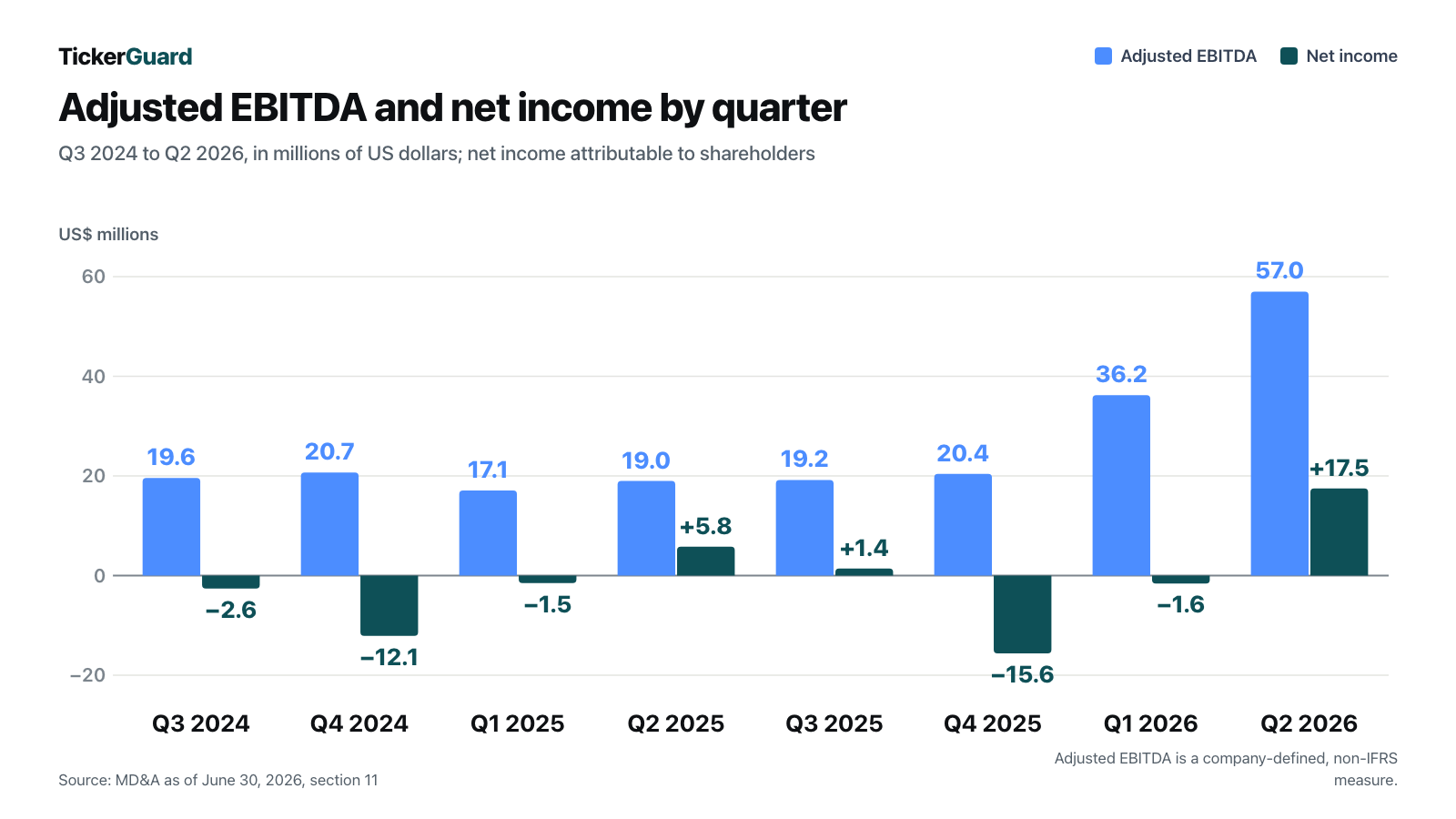
The longer line is bumpier. Revenue was $640.3 million in 2022 and $478.8 million in 2025 — partly because Neo sold two Chinese separation plants. Net results attributable to shareholders were losses in 2023, 2024 and 2025: minus $8.4 million, minus $12.9 million and minus $10.0 million. Adjusted EBITDA, by contrast, stayed positive in each of those years ($37.2 million, $64.4 million and $75.6 million). In between sit interest, taxes, depreciation, patent disputes, start-up costs for the magnet plant and the remeasurement of a put option we will get to shortly. To be fair: in the first half of 2026, net income also turned positive, at $15.8 million.
One note on taxes, because it stands out: on $37.4 million of pre-tax income, Neo recorded $21.0 million of income tax expense in the first half, or 56 percent. According to the MD&A, that reflects losses in individual countries that cannot be offset for tax purposes and the non-deductible remeasurement of the put option.
What the filings say — the uncomfortable truths
Now let’s look behind the sign. What follows comes from the MD&A, the interim financial statements and the Annual Information Form.
Uncomfortable truth No. 1: The record is a hafnium record
Hafnium is a metal few people have heard of: it makes alloys heat-resistant, for example for jet engines and gas turbines. According to Neo’s Annual Information Form, three Chinese producers account for about 40 percent of global primary capacity, and China restricts exports; Chinese exports fell roughly 19 percent in 2025, and prices outside China reached record highs. That is exactly what is driving Neo’s numbers. The MD&A puts it in one sentence:
“For the six months ended June 30, 2026, Rare Metals contributed 45.1% of revenue, 77.7% of operating income and 65.6% of Neo’s reported Adjusted EBITDA from operations before eliminations.”
— Neo Performance Materials Inc., MD&A as of June 30, 2026, section 10.3 Rare Metals
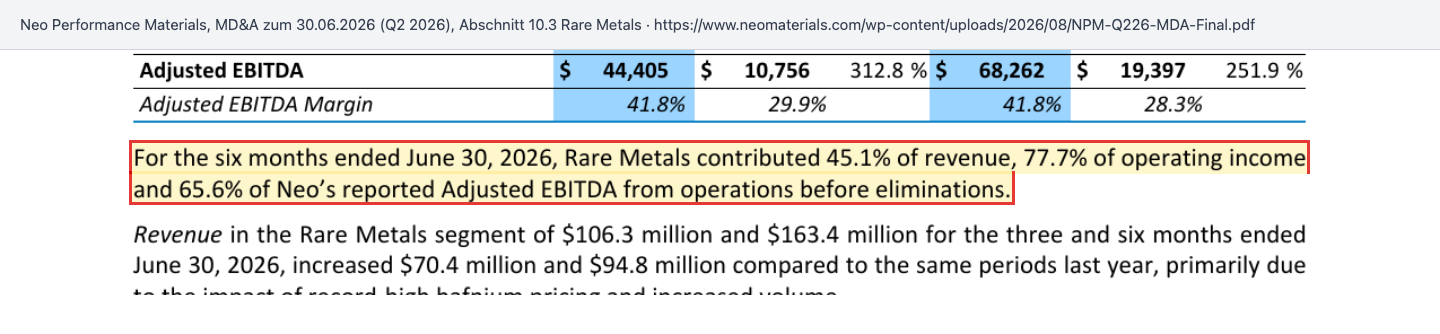
In the second quarter alone, the share was 70 percent: $44.4 million of the three segments’ $63.4 million of adjusted EBITDA, before corporate costs (our calculation from the segment figures). Rare Metals posted an adjusted EBITDA margin of 41.8 percent (prior year: 29.9 percent), on 38.6 percent more hafnium sold and prices the MD&A describes as record levels. The 2026 guidance explicitly assumes continued strong hafnium demand alongside elevated pricing and tight raw material supply. Two further details matter. First, customer concentration: according to the Annual Information Form, the ten largest customers accounted for about 76 percent of segment sales in 2025, the largest for about 30 percent. Second, the math for the back half: subtract the first half’s $93.3 million from the $140 million to $150 million outlook and you get $46.7 million to $56.7 million for July through December — at the high end about as much as the second quarter alone. On the August 11 earnings call, CFO Jonathan Baksh explained that the second-half plan assumes very few sales at spot prices. For you, that means the record EBITDA depends on a price Neo does not set, but receives.
Uncomfortable truth No. 2: Neo owns only half of the hafnium
According to the Annual Information Form, the group’s hafnium compounds are made by the German subsidiary Buss & Buss Spezialmetalle in Sagard, along with tantalum and rhenium. Neo owns 50.04 percent of it. Because Neo controls the subsidiary, all of its revenue and adjusted EBITDA flow into the consolidated figures. The other owners, however, hold a right to sell their shares to Neo — a put option. The interim statements explain how it is valued:
“In the case of Buss & Buss, in accordance with the terms of the put option contract, liability is re-measured based on 90% of the fair value of the subsidiary.”
— Neo Performance Materials Inc., interim financial statements as of June 30, 2026, note 7.1 Derivative Liabilities
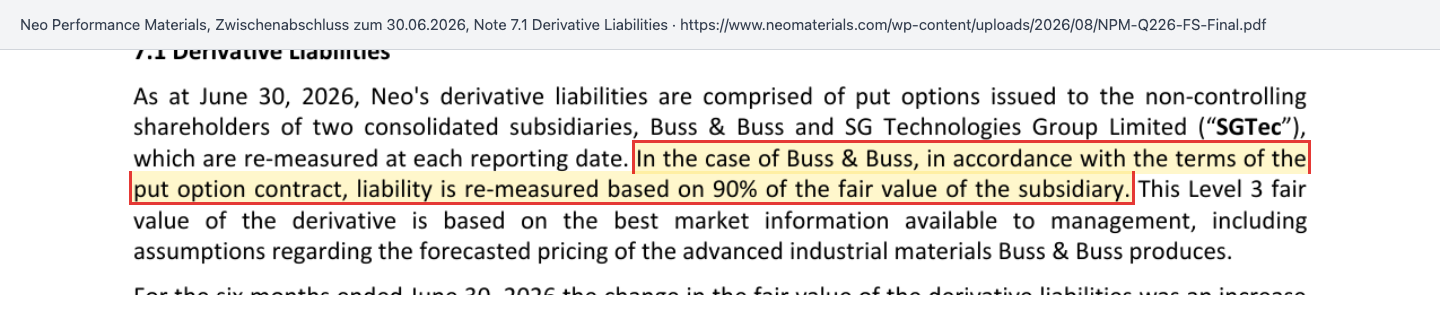
On June 30, 2026, this obligation stood on the balance sheet at $85.6 million, as a current liability and under “1 year” in the table of contractual obligations. Total cash was $96.2 million. In the first half, the two minority put options (besides Buss & Buss, there is a small one at the British subsidiary SGTec) rose by $24.7 million — booked as finance costs that weigh on net income. According to the statements, a 10 percent increase in the subsidiary’s forecast cash flows would raise the liability by another $9.7 million. And the minority receives dividends: $14.7 million in 2024 and $7.3 million in 2025.
In everyday terms: you share a productive orchard with a neighbor who may sell you his half at any time at the going rate. The more the trees yield, the more expensive that promise becomes. Since 2026, Neo’s “adjusted net income” strips out the remeasurement of the option and instead deducts the minority’s share of the subsidiary’s profit. Its adjusted EBITDA guidance of $140 million to $150 million, however, still includes Buss & Buss at 100 percent.
Uncomfortable truth No. 3: Profit is not yet cash
Back to the shop-sign trap. Neo’s “Free Cash Flow” for the first half of 2026 was plus $88.1 million. The actual cash from operations looked different:
“Cash used in operating activities was $49.6 million for the six months ended June 30, 2026, compared to cash used of $22.8 million for the six months ended June 30, 2025.”
— Neo Performance Materials Inc., MD&A as of June 30, 2026, section 12.1 Cash flow and Liquidity
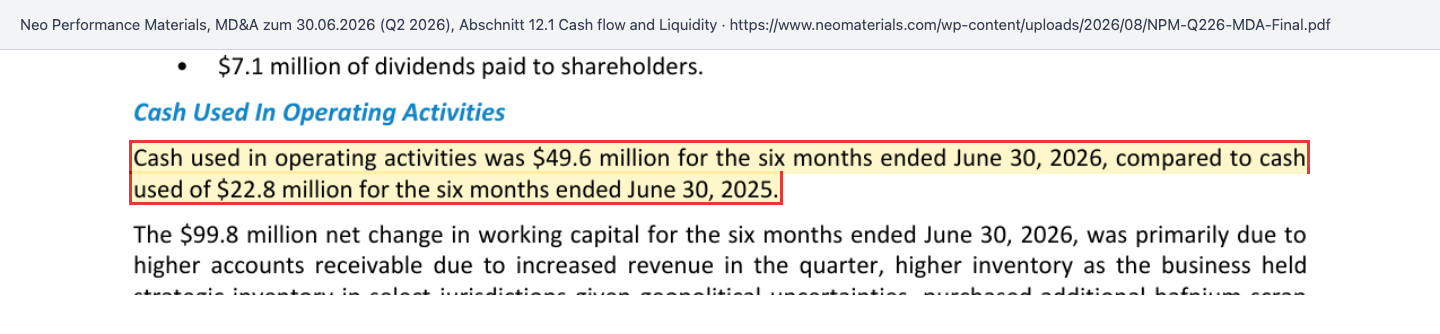
The cash flow statement shows where the money went. Taking net income and adding back non-cash items, Neo arrives at $89.8 million before working capital changes (our sum from the cash flow statement; Neo itself cites $71.6 million “before net change in working capital, income taxes paid and interest paid”; arithmetically, the difference equals exactly the patent settlement and cash-settled share awards). Then inventories alone absorbed $71.5 million and receivables $40.7 million; taxes, cash-settled share awards, the patent settlement with Rhodia and interest added another $39.7 million.
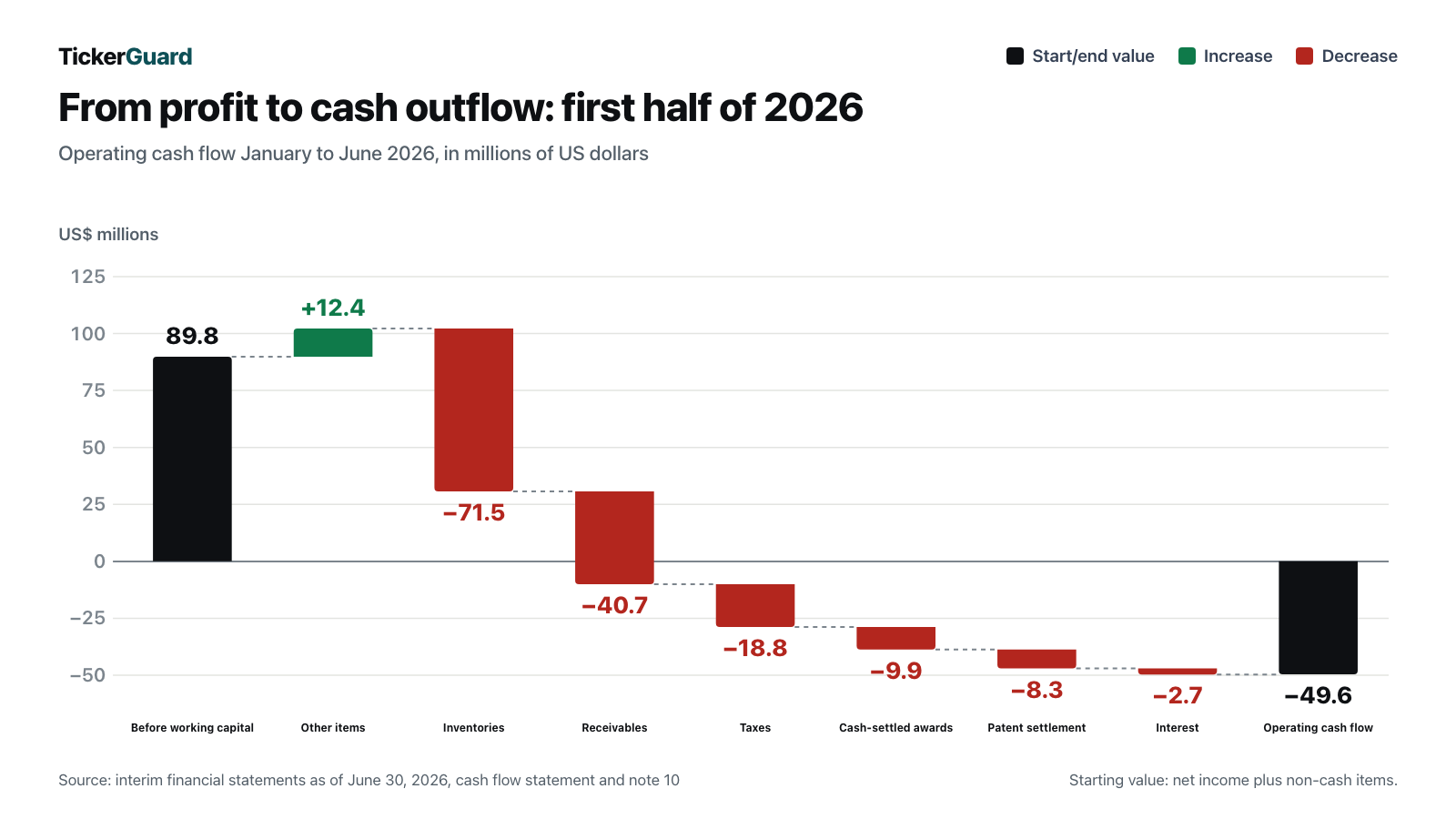
Neo says the inventory build is deliberate: strategic stock in select jurisdictions given geopolitical uncertainty, additional hafnium scrap purchases and inventory for the new magnet plant. That may pay off; on the call, CFO Jonathan Baksh spoke of potential profit sitting in that inventory. But it is not a one-off: for full-year 2025, operations already consumed $54.0 million in cash, while Neo’s “Free Cash Flow” showed plus $52.4 million. The gap was funded with new money. In May 2026, Neo issued 4,002,000 new shares at C$28.75 (C$115.1 million, $83.3 million gross); the share count rose from 41.6 million at year-end 2025 to 46.2 million on August 10, 2026, up about 11 percent. Debt grew from $101.8 million to $157.2 million in the half year, including $43.1 million of short-term bank borrowings. Rule of thumb: a record that sits in a warehouse becomes cash only once it is sold and paid for.
Uncomfortable truth No. 4: Independent of China — but not of Russia
Neo markets a supply chain outside China, and the magnet plant in Estonia is a genuine step in that direction. For the raw materials of its Estonian separation plant, however:
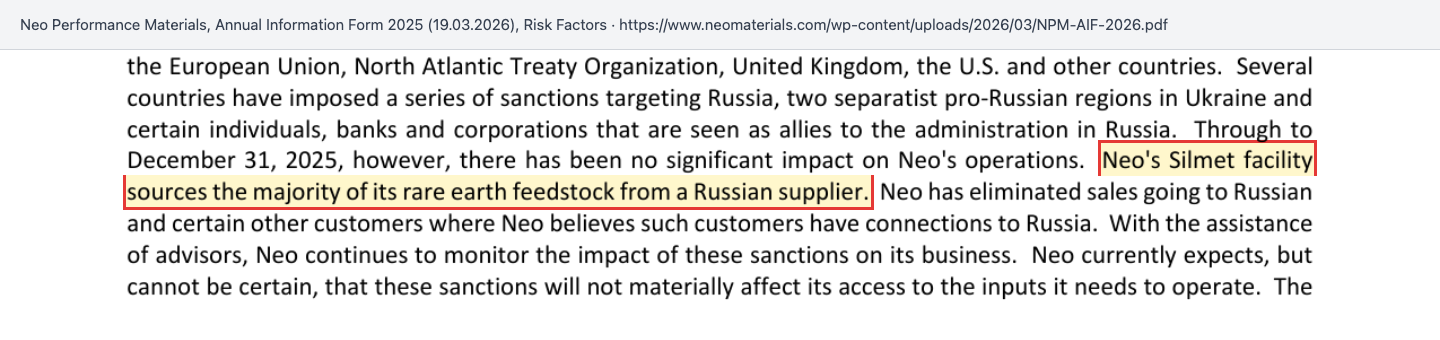
“Neo's Silmet facility sources the majority of its rare earth feedstock from a Russian supplier.”
— Neo Performance Materials Inc., Annual Information Form 2025 dated March 19, 2026, Risk Factors
According to Neo, the supplier is not currently restricted by sanctions, and through August 10, 2026, there had been no significant impact on operations. Neo itself writes, however, that it cannot be assured viable payment pathways will exist in the future. On the other side, Neo still runs Chinese plants in Tianjin, Chuzhou and Zibo, and China has restricted exports of heavy rare earths, magnet technology and gallium — partly to Neo’s advantage, partly as a risk: the sintered magnets from Narva require heavy rare earths such as dysprosium and terbium. The new partnerships with Carester (binding term sheet of August 31, 2026) and Rainbow Rare Earths (non-binding memorandum of understanding of September 24, 2026) are meant to help here; neither delivers anything yet.
Valuation: what the market pays for the hafnium record
With 46,197,570 shares (as of August 10, 2026) and a closing price of C$27.50 on October 9, 2026, Neo is worth about C$1.27 billion, or roughly $0.89 billion (at C$1.4257 per US dollar on the same day). The stock hit its highest close since early 2024, C$44.33, on August 10, 2026, the day before its quarterly results; on December 30, 2025, it had still stood at C$15.55. On October 9, it was 38 percent below that high and a little over 4 percent below the C$28.75 price of the May offering.
The orders of magnitude, in US dollars and using balance sheet figures as of June 30, 2026 (our own calculation): add $61 million of net debt ($157.2 million of debt minus $96.2 million of cash) to the market value, for an enterprise value of about $0.95 billion. Against the top of the guidance range ($150 million of adjusted EBITDA), that is a little over six times; counting the $85.6 million put option as debt, just under seven times. A price-to-earnings ratio on reported net income makes no sense, because the last four quarters together produced only $1.6 million of income for shareholders — which is also why the automatic P/E tile at the top of this page shows a four-digit figure that means nothing. On adjusted net income for the last four quarters ($49.3 million), the market pays about 18 times. Equity attributable to shareholders was $475.7 million ($476.2 million including the small minority interest), putting the market value at just under 1.9 times book. The dividend is C$0.10 per quarter, a little over 1.4 percent a year at that price.
The view from the pros: according to fundamental data (retrieved October 12, 2026), the analyst consensus price target stood at about C$54.60. This is not a price target of ours; the fundamental data do not show how many analysts are behind it or how far their estimates diverge. Price targets rest on assumptions about hafnium and rare earth prices that nobody knows for sure.
For a pure developer in the same field that has no revenue yet, see our analysis of Ucore Rare Metals. And for the company building the server fans in which Neo’s bonded magnets end up, see the analysis of Asia Vital Components.
Upside and risks at a glance
What speaks for the company:
- Record quarter. $57.0 million of adjusted EBITDA in the second quarter of 2026, all three segments up, 2026 guidance of $140 million to $150 million.
- Scarce metals. Hafnium, gallium and tantalum are in short supply and China restricts exports; Neo recycles and refines outside China; according to the MD&A as of June 30, 2026, customers are already booking hafnium contracts for 2027.
- Magnet plant in Europe. On September 14, 2026, Neo announced commercial production in Narva, with first volumes shipped to a Tier 1 EV traction motor supplier; expansion from 2,000 to 5,000 tonnes is planned.
- New demand. Bonded magnet volumes rose 35 percent in the second quarter, led by server cooling fans for AI data centers.
What speaks against it:
- Price dependence. 65.6 percent of segment EBITDA came from Rare Metals in the first half; the guidance assumes elevated hafnium prices and implies a much weaker second half.
- Negative cash flow. Minus $54.0 million from operations in 2025 and minus $49.6 million in the first half of 2026, funded with new shares and new debt.
- Half a subsidiary, a full obligation. The Buss & Buss minority put option of $85.6 million, carried as current and rising with hafnium’s success.
- Volatile earnings. Net losses in 2023, 2024 and 2025; a 56 percent income tax rate in the first half of 2026.
- Geopolitics in both directions. A Russian feedstock supplier for Silmet, plants in China, U.S. tariffs on some products; Narva needs heavy rare earths.
- Customer concentration. The largest Rare Metals customer accounted for about 30 percent of segment sales in 2025.
A human conclusion
Remember the baker from the beginning? Neo Performance Materials is not a shop with empty shelves and a pretty sign. The company has real plants, real customers and a record quarter carried by all three segments. By its own account, it built a magnet plant in Europe in under two years and brought it into commercial production. For a specialist that was still losing money in 2025, that is a lot.
But the sign decides how the numbers feel. “Adjusted EBITDA” and “Free Cash Flow” show the record. The cash flow statement shows that more than $100 million flowed out of Neo’s operations in 18 months. The balance sheet shows an $85.6 million obligation to the minority owners of the subsidiary that makes the hafnium. Whether the inventory turns into cash will show in the next two reports: for the quarter ended September 30 and for full-year 2026. Feel free to read the sign in the window — but then take a look in the basement.
What you do with this is your decision. And that’s how it should be.
Sources and data cutoff
- MD&A as of June 30, 2026 (dated August 10, 2026) and interim financial statements as of June 30, 2026
- Q2 2026 earnings release (August 11, 2026) and earnings call transcript (August 11, 2026)
- MD&A as of March 31, 2026
- 2025 annual financial statements (audited by KPMG LLP), 2025 MD&A and 2025 Annual Information Form (March 19, 2026)
- 2022 MD&A (2022 revenue)
- News releases: offering at C$28.75 (May 28, 2026), guidance increase (July 8, 2026), Carester partnership (August 31, 2026), Sarfartoq sale closed (September 2, 2026), commercial production in Narva (September 14, 2026), MOU with Rainbow Rare Earths (September 24, 2026)
- Price and exchange rate data: source fundamental data, as of October 9, 2026; analyst price target: source fundamental data, retrieved October 12, 2026
Data cutoff: Company figures as of June 30, 2026, or the date stated; share count as of August 10, 2026; news releases through September 24, 2026; prices as of October 9, 2026. The company’s news and reports page was last checked on October 13, 2026; the report for the quarter ended September 30, 2026, was not yet available. Neo is not registered with the SEC; the basis is its Canadian continuous-disclosure filings. The reporting currency is the US dollar; the shares are quoted in Canadian dollars. “Adjusted EBITDA,” “adjusted net income” and “Free Cash Flow” are company-defined, non-IFRS measures. Calculated values (market value, enterprise value, multiples, implied second-half range) are our own estimates and labeled as such. The key-figure tiles on this page show the current database values with their own rounding and may differ from the figures used here.
Disclaimer: This article is journalistic analysis, not investment advice. It contains no recommendation and is not a solicitation to buy or sell securities. Shares of rare earth and specialty metals processors swing sharply with metal prices, trade restrictions and exchange rates; a total loss of the capital invested is possible. Positions held by the operator are disclosed daily; where one exists, it appears as a notice at the top of this deep dive.
Our Bottom Line at a Glance
- Earnings trend positive
- Record Q2 2026 with $57.0 million of adjusted EBITDA (prior year: $19.0 million), all three segments up; 2026 guidance of $140 million to $150 million after $75.6 million in 2025.
- Dependence on metal prices negative
- Rare Metals delivered 65.6 percent of segment EBITDA in the first half of 2026, driven by record hafnium prices; the guidance assumes elevated prices and implies $46.7 million to $56.7 million for the second half.
- Cash flow negative
- Operating cash flow of minus $54.0 million (2025) and minus $49.6 million (first half of 2026), mainly from inventories and receivables; funded with $83.3 million from new shares (May 2026) and higher debt.
- Balance sheet and obligations neutral
- Cash of $96.2 million, debt of $157.2 million and total equity of $476.2 million (June 30, 2026), loan covenants met; plus the Buss & Buss minority put option of $85.6 million carried as current.
- European magnet strategy positive
- Commercial production at the Narva plant announced on September 14, 2026, first volumes to a Tier 1 EV traction motor supplier, expansion from 2,000 to 5,000 tonnes planned; Silmet’s feedstock comes mostly from Russia.
Neo Performance Materials reports record adjusted EBITDA for 2026, nearly two thirds of it from high hafnium and metal prices, while its operations have been losing cash to inventories and receivables since 2025 and the minority owners of its hafnium subsidiary hold an $85.6 million put option. Not investment advice.
What Our Rating Means
Open questions
The business works in principle, but one material question is open. As long as it stays open, our findings do not carry a quality verdict.
Yellow here is not about the share price or the valuation. Neo runs a functioning business with plants, customers and $476.2 million of equity, its loan covenants are met, and there is no documented existential risk such as a going-concern warning. One material operating question is open, though: in the first half of 2026, nearly two thirds of the record EBITDA depend on metal prices Neo does not control, and so far it is not arriving as cash — minus $54.0 million of operating cash flow in 2025 and minus $49.6 million in the first half of 2026. Net results also swung, with losses from 2023 through 2025. Green would become possible if inventories turn into cash and operating cash flow stays positive for several quarters, including at more normal hafnium prices. The decision is yours.
A journalistic assessment by our editorial team at the time of the deep dive, based on public sources — not investment advice and not a solicitation to buy or sell. Your personal circumstances (investment goals, risk capacity, taxes) cannot be taken into account. What our levels mean, how verdicts are formed, and what conflicts of interest exist →
Worth Noting
- This analysis was triggered by the wallstreet-online forum hot list (as of October 13, 2026); we track the company under its home listing NEO (Toronto Stock Exchange) as NEO.TO. It was not a hit from our in-house stock scanner.
- Neo is not registered with the SEC. The basis is its Canadian filings from the investor site neomaterials.com (identical to SEDAR+): interim statements and MD&A as of 06/30/2026, MD&A as of 03/31/2026, 2025 annual financial statements, MD&A and Annual Information Form, news releases through 09/24/2026. The report as of 09/30/2026 was not yet available on 10/13/2026.
- Calculated values are our own estimates: market value from 46,197,570 shares times the 10/09/2026 close; conversion at C$1.4257 per US$ (10/09/2026); enterprise value from market value plus net debt as of 06/30/2026; second-half range from full-year guidance minus the first-half figure.
- “Adjusted EBITDA,” “adjusted net income” and “Free Cash Flow” are company-defined measures without an IFRS standard; Neo’s “Free Cash Flow” is adjusted EBITDA minus capital expenditures and ignores tax and interest payments as well as changes in inventories and receivables.
Stock Watch
This analysis is as of October 13, 2026. Stock Watch will tell you what's changed at NEO.TO since then.
Later $1 a month per stock — signing up is free, and you'll be the first to know when it launches.
The full analysis as a PDF for later
We will send you this analysis as a PDF — to print, file away, and read at your own pace. And we will add you to the free Stock Watch list for Neo Performance Materials Inc (NEO.TO), so you hear about it when something material in this analysis changes.
Frequently Asked Questions
Neo Performance Materials is a Canadian manufacturer headquartered in Toronto. It makes magnetic powders and magnets (Magnequench segment), rare earth chemicals and catalyst oxides (Chemicals & Oxides) and rare metals such as hafnium, gallium and tantalum from recycling and refining (Rare Metals). Its plants are in Canada, China, Estonia, Germany, Thailand and the United Kingdom.
It is the same stock. NEO is the ticker on the Toronto Stock Exchange, quoted in Canadian dollars; NOPMF is the over-the-counter U.S. quote on the OTCQX. Do not confuse it with Nasdaq-listed NeoGenomics, which also uses the ticker NEO. TickerGuard tracks Neo Performance Materials as NEO.TO.
Mainly because of record prices for hafnium, gallium and tantalum in the Rare Metals segment, which delivered 65.6 percent of segment adjusted EBITDA in the first half of 2026. Magnets and catalyst oxides grew as well. For 2026, Neo expects $140 million to $150 million of adjusted EBITDA, after $75.6 million in 2025.
In the first half of 2026, Neo built up inventories by $71.5 million, including hafnium scrap and stock for its new magnet plant, and carried more unpaid customer invoices (plus $40.7 million). Taxes and a patent settlement added to that. As a result, operations consumed $49.6 million in cash, after $54.0 million in 2025.
Neo owns 50.04 percent of its German subsidiary Buss & Buss, which makes hafnium compounds. The other owners may sell their stake to Neo. The obligation is based on 90 percent of the subsidiary’s fair value and stood at $85.6 million as a current liability on Neo’s balance sheet on June 30, 2026.
Yes. Neo pays C$0.10 per share each quarter, most recently payable on September 28, 2026. At the closing price of C$27.50 on October 9, 2026, that equals a little over 1.4 percent a year. In the first half of 2026, Neo paid out $7.1 million in dividends.
Found an error?
Did you spot a factual error, an outdated number, or a typo in this deep dive? Let us know briefly — your report goes straight to the editorial team.