AVC: The Stock Has Tripled — Do the Numbers Keep Up?
Asia Vital Components (Taiwan, TWSE: 3017) spent decades building unremarkable fans and heat pipes for computers — today it is one of the most conspicuous names in the AI server boom on the Taiwan Stock Exchange: the stock trades roughly 267 percent above its 52-week low, revenue grew 94.6 percent in 2025 to NT$139.6 billion (roughly US$4.4 billion). The second-quarter 2026 earnings release and the consolidated balance sheet reveal more than the record numbers in the headline: manufacturing that sits largely in mainland China while the customers come from the US-led AI camp, and a business that narrowed from a broad product mix to two-thirds server and networking technology in a single year. Not investment advice — just a look at what actually carries the record revenue.
 Thomas Mücke
Founder & Publisher
Thomas Mücke
Founder & Publisher
There's a feeling every investor knows: a stock keeps running, the headlines get louder, and at some point you stop asking whether the company is any good and start asking only whether you've missed the train. Psychologists call it FOMO — fear of missing out. Asia Vital Components, AVC for short, listed on the Taiwan Stock Exchange under the code 3017, is exactly that kind of stock: the price is roughly 267 percent above its 52-week low, roughly 893 percent above where it stood three years ago. Whoever buys in now isn't buying the surprise anymore — they're buying a story everyone already knows. This analysis does the opposite of FOMO: it reads the numbers before it forms an opinion.
What AVC Actually Does — From Computer Fans to Liquid Cooling for AI Servers
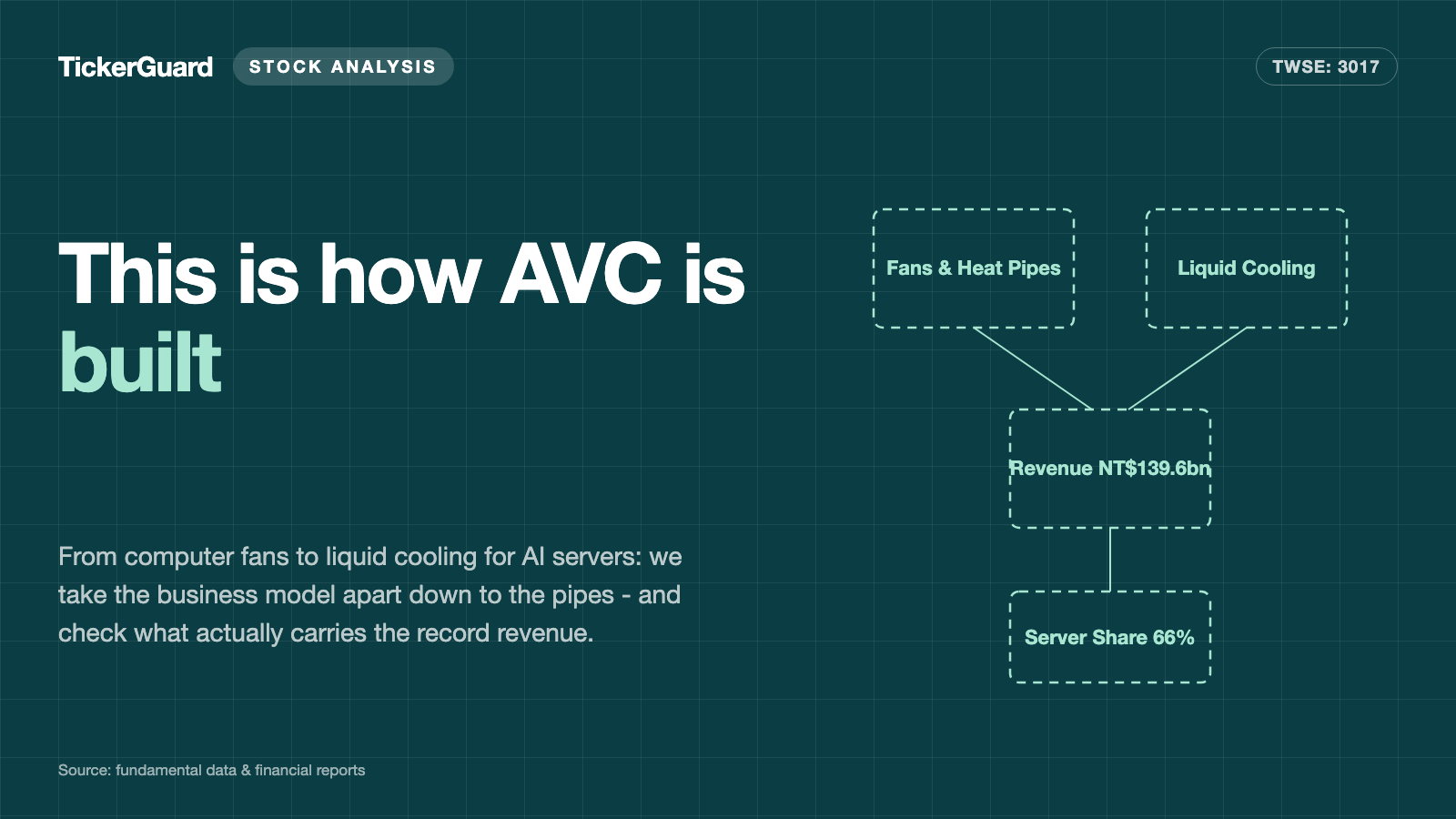
AVC was founded in 1991 in Kaohsiung in southern Taiwan and has been listed on the Taiwan Stock Exchange since 2002. In plain terms: if a computer chip is a muscle that heats up under strain, AVC has spent more than three decades building the cooling system around it — from simple fans through heat pipes (copper tubes that move heat from a hot spot to a cool one via evaporation and condensation) and vapor chambers (flat evaporation chambers for tight spaces) to complete liquid cooling systems and server chassis. For decades this was a fairly unremarkable supplier business for PC and notebook brands like HP and Lenovo, plus automotive, telecom and lighting technology.
Since 2024, that has turned into an AI infrastructure story. The reason: modern AI accelerators (graphics processors and specialized AI chips) draw so much power in so little space that air cooling hits its limits — data centers are switching to liquid cooling on a large scale as a result. According to Taiwanese business media, AVC was certified in April 2026 for the current NVIDIA server platforms GB200 and GB300, and has since positioned itself aggressively as a provider of complete thermal management solutions for AI data centers — not just individual components. Manufacturing still sits mostly in mainland China (plants in Shenzhen, Wuhan, Shanghai, Dongguan and Chengdu), supplemented since 2020 by a plant in Vietnam that was originally built as a hedge against US tariffs and, according to management comments on the second-quarter 2026 call, is now being expanded specifically for cloud customers. This geographic setup — a supplier at the heart of the US-led AI supply chain that manufactures mostly in China — is a point we return to below.
Company history for investors
-
1991
Founded in Kaohsiung
AVC is founded as a maker of computer fans and cooling components — the base for what becomes a global thermal-management business.
-
2002
IPO on the Taiwan Stock Exchange
The stock becomes regularly tradable under code 3017 — investors' only direct access to the company ever since.
-
2020
First plant in Vietnam
As a hedge against US import tariffs, AVC builds its first notable manufacturing capacity outside mainland China.
-
2025
Revenue jumps 94.6 percent
Carried by the AI server business, revenue grows to NT$139.6 billion and gross margin to 25.8 percent — both record levels.
-
2026
Dividend resolution for FY2025
The board resolves on March 11, 2026 a combined distribution of NT$21 per share — roughly 43.1 percent of annual profit flows to shareholders.
-
2026
Certified for NVIDIA GB200/GB300
Per Taiwanese business media, AVC is certified in April 2026 for the current NVIDIA server platforms — direct access to the leading AI chip ecosystem.
-
2026
Record quarter, narrower product mix
The second quarter of 2026 brings record revenue and margin, but the server/networking share of revenue now stands at 66.14 percent — concentration on a single cycle.
Where the Numbers Come From — Taiwan Instead of the SEC
A note up front, because it shapes the entire evidence base of this analysis: AVC has no 10-K, no 10-Q. The company is not registered with the US Securities and Exchange Commission — there is no EDGAR record, no CIK number. AVC's mandatory filings instead go through Taiwan's Market Observation Post System (MOPS, mops.twse.com.tw), where audited annual financial statements and reviewed quarterly reports are filed. This analysis draws on the consolidated financial metrics aggregated from those filings for fiscal years 2021 through 2025, the official second-quarter 2026 earnings release of August 12, 2026, and the English-language Taipei Times' coverage of it. That is why every figure in this analysis is sourced as "fundamental data & financial reports (Asia Vital Components Co., Ltd.)," not "SEC filings." This setup — listed on a major Asian exchange but not an SEC filer — is one AVC shares with other stocks we've already covered, such as Taiwanese server builder Wistron.
In the interest of honesty: our own system for earnings-call transcripts turns up nothing for AVC — the lookup returned zero matches. Instead, we evaluated a publicly available transcript of the second-quarter 2026 earnings call; a complete transcript of the first-quarter 2026 call could not be reliably retrieved from this environment, so the assessment of management's tone in this analysis focuses on the second quarter and relies on the earnings release itself for the first quarter.
The Numbers Over the Years: From Niche Supplier to Record Holder
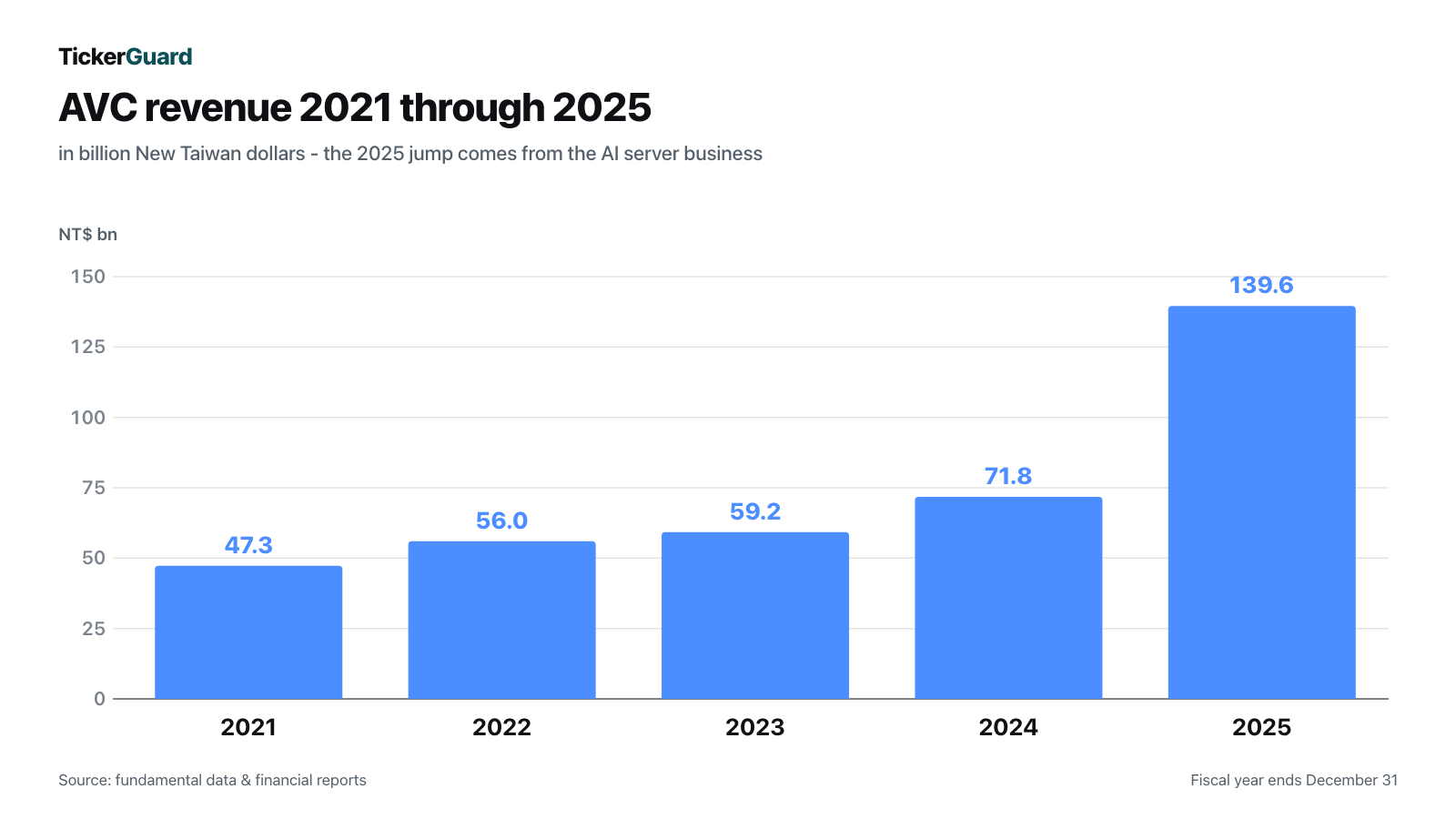
First the sober sequence: revenue NT$47.3 billion (2021), NT$56.0 billion (2022), NT$59.2 billion (2023), NT$71.8 billion (2024, up 21.2 percent) and NT$139.6 billion (2025, up 94.6 percent) — roughly US$4.41 billion or €3.80 billion (exchange rate as of August 29, 2026). Anyone looking only at the last two years might assume AVC has always been a high-growth stock. In fact, annual growth from 2021 to 2023 ran at roughly 12 percent — the acceleration to 21 and then 95 percent is a phenomenon of the last two fiscal years, carried by the AI server business.
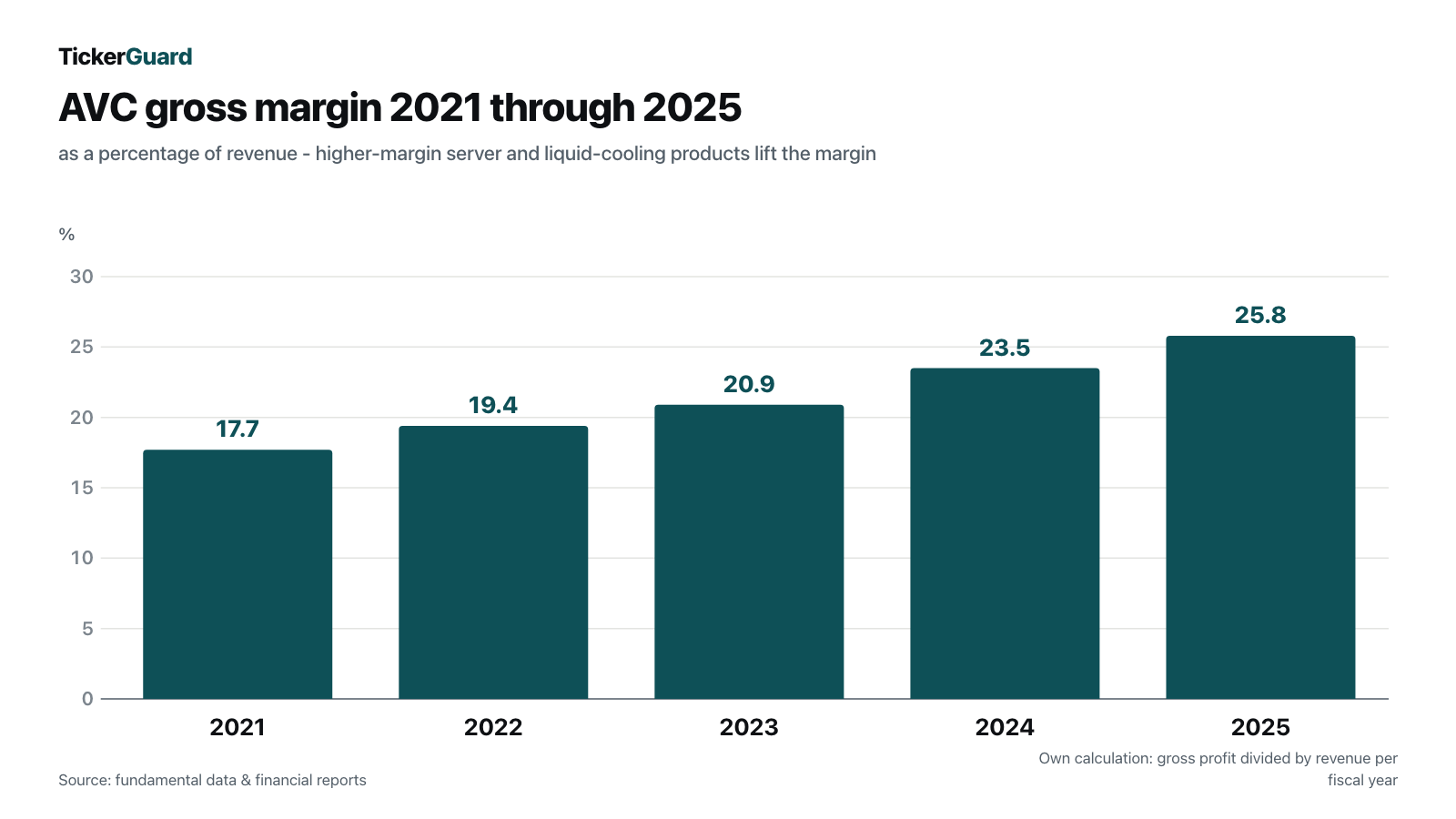
Gross margin — the share of revenue left after production costs — shows the same trend: 17.7 percent (2021), 19.4 (2022), 20.9 (2023), 23.5 (2024) and 25.8 percent (2025). Higher-margin server and liquid-cooling products are increasingly displacing the lower-margin classic consumer business.
The current fiscal year 2026 continues that trend and sharpens it: in the first quarter, AVC reported a record quarterly result (earnings per share NT$20.17); the second quarter followed with NT$49.12 billion in revenue (up 65.98 percent year over year, but just 0.17 percent versus the first quarter of 2026) and gross margin rising to 32.57 percent for the next record — net income NT$9,567 million, earnings per share NT$24.37. For the first half of 2026 combined: revenue NT$98,159 million (roughly US$3.10 billion), net income NT$17,483 million (up 142.5 percent versus the first half of 2025), earnings per share NT$44.54. Operating cash flow also grew strongly: NT$26,291 million in the first half of 2026 (up 175.5 percent), and free cash flow (cash flow after investment) rose to NT$19,179 million — roughly triple the prior-year figure. The balance sheet as of June 30, 2026 shows net cash (cash minus financial debt) of roughly NT$39.1 billion against total debt of NT$39.3 billion and cash of NT$78.4 billion — unusually strong substance for a company in the middle of a growth phase.
On March 11, 2026, the board resolved a fiscal-year-2025 distribution of NT$18 per share from retained earnings plus NT$3 per share from capital surplus — NT$21 per share combined, or NT$8,235,754,947 in total to shareholders, a payout ratio of roughly 43.1 percent against 2025 earnings per share of NT$48.74.
What Management Says — and What the Q&A Reveals
On the second-quarter 2026 earnings call on August 12, 2026, analysts focused on one question above all: how durable is the AI demand really? Asked whether AVC depends more on GPU or on specialized AI chip (ASIC) customers, sales-focused manager Eric Chan avoided being pinned down:
"For AVC, it's not an either/or for GPU, for ASIC product. Both product need thermal and mechanical solutions."
— Eric Chan, per the transcript an AVC manager focused on sales, second-quarter 2026 earnings call (August 12, 2026)
That's an honest answer to a question that was really asking for a clear commitment — and it also shows how AVC downplays its dependence on individual chip architectures without addressing the underlying dependence on the broader AI infrastructure cycle. More revealing was the answer on demand visibility, where another manager, Matthew Shen, offered a concrete argument:
"Customers are willing to do this for us, to prepay us for expansion, to prepay us for capacity."
— Matthew Shen, per the transcript an AVC manager, second-quarter 2026 earnings call (August 12, 2026)
Customer prepayments for capacity expansion are genuinely a strong signal of real rather than merely forecast demand — they financially bind the customers themselves to the growth. But it's worth noting the same setup deepens a concentration risk: whoever prepays usually doesn't do it out of charity, but because they themselves depend on that capacity — which deepens the dependency in both directions rather than reducing it. As a third, forward-looking point, Eric Chan described a new market segment beyond data centers: cooling for space applications, "a very advanced version, super improved version of existing product," relying on conduction, convection and evaporation instead of the air cooling unavailable in space. On margins, management was deliberately cautious for the third quarter of 2026 and pointed only generally to the shift into mass production and continued automation rollout as supporting factors — it did not name a specific figure.
Uncomfortable Truth No. 1: The Factories Are in China, the Customers Are in the US Camp
AVC is a Taiwanese-listed stock that today lives at the core of the US-led AI supply chain — certified for NVIDIA platforms, with cloud operators as its most important growth customers. Yet that business is manufactured largely in mainland China: the company's production plants, per its own disclosure, sit in Shenzhen, Wuhan, Shanghai, Dongguan and Chengdu. Only in 2020 did Vietnam become the first notable manufacturing location outside China — originally conceived as a hedge against US import tariffs. On the second-quarter 2026 earnings call, management confirmed it is deliberately expanding Vietnam capacity to serve cloud-operator demand — an implicit sign that at least part of the customer base itself values manufacturing outside China.
For you as an investor, that means: a company whose growth story is inseparable from the geopolitically sensitive US-China race for AI chips manufactures a substantial part of that technology in the very country whose trade relationship with the US triggered that race in the first place. New export controls, tariffs, or an escalation of tensions around Taiwan itself could hit AVC from two directions at once — as a Taiwanese company and as a China manufacturer. The Vietnam expansion shows AVC has recognized this risk; it reduces it, but doesn't eliminate it.
Uncomfortable Truth No. 2: The Price Already Bets on the Exception Continuing
Roughly 267 percent since its 52-week low, roughly 893 percent in three years, a close near its 52-week high (NT$3,360 on August 28, 2026; the 52-week intraday high stood at NT$3,450) — the stock has long since priced in more than its own growth story. At trailing four-quarter earnings, the stock trades at roughly 45 times earnings, a price-to-book ratio of roughly 23.9, a price-to-sales ratio of roughly 7. Those are valuation multiples usually reserved for software or platform growth stories — not, historically, for the cooling-component supplier AVC was through 2023.
Recall the numbers from the previous chapter: from 2021 to 2023, AVC grew at roughly 12 percent a year on average. The current valuation assumes the exceptional years 2024 and 2025 (up 21 and 95 percent) are the new normal, not the exception. That may prove true — the company's own guidance for a stronger second half of 2026 and the customer prepayments described above support it. But a valuation paid for the continuation of an exceptional growth run that's only two years old leaves little buffer for disappointment. An analyst consensus price target of roughly NT$3,833 (as of August 28, 2026) implies roughly 14 percent further upside by this math — for a stock that, over the past twelve months, has already risen far faster than any price target could keep up with.
Uncomfortable Truth No. 3: Two-Thirds of the Business Now Rides on a Single Cycle
The third uncomfortable truth belongs at the center of any valuation of this stock: the share of server and networking applications in first-half revenue jumped from 48.4 percent (first half 2025) to 66.14 percent (first half 2026) — a narrowing of the business model onto a single, highly cyclical end market within just twelve months. Cloud and AI infrastructure investment is historically anything but steady: when hyperscalers cut capital spending plans — as happened industry-wide in 2022/2023, just without today's AI focus — that hits AVC more directly today than it would have two years ago, when the business was spread more broadly across PC, automotive and telecom customers.
To be clear, this is not a solvency risk: the balance sheet, with net cash and an Altman Z-score of 9.23, is unusually stable, and a demand downturn would not threaten AVC's existence. But it is an open operating question that so far only one exceptional year has answered — not a full investment cycle.
Valuation: Expensive — the Question Is Whether Rightly So
Putting the ratios together: price NT$3,360 (August 28, 2026, roughly US$106 or €91), market capitalization roughly NT$1,319 billion (roughly US$41.7 billion or €35.9 billion), price-to-earnings ratio at trailing four-quarter earnings roughly 45, at analysts' expected earnings for the coming twelve months roughly 32. For comparison: revenue grew 94.6 percent in 2025, and first-half 2026 net income grew 142.5 percent — by that measure, the growth-to-valuation ratio (the so-called PEG, P/E divided by growth rate) still looks moderate as long as the growth rate holds. That's exactly the crux of this stock: it isn't obviously irrationally valued if you extrapolate the most recent growth rate — but it offers essentially no safety margin should that rate fall back to the long-run average of roughly 12 percent.
Opportunities and Risks at a Glance
Opportunities: AVC is certified for the current NVIDIA GB200/GB300 platforms and positions itself as a provider of complete cooling solutions rather than individual components, in a market where liquid cooling, per management, should penetrate more than half of data centers by 2027. Customer prepayments for capacity expansion suggest durable rather than merely forecast demand. A balance sheet with roughly NT$39.1 billion in net cash allows self-funded investment without diluting shareholders through a capital raise. A new market segment (space cooling) could add growth beyond data centers over the long run.
Risks: Manufacturing sits largely in mainland China while core customers come from the US-led AI camp — a geopolitical risk the ongoing Vietnam expansion only partly addresses. Two-thirds of the business now rides on a single, historically volatile investment cycle. A roughly 45-times-earnings valuation leaves little room for disappointment, and management itself has set a concrete, checkable bar with its guidance for a stronger second half of 2026.
The Human Verdict
Back to the opening question: have you missed the train? The honest answer is unglamorous: the numbers AVC has delivered so far are real and impressive — record revenue, record margin, record profit, a balance sheet with more cash than debt. But those same numbers are already in the price, and the FOMO feeling drawing you to this stock is no substitute for asking whether a company whose China-heavy manufacturing and whose AI business — now two-thirds of revenue — have both existed in this form for only a year or two deserves a full valuation premium for a multi-year exceptional run. Buying in here isn't buying an undiscovered company — it's buying an already-written, well-documented story and betting the next chapter will be at least as good. Not investment advice — just the numbers that belong to that decision.
Sources
This analysis draws on the consolidated financial statements filed with Taiwan's Market Observation Post System (MOPS, mops.twse.com.tw) for fiscal years 2021 through 2025 (aggregated metrics), the second-quarter 2026 earnings release of August 12, 2026, Taipei Times coverage of August 13, 2026, a publicly available transcript of the second-quarter 2026 earnings call (investing.com/Quartr), and fundamental data as of August 28/29, 2026. No SEC filing, no EDGAR record — AVC is not a US registrant. This analysis is not investment advice, not a buy or sell recommendation. All price references are dated anchor values, not real-time quotes.
Our Bottom Line at a Glance
- Growth positive
- Revenue up 94.6 percent in fiscal 2025, first-half 2026 net income up 142.5 percent year over year, records in both 2026 quarters so far. Before 2024, AVC grew at only around 12 percent a year — the current growth rate is historically exceptional and only two fiscal years old.
- Earnings quality and margin positive
- Gross margin rose from 17.7 percent (2021) to 25.8 percent (2025) and further to 32.57 percent in the second quarter of 2026 — driven by genuine product-mix shift toward higher-margin server and liquid-cooling products, not one-off effects. Operating cash flow grew 175.5 percent in the first half of 2026, and free cash flow roughly tripled.
- Balance sheet and debt positive
- Net cash of roughly NT$39.1 billion (June 30, 2026) against total debt of NT$39.3 billion; Altman Z-score of 9.23, well within the range considered safe. Roughly NT$15 billion of planned 2026 investment is to be funded from operating cash flow, without external financing.
- Customer and market concentration negative
- The share of server and networking applications in first-half revenue jumped from 48.4 percent (H1 2025) to 66.14 percent (H1 2026) — a rapid narrowing onto a single, cyclical investment market. Customer prepayments for capacity expansion signal durable demand but also deepen mutual dependency.
- Geographic and geopolitical risk negative
- Manufacturing sits mostly in mainland China (Shenzhen, Wuhan, Shanghai, Dongguan, Chengdu) while core customers come from the US-led AI ecosystem. The Vietnam expansion under way since 2020 reduces this risk but doesn't eliminate it — export controls or an escalation of tensions around Taiwan could hit AVC from two directions at once.
- Share price and valuation neutral
- The stock stands at NT$3,360 on August 28, 2026, roughly 267 percent above its 52-week low and near its 52-week high (intraday NT$3,450). At trailing four-quarter earnings, the price-to-earnings ratio is roughly 45 — high, but not obviously irrational given recently reported growth rates, as long as those rates hold.
AVC delivers operationally what a cooling specialist in the AI server boom should deliver: record revenue, record margin and record profit on an unusually strong balance sheet with roughly NT$39.1 billion in net cash. At the same time, the business has narrowed within twelve months from 48.4 to 66.14 percent server/networking share, manufacturing sits largely in mainland China while core customers come from the US-led AI camp, and the stock, at 45 times earnings, has already priced in the continuation of a growth exception that is only two years old. Not investment advice.
What Our Rating Means
Open questions
The business works in principle, but one material question is open. As long as it stays open, our findings do not carry a quality verdict.
Yellow here is not about a going-concern question — the balance sheet, with net cash and an Altman Z-score of 9.23, is unusually stable, and the operating business is profitable and cash-generative. Yellow stands because two material operating questions remain open: first, the current exceptional growth rate (up 94.6 percent in 2025, up 142.5 percent net income in the first half of 2026) has only two fiscal years of track record, after AVC grew at roughly 12 percent a year for years before that — whether the new growth level is the new normal or a one-off demand surge can only be answered by a full investment cycle at the earliest. Second, customer and market concentration narrowed within just twelve months from 48.4 to 66.14 percent server/networking share, on manufacturing that sits mostly in mainland China while core customers come from the US-led AI ecosystem — a geopolitical risk the ongoing Vietnam expansion only partly addresses. Both are operating questions, not solvency questions: the business model itself clearly works, but its durability across a full cycle has not yet been proven. The decision is yours.
A journalistic assessment by our editorial team at the time of the deep dive, based on public sources — not investment advice and not a solicitation to buy or sell. Your personal circumstances (investment goals, risk capacity, taxes) cannot be taken into account. What our levels mean, how verdicts are formed, and what conflicts of interest exist →
Worth Noting
- This analysis was written on August 29, 2026, based on the consolidated financial statements filed with Taiwan's Market Observation Post System (MOPS) for fiscal years 2021 through 2025, the second-quarter 2026 earnings release (August 12, 2026), Taipei Times coverage (August 13, 2026), and a publicly available transcript of the second-quarter 2026 earnings call. Price, share count and the 52-week range are as of August 28/29, 2026.
- AVC is not an SEC filer and has no EDGAR record — every figure comes from Taiwanese consolidated financial statements and official earnings releases, not from 10-K/10-Q reports.
- Our internal system for earnings-call transcripts found no matches for this ticker; we instead evaluated a publicly available transcript of the second-quarter 2026 earnings call. No complete transcript was available for the first quarter of 2026.
The full analysis as a PDF for later
We will send you this analysis as a PDF — to print, file away, and read at your own pace.
Frequently Asked Questions
AVC develops and manufactures thermal management components: computer fans, heat pipes, vapor chambers, liquid cooling systems and server chassis. Originally a supplier to PC and notebook brands like HP and Lenovo, AVC has since 2024/2025 become known primarily as a cooling-solutions provider for AI servers — certified, per Taiwanese business media, for the NVIDIA GB200 and GB300 platforms since April 2026.
No. AVC is listed exclusively on the Taiwan Stock Exchange (code 3017) and files its mandatory reports with Taiwan's Market Observation Post System (MOPS), not the SEC. There is no 10-K, no 10-Q, and no EDGAR record.
Yes. For fiscal year 2025, the board resolved on March 11, 2026 a distribution of NT$18 per share from retained earnings plus NT$3 per share from capital surplus — NT$21 per share combined, NT$8,235,754,947 in total, a payout ratio of roughly 43.1 percent against 2025 earnings per share of NT$48.74.
At trailing four-quarter earnings, the stock trades at roughly 45 times earnings (price NT$3,360 on August 28, 2026); at analysts' expected earnings for the coming twelve months, roughly 32 times. That's a high valuation level that assumes the exceptional growth of 2024/2025 continues.
AVC built its manufacturing base historically in mainland China (plants in Shenzhen, Wuhan, Shanghai, Dongguan and Chengdu) and only diversified with a Vietnam plant in 2020, originally as a hedge against US import tariffs. Since its core customers come from the US-led AI ecosystem, this geographic setup is a geopolitical risk the ongoing Vietnam expansion only partly addresses.
Liquid cooling carries heat away from computer chips via a liquid instead of air — necessary because modern AI accelerators draw so much power in so little space that air cooling hits its limits. AVC has evolved from a supplier of individual cooling parts to a provider of complete liquid cooling systems for data centers; per management comments on the second-quarter 2026 call, liquid cooling should penetrate more than half of data centers by 2027.
Very, and very quickly: the share of server and networking applications in first-half revenue rose from 48.4 percent in the first half of 2025 to 66.14 percent in the first half of 2026 — two-thirds of the business is now tied to a single, cyclical investment market.
Very solid: as of June 30, 2026, cash of NT$78.4 billion stood against total debt of NT$39.3 billion, for net cash of roughly NT$39.1 billion. The Altman Z-score (an insolvency-risk indicator), per fundamental data, stood at 9.23 — well within the range considered safe.
Found an error?
Did you spot a factual error, an outdated number, or a typo in this deep dive? Let us know briefly — your report goes straight to the editorial team.