Ballard Power: $502 Million in the Bank, $1.06 Billion Burned — and Now a $400 Million Acquisition
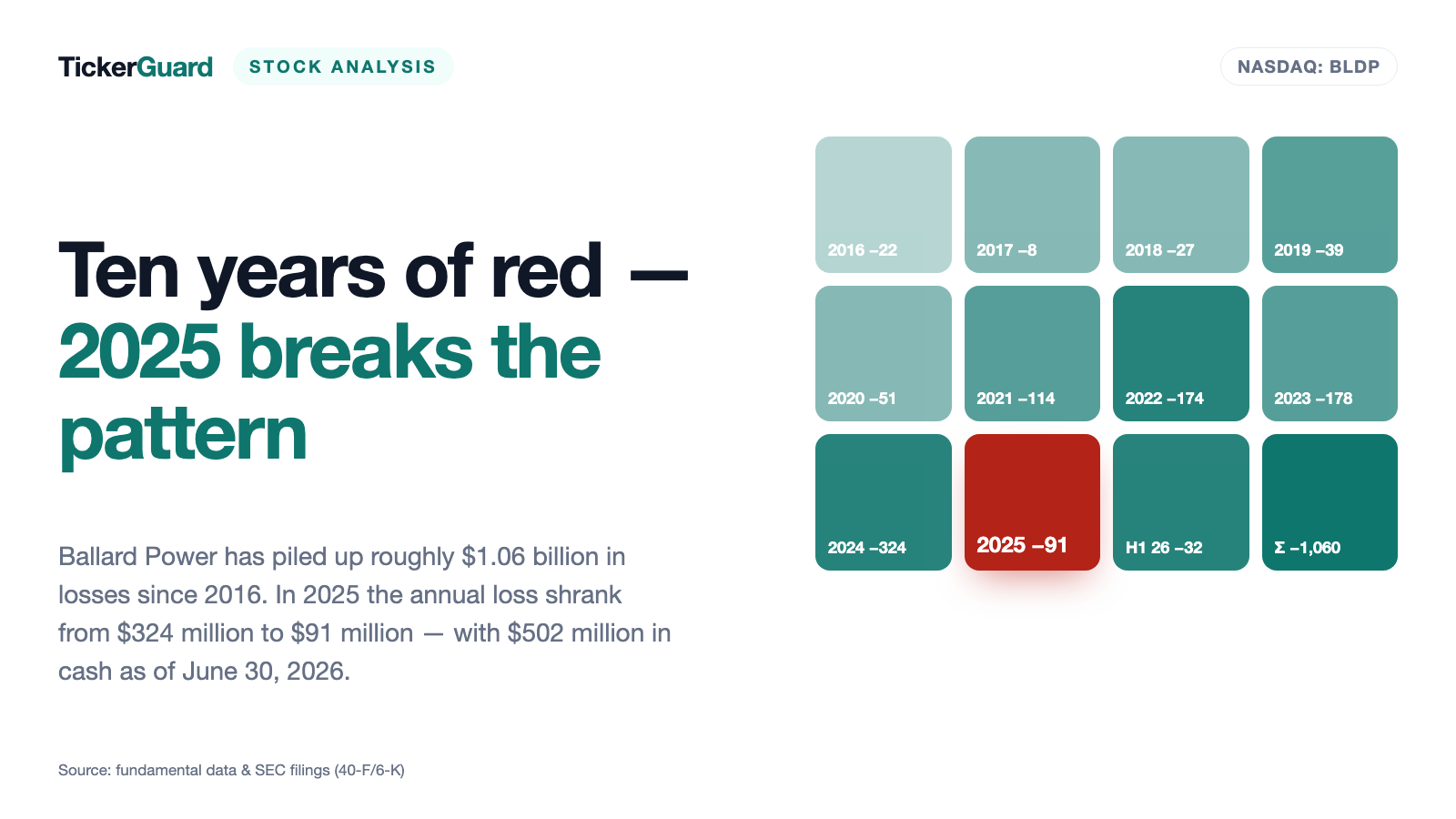
Ballard Power has been building fuel cells for buses, trains and off-grid power for more than thirty years. Revenue has moved between $70 million and $121 million for a decade, the losses since 2016 add up to roughly $1.06 billion — and yet on June 30, 2026 the company still held $502.1 million in cash without a single dollar of bank debt. In 2026 gross margin turned positive, the quarterly loss narrowed and the order backlog climbed to $156.6 million. At the same time Ballard is buying UK-based GeoPura for £275 million upfront, issuing about 50.8 million new shares to pay for it. We read what Ballard told the U.S. securities regulator, the SEC — and do the math on how long the money lasts.
 Thomas Mücke
Founder & Publisher
Thomas Mücke
Founder & Publisher
As of Today
As of: September 29, 2026
- Closing price
- 2.10 $ +1.90%
- Market Capitalisation
- 0.6 $B
- Growth Score
- 4/10
- AAQS
- 3/10
This analysis has a cut-off date. The Stock Guard tells you when something material changes in the numbers. Reserve your free spot
Chart
Interactive price chart (TradingView).
52-week range: 2.00 $ to 6.40 $ · Last price: 2.10 $ (As of: September 29, 2026)
Note: pure fact-based analysis, not investment advice and not a solicitation to buy or sell. All figures without guarantee.
There is an investor trap that does not feel like a trap at all. It feels like prudence: cash comfort. It works like this. You read that a company is losing money — and in the next sentence, that it holds half a billion dollars in the bank with no debt. Something in your head relaxes immediately. "They can afford it." And because they can afford it, you stop asking the question that actually matters: will this money ever turn into a business? Ballard Power Systems (NASDAQ and TSX: BLDP), based in Burnaby just outside Vancouver, is the company to learn this trap on. It has been building fuel cells for more than thirty years, it really did hold $502.1 million in cash on June 30, 2026 with no bank debt at all — and it has lost roughly $1.06 billion since 2016 on revenue that sits about where it sat in 2016. So let us make a deal: before you let the cash pile calm you down, we read together what Ballard told the U.S. securities regulator, the SEC — the annual report on Form 40-F for 2025, filed March 12, 2026, and the interim report on Form 6-K as of June 30, 2026, filed July 31, 2026. Those filings are truthful under penalty of law. And they describe a real turn in margin, three customers carrying half of revenue, a cash pile that has halved since 2021 — and an acquisition worth roughly $400 million that is supposed to change everything. In the end, you decide.
What Ballard Power actually does — electricity from hydrogen, without combustion
A fuel cell is, in everyday terms, a battery you do not recharge but refuel. You feed it hydrogen, it pulls oxygen from the air, and the chemical reaction between the two produces electricity directly — no flame, no piston, no exhaust pipe, just water left over. Ballard builds these cells using the proton exchange membrane approach, named for the wafer-thin plastic membrane at its core, and sells them not to end users but to manufacturers who build them into their products. The annual report describes the business as a single segment: Fuel Cell Products and Services. There are four markets: buses, the most mature one, where the customers are European and North American bus builders; rail, aimed at lines without overhead wires; stationary power for backup, construction sites, film sets and charging hubs; and a catch-all of trucks, marine vessels, material handling and off-road equipment. In the first half of 2026 the $40.0 million in revenue broke down as $16.4 million from bus, $9.1 million from rail, $7.0 million from stationary and $7.4 million from other markets. As of December 31, 2025 Ballard employed 492 people, following a corporate restructuring that began in July 2025 and included a change at the top of the company.
That sets up the central tension of this analysis, and it runs through every chapter: Ballard has more money in the bank than it generates in five years of revenue — but that money is a reserve, not a return, and it has been shrinking since 2021. The question is not whether the company runs out of cash next year. The question is whether the reserve turns into a self-sustaining business before it is gone.
How this stock landed on our desk
Ballard did not come to us through a momentum or value screen but through our running review of new SEC filings. Three of them in five weeks were impossible to ignore: on June 23, 2026 the agreement to acquire UK-based GeoPura Limited; on July 6, 2026 a notice of proposed sale (Form 144) covering 15 million shares from Chinese anchor shareholder Weichai; and on July 31, 2026 the half-year report showing a fourth consecutive quarter of positive gross margin. Our cut-off date is August 13, 2026; every figure in this article carries its own date. One thing matters for anyone who wants to check the filings: Ballard is a Canadian corporation and therefore files no 10-K annual report and no 10-Q quarterly reports with the SEC. It files an annual report on Form 40-F and interim reports on Form 6-K. Search EDGAR for a 10-K and you find nothing, which can make the company look opaque. It is not — it simply sits in a different drawer. Accounting follows the international IFRS standard, the reporting currency is the U.S. dollar, and the fiscal year matches the calendar year.
The numbers over the years — credit where credit is due
First the part of 2026 that genuinely impresses, because it is more than the loss history suggests. In the second quarter of 2026 revenue rose 15 percent to $20.6 million, and gross margin — what is left after the direct cost of building the product — swung from negative $1.5 million (negative 8 percent of revenue) to positive $4.1 million, or 20 percent. The company says that is the fourth consecutive quarter in positive territory. Operating expenses fell 34 percent to $20.9 million, the quarterly net loss narrowed from $24.3 million to $20.3 million, and adjusted EBITDA improved from negative $30.6 million to negative $9.8 million. The order backlog jumped 38.8 percent during the quarter to $156.6 million, with the portion scheduled for delivery over the next twelve months rising to $74.4 million. For full-year 2026 Ballard guides operating expenses of $65 million to $75 million, down from $108.9 million in 2025. In short: the company has become considerably cheaper to run, and for the first time in years it earns something on each unit it ships.
And now the chart that puts all of it in context — revenue and net income over ten years:
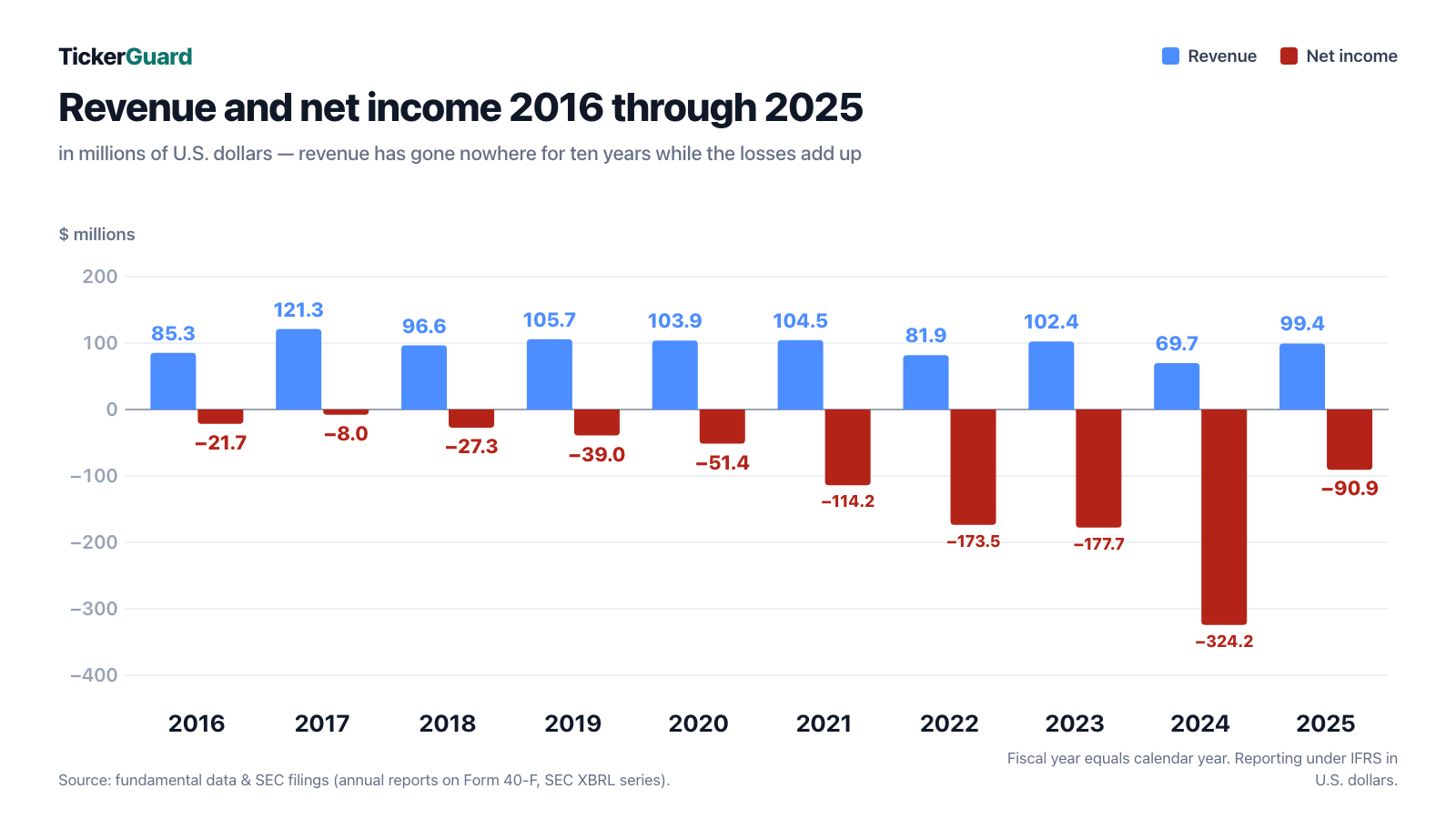
Revenue in 2025 ($99.4 million) came in below the 2017 figure ($121.3 million). Nine years of product development, nine years of market building, nine years of hydrogen euphoria and hydrogen hangover — and the revenue base is the same size. Remember this sentence, because it is the core of the whole analysis: at Ballard the loss is not the real problem; the real problem is that revenue never caught up with it. Which brings us to the uncomfortable truths.
What the filings say — the uncomfortable truths
Uncomfortable truth no. 1: a third of the new gross margin comes from released provisions
The margin turn is real — but it is not as clean as the headline "20 percent gross margin" suggests. The half-year report lists the reasons itself, and the last one is the interesting part:
"The improvement in gross margin in 2026 as compared to 2025 is due primarily to product cost reduction initiatives and lower manufacturing overhead costs as a result of the global corporate restructuring initiated in July 2025, and through certain non-ratable adjustments to warranty and inventory provisions."
— Ballard Power Systems Inc., Form 6-K as of June 30, 2026, management discussion and analysis, gross margin section

What does "adjusting a provision" mean? Picture a contractor who sets money aside every year for warranty claims. If fewer claims arrive than feared, he pulls part of that money back into the profit line — and this year's profit rises without a single extra job being completed. That is exactly what happened at Ballard, and the amounts sit in the notes. On inventories, write-downs of $907,000 were offset by reversals of $2,420,000, producing a net recovery of $1,513,000; on top of that the warranty provision was adjusted downward by $818,000. Together that is $2.331 million against a half-year gross margin of $6.843 million — roughly 34 percent. Strip it out and the margin falls to about 11 percent of revenue instead of 17 percent. To be fair: the chief executive attributes the reversals to products proving more durable in the field than assumed, which would be good news about the technology. It is simply a one-time piece of good news per provision. Remember: a margin that is one third reverse gear is a status report, not proof.
Uncomfortable truth no. 2: three customers carry more than half of revenue
Ballard does not sell to many buyers; it sells to a few. The 2025 financial statements put the numbers on the table without dressing them up:
"In 2025, revenues included sales to three individual customers of $18,239,000, $16,919,000 and $16,244,000 respectively, which exceeded 10% of total revenue."
— Ballard Power Systems Inc., Form 40-F for 2025, notes to the consolidated financial statements (concentration risk)

Added up, that is $51.4 million, or roughly 52 percent of 2025 revenue of $99.4 million, spread across three addresses. The management discussion adds that the order backlog and the twelve-month order book are likewise "concentrated among a limited number of customers" and may be subject to cancellation, delay and pricing adjustments. Translated: if one of those three walks away, Ballard does not lose a percentage point, it loses a sixth of the business. That is not a Ballard peculiarity but typical of a market still built on pilot projects — it does, however, make the revenue line far more fragile than an annual figure suggests. For a picture of what happens when such a market fails to take off for decades, look at a direct competitor: our analysis of FuelCell Energy covers a company that has not posted a profitable year since 1997.
Uncomfortable truth no. 3: the war chest has halved since 2021
Now for the cash that provides so much comfort. It is real: $502.1 million on June 30, 2026, plus $3.0 million in short-term investments, for $505.1 million in total liquidity — and no bank debt whatsoever. It is not bedrock, though. It is an iceberg:
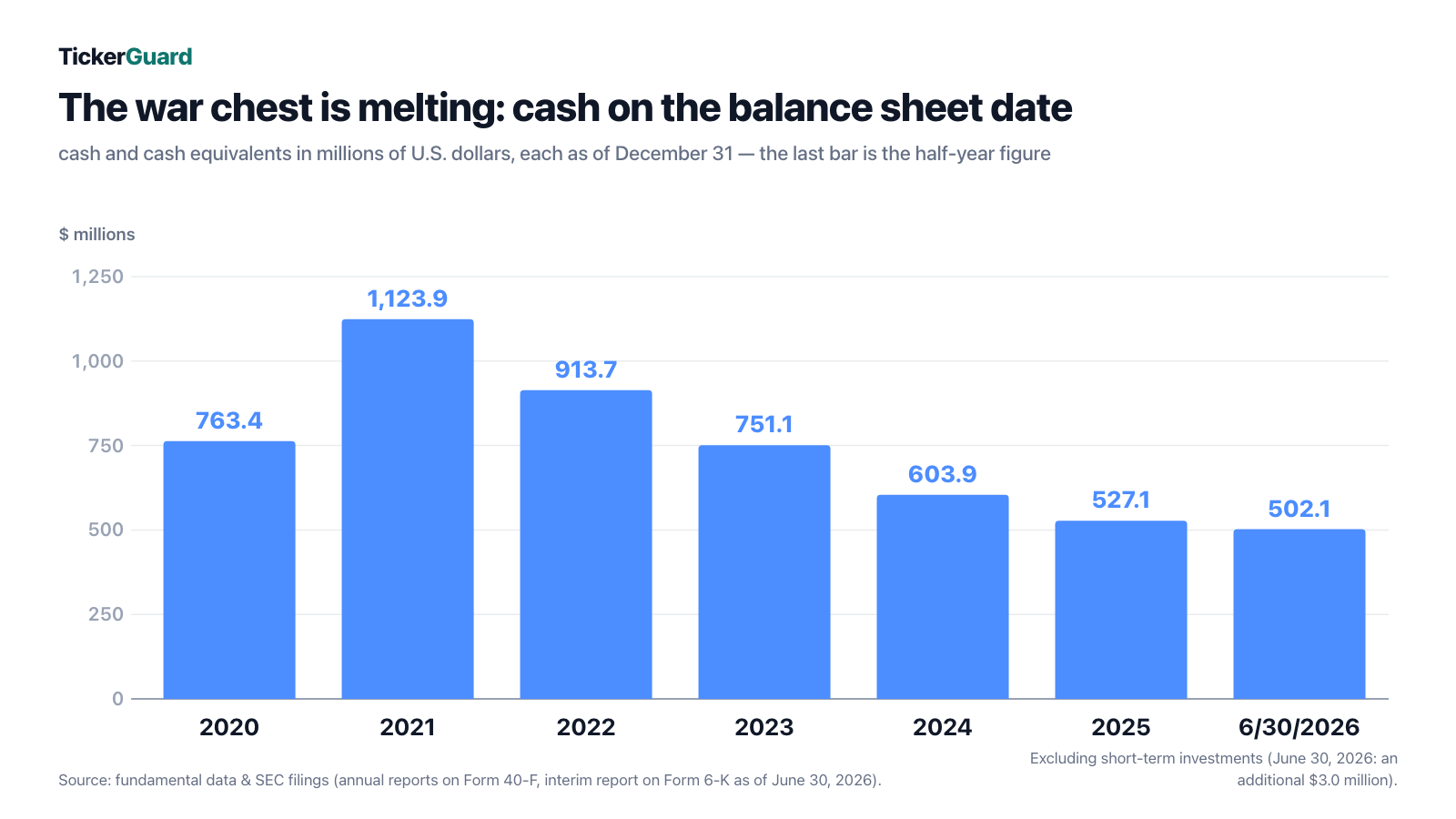
The 2021 peak of $1,123.9 million dates from the hydrogen boom, when Ballard could sell new shares at high prices. The balance has fallen every year since. The good news is that the pace has slowed sharply. In the first half of 2026 operating activities consumed only $19.2 million, down from $44.7 million a year earlier; for full-year 2025 the figure was $56.2 million and for 2024 it was $108.1 million. Extend the half-year pace and add the $5 million to $10 million of planned capital expenditure, and the cash arithmetically lasts more than a decade. Ballard states its own yardstick like this:
"The Corporation's liquidity objective to remain a going concern into the foreseeable future is to maintain cash balances sufficient to fund at least six quarters of forecasted cash used by operating activities and contractual commitments."
— Ballard Power Systems Inc., Form 6-K as of June 30, 2026, note 2(e) "Future operations"

An important distinction: this is not a going concern warning of the kind auditors attach to struggling companies. It is a self-imposed benchmark — and Ballard currently clears it by a wide margin. Equally worth stating: a base shelf prospectus for new share issues has been in place since June 11, 2025, effective for 25 months through July 2027, and nothing had been drawn from it as of the half-year report. So the reserve is large, the outflow is slowing and the back door stands open. It is finite all the same — and part of it has just been committed.
Uncomfortable truth no. 4: the $400 million acquisition is largely paid for in new shares
On June 23, 2026 Ballard agreed to acquire GeoPura Limited, a British provider of hydrogen-based power solutions. The idea is to turn a component supplier into a company that sells power as a service — from hydrogen production through logistics and refueling to the generator on site. The terms sit in the notes:
"The Transaction consists of an upfront equity purchase price of £275,000,000 ("Upfront Consideration"), funded through a combination of £82,500,000 of the Corporation's cash on hand and the issuance of approximately 50,800,000 of its common shares to GeoPura shareholders, at $5.02 per share, based on the Corporation's 30-day volume-weighted average share price."
— Ballard Power Systems Inc., Form 6-K as of June 30, 2026, note 25 "Subsequent event"
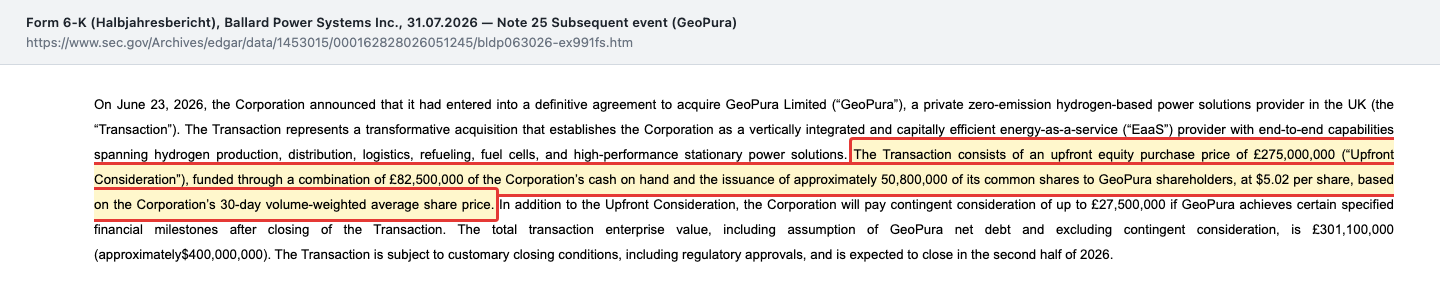
Three things about this deserve your attention. First, dilution. Dilution means your slice of the pie gets smaller because new slices are handed out. About 50.8 million new shares on top of the 301,506,494 outstanding on June 30, 2026 is an increase of roughly 17 percent. Hold 100 shares today and you economically hold about 86 after closing. Second, the price of the currency. Payment is in shares valued at $5.02 — the 30-day average before the announcement. On July 6, 2026, a little over two weeks later, Weichai's Form 144 put a market value of $57.15 million on 15 million shares, or roughly $3.81 apiece. If the price falls between signing and closing, the share component becomes more expensive for existing holders, not cheaper, because the number of shares is fixed while the value behind them is not. Third, the cash. Using the ratio the report itself provides (£301.1 million ≈ $400 million), £82.5 million works out to roughly $110 million — a good fifth of the balance. Add up to £27.5 million in contingent consideration plus advisory fees: $3.9 million was already expensed in the second quarter of 2026, and a further $3 million to $5 million falls due only on successful closing. As of June 30, 2026 the transaction had not closed; management expects completion in the second half of 2026, subject to regulatory approvals. Not a dollar of it appears on the balance sheet yet.
Uncomfortable truth no. 5: the anchor shareholder from China is leaving
In 2018 Chinese engine maker Weichai Power came in with 46,131,712 shares as a strategic partner, paired with a joint venture in China and two board seats. Both are history. In May 2026 Weichai reported a smaller holding three times in one week: 39,252,826 shares (13.02 percent) on May 12, 34,999,826 on May 14 and 31,102,826 (10.32 percent) on May 15. Below the 15 percent threshold the right to two board seats lapsed, and the nominees resigned effective May 13, 2026. On July 6, 2026 a notice covering a further 15 million shares followed. The operating side fits the picture: Ballard fully wrote off its 49 percent stake in the Weichai Ballard joint venture in 2025 ($4.634 million) and said it is exiting China — revenue from China in the first half of 2026 was zero, against $263,000 a year earlier. For you as an investor that means two things: the largest single shareholder is selling, which regularly weighs on the price, and the strategic door to China is shut. In fairness, a strategic investor exiting after eight years is not unusual, and every step has been fully disclosed. It is still not a vote of confidence.
Valuation: you are mostly buying the cash — and paying little for the business
How expensive is Ballard? A price-to-earnings ratio cannot be formed without earnings, so let us work in orders of magnitude, all dated. On August 12, 2026 the stock closed at $2.62. Multiplied by the 301,506,494 shares from the half-year report, that is a market value of roughly $790 million. Of that, $505.1 million is simply money, with another $42.0 million in fund holdings. Subtract both and the market is paying roughly $245 million for the actual fuel cell business — technology, patents, backlog, brand — or about two and a half times 2025 revenue. Measured against the full market value it is roughly eight times revenue. Book value per share stands at $1.86 (equity of $559.7 million on June 30, 2026), so on August 12, 2026 the stock traded at about 1.4 times book. One dated anchor comes from the company itself: in the GeoPura agreement Ballard valued its own shares at $5.02, well above the August level. And the professionals? Of the 17 analysts in the consensus, 11 rated the stock hold, 2 buy and 4 sell, with an average price target of $4.11 (data as of August 13, 2026) — a consensus that expresses neither euphoria nor panic, but patience. Remember the order of magnitude: buy Ballard and roughly two thirds of what you get is a bank balance and one third is a bet. For a sense of how the market prices similar bets in the energy transition, see our analysis of Eos Energy, where every dollar of revenue cost $2.26 to produce.
Opportunities and risks at a glance
What speaks for Ballard Power:
- Financial resilience with few equals in the sector: $502.1 million in cash and $505.1 million in total liquidity as of June 30, 2026, no bank debt, equity of $559.7 million against total liabilities of just $84.2 million.
- The cost turn is documented: operating expenses down 34 percent to $20.9 million in the second quarter of 2026, full-year guidance of $65 million to $75 million after $108.9 million in 2025, and operating cash usage halved to $19.2 million in the half year.
- The product finally earns money: gross margin of 20 percent in the second quarter of 2026 after negative 8 percent a year earlier, the fourth consecutive positive quarter according to the company.
- The order backlog is growing sharply: $156.6 million on June 30, 2026 after $112.9 million at the end of March, with $64.4 million of orders taken in the second quarter alone; recent wins include platform nominations from Wrightbus (May 2026, series production from 2027) and Solaris (agreement extended to 2029).
- The GeoPura acquisition shifts the model from component sales toward recurring service revenue — precisely the kind of revenue the company has lacked.
What speaks against it:
- Ten years without revenue growth: $99.4 million in 2025 against $121.3 million in 2017, with cumulative losses of roughly $1.06 billion since 2016 and an accumulated deficit of $2.183 billion as of June 30, 2026.
- The margin turn is partly an accounting effect: about 34 percent of the half-year gross margin came from released inventory and warranty provisions ($2.331 million of $6.843 million).
- Severe customer concentration: three customers accounted for $51.4 million, or roughly 52 percent of 2025 revenue, and the filings describe the backlog and twelve-month order book as similarly concentrated.
- Dilution and cash outflow from GeoPura: about 50.8 million new shares (roughly 17 percent more stock) plus around $110 million from the balance sheet, with up to £27.5 million contingent and $3 million to $5 million in success fees at closing — which had not happened as of the balance sheet date.
- Anchor shareholder Weichai has been reducing since May 2026 (last reported at 31,102,826 shares, or 10.32 percent) and filed on July 6, 2026 to sell a further 15 million shares; the Chinese joint venture is written off and revenue from China is zero.
- Earnings also swing on unlisted fund holdings: a carrying value of $42.0 million whose fair value fell $9.657 million in the first half of 2026 — roughly 30 percent of the half-year loss.
A human conclusion
Back to the cash comfort we started with. It works so well because it is not wrong: Ballard does have the money, Ballard does have no debt, Ballard can afford years without success without a single creditor knocking. What the comfort leaves out is the price of time. More than $600 million has flowed out of the balance since 2021, and revenue today sits below where it was in 2017. Now another slice of the reserve plus 17 percent in fresh shares is going to a British company that is supposed to rebuild the business model. It may work — Ballard really has cut costs, really does earn something per unit for the first time, and really has grown its backlog. It may equally become the next round of the same story: plenty of money, plenty of future, not much revenue. So the honest question is not "can Ballard survive?" — visibly it can, for a long time. It is this: are you willing to pay for another decade in which good technology waits for a market that has not arrived? If yes, you get an unusually solid balance sheet to make that bet on. If no, a big cash pile is no reason to stay. What you make of that is your decision. And that is exactly as it should be.
Sources
Every original document used in this analysis — for you to read yourself:
- Ballard Power Systems Inc. — Form 6-K as of June 30, 2026, condensed consolidated interim financial statements (filed July 31, 2026)
- Ballard Power Systems Inc. — Form 6-K as of June 30, 2026, management discussion and analysis (filed July 31, 2026)
- Ballard Power Systems Inc. — Form 6-K of July 31, 2026: news release on second quarter 2026 results
- Ballard Power Systems Inc. — Form 40-F for 2025, consolidated financial statements (filed March 12, 2026)
- Ballard Power Systems Inc. — Form 40-F for 2025, annual information form (business, markets, employees)
- Weichai Power Hong Kong International Development Co., Ltd. — Form 144 filed July 6, 2026 (notice of proposed sale of 15,000,000 Ballard shares)
- Weichai Power Hong Kong International Development Co., Ltd. — SCHEDULE 13D/A filed May 19, 2026 (holding of 31,102,826 shares, 10.32 percent)
- Full SEC filing history for Ballard Power Systems Inc.: EDGAR overview (sec.gov)
- Fundamental data (share count, market value, book value, analyst consensus; data as of August 12/13, 2026), reconciled with the SEC filings and the SEC XBRL series.
Transparency & disclaimer: this analysis is journalistic commentary on publicly available information. It is not investment advice, not a regulated financial analysis and not a solicitation to buy or sell securities. Equity investments carry substantial risk up to and including total loss. All information is provided without warranty; the date of each figure is noted in the text. Positions held by the operator are disclosed daily; where one exists, it appears as a notice at the top of this deep dive.
Key figures at a glance
All monetary figures in millions of $; earnings per share as reported.
| Metric | 2021 | 2022 | 2023 | 2024 | 2025 |
|---|---|---|---|---|---|
| Revenue | 104.5 | 81.9 | 102.4 | 69.7 | 101.1 |
| Operating Income (EBIT) | -88.0 | -142.0 | -162.9 | -183.3 | -81.5 |
| Net Income | -114.4 | -173.5 | -177.7 | -324.2 | -92.5 |
| Net Margin | -109.5% | -211.9% | -173.6% | -465.0% | -91.4% |
| Earnings Per Share | -0.39 $ | -0.58 $ | -0.60 $ | -1.08 $ | -0.31 $ |
Source: fundamental data & SEC filings (annual and quarterly reports, 10-K/10-Q)
Our Bottom Line at a Glance
- Balance sheet & financial strength positive
- As of June 30, 2026 the balance sheet showed $502.1 million in cash and $505.1 million in total liquidity with no bank debt, against equity of $559.7 million and total liabilities of only $84.2 million. There is no going concern warning, and the self-imposed six-quarter liquidity buffer is exceeded many times over.
- Revenue trajectory negative
- Annual revenue of $99.4 million in 2025 came in below the 2017 figure of $121.3 million, having ranged between $69.7 million and $105.7 million in between. Ten years of product development have not produced a durably larger revenue base — the roughly $1.06 billion of losses since 2016 were never caught up by growing sales.
- Cost turn & margin neutral
- The cost turn is documented: operating expenses down 34 percent to $20.9 million in the second quarter of 2026, half-year operating cash usage halved to $19.2 million, gross margin at 20 percent after negative 8 percent. However, roughly 34 percent of the half-year margin came from released inventory and warranty provisions ($2.331 million of $6.843 million) and does not repeat on its own.
- Customer concentration negative
- Three customers accounted for $51.4 million, or roughly 52 percent of 2025 revenue (2025 financial statements, concentration risk note). The management discussion describes the order backlog and twelve-month order book as similarly concentrated and flags possible cancellation, delay and pricing adjustments.
- GeoPura acquisition neutral
- The deal agreed on June 23, 2026 (£275 million upfront, of which £82.5 million in cash and about 50.8 million new shares at $5.02, enterprise value £301.1 million or roughly $400 million) moves the model toward recurring service revenue — at a cost of roughly 17 percent dilution and a good fifth of the cash. Closing was still pending as of June 30, 2026.
- Ownership negative
- Anchor shareholder Weichai Power reported three declining holdings within a single week in May 2026, down to 31,102,826 shares (10.32 percent), and filed on July 6, 2026 to sell a further 15 million shares; both board seats lapsed on May 13, 2026. The Chinese joint venture has been fully written off since 2025 and revenue from China was zero in the first half of 2026.
Ballard Power is financially sturdier than almost any other company in the hydrogen sector: $505.1 million in liquidity, no bank debt and equity of $559.7 million as of June 30, 2026. Operationally, though, revenue has stood still for a decade ($99.4 million in 2025 against $121.3 million in 2017) while losses have added up to roughly $1.06 billion since 2016. 2026 shows genuine progress — a 20 percent gross margin in the second quarter, operating expenses down 34 percent, a backlog of $156.6 million — yet a third of the new margin came from released provisions, three customers carry half of revenue, and the GeoPura deal costs roughly 17 percent dilution. Not investment advice.
What Our Rating Means
Open questions
The business works in principle, but one material question is open. As long as it stays open, our findings do not carry a quality verdict.
There is no basis for a red rating: the balance sheet is healthy, there is no bank debt, no going concern warning and no governance or accounting breach, and cash runway at the current burn rate extends far beyond four quarters. Green is not warranted either, because the business model has yet to prove itself: revenue has been flat for ten years, roughly a third of the new gross margin came from released provisions, and half of sales depend on three customers. That is an open operating question rather than a threat to the company's substance. The decision is yours.
A journalistic assessment by our editorial team at the time of the deep dive, based on public sources — not investment advice and not a solicitation to buy or sell. Your personal circumstances (investment goals, risk capacity, taxes) cannot be taken into account. What our levels mean, how verdicts are formed, and what conflicts of interest exist →
Worth Noting
- This analysis was prompted by our own review of new SEC filings: the GeoPura agreement of June 23, 2026, major shareholder Weichai's Form 144 notice of July 6, 2026 and the half-year report on Form 6-K of July 31, 2026 — not by a screener hit.
- Ballard is a Canadian foreign filer: there is no 10-K annual report and no 10-Q quarterly report, only the Form 40-F annual report and Form 6-K interim reports, prepared under IFRS in U.S. dollars. Searching the SEC archive for a 10-K therefore returns nothing.
- Valuation figures are dated and evergreen: a market value of roughly $790 million derived from the 301,506,494 shares in the half-year report and the closing price of $2.62 on August 12, 2026; analyst consensus as of August 13, 2026. No daily price is a reason to buy.
- Not to be confused: Ballard Power Systems Inc. of Burnaby, Canada is neither the U.S. competitor FuelCell Energy nor Plug Power; the former corporate name attached to today's SEC identifier was 7076991 Canada Inc. (2009).
Stock Watch
This analysis is as of August 26, 2026. Stock Watch will tell you what's changed at BLDP since then.
Later $1 a month per stock — signing up is free, and you'll be the first to know when it launches.
The full analysis as a PDF for later
We will send you this analysis as a PDF — to print, file away, and read at your own pace. And we will add you to the free Stock Watch list for Ballard Power Systems Inc (BLDP), so you hear about it when something material in this analysis changes.
Frequently Asked Questions
Ballard Power Systems Inc. (NASDAQ and TSX: BLDP), based in Burnaby, British Columbia, builds proton exchange membrane fuel cells. They generate electricity directly from hydrogen and oxygen without combustion. Ballard sells them to manufacturers of buses, trains, stationary generators, trucks, marine vessels and material handling equipment. Of the $40.0 million in revenue in the first half of 2026, $16.4 million came from bus, $9.1 million from rail, $7.0 million from stationary power and $7.4 million from other markets.
Because Ballard is a Canadian corporation and reports to the U.S. securities regulator, the SEC, under the simplified regime for Canadian issuers. Instead of a 10-K annual report it files an annual report on Form 40-F (most recently March 12, 2026 for 2025), and instead of 10-Q quarterly reports it files interim reports on Form 6-K (most recently July 31, 2026 for the period ended June 30, 2026). Accounting follows the international IFRS standard in U.S. dollars, and the fiscal year matches the calendar year.
As of June 30, 2026 Ballard held $502.1 million in cash plus $3.0 million in short-term investments, for $505.1 million in total liquidity and no bank debt. Operating activities consumed $19.2 million in the first half of 2026, down from $44.7 million a year earlier, and planned 2026 capital expenditure is $5 million to $10 million. At that pace the cash arithmetically lasts more than a decade — although roughly $110 million is earmarked for the GeoPura acquisition. There is no going concern warning.
The interim report gives three reasons: product cost reductions, lower manufacturing overhead after the July 2025 corporate restructuring, and "certain non-ratable adjustments to warranty and inventory provisions." Those reversals accounted for $2.331 million of the $6.843 million half-year gross margin, roughly 34 percent. Without them the half-year margin would sit near 11 percent of revenue rather than 17 percent. In the second quarter of 2026 the reported margin was 20 percent, up from negative 8 percent a year earlier.
GeoPura Limited is a British provider of hydrogen-based power solutions; the deal is meant to move Ballard from component supplier to provider of power as a service. The agreement of June 23, 2026 sets an upfront price of £275 million — £82.5 million in cash and about 50.8 million new Ballard shares at $5.02 — plus up to £27.5 million in contingent consideration. The new shares equal roughly 17 percent of the 301,506,494 shares outstanding. Closing is expected in the second half of 2026 and had not occurred as of June 30, 2026.
Highly. The 2025 financial statements disclose three individual customers with revenue of $18.239 million, $16.919 million and $16.244 million, each above 10 percent of the total — together $51.4 million, or roughly 52 percent of the $99.4 million in annual revenue. In 2024 it was two customers at $20.176 million and $10.451 million. The management discussion adds that the order backlog and twelve-month order book are likewise concentrated among a limited number of customers.
Weichai Power came in with 46,131,712 shares in 2018 as a strategic partner. In May 2026 its Hong Kong subsidiary reported three declining holdings: 39,252,826 shares (13.02 percent) on May 12, 34,999,826 on May 14 and 31,102,826 (10.32 percent) on May 15. Below 15 percent the right to two board seats lapsed and the nominees resigned effective May 13, 2026. On July 6, 2026 Weichai filed notice to sell a further 15 million shares. The filings give no reason; separately, Ballard fully wrote off the shared Chinese joint venture in 2025.
A price-to-earnings ratio cannot be formed without earnings. On August 12, 2026 the 301,506,494 shares and a closing price of $2.62 produced a market value of roughly $790 million. Subtract $505.1 million in liquidity and $42.0 million in fund holdings and the market is paying about $245 million for the operating business, roughly two and a half times 2025 revenue. Book value per share was $1.86. The average analyst price target stood at $4.11 with predominantly neutral recommendations (data as of August 13, 2026).
Found an error?
Did you spot a factual error, an outdated number, or a typo in this deep dive? Let us know briefly — your report goes straight to the editorial team.