Nestlé Without the Security Blanket: Growth From the Price Tag, CHF 51 Billion of Net Debt and Three CEOs Since 2024
Nestlé is the stock people buy, tuck away and forget. Yet between the end of 2021 and the end of 2025 its market value shrank from CHF 352 billion to CHF 203 billion, and its own chairman concedes that performance and the share price have raised concerns. We read the 2025 annual report, the 2026 half-year report and every mandatory disclosure through September 2026. A sleep-well stock still deserves a look under the mattress now and then — so we lifted it.
 Thomas Mücke
Founder & Publisher
Thomas Mücke
Founder & Publisher
Chart
Interactive price chart (TradingView).
Note: pure fact-based analysis, not investment advice and not a solicitation to buy or sell. All figures without guarantee.
There is a trap that careful investors fall into more often than reckless ones: the sleep-well trap. Some stocks you do not buy to watch — you buy them to forget. You tuck them under the mattress, so to speak, and sleep soundly because the name stands for safety. The catch: the safer a stock feels, the less often we check whether the feeling still holds. The mattress becomes the reason to stop looking.
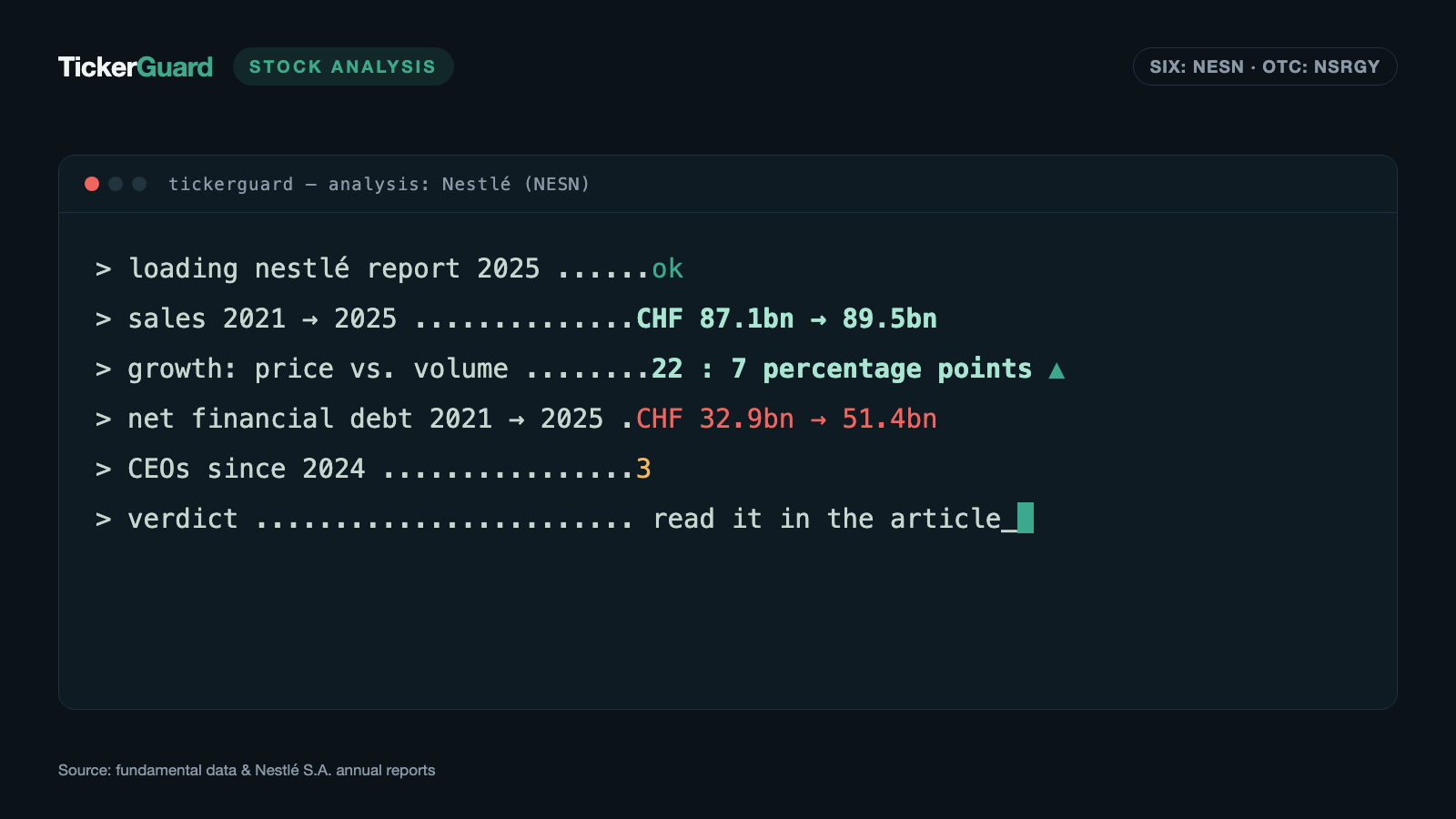
Few names are as “sleep well” as Nestlé. Nescafé, KitKat, Maggi, Purina — the Swiss group says it sells in 185 countries and has not cut its dividend in Swiss francs in 66 years. And yet: at the end of 2021 Nestlé was worth CHF 351.7 billion on the stock market; at the end of 2025 it was worth CHF 202.5 billion — down about 42 percent in four years. The new chairman, Pablo Isla, puts it plainly in the 2025 annual report:
“I recognize that Nestlé’s recent performance and share price development have raised concerns.”
— Nestlé S.A., Annual Review 2025, Letter from the Chairman, page 5
Let’s make a deal: we lift the mattress and read together what Nestlé itself writes — in the 2025 Annual Review, the 2025 consolidated financial statements, the 2026 Half-Year Report and the mandatory announcements through the end of September 2026. Nestlé does not report to the U.S. securities regulator, the SEC; it publishes its reports in English on nestle.com, and we quote those originals. The central tension of this analysis: Nestlé owns some of the strongest brands in the world and generates roughly CHF 9 billion of free cash flow year after year. But its growth in recent years came mostly from price increases, payouts to shareholders outran the cash the business produced, and the CEO chair has changed hands three times since 2024. Whether the mattress still holds is your call.
What Nestlé actually does — from Nescafé to cat food
At its core, Nestlé is an everyday brand machine: it makes things people buy every day and earns its money from their reaching for the familiar label. In 2025, Nestlé had sales of CHF 89.5 billion. By product group, according to the 2025 Annual Review, 28.1 percent came from powdered and liquid beverages (mostly coffee: Nescafé, Nespresso and the licensed Starbucks products for retail), 20.6 percent from pet food (Purina, Pro Plan, Felix), 16.0 percent from nutrition and health science (infant nutrition, supplements, medical nutrition), 11.3 percent from prepared dishes and cooking aids (Maggi), 10.8 percent from milk products and ice cream, 9.7 percent from confectionery (KitKat) and 3.5 percent from water.
By region, 48.0 percent of 2025 sales came from the Americas, 26.8 percent from Asia, Oceania and Africa and 25.2 percent from Europe. The United States alone contributed CHF 28.6 billion. At the end of 2025 the group employed about 271,000 people in 335 factories. Since February 2026, CEO Philipp Navratil has been focusing Nestlé on four businesses: coffee, pet care and nutrition — together about 70 percent of sales — plus food and snacks. The water business is moving into a joint venture, the sale of the mainstream vitamin business has been agreed, and the remaining ice cream business is going to the Froneri joint venture.
Then there is an asset many people forget: Nestlé holds 107,621,021 shares of the cosmetics group L’Oréal, a 20.2 percent stake. At the end of 2025 that stake had a market value of CHF 36.7 billion.
Company history for investors
-
2021
Bountiful core brands bought for $5.75bn
Nestlé makes a big bet on vitamins; net debt stands at CHF 32.9bn at the end of 2021, market value at CHF 351.7bn.
-
2022
Pricing +8.2%, volume +0.1%
Growth comes almost entirely from price increases; a CHF 20bn buyback program starts at the same time. Payouts far exceed free cash flow.
-
2025
CEO dismissed, new chairman
On 09/01, Laurent Freixe has to go and Philipp Navratil takes over; from 10/01, Pablo Isla chairs the board. About 16,000 jobs are to go by the end of 2027.
-
2026
January: infant formula recall
Global precautionary recall over cereulide from a supplier ingredient; the nutrition business shrinks 1.2% organically in the first half.
-
2026
July to September: portfolio overhaul
Water into the Peranel joint venture, vitamin business sold for $1.0bn after a CHF 1.3bn write-down; Nestlé Russia placed under external administration (09/18).
How the stock landed on our desk — through the NSRGY side door
Not through a hit in our in-house stock scanner, but through a ticker: at the end of September 2026, NSRGY landed on our research list. Look the symbol up and you quickly see it is not a separate company but a side door to the Swiss stock. NSRGY is an American Depositary Receipt — a certificate issued by a U.S. bank (here Citibank) that represents exactly one registered Nestlé share. It trades over the counter in the U.S., in dollars. The actual stock trades as NESN on the SIX Swiss Exchange in Zurich (ISIN CH0038863350), in Swiss francs.
One thing matters for anyone used to U.S. sources: Nestlé files no annual or quarterly reports with the SEC. According to the registration of the ADR program dated February 20, 2026, the company relies on an exemption (Rule 12g3-2(b)) and publishes its reports on nestle.com instead. This analysis therefore rests entirely on the company’s original reports. And because Nestlé reports in Swiss francs, anyone holding NSRGY in dollars is also exposed to the franc-dollar exchange rate. Rule of thumb: a different ticker is not a different company — but it can be a different currency.
The numbers over the years — honestly appraised
First, what deserves credit. Nestlé is a cash machine in the best sense. Free cash flow — the money left after all investment — was CHF 9.2 billion in 2025, CHF 10.7 billion in 2024 and CHF 10.4 billion in 2023. The underlying trading operating profit margin held steady between 17.1 and 17.4 percent from 2021 through 2024 — roughly one franc in six of sales stayed behind as operating profit. For a food company, that is an excellent level. And the dividend rose from CHF 2.80 per share for 2021 to CHF 3.10 for 2025.
2026 shows some light, too: in the first half, organic sales grew 3.6 percent, free cash flow rose to CHF 3.4 billion from CHF 2.3 billion a year earlier, and net financial debt of CHF 56.3 billion was below the CHF 60.0 billion of June 30, 2025. The “Fuel for Growth” program is meant to cut costs by CHF 3.0 billion by the end of 2027; according to the half-year report, CHF 1.7 billion had been achieved by mid-2026.
The flip side: profits have been heading down. The margin fell to 16.1 percent in 2025, net profit dropped 17.0 percent to CHF 9.0 billion, and earnings per share fell 16.3 percent to CHF 3.51. In the first half of 2026, net profit even fell 31.4 percent to CHF 3.5 billion — mainly because of restructuring costs and a write-down we will get to shortly. And 2025 sales of CHF 89.5 billion were barely above the CHF 87.1 billion of 2021, even though Nestlé raised prices hard in those years. The strong franc ate much of that: in 2025 alone, currency cost 5.7 percent of sales.
Uncomfortable truth No. 1: Growth came from the price tag, not the shopping cart
Nestlé splits its growth into two parts itself, and that split is the most important number in this analysis. Organic growth is sales growth excluding acquisitions, disposals and currency effects. It consists of pricing — the same jar of Nescafé costs more — and real internal growth (RIG) — more jars, or pricier jars, are sold. Put simply: one is a higher price tag, the other a fuller shopping cart.
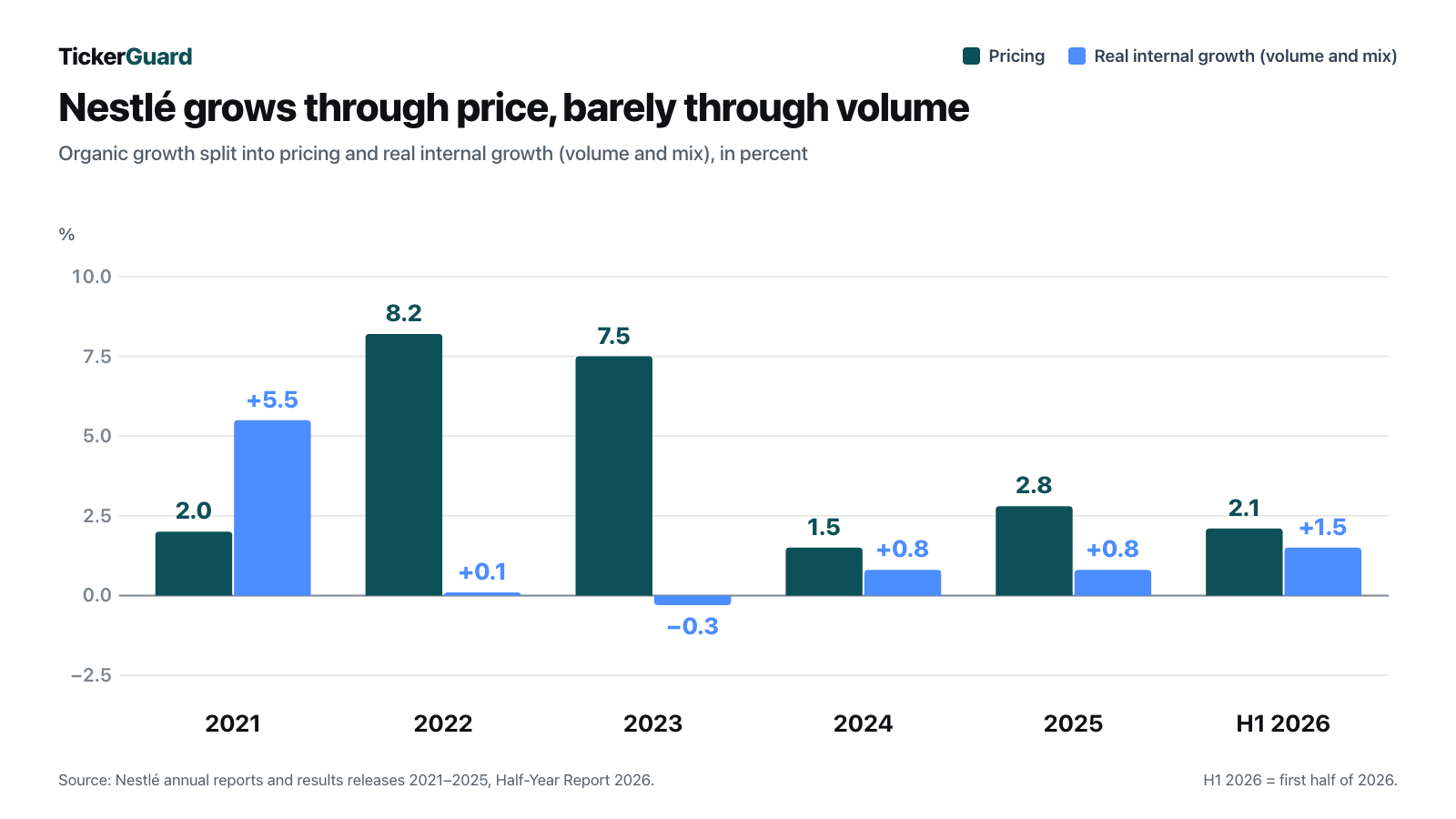
Add up the five years from 2021 through 2025 and roughly 22 percentage points of growth came from pricing and just under 7 percentage points from volume and mix — 5.5 of those in the pandemic year 2021 alone. From 2022 through 2025, real internal growth never exceeded 0.8 percent in any year, and in 2023 it was actually negative at minus 0.3 percent. (Small rounding gaps are normal: for 2024, Nestlé reported 2.2 percent organic growth from 1.5 percent pricing and 0.8 percent RIG.) Price increases work for a while because customers stay loyal to the brand. But they spend exactly that loyalty. How much of it was spent, Nestlé admitted with remarkable candor in its results release of February 19, 2026:
“In recent years, Nestlé lost some of its marketing muscle.”
— Nestlé S.A., press release “Full-year results 2025 and strategic update,” February 19, 2026, page 5

To be fair, Nestlé is changing course. Advertising and marketing spending rose to 8.6 percent of sales in 2025 and to 8.9 percent in the first half of 2026. Real internal growth climbed from 0.2 percent in the first half of 2025 to 1.4 percent in the second half and to 1.8 percent in the second quarter of 2026. Management’s medium-term goal is RIG of at least 2 percent and organic growth of 4 percent plus. It is not there yet. Rule of thumb: a higher price tag is growth borrowed from the customer — real growth shows up in the shopping cart.
Uncomfortable truth No. 2: Payouts outran the cash — and debt grew alongside
Nestlé has sent its shareholders a great deal of money in recent years: as dividends and through share buybacks, in which the company buys its own shares on the market and cancels them so every remaining share owns a bigger slice of the pie. The CHF 20 billion buyback program ran from January 2022 to December 2024. The next chart shows the problem: the total was bigger than the cash the business left over.
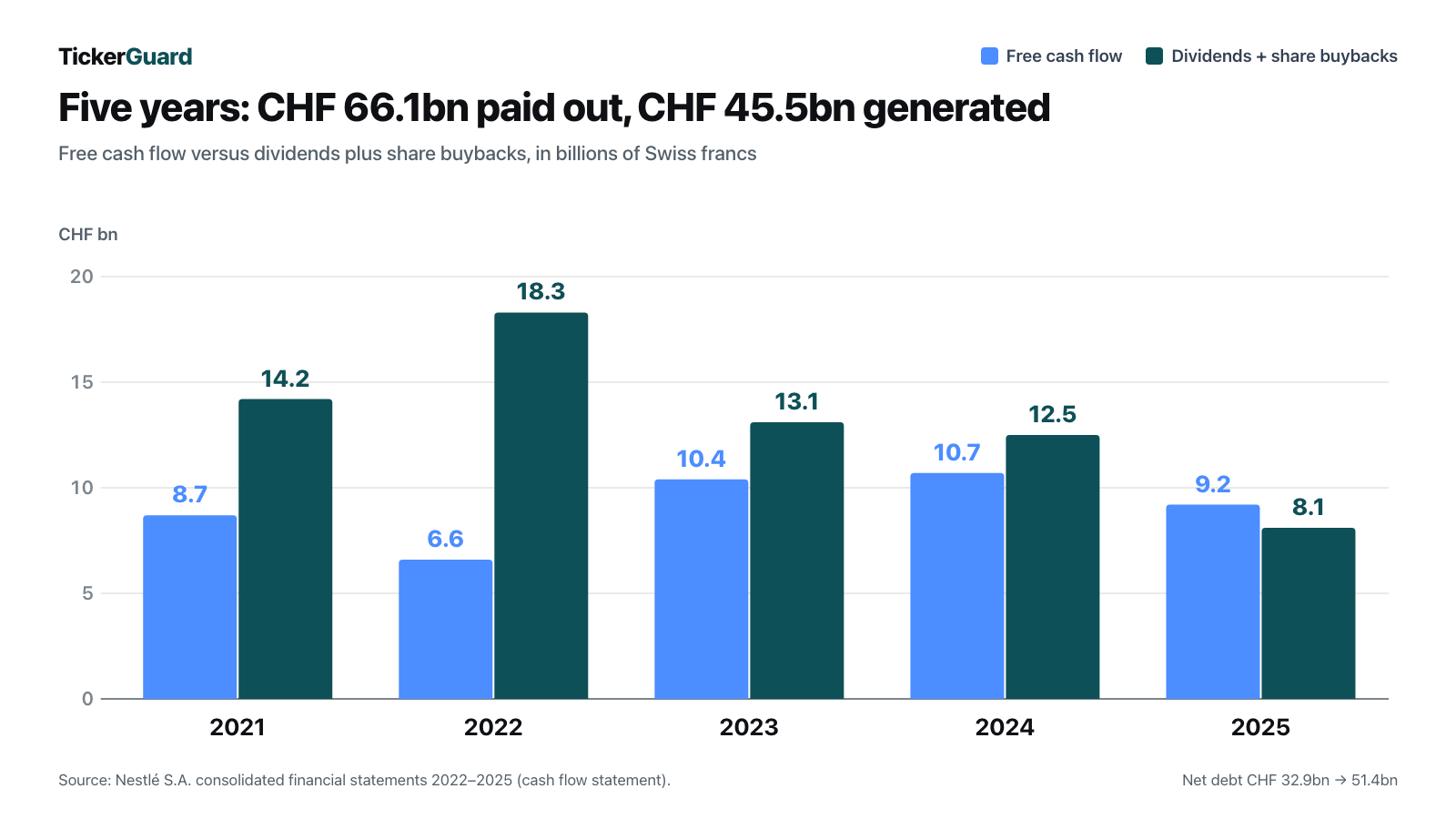
From 2021 through 2025, Nestlé generated a combined CHF 45.5 billion of free cash flow. Over the same period it paid CHF 38.8 billion in dividends and bought back CHF 27.4 billion of its own shares — CHF 66.1 billion in total. The gap of roughly CHF 20 billion did not vanish; it sits on the balance sheet. Net financial debt rose from CHF 32.9 billion at the end of 2021 to CHF 51.4 billion at the end of 2025. The ratio of net debt to equity (gearing) was 155.4 percent at the end of 2025, versus 61.3 percent in 2021. Nestlé itself puts year-end 2025 net debt at 2.85 times adjusted EBITDA (operating profit before depreciation and amortization) — in other words, it would take the company almost three years of its entire operating earnings to be debt-free.
Since 2025, buybacks have stopped (CHF 213 million versus CHF 4.7 billion in 2024), but the dividend keeps flowing. For 2025, Nestlé pays CHF 3.10 per share, CHF 7.98 billion in total — 88.3 percent of earnings per share. In the first half of 2026 the payment took CHF 8.0 billion, while free cash flow for the half came to CHF 3.4 billion; net debt therefore rose from CHF 51.4 billion to CHF 56.3 billion. The chairman sets out the direction in the annual report:
“We understand that many of you count on Nestlé’s dividend payments. To support this, we are committed to delivering free cash flow growth that outpaces dividend growth.”
— Nestlé S.A., Annual Review 2025, Letter from the Chairman, page 5
That is a sensible promise — but a promise about the future. In 2025, free cash flow fell 14.2 percent while the dividend rose 1.6 percent. Rule of thumb: a dividend that has not been cut in 66 years is a strong signal. It is not a law of nature — it is paid either from the cash the business leaves over or from new debt.
Uncomfortable truth No. 3: Three CEOs, a new chairman — and a dismissal
For a company that stands for constancy, the top floor has been unusually turbulent. For fiscal 2024, the compensation report still lists Mark Schneider as the former CEO; the 2024 annual report was already signed by Laurent Freixe as Chief Executive Officer. On September 1, 2025, the break came:
“The departure of Laurent Freixe follows an investigation into an undisclosed romantic relationship with a direct subordinate which breached Nestlé’s Code of Business Conduct.”
— Nestlé S.A., ad hoc announcement of September 1, 2025

His successor, effective immediately, was Philipp Navratil, with Nestlé since 2001 and previously head of Nespresso. A month later, on October 1, 2025, Pablo Isla, the former head of fashion group Inditex, took over as chairman from Paul Bulcke. According to the compensation report, Freixe received nothing on his departure other than his pro rata base salary until September 1, 2025. That suggests the board acted decisively. For investors, though, three CEOs in roughly two fiscal years means three sets of priorities. Navratil is now reshaping the group quickly — about 16,000 jobs are to go worldwide by the end of 2027, roughly 12,000 of them white-collar, and managers’ bonuses now include a volume-growth “gatekeeper.”
Uncomfortable truth No. 4: The overhaul costs money — write-downs, a recall and open water questions
A company that “sharpens its portfolio” usually sells what no longer fits — and not always at the price it once paid. Nestlé sold its mainstream vitamins and supplements business (including Nature’s Bounty, Puritan’s Pride, Osteo Bi-Flex and Ester-C) to Yellow Wood Partners on September 1, 2026, for $1.0 billion (CHF 0.8 billion); closing is expected by the first half of 2027, and the business had 2025 sales of $1.2 billion. Nature’s Bounty, Puritan’s Pride and Osteo Bi-Flex came from the acquisition of The Bountiful Company’s core brands, for which Nestlé paid $5.75 billion in 2021, according to its results release. It is not an apples-to-apples comparison — Nestlé is keeping the premium brand Solgar from the same deal — but the order of magnitude speaks for itself. The bill was already in the half-year accounts:
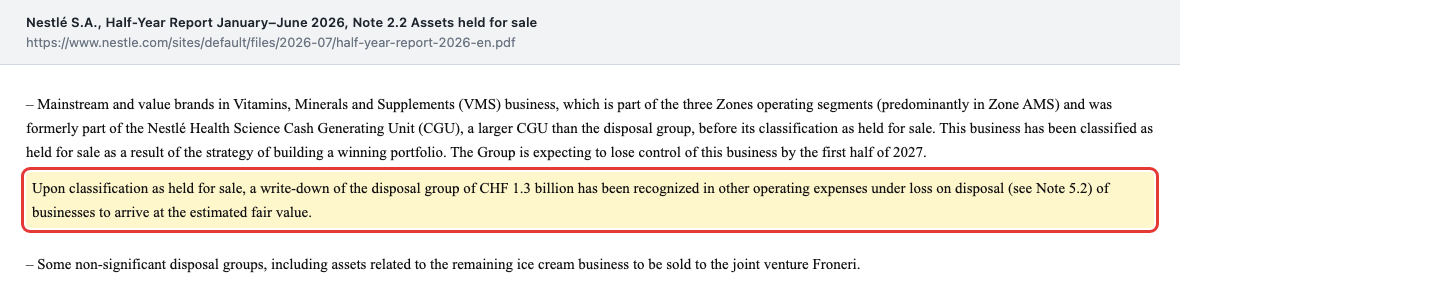
“Upon classification as held for sale, a write-down of the disposal group of CHF 1.3 billion has been recognized in other operating expenses under loss on disposal (see Note 5.2) of businesses to arrive at the estimated fair value.”
— Nestlé S.A., Half-Year Report January–June 2026, Note 2.2
The water business (S.Pellegrino, Perrier and other brands) is moving into Peranel, a 50:50 joint venture with private equity firm Platinum Equity. It is valued at €4.9 billion; at closing in the first half of 2027, Nestlé expects about €3.0 billion (CHF 2.8 billion) in cash. According to the half-year report, a currency translation loss of about CHF 1.3 billion accumulated over the years will hit the income statement at the same time.
Then there are quality questions that are no side issue for a food company. In January 2026, Nestlé launched a global precautionary recall of batches of infant formula after the bacterial toxin cereulide was detected — caused, according to the annual report, by an ingredient from a global industry supplier; that cost sales in the nutrition business, where organic growth was minus 1.2 percent in the first half of 2026. And since the 2023 financial statements, the notes have carried a sentence about mineral water:
“With food safety as a primary goal, operating practices at some of Nestlé’s natural mineral water production sites may not be in line with the applicable regulatory framework.”
— Nestlé S.A., Consolidated Financial Statements 2025, Note 11.2 (Contingencies)
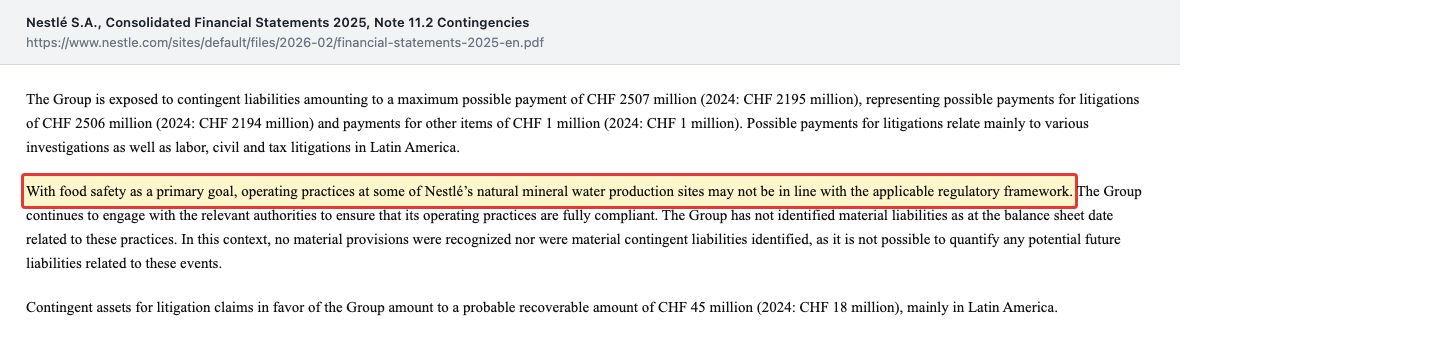
In fairness: Nestlé says it has identified no material liabilities, and the same sentence appears word for word in the 2026 half-year report. But a risk without a price tag is not an all-clear. And since September 18, 2026, there is another one: Nestlé announced that a Russian presidential decree places Nestlé Russia under temporary external administration, and that it is assessing the situation and its options. According to its annual report, Nestlé operated six factories in Russia at the end of 2025. The company does not break out Russian sales or assets — so how costly the intervention will be remains open.
Valuation: about CHF 198 billion for a group in the middle of an overhaul
At the SIX closing price of CHF 77.00 on September 28, 2026, Nestlé’s 2,576,520,000 shares were worth about CHF 198 billion. Against 2025 earnings per share of CHF 3.51, that is a price-to-earnings ratio of about 22 — you pay roughly 22 years of profit. Using underlying EPS of CHF 4.42, which strips out one-off items, it is about 17. Using the latest twelve months through June 2026 instead — the second half of 2025 (CHF 1.54) plus the first half of 2026 (CHF 1.35), CHF 2.89 in total — the write-down pushes the P/E to about 27; that is how many screening tools calculate it. The CHF 3.10 dividend equals a yield of about 4.0 percent; 2025 free cash flow of CHF 9.2 billion equals about 4.6 percent of market value.
Two counterweights belong in the math. On one side is net financial debt of CHF 56.3 billion as of June 30, 2026: anyone buying the whole company would take it on, too. On the other side is the L’Oréal stake, worth CHF 36.7 billion at the end of 2025 — close to a fifth of today’s market value, and an asset that has nothing to do with the food business. For a group with a 16 percent operating margin and steady cash generation, this valuation is no fire sale, but no exaggeration either. It prices in a successful overhaul — without the premium Nestlé commanded when its shares traded around CHF 120 (annual highs from 2021 to 2023).
If pet food as a growth market interests you, our Freshpet analysis covers a smaller challenger to Purina — and our Nature’s Sunshine analysis looks at a supplement maker, right in the market Nestlé is now leaving with its mainstream brands.
Opportunities and risks at a glance
What speaks for Nestlé:
- Strong brands in growing categories: coffee, pet care and nutrition make up about 70 percent of sales; coffee grew 7.5 percent organically in the first half of 2026.
- High, reliable cash generation: CHF 9.2 billion of free cash flow in 2025, guidance of more than CHF 9 billion for 2026; CHF 3.4 billion in the first half of 2026 versus CHF 2.3 billion a year earlier.
- Volume is picking up: RIG of 1.8 percent in the second quarter of 2026, after 0.2 percent in the first half of 2025.
- Savings on track: CHF 1.7 billion of the CHF 3.0 billion target achieved by mid-2026.
- Hidden reserve in L’Oréal: a 20.2 percent stake worth CHF 36.7 billion at the end of 2025.
- 66 years without a dividend cut in Swiss francs; dividend for 2025: CHF 3.10.
What speaks against it:
- Growth mostly from pricing: about 22 percentage points of price versus just under 7 of volume from 2021 through 2025.
- Net financial debt up from CHF 32.9 billion (2021) to CHF 51.4 billion (2025), CHF 56.3 billion as of June 30, 2026; payout ratio of 88.3 percent of EPS.
- Turmoil at the top: three CEOs since 2024, a dismissal for breaching the code of conduct, a new chairman since October 2025.
- Overhaul costs: a CHF 1.3 billion write-down on vitamins, a translation loss of about CHF 1.3 billion when the water joint venture closes, 16,000 jobs to go by the end of 2027.
- Open risks without a price tag: possible regulatory breaches at mineral water sites, the January 2026 infant formula recall, external administration of Nestlé Russia since September 2026.
- Holders of NSRGY in dollars carry franc-dollar currency risk on top.
A human conclusion
Back to the sleep-well trap. The feeling that you can sleep soundly with Nestlé is not made up: the brands are strong, the business throws off billions every year, and the dividend has held for 66 years. But anyone who has not looked under the mattress in recent years has slept through quite a bit: growth that came mostly from price increases, payouts that pushed debt higher, a CEO who had to go, and an overhaul that costs money before it pays. A good company is a good start — but only what you check regularly lets you sleep well. The next chances to check come on October 22, 2026, with nine-month sales, and on February 18, 2027, with full-year 2026 results. What you make of it is your decision. And that is exactly as it should be.
Sources
All original documents used in this analysis — so you can check them yourself:
- Nestlé S.A. — Half-Year Report January–June 2026 (July 23, 2026) — latest periodic report; Notes 2.2 (assets held for sale), 8 (share capital, dividend) and 11 (contingencies), financial calendar; plus the prepared remarks for the half-year call
- Nestlé S.A. — ad hoc announcements “Update on Nestlé’s operations in Russia” (September 18, 2026), sale of the mainstream VMS business (September 1, 2026), Peranel with Platinum Equity (July 23, 2026) and CEO change (September 1, 2025)
- Nestlé S.A. — Annual Review 2025, Consolidated Financial Statements 2025 (5-year review, cash flow statement, Notes 11.2 and 14.1), Corporate Governance and Compensation Report 2025 and the full-year 2025 press release (all February 19, 2026)
- Nestlé S.A. — consolidated financial statements 2024, 2023 and 2022 (cash flow statements 2021–2024), Annual Review 2024, Annual Review 2023 and the results releases for 2022 and 2021 (organic growth, pricing and RIG; acquisition of the Bountiful core brands)
- U.S. Securities and Exchange Commission — ADR program registration (Form F-6 POS) of February 20, 2026: 1 NSRGY certificate = 1 registered Nestlé share, depositary Citibank, Rule 12g3-2(b) exemption
- Price: CHF 77.00 SIX Swiss Exchange close on September 28, 2026; market value, P/E and yields are our own calculations. Other metrics: source: fundamental data.
Transparency & disclaimer: This analysis is a journalistic assessment of publicly available information. It is not investment advice, not a financial analysis in the regulatory sense and not a solicitation to buy or sell securities. Investing in stocks involves substantial risk, up to and including total loss. All information without guarantee; the date of each data point is noted in the text. Positions held by the operator are disclosed daily; where one exists, it appears as a notice at the top of this deep dive.
Our Bottom Line at a Glance
- Brands and market position positive
- Coffee, pet care and nutrition make up about 70% of sales (press release 02/19/2026); coffee grew 7.5% organically in H1 2026.
- Quality of growth negative
- From 2022 through 2025, real internal growth never exceeded 0.8% a year and was −0.3% in 2023; growth came mainly from pricing. Improving: RIG of 1.8% in Q2 2026.
- Cash generation positive
- Free cash flow of CHF 9.2bn (2025), CHF 3.4bn in H1 2026 versus CHF 2.3bn; 2026 guidance above CHF 9bn.
- Balance sheet and payouts neutral
- Net financial debt CHF 51.4bn (end of 2025, 2.85x EBITDA), CHF 56.3bn on 06/30/2026; payout ratio 88.3%; CHF 66.1bn paid out 2021–2025 against CHF 45.5bn of free cash flow.
- Leadership and governance negative
- Three CEOs since 2024; Laurent Freixe dismissed on 09/01/2025 for breaching the code of conduct; new chairman since 10/01/2025.
- Overhaul and special risks neutral
- CHF 1.3bn VMS write-down (H1 2026), about CHF 1.3bn translation loss at Peranel closing; infant formula recall (01/2026), mineral water contingency, external administration in Russia (09/2026).
Nestlé is a group with world-class brands and reliable cash generation in the middle of an overhaul: for years growth came mainly from pricing, debt rose on the back of heavy payouts, and leadership has changed repeatedly since 2024. Volumes are picking up in 2026, but the turnaround is not yet proven. Not investment advice.
What Our Rating Means
Open questions
The business works in principle, but one material question is open. As long as it stays open, our findings do not carry a quality verdict.
Yellow here stands for an open operating question, not a threat to the company’s substance: the business model works, free cash flow was CHF 9.2 billion in 2025, and debt at 2.85 times EBITDA is high but manageable. What is open is whether Nestlé can grow through volume on its own again — real internal growth never exceeded 0.8 percent from 2022 through 2025, the margin fell to 16.1 percent in 2025, and the overhaul under the third CEO since 2024 is not yet proven. The share price decline since 2021 plays no role in this rating. The decision is yours.
A journalistic assessment by our editorial team at the time of the deep dive, based on public sources — not investment advice and not a solicitation to buy or sell. Your personal circumstances (investment goals, risk capacity, taxes) cannot be taken into account. What our levels mean, how verdicts are formed, and what conflicts of interest exist →
Worth Noting
- Version of September 28, 2026, based on the 2025 Annual Review and Financial Statements, the 2026 Half-Year Report (latest periodic report) and ad hoc announcements through September 18, 2026. Nestlé reached our research list via the U.S. ticker NSRGY, not via a scanner hit.
- Nestlé does not report to the U.S. securities regulator, the SEC (Rule 12g3-2(b) exemption); all evidence comes from the original reports on nestle.com. The 2025 and 2026 reports do not mention weight-loss drugs as a factor — we do not speculate about them.
- Totals for 2021–2025 (pricing and volume shares, payouts, free cash flow) as well as market value, P/E and yields are our own calculations from company data and the SIX close of September 28, 2026. Not to be confused: NSRGY (U.S. certificate in dollars) and NESN (original share in Swiss francs) — same company, different currency.
The full analysis as a PDF for later
We will send you this analysis as a PDF — to print, file away, and read at your own pace.
Frequently Asked Questions
NSRGY is an American Depositary Receipt: a certificate issued by Citibank that represents exactly one registered Nestlé share and trades over the counter in the U.S., in dollars. The original stock trades as NESN on the SIX Swiss Exchange in Swiss francs. Nestlé files no periodic reports with the SEC; it publishes them on nestle.com.
For fiscal 2025, Nestlé paid CHF 3.10 per share on April 22, 2026, CHF 7.98 billion in total — 88.3 percent of earnings per share. Nestlé says it has maintained or raised its dividend in Swiss francs for 66 years. At the CHF 77.00 price of September 28, 2026, that is a yield of about 4.0 percent.
Market value fell from CHF 351.7 billion at the end of 2021 to CHF 202.5 billion at the end of 2025. According to its reports, Nestlé grew mainly through pricing rather than volume, the underlying operating margin fell to 16.1 percent in 2025, EPS dropped 16.3 percent, and the CEO changed three times since 2024 and the chairman in 2025.
Net financial debt was CHF 51.4 billion at the end of 2025 and CHF 56.3 billion on June 30, 2026, after the dividend payment. At the end of 2021 it was CHF 32.9 billion. Nestlé puts year-end 2025 net debt at 2.85 times adjusted EBITDA; the average cost of net debt was 2.6 percent in 2025.
Organic growth is sales growth excluding acquisitions, disposals and currency effects. Nestlé splits it into pricing and real internal growth (RIG), meaning more or higher-value goods sold. In 2025, organic growth was 3.5 percent, with 2.8 percent pricing and 0.8 percent RIG; in the first half of 2026 it was 3.6 percent with 1.5 percent RIG.
Nestlé is moving Nestlé Waters & Premium Beverages, with brands such as S.Pellegrino and Perrier, into Peranel, a 50:50 joint venture with Platinum Equity. The enterprise value is €4.9 billion, and Nestlé expects about €3.0 billion in cash. Closing is planned for the first half of 2027.
In the fourth quarter of 2025, Nestlé announced it would cut about 16,000 jobs worldwide by the end of 2027, roughly 12,000 of them white-collar. It is part of the “Fuel for Growth” program, which targets CHF 3.0 billion of savings by the end of 2027; CHF 1.7 billion had been achieved by mid-2026.
Found an error?
Did you spot a factual error, an outdated number, or a typo in this deep dive? Let us know briefly — your report goes straight to the editorial team.