Mayfair Gold: 4.3 Million Ounces in the Ground, Cash for About Ten Months — and Carson Block on the Board
Mayfair Gold (TSXV: MFG, NYSE American: MINE) wants to build a C$450 million gold mine in Ontario. Its own study points to a 24 percent return, and one of the best-known short sellers in the world sits on its board. Its filings with the SEC also show no revenue, C$22.9 million in cash, C$13.7 million burned in six months and a C$250 million shelf for new shares. The gold is in the ground; the money to get it out is not yet in the bank.
 Thomas Mücke
Founder & Publisher
Thomas Mücke
Founder & Publisher
Chart
Interactive price chart (TradingView).
Note: pure fact-based analysis, not investment advice and not a solicitation to buy or sell. All figures without guarantee.
There is an investor weakness that feels like good judgment of character: when someone we admire buys a stock, their reputation rubs off on it. Psychologists call it the halo effect. Let's call it the halo trap here: we see the famous name and check the numbers behind it less strictly than we would for a stranger.
Mayfair Gold Corp. is a perfect place to practice. Its board includes Carson Block, founder of the hedge fund Muddy Waters and one of the best-known short sellers in the world — a man who makes a living exposing polished stories. If he of all people is on the buy side, the story must hold up, right? So here is the deal: we set the halo aside for a moment and read what Mayfair itself files with the U.S. securities regulator, the SEC. The company and its management are liable for false statements in those filings, and in this case they are unusually revealing. In the end, you decide.

What Mayfair Gold actually does
Mayfair Gold is a British Columbia company headquartered in Matheson, a small town in northeastern Ontario in the gold country around Timmins. It has exactly one project, and it does not yet earn a cent from it: the Fenn-Gib gold deposit. Mayfair bought it from Lake Shore Gold on December 31, 2020 for about C$14.0 million and a 1 percent royalty on future production. In May 2026 it added neighboring ground from Plato Gold for C$2.5 million.
Fenn-Gib is a classic bulk-tonnage deposit: lots of rock with little gold in it. The current estimate shows 181.3 million tonnes averaging 0.74 grams of gold per tonne, or 4.31 million ounces in the indicated category. For perspective: one gram per tonne means roughly one gram of gold in a small car's worth of rock. That only pays in an open pit, at large scale and at a high gold price.
Since January 2026 there has been a first economic study, a so-called pre-feasibility study. It is deliberately modest. Instead of mining the entire deposit, Mayfair targets the richest near-surface part: 1.04 million ounces of probable reserves, 25.1 million tonnes at 1.29 grams per tonne. A 4,800-tonne-per-day plant is to recover 920,000 ounces over 14.3 years, an average of 64,000 ounces a year. According to the MD&A, this keeps the project in Ontario's provincial environmental assessment process, without triggering a comprehensive or federal impact assessment. Construction decision in 2028, first gold in 2030 — that is the company's plan.
So what is Mayfair today? A planning office with a gold deposit, a study and a bank account. There is no revenue, and there will be none before the first gold pour in 2030 at the earliest. Keep this tension in mind; it runs through the whole piece: a valuable deposit, but a small cash pile in front of a very large bill.
Company history for investors
-
2020
Fenn-Gib bought from Lake Shore Gold
For about C$14.0M and a 1% royalty. Barrick's back-in right to 51% of certain claims from 5 million ounces, valid until 2032, came with the ground.
-
2024
Muddy Waters takes over the board
After a proxy vote on 06/05/2024, the hedge fund's nominees, including Carson Block, joined the board. Since then large holders shape strategy and financing.
-
2025
C$40M raised at C$3.30 per share
The September 2025 placement lifted cash to C$38.2M at year-end — and added just over 12 million shares.
-
2026
Study and NYSE American listing
January 2026 brought the pre-feasibility study (C$450M build, C$652M NPV) and the U.S. listing as MINE — and with it, reporting to the SEC.
-
2026
New CEO, C$250M shelf
Drew Anwyll took charge in May 2026, and the shelf for new shares became effective in June. Cash fell to C$22.9M by 06/30/2026.
How the stock landed on our desk
Not via our in-house stock scanner. Mayfair showed up under the ticker MINE in the rankings of most-discussed and most-searched stocks on a major German stock portal. MINE is the company's listing on the NYSE American, which it joined on January 27, 2026. The home market remains the TSX Venture Exchange in Canada under MFG, plus Frankfurt under 9M5. The former U.S. over-the-counter ticker MFGCF on OTCQX is history. We track the company under its home listing MFG; its international securities identification number (ISIN) has been CA57808L3056 since the December 2025 share consolidation.
A warning against mix-ups: on the TSX Venture Exchange, the ticker MINE belongs to a completely different company, the explorer Inomin Mines. Type “MINE” into a Canadian quote screen and you will not land on Mayfair.
The move to the NYSE American has a side effect that is golden for this analysis. As a Canadian company, Mayfair now also reports to the SEC under the joint Canada-U.S. system (MJDS): an annual report on Form 40-F with a business description, risk factors and audited financial statements, plus interim reports and news on Form 6-K. The latest periodic report covers the quarter ended June 30, 2026 and was filed on August 12, 2026. Through September 29, 2026 three more filings followed: Oaktree's stake disclosure (August 20), two new executives with equity awards (August 24) and an update on summer mapping and infrastructure drilling (September 8). None of them was a financing or a new study. No earnings-call transcripts were available for Mayfair; we analyzed all the filings listed instead.
The numbers over the years — honestly appraised
Let's start with what is genuinely impressive, and at Mayfair that is the geology, not the accounting. Indicated resources grew from 3.38 million ounces (April 2023 estimate) to 4.31 million (September 2024). The January 2026 study shows that the richest part pays: an after-tax net present value of C$652 million, an internal rate of return of 24.1 percent and payback in 2.7 years. Net present value is, put simply, today's value of all future mine surpluses, discounted at 5 percent a year. The study puts all-in sustaining costs (AISC) at $1,292 per ounce.
Add a tailwind the study does not even price in. It assumes $3,100 per ounce of gold. On September 25, 2026 an ounce cost about $4,298. The study's own sensitivity table shows what that means: at $4,100 gold the after-tax NPV would rise to C$1,155 million, at $4,600 to C$1,405 million. And a tightly spaced drilling program completed in late 2025 in the planned starter pit found, per the June 2026 evaluation, 37 percent more gold in the higher-grade portion than the reserve model had predicted there.
Now the other half. A developer has no revenue, so it books a loss every quarter. That is normal. What stands out is how fast the losses have grown since the study:
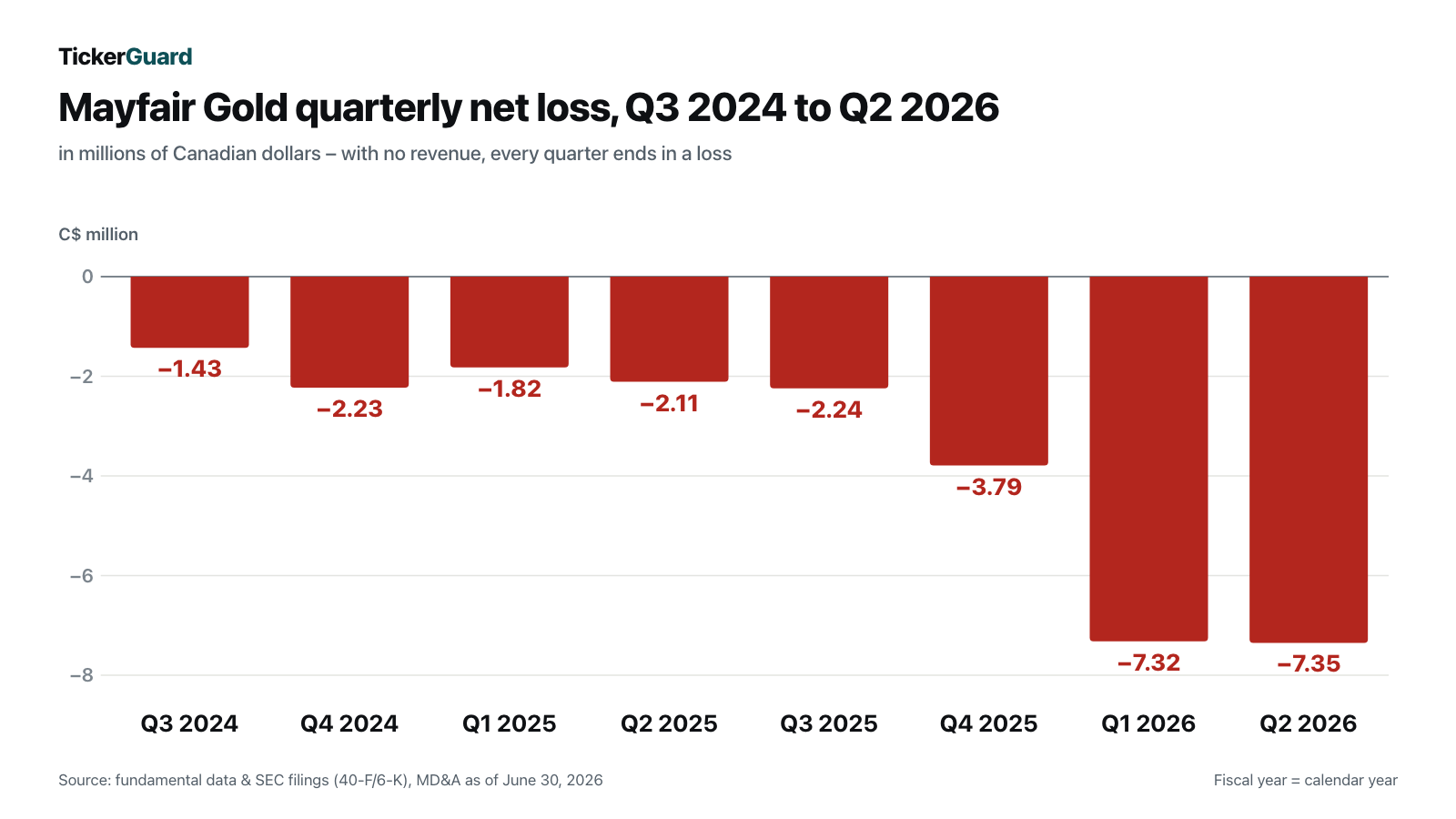
The first-half 2026 loss was C$14.7 million — more than the entire 2025 loss of C$10.0 million. The reasons make sense: exploration and evaluation spending rose from C$2.6 million to C$10.0 million, mostly for environmental studies. General and administrative costs quadrupled in the second quarter from C$0.6 million to C$2.5 million, which the MD&A attributes to professional fees for the NYSE listing, pricier directors' and officers' insurance and new executives. That is the price of seriously preparing a mine. But it is paid out of a finite bank account.
What the filings say — the uncomfortable truths
Now come the passages you skim past in an investor presentation. All of them come from the mandatory reports Mayfair filed with the SEC.
Uncomfortable truth No. 1: at the current pace, the cash does not last a year
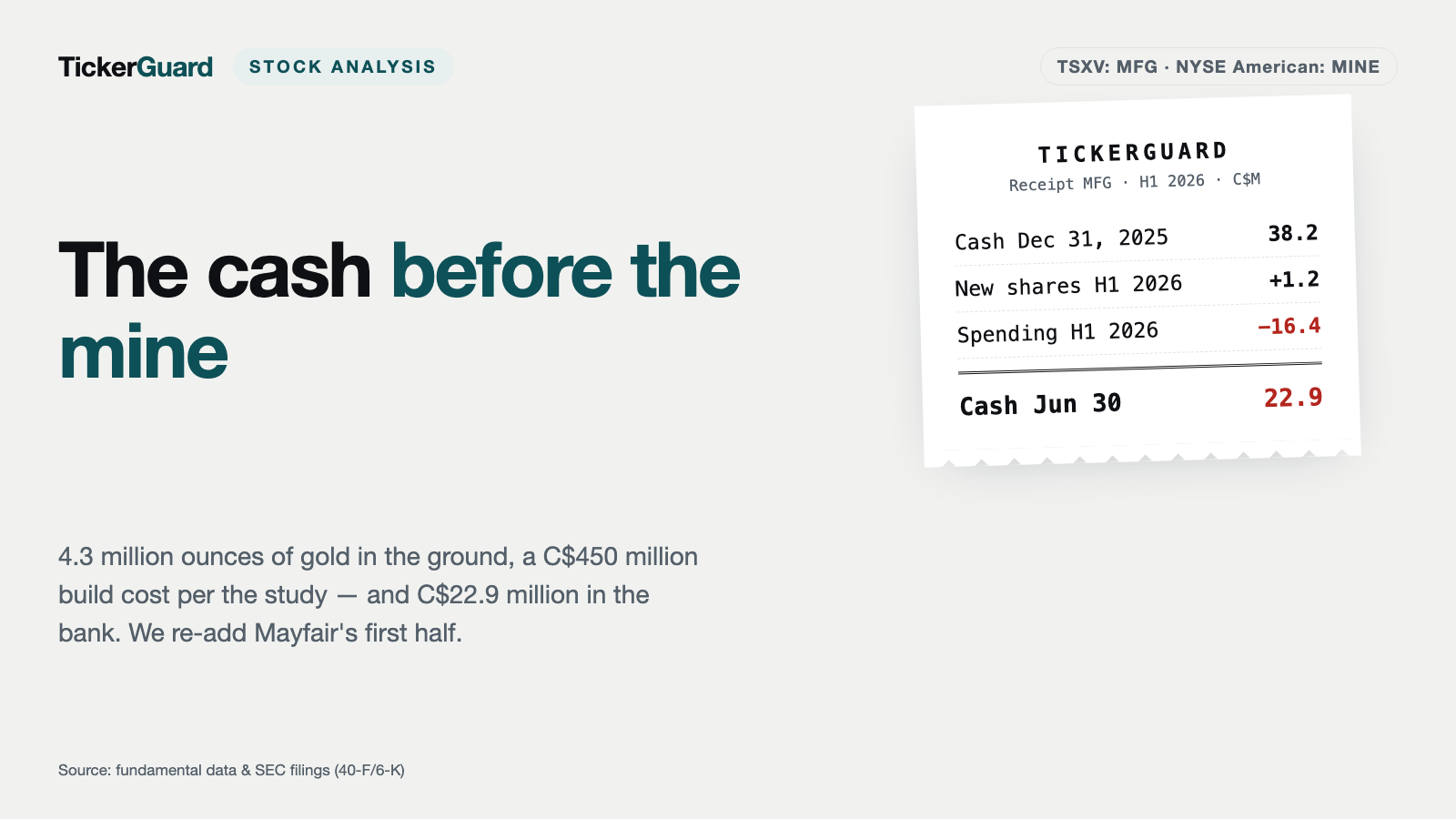
On June 30, 2026 Mayfair had C$22.9 million in cash and no debt. Operations consumed C$13.7 million in the first half, about C$6.9 million in the second quarter alone. Do the math: if the pace holds, the money lasts roughly ten months, until about spring 2027. The interim statements say it more soberly, but unmistakably:
“The Company has not generated revenue from operations to date and will require additional financing or outside participation to undertake further advanced exploration of its mineral properties.”
— Mayfair Gold Corp., interim financial statements as of June 30, 2026 (6-K filed August 12, 2026), Note 1
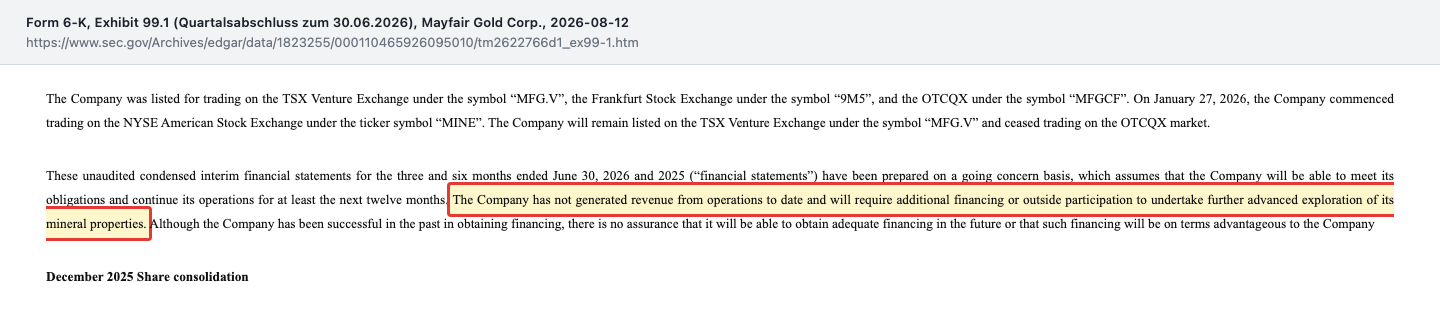
What is striking is how the MD&A frames the same issue a few pages later:
“As at June 30, 2026, the Company had cash and cash equivalents of $22,948,715 (December 31, 2025 - $38,193,983) to settle current liabilities of $2,836,142 (December 31, 2025 - $1,167,556) and has assessed the liquidity risk as minimal.”
— Mayfair Gold Corp., MD&A as of June 30, 2026, Liquidity risk
Both statements are true at once, and that is the trap. “Minimal” refers to C$2.8 million of open bills, not to how long the money funds the program. For a company that burns C$13.7 million in six months, liquidity risk is not decided by its supplier invoices but by its next equity raise.
Uncomfortable truth No. 2: C$250 million of new shares are already on the shelf
Mayfair has long prepared for that next raise. Since June 1, 2026 a so-called base shelf prospectus has been effective. Think of it as a pre-approved pantry: the company can take out new shares at any time without going through a full prospectus process each time.
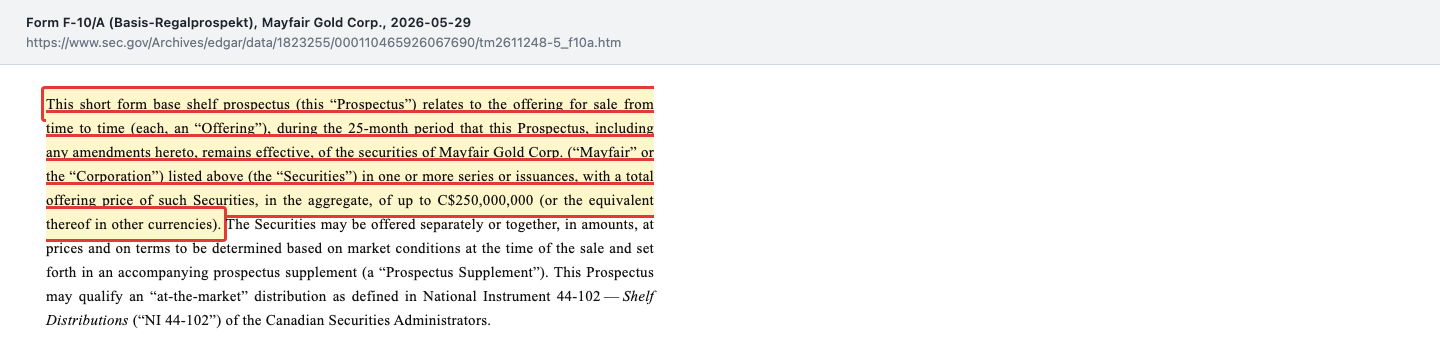
C$250 million is 93 percent of the market value on September 28, 2026. The prospectus also says why the company would rather raise sooner than later:
“Whether or not permitting is fast-tracked, any or all of the C$250,000,000 aggregate proceeds that may be raised under this Prospectus is expected to be raised in a favourable market to decrease the Corporation’s cost of capital and dilution.”
— Mayfair Gold Corp., shelf prospectus F-10/A, Use of Proceeds
Dilution simply means your slice of the pie gets smaller when new slices are cut for new shareholders. How much depends on the issue price. For comparison: in September 2025 Mayfair raised C$40.0 million at C$3.30 per share, issuing 12.1 million new shares. On June 30, 2026 there were 67.1 million shares outstanding, plus 2.15 million options and 0.36 million warrants. On August 24, 2026 another 400,000 options and 2.45 million performance restricted share units for executives were added. Fully diluted, that is about 72.5 million shares before a single share comes off the shelf.
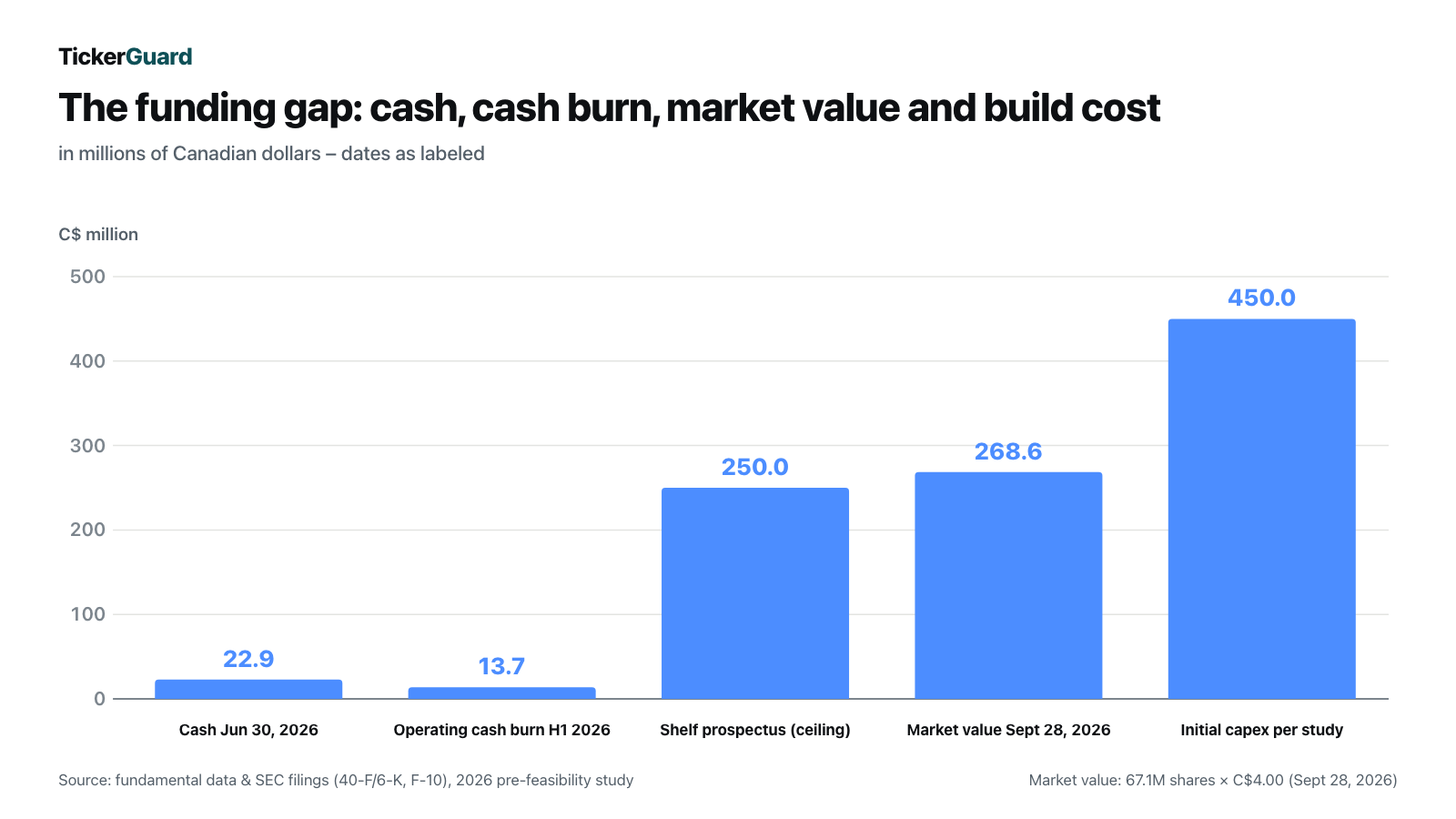
Our chart puts the orders of magnitude side by side:
Uncomfortable truth No. 3: the study counts money that does not exist yet
The C$652 million NPV sounds like a price tag for the mine. It is really a model with assumptions worth knowing. The study summary in the annual report lists them, and two matter to you as a shareholder:
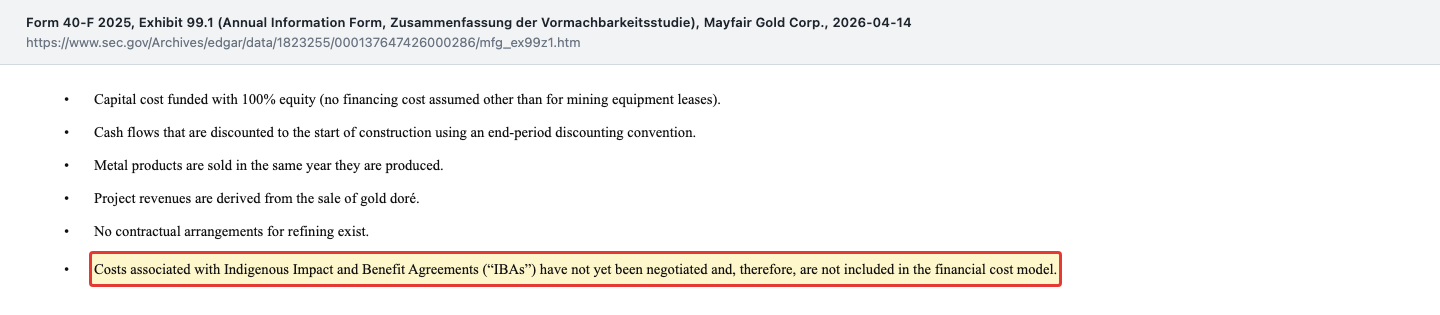
“Costs associated with Indigenous Impact and Benefit Agreements (“IBAs”) have not yet been negotiated and, therefore, are not included in the financial cost model.”
— Mayfair Gold Corp., 40-F 2025, Exhibit 99.1, technical report summary, Economic Analysis
The first assumption means the study pretends the construction money is already in the bank — no interest, no cost of an equity raise. In reality, Mayfair first has to find C$450 million, almost twice today's market value. Every dollar of it arrives either as debt with interest or as new shares with dilution. The C$652 million NPV therefore belongs to the project, not automatically to today's shareholders.
The second assumption concerns the Apitipi Anicinapek Nation, the First Nation right next to the site. An exploration agreement is in place, and a benefits agreement for the mine is to follow. Its cost appears nowhere in the study. Such agreements are customary and sensible in Canada — but they are a cost block negotiated after the study. On top of that, permitting is still pending: the Notice of Project Status went to the province on February 5, 2026, and the application for the fast-track “One Project, One Process” framework was still being prepared as of August 12, 2026.
Uncomfortable truth No. 4: the study uses a quarter of the deposit — and the rest is not a reserve
The 4.31 million ounces are the number in every presentation. The study, however, rests on 1.04 million ounces of reserves, roughly a quarter. The difference is not mere caution but definition. Mayfair writes it into every report itself:
“Mineral resources are not mineral reserves and do not have demonstrated economic viability.”
— Mayfair Gold Corp., MD&A as of June 30, 2026, 2026 Fenn-Gib Resource Estimate
A resource is the estimate of how much gold is in the ground, calculated at $2,000 per ounce and a minimum concentration of 0.3 grams per tonne. A reserve is the part for which an economic study has shown that mining pays — at Fenn-Gib calculated at $1,750 and at least 0.8 grams per tonne. The remaining three-plus million ounces are an option for later, not part of the plan. Anyone who values Mayfair on “4.3 million ounces” is mostly valuing gold for which there is no mine plan yet.
Uncomfortable truth No. 5: a hedge fund took the helm — and CEOs change quickly
This is where our halo comes in. Carson Block is not on the board by accident. The annual report describes soberly how it happened: in March 2024 Muddy Waters, then holding about 16.8 percent of the shares, announced its intention to replace the board. At the June 5, 2024 shareholder meeting, the fund's nominees won by a wide margin. The chair since then has been Darren McLean, who according to the annual report has also consulted for Muddy Waters since 2023. The annual report lists the power struggle explicitly among its risk factors:
“The Company faced such a contested proxy campaign in 2024.”
— Mayfair Gold Corp., 40-F 2025, Exhibit 99.1 (Annual Information Form), Risk Factors – Shareholder Activism
Since then, leadership has kept moving. The interim CEO after the vote was the chair himself. In January 2025 Nicholas Campbell became CEO; in May 2026 he stepped down. His successor is the former chief operating officer Drew Anwyll, a mining engineer with construction and permitting experience in Ontario. The CFO since April 2026 is Kevin Annett, previously CFO North America at industry giant Barrick. These are experienced people for the build phase, and a shareholder-driven change of control can genuinely improve a company. But it also means the strategy depends heavily on the will of a few large shareholders. Directors and officers together held 25.6 percent of the shares per the annual report, and asset manager Oaktree reported another 8.2 percent on August 20, 2026 — including one million shares bought on August 19, 2026. Whether the Muddy Waters stake is included in the 25.6 percent is not broken out in the report; no newer ownership filing by the fund appears in the SEC filing list through September 29, 2026.
And one clause in the annual report deserves a closer look. Barrick, which sold the ground to Lake Shore Gold in 2011, kept a back-in right:
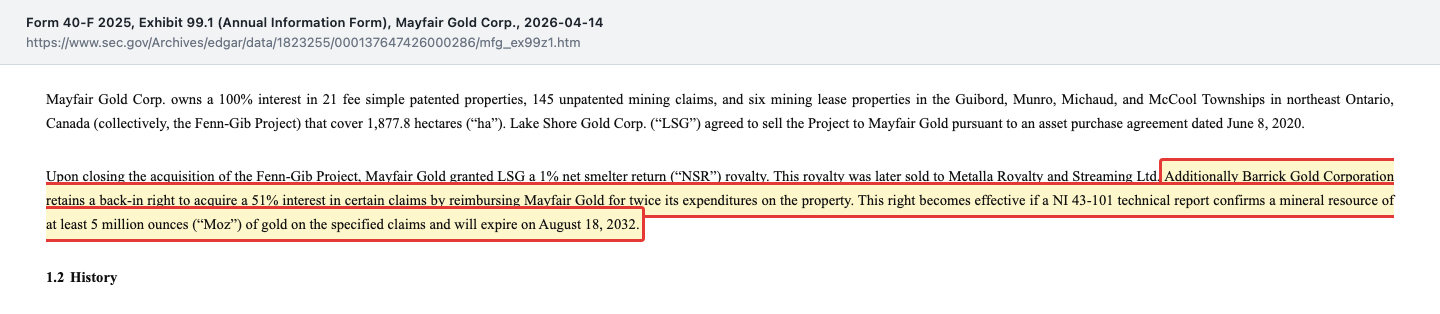
“This right becomes effective if a NI 43-101 technical report confirms a mineral resource of at least 5 million ounces (“Moz”) of gold on the specified claims and will expire on August 18, 2032.”
— Mayfair Gold Corp., 40-F 2025, Exhibit 99.1, Section 1.1 Project Description, Location, and Ownership
The current estimate adds up to 4.45 million indicated and inferred ounces. The report does not say which claims are affected. If the deposit sits on them, a big exploration success before August 2032 would cut both ways: more gold, but possibly only 49 percent of it. If you want to get to know Barrick as a company, see our analysis of Barrick Mining. We have also logged the clause as a side find.
Valuation: what the market pays for the project
Now let's add it up. On September 28, 2026 the stock closed at C$4.00 on the TSX Venture Exchange and at $2.86 on the NYSE American. With 67,138,496 shares, that is a market value of about C$268.6 million, or roughly $192 million. Subtracting the June 30, 2026 cash leaves an enterprise value of about C$245.6 million.
What do you get for that? For developers without revenue, the usual metrics such as the price-to-earnings ratio fail. The industry therefore uses three other yardsticks:
- Price per ounce in the ground: C$245.6 million divided by 4.31 million indicated ounces comes to about C$57 per ounce. Using only the 1.04 million ounces of reserves, it is about C$236 per ounce.
- Price to net asset value: the market value equals 0.41 times the study's after-tax NPV of C$652 million. Developers ahead of financing almost always trade well below that value, because the NPV takes construction capital, permits and execution for granted.
- Market value versus build cost: initial capex of C$450 million is 1.7 times the market value. That is the number that decides future dilution.
Honestly assessed: the market pays less than half of what the study calculates for the mine, and at a gold price more than a third above the study's assumption. That can be an opportunity. But above all it is the discount for the fact that roughly half a billion Canadian dollars of financing, a permit and two years of construction lie between today and first gold. Over the twelve months through the end of September 2026, the stock traded between C$3.19 and C$6.65 on the TSX Venture. For a developer with far more cash in the bank, see our analysis of Southern Cross Gold.
Opportunities and risks at a glance
What speaks for the company:
- A large deposit in mining country. 4.31 million ounces indicated, 1.04 million ounces of reserves, infrastructure and skilled labor in the Timmins region, no emerging-market risk.
- A study with headroom. After-tax NPV of C$652 million and a 24.1 percent return at $3,100 gold; gold was about $4,298 on September 25, 2026.
- Tested grades in the starter pit. The tightly spaced drilling program confirmed the reserve and found 37 percent more gold than expected in the higher-grade portion.
- Debt-free, with deep-pocketed holders. No financial debt at June 30, 2026; directors and officers own 25.6 percent together, Oaktree reported 8.2 percent and was still buying in August 2026.
- Experienced builders. CEO Anwyll and the project and permitting executives hired in August 2026 have planned, permitted and built mines in Ontario.
What speaks against it:
- The cash pile is small. C$22.9 million at June 30, 2026 against C$13.7 million of operating cash burn in six months — roughly ten months at that pace.
- Dilution is built in. A shelf of up to C$250 million, C$450 million of build cost, already about 72.5 million shares fully diluted.
- The study leaves out financing and First Nations costs. Modeled as fully equity-funded, First Nations agreements excluded, permits not yet granted.
- A single project. The annual report itself calls the chance of ever reaching development or production “uncertain.”
- Power in few hands. A board installed by proxy fight, three CEOs since mid-2024, a Barrick back-in right from five million ounces. For U.S. holders, the company also says it expects to be a passive foreign investment company (PFIC), which can mean adverse U.S. tax treatment.
A human conclusion
Remember the halo trap from the start? With Mayfair it would be too easy to say: Carson Block is in, so it must be fine. But concluding the opposite would be just as wrong. The filings show a real, large gold deposit, a study with respectable numbers, a gold price far above its assumption and major shareholders, one of whom — Oaktree — was still buying in August 2026.
What the halo outshines is the sequence. Before the first gold flows, Mayfair needs a permit, an agreement with the First Nations and roughly C$450 million. At the current pace, the cash lasts until about spring 2027. Whether Muddy Waters takes part in the next equity raise is open; in June 2023 the fund participated in a placement. For you, its issue price decides how much of the C$652 million ultimately lands on your share.
The next hard test is the first financing off the shelf — price, size and who takes it up. After that, the permitting path with the province of Ontario.
What you do with this is your decision. And that is how it should be.
Sources and data cut-off
- Interim financial statements as of June 30, 2026 (IAS 34, unaudited) and MD&A as of June 30, 2026, both filed on Form 6-K on August 12, 2026
- MD&A as of March 31, 2026 (6-K of May 14, 2026)
- Annual report on Form 40-F for 2025 (April 14, 2026) with the Annual Information Form including the pre-feasibility study summary, the audited 2025 financial statements and the 2025 MD&A
- Base shelf prospectus F-10/A of May 29, 2026 (effective June 1, 2026)
- Oaktree Schedule 13G of August 20, 2026
- Releases on Form 6-K: CEO transition (May 4, 2026), AGM voting results (June 25, 2026), Q2 project update (July 23, 2026), new executives and equity awards (August 24, 2026), exploration and condemnation drilling (September 8, 2026)
- All SEC filings under CIK 0001823255; in Canada on SEDAR+
- Origin of the property: Lake Shore Gold's 2011 MD&A (acquisition of Fenn-Gib from Barrick on August 18, 2011)
- Gold price: CNBC, September 25, 2026
- Price data: fundamental data, TSX Venture Exchange and NYSE American, closing prices of September 28, 2026
Data cut-off: company figures as of June 30, 2026 or the date stated; price and market-value figures as of September 28, 2026. The company's releases were last checked on September 29, 2026; the latest remains the one from September 8, 2026. The reporting currency is the Canadian dollar (C$); U.S.-dollar amounts are marked as such. All share counts reflect the 2-for-1 consolidation of December 18, 2025.
Note: This article is journalistic commentary and not investment advice. It contains no recommendation to buy or sell and is not a solicitation to buy or sell securities. Shares of pre-revenue mining developers are especially volatile; a total loss of the capital invested is possible. Positions held by the operator are disclosed daily; where one exists, it appears as a notice at the top of this deep dive.
Our Bottom Line at a Glance
- Deposit positive
- Fenn-Gib holds 4.31 million ounces of indicated gold resources and 1.04 million ounces of probable reserves. A tightly spaced drilling program confirmed the reserve in the starter pit in 2025/2026 and found 37 percent more gold than expected in the higher-grade portion.
- Economics per the study positive
- The pre-feasibility study (effective 12/19/2025) calculates an after-tax NPV of C$652 million and a 24.1 percent IRR at $3,100 gold; gold was about $4,298 on 09/25/2026.
- Cash and cash burn negative
- C$22.9 million of cash at 06/30/2026 against C$13.7 million of operating cash burn in the first half. At the same pace the money lasts about ten months; with no revenue, the next financing is required.
- Dilution negative
- A shelf prospectus of up to C$250 million has been effective since 06/01/2026, and initial capex of C$450 million is 1.7 times the market value. Fully diluted, there are already about 72.5 million shares.
- Permitting and study assumptions neutral
- The Notice of Project Status went to the province on 02/05/2026; the fast-track application was still being prepared as of 08/12/2026. The study assumes 100 percent equity funding and excludes the cost of the First Nations agreement.
- Owners and management neutral
- Muddy Waters replaced the board in a 2024 proxy fight; three CEOs since. Directors and officers own 25.6 percent, Oaktree 8.2 percent; Barrick holds a back-in right to 51 percent of certain claims from five million ounces.
With Fenn-Gib, Mayfair Gold owns a large gold deposit in Ontario and a study with solid numbers that would look considerably better at today's gold prices. Its SEC filings, however, show a company with no revenue whose C$22.9 million of cash lasts about ten months at the current pace, ahead of C$450 million of initial capex. A C$250 million shelf prospectus is ready. The next test is the price and size of the first financing. Not investment advice.
What Our Rating Means
Substance risk
We found at least one documented issue that threatens the company itself — regardless of how the stock is currently valued.
Red here does not mean a bad deposit or a bankruptcy case. The geology is documented, the study is solid, there is no debt, and the financial statements flag no going-concern doubt. But the traffic light follows a fixed rule: a cash runway of less than about four quarters with ongoing cash burn is a documented substance risk. At June 30, 2026 Mayfair had C$22.9 million against C$13.7 million of cash burn in six months — money for about ten months — no revenue, and it states itself that additional financing is required. The plan therefore hinges on the next equity raise. If it succeeds on reasonable terms, the rating changes. That large holders such as Muddy Waters (June 2023 placement) and Oaktree (August 2026 purchase) have already put in money supports a financing but does not guarantee it. The decision is yours.
A journalistic assessment by our editorial team at the time of the deep dive, based on public sources — not investment advice and not a solicitation to buy or sell. Your personal circumstances (investment goals, risk capacity, taxes) cannot be taken into account. What our levels mean, how verdicts are formed, and what conflicts of interest exist →
Worth Noting
- This analysis was prompted by the ticker MINE in the rankings of a major German stock portal; MINE is Mayfair Gold's NYSE American listing. We track the company under its home listing MFG on the TSX Venture Exchange. There is no hit from our in-house stock scanner.
- Risk of confusion: on the TSX Venture Exchange the ticker MINE stands for Inomin Mines Inc., a different issuer. Mayfair Gold's ISIN has been CA57808L3056 since the 12/18/2025 consolidation.
- As a Canadian company, Mayfair reports to the SEC under the MJDS: annual report on Form 40-F, interim reports and releases on Form 6-K. No earnings-call transcripts were available for the developer; we analyzed the mandatory filings through the release of 09/08/2026.
- All company figures in Canadian dollars; share counts after the 2-for-1 consolidation. The cash runway is our own calculation from cash and first-half 2026 cash burn, not a company figure.
- The study is a pre-feasibility study, not a feasibility study; its NPV assumes financing, permits and construction.
The full analysis as a PDF for later
We will send you this analysis as a PDF — to print, file away, and read at your own pace.
Frequently Asked Questions
Mayfair Gold is a Canadian gold developer with no revenue and a single project: Fenn-Gib near Matheson in the Timmins region of Ontario. The deposit holds 4.31 million ounces of indicated gold resources, including 1.04 million ounces of reserves. Per its study, an open-pit mine is to produce an average of 64,000 ounces a year from 2030.
They are the same stock on three exchanges. MFG is the ticker on Canada's TSX Venture Exchange, the home market. MINE is the NYSE American listing since January 27, 2026, and 9M5 the Frankfurt listing. Careful: on the TSX Venture, MINE stands for a different company, Inomin Mines.
As of June 30, 2026 it held C$22.9 million and no financial debt. Operations consumed C$13.7 million in the first half of 2026. At the same pace, the cash lasts roughly ten months, until about spring 2027. The company itself states that it will require additional financing.
The pre-feasibility study, effective December 19, 2025, estimates initial capex of C$450 million, including a 26 percent contingency on direct costs. Over the mine life it adds C$60.9 million of sustaining capital and C$49.4 million for closure. The construction decision is targeted for 2028.
Carson Block, founder of the hedge fund Muddy Waters, has been a director since June 5, 2024. Muddy Waters, then holding about 16.8 percent of the shares, forced a proxy contest and replaced the board. Chair Darren McLean has consulted for Muddy Waters since 2023, according to the annual report.
Yes, it is built in. Since June 1, 2026 a base shelf prospectus has let Mayfair issue up to C$250 million of securities over 25 months, including at-the-market sales. That equals 93 percent of the market value on September 28, 2026. Fully diluted, there are already about 72.5 million shares.
Barrick sold the ground to Lake Shore Gold in 2011 and, per the annual report, kept a back-in right to a 51 percent interest in certain claims. It kicks in if at least five million ounces of gold are confirmed there, against reimbursement of twice Mayfair's expenditures. The current estimate totals 4.45 million ounces; the right expires on August 18, 2032.
Found an error?
Did you spot a factual error, an outdated number, or a typo in this deep dive? Let us know briefly — your report goes straight to the editorial team.