Borussia Dortmund: The Brand Keeps Growing, the Core Business Keeps Losing — and Player Sales Pay the Bill
EUR 460.5 million in revenue and record sponsorship income — yet a consolidated net loss of EUR 21.7 million in fiscal 2025/2026. Strip out transfer gains and the club was in the red before tax in each of the last five years. We read the ad hoc releases, the results presentation, the quarterly reports and the latest annual report. If you love this club and are thinking about its stock, do the thinking with a calculator, not with a scarf.
 Thomas Mücke
Founder & Publisher
Thomas Mücke
Founder & Publisher
Chart
Interactive price chart (TradingView).
Note: pure fact-based analysis, not investment advice and not a solicitation to buy or sell. All figures without guarantee.
There is a thinking error that shows up more reliably with soccer stocks than anywhere else on the market. Psychologists call it affinity bias: we believe that what we like must be a good investment. If you stand on the south terrace in Dortmund on Saturdays — the famous Yellow Wall — you know every player, every transfer fee, every goal, and you feel you know the business behind it just as well. That feeling is the problem. You know the club from the stadium. You only know the listed company once you have read its numbers.
Let’s make a deal: we read together what Borussia Dortmund GmbH & Co. KGaA has published itself — the ad hoc release and the annual press conference presentation of August 21, 2026, with preliminary figures for fiscal 2025/2026 (July 1, 2025 to June 30, 2026), the quarterly reports for that year and the 2024/2025 annual report. Borussia Dortmund is a German company and does not report to the U.S. securities regulator, the SEC; it publishes its reports in German and English, and we quote the English versions. One note on timing: the club has announced its audited annual financial report for 2025/2026 for September 28, 2026. All figures for the fiscal year just ended are therefore the company’s preliminary, unaudited numbers.
The central tension of this analysis: the Borussia Dortmund brand keeps growing — advertising income hit a record EUR 157.9 million in 2025/2026. But the core business of match days, TV money, sponsorship and merchandise does not cover its costs: without transfer gains, the group would have posted a pre-tax loss in each of the last five fiscal years. Let’s work out step by step what that means for a shareholder.
What Borussia Dortmund actually sells — and why the pitch writes the balance sheet
Borussia Dortmund has been listed since October 31, 2000, and by its own account is still the only Bundesliga club on the stock exchange. The shares trade in the Prime Standard segment of the Frankfurt Stock Exchange under the symbol BVB (ISIN DE0005493092). The group employed an average of 1,057 people in fiscal 2024/2025, 227 of them in the sports department. It does not sell a product; it sells an experience, in five revenue categories. According to the results presentation of August 21, 2026, fiscal 2025/2026 broke down as follows:
- TV marketing: EUR 168.4 million — broadcasting money from the Bundesliga, the German Cup and above all the UEFA competitions.
- Advertising: EUR 157.9 million — shirt deals, stadium naming, sponsors and hospitality.
- Match operations: EUR 50.3 million — tickets and season tickets.
- Conference, catering and other: EUR 45.1 million.
- Merchandising: EUR 38.7 million — jerseys, scarves, fan gear.
There is a sixth source that sits below revenue rather than in it: the net transfer result. When the club sells a player, the fee minus the player’s remaining book value and transfer costs is booked as a separate gain. In 2025/2026 that came to EUR 59.3 million, according to the club’s press release driven in part by Jamie Gittens’ move to Chelsea.
A picture helps with the balance sheet: players are to a soccer club what machines are to a manufacturer. When the club buys a player, it books the fee as an intangible asset and amortizes it over the contract term, the way a factory depreciates a machine over its useful life. On June 30, 2026, intangible assets on the group balance sheet stood at EUR 186.7 million, down from EUR 241.2 million a year earlier. Keep this in mind for the rest of the analysis: at BVB, the squad is the team, the machinery and the warehouse the club sells from — all at once.
One peculiarity belongs up front because it matters later: Borussia Dortmund is not an ordinary German stock corporation but a partnership limited by shares (KGaA). The business is run not by a management board but by Borussia Dortmund Geschäftsführungs-GmbH — and that company’s sole shareholder is the club association, Ballspielverein Borussia 09 e.V. Dortmund. More on that in the fourth uncomfortable truth.
Company history for investors
-
2000
IPO on October 31
Borussia Dortmund becomes the first and still the only listed Bundesliga club — as a KGaA in which the club association keeps control through the general partner.
-
2025
Record revenue and the dividend returns
In fiscal 2024/2025 revenue reaches EUR 526.0m, the group earns EUR 6.5m and again pays a dividend of 6 euro cents per share.
-
2025
November: Watzke leaves, Cramer takes over
Hans-Joachim Watzke leaves management; Carsten Cramer becomes spokesman, and Svenja Schlenker joins to run human resources.
-
2026
February: play-off exit and forecast cut
After the Champions League play-off exit, BVB cuts its forecast to −12 to −22 EUR m — one match moves the annual result by up to EUR 27m.
-
2026
March: new sporting director
Sebastian Kehl leaves, Ole Book takes over on March 25 — the squad remains the biggest value driver and the biggest risk on the balance sheet.
-
2026
August: EUR 21.7m loss, no dividend
Preliminary 2025/2026 figures: revenue EUR 460.5m, cash EUR 3.7m, 2026/2027 guidance of EUR 0–10m net income. Geske and Cramer buy shares afterwards.
How the stock landed on our desk
By way of America. In late September 2026, the symbol BORUF showed up in the ranking of most-discussed stocks on wallstreet-online, one of Germany’s largest retail-investor forums. There is no separate company behind it: BORUF is merely an over-the-counter U.S. trading symbol for the same Dortmund shares. It is not on the SEC’s ticker list, and there is no SEC-reporting issuer named Borussia Dortmund (checked on September 27, 2026). What counts is the Frankfurt listing and the company’s own reports. We saw the same setup — German issuer, U.S. secondary symbol with no reporting obligation of its own — with Verbio.
A forum ranking is an attention signal and explicitly not a reason to buy: a stock gets discussed because it interests someone, not because it is good. As of September 27, 2026, BVB did not show up as a hit in any strategy of our in-house stock scanner. Two ratios on the stock page are still worth a sentence: the Piotroski score, a nine-point health check of the books, stood at 7 out of 9 — solid, not top marks — and the Altman Z″, an early-warning gauge for insolvency risk, at 3.04, in the safe zone above 2.6. Our system calculates both from fundamental data; they say the balance sheet is not ringing any alarm bells. They say nothing about how BVB makes its money.
The numbers over the years — honestly appraised
First, what genuinely impresses. Group revenue climbed from EUR 351.6 million in fiscal 2021/2022 to EUR 418.2 million (2022/2023), EUR 509.1 million (2023/2024) and a record EUR 526.0 million in fiscal 2024/2025. Advertising income kept growing even in the weak 2025/2026 season, from EUR 153.6 million to EUR 157.9 million — while the team crashed out of the Champions League early. That is the real strength of this business: sponsors pay for the brand, not just for the league table. According to the 2024/2025 annual report, the key partners are locked in for years — the SIGNAL IDUNA group until 2031, kit supplier PUMA until 2034 and Vodafone until 2030.
The balance sheet holds up too. On June 30, 2026, equity of EUR 298.7 million stood against total assets of EUR 580.0 million — an equity ratio of 51.5 percent. Financial liabilities totaled EUR 28.5 million, plus EUR 11.2 million in lease liabilities. Finance director Thomas Treß summed it up at the annual press conference (our translation from the German press release): “The net loss of more than EUR 20 million is not satisfactory for us. At the same time, our equity remains at around EUR 300 million, the equity ratio exceeds 50 percent, no new financial debt was taken on and no overdraft facilities were drawn.”
And then fiscal 2025/2026 itself. Revenue fell by EUR 65.6 million to EUR 460.5 million, earnings before interest, taxes, depreciation and amortization (EBITDA) dropped from EUR 115.9 million to EUR 92.2 million, and pre-tax earnings came in at minus EUR 20.3 million. The bottom line was a consolidated net loss of EUR 21.7 million, after a profit of EUR 6.5 million the year before. To be fair about the cost side: personnel expenses fell by EUR 8.4 million to EUR 259.9 million, and other operating expenses by EUR 16.9 million to EUR 145.4 million. The club did cut costs — it just was not enough.
Add up five years and the real picture emerges. From 2021/2022 to 2025/2026, consolidated net results (minus EUR 31.9 million, plus 9.6, plus 44.3, plus 6.5 and minus 21.7 million) sum to just EUR 6.7 million. Free cash flow — the money left after all investments, including in players — totaled minus EUR 24.3 million over the same period. Five years of 31 percent revenue growth left shareholders with next to nothing.
Uncomfortable truth No. 1: Without player sales, five years in the red
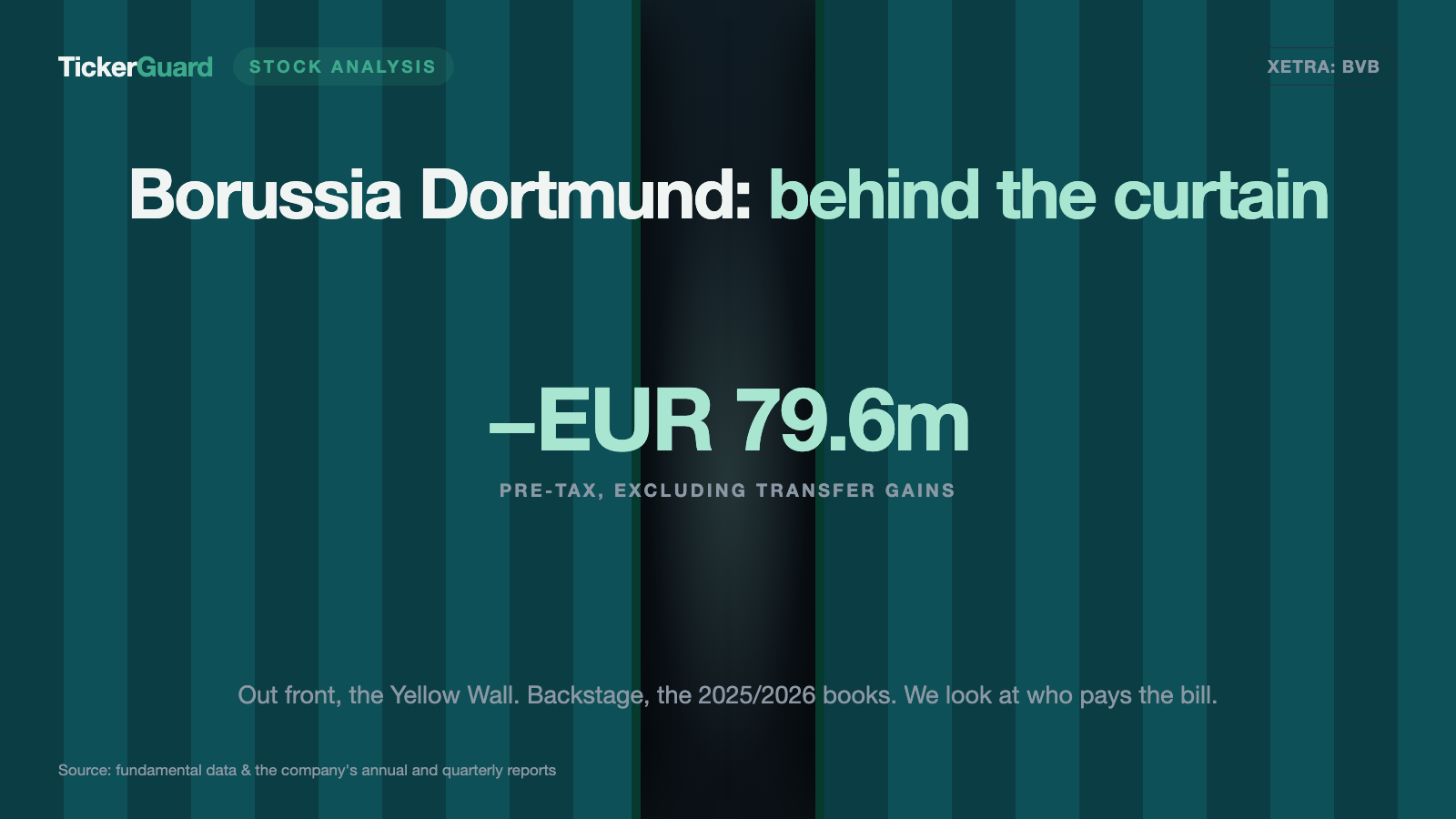
The most important number in this analysis is not in any press release; you have to calculate it yourself. Subtract the net transfer result from pre-tax earnings and you are left with what the ongoing business earned on its own. In 2025/2026 that was minus EUR 79.6 million (pre-tax earnings of minus EUR 20.3 million, including EUR 59.3 million from transfers). And it is no outlier: in every one of the five fiscal years since 2021/2022 this calculation came out negative, between minus EUR 28.3 million and minus EUR 93.1 million. Over those five years, transfers contributed EUR 330.4 million in total — EUR 62.9 million, 72.5 million, 97.9 million, 37.8 million and 59.3 million.
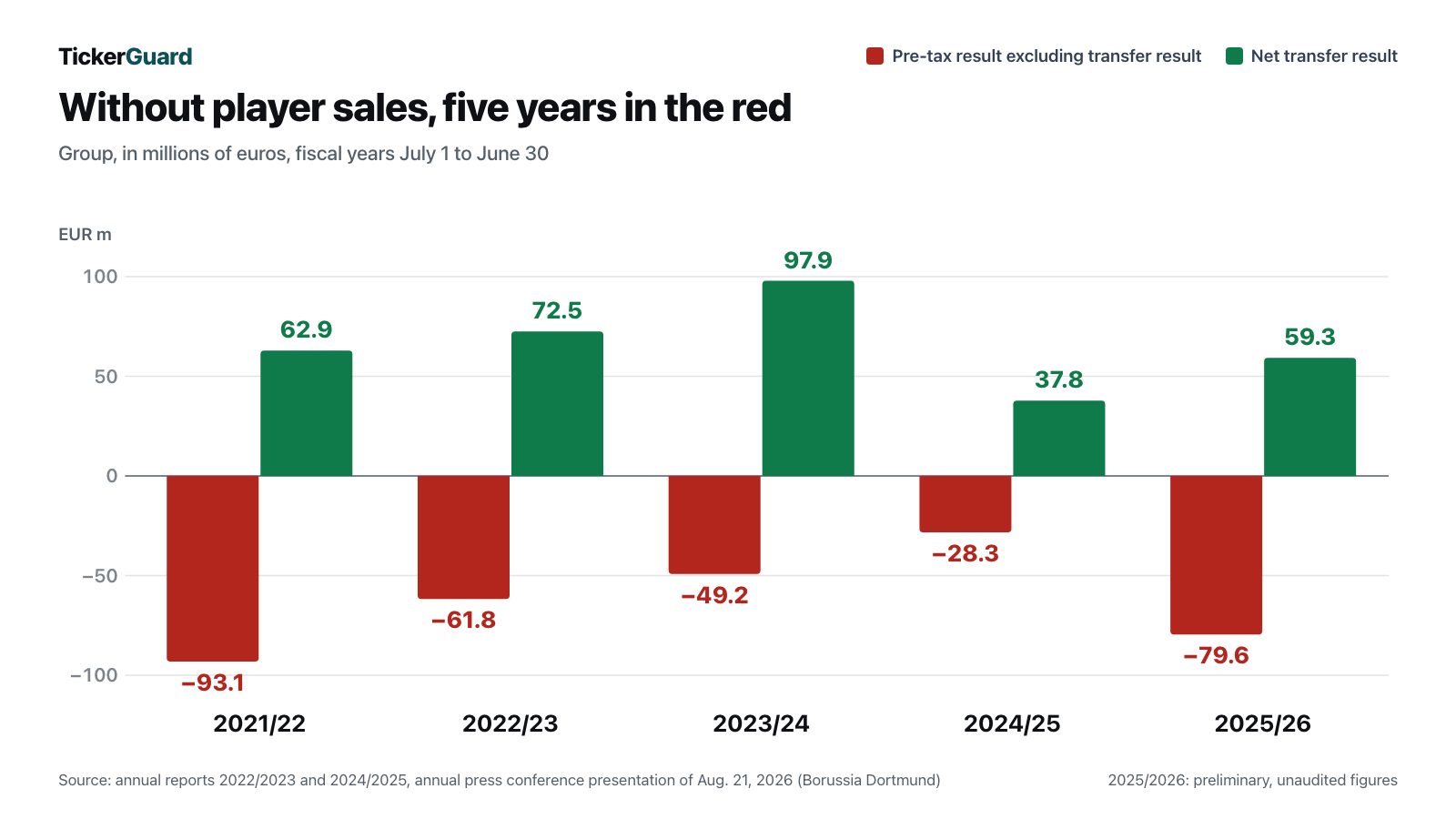
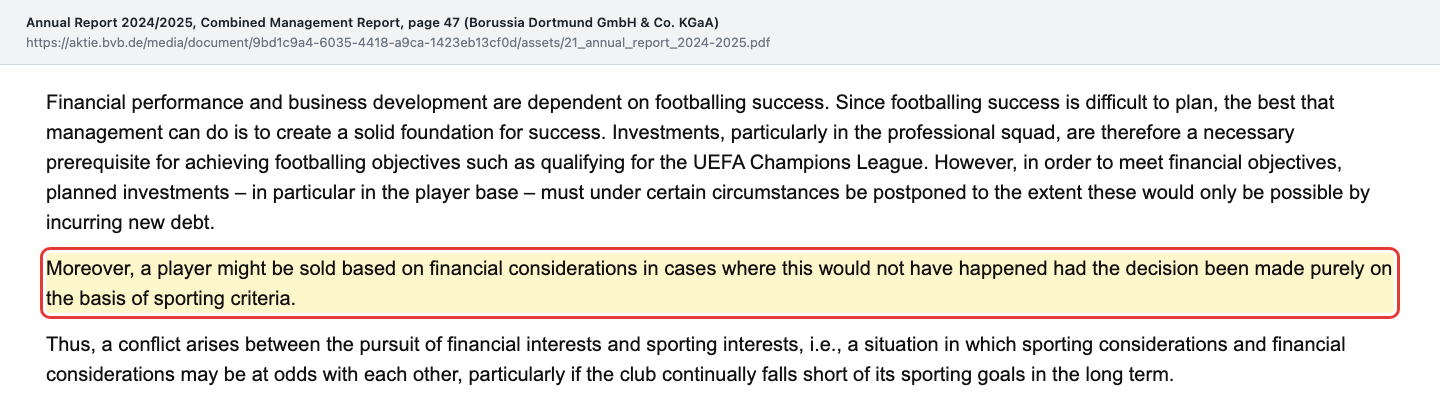
A caveat belongs here, or the calculation would be unfair: without sales the cost side would look different, and a well-sold player is the result of good scouting. Transfers are not luck at a soccer club; they are part of the business. But they are a part the club cannot plan like a sponsorship contract — and one that can collide with the sporting side. The 2024/2025 annual report says so with remarkable candor:
“Moreover, a player might be sold based on financial considerations in cases where this would not have happened had the decision been made purely on the basis of sporting criteria.”
— Borussia Dortmund GmbH & Co. KGaA, Annual Report 2024/2025, combined management report, page 47
In plain terms: at BVB, the shareholder always has a stake in the transfer market too. The new management knows it. Carsten Cramer, spokesman of the management since November 2025, said at the annual press conference (our translation) that the club had used the season to work on “our structural deficits” and to make BVB “even more independent of transfer activity.” That is the right goal. The biggest cost block shows how to measure it: personnel expenses of EUR 259.9 million equaled about 56 percent of revenue in 2025/2026. The turnaround is proven only once that ratio falls and the red bars in the chart above start to shrink.
Uncomfortable truth No. 2: One evening in February cost the forecast
February 25, 2026, shows how sensitive this business model is. That evening, Borussia Dortmund went out in the Champions League play-offs, according to the club’s press release against Atalanta Bergamo. The next morning came the mandatory disclosure to the capital market:
“Following its elimination from the UEFA-Champions League play-offs yesterday evening and the resulting loss of planned earnings from this competition, Borussia Dortmund is now revising its earnings forecast published in the group management report as of June 30, 2025 to a consolidated net loss of between EUR -12,000 thousand and EUR -22,000 thousand (previously between EUR -5,000 thousand and EUR 5,000 thousand).”
— Borussia Dortmund GmbH & Co. KGaA, ad hoc release of February 26, 2026
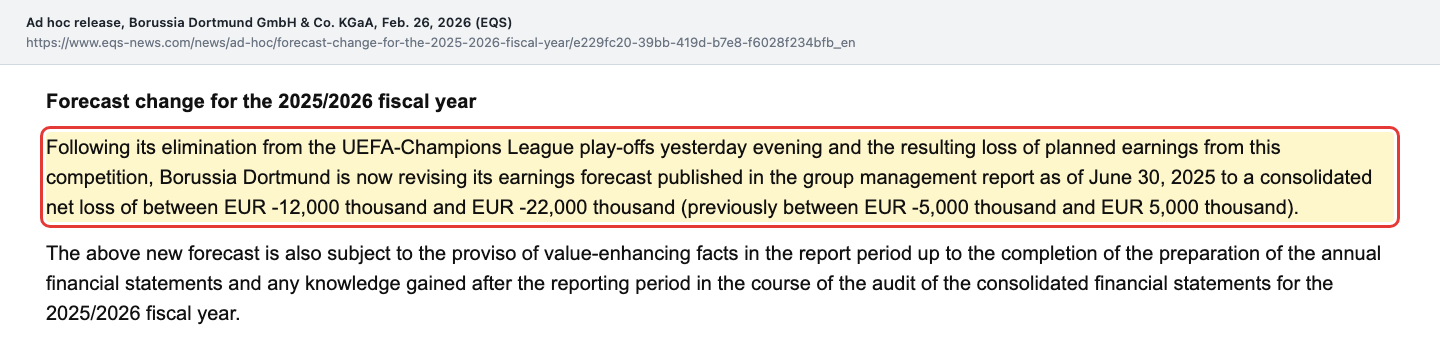
In the end, the loss of EUR 21.7 million landed close to the bottom of that range. The revenue breakdown shows where the money went missing: TV marketing plunged by EUR 58.8 million to EUR 168.4 million. The ad hoc release of August 21, 2026, cites the missed round of 16 — the year before, BVB had reached the quarterfinals — and lower income from the 2025 FIFA Club World Cup “due to the timing,” part of which had already been booked in the prior year. Only advertising grew.
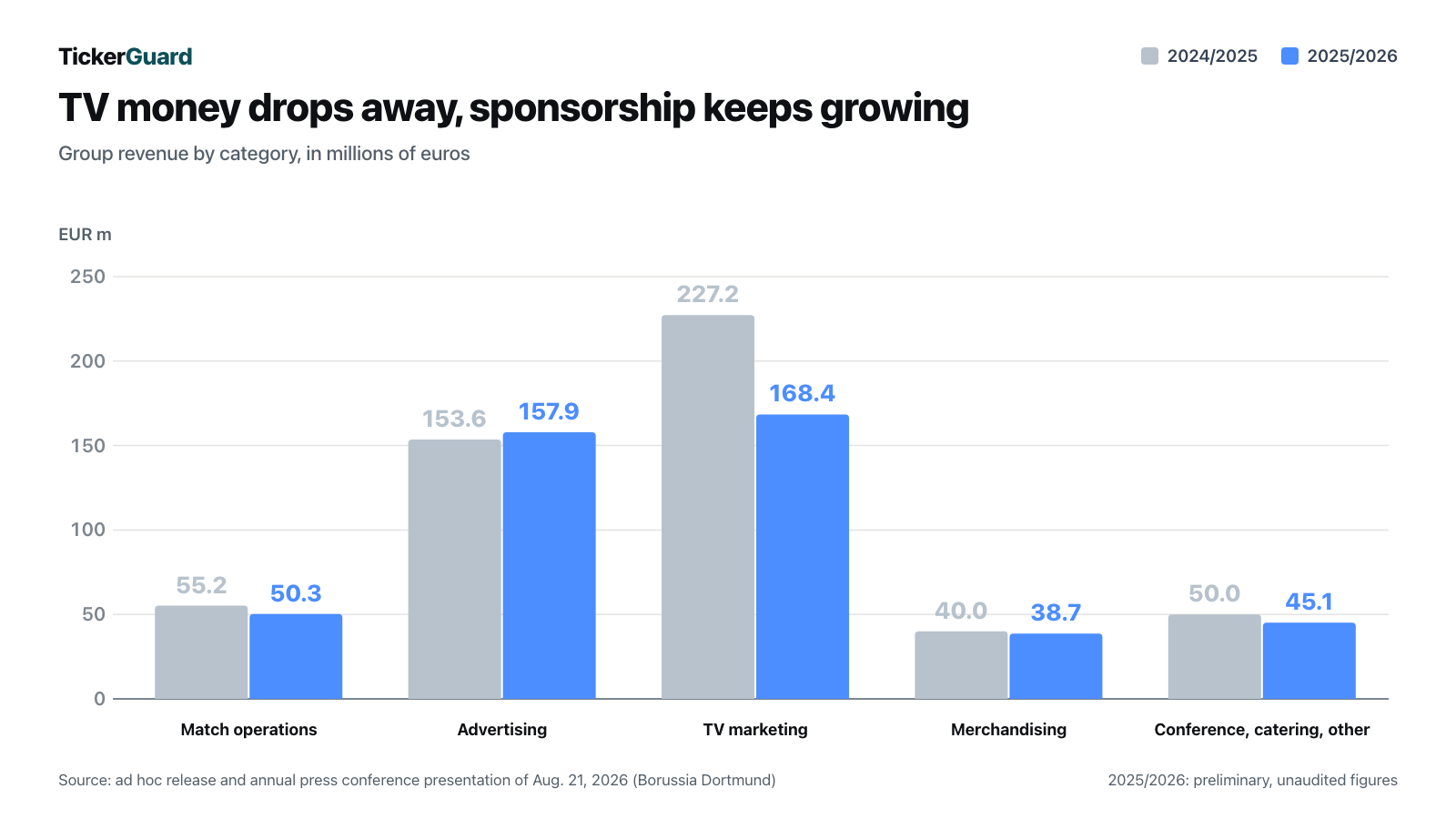
The dependence is starkest in the final quarter. After nine months, the quarterly statement still showed a consolidated net profit of EUR 5.9 million. For the full year BVB reported minus EUR 21.7 million — so the April-to-June 2026 quarter produced a calculated loss of EUR 27.6 million. EBITDA for that quarter was a calculated minus EUR 1.9 million, and April-to-June revenue fell from a calculated EUR 132.7 million to EUR 89.1 million. Part of the reason is the calendar: the Club World Cup ran from June 15 to July 13, 2025, and according to the 2024/2025 annual report BVB booked EUR 33.9 million in income from it in the old fiscal year — that is, in the prior-year final quarter. There was no comparable club tournament in June 2026.
Uncomfortable truth No. 3: EUR 3.7 million in cash and no dividend
The balance sheet is solid — the cash position much less so. On June 30, 2026, the results presentation showed cash of EUR 3.7 million, down from EUR 20.6 million a year earlier. For a group with EUR 460 million in revenue and EUR 86.5 million in current trade payables, that is very little. The backstop is a credit line: according to the Q3 statement as of March 31, 2026, an overdraft facility of EUR 75 million is available, which according to Thomas Treß had not been drawn at fiscal year-end.
The cash flow statement shows why. Operating activities brought in EUR 63.9 million in 2025/2026. But EUR 114.3 million went out for new players and other intangible assets, net transfer receipts brought in EUR 60.0 million and EUR 11.8 million went into property, plant and equipment. Free cash flow therefore came to a calculated minus EUR 2.3 million. On top of that came EUR 6.6 million in dividends for the prior year and EUR 5.1 million in debt repayment. In other words: BVB put almost exactly as much into its squad as the business and player sales generated together — nothing was left for shareholders.
That has consequences for the dividend. A year earlier, management had written in its letter to shareholders that the club planned “to continue paying dividends in the future.” The ad hoc release of August 21, 2026, now says:
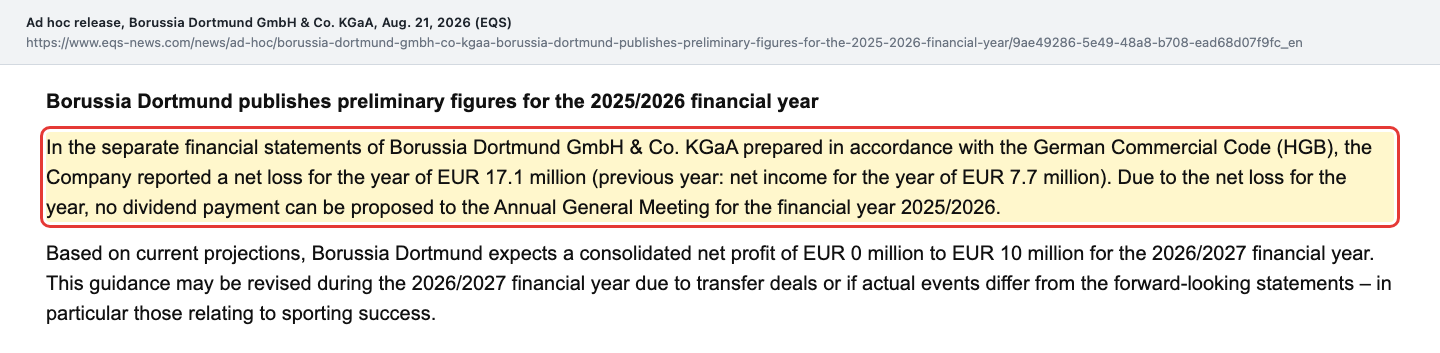
“Due to the net loss for the year, no dividend payment can be proposed to the Annual General Meeting for the financial year 2025/2026.”
— Borussia Dortmund GmbH & Co. KGaA, ad hoc release of August 21, 2026
To be fair: the dividend policy in the 2024/2025 annual report explicitly makes a payout conditional on the company generating a net profit. No promise was broken. But anyone who bought the stock for the 6 cents per share paid for 2023/2024 and 2024/2025 should know how quickly that chain can snap: one lost play-off match was enough.
Uncomfortable truth No. 4: Shareholders elect the supervisory board — the club picks management
At an ordinary German stock corporation, shareholders elect the supervisory board, and the supervisory board appoints and dismisses the management board. At BVB that chain is broken. The Corporate Governance Declaration of July 2026 puts it this way:
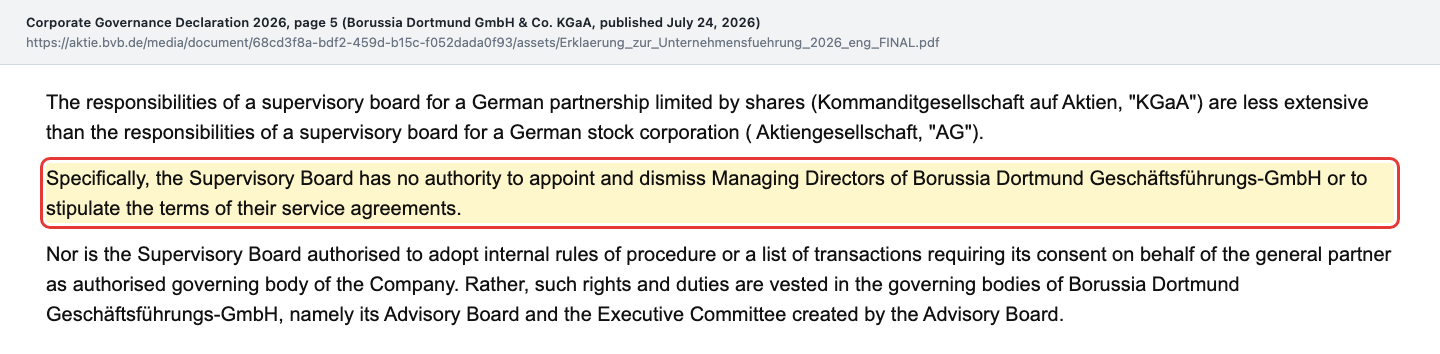
“Specifically, the Supervisory Board has no authority to appoint and dismiss Managing Directors of Borussia Dortmund Geschäftsführungs-GmbH or to stipulate the terms of their service agreements.”
— Borussia Dortmund GmbH & Co. KGaA, Corporate Governance Declaration 2026, page 5
So who decides? According to the same declaration, the governing bodies of the general partner, whose sole shareholder is the club association, Ballspielverein Borussia 09 e.V. Dortmund. According to the 2024/2025 annual report, the association held only 5.45 percent of the shares on June 30, 2025 — yet it controls management. Think of it this way: you can buy a season ticket to the stock, but you get no vote on who coaches the team. November 2025 showed how that works in practice: after Hans-Joachim Watzke left management, the presidential committee of the general partner’s advisory board decided, according to the ad hoc release of November 26, 2025, that Carsten Cramer would become spokesman and Svenja Schlenker would join management — the shareholders’ meeting played no part.
This is disclosed, legal and common in German professional soccer with its 50+1 ownership rule. But it means two things: a takeover against the club’s will is practically ruled out, and when sport and returns pull in different directions, the shareholders’ meeting does not have the final say. The largest shareholders on June 30, 2025, were Bernd Geske (8.30 percent), Evonik (8.20), SIGNAL IDUNA (5.98), the club association (5.45), PUMA (5.32) and Ralph Dommermuth Beteiligungen GmbH (5.03); 61.72 percent was free float. Geske, a member of the supervisory board, bought more shares worth EUR 191,400 at EUR 3.19 on August 24, 2026, according to a mandatory filing, and Carsten Cramer bought shares worth a combined EUR 50,867.99 on August 21 and 24, 2026.
Valuation — the order of magnitude
On September 25, 2026, the stock closed at EUR 3.165 on Xetra. Multiplied by 110,377,320 shares outstanding (110,396,220 minus 18,900 treasury shares), that gives a market value of about EUR 349 million. Measured against equity of EUR 298.7 million on June 30, 2026, that is roughly 1.2 times book value; measured against revenue, roughly 0.8 times.
EBITDA is of limited use as a yardstick at BVB, and you should know why before quoting any multiple. Add financial and lease debt and subtract cash, and enterprise value comes to about EUR 385 million — 4.2 times EBITDA of EUR 92.2 million. Sounds cheap. But those EUR 92.2 million include EUR 59.3 million of transfer result, and player purchases never show up in EBITDA because they are booked as amortization. Without transfers, EBITDA is EUR 32.9 million — a multiple of 11.7. For 2026/2027, BVB expects consolidated net income of EUR 0 million to EUR 10 million; at the midpoint, that would mean a price-to-earnings ratio of about 70.
The club sees it differently. In a corporate news release on June 2, 2026, it pointed to the Forbes list of the most valuable soccer clubs, which ranks BVB 13th at USD 2.2 billion, and wrote: “This once again demonstrates that BVB shares are significantly undervalued based on their current market capitalization.” That is the company’s view of its own stock — and a Forbes estimate is not a price an independent buyer actually pays. As long as the association controls management and a takeover is practically ruled out, shareholders get from such a brand value only what arrives as profit and dividends. Analysts at NuWays reiterated their buy rating with a EUR 5.00 price target on August 25, 2026; by their account, the club’s plan for 2026/2027 assumes, among other things, reaching the Champions League round of 16. If you want to see how a sporting-goods group makes money from the same stadiums and jerseys, our adidas analysis has the comparison.
Upside and risks at a glance
What speaks for Borussia Dortmund
- The brand carries weight: advertising income rose to EUR 157.9 million in 2025/2026 despite an early Champions League exit; the major partners are signed until 2030, 2031 and 2034.
- The balance sheet is healthy: equity of EUR 298.7 million, a 51.5 percent equity ratio and financial debt of EUR 28.5 million (June 30, 2026); an overdraft facility of EUR 75 million was undrawn.
- Costs are coming down: personnel expenses fell by EUR 8.4 million and other operating expenses by EUR 16.9 million in fiscal 2025/2026.
- The sporting lever is big: according to the club’s press release, the team finished the 2025/2026 Bundesliga season as runner-up; for 2026/2027 BVB plans revenue of EUR 485 million to EUR 495 million and net income of EUR 0 million to EUR 10 million.
- Insiders are buying: supervisory board member Bernd Geske and managing director Carsten Cramer bought shares worth about EUR 242,000 combined after the annual figures in August 2026.
What speaks against it
- Excluding the transfer result, pre-tax earnings were negative in all five years from 2021/22 to 2025/26 — minus EUR 79.6 million in 2025/2026.
- A single match can overturn the forecast, as on February 26, 2026; the 2026/2027 guidance is also subject to sporting success and transfer activity, according to the ad hoc release.
- Cash is thin: EUR 3.7 million on June 30, 2026, and cumulative free cash flow of minus EUR 24.3 million over five years.
- There is no dividend for 2025/2026; the KGaA’s separate statement shows a net loss of EUR 17.1 million.
- Shareholders have no say over who runs the company — that rests with the club association, which holds 5.45 percent of the shares (June 30, 2025).
- The 2025/2026 figures are still preliminary; the audited report is announced for September 28, 2026.
A human conclusion
Back to the affinity bias from the start. It is easy to like BVB, and there is nothing wrong with that. It only goes wrong when the feeling replaces the math. The math says: Borussia Dortmund is a strong brand with a solid balance sheet whose ongoing business has not managed without player sales for years. Over five years, shareholders were left with EUR 6.7 million in consolidated net income and negative free cash flow — while revenue grew by almost a third.
That does not make the stock a bad paper. The new management has cut costs, speaks openly of “structural deficits” and wants to become less dependent on transfers. Whether that works can be measured: by the red bars in the chart, by the cash position and by the 2026/2027 Champions League campaign. The next dates are the audited annual report on September 28, 2026, the quarterly statement on November 12 and the annual general meeting on November 23, 2026.
If you buy the stock, please buy it as a shareholder, not as a fan — your spot on the Yellow Wall stays yours whether you own the shares or not. What you do with all this is your call. And that is exactly how it should be.
Sources
- Borussia Dortmund, ad hoc release of August 21, 2026 — preliminary figures for fiscal 2025/2026, no dividend, guidance for 2026/2027
- Borussia Dortmund, annual press conference presentation of August 21, 2026 — income statement, revenue by category, transfer result, balance sheet as of June 30, 2026, cash flow statement, guidance
- bvb.de, press release on the annual press conference of August 21, 2026 (German) — statements by Carsten Cramer and Thomas Treß
- Borussia Dortmund, Q3 statement 2025/2026 (as of March 31, 2026) — liquidity analysis, overdraft facility
- Borussia Dortmund, half-yearly financial report 2025/2026
- Borussia Dortmund, ad hoc release of February 26, 2026 — forecast change
- Borussia Dortmund, Annual Report 2024/2025 — key figures, letter to shareholders, shareholder structure, risk report, dividend policy, notes
- Borussia Dortmund, Annual Report 2022/2023 (German) — group figures for 2021/2022 and 2022/2023
- Borussia Dortmund, Corporate Governance Declaration 2026 — KGaA legal form, supervisory board powers
- Borussia Dortmund, corporate news of June 2, 2026 — Forbes valuation
- Managers’ transactions of August 26, 2026 — Bernd Geske; plus two filings on Carsten Cramer the same day
- NuWays AG, research update of August 25, 2026 — buy rating, EUR 5.00 price target, assumptions behind the 2026/2027 plan
- Price as of September 25, 2026, and stock-page ratios: fundamental data
Journalistic analysis, not investment advice and not a solicitation to buy or sell securities. Stocks can lose their entire value. All figures come from the original documents linked above and are stated with their respective reference dates; the figures for fiscal 2025/2026 are preliminary and unaudited. Positions held by the operator are disclosed daily; where one exists, it appears as a notice at the top of this deep dive.
Our Bottom Line at a Glance
- Brand and sponsorship positive
- Advertising income of EUR 157.9m in fiscal 2025/2026 (prior year 153.6) despite an early Champions League exit; SIGNAL IDUNA signed until 2031, PUMA until 2034, Vodafone until 2030 (Annual Report 2024/2025).
- Balance sheet positive
- Equity of EUR 298.7m, 51.5% equity ratio and EUR 28.5m in financial liabilities as of June 30, 2026; according to the company, the EUR 75m overdraft facility was not drawn.
- Dependence on transfers negative
- Pre-tax earnings excluding the transfer result were negative in all five fiscal years 2021/22–2025/26, at EUR −79.6m in 2025/26; transfers contributed EUR 330.4m combined over that period.
- Dependence on sporting success negative
- After the play-off exit on Feb. 25, 2026, BVB cut its forecast from −5/+5 to −12 to −22 EUR m; TV income fell EUR 58.8m and net income came in at EUR −21.7m (preliminary).
- Liquidity and payouts neutral
- Cash of EUR 3.7m on June 30, 2026, free cash flow of EUR −2.3m (2025/26) and EUR −24.3m over five years; no dividend for 2025/26.
- Governance neutral
- KGaA: the club association controls management as sole shareholder of the general partner; the supervisory board can neither appoint nor dismiss managing directors (Corporate Governance Declaration 2026). Disclosed and legal, but it limits shareholder influence.
Borussia Dortmund is a strong brand with a solid balance sheet whose ongoing business has not managed without player sales for years: excluding the transfer result, pre-tax earnings were negative in all five fiscal years since 2021/22, at EUR −79.6m in 2025/26. A single play-off exit was enough to turn a break-even plan into a EUR 21.7m loss. Not investment advice.
What Our Rating Means
Open questions
The business works in principle, but one material question is open. As long as it stays open, our findings do not carry a quality verdict.
Yellow here does not signal a threat to the company’s substance — the equity ratio is above 50 percent, financial debt is low and a EUR 75 million credit line was undrawn. What is open is the key operating question of whether the business can stand on its own without transfer gains: pre-tax earnings excluding transfers were negative in all five years, and the annual result hinges on the Champions League, as the forecast cut of February 2026 showed. The thin cash position of EUR 3.7 million and the missing dividend fit that picture. The KGaA structure is a governance feature, not a breach. The decision is yours.
A journalistic assessment by our editorial team at the time of the deep dive, based on public sources — not investment advice and not a solicitation to buy or sell. Your personal circumstances (investment goals, risk capacity, taxes) cannot be taken into account. What our levels mean, how verdicts are formed, and what conflicts of interest exist →
Worth Noting
- Version of September 27, 2026, based on the preliminary, unaudited figures for fiscal 2025/2026 (ad hoc release and results presentation of August 21, 2026). The audited annual financial report is announced for September 28, 2026 and was not available at the time of writing.
- The hook was the U.S. secondary symbol BORUF in the ranking of most-discussed stocks on wallstreet-online — an attention signal, not a data source. Borussia Dortmund does not report to the U.S. securities regulator, the SEC; all evidence comes from the company’s own reports and mandatory announcements.
- Our own calculations: pre-tax earnings excluding the transfer result (pre-tax earnings minus net transfer result), 2025/2026 free cash flow (operating cash flow minus investing cash flow), April-to-June 2026 quarterly figures (full year minus nine months) and market value (shares outstanding times the closing price of September 25, 2026).
The full analysis as a PDF for later
We will send you this analysis as a PDF — to print, file away, and read at your own pace.
Frequently Asked Questions
According to preliminary figures released on August 21, 2026, BVB posted a consolidated net loss of EUR 21.7 million for fiscal 2025/2026 (July 1, 2025 to June 30, 2026), after a EUR 6.5 million profit the year before. Revenue fell from EUR 526.0 million to EUR 460.5 million, mainly because of lower TV income after an early Champions League exit.
No. According to the ad hoc release of August 21, 2026, the KGaA’s separate financial statements under the German Commercial Code show a net loss of EUR 17.1 million, so no dividend can be proposed to the annual general meeting on November 23, 2026. For 2023/2024 and 2024/2025, the club paid 6 euro cents per share each year.
Crucial. The net transfer result came to EUR 59.3 million in 2025/2026, driven in part by Jamie Gittens’ move to Chelsea. Without it, pre-tax earnings would have been minus EUR 79.6 million. On that calculation, the ongoing business excluding transfers was loss-making before tax in all five years since 2021/2022.
BORUF is an over-the-counter U.S. trading symbol for shares of Borussia Dortmund GmbH & Co. KGaA. It carries no reporting obligation of its own, and there is no SEC-reporting issuer named Borussia Dortmund. The primary listing is on Xetra and in Frankfurt under the symbol BVB, ISIN DE0005493092; the company’s own reports are what counts.
The KGaA is run by Borussia Dortmund Geschäftsführungs-GmbH, whose sole shareholder is the club association, Ballspielverein Borussia 09 e.V. Dortmund. The supervisory board elected by shareholders cannot appoint or dismiss the managing directors. The association itself held only 5.45 percent of the shares on June 30, 2025; free float stood at 61.72 percent.
For fiscal 2026/2027, BVB plans group revenue of EUR 485 million to EUR 495 million and consolidated net income of EUR 0 million to EUR 10 million. According to the ad hoc release of August 21, 2026, the guidance may change because of transfer deals or if sporting success differs from the plan.
Found an error?
Did you spot a factual error, an outdated number, or a typo in this deep dive? Let us know briefly — your report goes straight to the editorial team.