Verbio stock: the turnaround is real — but not management's achievement alone
From minus EUR 137.9 million to plus EUR 63.9 million in net result within one fiscal year — and at the same time EUR 131 million in GHG quotas that can only be used in 2027. We read two annual reports, the quarterly statement and three ad-hoc releases and checked who actually earned that profit. Updated September 24, 2026 with the audited 2025/2026 accounts.
 Thomas Mücke
Founder & Publisher
Thomas Mücke
Founder & Publisher
Chart
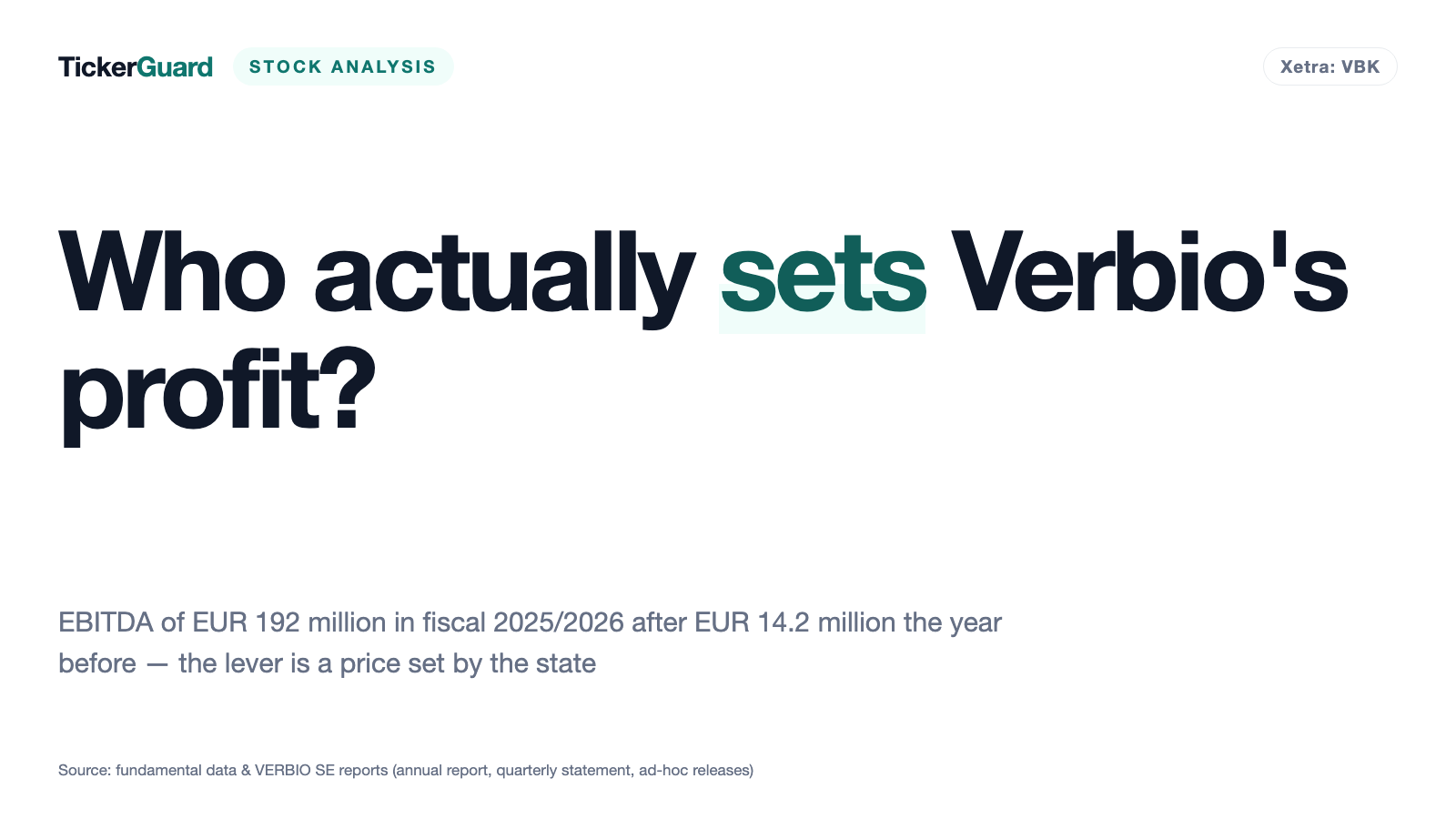
Interactive price chart (TradingView).
Note: pure fact-based analysis, not investment advice and not a solicitation to buy or sell. All figures without guarantee.
There is a thinking error investors make with remarkable reliability, and it has no pretty name: the credit reflex. When profits rise, we praise management. When profits fall, we blame management. Both feel reasonable — and for some companies both are simply wrong. VERBIO SE (Xetra: VBK) is one of those companies. In fiscal 2024/2025 it posted a net loss of EUR 137.9 million. One year later the same company, with the same plants and the same six-member management board, reports audited EBITDA of EUR 193.9 million and a net profit of EUR 63.9 million. In between there was no change of strategy, no acquisition, no new product. In between, above all, there is a price set by the state.
This analysis reads what Verbio itself reported — the annual reports for 2024/2025 and 2025/2026, the quarterly statement for the period ended March 31, 2026, and the three ad-hoc releases of March 25, May 27 and August 3, 2026. It separates what the company achieved from what fell into its lap. And it points to four places in Verbio's own reports where the story gets uncomfortable. What you do with that is your call.
Update of September 24, 2026: what the audited accounts show
On September 24, 2026 Verbio published its Annual Report 2025/2026. The fiscal year ended on June 30, 2026, so the report contains the fourth quarter and the audited full year. The key changes against our version of August 12, 2026:
- The preliminary figure holds. EBITDA came in at EUR 193.9 million versus the roughly EUR 192 million flagged in August. Revenue rose 18.5 percent to EUR 1,872.7 million, net profit to EUR 63.9 million (EUR 1.00 per share).
- The cash actually arrived. Operating cash flow was EUR 164.6 million (prior year EUR 13.9 million); after EUR 86.6 million of capital spending, free cash flow came to EUR 78.0 million. Net financial debt fell to EUR 91.5 million.
- The year was made in the second half. Of the EUR 193.9 million of EBITDA, EUR 148.4 million fell in January through June 2026; the fourth quarter alone delivered EUR 88.2 million (prior-year quarter: minus EUR 8.2 million).
- The write-up now has a number: EUR 19.1 million — just under one tenth of full-year EBITDA. At the same time, quotas with a carrying amount of EUR 131.1 million sit in inventory that can only be used for the 2027 obligation year (uncomfortable truth No. 2).
- The dividend is back: the management and supervisory boards propose EUR 0.20 per share to the annual general meeting on December 4, 2026.
- New guidance: for 2026/2027 Verbio expects EBITDA of EUR 210 to 250 million, driven by the Bioethanol/Biomethane segment, while the board plans for a slight earnings decline in biodiesel.
The guidance in the company's words:
"For the financial year 2026/27 the Management Board expects the Group’s EBITDA to be between EUR 210 million and EUR 250 million, which is higher than in the financial year 2025/26. The expected increase in Group EBITDA is primarily due to the higher contribution to earnings from the Bioethanol/Biomethane segment."
— VERBIO SE, corporate news of September 24, 2026
Verbio held a conference call the same day according to its financial calendar. At the time of writing on September 24, 2026, neither the presentation nor a recording nor a transcript had been published. We therefore evaluated only what Verbio put in writing: the annual report and the corporate news. There was no ad-hoc release after August 3, 2026.
What Verbio does — and why a law runs the till
Verbio is based in Zörbig, Saxony-Anhalt, has been listed since October 2006, rejoined Germany's SDAX small-cap index on December 22, 2025, and employed 1,391 people at June 30, 2026 (prior year 1,458). It describes itself as a leading bioeconomy company and mainly produces biofuels. Three products leave the plants: biodiesel from rapeseed and used cooking oils, bioethanol from grain, and biomethane from residues such as straw. Reporting runs through two segments plus a residual line: Biodiesel, Bioethanol/Biomethane and Other.
The decisive lever, however, does not sit in the fuel. It sits in a certificate attached to it: the German greenhouse gas reduction quota, or GHG quota. Think of it as a legally mandated diet for the filling station. Lawmakers force the mineral oil industry to cut the carbon footprint of the fuel it sells, year after year. Companies that cannot manage it on their own buy someone else's savings — as a tradable certificate. Verbio helps produce those savings and sells them.
The price of those certificates is not an ordinary product price. It emerges from regulation, enforcement and import volumes. When cheap volumes flood the market — according to Verbio's Annual Report 2024/2025 partly through fraud with falsely declared sustainability certificates — the quota price falls, and Verbio's margin falls with it. When regulation tightens, it rises. That is why Verbio's bottom line can swing by more than EUR 200 million between two fiscal years without anything fundamental changing inside the plants. Keep this in mind for the rest of this analysis: Verbio's most important price is not on Verbio's price list.
One more point up front, because it shapes the entire evidence chain: there is no filing from Verbio with the U.S. securities regulator, the SEC. The company is listed in the Prime Standard of the Frankfurt Stock Exchange; the U.S. ticker VBVBF is merely an over-the-counter secondary listing with no reporting duty of its own. Every figure in this analysis therefore carries the label "source: fundamental data and VERBIO SE reports" rather than "SEC filings (10-K/10-Q)". We had the same constellation most recently at RENK, another German issuer whose own reports are the only usable primary source.
How the stock landed on our desk
Through an ad-hoc release containing a rare combination of words: exceeds forecast. On August 3, 2026 Verbio reported preliminary full-year EBITDA of roughly EUR 192 million — against guidance of EUR 160 to 180 million that was itself only ten weeks old. Verbio had formally raised guidance on March 25 and May 27, 2026; the August 3 release was the third positive surprise inside a single fiscal year.
How the stock went into the end of the fiscal year is revealing. According to the annual report, the lowest Xetra close during fiscal 2025/2026 was EUR 9.90 and the highest EUR 45.80. At the June 30, 2026 balance sheet date it closed at EUR 29.80 — roughly a third below the yearly high, after having more than quadrupled from its low before that.
A stock that quadruples and then gives back a third while the numbers keep improving is exactly the kind of contradiction this section exists for. It can be resolved — you only need to know where the profit comes from.
The numbers over the years — credit where it is due
First the part that impresses without qualification: Verbio survived the crash under its own steam, without an emergency capital raise and without a balance sheet break. The fiscal year ends on June 30, so "2024/2025" covers essentially the second half of calendar 2024 and the first half of 2025.
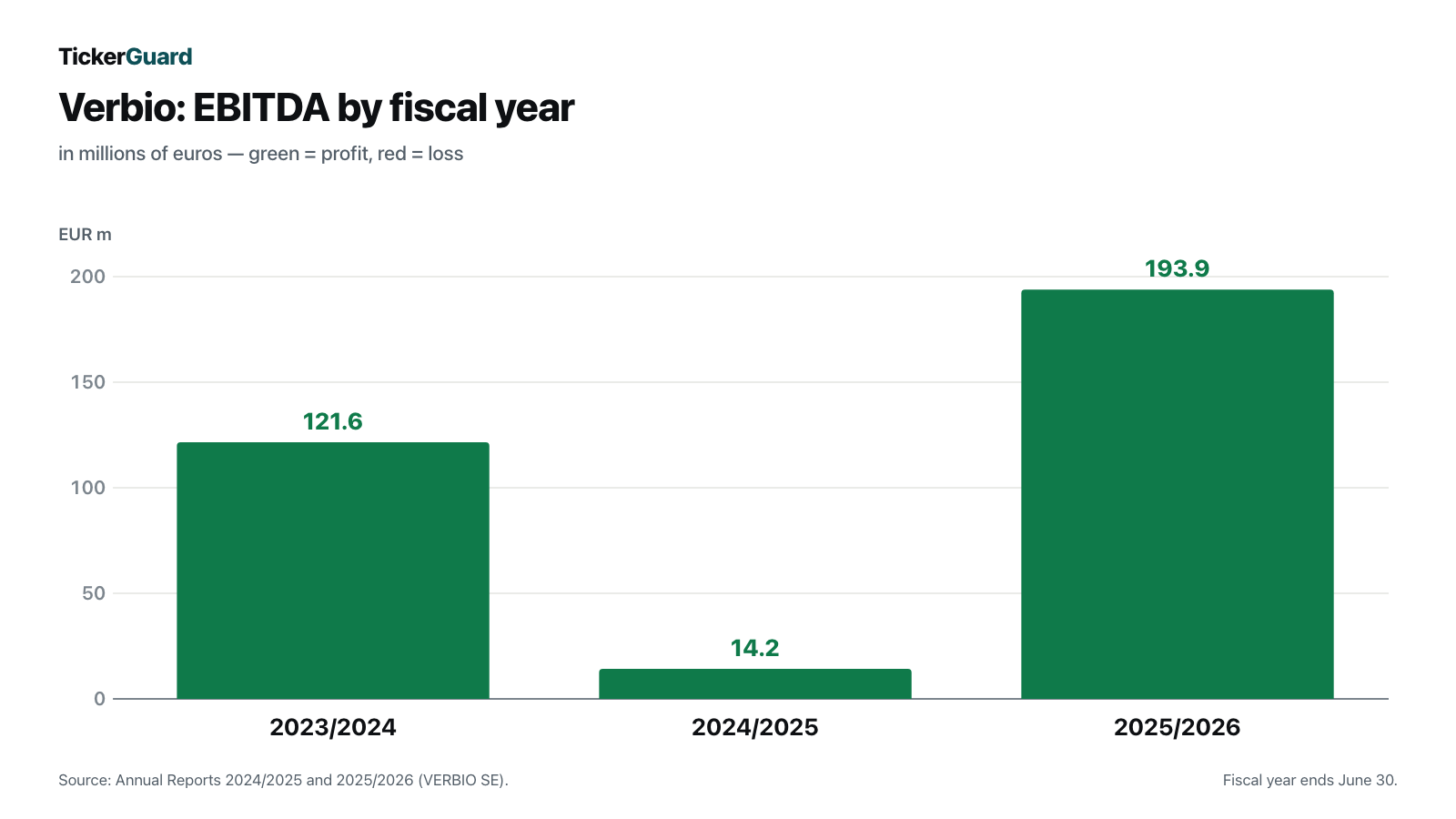
In fiscal 2024/2025 group revenue came to EUR 1,579.8 million (prior year EUR 1,658.0 million). Below that line, earnings collapsed. EBITDA — earnings before interest, taxes, depreciation and amortization, in other words what the running business leaves behind — fell from EUR 121.6 million to EUR 14.2 million. Operating income (EBIT) swung from plus EUR 69.6 million to minus EUR 118.2 million, and the bottom line showed minus EUR 137.9 million with a loss per share of EUR 2.17. The dividend, 20 cents per share every year since fiscal 2016/2017, was suspended.
Then came the counter-move. In fiscal 2025/2026 (July 1, 2025 through June 30, 2026) revenue rose to EUR 1,872.7 million, EBITDA to EUR 193.9 million, EBIT to EUR 128.2 million and the net result to plus EUR 63.9 million. How unevenly that was spread across the year shows in the halves: EUR 45.5 million of EBITDA from July to December 2025, EUR 148.4 million from January to June 2026 — the first half even ended with a small net loss.
The balance sheet recovered too, and that deserves fair credit. Net financial debt stood at EUR 164.0 million at June 30, 2025, rose to EUR 173.6 million at the half-year mark and fell to EUR 91.5 million by June 30, 2026 — against equity of EUR 816.7 million and an equity ratio of 59.7 percent. Operating cash flow of EUR 164.6 million covered capital spending almost twice over. The annual report states that, based on its risk simulation, no risks threatening the group's ability to continue as a going concern were identifiable at the balance sheet date. Anyone looking for a balance sheet story at Verbio will not find one.
Production rose too: biodiesel and bioethanol together reached 1,217.8 kilotonnes against 1,201.9 — a new production record, according to the annual report. Biomethane output came to 1,410 gigawatt hours against 1,190 a year earlier, with plant utilization up from 60.1 to 71.2 percent, driven by the ramp-up of the plant in Nevada, Iowa.
What the reports actually say — the uncomfortable truths
Uncomfortable truth No. 1: nine out of ten euros of the turnaround come from one segment
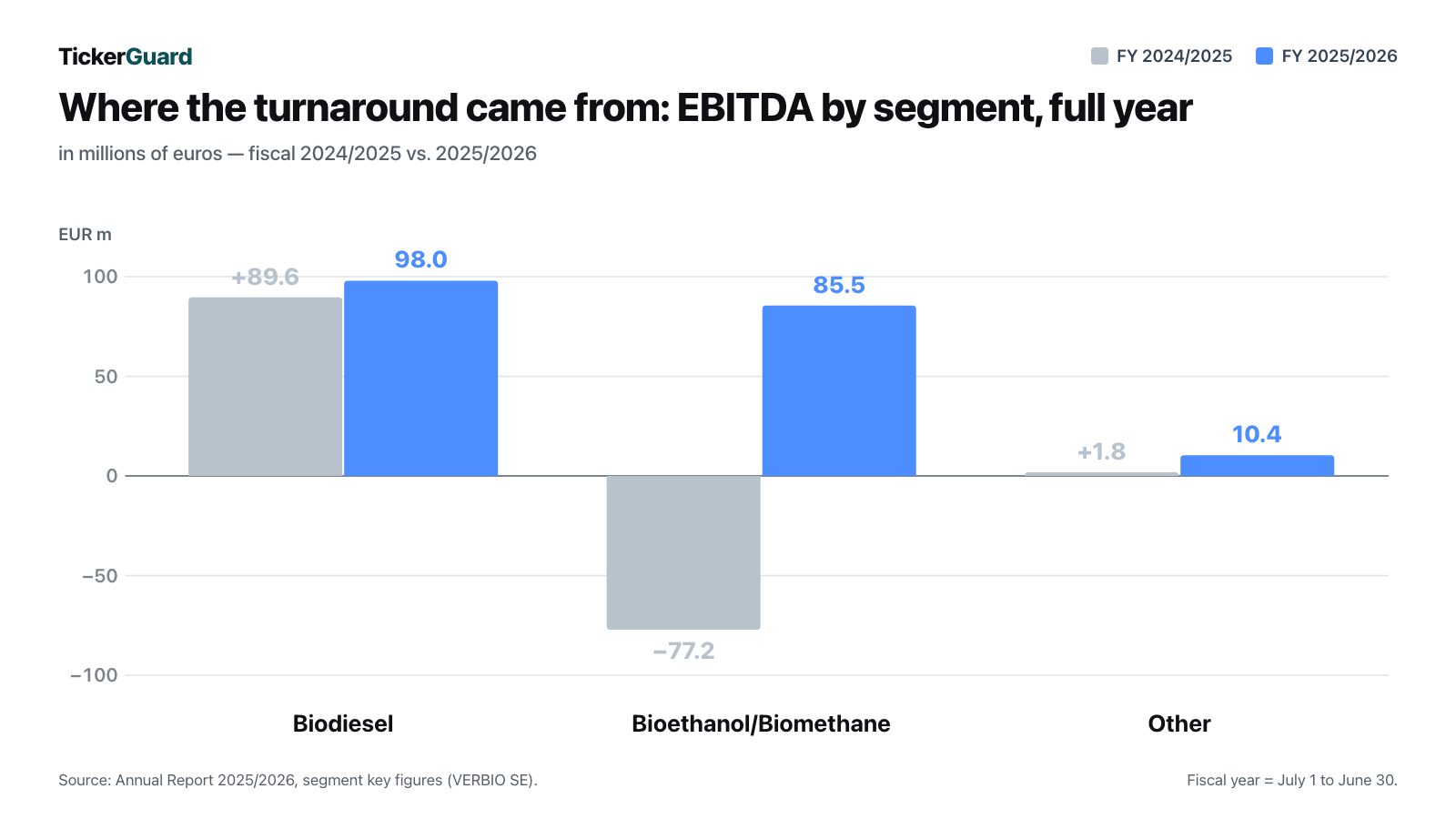
Anyone crediting the turnaround to management has to explain where it originated. The segment figures in the annual report make that easy. Group EBITDA rose by EUR 179.7 million. Of that, EUR 162.7 million — roughly 90 percent — came from the Bioethanol/Biomethane segment, which swung from minus EUR 77.2 million to plus EUR 85.5 million. The core Biodiesel business rose from EUR 89.6 million to EUR 98.0 million, the residual Other line from EUR 1.8 million to EUR 10.4 million.
A correction belongs here: our August version said biodiesel earnings had slipped slightly. That was true for the first nine months (EUR 65.2 million after EUR 68.8 million), but not for the full year — a strong fourth quarter with EUR 32.8 million of EBITDA (prior-year quarter EUR 20.8 million) turned it around. The annual report, however, again names mostly market factors as the reasons: favorable rapeseed oil purchases, higher quota prices and better prices for by-products. According to the corporate news of September 24, 2026, logistical constraints at some competitors due to low water on the Rhine added to this in the fourth quarter, while Verbio was able to meet the increased demand.
The Bioethanol/Biomethane segment contains both: genuine work — higher utilization in Nevada, lower repair costs there — and the market. The annual report names the normalization of the GHG quota market, better spreads between ethanol and grain prices, and the write-up on quota inventories as key drivers. And the May quarterly statement had already explained why the market turned at all:
"On May 8, the implementation of the revised Renewable Energy Directive (RED III) was passed by the upper house of the German parliament. This resolution addresses the systemic misguided incentives that have led to significant market distortions in the biofuels market in recent years, as well as to a loss of confidence in the GHG quota system."
— VERBIO SE, quarterly statement for the period ended March 31, 2026, subsequent-events report
In plain language: by Verbio's reading, lawmakers are correcting misguided incentives they had set themselves. That is good news for Verbio — but it was written in Berlin and Brussels, not in Zörbig. Buying the stock means buying, to a substantial degree, a bet that this policy holds.
Uncomfortable truth No. 2: EUR 19.1 million is a booking — and EUR 131 million sits in the quota stockpile
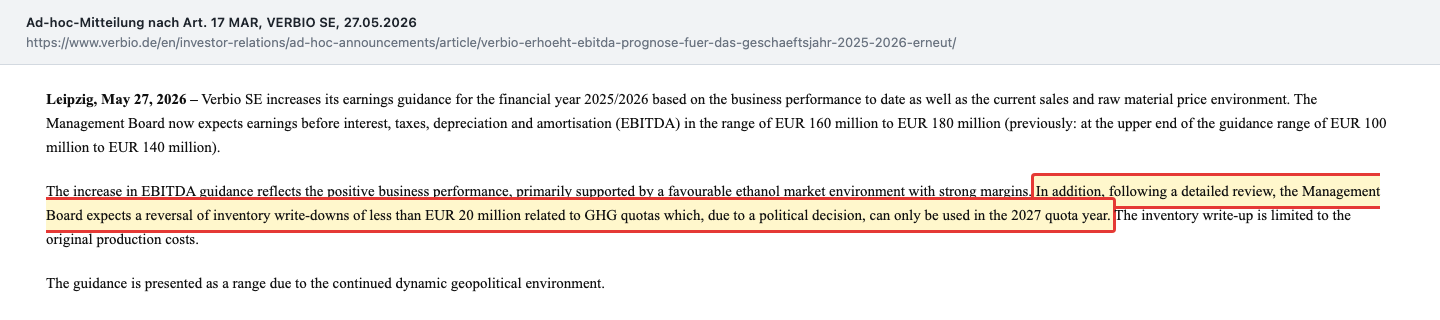
On May 27, 2026 Verbio raised EBITDA guidance from "the upper end of the EUR 100 to 140 million range" to EUR 160 to 180 million. The same release contains a sentence that is easy to skip:
"In addition, following a detailed review, the Management Board expects a reversal of inventory write-downs of less than EUR 20 million related to GHG quotas which, due to a political decision, can only be used in the 2027 quota year."
— VERBIO SE, ad-hoc release of May 27, 2026
The audited accounts now put an exact figure on the booking — and deliver a second, much larger number along with it:
"GHG quotas included in inventories of finished goods include quotas with carrying amounts of EUR 131,085 thousand that can only be used for the obligation year 2027, accordingly it is expected that the majority of these GHG quotas will not be realised until the financial year 2027/2028."
— VERBIO SE, Annual Report 2025/2026, notes 6.2.1 (inventories)
The same note states that EUR 19,087 thousand of the inventory-related income relates to the write-up of GHG quotas from calendar 2024. A write-up is the mirror image of a write-down: inventory that was once marked down for prudence is marked back up because it turns out to be worth more. That raises reported profit without a single euro entering the building. Measured against EUR 193.9 million of EBITDA, that is just under 10 percent. The fair counter-calculation: without this booking, EBITDA would have been roughly EUR 175 million — still within the EUR 160 to 180 million range raised in May, in its upper half.
The bigger number, though, is the EUR 131.1 million. That is capital already earned but tied up in quotas that can be redeemed in the 2027 quota year at the earliest — at prices nobody knows today. The forecast report names the uncertainty itself: it is open how many quota carry-overs from previous years, particularly from 2024, will actually re-enter the market. That affects not just Verbio's stockpile but every market participant holding carry-overs — and therefore the quota price itself.
Uncomfortable truth No. 3: a quarter in free float — and a grain supplier linked to the family
Verbio looks like an ordinary small cap but is, in corporate terms, a listed family company. The Annual Report 2025/2026 puts the free float at 27.97 percent at June 30, 2026 (prior year 27.90 percent). According to the shareholder structure chart, the management board directly holds 35.7 percent of the share capital. And a pooling agreement binds considerably more:
"As at the June 30, 2026 balance sheet date the arrangements under the pool agreement bind the votes of 65.72 percent of the total voting capital."
— VERBIO SE, Annual Report 2025/2026, takeover-related disclosures
Roughly two thirds of the votes are therefore cast as one block. For a minority shareholder that means two things: most votes at the annual general meeting are effectively decided in advance — for resolutions that need a three-quarters majority it depends on attendance — and a takeover against the wishes of the pooled founding shareholders is practically impossible. That is not automatically bad — family owners often think in longer horizons than quarterly managers. It is simply something to know before buying.
There is also a number in the notes that rarely gets quoted. Among the related-party disclosures sits the grain purchased from Farma Redlo Sp. z o.o.: EUR 83.7 million in fiscal 2025/2026 after EUR 93.3 million the year before and EUR 63.0 million in 2023/2024. That is roughly 4.5 percent of group revenue. Grain is the single most important input of the bioethanol business, and therefore a direct margin lever. That a supplier of this size is close to the owner circle is disclosed and thus properly handled — but it deserves a second look whenever raw material costs come up.
Uncomfortable truth No. 4: the U.S. plant cost EUR 65.6 million — and is carried at EUR 133 million
A good part of the loss year 2024/2025 was self-inflicted. Within depreciation and amortization of EUR 132.4 million sat an unscheduled impairment of EUR 65.6 million on the assets of the straw biomethane plant in Nevada, Iowa. Technical quality problems and repair costs came on top.
The plant is now ramping up, and no further impairment was needed in 2025/2026. The auditor nevertheless lists the recoverability of the U.S. assets as a key audit matter: of EUR 725 million of property, plant and equipment, EUR 133 million is attributable to Nevada and EUR 55 million to South Bend, Indiana — and whether those carrying amounts hold depends, per the risk report, to a significant extent on planned utilization, raw material, sales and energy prices, and the terms of production subsidies. Proof that the U.S. investment earns its cost of capital is therefore still outstanding.
An honest account also looks at board pay. In the loss-making year 2024/2025 it had risen from EUR 5.759 million to EUR 6.582 million; that figure included EUR 2.505 million of long-term remuneration settled in shares. In fiscal 2025/2026 it came to EUR 5.125 million, with no such long-term component. And the dividend is returning faster than announced; a year earlier the board had only promised a return "in the medium term":
"As a result, thanks to strong cash flow generation in the financial year 2025/2026, the Company plans to make an early return to its usual dividend policy."
— VERBIO SE, Annual Report 2025/2026, economic report
The guidance staircase — and the next step
To understand Verbio, look at how guidance moved during fiscal 2025/2026. It is a lesson in how little this business can be planned:
- September 25, 2025 (with the annual report): EBITDA "in the high double-digit millions", plus a moderate reduction in net debt.
- March 25, 2026 (ad-hoc): raised to EUR 100 to 140 million, with net financial debt of around EUR 140 million expected at year end.
- May 13, 2026 (quarterly statement and corporate news of the same day): Verbio expects the upper end of that range.
- May 27, 2026 (ad-hoc): raised to EUR 160 to 180 million.
- August 3, 2026 (ad-hoc): preliminary figure of roughly EUR 192 million — above the company's own range.
- September 24, 2026 (annual report): audited EUR 193.9 million; new guidance for 2026/2027: EUR 210 to 250 million.
The penultimate release reads as follows:
"Based on preliminary financial figures that have not yet been audited by the independent auditor, the Management Board expects earnings before interest, taxes, depreciation and amortisation (EBITDA) for the financial year 2025/2026 to amount to approximately EUR 192 million. […] This positive development is primarily attributable to the improved CO₂ efficiency of Verbio's biofuels and higher-than-expected selling prices."
— VERBIO SE, ad-hoc release of August 3, 2026

And the next step? The EUR 210 to 250 million range is wide, and how it is built is revealing. More earnings are to come from Nevada and biomethane — that is operating work. But more is also to come from the quota business, whose contribution, according to the forecast report, depends on how many surplus quotas from earlier years flood back into the market from 2027. In biodiesel the board deliberately plans with historical spreads below those of 2025/2026, and therefore with a slight decline. The annual report also warns that a significant part of the quota profit will only be booked in the third quarter (January through March 2027). Anyone reading the November quarterly statement should not expect an even pace.
Valuation — the order of magnitude
We use the price Verbio itself documents in the annual report: EUR 29.80 at the Xetra close on June 30, 2026. Times 64,008,484 shares, that gives a market capitalization of roughly EUR 1.91 billion (the annual report says EUR 1.9 billion). Adding net financial debt of EUR 91.5 million gives an enterprise value of just under EUR 2.0 billion. Measured against full-year EBITDA of EUR 193.9 million, that is a multiple of roughly 10.3; measured against the midpoint of the new guidance (EUR 230 million), roughly 8.7.
With earnings per share of EUR 1.00, the price-to-earnings ratio is just under 30, and the price-to-sales ratio about 1.0. Book value per share stood at EUR 12.76 at June 30, 2026, so the stock traded at about 2.3 times reported equity. How far the price has moved since then is shown by the live quote at the top of this page — the orders of magnitude shift with it, the logic does not.
The honest reading of these numbers: a multiple of around 10 times EBITDA is neither cheap nor expensive for an industrial producer — if the EBITDA is repeatable. That is precisely the open question at Verbio. On the EUR 14.2 million of EBITDA reported in 2024/2025, the same multiple would be about 140. Any ratio here is a snapshot of a cycle whose beat is set by lawmakers. For comparison, look at the U.S. biodiesel producer FutureFuel, whose earnings hang on the American version of the same incentive logic — the same dependency, a different capital city.
Opportunities and risks at a glance
Opportunities
- The RED III implementation of May 8, 2026 removes, by Verbio's own account, exactly the misguided incentives that had wrecked the quota market — the annual report sees signs of a structurally higher price level for greenhouse gas reductions.
- The balance sheet is back in order: net financial debt of EUR 91.5 million against EBITDA of EUR 193.9 million, an equity ratio of 59.7 percent and free cash flow of EUR 78.0 million (all fiscal 2025/2026 or June 30, 2026).
- The U.S. business is ramping up after the impairment; biomethane utilization rose to 71.2 percent, and the 2026/2027 guidance builds on further volume growth in Nevada.
- The biodiesel core stayed profitable even in the loss year 2024/2025 (EUR 89.6 million of EBITDA in 2024/2025) — there is solid ground beneath the cycle.
- The dividend returns at EUR 0.20 per share (proposal to the annual general meeting on December 4, 2026).
Risks
- The earnings lever sits outside the company: if the GHG quota price falls again, 2024/2025 repeats itself — same plants, same management, different sign.
- EUR 131.1 million is tied up in quotas usable only for 2027 and mostly turned into cash only in 2027/2028; how many carry-overs from other market participants return in 2027 is, per Verbio, an open question.
- Just under one tenth of fiscal 2025/2026 EBITDA (EUR 19.1 million) was a write-up without a cash inflow.
- Raw material prices for grain, rapeseed and used oils fluctuate independently and squeeze the margin from the cost side; for biodiesel the board itself plans with lower spreads in 2026/2027.
- The U.S. plants are carried at EUR 188 million; the auditor lists their recoverability as a key audit matter.
- Free float is 27.97 percent and 65.72 percent of votes are pooled — minority shareholders have little influence, and because only just over a quarter of the shares trade freely, the price reaction to news can be stronger than for widely held stocks.
- The 2022 authorized capital lets the board issue new shares with a nominal value of EUR 30,766,964 until February 3, 2027 — arithmetically almost half of today's share capital. The annual general meeting on December 4, 2026 is the last before this authorization expires; its agenda will show whether a new one is proposed.
A human conclusion
Back to the credit reflex from the opening. It is tempting to read Verbio as a hero story: company crashes, company fights back, company reports record production. The numbers support the first and third parts — the middle one only partly. Nine out of ten euros of the earnings swing sit in one segment, and a substantial part of that in trading certificates whose price is decided in Berlin and Brussels. The audited accounts changed nothing about that; they only showed that this time the cash really did arrive.
That does not make Verbio a bad company. On the contrary: the balance sheet is solid, the plants are producing record volumes, the dividend is coming back, and management came through a brutal cycle without an emergency equity raise. It merely makes Verbio a company whose profit cannot be forecast from inside the company. Buying this stock means buying a well-run production base plus a bet on regulation. The production base on its own is not on offer with this stock.
The most honest sentence in this analysis therefore remains a question mark: Verbio is guiding for EUR 210 to 250 million in 2026/2027 — a EUR 40 million range that in itself shows how much of the outcome is decided outside Zörbig. The next data points are the quarterly statement on November 12, 2026 and the third quarter in May 2027, when the quota business shows its weight. What you do until then is your decision. And that is exactly as it should be.
Sources
- VERBIO SE, Annual Report 2025/2026 (fiscal year ended June 30, 2026, published September 24, 2026) — group and segment key figures, the Verbio share, economic and forecast report, takeover-related disclosures, notes (inventories, share capital, related parties), independent auditor's report
- VERBIO SE, corporate news of September 24, 2026 — fourth-quarter key figures, 2026/2027 guidance
- VERBIO SE, financial calendar — conference call September 24, 2026, quarterly statement November 12, 2026, annual general meeting December 4, 2026
- VERBIO SE, Annual Report 2024/2025 (fiscal year ended June 30, 2025) — key figures, group management report, takeover-related disclosures, notes on related parties
- VERBIO SE, quarterly statement for the period ended March 31, 2026 — group and segment key figures, business report, forecast report, subsequent events
- VERBIO SE, corporate news of May 13, 2026 — nine-month figures, guidance at the upper end of the EUR 100-140 million range
- VERBIO SE, ad-hoc release of March 25, 2026 — EBITDA guidance raised to EUR 100-140 million
- VERBIO SE, ad-hoc release of May 27, 2026 — raise to EUR 160-180 million, expected reversal of inventory write-downs on GHG quotas
- VERBIO SE, ad-hoc release of August 3, 2026 — preliminary EBITDA of roughly EUR 192 million, net debt of roughly EUR 92 million
- Price and range figures: Annual Report 2025/2026 (Xetra close at June 30, 2026, yearly high and low); the live quote on this page comes from fundamental data
Journalistic analysis, not investment advice and not a solicitation to buy or sell securities. Shares can lose their entire value. All figures come from the original documents linked above and are stated with their respective reporting dates. Positions held by the operator are disclosed daily; where one exists, it appears as a notice at the top of this deep dive.
Our Bottom Line at a Glance
- Earnings turnaround positive
- After the loss year 2024/2025 (net result EUR -137.9 million, EBITDA EUR 14.2 million), the audited Annual Report 2025/2026 shows EBITDA of EUR 193.9 million and net profit of EUR 63.9 million — above the EUR 160-180 million range raised in May.
- Earnings lever sits outside the company negative
- Roughly 90 percent of the earnings swing (EUR 162.7 million of EUR 179.7 million) came from the Bioethanol/Biomethane segment, largely driven by the normalized GHG quota market. That quota price arises from regulation, enforcement and import volumes — the same lever produced the 2024/25 loss (Annual Report 2025/2026).
- Balance sheet and internal funding positive
- Operating cash flow EUR 164.6 million, free cash flow EUR 78.0 million, net financial debt cut from EUR 164.0 million to EUR 91.5 million, equity ratio 59.7 percent (June 30, 2026). The annual report sees no going-concern risks; the dividend returns at EUR 0.20.
- Quality of earnings neutral
- EUR 19.1 million of EBITDA is a write-up on GHG quotas without a cash inflow; in addition, EUR 131.1 million is tied up in quotas usable only for the 2027 obligation year and mostly realized only in 2027/2028 (notes 6.2.1).
- U.S. ramp-up neutral
- Nevada, Iowa cost an impairment of EUR 65.6 million in 2024/25 but carries the higher biomethane output (1,410 GWh, 71.2 percent utilization) and the 2026/27 guidance. At a carrying amount of EUR 133 million, its recoverability remains a key audit matter.
- Ownership and capital authorizations negative
- Free float of 27.97 percent, a voting pool covering 65.72 percent of the voting capital, and EUR 83.7 million of grain bought from a related party in 2025/26. On top of that, authorized capital of EUR 30,766,964 — arithmetically almost half the share capital — is available until February 3, 2027 (Annual Report 2025/2026).
Verbio is back in profit, and the audited accounts show the numbers are real and the cash arrived — EUR 193.9 million of EBITDA, EUR 164.6 million of operating cash flow, EUR 91.5 million of net debt. A large part of it, however, is not to management's credit but down to a certificate price shaped by regulation and enforcement; EUR 131 million also sits in quotas that only count in 2027. Buying here means buying a solid production base plus a bet on regulation. Not investment advice.
What Our Rating Means
Open questions
The business works in principle, but one material question is open. As long as it stays open, our findings do not carry a quality verdict.
Re-examined against the Annual Report 2025/2026 — the level stays, and so does the reason. The balance sheet holds, and there is no sign of a threat to the company's substance: net financial debt of EUR 91.5 million against EUR 193.9 million of EBITDA, an equity ratio of 59.7 percent, EUR 164.6 million of operating cash flow. What is missing for green is the decisive property: Verbio cannot set its own result. Roughly 90 percent of the earnings swing came from one segment and largely from the quota market, just under one tenth of EBITDA is a write-up, and EUR 131 million hinges on 2027 quota prices. That is an open operating question, not a substance risk — hence yellow. The decision is yours.
A journalistic assessment by our editorial team at the time of the deep dive, based on public sources — not investment advice and not a solicitation to buy or sell. Your personal circumstances (investment goals, risk capacity, taxes) cannot be taken into account. What our levels mean, how verdicts are formed, and what conflicts of interest exist →
Worth Noting
- The hook for this analysis was the ad-hoc release of August 3, 2026 ("Preliminary EBITDA for FY 2025/2026 exceeds forecast"), not a screening hit. Updated on September 24, 2026 with the audited Annual Report 2025/2026.
- Data as of September 24, 2026. Company figures from the Annual Reports 2024/2025 and 2025/2026, the corporate news of September 24, 2026, the quarterly statement for the period ended March 31, 2026 and the ad-hoc releases of March 25, May 27 and August 3, 2026. Valuation based on the Xetra close of June 30, 2026 documented in the annual report (EUR 29.80).
- No presentation, recording or transcript of the September 24, 2026 conference call was available at the time of writing; the written publications were evaluated instead.
- Verbio is not an SEC filer: no 10-K, no 10-Q, no 20-F. The U.S. ticker VBVBF is an over-the-counter secondary listing; the reference listing is Xetra under VBK.
- Risk of confusion: a Spanish speech technology company called "Verbio Technologies" shares the name and has nothing to do with VERBIO SE. Likewise, the "Nevada" plant is not in the state of Nevada but in the city of Nevada, Iowa.
The full analysis as a PDF for later
We will send you this analysis as a PDF — to print, file away, and read at your own pace.
Frequently Asked Questions
Verbio (Xetra: VBK) produces biofuels: biodiesel from rapeseed and used oils, bioethanol from grain, and biomethane from residues such as straw. A substantial share of earnings comes from selling German greenhouse gas reduction quotas, which the mineral oil industry must buy to meet its statutory carbon savings obligation.
According to the audited annual report of September 24, 2026, Verbio generated EBITDA of EUR 193.9 million, EBIT of EUR 128.2 million and net profit of EUR 63.9 million (EUR 1.00 per share) on revenue of EUR 1,872.7 million in the fiscal year ended June 30, 2026. The prior year closed with a EUR 137.9 million loss.
Verbio expects group EBITDA of EUR 210 to 250 million for fiscal 2026/2027, plus a further significant reduction in net debt. The extra earnings are to come mainly from Bioethanol/Biomethane and the quota business; for biodiesel the board plans for a slight decline.
Prices for GHG quotas fell and stayed too low — according to Verbio's Annual Report 2024/2025, partly because of certificate fraud that the authorities failed to stop effectively. That produced a net loss of EUR 137.9 million in fiscal 2024/2025. Quality problems and a EUR 65.6 million impairment at the U.S. plant added to the damage.
Yes, and since the audited accounts it shows in cash as well: EUR 164.6 million of operating cash flow. But it is carried to a large extent by the quota market, so it is not management's achievement alone. Roughly 90 percent of the earnings swing came from the Bioethanol/Biomethane segment, largely from the normalized quota market, and just under one tenth of EBITDA is a write-up.
The German greenhouse gas reduction quota obliges the mineral oil industry to cut the carbon footprint of its fuel every year. Companies that fall short buy reduction certificates, which Verbio helps produce. The price arises from regulation, enforcement and import volumes — it largely determines Verbio's profit and is not set by the company.
The dividend was suspended for 2024/2025. For 2025/2026 the management and supervisory boards propose EUR 0.20 per share again to the virtual annual general meeting on December 4, 2026, roughly EUR 12.8 million in total. The annual report calls it an early return to the usual dividend policy.
Free float stood at 27.97 percent at June 30, 2026. The management board directly holds 35.7 percent of the share capital, and a voting pool binds 65.72 percent of the total voting capital to a uniform vote. Verbio is not an SEC filer; the U.S. ticker VBVBF is only an over-the-counter secondary listing.
Found an error?
Did you spot a factual error, an outdated number, or a typo in this deep dive? Let us know briefly — your report goes straight to the editorial team.