RENK Stock: The Order Backlog Is Filling Up, the Earnings Picture Stays Murky
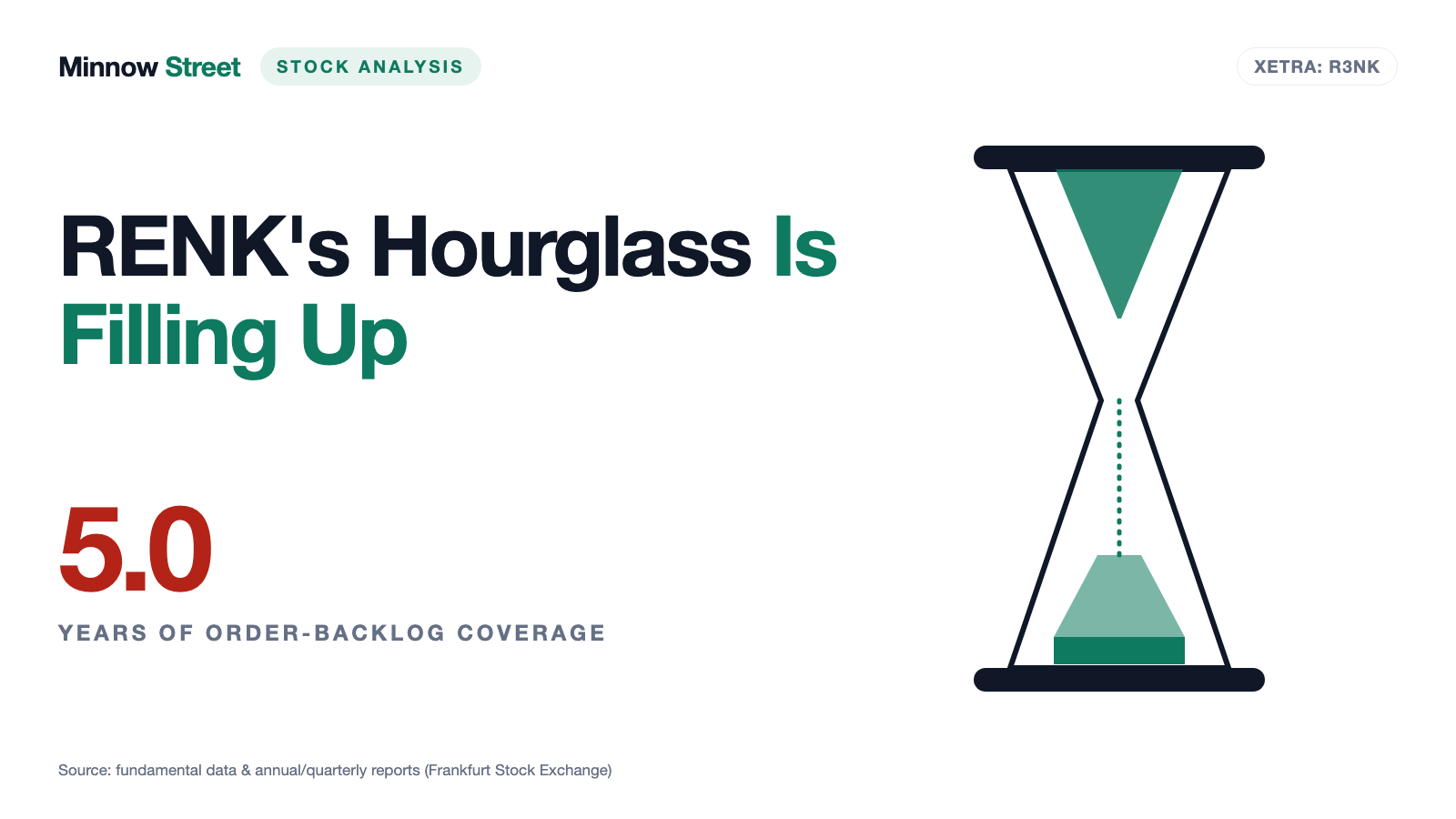
RENK builds gearboxes for battle tanks and warships - its order backlog has grown from €4,643.6 million (end of 2023) to €7,399 million (June 30, 2026), roughly 5.3 years of revenue by the company's own math. But the half-year report published August 6, 2026 also supplies the counter-check: adjusted EBIT rose 10.1 percent while reported EBIT fell 2.1 percent - and the tax rate jumped from minus 0.66 to 36.9 percent, so profit after tax shrank even though pre-tax profit was 54 percent higher. Not a buy or sell recommendation - just the gap between the number in the headline and the number behind it in the report.
 Thomas Mücke
Founder & Publisher
Thomas Mücke
Founder & Publisher
Chart
Interactive price chart (TradingView).
Note: pure fact-based analysis, not investment advice and not a solicitation to buy or sell. All figures without guarantee.
There is a small trick company figures sometimes play on their own: hand someone two different numbers for the same fact, and their mind will almost automatically reach for the friendlier one. Call it the favorite-number trap. A reader sent us issue 24 of the "Hot Stocks Europe" newsletter, dated November 28, 2025 (B-Inside International Media GmbH, Freiburg, Germany; author Michael Calivas). In it, today's stock shows up in exactly one sentence, in a look-back at the top performers of 2025: "Hensoldt and Renk: share-price gains of 100 to 300 percent." No company figure, no forecast - just a price range from the past. So let's make a deal: we'll leave that price range where it belongs, in the past, and read the reports instead - the half-year financial report published August 6, 2026, the 2025 annual report, and the quarterly statement as of September 30, 2025. By the end, it turns out RENK offers you several chances to fall into the favorite-number trap - and the reports themselves reveal which number is the more honest one.
This analysis first appeared on July 27, 2026 and was updated on August 11, 2026 with the figures from the half-year financial report 2026 (published August 6, 2026). Every figure carries its own reporting date.
What RENK Actually Does - Drivetrain Technology for Tanks, Ships and Industry
RENK Group AG, headquartered in Augsburg, Germany, builds gearboxes, engines and bearing solutions for three worlds: land vehicles, ships and industrial plants. Put in everyday terms: if a battle tank is a muscle, RENK builds the knee joint - the gearbox that translates the engine's power into motion, agility and braking force in the first place. The company reports across three segments. Vehicle Mobility Solutions (VMS) supplies transmissions, final drives, suspension systems and electrical components for tracked and wheeled military vehicles to more than 70 land forces worldwide, with a focus on the EU, NATO and NATO-equivalent countries such as South Korea, India and Israel. One concrete example: since the first delivery in 2014/2015, South Korea's K2 Black Panther battle tank, built by Hyundai Rotem, has run on a RENK transmission - after a domestically developed automatic transmission had failed durability testing. Marine & Industry (M&I) builds propulsion and coupling solutions for warships (frigates, corvettes, used by more than 40 navies worldwide) and for commercial shipping, plus industrial customers in cement, plastics, oil and gas production. Slide Bearings (SB) is, by the company's own account, the global market leader in standardized plain bearings for electric machinery and power generation. RENK has traded on the Frankfurt Stock Exchange since February 2024, previously owned by private-equity firm Triton - how that ownership circle has shifted since is covered later in this piece.
Company history for investors
-
2014
First RENK transmission in the K2 Black Panther
Since 2014/2015, South Korea's K2 battle tank has run on a RENK transmission, after a domestically developed unit failed durability testing.
-
2024
IPO on the Frankfurt Stock Exchange
Private-equity firm Triton took RENK public at €15 per share on the Frankfurt Stock Exchange in February 2024.
-
2025
Triton transfers shares to KNDS
In July 2025, as part of a settlement, Triton transferred 9.2 million shares to KNDS, lifting its stake to 15.84 percent.
-
2025
Triton exits completely
In late August 2025, private-equity firm Triton fully exited RENK, having taken the company public in 2024.
-
2026
KNDS reduces stake to 10 percent
In May 2026 KNDS sold 5.8 million RENK shares for €262 million, cutting its stake to roughly 10 percent.
Why There Is No SEC Report Here - and Where the Numbers Come From Instead
One point up front, because it shapes the entire evidence base of this analysis: RENK files no 10-K, no 10-Q. The company is not a U.S. reporting company - searching EDGAR for the tickers RENK and R3NK returns no usable match. RENK's mandatory reporting instead runs through the regulated market (Prime Standard) of the Frankfurt Stock Exchange. There are three kinds of report, and the difference matters: an audited IFRS consolidated annual report (most recently for 2025, published March 5, 2026), a half-year financial report under Section 52 of the Frankfurt Exchange Rules, with a full interim balance sheet and a review by the statutory auditor (most recently for the first half of 2026, published August 6, 2026) - and in between, short, unaudited quarterly statements: the one as of September 30, 2025 describes itself, in the fine print, as "a quarterly statement in accordance with Section 53 of the Exchange Rules for the Frankfurter Wertpapierbörse," not an audited interim financial statement. What that means for you: the half-year report is the most reliable interim source this stock offers - which is exactly why it sits at the center of this update. Every figure in this analysis is labeled "Source: fundamental data & company reports (annual/quarterly report, Frankfurt Stock Exchange)," not "SEC filings." RENK shares this setup - listed on Xetra but not an SEC filer - with a number of other German industrial names. Our PFISTERER analysis traced its entire evidence chain through the company's own annual and quarterly reports as well, rather than through sec.gov.
How This Stock Landed on Our Desk
Honesty first: the hook for this analysis is deliberately thin. A reader sent us issue 24 of the "Hot Stocks Europe" newsletter, dated November 28, 2025 - RENK does not appear there as a stand-alone pick, only in the editorial look-back on page 1: "Hensoldt and Renk: share-price gains of 100 to 300 percent" in 2025. No company figure, no forecast, no analyst price target - just a price range from the past, in an issue that is already eight months old as we read it. The same line also names HENSOLDT, a second German defense name from the same look-back - read both analyses, and you'll find two entirely different stories behind the same price range. Worth noting for context: the newsletter discloses on page 8 that the publisher and author may hold long positions in stocks discussed and intend to sell into rising prices (EU Market Abuse Regulation No. 596/2014). What became of that celebrated price range since the newsletter was written is the subject of the rest of this analysis.
The Numbers Over the Years - Fairly Assessed
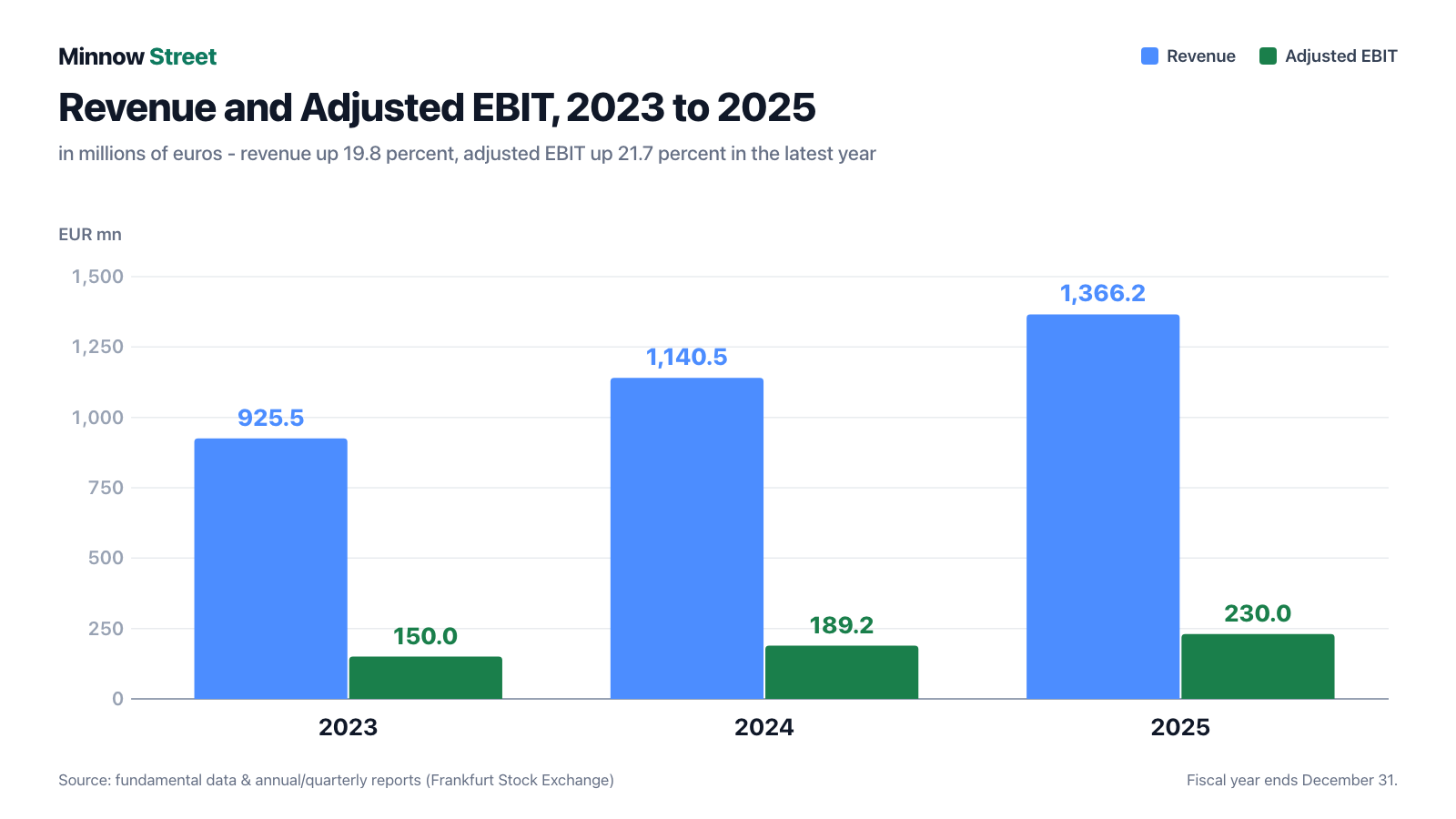
First, what genuinely impresses. RENK has grown by double digits for years: revenue of €925.5 million (2023), €1,140.5 million (2024), €1,366.2 million (2025), up 19.8 percent in the latest year. Adjusted EBIT - RENK's own metric, more on that shortly - grew alongside it: €150.0 million (2023), €189.2 million (2024), €230.0 million (2025), up 21.7 percent.
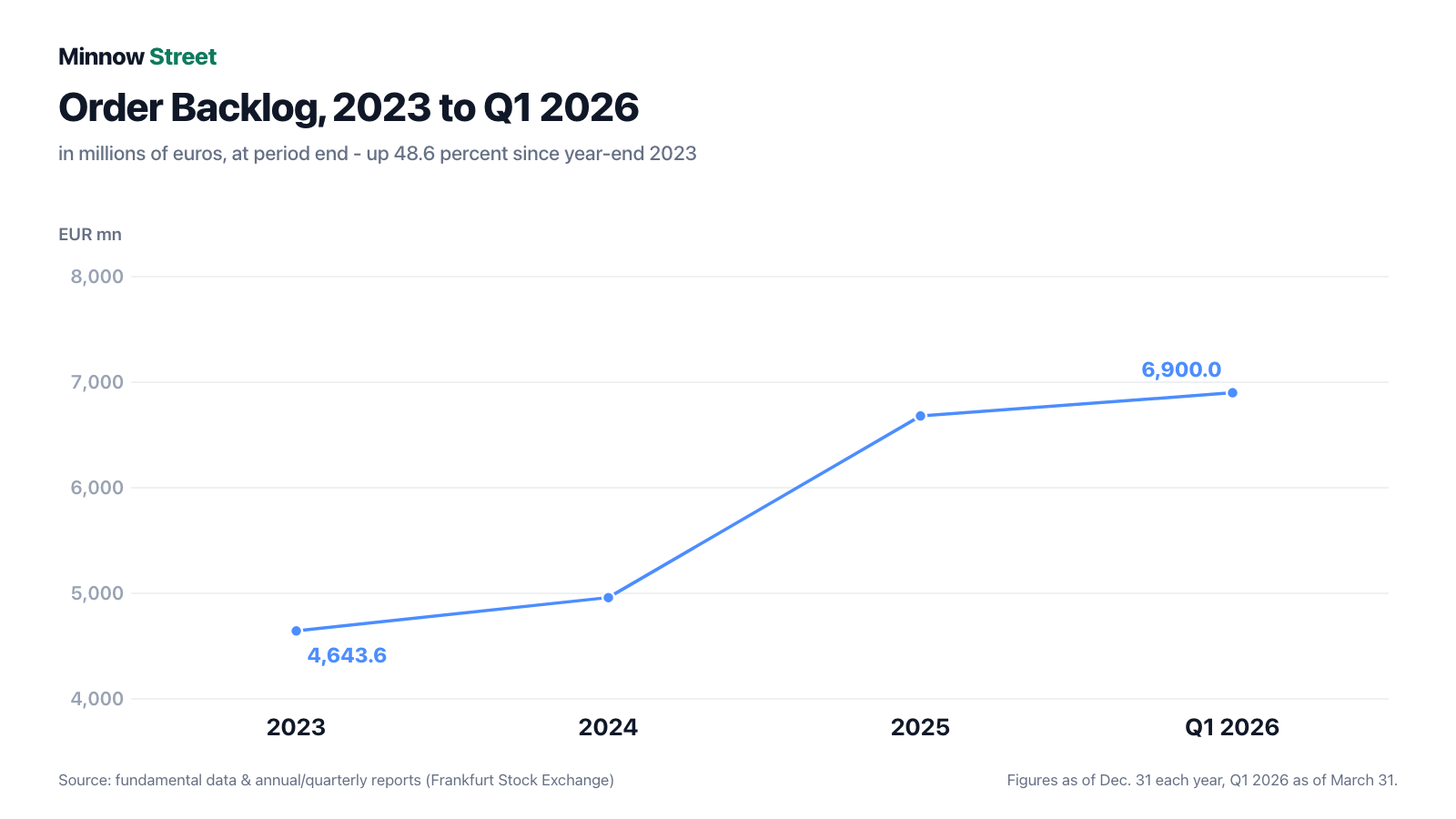
The order picture is even more impressive. The order backlog grew from €4,643.6 million (end of 2023) through €4,960.1 million (end of 2024) to €6,676 million (end of 2025), on to €6,900 million as of March 31, 2026 and to €7,399 million as of June 30, 2026 - up 59.3 percent since the end of 2023, driven mainly by the VMS division and its land-force transmissions. RENK measures that €7.4 billion against last-twelve-month revenue and arrives at roughly 5.3 years of revenue already secured - the hourglass on this analysis's cover image is literally filling up, rather than draining like it would for a company running short on cash. One important qualifier: only part of that is firmly ordered. The half-year report 2026 splits the backlog into €2,844 million of fixed orders (December 31, 2025: €2,260 million, up 25.9 percent), €957 million from framework agreements, and €3,597 million of "soft order backlog" - expected orders from ongoing negotiations and defense budgets that nobody has signed yet. Read the €7.4 billion as an order book in the narrow sense, and you overstate the certainty by more than a factor of two.
The first half of 2026 sharpened the order trend even further: €1,195.1 million of order intake in six months (prior-year period: €921.2 million, up 29.7 percent), of which €612.8 million came in the second quarter alone - the highest quarterly figure in company history. The book-to-bill ratio, meaning order intake divided by revenue, rose to 1.9x (prior-year period: 1.5x). In plain terms: for every euro of work RENK completed in the first half, €1.90 of new work came in. Revenue itself grew only 2.7 percent to €637.2 million - the company attributes that to customer delivery schedules and explicitly guides to a stronger second half. RENK confirmed its full-year 2026 guidance: revenue above €1.5 billion, adjusted EBIT between €255 million and €285 million, with a stated aim of landing in the upper half of that range. Where exactly the curve picks up question marks is the subject of the next three uncomfortable truths.
What the Reports Show - the Uncomfortable Truths
Uncomfortable Truth No. 1: Two EBIT Figures for the Same Year
Every RENK press release foregrounds adjusted EBIT - €230.0 million for 2025, €98.2 million for the first half of 2026. That is the number in every headline. What appears less often in headlines: reported, unadjusted (IFRS) EBIT is routinely much smaller - for full-year 2025, for instance, €169,352 thousand against the €230.0 million in the press release. For the first nine months of 2025, the company's own report even lays out the bridge:
"The strong revenue growth was translated into a €37,224k increase in operating profit (EBIT) to €95,547k at the end of the nine-month period. Adjusted EBIT rose by €28,616k to €140,969k, marking a 25.5% improvement."
— RENK Group AG, Quarterly Statement 9M 2025, page 2
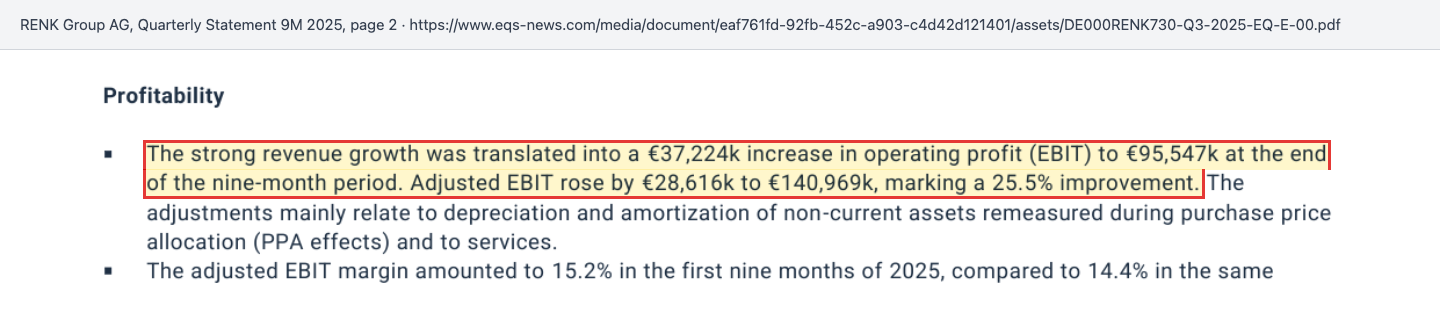
The €45,422 thousand gap is broken down in detail in the same report: €33,556 thousand comes from purchase-price-allocation depreciation (PPA effects - the accounting remeasurement of assets from earlier acquisitions), €5,986 thousand from "global system improvements," €2,466 thousand from M&A costs tied to three U.S. acquisitions (Midwest Gear & Tool, Cincinnati Gearing Systems, Lee Holdings), and the rest from tax-compliance and other consulting costs. Put in everyday terms: if someone tells you their monthly pay "before rent, loan payments and phone bill" - that's not a lie, but it's also not the number that actually lands in their account.
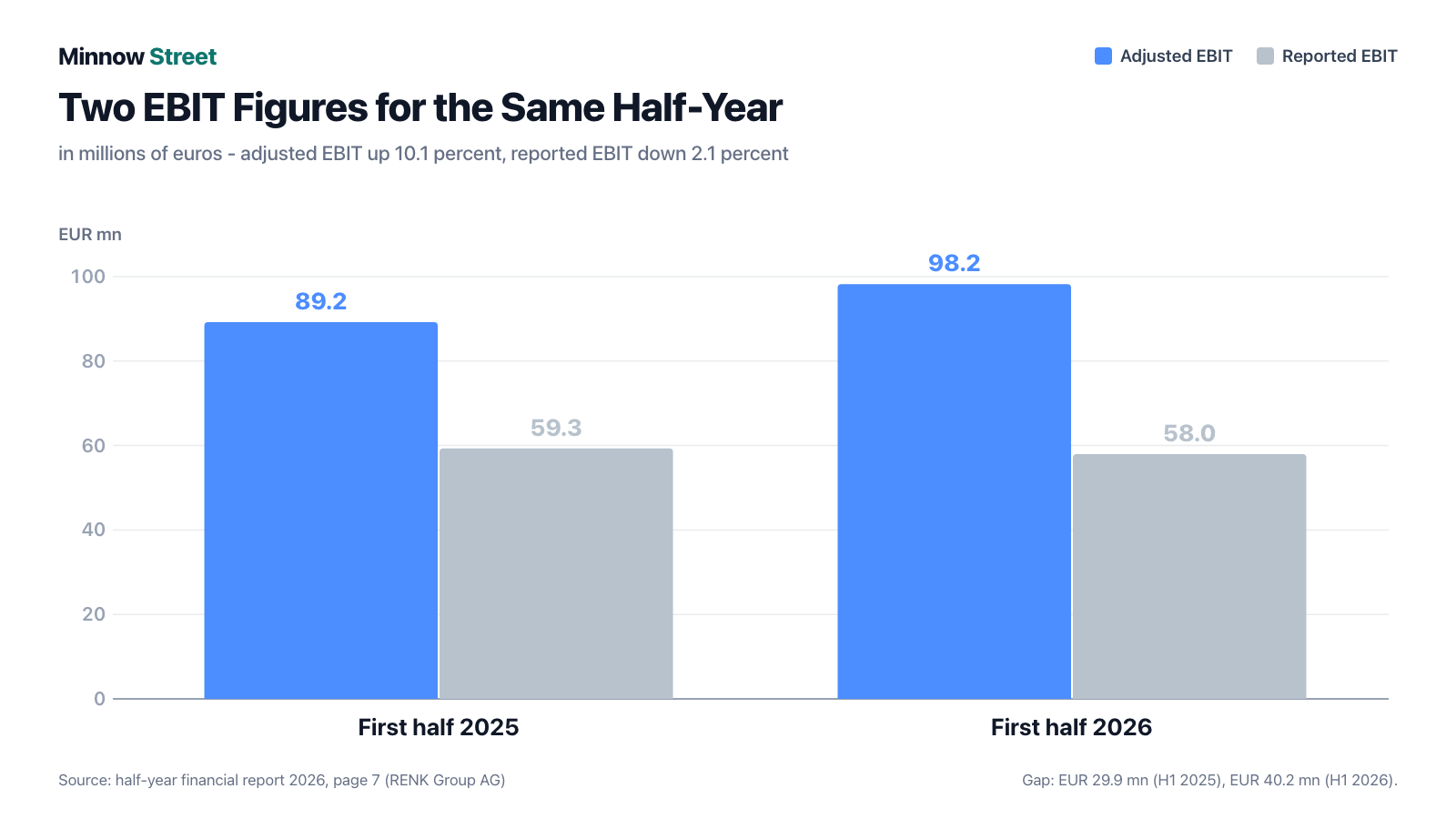
In the first half of 2026, the two figures moved in opposite directions for the first time - and that is what turns this uncomfortable truth from a footnote into the headline. Adjusted EBIT rose 10.1 percent to €98,186 thousand, and the adjusted margin from 14.4 to 15.4 percent. Reported EBIT, meanwhile, fell 2.1 percent to €58,001 thousand (prior-year period: €59,272 thousand), and the reported margin from 9.6 to 9.1 percent. The gap between the two therefore widened from €29,945 thousand to €40,185 thousand, up 34.2 percent. The report breaks it down: €21.9 million of purchase-price-allocation depreciation (essentially unchanged from €22.2 million a year earlier), €10.0 million of M&A-related consulting costs (prior-year period: €1.3 million - mainly for the planned acquisition of David Brown Defence), €4.2 million for implementing process standards, €1.4 million for "global system improvements," €1.0 million of severance provisions and €1.6 million of other items.
What stands out is how openly the company addresses it. On the half-year earnings call on August 6, 2026, CFO Anja Mänz-Siebje said:
"The important distinction here is between the reported result and the underlying operating development. Reported operating profit absorbed a higher level of transaction and transformation expenditure, whereas the adjusted figures reflect the clear earnings improvement generated by the business."
— Anja Mänz-Siebje, Chief Financial Officer, RENK Group AG, H1 2026 conference call (official transcript, August 6, 2026)
That is a fair description - and at the same time the precise junction where the favorite-number trap springs shut. Because those €10.0 million of acquisition consulting costs are real money RENK spent in 2026. They are missing from reported earnings, but not from adjusted ones. Remember this tension: adjusted EBIT is not a lie, but it is the number a company most likes to show on its own - the unadjusted figure belongs to the truth just as much.
Uncomfortable Truth No. 2: A 6.7 Percent Tax Rate Gave the Bottom Line a Considerable Lift
The favorite-number trap shows up even more clearly at the after-tax line. For the first nine months of 2025, RENK reports pre-tax profit of €59,450 thousand (prior-year period: €24,837 thousand) - a sizable jump. But a good part of that jump did not come from the operating business - it came from the tax line:
"The income tax expense for the first nine months of 2025 equates to a tax rate of 6.7% (previous year: 71.7%)."
— RENK Group AG, Quarterly Statement 9M 2025, page 3
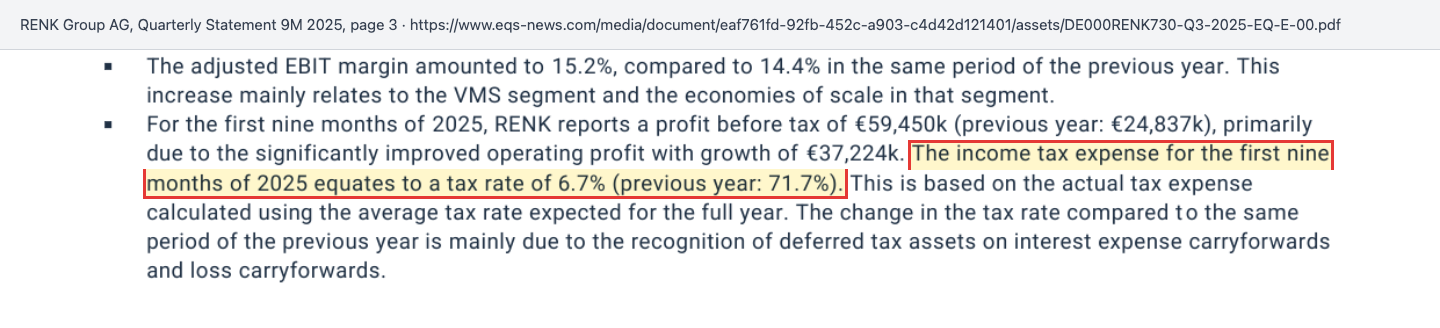
RENK itself cites the recognition of deferred tax assets on interest-expense and tax-loss carryforwards as the reason - a real, audited balance-sheet event, not an accounting trick. Nine-month net income climbed to €55,495 thousand as a result, up from just €7,023 thousand a year earlier - more than a sevenfold jump, a substantial share of which is down to the unusually low tax rate.
That question has since been answered - exactly the way the first version of this analysis feared. The half-year financial report 2026 states it in black and white:
"The income tax expense for the first six months of 2026 equates to a tax rate of 36.90% (previous year: -0.66%). This increase represents the Group tax rate returning to normal levels."
— RENK Group AG, half-year financial report 2026, page 7

What that means in numbers may be the most instructive passage in this entire analysis. Profit before tax rose 54.0 percent in the first half of 2026, to €47,714 thousand. Profit after tax fell 3.5 percent over the same period, to €30,107 thousand. Earnings per share slipped from €0.31 to €0.30. A company can therefore lift its pre-tax profit by more than half and still report lower earnings per share - if a one-off tax effect flattered the prior-year comparison. For you as an investor: line up the 2024, 2025 and 2026 earnings figures and you are comparing three entirely different tax worlds (group tax rate 2024: roughly 42 percent, 2025: roughly 18 percent, first half of 2026: 36.9 percent), and you must not credit those swings to the operating business. For its own adjusted net income calculation, incidentally, RENK assumes a budgeted group tax rate of 31.95 percent - another adjusted figure that flatters the reported result.
Uncomfortable Truth No. 3: What RENK Depends On - and That the Dependence Is Growing
The 2024 annual report discloses a figure that is easy to miss in the day-to-day headlines:
"In fiscal year 2024, more than 10% of the revenue was generated with a single customer (previous year: n.a.). These sales in the amount of € 127,155 thousand are attributable to the VMS segment."
— RENK Group AG, Annual Report 2024, page 214
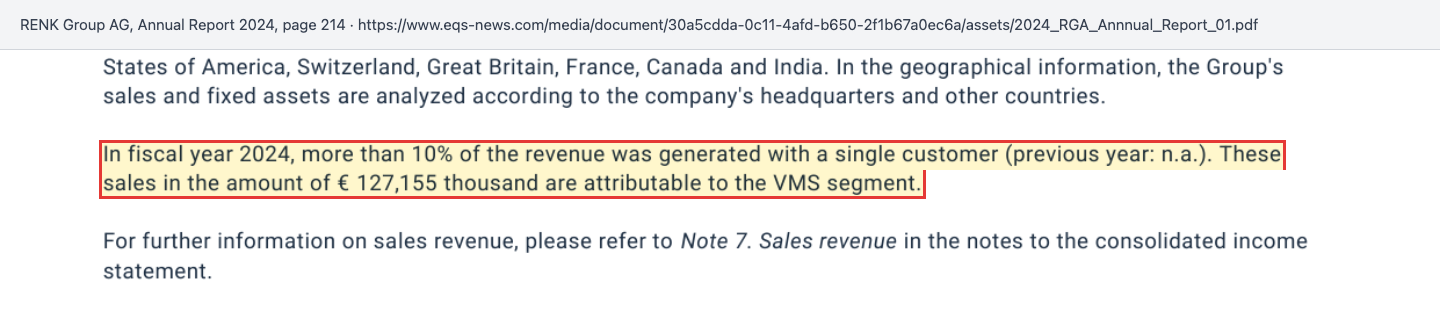
The report does not name the customer - but the figure lines up almost exactly with revenue from South Korea disclosed separately elsewhere in the same report (€127.489 million that same year), where RENK has supplied the transmission for Hyundai Rotem's K2 Black Panther battle tank since 2014.
One year on, that dependence is bigger, not smaller. The 2025 annual report repeats the disclosure with a markedly higher figure:
"In fiscal year 2025 and in the previous year, more than 10% of revenue was generated with a single customer. This revenue of €191,411k (previous year: €127,155k) is attributable to the VMS segment."
— RENK Group AG, Annual Report 2025, page 200
In percentage terms: a good 11 percent of 2024 group revenue became roughly 14 percent of 2025 group revenue - revenue with that one customer grew 50.5 percent while group revenue grew 19.8 percent. The concentration is growing faster than the company. Put in everyday terms: if your neighbor tells you their business is booming, but more than a tenth of revenue comes from one single client in one single country - would you pause for a moment? Exactly that kind of dependence stopped being theoretical in 2025: press reports (including Axios, August 8, 2025, and Al Jazeera, November 24, 2025) document that the German government under Chancellor Friedrich Merz imposed a partial arms-export embargo against Israel on August 8, 2025 - no new licenses for military equipment that could be used in Gaza. According to press reports (ad-hoc-news.de, May 1, 2026, citing statements by RENK CEO Dr. Alexander Sagel), that also affected RENK's transmission deliveries for Israeli tanks and cost the company revenue in the low double-digit millions in the fourth quarter of 2025, with Israel accounting for roughly 2 to 3 percent of group revenue. The embargo was lifted on November 24, 2025 alongside the ceasefire between Israel and Hamas. According to the same press reports, RENK responded with a plan to relocate the affected production line to its existing Muskegon, Michigan facility - outside German export-control jurisdiction. Important context: these press reports do not come from RENK's own annual or quarterly reports - they are external, named financial-press coverage with dates, and they show that the customer concentration the annual report names only in the abstract became concrete elsewhere in the very same year.
RENK has since put a number on the size of that Israel exposure. On the H1 2026 conference call, CEO Dr. Alexander Sagel said:
"In the first two quarters of 2025 we had approx. 20-25 Mio EUR of revenues per quarter related to Israel. For 2026 the deliveries were and are scheduled — according to our customers' contracts — to start at the end of Q2 and peaking during H2. For your information, the deliveries have started as planned."
— Dr. Alexander Sagel, Chief Executive Officer, RENK Group AG, H1 2026 conference call (official transcript, August 6, 2026)
That statement also explains, in passing, why revenue grew only 2.7 percent in the first half of 2026: the prior-year base contained roughly €40 to €50 million of Israel-related revenue, while 2026 contained next to none - deliveries only started toward the end of the second quarter. What looks like a growth dent is largely a shift in the calendar. Then again, the reverse holds too: a business whose revenue curve is bent this visibly by a political export decision is precisely the kind of dependence this uncomfortable truth describes.
What Else the 2026 Half-Year Report Brings
Three points from the half-year report are too important to leave in a footnote - and none of them made a headline.
First: cash generation nearly quadrupled. Free cash flow rose from €11,481 thousand in the first half of 2025 to €41,941 thousand. The reason lies almost entirely in working capital: a year earlier RENK tied up an additional €42.2 million of net working capital, while the first half of 2026 released €6.1 million - mainly because receivables and contract assets fell by €49.4 million. That is a genuine improvement, but the report itself names "cut-off effects" as the cause, and inventories rose €65.8 million to €506.7 million at the same time. Annualize this free cash flow and you are annualizing a reporting-date snapshot.
Second: the new financing costs money first. On July 27, 2026, RENK repaid its old €525 million loan early and replaced it with an unsecured package of roughly €1.05 billion - a €450 million term loan, a €225 million revolving credit facility, €375 million of guarantee lines, plus €95 million of bilateral guarantee lines, each running five years with two extension options. On the earnings call, the CFO put the annual savings at roughly €7 million. The subsequent-events note in the half-year report, however, puts the impact on the financial result at an expense of roughly €16 million, of which roughly €13 million is a one-time carrying-amount adjustment forced by the early repayment. Both numbers are correct - one measures cash outflows, the other the expense in the income statement. For reported second-half 2026 earnings, the second one counts, and it equals more than half of the entire half-year profit of €30,107 thousand. You can guess which of the two made the headlines.
Third: RENK is buying. On July 3, 2026, RENK signed the agreement to acquire all shares in DB Defence Holdco S.à r.l. (Luxembourg) and its three subsidiaries, notably David Brown Santasalo UK Limited in Huddersfield, from private-equity firm Stellex Capital Management. The report puts the purchase price "in the low triple-digit millions of euros"; closing is subject to antitrust approval and expected in the fourth quarter of 2026. RENK expects access to naval programs in the United Kingdom, Canada and Australia. For you as an investor, that cuts two ways: the marine business, which shrank in the first half of 2026 (revenue down 6.1 percent, adjusted margin down from 10.7 to 9.9 percent), is to be bought rather than grown - and the consulting costs of that acquisition are exactly the €10.0 million that depressed reported EBIT in the first half.
Valuation: Between €40 and €90, Steady Leverage, a New Ownership Circle
On August 11, 2026, the stock traded at €50.16 - with 100 million shares outstanding, a market capitalization of roughly €5.02 billion. That is about 44 percent below the all-time high of roughly €90 in October 2025, and roughly a quarter above the 52-week low of €40.34. Add up trailing-twelve-month earnings per share straight from the reports - €1.00 for full-year 2025, minus €0.31 for the first half of 2025, plus €0.30 for the first half of 2026 - and you get roughly €0.99, which puts the price-to-earnings ratio at roughly 51. That is well above the roughly 40 the same calculation produced in July 2026, and the reason is not the share price alone: reported earnings per share fell while the price rose. That is precisely the arithmetic a "record half-year" headline does not show. After the half-year figures, several firms reiterated buy ratings; the price targets cited in the financial press in early August 2026 ranged from €60 (Jefferies) to roughly €73, with a consensus around €69.
On leverage, the downward trend has come to a halt - at a comfortable level. Net financial debt to trailing-twelve-month adjusted EBITDA - RENK's own metric, regularly cited in its reports - fell from 2.4x (December 31, 2024) through 1.7x (September 30, 2025) to 1.5x (March 31, 2026) and stood unchanged at 1.5x as of June 30, 2026; net debt itself edged up from €391 million (December 31, 2025) to €407 million. The balance sheet as of June 30, 2026 shows equity of €473.9 million against total assets of €1,733.9 million - an equity ratio of 27.3 percent, down from 28.7 percent at year-end 2025. The reason is simple: €58.0 million of dividends went out on June 15, 2026 (prior year: €42.0 million). Cash fell from €152.1 million to €136.5 million over the half-year, but stood well above the €95.0 million recorded on June 30, 2025.
The ownership circle has shifted since the IPO, too. Private-equity firm Triton, which took RENK public in February 2024 at €15 per share, has exited completely as of late August 2025 - having transferred 9.2 million RENK shares to defense group KNDS in July 2025 as part of a settlement (KNDS, a Franco-German consortium known among other things for the Leopard 2's successor program), which lifted KNDS's stake from 6.7 to 15.84 percent. In May 2026, KNDS reduced that stake to roughly 10 percent by selling 5.8 million shares for €262 million - likely, in part, to free up capital ahead of its own planned 2026 IPO. The remainder is spread across the free float. For you as an investor, that means: the stable anchor shareholder of the IPO era no longer exists in that form - RENK trades today with a far broader free float than at its stock-market debut.
Opportunities and Risks at a Glance
What speaks for RENK:
- A structural tailwind: order backlog up from €4.64 billion (end of 2023) to €7.4 billion (June 30, 2026), roughly 5.3 years of revenue by RENK's own math; fixed orders alone rose 25.9 percent in the first half of 2026, to €2.84 billion.
- Record order intake: €1,195.1 million in the first half of 2026 (up 29.7 percent), book-to-bill 1.9x; full-year 2026 guidance (revenue above €1.5 billion, adjusted EBIT €255-285 million) confirmed, with a stated aim of the upper half of the range.
- The adjusted margin is climbing: 15.4 percent in the first half of 2026 versus 14.4 percent, carried by the VMS division (19.2 versus 17.1 percent) and the new modular production line in Augsburg.
- Free cash flow of €41.9 million in the first half of 2026 after €11.5 million a year earlier; leverage steady at 1.5x adjusted EBITDA, and a new unsecured €1.05 billion financing package secured for five years.
- Dividend for 2025 raised 38 percent to €0.58 per share (payout ratio 40.9 percent), approved June 10, 2026 and paid June 15, 2026; a broad customer base spanning more than 70 land forces and more than 40 navies worldwide.
What speaks against it:
- Adjusted and reported EBIT now move in opposite directions: in the first half of 2026, up 10.1 percent (adjusted, €98,186 thousand) versus down 2.1 percent (reported, €58,001 thousand); the gap widened from €29,945 thousand to €40,185 thousand.
- The 2025 tax benefit is gone: the rate jumped from minus 0.66 percent (first half of 2025) to 36.90 percent - profit after tax fell 3.5 percent despite a 54.0 percent higher pre-tax profit, and earnings per share slipped from €0.31 to €0.30.
- Customer concentration is growing: €191,411 thousand of 2025 revenue from a single customer (roughly 14 percent of group revenue) after €127,155 thousand the year before; how real political customer and country risks can become was shown by Germany's arms-export embargo against Israel from August to November 2025.
- Two of the three divisions are shrinking: Marine & Industry down 6.1 percent in revenue and 13.5 percent in adjusted EBIT, Slide Bearings down 4.4 and 28.0 percent - growth rests almost entirely on the tank-transmission business.
- Despite a record order backlog, the stock trades about 44 percent below its October 2025 all-time high, at a P/E of roughly 51 on reported trailing-twelve-month earnings per share of roughly €0.99; on top of that, roughly €16 million of refinancing expense will hit the financial result in the second half of 2026.
A Human Conclusion
Back to the favorite-number trap from the start. The newsletter's price range was not wrong - a 100 to 300 percent gain in 2025 is entirely plausible for RENK, even though the newsletter itself cites not a single company figure to back it up. What a look-back at a price range naturally cannot show is what sits behind the headline numbers. And since August 6, 2026 we know it more precisely than we did in July: in the first half of 2026, adjusted EBIT rose 10.1 percent - and reported EBIT fell 2.1 percent. Pre-tax profit rose 54.0 percent - and earnings per share slipped from €0.31 to €0.30. A customer worth a good 11 percent of revenue in 2024 was worth roughly 14 percent in 2025. And a refinancing meant to save €7 million a year costs roughly €16 million up front.
None of that disproves the growth story. An order backlog of €7.4 billion, record order intake of €1.2 billion in six months and free cash flow that nearly quadrupled are just as real as the 2025 share-price gain. These are two stories about the same company, and both sit in the same report - one in the headline, the other on page 7. Reach for the friendlier of the two numbers next time, and you'll have walked straight into the trap this analysis set out to show. What you make of it is your decision. And that is exactly as it should be.
Sources
All original documents used in this analysis - for you to check yourself:
- RENK Group AG - Half-year financial report 2026 (published August 6, 2026), analyst presentation and the official conference-call transcript
- RENK Group AG - Annual Report 2025 (audited, published March 5, 2026)
- RENK Group AG - Quarterly Statement 9M 2025 (published November 13, 2025)
- RENK Group AG - Annual Report 2024 (published March 27, 2025)
- RENK Group AG - Press release "Fiscal year 2025" (March 5, 2026)
- RENK Group AG - Press release "Q1 2026" (May 6, 2026)
- RENK Group AG - 2026 Annual General Meeting notice (June 10, 2026, dividend resolution)
- Press coverage of Germany's arms-export embargo against Israel: Axios (August 8, 2025), Al Jazeera (November 24, 2025), ad-hoc-news.de (May 1, 2026), jpost.com - each dated, flagged as external sources rather than RENK's own filings
- Fundamental data (share price, share count, 52-week range; data as of August 11, 2026), cross-checked against the company reports. Trailing-twelve-month earnings per share was calculated from the 2025 annual report and the two half-year reports themselves, not taken from the data feed.
- Analyst price targets after the half-year figures: financial-press coverage from early August 2026 (including boerse-express.com and stock-world.de) - flagged as an external, dated secondary source.
- Hook: "Hot Stocks Europe" newsletter, issue 24, dated November 28, 2025 (B-Inside International Media GmbH, Freiburg, Germany) - cited as a third party's expectation, not used as a source for company figures.
Transparency & disclaimer: This analysis is journalistic commentary on publicly available information and does not constitute investment advice, a regulated financial analysis, or a solicitation to buy or sell securities. Equity investments carry substantial risk, including total loss. All figures are provided without guarantee; the date of each figure is noted in the text. Positions held by the operator are disclosed daily; where one exists, it appears as a notice at the top of this deep dive.
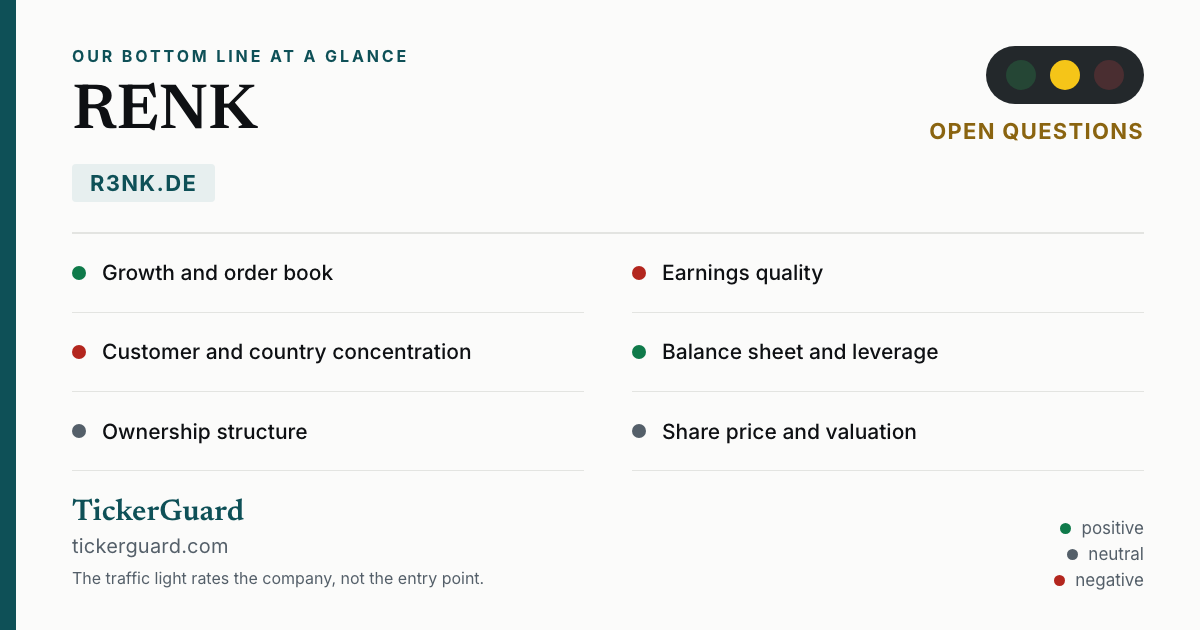
Our Bottom Line at a Glance
- Growth and order book positive
- Order intake rose 29.7 percent to €1,195.1 million in the first half of 2026, of which €612.8 million came in the second quarter alone - the highest quarterly figure in company history. The order backlog grew to €7.4 billion (June 30, 2026), with fixed orders alone up 25.9 percent to €2.84 billion. Revenue lags at plus 2.7 percent, which RENK attributes to delivery scheduling and a back-end loaded year.
- Earnings quality negative
- In the first half of 2026 the two EBIT figures moved against each other for the first time: adjusted up 10.1 percent to €98,186 thousand, reported down 2.1 percent to €58,001 thousand, with the gap widening from €29,945 to €40,185 thousand. At the same time the 2025 tax benefit is gone (rate 36.90 percent versus minus 0.66 percent): pre-tax profit rose 54.0 percent, yet profit after tax fell 3.5 percent.
- Customer and country concentration negative
- The dependence is growing: €191,411 thousand of revenue from a single customer in fiscal 2025 (roughly 14 percent of group revenue) after €127,155 thousand (a good 11 percent) the year before. How real such dependencies become was shown by Germany's arms-export embargo against Israel from August to November 2025 - RENK puts Israel-related revenue in the first two quarters of 2025 at €20 to €25 million each.
- Balance sheet and leverage positive
- Net financial debt to adjusted EBITDA stood unchanged at 1.5x as of June 30, 2026, after 2.4x at the end of 2024. Free cash flow rose from €11.5 million to €41.9 million. The equity ratio slipped to 27.3 percent on the dividend payment; the new unsecured financing package of roughly €1.05 billion runs five years but costs a one-off expense of roughly €16 million in the financial result in the second half of 2026.
- Ownership structure neutral
- IPO anchor shareholder Triton exited completely as of late August 2025. KNDS briefly held 15.84 percent, but reduced that to roughly 10 percent in May 2026. The stock trades with a far broader free float today than at its 2024 stock-market debut.
- Share price and valuation neutral
- The stock stood at €50.16 on August 11, 2026, about 44 percent below its all-time high of roughly €90 (October 2025). On trailing-twelve-month earnings per share of roughly €0.99, calculated from the reports, that is a P/E of roughly 51. The price targets cited in the financial press after the half-year figures ranged from €60 to roughly €73.
RENK delivers operationally what a growing defense drivetrain supplier should: record order intake of €1.2 billion in the first half of 2026, an order backlog of €7.4 billion, rising adjusted margins and free cash flow that nearly quadrupled. But reported earnings tell a different story from the press release: unadjusted EBIT fell 2.1 percent in the first half of 2026, the normalized tax rate pushed earnings per share down from €0.31 to €0.30, and dependence on a single customer grew to roughly 14 percent of 2025 revenue. Not investment advice.
What Our Rating Means
Open questions
The business works in principle, but one material question is open. As long as it stays open, our findings do not carry a quality verdict.
Yellow here is not about a going-concern question - cash of €136.5 million (June 30, 2026) is well stocked, leverage is steady at 1.5x adjusted EBITDA, free cash flow rose from €11.5 million to €41.9 million, and the financing is secured through 2031. Yellow reflects the fact that after the 2026 half-year report, earnings quality looks sharper rather than better: first, adjusted and reported EBIT moved against each other for the first time - up 10.1 percent versus down 2.1 percent, with the gap widening to €40.2 million - and the company's press releases foreground almost exclusively the larger, adjusted number. Second, the tax rate normalized from minus 0.66 to 36.90 percent: pre-tax profit rose 54.0 percent, yet profit after tax still fell 3.5 percent - anyone comparing the 2024 to 2026 earnings series is comparing three different tax worlds. Third, customer concentration is growing faster than the company (€191.4 million versus €127.2 million of revenue from a single customer), and two of the three divisions are shrinking: Marine & Industry and Slide Bearings lost 13.5 and 28.0 percent of adjusted EBIT respectively in the first half of 2026. The business model itself - structurally growing defense budgets, record order intake, secured financing - clearly holds up. But reported earnings face an additional roughly €16 million of refinancing expense in the second half of 2026; whether earnings quality keeps pace is a question the third-quarter statement will answer at the earliest.
A journalistic assessment by our editorial team at the time of the deep dive, based on public sources — not investment advice and not a solicitation to buy or sell. Your personal circumstances (investment goals, risk capacity, taxes) cannot be taken into account. What our levels mean, how verdicts are formed, and what conflicts of interest exist →
Worth Noting
- The hook for this analysis is issue 24 of the "Hot Stocks Europe" newsletter, dated November 28, 2025 (B-Inside International Media GmbH, Freiburg, Germany), which names RENK only in the editorial look-back on page 1 ("share-price gains of 100 to 300 percent" in 2025, alongside Hensoldt) - no company figure, no price target. The newsletter discloses on page 8, as standard practice, that the publisher, author or related third parties may hold long positions in stocks discussed and intend to sell into rising prices (EU Market Abuse Regulation No. 596/2014).
- This analysis first appeared on July 27, 2026 and was updated on August 11, 2026. All company figures come from the half-year financial report 2026 (published August 6, 2026, Section 52 of the Frankfurt Exchange Rules, with auditor review), the audited 2025 Annual Report (March 5, 2026), the Quarterly Statement 9M 2025 (November 13, 2025), the 2024 Annual Report (March 27, 2025), and the analyst presentation and official transcript of the H1 2026 conference call - not from the newsletter. Share price, share count and the 52-week range are as of August 11, 2026; trailing-twelve-month earnings per share was calculated from the reports themselves rather than taken from the data feed.
- Press coverage of the Israel export embargo (Axios, Al Jazeera, ad-hoc-news.de, jpost.com) consists of external, named sources with dates - it does not come from RENK's own annual or quarterly reports and is labeled accordingly throughout this analysis.
Download the verdict card (traffic light and rating of this analysis as an image, PNG)
The full analysis as a PDF for later
We will send you this analysis as a PDF — to print, file away, and read at your own pace.
Frequently Asked Questions
RENK Group AG, based in Augsburg, Germany, builds gearboxes, engines and bearing solutions for tracked and wheeled military vehicles (Vehicle Mobility Solutions segment), for warships and industrial plants (Marine & Industry), and plain bearings (Slide Bearings). Best-known example: since 2014, RENK has supplied the transmission for South Korea's K2 Black Panther battle tank, built by Hyundai Rotem.
RENK trades on the Prime Standard of the Frankfurt Stock Exchange, not in the U.S. - there is no 10-K, no 10-Q, no SEC registration. It must publish an audited IFRS annual report, a half-year financial report under Section 52 of the Frankfurt exchange rules with an auditor review, and in between short, unaudited quarterly statements under Section 53. This analysis draws on the half-year financial report 2026 (August 6, 2026), the 2025 Annual Report and the Quarterly Statement as of September 30, 2025.
In the first half of 2026, adjusted EBIT rose 10.1 percent to €98,186 thousand while reported (IFRS) EBIT fell 2.1 percent to €58,001 thousand - a gap of €40,185 thousand after €29,945 thousand a year earlier. RENK attributes it to purchase-price-allocation depreciation (€21.9 million), M&A consulting costs (€10.0 million), process standards, system improvements and severance provisions.
According to the 2025 Annual Report, €191,411 thousand of revenue came from a single customer in Vehicle Mobility Solutions - roughly 14 percent of group revenue, after €127,155 thousand (a good 11 percent) in 2024. The concentration is therefore growing faster than the company. How real such political customer and country risks can become was shown by Germany's arms-export embargo against Israel from August to November 2025.
According to press reports, the German government imposed a partial arms-export embargo against Israel on August 8, 2025, which also affected RENK's transmission deliveries; it was lifted on November 24, 2025. On the H1 2026 conference call, RENK itself put Israel-related revenue in the first two quarters of 2025 at roughly €20 to €25 million per quarter - in 2026 deliveries only started toward the end of the second quarter, which explains part of the weak 2.7 percent revenue growth in the first half.
Yes. For fiscal year 2025, the annual general meeting on June 10, 2026 approved a dividend of €0.58 per share (prior year €0.42, up 38 percent), a payout ratio of 40.9 percent. Payment was made on June 15, 2026.
Former majority owner Triton, which took RENK public in 2024, exited completely as of late August 2025. Defense group KNDS briefly held 15.84 percent after a July 2025 transfer, but reduced that stake through a share sale in May 2026 to roughly 10 percent. The remainder is spread across the free float.
Adding up trailing-twelve-month earnings per share straight from the reports (€1.00 for 2025, minus €0.31 for the first half of 2025, plus €0.30 for the first half of 2026) gives roughly €0.99. At a share price of €50.16 (August 11, 2026), that is a P/E of roughly 51. The rise from roughly 40 in July 2026 is not down to the share price alone: reported earnings per share fell because the tax rate normalized.
Found an error?
Did you spot a factual error, an outdated number, or a typo in this deep dive? Let us know briefly — your report goes straight to the editorial team.