Nel Can Afford to Wait for the Hydrogen Boom — the Question Is How Long
Norwegian electrolyser maker Nel has NOK 1.33 billion in cash and no bank debt. But revenue fell 12 percent in the second quarter of 2026, the largest PEM order in the company's history now sits in the at-risk bucket, and NOK 362 million of goods a customer never paid for are sitting in the warehouse. We read the annual and quarterly reports and worked out how much patience Nel's cash can still buy.
 Thomas Mücke
Founder & Publisher
Thomas Mücke
Founder & Publisher
Sound familiar? You plan a three-month renovation and it ends up taking a year. Not because you were lazy, but because when you planned it, your brain only pictured the smooth version — and quietly left out the delayed delivery, the contractor who got sick and the permit that never came. Psychologists call it the planning fallacy: we almost always underestimate how long things take, even when we have misjudged it many times before. Investors are not immune. Quite the opposite: whoever bets on an industry of the future is counting on the day the market “finally takes off” — and rarely on that day slipping a little further every year.
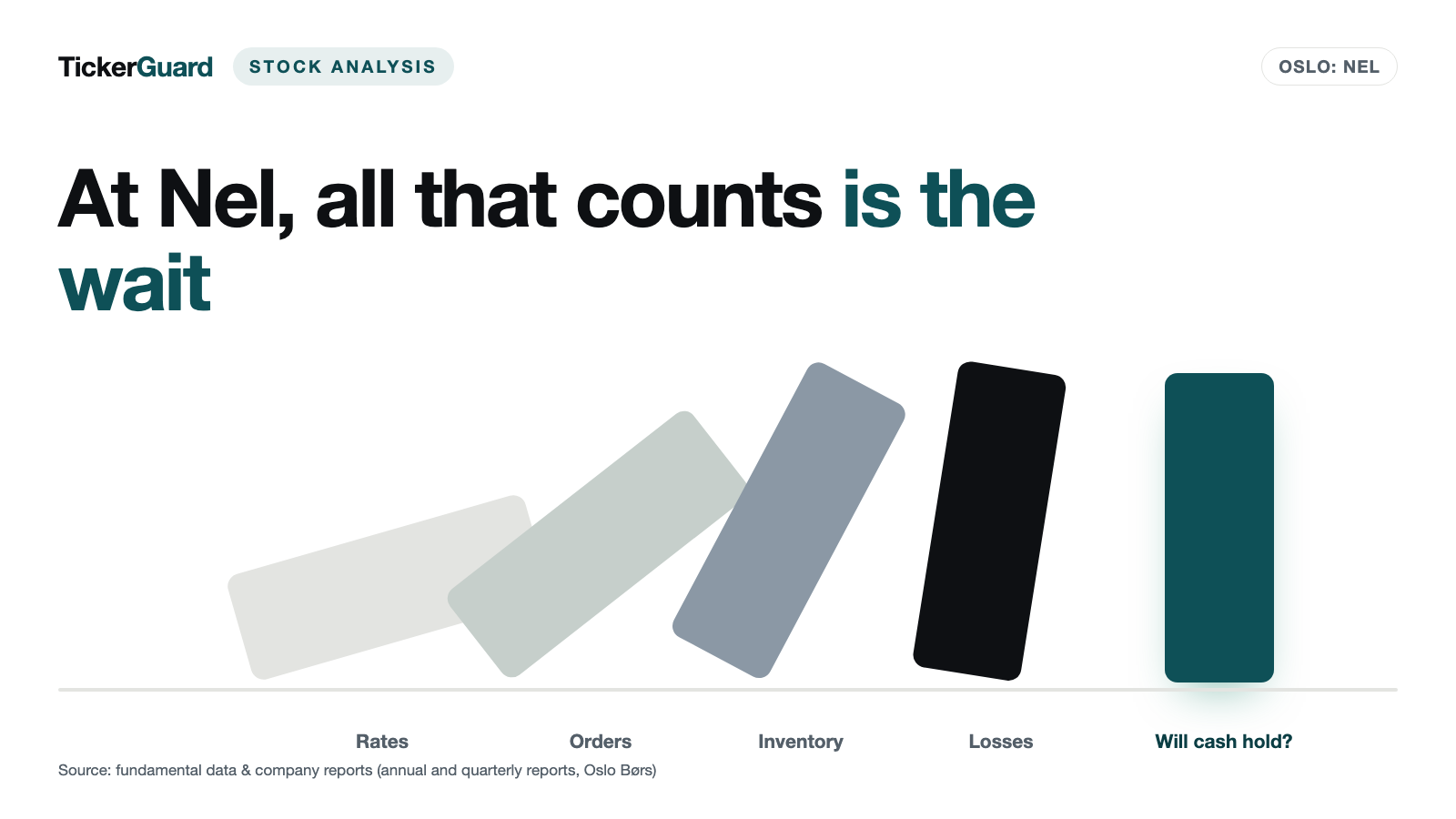
Nel is a stock where this thinking error is easy to watch in action. The Norwegian maker of electrolysers — machines that use electricity to turn water into hydrogen — writes in its July 2026 outlook that it will be ready to return to its growth strategy “when the market returns.” So let's make a deal: we won't ask whether the hydrogen market is coming. We'll use the actual reports to work out how long Nel can afford to wait for it. The tension running through this analysis: Nel has enough cash to wait and no debt — but several items on its balance sheet lose value with every month of waiting.
What Nel actually does — hydrogen from power and water
Oslo-based Nel ASA builds electrolysers. Think of an electrolyser as a kettle that doesn't heat the water but uses electricity to split it into its parts — hydrogen and oxygen. If the power comes from wind or solar, the result is hydrogen without CO₂ emissions that refineries, steel mills, fertilizer producers or fueling stations can use. Nel builds two types. Alkaline technology (the Nel Alkaline Electrolyser division, with its plant in Herøya, Norway) is the older, rugged option for large industrial sites. PEM technology (the Nel PEM Electrolyser division, with its plant in Wallingford, Connecticut) uses a polymer membrane and responds faster to fluctuating renewable power. The company traces its roots back to 1927; today's company was formed in 1998.
As of June 30, 2026, Nel had 313 employees, 13 percent fewer than a year earlier. The fueling-station business is gone: it was spun off in 2024 as Cavendish Hydrogen ASA and listed separately. Every figure in this piece therefore refers to the remaining electrolyser business. The fiscal year matches the calendar year, and Nel reports in Norwegian kroner (NOK). For scale: at the European Central Bank reference rates of September 25, 2026, one euro was worth NOK 10.84 and $1.1403, which puts one dollar at roughly NOK 9.5.
One point matters for the evidence trail: Nel does not report to the U.S. securities regulator, the SEC. The ticker NLLSF is merely a secondary over-the-counter quote in the U.S. with no reporting obligation of its own; the stock's home is Euronext Oslo Børs under the ticker NEL. All evidence in this analysis therefore comes from the company's own reports — the audited Annual Report 2025, the report for the second quarter of 2026 and its stock exchange releases.
Company history for investors
-
2024
Fueling division spun off as Cavendish Hydrogen
Nel focuses on electrolysers. Per the 2024 annual report, the spin-off reduced cash by NOK 625M. Nel only settled the Iwatani lawsuit from February 2024 in 2026, with its own payment.
-
2025
Samsung E&A buys in for NOK 353 million
Private placement in March 2025 at an implied NOK 2.11 per share. Samsung E&A becomes the largest shareholder with 9.09% — at a price matching the September 2026 share price.
-
2025
About NOK 800 million of impairments
Herøya equipment and PEM goodwill are written down because Nel's own new technology devalues the older platforms. Net loss of NOK 1,265M for the year.
-
2025
Record order from HYDS
In the fourth quarter, Nel wins 40 megawatts of PEM for two sites in Norway — per the CEO, the largest PEM order in the company's history.
-
2026
June: Iwatani settlement and CEO resignation
Nel pays $7.5 million to Iwatani (NOK 70M charge in Q2), and CEO Håkon Volldal resigns with six months' notice. No successor as of late September.
-
2026
July: HYDS projects in the at-risk bucket
The Q2 report flags NOK 296M of the backlog as significantly at risk. For shareholders, the very order meant to prove the turnaround at the end of 2025 is now wobbling.
-
2026
September: assembly partner Hydrasun
Framework agreement with Hydrasun (Aberdeen) for final assembly of containerized PEM systems in Europe. No firm order comes with it.
How the stock landed on our desk
Through the forum ranking of the German finance portal wallstreet-online — the list of stocks German retail investors discuss most — as of September 25, 2026, where it appeared under its U.S. symbol NLLSF. A list like that measures attention, not quality. Nel has been a fixture on German message boards for years because, for many investors, the stock embodies the promise of hydrogen. The closing price in Oslo on September 25, 2026, was NOK 2.06. That is almost exactly what the largest shareholder paid a year and a half earlier — more on that shortly.
There was no shortage of talking points in 2026: in May, Nel launched a new generation of pressurized alkaline electrolysers; in June it settled a lawsuit in California and its CEO resigned; in September it signed a framework agreement with the Scottish assembly partner Hydrasun. We traced a similar pattern of a big promise and a long wait for the breakthrough in our stock analysis of fuel-cell maker Ballard Power — Nel sits one step earlier in the same value chain, where the hydrogen is made in the first place.
The numbers over the years — given their due
First, what genuinely speaks for Nel: the balance sheet is solid. As of June 30, 2026, it held NOK 1,328 million of unrestricted cash, plus NOK 144 million of restricted deposits backing bank guarantees. There are no bank loans; the only interest-bearing obligations are leases totaling NOK 218 million. Equity came to NOK 3,602 million, or 78 percent of total assets. In March 2025, the South Korean engineering group Samsung E&A bought in for NOK 353 million and has held 9.09 percent ever since. And PEM orders have picked up: NOK 222 million in the second quarter of 2026, almost four times the level a year earlier.
Now the multi-year view. Revenue from the continuing electrolyser business rose from NOK 436 million (2021) to NOK 708 million (2022), NOK 1,350 million (2023) and NOK 1,390 million (2024) — then fell to NOK 963 million in 2025, down 31 percent. EBITDA, roughly what the day-to-day business throws off before depreciation, interest and taxes, was negative in all five years: minus 306, minus 428, minus 272, minus 173 and minus NOK 275 million.
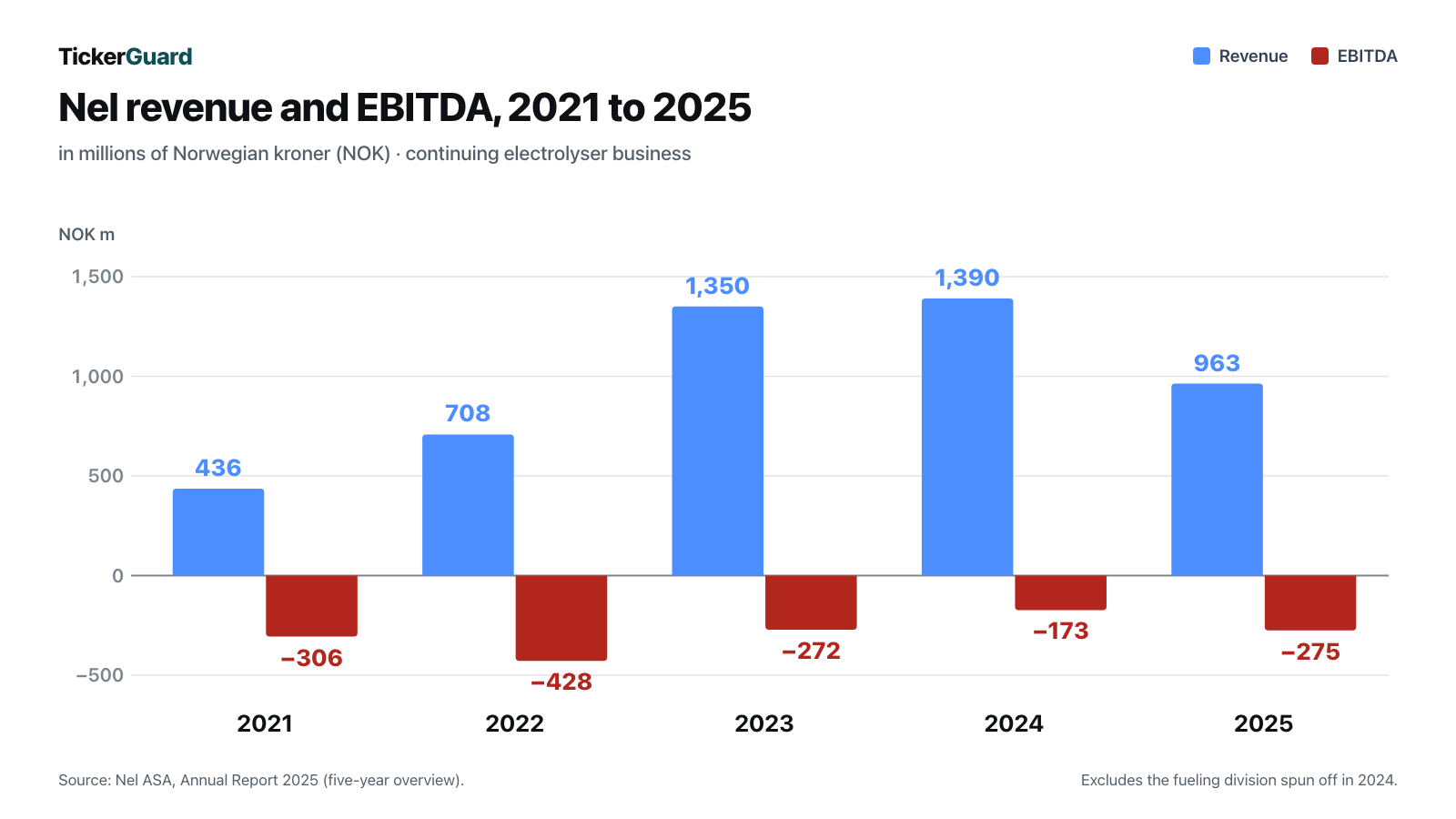
The bottom line for 2025 was a net loss of NOK 1,265 million. Most of that is write-downs, which cost no cash but tell you something: NOK 361 million on production equipment at Herøya and NOK 439 million on goodwill and technology from the acquisition of what is now the PEM division. The explanation in the annual report is remarkably candid — Nel's own next-generation technology is likely to weaken the outlook for the existing platforms. In other words, Nel wrote down part of its old factory because the next generation is coming. Hold on to that thought; it comes back in the warehouse.
The latest quarter confirms the picture. In the second quarter of 2026, revenue fell 12 percent to NOK 153 million, EBITDA dropped to minus NOK 155 million and the net loss came to NOK 189 million. That includes NOK 70 million for a settlement with Iwatani Corporation of America: the partner had sued Nel in February 2024 over hydrogen fueling stations in California, and on June 7, 2026, the parties agreed on a payment of $7.5 million, which according to the report flows out in the third quarter of 2026. Some of the entities involved at the time now belong to Cavendish — the payment agreed in the settlement is made by Nel.
Uncomfortable truth No. 1: the record order sits in the at-risk bucket
In the fourth quarter of 2025, Nel celebrated its biggest win in years. Then-CEO Håkon Volldal wrote in the annual report that the company had won a 40-megawatt order from Norwegian project developer HYDS for two sites in Norway:
“This contract represents the largest PEM order in Nel’s history and the company’s second largest order ever in terms of value.”
— Nel ASA, Annual Report 2025, letter from the CEO
Six months later it reads differently. With every report, Nel publishes a small table that sorts the order backlog into three buckets: planned delivery this year, delivery later — and “significant risk of delay or cancellation.” At the end of 2025, that bucket held NOK 132 million, of which only NOK 17 million came from PEM. As of June 30, 2026, it held NOK 296 million, all of it PEM. Directly below the table, the report explains why:
“One HYDS project is delayed in the initial phase but plans to proceed in time for hydrogen production in 2028. The other project needs to be reevaluated after changed external circumstances and the contractual obligations of HYDS may be fulfilled through deliveries to other projects in the HYDS portfolio.”
— Nel ASA, Q2 and half-year 2026 report, Alternative Performance Measures, p. 20
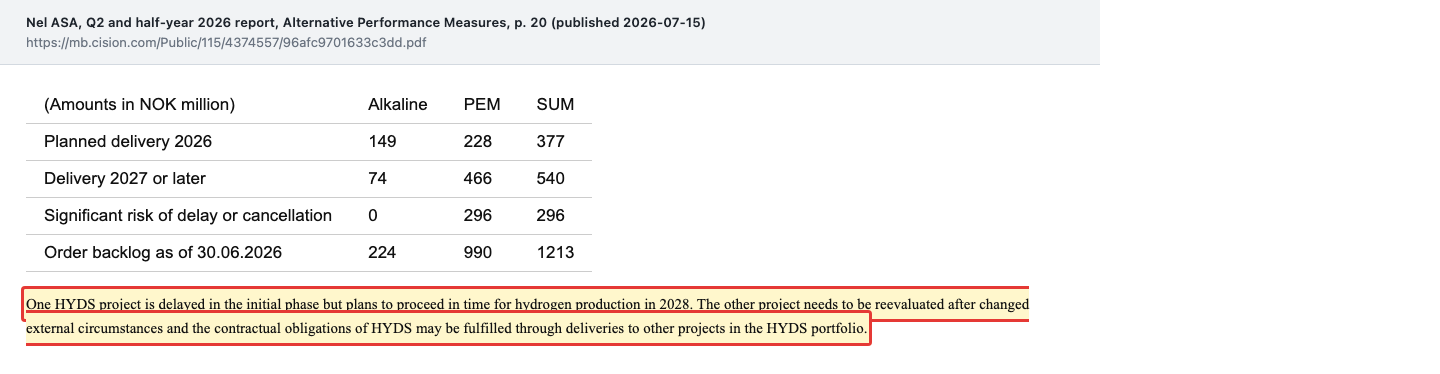
Let's translate that. Of the NOK 990 million PEM backlog, NOK 296 million, or 30 percent, is at significant risk — and the explanation names exactly the HYDS projects. The alkaline business has a different problem: there is hardly any backlog left to wobble. It shrank from NOK 826 million to NOK 224 million within a year, down 73 percent, because Nel delivered more than it booked. In the second quarter of 2026, the alkaline division took in all of NOK 8 million in new orders. Nel points to paid front-end studies for projects above 100 megawatts that are supposed to turn into firm orders. They are not contracts yet.
Rule of thumb: a backlog is a customer's promise, not a wire transfer. At Nel, what matters is not the size of the backlog but the bucket it sits in.
Uncomfortable truth No. 2: a warehouse full of goods nobody picked up
Nel normally builds to order, so inventory should turn over quickly. It doesn't. At the end of 2025, inventories stood at NOK 919 million, almost double the prior year's NOK 532 million. Finished goods alone jumped from NOK 67 million to NOK 552 million. Note 4.1 of the annual report gives the reason:
“A customer defaulted on its payment, so Nel accepted the goods as settlement for the outstanding receivables. This reduced trade receivables and increased inventory by approximately NOK 362 million. These goods remain unsold and are still held in inventory at the end of 2025.”
— Nel ASA, Annual Report 2025, Note 4.1 Inventories
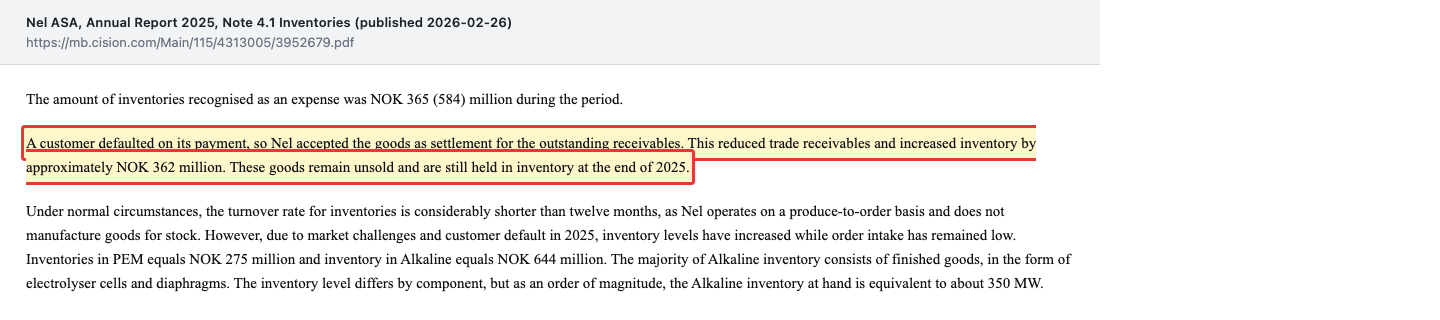
An everyday picture: a furniture store delivers a custom kitchen, the customer doesn't pay, and the store takes the kitchen back and puts it in its own warehouse — valued at full cost, even though it was built for someone else's floor plan. At Nel this is not a one-off item. According to the annual report, the NOK 644 million alkaline inventory is equivalent to roughly 350 megawatts of electrolyser capacity, mostly finished cells and diaphragms. For comparison, the entire alkaline order backlog stood at NOK 224 million as of June 30, 2026. And the goods belong to the technology generation whose prospects Nel itself now rates lower because of its new pressurized systems — the very reason it wrote down the Herøya equipment in 2025.
Even so, the goods are carried at full cost. Nel tested whether the achievable selling price covers that value, and its sensitivity analysis shows how thin the cushion is: a selling price roughly 20 percent lower would wipe it out. And time is a factor too:
“A delay in expected order intake or delivery compared with management’s assumptions would increase the impact of discounting and may result in a lower NRV. A delay of 12 months compared to estimated timing of sale would result in zero headroom, all else equal.”
— Nel ASA, Annual Report 2025, Note 4.1 Inventories, sensitivity analysis

This is the planning fallacy in balance-sheet form. The inventory's value depends on an assumption about when Nel sells the goods. Push that date out by a year and the cushion is gone; every further delay becomes a write-down. As of June 30, 2026, inventories stood at NOK 890 million, just NOK 29 million less than at year-end. That is not a rapid sell-down.
A second item belongs here. Of gross trade receivables of NOK 274 million, NOK 114 million were more than a year past due as of June 30, 2026; Nel has set aside a NOK 40 million allowance against them. Same question again: how long do you wait for money before admitting it isn't coming?
Uncomfortable truth No. 3: no profit without more revenue — and the cash is shrinking
Nel says plainly what everything depends on. The report for the second quarter of 2026 puts it in one unadorned sentence:
“Nel does depend on increasing revenues to achieve profitability.”
— Nel ASA, Q2 and half-year 2026 report, financial development — group, p. 4

But revenue is not increasing; it is falling: NOK 302 million in the first half of 2026 versus NOK 329 million a year earlier. Nel has therefore cut costs and capacity, the alkaline plant at Herøya is no longer running full, and headcount has shrunk. At the same time, Nel keeps investing in its next generation, including a new production line with 1 gigawatt of annual capacity at Herøya, for whose industrialization the EU Innovation Fund selected Nel for a grant of up to €135 million. The cash balance shows what all of that costs together.
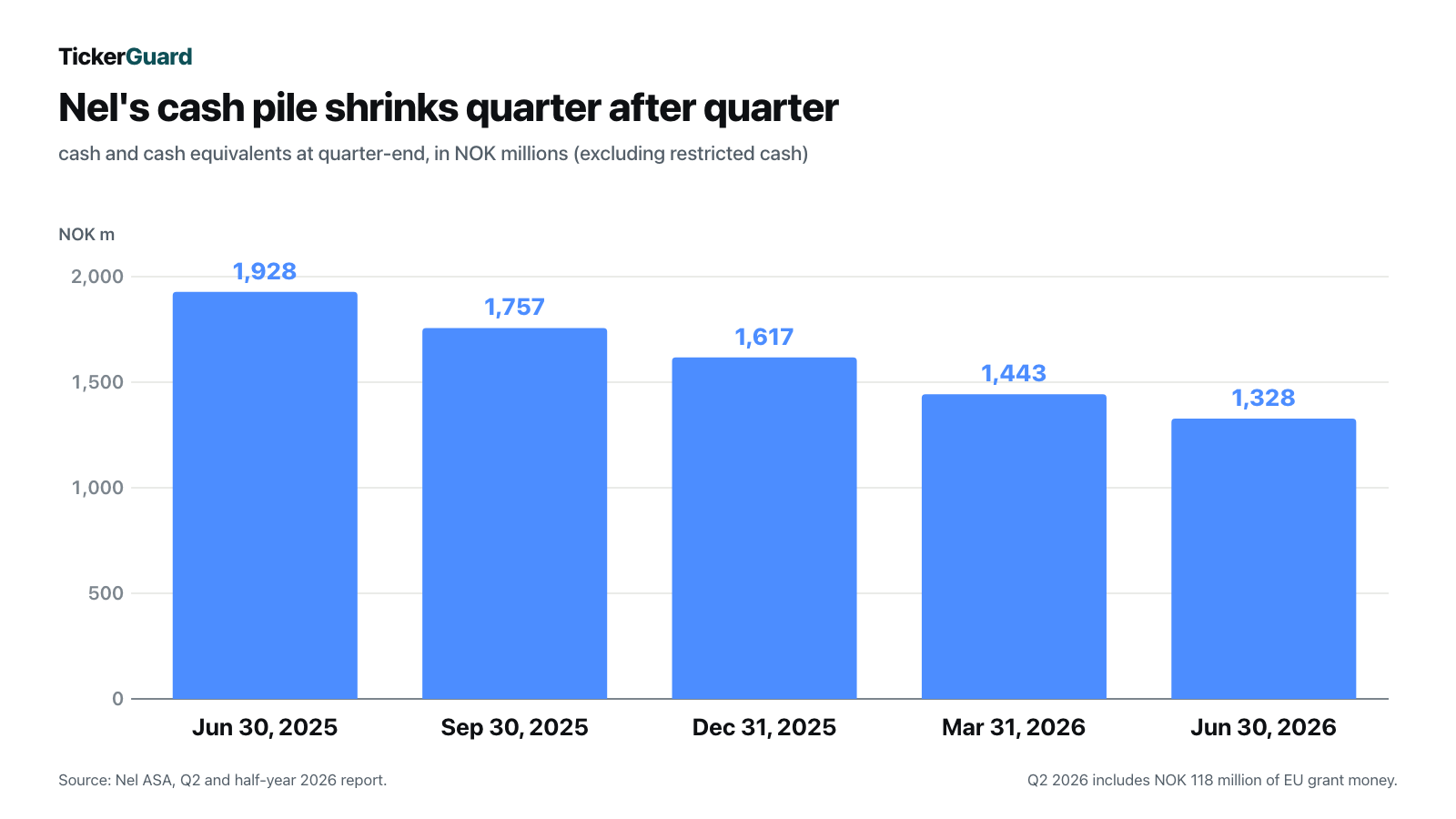
Over twelve months, NOK 600 million went out the door, an average of NOK 150 million a quarter. And the second quarter of 2026 looks better than it is: operating cash flow was positive at NOK 2 million only because NOK 118 million of EU grant money came in. Without that payment it would have been roughly minus NOK 116 million (our calculation). The third quarter also carries the NOK 70 million outflow for the Iwatani settlement.
Let's work out the waiting time as simply as possible: NOK 1,328 million divided by NOK 600 million of outflow a year gives a little over two years. That is not a crisis — the board confirms the going-concern basis in the audited 2025 financial statements, the auditor's report contains no material-uncertainty paragraph, and Nel writes in its outlook that its cash, together with cost adjustments, allows it to fund operations, technology development and a return to growth:
“Nel has a cash balance that, in combination with adjustments to the cost base and capacity utilization, allows the company to fund its operations, investment in technology development and to be ready to return to its growth strategy when the market returns.”
— Nel ASA, Q2 and half-year 2026 report, outlook, p. 9
Note the key word: “when.” There is no date attached. And who leads the way there is an open question. On June 15, 2026, CEO Håkon Volldal, who had run Nel since July 2022, resigned to take a job in a different industry. He stays on through his six-month notice period; as of September 25, 2026, Nel had not named a successor. The board stresses that the strategy and top priorities remain unchanged.
What the stock costs
At the closing price of NOK 2.06 on September 25, 2026, and 1,838.5 million shares, Nel is worth about NOK 3.79 billion — roughly $398 million or €349 million. Of that, NOK 1,328 million, about a third, is unrestricted cash. The rest, roughly NOK 2.5 billion, is what the market pays for the actual business: about 2.5 times 2025 revenue. There is no price-to-earnings ratio because there are no earnings.
Measured against its assets, the stock costs almost exactly book value: equity of NOK 3,602 million equals 0.95 times the market value, which is a price-to-book ratio of about 1.05 the other way round. That sounds like a safety net, but it is only as solid as what it is made of. Besides the cash, it contains NOK 1,157 million of property and equipment, NOK 632 million of capitalized technology and goodwill and NOK 890 million of inventory — exactly the items whose value hinges on the question of when the market arrives.
One point of comparison: in March 2025, Samsung E&A paid NOK 353 million for 167.1 million new shares, or roughly NOK 2.11 per share (our calculation). The largest shareholder bought at today's price — and has waited a year and a half without making anything. On dilution, meaning whether your slice of the pie gets smaller: the annual general meeting on April 10, 2026, authorized the board to raise share capital by up to 10 percent. Nel states openly in its annual report that, if necessary, it will attempt to raise capital through private placements, debt financing, partnerships or strategic alliances.
Upside and risks at a glance
What speaks for Nel:
- No bank debt, NOK 1,328 million of unrestricted cash and an equity ratio of 78 percent as of June 30, 2026; the audited 2025 financial statements confirm the going-concern basis.
- PEM order intake picked up: NOK 222 million in the second quarter of 2026, lifting the PEM backlog to NOK 990 million.
- With its new pressurized alkaline technology and up to €135 million of EU funding, Nel has a new product designed to lower customers' costs.
- Strong partners: Samsung E&A holds 9.09 percent, plus collaborations with Reliance and Saipem and, since September 2026, a European assembly partner (Hydrasun).
What speaks against Nel:
- Revenue fell 31 percent in 2025 and another 8 percent in the first half of 2026; EBITDA has been negative five years running.
- 30 percent of the PEM backlog (NOK 296 million) carries a significant risk, including the largest PEM order in the company's history; the alkaline backlog shrank 73 percent within a year.
- The warehouse holds NOK 362 million of repossessed goods from a customer default; by Nel's own sensitivity analysis, a 12-month delay is enough to wipe out the valuation cushion.
- NOK 600 million went out in twelve months; at that pace the cash lasts a little over two years, and an authorization for up to 10 percent new shares is in place.
- The CEO is leaving, and no successor had been named as of September 25, 2026.
A human conclusion
Remember the renovation from the beginning that was supposed to take three months? Nel is a company that has planned carefully for years and still keeps taking longer than it wanted — not out of incompetence, but because subsidy programs were postponed, interest rates rose and customers' projects fell through. The company says so itself in every report. The good news: Nel has money for the wait, and no bank breathing down its neck.
The uncomfortable news is in the notes. The inventory, the backlog and the capitalized technology are all valued on the assumption that the market arrives in time. The longer it keeps everyone waiting, the more of those values melt away — first in the at-risk bucket, then on the balance sheet. The next test comes on October 15, 2026, with the third-quarter report: how big is the at-risk bucket, how much inventory was sold, and who runs the company from the winter on? Anyone at Nel who only watches for the day hydrogen takes off should also keep an eye on the clock ticking on the balance sheet. What you make of it is your call.
Sources
- Nel ASA — Q2 and half-year 2026 report (published July 15, 2026; most recent periodic report, IAS 34)
- Nel ASA — Annual Report 2025 (IFRS consolidated financial statements, auditor Ernst & Young AS; published February 26, 2026)
- Nel ASA — Annual Report 2024 (key figures for continuing operations, Cavendish Hydrogen spin-off)
- Nel ASA — Q1 2026 report (April 22, 2026) and Q4 2025 report (February 26, 2026)
- Notice of the 2026 annual general meeting (March 17, 2026; authorization to increase share capital by up to 10 percent)
- Stock exchange releases: settlement with Iwatani (June 7, 2026), CEO resignation (June 15, 2026), framework agreement with Hydrasun (September 10, 2026), financial calendar (as of September 26, 2026: Q3 2026 report on October 15, 2026; the calendar of July 15, 2026 still listed October 21)
- Euronext Oslo Børs — Nel ASA quote page (ISIN NO0010081235), closing price of September 25, 2026
- European Central Bank — euro reference exchange rates of September 25, 2026 (conversion of NOK into dollars and euros)
- Source: fundamental data & company reports (annual and quarterly reports, Oslo Børs)
This analysis is a journalistic assessment based on publicly available company reports. It is not investment advice and not a solicitation to buy or sell securities. Stocks can lose value, up to and including a total loss. All figures carry the date of their source; prices are dated snapshots. Positions held by the operator are disclosed daily; where one exists, it appears as a notice at the top of this deep dive.
Our Bottom Line at a Glance
- Balance sheet and liquidity positive
- As of June 30, 2026, Nel held NOK 1,328 million of unrestricted cash, had no bank debt and an equity ratio of 78 percent. The audited 2025 financial statements confirm the going-concern basis; Samsung E&A has been the largest shareholder with 9.09 percent since March 2025.
- Revenue and earnings negative
- Revenue fell 31 percent to NOK 963 million in 2025 and from NOK 329 million to NOK 302 million in the first half of 2026. EBITDA was negative every year from 2021 to 2025; Nel itself says it depends on increasing revenue to become profitable.
- Order backlog negative
- Of the NOK 1,213 million backlog (June 30, 2026), NOK 296 million carries a significant risk of delay or cancellation, affecting the HYDS projects. The alkaline backlog shrank from NOK 826 million to NOK 224 million within a year.
- Balance-sheet quality negative
- Roughly NOK 362 million of goods repossessed after a customer default were unsold at the end of 2025; per the annual report, a 12-month delay would wipe out the cushion on the alkaline inventory. NOK 114 million of receivables were more than a year past due as of June 30, 2026.
- New technology and partners neutral
- In May 2026, Nel launched a new pressurized alkaline system, supported by up to €135 million from the EU Innovation Fund, and in September 2026 it gained an assembly partner in Europe. Whether this turns into firm orders remains open.
- Leadership neutral
- CEO Håkon Volldal resigned on June 15, 2026, with six months' notice; as of September 25, 2026, no successor had been named. The board says the strategy remains unchanged.
Nel ASA has NOK 1.33 billion in cash and no bank debt, but it burns about NOK 600 million a year and needs rising revenue to become profitable — revenue that is currently falling. The largest PEM order in its history sits in the at-risk bucket, NOK 362 million of repossessed goods sit in the warehouse, and the CEO is leaving. At NOK 2.06 (September 25, 2026), roughly a third of the market value is cash. Not investment advice.
What Our Rating Means
Open questions
The business works in principle, but one material question is open. As long as it stays open, our findings do not carry a quality verdict.
Yellow here stands for an open operational question, not an acute threat to the company. The balance sheet holds up: NOK 1,328 million of unrestricted cash, no bank debt, a 78 percent equity ratio and audited financial statements that confirm the going-concern basis. At the twelve-month outflow of NOK 600 million, the cash lasts a little over two years — well beyond the roughly four quarters at which we assign red. What remains open is everything about the business itself: five years of negative EBITDA, falling revenue, a backlog with NOK 296 million in the at-risk bucket and balance-sheet items — inventory, overdue receivables, capitalized technology — whose value depends on when the hydrogen market picks up. Add a leadership change with no named successor. If revenue does not pick up, the open question becomes a question of cash runway; the next checkpoint is the third-quarter report on October 15, 2026. The decision is yours.
A journalistic assessment by our editorial team at the time of the deep dive, based on public sources — not investment advice and not a solicitation to buy or sell. Your personal circumstances (investment goals, risk capacity, taxes) cannot be taken into account. What our levels mean, how verdicts are formed, and what conflicts of interest exist →
Worth Noting
- This analysis was prompted by the forum ranking of the German portal wallstreet-online (the stocks German retail investors discuss most), as of September 25, 2026, where Nel appeared under its U.S. symbol NLLSF. The common thread is the planning fallacy: we underestimate how long things take — and at Nel the value of several balance-sheet items hinges on exactly that question of timing.
- On the evidence: Nel is not an SEC filer; NLLSF is an over-the-counter secondary symbol with no reporting obligation (no SEC identifier, checked September 25, 2026). All company figures come from the audited Annual Report 2025 (auditor Ernst & Young AS), the Annual Report 2024, the reports for the fourth quarter of 2025 and the first and second quarters of 2026, and stock exchange releases through September 25, 2026. The reporting currency is the Norwegian krone (NOK).
- Our own calculations: twelve-month outflow (NOK 1,928 million minus NOK 1,328 million), implied cash runway, second-quarter 2026 operating cash flow excluding the EU grant (roughly minus NOK 116 million), share of the PEM at-risk bucket (NOK 296 million of NOK 990 million), market value, market value minus cash and Samsung E&A's implied entry price (NOK 353.07 million gross for 167,132,530 shares, about NOK 2.11). Dollar and euro figures at the ECB reference rates of September 25, 2026 (NOK 10.84 and $1.1403 per euro).
- Price and market value: closing price of NOK 2.06 on Euronext Oslo Børs on September 25, 2026 (Euronext price history). Market-value cross-check: 1,838,457,834 shares times NOK 2.06 equals NOK 3,787.2 million; fundamental data as of August 2026 showed the same share count at NOK 2.16.
- Name confusion: Nel ASA (Oslo, hydrogen electrolysers) has nothing to do with Nelnet Inc. (ticker NNI, a U.S. education-finance company). The former fueling division spun off in 2024 now trades separately as Cavendish Hydrogen ASA.
The full analysis as a PDF for later
We will send you this analysis as a PDF — to print, file away, and read at your own pace.
Frequently Asked Questions
Oslo-based Nel ASA builds electrolysers, machines that use electricity to make hydrogen from water. It has two divisions: alkaline electrolysers from its Herøya plant in Norway and PEM electrolysers from Wallingford, Connecticut. Revenue was NOK 963 million in 2025, and Nel had 313 employees as of June 30, 2026.
NLLSF is an over-the-counter secondary symbol for Nel shares in the U.S. with no reporting obligation of its own. The home exchange is Euronext Oslo Børs, ticker NEL. Nel reports under IFRS and Norwegian law in annual and quarterly reports, not to the U.S. securities regulator, the SEC; the company is not registered with the SEC.
Weakly. Revenue fell 12 percent to NOK 153 million, and EBITDA dropped to minus NOK 155 million, including NOK 70 million for the Iwatani settlement. The net loss was NOK 189 million. Order intake, by contrast, rose to NOK 230 million, almost all of it from the PEM business.
As of June 30, 2026, Nel had NOK 1,328 million of unrestricted cash, down NOK 600 million over the previous twelve months. At the same pace, the cash would last a little over two years. The audited 2025 financial statements confirm the going-concern basis, and an authorization for up to 10 percent new shares has been in place since April 2026.
A customer failed to pay in 2025, so Nel took back the goods it had delivered. Roughly NOK 362 million of inventory was still unsold at the end of 2025. The alkaline inventory equals roughly 350 megawatts, per the annual report; a 12-month delay in selling or a price cut of about 20 percent would wipe out the valuation cushion.
Håkon Volldal, CEO since July 2022, resigned on June 15, 2026, to take a job in a different industry. He stays in the role through his six-month notice period while the board searches for a successor; as of September 25, 2026, Nel had not named one.
No. According to the 2025 annual report, dividends and share buybacks are currently not prioritized given the company's situation. Nel has been losing money for years; the 2025 net loss was NOK 1,265 million, about NOK 800 million of it from write-downs on equipment, technology and goodwill.
Found an error?
Did you spot a factual error, an outdated number, or a typo in this deep dive? Let us know briefly — your report goes straight to the editorial team.