Under Armour: Everyone Knows the Brand — One Man Holds the Votes, and the Quarterly Profit Came Back From Customs
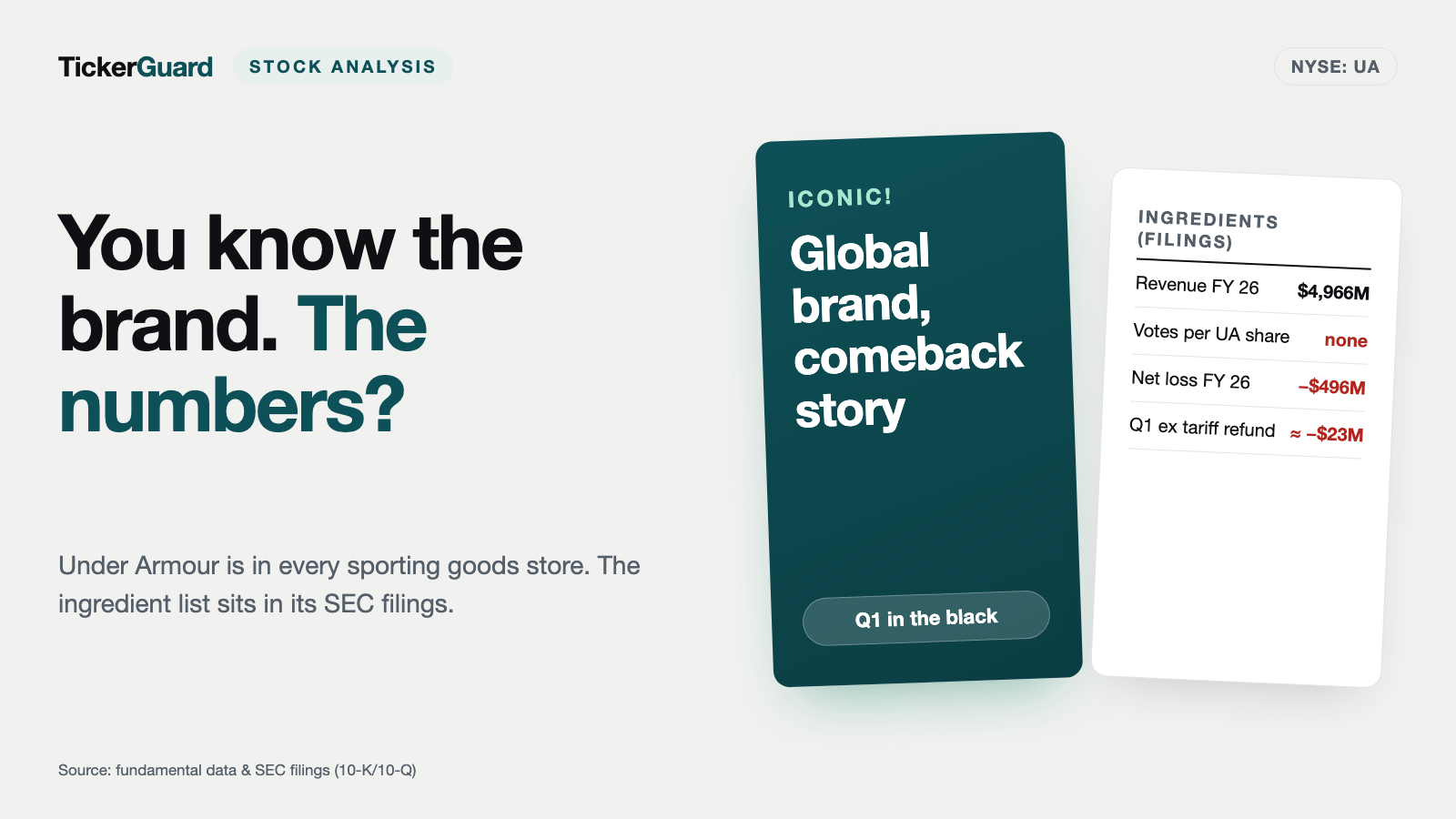
Under Armour hangs in every sporting goods store, and that is exactly what makes the stock feel so familiar. The company's filings with the U.S. securities regulator, the SEC, show a different side of the brand: three straight years of falling revenue to $4,966 million in the fiscal year ended March 2026, a $496 million net loss, a spring 2026 quarterly profit that by our arithmetic came entirely from roughly $70 million of refunded tariffs — and a stock, ticker UA, that gives its buyer not a single vote. We read the documents and did the math. Not investment advice — just the ingredient list for a brand you probably already own.
 Thomas Mücke
Founder & Publisher
Thomas Mücke
Founder & Publisher
As of Today
As of: September 25, 2026
- Closing price
- 4.40 $ -1.40%
- Market Capitalisation
- 1.9 $B
- Growth Score
- 3/10
- AAQS
- 0/10
Price change since September 25, 2026: +0.7%
This analysis has a cut-off date. The Stock Guard tells you when something material changes in the numbers. Reserve your free spot
Chart
Interactive price chart (TradingView).
52-week range: 4.00 $ to 7.90 $ · Last price: 4.40 $ (As of: September 25, 2026)
Note: pure fact-based analysis, not investment advice and not a solicitation to buy or sell. All figures without guarantee.
There is an investing trap you don't learn at the stock exchange but in front of your closet. Call it the closet trap. You open the door, see the performance shirt with the interlocking logo, the running shoes, the training jacket — and your brain draws a conclusion it has never checked: "I know this company. I understand it." What you wear every day feels solid. Psychologists call it the familiarity effect: we treat the familiar as safer than it is, simply because it is familiar. The old market rule "buy what you know" has a sibling that gets talked about less: knowing the product is not the same as knowing the company.
Under Armour is the textbook case. The Baltimore brand hangs in every sporting goods store; it is on jerseys, running shoes and caps. The stock with the ticker UA, on the other hand, is a security most buyers have never looked at closely. So let's make a deal: before you buy a brand that is already in your closet, let's read together what the company itself has reported to the U.S. securities regulator, the SEC — the annual report (Form 10-K) for the fiscal year ended March 2026, the quarterly report (Form 10-Q) through June 2026, the 2026 proxy statement and everything filed since. An SEC filing is made under penalty of law. And this one tells a story of three straight years of falling revenue, of a quarterly profit that came back from customs — and of a stock that gives its buyer no vote. What you make of it is up to you.
What Under Armour Actually Does — Jerseys, Shoes and a Founder With the Majority of Votes
Under Armour sells athletic apparel, footwear and accessories — performance shirts, training pants, running and basketball shoes, bags, caps. Kevin Plank founded the company in 1996. Today Plank is CEO again: according to the 2026 proxy statement, he was CEO and board chair from 1996 to 2019, "Executive Chair and Brand Chief" from January 2020 to March 2024 — and took the helm again in April 2024. As of March 31, 2026, Under Armour employed about 14,100 people, some 10,100 of them in its own stores; as of June 30, 2026, it ran 438 company-owned stores worldwide, most of them outlet "Factory House" locations.
It sells through two channels. The larger is wholesale — sporting goods chains and department stores that buy the goods and resell them: $2.8 billion in fiscal 2026. The smaller is direct-to-consumer through its own stores and website: $2.1 billion. Think of wholesale as the delivery truck that restocks other people's shelves every morning — lots of volume, but the retailer decides how much space you get. Direct-to-consumer is your own shop — more margin, but also more rent. Geographically everything hinges on one market: North America generated about 58 percent of fiscal 2026 revenue; EMEA, Asia-Pacific and Latin America made up the rest.
One detail you need before reading the numbers: Under Armour has a non-calendar fiscal year running from April through March. "Fiscal 2026" therefore means April 2025 to March 2026, and "the first quarter of fiscal 2027" means April to June 2026. Through 2021 the company reported on a calendar-year basis; the transition quarter from January to March 2022 was reported separately.
And then there is the question of which stock you are actually buying. Under Armour has three share classes. Class A (ticker UAA) carries one vote per share. Class B carries ten votes per share and is owned entirely by Kevin Plank; it is not listed. Class C (ticker UA) carries — apart from narrow exceptions — no vote at all. That defines the central tension of this analysis, and it runs through every section: you know the brand from daily life — but the company behind it has been shrinking for three years, its latest quarterly profit came from a tariff refund, and UA stock does not even give you a vote on what happens next.
Company history for investors
-
2016
The non-voting Class C stock starts trading (ticker UA)
New shares without votes can be issued without diluting Kevin Plank's control. In April 2016 the Class C stock still traded above $45.
-
2024
Kevin Plank returns as CEO (April)
The founder who holds the voting majority runs the company himself again. For shareholders that means strategy and control sit in one pair of hands.
-
2025
New $400 million bond at 7.25 percent (June)
It replaces $600 million of notes at 3.25 percent. Net interest expense rises from $6.1 million to $30.3 million in fiscal 2026.
-
2026
Appeals court: $90 million back to the insurers (January 20)
Under Armour must repay insurance proceeds it already received. That feeds the $98.5 million reserve and the write-off of the U.S. tax credits.
-
2026
Supreme Court strikes down IEEPA tariffs (February 20)
The refund process starts in April. About $70 million of net benefit makes the April-to-June 2026 quarter profitable — once.
-
2026
Fairfax reports 45.3 million Class A shares (May)
The Canadian insurer holds 24 percent of the voting Class A stock and buys 2.3 million more at around $5 — a professional betting on a turnaround.
-
2026
Covenants loosened, revenue outlook cut (August 4 and 7)
Minimum interest coverage 3.0 instead of 3.5, revenue expected to decline at a mid-single-digit rate. The company buys itself room for a weaker year.
How This Stock Reached Our Desk
Under Armour did not reach our research list through a metric but through the Reddit hype scanner — the count of how often a ticker appears in the large retail investor forums (source of the count: ApeWisdom, recorded on September 27, 2026). Honestly, it was a whisper, not a storm: a single mention. With a two-letter ticker, even that one mention may be a coincidence. What is more interesting is something else: the scanner deliberately looks for smaller companies with a market value between $50 million and $2 billion. That a global brand like Under Armour now falls into that net is a finding in itself. As of September 25, 2026, the market value of all three share classes was roughly $1.9 billion. The Class C stock closed that day at $4.37; in April 2016, shortly after it was introduced, it had traded above $45.
The metrics from our fundamental data (as of September 25, 2026), which our in-house stock scanner also uses, are mixed. The Piotroski score — a nine-point health checklist for the balance sheet, from "is the company profitable?" to "is debt falling?" — stands at 3 out of 9. That is weak; a truly healthy company scores 8 or 9. The Altman Z-score, a formula for early detection of financial distress, is 1.83, in the so-called gray zone — no alarm, but no clean bill of health either. The equity ratio is about one third (32 percent as of March 31, just under 35 percent as of June 30, 2026): of every hundred dollars on the balance sheet, a little over thirty belong to shareholders. Solid, not lavish. Keep this finding in mind from the start: a famous name is not a health certificate — and this brand's balance sheet is currently middling.
The Numbers Over the Years — Given Their Due
First, what genuinely speaks for Under Armour, because it is more than the red bottom line suggests. The company has cut its cost base noticeably: selling, general and administrative expenses fell 12 percent to $2.3 billion in fiscal 2026. Debt is manageable: as of June 30, 2026, a $400 million bond and $200 million drawn on the credit line compared with $396 million in cash; the old $600 million bond due June 2026 has been fully repaid. The share count has come down through buybacks — from an average of 465.5 million in 2021 to 426.6 million in fiscal 2026. And there is growth, just not where it matters most: EMEA grew 12 percent in the first quarter of fiscal 2027, Latin America 8 percent. According to the 10-K, no single customer accounts for more than 10 percent of revenue.
Now the curve that overshadows everything else — revenue across five reporting years:
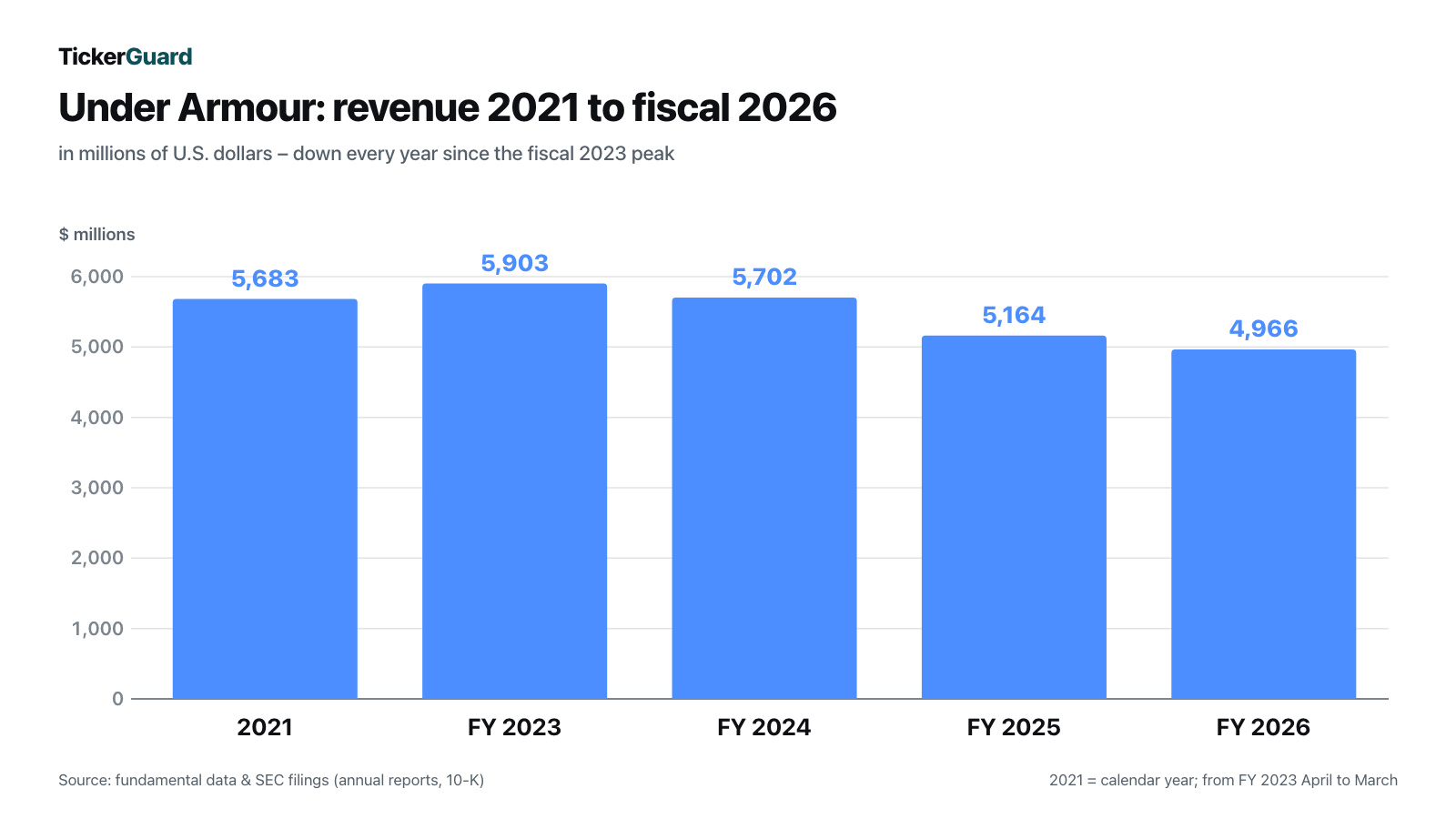
The earnings picture is even clearer. Operating income — what is left from the actual business before interest and taxes — was $475 million in 2021, $264 million in fiscal 2023 and $230 million in fiscal 2024. Then it turned negative: negative $185 million in fiscal 2025 and negative $163 million in fiscal 2026. To be fair, both loss years carry large one-time charges — a $261 million reserve for a shareholder class action in fiscal 2025, $128 million of restructuring and $98.5 million for the insurer dispute in fiscal 2026. The company itself reports adjusted operating income of $107 million for fiscal 2026. But even adjusted, the brand earns far less than it used to. And operating cash flow — the money the business actually brings in — was negative in two of the last three fiscal years: negative $59 million in fiscal 2025 and negative $75 million in fiscal 2026.
The first quarter of fiscal 2027 (April to June 2026) then looked like a turnaround: gross margin jumped 5.9 percentage points to 54.1 percent, operating income rose from $3.3 million to $46.7 million, and operating cash flow reached $109 million. Only revenue didn't join the story: down 3 percent to $1,098 million, down 9 percent in North America. So where did the profit come from? The answer sits in a footnote — which brings us to the uncomfortable truths.
What the Filings Say — the Uncomfortable Truths
Uncomfortable Truth No. 1: With UA You Buy the Stock Without a Vote
Let's start with the point most buyers of UA stock don't know, because it isn't on the label. The 10-K for fiscal 2026 states it plainly in its risk factors:
"Our Class A Common Stock has one vote per share, our Class B Convertible Common Stock has 10 votes per share and our Class C Common Stock has no voting rights (except in limited circumstances)."
— Under Armour, Inc., Form 10-K for fiscal 2026, Item 1A "Risk Factors"
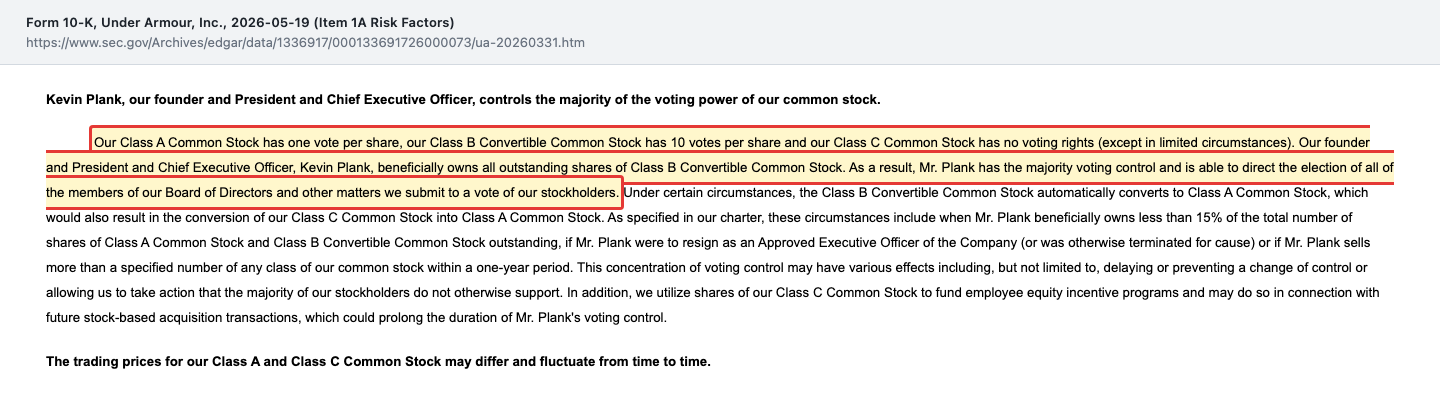
The 2026 proxy statement supplies the numbers: Kevin Plank controls 64.6 percent of the voting power. Economically, he owns only about one eighth of the company — per the same table, 34.6 million Class A and B shares and 18.3 million Class C shares including exercisable options, against roughly 429.5 million shares outstanding. Picture it this way: you co-own an apartment building and pay your share of every repair — but at the owners' meeting you sit in the hallway, while one neighbor with an eighth of the units decides alone. To be fair: Plank founded the company, and the board has an independent chair, the economist Mohamed El-Erian. But management cannot be voted out against Plank's will.
A second sentence from the same section deserves attention because it lays bare the mechanics: Under Armour pays for employee equity awards with Class C stock, and the company itself writes that this could prolong Plank's voting control. The annual meeting on August 26, 2026 approved exactly that — 20 million additional Class C shares for the equity incentive plan; they were registered with the SEC on August 31, 2026 (Form S-8). That is about 4.7 percent of all shares outstanding. Plank's own pay, incidentally, hinges on a stock-price hurdle: the fiscal 2026 award (2 million Class C shares) vests only if Class C averages at least $10 over 60 consecutive trading days; the award of August 26, 2026 (2,165,533 shares, reported on Form 4) sets the hurdle at $5.77. Note the pattern: the hurdle follows the stock price down — the voting majority stays where it is.
Uncomfortable Truth No. 2: The Spring 2026 Profit Came Back From Customs
Back to the question from the end of the last section: where did the $46.7 million of operating income in the first quarter of fiscal 2027 come from? The backdrop is geopolitics. The U.S. government had imposed tariffs under an emergency powers law, the International Emergency Economic Powers Act, or IEEPA. On February 20, 2026, the Supreme Court invalidated certain of those tariffs, and the refund process started in April 2026. Under Armour had expensed the tariffs in fiscal 2026 — and now got them back. The 10-Q quantifies it:
"During the three months ended June 30, 2026, the Company started receiving tariff refunds. As a result, the Company recognized a net benefit of approximately $70 million in cost of goods sold related to the recovery of tariff costs previously recognized during Fiscal 2026."
— Under Armour, Inc., Form 10-Q for the quarter ended June 30, 2026, Note 8 "Commitments and Contingencies," section "IEEPA Tariffs"
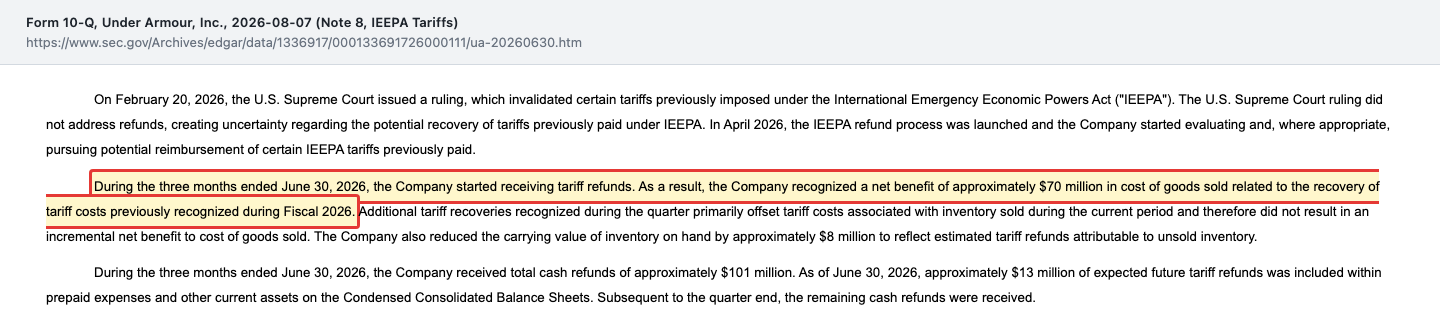
Now the simple calculation you won't find in any press release. Reported operating income: $46.7 million. Minus the refund for the prior year of about $70 million. Result: roughly negative $23 million. Without the money from customs, Under Armour would have posted an operating loss in spring 2026.
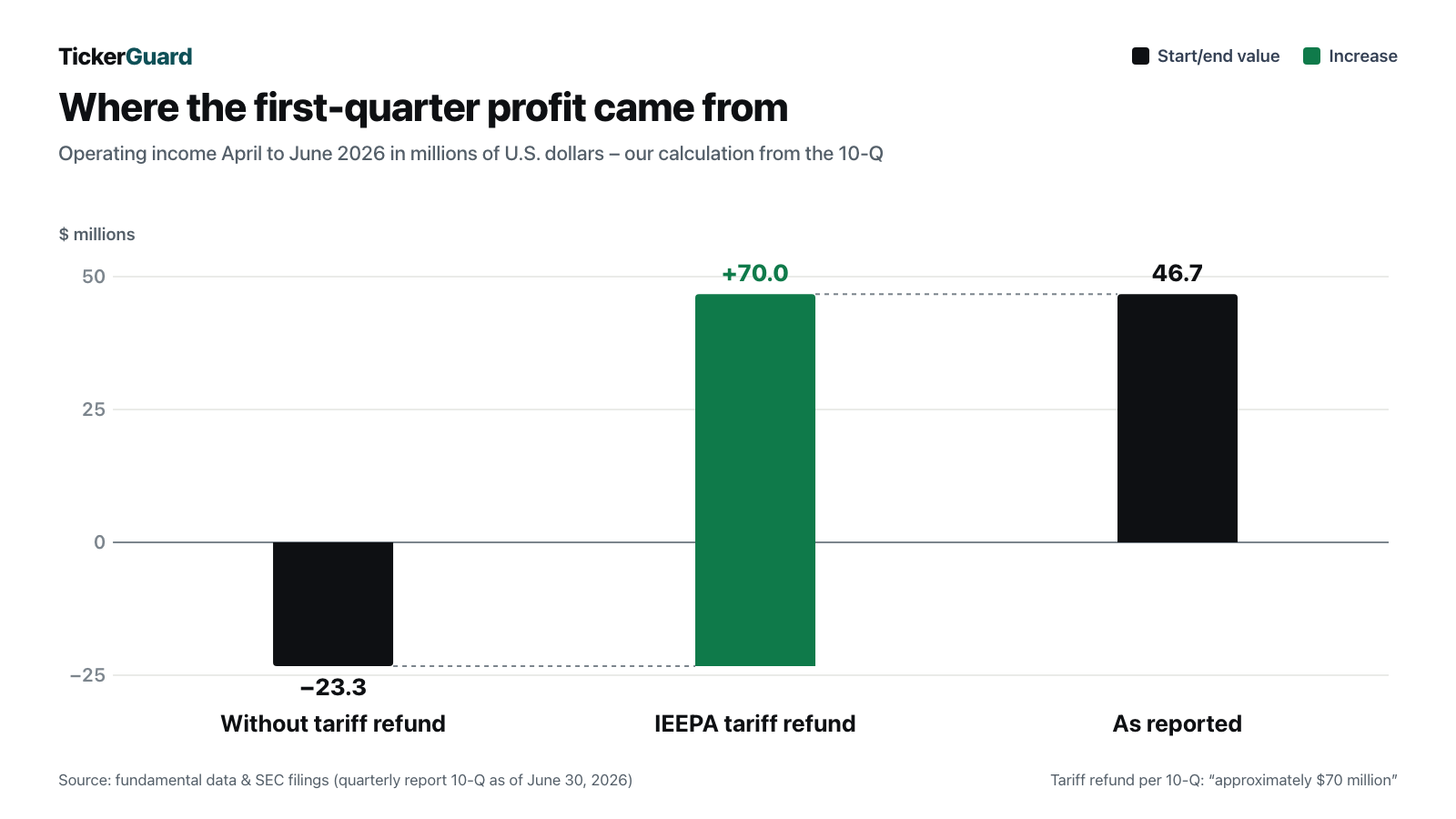
Below the operating line it got thinner still: of $29.1 million in pre-tax income, $28.3 million went to taxes (a 97.4 percent effective rate) and $0.2 million to a loss from equity-method investments, leaving just $0.5 million. And the refund props up the full year, too: the fiscal 2027 outlook of $96 million to $116 million in operating income includes, per the August 7, 2026 earnings release, a benefit of about $70 million from the tariff refund. For the current second quarter (July to September 2026), Under Armour itself expects operating income of negative $11 million to negative $1 million. We found the same pattern at children's apparel maker Carter's, where most of the profit also came back from customs. Remember the line: a refund is money for yesterday — it says nothing about what the brand earns tomorrow.
Uncomfortable Truth No. 3: Under Armour No Longer Trusts Its Own U.S. Tax Credits
Fiscal 2026 ended with a net loss of $495.6 million — more than twice the pre-tax loss of $200.7 million. The difference is a tax line of $294.8 million. A company with a pre-tax loss doesn't normally pay taxes of that size; this is a write-down. Under Armour recorded a valuation allowance on its U.S. federal deferred tax assets — $247 million, according to the May 12, 2026 earnings release. Deferred tax assets are, in plain terms, vouchers for future tax savings: losses today can be offset against profits later. They sit on the balance sheet as an asset for as long as the company can credibly claim it will redeem them. The 10-K explains why Under Armour no longer can:
"During Fiscal 2026, the Company expanded the 2025 restructuring plan and incurred additional litigation reserve expense related to the previously disclosed insurance carrier litigation described in Note 8. These recent developments have caused the negative evidence to outweigh the positive evidence, and therefore, in accordance with Topic 740, the Company has recorded valuation allowances on all U.S. federal deferred tax assets as of March 31, 2026."
— Under Armour, Inc., Form 10-K for fiscal 2026, Note 15 "Provision for Income Taxes"
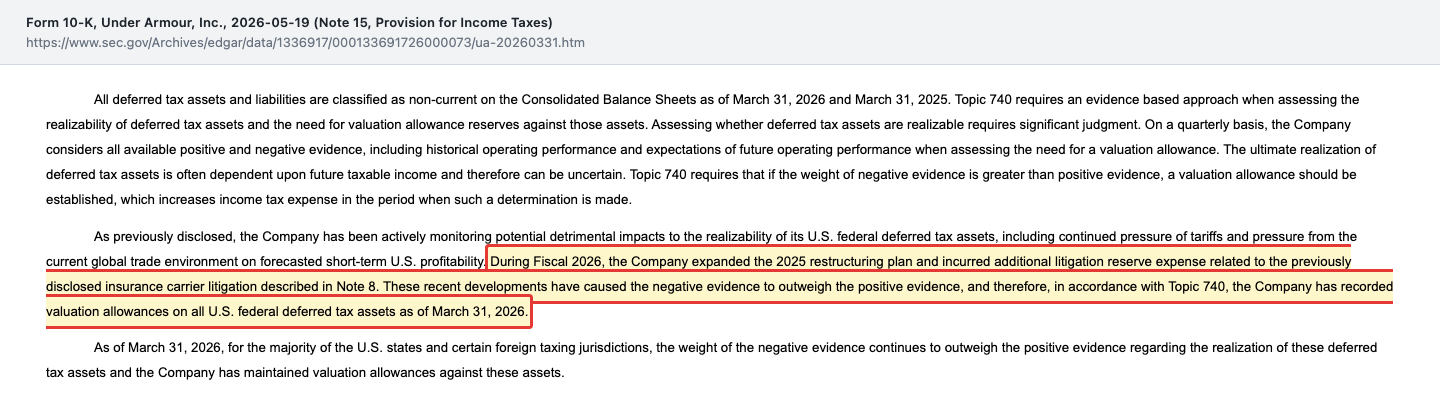
The entry is non-cash — no money left the company. But it is a statement about the future: management does not expect enough taxable U.S. profit in the foreseeable future. The 10-Q for the quarter ended June 30, 2026 confirms the allowances remain in place. You can see the side effect every quarter: because U.S. losses no longer reduce the tax line, taxes eat almost all of pre-tax income — see the 97.4 percent from the first quarter.
The reserve has a backstory of its own. The past shareholder class action is settled, but Under Armour is still fighting some of its insurers over who pays. On January 20, 2026, the U.S. Court of Appeals for the Fourth Circuit ruled that Under Armour must repay $90 million of insurance proceeds already received; per the 10-Q, the money was paid back during fiscal 2026. On July 7, 2026, the district court denied the insurers' request for $8.5 million of prejudgment interest — with 30 days to appeal.
Uncomfortable Truth No. 4: The Home Market Is Shrinking — and Guidance Was Cut
For Under Armour, North America is not one market among many; it is the foundation: 58 percent of fiscal 2026 revenue. That is exactly where things are going downhill. North American revenue fell 8 percent to $2,859 million in fiscal 2026 and another 9 percent to $610 million in the first quarter of fiscal 2027. The 10-K states the reasons plainly: declines in both wholesale and direct-to-consumer, online as well as in company-owned stores; apparel sold mainly at lower average prices, while footwear saw both lower unit sales and lower prices. The region's operating income fell 29.7 percent in fiscal 2026 — partly because of higher tariff costs. The growth in EMEA (up 12 percent in the quarter) is real, but it doesn't offset the loss at home. The channels point down, too: e-commerce revenue fell 12 percent in the quarter, footwear 8 percent.
And the company itself has lowered its expectations. In May 2026 it had guided to a slight revenue decline for fiscal 2027. On August 7, 2026, that became a decline at a mid-single-digit rate, attributed to softer demand, particularly in North America and Asia-Pacific. The operating income outlook held — but only because the company now plans deeper cost cuts: selling, general and administrative expenses are now expected to fall at a high-single-digit rate instead of a low-single-digit rate. Kevin Plank put it this way in the earnings release: "As we navigate a challenging consumer demand environment …" Translation: the brand has to cut costs to hold its profit, because it is not earning it through revenue.
Uncomfortable Truth No. 5: More Expensive Money and Looser Covenants
Under Armour has restructured its debt, and it came at a price. In June 2016 the company borrowed $600 million at 3.25 percent, due June 2026. In June 2025 it replaced that with a new $400 million bond at 7.25 percent, due 2030. Net interest expense rose from $6.1 million (fiscal 2025) to $30.3 million (fiscal 2026); in the first quarter of fiscal 2027 it was $10.6 million versus $4.1 million. Relative to revenue that is manageable, but it shows how the capital markets price the risk today.
More telling is a contract change the 10-Q reports in the fine print. On August 4, 2026, Under Armour signed the ninth amendment to its $1.1 billion credit agreement:
"Pursuant to the ninth amendment, the interest coverage covenant was changed to require the Company to maintain a ratio of consolidated EBITDA to consolidated interest expense of not less than 3.00 to 1.00 and the leverage covenant was changed to not permit the Company to allow the ratio of consolidated total indebtedness to consolidated EBITDA to be greater than 3.75 to 1.00 …"
— Under Armour, Inc., Form 10-Q for the quarter ended June 30, 2026, Note 7 "Credit Facility and Other Long-Term Debt"
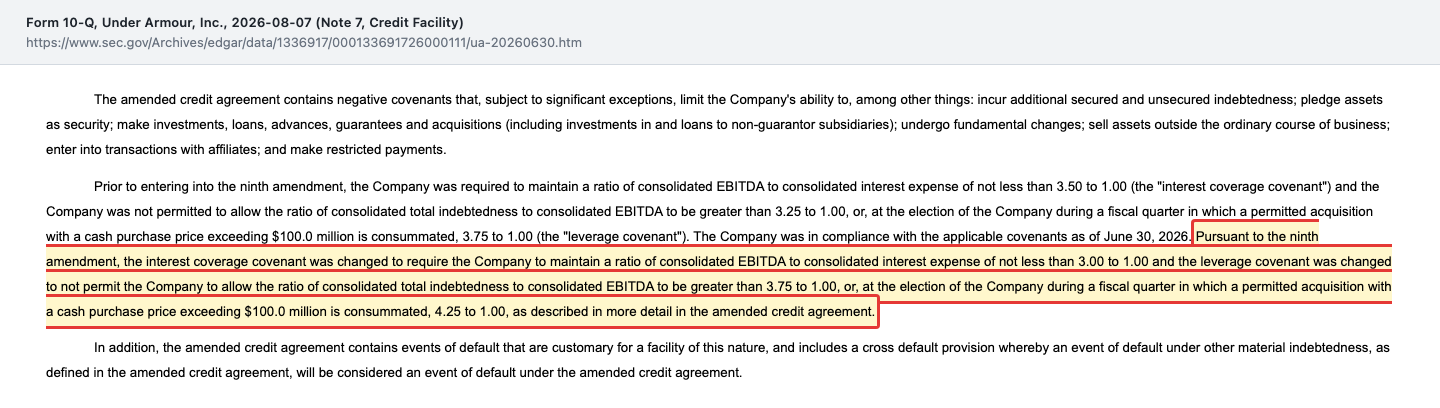
Covenants are the guardrails a bank puts around a borrower. In plain terms: overdraw at the bank and sooner or later you get a phone call. Previously Under Armour had to keep EBITDA — operating earnings before depreciation — at least 3.5 times interest expense; now 3.0 times is enough. Debt could be 3.25 times EBITDA; now 3.75 times. Important for context: the old covenants were met as of June 30, 2026, and the 10-Q says so explicitly. But a company that asks for more room in the middle of the year may well expect to need it. Keep the image in mind: nobody loosens their belt when they plan to lose weight.
Uncomfortable Truth No. 6: The Restructuring Costs More Than Planned — and Isn't Finished
A restructuring plan has been running since fiscal 2025: job cuts, closures, a distribution center in California being exited, and the "Curry Brand" product line was separated from the company. In fiscal 2026, $69.7 million of non-cash contract termination costs were recorded, primarily related to that separation. The plan was originally expected to cost about $255 million; in May 2026 it was extended to about $305 million. Through June 30, 2026, $266 million had been incurred, $116 million of it in cash. The company expects the plan to be substantially complete by December 31, 2026. That is a clear date — and therefore a clear test: from 2027 on, "restructuring charges" stop being an excuse.
Valuation — What Roughly $1.9 Billion for Almost $5 Billion of Revenue Means
Let's talk orders of magnitude without pretending to know today's price. According to the 10-Q, 429,545,541 shares were outstanding as of July 31, 2026: 188,839,506 Class A, 34,450,000 Class B and 206,256,035 Class C. Using closing prices on September 25, 2026 — $4.43 for Class A, $4.37 for Class C, and Class B valued like Class A, into which it converts — that gives a market value of about $1.9 billion. As a cross-check: Fairfax bought Class A shares at $4.94 to $5.15 in May 2026, and CFO Reza Taleghani bought at $5.37 in August 2026 — the order of magnitude fits.
Three ratios follow. Price to sales is about 0.38 — the market pays 38 cents for every dollar of trailing twelve-month revenue ($4,930 million through June 2026). Price to book is about 1.3, measured against $1,428 million of equity as of June 30, 2026. A price-to-earnings ratio can't be calculated for fiscal 2026 because there were no earnings. Add net financial debt ($600 million of bond and credit line minus $396 million of cash) and enterprise value comes to about $2.1 billion.
The truly revealing comparison is with the company's own outlook. Under Armour expects adjusted operating income of $140 million to $160 million for fiscal 2027. On that basis the company costs 13 to 15 times adjusted operating income — no bargain for a shrinking business, but no excess either. Take out the one-time tariff refund of about $70 million, though, and you are left with $70 million to $90 million — and the multiple jumps to roughly 23 to 30. How differently a sports brand can be positioned is shown in our analysis of Deckers Outdoor (HOKA and UGG): there the brands delivered a record year, and the question is why the stock fell anyway. Under Armour is the reverse — the stock is low because the business is shrinking, and the question is whether it will grow again.
The view of the professionals, put in context rather than adopted: analyst estimates in our data set (as of September 25, 2026) project about $4.77 billion of revenue for fiscal 2027, a decline of about 4 percent — in line with company guidance. And the largest shareholder outside the founder's family, Canadian insurer Fairfax Financial, holds 45.3 million Class A shares per its Schedule 13D/A of May 15, 2026 — 24 percent of that class. A holder that size is betting on a turnaround. But Fairfax, too, chose the voting Class A stock, not UA.
Upside and Risks at a Glance
What speaks for Under Armour:
- A genuine global brand. $4,966 million of revenue in fiscal 2026, 438 company-owned stores (June 30, 2026), no customer above 10 percent of revenue.
- Costs are falling noticeably. SG&A down 12 percent in fiscal 2026; the restructuring is expected to be substantially complete by December 31, 2026.
- Manageable debt. $400 million bond plus $200 million on the credit line against $396 million of cash (June 30, 2026); the 2026 notes are repaid, and most of the $1.1 billion credit facility is undrawn.
- Growth outside the U.S. EMEA up 12 percent, Latin America up 8 percent in the April-to-June 2026 quarter.
- Fewer shares. An average of 426.6 million in fiscal 2026 versus 465.5 million in 2021; about $385 million remains under the May 2024 buyback program.
- A prominent major shareholder. Fairfax Financial bought about 2.3 million more Class A shares at $4.94 to $5.15 in May 2026, and the CFO bought at $5.37 in August 2026 — both, however, in the voting Class A stock, not UA.
What speaks against it:
- No vote for UA holders. Class C stock carries no voting rights; Kevin Plank controls 64.6 percent of the votes with roughly an eighth of the capital.
- Revenue is shrinking. Three declines in a row since the fiscal 2023 peak; for fiscal 2027 the company expects another decline at a mid-single-digit rate.
- The quarterly profit is borrowed. Without about $70 million of tariff refunds, April to June 2026 would show an operating loss of roughly $23 million by our arithmetic; for July to September the company itself expects negative $11 million to negative $1 million.
- Written-off tax credits. A $247 million valuation allowance on U.S. federal deferred tax assets; management does not expect enough U.S. profit in the foreseeable future.
- Negative operating cash flow. Negative $59 million (fiscal 2025) and negative $75 million (fiscal 2026).
- Looser covenants and pricier money. Minimum interest coverage has been only 3.0 since August 4, 2026; the new bond costs 7.25 instead of 3.25 percent.
- More dilution. 20 million additional Class C shares for employee awards, registered on August 31, 2026 — about 4.7 percent of all shares.
A Human Conclusion — Back to the Closet
Remember the closet from the beginning? The shirt with the logo hangs there for a reason: Under Armour makes products people buy, almost five billion dollars' worth a year. The brand is real, the company is not in distress, the debt is manageable, and an experienced large investor bought more in May 2026. If you believe the restructuring really wraps up by the end of 2026 and the brand grows again after that, a price-to-sales ratio of about 0.38 offers a lot of leverage.
But the closet trap nudged you toward a conclusion the filings don't support. You know the product — and the company behind it has three years of falling revenue behind it, has written off its own U.S. tax credits, asked for looser covenants in mid-year and owes its latest quarterly profit to a tariff refund. And whoever buys the stock with the ticker UA buys the class that gets no say in any of it. So the honest question isn't "Do I know the brand?" but "Would I buy this company if I had never seen its logo?"
Both sides can be documented from the same filings — which is exactly why we don't make a recommendation here. We read the reports, redid the math and highlighted the passages where it hurts. What you do with that is your decision. And that's how it should be.
Sources and Notes
- Form 10-Q for the quarter ended June 30, 2026 (filed August 7, 2026) — most recent periodic report: quarterly results, tariff refund, insurer litigation, covenants and ninth amendment, tax rate, share count as of July 31, 2026
- Form 8-K of August 7, 2026, Exhibit 99.1 — first-quarter fiscal 2027 earnings release and updated full-year outlook
- Form 10-K for fiscal 2026 (filed May 19, 2026) — business model, employees, share classes and voting rights, tax valuation allowance, restructuring, debt
- Form 8-K of May 12, 2026, Exhibit 99.1 — fiscal 2026 results, size of the valuation allowance, initial fiscal 2027 outlook
- Form 10-K for fiscal 2025 (filed May 22, 2025) and Form 10-K for fiscal 2024 (filed May 29, 2024) — multi-year figures including 2021 and the 2022 transition quarter
- Proxy statement DEF 14A 2026 (filed July 15, 2026) — voting power, share ownership, CEO compensation
- Form 8-K of August 27, 2026 (Item 5.07) — annual meeting voting results and plan share increase; plus the Form S-8 and the shelf registration S-3ASR of August 31, 2026
- Schedule 13D/A by Fairfax Financial Holdings of May 15, 2026 and insider filings (Form 4) from May to September 2026
- Source: fundamental data & SEC filings (annual and quarterly reports, 10-K/10-Q) — metrics, share prices, analyst estimates; data as of September 25, 2026
- Reddit mentions: ApeWisdom (recorded September 27, 2026) via our in-house Reddit hype scanner
Disclaimer: This article is journalistic analysis and is expressly not investment advice and not a solicitation to buy or sell securities. Share prices can move sharply; a total loss of invested capital is possible. All figures come from the original documents linked above and carry the as-of dates stated there. At the time of publication, the author holds no position in the stock discussed.
Key figures at a glance
All monetary figures in millions of $; earnings per share as reported.
| Metric | 2022 | 2023 | 2024 | 2025 | 2026 |
|---|---|---|---|---|---|
| Revenue | 5,903.6 | 5,701.9 | 5,694.2 | 5,165.7 | 4,966.4 |
| Operating Income (EBIT) | 283.8 | 229.8 | 232.7 | 171.1 | -35.4 |
| Net Income | 386.8 | 232.0 | 232.0 | -201.3 | -495.6 |
| Net Margin | 6.6% | 4.1% | 4.1% | -3.9% | -10.0% |
| Earnings Per Share | 0.84 $ | 0.53 $ | 0.51 $ | -0.47 $ | -1.16 $ |
Source: fundamental data & SEC filings (annual and quarterly reports, 10-K/10-Q)
Our Bottom Line at a Glance
- Revenue and demand negative
- Revenue fell from $5,903 million (fiscal 2023) to $4,966 million (fiscal 2026), with North America alone down 8 percent in fiscal 2026. The April-to-June 2026 quarter brought another 3 percent decline, 9 percent in North America. On August 7, 2026, the company cut its fiscal 2027 revenue outlook to a decline at a mid-single-digit rate.
- Earnings power negative
- Operating income was negative $185 million (fiscal 2025) and negative $163 million (fiscal 2026), each with large one-time charges; adjusted, $107 million. The April-to-June 2026 quarter reported $46.7 million, including about $70 million of refunded prior-year tariffs — without it, roughly negative $23 million by our arithmetic. The $247 million valuation allowance on U.S. tax assets shows management does not expect U.S. profits soon.
- Balance sheet and liquidity positive
- As of June 30, 2026: $396 million of cash, $1,428 million of equity, a $400 million bond (7.25 percent, due 2030) and $200 million drawn on a $1.1 billion credit line. The $600 million bond was repaid on June 15, 2026 from funds set aside earlier. One caveat: operating cash flow was negative in fiscal 2025 and 2026 (negative $59 million and negative $75 million); only in the April-to-June 2026 quarter was it positive, at $109 million.
- Covenants neutral
- The previous covenants (interest coverage of at least 3.5, leverage no higher than 3.25 times EBITDA) were met as of June 30, 2026. On August 4, 2026, they were loosened to 3.0 and 3.75. That buys room, but it shows the company expects tighter ratios.
- Governance and voting rights negative
- UA stock (Class C) carries no vote. Through Class B shares with ten votes each, Kevin Plank controls 64.6 percent of the voting power with roughly an eighth of the capital and, per the 10-K, can direct the election of every board member. Employee awards are paid in Class C stock; 20 million more shares were registered on August 31, 2026.
- Costs and restructuring positive
- Selling, general and administrative expenses fell 12 percent in fiscal 2026. The restructuring plan (about $305 million total cost, $266 million incurred through June 30, 2026) is expected to be substantially complete by December 31, 2026. Buybacks cut the average share count from 465.5 million (2021) to 426.6 million (fiscal 2026).
Under Armour is a global brand with a shrinking business. Revenue fell three years in a row to $4,966 million in fiscal 2026, which ended with a $496 million net loss — including a $247 million valuation allowance on U.S. tax assets. The profit in the April-to-June 2026 quarter came, by our arithmetic, entirely from about $70 million of refunded tariffs; for July to September the company itself expects a small operating loss, and in August the credit covenants were loosened. On the other side stand a solid balance sheet with $396 million of cash, falling costs, growth in EMEA and a major shareholder that has been buying. UA stock itself gives its buyer no vote. Not investment advice.
What Our Rating Means
Open questions
The business works in principle, but one material question is open. As long as it stays open, our findings do not carry a quality verdict.
Yellow, because the central operating question is open: the turnaround is unproven. Revenue has fallen every year since fiscal 2023, and the only recent quarterly profit (April to June 2026) rests, by our arithmetic, entirely on about $70 million of tariff refunds. It is not red under the criteria, and that needs explaining, because reported operating income in fiscal 2026, negative $163 million, was below interest expense of $30 million. That loss stems from one-time charges — $128 million of restructuring and a $98.5 million reserve in the insurer dispute — adjusted operating income of $107 million covers interest a good three times over, and the lenders' own yardstick (interest coverage of at least 3.5) confirms compliance as of March 31 and June 30, 2026. Add $1,428 million of equity, $396 million of cash, a largely undrawn $1.1 billion credit line and no going-concern doubt. Expressly irrelevant to the rating are the missing vote of UA stock, the years-long share price decline and the low price-to-sales ratio — those are questions of share class and price, not of substance. Against green: the revenue decline, the written-off U.S. tax credits and the covenants loosened in August 2026. Red would come into play if, after the restructuring ends in late 2026, operating income without refunds stayed persistently below interest expense. The decision is yours.
A journalistic assessment by our editorial team at the time of the deep dive, based on public sources — not investment advice and not a solicitation to buy or sell. Your personal circumstances (investment goals, risk capacity, taxes) cannot be taken into account. What our levels mean, how verdicts are formed, and what conflicts of interest exist →
Worth Noting
- Under Armour reached our research list through the Reddit hype scanner with a single mention (ApeWisdom, recorded September 27, 2026). The scanner looks for companies with $50 million to $2 billion of market value — that the global brand, at about $1.9 billion, falls into that range was the real trigger.
- Currency of data: the most recent periodic report reviewed is the Form 10-Q for the quarter ended June 30, 2026, filed August 7, 2026, together with the earnings release of the same day. All filings since were reviewed: annual meeting voting results (8-K of August 27, 2026), the registration of 20 million additional Class C shares (S-8) and a shelf registration (S-3ASR) of August 31, 2026 — the S-3ASR allows future issuance of debt or equity but names no specific offering — insider filings (Form 4) and a notice of proposed sale by a former executive (Form 144, about 86,600 Class C shares).
- Risk of confusion: the ticker UA belongs to the non-voting Class C stock, UAA to the voting Class A stock — both issued by Under Armour, Inc. (CIK 0001336917). The figures in this analysis apply to the company as a whole; earnings per share and dividend rights are the same for all classes. The prices of the two classes can differ.
Stock Watch
This analysis is as of September 27, 2026. Stock Watch will tell you what's changed at UA since then.
Later $1 a month per stock — signing up is free, and you'll be the first to know when it launches.
The full analysis as a PDF for later
We will send you this analysis as a PDF — to print, file away, and read at your own pace. And we will add you to the free Stock Watch list for Under Armour Inc C (UA), so you hear about it when something material in this analysis changes.
Frequently Asked Questions
UAA is the Class A stock with one vote per share; UA is the Class C stock with no voting rights (except in limited circumstances). Both trade on the New York Stock Exchange and share equally in earnings and dividends. There is also an unlisted Class B stock with ten votes per share, owned entirely by founder Kevin Plank. As of July 31, 2026, 188.8 million Class A, 34.5 million Class B and 206.3 million Class C shares were outstanding.
Founder and CEO Kevin Plank. He owns all Class B shares with ten votes each and, per the 2026 proxy statement, controls about 64.6 percent of the voting power. According to the 10-K, that lets him direct the election of every board member. Economically he owns roughly one eighth of the shares. The largest holder of the Class A stock is Canadian insurer Fairfax Financial, with 45.3 million shares (24 percent of Class A) and 8.5 percent of total voting power.
In 2022 Under Armour switched from calendar years to a fiscal year running April through March; the transition quarter from January to March 2022 was reported separately. Fiscal 2026 therefore covers April 2025 to March 2026, and the first quarter of fiscal 2027 covers April to June 2026. Anyone comparing figures with competitors needs to account for this one-quarter shift.
Most of the $495.6 million net loss arose below the operating business. The pre-tax loss was $200.7 million; the tax line cost $294.8 million, mainly because of a $247 million valuation allowance on U.S. federal deferred tax assets. The operating loss of $163 million included $128 million of restructuring charges and a $98.5 million reserve for the dispute with the insurers.
Mostly from a tariff refund. After the Supreme Court struck down tariffs imposed under the IEEPA emergency powers law on February 20, 2026, Under Armour received money back and, per the 10-Q, recorded a net benefit of about $70 million for prior-year tariff costs. Reported operating income was $46.7 million; without the refund it would have been roughly negative $23 million. Net income was $0.5 million.
No, financial debt is manageable. As of June 30, 2026, a $400 million bond at 7.25 percent (due 2030) and $200 million drawn on the credit line compared with $396 million of cash. The credit facility totals $1.1 billion. On August 4, 2026, the covenants were loosened: minimum interest coverage fell from 3.5 to 3.0, and permitted leverage rose to 3.75 times EBITDA.
With 429.5 million shares and closing prices of $4.37 (Class C) and $4.43 (Class A) on September 25, 2026, the market value is about $1.9 billion. That equals a price-to-sales ratio of about 0.38 and a price-to-book ratio of about 1.3. Measured against the outlook of $140 million to $160 million of adjusted operating income for fiscal 2027, enterprise value is 13 to 15 times.
Found an error?
Did you spot a factual error, an outdated number, or a typo in this deep dive? Let us know briefly — your report goes straight to the editorial team.