7C Solarparken Trades at Two Thirds of Book Value — and Management Itself Plans for EBITDA to Fall to €31 Million by 2030
7C Solarparken runs 504 MWp of solar and wind parks, generates reliable cash and buys back its own shares below book value. But two thirds of its power sales come from legacy plants whose fixed feed-in tariffs expire between 2027 and 2030, and the company itself expects profits to shrink. We read the 2026 half-year report, the 2025 financial statements and the Roadmap 2030. Whether this is a bargain or an asset melting on schedule is decided by the calendar, not the balance sheet.
 Thomas Mücke
Founder & Publisher
Thomas Mücke
Founder & Publisher
Chart
Interactive price chart (TradingView).
Note: pure fact-based analysis, not investment advice and not a solicitation to buy or sell. All figures without guarantee.
There is a reflex almost every investor knows: when a stock costs less than the company is worth according to its own balance sheet, buying it feels like a flea-market find. You get a euro of assets for 67 cents — what could go wrong? Investors have a name for the flip side of that reflex: the value trap. Something looks cheap because we compare the price with book value, but we overlook that the book value itself is melting. The flea-market find turns out to be a block of ice sitting in the sun.
With 7C Solarparken the reflex is especially strong. On September 25, 2026, the stock cost €1.805. Book value per share stood at €2.71 on June 30, 2026, according to the company — so the market valued the group at roughly two thirds of its balance-sheet equity. Management sees it the same way: in the half-year report it notes that the price-to-book ratio is “significantly below one” and keeps buying back its own shares for that reason. CEO Steven De Proost put it more sharply in April 2026 (our translation from the German press release): “The market continues to value us like a closed-end run-off fund. We are not.”
Let’s make a deal: we test that sentence against what 7C Solarparken itself has published — the 2026 half-year report of September 22, 2026, the audited 2025 consolidated financial statements and the business plan “Roadmap Towards 2030.” 7C Solarparken is a German company and does not report to the U.S. securities regulator, the SEC; its financial reports appear in German only, so we quote them in the original and add our translation. The central tension of this analysis: the solar parks generate reliable cash, and measured against the balance sheet the stock is cheap — but the company itself plans for its operating profit (EBITDA) to fall from €59.6 million in 2025 to about €31 million in 2030, because its best-paid legacy plants are dropping out of the subsidy regime. Bargain or honestly priced block of ice? In the end, you decide.
What 7C Solarparken actually does — a power producer with fixed prices for a limited time
7C Solarparken, based in Bayreuth, Germany, is an independent power producer: it owns and operates solar parks and two wind turbines and sells the electricity. On June 30, 2026, the portfolio totaled 504 MWp of capacity, including 498 MWp of solar in 269 parks and 6 MW of wind. 434 MWp are in Germany — mostly in Bavaria (182 MWp), Saxony-Anhalt (79 MWp) and Mecklenburg-Western Pomerania (37 MWp) — and 64 MWp are rooftop plants in Belgium. The parks are small: about 1.7 MWp each. According to the company, the portfolio produces around 472 gigawatt hours a year, enough for more than 147,000 three-person households. On top come 207 hectares of owned land, the management of 36.5 MWp of third-party parks and, since 2026, the first battery storage.
The business model is simpler than almost any other stock: nearly the entire German portfolio receives a fixed feed-in tariff for 20 years from commissioning under Germany’s Renewable Energy Sources Act (EEG). Picture it this way: every solar park is an apartment rented out on a 20-year lease with the rent locked in on move-in day. Whoever connected a solar park in 2008 still collects a price new plants can only dream of. The catch is the flip side: every one of these leases has an end date. After that, the apartment has to be re-let at market rent — and those end dates are what this analysis is about.
Some background belongs here. Today’s 7C Solarparken AG is the former listed shell of Colexon Energy AG, which 7C Solarparken took over in September 2014; the shares trade on the regulated market of the Frankfurt Stock Exchange (General Standard). The management board consists of Steven De Proost (CEO), Koen Boriau (CFO) and Philippe Cornelis (CTO); the group employed about 30 people in the first half of 2026. Each park sits in its own project company and is typically financed with 35 percent equity and 65 percent bank debt.
Company history for investors
-
2014
Takeover of Colexon Energy AG
7C Solarparken took over listed Colexon in September 2014; the old listed shell became a pure operator of solar parks.
-
2022
Record year in the energy crisis
EBITDA of €74.7M on very high power prices, dividend of €0.12 per share — the peak later years should not be measured against.
-
2024
Reuden Süd fraud case
The loan already paid for and the stake turned out to be pledged, seller and builder went bankrupt. A €5.4M hit to EBITDA, no dividend for 2024.
-
2025
Roadmap 2030 published
The company openly plans for EBITDA to fall to about €31M in 2030 and relies on buybacks, new parks and batteries instead of dividends.
-
2026
March: Reuden Süd online
After the fraud case, the 20 MWp park delivers power at about €87/MWh; at least €1.5M of revenue a year is expected.
-
2026
May: buyback offer almost four times oversubscribed
6,696,310 shares were tendered at €1.90, 26% accepted. The CEO also sold €777,467 worth into the offer.
-
2026
September: first half ahead of plan
EBITDA of €28.9M versus a planned €27M, 2026 guidance confirmed; €5.4M impairment due to higher interest rates.
How the stock landed on our desk
Through other investors’ curiosity: in late September 2026, 7C Solarparken showed up in the ranking of most-discussed stocks on wallstreet-online, one of Germany’s largest retail-investor forums. That is an attention signal and explicitly not a reason to buy — a stock gets discussed because it interests someone, not because it is good.
More interesting is what our in-house stock scanner says about it. As of September 27, 2026, 7C Solarparken met exactly one of our scanner strategies — a warning-signal scanner: the Beneish M-Score. Developed by accounting professor Messod Beneish, it compares eight ratios from two consecutive annual reports — such as receivables versus revenue, the pace of depreciation and the margin trend. A value above minus 1.78 is a prompt to look closer. 7C Solarparken scored minus 1.22. For context: on the same date the scanner flagged 2,953 stocks worldwide, 83 of them German; it is a coarse sieve, not a verdict. It does not show which of the eight ratios tips the balance. So we checked the reports: the big swings between 2024 and 2025 are explained there — large impairments on the solar parks and one-off gains — and the auditor, RSM Ebner Stolz, gave the 2025 consolidated financial statements an unqualified opinion. We found no signs of window-dressed books. The Piotroski F-Score, a nine-point test of the health of the books, stands at 6 of 9: okay, not good.
The numbers over the years — honestly appraised
First, what genuinely impresses. 7C Solarparken is a cash machine with very low costs: of €65.7 million in revenue in fiscal 2025, €59.6 million of EBITDA remained — earnings before interest, taxes, depreciation and amortization — a margin of 90.8 percent. The metric the company measures itself by is cash flow per share: EBITDA minus interest, taxes and lease payments actually paid, divided by the number of shares. It came to €0.59 in 2025, up from €0.44 in 2024. And debt keeps falling: net debt dropped from €176.5 million at the end of 2021 to €96.3 million at the end of 2025 and €87.4 million on June 30, 2026, while the equity ratio rose from 38.8 to 44.5 percent.
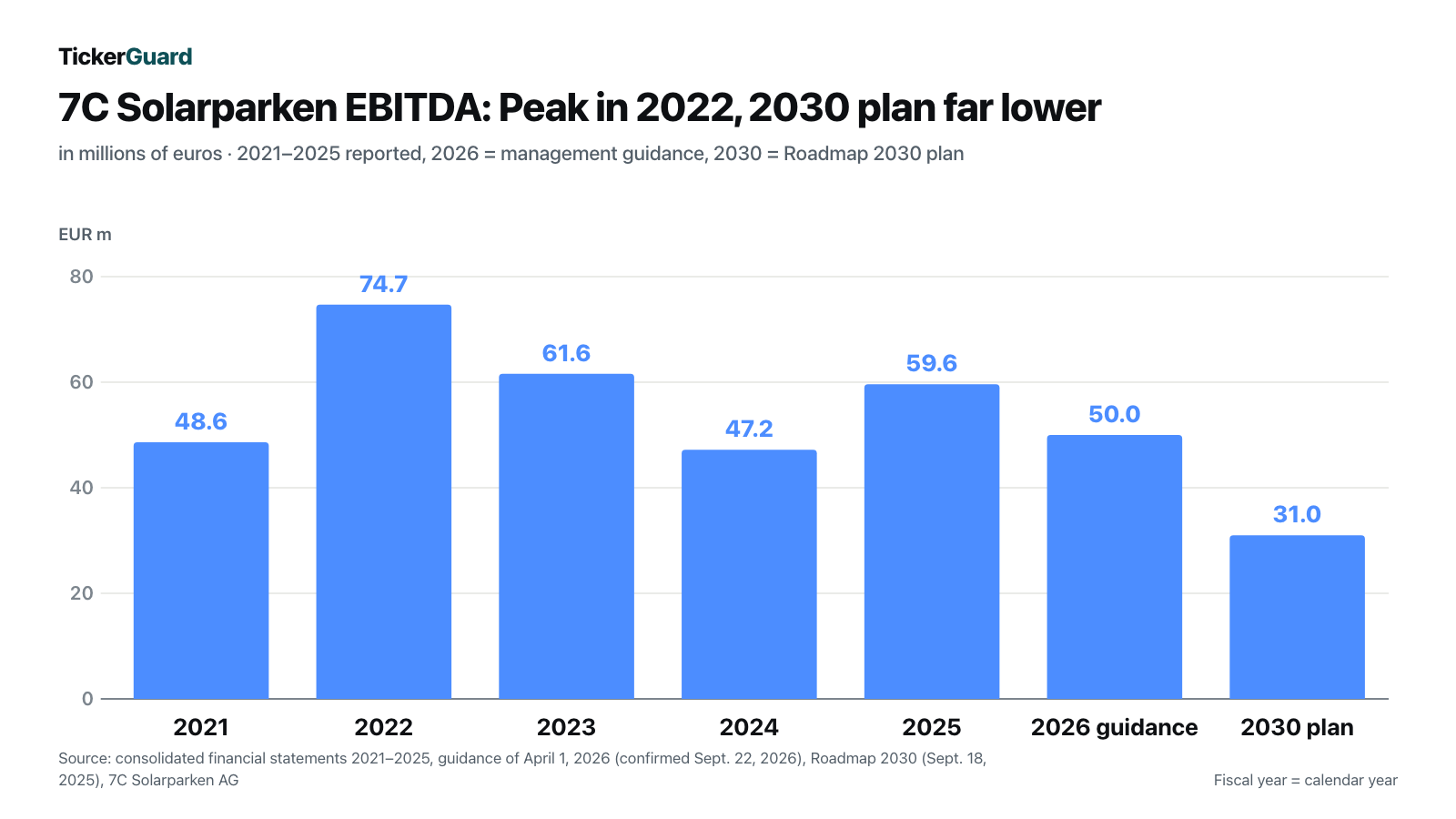
The chart also shows why you can’t simply extrapolate: EBITDA was €48.6 million in 2021, €74.7 million in 2022 and €61.6 million in 2023 — hardly a straight line. The €74.7 million peak in 2022 came from the energy crisis, when wholesale power prices ran far above the fixed tariffs. 2024, at €47.2 million, was weighed down among other things by a €5.4 million write-off on a receivable in the Reuden Süd project, which we return to below. And the strong 2025 included €4.2 million of grid-operator compensation for forced curtailments, €1.1 million of insurance and contractor refunds and €4.3 million of one-offs from the sale of a plant as well as released provisions and extinguished liabilities. Despite the high EBITDA, the bottom line was a group net loss of €6.5 million, with minus €7.8 million (minus €0.10 per share) attributable to shareholders — due to €21.2 million of impairments, the subject of the second uncomfortable truth. There was no dividend for 2024 or 2025; the last payouts were €0.12 per share for 2022 and €0.06 for 2023.
The first half of 2026: ahead of plan, behind last year
7C Solarparken published its half-year report on September 22, 2026. The key figures: revenue of €35.1 million (prior year €35.9 million, down 2.2 percent) and EBITDA of €28.9 million (prior year €32.8 million, down 11.9 percent). That sounds worse than it is against the company’s own plan: full-year guidance assumed only €27 million of EBITDA for the first half. The bottom line was a small profit of €0.6 million after a €2.8 million loss a year earlier; cash flow per share was €0.31 (prior year €0.33) — on 7.4 percent fewer shares.
Output rose 3.7 percent to 231 gigawatt hours because new parks — most recently Reuden Süd — added capacity; per installed kilowatt, weaker sunshine and more curtailment meant less electricity. But the realized price per megawatt hour — power sales divided by output — fell from €159 to €150. The main reason: a hedge that had fixed a price of €70 per megawatt hour for 120 MWp in 2025 expired; the new hedge for 100 MWp in the second and third quarters of 2026 sits at about €40. The market backdrop, by contrast, improved slightly for the first time in years: the number of hours with negative power prices fell from 389 to 295 in the half-year, and the solar market value rose from €36 to €44 per megawatt hour.
Management confirmed its 2026 guidance, first published with the annual accounts on April 1, 2026: €66.5 million of revenue, €50.0 million of EBITDA and €0.50 of cash flow per share. The fourth quarter is no longer hedged; the company points to a forward curve above €120 per megawatt hour as “additional upside.” Net debt is set to rise again by year-end because 7C Solarparken is accelerating its battery program: €26 million of investment is contractually committed for 2026 and 2027, including 34 MW of battery storage and 18 MWp of new solar capacity. If you want the manufacturer’s view on the economics of grid-scale storage, see our Eos Energy analysis.
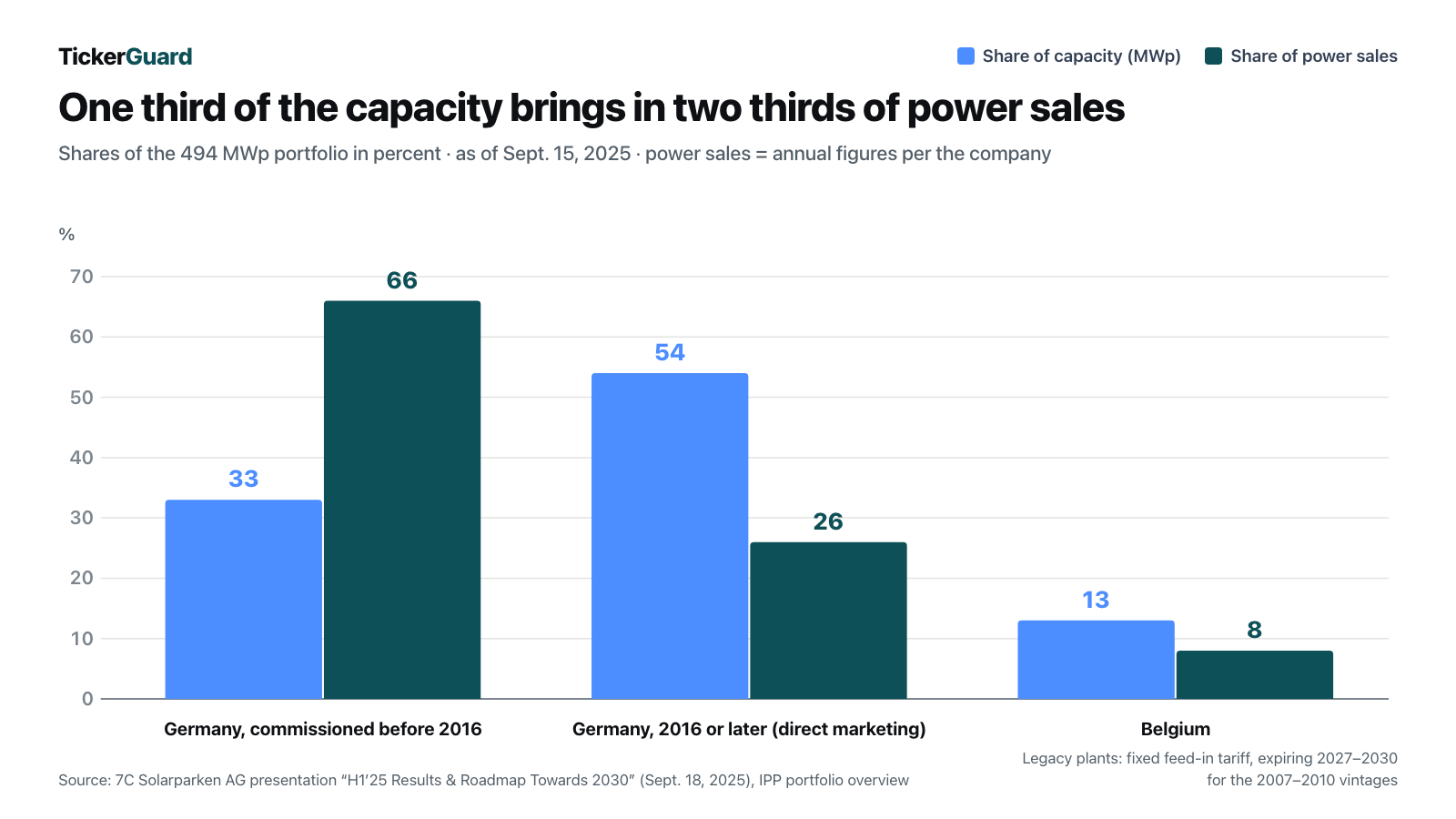
Uncomfortable truth no. 1: A third of the plants bring in two thirds of power sales — and are losing their tariffs
This is the core of the analysis, and the company does not hide it. In its Roadmap 2030 presentation of September 18, 2025, 7C Solarparken broke down its portfolio: the German plants connected before 2016 with a fixed feed-in tariff had 165 MWp of capacity — a third of the portfolio. Yet they brought in €43 million of €65 million in annual power sales, at €274 per megawatt hour. The newer German plants from 2016 onward, with 265 MWp (20 MWp of which were not yet connected at the time), produced only €17 million, at €68 per megawatt hour. Measured against the portfolio of 494 MWp at the time, the legacy plants accounted for 33 percent of capacity and 66 percent of power sales, the newer German plants for 54 percent of capacity and 26 percent of sales, and the Belgian rooftops for 13 percent of capacity and 8 percent of sales.
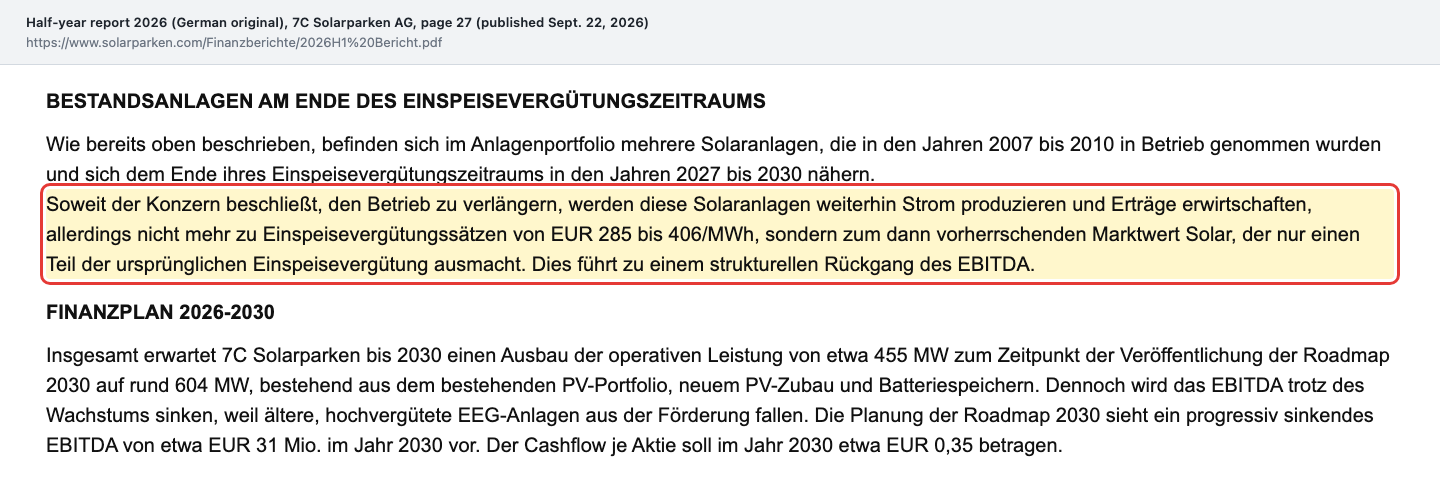
And these legacy plants are losing their subsidy — not someday, but within the next four years. The 2026 half-year report describes it like this:
“Soweit der Konzern beschließt, den Betrieb zu verlängern, werden diese Solaranlagen weiterhin Strom produzieren und Erträge erwirtschaften, allerdings nicht mehr zu Einspeisevergütungssätzen von EUR 285 bis 406/MWh, sondern zum dann vorherrschenden Marktwert Solar, der nur einen Teil der ursprünglichen Einspeisevergütung ausmacht. Dies führt zu einem strukturellen Rückgang des EBITDA.”
Translation: “To the extent the group decides to extend operation, these solar plants will continue to produce power and generate income, but no longer at feed-in tariff rates of EUR 285 to 406/MWh, rather at the then prevailing solar market value, which amounts to only a fraction of the original feed-in tariff. This leads to a structural decline in EBITDA.”
— 7C Solarparken AG, half-year report 2026 (German original), section “Existing plants at the end of the feed-in tariff period,” page 27
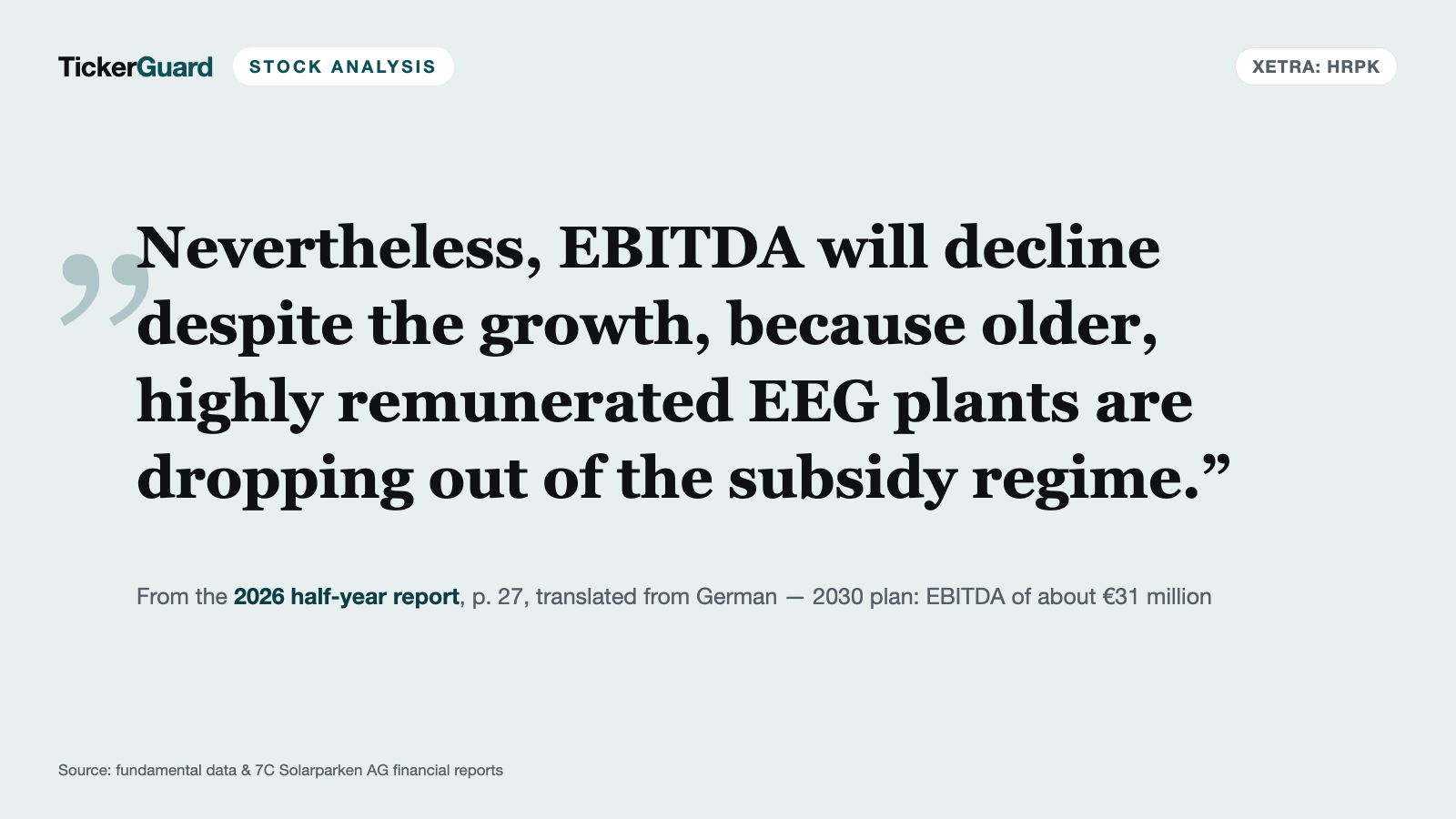
For scale: the solar market value stood at €45 per megawatt hour for full-year 2025 and €44 in the first half of 2026. A plant that currently earns €350 will earn only a fraction of that afterward. The Roadmap spells out what this means for the existing portfolio: revenue from existing plants falls from about €66 million (2025 guidance) to about €40 million in 2030, and their EBITDA from €51 million to €28 million. New solar parks and batteries are meant to add only about €5 million of EBITDA combined by 2030. The half-year report sums it up in one sentence (our translation): “Nevertheless, EBITDA will decline despite the growth, because older, highly remunerated EEG plants are dropping out of the subsidy regime.” All told, the company plans group EBITDA of about €31 million and cash flow per share of about €0.35 for 2030 — and the 2026 half-year report confirms that plan.
What happens to the legacy plants once their tariffs end? They are not torn down: if the group extends operation, they keep running at the market value. On top of that, 7C Solarparken is betting on repowering — newer, more powerful modules on the same land. Since Germany’s “Solar Package I,” modules may be swapped while keeping the feed-in tariff even when they are not defective; according to the 2025 financial statements, however, the additional capacity is not paid at the old high rate. The Roadmap presentation of September 2025 named the Neuhaus-Stetten park, then being rebuilt from 3 to 7 MWp, as the first project. The scale remains modest: for new builds, extensions and repowering, the 2026 half-year report plans about €22 million of investment from 2026 through 2029, contributing about €0.7 million to EBITDA in 2027 and about €1.7 million in 2030, at a targeted return of at least 6 percent. Against a planned decline of almost €29 million, that is a band-aid, not a replacement.
Remember: a fixed feed-in tariff is a lease with an end date. The balance sheet shows the value of the apartment, but the high rent on the oldest parks runs out within four years. If you value 7C Solarparken on its 2025 cash flow, you are valuing a rent that will not exist in that form in 2030.
Uncomfortable truth no. 2: Market prices are eating into the younger plants — and into book value
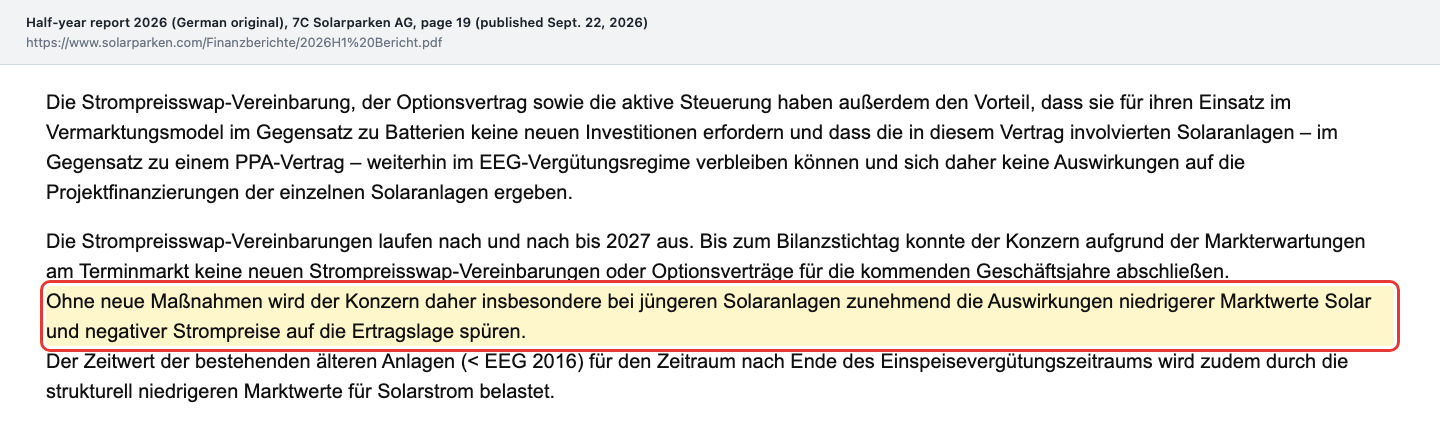
The younger plants from 2016 onward have a different problem. They sell their power on the exchange through a direct marketer and receive a premium from the grid operator up to their guaranteed value. During stretches of negative power prices — when sunny middays produce more electricity than is needed — that premium disappears once the negative prices last six, four or even just one hour, depending on the plant’s vintage. In 2025, Germany saw a record 575 hours of negative prices. By the company’s own count, that directly cost 7C Solarparken only about €0.8 million in 2025 — the real burden lies elsewhere: in the prices achievable without a hedge. The half-year report is blunt about it:
“Ohne neue Maßnahmen wird der Konzern daher insbesondere bei jüngeren Solaranlagen zunehmend die Auswirkungen niedrigerer Marktwerte Solar und negativer Strompreise auf die Ertragslage spüren.”
Translation: “Without new measures, the group will therefore increasingly feel the effects of lower solar market values and negative power prices on its earnings, particularly at its younger solar plants.”
— 7C Solarparken AG, half-year report 2026 (German original), section “Marketing model of the German portfolio,” page 19
This outlook feeds directly into the book value that the bargain argument rests on. The balance-sheet value of a solar park is not a fixed number but a calculation: future revenue, discounted at an interest rate. If expected prices fall or rates rise, the value drops. In 2025, 7C Solarparken therefore booked €21.2 million of impairments — €20.2 million on solar and wind parks and €1.0 million on goodwill and project rights — and management cut its long-term assumption for the solar power price through 2030 to €40 per megawatt hour. The consolidated financial statements name the reasons:
“Wesentliche Einflussfaktoren waren dabei die zunehmende Häufigkeit von Zeiträumen mit negativen Strompreisen, die sich bereits im Zeitraum der Einspeisevergütung belastend auswirkt, sowie die verringerte erwartete Ertragskraft der Solarparks für den Zeitraum nach Auslaufen der Einspeisevergütung.”
Translation: “Key factors were the increasing frequency of periods with negative power prices, which already weighs on results during the feed-in tariff period, and the reduced expected earning power of the solar parks for the period after the feed-in tariff expires.”
— 7C Solarparken AG, consolidated financial statements 2025 (German original), management report, section “Depreciation and impairments”
In the first half of 2026 another €5.4 million followed (prior-year half: €14.8 million), this time not because of weaker price expectations but because the discount rate used for valuation rose from 5.87 to 6.82 percent. Book value per share still edged up from €2.66 to €2.71 — partly because buybacks below book value support it. Remember: book value is not a floor but an estimate, and it has been revised down three times in 18 months.
Uncomfortable truth no. 3: Reuden Süd — a fraud that ended well but cost money
The story of the Reuden Süd park, one of Germany’s largest solar rooftops at 20 MWp, shows that even a seemingly boring business holds surprises. In June 2023, 7C Solarparken bought the stake in the project company; a shareholder loan of about €5.3 million was assigned and paid for immediately, while the partnership interests themselves were only to transfer after grid connection. Construction stalled. After 7C took over management of the project company in June 2024, a third-party investor came forward claiming that the stake and the loans had already been pledged to him as collateral in 2021. The 2025 financial statements sum it up:
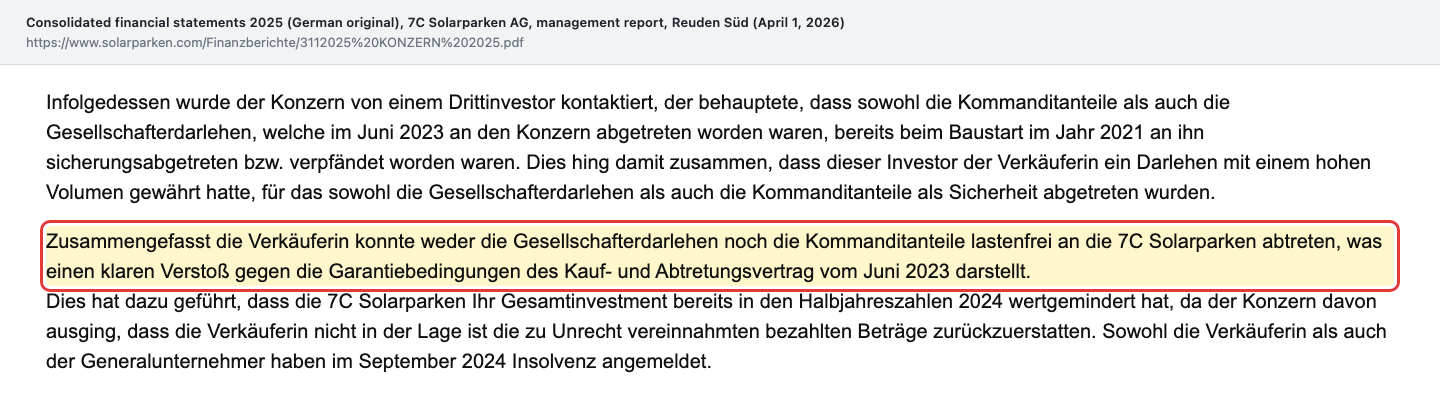
“Zusammengefasst die Verkäuferin konnte weder die Gesellschafterdarlehen noch die Kommanditanteile lastenfrei an die 7C Solarparken abtreten, was einen klaren Verstoß gegen die Garantiebedingungen des Kauf- und Abtretungsvertrag vom Juni 2023 darstellt.”
Translation: “In summary, the seller could assign neither the shareholder loans nor the limited partnership interests to 7C Solarparken free of encumbrances, which constitutes a clear breach of the warranty terms of the purchase and assignment agreement of June 2023.”
— 7C Solarparken AG, consolidated financial statements 2025 (German original), management report, section “Goals and strategies,” Reuden Süd
The seller and the general contractor filed for insolvency in September 2024, and their managing directors later did so personally as well. 7C Solarparken wrote off the receivable, a €5.4 million hit to 2024 EBITDA, and does not expect meaningful recoveries from the insolvencies. In February 2026 the CEO addressed it openly (our translation): “Despite the fraud uncovered in 2024 …” The good news: 7C did not give up on the project. In 2025 the group reached settlements with the bank, the third-party investor and the insolvency administrators totaling €3.8 million, set a completion budget of €7.9 million and brought the park online in March 2026. It receives three fixed auction tariffs, together about €87 per megawatt hour, through 2042 according to the 2025 financial statements, and is expected to generate at least €1.5 million of revenue a year.
The lesson cuts both ways. Management resolved a tangled situation with persistence. But the contract structure, in which money flowed before the stake was transferred, turned out to be the weak spot: the seller’s warranties proved worthless because the seller went bankrupt. And measured against expected annual revenue of about €1.5 million, the park has tied up a lot of money.
Uncomfortable truth no. 4: Buybacks instead of dividends — and who is tendering the shares
7C Solarparken paid no dividend for fiscal 2024 or 2025; instead it buys back its own shares as long as they trade below book value. That is arithmetically consistent — buying back a euro of book value for 67 cents raises book value per remaining share. From April 2025 through June 30, 2026, the group repurchased 8,136,776 shares for €14.87 million, about €1.83 apiece. 2.5 million of them were canceled on July 27, 2026, leaving 78,867,767 shares. Another program for up to 2.25 million shares at no more than €1.90 has been running since August 5 and ends by December 23, 2026 at the latest; 157,021 shares had been bought by September 18. The Roadmap calls for annual buybacks of up to about €8 million, with fewer than 65 million shares outstanding by 2030.
What is revealing is who stands on the other side. In May 2026, 7C Solarparken offered all shareholders to buy back up to 1,744,249 shares at €1.90 — according to the company, about 5 percent above the price of the preceding ten trading days. Shareholders tendered 6,696,310 shares, 8.2 percent of the share capital; only 26 percent of each tender could be accepted. One of the sellers was the CEO himself:
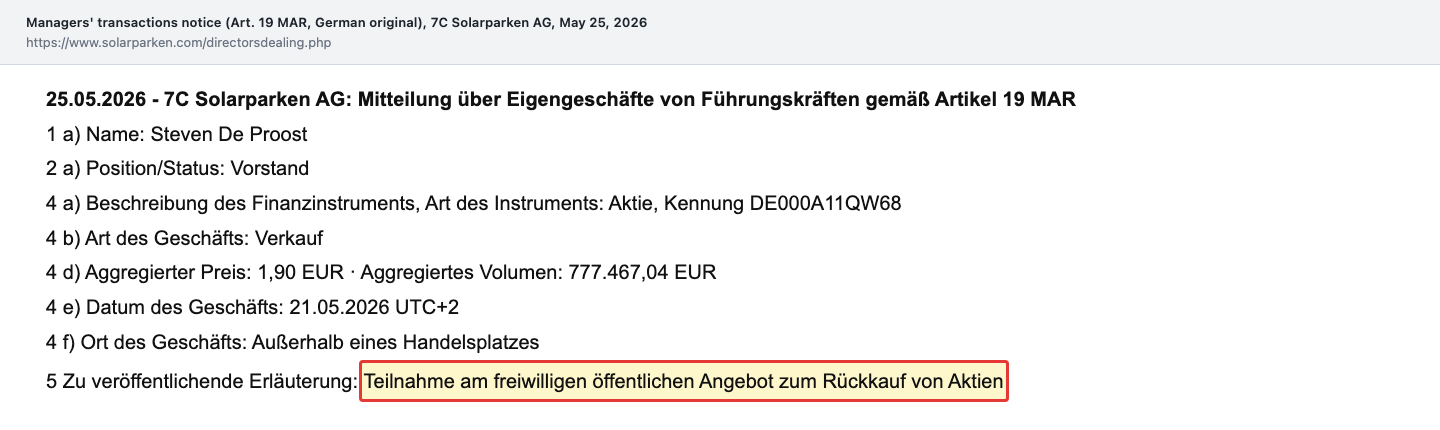
“Teilnahme am freiwilligen öffentlichen Angebot zum Rückkauf von Aktien”
Translation: “Participation in the voluntary public share buyback offer”
— 7C Solarparken AG, managers’ transactions notice of May 25, 2026 (German original; Steven De Proost, sale at €1.90, volume €777,467.04, trade date May 21, 2026)
This is legal and properly disclosed — the offer applied equally to all shareholders. Fairness also requires the full picture: De Proost had bought shares worth about €425,000 at €1.50 to €1.60 between October and December 2025, and bought another roughly €170,000 at €1.65 to €1.72 on June 30 and July 1, 2026. CFO Koen Boriau also sold €40,830 into the offer — after buying about €82,600 worth at €1.55 to €1.60 between October and December 2025. The message is still different from the book-value argument: at €1.90, holders of 8.2 percent of the capital wanted out, and the CEO was among them. When the buyback is the stock’s most important buyer, it pays to look at how many sellers are waiting for it.
Valuation: cheap on today’s numbers, less cheap on 2030’s
At €1.805 (closing price on September 25, 2026) and about 73.1 million shares outstanding — 78,867,767 shares minus about 5.8 million treasury shares — 7C Solarparken had a market value of roughly €132 million. Adding net debt of €87.4 million (June 30, 2026, company definition) gives about €219 million. That is about 4.4 times expected 2026 EBITDA of €50 million, and the share price is 3.6 times expected 2026 cash flow per share of €0.50. The price-to-earnings ratio is meaningless because impairments distort net income: 2025 closed with a loss, and the first half of 2026 with earnings of zero euros per share.
Those are low multiples — on today’s numbers. Put the 2030 plan next to them and the picture changes: at cash flow per share of about €0.35, today’s price would be 5.2 times. The Roadmap projects about €165 million of cumulative net cash flow for 2026 through 2030, more than today’s market value. But about €96 million of that is earmarked for debt repayment and about €60 million for capital spending, mainly on batteries and new solar parks. The rest, plus existing liquidity, funds the buybacks. On June 30, 2026, the group held €68.2 million in cash, €13.9 million of it restricted for project reserves and guarantees.
The professionals’ view is thin: in our fundamental data a single analyst firm publishes a price target, €2.50 (as of September 27, 2026). One voice is not a market consensus. The company offers its own comparison in its half-year presentation of September 22, 2026: British solar funds traded below book value there as well, such as NextEnergy Solar Fund at 0.67 times and Foresight Solar Fund at 0.73 times, while takeovers in the sector went through at 0.9 to 1.1 times book value, according to 7C Solarparken. That is an argument for catch-up potential — and at the same time a reminder that the discount to book value is widespread across the industry. And the book value on which the bargain argument rests is exactly the figure that has been revised down three times in the past 18 months. A warrant bond with an exercise price of €3.75 per share sits far above the market price and is currently not dilutive.
Opportunities and risks at a glance
What speaks for 7C Solarparken:
- A highly predictable business: 90.8 percent EBITDA margin in 2025, cash flow per share of €0.59; 2026 guidance (€50 million EBITDA, €0.50 cash flow per share) was confirmed on September 22, 2026.
- Debt has been falling for years: net debt from €176.5 million (end of 2021) to €87.4 million (June 30, 2026), equity ratio 44.5 percent.
- The stock trades at about two thirds of book value of €2.71 per share; buybacks below book value raise the value per remaining share.
- Reuden Süd is online after the fraud case; €26 million of investment in batteries and new parks is contractually committed for 2026 and 2027.
- The market backdrop improved in the first half of 2026: fewer negative-price hours (295 instead of 389) and a higher solar market value (€44 instead of €36 per megawatt hour).
What speaks against it:
- Two thirds of power sales come from 165 MWp of legacy plants whose fixed tariffs of €285 to €406 per megawatt hour end between 2027 and 2030 for the 2007 to 2010 vintages.
- The company itself plans for EBITDA to decline: about €31 million in 2030 after €59.6 million in 2025, with cash flow per share of about €0.35.
- Impairments of €21.2 million (2025) and €5.4 million (first half of 2026) show how sensitive book value is to prices and interest rates; 2025 ended with a group loss.
- Price hedges run out by 2027; without new hedges, the younger plants feel low market prices and negative power prices directly.
- The Reuden Süd fraud cost money and exposed a weakness in the contract structure: money flowed before the stake was transferred; in May 2026 the CEO sold shares worth €777,467 into the company’s own buyback offer.
A human conclusion
Back to the flea market. The find is real: 7C Solarparken is no swindle but a well-run power producer with falling debt, a clean audit opinion and a stock that costs less than its balance-sheet equity. But the flea-market reflex only asks, “How much am I paying for a euro of book value?” — and for this company that is the wrong question. The right one is: How much cash will these parks still generate once the oldest leases expire over the next four years — and is that enough to justify today’s price, even if only about €0.35 of cash flow per share is left in 2030? Management has written its answer into the Roadmap as a number; the market has written its answer into the share price. Whether the gap is an opportunity or a value trap depends on whom you believe. What you make of it is your decision. And that is exactly as it should be.
If you want to see how another German renewables company fares — one that mainly develops wind and solar parks itself and sells some of them — read our Energiekontor analysis.
Sources
All original documents used in this analysis — so you can check them yourself (mostly in German):
- 7C Solarparken AG — half-year report 2026 (as of June 30, 2026, published September 22, 2026) — latest periodic report; source for half-year figures, marketing model, Roadmap status, guidance, treasury shares and subsequent events
- 7C Solarparken AG — press releases on the first half of 2026 (September 22, 2026), Q1 2026 (June 2, 2026), fiscal 2025 (April 1, 2026), the price hedge (March 6, 2026) and Reuden Süd (February 24, 2026)
- 7C Solarparken AG — consolidated financial statements and management report 2025 (April 1, 2026, unqualified audit opinion by RSM Ebner Stolz) — source for impairments, Reuden Süd and the risk report
- 7C Solarparken AG — consolidated financial statements 2021 through 2024 (financial reports on solarparken.com) — source of the multi-year figures
- 7C Solarparken AG — investor presentation on the 2026 half-year results (September 22, 2026, English) — source for the book-value comparison with peers
- 7C Solarparken AG — presentation “H1’25 Results & Roadmap Towards 2030” (September 18, 2025, English) — source for the portfolio breakdown and the financial plan through 2030
- 7C Solarparken AG — ad-hoc notices on the buybacks (January 13, April 27 and August 4, 2026) and result of the public buyback offer (May 21, 2026)
- 7C Solarparken AG — managers’ transactions (notices from October 2025 through July 2, 2026) and voting-rights notices (latest September 14, 2026; accessed September 27, 2026)
- Fundamental data (closing price of €1.805 on September 25, 2026, analyst price target), checked against the share count from the half-year report, the voting-rights notice and the buyback list.
Transparency & disclaimer: This analysis is a journalistic contextualization of publicly available information and is not investment advice, not a financial analysis in the regulatory sense and not a solicitation to buy or sell securities. Investing in stocks involves substantial risk, up to and including total loss. All information without guarantee; the data date is noted in the text. Positions held by the operator are disclosed daily; where one exists, it appears as a notice at the top of this deep dive.
Our Bottom Line at a Glance
- Predictable cash flows positive
- EBITDA margin of 90.8% and cash flow per share of €0.59 in 2025; first-half 2026 EBITDA of €28.9M beat the company’s own plan (€27M); 2026 guidance confirmed on September 22, 2026.
- Balance sheet and deleveraging positive
- Net debt cut from €176.5M (end of 2021) to €87.4M (June 30, 2026), equity ratio 44.5%; 2025 financial statements received an unqualified audit opinion.
- Legacy tariff expiry negative
- 165 MWp of legacy plants bring in €43M of €65M in power sales (as of September 15, 2025); for the 2007–2010 vintages tariffs end in 2027–2030. 2030 plan: EBITDA about €31M, cash flow per share about €0.35.
- Market prices and book value negative
- Impairments of €21.2M (2025) and €5.4M (H1 2026); group net loss of €6.5M in 2025. Price hedges run out by 2027, and no new ones had been signed as of June 30, 2026.
- Execution and controls neutral
- Reuden Süd fraud: a receivable of about €5.3M written off in 2024, settlements of €3.8M; the 20 MWp park has been online since March 2026.
- Capital allocation and valuation neutral
- Price €1.805 (September 25, 2026) against book value of €2.71 per share; buybacks instead of dividends. In the May 2026 buyback offer, 8.2% of the capital was tendered, including by the CEO.
7C Solarparken is a soundly financed power producer with highly predictable revenue, falling debt and a stock below book value. But two thirds of its power sales depend on legacy plants whose fixed tariffs end between 2027 and 2030, and the company itself plans EBITDA of only about €31 million for 2030. Not investment advice.
What Our Rating Means
Open questions
The business works in principle, but one material question is open. As long as it stays open, our findings do not carry a quality verdict.
Yellow here does not signal a threat to the company itself — the balance sheet is sound, debt is falling, the 2025 accounts carry an unqualified audit opinion and the parks generate reliable cash. What remains open is the key operating question of whether the business can absorb the expiry of its high legacy tariffs: the company itself plans for EBITDA to fall from €59.6 million (2025) to about €31 million (2030), with batteries and new parks adding only about €5 million by then — and that has yet to be proven. On top come impairments that have cut book value several times since 2025 and the Reuden Süd fraud case. That the stock trades below book value is a price argument, not a quality argument, and does not change this rating. The decision is yours.
A journalistic assessment by our editorial team at the time of the deep dive, based on public sources — not investment advice and not a solicitation to buy or sell. Your personal circumstances (investment goals, risk capacity, taxes) cannot be taken into account. What our levels mean, how verdicts are formed, and what conflicts of interest exist →
Worth Noting
- Version of September 27, 2026, based on the 2026 half-year report (published September 22, 2026), the 2025 consolidated financial statements, the Roadmap 2030 of September 18, 2025, and statutory notices through September 18, 2026. The hook is the ranking of most-discussed stocks on wallstreet-online — an attention signal, not a data source.
- 7C Solarparken does not report to the U.S. securities regulator, the SEC; all evidence comes from the company’s reports and notices on solarparken.com, published in German only — quotes appear in the German original with our translation. The half-year report is unaudited. The portfolio breakdown by vintage comes from the presentation of September 18, 2025.
- Net debt per the company’s definition; lease liabilities of €37.5 million (June 30, 2026) come on top. Market value is our own calculation from shares outstanding net of treasury shares and the closing price of September 25, 2026.
The full analysis as a PDF for later
We will send you this analysis as a PDF — to print, file away, and read at your own pace.
Frequently Asked Questions
7C Solarparken (Xetra: HRPK) owns and operates solar and wind parks in Germany and Belgium with 504 MWp of capacity (June 30, 2026) and sells the power. Nearly the entire German portfolio receives a fixed feed-in tariff for 20 years under Germany’s Renewable Energy Sources Act; in 2025 revenue was €65.7 million and EBITDA €59.6 million.
About two thirds of power sales come from legacy plants connected before 2016 that receive high fixed tariffs. For the 2007 to 2010 vintages, at €285 to €406 per megawatt hour, those tariffs end between 2027 and 2030; afterward only the market price applies. The company therefore plans EBITDA of about €31 million for 2030.
No. There was no dividend for fiscal 2024 or 2025; the last payouts were €0.12 per share for 2022 and €0.06 for 2023. Instead the company buys back its own shares: 8,136,776 shares for €14.87 million through June 30, 2026. Another program runs until December 23, 2026 at the latest.
Yes. On June 30, 2026, book value was €2.71 per share according to the company, and the closing price on September 25, 2026, was €1.805 — roughly two thirds. Book value is an estimate, though: in 2025 and the first half of 2026, solar parks, goodwill and project rights were written down by a combined €26.6 million as price expectations fell and interest rates rose.
In 2023, 7C Solarparken paid about €5.3 million for a loan to the project company that turned out in 2024 to have already been pledged to a third party; the seller and the builder went bankrupt. After settlements totaling €3.8 million, 7C completed the 20 MWp park itself. It has been online since March 2026.
Net debt was €87.4 million on June 30, 2026, according to the company, down from €176.5 million at the end of 2021; the equity ratio was 44.5 percent. Most financial debt consists of project loans at individual solar parks. Net debt is set to rise again by the end of 2026 due to battery investments; the company targets €39 million by 2030.
Found an error?
Did you spot a factual error, an outdated number, or a typo in this deep dive? Let us know briefly — your report goes straight to the editorial team.