Energiekontor Stock: a Half-Year in the Red — and Guidance That Still Promises 40 to 60 Million
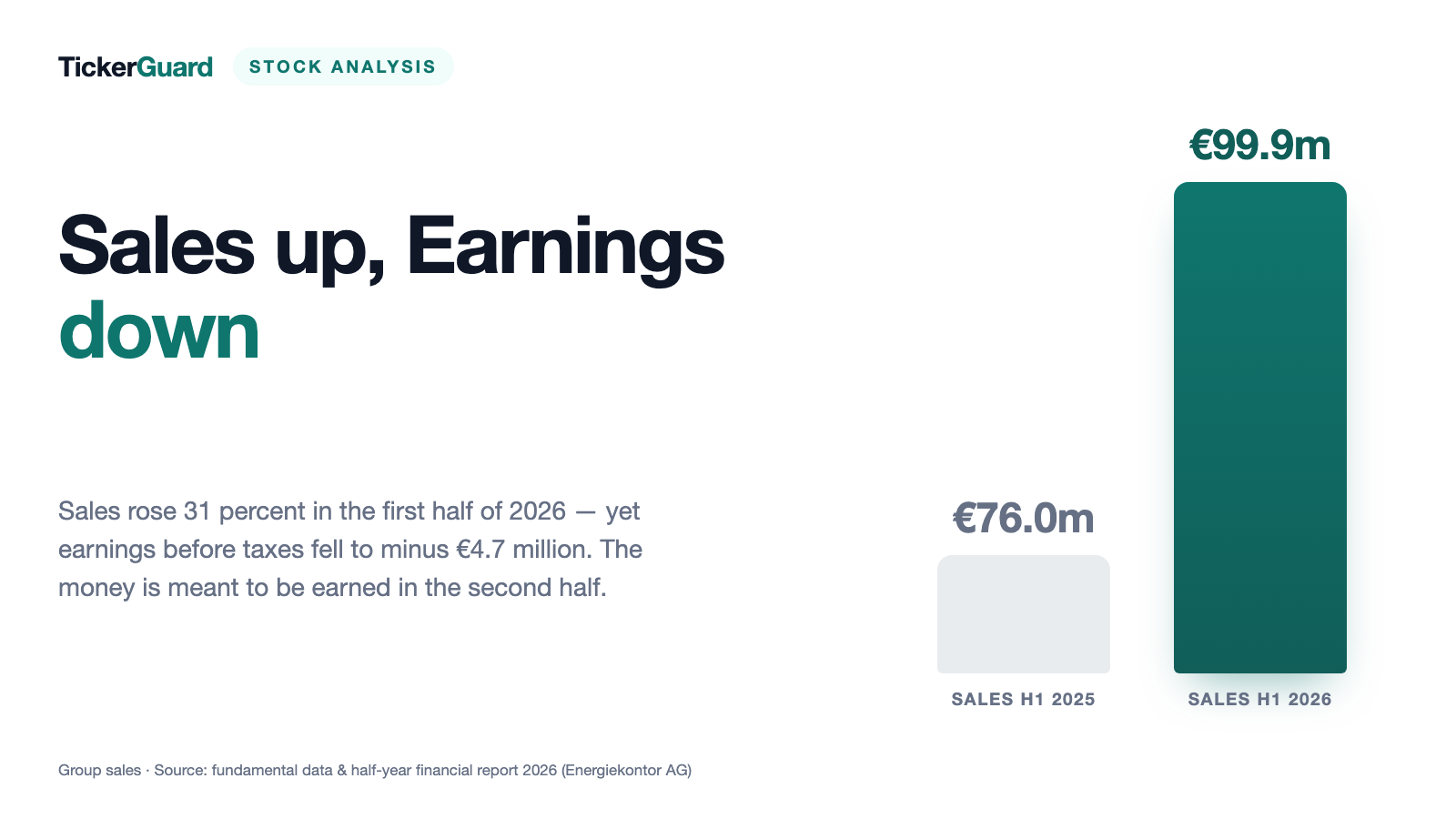
Sales rose 31 percent to €99.9 million in the first half of 2026, and earnings before taxes still fell to minus €4.7 million. Energiekontor is sticking to full-year guidance of €40 million to €60 million anyway. We went looking for what that promise actually rests on.
 Thomas Mücke
Founder & Publisher
Thomas Mücke
Founder & Publisher
Chart
Interactive price chart (TradingView).
Note: pure fact-based analysis, not investment advice and not a solicitation to buy or sell. All figures without guarantee.
There is an investor trap that makes nobody rich and plenty of people nervous: the calendar-slice trap. We cut a company's life into twelve-month slices, put two of them side by side and treat the comparison as a verdict. For most businesses that works. For Energiekontor (Xetra: EKT) it fails systematically — and the half-year financial report published on August 13, 2026 is the best illustration yet. Sales rose 31 percent. Earnings before taxes still went negative. And management is holding on to full-year guidance that could mean nearly double last year's profit. Let us read what the report actually says. What you make of it is your call.
What Energiekontor does: developer and owner at the same time
Energiekontor is based in Bremen, was founded in Bremerhaven in 1990 and has been listed since May 25, 2000. The company plans, builds and sells wind and solar parks in Germany, the United Kingdom, France, Portugal and the United States — and keeps a growing share of them on its own books.
That produces two very different sources of money. The first is the project business: develop a park, get it permitted, build it, sell it. Profitable, but it pays out in lumps — a single sale can turn a quarter around. The second is the owned portfolio: parks Energiekontor keeps and whose electricity it sells. That is the quiet part, a kind of rental income measured in megawatt hours.
At June 30, 2026 that owned portfolio comprised 41 wind and solar parks with around 460.6 megawatts — 34 parks in Germany (around 363 MW), three in the United Kingdom (around 60 MW) and four in Portugal (around 38 MW). A further 226.8 megawatts are under construction and earmarked for the company's own books; the target remains more than 680 megawatts. The group's internal yardstick is earnings before taxes (EBT), and that is the measure its targets are set in.
How the stock landed on our desk
Energiekontor appeared among the most-discussed names on the German wallstreet-online forum in July 2026, alongside far more speculative stocks. That is an attention signal, not a reason to buy. The contrast was what made it interesting: no collapse story, no lottery ticket, but a company that has been profitable for decades. That is why we looked at it — and why we updated this analysis on August 13, 2026 with the fresh half-year numbers.
The numbers over the years, given their due
First the part that genuinely impresses: Energiekontor makes money, year after year. In 2025 sales came to €167.9 million (2024: €126.5 million), EBITDA to €86.1 million and earnings before taxes to €40.5 million (2024: €36.2 million). Net profit was €41.0 million and earnings per share €2.94.
Then put 2023 next to it: €241.8 million of sales, €95.5 million of EBT, €5.97 per share. Between 2023 and 2024 profit almost halved — not because the business broke down, but because large project sales slid into a different calendar year.
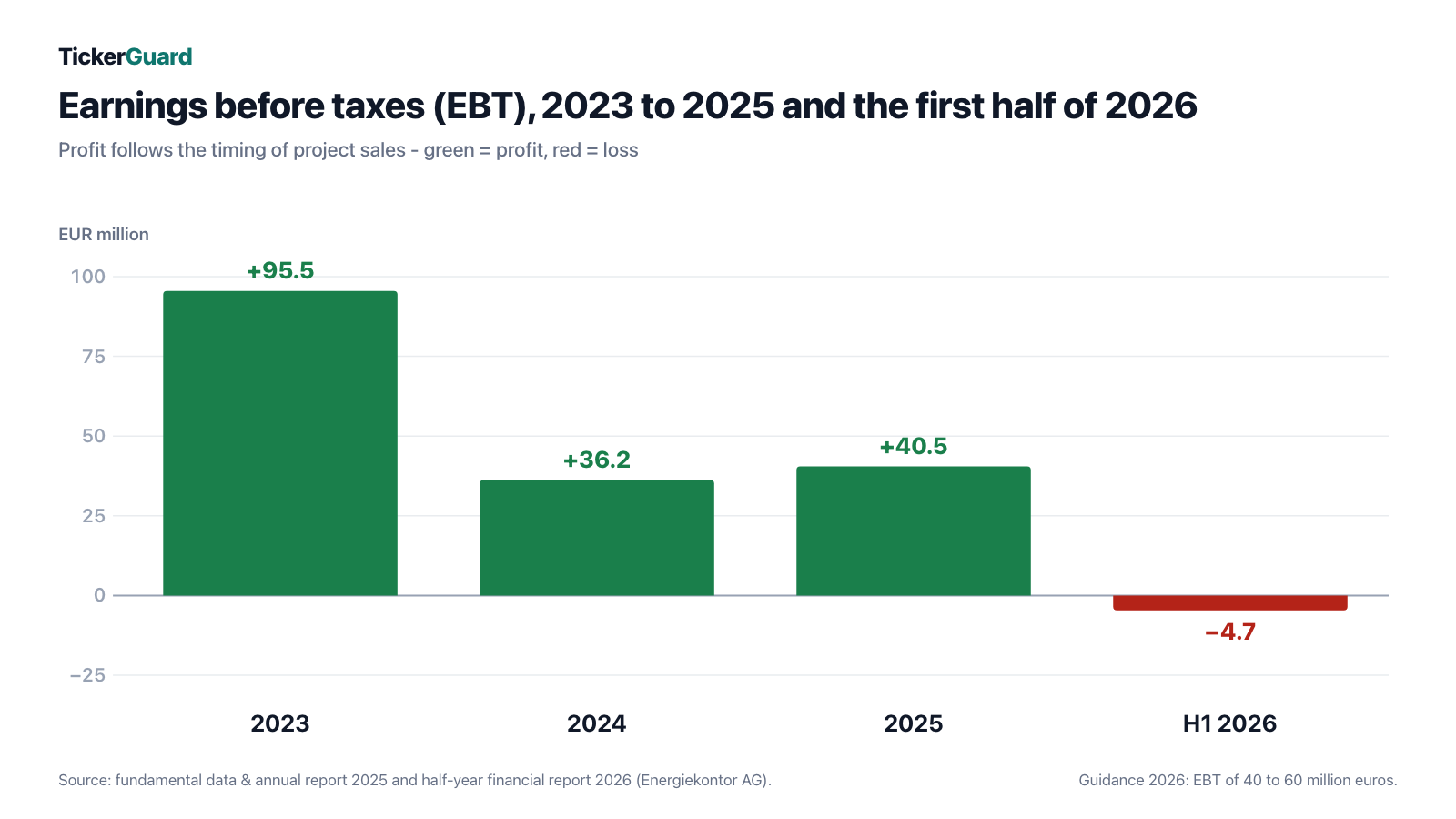
Energiekontor makes no secret of the mechanism. The August 2026 letter to shareholders puts it in one sentence:
"Experience has shown that significant earnings contributions are predominantly realised in the second half of the year, and in some cases not until towards the end of a financial year."
— Energiekontor AG, half-year financial report 2026, letter to the shareholders, page 8
The first half of 2026: more sales, less profit
On August 13, 2026 Energiekontor reported the numbers for January 1 to June 30, 2026. Sales rose 31 percent to €99.9 million (prior-year period: €76.0 million) and total income to €182.8 million (€171.5 million). From there the line points down: EBITDA of €21.1 million (€51.0 million), EBIT of €10.1 million (€39.3 million) and earnings before taxes of minus €4.7 million after plus €28.3 million. The net loss was €5.3 million, or €0.38 per share.
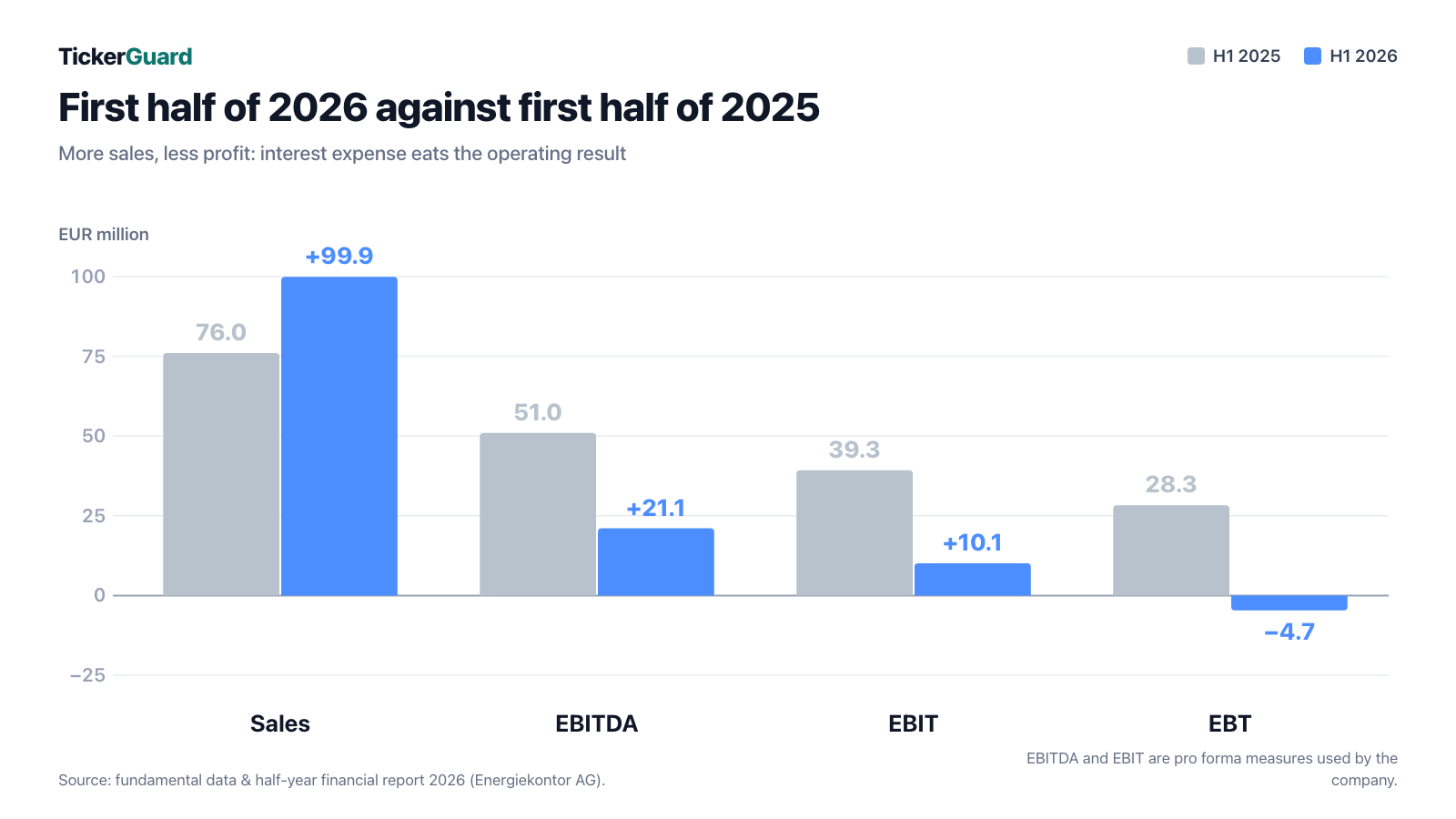
Operationally the half-year was anything but weak. Four wind parks totalling around 88 megawatts went online — the repowered Oederquart, Strathrory in Scotland, Holtumer Moor and Drensteinfurt-Rieth. Three projects with around 56 megawatts reached financial close. At June 30, 2026, 20 projects with around 609 megawatts were under construction or had reached financial close, on top of 33 building permits covering around 1.2 gigawatts. Own power generation improved too: around 329 gigawatt hours against 287 in the prior-year period.
The catch is that building costs money first. The earning happens on sale and handover — and this year almost all of those are still ahead.
Uncomfortable truth no. 1: interest eats the operating profit
At Energiekontor the gap between EBIT and EBT is not a rounding difference but an interest bill. In the first half of 2026, an operating result of €10.1 million faced interest expenses of €16.1 million (prior-year period: €12.8 million). The financial result was minus €14.7 million after minus €11.0 million.
In plain terms: interest coverage — how many times operating profit pays the interest — was about 0.6 for the half-year. The operating business produced roughly 60 cents for every euro of interest. Full-year 2025 looked different (EBIT of €65.4 million, EBT of €40.5 million) because the sale gains landed. That is exactly why the interest bill is the quiet metronome: it runs every day, while the income arrives in bursts.
The cause is on the balance sheet. At June 30, 2026 non-current financial liabilities stood at €409.1 million (December 31, 2025: €378.6 million) and current financial liabilities at €390.1 million (€365.1 million). A large part of that is project finance tied to individual parks — but the interest is real all the same.
Uncomfortable truth no. 2: the pipeline is shrinking, on purpose
For years the growing project pipeline was the showpiece. At June 30, 2026 it got smaller for the first time: 11,287 megawatts excluding US project rights (December 31, 2025: 11,574 megawatts), or around 11.9 gigawatts including the 602 megawatts of US solar rights, after around 12.2 gigawatts at the end of 2025. That is 287 megawatts, or 2.5 percent, less.
The report explains it head-on:
"The slight decline is primarily attributable to the decision not to pursue certain projects in the early stages of development as part of the ongoing prioritisation of the project pipeline."
— Energiekontor AG, half-year financial report 2026, chapter "Our valuable project pipeline", page 16
As reasons the report names the marked decline in German auction prices and the still unclear effect of the German Renewable Energy Sources Act amendment from 2027 and the grid connection package. You can read that as discipline — fewer projects, but ones that pencil out. You should not read it as a good sign for market prices: when auctions are so oversubscribed that projects stop working economically, that is an industry finding, not a company finding.
The core held up, though. In the advanced development phases three to five, where roughly 90 percent of the value is created, 3.0 gigawatts remained at June 30, 2026 (December 31, 2025: 3.1 gigawatts) — unchanged at around 27 percent of the pipeline. By region, 59.1 percent sits in Germany, 26.2 percent in the United Kingdom, 8.9 percent in France, 5.1 percent in the United States and 0.7 percent in Portugal.
Uncomfortable truth no. 3: the equity base is thinning
The balance sheet grew at June 30, 2026 — but at different speeds on each side. Total assets rose to €1,127.5 million (December 31, 2025: €1,077.9 million) while equity fell to €201.3 million (€224.7 million). The equity ratio dropped from 20.8 percent to 17.9 percent.
Two things belong in the picture for fairness. First, Energiekontor paid its dividend in May 2026 — money that leaves on plan. Second, the group also reports a notional equity ratio that treats non-recourse project finance differently; it stood at 25.2 percent after 29.0 percent. Both measures point the same way.
Liquidity fell as well: cash and securities together came to €178.0 million after €194.6 million at year-end. Operating cash flow was minus €26.0 million after plus €18.6 million in the prior-year period. For a project developer in a construction phase that is explainable. As a permanent state it would not be.
The 2028 plan — and how its wording has shifted
The growth target has been in place since fiscal 2022: consolidated EBT is to reach around €120 million by 2028, starting from the 2023 base year — an average of around 15 percent a year. The Q1 2026 statement still put it exactly like that:
"The company aims to increase its Group EBT by an average of 15 percent per year in the period from 2023 to 2028."
— Energiekontor AG, quarterly statement Q1 2026
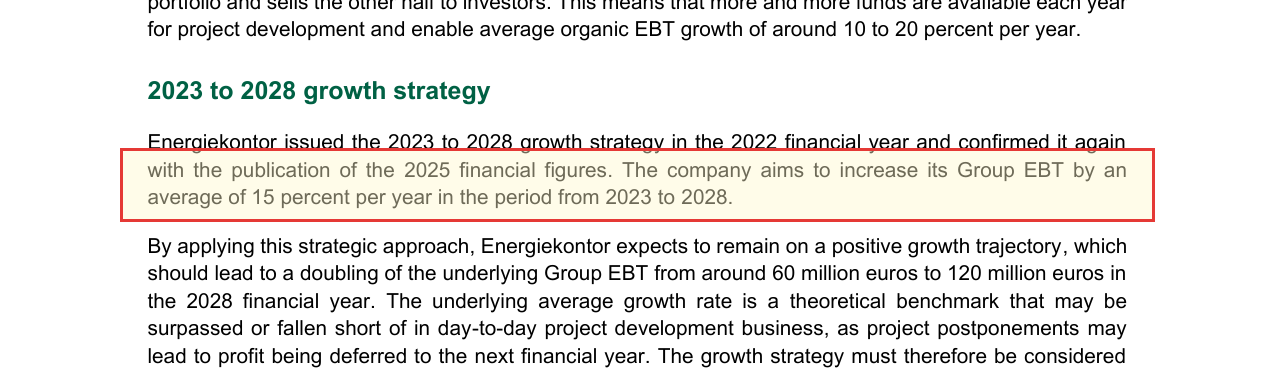
The half-year financial report 2026 still carries the target — but it has picked up a sentence that was not there before:
"The regulatory and market conditions have changed and become more complex since the strategy was adopted."
— Energiekontor AG, half-year financial report 2026, chapter "Outlook", page 42
That is not an abandoned target, but it is not nothing either. "We grow 15 percent on average" has become "we are sticking to the target and reviewing implementation continuously". Anyone taking the roadmap seriously should take that sentence seriously too.
What the 2026 guidance actually rests on
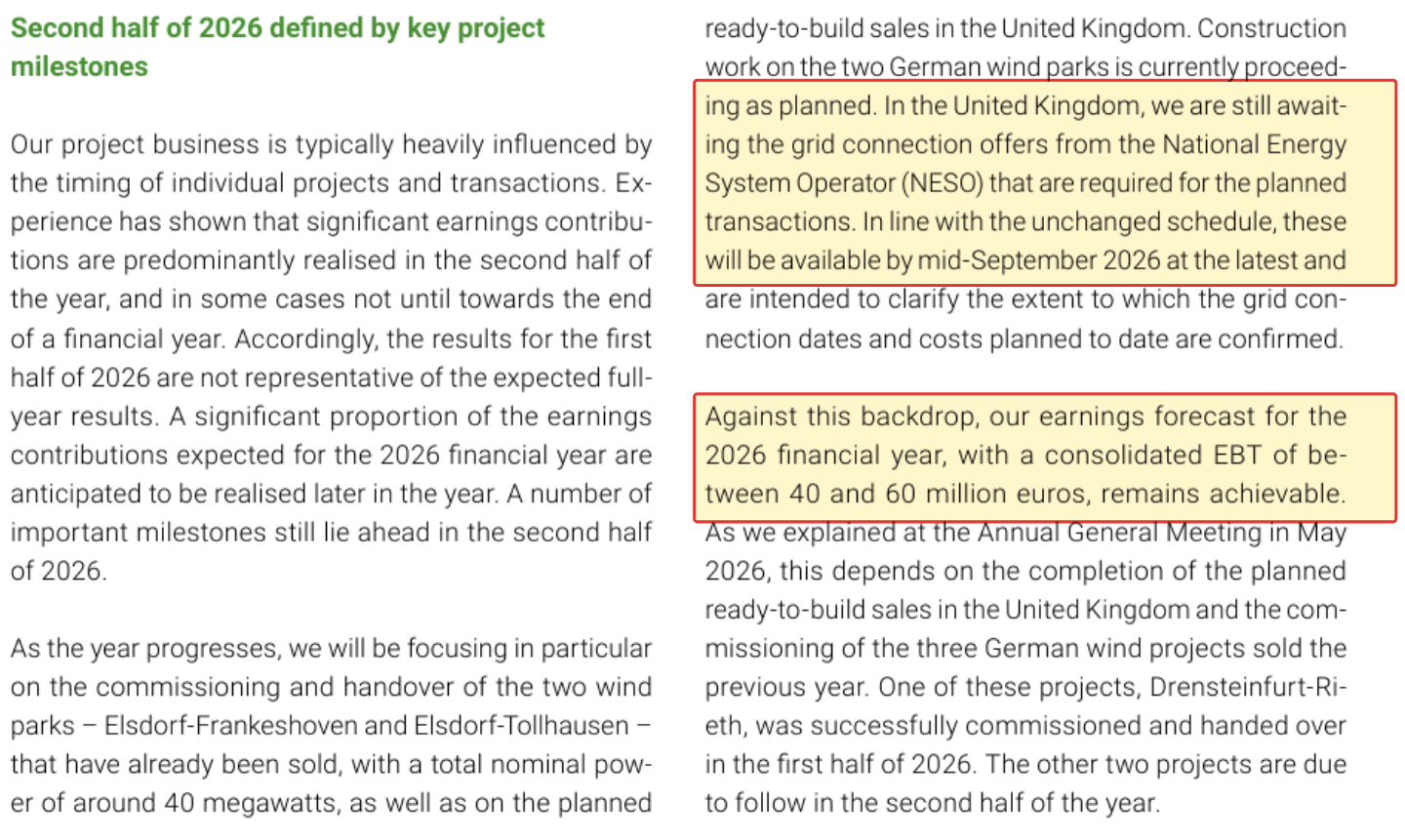
Despite the half-year loss, the expectation for 2026 remains consolidated EBT of €40 million to €60 million. The report names what has to happen: several ready-to-build project sales in the United Kingdom and the commissioning of three German wind projects sold the previous year. One of them — Drensteinfurt-Rieth — was handed over in the first half. The other two, Elsdorf-Frankeshoven and Elsdorf-Tollhausen with around 40 megawatts combined, are still outstanding.
And for the British sales, an outside commitment was still missing at the reporting date:
"In the United Kingdom, we are still awaiting the grid connection offers from the National Energy System Operator (NESO) that are required for the planned transactions. In line with the unchanged schedule, these will be available by mid-September 2026 at the latest and are intended to clarify the extent to which the grid connection dates and costs planned to date are confirmed."
— Energiekontor AG, half-year financial report 2026, letter to the shareholders, page 8
The segment numbers show where the hole sits. In the first half of 2026, segment EBT in project development came to minus €12.9 million (prior-year period: plus €22.9 million). Power generation from the owned parks delivered plus €7.0 million (€4.8 million) and operations management plus €1.3 million (€0.6 million). The quiet part of the business did its job; the lumpy part has not paid out yet.
The dividend: modest, but honest
For 2025 the annual general meeting on May 27, 2026 approved a dividend of €1.00 per share, after €0.50 for 2024. That distribution used around 35 percent of Energiekontor AG's balance sheet profit (2024: around 43 percent). Measured against the June 30, 2026 closing price of €39.00, it works out at roughly 2.6 percent.

The policy is results-driven: more in good years, less in weak ones. That is consistent with a profit that arrives in bursts — and more honest than an artificially smoothed payout funded out of substance.
Alongside that, Energiekontor buys back its own shares. Under the programme launched in July 2025 it acquired 47,314 shares through April 2, 2026 and then cancelled them, cutting the share capital from 13,942,086 to 13,894,772 shares. A new programme dated May 28, 2026 provides for up to 80,000 further shares for a maximum of €9.0 million, running until May 27, 2027 at the latest. There is currently no authorised capital — so the risk of your slice of the cake shrinking through new shares is small.
What the stock actually is
At June 30, 2026 the share closed at €39.00 on XETRA, up from €35.75 at the end of 2025 — a gain of 9.1 percent over the half-year, with a high of €49.80 on May 20 and a low of €30.30 on March 19. Market capitalisation was around €542 million. Against 2025 earnings per share of €2.94, that is a price-earnings ratio of a little over 13.
That 13, though, is a snapshot on a year that need not be representative — precisely the calendar-slice trap from the opening. If guidance landed at the top end (€60 million of EBT), the stock would trade at roughly nine times pre-tax earnings. If it were missed, every multiple would be waste paper. This is not a bargain case like thyssenkrupp and not a bet on a state-made price like Verbio — it is the question of whether you believe the second-half schedule.
One more point on ownership: the two founders, Dr Bodo Wilkens (25.62 percent) and Günter Lammers (25.57 percent), together held more than half of the share capital at June 30, 2026. That brings stability and a long horizon — and it also means outside shareholders never carry a vote on their own.
Opportunities and risks at a glance
Opportunities:
- Around 11.9 gigawatts of project pipeline at June 30, 2026, of which 3.0 gigawatts sit in the advanced phases three to five where roughly 90 percent of the value is created.
- The owned portfolio is growing on plan from 460.6 megawatts to more than 680 megawatts and delivers recurring power revenue — plus €7.0 million of segment EBT in the first half of 2026.
- The German Renewable Energy Sources Act amendment from 2027 provides for higher auction volumes, according to the report — more room for projects.
- Solid cash position: €178.0 million in cash and securities, no authorised capital and a running buyback.
Risks:
- Full-year guidance depends on a handful of transactions for which the NESO grid connection offers were still missing at the reporting date (announced for mid-September 2026 at the latest).
- Interest coverage of roughly 0.6 in the half-year: €16.1 million of interest expense against €10.1 million of EBIT.
- The equity ratio fell from 20.8 percent to 17.9 percent while inventories rose to €472.4 million — more than twice the equity base.
- The pipeline shrank for the first time (minus 287 megawatts) on lower German auction prices and unresolved regulation.
- Weather still matters: wind reached 89.2 percent of the long-term average in Germany and solar irradiation 84.5 percent of the planned value.
A human conclusion
Back to the calendar-slice trap. Judge Energiekontor on the first half of 2026 and you see a loss of €4.7 million and think: crisis. Judge it on 2023 and you saw €95.5 million and thought: gold mine. Both measure the same company with the wrong ruler. The right ruler here is a five-year arc — and the question of whether the firm gets its projects sold at the prices it calculated.
What has changed since our first assessment is not the story but its hardness. Interest is now a genuine opponent of operating profit. Equity is thinner. The pipeline is shrinking for the first time, by choice. And the full-year target visibly hangs on a date in September and two wind park handovers. None of that makes Energiekontor a bad company — it just makes the coming months checkable. The next piece of evidence lands on November 12, 2026 with the nine-month statement.
What you make of it is your decision. And that is exactly how it should be.
Sources
- Energiekontor AG, half-year financial report 2026 (January 1 to June 30, 2026), published August 13, 2026
- Energiekontor AG, company presentation on the first half of 2026 (August 13, 2026)
- Energiekontor AG, quarterly statement Q1 2026
- Energiekontor AG, annual report 2025 (IFRS consolidated accounts)
- Energiekontor AG, overview of all financial reports
Source: fundamental data & Energiekontor AG company reports (annual report 2025, half-year financial report 2026, quarterly statement Q1 2026). Energiekontor is not an SEC filer: there are no annual reports (10-K) and no quarterly reports (10-Q), and all evidence comes from the company's own publications. This analysis is journalism, not investment advice and not a solicitation to buy or sell securities. Shares can fall to a total loss. Positions held by the operator are disclosed daily; where one exists, it appears as a notice at the top of this deep dive.
Our Bottom Line at a Glance
- Substance and growth plan positive
- At June 30, 2026 the pipeline covered around 11.9 GW, of which 3.0 GW sit in the value-heavy phases three to five, alongside 41 owned parks with 460.6 MW and an expansion path above 680 MW. The target of around €120 million of consolidated EBT by 2028 is unchanged.
- Recurring revenue positive
- The owned parks delivered segment EBT of €7.0 million in the first half of 2026 after €4.8 million, on around 329 GWh of power production (prior-year period 287 GWh). This part of the business pays even when no park is sold.
- First-half 2026 result negative
- EBT of minus €4.7 million after plus €28.3 million, a net loss of €5.3 million and a loss per share of €0.38. The project development segment came in at minus €12.9 million after plus €22.9 million in the prior-year period.
- Interest burden negative
- Interest expense of €16.1 million in the half-year (prior-year period €12.8 million) against EBIT of €10.1 million — interest coverage of roughly 0.6. Financial liabilities stood at €409.1 million non-current and €390.1 million current at June 30, 2026.
- Balance sheet neutral
- Equity of €201.3 million and an equity ratio of 17.9 percent after 20.8 percent at December 31, 2025; the notional equity ratio stood at 25.2 percent after 29.0 percent. Inventories were €472.4 million, cash and securities €178.0 million and operating cash flow minus €26.0 million.
- Guidance dependency neutral
- The €40 million to €60 million EBT range for 2026 was confirmed on August 13, 2026 but hangs on few events: ready-to-build sales in the United Kingdom, whose NESO grid connection offers are only expected by mid-September 2026, and two German wind park handovers.
Energiekontor is a project developer that has been profitable for decades, with around 11.9 gigawatts of pipeline, 41 owned parks and a clear target for 2028. The first half of 2026 shows how the model breathes: 31 percent more sales and still minus €4.7 million before taxes, because the company built rather than sold and because €16.1 million of interest expense met €10.1 million of EBIT. Full-year guidance of €40 million to €60 million stands — resting on second-half dates that can be checked. Not investment advice.
What Our Rating Means
Open questions
The business works in principle, but one material question is open. As long as it stays open, our findings do not carry a quality verdict.
Yellow here is not about survival. Energiekontor has been profitable for decades, held €178.0 million in cash and securities at June 30, 2026, carries positive equity of €201.3 million, has no authorised capital and owns a park portfolio that earns money even without a single sale. Yellow stands because one material operating question is open: the entire 2026 result depends on a handful of second-half transactions, and for the British sales the grid connection offers from the grid operator NESO were still missing at the reporting date, expected only by mid-September 2026. Two further numbers deserve watching: interest coverage of roughly 0.6 in the half-year and an equity ratio that fell from 20.8 percent to 17.9 percent, against inventories of €472.4 million. That the pipeline shrank for the first time we read as pricing discipline rather than weakness. The next checkpoint is the nine-month statement on November 12, 2026. The decision is yours.
A journalistic assessment by our editorial team at the time of the deep dive, based on public sources — not investment advice and not a solicitation to buy or sell. Your personal circumstances (investment goals, risk capacity, taxes) cannot be taken into account. What our levels mean, how verdicts are formed, and what conflicts of interest exist →
Worth Noting
- Starting point: Energiekontor appeared among the most-discussed names on the German wallstreet-online forum in July 2026 — an attention signal, not a reason to buy. Updated on August 13, 2026 with the half-year financial report 2026.
- Data cut-off August 13, 2026. The latest period report evaluated is the half-year financial report 2026 covering January 1 to June 30, 2026, published August 13, 2026. Next date: the nine-month statement on November 12, 2026.
- Energiekontor is not an SEC filer: no annual reports (10-K), no quarterly reports (10-Q), no EDGAR identifier. All evidence comes from the company's reports on energiekontor.de, which are published in English.
- The interest coverage of roughly 0.6 is our own calculation: EBIT of €10.085 million divided by interest expense of €16.144 million in the first half of 2026. The group does not report an interest coverage metric itself.
- EBITDA and EBIT are pro forma measures outside German GAAP and IFRS, according to the report, and are only comparable to other companies to a limited extent.
- The notional equity ratio (25.2 percent at June 30, 2026) is a company measure that treats non-recourse project finance differently from the reported ratio of 17.9 percent. Both figures appear in the half-year financial report 2026.
- Easy to confuse: the shorthand EKT.DE simply means "Energiekontor, listed in Germany" and is not an official exchange code. The stock trades in the General Standard segment, not in the Prime Standard.
The full analysis as a PDF for later
We will send you this analysis as a PDF — to print, file away, and read at your own pace.
Frequently Asked Questions
Because the half-year was mostly construction and almost no selling. Sales rose to €99.9 million, yet earnings before taxes came in at minus €4.7 million. The project development segment posted minus €12.9 million, while the owned parks contributed plus €7.0 million.
Yes. The half-year financial report 2026 still describes consolidated EBT of €40 million to €60 million as achievable. It depends on several ready-to-build project sales in the United Kingdom and the commissioning of two German wind parks already sold, both in the second half.
A large part of the result comes from selling individual parks, and the timing of those sales decides which year the profit lands in. Earnings before taxes were €95.5 million in 2023, €36.2 million in 2024 and €40.5 million in 2025.
At June 30, 2026 it covered 11,287 megawatts excluding US project rights, or around 11.9 gigawatts including the 602 megawatts of US solar rights. At the end of 2025 it was around 12.2 gigawatts. The 287 megawatt decline came from deliberately dropped early-stage projects.
At June 30, 2026 equity stood at €201.3 million and the equity ratio at 17.9 percent, down from 20.8 percent at the end of 2025. Cash and securities added up to €178.0 million. Operating cash flow was negative at minus €26.0 million.
The annual general meeting on May 27, 2026 approved €1.00 per share for 2025, after €0.50 for 2024. That is around 35 percent of the parent company's balance sheet profit (2024: around 43 percent) and roughly 2.6 percent against the June 30, 2026 closing price of €39.00.
It closed at €39.00 on June 30, 2026, giving a market value of around €542 million. Against 2025 earnings per share of €2.94 that is a price-earnings ratio of a little over 13. The yardstick swings sharply from year to year with the result.
No. Energiekontor is a German stock corporation in the General Standard segment of the Frankfurt Stock Exchange and a member of the SDAX. There are no annual reports (10-K) and no quarterly reports (10-Q). All evidence comes from the company's own reports on energiekontor.de.
Found an error?
Did you spot a factual error, an outdated number, or a typo in this deep dive? Let us know briefly — your report goes straight to the editorial team.