Thyssenkrupp Raises Guidance — and the Cash Gap Widens to €1.9 Billion
On August 13, 2026 thyssenkrupp published its nine-month figures for fiscal 2025/2026 (October 1, 2025 to June 30, 2026) and raised its earnings guidance: adjusted EBIT rose 62 percent to €591 million, while reported EBIT stands at €48 million. The same report shows free cash flow before M&A of minus €1,940 million against unchanged full-year guidance of minus €600 million to minus €300 million. We do the arithmetic on what the final quarter would have to deliver — and on how much of the promised elevator billion actually arrived.
 Thomas Mücke
Founder & Publisher
Thomas Mücke
Founder & Publisher
Chart
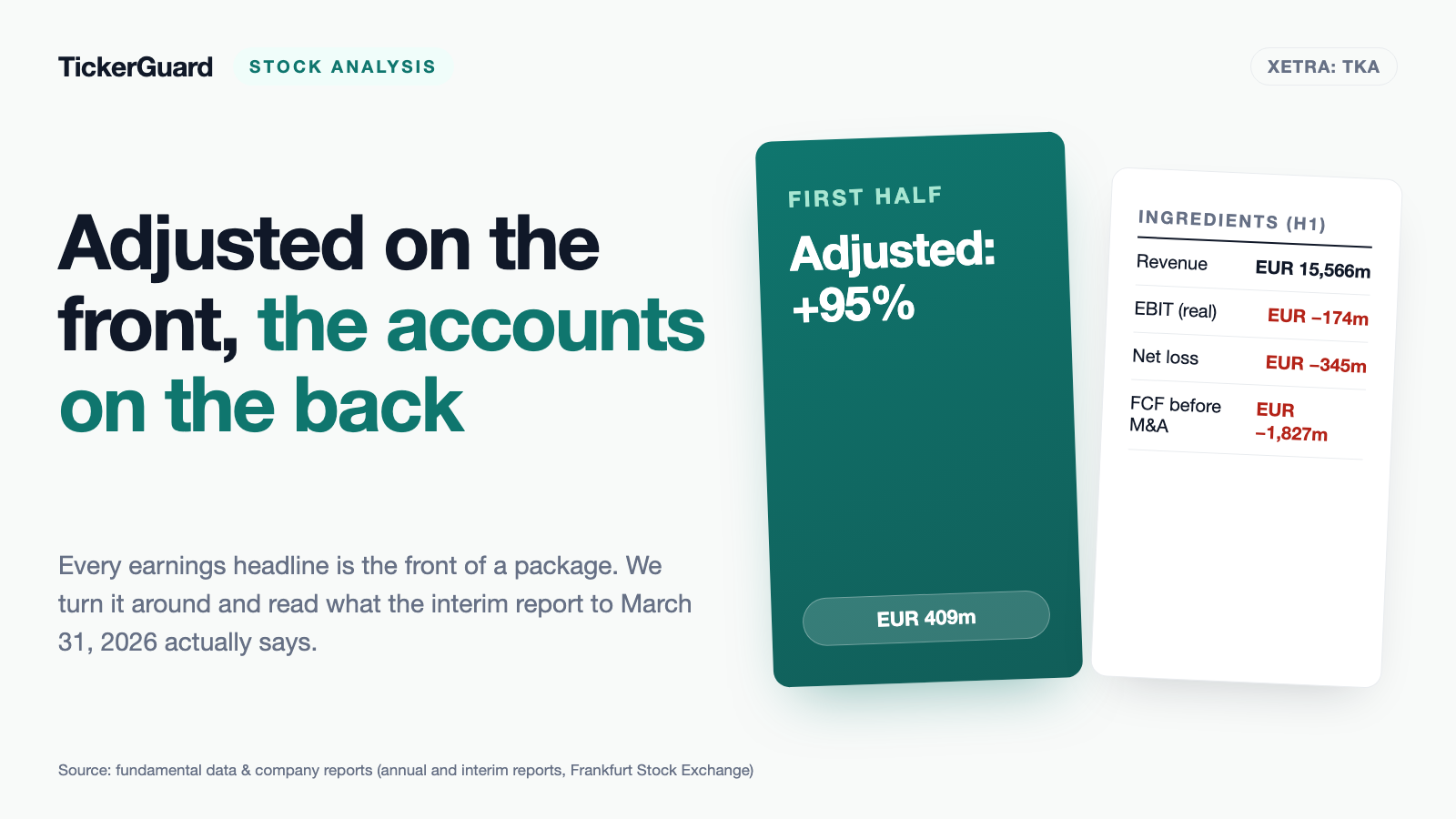
Interactive price chart (TradingView).
Note: pure fact-based analysis, not investment advice and not a solicitation to buy or sell. All figures without guarantee.
There is an investor trap that needs no fraud to work — only an asterisk. Call it the asterisk trap: the headline carries the adjusted number, and because it looks friendlier than the real one, that is the number your brain keeps. But "adjusted" means nothing other than: without the parts that hurt. The costs were still incurred, the cash still left the building, and the audited accounts still show the other figure. So let us make a deal: with thyssenkrupp we read both numbers side by side — the one on the front of the package and the one on the ingredients list. The basis is the interim report for the first nine months of fiscal 2025/2026, published August 13, 2026, and the Annual Report 2024/2025. And out of that comes the tension running through this analysis: almost everything thyssenkrupp reports on an adjusted basis points up — almost everything that stands unadjusted in the accounts points down.
What thyssenkrupp actually does — and why that is hard to say
thyssenkrupp AG, registered in Duisburg and Essen, is not one company but a collection of companies. The group reports in five segments: Automotive Technology (chassis, components, aftermarket and forging for carmakers), Decarbon Technologies (slewing bearings from Rothe Erde, chemical plant engineering from Uhde, cement plants from Polysius and water electrolysis from the separately listed majority holding thyssenkrupp nucera), Materials Services (materials distribution and supply-chain services), Steel Europe (flat steel from Duisburg) and Marine Systems (submarines and naval vessels from TKMS).
Put in everyday terms: picture an apartment building with five wholly unrelated tenants — a steel mill, a car-parts maker, a wholesaler, a plant engineer and a shipyard. All they share is the address and the caretaker. That is exactly the starting point of the group strategy called ACES 2030: thyssenkrupp AG is to become a financial holding company in which the businesses stand on their own, made independent step by step and opened up to third-party investors. This is no longer a statement of intent. The naval unit TKMS AG & Co. KGaA has been separately listed on the Frankfurt Stock Exchange since October 20, 2025 (thyssenkrupp holds 51 percent), the stake in the Hüttenwerke Krupp-Mannesmann steel works went to Salzgitter AG on July 9, 2026, and an extraordinary general meeting on August 7, 2026 approved the spin-off of a minority stake in the materials distributor, which has traded under the name tk accelis since July 20, 2026.
At June 30, 2026 the group employed 89,813 people, against 93,955 a year earlier. Revenue in fiscal 2024/2025 came to €32,837 million.
Two things first: no SEC filings — and a shifted fiscal year
Two peculiarities shape every number here. First: thyssenkrupp files no 10-K and no 10-Q. The company is not a U.S. reporting issuer; a search of the registry of the U.S. securities regulator, the SEC, for the tickers TKA and TKAMY returns nothing. Its mandatory reporting runs through the regulated market (Prime Standard) of the Frankfurt Stock Exchange: audited IFRS consolidated accounts, a half-year report and quarterly statements. Every figure here therefore carries the line "Source: fundamental data & company reports (annual/interim report, Frankfurt Stock Exchange)" rather than "SEC filings". You know the same setup from our analysis of Rheinmetall — another German index constituent without SEC registration, where the entire chain of evidence runs through the company's own reports. Because those reports are published in German, the quotes below appear in the original with an English translation.
Second: thyssenkrupp's fiscal year runs from October 1 to September 30. The current fiscal year 2025/2026 ends on September 30, 2026. So when we say "first nine months of 2025/2026", we mean October 1, 2025 through June 30, 2026 — not January to September. The "third quarter of 2025/2026" is April to June 2026. Comparing thyssenkrupp with a calendar-year company means comparing different stretches of weather.
On timeliness: the latest complete period report is the interim report for the first nine months of 2025/2026, published August 13, 2026; the executive board released it on August 11, 2026 and the auditor KPMG completed its review on August 12, 2026. The next set of numbers arrives with the annual report on December 8, 2026. Everything that has come in since — TKMS being selected for the Canadian submarine program, four MEKO frigates for the German navy, completion of the HKM sale and approval of the tk accelis spin-off — appears below.
The state of play on August 13, 2026 — what the nine-month figures change
The headline in one sentence: thyssenkrupp raised its earnings guidance and cut its capital expenditure at the same time — while the cash position sits €1,940 million in the red after nine months. In order.
The numbers. In the first nine months of 2025/2026 revenue came to €24,353 million (down 1 percent), adjusted EBIT to €591 million (up 62 percent), reported EBIT to €48 million (prior-year period: €239 million) and the net loss to €311 million. In the third quarter alone — April to June 2026 — revenue rose 8 percent to €8,786 million, adjusted EBIT rose 18 percent to €183 million, and the bottom line showed a quarterly profit of €34 million for the first time in a long while, against a loss of €255 million a year earlier.
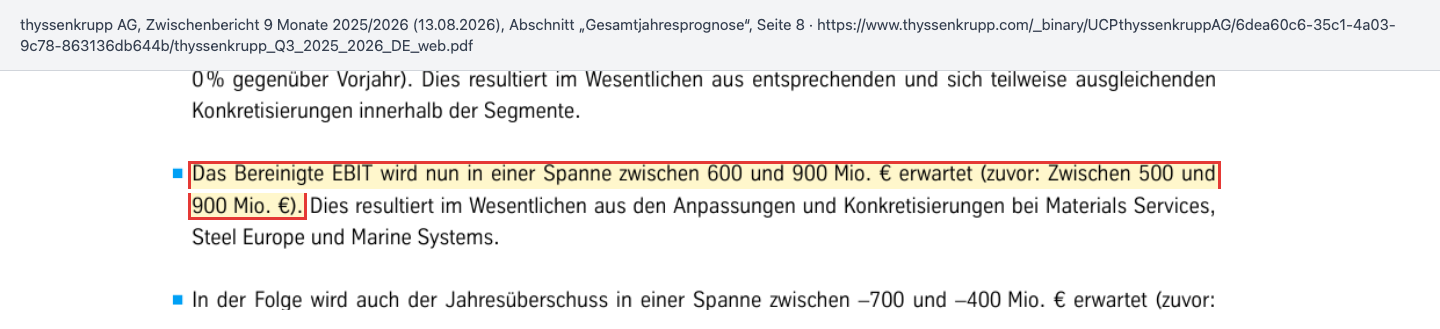
The raised guidance. For the full year thyssenkrupp now expects adjusted EBIT of €600 million to €900 million instead of €500 million to €900 million, and a net loss of €400 million to €700 million instead of €400 million to €800 million. The group puts it like this:
“Das Bereinigte EBIT wird nun in einer Spanne zwischen 600 und 900 Mio. € erwartet (zuvor: Zwischen 500 und 900 Mio. €). Dies resultiert im Wesentlichen aus den Anpassungen und Konkretisierungen bei Materials Services, Steel Europe und Marine Systems.”
Translation: "Adjusted EBIT is now expected in a range between €600 million and €900 million (previously: between €500 million and €900 million). This results essentially from the adjustments and refinements at Materials Services, Steel Europe and Marine Systems."
— thyssenkrupp AG, interim report 9M 2025/2026, section on full-year guidance, page 8
The line nobody puts in a headline. The same block of bullet points contains a fourth change: capital expenditure is now expected "in a range of €1,200 million and €1,300 million" — the earlier plan was €1,400 million to €1,600 million. Measured at both ends of the range that is €200 million to €300 million less spending, explained by "market developments to date". Spending less means keeping more cash. Anyone reading the guidance upgrade should read this line alongside it. Remember: better earnings guidance combined with a trimmed capex budget is mixed news, not purely good news.
What else changed, in brief — each point is covered in full below:
- The elevator billion arrived at half strength. In May thyssenkrupp expected the TK Elevator stake to be written up by "around €1 billion" following the Kone agreement. In fact the fair value of the common shares rose from €1,021 million to €1,540 million — up €519 million, recognised directly in equity. In the income statement the same stake produced a €99 million charge.
- HKM is sold — and it costs money. The 50 percent stake went to Salzgitter AG for a symbolic purchase price of one euro. On top of that come equity contributions in "a low to mid three-digit million euro amount" and a further disposal loss in the fourth quarter.
- TKMS has two record orders — but only after the reporting date. Order intake at the naval unit was just €208 million in the third quarter, down 93 percent. Canada's submarine decision and the four MEKO frigates both landed in July 2026, that is, in the fourth quarter.
- tk accelis is decided. The extraordinary general meeting approved the spin-off on August 7, 2026; a Prime Standard listing is still planned for this calendar year.
How this stock landed on our desk
Honestly: not through a screener hit but through a ranking of attention. On our cut-off date of August 6, 2026, thyssenkrupp sat high in the most-discussed rankings on the German retail-investor forum wallstreet-online — the place where German private investors are talking loudest about a stock right now. That is an attention signal and explicitly not a reason to buy. A stock shows up in those lists when a lot is being written about it; that can be enthusiasm, anger, hope or plain habit. With thyssenkrupp there is the added fact that family history and portfolio positions have overlapped here for decades.
For us such a list is useful as a topic radar: when many people talk at once, the details that matter are exactly what gets lost in the noise. We had the same starting point in our analysis of adidas — a completely different company with a strikingly similar question: how much of the recovery is substance, and how much is narrative?
The numbers over the years — fairly credited
First the part that genuinely impresses. thyssenkrupp came out of two disaster years: fiscal 2022/2023 closed with a loss of €1,986 million, fiscal 2023/2024 with a loss of €1,450 million. Earnings per share were minus €3.33 and minus €2.42. In fiscal 2024/2025 the sign flipped: a net profit of €532 million, or €0.75 per share. The market rewarded that with a total shareholder return of 234 percent over the fiscal year; the shares stood at €11.68 on September 30, 2025, after a low of €3.15 on November 1, 2024.
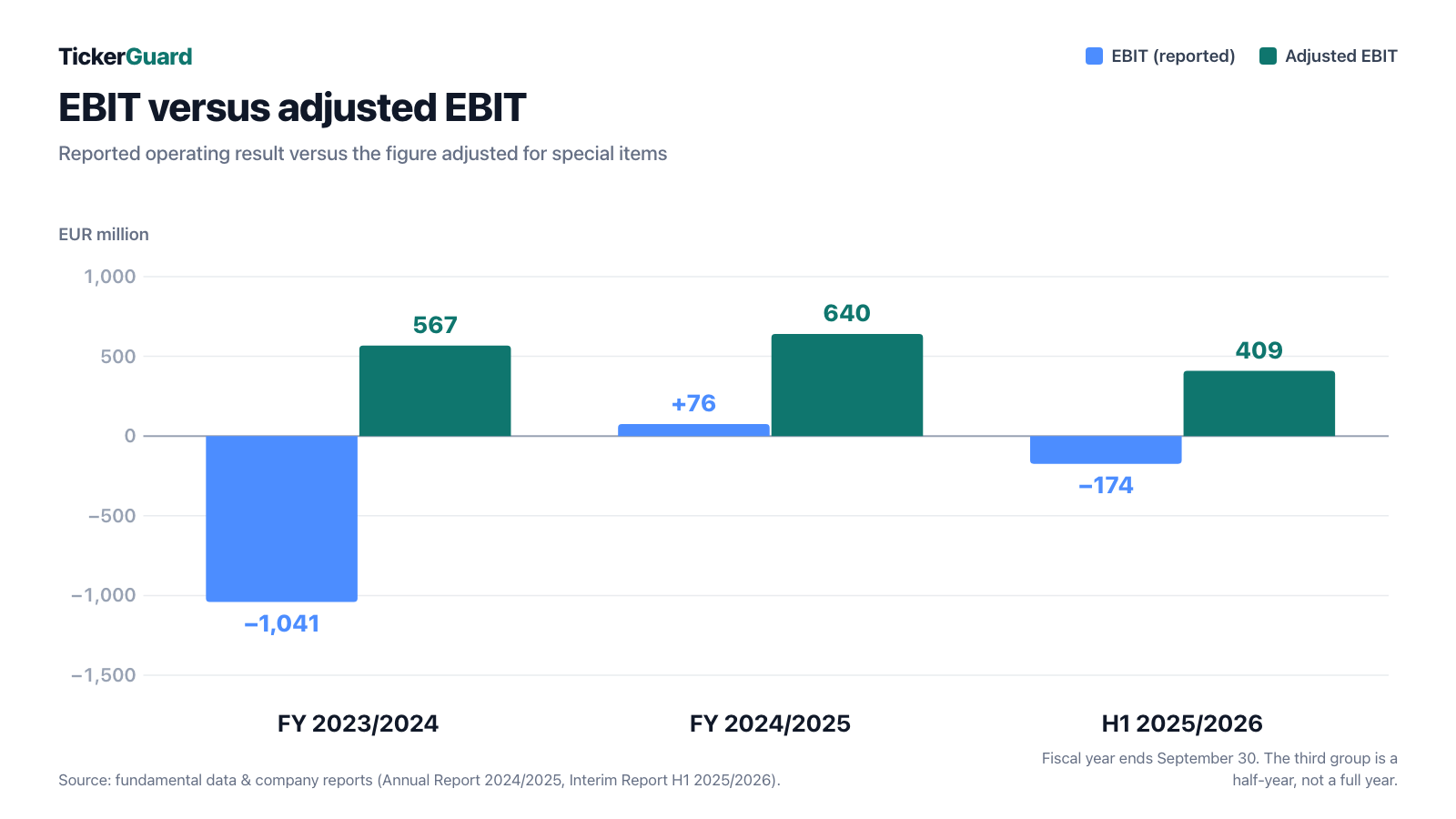
There is operating momentum, too. Adjusted EBIT — the operating result with restructuring, impairments and disposal gains stripped out — rose from €567 million (2023/2024) to €640 million (2024/2025). In the first nine months of 2025/2026 it climbed 62 percent to €591 million, lifting the adjusted margin from 1.5 to 2.4 percent. Every segment except Decarbon Technologies contributed more than a year earlier: Steel Europe went from €177 million to €373 million of adjusted EBIT, Materials Services from €82 million to €178 million, Marine Systems from €85 million to €110 million. And for an industrial group in this position the balance sheet is remarkably solid: an equity ratio of 37 percent and net financial assets rather than net debt.
Chief executive Miguel López summed up the direction in the press release on the nine-month figures:
“thyssenkrupp gewinnt weiter an operativer Stärke und an strategischer Klarheit.”
Translation: "thyssenkrupp continues to gain operational strength and strategic clarity."
— Miguel López, Chief Executive Officer of thyssenkrupp AG, in the press release on the third quarter of 2025/2026, August 13, 2026
Chief financial officer Axel Hamann added in the same release: "The figures show that our measures to improve performance are working." So much for the front of the package. Now we turn it around.
What the reports say — the uncomfortable truths
Uncomfortable truth no. 1: €544 million sits between "adjusted" and "reported"
Adjusted EBIT for the first nine months of 2025/2026 is €591 million. Reported EBIT for the same period is €48 million, after €239 million a year earlier. The difference is not a matter of opinion but of addition, and thyssenkrupp spells it out in the interim report itself:
“Konzernweit war das EBIT in den ersten 9 Monaten des Geschäftsjahres durch Sondereffekte von insgesamt 544 Mio. € belastet, die mit 500 Mio. € Restrukturierungsaufwendungen insbesondere aus den Segmenten Steel Europe und Decarbon Technologies innerhalb des Zementanlagenbaus sowie Wertminderungen in Höhe von insgesamt 276 Mio. € im Zusammenhang mit dem erstmaligen Ausweis der HKM als Veräußerungsgruppe gemäß IFRS 5 zum 30. Juni 2026 enthalten.”
Translation: "Across the group, EBIT in the first nine months of the fiscal year was burdened by special items totalling €544 million, comprising €500 million of restructuring expenses, in particular from the Steel Europe and Decarbon Technologies segments within cement plant engineering, as well as impairments totalling €276 million in connection with the first-time classification of HKM as a disposal group under IFRS 5 as at June 30, 2026."
— thyssenkrupp AG, interim report 9M 2025/2026, section on special items, page 12

In the third quarter the asterisk actually pointed the other way for once: special items there were positive at €39 million, because a €407 million reversal of impairment at Steel Europe outweighed the €276 million HKM write-down. Reported EBIT for the quarter (€222 million) therefore came in above the adjusted figure (€183 million). Fairness demands that this is said — and it also shows how much both numbers depend on valuation judgements.
Is the adjustment improper? No — it is properly defined in the annual report, disclosed every quarter and serves the stated purpose of making operating performance comparable across periods. That is a legitimate aim. The problem is that at thyssenkrupp restructuring charges are not a slip but a permanent condition. Special items came to €1,609 million in fiscal 2023/2024, €564 million in fiscal 2024/2025 and already €544 million in nine months of 2025/2026 — and that is after deducting the €407 million reversal. Remember: when a one-off appears every single year, it is not a one-off — it is a feature of the business.
Uncomfortable truth no. 2: the 2024/2025 profit came from a revaluation, not from the business
The €532 million net profit of fiscal 2024/2025 is the number everyone quoted. Put it next to that year's EBIT — €76 million — and a question arises: how do €76 million of operating profit turn into €532 million of profit after tax? The answer sits in the financial result, which swung by €1,135 million to plus €1,009 million:
“Die Verbesserung betraf mit 902 Mio € hauptsächlich den im Berichtsjahr erfassten Ertrag aus der am 30. September 2025 erfolgten erstmaligen Bewertung der Stammaktien der Elevator-Beteiligung zum beizulegenden Zeitwert, der innerhalb der Finanzierungserträge ausgewiesen wurde.”
Translation: "The improvement related mainly, in the amount of €902 million, to the income recognised in the reporting year from the first-time measurement at fair value of the common shares of the Elevator investment on September 30, 2025, which was reported within financing income."
— thyssenkrupp AG, Annual Report 2024/2025, group management report, section on the financial result

In plain terms: since selling its elevator business in 2020, thyssenkrupp has kept a stake in it — indirectly 16.2 percent of TK Elevator. At the balance sheet date that stake was carried at market value for the first time instead of being equity-accounted. The resulting book gain is €902 million. No euro reached a bank account and no tax charge arose. A further €219 million came from the same stake through equity accounting.
And this item is not finished yet. On April 29, 2026 Finland's Kone and TK Elevator's owners Advent and Cinven agreed on the sale of TK Elevator to Kone. The half-year interim report attached a remarkably concrete expectation to that: the fair value of the common shares would be "around €1 billion" above the level of March 31, 2026 (€1.0 billion). That is precisely the kind of statement an analysis can be checked against: did the promised billion arrive?
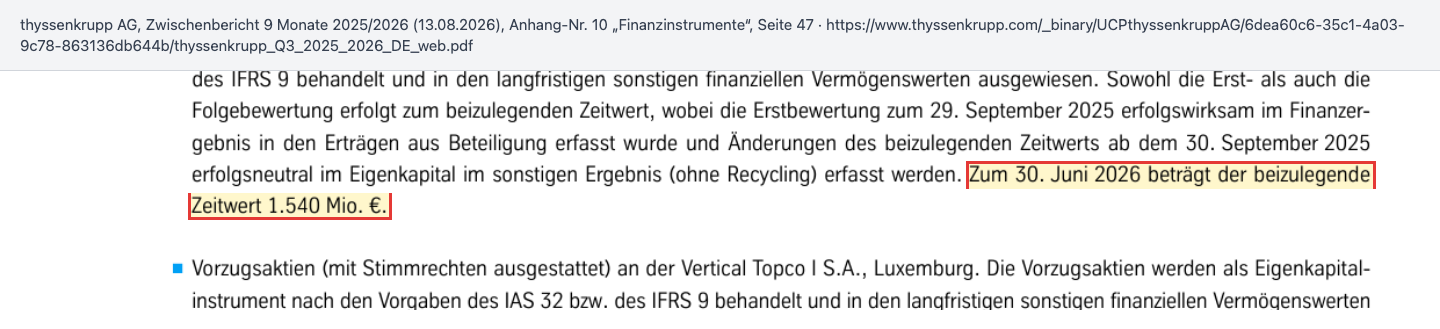
The answer in the nine-month report is: about half of it. The fair value of the TK Elevator common shares at June 30, 2026 is not around €2.0 billion but €1,540 million — up €519 million from the €1,021 million of March 31, 2026.
“Zum 30. Juni 2026 beträgt der beizulegende Zeitwert 1.540 Mio. €.”
Translation: "As at June 30, 2026 the fair value amounts to €1,540 million."
— thyssenkrupp AG, interim report 9M 2025/2026, note 10 "Financial instruments", page 47
Two caveats belong with that, and both are in the report. First, the increase is not down to the Kone deal alone: thyssenkrupp simultaneously lowered the discount rate for the common shares from 11.29 percent to 9.14 percent. A lower rate makes future cash flows arithmetically worth more — the business itself is not a euro better for it. The report names both causes side by side. Second, this gain does not land in profit: it is recognised "directly in equity in other comprehensive income (without recycling)", meaning it can never pass through the income statement, not even on a later sale.
And now the twist that is easy to miss. In the income statement the same stake worked against the group in the third quarter. thyssenkrupp had to reassess the expected repayment date of the interest-free loan to the Elevator holding company and booked €99 million of expense in the financial result, which swung from plus €26 million to minus €117 million. Translated: the money is coming later than assumed, so the receivable is worth less today. Remember: a valuation gain lands in equity, not in the bank account — and the bill for it can still land in profit.
Cash will only arrive from the stake when Kone completes the takeover, which the buyer expects to take 12 to 18 months from the end of April 2026 and to require clearance from several competition authorities. For you as an investor that means the price-earnings ratio on fiscal 2024/2025 is a pretty number with a weak denominator. Anyone using it is valuing an industrial group on the result of a financial investment. How seriously thyssenkrupp takes that itself shows in its own guidance for the current year: a net loss of €400 million to €700 million.
Uncomfortable truth no. 3: the cash pile lost €2.3 billion in nine months
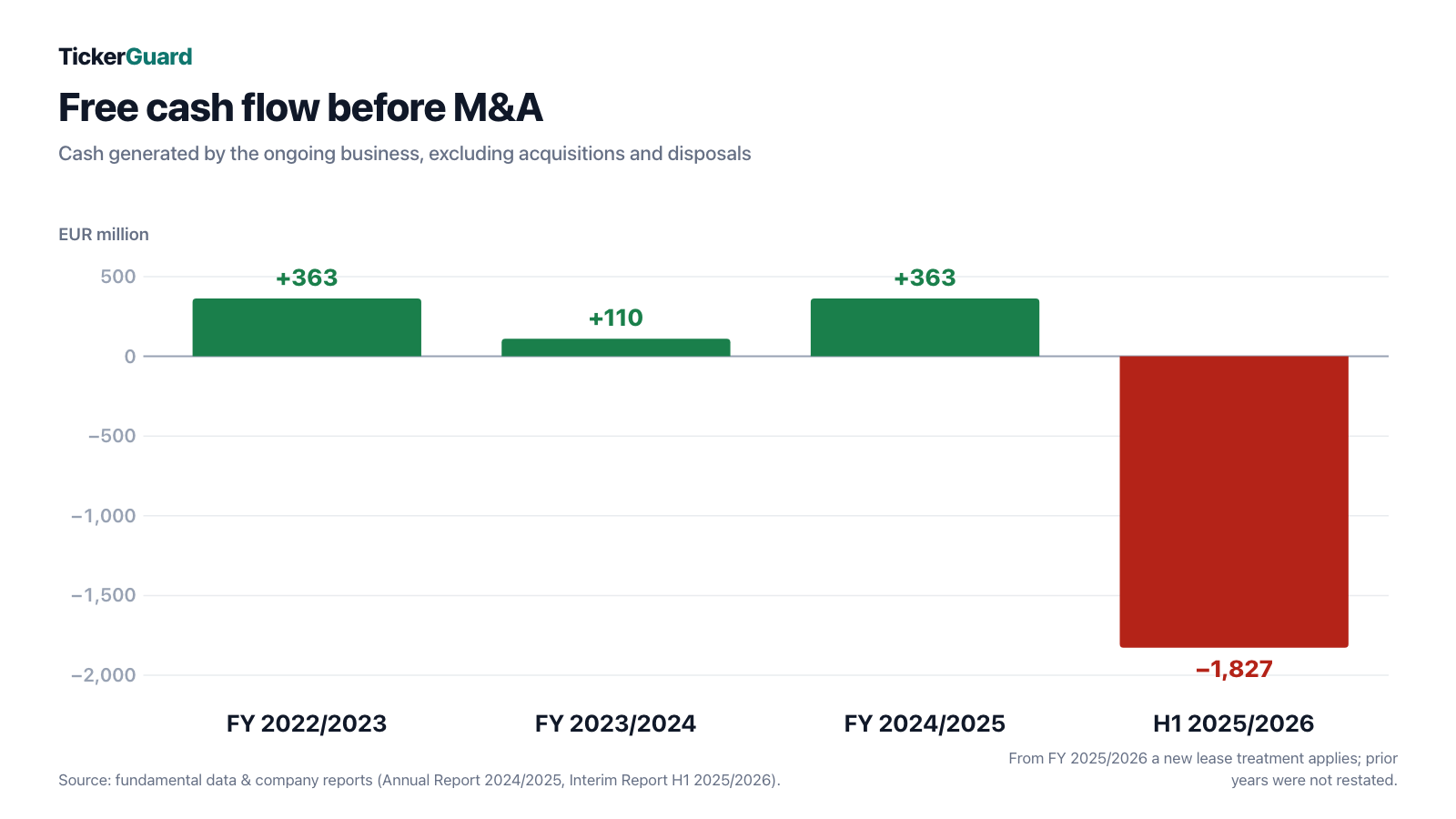
This is the number that decides the fiscal year. Free cash flow before M&A — thyssenkrupp's own metric for cash from the ongoing business, excluding acquisitions and disposals — came to minus €1,940 million in the first nine months of 2025/2026, against minus €817 million a year earlier. Operating cash flow alone was minus €1,287 million. Cash and cash equivalents fell from €5,725 million to €3,379 million — €2.3 billion less in nine months.
“Das Netto-Finanzguthaben ist zum 30. Juni 2026 im Vergleich zum 30. September 2025 i. W. wegen einer erhöhten Mittelbindung im Netto-Umlaufvermögen von 4,9 Mrd. € auf 2,6 Mrd. € zurückgegangen.”
Translation: "Net financial assets fell from €4.9 billion to €2.6 billion as at June 30, 2026 compared with September 30, 2025, essentially because of higher funds tied up in net working capital."
— thyssenkrupp AG, interim report 9M 2025/2026, section on free cash flow and net financial assets, page 13

Part of that is explainable. A customer prepayment of roughly €1 billion for four submarines landed in the prior-year period and was absent this time; inventories and receivables tied up more cash because Materials Services and Steel Europe are carrying more goods. There is progress, too: in the third quarter alone the outflow was €114 million, roughly half the €227 million of the prior-year quarter. Growth and pre-financing cost money that comes back later — that is the friendly reading.
The unfriendly reading is arithmetic, and it is sharper after nine months than after six. On August 13, 2026 thyssenkrupp left its full-year guidance for free cash flow before M&A unchanged: minus €600 million to minus €300 million. After nine months the figure stands at minus €1,940 million. That means the fourth quarter alone has to deliver €1,340 million to €1,640 million.
Is that a made-up hurdle? No — and that is why we check it against the prior-year quarter rather than dividing an annual figure by four. The fourth quarter is by far thyssenkrupp's strongest cash quarter: in fiscal 2024/2025 it brought €1,179 million of free cash flow before M&A, and €1,093 million the year before. So the effect is real, not seasonal noise. It simply does not stretch far enough this time: what is required is 14 to 39 percent more than the best closing quarter on record — in a quarter that also carries restructuring payouts and, on the company's own expectation, a further disposal loss on HKM. The trimmed capital expenditure plan provides some relief. Remember: guidance left unchanged after three of four quarters is not a result, it is a promise about three months. The evidence arrives on December 8, 2026 with the annual report.
Uncomfortable truth no. 4: what you own changes faster than you can analyse it
The conversion into a financial holding has a side effect that rarely gets discussed: the group whose numbers you are analysing will soon no longer exist in that shape. Three examples from ten months.
TKMS. The spin-off of a 49 percent minority stake in the naval unit was entered in the commercial register on October 17, 2025, and TKMS AG & Co. KGaA was first listed in the Prime Standard on October 20, 2025; the shares joined the MDAX index on December 22, 2025. thyssenkrupp shareholders received one TKMS share for every 20 thyssenkrupp shares. thyssenkrupp remains the majority owner with 51 percent and continues to consolidate the unit in full — the other 49 percent has since appeared in equity as a non-controlling interest. TKMS still held an order backlog of more than €20 billion at June 30, 2026. July 2026 added two pieces of news, both of which land in the fourth quarter: selection as preferred supplier for the Canadian submarine program covering up to twelve Type 212CD boats (a build-and-service contract worth around €20 billion), and approval by the German parliament's budget committee on July 8, 2026 of four MEKO A-200 DEU frigates for the German navy (around €6.3 billion, with an option on four more). Both are records in TKMS history — and both belong to thyssenkrupp AG only to the tune of 51 percent.
HKM. The Hüttenwerke Krupp-Mannesmann works in Duisburg, in which thyssenkrupp Steel Europe held 50 percent, passed entirely to Salzgitter AG on July 9, 2026 — contracts signed and closed the same day. According to the notes the stake changed hands "for a symbolic sale price of 1 euro"; on top of that thyssenkrupp Steel committed to an equity contribution to HKM "in a low to mid three-digit million euro amount", and for the fourth quarter of 2025/2026 the group expects a further disposal loss in the low hundreds of millions. The site keeps operating and the supply contract with thyssenkrupp Steel runs to the end of 2028. HKM hit the nine-month accounts twice: a €276 million impairment on all assets of the disposal group and, in the other direction, a €407 million reversal of impairment at Steel Europe, because ending the old slab supply contract lifts the segment's future profitability. Remember: when a sale for one euro costs money and still raises book value, the music is not in the price but in the contract behind it.
tk accelis. On July 20, 2026 the materials distributor — until then the Materials Services segment — presented its own medium-term targets at its first capital markets day in London: annual revenue growth above 4 percent and an adjusted EBITDA margin of 4 to 5 percent. The business generated €11.4 billion of revenue in fiscal 2024/2025, with around 15,500 employees, some 400 sites and roughly 250,000 customers. An extraordinary general meeting on August 7, 2026 approved the spin-off — following the same template as TKMS: 49 percent goes to thyssenkrupp shareholders while 51 percent stays inside the group, which continues to consolidate the unit in full. A Prime Standard listing is still planned for this calendar year; for the time afterwards tk accelis has already signed its own €1.7 billion credit facility, whose size depends on receivables and inventories pledged as collateral. Chief financial officer Daniel Wodera put it like this:
“Unsere Transformation ist real, sie ist messbar, und sie trägt. Unser kapitaleffizientes Modell ist darauf ausgelegt, solide Cashflows über alle Marktphasen und eine nachhaltige Wertschöpfung für unser Unternehmen und unsere Anteilseigner zu ermöglichen.”
Translation: "Our transformation is real, it is measurable, and it is delivering. Our capital-efficient model is designed to enable solid cash flows across all market phases and sustainable value creation for our company and our shareholders."
— Daniel Wodera, Chief Financial Officer of tk accelis, in the press release on the capital markets day, July 20, 2026
For an investor this is an unusual mental exercise. You are not buying a company; you are buying a shareholding structure in motion. One illustration: anyone holding thyssenkrupp AG shares today also holds, indirectly, 51 percent of TKMS. That stake was worth around €2.9 billion on August 5, 2026 (63,523,647 TKMS shares at €88.60, of which 51 percent) — against a market value of roughly €7.8 billion for all of thyssenkrupp AG on the same day (the interim report puts it at €6,481 million at the end of June 2026). A good third of the ticker therefore sits in a subsidiary whose figures you can look up separately. Whether that is hidden value or merely a different presentation of the same substance depends on what is left in the holding company at the end — and on what those leftovers earn.
Uncomfortable truth no. 5: the orders come from a business that is only half in the group
Group order intake fell 15 percent to €26,046 million over nine months, and 24 percent to €7,723 million in the third quarter. The reason has a name: Marine Systems. The segment booked just €208 million of orders in the third quarter of 2025/2026, against €3,001 million a year earlier — down 93 percent. Over nine months the figure fell from €8,591 million to €3,617 million.
Before that turns into a disaster headline: the explanation is mundane. The prior year contained an order extension for two submarines for Southeast Asia and a large service contract for six German navy submarines. The order backlog still stands above €20 billion, and both revenue and earnings of the unit rose sharply (revenue up 44 percent in the quarter, adjusted EBIT from €23 million to €50 million). The two billion-euro orders from Canada and the German navy only came in July, so they will not show up before the fourth quarter. Remember: a collapsed order intake alongside a full order book is a comparison figure, not news.
The real question is a different one: what does the group earn without the shipyard? Strip out Marine Systems and what remains over nine months is roughly €22.5 billion of revenue on €481 million of adjusted EBIT — a margin of about 2.1 percent. Steel Europe contributed €373 million of adjusted EBIT on €7,038 million of revenue, but carried most of the €500 million of restructuring charges and therefore reported only €80 million of EBIT. Automotive Technology managed €98 million of adjusted EBIT on €5,064 million of revenue — a margin of 1.9 percent — and minus €3 million on a reported basis. Translated: in its two largest industrial businesses the group earns less than €2 per €100 of revenue, and only after adjustment.
Valuation — what the market pays for the remainder
The interim report supplies its own valuation anchors: a closing price of €10.41 at the end of June 2026 and a market capitalisation of €6,481 million across 622,531,741 shares. At the Xetra close of August 5, 2026 the figures were €12.60 and roughly €7.8 billion. Against fiscal 2024/2025 revenue of €32,837 million that is a price-to-sales ratio of 0.20 to 0.24 — one euro of market value for four to five euros of revenue. That is typical for steel and materials distribution, not for technology.
Earnings are where it gets murky. On earnings per share of €0.75 (fiscal 2024/2025) the price-earnings ratio works out at about 14 to 17 — except that this profit, as shown above, rests mainly on a valuation gain. For the current fiscal year thyssenkrupp itself expects a loss of €400 million to €700 million, so no price-earnings ratio can be formed at all. That leaves book value: equity stood at €10,877 million on June 30, 2026, of which €1,161 million was non-controlling interests (essentially the 49 percent of TKMS). That leaves €9,716 million attributable to thyssenkrupp AG shareholders — across 622,531,741 shares, roughly €15.61 per share (as of June 30, 2026). The stock traded at roughly 0.67 times that book value at the end of June 2026 and 0.81 times on August 5, 2026. Worth noting: a meaningful part of the higher book value comes from the write-up of the elevator stake — substance that only turns into cash when the Kone deal closes.
Two outside verdicts for context. The rating agencies still place thyssenkrupp below investment grade: Standard & Poor's at BB with a stable outlook, Moody's at Ba3 with a stable outlook (as stated in the interim report of August 13, 2026). The analysts: at the end of March 2026, twelve houses published regular recommendations — 42 percent positive, 50 percent neutral, 8 percent negative. That is not a signal of conviction; it is a signal of waiting.
And the price anchors themselves, because they show how volatile this stock is: €3.15 on November 1, 2024; €11.68 at the fiscal year-end on September 30, 2025; an interim high of €12.28 on February 11, 2026; a low of €7.19 on March 30, 2026; €10.41 at the quarter-end of June 30, 2026; and €12.60 on August 5, 2026. Anyone calling this stock cheap or expensive should say which day they mean.
And the balance sheet? That is the best part of this story
For all the criticism, the other side belongs here just as plainly. thyssenkrupp does not have a balance sheet crisis — and at June 30, 2026 it is even a little sturdier than three months earlier. The accounts showed equity of €10,877 million and an equity ratio of 37 percent, and the group held more financial assets than financial debt: net financial assets of €2,621 million. Available liquidity — cash plus undrawn committed credit lines — rose to €5.3 billion, because on June 11, 2026 thyssenkrupp signed new bank financing: a committed syndicated cash facility of €1.7 billion and a guarantee facility of €1.25 billion, each with an initial three-year term. Of a €3.0 billion commercial paper program, just €79 million was drawn. And the risk section of the interim report is unambiguous:
“Aus heutiger Sicht liegen unverändert keine Risiken vor, die den Bestand des Unternehmens gefährden.”
Translation: "From today's perspective there are, as before, no risks that endanger the existence of the company."
— thyssenkrupp AG, interim report 9M 2025/2026, section on opportunities and risks, page 24

That is why, for all the open questions, this is not a case of impaired substance. A company with a 37 percent equity ratio and net financial assets has time — and in a group restructuring, time is the scarcest currency there is.
And artificial intelligence?
thyssenkrupp sells no AI products and reports no AI revenue. The Annual Report 2024/2025 mentions artificial intelligence in the opportunities section with striking caution: opportunities may arise "through the increased use of artificial intelligence (AI), which cannot yet be conclusively assessed today" (translated from the German original), with optimised logistics and production processes given as examples. The press release on the second quarter, dated May 12, 2026, already names a live application: through its Pacemaker unit the materials distributor "launched a new AI-supported application for inventory management, in order to secure product availability in the face of demand swings and to reduce warehousing costs" (translated from the German original). What followed was more concrete. On June 25, 2026 the group announced a strategic alliance with GlobalLogic (Hitachi group) around "physical AI" — autonomous inspection drones and "robocams" in hazardous production areas, plus a data platform linking shop-floor data with business data. And on July 20, 2026 tk accelis named as one of three medium-term priorities that it digitises processes and deploys "AI to raise efficiency" (translated from the German original). In our taxonomy that makes thyssenkrupp an AI user, not an AI vendor: the technology lowers costs and improves safety, but it is not the product.
Opportunities and risks at a glance
Opportunities
- Adjusted EBIT rose 62 percent to €591 million over nine months of 2025/2026, with every segment except Decarbon Technologies lifting its contribution. Steel Europe went from €177 million to €373 million, Materials Services from €82 million to €178 million.
- On August 13, 2026 thyssenkrupp raised its guidance: adjusted EBIT of €600 million to €900 million (previously €500 million to €900 million) and a net loss of €400 million to €700 million (previously €400 million to €800 million).
- The balance sheet holds and grew sturdier: a 37 percent equity ratio, €2,621 million of net financial assets and €5.3 billion of available liquidity at June 30, 2026, plus a new €1.7 billion bank facility signed on June 11, 2026.
- The restructuring produces verifiable results rather than announcements: TKMS separately listed since October 20, 2025, Automation Engineering sold on March 31, 2026, HKM on July 9, 2026, and the tk accelis spin-off approved by shareholders on August 7, 2026.
- The stock trades below book value (about 0.67 times at June 30, 2026 and 0.81 times on August 5, 2026) and at a price-to-sales ratio of 0.20 to 0.24 — anyone who believes the restructuring will succeed is paying no premium for the substance.
- Marine Systems provides a tailwind from the European defense cycle: an order backlog above €20 billion at June 30, 2026, plus selection in July 2026 as preferred supplier for the Canadian submarine program and approval of four MEKO A-200 frigates for the German navy.
- The remaining 16.2 percent of TK Elevator was written up after the Kone agreement: the fair value of the common shares rose from €1,021 million (March 31, 2026) to €1,540 million (June 30, 2026). Cash only follows on completion, which the buyer expects in 12 to 18 months.
Risks
- Free cash flow before M&A stood at minus €1,940 million after nine months. Reaching the unchanged full-year guidance of minus €600 million to minus €300 million requires €1,340 million to €1,640 million in the fourth quarter — 14 to 39 percent more than the best closing quarter on record (€1,179 million in fiscal 2024/2025).
- thyssenkrupp itself expects a net loss of €400 million to €700 million for fiscal 2025/2026 and a return on capital employed between minus 4 percent and zero — the group is not earning its cost of capital.
- The raised earnings guidance comes with a trimmed investment plan: €1,200 million to €1,300 million instead of €1,400 million to €1,600 million, explained by market developments.
- Restructuring charges are a permanent condition: €1,609 million of special items in fiscal 2023/2024, €564 million in 2024/2025 and €544 million in nine months of 2025/2026 — and that is after deducting a €407 million reversal of impairment.
- The HKM sale is not settled yet: a symbolic purchase price of one euro, an equity contribution in a low to mid three-digit million euro amount, and a further disposal loss the group expects in the fourth quarter.
- The ratings of BB (Standard & Poor's) and Ba3 (Moody's) sit below investment grade — debt is expensive for this group.
- The perimeter keeps changing. Every spin-off shrinks what remains in the holding company, comparability of the group's own time series suffers, and the proceeds of a spin-off go to shareholders as shares rather than to the group as cash.
- Steel Europe depends on steel prices, energy costs and trade policy — three variables thyssenkrupp does not control. The nine-month report cites declines in tinplate on the back of U.S. trade policy and in electrical steel because of third-country imports into the EU.
A human conclusion
The asterisk trap from the opening is not a quirk of thyssenkrupp's press office; it is the nature of this stock. Both numbers are true. Adjusted EBIT of €591 million shows what the group earns day to day if you set the restructuring aside. Reported EBIT of €48 million shows what is left if you do not. And free cash flow of minus €1,940 million shows what happened in the bank account — the one number that cannot be adjusted.
August 13, 2026 made this analysis checkable in two places, and that is the real gain from this quarter. thyssenkrupp passed the first test: the operating business really is improving, clearly enough for the company's own guidance to rise. The second test remains open: the elevator billion floated in May arrived at half strength, it sits in equity rather than in profit, and after three of four quarters the cash shortfall is larger than ever.
What you make of that hangs on a single question: do you believe the restructuring will ever be finished? If yes, the special items really are a transition, and in a few years the adjusted figure will sit next to the real one. If no, you are buying a company that has been reporting the same exception for years. The balance sheet gives thyssenkrupp time to answer that question — but time is not a result. The next piece of evidence lands on December 8, 2026 with the annual report for 2025/2026.
We are not telling you whether to buy. We are telling you this: read both numbers, not one. What you make of it is your decision. And that is exactly how it should be.
Sources
- thyssenkrupp AG, interim report for the first nine months of fiscal 2025/2026 (October 1, 2025 to June 30, 2026), published August 13, 2026 — latest period report
- thyssenkrupp AG, press release on the third quarter of 2025/2026, August 13, 2026
- thyssenkrupp AG, interim report for the first half of fiscal 2025/2026 (October 1, 2025 to March 31, 2026), published May 12, 2026 — comparative period and source of the May expectation about the Elevator stake
- thyssenkrupp AG, press release on the second quarter of 2025/2026, May 12, 2026
- thyssenkrupp AG, Annual Report 2024/2025 (fiscal year ended September 30, 2025)
- thyssenkrupp AG, press release on the first quarter of 2025/2026, February 12, 2026
- thyssenkrupp AG, press release on the GlobalLogic alliance ("physical AI"), June 25, 2026
- thyssenkrupp AG, press release "Salzgitter AG takes over HKM in full", July 9, 2026
- thyssenkrupp AG, press release on the tk accelis capital markets day, July 20, 2026
- thyssenkrupp AG, press release "TKMS selected as the preferred supplier for the Canadian patrol submarine project", July 6, 2026
- Bundeswehr, project page on the MEKO A-200 DEU frigates for the German navy — cleared by the budget committee on July 8, 2026
- thyssenkrupp AG, financial calendar (annual report 2025/2026 on December 8, 2026)
- Price and valuation data: closing price at the end of June 2026 (€10.41) and market capitalisation (€6,481 million) from the nine-month report 2025/2026; additionally fundamental data and Xetra closing prices of August 5, 2026 (thyssenkrupp €12.60, TKMS €88.60).
- Ranking of the most-discussed stocks on the wallstreet-online forum, cut-off date August 6, 2026 (the starting point for this analysis, not a source for company figures).
Transparency & disclaimer: this article is journalistic analysis of publicly available information. It is not investment advice, not a recommendation to buy or sell, and not a solicitation to buy or sell securities. Equity investments carry substantial risk up to total loss. All figures carry the reporting date stated in the text; the overall cut-off for this version is August 13, 2026. The latest period report evaluated is the interim report for the first nine months of fiscal 2025/2026, published August 13, 2026; the annual report due December 8, 2026 may update or correct the numbers shown here. Positions held by the operator are disclosed daily; where one exists, it appears as a notice at the top of this deep dive.
Our Bottom Line at a Glance
- Operating performance positive
- Adjusted EBIT rose 62 percent to €591 million in the first nine months of 2025/2026, lifting the adjusted margin from 1.5 to 2.4 percent. Every segment except Decarbon Technologies contributed more than a year earlier; Steel Europe went from €177 million to €373 million and Materials Services from €82 million to €178 million. The third quarter showed a net profit of €34 million, the first in a long while.
- Guidance positive
- On August 13, 2026 thyssenkrupp raised its earnings guidance: adjusted EBIT of €600 million to €900 million instead of €500 million to €900 million, and a net loss of €400 million to €700 million instead of €400 million to €800 million. The caveat is that planned capital expenditure was cut in the same breath, from €1,400–1,600 million to €1,200–1,300 million.
- Earnings quality negative
- Reported EBIT after nine months of 2025/2026 was €48 million against €591 million on an adjusted basis, with €544 million of special items in between. The €532 million net profit of fiscal 2024/2025 rested mainly on a €902 million valuation gain from the Elevator stake, while EBIT that year was only €76 million.
- Cash flow negative
- Free cash flow before M&A stood at minus €1,940 million after nine months (prior-year period: minus €817 million). Full-year guidance of minus €600 million to minus €300 million was left unchanged, which requires €1,340 million to €1,640 million in the fourth quarter — 14 to 39 percent more than the best closing quarter on record at €1,179 million.
- Balance sheet and funding positive
- At June 30, 2026 the accounts showed equity of €10,877 million and an equity ratio of 37 percent, plus net financial assets of €2,621 million and €5.3 billion of available liquidity — supported by new facilities signed on June 11, 2026 worth €1.7 billion in cash and €1.25 billion in guarantees. The report explicitly states there are no risks to the company's existence; the BB and Ba3 ratings sit below investment grade.
- Group restructuring neutral
- ACES 2030 delivers verifiable steps: TKMS separately listed since October 20, 2025 (51 percent held, order backlog above €20 billion), Automation Engineering sold on March 31, 2026, HKM closed on July 9, 2026, and the tk accelis spin-off approved by shareholders on August 7, 2026. The HKM sale costs money, though: a symbolic price of one euro, an equity contribution in a low to mid three-digit million euro amount and a further disposal loss in the fourth quarter.
- Valuation neutral
- At €10.41 on June 30, 2026 the interim report puts the market value at €6,481 million; at €12.60 on August 5, 2026 it was roughly €7.8 billion. That is a price-to-sales ratio of 0.20 to 0.24 and 0.67 to 0.81 times the book value of €15.61 per share. No meaningful price-earnings ratio exists: for 2025/2026 the company itself expects a loss of €400 million to €700 million.
thyssenkrupp is making operating progress: adjusted EBIT rose 62 percent to €591 million in nine months of 2025/2026, and on August 13, 2026 the group raised its earnings guidance. The same report, however, shows reported EBIT of only €48 million, a net loss of €311 million and free cash flow before M&A of minus €1,940 million — against unchanged full-year guidance of minus €600 million to minus €300 million. A balance sheet with a 37 percent equity ratio and €2.6 billion of net financial assets gives the group time to close that gap. Not investment advice.
What Our Rating Means
Open questions
The business works in principle, but one material question is open. As long as it stays open, our findings do not carry a quality verdict.
Yellow is not about an existential question here. The balance sheet at June 30, 2026 is solid: €10,877 million of equity, a 37 percent equity ratio, net financial assets of €2,621 million, €5.3 billion of available liquidity, a barely used commercial paper program, freshly signed credit facilities of €1.7 billion and the explicit statement in the interim report that no risks endanger the existence of the company. Operations are improving too: adjusted EBIT up 62 percent after nine months, a quarterly profit in the third quarter, raised guidance and the conversion into a financial holding proceeding in visible steps with TKMS, HKM and tk accelis. Yellow stands because two operating questions remain open. First, earnings quality: €544 million of special items sit between adjusted and reported EBIT over nine months, last year's profit came from a €902 million valuation gain on an investment rather than from the business, and the write-up of that same investment promised in May at around €1 billion arrived at half strength — recognised in equity, while €99 million of expense from the same position landed in profit. Second, cash: free cash flow before M&A of minus €1,940 million after nine months against unchanged full-year guidance of minus €600 million to minus €300 million demands €1.34 billion to €1.64 billion from the final quarter, where the best closing quarter on record delivered €1,179 million. The fact that the stock trades below book value does not colour this rating — that is a price question, not a quality question. The next verifiable checkpoint is the annual report on December 8, 2026. The decision is yours.
A journalistic assessment by our editorial team at the time of the deep dive, based on public sources — not investment advice and not a solicitation to buy or sell. Your personal circumstances (investment goals, risk capacity, taxes) cannot be taken into account. What our levels mean, how verdicts are formed, and what conflicts of interest exist →
Worth Noting
- Starting point: on August 6, 2026 thyssenkrupp ranked high among the most-discussed stocks on the German retail-investor forum wallstreet-online — an attention signal, not a reason to buy.
- Non-calendar fiscal year: October 1 to September 30. Fiscal 2025/2026 ends on September 30, 2026; "9M 2025/2026" means October 1, 2025 to June 30, 2026, and "Q3" means April to June 2026. Comparing thyssenkrupp with calendar-year companies means comparing different periods.
- Data cut-off August 13, 2026. The latest period report evaluated is the interim report for the first nine months of 2025/2026, published August 13, 2026 (released by the executive board on August 11 and reviewed by KPMG on August 12); the annual report for 2025/2026 is due December 8, 2026.
- thyssenkrupp is not an SEC filer: no 10-K, no 10-Q, no EDGAR identifier (searches for TKA and TKAMY return nothing). All evidence comes from the Annual Report 2024/2025, the 2025/2026 interim reports and the company's press releases. Because those reports are published in German, quotes appear in the original with an English translation.
- Easy to confuse: the ticker TKA.DE is shorthand for "thyssenkrupp, listed in Germany" — not an official exchange code. Three group companies are separately listed: thyssenkrupp AG (TKA), TKMS AG & Co. KGaA (since October 20, 2025) and thyssenkrupp nucera AG & Co. KGaA. The planned fourth listing is tk accelis, the former Materials Services segment.
- Checking the May expectation: the half-year interim report projected a write-up of the TK Elevator common shares of "around €1 billion" versus the fair value of March 31, 2026. In fact the fair value rose from €1,021 million to €1,540 million by June 30, 2026. The report names two causes side by side: the valuation implied by the Kone agreement and a lower discount rate (11.29 percent down to 9.14 percent).
- The figure "€1.34 billion to €1.64 billion in the fourth quarter" is our own derivation: full-year guidance for free cash flow before M&A (minus €600 million to minus €300 million) less the nine-month figure (minus €1,940 million). The cross-check is the prior-year closing quarter at €1,179 million (Annual Report 2024/2025, cash flow statement). From fiscal 2025/2026 lease payments enter this metric differently than before; prior-year figures were not restated.
The full analysis as a PDF for later
We will send you this analysis as a PDF — to print, file away, and read at your own pace.
Frequently Asked Questions
thyssenkrupp AG, registered in Duisburg and Essen, is an industrial and technology group with five segments: Automotive Technology (car parts), Decarbon Technologies (plant engineering, slewing bearings, water electrolysis), Materials Services (materials distribution, renamed tk accelis in July 2026), Steel Europe (flat steel) and Marine Systems (submarines and naval vessels from TKMS). It employed 89,813 people at June 30, 2026.
The fiscal year runs from October 1 to September 30, so fiscal 2025/2026 ends on September 30, 2026. The first nine months of 2025/2026 cover October 1, 2025 to June 30, 2026, and the third quarter covers April to June 2026. The nine-month report appeared on August 13, 2026; the annual report follows on December 8, 2026.
Revenue fell 1 percent to €24,353 million and order intake 15 percent to €26,046 million. Adjusted EBIT rose 62 percent to €591 million, while reported EBIT fell from €239 million to €48 million. The bottom line was a net loss of €311 million and earnings per share of minus €0.57 (reporting date June 30, 2026).
Because of better prospects at Materials Services, Steel Europe and Marine Systems. Adjusted EBIT is now expected at €600 million to €900 million instead of €500 million to €900 million, and the net loss at €400 million to €700 million instead of €400 million to €800 million. At the same time planned capital expenditure fell from €1,400–1,600 million to €1,200–1,300 million.
Because thyssenkrupp strips out restructuring, impairments, disposal gains and carbon forward transactions. In the first nine months of 2025/2026, special items of €544 million weighed on EBIT, including €500 million of restructuring charges and a €276 million write-down on the HKM disposal group, offset by a €407 million reversal of impairment at Steel Europe.
Free cash flow before M&A came to minus €1,940 million after nine months of 2025/2026. The main reasons: a customer prepayment of roughly €1 billion for four submarines landed in the prior-year period and was absent this time, while inventories and receivables tied up more cash. Cash fell from €5,725 million to €3,379 million and net financial assets from €4.9 billion to €2.6 billion.
Only about half of it. In May 2026 thyssenkrupp expected the common shares to be written up by "around €1 billion" after the Kone agreement. By June 30, 2026 the fair value had risen from €1,021 million to €1,540 million. The gain is recognised directly in equity rather than in profit; in the financial result the same stake produced a €99 million charge.
Both are parts of the conversion into a financial holding. The naval unit TKMS has been separately listed since October 20, 2025 and in the MDAX index since December 22, 2025; thyssenkrupp holds 51 percent. An extraordinary general meeting on August 7, 2026 approved the spin-off of a minority stake in the materials distributor tk accelis (formerly Materials Services); a listing is still planned for 2026.
Found an error?
Did you spot a factual error, an outdated number, or a typo in this deep dive? Let us know briefly — your report goes straight to the editorial team.