adidas in the World Cup quarter: EUR 6.7 billion in record sales — and the shoe stands still
In the second quarter of 2026 adidas revenue climbed 14 percent on a currency-neutral basis to a record EUR 6,743 million. Footwear, a little more than half of the business, added 1 percent — all of the growth came from apparel and accessories. Because adidas spent EUR 212 million more on World Cup campaigns, operating profit rose only 5 percent and the operating margin slipped from 9.2 to 8.5 percent. And in full-year 2025 net cash from operating activities fell 74 percent to EUR 751 million while operating profit rose 54 percent. No buy or sell recommendation — just the question of what a record quarter is worth when the growth is still sitting on the shelf.
 Thomas Mücke
Founder & Publisher
Thomas Mücke
Founder & Publisher
Chart
Interactive price chart (TradingView).
Note: pure fact-based analysis, not investment advice and not a solicitation to buy or sell. All figures without guarantee.
There is one investor weakness that catches you precisely at the companies you believe you know best: the wardrobe trap. If two pairs of shoes with three stripes are standing in your hallway, you no longer examine the company behind them as strictly as some unfamiliar name from the small-cap list. You know the stuff is good. You see the jerseys in the stadium, the ads in your feed, the store on the high street — and your brain quietly converts all of that into a statement about a balance sheet. So let us make a deal: we keep the wardrobe closed and read the 2025 annual report (signed February 19, 2026), the 2026 half-year report and the second-quarter earnings release, both dated July 30, 2026. There is plenty in there to admire — and four or five places where you stop for a moment.
The tension in this analysis fits into one sentence: adidas is selling more than at any point in its history — but the growth comes from textiles and marketing rather than from the shoe, and less and less of it arrives as cash. Both halves are documented, both are explainable, and both belong together.
What adidas actually does
adidas AG, headquartered in Herzogenaurach, traces back to 1949, when the "Adolf Dassler adidas Sportschuhfabrik" was entered in the commercial register. The business model has stayed remarkably plain: adidas designs athletic footwear, apparel and accessories, has them manufactured and sells them — either to retailers (wholesale) or straight to you (direct-to-consumer, meaning its own stores and its own online shop). On top of that the company buys visibility: contracts with federations, clubs, leagues and individual athletes.
Three product divisions split the revenue: footwear (2025: EUR 14,232 million), apparel (EUR 8,764 million) and accessories (EUR 1,815 million). Regionally adidas reports in six segments: Europe, North America, Greater China, Emerging Markets, Latin America and Japan/South Korea. At the end of 2025 the group employed 64,938 people; by mid-2026 the figure was 64,394.
One point you have to know, because it distorts every multi-year comparison: until 2024 adidas was still selling down the remaining inventory of the discontinued Yeezy line. The 2025 annual report is explicit that this ended with the 2024 sell-through — 2025 contained no Yeezy revenue at all, against roughly EUR 650 million of revenue and around EUR 200 million of operating profit in the prior year. So anyone comparing growth rates has to know whether the prior-year base includes Yeezy. adidas discloses both; below we always name which base is meant.
Why there is no US-style filing here — and where the numbers come from instead
One note up front, because it shapes the entire evidence chain: adidas files no annual report on Form 10-K and no quarterly report on Form 10-Q. It is not a US reporting company. Mandatory reporting runs through the regulated market (Prime Standard) of the Frankfurt Stock Exchange: audited IFRS consolidated accounts, a half-year financial report, quarterly statements and ad-hoc releases under Article 17 of the EU Market Abuse Regulation.
What confuses people is that the stock does exist in America. Traded in the United States is a depositary receipt on the adidas share — an American Depositary Receipt under the symbol ADDYY, over the counter on the OTCQX International Premier tier. adidas describes it as a "sponsored Level I ADR Program" run by Deutsche Bank Trust Company Americas, with a ratio of two receipts per share. A Level I program is the simplest tier — and it explicitly triggers no reporting duty toward the Securities and Exchange Commission. Search EDGAR for adidas numbers and you find nothing, and that is not a warning sign but the ordinary consequence of the structure.
Every figure in this analysis therefore carries "Source: fundamental data & company reports (annual/half-year report, Frankfurt Stock Exchange)". You know the same constellation from our Rheinmetall analysis — another DAX name without an SEC registration, where the whole evidence chain runs through the company's own reports.
And a word on currency of information: the most recent complete periodic report is the half-year report of July 30, 2026. The second-quarter earnings release with the raised full-year guidance was published on the same day. Everything later, up to our editorial cut-off on August 5, 2026, amounts to a single mandatory disclosure, and that one sits further down in the valuation chapter. The next report is the nine-month figures on October 29, 2026.
How this stock reached our desk
Honestly: not through a scanner hit, but through an attention ranking. On August 5, 2026 adidas sat near the top of the most-discussed lists in the wallstreet-online forum — that is, where retail investors were talking loudest about a stock right then. That is an attention signal and explicitly not a reason to buy. A stock lands on such lists when a lot is being written about it; that can be enthusiasm, annoyance, hope or simply habit.
Even so, a list like that is useful to us — as a topic radar. When a great many people talk about a stock at once, the sober look into the primary reports pays off precisely because the details drown in the noise. Those details are what we pull out now.
The numbers over the years — fairly credited
First the genuinely impressive part, and there is a lot of it. adidas is climbing out of a deep hole. The operating margin — the share of revenue left as operating profit after all running costs — stood at 9.4 percent in 2021, collapsed to 3.0 percent in 2022 and fell to 1.3 percent in 2023. Out of every EUR 100 of revenue, EUR 1.30 was left. In 2024 it was 5.6 percent, and in 2025 8.3 percent again. Operating profit rose 54 percent to EUR 2,056 million in 2025 (prior year EUR 1,337 million), even though roughly EUR 200 million of the prior-year figure had come from the Yeezy sell-through.
Revenue reached a record EUR 24,811 million in 2025 (prior year EUR 23,683 million): up 5 percent in euro terms, up 10 percent currency-neutral and up 13 percent currency-neutral for the adidas brand alone, that is, stripping the Yeezy effect out of the prior-year base. The gross margin — what is left after the pure cost of goods — improved 0.8 percentage points to 51.6 percent. Net income from continuing operations rose from EUR 824 million to EUR 1,377 million, earnings per share from EUR 4.24 to EUR 7.46. The dividend for 2025 was raised from EUR 2.00 to EUR 2.80 per share, approved at the annual general meeting on May 7, 2026.
The balance sheet also looks healthier than three years ago. Equity rose 5 percent to EUR 5,776 million in 2025 and the equity ratio from 26.5 to 28.5 percent. Leverage — adjusted net borrowings divided by operating profit before depreciation and amortization (EBITDA) — improved from 1.5 to 1.4; in 2023 it was still 3.3. In everyday terms: the debt pile now equals a good one year of earnings instead of a good three. That is real progress.
And 2026 has kept going. First-quarter revenue rose 14 percent currency-neutral to EUR 6.6 billion, operating profit 16 percent to EUR 705 million, the operating margin to 10.7 percent. The second quarter then delivered the record: EUR 6,743 million of revenue, up 13 percent in euro terms and 14 percent currency-neutral. The half-year adds up to EUR 13,335 million of revenue and EUR 1,279 million of operating profit. adidas raised its full-year guidance on July 30, 2026 accordingly: currency-neutral revenue is now expected to grow 9 to 10 percent in 2026 instead of "at a high-single-digit rate".
So much for the success story, and it is largely deserved. Now comes the part the applause covers up.
What the reports say — the uncomfortable truths
Uncomfortable truth no. 1: the shoe stands still
adidas was founded as a shoe company, and footwear is still the largest business: EUR 3,492 of the EUR 6,743 million of quarterly revenue, or 52 percent. And that is precisely the division that barely grew in the record quarter. The company says it in one sentence:
"Footwear revenues were up 1%."
— adidas AG, Second Quarter 2026 Results, published July 30, 2026 (currency-neutral; in euro terms adidas reports 0 percent)

In euro terms footwear revenue rose from EUR 3,476 million to EUR 3,492 million — EUR 16 million, or 0.5 percent. In the same quarter apparel added 34 percent to EUR 2,721 million and accessories 18 percent to EUR 530 million. All of the record quarter's growth therefore came from textiles and add-ons.
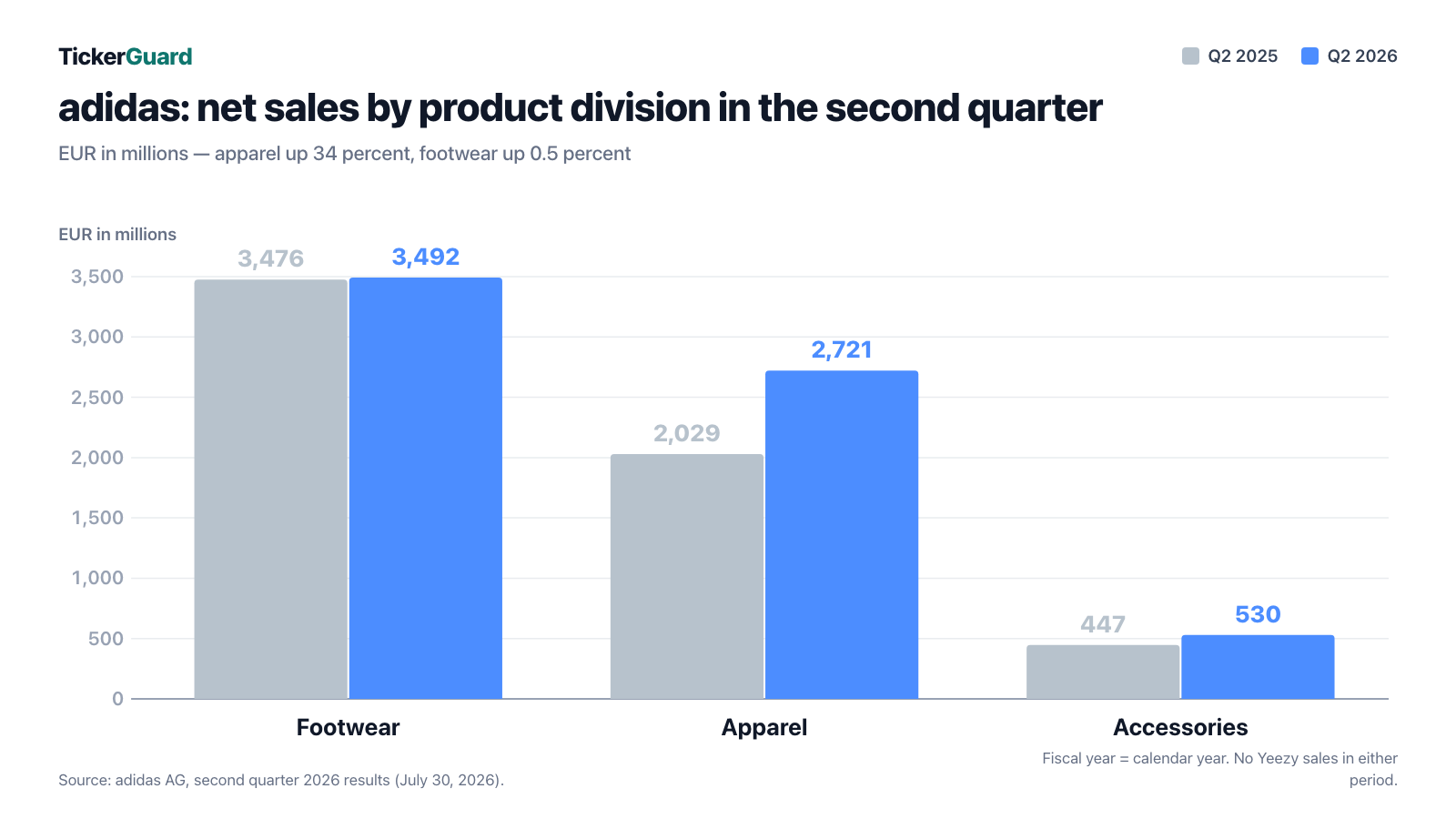
Why? adidas gives two reasons, and both are credible. First, performance footwear is doing well: the chief executive names football, running and training as the drivers, and the earnings release explicitly reports double-digit growth in running and training footwear. Second, lifestyle footwear is under pressure: the company describes a market marked by heavy discounting, especially in Europe, and adidas deliberately chose not to load the trade in order to protect its own price points. That is a defensible decision — it simply does not change the fact that the division carrying more than half the business stood still in the best quarter the company ever had. For the whole first half of 2026 footwear revenue is up 2 percent currency-neutral against 33 percent for apparel.
Rule of thumb: a record top line tells you how much was sold. It does not tell you whether the core business is still growing.
Uncomfortable truth no. 2: the record was bought expensively
The second quarter of 2026 was the quarter of the football World Cup, and adidas used it: by the company's own count its campaign drew more than 9 billion views and over 400 million interactions — the most successful in the brand's history. That has a price, and the price is in the earnings release: marketing and point-of-sale expenses rose 30 percent, or EUR 212 million, to EUR 924 million, and their share of revenue went from 12.0 to 13.7 percent. On top came 12 percent higher operating overheads, mostly shipping and staff for the growing direct business.
The result of that arithmetic: revenue up 14 percent, operating profit up only 5 percent to EUR 574 million — and the operating margin down from 9.2 to 8.5 percent. In everyday terms: the store was fuller than ever, but every hundred-euro note left EUR 8.50 behind instead of EUR 9.20.
In fairness: advertising does not only work in the quarter it is paid for. And the gross margin, the measure of pricing quality, actually improved by 0.8 percentage points to 52.5 percent in the second quarter — adidas is selling more at full price. Still the sober finding stands: the tournament is over, the costs were exceptionally high once, and the decisive question is how much of the momentum survives without one. The first answer comes with the nine-month figures on October 29, 2026.
Uncomfortable truth no. 3: profit turns into cash less and less often
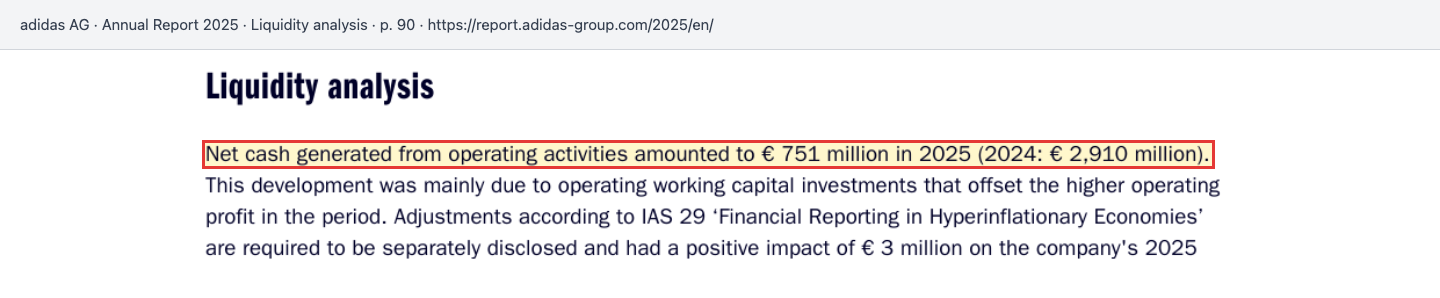
This is the heart of the analysis. Operationally 2025 was the best year in a long time — and the year in which the least money came in. The annual report says so without hedging:
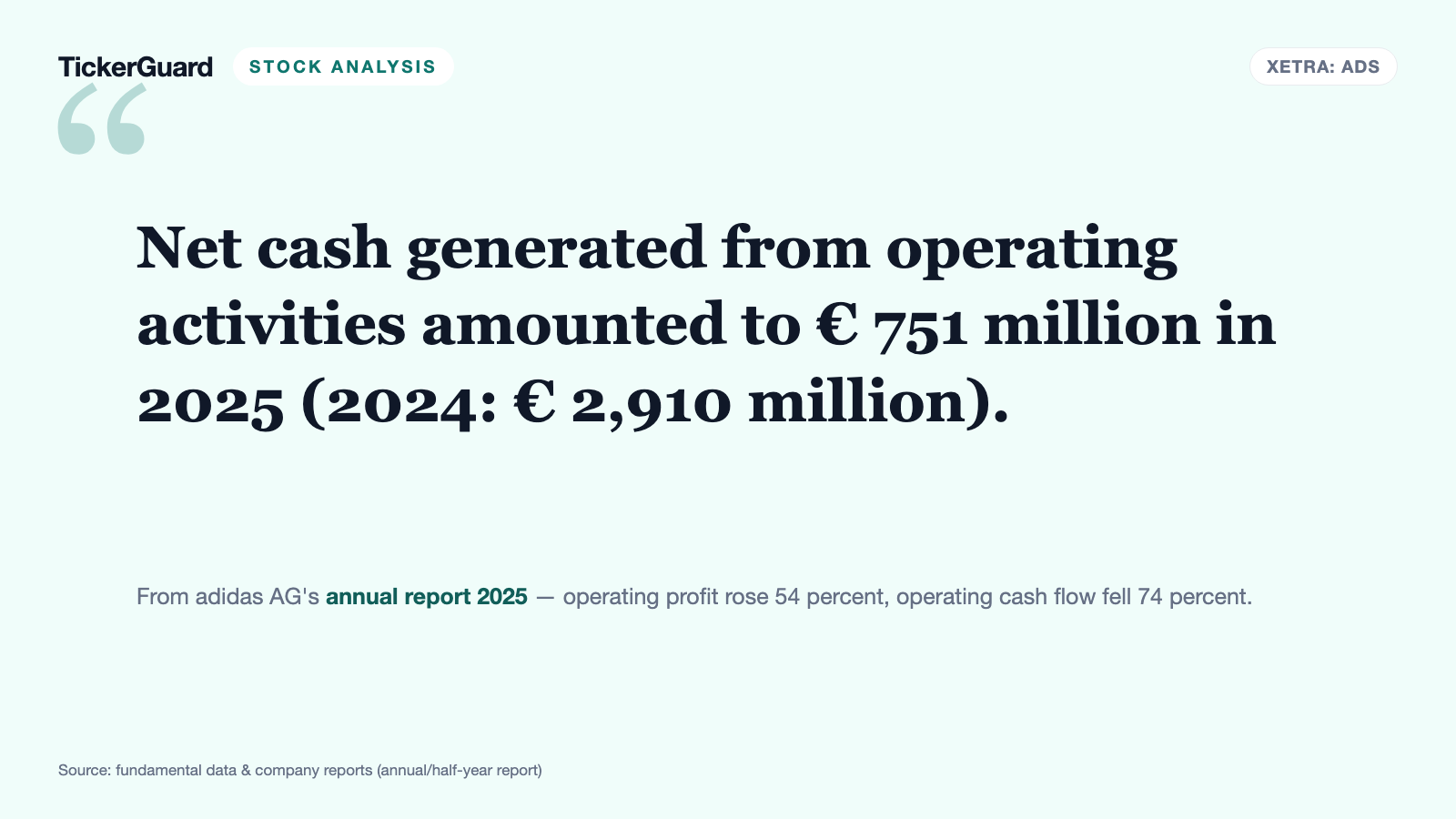
"Net cash generated from operating activities amounted to € 751 million in 2025 (2024: € 2,910 million). This development was mainly due to operating working capital investments that offset the higher operating profit in the period."
— adidas AG, Annual Report 2025, "Liquidity analysis", p. 90
What is working capital? Picture a store. Working capital is everything standing between you and your money: the goods on the shelf and in the warehouse (inventories), plus what customers still owe you (receivables), minus what you still owe your suppliers (payables). When that number grows faster than sales it means you are earning on paper while your money sits in boxes.
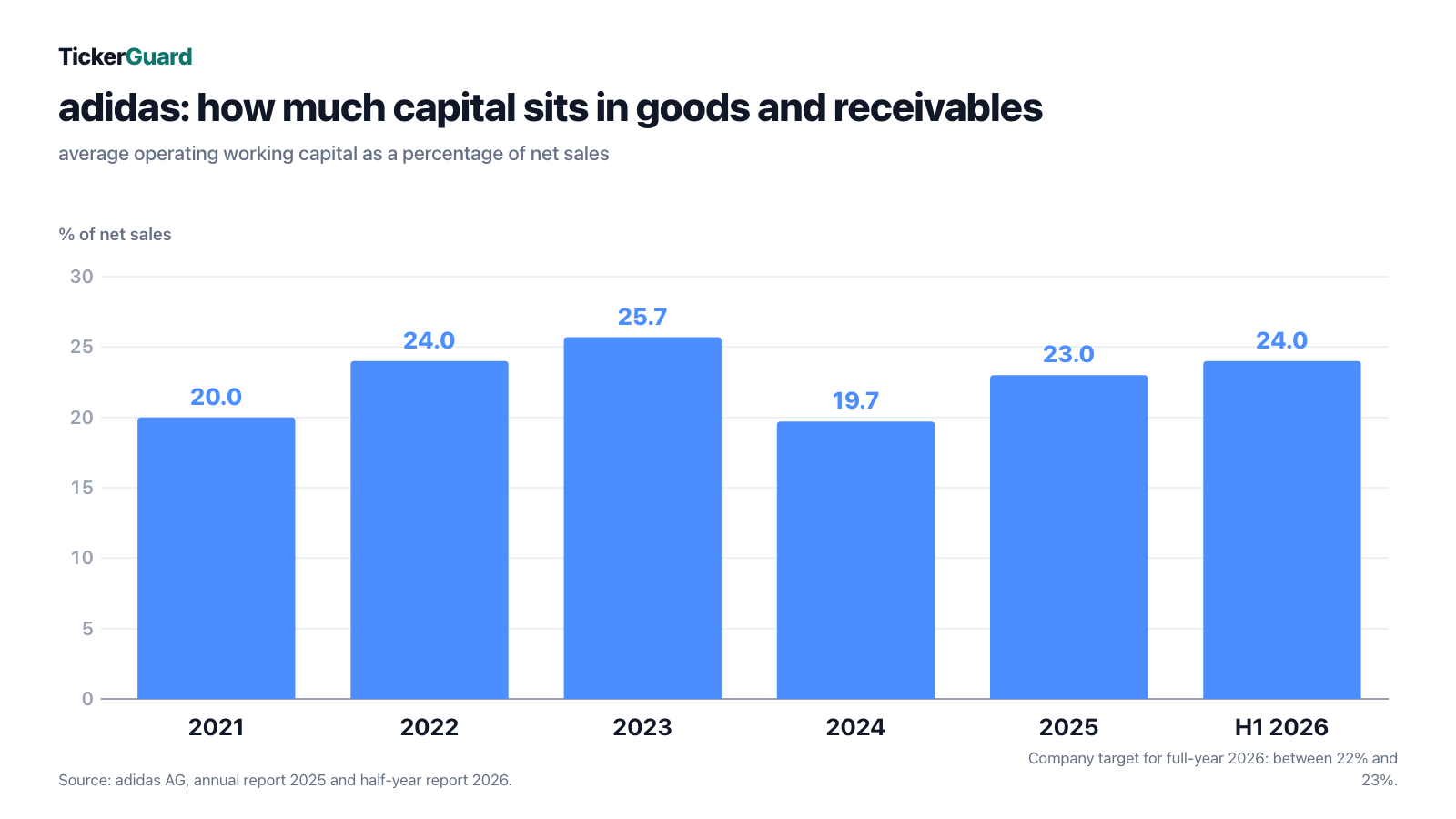
That is exactly what is happening. By June 30, 2026 inventories were up 13 percent to EUR 5,969 million and operating working capital up 18 percent to EUR 6,661 million — against a 10 percent rise in euro-denominated revenue. On average working capital equalled 24.0 percent of sales, after 20.7 percent a year earlier. adidas explains it openly:
"This development reflects the company's decision to prioritize availability of the brand's products, particularly related to the World Cup, over short-term inventory optimization."
— adidas AG, Second Quarter 2026 Results and Half-Year Report 2026, both published July 30, 2026
That is understandable: if you want to be in stock for the tournament, you have to have the goods made beforehand. What is notable, though, is that adidas is now above its own target. In the outlook of the 2025 annual report the company guided to average working capital of 22 to 23 percent of sales for 2026 — and explicitly confirmed that range in the half-year report even though the half-year figure already stood at 24.0 percent. Either the second half brings the reduction, or the target wobbles.
The series shows this is not a new question. The ten-year overview in the 2025 annual report reports average operating working capital as a percentage of net sales at 20.0 percent (2021), 24.0 percent (2022), 25.7 percent (2023), 19.7 percent (2024) and 23.0 percent (2025); in the first half of 2026 it was 24.0 percent. And for 2025 the annual report already concedes that the figure came in "above the guidance of between 21% and 22%". The 2026 target is therefore the second in a row that adidas itself has flagged as demanding.
Fairness demands the counter-movement too: in the first half of 2026 operating activities brought in EUR 644 million, after EUR 916 million had flowed out in the prior-year half. So the trend has turned. Even so, EUR 644 million of cash stands against EUR 1,279 million of operating profit: roughly half of the reported success did not arrive as money in the half-year. Rule of thumb: profit is an opinion, cash flow is a fact.
Uncomfortable truth no. 4: 92 percent of production sits in Asia — and customs does the maths too
adidas owns virtually no factory. The annual report puts it plainly: "we outsource almost 100% of our production to independent manufacturing partners with the vast majority located in Asia." And there the whole thing concentrates in a handful of countries:
"In 2025, Vietnam remained the largest sourcing country, accounting for 27% of adidas' total volume (2024: 27%), followed by Indonesia at 18% (2024: 19%) and China at 16% (2024: 16%). Overall, 92% of our total 2025 volume was produced in Asia (2024: 92%)."
— adidas AG, Annual Report 2025, "Sourcing and Supply Chain", p. 68
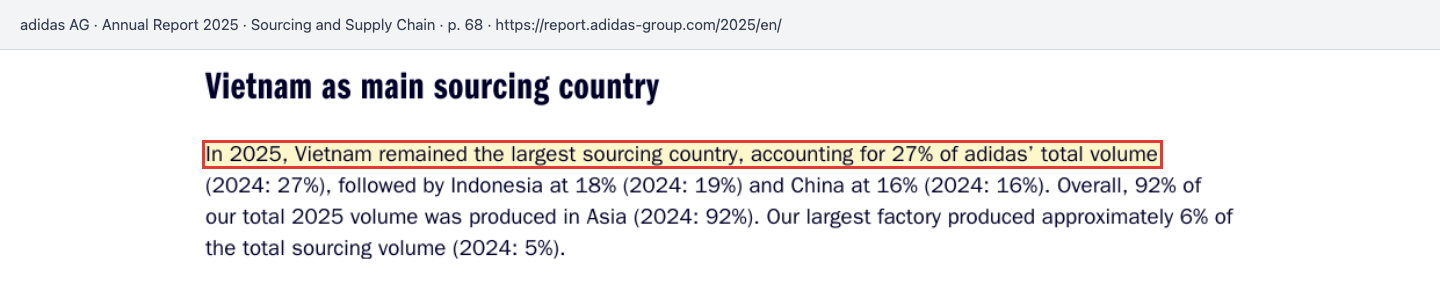
Why it matters: every item shipped from Asia into the United States passes US customs. In its 2025 risk report adidas rates tax and customs risks as "high" — with a probability of occurrence of 15 to 30 percent. In the first half of 2026 that showed up concretely: in North America the gross margin was almost unchanged at 44.3 percent because a more favourable product mix was eaten up by higher US tariffs.
There is a movement in the other direction too, and it is remarkable: in the second quarter of 2026 adidas received a first small refund of previously paid US tariffs and puts possible further refunds at USD 250 million to USD 300 million — deliberately excluded from the full-year guidance. For full-year 2026 the company guides to an operating profit of around EUR 2.3 billion, so a refund of that size would be worth roughly a tenth of it. If you want to see what such supply-chain dependence does to the numbers, our Carter's analysis offers a second example where the same constellation hits the margin directly.
Uncomfortable truth no. 5: EUR 7.9 billion of advertising contracts that appear on no balance sheet
At adidas, visibility is not an accident but a contract. And those contracts are large:
"At the end of December 2025, financial commitments for promotion and advertising decreased 3% to € 7,897 million in 2025 (2024: € 8,122 million)."
— adidas AG, Annual Report 2025, "Off-balance-sheet items", p. 91, and notes (38), p. 399

"Off balance sheet" means these payment promises do not appear on the balance sheet at all; they only live in the notes. They fall due regardless — EUR 1,578 million within one year, EUR 4,345 million in one to five years and EUR 1,974 million after that, with remaining terms of up to 13 years. For comparison: total equity on the same date was EUR 5,776 million. adidas has therefore promised federations, clubs and athletes more than the company owns in equity.
This is not a scandal but the business model: without those contracts there are no jerseys in the final and no shoes on the feet of world-record holders. But it is a fixed-cost base that does not shrink along with a weaker year. And it explains why the adidas operating margin sits in the single digits even in good years, while at a competitor such as Deckers you find it markedly higher.
Valuation — orders of magnitude rather than a daily price
We name no daily price here, only dated anchors from the reports themselves. On December 31, 2025 the share closed at EUR 169.05 according to the ten-year overview. Multiplied by the 178,665,018 shares outstanding at the time, that gives a market value of about EUR 30,203 million. Measured against 2025 revenue (EUR 24,811 million) that is roughly 1.2 times; measured against earnings per share of EUR 7.46 it is a price-to-earnings ratio of 22.7. At the end of the prior year, with EUR 236.80 and earnings per share of EUR 4.24, the same ratio stood at 55.9 — the share fell 29 percent in 2025 while earnings rose 76 percent.
Two more recent anchors complete the picture. On June 30, 2026 the share closed at EUR 179.40 according to the half-year report. And on July 31, 2026, one day after the half-year figures, adidas published a mandatory disclosure under Article 19 of the EU Market Abuse Regulation: chief executive Bjørn Gulden bought company shares via Xetra for a total of EUR 508,569.05 at an average price of EUR 158.93. Such disclosures are neither a recommendation nor a forecasting tool — the boss can be wrong like anyone else. But they are a data point: on that day the person with the best view considered the price acceptable.
Valuation also includes what flows back. For 2025 adidas paid a dividend of EUR 2.80 per share, EUR 491 million in total during the first half of 2026; the payout ratio was 36 percent of net income from continuing operations. On top of that runs a share buyback of up to EUR 1 billion, of which EUR 525 million was executed in the first half; the repurchased shares are to be cancelled. The effect is already visible: the share count fell from 178,665,018 (December 31, 2025) to 175,062,879 (June 30, 2026), a drop of 2.0 percent. Your slice of the pie is getting bigger here, not smaller — the opposite of most companies we write about.
And what does the road ahead look like? The company's own 2026 guidance: 9 to 10 percent currency-neutral revenue growth, operating profit of around EUR 2.3 billion, average working capital of 22 to 23 percent of sales and capital expenditure of around EUR 500 million. If the profit target were met, the operating margin would land near 8.5 percent — roughly the 2025 level and far below the 11.3 percent of 2019. Whether the market wants to pay today's price tag for that path is a price question, not a quality question. It decides the return, not the substance.
Opportunities and risks at a glance
Opportunities
- Demonstrated turnaround: operating margin from 1.3 percent (2023) through 5.6 percent (2024) to 8.3 percent (2025), 2025 operating profit up 54 percent to EUR 2,056 million.
- Broad-based growth in the first half of 2026: currency-neutral up 15 percent in North America, 16 percent in Greater China, 27 percent in Latin America and 21 percent in Japan/South Korea.
- Direct-to-consumer as a margin lever: up 23 percent currency-neutral in the half-year, e-commerce up 26 percent, own stores up 21 percent — at a better margin than wholesale.
- Balance sheet materially relieved: leverage of 1.6 at mid-2026 after 3.3 in 2023, equity ratio 28.3 percent, cash and cash equivalents EUR 1,159 million.
- Returns to shareholders: EUR 2.80 dividend per share for 2025 plus a buyback of up to EUR 1 billion, with the share count already down 2.0 percent.
- An opportunity not in the numbers: USD 250 million to USD 300 million of possible US tariff refunds are explicitly excluded from the full-year guidance.
Risks
- Footwear, 52 percent of quarterly revenue, grew only 1 percent currency-neutral in the second quarter of 2026; the company describes a lifestyle footwear market marked by heavy discounting.
- Operating margin down from 9.2 to 8.5 percent in the second quarter of 2026 as marketing spend rose 30 percent — the World Cup as a revenue driver does not repeat.
- Net cash from operating activities down 74 percent to EUR 751 million in 2025; in the first half of 2026 EUR 644 million came in against EUR 1,279 million of operating profit.
- Tied-up capital above the company's own target: 24.0 percent of sales on average in the first half of 2026 against a full-year target of 22 to 23 percent; inventories up 13 percent.
- Sourcing concentration: 92 percent of volume from Asia, of which 27 percent Vietnam, 18 percent Indonesia and 16 percent China — against US customs risks adidas itself rates as "high".
- EUR 7,897 million of off-balance-sheet promotion and advertising commitments with terms of up to 13 years, more than the EUR 5,776 million of equity.
- Change at the top of finance: Birgit Kretschmer joins the executive board on September 1, 2026 and takes over at year-end from Harm Ohlmeyer, who has held the role since May 2017.
A human bottom line
Back to the wardrobe trap. It is treacherous because it feels like knowledge. You know the products, you see the stores busy, you remember the final — and out of that your mind builds a verdict on a balance sheet you have never read. But the question on the stock market is never "is the brand good?", it is "what does it cost, and what does it earn?".
After the reading, a double picture remains. adidas has a genuine turnaround behind it: 1.3 percent operating margin in 2023 became 8.3 percent, leverage of 3.3 became 1.6, no dividend became EUR 2.80 per share, and the share count is falling rather than rising. And at the same time: the largest business — footwear — stood still in the record quarter, the margin fell despite record revenue, the capital in the warehouses is growing faster than sales and sits above the company's own target, and the record summer was a tournament summer that will not come back in 2027.
On October 29, 2026 adidas publishes its nine-month figures. That is where it will say whether footwear is growing again, whether working capital is back at 22 to 23 percent and whether anything of the momentum survives the tournament. Until then, every statement about the second half of 2026 is a guess — including ours.
What you make of that is your decision. And that is how it should be.
Sources
- adidas AG, Annual Report 2025 (IFRS consolidated accounts, signed February 19, 2026, published with the annual results on March 4, 2026) — key figures, ten-year overview p. 425 f., financial review, working capital, liquidity analysis p. 90, off-balance-sheet items p. 91, Sourcing and Supply Chain p. 68, outlook, risk and opportunity report, notes (38) p. 399, financial calendar p. 434
- adidas AG, Half-Year Report 2026 and Second Quarter 2026 Results (both published July 30, 2026)
- adidas AG, First Quarter 2026 Results (April 29, 2026)
- adidas AG, managers' transaction under Article 19 of the EU Market Abuse Regulation: Bjørn Gulden, July 31, 2026
- adidas AG, ADR program information (ADDYY, OTCQX International Premier, ratio 2:1, depositary Deutsche Bank Trust Company Americas, CUSIP 00687A107)
- adidas AG, share buyback 2026 information (up to EUR 1 billion, second tranche)
- Ranking of the most-discussed stocks in the wallstreet-online forum, as of August 5, 2026 (the hook for this analysis, not a data source for company figures)
Disclaimer: this piece is journalistic analysis and not investment advice, not a buy or sell recommendation and not a solicitation to trade in securities. All figures come from the adidas AG publications named above and carry the reporting date stated there; the data cut-off for this analysis is August 5, 2026. The most recent periodic report evaluated is the Half-Year Report 2026 of July 30, 2026; the nine-month figures on October 29, 2026 may update or correct the values shown here. Equities can cause substantial losses up to and including total loss. Positions held by the operator are disclosed daily; where one exists, it appears as a notice at the top of this deep dive.
Our Bottom Line at a Glance
- Turnaround and profitability positive
- The operating margin rose from 1.3 percent (2023) through 5.6 percent (2024) to 8.3 percent (2025), and 2025 operating profit by 54 percent to EUR 2,056 million. In the first half of 2026 it added 11 percent to EUR 1,279 million at an operating margin of 9.6 percent.
- Growth of the core business negative
- Footwear revenue — EUR 3,492 of EUR 6,743 million, or 52 percent of quarterly sales — rose only 1 percent currency-neutral in the second quarter of 2026 (0 percent in euro terms), while apparel gained 35 percent. For the first half of 2026 footwear growth was 2 percent.
- Cost of the record quarter neutral
- Marketing and point-of-sale expenses rose 30 percent, or EUR 212 million, to EUR 924 million in the second quarter of 2026. Operating profit therefore grew only 5 percent to EUR 574 million and the operating margin fell from 9.2 to 8.5 percent. The gross margin moved the other way, improving 0.8 percentage points to 52.5 percent.
- Turning profit into cash negative
- Net cash from operating activities fell 74 percent to EUR 751 million in 2025 (2024: EUR 2,910 million), according to the 2025 annual report because of operating working capital investments. In the first half of 2026 EUR 644 million came in (prior year: EUR 916 million outflow) — against EUR 1,279 million of operating profit.
- Balance sheet and shareholder returns positive
- Leverage improved from 3.3 (2023) to 1.6 as of June 30, 2026 and the equity ratio to 28.3 percent. The dividend for 2025 rose to EUR 2.80 per share, and the buyback of up to EUR 1 billion cut the share count 2.0 percent to 175,062,879 by June 30, 2026.
- Supply chain and tariffs neutral
- 92 percent of 2025 sourcing volume came from Asia (Vietnam 27, Indonesia 18, China 16 percent), and production is outsourced almost entirely. adidas rates tax and customs risks as "high" in its 2025 annual report; on the other side stand USD 250 million to USD 300 million of possible tariff refunds that are deliberately excluded from the full-year guidance.
adidas has a documented turnaround behind it: operating margin from 1.3 percent (2023) to 8.3 percent (2025), leverage from 3.3 to 1.6, a rising dividend and a falling share count. At the same time, in the record quarter of the 2026 World Cup summer it was footwear of all things that contributed nothing to growth (up 1 percent currency-neutral at a 52 percent revenue share), the operating margin fell to 8.5 percent on EUR 212 million of extra marketing spend, and tied-up capital sits at 24.0 percent of sales, above the company's own full-year target. The nine-month figures on October 29, 2026 deliver the first answer on all three. Not investment advice.
What Our Rating Means
Open questions
The business works in principle, but one material question is open. As long as it stays open, our findings do not carry a quality verdict.
The business model carries, the accounts are audited IFRS consolidated statements, the balance sheet is solid with an equity ratio of 28.3 percent and leverage of 1.6, and there is neither an existential dependence on a single counterparty nor an accounting or governance finding. What remains open is one material operating question, which is why the light stands at amber: the largest segment — footwear, 52 percent of quarterly revenue — grew only 1 percent currency-neutral in the best quarter in company history, the growth came from apparel and from a tournament that does not repeat in 2027, and since 2025 noticeably less cash comes out of operating profit: EUR 751 million of net cash inflow in 2025 after EUR 2,910 million the year before. Explicitly separate from all that: whether the share is expensive or cheap at a price-to-earnings ratio of 22.7 on the 2025 year-end close does not colour this light — that is a price question.
A journalistic assessment by our editorial team at the time of the deep dive, based on public sources — not investment advice and not a solicitation to buy or sell. Your personal circumstances (investment goals, risk capacity, taxes) cannot be taken into account. What our levels mean, how verdicts are formed, and what conflicts of interest exist →
Worth Noting
- The hook: adidas ranked near the top of the most-discussed lists in the wallstreet-online forum on August 5, 2026 — an attention signal, not a reason to buy.
- Data as of August 5, 2026. The most recent periodic report evaluated is the Half-Year Report 2026 of July 30, 2026; the nine-month figures follow on October 29, 2026.
- adidas is not an SEC filer: no 10-K, no 10-Q. The US receipt ADDYY is a sponsored Level I ADR on OTCQX and triggers no US reporting duty. All evidence comes from the 2025 annual report, the 2026 half-year report, the earnings releases and the company's mandatory disclosures.
- Easy to confuse: adidas almost always publishes two growth rates — in euro terms and currency-neutral. For 2025 that was 5 versus 10 percent, for the first half of 2026 10 versus 14 percent. On top of that, the 2024 base still contained roughly EUR 650 million of Yeezy revenue, while 2025 contained none.
- The purchase of company shares by the chief executive on July 31, 2026 (EUR 508,569.05 at an average of EUR 158.93) is a mandatory disclosure under Article 19 of the EU Market Abuse Regulation and is neither a forecast nor a recommendation.
- Analyses are evergreen; daily prices are not a reason to buy. Every price in this text is a dated anchor from a report or a mandatory disclosure.
The full analysis as a PDF for later
We will send you this analysis as a PDF — to print, file away, and read at your own pace.
Frequently Asked Questions
adidas AG of Herzogenaurach, Germany, designs and sells athletic footwear, apparel and accessories. Of EUR 24,811 million of 2025 revenue, EUR 14,232 million came from footwear, EUR 8,764 million from apparel and EUR 1,815 million from accessories. Sales run through retail partners and through own stores and online shops; at the end of 2025 the group had 64,938 employees.
adidas is listed in the Prime Standard of the Frankfurt Stock Exchange and is not a US reporting company. In the United States only a depositary receipt on the share trades over the counter on OTCQX (ADDYY) — a sponsored Level I program, which triggers no reporting duty toward the Securities and Exchange Commission. What is mandatory instead are audited IFRS annual accounts, a half-year financial report, quarterly statements and ad-hoc releases.
Revenue rose 14 percent currency-neutral to a record EUR 6,743 million. Apparel added 35 percent, footwear only 1 percent. Because marketing and point-of-sale spending rose 30 percent, or EUR 212 million, to EUR 924 million, operating profit grew just 5 percent to EUR 574 million and the operating margin fell from 9.2 to 8.5 percent.
Net cash from operating activities fell 74 percent to EUR 751 million in 2025 after EUR 2,910 million a year earlier. The annual report names operating working capital investments as the main reason: they offset the higher operating profit — meaning more goods in the warehouse and higher receivables alongside lower payables.
As of June 30, 2026 inventories stood at EUR 5,969 million, 13 percent more than a year earlier. Total operating working capital rose 18 percent to EUR 6,661 million and equalled 24.0 percent of sales on average, after 20.7 percent in the prior-year half — above the company's own full-year target of 22 to 23 percent.
Both. For financial year 2025 a dividend of EUR 2.80 per share was approved (prior year EUR 2.00), and EUR 491 million was paid out in the first half of 2026. In addition a share buyback of up to EUR 1 billion is running; EUR 525 million was executed in the first half, taking the share count down to 175,062,879.
By its own account adidas outsources almost 100 percent of production to independent manufacturing partners. In 2025, 92 percent of volume came from Asia: 27 percent from Vietnam, 18 percent from Indonesia and 16 percent from China. The single largest factory produced around 6 percent of total sourcing volume.
The nine-month figures for 2026 are due on October 29, 2026 according to the financial calendar in the 2025 annual report. They are the next hard test for the three open questions of this analysis: whether footwear revenue grows again, whether working capital returns to the 22 to 23 percent target range and whether further US tariff refunds are booked.
Found an error?
Did you spot a factual error, an outdated number, or a typo in this deep dive? Let us know briefly — your report goes straight to the editorial team.