Heidelberg Pharma: A Cancer Drug Built on Death Cap Mushroom Toxin, an Auditor’s Going-Concern Warning — and Cash That Lasts Until Mid-2027
Heidelberg Pharma builds cancer drugs from the toxin of the death cap mushroom, and its lead candidate HDP-101 is showing early signs of efficacy in the clinic. But the auditor flags a material uncertainty about the company’s ability to continue as a going concern, equity is negative, and management says the money lasts until mid-2027. We read the 2025 annual report, the 2026 half-year report and every notice since. Whether a drug is maturing here or the clock is simply running out depends on an FDA letter to another company.
 Thomas Mücke
Founder & Publisher
Thomas Mücke
Founder & Publisher
Chart
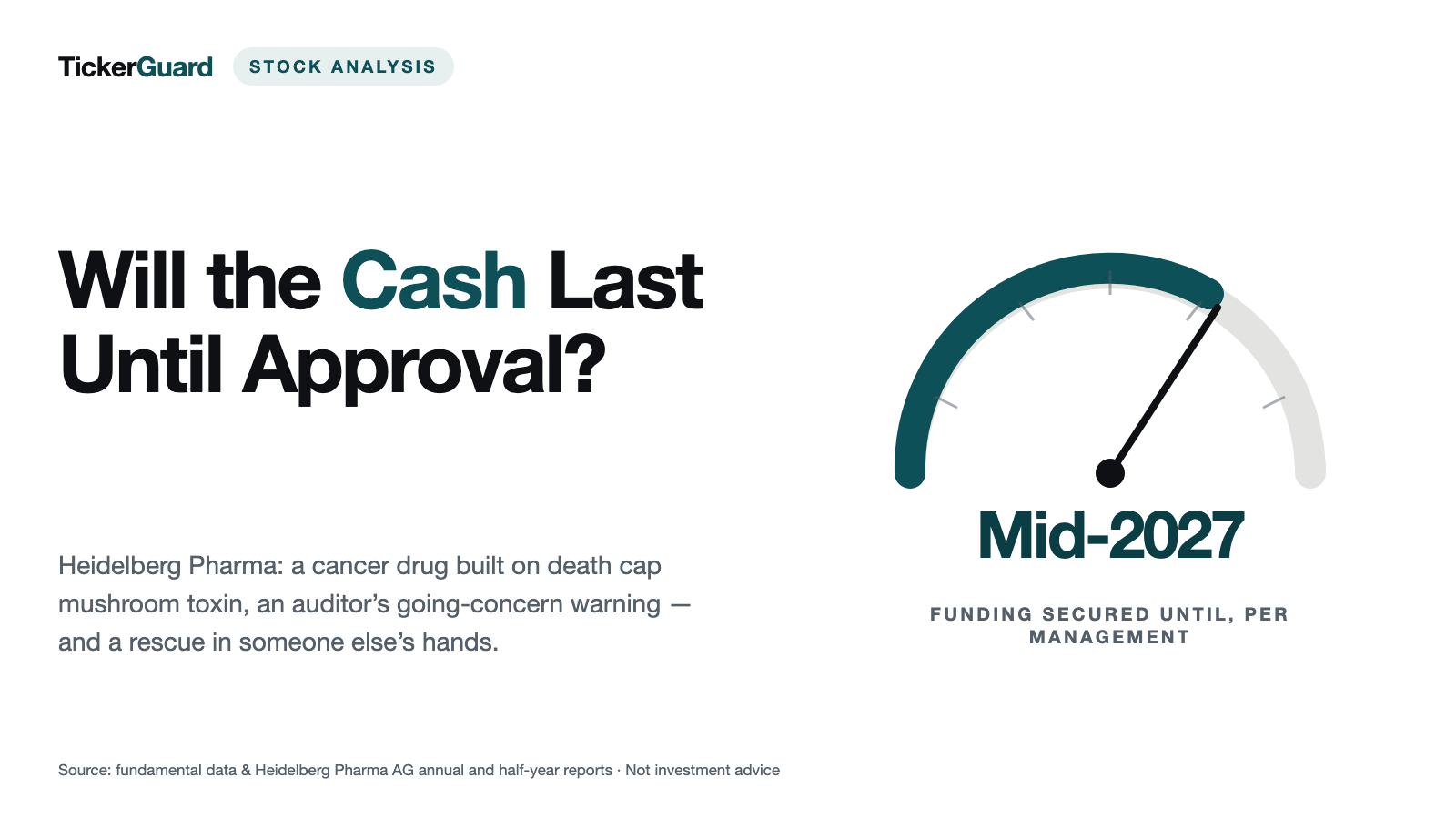
Interactive price chart (TradingView).
Note: pure fact-based analysis, not investment advice and not a solicitation to buy or sell. All figures without guarantee.
Some numbers stick in investors’ heads the moment they hear them. Psychologists call it the anchoring effect: once we learn that a well-informed buyer paid a certain price for something, we measure every later price against it — even if the world has changed since. With Heidelberg Pharma the anchor sits unusually close. In 2022 the Chinese drugmaker Huadong Medicine came on board: it took up 11,838,652 new shares in a capital increase and bought another 4,465,908 shares from major shareholder dievini — each at €6.44 per share. On September 25, 2026, the stock closed at €2.58 on Xetra, Germany’s main electronic exchange. And there is a second anchor: behind the company stand two deep-pocketed major shareholders, the circle around investor Dietmar Hopp and Huadong, who together hold 79 percent. Surely nothing can go wrong — right?
Let’s make a deal: we set the anchors aside and read what Heidelberg Pharma has published itself — the audited 2025 annual report, the 2026 half-year financial report of July 15, 2026, and every mandatory notice since. Heidelberg Pharma is a German company and does not report to the U.S. securities regulator, the SEC; it publishes its reports in German and English, and we quote the official English versions. The central tension of this analysis: its own drug candidate HDP-101 is showing real early signs of efficacy in the clinic — but whether the company survives long enough to finish developing it depends, according to its annual report, on U.S. approval of a completely different product that another company controls. In the end, you decide.
What Heidelberg Pharma actually does — cancer medicine from the death cap mushroom
Heidelberg Pharma, based in Ladenburg near Heidelberg, Germany, develops antibody drug conjugates, or ADCs. Think of a guided missile: an antibody homes in on cancer cells by a specific marker on their surface, and it carries a cell toxin that is released only inside the cancer cell. What sets Heidelberg Pharma apart is the payload: amanitin, the toxin of the green death cap mushroom. The company calls its platform ATAC technology and describes itself as the first company to use amanitin for cancer therapy.
Its most important in-house candidate is HDP-101 (international nonproprietary name pamlectabart tismanitin). It targets the surface marker BCMA and has been tested since February 2022 in a Phase I/IIa study in multiple myeloma, a cancer of the bone marrow. The FDA has granted HDP-101 orphan drug designation (March 2024) and Fast Track designation (October 2025). The other programs are on ice or meant to continue only with partners: enrollment of new patients in HDP-102 for lymphoma is suspended, and the company says it will not develop HDP-103 for prostate cancer or HDP-104 for colorectal cancer itself.
So far Heidelberg Pharma earns money almost exclusively through partners: licensees such as Japan’s Takeda develop their own amanitin-based drugs and pay milestones as development steps are reached; Huadong holds the rights to HDP-101 in 20 Asian markets. On top of that come older, non-amanitin products at partners — above all the imaging agent TLX250-Px for kidney cancer, which Australia’s Telix Pharmaceuticals is trying to get approved. Some history: the company was founded in 1997 as WILEX by physicians and cancer researchers from the Technical University of Munich, has been listed in the Frankfurt Stock Exchange’s Prime Standard since November 2006, and has been called Heidelberg Pharma AG since October 2017. On May 31, 2026, it employed only 42 people including management — a year earlier the figure was 122.
One detail matters for every number in this article: Heidelberg Pharma’s fiscal year runs from December 1 to November 30. Fiscal 2025 ended on November 30, 2025, and the “first half of 2026” covers December 1, 2025, through May 31, 2026.
Company history for investors
-
2006
IPO as WILEX
Listing in the Frankfurt Stock Exchange’s Prime Standard; since 2017 the company has been called Heidelberg Pharma AG, based in Ladenburg.
-
2022
Huadong takes a 35 percent stake
Capital increase with about €80M in gross proceeds at €6.44 per share, most of it taken up by Huadong; cash rises to €81.3M — the anchor many investors still measure today’s price against.
-
2024
Royalties sold to HCRx
Upfront payment of $25M against future royalties on TLX250-Px; the big payment was meant to follow FDA approval.
-
2025
Complete response letter and restructuring
The FDA halts TLX250-Px for now, and the expected $70M payment is delayed. Workforce cut by about 75 percent, new CEO from Huadong’s management.
-
2026
March: $20M from Soleus
New upfront payment in exchange for a higher cap on assigned royalties; financing now reaches mid-2027.
-
2026
September: HDP-101 data
Responses in 13 of 31 evaluable patients in cohorts 5–9; Phase IIa is underway. A sign of hope that does not close any funding gap.
How the stock landed on our desk
Through other investors’ curiosity: in late September 2026, Heidelberg Pharma appeared in the ranking of most-discussed stocks on wallstreet-online, one of Germany’s largest retail-investor forums. That is an attention signal and explicitly not a reason to buy — a stock gets discussed because it interests someone, not because it is good.
More telling is what our in-house stock scanner says. As of September 27, 2026, Heidelberg Pharma met five scanner strategies, and the two most important are warning signals: the going-concern scanner, which looks for companies with balance-sheet scores in the danger zone, earnings too weak to cover interest and cash flowing out (1,338 hits across the universe), and the insolvency radar, which triggers when cash would last less than four quarters at the current burn rate (1,007 hits). Two ratios fit the picture: the Piotroski score, a nine-point health check of the books, stands at 1 out of 9 — a clear warning sign. And the Altman Z″ score, an early-warning system for insolvency, sits at minus 15.77, deep in the danger zone that starts below 1.1. The other three hits say less: the stock trades below its 50-day and 200-day moving averages, the loss per share has recently been shrinking faster, and according to the data feed more than 80 percent of the shares sit with institutions and insiders combined — here mainly the two major shareholders.
A scanner only crunches ratios; it does not read reports. Our going-concern scanner itself warns that it is no substitute for the auditor’s actual opinion. With Heidelberg Pharma we checked — and the auditor confirms the warning. More on that shortly.
The numbers over the years — honestly appraised
First, what genuinely impresses. Heidelberg Pharma has convinced two large drugmakers of its technology: Takeda has taken its own licensed amanitin drug against the target CCR8 into a clinical study in solid tumors, and Huadong did not just buy rights in 2022 but took a 35 percent stake in the company. The cost cuts of fall 2025 are working, too: in the first half of 2026, operating expenses fell 32 percent to €12.3 million, and the net loss shrank from €12.6 million to €3.4 million.
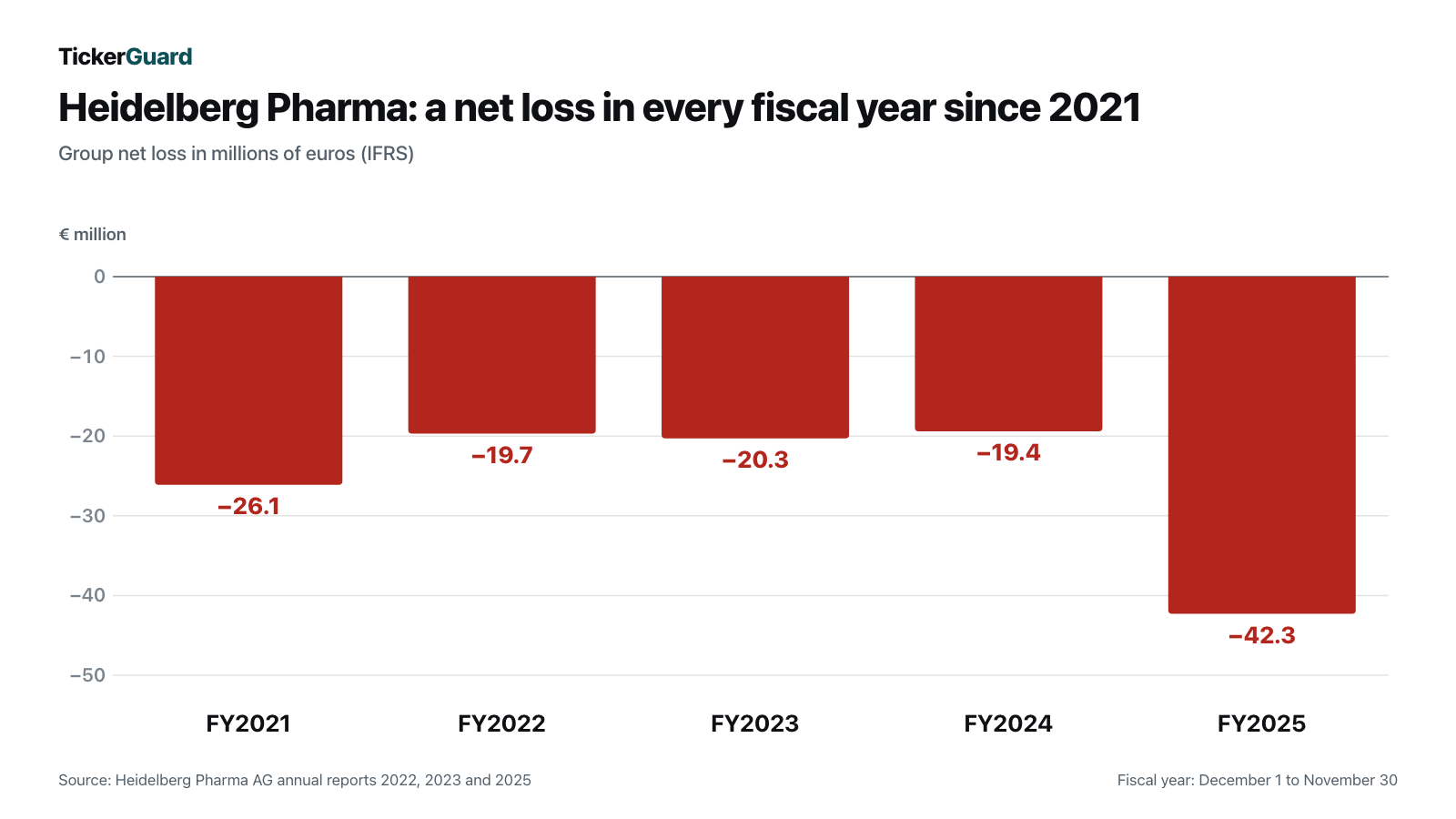
Over the years, though, the picture is unambiguous: Heidelberg Pharma has not made money in any of the past five fiscal years. The group lost €26.1 million in fiscal 2021, €19.7 million in 2022, €20.3 million in 2023, €19.4 million in 2024 and €42.3 million in fiscal 2025 (ended November 30, 2025). The jump in 2025 had three main causes: revenue fell from €6.8 million to just €1.5 million (€6.9 million including other income), research costs rose with two clinical studies, and restructuring the company caused €10.6 million in one-off charges.
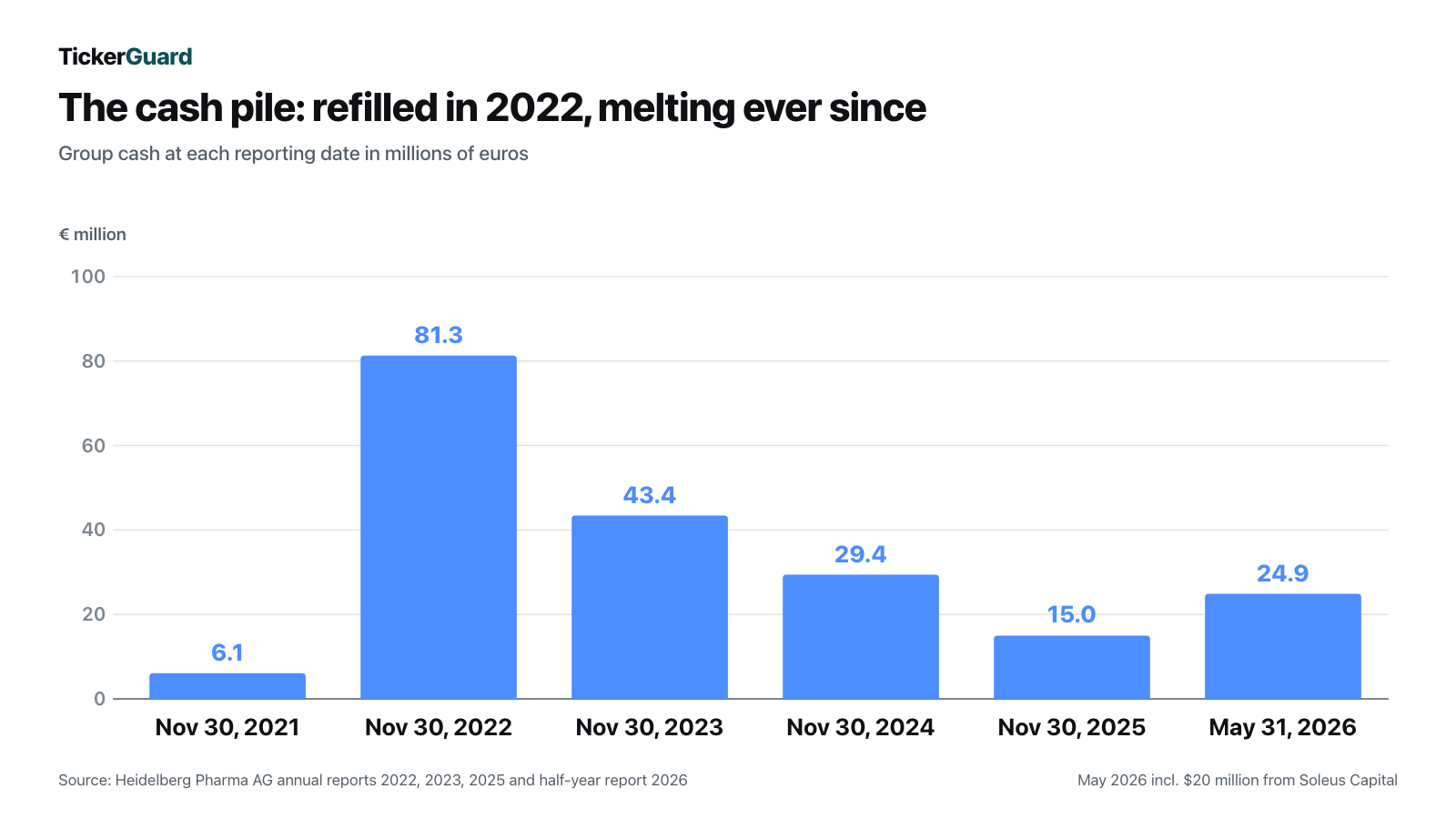
These losses have been funded from outside time and again. The cash balance shows how much that mattered: at the end of November 2021 there was only €6.1 million in the bank. Then came the 2022 capital increase with gross proceeds of about €80 million, most of it subscribed by Huadong, and at the end of November 2022 the group had €81.3 million. Since then the pile has melted — to €43.4 million at the end of fiscal 2023, €29.4 million a year later and €15.0 million on November 30, 2025. Operating cash outflow in fiscal 2025 was €31.6 million. The rebound to €24.9 million on May 31, 2026, came not from the business but from an upfront payment of $20 million, which we get to in uncomfortable truth no. 2.
The first half of 2026 and what has happened since
On July 15, 2026, Heidelberg Pharma published its half-year financial report for December 1, 2025, through May 31, 2026 — the latest periodic report; the nine-month statement is due on October 15, 2026, according to the financial calendar. Revenue and other income rose to €9.2 million (prior year: €5.0 million), mainly from milestone payments and material sales; Takeda and Huadong paid milestones, but the company does not disclose the amounts. Operating cash outflow halved to €7.3 million. Equity stood at minus €14.2 million on May 31, 2026, after minus €10.9 million on November 30, 2025.
For fiscal 2026, management confirmed its guidance of March 26, 2026: €11 million to €15 million in revenue and other income, €25 million to €29 million in operating expenses — an operating loss of €13 million to €17 million — and €11 million to €15 million in cash at fiscal year-end on November 30, 2026. The half-year report states: “The Group’s financing is secured until mid-2027 based on current internal planning.”
Since the half-year report the company has published four news items. Clinically: in April 2026 the HDP-101 study set the dose for the Phase IIa part (175 micrograms per kilogram). At the annual meeting of the International Myeloma Society, Heidelberg Pharma presented the dose-escalation data on September 24, 2026: 53 heavily pretreated patients with a median of five prior lines of therapy (the median is the typical case: half the patients had more, half had fewer), no maximum tolerated dose reached, and no treatment-related grade 5 (fatal) adverse events. In cohorts 5 through 9, 13 of 31 evaluable patients responded (42 percent), including three stringent complete responses. In the cohort at the chosen dose, two of five responded. The Phase IIa part is to include up to 30 patients, with enrollment targeted for completion in the third or fourth quarter of 2026. On the partner side: on August 26, 2026, Huadong received approval in China for a combination study with HDP-101, with Huadong bearing the costs, and on August 28, 2026, the two companies announced a further research collaboration in an ad hoc announcement — more on that in uncomfortable truth no. 4. There has been no capital measure, no new voting-rights notification and no share transaction by management since the half-year report (as of September 27, 2026).
To put the trial data in context: a response in 42 percent of heavily pretreated patients is an encouraging signal, but an open-label study with no control group and few patients per dose level is no proof of efficacy. And BCMA is a crowded target: according to the 2025 annual report, GlaxoSmithKline’s Blenrep, a BCMA-directed ADC, and Regeneron’s Lynozyfic, a bispecific BCMA antibody, were approved in the U.S. and the EU in 2025. If you are interested in another German biotech with a long history of losses, our Evotec analysis offers a comparison.
Uncomfortable truth no. 1: the auditor doubts the company can continue as a going concern
This is the heaviest sentence in the 2025 annual report, and it is not buried in the fine print — it appears in three places: in management’s risk report, in the notes to the financial statements and in the audit opinion of Baker Tilly. The notes put it this way:
“As a result, there is currently material uncertainty about the Group’s and/or the Group companies’ ability to continue as a going concern.”
— Heidelberg Pharma AG, Annual Report 2025, notes section 6 “Going concern risk,” page 106
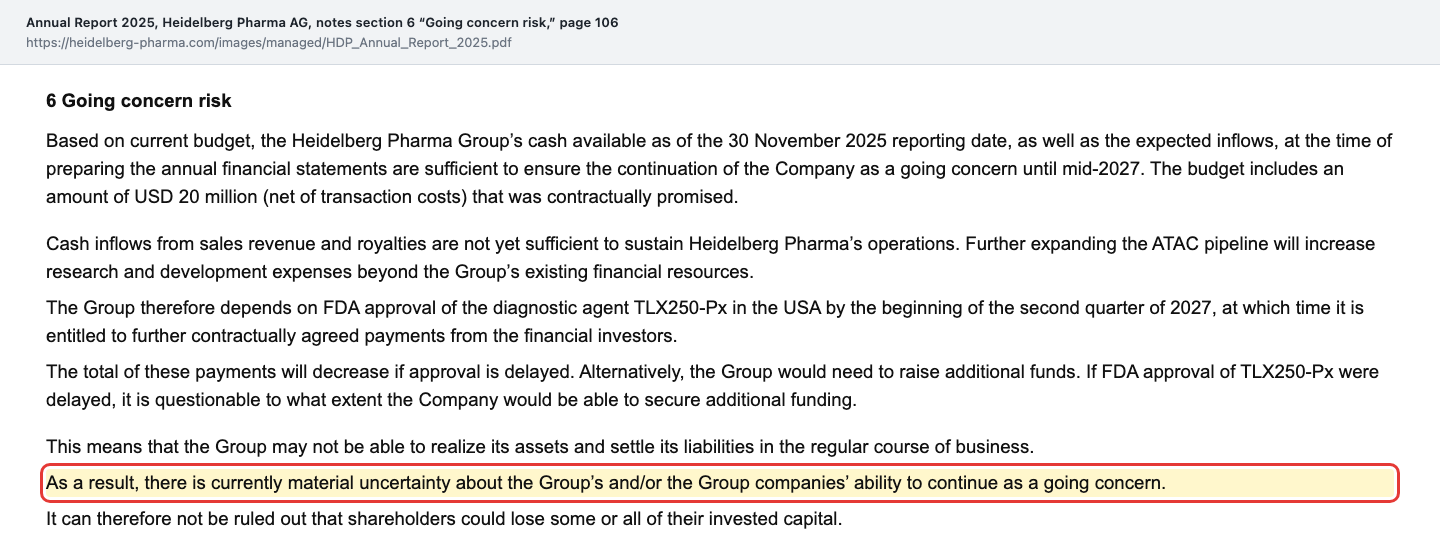
In plain English: a company always prepares its accounts on the assumption that it will keep operating. A “material uncertainty” means management and auditor still consider that assumption defensible but expressly warn that it may fail. The auditor nevertheless issued an unqualified opinion and singled out the going-concern question as a separate key audit matter. The notes spell out the consequence for investors: “shareholders could lose some or all of their invested capital.”
How serious things got in 2025 is visible in the timeline: after Heidelberg Pharma announced in an ad hoc notice on August 28, 2025, that an expected payment of $70 million would be delayed, the closing price fell from €4.55 to €3.66 in a single day, according to fundamental data. On September 25, 2025, management decided to cut the workforce by about 75 percent, wound down early research and suspended the second clinical program, HDP-102. In November 2025 the supervisory board revoked the appointment of the previous head of the management board. Remember: a going-concern warning is not an insolvency verdict — but it is the clearest warning sign an audited set of accounts can carry.
Uncomfortable truth no. 2: the rescue hinges on the approval of someone else’s product
Where is the money supposed to come from after mid-2027? Not from HDP-101 — a drug in Phase IIa is years away from revenue. The annual report names a different source, and it lies outside the company’s control:
“The Group therefore depends on FDA approval of the diagnostic agent TLX250-Px in the USA by the beginning of the second quarter of 2027, at which time it is entitled to further contractually agreed payments from the financial investors.”
— Heidelberg Pharma AG, Annual Report 2025, notes section 6 “Going concern risk,” page 106
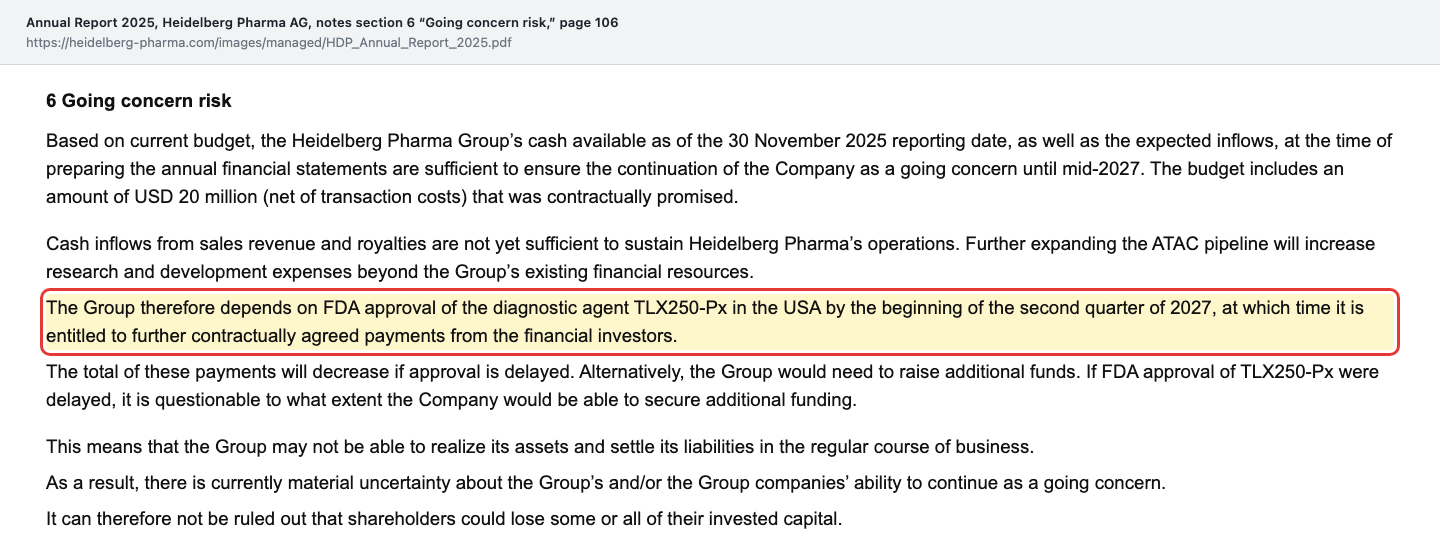
The backstory: in March 2024, Heidelberg Pharma sold part of its future royalties on TLX250-Px to the U.S. royalty investor HealthCare Royalty (HCRx) and received $25 million upfront. In March 2025, HCRx paid another $20 million upfront, in exchange for which Heidelberg Pharma waived future payments of the same amount; in March 2026 a further $20 million came from the investment firm Soleus Capital — in return, Heidelberg Pharma agreed to a higher cap on the royalties it has assigned. The big money only flows upon FDA approval: then $25 million from Soleus and a payment from HCRx that was originally set at $75 million, was cut to $70 million in March 2025 and, according to the annual report, declines further if approval comes after the end of 2025.
That very approval has stalled. In August 2025 Telix received a complete response letter from the FDA citing deficiencies in chemistry, manufacturing and controls; the FDA wants proof that the material used in the trials and the material from commercial-scale production are comparable, and it flagged two external manufacturing and supply-chain partners. According to Telix’s half-year report of August 2026, the final manufacturing documentation was “nearing completion,” and Telix had been granted an extension for the resubmission. At that point the application had not yet been resubmitted. Heidelberg Pharma itself writes in the annual report that if approval were delayed further, “it is questionable to what extent the Company would be able to secure additional funding.” Remember: over the coming months, Heidelberg Pharma’s fate depends less on its own lab than on a partner’s manufacturing paperwork.
Uncomfortable truth no. 3: negative equity — half warning sign, half accounting
Negative equity means the liabilities on the balance sheet exceed the assets. At Heidelberg Pharma, equity stood at minus €14.2 million on May 31, 2026. That sounds like over-indebtedness — and yet there is a quirk you need to know about. The largest item on the liability side is non-current financial liabilities of €52.9 million. These are the upfront payments from HCRx and Soleus, which accounting rules require to be booked as debt. But they are not repaid by Heidelberg Pharma; they are paid down from the royalties Telix pays after an approval. And the annual report states:
“What is more, if FDA approval is not granted, the liability will not be repaid.”
— Heidelberg Pharma AG, Annual Report 2025, notes 19.2 “Financial liabilities (non-current),” page 119
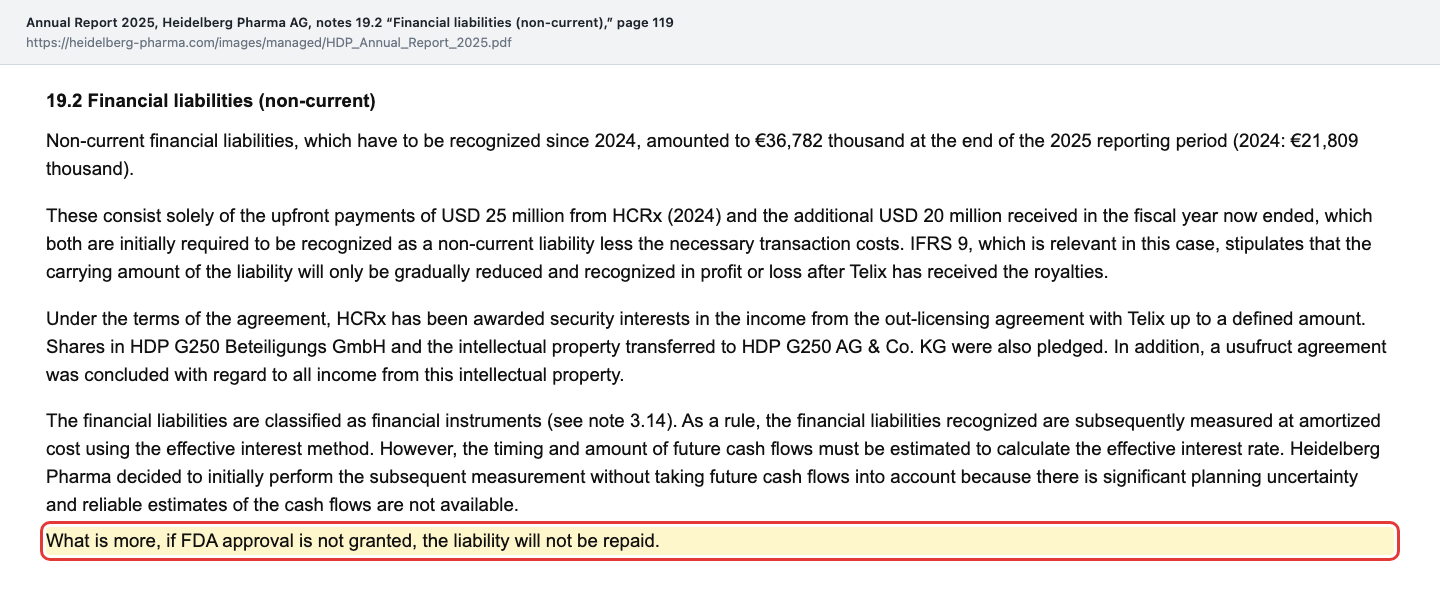
That softens the picture somewhat: this liability does not force Heidelberg Pharma to pay anything out of its own cash. It is not harmless, though. The royalties on TLX250-Px, once a potential cash generator for shareholders, have been sold up to a cap and pledged — HCRx holds security interests in the income from the Telix agreement, and shares in one subsidiary as well as the intellectual property transferred to another subsidiary have been pledged. And the negative equity is not just accounting: it arose because the losses of fiscal 2025 wiped out equity of €30.9 million. The company itself writes in the half-year report that it “is currently unable to finance itself solely through product sales and license revenue.”
Uncomfortable truth no. 4: two major shareholders, and a partner as CEO
According to the 2026 half-year report, Dietmar Hopp, related parties and companies they control, such as dievini Hopp BioTech, hold 44 percent and Huadong Medicine 35 percent; only 21 percent is free float. That is an opportunity and a risk at once: major shareholders can inject money in an emergency — but they do not have to, and if they do, they set the price.
Since November 2025 the ties have become even closer. The supervisory board revoked the appointment of the previous head of the management board and made Dr. Dongzhou Jeffery Liu CEO; according to the ad hoc announcement of November 24, 2025, he is also Chief Scientific Officer of Huadong Medicine and President of Huadong Global Development. The half-year report explicitly notes that revenue was generated with Huadong and that subscription rights were granted to management board members “who also have an role at Huadong” (sic). On August 28, 2026, the subsidiary Heidelberg Pharma Research agreed on a further research collaboration with Huadong covering up to six new targets. The ad hoc announcement settles who owns the results in a single sentence:
“The agreement foresees that ownership of the resulting development candidates will be allocated between the partners, taking into account their respective contributions.”
— Heidelberg Pharma AG, ad hoc announcement of August 28, 2026
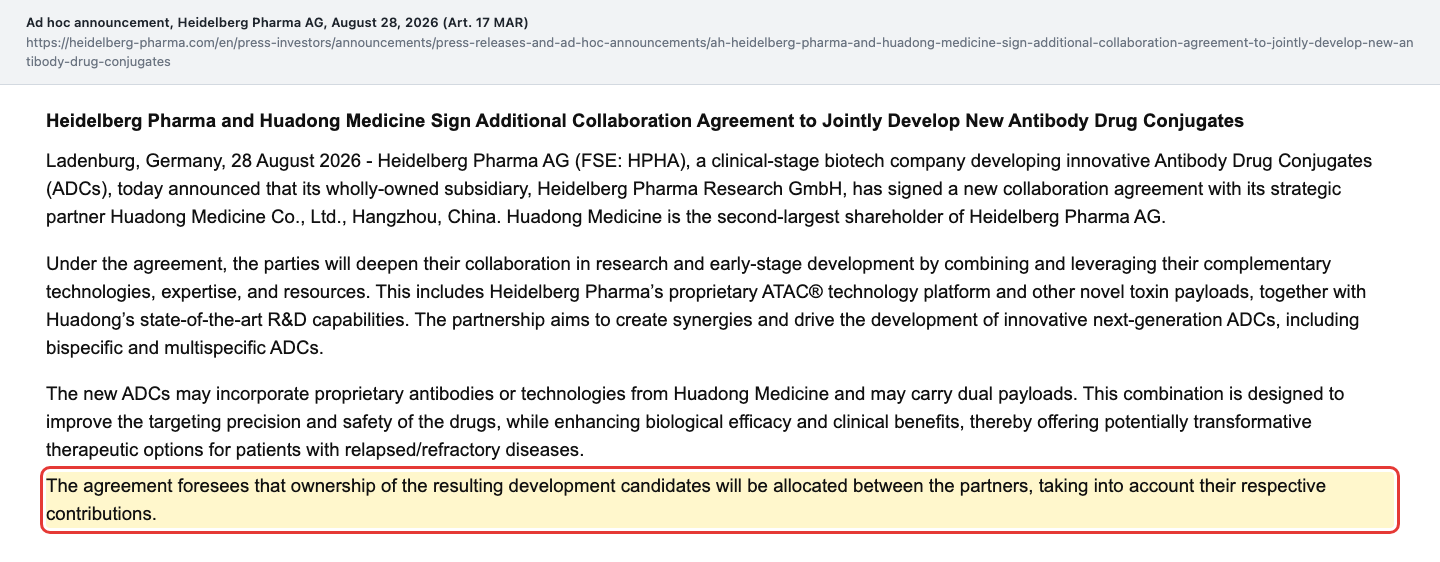
The announcement discloses no financial terms. For free-float shareholders this is a question of trust: whoever negotiates the split of rights between Heidelberg Pharma and Huadong sits on both sides of the table within the same group. None of this is improper — as a controlled company, Heidelberg Pharma prepares a legally required dependency report, which the auditor reviews. But it does mean the key decisions about the company are not made on the stock market.
Valuation: €121 million for a bet with a deadline
At €2.58 (Xetra close, September 25, 2026) and 46,784,317 shares, Heidelberg Pharma had a market value of about €121 million. Classic ratios do not help here: there is no price-to-earnings ratio without earnings, and a price-to-book ratio is meaningless with negative equity. The more honest calculation weighs two quantities. On one side sit €24.9 million in cash (May 31, 2026) and a burn rate that, according to guidance, leaves €11 million to €15 million by the end of November 2026. On the other side sit the possible payments upon approval of TLX250-Px — $25 million from Soleus plus a declining payment from HCRx — and whatever value the market assigns to HDP-101 and the technology.
The analysts’ view is thin and friendly: according to the company’s investor relations page, Pareto Securities has a price target of €8.00 (April 29, 2026) and EQUI.TS one of €5.50 (December 8, 2025), both rated “buy.” Two voices are not a market consensus, and Pareto is also the stock’s designated sponsor — the bank that, on the company’s behalf, ensures tradable prices. The chart tells a more sober story: in the twelve months to September 25, 2026, the stock closed between €2.40 and €3.25 — far below the price Huadong paid in 2022.
One thing matters for any valuation: the cash guidance for 2026 is explicitly “not including any corporate actions.” If approval comes too late, a capital increase is the obvious route — and with a free float of 21 percent, the major shareholders determine the price. For scale, purely as an illustration: raising €20 million at the September 25, 2026, close would mean about 7.8 million new shares — almost 17 percent more than today. Remember: for a company with a going-concern warning, the most important number is not the share price but the date until which the money lasts.
Upside and risks at a glance
What speaks for Heidelberg Pharma:
- HDP-101 produced responses in 13 of 31 evaluable, heavily pretreated patients (cohorts 5 through 9) without reaching a maximum tolerated dose (data of September 24, 2026).
- The FDA has granted HDP-101 orphan drug and Fast Track designation; Huadong is paying for the combination study in China (approved August 26, 2026).
- Well-known partners: Takeda is testing a licensed amanitin drug in the clinic, and Huadong holds 35 percent and expanded the collaboration on August 28, 2026.
- The cost cuts are working: first-half 2026 net loss of €3.4 million instead of €12.6 million, operating cash outflow halved to €7.3 million.
- Approval of TLX250-Px would trigger $25 million from Soleus plus a payment from HCRx; the liability booked for it does not have to be repaid without approval.
What speaks against it:
- The 2025 annual report and the auditor see a material uncertainty about the company’s ability to continue as a going concern.
- According to management, financing is secured only until mid-2027; the group depends on FDA approval of TLX250-Px by the beginning of the second quarter of 2027, the timing of which Telix controls.
- Equity of minus €14.2 million (May 31, 2026) after losses in every fiscal year since 2021, including €42.3 million in fiscal 2025 alone.
- BCMA is a crowded target; Blenrep and Lynozyfic, two BCMA-directed drugs, were approved in 2025.
- Close ties to the 35 percent shareholder Huadong, whose management supplies the CEO; only 21 percent free float and the threat of dilution in a capital increase.
A human conclusion
Back to the anchor. The €6.44 per share Huadong paid in 2022 and the price targets of €5.50 and €8.00 are real numbers — but they come from a time or a vantage point in which the question of staying power was not front and center. And the second anchor, the wealthy major shareholders, is a promise nobody has made: in the reports and notices we reviewed, we found no commitment by the major shareholders to close a funding gap. The right question, then, is not “How cheap is the stock compared with before?” but: Will TLX250-Px be approved in time — and if not, at what price and by whom will Heidelberg Pharma be financed before HDP-101 can show what it can really do? The first answers come with the nine-month statement on October 15, 2026, and with every piece of news from Telix. What you make of it is your decision. And that is how it should be.
For a look at a biotech that has already taken its drugs all the way to approval and still struggles with losses, see our BioNTech analysis.
Sources
All original documents used in this analysis — so you can check them yourself:
- Heidelberg Pharma AG — Half-year financial report 2026 (December 1, 2025, to May 31, 2026, published July 15, 2026) — latest periodic report; source for first-half figures, guidance, cash runway, risk report, subsequent events and shareholder structure
- Heidelberg Pharma AG — Annual Report 2025 (fiscal year ended November 30, 2025, published March 26, 2026) with Baker Tilly’s audit opinion of March 24, 2026 — source for going-concern risk, financial liabilities, restructuring and competitive landscape
- Heidelberg Pharma AG — annual reports 2022 and 2023 (financial reports on heidelberg-pharma.com) — source for the multi-year figures 2021 through 2023 and Huadong’s capital increase
- Heidelberg Pharma AG — interim statement for the first three months of 2026 (April 29, 2026)
- Heidelberg Pharma AG — press releases and ad hoc announcements, in particular of August 28 and September 25, 2025, November 24, 2025, March 7, April 9, April 17 and July 15, 2026, August 26 and 28, 2026, and September 24, 2026 (accessed September 27, 2026)
- Heidelberg Pharma AG — investor relations pages on analysts, share data, financial calendar, directors’ dealings and voting rights (accessed September 27, 2026)
- Telix Pharmaceuticals Ltd — Half-year report 2026, furnished to the SEC as a foreign private issuer report (Form 6-K), August 2026 — status of the TLX250-Px resubmission
- Fundamental data (closing prices, trading range, market value), reconciled with the share count in the 2026 half-year financial report.
Transparency & disclaimer: This analysis is a journalistic assessment of publicly available information. It is not investment advice, not financial analysis in the regulatory sense and not a solicitation to buy or sell securities. Investing in stocks involves substantial risk, up to and including total loss. All information without guarantee; the date of each data point is noted in the text. Positions held by the operator are disclosed daily; where one exists, it appears as a notice at the top of this deep dive.
Our Bottom Line at a Glance
- Drug candidate HDP-101 positive
- Responses in 13 of 31 evaluable patients in cohorts 5–9, no maximum tolerated dose reached (data of 09/24/2026); FDA orphan drug and Fast Track designation. Not proof of efficacy: open-label study without a control group.
- Partners and costs positive
- Takeda and Huadong are developing amanitin drugs and paid milestones in 2026; first-half 2026 net loss cut from €12.6M to €3.4M, operating cash outflow halved.
- Going concern and funding negative
- Material uncertainty about going concern per the 2025 annual report and audit opinion; financing secured only until mid-2027 according to the half-year report of 07/15/2026.
- Dependence on TLX250-Px negative
- Per the annual report, depends on FDA approval of the Telix imaging agent by early Q2 2027; according to Telix’s own half-year report of August 2026, the application had not yet been resubmitted.
- Balance sheet negative
- Equity −€14.2M (05/31/2026) after losses in every year since 2021; the €52.9M in financial liabilities, however, is not repayable without approval.
- Ownership and governance neutral
- Hopp circle 44%, Huadong 35%, free float 21%; CEO is also Chief Scientific Officer of Huadong, further collaboration with Huadong of 08/28/2026 without disclosed terms.
Heidelberg Pharma has a drug candidate, HDP-101, that is showing real early efficacy in the clinic, and well-known partners. But management and the auditor see a material uncertainty about the company’s ability to continue as a going concern, equity is negative, and the money lasts until mid-2027 under current planning — follow-on funding hinges on U.S. approval of a partner’s product. Not investment advice.
What Our Rating Means
Substance risk
We found at least one documented issue that threatens the company itself — regardless of how the stock is currently valued.
Red here signals a documented substance risk, not a verdict on the drug: the 2025 annual report and the audit opinion disclose a material uncertainty about going concern, equity is negative, cash outflows continue, and management says financing lasts only until mid-2027 — less than four quarters from now. The rescue hinges on FDA approval of a product a partner controls. The encouraging HDP-101 data and the strong major shareholders do not change this rating as long as no funding beyond mid-2027 is documented. The decision is yours.
A journalistic assessment by our editorial team at the time of the deep dive, based on public sources — not investment advice and not a solicitation to buy or sell. Your personal circumstances (investment goals, risk capacity, taxes) cannot be taken into account. What our levels mean, how verdicts are formed, and what conflicts of interest exist →
Worth Noting
- Version of September 27, 2026, based on the half-year financial report 2026 (published July 15, 2026), the 2025 annual report and all press releases and ad hoc announcements through September 24, 2026. The nine-month statement is due on October 15, 2026, according to the financial calendar. The hook is the most-discussed ranking on wallstreet-online — an attention signal, not a data source.
- Heidelberg Pharma does not report to the U.S. SEC; all evidence comes from the company’s reports and notices on heidelberg-pharma.com, quoted from the official English versions. The half-year report is unaudited. The status of the TLX250-Px application comes from Telix Pharmaceuticals’ 2026 half-year report.
- The €6.44 per share Huadong paid in 2022, both in the capital increase and for shares bought from dievini, comes from the 2022 annual report. Market value is calculated from 46,784,317 shares and the Xetra close of September 25, 2026.
The full analysis as a PDF for later
We will send you this analysis as a PDF — to print, file away, and read at your own pace.
Frequently Asked Questions
Heidelberg Pharma (Xetra: HPHA) develops antibody drug conjugates using the mushroom toxin amanitin and so far earns money mainly from partners: milestone payments from licensees such as Takeda and Huadong, plus material sales. In the first half of fiscal 2026 (through May 31), revenue and other income came to €9.2 million and the net loss to €3.4 million.
The 2025 annual report and the auditor, Baker Tilly, point to a material uncertainty about the company’s ability to continue as a going concern. According to the half-year report of July 15, 2026, financing is secured until mid-2027. After that the company depends on FDA approval of TLX250-Px or additional funding. That is not an insolvency verdict, but a serious warning sign.
TLX250-Px is an imaging agent for kidney cancer that Telix Pharmaceuticals is seeking to get approved in the U.S. Heidelberg Pharma has sold royalties on it to investors; upon approval it is entitled to $25 million from Soleus and a declining payment from HealthCare Royalty. In August 2025 the FDA asked for more manufacturing data.
The €42.3 million loss in fiscal 2025 wiped out equity; on May 31, 2026, it stood at minus €14.2 million. The largest liability is €52.9 million in upfront payments from HealthCare Royalty and Soleus, which are paid down from future royalties and do not have to be repaid without FDA approval.
According to the 2026 half-year report, Dietmar Hopp, related parties and controlled companies such as dievini Hopp BioTech hold 44 percent, and Chinese drugmaker Huadong Medicine holds 35 percent. Only 21 percent is free float. Since November 2025 the CEO has been Dr. Dongzhou Jeffery Liu, who is also Chief Scientific Officer of Huadong.
Heidelberg Pharma’s fiscal year runs from December 1 to November 30. Fiscal 2025 therefore ended on November 30, 2025, and the first half of fiscal 2026 covers December 1, 2025, through May 31, 2026. The nine-month statement for fiscal 2026 is scheduled for October 15, 2026.
Found an error?
Did you spot a factual error, an outdated number, or a typo in this deep dive? Let us know briefly — your report goes straight to the editorial team.