BioNTech: 16.6 Billion Euros in the Bank — and Both Founders Are Leaving the Bridge
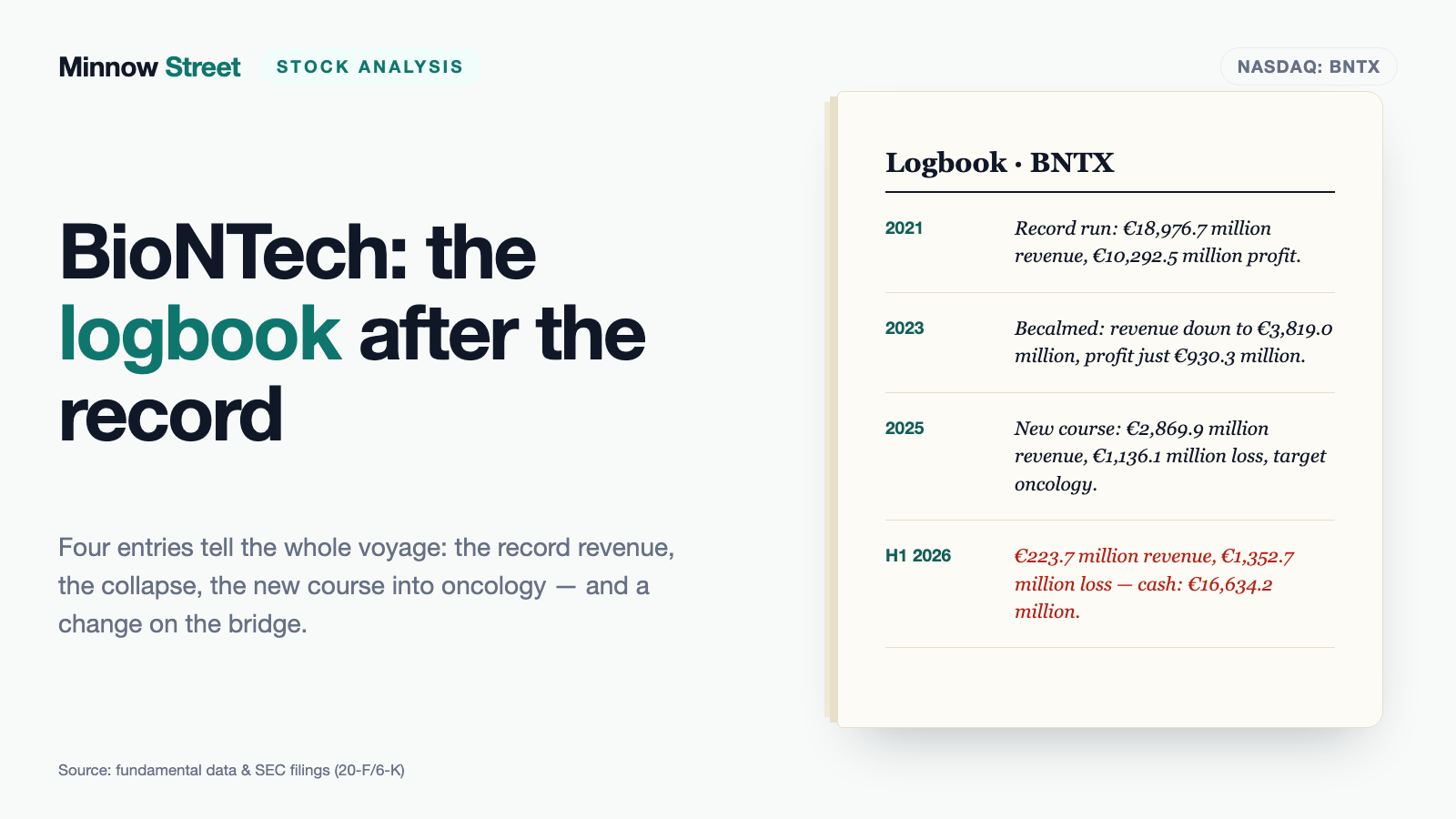
BioNTech is the company Germany trusted in 2020. Five years later its filings with the U.S. securities regulator, the SEC, tell a colder story: 223.7 million euros of revenue in the first half of 2026, a loss of 1,352.7 million euros — and guidance cut on August 4, 2026 from 2.0–2.3 to 1.6–1.9 billion euros. One day earlier the Supervisory Board had appointed a new chief executive: co-founder Ugur Sahin steps down, co-founder Özlem Türeci moves to a new company of her own. What remains is 16,634.2 million euros in cash and securities against a market value of roughly 19.6 billion euros at the company's own second-quarter buyback price. Not investment advice — just the question of what you actually pay for when almost the entire price is cash.
 Thomas Mücke
Founder & Publisher
Thomas Mücke
Founder & Publisher
As of Today
As of: September 25, 2026
- Closing price
- 98.50 $ -0.70%
- Market Capitalisation
- 24.7 $B
- Growth Score
- 4/10
- AAQS
- 2/10
This analysis has a cut-off date. The Stock Guard tells you when something material changes in the numbers. Reserve your free spot
Chart
Interactive price chart (TradingView).
52-week range: 83.90 $ to 119.30 $ · Last price: 98.50 $ (As of: September 25, 2026)
Note: pure fact-based analysis, not investment advice and not a solicitation to buy or sell. All figures without guarantee.
The founder bonus: why you buy faces instead of balance sheets
There is a weakness that looks smarter than it is: we buy people. A company with a founder whose story we know feels safer than one run by an interchangeable board. At BioNTech SE (Nasdaq: BNTX) that founder bonus was unusually large for years: Ugur Sahin and Özlem Türeci, the research couple from Mainz who delivered the first approved mRNA vaccine against COVID-19 in the winter of 2020. Buying the stock meant buying a promise with two faces attached.
On August 3, 2026 the Supervisory Board rewrote that promise. It appointed Guido Oelkers as the new Chief Executive Officer — taking office by February 1, 2027, at the latest — and Özlem Türeci is leaving the Management Board to lead a new, independent company with Sahin. One day later, on August 4, 2026, BioNTech cut its own revenue guidance for 2026.
So we are going to do something unromantic here: set the faces aside and read the mandatory filings to the U.S. securities regulator, the SEC. And because BioNTech is treated there as a foreign private issuer, those filings carry different names than at U.S. companies — more on that shortly. The central tension of this analysis is already clear: the cash pile is enormous and real, the operating business keeps shrinking — and the people investors trusted are clearing the bridge.
Contents
- The founder bonus
- What BioNTech actually is today
- How the stock reached our desk
- The numbers over the years — given their due
- What the filings say: five uncomfortable truths
- What the market is charging for it
- Opportunities and risks at a glance
- A human conclusion
- Sources
What BioNTech actually is today
BioNTech was founded in Mainz in 2008 and listed on Nasdaq on October 10, 2019. As of December 31, 2025 it employed 7,807 full-time equivalents, of whom 1,310 hold a doctoral degree or higher. The business now rests on four legs, and only one of them makes meaningful money.
First, the COVID-19 vaccine. BioNTech develops and markets it together with Pfizer. This matters for reading the numbers: across much of the world BioNTech does not sell the vaccine itself but receives a share of its partner's gross profit. What appears as revenue in the income statement is therefore largely a profit share — and it falls faster than unit sales because it sits at the end of the chain. In 2025 this business brought in 1,995.3 million euros, down from 2,432.1 million in 2024, a decline of 18 percent. In July 2026 the European Commission approved the XFG variant-adapted vaccine for the 2026–2027 season; a corresponding application is pending with the U.S. Food and Drug Administration.
Second, oncology — the declared future. Fourteen pivotal trials are running here. The most important candidate is pumitamig (development name BNT327), a bispecific antibody. Picture a bouncer with two hands: one blocks the tumor's cloak against the immune system (PD-L1), the other cuts off its blood supply (VEGF-A). Alongside it sit gotistobart (BNT316, with OncoC4) and two antibody-drug conjugates developed with the Chinese partner DualityBio: trastuzumab pamirtecan (BNT323) and elfetabart drozuntecan (BNT324). Antibody-drug conjugate sounds technical but the image is simple: an antibody acts as a courier that delivers a chemotherapy payload directly to the tumor cell instead of spreading it through the whole body.
Third, acquisitions. In July 2023 BioNTech bought the AI company InstaDeep, in January 2025 the Chinese antibody developer Biotheus, and in December 2025 the Tübingen mRNA pioneer CureVac for total consideration of 400.1 million euros. The InstaDeep purchase is more than a tool acquisition: the annual report treats InstaDeep's external business as its own valuation unit and explicitly counts BioNTech among the competitors in the AI industry.
"Following our acquisition of InstaDeep Ltd., or InstaDeep, we also face competition in the rapidly growing and developing artificial intelligence, or AI, industry."
— BioNTech SE, annual report on Form 20-F for 2025, Item 3.D Risk Factors

Fourth, the cash. What survived the pandemic years is by far the largest item on the balance sheet — and the real reason the stock has a floor at all. We get to that in the valuation section.
A word on the filings: Form 20-F, not Form 10-K
BioNTech is a German-domiciled European company (SE) headquartered in Mainz whose shares trade on Nasdaq. The SEC classifies such companies as foreign private issuers. In practice that means: instead of a U.S. annual report (Form 10-K) there is an annual report on Form 20-F, and instead of quarterly reports (Form 10-Q) there are interim reports on Form 6-K. BioNTech files no Form 10-Q at all. It reports under IFRS and in euros while the stock trades in U.S. dollars. That currency gap is not a footnote: it is the reason some automatically calculated ratios simply make no sense here, because a euro balance sheet cannot be held against a dollar market value without conversion. We therefore keep this analysis in euros, exactly as the company does.
How the stock reached our desk
Not through a momentum filter but through the calendar: within 48 hours in August 2026, BioNTech announced a leadership change and cut its guidance. That combination is the classic moment when a stock gets repriced — and the moment when reading the filings beats reading the headlines.
In our in-house stock scanner BioNTech is a special case worth understanding. Because the balance sheet is in euros while the listing is in U.S. dollars, several absolute metrics — Altman Z-score, net current asset value per share, cash per share — are deliberately left blank. A number here would not be a better number, it would be a wrong one. Remember the principle: an empty cell is more honest than a false figure. What the scanner does show is the valuation relationship: as of August 12, 2026 the market value stood at roughly 23.3 billion U.S. dollars and the price-to-book ratio at about 1.1 — the market is paying roughly what the balance sheet says, and little more.
For a thematically related calculation: we ran the same post-pandemic transition through the numbers at Moderna — there with a far smaller cash pile and a loan secured against the company's assets. The comparison is worth the time, because the same technology left behind two very different balance sheets.
The numbers over the years — given their due
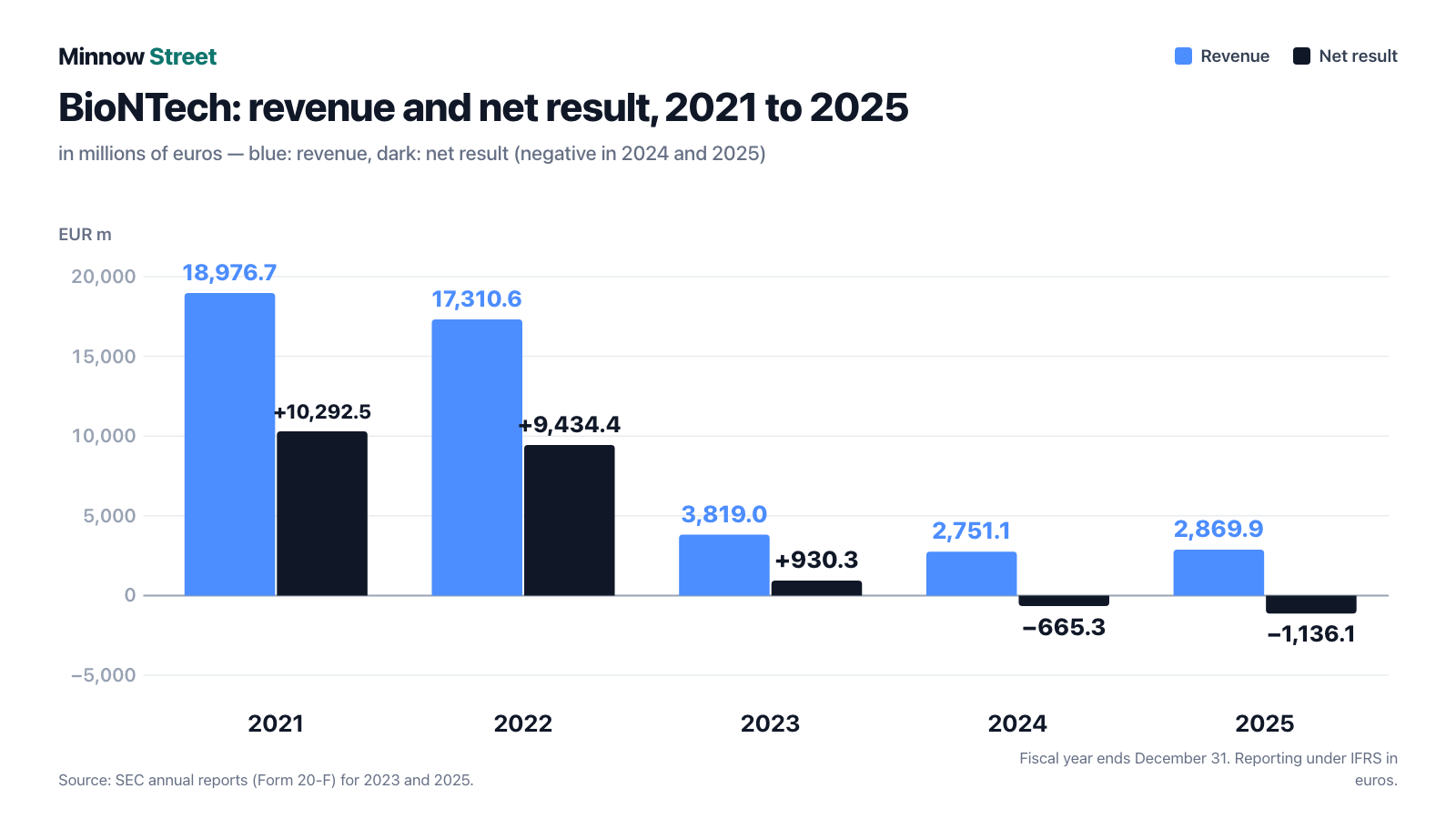
Start with what genuinely impresses: BioNTech earned more in two years than most German industrial groups earn in a decade. In 2021 the books showed 18,976.7 million euros of revenue and 10,292.5 million euros of profit; in 2022 it was 17,310.6 million and 9,434.4 million. Diluted earnings per share reached 39.63 euros in 2021. That was not a bubble — it was billed, delivered business.
Then came the fall. In 2023 revenue dropped to 3,819.0 million euros and profit to 930.3 million. In 2024 the company slipped to a loss of 665.3 million on revenue of 2,751.1 million. In 2025 revenue edged up to 2,869.9 million — but only because an out-licensing deal contributed 613.0 million euros that did not exist in 2024; the vaccine business itself kept shrinking. The loss widened to 1,136.1 million euros.
The current year continues the trend. In the second quarter of 2026 revenue came to 105.6 million euros against 260.8 million in the prior-year quarter — a decline of about 60 percent. The quarterly loss doubled to 820.8 million euros. Across the first half of 2026 revenue was 223.7 million euros against a loss of 1,352.7 million, with diluted loss per share of 5.34 euros.
Where the loss comes from is no mystery: research and development cost 1,108.0 million euros in the first half of 2026 — five times the revenue over the same period. Add 348.6 million euros of selling, general and administrative expenses for a commercial build-up that is not yet selling anything. That is the arithmetic of a company constructing a new business before the old one runs out.
One detail that is easy to miss: operating cash flow in 2025 was positive at 456.0 million euros — despite the 1,136.1 million loss. The reason was the 1.5 billion U.S. dollar upfront payment from Bristol Myers Squibb. In the first half of 2026 operating cash flow flipped to negative 410.5 million euros. Remember: a positive cash flow that comes from a one-time payment is no proof of a sustainable business.
What the filings say: five uncomfortable truths
Uncomfortable truth no. 1: a third of the revenue guidance is a contractual payment
BioNTech expects between 1.6 and 1.9 billion euros of revenue in 2026. Of that, 613 million euros is not a product sale but a contractually committed payment from the U.S. pharmaceutical group Bristol Myers Squibb, to be recognized in the third quarter of 2026. The background: in September 2025 BioNTech out-licensed its most important oncology candidate, pumitamig, to Bristol Myers Squibb for a 1.5 billion U.S. dollar upfront payment, 2.0 billion U.S. dollars of non-contingent anniversary payments through 2028, and up to 7.6 billion U.S. dollars in potential milestones. Profits and losses are shared equally.
"BioNTech continues to expect the majority of 2026 revenues to be realized in the second half of the year, specifically in the third quarter, when it also expects to recognize the €613 million Bristol Myers Squibb Company ("BMS") collaboration revenue."
— BioNTech SE, Form 6-K filed August 4, 2026, Exhibit 99.1, second-quarter 2026 earnings release

None of this is improper — such payments are standard in pharmaceuticals and accounted for correctly. But they say nothing about whether a drug will ever be sold. Strip the 613 million out of the guidance and roughly 1.0 to 1.3 billion euros remain for the actual product business — after 1,995.3 million from the vaccine alone in 2025.
Uncomfortable truth no. 2: guidance was cut mid-year
In March 2026 BioNTech still pointed to 2.0 to 2.3 billion euros of revenue for the year. On August 4, 2026 that became 1.6 to 1.9 billion euros — a cut of roughly 400 million euros, or one fifth. Chief Financial Officer Ramón Zapata attributed it to "recently emerged external developments." The release names three specifically: softer than anticipated global COVID-19 vaccine demand, existing vaccine inventory in Germany being used up during the 2026 season — which generates no new sales — and a milestone payment from an out-licensed research program no longer expected in 2026.
At the same time BioNTech lowered planned adjusted research and development expenses from 2.2–2.5 to 2.0–2.3 billion euros. That is the more revealing part of the announcement: the company is responding to falling revenue by trimming the very research that carries the entire future promise.
Uncomfortable truth no. 3: Marburg is being vacated
In 2020 BioNTech bought a plant in Marburg to manufacture its vaccine at a scale of billions of doses. It was the most visible sign that a research house had become a manufacturer. In the second quarter of 2026 it turned into a write-down: 96.1 million euros of impairments on property, plant and equipment, of which 87.0 million euros related to the Marburg and Idar-Oberstein sites. The recoverable amount of equipment, tools and leasehold improvements was set to zero; land and buildings remain on the books at 6.8 million euros. On top came 97.6 million euros of employee-related restructuring costs in that quarter alone.
"These losses mainly related to our ongoing pipeline prioritization following our decision on our manufacturing footprint consolidation, in particular, to exit operations at several manufacturing sites."
— BioNTech SE, interim report on Form 6-K for the period ended June 30, 2026, Note 7 (Property, plant and equipment)
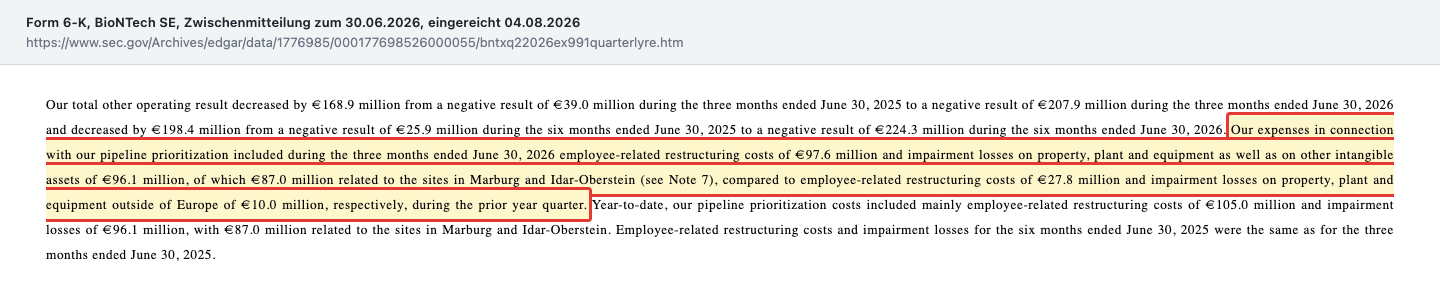
In parallel, BioNTech wrote down 126.9 million euros of intangible assets in the first half of 2026 — research programs for which no licensee could be found and which will not be pursued internally. Together that is more than 320 million euros cleared away in six months. This is housekeeping, not growth.
Uncomfortable truth no. 4: the inherited 450 million euro bill
The CureVac acquisition of December 2025 brought a legacy item that the 400.1 million euro purchase price does not contain. In November 2020 CureVac had signed an Advance Purchase Agreement with the European Commission for up to 405 million vaccine doses and received a 450 million euro upfront payment. When CureVac withdrew its regulatory application in October 2021, the agreement terminated automatically — and any unspent portion would have to be returned. Since July 2024, Deloitte has been auditing on the Commission's behalf how much was actually spent. The draft report of September 2025 alleged missing documentation and inconsistencies.
"As the successor to CureVac following the acquisition, we cannot exclude the possibility of being required to repay a portion or all of the €450 million upfront payment."
— BioNTech SE, annual report on Form 20-F for 2025, Item 3.D Risk Factors

For scale: 450 million euros is roughly 16 percent of total group revenue for 2025 and about 2.7 percent of the cash pile. For a company with 16.6 billion euros of liquidity that is no existential threat — but it is money nobody budgeted for, and it does not appear as a provision of that size on the December 31, 2025 balance sheet. More of these research by-products in our side-finds section.
Uncomfortable truth no. 5: who owns the company — and who is leaving it
BioNTech looks like a widely held public company. It is not. As of December 31, 2025, AT Impf GmbH — the vehicle behind ATHOS KG, the investment arm of the Strüngmann family — held 101,279,878 of the 251,325,340 shares outstanding, or 40.3 percent. Ugur Sahin reaches 16.4 percent through his Medine GmbH and direct holdings. The annual report spells out the power structure itself, and remarkably plainly:
"ATHOS KG via AT Impf GmbH has de facto control over BioNTech based on its substantial shareholding, which practically enables it to exercise the majority of voting rights to pass resolutions at our Annual General Meeting, or AGM."
— BioNTech SE, annual report on Form 20-F for 2025, Item 7.A Major Shareholders
Put in everyday terms: you buy a share of a house in which somebody else holds the keys to every door. That is not necessarily bad — a long-term anchor investor can shield a research company from quarterly pressure. But it means the major decisions are not made by minority shareholders.
And above the ownership question sits the personnel question since August 3, 2026. The Supervisory Board appointed Guido Oelkers as the new Chief Executive Officer — until now head of the Swedish pharmaceutical company Swedish Orphan Biovitrum (Sobi), where, by the company's own account, he more than quadrupled revenues over nine financial years. He takes office by February 1, 2027, at the latest. The same release contains a second departure:
"As previously announced, BioNTech's Chief Medical Officer, Prof. Özlem Türeci, M.D., will transition into the management of a new, independent company, which she will lead together with her husband and co-founder, Prof. Ugur Sahin, M.D."
— BioNTech SE, Form 6-K filed August 3, 2026, Exhibit 99.1
So both founders are leaving operational leadership — and building something new together. A successor for the Chief Medical Officer is still being sought. Sahin has committed to supporting the handover, and he remains the largest individual shareholder after the family holding with 16.4 percent. Still, the fact stands: from February 2027 someone else is at the helm.
What the market is charging for it
Here is where it gets interesting, because this is the real reason the stock is discussed at all. As of June 30, 2026 BioNTech held 16,634.2 million euros in cash and security investments: 9,741.0 million as cash and cash equivalents, 5,035.1 million as current and 1,858.1 million as non-current security investments. Equity stood at 17,757.5 million euros against total assets of 20,342.6 million. Put differently: about 82 percent of the balance sheet is money or securities, and there is almost no debt against it.
To calculate the market value in an evergreen way, we use no daily price but one documented in a mandatory filing: in the second quarter of 2026 BioNTech repurchased 1,693,056 of its own American Depositary Shares at an average price of $89.50 — stated in the report as 77.85 euros. Multiplied by the 251,204,366 shares outstanding, that gives a market value of roughly 19,556 million euros.
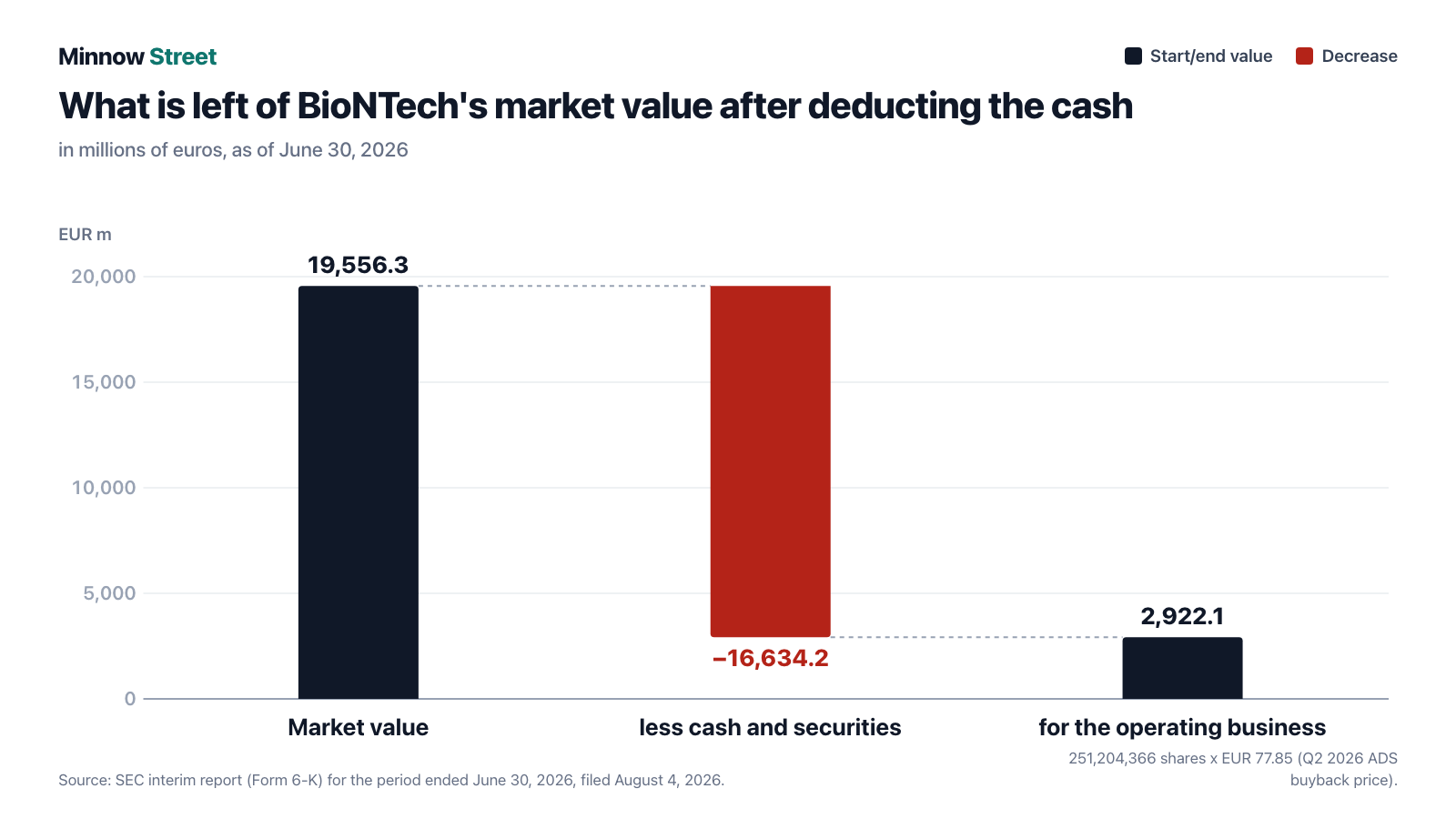
Deduct the cash and the market is paying roughly 2.9 billion euros for everything else — 14 pivotal trials, the Bristol Myers Squibb contract, the vaccine profit share, InstaDeep, CureVac, Biotheus, the plants and 7,807 employees. That is about one year of 2025 revenue, or roughly eighteen months of research budget.
How should you read that? There are two honest readings and both are defensible. Reading one: the market is handing you an entire oncology pipeline for almost nothing because it expects nothing from it — the classic case of a stock below asset value. Reading two: the market assumes the cash will be burned over the coming years and therefore refuses to value it fully. With an operating cash outflow of 410.5 million euros in the first half of 2026 and planned adjusted research spending of 2.0 to 2.3 billion euros for the full year, that concern is not unreasonable.
A price-to-earnings ratio does not exist for lack of earnings. The price-to-sales ratio stood at roughly nine times as of August 12, 2026 — which says little for a company whose revenue consists largely of contractual payments. The price-to-book ratio of about 1.1 is the more honest figure here: the market pays barely more than the balance sheet states. For buybacks, BioNTech authorized a program of up to 1.0 billion U.S. dollars through May 6, 2027 and had already deployed 151.6 million U.S. dollars of it in the second quarter — a signal that management considers its own stock undervalued.
Opportunities and risks at a glance
Opportunities
- Balance sheet strength with few peers in the sector: 16,634.2 million euros of cash and securities, 17,757.5 million euros of equity, virtually no financial debt (June 30, 2026). That funds many years of research without a capital increase.
- A deep-pocketed partner for the lead candidate: Bristol Myers Squibb paid 1.5 billion U.S. dollars upfront, committed 2.0 billion in non-contingent anniversary payments through 2028, and shares profits and losses equally — halving the development risk on pumitamig.
- A broad late-stage pipeline: 14 ongoing pivotal trials, seven of them for pumitamig; three late-stage readouts are expected in 2026, including the primary analysis of the Phase 3 DYNASTY-Breast02 trial in the fourth quarter.
- Buyback program and an asset-based valuation: price-to-book around 1.1 (as of August 12, 2026), plus a repurchase program of up to 1.0 billion U.S. dollars running through May 2027.
- A second leg almost nobody prices in: InstaDeep's external business is carried in the annual report as its own valuation unit — a business with third parties, not merely an internal tool.
Risks
- The legacy business is shrinking faster than planned: 2026 revenue guidance cut on August 4 from 2.0–2.3 to 1.6–1.9 billion euros; second-quarter 2026 revenue of 105.6 million euros against 260.8 million a year earlier.
- The loss is widening: 1,352.7 million euros in the first half of 2026 alone, against 802.4 million in the prior-year period, with an operating cash outflow of 410.5 million euros.
- Leadership change at the top: both founders are leaving the Management Board, the new chief executive takes office by February 1, 2027 at the latest, and the search for a new Chief Medical Officer is still running.
- Inherited legal exposure: up to 450 million euros of European Commission repayment risk from CureVac's 2020 contract, plus 132.1 million euros of settlement expenses in 2025 alone.
- Everything rests on a handful of readouts: if pumitamig fails in its pivotal trials, it is not one product that falls away but the load-bearing pillar of the entire oncology strategy — and with it a large part of the Bristol Myers Squibb payments.
- De facto control by one large shareholder: 40.3 percent at AT Impf GmbH (December 31, 2025); minority shareholders do not decide the major questions.
A human conclusion
We started with the founder bonus — the habit of valuing a company through the people who built it. At BioNTech that bonus can no longer be drawn. From February 2027 at the latest, a pharmaceutical executive runs the house while the two founders build something new next door. The numbers do not change because of that. The story people tell themselves about the numbers does.
What remains is an unusual calculation. On one side, a company that turned 223.7 million euros of revenue into a 1,352.7 million euro loss in the first half of 2026 and had to cut its guidance. On the other, 16.6 billion euros of cash, essentially debt-free equity, and a partner who has paid billions for a single drug candidate. Buying this stock is not buying a running business. It is buying a very large savings account with a research laboratory attached — and the question of whether the laboratory consumes the account or multiplies it.
No ratio answers that question. A handful of trial readouts over the next two years will. Until then, only what is measurable can be tracked: quarterly revenue excluding contractual payments, the cash balance, and the dates of the late-stage readouts.
What you make of it is your decision. And that is exactly as it should be.
Sources
- BioNTech SE — interim report on Form 6-K for the period ended June 30, 2026, filed August 4, 2026 (SEC EDGAR, CIK 0001776985)
- BioNTech SE — second-quarter 2026 earnings release, Exhibit 99.1 to the Form 6-K filed August 4, 2026 (guidance cut, buyback program, share count)
- BioNTech SE — appointment of Guido Oelkers as Chief Executive Officer, Exhibit 99.1 to the Form 6-K filed August 3, 2026
- BioNTech SE — annual report on Form 20-F for 2025, filed March 10, 2026 (figures for 2023 to 2025, risk factors, major shareholders, notes)
- BioNTech SE — annual report on Form 20-F for 2023, filed March 20, 2024 (source of the 2021 and 2022 figures)
- BioNTech SE — interim report on Form 6-K for the period ended March 31, 2026, filed May 5, 2026
- All SEC filings by BioNTech SE (CIK 0001776985)
- Fundamental data (market value, share count, price-to-book ratio, 52-week range), as of August 12, 2026 — cross-checked against the second-quarter 2026 buyback price documented in the filing
Disclaimer: This article is journalistic commentary and expressly not investment advice, not a buy or sell recommendation, and not a solicitation to buy or sell securities. Shares of biotechnology companies without current earnings can be highly volatile; a total loss of the capital employed is possible. All figures come from the primary documents named above and carry the as-of dates stated there; later developments are not reflected. Positions held by the operator are disclosed daily; where one exists, it appears as a notice at the top of this deep dive.
Key figures at a glance
All monetary figures in millions of €; earnings per share as reported.
| Metric | 2021 | 2022 | 2023 | 2024 | 2025 |
|---|---|---|---|---|---|
| Revenue | 18,976.7 | 17,310.6 | 3,819.0 | 2,751.1 | 2,756.6 |
| Operating Income (EBIT) | 15,283.8 | 12,642.7 | 690.4 | -1,314.3 | -623.9 |
| Net Income | 10,292.5 | 9,434.4 | 930.3 | -665.3 | -1,091.3 |
| Net Margin | 54.2% | 54.5% | 24.4% | -24.2% | -39.6% |
| Earnings Per Share | 39.63 € | 37.77 € | 3.83 € | -2.77 € | -4.51 € |
Source: fundamental data & SEC filings (annual and quarterly reports, 10-K/10-Q)
Our Bottom Line at a Glance
- Balance sheet and liquidity positive
- EUR 16,634.2 million in cash and security investments against EUR 17,757.5 million of equity and EUR 20,342.6 million of total assets (June 30, 2026), with virtually no financial debt. Even at the first-half 2026 rate of cash burn (EUR 410.5 million), that funds many years of research without a capital increase.
- Bristol Myers Squibb partnership positive
- For pumitamig, Bristol Myers Squibb paid $1.5 billion upfront, committed $2.0 billion in non-contingent anniversary payments through 2028, and offered up to $7.6 billion in milestones; profits and losses are shared equally (Form 20-F for 2025, Item 4.B).
- Current business negative
- Second-quarter 2026 revenue of EUR 105.6 million against EUR 260.8 million a year earlier, and EUR 223.7 million for the first half; a net loss of EUR 1,352.7 million and an operating cash outflow of EUR 410.5 million over the same period (Form 6-K for the period ended June 30, 2026).
- Quality of guidance negative
- 2026 revenue guidance was cut on August 4, 2026 from EUR 2.0–2.3 to EUR 1.6–1.9 billion; EUR 613 million of that is a Bristol Myers Squibb contractual payment due in the third quarter, not a product sale. Roughly EUR 1.0 to 1.3 billion is left for the actual product business.
- Leadership and ownership negative
- Both founders are leaving operational leadership: Guido Oelkers was appointed Chief Executive Officer on August 3, 2026 (taking office by February 1, 2027), and Özlem Türeci moves to a new company of her own, with her successor still unnamed. AT Impf GmbH held 40.3 percent as of December 31, 2025 and, per the annual report, exercises de facto control.
- Legacy items and clean-up costs neutral
- Up to EUR 450 million of European Commission repayment exposure from CureVac's 2020 contract (Form 20-F for 2025, Item 3.D); plus, in the first half of 2026, EUR 105.0 million of restructuring costs, EUR 96.1 million of impairments on property, plant and equipment (of which EUR 87.0 million on Marburg and Idar-Oberstein) and EUR 126.9 million on intangible assets. Bearable against EUR 16.6 billion of liquidity, but unbudgeted.
BioNTech today is a very large savings account with an expensive research laboratory attached. The balance sheet is exceptional — EUR 16,634.2 million in cash and securities, EUR 17,757.5 million of equity, virtually no financial debt (June 30, 2026). The operating business keeps shrinking: EUR 223.7 million of revenue against a EUR 1,352.7 million loss in the first half of 2026, plus annual guidance cut on August 4, 2026, of which EUR 613 million is a contractual payment. Whether 14 pivotal trials turn into a second viable business will be decided by readouts that are still ahead — and, from February 2027, by a board without either founder. Not investment advice.
What Our Rating Means
Open questions
The business works in principle, but one material question is open. As long as it stays open, our findings do not carry a quality verdict.
There is no basis for red: EUR 16,634.2 million in cash and securities, EUR 17,757.5 million of equity, no meaningful financial debt, and no going-concern indication in the interim report for the period ended June 30, 2026 — at this rate of cash burn the runway extends far beyond ten years. But green is out of reach because the decisive operating question is open, and it is a big one: the legacy COVID-19 vaccine business is shrinking faster than planned, annual guidance had to be cut by roughly one fifth on August 4, 2026, and a third of what remains is a contractual payment rather than a product sale. The new business exists as a pipeline, not as revenue. On top of that comes a leadership change in which both founders clear the bridge and one board seat is still unfilled. Yellow here means: solid substance, an unproven business model for the years after the vaccine. The decision is yours.
A journalistic assessment by our editorial team at the time of the deep dive, based on public sources — not investment advice and not a solicitation to buy or sell. Your personal circumstances (investment goals, risk capacity, taxes) cannot be taken into account. What our levels mean, how verdicts are formed, and what conflicts of interest exist →
Worth Noting
- BNTX reached our research list through two announcements within 48 hours: the appointment of a new chief executive on August 3, 2026 and the cut to 2026 revenue guidance on August 4, 2026.
- The SEC treats BioNTech as a foreign private issuer: an annual report on Form 20-F instead of a Form 10-K, and interim reports on Form 6-K instead of Form 10-Q. All figures in this analysis come from the annual report for 2025 (filed March 10, 2026), the annual report for 2023 (2021 and 2022 figures) and the interim report for the period ended June 30, 2026 (filed August 4, 2026).
- Reporting currency euro, listing currency U.S. dollar: metrics that mix market value with balance sheet figures (Altman Z-score, net current asset value per share, cash per share) are deliberately left blank in our in-house stock scanner. The market value from fundamental data (about $23.3 billion, as of August 12, 2026) was cross-checked against 251,204,366 shares x $89.50 (the documented second-quarter 2026 buyback price); the deviation is about 4 percent.
- Not to be confused with CureVac N.V., part of BioNTech since December 2025, nor with Moderna, Inc. (Nasdaq: MRNA), the U.S. competitor using the same technology with a considerably smaller cash pile.
Stock Watch
This analysis is as of August 26, 2026. Stock Watch will tell you what's changed at BNTX since then.
Later $1 a month per stock — signing up is free, and you'll be the first to know when it launches.
The full analysis as a PDF for later
We will send you this analysis as a PDF — to print, file away, and read at your own pace. And we will add you to the free Stock Watch list for BioNTech SE (BNTX), so you hear about it when something material in this analysis changes.
Frequently Asked Questions
Still mostly from the COVID-19 vaccine it markets with Pfizer — that brought 1,995.3 million euros in 2025, down from 2,432.1 million in 2024. Add 613.0 million euros from out-licensing and 261.6 million of other revenue. The future business is oncology, with 14 ongoing pivotal trials; it generates no product revenue so far.
Because the U.S. securities regulator, the SEC, treats BioNTech as a foreign private issuer. Such companies file an annual report on Form 20-F instead of a Form 10-K, and interim reports on Form 6-K instead of quarterly reports on Form 10-Q. BioNTech reports under IFRS in euros while its stock trades in U.S. dollars. Its fiscal year ends December 31.
As of June 30, 2026 the balance sheet held 16,634.2 million euros in cash and security investments: 9,741.0 million in cash and cash equivalents, 5,035.1 million in current and 1,858.1 million in non-current securities. At December 31, 2025 the figure was 17,235.6 million euros. Equity stood at 17,757.5 million euros against total assets of 20,342.6 million on June 30, 2026.
On August 4, 2026 BioNTech lowered its revenue expectation from 2.0–2.3 to 1.6–1.9 billion euros. Three reasons are named: softer than anticipated global COVID-19 vaccine demand, existing inventory in Germany being used up during the 2026 season, and a milestone payment from an out-licensed research program no longer expected in 2026. Planned adjusted research spending was also cut, to 2.0–2.3 billion euros.
On August 3, 2026 the Supervisory Board appointed Guido Oelkers as Chief Executive Officer; he takes office by February 1, 2027 at the latest, succeeding co-founder Ugur Sahin. Oelkers had led the Swedish pharmaceutical company Swedish Orphan Biovitrum since 2017. Co-founder Özlem Türeci leaves the Management Board to lead a new, independent company with Sahin; her successor has not been named.
CureVac received a 450 million euro upfront payment from the European Commission in November 2020 for a vaccine candidate whose regulatory application was withdrawn in October 2021. Deloitte has been auditing how the money was used since July 2024. Because BioNTech acquired CureVac in December 2025, the annual report on Form 20-F for 2025 states that repayment of part or all of the amount cannot be excluded.
Pumitamig (development name BNT327) is a bispecific antibody that simultaneously blocks the tumor's cloak against the immune system (PD-L1) and inhibits its blood supply (VEGF-A). It is being tested in seven pivotal trials. Bristol Myers Squibb paid 1.5 billion U.S. dollars upfront, committed 2.0 billion in non-contingent anniversary payments through 2028, and offered up to 7.6 billion in milestones.
It trades close to asset value. Multiplying 251,204,366 shares by the 77.85 euro second-quarter 2026 buyback price documented in the filing gives a market value of roughly 19,556 million euros; after deducting 16,634.2 million of cash, about 2,922 million remains for the entire operating business. The price-to-book ratio stood at about 1.1 as of August 12, 2026. There is no price-to-earnings ratio for lack of earnings.
Found an error?
Did you spot a factual error, an outdated number, or a typo in this deep dive? Let us know briefly — your report goes straight to the editorial team.