Moderna: $19 Billion of Revenue Is History — What the Filings Say About Today
In 2022 Moderna booked $19.3 billion of revenue and earned $8.4 billion. In 2025 it was $1.9 billion of revenue and a $2.8 billion loss. The first half of 2026 shows $534 million of revenue against a $2.1 billion loss — and research alone cost $1.3 billion. The cash still carries the company: $6.9 billion as of June 30, 2026. Yet in November 2025 the group borrowed money at 9.20 percent and handed over a first-priority lien on substantially all of its assets. We read the filings with the U.S. securities regulator, the SEC, line by line — and count how long the pandemic savings still last.
 Thomas Mücke
Founder & Publisher
Thomas Mücke
Founder & Publisher
As of Today
As of: September 18, 2026
- Closing price
- 154.00 $ -2.50%
- Market Capitalisation
- 61.1 $B
- Growth Score
- 5/10
- AAQS
- 4/10
This analysis has a cut-off date. The Stock Guard tells you when something material changes in the numbers. Reserve your free spot
Chart
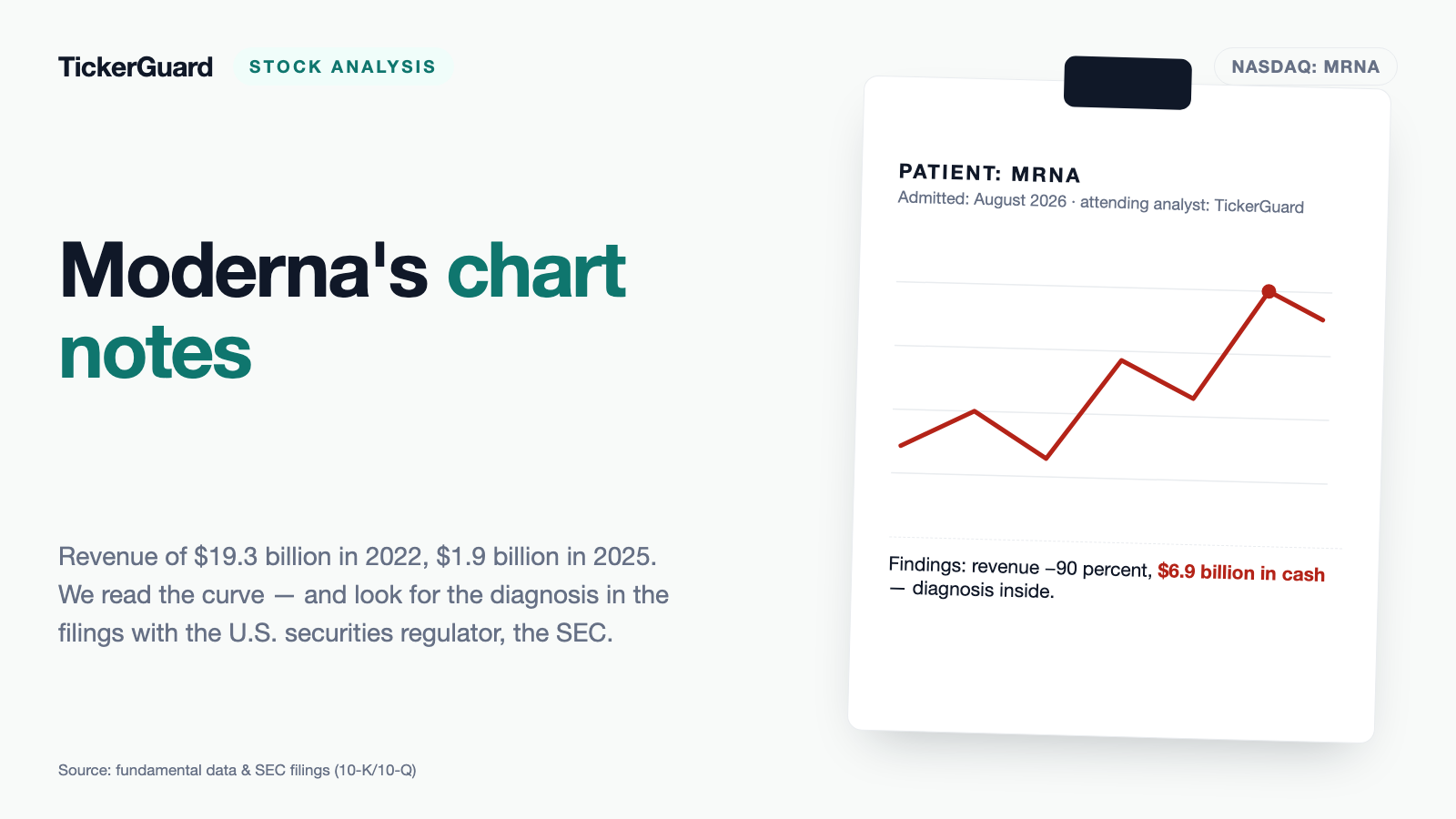
Interactive price chart (TradingView).
52-week range: 22.40 $ to 174.40 $ · Last price: 154.00 $ (As of: September 18, 2026)
Note: pure fact-based analysis, not investment advice and not a solicitation to buy or sell. All figures without guarantee.
The memory trap: why you are still holding on to 2021
There is a thinking error that reliably costs money in the stock market, and it has an unglamorous name: anchoring. It is the tendency to cling to the first number you ever heard about a thing — and to measure everything that follows against it.
With Moderna, that anchor is enormous. This is the company that delivered the vaccine half the world talked about in 2021. The company that earned $12.2 billion in a single year. Anyone carrying that around sees a share price far below the old high and automatically thinks: cheap.
The catch: the anchor is a memory, not a balance sheet. Between then and now sit three annual reports, eleven quarterly reports and a revenue decline of roughly 90 percent. So we are going to do something unromantic here. We put the memory aside and read the filings with the U.S. securities regulator, the SEC. Line by line, with a date on every number.
Contents
- The memory trap
- What Moderna actually sells today
- How the stock landed on our desk
- The numbers over the years — honestly credited
- What the filings say: five uncomfortable truths
- What the market is asking for it
- Opportunities and risks at a glance
- A human conclusion
- Sources
What Moderna actually sells today
Moderna builds medicines out of messenger ribonucleic acid, mRNA for short. Think of mRNA as a set of instructions you send into the body: instead of injecting a finished drug, you deliver the blueprint and let the body build the protein itself. The commercial appeal is obvious. The manufacturing process stays almost the same; only the instruction changes. One factory, many products.
Four products are on sale today: the COVID vaccines Spikevax and mNEXSPIKE, the RSV vaccine mRESVIA and the combination vaccine mCOMBRIAX against flu and COVID, which holds an EU approval. The annual report (10-K) for 2025 calls mNEXSPIKE the leading product in the U.S. retail channel.
A fifth has just arrived. On August 5, 2026 the U.S. Food and Drug Administration approved the flu vaccine mFLUSIVA (mRNA-1010) for adults aged 50 and older — a traditional approval for ages 50 to 64 and an accelerated approval for people 65 and older, subject to a confirmatory trial. It is the first mRNA influenza vaccine ever cleared in the United States, and the company plans to sell it for the 2026/27 flu season. None of the figures in this analysis change because of it; they come from filings dated June 30, 2026. But for the question of whether the research operation turns back into a business, it is the first evidence in a long while that comes from a regulator rather than from a trial readout.
That is one half. The other half is a research operation with about 4,700 employees in 18 countries (as of December 31, 2025) working three fronts at once: vaccines against infectious disease, cancer therapeutics and treatments for rare genetic disorders. The most important candidate is called intismeran autogene (mRNA-4157), an individually manufactured cancer therapy Moderna is developing with Merck. Nine phase 2 and phase 3 trials are running around it (earnings release of July 31, 2026).
Keep one sentence in mind for everything that follows: Moderna today is a research organization with a small selling business. Every number from here on is a variation of that sentence.
How the stock landed on our desk
This time it was not a scanner. Moderna appeared on August 5, 2026 on the most-discussed list of the wallstreet-online forum — the list that shows what retail investors are talking about right now. Such lists are not a buy signal; they are a mood reading. But they are a good reason to open the original documents instead of reading the discussion.
That is exactly what we did. The basis is the quarterly report (10-Q) as of June 30, 2026, filed on July 31, 2026, the annual reports (10-K) for 2025 and 2023, the earnings release of July 31, 2026 and an offer document from December 2025 that we will come back to. If you want to look yourself: everything sits freely accessible in the SEC EDGAR database under identifier CIK 0001682852.
The numbers over the years — honestly credited
Let us start with what genuinely impresses. Because that exists.
In 2021 and 2022 combined, Moderna earned $20.6 billion — net, after tax. That was not an accounting trick; that was real money. A company that had no approved product at all in 2020 became one of the most profitable pharmaceutical businesses in the world within two years. That achievement does not shrink because it is over.
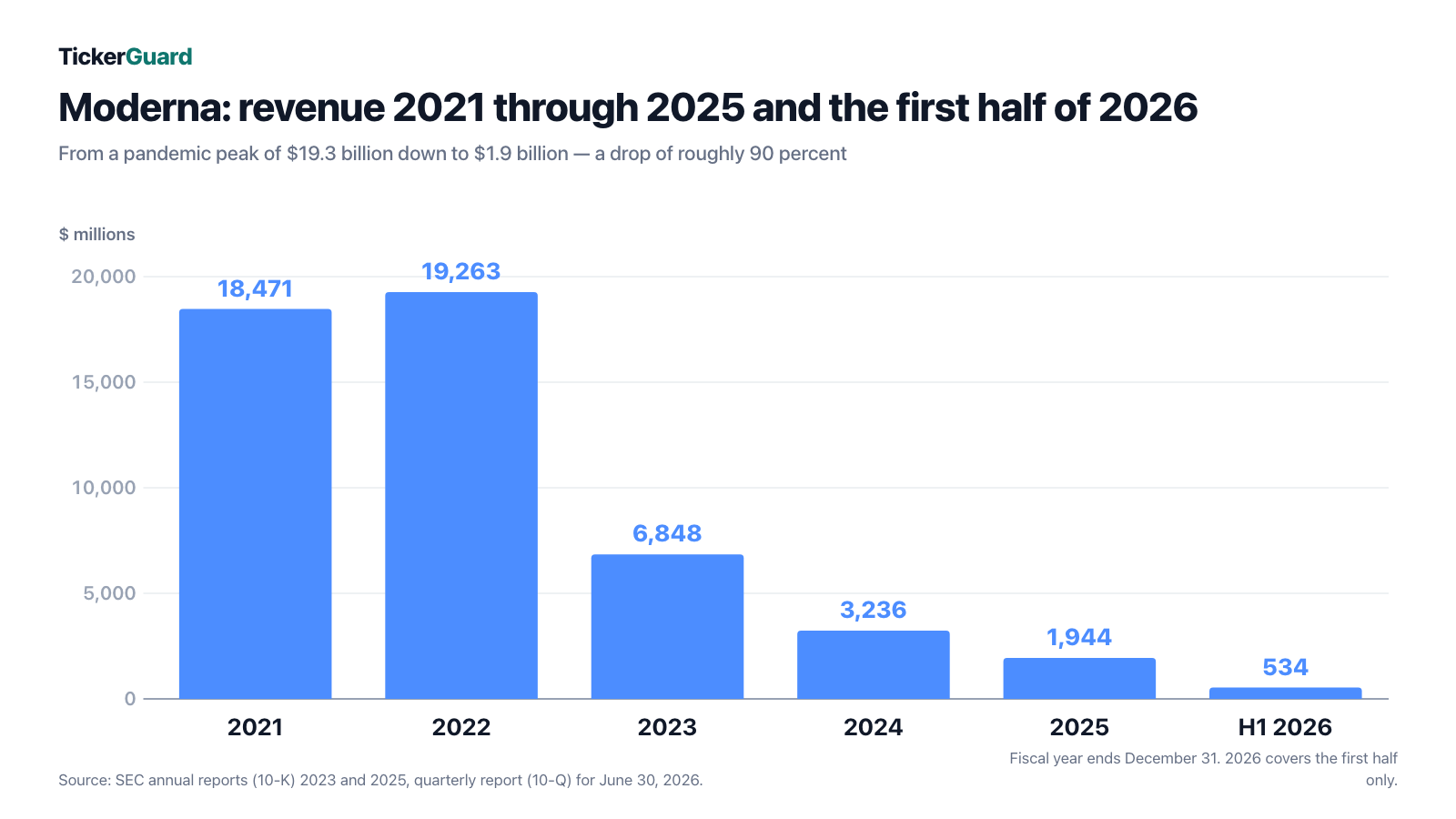
Now the other side. Revenue fell from $19,263 million (2022) to $6,848 million (2023), then to $3,236 million (2024) and finally to $1,944 million (2025). That is roughly 90 percent in three years. The 2025 annual report names the reasons plainly: lower COVID vaccine sales volumes across all regions, the completion of advance purchase agreements with government customers, and weaker overall demand. Elsewhere the report describes the COVID market itself as having become a seasonal one — which is why Moderna had to write down inventory again in both 2024 and 2025.
In the first half of 2026 revenue rose again for the first time — to $534 million after $250 million in the prior-year period, up 114 percent. Before you cheer: the second quarter alone brought $145 million against $142 million in the second quarter of 2025. The entire gain sits in the first quarter and comes, according to the quarterly report, from deliveries to governments under long-term partnerships. That is not a broader market.
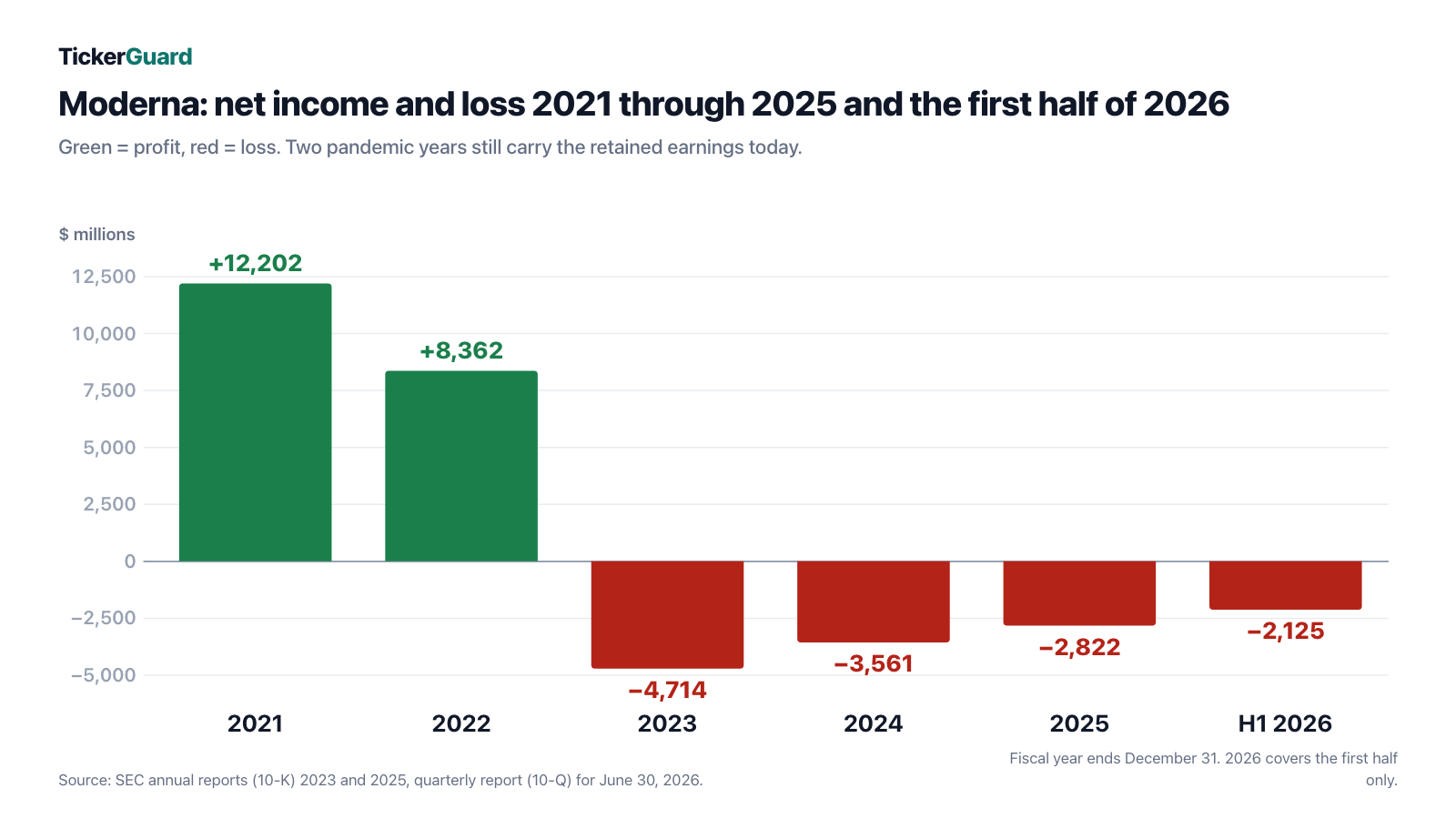
The bottom line looks the same: −$4,714 million (2023), −$3,561 million (2024), −$2,822 million (2025), −$2,125 million in the first half of 2026 alone. Three years and a half-year add up to a good $13.2 billion of losses. As a reminder: the two good years produced $20.6 billion. Roughly two thirds of that is gone again.
What the filings say: five uncomfortable truths
Truth No. 1: research costs more than the business brings in — several times over
In the second quarter of 2026 Moderna booked $145 million of revenue. In the same quarter it spent $651 million on research and development and $216 million on selling, general and administrative expense. Research alone was therefore 4.5 times revenue.
This is not a one-off. In 2025, $3,132 million of research expense faced $1,944 million of revenue. For 2026 the company itself plans about $2.9 billion of research and about $1.0 billion of administration — against a revenue target of "up to 10 percent growth" over 2025, so at most around $2.1 billion (earnings release of July 31, 2026).
Run the rough math: even if Moderna hits its revenue target and every dollar sold were pure margin, roughly two billion of costs would stay uncovered. That is exactly why the company loses money — not one failed program, but the sheer size of the apparatus.
Truth No. 2: the pandemic savings are visibly melting
There is one line in the balance sheet that is easy to overlook: retained earnings. It is the sum of all profits a company has generated since inception and not paid out — the savings account, in effect. At Moderna that line showed $7,223 million as of December 31, 2025. As of June 30, 2026 it was $5,098 million.
Down 29 percent in six months. At that pace the savings account would be empty in a good two years, and the balance sheet would show accumulated losses for the first time since the pandemic. The company says it itself in the quarterly report, in a paragraph that tells the whole story in four sentences:

"We reported a net loss of $2.1 billion for the six months ended June 30, 2026 and net losses of $2.8 billion and $3.6 billion for the years 2025 and 2024, respectively. […] We have retained earnings of $5.1 billion as of June 30, 2026."
— Moderna, Inc., SEC quarterly report 10-Q as of June 30, 2026, Item 2, "Operation and funding requirements"
Truth No. 3: a company with $6.9 billion of cash pledges all of its assets
This is the find we looked at twice. In November 2025 Moderna entered into a secured credit facility of up to $1.5 billion, with Ares Capital as lead arranger. Of that, $600 million is drawn, maturing in November 2030. The interest rate stood at 9.20 percent as of June 30, 2026 — term SOFR plus 5.50 percentage points.
You pay nine percent when you cannot get cheaper money. And the collateral posted for it is as far-reaching as collateral gets:
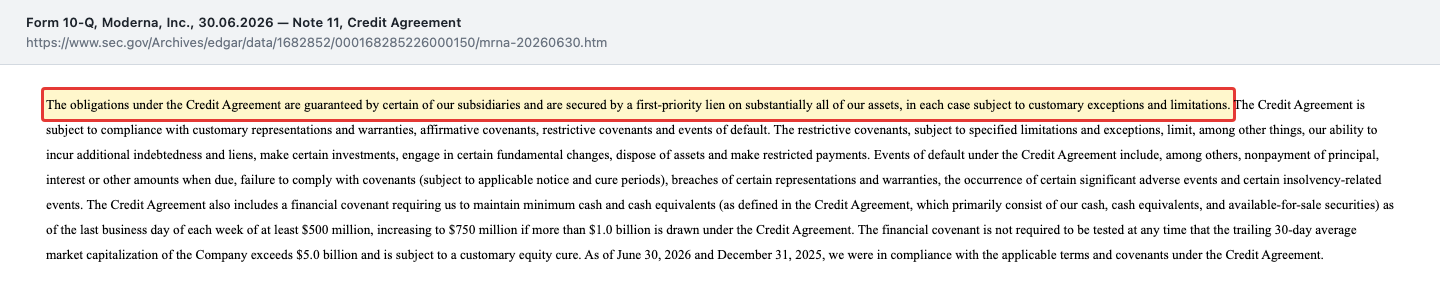
"The obligations under the Credit Agreement are guaranteed by certain of our subsidiaries and are secured by a first-priority lien on substantially all of our assets, in each case subject to customary exceptions and limitations."
— Moderna, Inc., SEC quarterly report 10-Q as of June 30, 2026, Note 11 "Credit Agreement"
A first-priority lien means, in everyday terms: if things go wrong, these creditors stand at the front of the line — ahead of shareholders in any case. On top of that comes a clause you rarely see. Moderna must show at least $500 million of cash on the last business day of every week ($750 million once more than $1.0 billion is drawn). That test falls away as long as the trailing 30-day average market capitalization exceeds $5.0 billion. The share price therefore helps decide how strict the covenants are. As of the August 6, 2026 data date, market capitalization was roughly $22.5 billion — a comfortable margin, but the link exists.
Truth No. 4: $950 million is paid, $1.3 billion can still come — with no accrual
On March 3, 2026 Moderna settled the worldwide patent dispute with Arbutus Biopharma and Genevant Sciences. It was about lipid nanoparticles — the fatty shell that carries the mRNA. Without that shell the instruction never reaches the cell; it is not a detail, it is the core of the product.
The price of peace: a one-time payment of $950 million, paid in July 2026. Of that, $876 million went straight into cost of sales — which is why cost of sales jumped to $1,048 million in the first half of 2026, more than the entire half-year revenue. And the fight is not quite over:
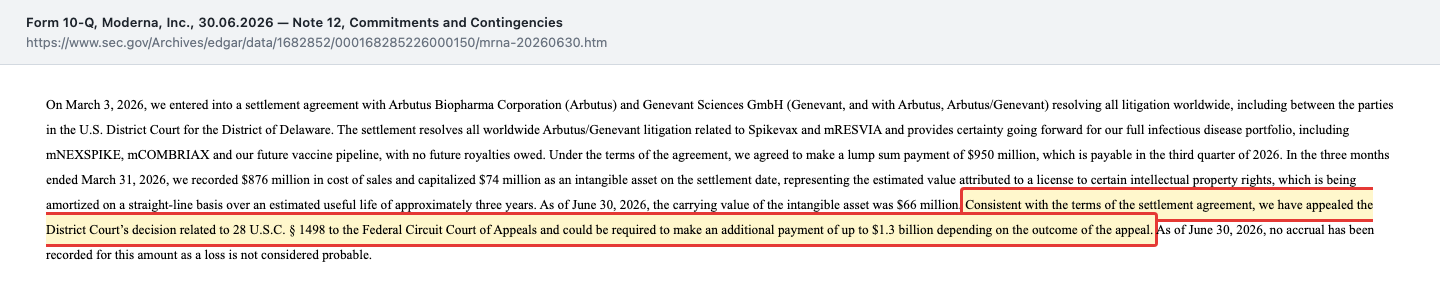
"Consistent with the terms of the settlement agreement, we have appealed the District Court's decision related to 28 U.S.C. § 1498 to the Federal Circuit Court of Appeals and could be required to make an additional payment of up to $1.3 billion depending on the outcome of the appeal. As of June 30, 2026, no accrual has been recorded for this amount as a loss is not considered probable."
— Moderna, Inc., SEC quarterly report 10-Q as of June 30, 2026, Note 12 "Commitments and Contingencies"
That $1.3 billion equals roughly 19 percent of cash as of June 30, 2026. And Arbutus is not the only opponent: in the same section Moderna lists proceedings with Pfizer and BioNTech, with GlaxoSmithKline, with CureVac, with subsidiaries of Sanofi, with Northwestern University and with Bayer/Monsanto — sometimes as plaintiff, sometimes as defendant. Patent wars are routine in this industry; at Moderna they have become a cost center of their own.
Truth No. 5: the workforce had to have its own options repriced
This number appears in no quarterly report but in an offer document from December 2025 — and it says more about the share price than any chart. Moderna offered its staff the chance to swap old stock options for new ones — board members and executive officers were expressly excluded. Eligible for exchange were options with an exercise price of $80 or more. Options like that are worthless when the stock trades far below; they are a voucher for something nobody would buy at that price.

2,865 employees accepted the offer — at about 4,700 full-time staff, well over half the workforce. Options on 4,328,461 shares were exchanged, 79.9 percent of all eligible ones. In return came 1,668,237 new options at an exercise price of $29.46, the closing price on December 12, 2025.
Two things sit inside that. First: the share price had fallen so far that a large part of the workforce's compensation had become practically worthless. Second: the exchange was designed gently for shareholders — 4.3 million old options turned into only 1.7 million new ones. Dilution, meaning your slice of the cake getting smaller, barely arises here; 1.7 million options against 399 million shares is little. It is not a balance sheet hazard. It is a mood reading from the inside.
What the market is asking for it
As of the August 6, 2026 data date, market capitalization stood at roughly $22.5 billion. Measured against 2025 revenue ($1,944 million) that is about 11.6 times sales. There is no price-to-earnings ratio, because there are no earnings.
For context: a sales multiple of around twelve is a price you normally pay for fast-growing software, not for a business with falling revenue. So the market is clearly not paying for the current business but for an expectation — the pipeline, the platform, the possibility that cancer therapy or the flu vaccine becomes a new pillar.
Strip out the net cash and the picture softens somewhat: cash and investments of $6,910 million, less the $950 million settlement paid in July, plus $591 million of debt gives an enterprise value of roughly $17 billion. Even that is about nine times prior-year revenue.
The professionals are split accordingly: 27 ratings split into 5 strong buy, 1 buy, 17 hold, 3 sell and 1 strong sell; the mean price target is $50.84 (data as of August 6, 2026). Translated: most analysts will neither recommend nor warn. For a company whose value hangs on trial results, that is more honest than a bold call.
If you want to see how a similar story continues, our analysis of Novavax covers the second vaccine maker whose pandemic business fell away — with a much smaller cushion. And our analysis of Evotec shows the same basic pattern in a European version: high research costs, uncertain revenue, a cash balance that sets the tempo. The running metrics for Moderna sit on our MRNA stock page.
Opportunities and risks at a glance
What speaks for Moderna
- The platform is proven. mRNA is no longer a hope but approved medicine — four products are on the market, and on August 5, 2026 mFLUSIVA became the fifth approval and the first mRNA flu vaccine cleared in the United States; further approvals arrived in 2026 in Australia, Mexico, Japan and Taiwan.
- The cash is real. $6,910 million in cash and investments as of June 30, 2026, plus $900 million of undrawn credit. That buys time many biotechs do not have.
- Costs are coming down. Research expense fell 7 percent in the second quarter of 2026 against the prior-year quarter, selling and administrative expense fell 6 percent. Guidance for 2026 was cut by about $0.2 billion on July 31, 2026.
- A tangible catalyst. For the cancer therapy intismeran autogene the company expects data from the phase 3 melanoma trial possibly still in 2026; five-year phase 2b data in June 2026 showed a 49 percent lower rate of recurrence or death in combination with Keytruda versus Keytruda alone.
- No balance sheet emergency. $6,761 million of equity, $591 million of debt, no going-concern language in the quarterly report.
What speaks against Moderna
- The core business keeps shrinking. $145 million of quarterly revenue against $142 million in the prior-year quarter — no sign of recovery in the second quarter of 2026.
- The cost base does not fit the business. About $3.9 billion of planned research and administrative expense for 2026 ($2.9 billion plus $1.0 billion) against at most roughly $2.1 billion of targeted revenue — with roughly $1.7 billion of cost of sales on top of that.
- Pipeline setbacks are real. The norovirus candidate mRNA-1403 missed the criteria for early success at the interim analysis on July 31, 2026; the decision on a registrational study for the methylmalonic acidemia therapy was deferred.
- Up to $1.3 billion of legal exposure with no accrual from the pending Arbutus appeal, alongside half a dozen further patent cases.
- Customer concentration. Three buyers accounted for 39 percent of 2025 revenue; the Canadian procurement agency alone held 33 percent of receivables.
- Expensive financing with far-reaching collateral. 9.20 percent interest and a first-priority lien on substantially all assets.
A human conclusion
Back to the anchor. The memory of 2021 is a poor adviser — but not because it is too optimistic. Because it asks the wrong question.
The question is not: "Will Moderna get back to $19 billion of revenue?" That will not happen; it would take a second pandemic, and nobody should bet on that. The question is: does the money from the good years last until research turns back into a business?
The filings give an honest, uncomfortable answer: maybe. As of June 30, 2026 there was $6.9 billion in the cash box. The company expects $4.7 billion to $5.2 billion at year end. At that pace, roughly two years remain before the question of fresh money has to be asked — the credit line and possible revenue gains extend that, a lost appeal over $1.3 billion shortens it.
Two years sounds long. In drug development it is short. That is exactly the tension the stock sits in: the technology has proven itself, the business model still has to do it again — and the clock is visibly running.
Whoever buys today is not buying a vaccine company. They are buying a research program with a bank account. That can pay off if the data delivers. It can also mean sitting in an equity raise two years from now. Both are possible, and both are written in the same documents.
What you make of it is your decision. And that is exactly how it should be.
Sources
- Moderna, Inc. — quarterly report (10-Q) as of June 30, 2026, filed July 31, 2026 (SEC EDGAR, CIK 0001682852)
- Moderna, Inc. — annual report (10-K) for 2025, filed February 20, 2026
- Moderna, Inc. — annual report (10-K) for 2023, filed February 23, 2024 (source of the 2021 and 2022 figures)
- Moderna, Inc. — second quarter 2026 earnings release, Exhibit 99.1 to the current report (8-K) of July 31, 2026
- Moderna, Inc. — Schedule TO-I/A (Amendment No. 2) on the option exchange, filed December 16, 2025 (results of the exchange offer)
- Moderna, Inc. — Schedule TO-I on the option exchange, filed November 13, 2025 (terms of the offer, including the $80 exercise-price threshold)
- Moderna, Inc. — press release “Moderna Receives U.S. FDA Approval for Influenza Vaccine mFLUSIVA”, August 5, 2026 (approval of the flu vaccine mFLUSIVA)
- All SEC filings by Moderna, Inc. (CIK 0001682852)
- Fundamental data (market capitalization, share count, analyst consensus), data as of August 6, 2026
- Most-discussed list of the wallstreet-online forum, as of August 5, 2026 (the hook for this analysis)
Disclosure: this article is journalistic analysis and expressly not investment advice, not a buy or sell recommendation and not a solicitation to buy or sell securities. Shares of biotechnology companies without current earnings can be highly volatile; a total loss of invested capital is possible. All figures come from the original documents named above and carry the reporting date stated there; later developments are not reflected. Positions held by the operator are disclosed daily; where one exists, it appears as a notice at the top of this deep dive.
Key figures at a glance
All monetary figures in millions of $; earnings per share as reported.
| Metric | 2021 | 2022 | 2023 | 2024 | 2025 |
|---|---|---|---|---|---|
| Revenue | 17,736.0 | 18,875.0 | 6,848.0 | 3,199.0 | 1,944.0 |
| Operating Income (EBIT) | 13,296.0 | 9,420.0 | -4,239.0 | -3,945.0 | -3,074.0 |
| Net Income | 12,202.0 | 8,362.0 | -4,714.0 | -3,561.0 | -2,822.0 |
| Net Margin | 68.8% | 44.3% | -68.8% | -111.3% | -145.2% |
| Earnings Per Share | 28.31 $ | 20.10 $ | -12.34 $ | -9.27 $ | -7.25 $ |
Source: fundamental data & SEC filings (annual and quarterly reports, 10-K/10-Q)
Our Bottom Line at a Glance
- Platform and approvals positive
- Moderna carried mRNA from idea to approved mass-market medicine — five products are approved (Spikevax, mNEXSPIKE, mRESVIA, mCOMBRIAX and, since 08/05/2026, mFLUSIVA), and the second quarter of 2026 added approvals in Australia, Mexico, Japan and Taiwan (earnings release 8-K of 07/31/2026). The manufacturing base is built and paid for: $2,059 million of property and equipment as of 06/30/2026.
- Revenue base negative
- Of $19,263 million (2022), $1,944 million (2025) is left. The second quarter of 2026 brought $145 million against $142 million in the prior-year quarter — flat at a low level. The 114 percent half-year gain came from government deliveries, not from a broader market (10-Q as of 06/30/2026).
- Cost structure negative
- Research costs a multiple of what the business brings in: $651 million of research expense against $145 million of revenue in the second quarter of 2026. For full-year 2026 the company itself plans about $2.9 billion of research and about $1.0 billion of selling, general and administrative expense (guidance of 07/31/2026) — against a revenue target of at most 10 percent above 2025.
- Cash position neutral
- At $6,910 million as of 06/30/2026 the cash box is well filled, and the company expects $4.7 billion to $5.2 billion at year-end 2026. But the direction is unambiguous: down $1,225 million in six months, plus the $950 million settlement paid in July. Two pandemic years left retained earnings of $5,098 million (06/30/2026), after $7,223 million half a year earlier.
- Financing structure negative
- Since November 2025 substantially all assets secure a facility of up to $1.5 billion at 9.20 percent interest (06/30/2026, Note 11 of the 10-Q). A company with $6.9 billion of liquidity that grants collateral of that reach is buying headroom at a steep price.
- Open legal exposure negative
- The settlement with Arbutus and Genevant cost $950 million (paid July 2026). The pending appeal can add up to $1.3 billion — with no accrual as of 06/30/2026. Alongside it run proceedings with Pfizer/BioNTech, GSK, CureVac, Sanofi subsidiaries, Northwestern University and Bayer/Monsanto (Note 12 of the 10-Q).
Moderna today is a research organization with a small selling business, funded out of the savings of two exceptional years. The technology is proven, the earning power is not: $145 million of quarterly revenue faces $651 million of research expense (second quarter of 2026). Cash of $6,910 million (06/30/2026) buys time, but it shrinks on plan, and the appeal, the credit covenants and pipeline readouts can all shorten the clock. Not investment advice.
What Our Rating Means
Open questions
The business works in principle, but one material question is open. As long as it stays open, our findings do not carry a quality verdict.
The substance is there as of the reporting date: $6,761 million of equity, $6,910 million of cash and investments, no going-concern language in the quarterly report as of June 30, 2026, and the loan is small at $591 million of carrying value against that liquidity. That is why this is not a red light. It is yellow all the same, because the decisive operating question stays open: whether a pipeline with nine ongoing oncology trials and several regulatory filings turns back into a self-carrying business will be settled by data readouts that are still ahead — the norovirus candidate already missed its interim analysis on July 31, 2026. Until then the company pays for research out of reserves that shrank 29 percent in six months. The decision is yours.
A journalistic assessment by our editorial team at the time of the deep dive, based on public sources — not investment advice and not a solicitation to buy or sell. Your personal circumstances (investment goals, risk capacity, taxes) cannot be taken into account. What our levels mean, how verdicts are formed, and what conflicts of interest exist →
Worth Noting
- Hook: the stock appeared on the most-discussed list of the wallstreet-online forum on August 5, 2026. This analysis grew out of that, not out of a price move.
- Data as of: all balance sheet and income figures come from the quarterly report (10-Q) as of June 30, 2026 (filed July 31, 2026), the annual reports (10-K) for 2025 and 2023, and the earnings release of July 31, 2026. The approval of the flu vaccine mFLUSIVA on August 5, 2026 comes from the company press release and is not yet reflected in any figure in this analysis. Market capitalization and analyst consensus: data as of August 6, 2026.
- Easy to confuse: "mRNA" is the abbreviation for messenger ribonucleic acid and at the same time Moderna's ticker symbol MRNA. Other mRNA companies such as BioNTech or CureVac trade under different symbols.
Stock Watch
This analysis is as of August 26, 2026. Stock Watch will tell you what's changed at MRNA since then.
Later $1 a month per stock — signing up is free, and you'll be the first to know when it launches.
The full analysis as a PDF for later
We will send you this analysis as a PDF — to print, file away, and read at your own pace. And we will add you to the free Stock Watch list for Moderna Inc (MRNA), so you hear about it when something material in this analysis changes.
Frequently Asked Questions
Because the pandemic market disappeared. In 2022 governments bought COVID vaccine under advance purchase agreements; those contracts ran out. The annual report (10-K) for 2025 cites lower COVID vaccine sales volumes across all regions, the completion of advance purchase agreements with government customers and weaker overall demand. Of the $19,263 million peak in 2022, $1,944 million was left in 2025.
No. Losses from 2023 through 2025 add up to $11.1 billion, and the first half of 2026 added $2.125 billion. Loss per share was $5.36 for six months. For 2026 the company itself plans about $2.9 billion of research expense and about $1.0 billion of administrative cost — against a revenue target of at most 10 percent above 2025.
As of June 30, 2026 the company held $6,910 million in cash and investments. It expects $4.7 billion to $5.2 billion at year-end 2026 and states in the quarterly report (10-Q) that its funds are sufficient for at least twelve months. Add $900 million of undrawn credit. At a burn rate like the one in 2026, today's cash would be gone in roughly two years.
It concerned patents on lipid nanoparticles, the delivery shell for mRNA. On March 3, 2026 Moderna settled worldwide for a one-time payment of $950 million with no future royalties; the money went out in July 2026. An appeal on one aspect is still running — and according to the quarterly report it could cost up to $1.3 billion more.
Moderna does not explain that in the filings. What is documented is the structure: a facility of up to $1.5 billion with Ares Capital as lead arranger, $600 million drawn, maturing November 2030, secured by a first-priority lien on substantially all assets. Two tranches totaling $900 million are tied to conditions and approval milestones.
Four products are on sale: the COVID vaccines Spikevax and mNEXSPIKE, the RSV vaccine mRESVIA and the combination vaccine mCOMBRIAX (EU approval). According to the 2025 annual report, mNEXSPIKE was the leading product in the U.S. retail channel. A fifth was added on August 5, 2026: the U.S. Food and Drug Administration approved the flu vaccine mFLUSIVA (mRNA-1010) for adults aged 50 and older; the launch is planned for the 2026/27 flu season.
Moderately so far. The share count rose from 394 million (December 31, 2025) to 399,235,889 (July 24, 2026) — roughly 1.3 percent in seven months, essentially only from employee programs. There were no equity raises; 2026 funding came from cash and the secured loan. With 1,600 million shares authorized, the headroom is large.
The credit agreement requires minimum cash of $500 million — $750 million once more than $1.0 billion is drawn — tested on the last business day of each week. That test falls away as long as the trailing 30-day average market capitalization exceeds $5.0 billion. The share price therefore helps decide how tight the loan covenants are.
Found an error?
Did you spot a factual error, an outdated number, or a typo in this deep dive? Let us know briefly — your report goes straight to the editorial team.