DWS Group Manages a Record €1,190 Billion — Yet It Earns Less on Every Euro Than It Did in 2022
Deutsche Bank’s asset manager keeps reporting records: more assets than ever, the best first half in its history, a €3 dividend and the prospect of a special payout. We read the half-year report, the earnings call and five annual reports. Behind the records sit a fee that shrinks year after year, a missed growth target and a majority owner that shares the wheel. Records are loud, basis points are quiet — we counted the quiet ones.
 Thomas Mücke
Founder & Publisher
Thomas Mücke
Founder & Publisher
Chart
Interactive price chart (TradingView).
Note: pure fact-based analysis, not investment advice and not a solicitation to buy or sell. All figures without guarantee.
There is one word that works like a key on the stock market: record. Record revenue, record profit, record inflows — when we read it, most of us stop asking what the record is actually made of. Call them record goggles: put them on and you see the size but miss the substance — the headline replaces the math. The tricky part is that records are almost always true. They just don’t tell the whole story. Sometimes the decisive point sits between the record announcements like a message in a bottle — in a single sentence the company wrote itself.
DWS Group, Deutsche Bank’s asset management arm, is giving investors plenty of reasons to put those goggles on right now. On June 30, 2026, it managed €1,190 billion — more than ever. CEO Stefan Hoops called the first half of 2026 “the best first half in DWS’ history”: profit before tax up 16 percent, earnings per share up 21 percent, net inflows of €35.8 billion. Shareholders received a €3 dividend for 2025, and the company has held out the prospect of a special payout in 2027.
Let’s make a deal: we read together what sits behind those records — the Half Year Report 2026 of July 29, 2026, the transcript of the earnings call held the same day and the annual reports for 2021 through 2025. DWS is a German company listed in Frankfurt and does not report to the U.S. securities regulator, the SEC; its reports are published in English as well, so we quote them in the original. The central tension of this analysis: DWS is growing in volume and profit, but it earns less on every euro it manages — its management fee margin fell from 28.1 basis points in 2022 to 24.7 basis points in the first half of 2026. And above it all sits a majority owner holding almost four fifths of the shares. Whether the growth still carries the stock is your call.
What DWS actually does — a toll booth for other people’s money
DWS manages other people’s money: savers who buy a mutual fund or an ETF, pension funds, insurers and corporations. Think of the business as a toll booth. For every euro that travels down the road, DWS collects a small amount each year — the management fee. The industry measures that fee in basis points: one basis point is one hundredth of a percent. At 24.7 basis points, DWS keeps about €2.47 a year for every €10,000 it manages. Profit therefore depends on two dials: how much money travels down the road — and how high the toll is.
According to the half-year report, assets under management on June 30, 2026, broke down as follows: €455 billion in passive products, mainly the exchange-traded funds (ETFs) of its Xtrackers brand; €490 billion in actively managed funds and mandates (fixed income 211, equities 133, systematic and quantitative strategies 90, multi-asset 56 billion euros); €105 billion in alternatives such as real estate and infrastructure, partly under the RREEF brand; plus €125 billion in cash (money market) products and €16 billion in advisory mandates. Well-known retail funds include DWS Top Dividende, Akkumula and DWS Concept Kaldemorgen. On the July 29, 2026, earnings call, CEO Hoops called DWS “Germany’s number 1 asset manager”; in its 2025 annual report, the company states the aim to “maintain market leadership in our German home market.”
Some background belongs here. DWS has been listed since March 2018, and its legal form is a German partnership limited by shares (KGaA): the business is run not by a stock corporation’s board but by the general partner, DWS Management GmbH, whose managing directors form the executive board. Stefan Hoops has been CEO since June 2022, Markus Kobler CFO since November 2023. On June 30, 2026, the group had 4,811 full-time equivalent employees. And starting in early November 2026, the group will operate worldwide under a new old name: Deutsche Asset Management — what it was called before the IPO. According to the announcement of September 8, 2026, the parent company will for now keep the name DWS Group GmbH & Co. KGaA, and the DWS ticker and the product brands DWS, Xtrackers and RREEF will remain; the transition is to be completed by March 2027.
Company history for investors
-
2018
IPO as DWS
Deutsche Bank lists its asset manager in March 2018 and keeps 79.49%. For investors, the free float has stayed small ever since.
-
2022
2022 bear market: assets fall to €821bn
Assets under management shrink by €106bn to €821bn with market prices, and EPS drops from €3.90 to €2.97 — the dependence on the market becomes visible.
-
2023
$25m SEC settlement
The U.S. subsidiary pays over misleading ESG statements and anti-money-laundering failures. The reputation as an ESG leader is damaged.
-
2024
€4.00 special dividend
On top of the regular €2.10 dividend for 2023, DWS pays a €4.00 per share special dividend (€800m), as promised at its 2022 Capital Markets Day — a pattern meant to return in 2027.
-
2025
Record year and Frankfurt fine
Profit before tax up 39%, EPS of €4.64; at the same time, a €25m greenwashing fine from the Frankfurt prosecutor becomes effective.
-
2026
May: DWS CEO joins Deutsche Bank’s board
Since May 1, 2026, Stefan Hoops has also been responsible for asset management on the parent’s management board.
-
2026
September: back to Deutsche Asset Management
From November 2026, DWS operates worldwide under the name it carried until 2018; the ticker and product brands remain.
How the stock landed on our desk
Through other investors’ curiosity: in late September 2026, DWS showed up in the ranking of most-discussed German stocks on wallstreet-online, one of Germany’s largest retail-investor forums. That is an attention signal and explicitly not a reason to buy — a stock gets discussed because it interests someone, not because it is good.
As of September 28, 2026, our in-house stock scanner listed DWS in exactly two strategies. The first, Pros 80%, collects stocks more than 80 percent owned by institutional investors and major shareholders. For DWS that is less an accolade than simple ownership structure: Deutsche Bank holds 79.49 percent and the Japanese insurer Nippon Life 5.00 percent. According to the company, only 15.51 percent of the shares are free float.
The second strategy is a warning-signal scanner: the Beneish M-Score. Developed by accounting professor Messod Beneish, it compares eight ratios from two consecutive annual reports — such as receivables versus revenue, the margin trend and the pace of depreciation — and flags unusually sharp changes in the books. On the same date it flagged 2,953 stocks worldwide; it is a coarse sieve, not a verdict, and it does not show which of the eight ratios tips the balance. So we checked the reports. At an asset manager, several line items that feed into the formula swing sharply for business-specific reasons: in 2025, performance and transaction fees more than doubled from €148 million to €318 million, and the balance sheet contains consolidated fund vehicles whose value swings largely offset each other in the income statement — in the first half of 2026, a €192 million gain from these vehicles was matched by a €184 million offsetting charge. The auditor, KPMG, issued an unqualified opinion on the 2025 consolidated financial statements on March 6, 2026. We found no signs of window-dressed books. The Piotroski F-Score, a nine-point test of the health of the books, stood at 6 of 9 on September 28, 2026: okay, not outstanding.
The numbers over the years — honestly appraised
First, what genuinely impresses. Assets under management rose from €928 billion at the end of 2021 to €1,085 billion at the end of 2025 and €1,190 billion on June 30, 2026 — up 28 percent in four and a half years, despite the slump to €821 billion in the 2022 bear market. 2025 was the strongest year so far: revenues rose to €3,155 million (2021: €2,720 million), profit before tax jumped 39 percent to €1,324 million, and earnings per share reached €4.64 — above the company’s own target of €4.50. Costs of €1,831 million were almost flat year over year, and the cost-income ratio (how many cents of cost go with each euro of revenue) fell from 65.6 to 58.0 percent.
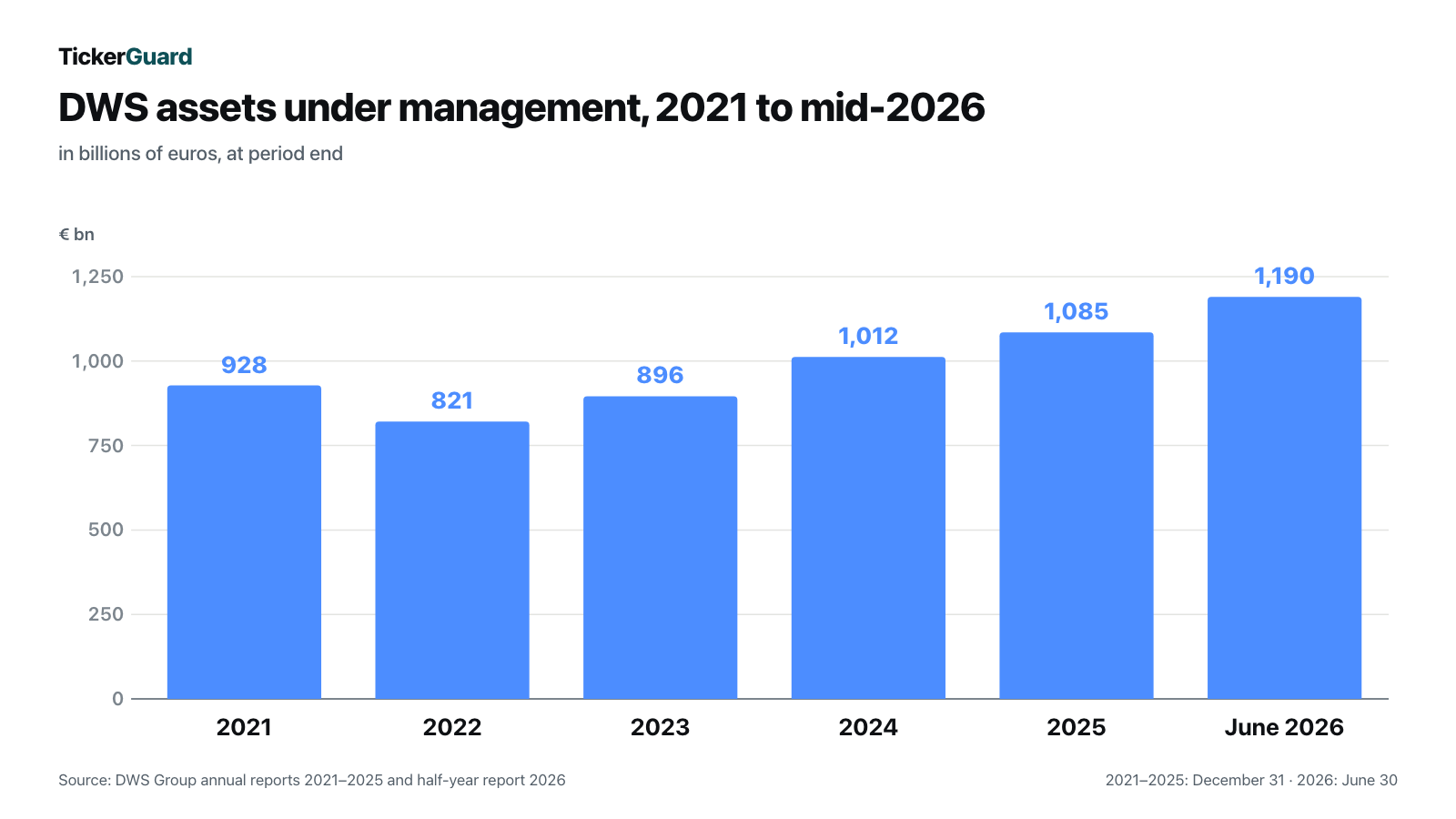
Shareholders benefit directly: the dividend rose from €2.00 for 2021 through €2.05 and €2.10 to €2.20 for 2024 and €3.00 for 2025; for 2023, a €4.00 special dividend came on top. Including the dividend for 2025, DWS says it has paid out more than €4 billion since its 2018 IPO. The payout ratio is about 65 percent of earnings. The business needs little debt in the classic sense: according to the half-year report, it is primarily equity-funded, and its liquidity position stood at €3,054 million on June 30, 2026.
The chart also shows why you should not simply extrapolate. Earnings per share were €3.90 in 2021, then fell to €2.97 (2022) and €2.76 (2023) and only recovered to €3.25 in 2024. An asset manager is a leveraged mirror of the stock market: when prices fall, assets under management shrink and the toll shrinks with them — but staff and technology costs stay. The record year 2025 also contained unusually high performance fees, profit shares that only become due when a fund beats certain return hurdles.
The first half of 2026: a record with footnotes
DWS published its half-year report on July 29, 2026. The key figures: revenues of €1,594 million (up 6 percent), costs of €912 million (flat), profit before tax of €682 million (up 16 percent), earnings per share of €2.51 after €2.06. The cost-income ratio fell to 57.2 percent. Management fees of €709 million in the second quarter were 13 percent above the prior-year quarter. That is a solid result. But three footnotes belong with it.
First: almost half of the record inflows is parked money. Of the €35.8 billion in net inflows in the first half, about €17 billion went into money market products, according to the half-year report (€4.6 billion plus €12.9 billion per the two quarterly statements) — money clients park short term and that earns only a very small fee. Long-term net flows excluding cash and advisory were €18.2 billion, driven almost entirely by index funds (€18 billion). According to the quarterly statements, active funds took in about €0.4 billion net, while alternatives saw net outflows of €0.5 billion. For 2026 through 2028, DWS is targeting roughly €160 billion in cumulative long-term net flows, or a little over €50 billion a year; CFO Kobler expects them “especially towards the end of the year.”
Second: the half year leaned on one infrastructure fund. In the first quarter, DWS booked €109 million in performance and transaction fees, of which €104 million, according to CFO Kobler, were infrastructure-related performance fees after its infrastructure fund PEIF II sold holdings. In the second quarter, the figure was only €11 million — and profit before tax fell 19 percent quarter over quarter to €305 million. For 2026, management expects performance and transaction fees at the upper end of its range of 4 to 8 percent of revenues; for 2027, only in the lower half.
Third: part of the profit jump came from the tax line. The half-year report notes that net income benefited from the tax treatment of certain performance fee income; according to Kobler, second-quarter net income included a positive tax effect of €25 million. DWS reaffirmed its 2026 outlook: significantly higher profit before tax than in 2025, earnings-per-share growth of 10 to 15 percent, a cost-income ratio between 55 and 57 percent, and net flows significantly higher than last year.
Uncomfortable truth No. 1: the toll keeps falling — year after year
This is the core of the analysis, and DWS does not hide it. The management fee margin — management fees divided by average assets under management — was 27.8 basis points in 2021 and 28.1 in 2022. Since then it has fallen without interruption: 27.1 (2023), 26.1 (2024), 25.0 (2025) and 24.7 basis points in the first half of 2026.
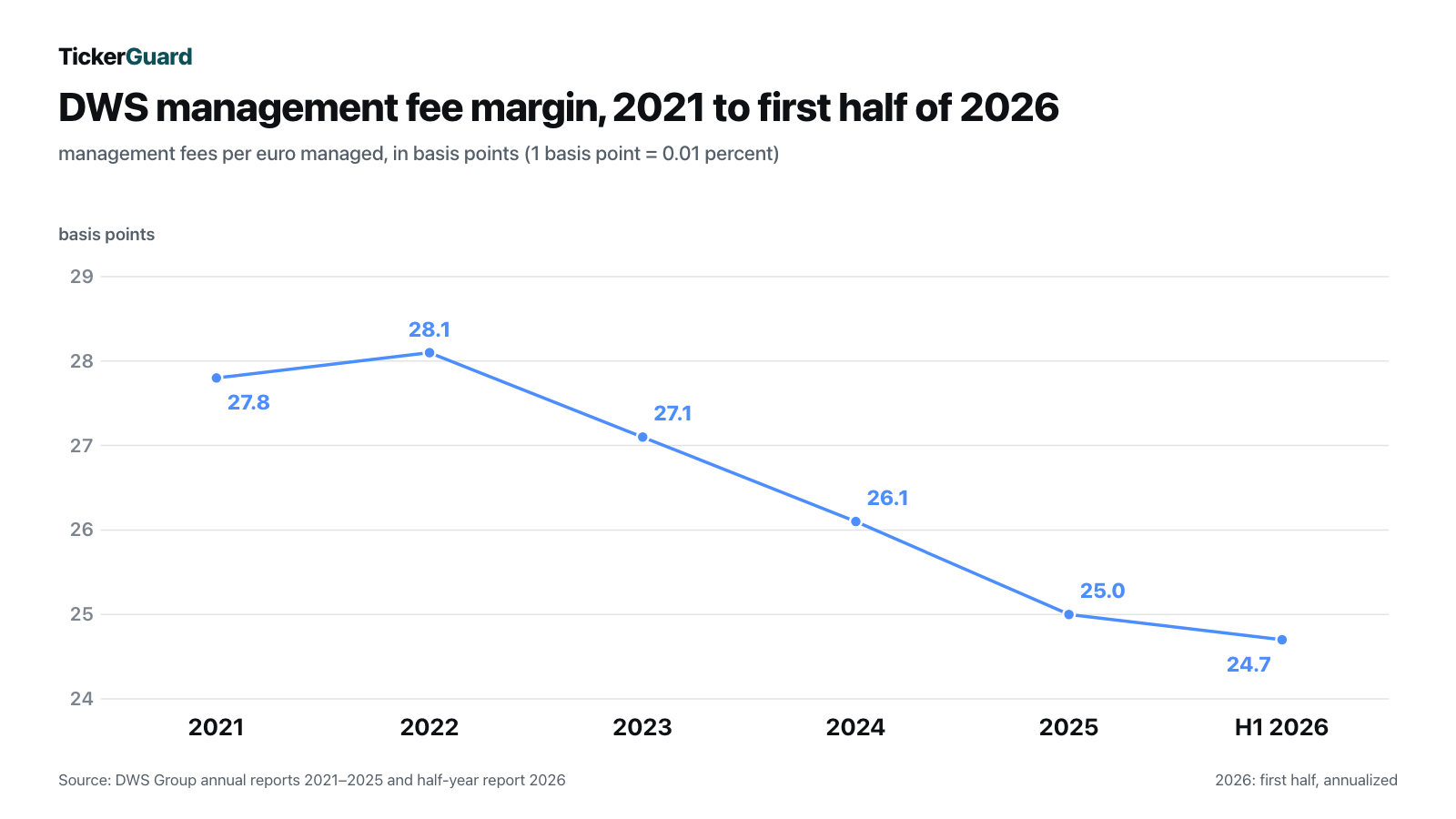
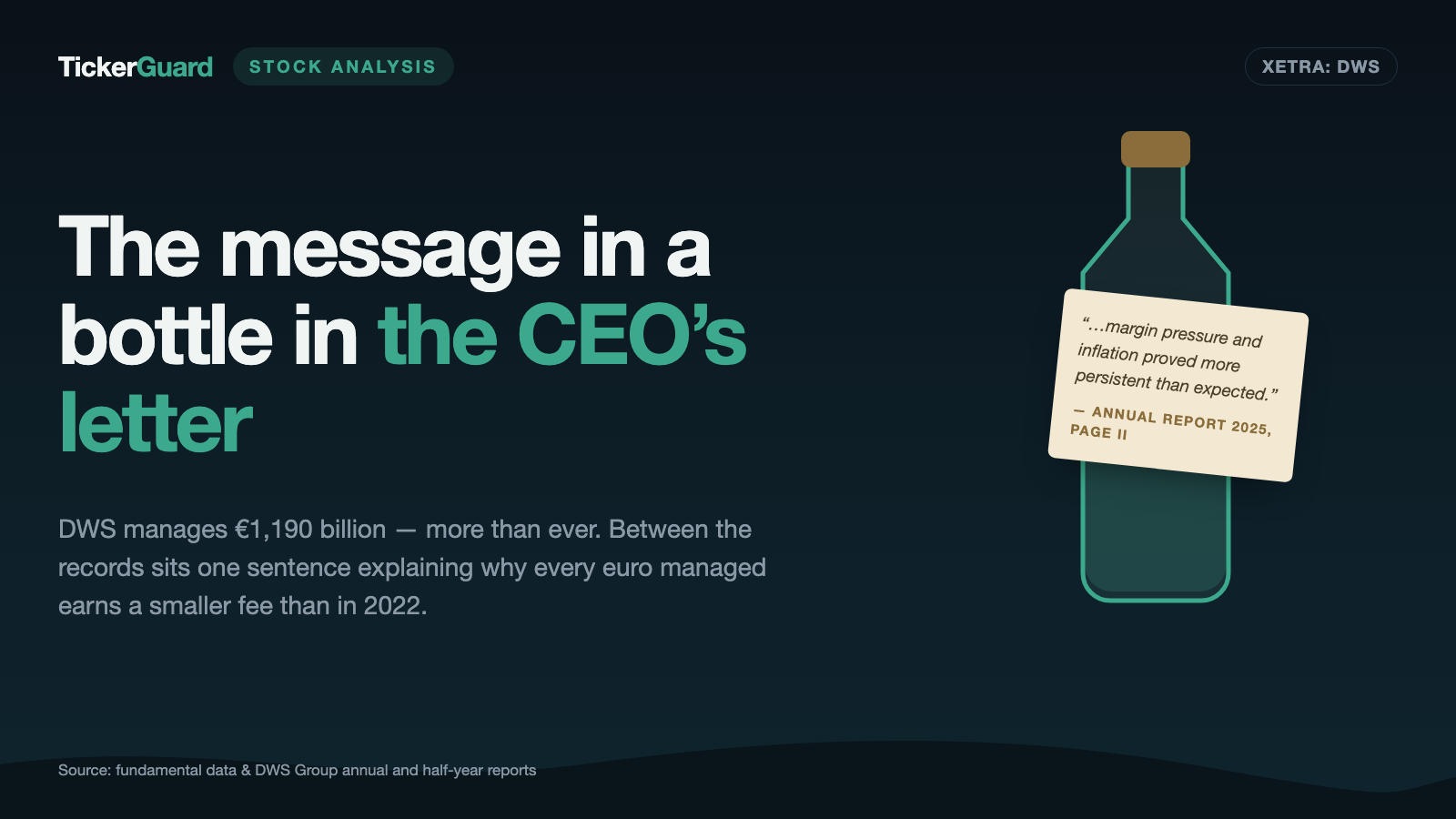
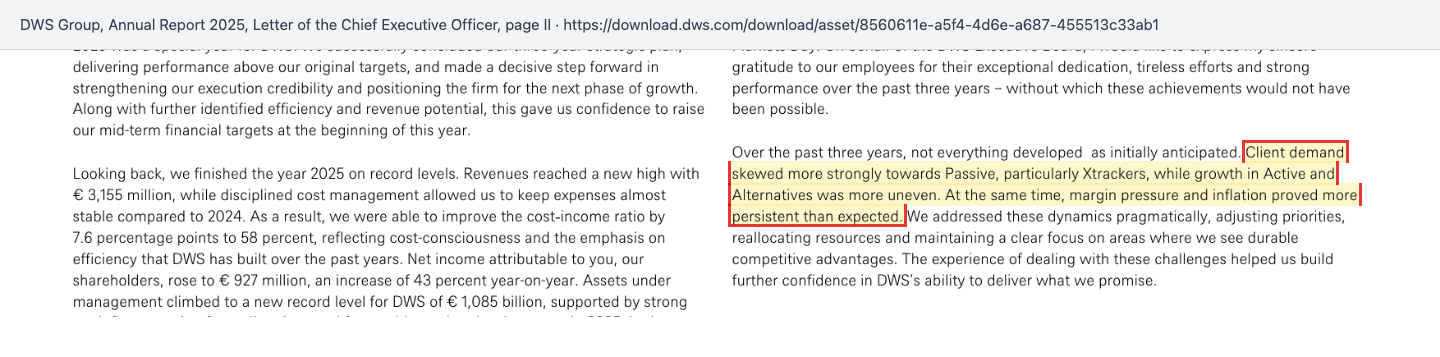
The reason is the mix. Growth comes mostly from index funds and money market products, where the toll is low; the pricier active funds and alternatives are growing more slowly. CEO Hoops describes it himself in the 2025 annual report — this is the message in a bottle from the start, tucked into his letter to shareholders between record revenue and record assets:
“Client demand skewed more strongly towards Passive, particularly Xtrackers, while growth in Active and Alternatives was more uneven. At the same time, margin pressure and inflation proved more persistent than expected.”
— DWS Group, Annual Report 2025, Letter of the Chief Executive Officer, page II
What one basis point is worth can be estimated. In the first half of 2026, DWS managed €1,130 billion on average. On that base, one basis point of margin equals roughly €113 million in annual fees. The decline from 28.1 to 24.7 basis points since 2022 therefore costs about €380 million a year at today’s asset level — more than a full quarter of profit before tax. Profits still rose because volume grew faster than the margin fell and costs stayed flat: from the end of 2022 to mid-2026, assets under management rose 45 percent (from €821 billion to €1,190 billion), while the margin fell 12 percent over the same period (from 28.1 to 24.7 basis points). For comparison: the U.S. asset manager in our Franklin Resources analysis earned an average of 40.5 basis points excluding performance fees in fiscal 2025 — and is fighting the same downward pull as clients move from pricey active funds to cheaper products.
Management pushes back. On the July 29, 2026, earnings call, Hoops said the average margin is “keeping a lot more stable than in prior years” because active equity funds are attracting money again. According to Hoops, 82 percent of equity assets with a benchmark are beating it. At the same time, he acknowledged price cuts at Xtrackers — on about 5 percent of ETF assets — and described a new €3 billion to €6 billion pension-reserve mandate from the German federal government and two states as “reasonably low margin.” Takeaway: for an asset manager, the most important number is not volume, but how much of each euro it gets to keep.
Uncomfortable truth No. 2: the growth target for alternatives was missed
Alternatives — real estate, infrastructure, private credit — are especially valuable to asset managers because clients pay higher fees and their money stays locked in for years. At its 2022 Capital Markets Day, DWS therefore set a goal of growing alternative assets by more than 10 percent a year through 2025. The result is in the 2025 annual report:
“Our Alternatives business remained broadly stable at € 108 billion in AuM over the same period; however, growth fell short of the 10% CAGR target set for 2022–2025.”
— DWS Group, Annual Report 2025, Management Report, page 12
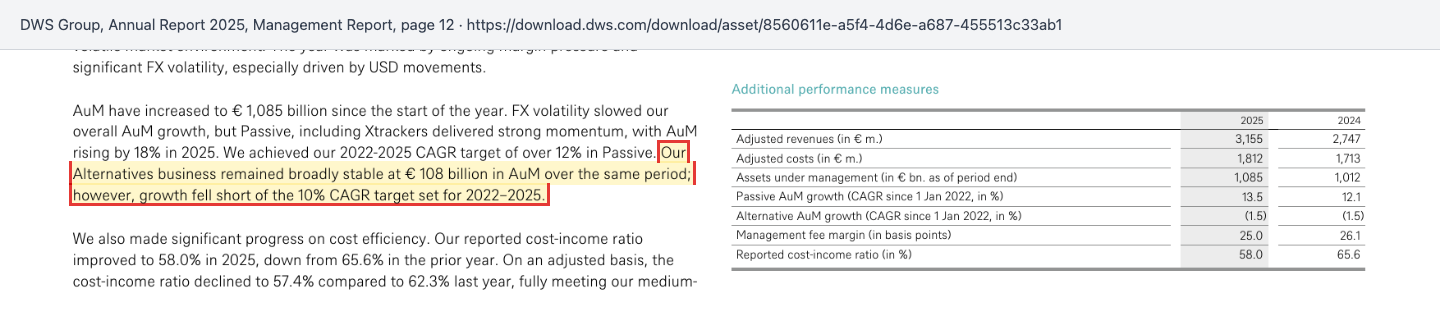
The table in the same report is even clearer: instead of growing more than 10 percent a year, alternative assets have shrunk 1.5 percent a year since the start of 2022. By June 30, 2026, they were slightly lower still at €105 billion, partly because two infrastructure funds returned €1.3 billion to investors after asset sales. Passive products, by contrast, beat their target of more than 12 percent with 13.5 percent annual growth since the start of 2022, according to the same table — which pushes the margin down further. On the earnings call, Hoops openly admitted that DWS lacks capabilities in certain real estate strategies: “that is something which we don’t possess at scale, need to acquire.” Hopes now rest on private credit, where several funds are expected to reach first closings within the next six months, according to Kobler, and on a 40 percent stake in an Indian alternatives platform of its partner Nippon Life India.
Uncomfortable truth No. 3: Deutsche Bank shares the wheel
Buy DWS shares and you become a co-owner alongside Deutsche Bank. Through its subsidiary DB Beteiligungs-Holding GmbH, the bank holds 79.49 percent. According to the annual report, executive pay levels are set by the shareholders’ meeting of the general partner, DWS Management GmbH; the annual general meeting only approves the compensation system. Closeness to the parent has advantages the company itself stresses: Deutsche Bank’s Private Bank is, per the annual report, DWS’s largest global distribution partner, and the group’s sales network is meant to bring in clients from Germany’s pension reform. For more on the parent, see our Deutsche Bank analysis.
But the closeness has three sides minority shareholders should know. First, the dual role: since May 1, 2026, DWS CEO Hoops has also sat on Deutsche Bank’s management board, where he is responsible for asset management; on the earnings call he said he coordinates Deutsche Bank’s response to the pension reform on the group board. In its announcement of March 19, 2026, Deutsche Bank stressed that DWS remains a separately listed legal entity with its own leadership, strategy and governance. Second, pay: according to the 2025 compensation report, 10 percent of DWS executives’ long-term variable pay depends on a “Deutsche Bank Group component,” meaning targets of the parent such as its return on tangible equity. Third, the parent’s legacy issues rub off on DWS:
“In April 2024, the US Department of Labor extended our exemption, which is now scheduled to expire on 17 April 2027.”
— DWS Group, Annual Report 2025, Outlook – Risks, pages 23–24
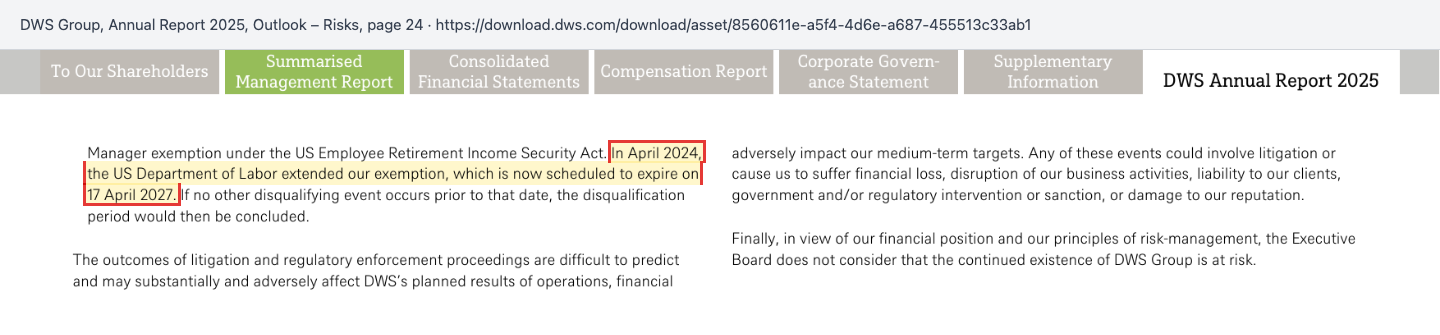
The background is in the sentence just before it: because of Deutsche Bank’s past criminal convictions, DWS had to seek an individual exemption so it could keep relying on the Qualified Professional Asset Manager (QPAM) exemption under the U.S. Employee Retirement Income Security Act (ERISA) when managing U.S. retirement money. If no other disqualifying event occurs before April 17, 2027, the disqualification period would then be concluded, according to the annual report. It is an example of how the parent’s problems create formalities and risks for the subsidiary. Takeaway: with a subsidiary that has a nearly 80 percent owner, you always buy a piece of the parent too — its strengths and its history.
Uncomfortable truth No. 4: greenwashing has cost money twice
For years, DWS marketed itself as a leader in sustainable investing. Authorities on two continents saw it differently. In September 2023, its U.S. subsidiary DWS Investment Management Americas paid a total of $25 million to settle two cases brought by the SEC, without admitting or denying the findings — $19 million over misleading statements about its ESG process and $6 million over anti-money-laundering failures:
“The order finds that DIMA marketed itself as a leader in ESG that adhered to specific policies for integrating ESG considerations into its investments; however, from August 2018 until late 2021, DIMA failed to adequately implement certain provisions of its global ESG integration policy as it had led clients and investors to believe it would.”
— U.S. Securities and Exchange Commission, press release 2023-194, September 25, 2023
In Germany, the Frankfurt public prosecutor imposed a €25 million fine for a negligently committed regulatory offense; DWS accepted the decision, which became effective on April 1, 2025, according to the 2025 annual report, concluding the matter. Both cases are closed, and the amounts are small relative to annual profit. What remains is the lesson that marketing claims and internal practice at DWS did not match — a burden for a firm whose only product is trust. Today, according to Hoops, about half of DWS’s new products are launched as ESG funds, and clients are left to choose.
Valuation: no bargain, but with a payout promise
At €72.40 (closing price, September 25, 2026) and 200 million shares, DWS had a market value of about €14.5 billion. Measured against 2025 earnings per share of €4.64, that is a price-to-earnings ratio (how many years of profit the price costs) of about 15.6. If DWS hits its 2026 goal of 10 to 15 percent EPS growth, earnings would come in at €5.10 to €5.34 per share — pushing the P/E down to about 13.6 to 14.2. The €3.00 dividend equals a yield of roughly 4.1 percent.
Equity stood at €7,512 million on June 30, 2026, or about €37.56 per share; the stock thus trades at just under twice book value. However, €3,588 million of that equity consists of goodwill and other intangible assets — values from past acquisitions that cannot be paid out. The interesting part is the surplus: in the 2025 annual report, DWS cites about €1 billion in excess capital and says it intends to propose a substantial part of it as a special dividend in 2027:
“We also remain committed to a dividend payout ratio of around 65 percent and, given our excess capital position of currently approximately € 1 billion, intend to propose the use of a substantial part of this capital for an extraordinary dividend in 2027, subject to capital commitment for organic and inorganic growth initiatives.”
— DWS Group, Annual Report 2025, Letter of the Chief Executive Officer, page II
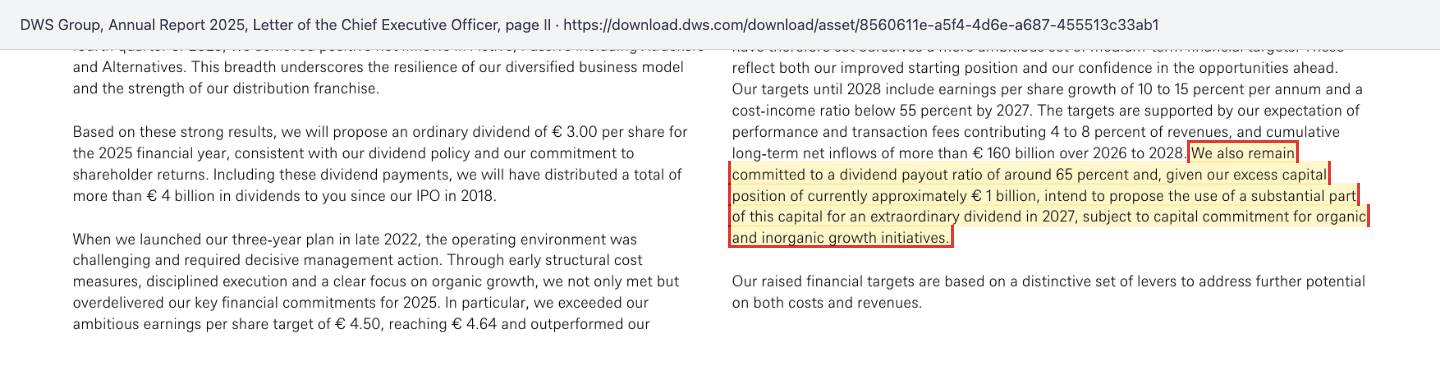
For scale: the full billion would equal about €5 per share, just under 7 percent of the market value. The caveat at the end of the sentence deserves attention, though, because on the earnings call Hoops spoke openly about acquisitions in real estate strategies. And almost 80 percent of every payout flows to Deutsche Bank.
The pros are split. According to the half-year report, as of June 30, 2026, six analysts rated the stock a buy, nine a hold and one a sell; the average price target was €64.09 — below the September share price. In our fundamental data, the average price target stood at €71.00 on September 28, 2026; the two figures come from different dates and not necessarily from the same group of analysts. After rising from €65.65 at the end of June to €72.40 in September, the stock is roughly where analysts see it on average. Price targets, however, often follow the price rather than predict it.
Upside and risks at a glance
What speaks for DWS:
- Record assets of €1,190 billion (June 30, 2026), first-half 2026 profit before tax up 16 percent, outlook reaffirmed: 10 to 15 percent EPS growth a year through 2028.
- Cost discipline: the cost-income ratio fell from 65.6 percent (2024) to 58.0 percent (2025) and 57.2 percent (first half of 2026); the target is below 55 percent by 2027.
- A well-capitalized business with little debt: liquidity of €3,054 million, a €3.00 dividend for 2025, about €1 billion in excess capital for a possible special dividend in 2027.
- Tailwind from Germany’s pension reform: the new retirement savings account launches on January 1, 2027, and DWS says it already manages close to €100 billion for German occupational pensions.
- Active equity funds are attracting money again: €1.1 billion of inflows in the second quarter of 2026, the best figure in six years.
What speaks against it:
- The management fee margin has fallen every year since 2022, from 28.1 to 24.7 basis points; growth comes mostly from low-cost index funds and money market products.
- The growth target for alternatives (more than 10 percent a year) was missed; assets shrank 1.5 percent a year since 2022 to €105 billion.
- Profit swings with the market and with individual performance fees: €104 million from the infrastructure fund PEIF II in the first quarter of 2026, and management expects less in 2027.
- Deutsche Bank holds 79.49 percent and the free float is 15.51 percent; the DWS CEO has sat on the parent’s management board since May 2026, and a U.S. exemption tied to the parent’s legacy issues runs until April 17, 2027.
- The greenwashing cases cost $25 million (SEC, 2023) and €25 million (Frankfurt prosecutor, 2025) — and cost trust.
A human conclusion
Back to the record goggles. DWS’s records are real: assets are bigger than ever, costs are under control, profits are rising, and shareholders receive a large share of them. This is a well-run, profitable company. But through those goggles you only see “how much?”, and for an asset manager the more important question is: what sticks to each euro — and who owns the rest? The toll has been falling for four years, the most lucrative growth area missed its target, and almost four out of every five euros paid out go to Deutsche Bank, whose management board the DWS CEO now sits on himself. Buying the stock is a bet that volume keeps outrunning margin. The math would flip if assets under management ever stopped growing while the margin kept falling — then every lost basis point would hit profit directly, at roughly €113 million a year. What you make of it is your decision. And that’s how it should be.
Sources
All original documents used in this analysis — so you can check them yourself:
- DWS Group — Half Year Report 2026 (as of June 30, 2026, published July 29, 2026, reviewed by EY) — latest periodic report; source for half-year figures, assets by asset class, shareholder structure, analyst overview and outlook
- DWS Group — Q2 2026 quarterly statement (July 29, 2026) and transcript of the July 29, 2026, earnings call
- DWS Group — Annual Report 2025 (published March 12, 2026, unqualified opinion by KPMG dated March 6, 2026) — CEO letter, management report, risk report, compensation report
- DWS Group — Annual Reports 2021 through 2024 (archive on group.dws.com) — source of the multi-year figures
- DWS Group — IR releases, including the new umbrella brand “Deutsche Asset Management” (September 8, 2026) and Stefan Hoops’ appointment to Deutsche Bank’s management board (March 19, 2026); accessed September 28, 2026
- Deutsche Bank AG — announcement on management board changes (March 19, 2026)
- U.S. Securities and Exchange Commission — press release 2023-194 (September 25, 2023); Frankfurt prosecutor’s fine as reported by hessenschau.de (April 2, 2025) and the 2025 annual report
- Fundamental data (closing price of €72.40 on September 25, 2026, average analyst price target, Piotroski F-Score), cross-checked against the share count in the Half Year Report 2026.
Transparency & disclaimer: This analysis is a journalistic assessment of publicly available information. It is not investment advice, not a financial analysis in the regulatory sense and not a solicitation to buy or sell securities. Investing in stocks involves substantial risk, up to and including the total loss of capital. All information without guarantee; the data date is noted in the text. Positions held by the operator are disclosed daily; where one exists, it appears as a notice at the top of this deep dive.
Our Bottom Line at a Glance
- Growth and profit positive
- Assets under management €1,190bn (06/30/2026, record); profit before tax up 39% to €1,324m in 2025 and up 16% to €682m in H1 2026; 2026 outlook reaffirmed on 07/29/2026.
- Cost discipline positive
- Cost-income ratio down from 65.6% (2024) to 58.0% (2025) and 57.2% (H1 2026); first-half costs flat at €912m; target below 55% by 2027.
- Fee margin negative
- From 28.1 basis points (2022) to 24.7 (H1 2026); growth mainly from index funds and money market products — about half of the €35.8bn first-half inflows was money market money.
- Alternatives negative
- Target of more than 10% annual growth for 2022–2025 missed, actual −1.5% a year; €105bn on 06/30/2026; management plans to buy real estate capabilities.
- Majority owner Deutsche Bank neutral
- Deutsche Bank 79.49%, free float 15.51%; largest distribution partner, but the CEO holds a dual role since 05/01/2026 and a U.S. exemption tied to the parent’s legacy issues runs until 04/17/2027.
- Capital and payouts positive
- Dividend €3.00 for 2025, payout ratio about 65%; liquidity €3,054m; about €1bn excess capital for a possible 2027 special dividend.
DWS is a profitable, well-capitalized asset manager with record assets, a falling cost ratio and a high payout. Against that stand a fee margin that has declined every year since 2022, a missed growth target in alternatives and a 79.49 percent majority owner whose management board the DWS CEO now sits on. Not investment advice.
What Our Rating Means
Quality confirmed
Business model, numbers and balance sheet hold up to our review. Whether the current price supports an entry is a separate question — it hangs on the price, not on the company.
Green here stands for a company whose quality is documented: the business model has worked for years, the numbers are audited (KPMG, unqualified), the balance sheet is primarily equity-funded, costs are falling relative to revenue, and profit rose sharply in 2025 and the first half of 2026. The declining fee margin and the missed alternatives target are real weaknesses, but they threaten neither the substance nor the profitability as long as volume grows faster than the margin falls. The greenwashing cases are closed. Whether the stock is still cheap after rising to €72.40, and whether you trust a nearly 80 percent majority owner, are questions of price and attitude, not of company quality. The decision is yours.
A journalistic assessment by our editorial team at the time of the deep dive, based on public sources — not investment advice and not a solicitation to buy or sell. Your personal circumstances (investment goals, risk capacity, taxes) cannot be taken into account. What our levels mean, how verdicts are formed, and what conflicts of interest exist →
Worth Noting
- Edition of September 28, 2026, based on the Half Year Report 2026 (published July 29, 2026), the quarterly statement and earnings call of July 29, 2026, the annual reports 2021–2025 and IR releases through September 8, 2026. The hook is the ranking of most-discussed stocks on wallstreet-online — an attention signal, not a data source.
- DWS does not report to the U.S. securities regulator, the SEC; all evidence comes from the company’s reports and releases on group.dws.com, quoted in the company’s own English wording. The half-year report was reviewed, not audited.
- The management fee margin is a company metric (management fees divided by average assets under management). The value per basis point and the market value are our own calculations from company data and the September 25, 2026, closing price. Not to be confused: DWS Group (Xetra: DWS) with retail funds that carry the DWS name.
The full analysis as a PDF for later
We will send you this analysis as a PDF — to print, file away, and read at your own pace.
Frequently Asked Questions
DWS Group (Xetra: DWS) manages money for retail and institutional investors — in Xtrackers index funds, active funds and alternatives such as real estate and infrastructure. It earns an annual fee on assets under management, averaging 24.7 basis points in the first half of 2026. On June 30, 2026, it managed €1,190 billion.
Yes. Deutsche Bank holds 79.49 percent of DWS shares through its subsidiary DB Beteiligungs-Holding GmbH, and the Japanese insurer Nippon Life holds 5.00 percent; the free float is 15.51 percent. DWS is nonetheless separately listed. Its CEO, Stefan Hoops, has also been a member of Deutsche Bank’s management board since May 1, 2026.
For fiscal 2025, DWS paid €3.00 per share, up from €2.20 for 2024; the payout ratio is about 65 percent of earnings. At €72.40 on September 25, 2026, that is a yield of roughly 4.1 percent. For 2027, DWS plans to propose a special dividend from about €1 billion in excess capital, subject to acquisitions.
Because growth comes mostly from low-fee products: Xtrackers exchange-traded funds and money market funds. Active funds and alternatives, which earn more, grew more slowly. The margin fell from 28.1 basis points in 2022 to 24.7 basis points in the first half of 2026. In the 2025 annual report, the CEO calls the margin pressure more persistent than expected.
At €72.40 on September 25, 2026, DWS had a market value of about €14.5 billion, 15.6 times 2025 earnings per share of €4.64 and just under twice book value. If it hits its 2026 goal of 10 to 15 percent EPS growth, the price-to-earnings ratio falls to about 13.6 to 14.2. On top comes a €3.00 dividend, a yield of roughly 4.1 percent.
From early November 2026, DWS is introducing “Deutsche Asset Management” as its global umbrella brand to raise international recognition; the transition is to be completed by March 2027. For now, the parent company remains DWS Group GmbH & Co. KGaA, the DWS ticker stays, and so do the product brands DWS, Xtrackers and RREEF and the fund names.
DWS marketed itself as a leader in sustainable investing but did not implement its own policies as described. In September 2023, the U.S. subsidiary paid a total of $25 million to settle two SEC cases, $19 million of it over the ESG statements — without admitting or denying the findings. The Frankfurt public prosecutor imposed a €25 million fine that became effective on April 1, 2025.
Found an error?
Did you spot a factual error, an outdated number, or a typo in this deep dive? Let us know briefly — your report goes straight to the editorial team.