Eos Energy Stock: The Batteries Are Real — Every $1 of Revenue Cost $2.26 to Build
Eos Energy builds zinc batteries in a real American factory, and in 2025 the ramp finally arrived: revenue grew more than sevenfold to $114.2 million. We read the annual report (10-K) for 2025, the quarterly report (10-Q) as of March 31, 2026 and every filing since — through the preliminary second-quarter numbers of July 15 and the rights-offering result of July 23, 2026. Out came the figures the ribbon-cutting photos leave out: cost of goods sold of $258.0 million against that revenue, a preferred stock held by Cerberus that ranks ahead of every common share, and a capital raise in which the company's own shareholders left three-quarters of the offering on the table. The good news is in there too, and it is real. Not investment advice — just a careful look at what a factory can prove, and what it cannot.
 Thomas Mücke
Founder & Publisher
Thomas Mücke
Founder & Publisher
As of Today
As of: September 17, 2026
- Closing price
- 4.00 $ +1.10%
- Market Capitalisation
- 1.5 $B
- Growth Score
- 4/10
- AAQS
- 4/10
Price change since August 4, 2026: +5.3%
This analysis has a cut-off date. The Stock Guard tells you when something material changes in the numbers. Reserve your free spot
Chart
Interactive price chart (TradingView).
52-week range: 3.00 $ to 19.20 $ · Last price: 4.00 $ (As of: September 17, 2026)
Note: pure fact-based analysis, not investment advice and not a solicitation to buy or sell. All figures without guarantee.
Concrete is convincing. A factory hall you can walk through, a robot arm that swings on cue, a flag, a groundbreaking, a politician with a pair of oversized scissors — our brains treat all of it as proof. Psychologists would file it under the availability heuristic: what we can see and touch feels more true than what we would have to calculate. Call it the ribbon-cutting trap: the more photogenic the evidence, the less anybody checks the arithmetic. And hardly any stock sets that trap as beautifully as Eos Energy Enterprises (Nasdaq: EOSE). Everything you can photograph here is genuinely real: a plant in Turtle Creek, Pennsylvania; batteries made without lithium; a loan from the U.S. Department of Energy; and, in 2025, a production ramp that finally, after years of promises, showed up in the revenue line. Reddit, by the way, is barely watching — our Reddit hype scanner counted 2 mentions in 24 hours (ApeWisdom, as of July 16, 2026). So let's make a deal: we look at the pictures, and then we read the parts nobody photographs. Our material is the annual report (10-K) for 2025 and the quarterly report (10-Q) as of March 31, 2026, both filed with the U.S. securities regulator, the SEC — and a filing to the SEC is honest under penalty of law. Fair warning: this one does not end where you probably expect.
What Eos actually does — a very large, very patient bucket for electricity
Eos Energy builds battery energy storage systems for the power grid. Not for cars, not for phones — for utilities, independent power producers and industrial customers who need to park electricity for a while. The problem it addresses is easy to picture: solar panels make their power at noon, wind turbines make theirs when the wind blows, and the demand for electricity does neither. Somebody has to hold the surplus until evening. Eos builds the bucket.
What makes the company unusual is the chemistry. Nearly the entire industry stores power in lithium-ion cells; Eos uses zinc and a water-based electrolyte, a design it calls Znyth, built around a module named Z3. In everyday terms: instead of the compact, energetic and flammable chemistry in your laptop, Eos uses something closer to a heavy, sluggish, hard-to-ignite tank. That trade is deliberate. A Znyth system is bigger and heavier per stored kilowatt-hour — but it does not burn, it needs no lithium, cobalt or rare earths, its raw materials come primarily from the United States, and it is built for 3- to 12-hour discharge, the "long duration" end of the market where lithium gets expensive. The 10-K calls the Z3 the only U.S.-designed and manufactured battery module offering utilities "a viable alternative to lithium-ion and lead-acid monopolar batteries" for that duration. Manufacturing runs in Turtle Creek, Pennsylvania, and since June 2026 on a second commercial line at the Thorn Hill facility, which the annual report lists under the Warrendale site. The whole company is 787 full-time employees (December 31, 2025), roughly 420 of them union-represented, and reports as a single operating segment, selling almost entirely in North America. Its registered offices moved from Edison, New Jersey to Pittsburgh, Pennsylvania in July 2026.
The market story writes itself, and Eos tells it well: renewables keep growing, electricity demand is being pushed higher by artificial intelligence and data centers, the grid is getting tighter, and Washington wants batteries built domestically. All of that is true. Which brings us to the central tension of this analysis, and it runs through every chapter that follows: Eos has now proved it can build these batteries at scale — but not yet that it can build them for less than customers pay, and while that question stays open, the investor who financed the waiting holds a claim that ranks ahead of every common share. We looked at a neighbouring case recently in Amprius, another American battery maker selling a chemistry the incumbents do not have. The pattern there was the same one that matters here: in this industry, the hard part is never the physics. It is the cost per unit.
Where the stock shows up in our scanner — a metrics sheet with two red boxes
Every day we run about 3,500 stocks through our scanners. Eos has a row in our database — its company profile sits in the stocks section — and as of the July 8, 2026 data cut-off, the metrics sheet reads like a warning label with one very loud exception. On the warning side: an equity ratio of minus 35.8 percent, flagged "very low" — the company's liabilities exceed its assets. An Altman Z-score of minus 3.95, flagged "warning zone" — we use the Altman Z-double-prime variant, a decades-old early-warning thermometer for financial distress; below 1.1 is the danger zone and above 2.6 counts as unremarkable, and deeply negative readings arise above all when equity sits below zero. An EBIT margin of minus 139.1 percent: of every $100 of revenue, $139 are lost before financing even enters the picture. Return on equity of minus 2,816.1 percent — a number that has stopped meaning anything, which is precisely what a negative equity base does to a ratio. And a relative-strength rating of 36 with stage 4, the downtrend stage in Stan Weinstein's framework; the stock was down 43.4 percent year to date at the cut-off.
The loud exception: sales growth of 631.79 percent year over year, with forward sales growth of 98.68 percent expected. That is not a typo, and it is the whole reason this analysis exists. A Piotroski F-Score of 6 of 9 — a nine-point test of the health of the books, where thoroughly healthy companies score 8 or 9 — sits oddly high for a company this deep in the red, and it sits high precisely because Piotroski rewards improvement: better margins, better asset turnover, more revenue. Eos is improving fast from a terrible base. That is the honest reading of this sheet: the ratios describe where the company has been; the growth rate describes where it is going; and no single one of them settles the argument. One more box on that profile is worth a glance: our AI rating classifies EOSE as Neutral. Eos sells battery storage, not artificial intelligence — AI shows up in its filings as a reason grid demand is rising, with the 10-K for 2025 naming the "incremental load growth associated with the expansion of artificial intelligence" as one reason capacity needs are growing. Exposure to an end market is not the same as selling into it.
To replicate the sheet yourself: open the EOSE company profile and scroll to "Balance Sheet & Safety". Two of the boxes there carry a red flag — the equity ratio at minus 35.8 percent ("very low") and the Altman Z at minus 3.95 ("warning zone") — while the Piotroski box shows 6 of 9, the score that rewards the company's rapid improvement. The "Profitability" row above them reads EBIT margin minus 139.1 percent and return on equity minus 2,816.1 percent; gross margin, net margin and return on assets have no value at all, because a negative denominator makes them meaningless. The lists are recalculated daily, so these readings carry a data cut-off of July 8, 2026. Source: in-house stock scanner, fundamental data.
The numbers over the years — honestly appraised
Let us start with what genuinely impresses, because it deserves to be said first and said plainly: the ramp is real. For three years Eos was a company that talked about scale while selling almost nothing — revenue of $17.9 million (2022), then $16.4 million (2023), then less, $15.6 million (2024). Three years of a story going one way and a revenue line going the other. Then 2025: $114.2 million, an increase of 632 percent. And the first quarter of 2026 did not give it back — $57.0 million in three months, against $10.5 million in the same quarter a year earlier. Product revenue accounted for $112.0 million of the 2025 total; services are a rounding error. And the second quarter did not give it back either: on July 15, 2026 Eos reported preliminary revenue of $68 million to $69 million, by its own account the highest quarterly revenue in its history, driven by a more than three-fold increase in shipments against the prior-year quarter. Revenue in the first half of 2026 alone surpassed the full-year 2025 total. Whatever else is true in these filings, the factory is now shipping batteries in volume. That is exactly the thing Eos had failed to prove for five years, and it proved it.
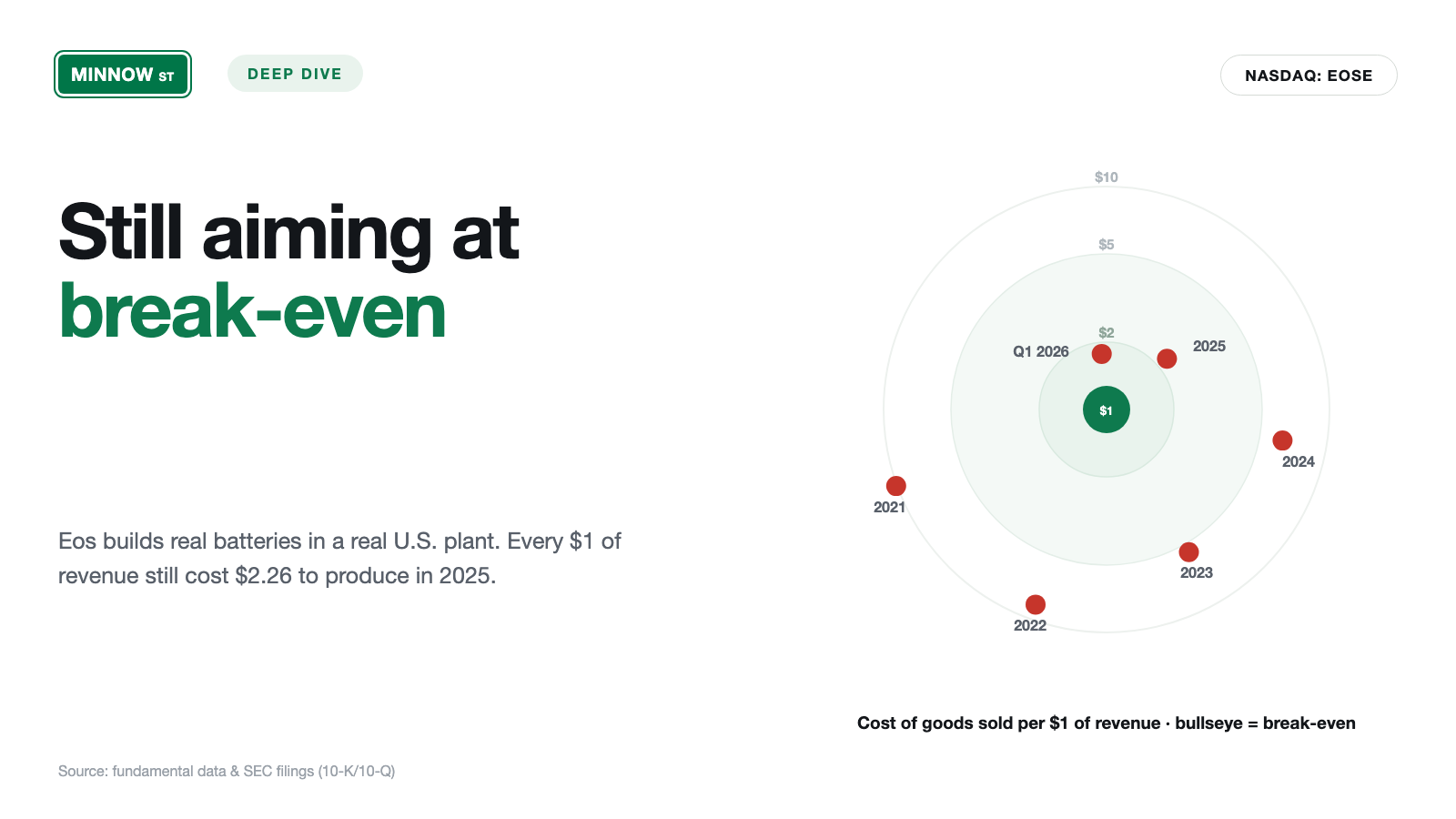
Now the sentence that the ribbon-cutting photos leave out. In 2025, cost of goods sold was $258.0 million — against $114.2 million of revenue. That is a gross loss of $143.8 million, before a single dollar of research or administration. Put it in the everyday image that matters: for every $1 of revenue, Eos spent $2.26 just to build and ship the product. Not to develop it, not to sell it, not to keep the lights on in head office — purely to make the thing. Remember that number, because it is the one the whole investment case turns on: a company that loses money on the product itself cannot fix it by selling more. Growth makes it worse, not better, until the line is crossed.
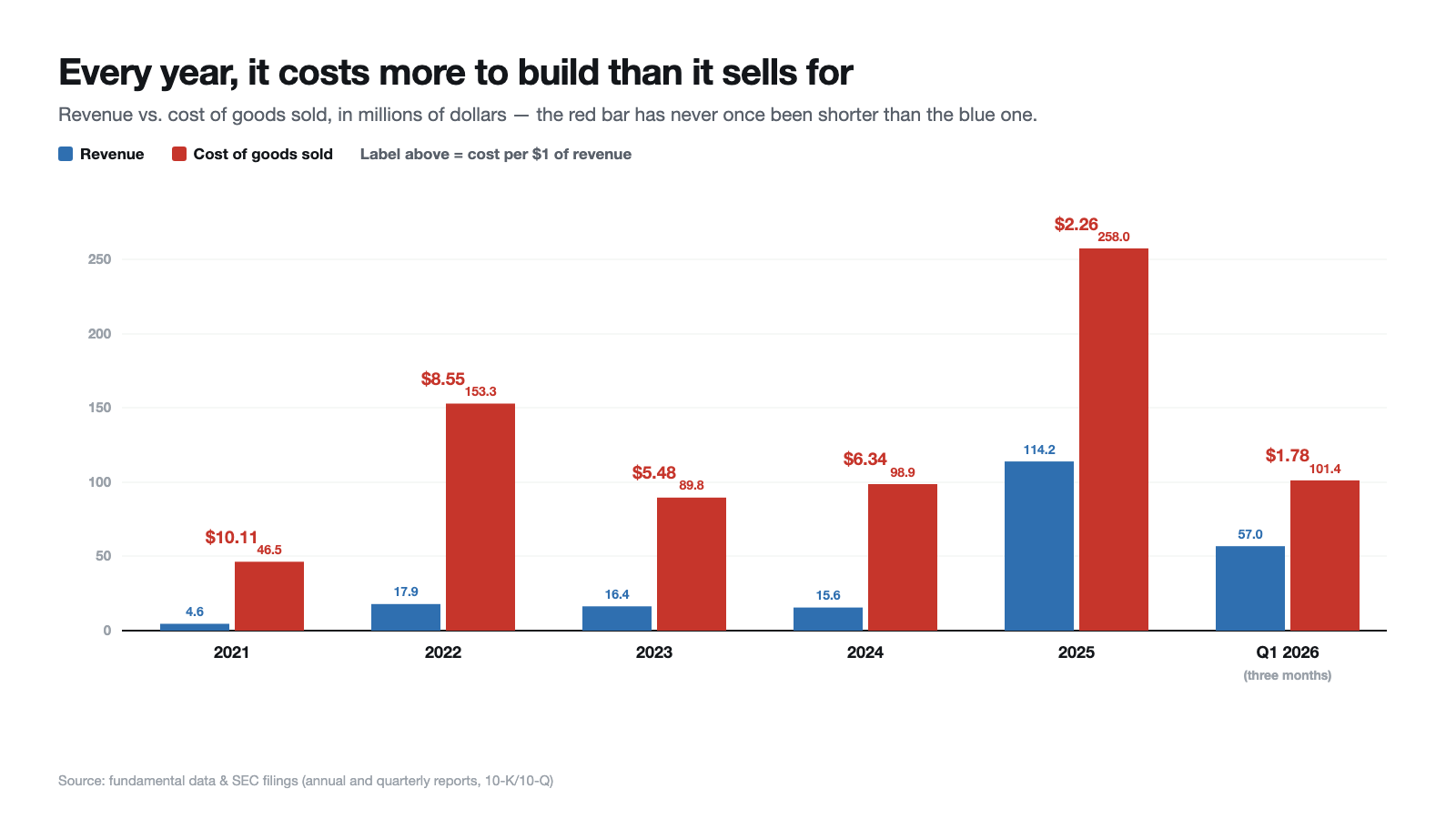
And here is where fairness demands a second look at the same chart, because the trend inside it is the strongest argument the bulls have. The cost of producing $1 of revenue has gone: $10.11 (2021), $8.55 (2022), $5.48 (2023), $6.34 (2024) — and then $2.26 (2025) and $1.78 in the first quarter of 2026. For the second quarter of 2026, Eos guided preliminarily to a gross margin loss between minus 69 percent and minus 73 percent, which works out to $1.69 to $1.73 of cost per $1 of revenue. That is not noise; that is a manufacturing learning curve doing what manufacturing learning curves do. The 10-K backs it with operational detail: the company reports beating its January raw-materials cost-out target by 6 percent and running manufacturing cycle times "below 10 seconds". Eos has closed roughly four-fifths of the distance to break-even in four years. The remaining fifth is the entire question, and it is the hardest fifth — because the easy savings always come first.

What the filings say — the uncomfortable truths
Uncomfortable truth no. 1: the company itself will not promise the line gets crossed
The risk factors are unusually direct about the thing that matters. Eos names cost reduction and revenue growth as the joint condition for ever making money — and then declines to promise the outcome:
"If we are not able to sustain revenue growth, reduce cost and continue to raise the capital necessary to support operations, our failure to achieve or maintain profitability could negatively impact the value of our common stock. Even if we do achieve profitability when expected, we may be unable to sustain or increase our profitability in the future."
— Eos Energy Enterprises, Inc., SEC annual report 10-K for 2025, Item 1A "Risk Factors". The summary of risks opens on the same note: "Our history of losses puts the onus on us to deliver on our potential for significant business growth and to improve our manufacturing processes to achieve sustained, long-term profitability and commercial success." Read it as the company's own framing of the bet: everything depends on the cost curve continuing, and the company will not tell you that it will.
Uncomfortable truth no. 2: the reported bottom line is a mirror of the share price — and it runs backwards
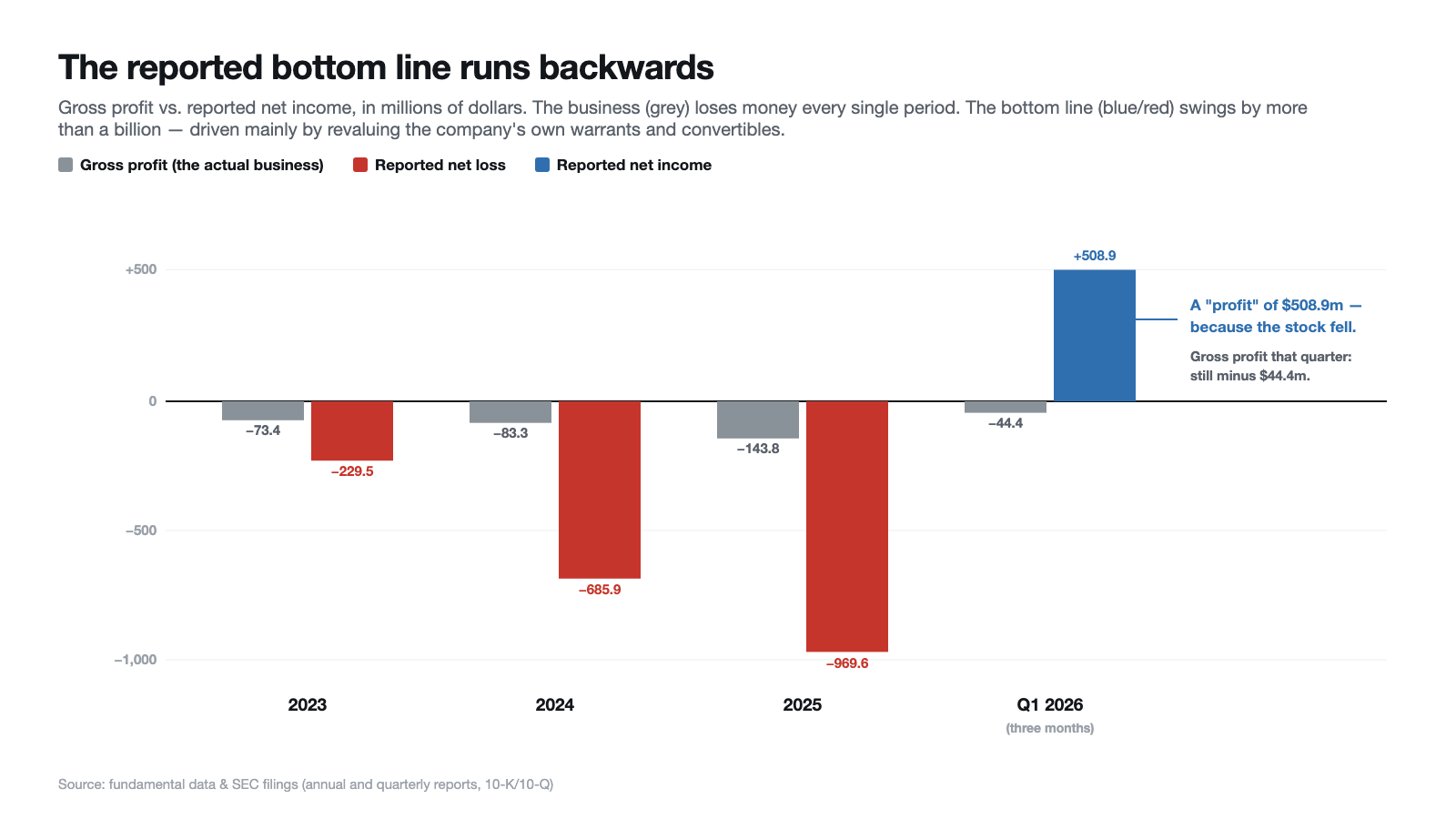
Eos reported a net loss of $969.6 million for 2025 on $114.2 million of revenue. If you assume that is the business burning money, you have misread it. The operating loss — the actual business — was $259.3 million. More than two-thirds of the reported loss came from revaluing the company's own financial instruments as the share price climbed: minus $279.9 million on warrants, minus $383.3 million on related-party derivatives. The 10-K explains the warrant line in one flat sentence:
"The change is largely driven by the Company's common stock price increase year over year."
— Eos Energy Enterprises, Inc., SEC annual report 10-K for 2025, Item 7 MD&A, "Change in fair value of warrants". The mechanism is worth understanding, because it inverts the scoreboard: warrants and conversion rights are carried as liabilities and marked to fair value every period, with the difference running through the income statement. When the shares rise, those obligations become more valuable — and the company books a loss. When the shares fall, it books a gain. Which is exactly what happened next: in the first quarter of 2026, Eos reported net income of $508.9 million — the single largest "profit" in its history — built from $168.7 million on warrants, $165.9 million on derivatives and $267.2 million on related-party derivatives, all because the price went down. Gross profit that same quarter: minus $44.4 million. Remember the mechanism: when this company's headline says "profit", check the chart first. (The same accounting seesaw drives the reported quarterly results at The RealReal — it is a common feature of companies that financed themselves with warrants rather than earnings.)
Uncomfortable truth no. 3: the order book is thinner than a single quarter of revenue
Battery companies love the word "backlog", and the number that usually travels with it is large. Eos reported a backlog of approximately $807 million as of June 30, 2026 — a company record and roughly 25 percent above the prior quarter. That figure comes from a press release, not from an audited statement. The audited version of the same idea in the annual report is called remaining performance obligations — the revenue Eos has contractually secured but not yet delivered. It is the one order-book figure that has to survive an auditor:
"As of December 31, 2025, the Company's remaining performance obligations were approximately $45,781."
— Eos Energy Enterprises, Inc., SEC annual report 10-K for 2025, Note 4 "Revenue Recognition", figure in thousands of dollars. That is $45.8 million — against quarterly revenue of $57.0 million in the very next quarter. The contracted order book, in other words, was worth less than three months of shipping, and 83 percent of it was expected to convert within twelve months. As of March 31, 2026 the equivalent disclosure reads approximately $31.0 million, this time explicitly excluding contracts satisfied in under a year — the two figures are not directly comparable, but neither is large. The gap between $807 million and $45.8 million is not dishonesty: the reported backlog includes framework agreements and projects that do not yet meet the strict criteria for a balance-sheet disclosure. But it is precisely the difference between an intention and a contract an auditor has signed off on.

The second half of this truth is who the customers are. In 2025, two customers accounted for 51.5 percent and 18.8 percent of total revenue — a bit over 70 percent between them, with a single buyer taking more than half. In the first quarter of 2026, three customers made up 93.3 percent. Picture the baker whose shop is finally busy — but nine of every ten rolls go to three people who could each stop coming tomorrow. That concentration is normal for early-stage grid projects, where individual orders are enormous and lumpy. It also means the revenue curve that looks like a hockey stick is, at this moment, resting on a very small number of shoulders.
Uncomfortable truth no. 4: Cerberus's preferred stock ranks ahead of you — and it cost common shareholders $770.7 million in one year
This is the finding that reframes everything above, and it lives below the line where most readers stop. Eos financed its survival largely through Cerberus — via a credit agreement and a securities purchase agreement that produced a delayed-draw term loan of $210.5 million, a warrant, and Series B Preferred Stock. The scale of the resulting claim is disclosed in the risk factors:
"As of February 24, 2026, there were 339,434,259 shares of common stock issued and outstanding and an aggregate of 218,541,252 shares of common stock issuable upon the conversion or exercise of outstanding convertible securities (as calculated under the Credit Agreement and the SPA), including 159,587,654 shares of common stock underlying the Warrant (as defined below) and Preferred Stock (as defined below) issued to Cerberus under the Credit Agreement and the SPA (the "Cerberus Securities")."
— Eos Energy Enterprises, Inc., SEC annual report 10-K for 2025, Item 1A "Risk Factors", "Risks Related to Our Securities". Do the arithmetic: 339.4 million shares outstanding plus 218.5 million issuable is roughly 558.0 million fully diluted — of which the Cerberus instruments alone represent 159.6 million, about 29 percent. Nearly three of every ten shares in the fully diluted company are a claim held by one lender.

But the dilution is only half of it. The Series B Preferred is remeasured to its redemption value at every balance sheet date: if the redemption value exceeds the carrying value, the carrying value is written up — and the difference is charged against common shareholders, below the net loss line. In 2025 that charge was $770.7 million (2024: $278.3 million). It turns the headline net loss of $969.6 million into a net loss attributable to common shareholders of $1,744.8 million — $6.69 per share, on revenue of $114.2 million. Fifteen dollars of loss to common for every dollar of revenue.

Now hold two balance-sheet figures side by side, both from the quarterly report as of March 31, 2026. As of December 31, 2025, the Series B Preferred Stock was carried at $1,361.5 million. Total assets of the entire company on that date: $885.2 million. The preferred claim ranking ahead of every common share was worth more than everything the company owned, and total shareholders' deficit stood at minus $2,238.9 million. By March 31, 2026 — after the share price fell — the preferred had been remeasured down to $582.7 million and the deficit to minus $868.4 million. That is the answer to the question of who economically owns this business today: the common shareholder owns the residual, and in a good year for the stock, the residual shrinks. The better the news, the more of the company belongs to Cerberus before you see a cent.
Uncomfortable truth no. 5: in July 2026 the company's own shareholders left three-quarters of the offering on the table
This is the newest finding, and it is only weeks old. The venture was first announced on May 12, 2026, in a binding term sheet with Cerberus alone (Form 8-K of May 13, 2026). On June 30, 2026, Eos signed an amended and restated version that brings in Hudson Bay as a third partner, forming Frontier Power USA Parent, LLC — a joint venture with a Cerberus affiliate and a Hudson Bay affiliate that is meant to develop the power capacity Eos has so far only supplied. Its own contribution was to be funded in part through a rights offering targeting $150 million. On July 2, 2026, Eos distributed rights to acquire 27,367,171 units at $5.481 each, every unit consisting of one share and 0.4388 of a warrant exercisable at $5.481. The subscription price sat about 0.3 percent below the last reported sale price of $5.55 on July 1, 2026, as documented in the prospectus supplement.
The subscription period closed on July 21, 2026. Two days later the result was filed: holders subscribed for 6,885,218 units — roughly a quarter of the offering — for expected gross proceeds of about $37.7 million instead of the $150 million targeted. Rights not exercised have expired, and the "Right" security class (ticker EOSER) was struck from Nasdaq by Form 25-NSE on July 20, 2026; the common stock EOSE is untouched and still trades. The rest of the money comes from the financial investors: on July 1, 2026 Eos issued 13,683,634 shares plus 6,004,378 warrants to a Hudson Bay fund — roughly $75.0 million — while Cerberus commits $100 million and Hudson Bay another $50 million directly into the new venture. Together roughly $263 million, which Eos presents as beating its own target. Except that it was raised mostly from people who were not already there.
Uncomfortable truth no. 6: the partner gets part of its stake for free
How the new venture is split is spelled out in the June 30, 2026 filing, and it is remarkable. The Cerberus vehicle CCM Frontier is to receive 50,000,001 Class A-1 Units, expressly as founder's equity for intangibles:
"CCM Frontier (or its applicable designated affiliate) is expected to (a) receive 50,000,001 Class A-1 Units of the JV Company … as founder's equity in consideration for the contracts, contacts, investment opportunities, subject matter expertise and other going concern value with respect to the frontier power platform developed by affiliates of CCM Frontier …"
— Eos Energy Enterprises, Inc., SEC Form 8-K of June 30, 2026, Item 1.01, "Equity Ownership".

Counted in $1.00 units, the split looks like this: Cerberus 50,000,001 units with no cash plus 100,000,000 units for $100 million; Hudson Bay 50,000,000 units for $50 million; Eos the net proceeds from the registered direct offering and the rights offering, so roughly $110 million of Class B Units. Whoever contributes the most fresh cash — cash it first collected from its own shareholders — ends up holding the smallest of the three positions. On top of that come warrants on 20,017,772 Eos shares for Cerberus and on 10,008,886 for Hudson Bay, both at $5.481, plus an exchange right on the Hudson Bay units. In fairness: the closing is still outstanding, definitive agreements are not yet signed, and the whole thing depends among other things on the consent of the U.S. Department of Energy. And the platform Cerberus contributes is not nothing — contacts and project pipelines in the power market carry real value. It is simply value that appears on no balance sheet, while what Eos contributed sat in the bank.
To be fair: the doubt that defined this stock for years is gone
Here is where the expected story breaks, and honesty requires saying so clearly. For years, the phrase attached to Eos Energy was going concern — the formal accounting warning that a company may not survive twelve months. Investors have been trained to expect it in this filing. It is not there. After raising roughly $1 billion during 2025, management reached the opposite conclusion:
"In light of the significant amount of capital raised in 2025 and our anticipated ability to meet the covenants associated with the debt instruments held by the Company, management has concluded that there is no longer substantial doubt about our ability to continue as a going concern within one year after the date that the Consolidated Financial Statements are issued."
— Eos Energy Enterprises, Inc., SEC annual report 10-K for 2025, Item 7 MD&A "Going Concern" and Note 2 "Summary of Significant Accounting Policies".

The cash backs it. Eos held $410.7 million of cash plus $39.8 million of short-term restricted cash on March 31, 2026, against a minimum liquidity covenant of just $15.0 million. The DOE facility offers up to $303.5 million, of which $90.9 million had been drawn through year-end 2025. The catch is dated rather than hypothetical: the minimum consolidated EBITDA and minimum consolidated revenue covenants take effect with the quarter ending March 31, 2027 — until then the covenant grid is loose.
And the burn is real. To keep the series on one single basis we count cash plus all restricted cash throughout — the very measure Eos itself reports as total cash: $624.6 million on December 31, 2025 ($568.0 plus $34.6 short-term plus $21.9 long-term restricted), $472.4 million on March 31, 2026 ($410.7 plus $39.8 plus $21.9 — the figure the quarterly report states itself) — and, per the preliminary release, roughly $364 million on June 30, 2026. That is more than $260 million in six months, even though customer collections of roughly $78 million in the second quarter exceeded that quarter's revenue. The doubt has been bought off with equity, not earned away with profit. But it has been bought off, and pretending otherwise would be the same lazy reflex as the ribbon-cutting trap, only pointed the other way.
Valuation — priced for the line to be crossed
Because this is an evergreen analysis we work with dated anchors rather than a daily price. The last price documented inside an SEC filing is $5.55 on July 1, 2026 (rights-offering prospectus supplement of July 2, 2026). Against roughly 353.2 million shares — 339,514,027 on the cover of the quarterly report as of May 11, 2026, plus the 13,683,634 shares of the July 1 registered direct offering — that is a market value of just over $1.9 billion. (The same prospectus supplement implies 354.3 million shares outstanding before the rights offering, and 381,642,806 had all the offered units been taken up.) By the data cut-off of July 27/28, 2026, our fundamental data showed only about $1.3 billion; the stock fell sharply over those four weeks. Both figures are dated and both are defensible — but the gap between them is a price move, not measurement uncertainty, so read the lower figure as today and the higher one as July 1.
A price-to-earnings ratio does not exist — there is no profit to divide by, and the one quarterly "profit" on record was an artifact of a falling share price. So we are left with revenue: on fiscal 2025 revenue of $114.2 million the price-to-sales ratio runs from about 11 to 17 across those two dates; on trailing twelve-month revenue of $160.7 million from about 8 to 12. For context, those are multiples normally reserved for software companies with high gross margins. Eos has negative gross margins. You are not paying for the revenue that exists; you are paying for the cost curve to keep bending. In fairness: the first half of 2026 already exceeded all of 2025 in revenue — the denominator is growing fast.
Count like a buyer of the whole company and the picture gets heavier. To that market value add real debt: $943.6 million of principal outstanding, carried at $619.5 million (including $600.0 million of convertible notes due December 2031 at a 14.2 percent effective rate, $50.0 million of convertible notes due June 2030, and the DOE facility; March 31, 2026), subtract $410.7 million of cash — and, crucially, remember the $582.7 million of Series B Preferred that ranks ahead of the common. Note also what is not real debt: of the $1,085.1 million of total liabilities on that balance sheet, some $316.3 million is warrant liability — an obligation payable in shares, not cash. That distinction cuts both ways: it will not drain the treasury, and it will dilute you.
The professionals' view is split in a telling way. Nine analysts cover the stock; the consensus sits between hold and buy (4 strong buy, 5 hold, no sells) with an average target around $9.11 — well above the mid-July level (data as of July 15, 2026). Our own fundamental rating puts EOSE at B (61 out of 100) (data as of July 8, 2026), and institutions hold about 63 percent of the stock, led by BlackRock (7.1 percent) and Vanguard (5.5 percent). Insiders, meanwhile, recorded 4 purchases against 16 sales over twelve months. Put plainly: the price already assumes the cost curve gets to the other side of $1.00. If it does, today's multiple on today's revenue will look irrelevant, because the revenue will not be today's. If it stalls at $1.30, the multiple is not the problem — the model is.
Opportunities and risks at a glance
What speaks for Eos Energy
- The ramp is proven, not promised: revenue from $15.6 million (2024) to $114.2 million (2025), $57.0 million in the first quarter of 2026 and a preliminary $68 million to $69 million in the second — after three years in which revenue had gone sideways and then down.
- The cost curve is bending hard: cost per $1 of revenue fell from $10.11 (2021) to $2.26 (2025), $1.78 in the first quarter of 2026 and a preliminary $1.69 to $1.73 in the second, backed by operational detail (raw-materials cost-out target beaten by 6 percent, cycle times below 10 seconds).
- The going-concern doubt is formally lifted (10-K for 2025), with total cash including restricted cash of roughly $364 million on June 30, 2026 (preliminary) against a $15.0 million minimum liquidity covenant, and the first EBITDA/revenue covenants only biting from the quarter ending March 31, 2027.
- A genuine technological niche with policy tailwind: the only U.S.-designed and -manufactured module offered as an alternative to lithium-ion and lead-acid for 3- to 12-hour storage, non-flammable, no lithium or cobalt, domestic raw materials — plus up to $303.5 million from the first Title XVII battery loan ever closed.
- Demand drivers are structural rather than cyclical: renewables build-out, grid constraints, and electricity demand from artificial intelligence, high-performance computing and data centers. Self-reported backlog rose to roughly $807 million (June 30, 2026).
- Fresh capital is secured: roughly $263 million of gross proceeds for the new Frontier Power USA venture, with Cerberus and Hudson Bay as paying partners.
What speaks against it
- Nothing is earned per unit: $258.0 million of cost of goods sold against $114.2 million of revenue in 2025 — a gross loss of $143.8 million, and $44.4 million more in the first quarter of 2026. Until $1.00 is crossed, growth deepens the hole.
- Cerberus's Series B Preferred ranks ahead of every common share, was carried at $1,361.5 million against $885.2 million of total assets (December 31, 2025), and cost common shareholders $770.7 million of remeasurement in 2025 alone — a loss to common of $1,744.8 million, or $6.69 per share.
- Dilution is structural, not incidental: 218.5 million shares issuable against 339.4 million outstanding (February 24, 2026), of which 159.6 million sit with Cerberus; weighted-average shares grew from 212.0 million (2024) to 260.8 million (2025); and shareholders raised authorized common stock from 600 million to 800 million shares on June 3, 2026. Since May 13, 2026 an automatic shelf registration statement (S-3ASR, File No. 333-295819) has also been on file — both the July 1 registered direct offering and the July 2 rights offering were made under it.
- The audited order book is small and the customers are few: remaining performance obligations of $45.8 million (December 31, 2025); two customers were 51.5 percent and 18.8 percent of 2025 revenue, and three customers were 93.3 percent of first-quarter 2026 revenue.
- The burn continues: operating cash flow of minus $211.2 million in 2025 with $54.7 million of capital expenditure; cash plus all restricted cash fell from $624.6 million (December 31, 2025) via $472.4 million (March 31, 2026) to, preliminarily, roughly $364 million (June 30, 2026) — and the DOE tranches are use-it-or-lose-it, with unused amounts unable to move between tranches.
- The company's own shareholders did not follow in July 2026: of 27,367,171 rights units offered, 6,885,218 were subscribed, raising roughly $37.7 million instead of $150 million. And shareholders' deficit stays deeply negative at minus $868.4 million against $799.3 million of total assets (March 31, 2026).
- The scanner's structural readings stay red: equity ratio minus 35.8 percent, Altman Z minus 3.95, EBIT margin minus 139.1 percent, stage 4 (data as of July 8, 2026).
A human conclusion
Back to the ribbon-cutting trap. The remarkable thing about Eos Energy is that the photographs do not lie. The factory is real. The zinc chemistry is real. The DOE loan is real, and it is the first of its kind. And the ramp everyone had stopped believing in arrived in 2025, seven times over. If you have been waiting five years for this company to prove it can actually build and ship batteries at scale, the 2025 annual report is the document where it did. That deserves to be said without hedging, and most of the bear commentary on this stock does not say it.
What the photographs cannot show you is the arithmetic behind the loading dock. Every battery that left Turtle Creek in 2025 cost $2.26 to make for every $1 it brought in. The order book that had to survive the auditor came to $45.8 million. And the reported bottom line — a $969.6 million loss one year, a $508.9 million profit the next quarter — tracked the share price rather than the business, in the wrong direction both times. Most of all, the capital that bought the company its survival did not come free: below the net loss line sits $770.7 million that belongs to Cerberus's preferred stock, ranking ahead of everything you own, and growing precisely when the news is good.
July 2026 added a new layer to this story, and it is an uncomfortable one. When Eos went to its own shareholders for the money for the next step, $37.7 million of a $150 million target came back. The rest was put up by the two financial investors who already sat at the longer end of the lever — and one of them receives 50,000,001 units of the new venture for contracts, contacts and expertise while Eos pays for its own in cash.
So the honest finding is not "a fraud" and not "a rocket". It is this: Eos has solved the engineering problem and has not yet solved the economic one — and it bought the time to keep trying by selling the upside to someone who stands in front of you in the queue. Whoever buys today is betting on one number and one number only: that the $1.69 to $1.73 keeps falling until it passes $1.00, and that it gets there before the covenants tighten in March 2027 and before the next round of financing is needed. That is a real bet with a real basis — the curve has been bending for four straight years. It is also a bet where being right about the factory is not sufficient to be right about the stock. What you make of that is your decision. And that is exactly as it should be.
Sources
All original documents used in this analysis — to read for yourself:
- Eos Energy Enterprises, Inc. — SEC annual report 10-K for 2025 (filed February 26, 2026)
- Eos Energy Enterprises, Inc. — SEC quarterly report 10-Q as of March 31, 2026 (filed May 13, 2026)
- Eos Energy Enterprises, Inc. — SEC Form 8-K of May 13, 2026, Item 1.01 (first Frontier Power USA term sheet, with Cerberus alone)
- Eos Energy Enterprises, Inc. — SEC automatic shelf registration statement S-3ASR of May 13, 2026 (File No. 333-295819) — the basis for both July offerings
- Eos Energy Enterprises, Inc. — SEC Form 8-K of June 30, 2026, Item 1.01 (Frontier Power USA term sheet)
- Eos Energy Enterprises, Inc. — SEC Form 8-K of July 1, 2026 (registered direct offering of 13,683,634 shares)
- Eos Energy Enterprises, Inc. — SEC prospectus supplement 424B2 of July 2, 2026 (rights offering)
- Eos Energy Enterprises, Inc. — SEC Form 8-K of July 15, 2026, Items 2.02 and 8.01 (preliminary second-quarter 2026 results)
- Eos Energy Enterprises, Inc. — SEC Form 8-K of July 23, 2026, Item 8.01 (expiration and results of the rights offering)
- Eos Energy Enterprises, Inc. — SEC proxy statement DEF 14A of April 14, 2026 (increase of authorized common stock from 600 to 800 million shares)
- Eos Energy Enterprises, Inc. — Filing index of the annual report 10-K for 2025 (accession 0001628280-26-011961)
- Eos Energy Enterprises, Inc.'s complete SEC filing history: EDGAR overview (sec.gov)
- Fundamental data (metrics, quarterly series, valuation; data as of July 8 and July 15, 2026), reconciled with the SEC filings.
- Screener and rating data: in-house stock scanner (data as of July 8, 2026); Reddit mentions: ApeWisdom (as of July 16, 2026).
Transparency & disclaimer: This analysis is a journalistic contextualization of publicly available information and is not investment advice, not a financial analysis in the regulatory sense, and not a solicitation to buy or sell securities. Stock investments carry substantial risks up to total loss. All information without guarantee; the data cut-off is noted in the text in each case. Positions held by the operator are disclosed daily; where one exists, it appears as a notice at the top of this deep dive.
Key figures at a glance
All monetary figures in millions of $; earnings per share as reported.
| Metric | 2021 | 2022 | 2023 | 2024 | 2025 |
|---|---|---|---|---|---|
| Revenue | 4.6 | 17.9 | 16.4 | 15.6 | 114.2 |
| Operating Income (EBIT) | -134.7 | -221.3 | -152.9 | -175.2 | -257.5 |
| Net Income | -124.2 | -229.8 | -229.5 | -685.9 | -969.6 |
| Net Margin | -2,701.5% | -1,282.2% | -1,401.3% | -4,394.9% | -849.1% |
| Earnings Per Share | -2.36 $ | -3.68 $ | -1.81 $ | -3.23 $ | -3.72 $ |
Source: fundamental data & SEC filings (annual and quarterly reports, 10-K/10-Q)
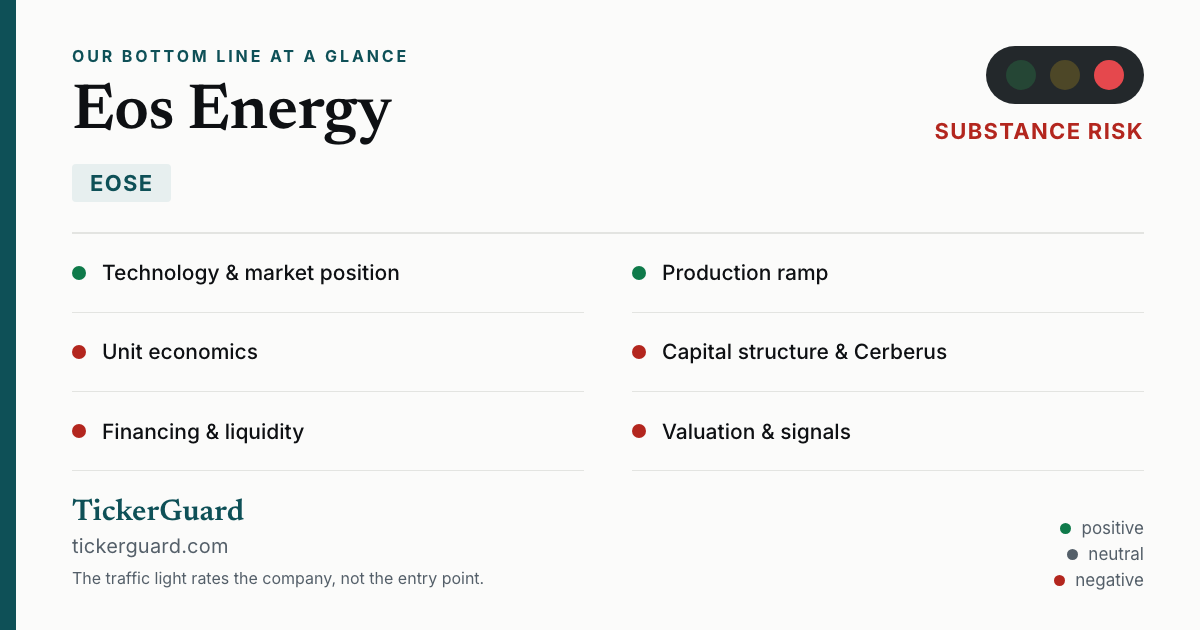
Our Bottom Line at a Glance
- Technology & market position positive
- A genuine niche with policy tailwind: zinc-based Znyth systems with a water-based electrolyte — non-flammable, no lithium, cobalt or rare earths, primarily domestic raw materials — built for 3- to 12-hour storage. The annual report (10-K for 2025) describes the Z3 as the only U.S.-designed and manufactured module offering utilities an alternative to lithium-ion and lead-acid for that duration; the DOE facility is the first Title XVII battery loan ever closed.
- Production ramp positive
- The thing Eos had failed to prove for five years, it proved in 2025: revenue from $15.6 million (2024) to $114.2 million (+632 percent), $57.0 million in the first quarter of 2026 against $10.5 million a year earlier, and a preliminary $68 million to $69 million in the second quarter (8-K of July 15, 2026) — after revenue had gone sideways and then down from 2022 to 2024. Cost per $1 of revenue fell from $10.11 (2021) to $2.26 (2025), $1.78 in Q1 2026 and a preliminary $1.69 to $1.73 in Q2 2026.
- Unit economics negative
- Nothing is earned per battery. Cost of goods sold of $258.0 million against $114.2 million of revenue in 2025 (gross loss $143.8 million), and a further $44.4 million gross loss in the first quarter of 2026. Until the cost of $1 of revenue passes below $1.00, every additional order deepens the loss; the company itself declines to promise the crossing: "we may be unable to sustain or increase our profitability in the future" (10-K for 2025, Item 1A).
- Capital structure & Cerberus negative
- The Series B Preferred issued to Cerberus ranks ahead of every common share and is remeasured to its redemption value: $770.7 million charged against common shareholders in 2025 alone (2024: $278.3 million), turning the $969.6 million net loss into $1,744.8 million attributable to common (−$6.69 per share). The preferred was carried at $1,361.5 million on December 31, 2025 — against total assets of $885.2 million. 159,587,654 shares underlie the Cerberus securities, about 29 percent fully diluted.
- Financing & liquidity negative
- The going-concern doubt is formally lifted in the 10-K for 2025 after roughly $1 billion raised — a real change, and preliminary total cash of roughly $364 million (June 30, 2026) sits far above the $15.0 million minimum liquidity covenant. But shareholders' deficit stays at −$868.4 million against $799.3 million of total assets (March 31, 2026), the burn continues (operating cash flow −$211.2 million in 2025; cash plus all restricted cash down from $624.6 million to roughly $364 million in six months), the minimum EBITDA and revenue covenants first bite with the quarter ending March 31, 2027, and the July 2026 rights offering brought in $37.7 million instead of $150 million (8-K of July 23, 2026).
- Valuation & signals negative
- Between roughly $1.3 billion (fundamental data, July 27/28, 2026) and just over $1.9 billion (the documented $5.55 price of July 1, 2026 times about 353.2 million shares) sits a price-to-sales ratio of about 11 to 17 on 2025 revenue — a software-like multiple on a business with negative gross margins, with $582.7 million of preferred ranking ahead of the common. Analysts lean constructive (4 strong buy, 5 hold, target ~$9.11), but the scanner's structural readings stay red: equity ratio −35.8 percent, Altman Z-double-prime −3.95 (thresholds 1.1 / 2.6), stage 4, and 4 insider purchases against 16 sales (data as of July 8 and July 15, 2026).
Eos Energy is the rare case where the pictures do not lie and the arithmetic still does not work. The factory in Turtle Creek is real, the zinc chemistry is real, the DOE loan is the first of its kind — and in 2025 the production ramp finally arrived, revenue rising more than sevenfold to $114.2 million with the cost of $1 of revenue falling from $10.11 (2021) to $2.26. The going-concern doubt that defined this stock for years is formally gone. What has not been solved is the economics: cost of goods sold of $258.0 million against that revenue, an audited order book of $45.8 million, a shareholders' deficit of −$868.4 million (March 31, 2026), and a Series B Preferred held by Cerberus that ranks ahead of every common share, was carried at $1,361.5 million against $885.2 million of total assets, and cost common shareholders $770.7 million of remeasurement in one year. In July 2026 the company's own shareholders subscribed for only a quarter of the rights offered. Not investment advice.
What Our Rating Means
Substance risk
We found at least one documented issue that threatens the company itself — regardless of how the stock is currently valued.
The light is red on substance, not on price: shareholders' deficit of −$868.4 million against $799.3 million of total assets (March 31, 2026), operating cash flow of −$211.2 million in 2025, cash plus all restricted cash down from $624.6 million to roughly $364 million in six months, and financing that hangs on a single counterparty whose preferred stock ranks ahead of every common share. Whoever holds today is betting on one number: that the $1.69 to $1.73 of cost per $1 of revenue keeps falling until it passes $1.00 — and that it gets there before the EBITDA and revenue covenants bite with the quarter ending March 31, 2027 and before the next financing round is needed. The curve has bent for four straight years, so that bet has a real basis. Whoever buys new pays roughly 11 to 17 times 2025 revenue for a business with negative gross margins, and buys behind a preferred stock that grows its claim precisely when the news is good — being right about the factory is not sufficient to be right about the stock. The decision is yours.
A journalistic assessment by our editorial team at the time of the deep dive, based on public sources — not investment advice and not a solicitation to buy or sell. Your personal circumstances (investment goals, risk capacity, taxes) cannot be taken into account. What our levels mean, how verdicts are formed, and what conflicts of interest exist →
Worth Noting
- EOSE reached our research list via the Reddit hype scanner (ApeWisdom, 2 mentions in 24 hours, as of July 16, 2026) — the forums are barely watching this one. Scanner metrics carry the July 8, 2026 data cut-off and rotate daily.
- A note on one figure you may see quoted differently elsewhere: some data providers report Eos's equity as about −$877 million for December 31, 2025. That nets the Series B Preferred into equity. The filing itself separates them: total shareholders' deficit of −$2,238.9 million, with $1,361.5 million of Series B Preferred shown above it as mezzanine (10-Q as of 03/31/2026, balance sheet). We follow the filing.
- The reported bottom line is not a performance measure at this company: warrants and conversion rights are carried as liabilities and remeasured each period, so a rising share price produces losses and a falling one produces profits. Read gross profit and operating loss instead — and note that both critical audit matters in the 2025 audit concern exactly these instruments, not the manufacturing.
- On valuation: the market value from fundamental data (roughly $1.3 billion, July 27/28, 2026) differs by more than a fifth from "documented filing price times documented share count" ($5.55 on July 1, 2026 times about 353.2 million shares = just over $1.9 billion). The reason is the share-price decline over those four weeks, not a data defect: the same data set carries a share price of $3.61 and a one-month performance of −40.7 percent. We therefore name both anchors with their dates and give the multiples as a range across those two dates instead of presenting either as the single right number. Analyses are evergreen, daily prices are not a buy argument.
- Eos has announced full second-quarter 2026 results for August 5, 2026; the Q2 figures used here are the preliminary ones from the Form 8-K of July 15, 2026.
Download the verdict card (traffic light and rating of this analysis as an image, PNG)
Stock Watch
This analysis is as of August 26, 2026. Stock Watch will tell you what's changed at EOSE since then.
Later $1 a month per stock — signing up is free, and you'll be the first to know when it launches.
The full analysis as a PDF for later
We will send you this analysis as a PDF — to print, file away, and read at your own pace. And we will add you to the free Stock Watch list for Eos Energy Enterprises Inc (EOSE), so you hear about it when something material in this analysis changes.
Frequently Asked Questions
Eos Energy Enterprises (Nasdaq: EOSE) sells zinc-based battery energy storage systems for the power grid — utilities, independent power producers and industrial customers who need to store electricity for 3 to 12 hours. The systems are built around the Z3 module and manufactured in Turtle Creek, Pennsylvania. In 2025, revenue was $114.2 million, of which $112.0 million was product revenue and $2.2 million services; in the first quarter of 2026 revenue reached $57.0 million.
No — and it does not yet earn money on the product itself. In 2025, cost of goods sold of $258.0 million stood against revenue of $114.2 million, a gross loss of $143.8 million; the operating loss was $259.3 million. The reported net loss was $969.6 million, and after $770.7 million of preferred-stock remeasurement the loss attributable to common shareholders was $1,744.8 million, or $6.69 per share. The trend is improving: cost per $1 of revenue fell from $10.11 (2021) to $2.26 (2025) and $1.78 in the first quarter of 2026.
No, not in the annual report (10-K) for 2025 — this is where the long-running story changed. After raising roughly $1 billion in 2025, management concluded verbatim that "there is no longer substantial doubt about our ability to continue as a going concern within one year after the date that the Consolidated Financial Statements are issued". Total cash including restricted cash was a preliminary $364 million on June 30, 2026 against a minimum liquidity covenant of $15.0 million; the minimum EBITDA and revenue covenants only take effect with the quarter ending March 31, 2027.
Because its share price fell. Eos carries warrants and conversion rights as liabilities that are remeasured to fair value each period, with the difference running through the income statement. In the first quarter of 2026 that produced gains of $168.7 million on warrants, $165.9 million on derivatives and $267.2 million on related-party derivatives — a reported net income of $508.9 million. Gross profit in the same quarter was still minus $44.4 million. The mechanism runs both ways: in 2025, a rising share price caused $279.9 million of warrant losses.
Cerberus (through CCM Denali Debt Holdings and CCM Denali Equity Holdings) financed Eos via a credit agreement and a securities purchase agreement, including a $210.5 million delayed-draw term loan, a warrant and Series B Preferred Stock. As of February 24, 2026, 159,587,654 shares of common stock underlay those Cerberus securities — about 29 percent of the roughly 558 million fully diluted shares. The preferred is remeasured to its redemption value each period: that charge was $770.7 million in 2025, and the preferred was carried at $1,361.5 million on December 31, 2025.
The audited figure is smaller than most headlines suggest. Remaining performance obligations — contractually secured but undelivered revenue — were approximately $45.8 million as of December 31, 2025, with about 83 percent expected to convert within twelve months; that is less than the $57.0 million Eos shipped in the following quarter. As of March 31, 2026 the equivalent disclosure was approximately $31.0 million, excluding contracts satisfied in under a year. Customer concentration is high: two customers were 51.5 percent and 18.8 percent of 2025 revenue. The self-reported backlog was roughly $807 million as of June 30, 2026.
Weakly. On July 2, 2026, Eos distributed rights to acquire 27,367,171 units at $5.481 each, every unit consisting of one share and 0.4388 of a warrant. By the July 21, 2026 expiration, holders had subscribed for 6,885,218 units — about a quarter — for expected gross proceeds of roughly $37.7 million instead of the $150 million targeted. Unexercised rights expired, and the "Right" class (EOSER) was struck from Nasdaq on July 20, 2026; the common stock EOSE still trades.
Frontier Power USA Parent, LLC is a joint venture agreed on June 30, 2026 between Eos, a Cerberus affiliate and a Hudson Bay affiliate, intended to develop power capacity. Cerberus receives 50,000,001 units as founder's equity for contracts, contacts and expertise, plus 100,000,000 units for $100 million; Hudson Bay pays $50 million for 50,000,000 units. Eos contributes the net proceeds of its registered direct offering and rights offering. Closing is still pending and depends among other things on U.S. Department of Energy consent.
Found an error?
Did you spot a factual error, an outdated number, or a typo in this deep dive? Let us know briefly — your report goes straight to the editorial team.