eBay: Half the Shares, a Flat Buyer Base — and GameStop at the Table With 9.8 Percent
Most people remember eBay from the days of counting down the final seconds of an auction at midnight. The eBay of 2026 is a different company: a marketplace for trading cards and auto parts with a 20 percent operating margin that has bought back more than half of its own shares since 2017 — and that has been fending off an unsolicited takeover proposal from GameStop since May 2026. We read the annual reports through 2025, the quarterly report for the period ended June 30, 2026 and every mandatory filing through late September 2026. Time to hold that old snapshot up against the current numbers.
 Thomas Mücke
Founder & Publisher
Thomas Mücke
Founder & Publisher
As of Today
As of: September 28, 2026
- Closing price
- 107.30 $ -0.50%
- Market Capitalisation
- 45.9 $B
- P/E
- 25.2
- Growth Score
- 6/10
- AAQS
- 8/10
Price change since September 15, 2026: -0.7%
This analysis has a cut-off date. The Stock Guard tells you when something material changes in the numbers. Reserve your free spot
Chart
Interactive price chart (TradingView).
52-week range: 79.40 $ to 119.00 $ · Last price: 107.30 $ (As of: September 28, 2026)
Note: pure fact-based analysis, not investment advice and not a solicitation to buy or sell. All figures without guarantee.
There is a trap that experienced investors fall into more often than beginners: the time-capsule trap. We judge a company by the picture we formed of it at some point — and then seal that picture in a time capsule we never open again. The company changes; our picture does not. The catch: the more familiar the name, the more certain we are that we already know it.
Few names sit deeper in that capsule than eBay. For many people, eBay is the online flea market of the 2000s, where you counted down the last seconds of an auction at midnight. The eBay of 2026 is something else: a marketplace that handled $79.6 billion of merchandise in 2025, grows with trading cards and auto parts, keeps one in five revenue dollars as operating profit and has bought back more than half of its own shares since 2017. And since May 3, 2026, there is a shareholder who wants to buy the whole house: GameStop. eBay rejected the proposal on May 12, 2026, in blunt terms:
“We have concluded that your proposal is neither credible nor attractive.”
— eBay Inc., Form 8-K of May 12, 2026, Exhibit 99.2 (letter from the board chair to GameStop)
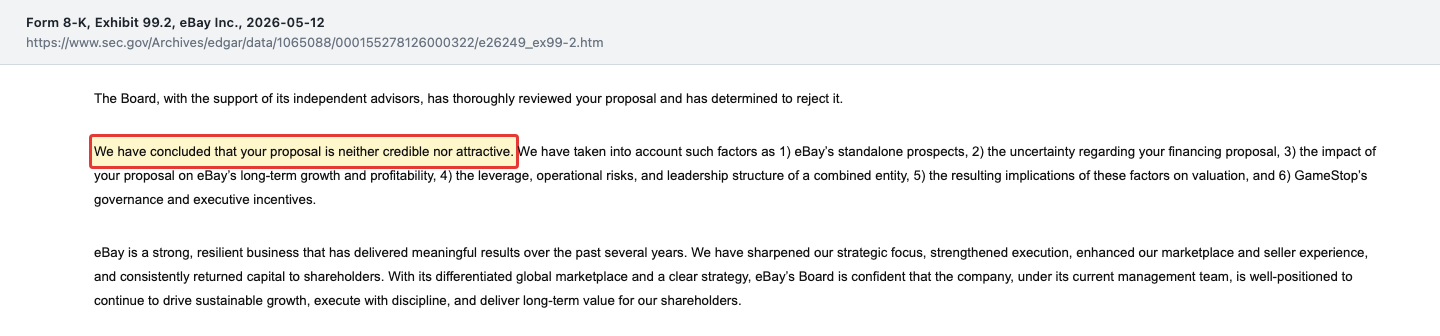
Let’s make a deal: we open the time capsule and read together what eBay itself has told the U.S. securities regulator, the SEC — the annual reports (10-K) through 2025, the quarterly reports (10-Q) through June 30, 2026 and every mandatory filing through late September 2026. The central tension of this analysis: eBay is a highly profitable, soundly financed marketplace that returns billions to its shareholders year after year. But its buyer count has been stuck for years, the new growth depends on the U.S. and on collectors, its advertising engine is exposed to AI shopping assistants — and a 9.8 percent shareholder wants to take over the company. Which of these weighs more is your call.
What eBay actually does today — a collectors’ exchange, not a flea market
eBay is a marketplace without a warehouse: the company sells almost nothing itself; it brings buyers and sellers together and charges fees for doing so. Picture a farmers’ market whose operator earns a cut of every apple sold without ever buying an apple. The value traded on this market is called gross merchandise volume, or GMV, and came to $79.6 billion in 2025. Of that, $11.1 billion stayed with eBay as revenue — a so-called take rate of 13.94 percent. Put simply: of every $100 purchase, eBay keeps just under $14.
That revenue comes from two sources. Marketplace revenue (final value fees, shipping programs, payments) was $9.1 billion in 2025. On top of that sits a fast-growing second leg: advertising. Sellers pay eBay to rank higher in search results (“Promoted Listings”). Advertising revenue rose 22 percent in 2025 to $1.99 billion — 18 percent of total revenue.
Strategically, eBay has shifted toward what it calls focus categories: collectibles such as trading cards, motors parts and accessories, luxury goods, refurbished products, fashion and sneakers. Around them come authenticity checks, a partnership with the card grader PSA and the live-shopping format eBay Live, whose GMV grew roughly eightfold in the second quarter of 2026 according to the earnings release. On July 30, 2026, eBay also closed its acquisition of the fashion marketplace Depop from Etsy, paying $1.4 billion in cash. At the end of 2025, eBay had 135 million active buyers, 2.5 billion live listings and about 12,300 employees. Jamie Iannone has been CEO since April 2020; Paul S. Pressler chairs the board.
Company history for investors
-
2021
Classifieds to Adevinta, Korea sold
$2.5 billion in cash plus Adevinta shares and the sale of 80.01% of the Korean business fund years of large buybacks.
-
2024
Agreement with the U.S. Attorney
Over the 2019 stalking scandal, eBay pays a $3 million penalty and accepts an independent monitor for three years.
-
2025
GMV grows again
GMV rises 7% to $79.6 billion, driven by U.S. collectibles; the buyer count stays at 135 million.
-
2026
May: GameStop offers $125 per share
eBay rejects it on May 12: “neither credible nor attractive.” GameStop raises its stake to 9.8% by July.
-
2026
July/August: Depop acquired, outlook raised
Depop bought for $1.4 billion; Q2 revenue +15%, eBay raises its full-year outlook. Transaction losses rise 62% in the first half.
How the stock landed on our desk — through a takeover proposal
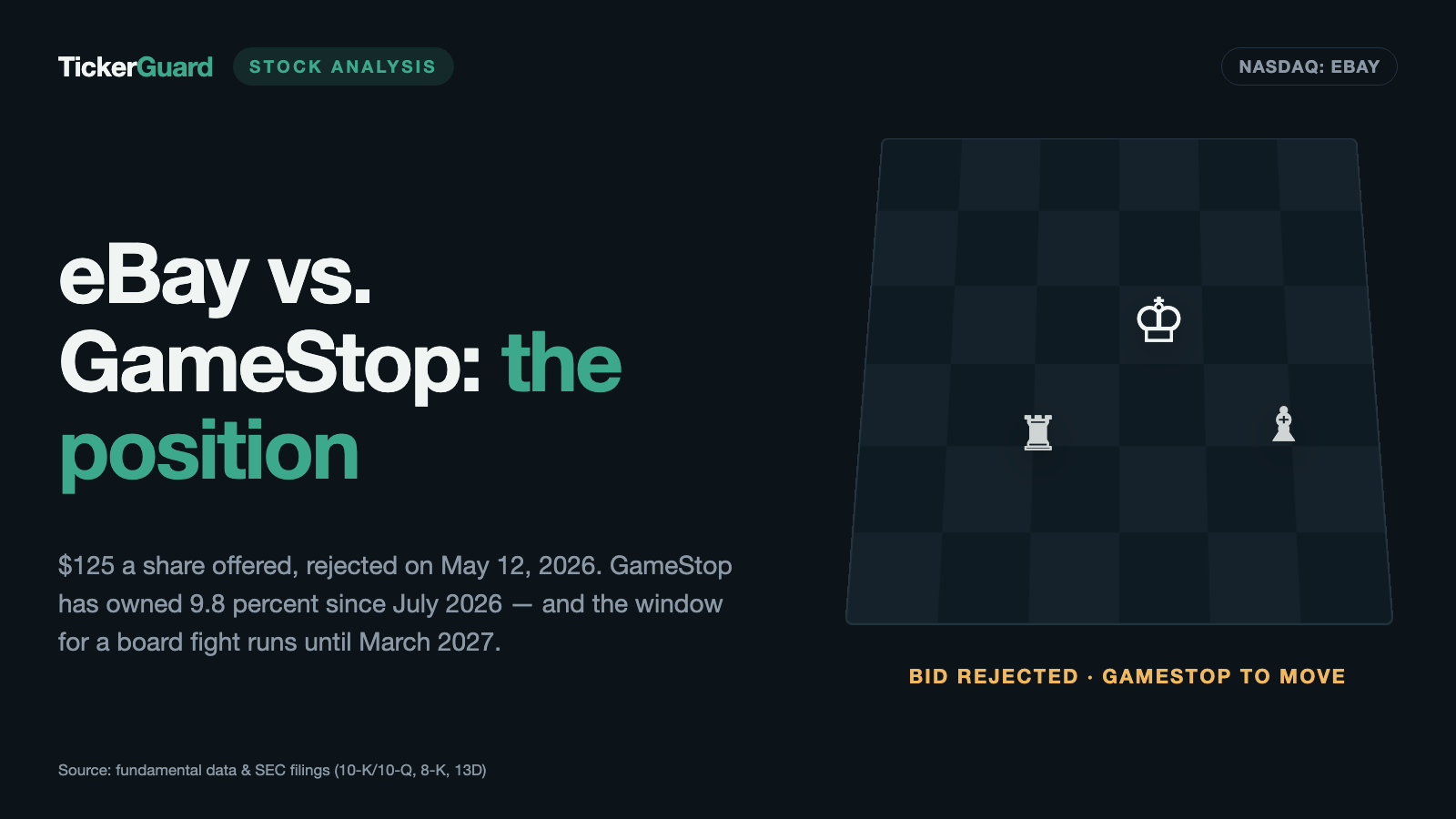
Not through a hit in our in-house stock scanner. In late September 2026, eBay showed up in the most-discussed rankings of a large German stock portal — and the reason is not in a quarterly report but in a series of mandatory filings. On May 3, 2026, GameStop sent eBay’s board chair a non-binding proposal: $125.00 per share, half in cash and half in GameStop stock, about $55.5 billion for all of eBay. According to GameStop, that was a 46 percent premium to the closing price of February 4, 2026, the day GameStop began building its position.
How serious GameStop is shows in its ownership filings on Schedule 13D — the form anyone must file after crossing 5 percent of a company with an intent to influence it. According to amendment No. 4 of July 17, 2026, GameStop owns 43,390,383 eBay shares, or 9.8 percent. For the 39,046,658 shares delivered on July 17 alone, GameStop paid about $3.97 billion out of its own cash. What that effort means for GameStop itself is covered in our GameStop stock analysis. Here we look at the other side of the board: what is eBay actually worth — with or without a bidder? Rule of thumb: a takeover proposal is not a valuation; it is an opening move.
The numbers over the years — honestly appraised
First, what deserves credit. eBay is a very profitable business. Its operating margin — the share of revenue left as operating profit after all running costs — was 20.5 percent in 2025 and 22.5 percent in 2024. In the second quarter of 2026 it rose to 21.6 percent from 17.6 percent a year earlier. Operating cash flow from continuing operations has been positive every year since 2017 and never below $2.0 billion; in the first half of 2026, operating income covered interest expense more than ten times ($1,287 million against $126 million).
And 2026 is a strong year. In the first half, revenue grew 17 percent to $6.22 billion, and second-quarter GMV rose 15 percent to $22.4 billion. Diluted earnings per share from continuing operations climbed 56 percent in the second quarter to $1.21, and free cash flow — the cash left after all capital spending — reached $1.22 billion in the first half, up from $203 million. For the third quarter of 2026, eBay’s August 5, 2026 earnings release guides to revenue of $3.07 billion to $3.12 billion, up 8 to 10 percent year over year on an FX-neutral basis.
The longer view shows the other side. GMV was $87.4 billion in 2021, fell to $73.9 billion in 2022 and $73.2 billion in 2023. Even after rising to $79.6 billion in 2025, it is still 8.9 percent below 2021. Revenue grew only from $10.4 billion to $11.1 billion over the same period, and the operating margin was 28.1 percent in 2021. Two special effects distort year-over-year comparisons: net income swings with the value of equity stakes (in 2022, fair-value losses on the Adevinta shares produced a loss from continuing operations of $1.27 billion). And 2025 free cash flow of $1.48 billion was depressed because eBay paid $685 million more in income taxes than a year earlier; in the first half of 2026, tax payments were $794 million lower than in the first half of 2025. Since January 2026, eBay has also expensed platform development costs immediately under a new rule (ASU 2025-06); prior-year figures in the 2026 quarterly reports were recast, and free cash flow is unaffected.
Uncomfortable truth No. 1: The share count is shrinking faster than the business is growing
The most important number in this analysis is not a revenue figure. It is the share count. eBay has been buying back and retiring its own stock on a large scale for years. For you as a shareholder, that means the pie barely grows, but it is split among fewer and fewer eaters — your slice grows even when the pie hardly does.
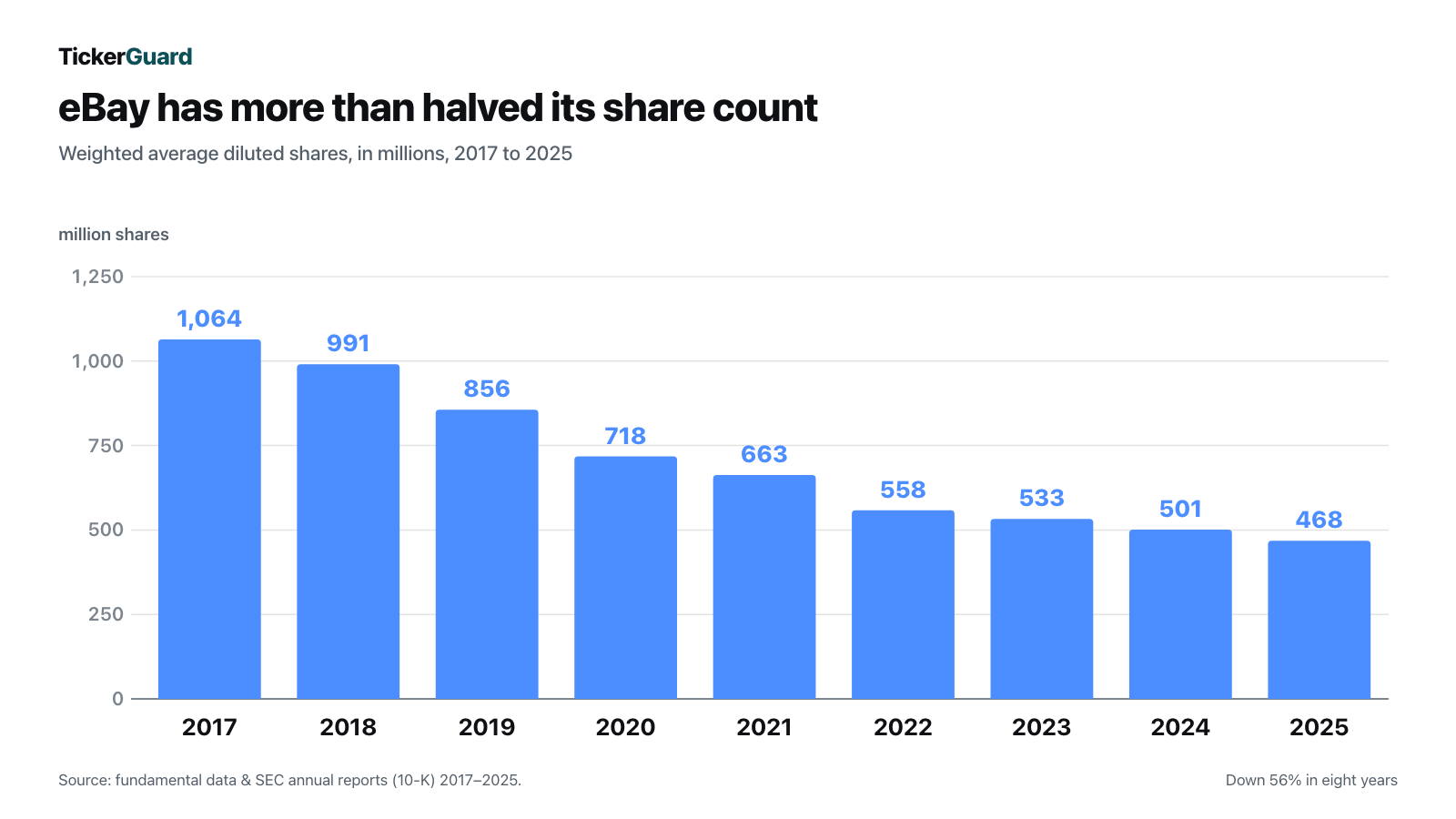
That is impressive — and it has a price. From 2021 through 2025, eBay spent $17.2 billion on share buybacks and $2.5 billion on dividends, $19.8 billion in total. Free cash flow from continuing operations over those five years came to only $10.2 billion. The gap of roughly $9.6 billion was closed mainly with divestiture proceeds: in 2021, eBay transferred its classifieds business to Adevinta for $2.5 billion in cash plus Adevinta shares, part of which it sold in November 2021 for $2.3 billion, and in the same year it sold 80.01 percent of its Korean business. In 2024 came $2.4 billion in cash for more Adevinta shares and $1.0 billion for part of the stake in Aurelia received in exchange. In 2025 alone, $3.0 billion went to shareholders against $1.48 billion of free cash flow.
That source is finite: you can only sell a classifieds business once. From the remaining stake in Aurelia — the company whose shares eBay received for part of its Adevinta stock in 2024 — another $194 million flowed back in the first quarter of 2026. In February 2026, the board’s audit committee, acting under delegated authority, authorized an additional $2.0 billion for buybacks; about $2.0 billion remained available as of June 30, 2026. The balance sheet bears the marks: stockholders’ equity was just $4.67 billion on June 30, 2026, and $2.93 billion of that consisted of deferred tax assets — future tax savings, not cash in the bank. Debt of $6.7 billion compared with $4.9 billion of cash and non-equity investments; a month later, $1.4 billion in cash went out for Depop; in addition, $750 million of commercial paper was outstanding as of June 30. And the underlying business? Active buyers stood at 134 million at the end of 2022, 132 million at the end of 2023, 134 million at the end of 2024, 135 million at the end of 2025 and 136 million in the second quarter of 2026. Rule of thumb: buybacks grow earnings per share, not the company. At some point the pie has to grow again — not just the sharpness of the knife.
Uncomfortable truth No. 2: The new growth comes from the U.S. — and from collectors
The growth of recent quarters is real, but it is unevenly spread. The next chart shows how much GMV grew in the U.S. and in the rest of the world compared with the same quarter a year earlier.
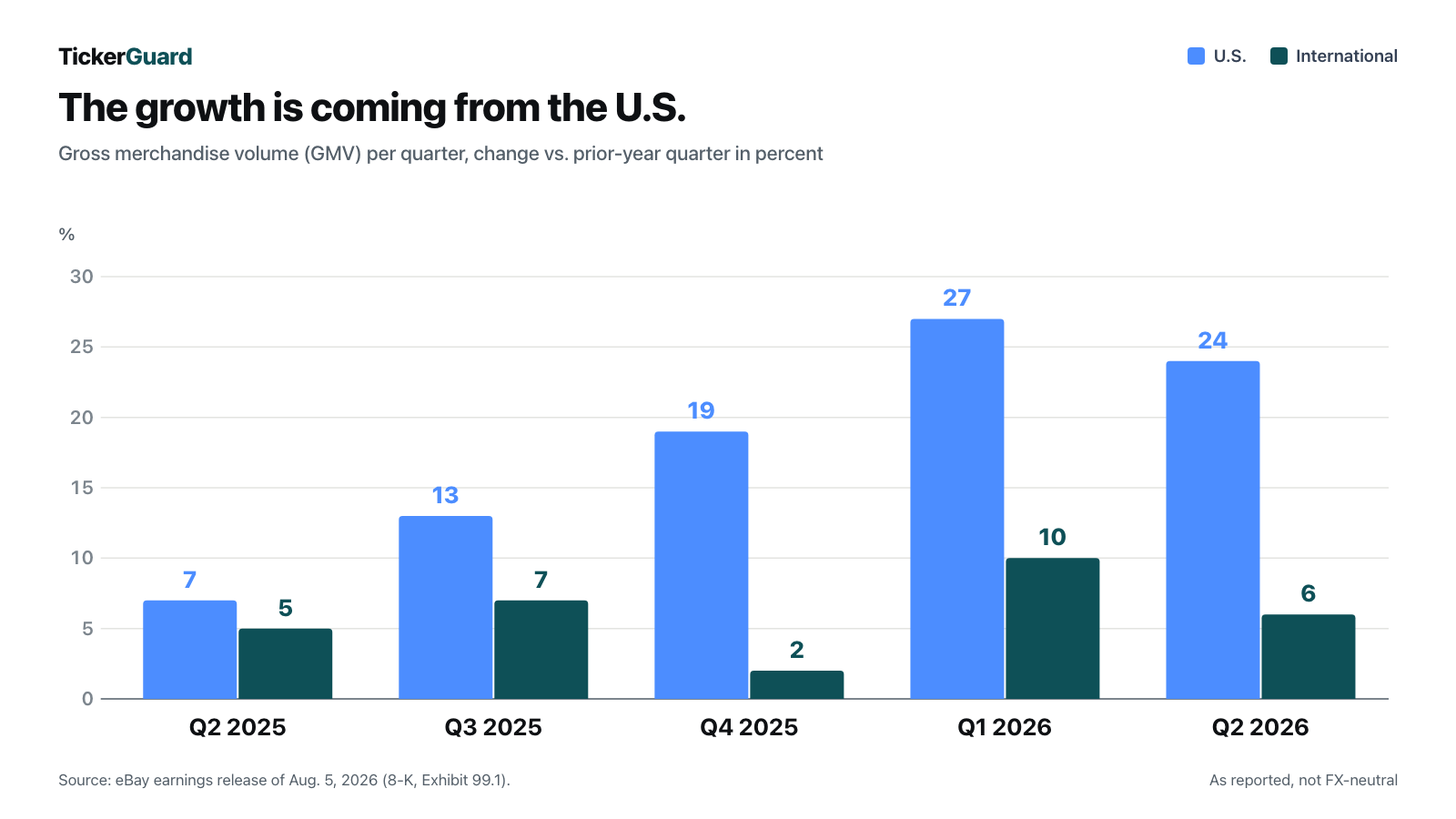
Where the U.S. boost comes from, eBay says itself: from the focus categories, led by collectibles. The quarterly report for the period ended June 30, 2026 says growth was “particularly strong” in collectibles, motors parts and accessories, fashion and refurbished goods; the 2025 annual report already singled out a “particularly strong performance in Collectibles” in the U.S. The August 5, 2026 earnings release cites a Michael Jordan card that sold for $4.3 million at eBay’s Goldin unit and 80 million scans with its AI-powered card recognition. Internationally, by contrast, eBay speaks of “continued challenging macroeconomic conditions.”
The trouble with collector waves: they are waves. eBay does not disclose how much of its GMV comes from trading cards, but the 2025 annual report explicitly lists the risk that consumer interest may shift away from its focus categories. There is also a revenue driver that has nothing to do with collector enthusiasm: part of the revenue growth, according to the quarterly report, stems from the U.S. shipping program (“higher volume and favorable rates associated with our U.S. net shipping program”). Rule of thumb: growth that depends on a passion is lovely — but check every quarter whether the passion is still there.
Uncomfortable truth No. 3: Buyer protection is getting pricier — fraud losses are growing almost four times as fast as revenue
A marketplace lives on trust. Anyone buying on eBay gets their money back under the eBay Money Back Guarantee if an item never arrives or does not match its description. eBay books the cost as transaction losses: buyer protection claims, chargebacks for stolen credit cards and cases in which a seller never delivered. In the first half of 2026 they rose to $271 million from $167 million a year earlier — up 62 percent while revenue grew 17 percent. Measured against revenue, the losses climbed from 3.1 to 4.4 percent. The explanation is in the quarterly report:
“The increase in transaction losses for the three months ended June 30, 2026 compared to the same period in 2025 was primarily due to $31 million from unfavorable fluctuations in buyer and seller fraud and recovery rates and $14 million from higher volume.”
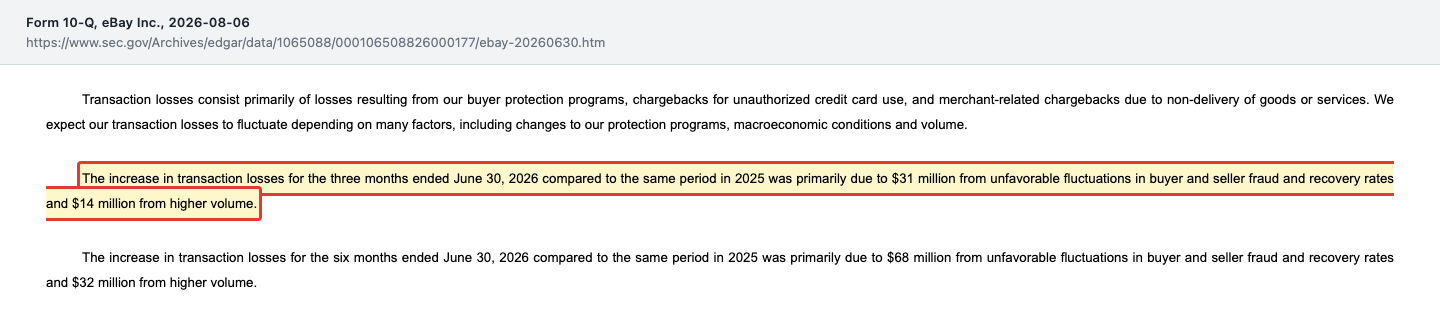
In plain terms: more than two thirds of the increase comes not from eBay selling more but from more fraud slipping through or less of it being recovered. The $104 million of additional losses in the first half equals about 8 percent of operating income of $1.29 billion. On a full-year basis the curve had long been flat — $360 million in 2023, $353 million in 2024, $396 million in 2025. The question is whether 2026 stays an outlier or is the price of more expensive collectibles changing hands. Rule of thumb: trust is a marketplace’s product — and trust costs money that shows up in no growth figure.
Uncomfortable truth No. 4: The advertising engine and the AI shopping assistants
eBay’s fastest-growing revenue line is advertising: in the second quarter of 2026, first-party advertising brought in $570 million, up 25 percent. Sellers pay so that buyers see their listings first in eBay search. This is exactly where eBay sees a threat that has sharpened: in its 2024 annual report, the company already warned that consumers might increasingly ask AI chatbots and shopping assistants instead of search engines. In the 2025 annual report, that possibility has become an observed development.
“For example, we are seeing consumers increasingly search for products using chatbots, virtual assistants and other Gen AI technologies powered by large language models instead of using traditional search engines. If AI technologies do not send referrals to eBay at the rate of traditional search engines for any reason, consumer traffic on our platforms could decrease, which would negatively impact on our business and results of operations.”
— eBay Inc., SEC annual report 10-K for 2025, Item 1A (Risk Factors)
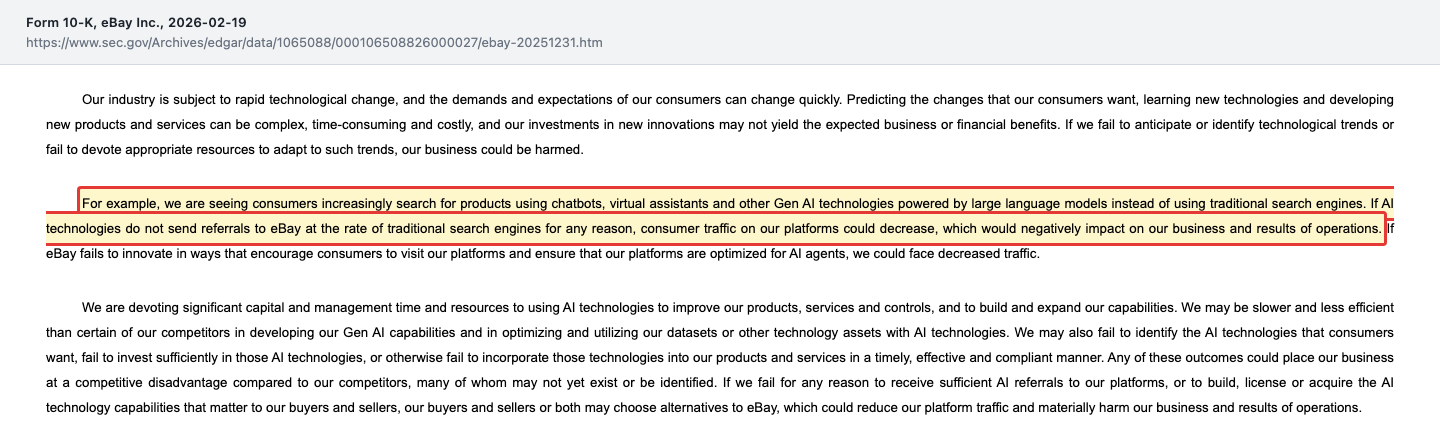
Elsewhere in the same report, eBay warns that sellers may stop paying for advertising if Promoted Listings drive sales less effectively than off-platform alternatives, “including AI technologies such as agents and chatbots.” When an AI assistant picks the cheapest offer for you, it does not see a paid placement — it sees the price. To be fair: eBay is leaning hard into AI itself, from auto-filled listings to an AI shopping agent pilot, and its annual report names optimizing its platforms for AI agents as its own task. Whether eBay gains more from this than it loses shows up in no number in the report. Rule of thumb: an advertising business is worth only as much as the attention it sells — and that attention is moving.
Uncomfortable truth No. 5: A major shareholder who wants the whole house
Back to the board. After the rejection on May 12, 2026, GameStop did not give up; it doubled down. Its stake grew from about 5 percent in May to 9.8 percent in July. In a newspaper interview published on July 19, 2026, which GameStop had to file with the SEC as a Rule 425 communication, CEO Ryan Cohen said: “I want to own eBay — that’s all I’ve been thinking about.” He added that the pessimist in him expected eBay to wait until the annual meeting. eBay itself describes the situation soberly in its latest quarterly report:
“Although our Board determined on May 12, 2026 that the proposal was neither credible nor attractive and, to date, no changes to this proposal that would alter our Board’s view have been proposed, we cannot predict whether this party or any other party will take further actions.”
— eBay Inc., SEC quarterly report 10-Q for the period ended June 30, 2026, Part II, Item 1A (Risk Factors)
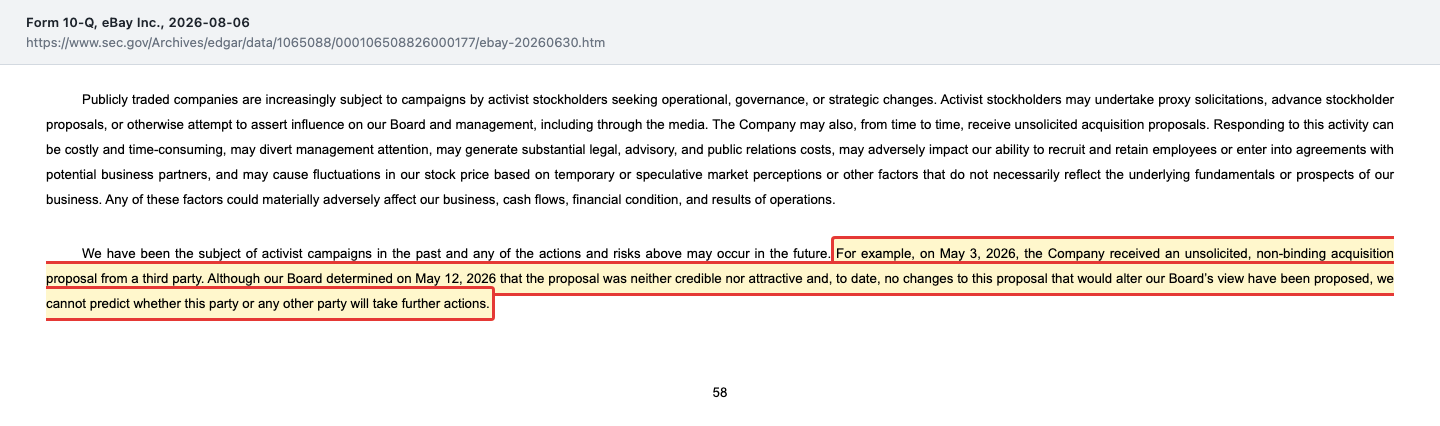
Which moves does GameStop have left? According to the proxy statement of April 30, 2026, only shareholders holding at least 20 percent combined can request a special meeting. A shareholder proposal to lower that threshold to 10 percent failed at the annual meeting on June 17, 2026, by roughly 157 million votes to 210 million. The simpler route of putting your own nominees on the company ballot (proxy access) requires holding at least 3 percent for three years — GameStop only started building its position in February 2026. That leaves the classic route: nominating its own board candidates and soliciting shareholders directly. According to the proxy statement, the window for that opens on February 17, 2027 and closes on March 19, 2027. Since July 20, 2026, the SEC database shows neither a new Rule 425 communication nor a further amendment to the ownership filing (as of September 29, 2026).
For you as a shareholder, that means two things. A forced takeover is hardly possible in the short term, and because GameStop shares would be part of the consideration, any price also depends on GameStop’s stock. And a shareholder with nearly a tenth of the votes who publicly lays claim to the CEO job ties up attention: in the second quarter of 2026, eBay already booked $25 million of transaction-related costs, a category that, according to the earnings release, expressly includes costs related to unsolicited proposals and shareholder activism. Rule of thumb: a bidder on the shareholder register is not a price promise; it is an open game.
Valuation: about $48 billion — with a $125 proposal in the background
In the insider filings (Form 4) of September 17, 2026, eBay values shares withheld from executives at $108.03 per share on September 15, 2026. With 445 million shares outstanding (July 31, 2026), that equals a market value of about $48 billion — our own calculation as of September 15, 2026. The market value shown in this page’s key-figures box comes from our database and uses a different price and data date, so it can differ. Against 2025 diluted earnings per share from continuing operations of $4.26, you pay roughly 25 times earnings; using the twelve months through June 2026 (about $4.76, with the half-year figures as recast in 2026), it is roughly 23. In other words: you pay more than two decades of today’s profit up front.
Free cash flow looks friendlier. In the twelve months through June 2026 it was about $2.5 billion, a little over 5 percent of market value — flattered, however, by the much lower tax payments in 2026. The dividend of $0.31 per quarter works out to a yield of about 1.1 percent; most of the payout runs through buybacks. GameStop’s $125 proposal was a little more than 15 percent above the September 15, 2026 price. But it is not a floor: it was non-binding, half payable in GameStop stock and rejected. Anyone buying the stock because of the proposal is not betting on eBay but on GameStop’s next move — which is exactly the second trap in this analysis, the anchoring effect: a number, once mentioned, sticks in your head even when nobody pays it. If you are interested in luxury resale, our The RealReal stock analysis covers a specialized competitor in exactly the category where eBay wants to grow with authentication.
Opportunities and risks at a glance
What speaks for eBay:
- Strong earnings power: operating margin of 20.5 percent (2025) and 21.6 percent in the second quarter of 2026; operating cash flow of at least $2.0 billion every year since 2017.
- Growth is back: first-half 2026 revenue up 17 percent, U.S. GMV up 24 percent in the second quarter.
- Advertising as a second leg: $1.99 billion of advertising revenue in 2025 (up 22 percent); first-party advertising up 25 percent in the second quarter of 2026.
- Consistent capital return: share count down 56 percent since 2017, another $2.0 billion buyback authorization, quarterly dividend of $0.31.
- Solid financing: interest covered more than ten times by operating income in the first half of 2026; $4.9 billion of cash and investments against $6.7 billion of debt (June 30, 2026).
What speaks against it:
- A flat buyer base: 132 million to 136 million active buyers since the end of 2022; 2025 GMV still 8.9 percent below 2021.
- Buybacks and dividends of $19.8 billion (2021–2025) far exceeded free cash flow of $10.2 billion; the gap was closed with divestiture proceeds that will not repeat.
- Growth concentrated in the U.S. and in collector categories; international GMV grew only 2 to 10 percent per quarter.
- First-half 2026 transaction losses up 62 percent to $271 million, driven mainly by worse fraud and recovery rates.
- According to the 2025 annual report, AI chatbots and shopping agents threaten traffic and the advertising business.
- Unrest on the shareholder register: GameStop owns 9.8 percent and wants to take over management; a possible board fight in spring 2027. And the past: according to the 2025 annual report, a three-year deferred prosecution agreement with the U.S. Attorney has applied since January 2024 over the 2019 stalking of the publisher of an e-commerce newsletter, including an independent compliance monitor.
A human conclusion
Back to the time-capsule trap. If you still picture eBay as the auction house of the 2000s, you underestimate the company: today it keeps about one fifth of every revenue dollar as operating profit, it has more than halved its share count, and it is growing at double digits again. But if you open the capsule only to take out the $125 proposal, you make the same mistake in a new form. Because the reports also show a buyer count that has barely grown in years, payouts that long exceeded the cash generated, a new upswing that rides a collector wave, rising fraud losses and an advertising business challenged by AI shopping assistants. A familiar name is not a current picture — you only get that if you open the capsule regularly. The next chances to do so: the quarterly report for the third quarter of 2026 and the nomination window from February 17 to March 19, 2027. What you make of it is your decision. And that is how it should be.
Sources
All original documents used in this analysis — so you can check them yourself:
- eBay Inc. — quarterly report 10-Q for the period ended June 30, 2026 (filed Aug. 6, 2026) — latest periodic report: share count, transaction losses, Depop acquisition, commercial paper, ASU 2025-06 adoption, risk factor on unsolicited acquisition proposals
- eBay Inc. — second-quarter 2026 earnings release, Form 8-K of Aug. 5, 2026, Exhibit 99.1 (GMV by region and quarter, advertising revenue, third-quarter 2026 outlook)
- eBay Inc. — quarterly report 10-Q for the period ended March 31, 2026, earnings release of April 29, 2026 and quarterly report 10-Q for the period ended September 30, 2025
- eBay Inc. — annual reports 10-K for 2025 (Feb. 19, 2026; AI risk factors, marketplace and advertising revenue, buyer count, transaction losses, legal matters), 2024, 2023 and 2022 (GMV and buyer count since 2021, transfer of the classifieds business to Adevinta)
- eBay Inc. — Forms 8-K of May 5, 2026 (receipt of the GameStop proposal) and May 12, 2026 (rejection, with the TD Securities financing letter as Exhibit 99.1) and of June 18, 2026 (annual meeting voting results)
- eBay Inc. — proxy statement (DEF 14A) of April 30, 2026: special-meeting threshold, proxy access, 2027 nomination deadline
- GameStop Corp. — Rule 425 communication of May 4, 2026 ($125 proposal, cash/stock split), Schedule 13D/A No. 4 of July 17, 2026 and Rule 425 communication of July 20, 2026 (interview with Ryan Cohen)
- eBay Inc. — insider filing (Form 4) of Sept. 17, 2026: valuation price of $108.03 on Sept. 15, 2026 (price anchor); market value, P/E ratio and yields are our own calculations. Multi-year figures: Source: fundamental data & SEC filings (annual and quarterly reports, 10-K/10-Q).
Transparency & disclaimer: This analysis is a journalistic assessment of publicly available information. It is not investment advice, not a financial analysis in the regulatory sense and not a solicitation to buy or sell securities. Investing in stocks involves substantial risk, up to and including total loss. All information without guarantee; the date of each data point is noted in the text. Positions held by the operator are disclosed daily; where one exists, it appears as a notice at the top of this deep dive.
Key figures at a glance
All monetary figures in millions of $; earnings per share as reported.
| Metric | 2021 | 2022 | 2023 | 2024 | 2025 |
|---|---|---|---|---|---|
| Revenue | 10,420.0 | 9,795.0 | 10,112.0 | 10,283.0 | 11,100.0 |
| Operating Income (EBIT) | 2,923.0 | 2,350.0 | 1,941.0 | 2,318.0 | 2,277.0 |
| Net Income | 13,608.0 | -1,269.0 | 2,767.0 | 1,975.0 | 2,031.0 |
| Net Margin | 130.6% | -13.0% | 27.4% | 19.2% | 18.3% |
| Earnings Per Share | 20.87 $ | -2.27 $ | 5.19 $ | 3.94 $ | 4.42 $ |
Source: fundamental data & SEC filings (annual and quarterly reports, 10-K/10-Q)
Our Bottom Line at a Glance
- Earnings power positive
- Operating margin 20.5% (2025) and 21.6% in Q2 2026; operating cash flow of at least $2.0 billion every year since 2017; interest covered more than ten times in H1 2026.
- Growth neutral
- Revenue H1 2026 +17%, U.S. GMV Q2 2026 +24%; but 2025 GMV still 8.9% below 2021 and active buyers at 132–136 million since the end of 2022.
- Capital return neutral
- Share count 2017–2025 −56%; 2021–2025 payouts of $19.8 billion against $10.2 billion of free cash flow — the gap was closed with one-off divestiture proceeds.
- Balance sheet positive
- Debt of $6.7 billion against $4.9 billion of cash and investments (06/30/2026); equity $4.7 billion, of which $2.9 billion deferred tax assets; Depop bought for $1.4 billion in July 2026.
- Operating risks negative
- Transaction losses H1 2026 +62% to $271 million; per the 2025 10-K, AI chatbots threaten traffic and advertising; growth concentrated in the U.S. and collectibles.
- Ownership and governance neutral
- GameStop owns 9.8% (07/17/2026) and wants to acquire eBay; proposal of 05/03/2026 rejected; nomination window 02/17–03/19/2027.
eBay is a highly profitable marketplace with strong cash generation that has returned a great deal to shareholders through buybacks. In 2026 the business is growing clearly again, carried by the U.S. and collector categories. Open questions remain: a buyer base that has been flat for years, rising fraud losses, the AI threat to advertising and the outcome of the takeover fight with GameStop. Not investment advice.
What Our Rating Means
Quality confirmed
Business model, numbers and balance sheet hold up to our review. Whether the current price supports an entry is a separate question — it hangs on the price, not on the company.
Green here stands for proven business quality, not for an attractive entry point: the business model has carried an operating margin of around one fifth for years, operating cash flow has been at least $2.0 billion every year since 2017, interest is covered more than ten times, and there is neither an existential dependency nor a balance-sheet or governance break. The open issues — a flat buyer count, rising fraud losses, AI risk to advertising, a would-be acquirer holding 9.8 percent — are serious but do not call the substance into question. Whether a price of about 25 times annual earnings is fair is not answered by this rating. The decision is yours.
A journalistic assessment by our editorial team at the time of the deep dive, based on public sources — not investment advice and not a solicitation to buy or sell. Your personal circumstances (investment goals, risk capacity, taxes) cannot be taken into account. What our levels mean, how verdicts are formed, and what conflicts of interest exist →
Worth Noting
- Version of Sept. 29, 2026, based on the 10-K annual reports 2022 through 2025, the 10-Q quarterly reports for the periods ended 09/30/2025, 03/31/2026 and 06/30/2026 (latest periodic report, filed 08/06/2026), the earnings release of 08/05/2026 and all SEC filings through 09/29/2026. The trigger was the EBAY ticker in the rankings of a large German stock portal, not a scanner hit.
- Since January 2026, eBay accounts for development costs under ASU 2025-06; prior-year figures in the 2026 quarterly reports are recast, while the 2021–2025 annual figures come from the respective annual reports. Free cash flow is unaffected by the change. Multi-year totals, market value, P/E and yields are our own calculations.
- The price anchor is the $108.03 valuation price for 09/15/2026 from the insider filings (Form 4) of 09/17/2026. Do not confuse: GameStop's $125 proposal was non-binding, half payable in GameStop stock and rejected — it is neither a price target nor a floor.
Stock Watch
This analysis is as of September 29, 2026. Stock Watch will tell you what's changed at EBAY since then.
Later $1 a month per stock — signing up is free, and you'll be the first to know when it launches.
The full analysis as a PDF for later
We will send you this analysis as a PDF — to print, file away, and read at your own pace. And we will add you to the free Stock Watch list for eBay Inc (EBAY), so you hear about it when something material in this analysis changes.
Frequently Asked Questions
On May 3, 2026, GameStop proposed to acquire all eBay shares for $125.00 per share, half in cash and half in GameStop stock, about $55.5 billion in total. The proposal was non-binding. For financing, GameStop presented a letter from TD Securities for up to $20 billion of debt, which expressly was not a commitment.
On May 12, 2026, eBay's board called the proposal “neither credible nor attractive.” It cited eBay's standalone prospects, the uncertain financing, the impact on long-term growth and profitability, the leverage and leadership structure of a combined company, valuation, and GameStop's governance and executive incentives.
According to Schedule 13D/A No. 4 of July 17, 2026, GameStop owns 43,390,383 eBay shares, or 9.8 percent. For the 39,046,658 shares delivered on July 17 under its option positions, GameStop paid about $3.97 billion from its own cash. No further amendment followed through Sept. 29, 2026.
eBay reported 136 million active buyers in the second quarter of 2026 — accounts that paid for at least one transaction in the preceding twelve months. The count was 134 million at the end of 2022, 132 million at the end of 2023, 134 million at the end of 2024 and 135 million at the end of 2025, essentially flat for years.
In 2026 eBay pays a quarterly dividend of $0.31 per share, most recently on Sept. 11, 2026. Annualized that is $1.24, or a yield of about 1.1 percent at the $108.03 price of Sept. 15, 2026. Most of the payout runs through share buybacks, which totaled $2.5 billion in 2025.
According to the proxy statement of April 30, 2026, nominations for the 2027 annual meeting must be received between Feb. 17 and March 19, 2027. Only shareholders holding at least 20 percent can request a special meeting; a proposal to lower that threshold to 10 percent failed on June 17, 2026.
In February 2026 eBay agreed with Etsy to buy the fashion marketplace Depop for $1.2 billion in cash. At closing on July 30, 2026, eBay paid $1.4 billion including preliminary purchase price adjustments. The outlook for the third quarter of 2026 already includes Depop.
Found an error?
Did you spot a factual error, an outdated number, or a typo in this deep dive? Let us know briefly — your report goes straight to the editorial team.