GameStop: Sales Are Falling Again — and Half the Company Now Sits in eBay Stock
Most people know GameStop only through the legend of January 2021. The company behind the name is a different one today. In the quarter ended August 1, 2026 revenue fell to $790.2 million, against $972.2 million a year earlier — while operating income rose from $66.4 million to $160.2 million over the same period, the company's best second quarter on record. Cash and marketable securities shrank from $8,368.1 million to $5,060.3 million, because the options bet on eBay turned into a real block of stock: 43.4 million shares carried at $4,946.9 million. Not investment advice — an attempt to lay both halves of this company side by side and add them up honestly.
 Thomas Mücke
Founder & Publisher
Thomas Mücke
Founder & Publisher
As of Today
As of: September 28, 2026
- Closing price
- 24.00 $ +2.40%
- Market Capitalisation
- 10.7 $B
- P/E
- 17.5
- Growth Score
- 5/10
- AAQS
- 4/10
This analysis has a cut-off date. The Stock Guard tells you when something material changes in the numbers. Reserve your free spot
Chart
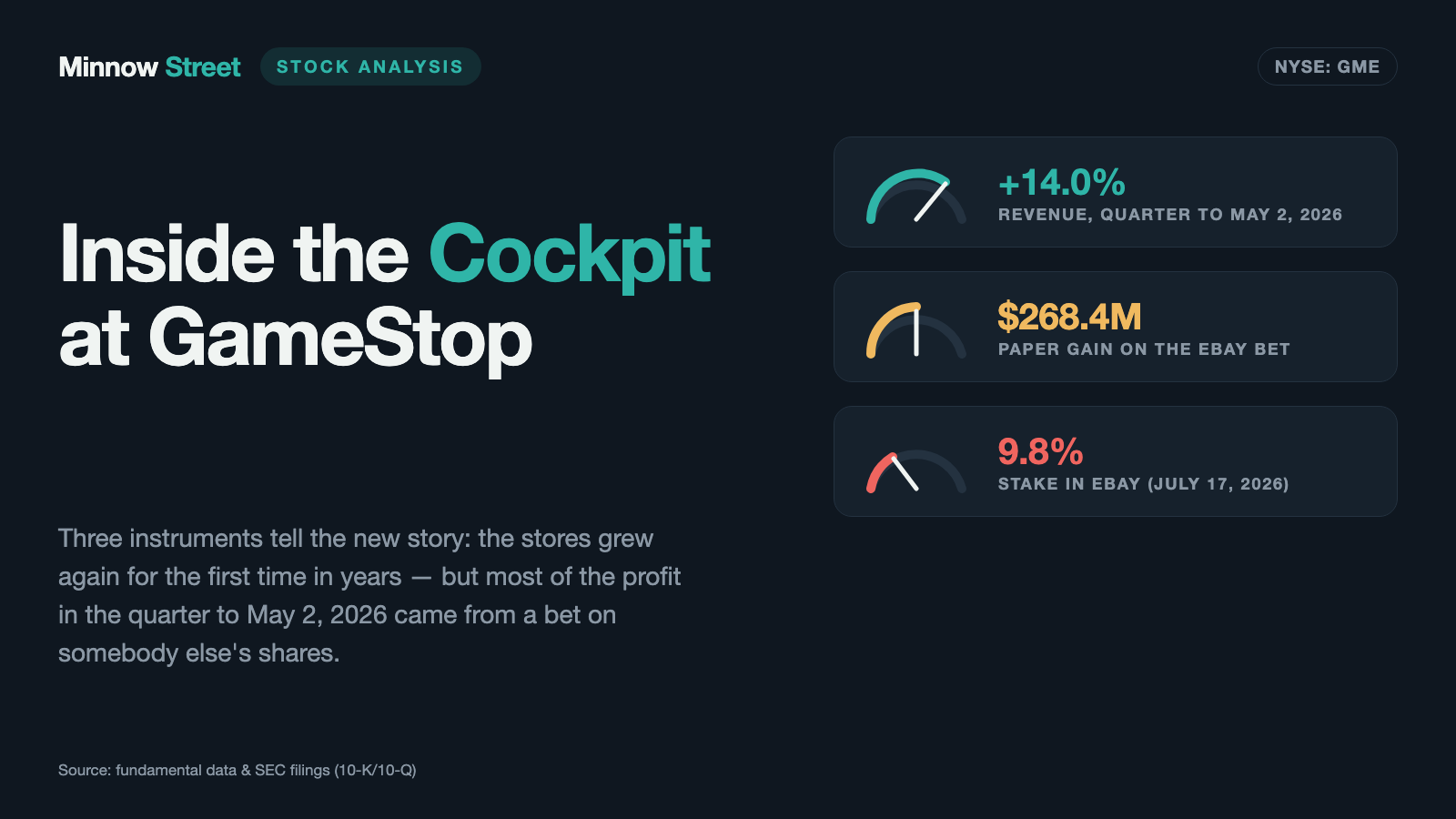
Interactive price chart (TradingView).
52-week range: 17.90 $ to 27.70 $ · Last price: 24.00 $ (As of: September 28, 2026)
Note: pure fact-based analysis, not investment advice and not a solicitation to buy or sell. All figures without guarantee.
There is an investor trap that no chart and no valuation model can disarm, because it lives in memory rather than in a spreadsheet: the legend trap. It works like this. A stock once wrote a story so large that it reached films, talk shows and family dinners. Years later you hear the name — and your mind loads the legend, not the company. For GameStop Corp. (NYSE: GME) that legend is January 2021: retail investors against short sellers, the used-video-game store as the battlefield. Except the store is now a different business. It has lost nearly a third of its revenue in two years, closed 727 U.S. stores in fiscal 2025 alone — and describes itself in its own quarterly report the way holding companies usually describe themselves. So let us make a deal: before you buy the legend, we read together what the company itself filed with the U.S. securities regulator, the SEC — the annual report (10-K) as of January 31, 2026, the quarterly report (10-Q) as of May 2, 2026, and every filing after it through the earnings release of September 8, 2026. Those documents are honest under penalty of law. What you do with them is your call.
What GameStop really is today
GameStop sells video games, consoles, accessories and collectibles across 2,206 stores as of January 31, 2026: 1,598 in the United States, 308 in France, 300 in Australia. The company is based in Grapevine, Texas, employs roughly 4,000 full-time associates and, depending on the season, between 11,000 and 16,000 part-timers. Eight years ago it ran more than 7,200 stores. Canada was sold in 2025, New Zealand closed — and France is now out as well: the 10-Q as of May 2, 2026 still carried the French operations as held for sale, while the earnings release of September 8, 2026 already names the completed divestiture as one of three reasons for lower revenue. The 308 French stores in the count above are therefore no longer part of the group; roughly 1,898 stores remain on that arithmetic, and the company has not published an updated count since the annual report. From the quarter ended August 1, 2026 GameStop reports its assortment in three new categories: Collectibles (new and pre-owned trading cards, figures, apparel, toys, plus fees from routing customers' cards to a third-party grading service), Video Games (new hardware, accessories, software physical and digital, digital currency, PC gaming) and Pre-Owned and Refurbished (used and refurbished consoles, discs, accessories, consumer electronics). The previous split ran along hardware, software and collectibles; the full-year figures in this analysis therefore still use the old presentation. Underneath it all sits the company's oldest idea: buying used product in the store for cash or credit, refurbishing it in its own centers, and selling it again.
And then the 10-Q as of May 2, 2026 contains a sentence that redefines the company:
"As we navigate the evolving commercial landscape, our business model is expanding beyond traditional retail to include value creation through disciplined capital allocation, and we view our significant cash and other sources of liquidity as a strategic asset to be deployed into investments, acquisitions, and control transactions that we believe offer long-term value."
— GameStop Corp., SEC quarterly report 10-Q as of May 2, 2026, Item 2 (Overview)

That names the central tension of this analysis, and it runs through every chapter: the stores are earning money again after years of shrinking — but the far larger share of the profit now arises alongside them, in a multi-billion-dollar cash pile and in bets on somebody else's shares. Buy GME and you buy both, and the second half rests on the decisions of one person. That person is Ryan Cohen, founder of the pet retailer Chewy, a director since 2021 and today chairman and chief executive officer. On July 7, 2026 he was re-elected with 244,771,847 votes in favor — the strongest result of all five nominees.
What a company looks like when its annual result no longer depends on its own operations but on a securities portfolio, we have worked through elsewhere: at Biglari Holdings, where profitable restaurants and insurers are routinely overwhelmed by the swings of an in-house fund. GameStop is not there yet. But the direction of travel is the same.
How the stock reached our desk
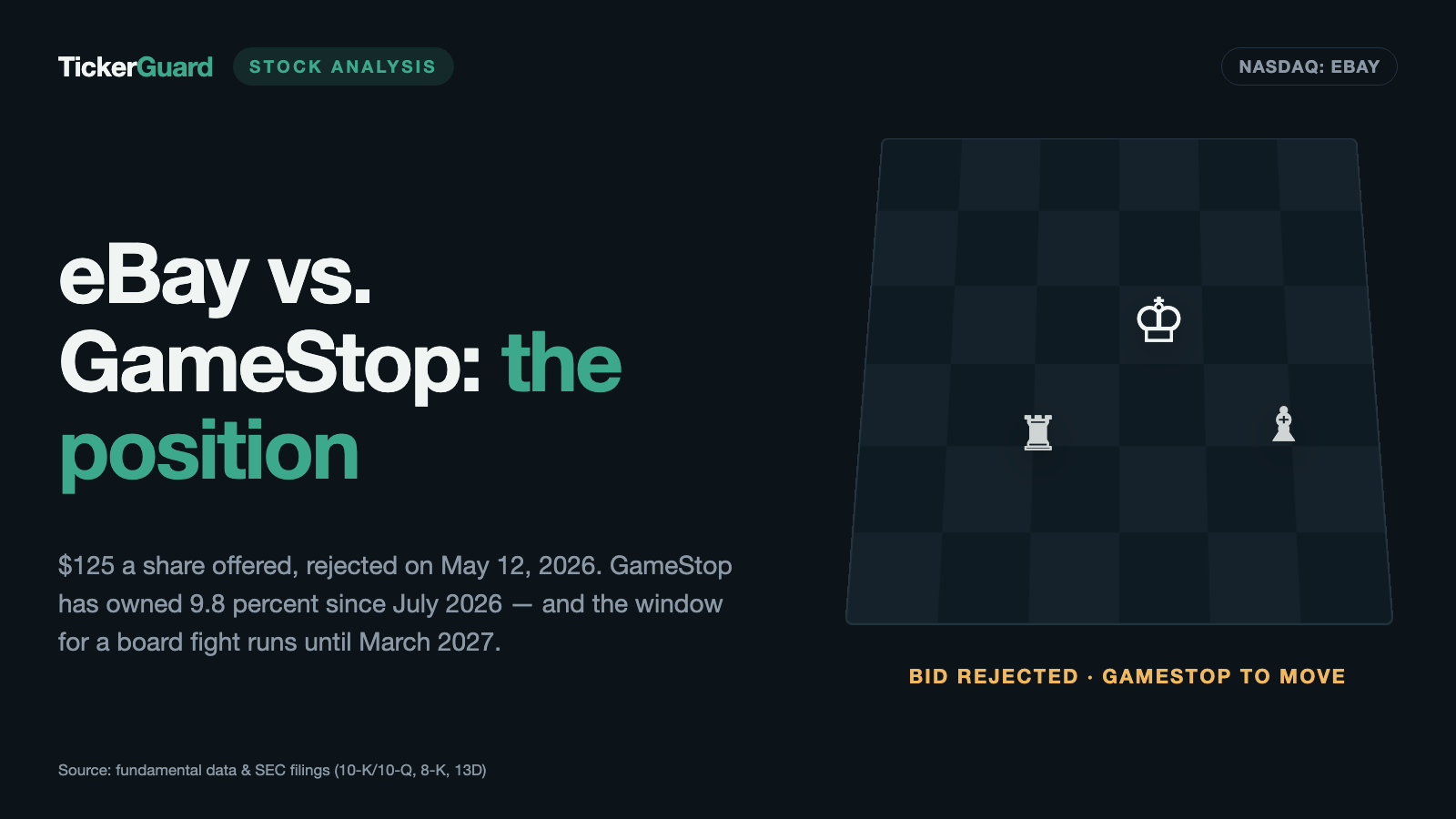
Not through one of our scanners. GameStop arrived by way of a mandatory filing: the current report (8-K) of May 4, 2026. In it the company disclosed that the previous day it had sent a non-binding letter to the chairman of the board of eBay Inc., proposing to acquire all outstanding eBay shares for $125.00 per share in a mix of cash and stock. The same day GameStop filed a Schedule 13D reporting its economic exposure to eBay. For scale: measured by market value, eBay is roughly five times the size of GameStop — the newspaper whose report GameStop itself had to file as a Rule 425 communication put eBay's market value at nearly $50 billion in its July 19, 2026 article, measured at the July 17 close.
What followed can be read week by week in the filings. On May 12, 2026, eBay rejected the proposal — the quarterly report records it flatly under subsequent events. GameStop kept buying anyway: Amendment No. 1 on May 19 (29,078,699 shares of economic exposure), No. 2 on May 28 (34,508,990), No. 3 on June 5 (39,874,306), No. 4 on July 17. Running alongside were more than two dozen communications under Rule 425 — the form that requires companies in a pending business combination to file every public word, from a television interview to a newspaper article. Note the finding early: at GameStop, the real story of 2026 is not in the quarterly report but in the filings between them.
The numbers over the years — fairly credited
First what genuinely impresses, and there is more of it than the legend suggests. GameStop really has turned the operation around. In fiscal 2024 (through February 1, 2025) it still posted an operating loss of $26.2 million. In fiscal 2025 (through January 31, 2026) that became $232.1 million of operating income. Operating cash flow — the money the business actually brings in — rose from $145.7 million to $614.8 million; two years earlier it had been negative $203.7 million. Gross margin, the share of revenue left after buying the goods, climbed from 29.1 percent in fiscal 2024 to 33.0 percent in fiscal 2025 and to 40.7 percent in the quarter ended May 2, 2026. That is not an accounting trick; it is the result of hard cuts — fewer stores, fewer countries, less low-margin hardware.
A word on the fiscal calendar, or every figure slips. GameStop closes its books at the end of January. Fiscal 2025 ran from February 2, 2025 to January 31, 2026 and therefore covers essentially calendar year 2025. The current fiscal 2026 ends January 30, 2027; its first quarter ran from February 1 to May 2, 2026.
The other side of the story is the revenue curve — and the shift underneath it:
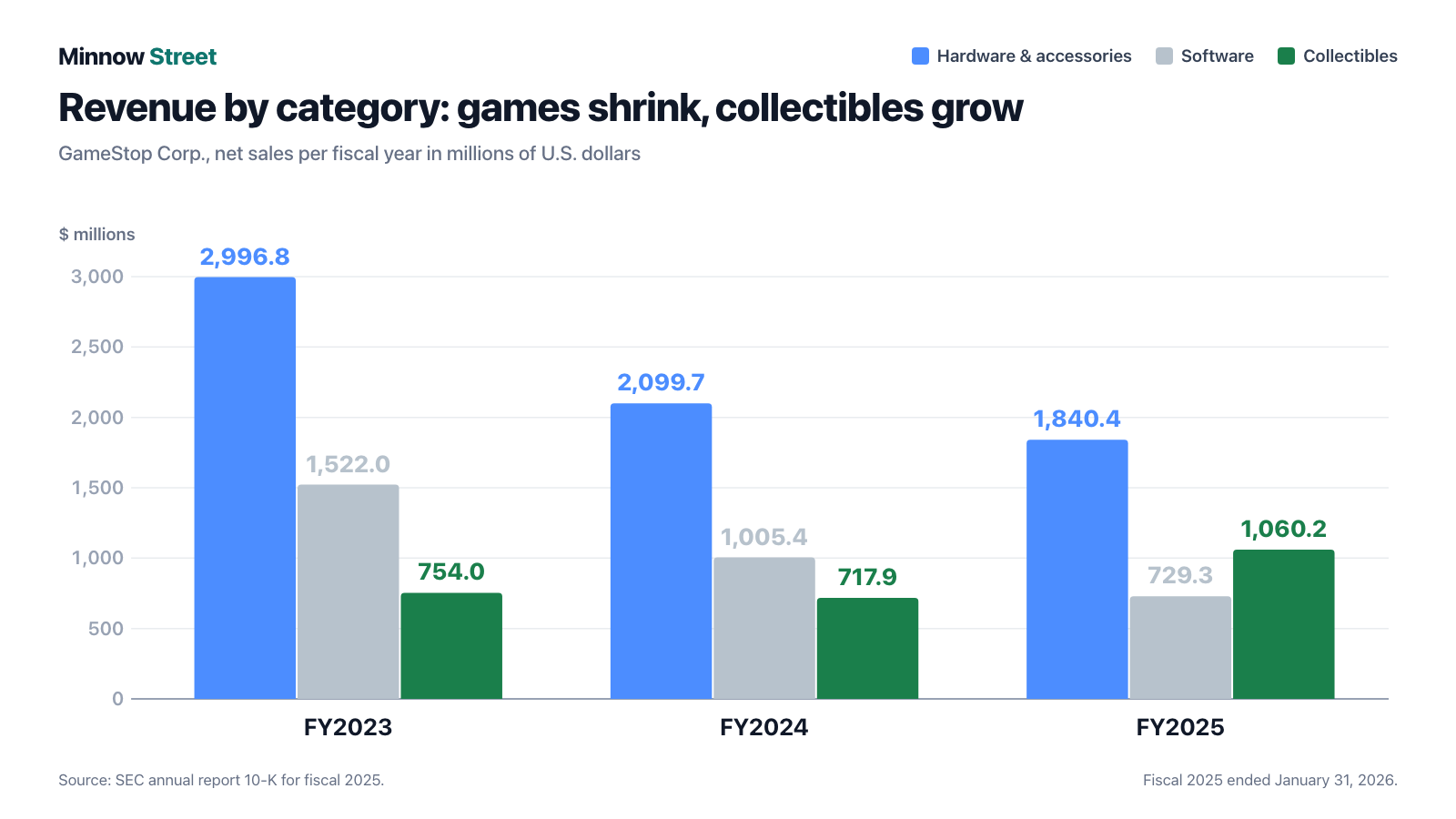
Total revenue fell from $5,272.8 million in fiscal 2023 through $3,823.0 million to $3,629.9 million in fiscal 2025 — nearly a third gone in two years. Inside that shrinking pie, though, a swap is under way: hardware and accessories lost 12.3 percent to $1,840.4 million, software lost 27.5 percent to $729.3 million — while collectibles gained 47.7 percent to $1,060.2 million and now account for 29.2 percent of revenue. The scale of the rebuild shows two years back: in fiscal 2023 hardware still stood at $2,996.8 million and software at $1,522.0 million against only $754.0 million of collectibles. The two old pillars have since lost almost $1.95 billion of revenue between them; the new one has gained roughly $306 million. Trading cards drive it. Since fiscal 2024 GameStop has been an authorized dealer for the grading service PSA, accepting cards for authentication and buying graded cards over the counter. The old pre-owned-games desk has become a trading-card desk. And in the quarter ended May 2, 2026 that finally showed in the top line: up 14.0 percent to $835.3 million — despite a smaller store base and despite the divested international operations. One quarter later that push was over; what has happened since gets its own chapter further down.
The three largest vendors, per the annual report, are Nintendo, Sony and Pokemon, which together supply the majority of new product purchases. That is an honest dependency: whoever sells trading cards and consoles sells what those three ship.
And then comes the line the whole debate hangs on. For the quarter ended May 2, 2026 GameStop reported net income of $389.6 million, against $44.8 million a year earlier — almost nine times as much. But where did it come from?
What the filings say — the uncomfortable truths
Uncomfortable truth no. 1: the stores delivered just over a quarter of the profit
The income statement in the 10-Q as of May 2, 2026 can be told in five lines. Pre-tax income was $506.4 million. It broke down like this:
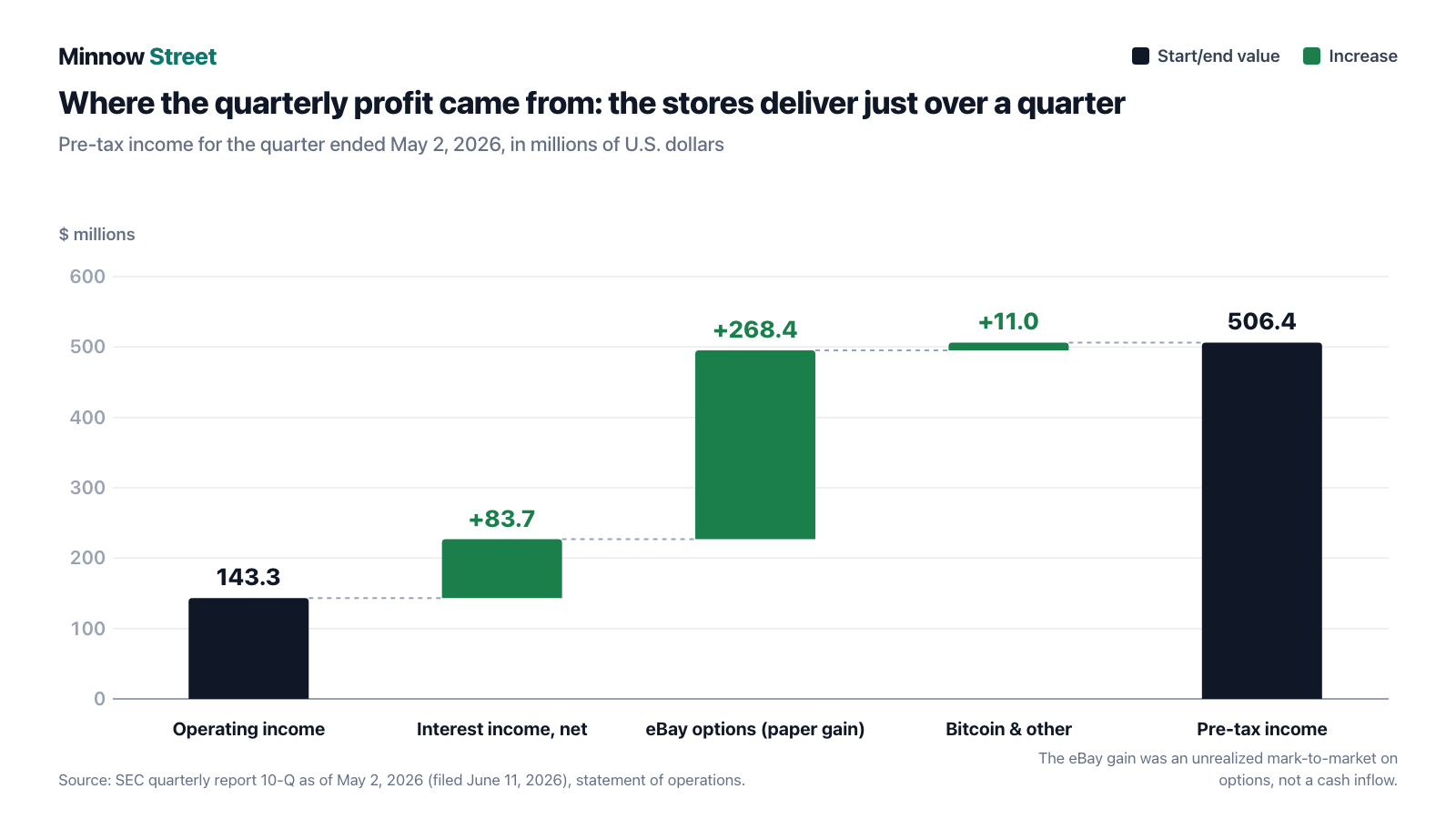
$143.3 million from operations — selling games, consoles and trading cards. $83.7 million of interest on the cash balance, more than in the entire prior-year quarter ($56.9 million). $268.4 million from an unrealized mark-to-market gain on options over eBay shares. And $11.0 million from bitcoin and other income. Put it in everyday terms: picture a shopkeeper who came into an inheritance last year. The shop runs decently and throws off $143 this quarter. But he also bought stock with the inheritance that happens to be worth $268 more on paper, and he collects $84 of interest on the savings account. The year ends in a record — and the shop had little to do with it. The paper gain can just as easily be a paper loss next quarter: the company itself books it as non-operating and calls it unrealized.
Fairness requires the other half: the $143.3 million from operations is a real improvement on a loss of $10.8 million a year earlier. And the interest is no accident — it is the mechanical result of a cash pile inflated by note issuance. But anyone reading $389.6 million of net income as "GameStop is making real money again" is reading the wrong line.
Uncomfortable truth no. 2: an options bet turned into a $3.97 billion invoice
In the first quarter of fiscal 2026 GameStop built economic exposure to eBay through so-called put/call pairs. Such a pair — a purchased call combined with a written put entered into with the same counterparty — is accounted for as a single forward contract: you carry the gains and losses of the share without initially owning it. The quarterly report states purpose and size plainly:
"The objective for holding these derivatives is to obtain economic exposure to eBay Common Stock."
— GameStop Corp., SEC quarterly report 10-Q as of May 2, 2026, Note 10 "Derivative Asset"

As of May 2, 2026 those pairs covered 22,176,000 eBay shares, plus 25,000 shares held directly — together roughly 5 percent of eBay. GameStop had already posted $983.3 million of collateral. Then came May 3: the $125.00-per-share proposal. On May 12, eBay's rejection. And after that — instead of a retreat — an expansion.
Schedule 13D/A No. 4 of July 17, 2026 quantifies the result. Between June 8 and June 15 GameStop bought 3,516,077 eBay shares for $381,301,906.81. On July 15 it notified eBay that it would take physical settlement of all 39,046,658 shares underlying the put/call pairs; delivery occurred on July 17, 2026 against $3,965,077,113.19, at an aggregated average strike of $101.295333 per share. The filing names the source of funds explicitly: working capital, nothing borrowed. GameStop now holds 43,390,383 eBay shares, or 9.8 percent of the company.
An options position has become a block of stock that absorbed a good $4.3 billion in two months. The switch is complete on the balance sheet as of the quarter ended August 1, 2026: where a derivative and posted collateral stood in the spring, the balance sheet now shows an equity investment of $4,946.9 million. For comparison: GameStop's own market value stood at roughly $9.53 billion (504,500,979 shares as of September 3, 2026, closing price $18.89 on September 8, 2026). And the target does not want this. In a television interview on July 16, 2026 — which GameStop itself had to file as a Rule 425 communication — Ryan Cohen said he was putting "$500 million of my own money into the transaction" and had committed to taking out "$2 billion within the first year" of costs at eBay. Three days later a newspaper quoted him: "I want to own eBay — that's all I've been thinking about." That is not a footnote. That is the second half of this stock.
Uncomfortable truth no. 3: your slice of the pie can get considerably smaller
Dilution means new shares appear, earnings are spread across more heads, and your share of the company shrinks — your slice of the pie gets smaller even though the pie is the same size. At GameStop four sources are working at once, and all of them are documented.
First, the convertible notes. In April 2025 GameStop issued $1,500 million of convertible notes due 2030; in June 2025 a further $2,700 million due 2032 — both with a coupon of 0.00 percent. The company therefore pays no interest; it pays instead with the holders' right to convert into stock, at roughly $29.85 and $28.91 per share respectively. As of January 31, 2026 the balance sheet carried $4,164.3 million and as of August 1, 2026 $4,167.8 million; after the exchange completed on September 3, 2026 roughly $1.1 billion of the 2030 notes and $1.7 billion of the 2032 notes remain, about $2.8 billion in total. Diluted earnings for the quarter ended May 2, 2026 already include 143.6 million additional shares from those notes: 448.4 million actual shares become 592.3 million diluted. That is exactly why diluted earnings per share are $0.66 while basic earnings per share are $0.87.
Second, the warrants. On October 7, 2025 GameStop distributed one warrant per ten shares to every holder — exercise price $32.00, expiry October 30, 2026, listed on the NYSE as "GME WS." A total of 59,153,963 shares is registered for issuance. Across all of fiscal 2025, 6,717 warrants were exercised. The quarterly report lists them expressly as anti-dilutive because the exercise price is "significantly above the average market price" — so they are not yet inside the 592.3 million diluted shares.
Third, the exchange of August 2, 2026. It was agreed on August 2 and filed a day later — which is why the quotation below is dated August 3. Here debt becomes equity:
"Following the closing of the Exchange, the Exchange Notes will be cancelled and no longer outstanding, and the Company's outstanding long-term debt will be reduced by approximately $1.4 billion (with approximately $1.1 billion aggregate principal amount of 2030 Notes and $1.7 billion aggregate principal amount of 2032 Notes remaining outstanding). The Exchange retires this debt without the use of cash."
— GameStop Corp., SEC current report 8-K of August 3, 2026, Item 1.01
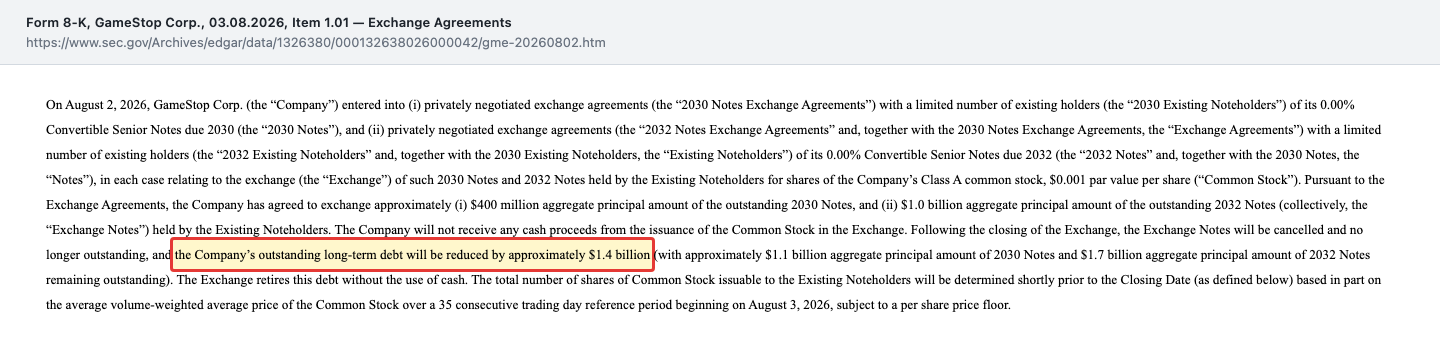
How many shares that would cost was originally to be settled by the volume-weighted average price over 35 consecutive trading days beginning August 3, 2026, with closing planned for September 23, 2026. It did not stay that way. On August 31, 2026 — exactly four weeks into the reference period — GameStop amended the agreements: the remainder of the reference period was terminated, the elapsed portion is still settled in shares, and the rest in cash. In aggregate the holders receive roughly 55.5 million shares (about 73 percent of the consideration) and roughly $358.4 million in cash (about 27 percent). The decisive sentence in the release reads: "No additional shares are issuable in respect of the Exchange." The earnings release of September 8, 2026 confirms that the exchange closed on September 3, 2026 and puts remaining long-term debt at roughly $2.8 billion.
The price of that certainty is cash, which the eBay purchases had already made scarcer. And the dilution is no longer announced but done: Ryan Cohen's beneficial ownership filing of September 3, 2026 — Amendment No. 15 — reports 504,500,979 shares outstanding. On June 5, 2026 the count was 448,691,257. That is 55,809,722 more shares, up 12.4 percent in three months. What triggered the filing is worth noting: Cohen states he had to file solely because the number of shares outstanding had increased — he has not sold a single share, yet his stake fell to 8.3 percent (42,082,626 shares, including 3,734,784 underlying warrants). If you want to know what dilution feels like, this is the most honest answer available: it hits the chief executive too.
Fourth, the room for everything else. At the annual meeting on July 7, 2026 shareholders approved a charter amendment raising authorized capital to 2,500,000,000 shares. Against 504,500,979 shares actually outstanding as of September 3, 2026, that is legal headroom for just under five times the current count. The vote itself is telling: 231,693,497 in favor against 104,566,841 opposed — 68.7 percent of votes cast, by the company's own account — while opposition on the remaining items ranged between 2.7 million and 30.7 million votes. A meaningful slice of GameStop's own shareholders objected. What a debt-for-equity swap eventually does to existing holders is something we worked through at Beyond Meat, where convertible notes redrew the shareholder pie.
Fairness cuts the other way too: on June 2, 2026 the board approved a new $2.0 billion share repurchase authorization. It obliges the company to nothing and can be terminated at any time — but it shows both directions are open.
Uncomfortable truth no. 4: the bitcoin no longer belongs to GameStop on the balance sheet
In the second quarter of fiscal 2025 GameStop bought 4,710 bitcoin for $500 million as a treasury reserve. In the fourth quarter of the same year it pledged 4,709 of them to Coinbase Credit, Inc. in order to write covered calls — a strategy that earns premiums but caps participation in sharp price rises. The decisive sentence is in the annual report:
"Under the terms of the Collateral Agreement, the counterparty retained the right to rehypothecate, commingle, or unilaterally sell the Pledged Bitcoin. As a result of these rights, we concluded that control of the Pledged Bitcoin transferred to the counterparty."
— GameStop Corp., SEC annual report 10-K for fiscal 2025, Item 7 (Digital Assets)

The consequence: the coins were derecognized and replaced by a receivable of $368.3 million — a contractual right to receive an equivalent amount of bitcoin later. Economically, GameStop writes, that still matches direct ownership. In everyday terms: your gold is no longer in your own vault but on loan to a dealer who may re-lend and sell it, against a promise to give you the same amount of gold back one day. As long as the dealer is solvent, those are the same thing. Precisely when he is not, they are not. As of January 31, 2026 an unrealized loss of $59.7 million had also built up on the receivable, because the bitcoin price had fallen since derecognition.
And the bill keeps growing. In its earnings release of September 8, 2026 GameStop puts the loss on "digital assets and related receivables" for the quarter ended August 1, 2026 at $75.0 million — more in a single quarter than the entire unrealized loss accumulated through January 31, 2026 ($59.7 million). A year earlier the same line carried a gain of $28.6 million. Measured against net income of $298.7 million for the same quarter it is roughly a quarter. And the balance sheet now shows what is left: "digital assets and related receivables" stands at $294.1 million as of August 1, 2026, against $368.3 million as of January 31, 2026. The coins have not come back into GameStop's own custody — the position remains a claim on a counterparty, and it is roughly $74 million smaller. The bitcoin is no longer a quiet reserve; it is a line that visibly drags on earnings.
The quarter ended August 1, 2026 — what it changes about this thesis
On September 8, 2026 GameStop released the full figures for the second quarter of fiscal 2026 — the 13 weeks ended August 1, 2026. They replace the preliminary ranges the company had put out eight days earlier as an exhibit to a note-exchange filing. Two things about this publication are worth flagging before a single number lands. First, it again arrived as Exhibit 99.1 to a current report (8-K), not as a quarterly report: no 10-Q for August 1, 2026 had been filed as of September 9, 2026, and the most recent filed one is still the 10-Q as of May 2, 2026. Second, the release carries no conference call, no analyst Q&A and not a single management quote — not a word from chairman and CEO Ryan Cohen about his own numbers. What the company wanted to say sits in four bullets under "Second Quarter Highlights" and nowhere else.
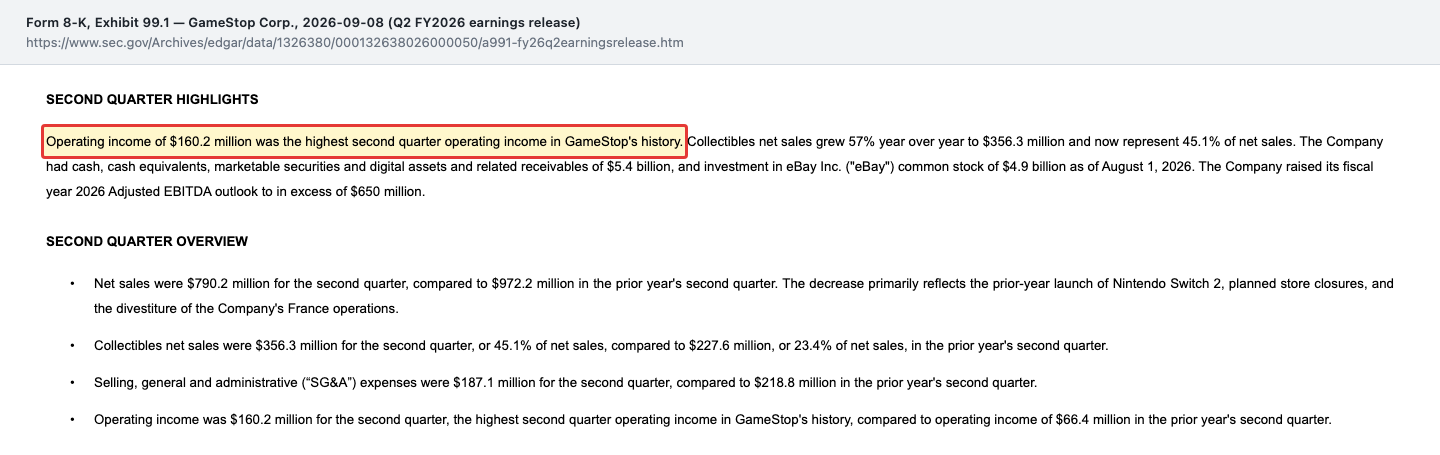
First: the revenue growth was a one-quarter event. Revenue came in at $790.2 million, against $972.2 million in the prior-year quarter — a decline of 18.7 percent. The company names three reasons, and all three hold up: the launch of the Nintendo Switch 2 in the prior-year quarter, planned store closures and the divestiture of the France operations. Two of the three are self-chosen, one is a comparison effect. The finding stands regardless: the 14.0 percent growth of the spring did not continue.
Second: the stores nonetheless earn considerably more — and it is measurable. Operating income reached $160.2 million against $66.4 million a year earlier, on 18.7 percent less revenue. The operating margin climbs from 6.8 to 20.3 percent, gross margin from 29.1 to 43.7 percent. Cost of sales fell from $689.1 million to $445.2 million, SG&A from $218.8 million to $187.1 million. In everyday terms: the store has fewer customers but sells them far more profitable goods and pays less rent. GameStop frames it as a record, verbatim:
"Operating income of $160.2 million was the highest second quarter operating income in GameStop's history."
— GameStop Corp., SEC current report 8-K of September 8, 2026, Exhibit 99.1 (Second Quarter Highlights)
The context belongs next to it: that is a record for a second quarter, not for a quarter outright — the holiday quarter is always the strongest in this business. And it rests on a revenue base that has been shrinking for two years. The statement is accurate and still only half the story.
Third: the basket is a different one — and GameStop has redrawn the books to match. From this quarter the company no longer reports net sales as hardware, software and collectibles, but as Collectibles, Video Games, and Pre-Owned and Refurbished, with prior-year amounts recast. The reason is in the release itself: the new presentation aligns with how management views and operates the business. A look at the result explains why:
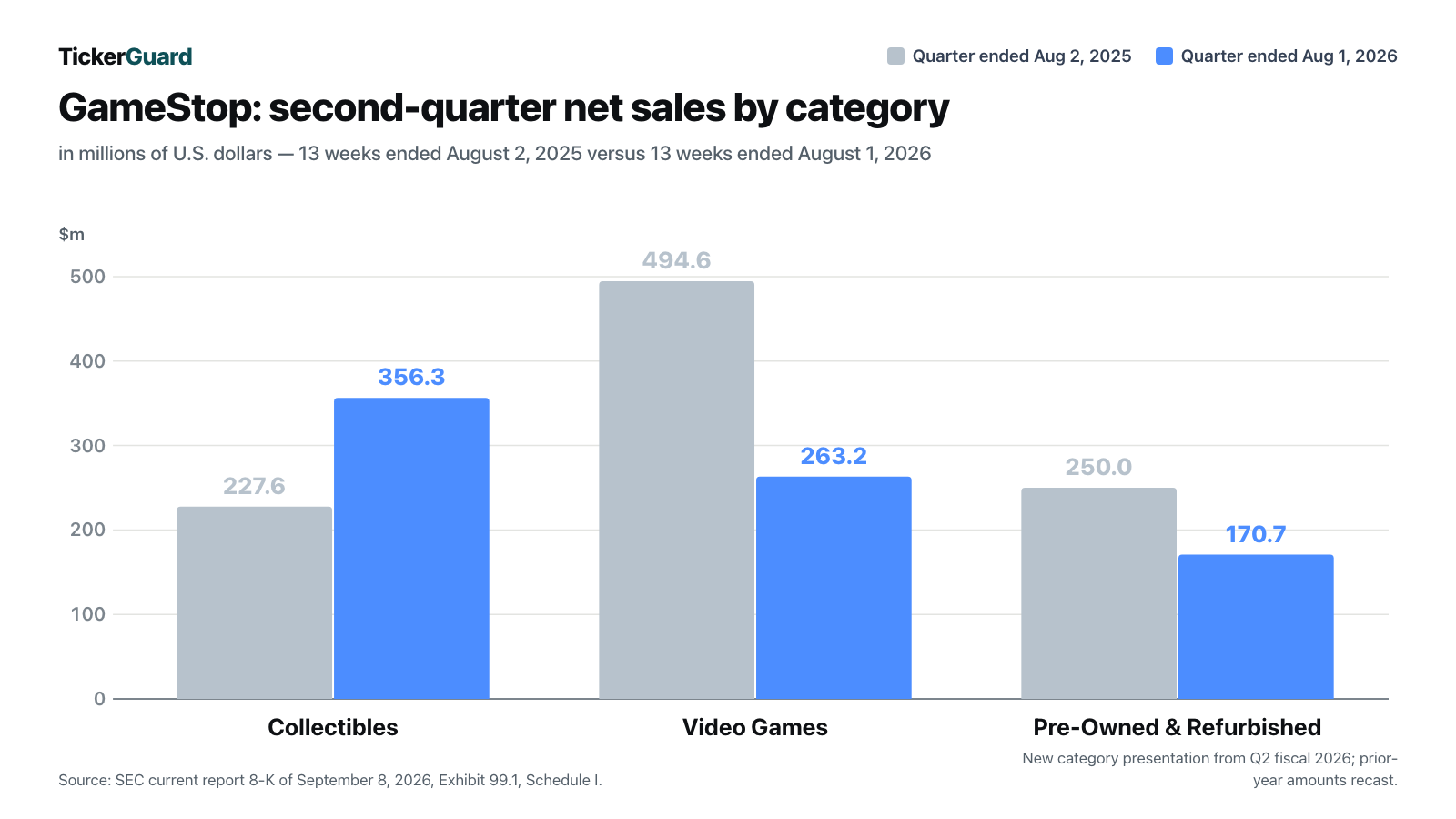
Collectibles grew 57 percent — precisely, from $227.6 million to $356.3 million — and now make up 45.1 percent of net sales, against 23.4 percent a year earlier. Video Games fell from $494.6 million to $263.2 million, down 46.8 percent, leaving them at 33.3 percent of the mix. Pre-Owned and Refurbished slipped from $250.0 million to $170.7 million. The rebuild traced above across three fiscal years has therefore landed in a single quarter: the trading-card counter has overtaken the video-game shelf. That is the real news of this quarter — and it explains the margin better than any cost line, because graded trading cards carry far more spread than a console.
Fourth: where the profit came from. Net income was $298.7 million, against $168.6 million. The sources are now on the record line by line: $160.2 million of operating income, $77.1 million of net interest income, $166.3 million of gains on the eBay derivative, $72.1 million of unrealized gain on the eBay equity investment, $19.5 million of other income — less $75.0 million of losses on digital assets and related receivables. That makes $420.2 million pre-tax, of which $121.5 million goes to tax. So $238.4 million came from the eBay position; netted against the $75.0 million bitcoin loss, a balance of $163.4 million remains — more than half of reported net income. GameStop does the arithmetic itself: stripping those effects out, adjusted net income is $161.1 million rather than $298.7 million, against $138.3 million a year earlier. The spring pattern repeats, on a better foundation.
Two numbers in the same release are easy to skim past. First, tax: $121.5 million of expense against $6.0 million a year earlier — a rate of 28.9 percent instead of 3.4 percent. The release gives no reason for the jump. It does carry a footnote pointing the same way: in the prior-year period there was "no tax impact of non-GAAP adjustments … due to the availability of net operating loss carryforwards and related valuation allowances," while for the current year the company applies a "blended statutory tax rate of approximately 24%." The likely explanation is therefore that the old losses no longer shelter the profit the way they did — certainty comes only when the 10-Q supplies the tax disclosures. Second, cash generation: operations produced only $62.4 million in the quarter, against $117.4 million a year earlier — despite operating income that more than doubled. Free cash flow was $60.7 million against $113.3 million. Over the first half the picture inverts: $399.8 million of operating cash flow against $309.9 million. Looking at one quarter alone, what you mostly see here is tax payments and higher receivables — no cause for alarm, but proof that a record operating income and a record cash inflow are two different things.
Fifth: the open question from the last edition is answered. Nobody knew how much liquidity was left after the billion-dollar purchases. Now it sits in a balance sheet:
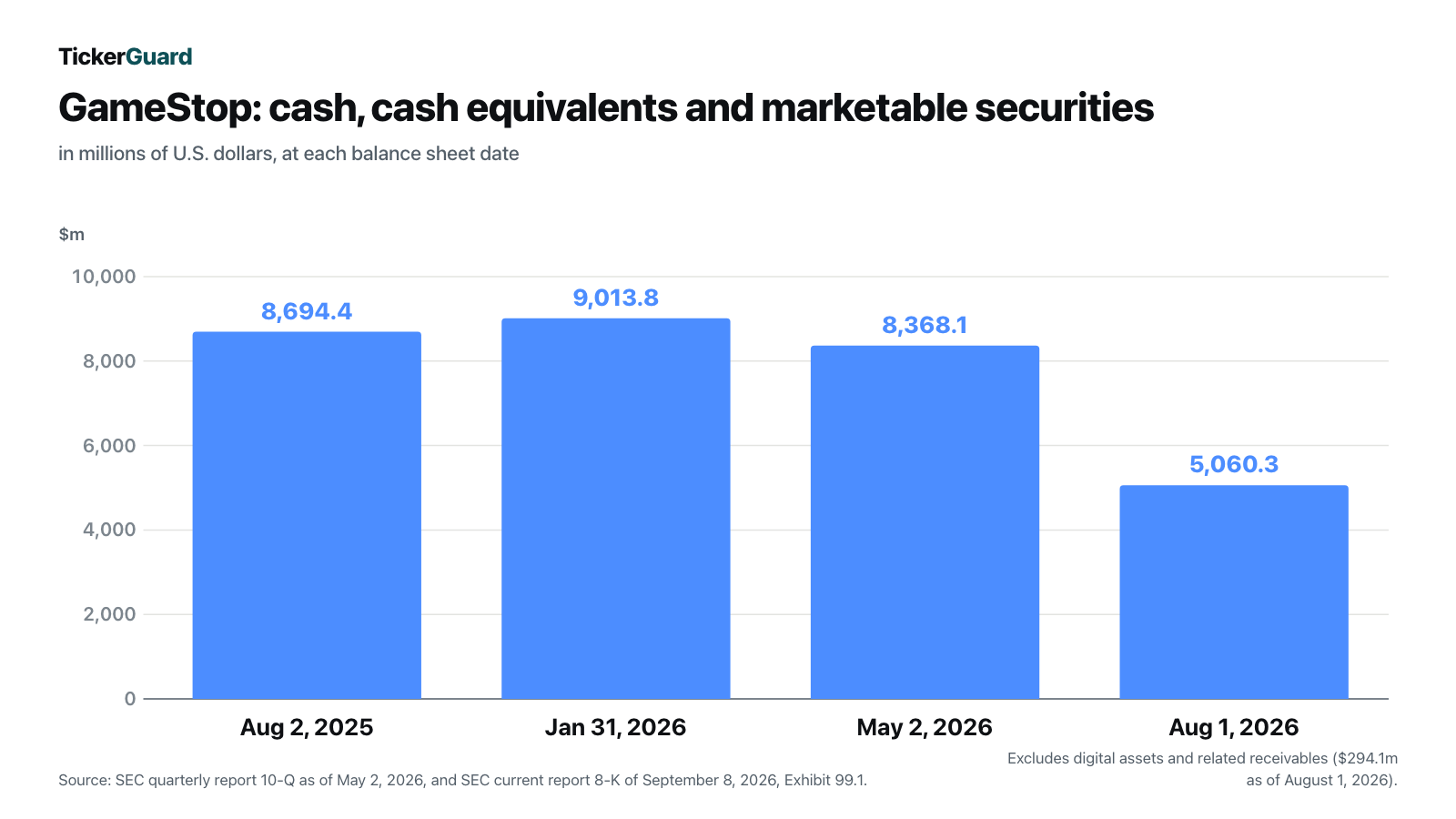
As of August 1, 2026 the balance sheet carried $4,854.3 million of cash and cash equivalents and $206.0 million of marketable securities, or $5,060.3 million together. On top sit $294.1 million of digital assets and related receivables — the bitcoin claim from the chapter above, which stood at $368.3 million as of January 31, 2026. GameStop itself rolls both into "$5.4 billion." On May 2, 2026 cash and marketable securities alone came to $8,368.1 million; a year earlier, $8,694.4 million. The money has not vanished, it has changed form: it now sits as an equity investment of $4,946.9 million on the other side of the same balance sheet. Total assets grew to $11,144.8 million and equity to $6,141.4 million, from $5,842.1 million on May 2. Anyone valuing this company from here on has to hold two numbers side by side — the cash and the price of somebody else's stock.
Sixth: the dilution is done, the debt is halved. The note exchange agreed on August 2, 2026 and amended on August 31 closed on September 3, 2026, per the release: roughly $1.4 billion of principal of the zero-coupon 2030 and 2032 convertible notes has been retired, taking long-term debt down to roughly $2.8 billion. The August 1, 2026 balance sheet still carries $4,167.8 million — that date sits before the closing. The bill was settled with 55.5 million new shares plus $358.4 million in cash; shares outstanding therefore rose to 504,500,979 (September 3, 2026). The $358.4 million of cash still comes out of the figure above; as of August 1, 2026 it was included.
Seventh: the outlook goes up. For the current fiscal year — it ends January 30, 2027 — GameStop now expects adjusted EBITDA in excess of $650 million, up from "in excess of $600 million" in its release of June 26, 2026. After the first half, $339.7 million of that is on the board, against $114.3 million a year earlier. For context: adjusted EBITDA is a measure the company defines itself — it strips out tax, interest, depreciation and, explicitly, the eBay valuation gains and the bitcoin losses. It measures the store, not the portfolio. Which is exactly why the increase is the most robust piece of good news in this quarter — and still a forecast, not a reported figure.
Valuation: what do you get for $9.5 billion?
Market value stands at roughly $9.53 billion. That number is computed, not copied: 504,500,979 shares from the beneficial ownership filing of September 3, 2026, times the closing price of $18.89 on September 8, 2026. We show the arithmetic because our own data source was for a time still working with the old count of 448,691,257 shares and therefore understated market value by roughly a billion dollars. Anyone taking a market value from a database should check the share count against the latest filing — otherwise the gap propagates into every ratio derived from it.
More honest than any multiple is the question of what sits inside the package. Add it up, each figure with its own date: $5.06 billion of cash and marketable securities (August 1, 2026), plus $0.29 billion of digital assets and related receivables (August 1, 2026), minus roughly $0.36 billion of cash paid for the note exchange (September 3, 2026), plus $4.95 billion of eBay shares at carrying value (August 1, 2026), minus roughly $2.8 billion of remaining convertible notes at face value. That leaves broadly $7.14 billion of financial assets net of financial debt. The rest of the market value — roughly $2.39 billion — is what the market pays for the retail business, the brand and the warrants. For an operation that produced $232.1 million of operating income in fiscal 2025, that is roughly ten times. Two caveats keep the arithmetic honest: the $0.29 billion of digital assets is not cash but a claim on a single counterparty. And operating income is currently running much higher — $303.5 million in the first half of fiscal 2026 against $55.6 million a year earlier. Anyone extrapolating that should know the holiday quarter decides everything in this business and does not appear in the first half at all.
A few lines on the balance sheet so the magnitudes are right: as of August 1, 2026, total assets of $11,144.8 million stood against liabilities of $5,003.4 million, leaving equity of $6,141.4 million, up from $5,842.1 million on May 2, 2026. On that basis the stock trades at roughly 1.55 times book. That ratio has a catch worth knowing: it does not yet include the September 3, 2026 note exchange, which turned $1.4 billion of debt into equity. A price-earnings ratio does not help either, as long as earnings consist largely of valuation effects that can flip either way. For the current fiscal year, the company has guided since September 8, 2026 to adjusted EBITDA in excess of $650 million, raised from in excess of $600 million and against $345.4 million in fiscal 2025 — a forecast, not a reported figure.
What is still outstanding is the formal quarterly report: no 10-Q for August 1, 2026 had been filed as of September 9, 2026. It will bring the note disclosures an earnings release does not carry — the footnote on the bitcoin receivable, the share count on the cover page, the disclosures on the eBay investment and the warrants. Until then: the figures in this chapter come from a company release, not from a filed report.
Opportunities and risks at a glance
What speaks for GameStop:
- Operations have turned — and keep improving: operating income moved from a loss of $26.2 million in fiscal 2024 to a profit of $232.1 million in fiscal 2025, and operating cash flow from negative $203.7 million in fiscal 2023 through $145.7 million to $614.8 million. In the quarter ended August 1, 2026 operating income rose to $160.2 million against $66.4 million a year earlier — on 18.7 percent less revenue, and by the company's own account its highest second quarter ever; in the first half of fiscal 2026 it stands at $303.5 million against $55.6 million.
- Margins follow the rebuild: gross margin rose from 29.1 percent (fiscal 2024) to 33.0 percent (fiscal 2025), to 40.7 percent in the quarter ended May 2, 2026 and to 43.7 percent in the quarter ended August 1, 2026 against 29.1 percent a year earlier; the operating margin stands at 20.3 percent against 6.8 percent.
- A viable second leg that is now the largest category: Collectibles grew 57 percent to $356.3 million in the quarter ended August 1, 2026 and make up 45.1 percent of net sales, against 23.4 percent a year earlier; the store network doubles as an intake and payout point for graded trading cards.
- A balance sheet under no pressure: $6,141.4 million of equity as of August 1, 2026 on total assets of $11,144.8 million; debt consisting solely of zero-coupon convertible notes maturing in 2030 and 2032 — of which only about $2.8 billion of face value remains after the exchange closed on September 3, 2026, with no interest expense and no near-term repayment.
- Guidance for the current fiscal year raised on September 8, 2026: adjusted EBITDA in excess of $650 million instead of $600 million, against $345.4 million in fiscal 2025; $339.7 million has already accrued in the first half. Plus a $2.0 billion repurchase authorization dated June 2, 2026.
What speaks against it:
- The growth was a one-quarter event: after 14.0 percent in the quarter ended May 2, 2026, revenue fell to $790.2 million in the quarter ended August 1, 2026, against $972.2 million — a decline of 18.7 percent. Video Games, until now the largest category, collapsed 46.8 percent to $263.2 million.
- Earnings still rest on valuation effects: net income of $298.7 million for the quarter ended August 1, 2026 includes $238.4 million of gains on the eBay position and $75.0 million of losses on digital assets — a balance of $163.4 million that can reverse. Stripping those out, GameStop itself reports adjusted net income of only $161.1 million.
- Concentration risk running into the billions: roughly 43.4 million eBay shares carried at $4,946.9 million as of August 1, 2026 — more than half of GameStop's own market value of roughly $9.53 billion in a single foreign security, bought against the stated wishes of a target that rejected the proposal on May 12, 2026.
- The dilution is done, not averted: shares outstanding rose from 448,691,257 (June 5, 2026) to 504,500,979 (September 3, 2026), up 12.4 percent. On top sit 59.1 million warrants ($32.00, expiring October 30, 2026) and authorized capital of 2.5 billion shares — approved against 104.6 million votes opposed. Diluted earnings for the quarter ended August 1, 2026 already run on 592.6 million shares against 448.8 million actual.
- The retail core is still shrinking in substance: revenue down from $5,272.8 million in fiscal 2023 to $3,629.9 million in fiscal 2025 and to $1,625.5 million in the first half of fiscal 2026 from $1,704.6 million; Nintendo, Sony and Pokemon supply the majority of new product. Operations produced only $62.4 million of cash in the quarter ended August 1, 2026, against $117.4 million a year earlier.
- Custody risk on the bitcoin: 4,709 of 4,710 coins sit with Coinbase Credit, which may rehypothecate, commingle or unilaterally sell them; on the balance sheet they are derecognized and replaced by a receivable carried at $294.1 million as of August 1, 2026, down from $368.3 million as of January 31, 2026 — after a further $75.0 million loss in the quarter ended August 1, 2026.
- The tax burden has jumped: tax expense came to $121.5 million in the quarter ended August 1, 2026, against $6.0 million a year earlier — a rate of 28.9 percent instead of 3.4 percent. The release gives no reason; for the current year it points to a blended statutory rate of approximately 24 percent. If that holds, future profits will reach the bottom line far less completely.
A human conclusion
Back to the legend trap. Its core is not that the legend is false — January 2021 really did happen the way everyone tells it. Its core is that a story stays fixed in memory while the company keeps moving. Today's GameStop is no longer a besieged video game retailer. It is a much smaller but profitable retailer with a surprisingly strong trading-card business — and, beside it, an investment operation with billions behind it, interest-free debt, a bitcoin holding in somebody else's custody, and a block of roughly 43.4 million shares in a company that wants nothing to do with the takeover. Both belong to this stock, inseparably.
The quarter ended August 1, 2026 sharpened both halves again. The retailer is better than its revenue line looks: 18.7 percent less revenue, yet by the company's own account its best second quarter ever — and the trading-card counter has overtaken the video-game shelf. The investment arm now sits in a balance sheet: $3.3 billion of cash became a block of stock carried at $4,946.9 million, whose value is re-established every day on somebody else's exchange. And the share count your ownership hangs on rose 12.4 percent in three months — including for the chief executive, who had to file a disclosure because of it. About all of this, management has said nothing in public: there was no conference call and no quote in the company's own release.
So the honest question is not "Is GameStop back?" but: do you want to be a part-owner of a restructured retailer and, at the same time, a silent partner in a takeover fight driven by one person, whose outcome lands in your quarterly profit? If yes, you know both halves and you have a thesis. If no, you had a legend. What you do with that is your call. And that is exactly as it should be.
Sources
Every original document used in this analysis — to read for yourself:
- GameStop Corp. — SEC quarterly report 10-Q as of May 2, 2026 (filed June 11, 2026)
- GameStop Corp. — SEC annual report 10-K for fiscal 2025, balance sheet date January 31, 2026 (filed March 24, 2026)
- GameStop Corp. — SEC current report 8-K of May 4, 2026: non-binding proposal at $125.00 per eBay share
- GameStop Corp. — SEC Schedule 13D/A No. 4 on eBay Inc. (filed July 17, 2026)
- GameStop Corp. — SEC current report 8-K of August 3, 2026: exchange of $1.4 billion of convertible notes for stock
- GameStop Corp. — SEC current report 8-K of September 8, 2026, Exhibit 99.1: full second-quarter fiscal 2026 results (13 weeks ended August 1, 2026), including balance sheet, cash flow statement and the recast sales categories
- GameStop Corp. — SEC current report 8-K of September 8, 2026, Item 2.02: announcement of second-quarter results
- GameStop Corp. — SEC current report 8-K of August 31, 2026, Exhibit 99.1: preliminary results for the quarter ended August 1, 2026
- GameStop Corp. — SEC current report 8-K of August 31, 2026, Exhibit 99.2: amendment to the note exchange, 55.5 million shares plus $358.4 million in cash
- Ryan Cohen — SEC Schedule 13D/A No. 15 on GameStop Corp. (filed September 3, 2026): 504,500,979 shares outstanding
- GameStop Corp. — SEC current report 8-K of July 8, 2026: annual meeting, authorized capital of 2.5 billion shares
- GameStop Corp. — SEC current report 8-K of June 26, 2026: guidance for adjusted EBITDA above $600 million
- GameStop Corp. — SEC Rule 425 communication of July 17, 2026: transcript of the July 16, 2026 television interview with Ryan Cohen
- GameStop Corp. — SEC Rule 425 communication of July 20, 2026: newspaper interview with Ryan Cohen of July 19, 2026
- Complete SEC filing history of GameStop Corp.: EDGAR overview (sec.gov)
- Fundamental data (closing price $18.89 of September 8, 2026; data as of September 9, 2026), reconciled with the SEC filings and the SEC XBRL financial series. The market value used in this analysis is computed from the share count in the beneficial ownership filing of September 3, 2026.
Transparency & disclaimer: this analysis is journalistic commentary on publicly available information. It is not investment advice, not a regulated financial analysis, and not a solicitation to buy or sell securities. Equity investments carry substantial risk up to and including total loss. All information is provided without warranty; the data cut-off is noted in the text. The author holds no position in GameStop shares at the time of publication.
Key figures at a glance
All monetary figures in millions of $; earnings per share as reported.
| Metric | 2022 | 2023 | 2024 | 2025 | 2026 |
|---|---|---|---|---|---|
| Revenue | 6,010.7 | 5,927.2 | 5,272.8 | 3,823.0 | 3,629.9 |
| Operating Income (EBIT) | -368.5 | -311.6 | -34.5 | -26.2 | 285.9 |
| Net Income | -381.3 | -313.1 | 6.7 | 131.3 | 418.4 |
| Net Margin | -6.3% | -5.3% | 0.1% | 3.4% | 11.5% |
| Earnings Per Share | -1.31 $ | -1.03 $ | 0.02 $ | 0.33 $ | 0.76 $ |
Source: fundamental data & SEC filings (annual and quarterly reports, 10-K/10-Q)
Our Bottom Line at a Glance
- Retail business neutral
- Less revenue, considerably more profit. Operating income moved from a loss of $26.2 million in fiscal 2024 to a profit of $232.1 million in fiscal 2025, and rose to $160.2 million in the quarter ended August 1, 2026 from $66.4 million a year earlier — by the company's own account its highest second quarter ever; the operating margin climbs from 6.8 to 20.3 percent, gross margin from 29.1 to 43.7 percent. The category swap carries it: Collectibles grew 57 percent to $356.3 million and are the largest category for the first time at 45.1 percent of net sales. At the same time the 14.0 percent growth of the spring quarter stayed a one-off: revenue fell to $790.2 million from $972.2 million, down 18.7 percent. Reasons given: the prior-year Nintendo Switch 2 launch, planned store closures, the divestiture of the France operations.
- Quality of earnings negative
- Of $506.4 million in pre-tax income for the quarter ended May 2, 2026, only $143.3 million came from operations; $268.4 million was an unrealized mark-to-market gain on eBay options. The ratio shifts in the quarter ended August 1, 2026 without turning around: $160.2 million of $420.2 million pre-tax income came from operations (38 percent), $238.4 million from the eBay position, offset by $75.0 million of losses on digital assets. Stripping those out, GameStop itself reports adjusted net income of only $161.1 million against $298.7 million reported. These effects can reverse in any quarter. New alongside them: tax expense came to $121.5 million against $6.0 million — the release gives no reason for it — and operations produced only $62.4 million of cash against $117.4 million a year earlier.
- Capital allocation negative
- A good $4.3 billion flowed into roughly 43.4 million eBay shares in two months; the August 1, 2026 balance sheet carries them as an equity investment of $4,946.9 million — more than half of GameStop's own market value of roughly $9.53 billion (504,500,979 shares as of September 3, 2026, closing price $18.89 on September 8, 2026). eBay had rejected the takeover proposal of $125.00 per share on May 12, 2026. Cash and marketable securities fell in the same move from $8,368.1 million (May 2, 2026) to $5,060.3 million.
- Dilution negative
- It is done, not averted: shares outstanding rose from 448,691,257 (June 5, 2026) to 504,500,979 (September 3, 2026), up 12.4 percent. The cause is the note exchange, which the earnings release of September 8, 2026 confirms closed on September 3: roughly 55.5 million new shares plus roughly $358.4 million in cash. Diluted earnings for the quarter ended August 1, 2026 already run on 592.6 million shares against 448.8 million actual. Still outstanding are 59.1 million warrants at $32.00 expiring October 30, 2026; authorized capital has stood at 2.5 billion shares since July 7, 2026 — approved against 104.6 million votes opposed.
- Balance sheet & funding positive
- As of August 1, 2026 the balance sheet carried $6,141.4 million of equity on total assets of $11,144.8 million, and debt consists exclusively of convertible notes with a coupon of 0.00 percent maturing in 2030 and 2032. After the exchange that closed on September 3, 2026 only about $2.8 billion of face value remains. There is no meaningful interest expense, no near-term repayment and no going-concern indication; as of August 1, 2026 cash and marketable securities stood at $5,060.3 million, plus $294.1 million of digital assets and related receivables.
- Custody of digital assets negative
- Of 4,710 bitcoin bought for $500 million, 4,709 are pledged to Coinbase Credit, which may rehypothecate, commingle or unilaterally sell them. GameStop therefore derecognized them and reports a receivable instead: $368.3 million as of January 31, 2026, already carrying $59.7 million of unrealized loss — and only $294.1 million as of August 1, 2026 after a further $75.0 million of losses on digital assets and related receivables in that quarter. A year earlier the same line showed a gain of $28.6 million. The coins have not returned to GameStop's own custody.
GameStop is two companies in one today. The first is a much smaller but increasingly profitable retailer: operating income turned from a loss of $26.2 million to a profit of $232.1 million, then reached $160.2 million in the quarter ended August 1, 2026 against $66.4 million — by the company's own account its best second quarter ever, on revenue that fell from $972.2 million to $790.2 million. Collectibles carry it, the largest category for the first time at $356.3 million and 45.1 percent of net sales. The second is an investment operation with interest-free billions in debt, a bitcoin holding in outside custody, and roughly 43.4 million eBay shares carried at $4,946.9 million — more than half its own market value of roughly $9.53 billion, bought against the stated wishes of the target. Cash and marketable securities fell to $5,060.3 million in exchange, and the share count rose 12.4 percent in three months. Not investment advice.
What Our Rating Means
Open questions
The business works in principle, but one material question is open. As long as it stays open, our findings do not carry a quality verdict.
There is still no documented case for red: $6,141.4 million of equity (August 1, 2026), debt consisting solely of zero-coupon convertible notes maturing in 2030 and 2032 — about $2.8 billion of face value after the exchange closed on September 3, 2026 — $5,060.3 million of cash and marketable securities as of August 1, 2026, and no going-concern indication anywhere. But green would require answers to two open operating questions, and the quarter ended August 1, 2026 sharpened rather than settled them. First, retail has not returned to a growth path: 14.0 percent growth in the quarter ended May 2, 2026 was followed by a decline of 18.7 percent — profitability improved markedly and reached what the company calls its best second quarter ever, but the revenue base keeps shrinking and Video Games, the former lead category, collapsed 46.8 percent. Second, earnings still hang on items that have nothing to do with the stores: $238.4 million of gains on the eBay position against $75.0 million of losses on digital assets — strip them out and $298.7 million of net income becomes $161.1 million — and more than half the market value sits in one foreign security whose issuer rejected the takeover. Those are open operating questions, not a documented threat to the substance of the business — hence yellow. The decision is yours.
A journalistic assessment by our editorial team at the time of the deep dive, based on public sources — not investment advice and not a solicitation to buy or sell. Your personal circumstances (investment goals, risk capacity, taxes) cannot be taken into account. What our levels mean, how verdicts are formed, and what conflicts of interest exist →
Worth Noting
- The hook for this analysis is the SEC current report 8-K of May 4, 2026, in which GameStop disclosed its non-binding proposal of $125.00 per eBay share — not a scanner hit. The decisive developments of 2026 are not in the quarterly report but in the filings between them: Schedule 13D amendments, more than two dozen Rule 425 communications, and results releases that arrive as exhibits to current reports rather than as filed quarterly reports.
- Data as of September 9, 2026. The most recent filed quarterly report is the 10-Q as of May 2, 2026 (filed June 11, 2026); no 10-Q for August 1, 2026 had been filed as of September 9, 2026. Every filing submitted afterwards through September 8, 2026 was reviewed and, where it changes the picture, incorporated: the 8-K filings of June 2 (repurchase authorization), June 23 (withdrawal of the compensation resolution), June 26 (guidance), July 8 (annual meeting, authorized capital), August 3 (note exchange), August 31 (preliminary quarterly figures and amended exchange) and September 8 (second-quarter earnings release, Item 2.02), plus Schedule 13D/A No. 4 on eBay of July 17 and Schedule 13D/A No. 15 on GameStop of September 3.
- The figures for the quarter ended August 1, 2026 come from the earnings release of September 8, 2026 (Exhibit 99.1 to a current report on Form 8-K). They replace the preliminary ranges of August 31, 2026 and include the balance sheet, cash flow statement, segment data and the recast sales categories — but they remain a company release, not a filed quarterly report. There was no conference call and no management quote accompanying them.
- The market value of roughly $9.53 billion is computed here rather than taken from a data feed: 504,500,979 shares from the beneficial ownership filing of September 3, 2026 times the closing price of $18.89 on September 8, 2026. Our own data source was for a time still working with 448,691,257 shares and therefore understated market value by roughly a billion dollars; anyone taking a market value from a database should check the share count against the latest filing.
- GameStop recast its sales categories with the quarter ended August 1, 2026 — from hardware, software and collectibles to Collectibles, Video Games, and Pre-Owned and Refurbished, with prior-year amounts restated. The full-year figures in this analysis for fiscal 2023 through 2025 therefore still use the old presentation and are not directly comparable with the new quarterly split.
- Easily confused: two GameStop securities trade on the NYSE — the common stock under GME and the warrants under GME WS (exercise price $32.00, expiring October 30, 2026). Anyone comparing "GME" should check which of the two is meant.
Stock Watch
This analysis is as of September 9, 2026. Stock Watch will tell you what's changed at GME since then.
Later $1 a month per stock — signing up is free, and you'll be the first to know when it launches.
The full analysis as a PDF for later
We will send you this analysis as a PDF — to print, file away, and read at your own pace. And we will add you to the free Stock Watch list for GameStop Corp. (GME), so you hear about it when something material in this analysis changes.
Frequently Asked Questions
GameStop Corp. (NYSE: GME) sells video games, consoles, accessories and collectibles. As of January 31, 2026 it ran 2,206 stores — 1,598 in the United States, 308 in France, 300 in Australia; the France operations have since been divested. It also buys used product and graded trading cards over the counter. From the quarter ended August 1, 2026 the company reports net sales in three new categories — Collectibles ($356.3 million, 45.1 percent of the mix), Video Games ($263.2 million, 33.3 percent) and Pre-Owned and Refurbished ($170.7 million, 21.6 percent); Collectibles are the largest category for the first time. In the quarterly report as of May 2, 2026 GameStop additionally describes itself as a capital allocator: its own liquidity is "a strategic asset" for investments, acquisitions and control transactions.
Per the earnings release of September 8, 2026, revenue fell to $790.2 million, against $972.2 million in the prior-year quarter — a decline of 18.7 percent. Operating income rose to $160.2 million from $66.4 million, which the company calls its highest second quarter on record; net income came in at $298.7 million against $168.6 million, adjusted net income at $161.1 million. Cash and marketable securities stood at $5,060.3 million against $8,694.4 million a year earlier, plus $294.1 million of digital assets and related receivables. No formal quarterly report (10-Q) for that date had been filed as of September 9, 2026.
Mostly not from the stores. In the quarter ended May 2, 2026, only $143.3 million of the $506.4 million in pre-tax income came from operating income; $83.7 million came from interest, $268.4 million from an unrealized mark-to-market gain on eBay options and $11.0 million from bitcoin and other income. In the quarter ended August 1, 2026 the ratio shifted somewhat: $160.2 million of the $420.2 million pre-tax income came from operations, or 38 percent. $238.4 million came from the eBay position, offset by $75.0 million of losses on digital assets — a net $163.4 million, more than half of the $298.7 million of net income. Stripping those out, GameStop itself reports adjusted net income of $161.1 million.
On May 3, 2026 GameStop proposed to acquire all of eBay at $125.00 per share; eBay rejected the proposal on May 12, 2026. GameStop kept building the position anyway. Per Schedule 13D/A No. 4 of July 17, 2026 it holds 43,390,383 eBay shares, or 9.8 percent. For the 39,046,658 shares physically settled in July alone it paid $3,965,077,113.19 from working capital, plus $381.3 million in June. On the August 1, 2026 balance sheet the block appears as an equity investment of $4,946.9 million.
448,691,257 shares were outstanding on June 5, 2026; by September 3, 2026 the count was 504,500,979 — up 12.4 percent in three months. The cause is the exchange of roughly $1.4 billion of convertible notes, which closed on September 3, 2026 at roughly 55.5 million new shares plus roughly $358.4 million in cash and took long-term debt down to roughly $2.8 billion. Still outstanding are 59.1 million warrants at $32.00 expiring October 30, 2026; authorized capital has stood at 2.5 billion shares since July 7, 2026. The stake of chairman and CEO Ryan Cohen fell to 8.3 percent as a result, without him selling a share.
At the end of January or beginning of February. Fiscal 2025 ran from February 2, 2025 to January 31, 2026 and therefore covers essentially calendar year 2025. The current fiscal 2026 ends January 30, 2027; its first quarter ran from February 1 to May 2, 2026, its second from May 3 to August 1, 2026. Anyone comparing GameStop figures should therefore check the balance sheet date rather than the year in the report title.
GameStop bought 4,710 bitcoin for $500 million and pledged 4,709 of them to Coinbase Credit in order to write covered call options. Because the counterparty may rehypothecate, commingle or unilaterally sell the coins, control passed to it, per the annual report. GameStop derecognized the bitcoin and instead reports a receivable. It stood at $368.3 million as of January 31, 2026 with $59.7 million of unrealized loss, and at only $294.1 million as of August 1, 2026 after a further $75.0 million loss on digital assets and related receivables in that quarter. The coins have not returned to GameStop's own custody.
Market value stands at roughly $9.53 billion — computed from 504,500,979 shares (September 3, 2026) and the closing price of $18.89 (September 8, 2026). Against that sit $5.06 billion of cash and marketable securities (August 1, 2026), $0.29 billion of digital assets, $4.95 billion of eBay shares at carrying value, minus $0.36 billion of cash paid for the note exchange and minus roughly $2.8 billion of remaining convertible notes. That leaves roughly $2.39 billion for the retail business itself — about ten times the $232.1 million of operating income from fiscal 2025. A price-earnings ratio does not help, because earnings consist largely of valuation effects; price-to-book is roughly 1.55 on $6,141.4 million of equity as of August 1, 2026.
Found an error?
Did you spot a factual error, an outdated number, or a typo in this deep dive? Let us know briefly — your report goes straight to the editorial team.