Beyond Meat: The Only Profit in Company History Came From Writing Off Debt
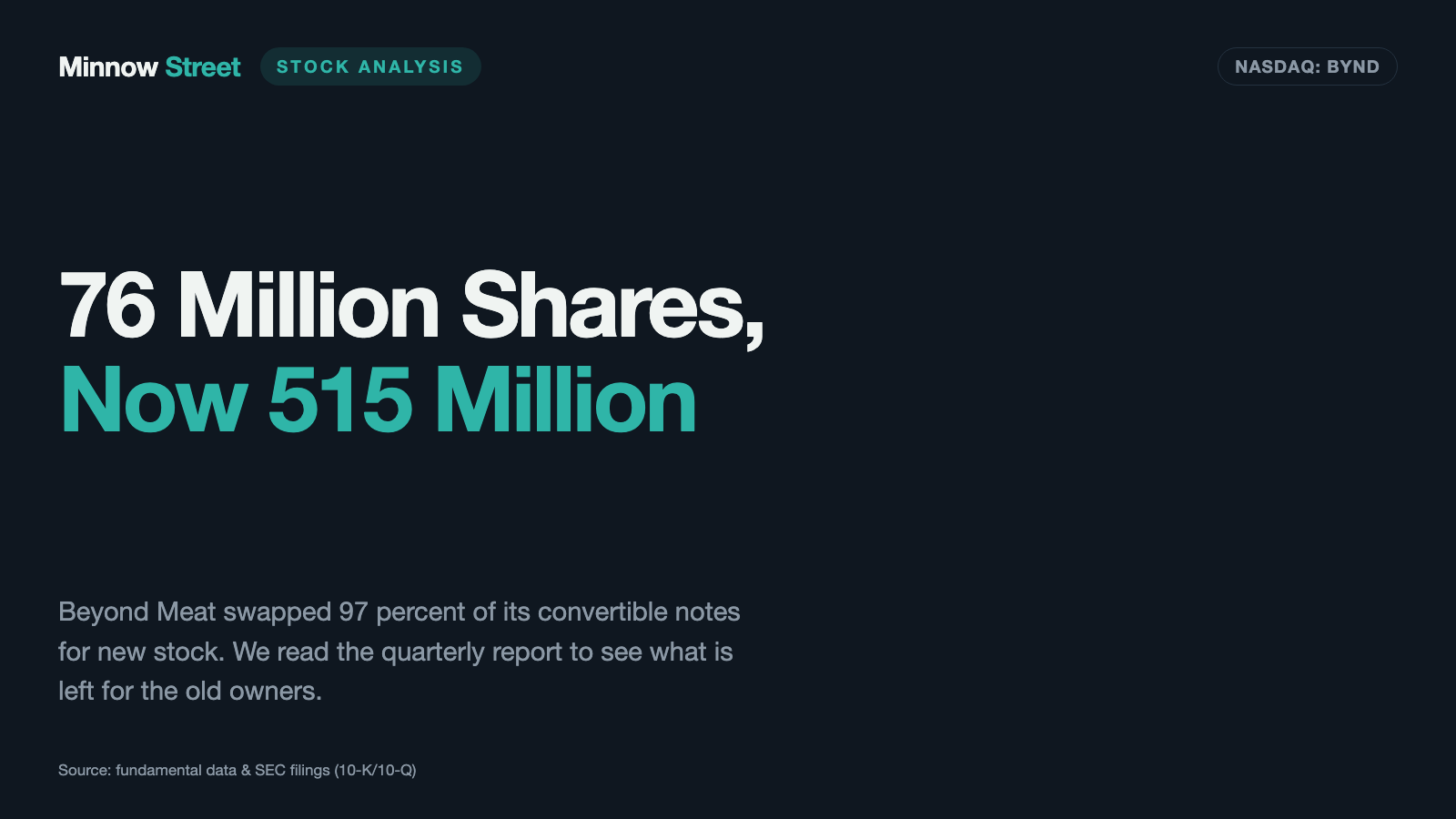
In 2025 Beyond Meat reported a full-year profit for the first time ever: $219.0 million. The annual report itself explains where it came from — $548.7 million of it is a book gain on the exchange of the company's convertible notes. The operating business lost $333.6 million in the same year and burned $144.9 million of cash. Existing shareholders paid for the swap: 76,065,969 shares as of December 31, 2024 became 515,342,392 by May 6, 2026, and equity stood at negative $21.1 million on March 28, 2026. We simply read what the company filed — and who owns the place now.
 Thomas Mücke
Founder & Publisher
Thomas Mücke
Founder & Publisher
As of Today
As of: September 18, 2026
- Closing price
- 11.50 $ -1.60%
- Market Capitalisation
- 0.2 $B
- Growth Score
- 2/10
- AAQS
- 1/10
This analysis has a cut-off date. The Stock Guard tells you when something material changes in the numbers. Reserve your free spot
Chart
Interactive price chart (TradingView).
52-week range: 0.407 $ to 14.80 $ · Last price: 11.50 $ (As of: September 18, 2026)
Note: pure fact-based analysis, not investment advice and not a solicitation to buy or sell. All figures without guarantee.
There is an investor trap that needs no greed at all, only a good memory: the anchoring trap. It works like this. You watched an IPO electrify Wall Street in 2019, you saw plant-based patties appear on every burger menu, you remember a small California company becoming the symbol of an entire shift in how people eat. Years later the same stock trades at a fraction of that price, and your brain fills in the rest: "It has never been this cheap." What your brain leaves out is that the yardstick itself moved. In October 2025 Beyond Meat (NASDAQ: BYND) exchanged almost its entire convertible bond for new stock, turning 76 million shares into more than 500 million. So let us make a deal. Before you compare the old price with the new one, we will read together what Beyond Meat told the U.S. securities regulator, the SEC: the annual report on Form 10-K for 2025 filed April 9, 2026, the quarterly report on Form 10-Q for the period ended March 28, 2026 filed May 7, 2026, and everything that has been filed since. An SEC filing is honest under penalty of law. What you make of it is up to you.
What Beyond Meat actually does — meat from peas, and now drinks
Beyond Meat makes plant-based meat. The underlying idea is a kitchen trick at industrial scale: pea protein and other plant ingredients are pressed and heated until the result behaves like muscle fiber when you chew it. That output reaches the market through three platforms — beef, pork and poultry — meaning burger patties, sausage and chicken pieces. Two channels carry the products: retail (grocery, mass merchandisers, club stores, natural retailers) and foodservice, which covers restaurants, catering and schools. Geographically the business splits roughly in half between the United States and international markets, which in practice means Europe; operations in China were shut down in 2025. For reporting purposes all of it sits in a single segment.
One key raw material comes from a single supplier. On March 28, 2026 Beyond Meat signed a sales agreement with the French group Roquette Frères for pea protein running to December 31, 2027, with minimum purchases totaling roughly $23.5 million over the term and liquidated damages if the company buys less. A $1.0 million standby letter of credit had to be posted as security. On the selling side the dependency runs the other way: one distributor accounted for about 11 percent of gross revenues in the first quarter of 2026 (14 percent a year earlier).
Since 2026 the company has been trying to reinvent itself: "Beyond Meat" is to become "Beyond The Plant Protein Company" — plant protein rather than only plant-based meat. The first visible step is Beyond Immerse, a line of still and sparkling plant protein drinks. On April 15, 2026 the beverage distributor Big Geyser was appointed exclusive distributor for a defined territory in the northeastern United States, for an initial term of ten years with automatic eight-year renewals. That frames the central tension of this analysis, and it runs through every chapter: the company is working on its future while its past has already been decided by somebody else — the creditors.
How this stock landed on our desk — through a warning letter, not a price chart
Beyond Meat did not arrive through a momentum or value scanner but through the daily review of mandatory SEC filings. On April 9, 2026 the company filed a current report on Form 8-K under Item 3.01 — the heading reserved for "Notice of Delisting or Failure to Satisfy a Continued Listing Rule." The substance: on April 6, 2026 Nasdaq had notified Beyond Meat that it was out of compliance because the annual report for 2025 had not been filed on time. The company would have had to submit a compliance plan by June 5, 2026; because it filed the report on April 9, the matter resolved itself the same day.
A company that cannot close its own books on schedule always deserves a second look — usually a hard accounting question sits behind it. Here it did, and the answer lives in two chapters of the report that we will come to shortly. Note the finding right at the outset: a late annual report is rarely a calendar problem and almost always a balance-sheet problem. And because the source here is a regulator's calendar entry rather than a price chart, the usual caution applies twice over. Conventional ratios mislead at Beyond Meat right now. A price-to-earnings ratio built on the 2025 "profit" would simply be wrong, and a price-to-sales ratio ignores the debt. So we take the filings instead.
The numbers over the years — given their due
Start with what genuinely impresses, because it is more than the stock's reputation suggests. Beyond Meat has pulled off the trick of cutting costs faster than its revenue is shrinking. In the first quarter of 2026 (ended March 28, 2026) the company reported a positive gross profit of $1.985 million after a gross loss of $6.926 million a year earlier — a margin swing from negative 10.1 percent to positive 3.4 percent. The operating loss over the same period shrank from $64.4 million to $41.1 million, research and development spending from $7.5 million to $5.2 million, and selling, general and administrative expenses from $50.0 million to $37.9 million. The cash figure is the most striking: cash used in operating activities in the first quarter of 2026 was just $5.0 million, against $26.1 million a year earlier. If you are looking for a company that can cut, this is one.
Cutting, however, is not a business model. The revenue curve shows what all that cutting is fighting against.
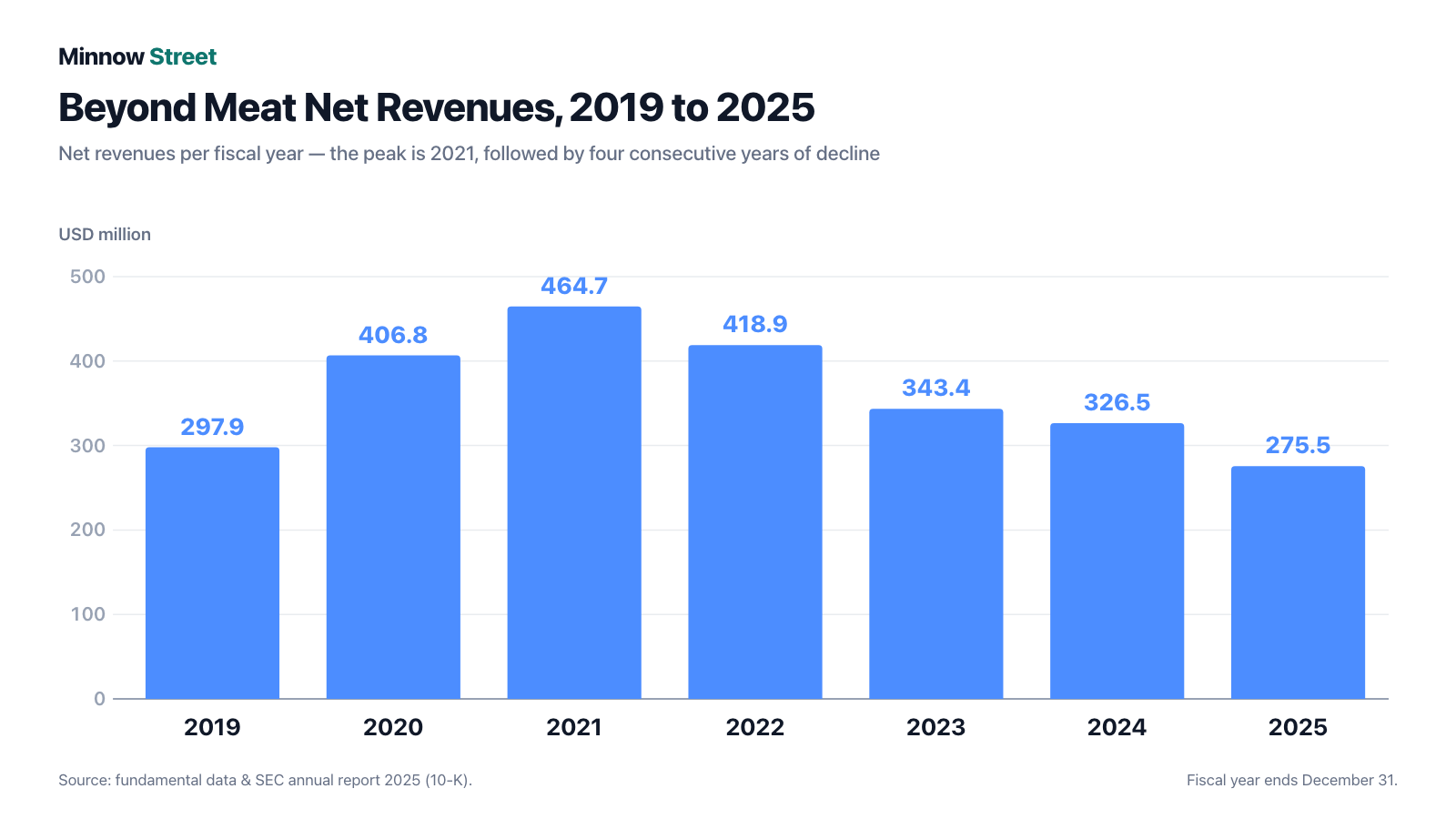
The climb was steep: $297.9 million in the IPO year of 2019, $406.8 million in 2020, then the peak of $464.7 million in 2021. It has gone one way ever since. In 2025 alone revenue fell 15.6 percent to $275.5 million, and the reason is uncomfortably clear: the company simply sold 15.9 percent less product. Net revenue per pound actually rose slightly, by 0.4 percent, so this is a volume problem rather than a price problem. U.S. retail took the hardest hit (down 17.5 percent to $124.5 million), followed by U.S. foodservice (down 18.1 percent to $39.0 million); international revenue fell more gently, by 12.5 percent to $112.1 million. The first quarter of 2026 continued the pattern: $58.2 million against $68.7 million, down 15.3 percent.
And the gross margin, encouraging as its first-quarter 2026 recovery is, has a history worth knowing. In 2023 it stood at negative 24.1 percent — the company was selling its products for less than they cost to make. In 2024 it was positive 12.8 percent, in 2025 only positive 2.8 percent. Translated: of every dollar of revenue in 2025, barely three cents were left before a single payroll run, advertisement or interest payment. For a sense of how powerfully a famous brand can drown out a weak set of numbers, our analysis of Krispy Kreme is worth a look — there too, a name everybody knows sits next to a balance sheet nobody knows.
What the filings say — the uncomfortable truths
Uncomfortable truth No. 1: the only profit in company history is a bookkeeping entry
In 2025 Beyond Meat reported an annual profit for the first time ever: $219.0 million. Read that line alone and the turnaround looks complete. The annual report clears it up in the very same sentence:
"Although we recorded net income of $219.0 million in 2025, primarily driven by the gain on debt restructuring, net of exchange fees, of $548.7 million resulting from the Exchange Offer, we incurred loss from operations of $333.6 million in 2025."
— Beyond Meat, Inc., Form 10-K for fiscal year 2025, Item 1A Risk Factors (filed April 9, 2026)
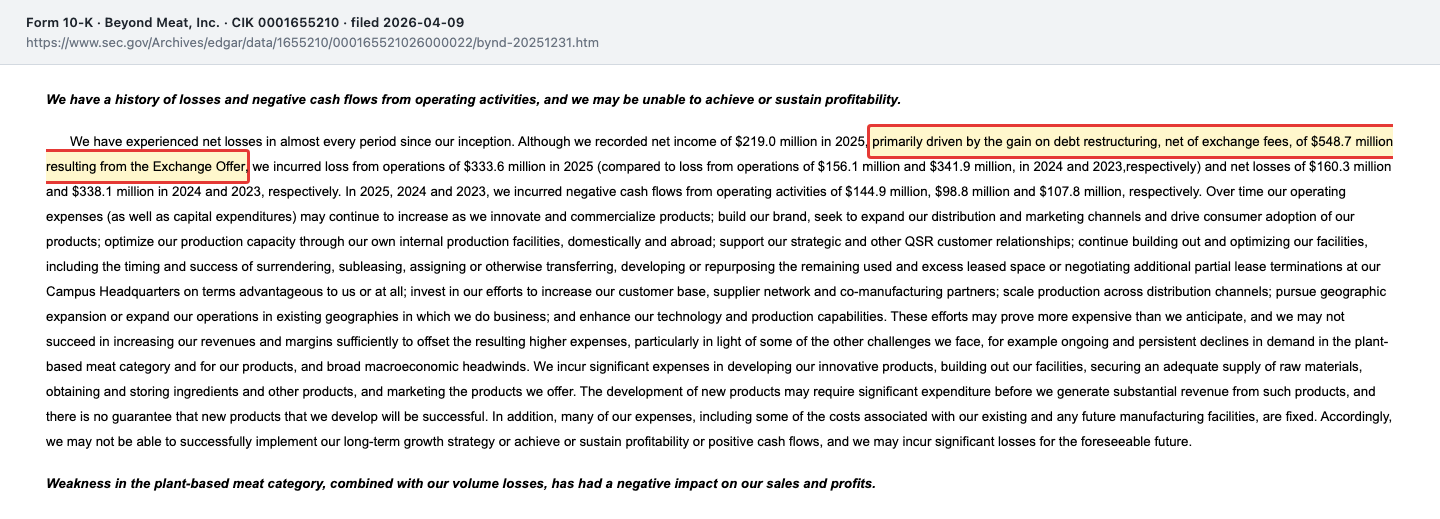
What is a "gain on debt restructuring"? Picture it this way: you owe the bank $100,000 and the bank forgives $60,000 of it. On paper you are $60,000 richer this year — yet not one cent has landed in your account. That is exactly what happened here, except the creditors received stock in return. The third piece of evidence that no money was involved sits in the cash flow statement: in 2025 the company used $144.9 million of cash in operating activities (2024: $98.8 million; 2023: $107.8 million). Remember the line: a profit that never reaches the bank account has never paid an invoice.
2025 also carried real write-downs that should not be overlooked: $51.3 million of impairment on long-lived assets, $49.0 million of loss on write-down of assets held for sale and a $38.9 million litigation accrual.
Uncomfortable truth No. 2: 76 million shares became 515 million in 17 months
In 2021 Beyond Meat issued $1.15 billion of convertible notes due 2027 at an interest rate of zero percent — a product of an era in which investors traded coupons for the prospect of growth. Once it became clear the company would not be able to repay that sum in 2027, it launched an exchange offer on September 29, 2025. The offer closed on October 30, 2025. The terms: for 97.44 percent of the old notes, holders handed back their paper and received $209.721 million of a new note due 2030 — and 317,834,446 new shares.
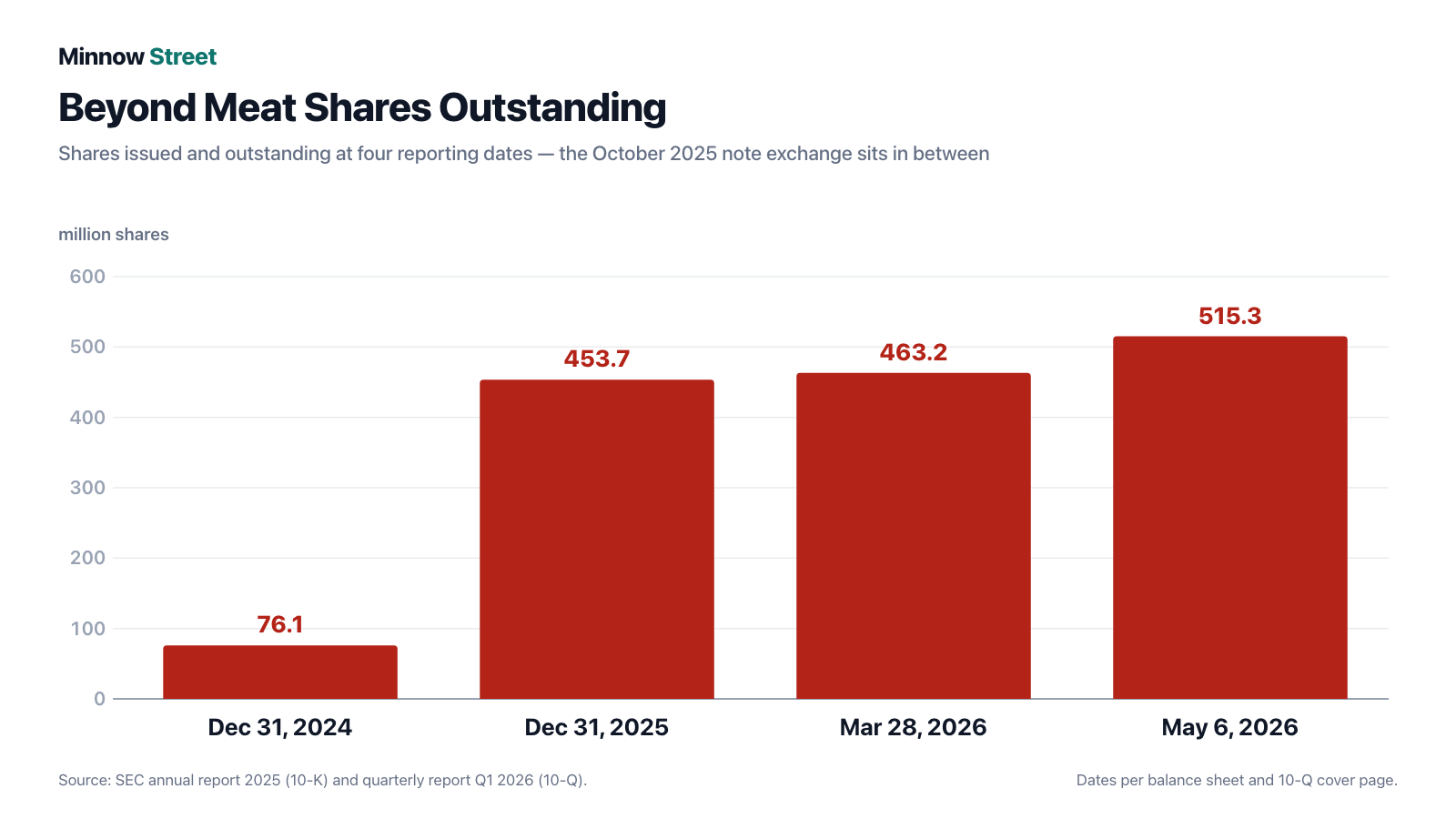
Dilution is one of those words best explained with a cake: your slice does not shrink because somebody nibbles at it, but because the cake gets cut into more pieces. An investor who owned one percent of Beyond Meat at the end of 2024 owned roughly 0.15 percent by mid-2026 without selling a single share. The effect shows up directly in the first-quarter 2026 income statement: the net loss shrank from $61.1 million to $28.5 million, but the loss per share fell from $0.80 to $0.06 — because the weighted average share count had risen from 76.2 million to 455.3 million. A loss per share that drops 93 percent while the loss itself drops only 53 percent tells you more about the denominator than the numerator.
And it continues. The 2030 notes convert at roughly $1.7459 per share, and holders are using that right: in the first quarter of 2026, $6.2 million converted into 5,315,857 shares, and after quarter end another $62.6 million into 52,092,284 shares. The quarterly report also lists the instruments that could still become shares and were therefore excluded from the loss-per-share calculation as antidilutive: 116,566,133 from the 2030 notes, 35,519,282 from employee stock awards, 9,558,635 from warrants, plus options and performance awards — 165,689,333 shares in total. The charter authorizes three billion. For another worked example of how heavy dilution settles over a growth story, see our analysis of Tilray Brands, where revenue hits record levels and each share still gets less of it.
Uncomfortable truth No. 3: the interest is paid in paper, and the debt pile grows while it happens
The debt swap made the burden smaller but did not remove it, and the terms of the new debt are demanding. The 2030 notes (remaining principal of $203.5 million as of March 28, 2026) are second-lien secured and carry 7.00 percent interest if paid in cash. Beyond Meat does not pay in cash: the company uses the option to accrue interest as payment-in-kind, in which case the rate is 9.50 percent and the amount owed grows. What that looks like in practice sits in the subsequent-events note:
"On May 1, 2026, the aggregate remaining principal amount of the 2030 Notes was increased by approximately $10.4 million in interest payment in the form of PIK interest at a rate of 9.5% for the period from October 15, 2025 to May 1, 2026, pursuant to the terms of the 2030 Notes indenture."
— Beyond Meat, Inc., Form 10-Q for the quarter ended March 28, 2026, Note 15 "Subsequent Events" (filed May 7, 2026)

Alongside it sits a first-lien term loan of $100 million, fully drawn since September 18, 2025. It carries 12.0 percent payment-in-kind interest; the effective rate as of March 28, 2026 was 14.3 percent. Here too no cash moves and the balance simply compounds. The loan comes with covenants: a minimum liquidity requirement of $15.0 million tested quarterly, plus a cap of $60.0 million on cash that may be used to repay the remaining old notes. As of March 28, 2026 the company was in compliance.
Now the interest coverage — the question of whether the business earns its interest. In the first quarter of 2026 an operating loss of $41.1 million faced an interest expense of $6.7 million (prior-year quarter: $1.0 million). Interest expense has therefore more than sextupled while operating income stayed negative. The balance sheet draws the logical conclusion: as of March 28, 2026 equity stood at negative $21.083 million — liabilities exceed assets. At the end of 2025 the figure was negative $1.0 million, and at the end of 2024 negative $601.2 million; the note exchange had nearly closed the gap, and a single loss-making quarter reopened it.
Uncomfortable truth No. 4: the company's own controls do not work, and it says so in the filing
Here is the answer to the question we left open earlier — why the annual report was late. Beyond Meat has disclosed two material weaknesses in internal control, and neither had been remediated by the end of the first quarter of 2026. The first concerns the accounting for "non-routine and complex transactions" — exactly the category a note exchange, a warrant and a lease fall into. The second concerns inventory valuation, specifically the provision for excess and obsolete inventory. The consequence is stated in Item 4 of the quarterly report:
"Based on this evaluation, our principal executive officer and principal financial officer concluded that our disclosure controls and procedures were not effective as of March 28, 2026, due to the previously identified material weaknesses in internal control over financial reporting described below, which have not been remediated."
— Beyond Meat, Inc., Form 10-Q for the quarter ended March 28, 2026, Item 4 "Controls and Procedures"
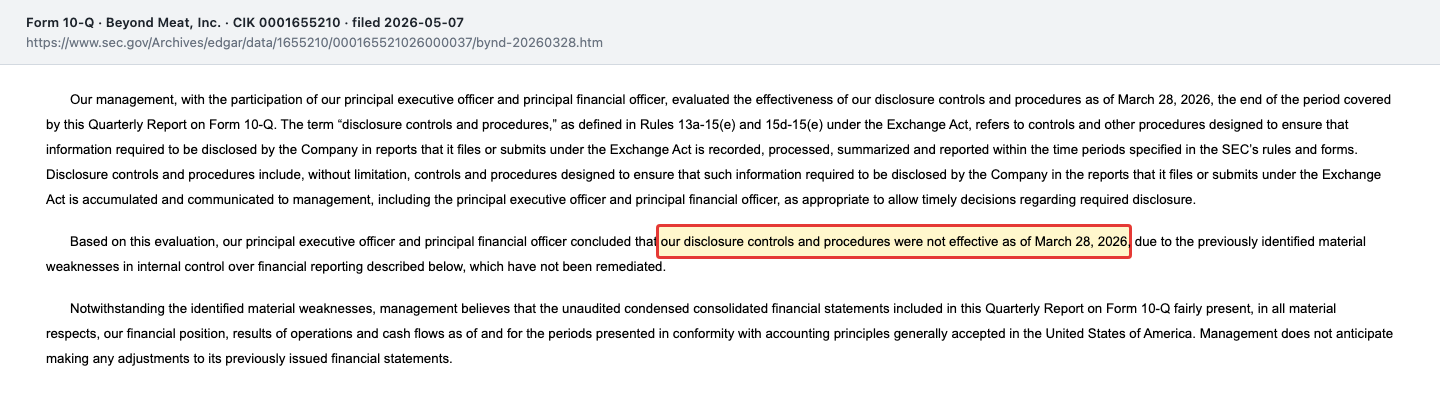
What does that mean for you as a reader? A material weakness is not an accusation of fraud. It means there is a reasonable possibility that a significant error in the numbers would not be caught in time. For inventory the filing says so explicitly — a misstatement in inventory and cost of goods sold could go undetected. And because gross margin is built from exactly those two figures, the uncertainty lands on the very number by which the turnaround is measured. In fairness: the company appointed a chief accounting officer on January 12, 2026 and is working through a remediation plan. That does not make the weakness resolved — the filing says the new controls must first have "operated effectively for a sufficient period of time."
Uncomfortable truth No. 5: the fast door to the capital market is shut
When a company runs short of money, it normally sells new stock. In the United States there is a convenient route for that: an at-the-market program, which dribbles small amounts of stock into the exchange over time. It requires a simplified registration statement, Form S-3. That is precisely what Beyond Meat no longer has:
"We no longer satisfy the eligibility requirements for use of a registration statement on Form S-3 and, as a result, are unable to access our ATM Program."
— Beyond Meat, Inc., Form 10-Q for the quarter ended March 28, 2026, Item 2 MD&A, "Liquidity and Capital Resources"

That leaves the cash pile: $191.0 million as of March 28, 2026 (plus $14.8 million of restricted cash), down from $203.9 million at the end of 2025. The company writes that it believes its balances are sufficient to meet its foreseeable cash requirements over the next twelve months — in the same passage it states that it expects to continue operating at a loss for the foreseeable future. A going-concern warning from the auditors, meaning the formal "substantial doubt" language, does not appear in the filings. That is an important distinction, and we name it explicitly because it is often muddled in discussions about this company.
One loose end remains from the old bond: $29.459 million of the 2027 notes were never tendered and moved into current liabilities in the first quarter of 2026 — about one year of remaining life as of March 28, 2026. On July 17, 2026 the company disclosed that it is in private discussions with holders of the 2030 notes about amending the indenture to permit the repurchase or exchange of that remaining stub for cash and/or equity. It requires consent from a majority of the principal amount, and the filing says there is no assurance that consent will be obtained. Anyone watching this stock now has a concrete next checkpoint.
Valuation — a multiple of what, exactly?
Start with what does not work. A price-to-earnings ratio built on 2025 net income would mislead, because that "profit" was an accounting entry. A price-to-book ratio is equally useless, because book value is below zero. That leaves revenue — and revenue has to be honestly adjusted for the debt.
The math, dated and reproducible: as of May 6, 2026 the 10-Q cover page reported 515,342,392 shares outstanding. At a price in the region of $0.60 to $0.65 — the cross-check comes from the 8-K of June 25, 2026, in which warrants were agreed at an exercise price of $0.60 — that produces a market capitalization of roughly $0.33 billion (data as of August 5, 2026). Against trailing-twelve-month revenue of about $265 million, that is roughly 1.2 times sales. Modest, until the debt is added: the 2030 notes (carrying amount $300.5 million), the first-lien term loan ($81.7 million), the remaining 2027 notes ($29.5 million) and finance leases ($79.9 million) stand against $191.0 million of cash. Enterprise value — market capitalization plus net debt — therefore comes to roughly $0.6 billion, or about 2.3 times sales. For a company whose revenue has fallen four years running and whose 2025 gross margin was 2.8 percent, that is not a liquidation price.
One more quantity belongs in the picture. With a conversion price of $1.7459 on the 2030 notes, holders convert once the stock trades well above that level, so any recovery brings new shares with it automatically. The professional view is correspondingly reserved: the average analyst price target stood at $0.70 (data as of August 5, 2026). Read as an order of magnitude rather than a forecast, that says the street expects stabilization at best, not a re-rating.
Opportunities and risks at a glance
Opportunities
- The cost side works. Cash used in operations fell to $5.0 million in the first quarter of 2026 from $26.1 million a year earlier, and the gross margin swung from negative 10.1 percent to positive 3.4 percent. Both moves are real and come from operations, not from accounting.
- The maturity wall has moved. Instead of $1.15 billion due in 2027, there is now $203.5 million due in 2030 and $100 million due in February 2030; only the remaining $29.5 million is near-term.
- The brand is known. Beyond Burger, Beyond Sausage and Beyond Chicken are established names with shelf space in grocery and menu placement in foodservice — an asset that appears on no balance sheet.
- A second leg is being built. With Beyond Immerse and the ten-year Big Geyser agreement of April 15, 2026, the company is trying to route around the growth problem of the meat-alternative aisle rather than keep fighting it.
- One legal fight went the company's way. The arbitration against a former co-manufacturer produced a full and final settlement on April 24, 2026 of $11.0 million payable to Beyond Meat within 60 days.
Risks
- Revenue has fallen for four years, and it is falling on volume (2025: 15.9 percent less product sold). Cost cutting can cushion that trend but cannot reverse it.
- Equity is below zero (negative $21.1 million as of March 28, 2026), and payment-in-kind interest of 9.5 and 12.0 percent keeps enlarging the debt without any cash moving.
- Dilution is not finished. A further 165,689,333 shares could arise from convertible notes, employee awards and warrants, against three billion authorized shares.
- Two material weaknesses remain open, one of them in inventory valuation — the very input from which gross margin is derived.
- Fast capital-market access is gone: no Form S-3, no at-the-market program. Fresh equity would have to be raised by other and costlier means.
- Listing risk. The company itself lists the Nasdaq minimum bid price requirement among the factors that could lead to delisting — with the stock below one dollar, that is not a theoretical concern.
- Open litigation. Beyond the $38.9 million trademark accrual, a securities class action (filed January 23, 2026) and a shareholder derivative action against officers and directors are pending.
A human conclusion
Back to the anchoring trap. It is so stubborn because it feels like experience rather than emotion: you were there, you read the headlines, you know the old price. But a price measures nothing except what one share costs — and at Beyond Meat that share is a different thing today than it was in 2019. Someone who owned one percent then owns about 0.15 percent now. The company you would be buying into has changed more quietly than any headline: the creditors swapped their paper for ownership and now sit in the boat, and some of them still hold conversion rights that let them take more.
The other picture deserves equal weight. This is not a company that has given up. Cash burn is down to a fifth, the gross margin is positive again, a beverage business is being built, a new chief accounting officer is in place and a new chief operating officer arrives in the autumn of 2026. But between "working on it" and "pulled it off" sits a balance sheet with equity below zero and interest paid in paper. Anyone buying here is not buying meat alternatives — they are betting that a shrinking revenue line and a growing debt line meet somewhere in the middle before the share cake gets sliced again.
None of this is a recommendation, in either direction. It is simply a suggestion to change the yardstick: compare not the price then with the price now, but the ownership stake then with the ownership stake now. What you make of that is your decision. And that is exactly as it should be.
Sources
- Beyond Meat, Inc. — Form 10-K, annual report for fiscal year 2025 (filed April 9, 2026)
- Beyond Meat, Inc. — Form 10-Q, quarterly report for the period ended March 28, 2026 (filed May 7, 2026)
- Beyond Meat, Inc. — Form 10-K, annual report for fiscal year 2024 (filed March 5, 2025)
- Beyond Meat, Inc. — Form 8-K of April 9, 2026 (Item 3.01, Nasdaq deficiency notice for the late annual report)
- Beyond Meat, Inc. — Form 8-K of April 2, 2026 (Roquette Frères sales agreement, inducement equity plan)
- Beyond Meat, Inc. — Form 8-K of June 25, 2026 (Big Geyser warrants, exercise prices of $0.60 and $0.001)
- Beyond Meat, Inc. — Form 8-K of July 17, 2026 (discussions on amending the 2030 notes indenture)
- Beyond Meat, Inc. — Form 8-K of July 30, 2026 (appointment of a chief operating officer)
- Complete SEC filing history for Beyond Meat, Inc.: EDGAR overview (sec.gov)
- Fundamental data (revenue series 2019 to 2022, valuation measures, analyst price target; data as of August 5, 2026), reconciled against the SEC filings.
Transparency & disclaimer: this analysis is journalistic commentary on publicly available information. It is not investment advice, not a regulated financial analysis and not a solicitation to buy or sell securities. Equity investments carry substantial risk up to and including total loss. All information without warranty; the as-of date for each figure is stated in the text. Positions held by the operator are disclosed daily; where one exists, it appears as a notice at the top of this deep dive.
Key figures at a glance
All monetary figures in millions of $; earnings per share as reported.
| Metric | 2021 | 2022 | 2023 | 2024 | 2025 |
|---|---|---|---|---|---|
| Revenue | 464.7 | 418.9 | 343.4 | 326.5 | 275.5 |
| Operating Income (EBIT) | -174.9 | -342.8 | -341.9 | -156.1 | -233.3 |
| Net Income | -182.1 | -366.1 | -338.1 | -160.3 | 219.9 |
| Net Margin | -39.2% | -87.4% | -98.5% | -49.1% | 79.8% |
| Earnings Per Share | -86.48 $ | -172.65 $ | -157.77 $ | -72.85 $ | 36.38 $ |
Source: fundamental data & SEC filings (annual and quarterly reports, 10-K/10-Q)
Our Bottom Line at a Glance
- Earnings quality negative
- The only annual profit in company history is an accounting entry: $219.0 million of net income in 2025, of which $548.7 million came from debt restructuring, against a $333.6 million operating loss and $144.9 million of cash used in operations. 2024 (−$160.3 million) and 2023 (−$338.1 million) were losses as well.
- Balance sheet & financing negative
- Equity stood at negative $21.1 million as of March 28, 2026. Interest is paid in paper — 9.50 percent PIK on the 2030 notes, 12.0 percent (14.3 effective) on the first-lien term loan — so the debt keeps growing: by $10.4 million on May 1, 2026 alone. With a $41.1 million quarterly operating loss against $6.7 million of interest expense, interest coverage is clearly below one.
- Dilution negative
- 76,065,969 shares (December 31, 2024) became 515,342,392 (May 6, 2026), 317,834,446 of them from the October 2025 note exchange. Another 165,689,333 instruments are potentially dilutive, against three billion authorized shares. Any recovery above the $1.7459 conversion price automatically brings new stock with it.
- Cost discipline positive
- Cash used in operating activities fell to $5.0 million in the first quarter of 2026 from $26.1 million a year earlier, the gross margin swung from negative 10.1 percent to positive 3.4 percent, and research and administrative costs dropped by double digits. That movement comes from operations, not from accounting.
- Demand & market position negative
- Revenue has fallen for four years — from $464.7 million (2021) to $275.5 million (2025), down 15.6 percent in 2025 alone on 15.9 percent lower volume; the first quarter of 2026 was down 15.3 percent. Net revenue per pound actually rose slightly: this is a volume problem, not a price problem.
- Reporting quality & controls negative
- Two material weaknesses in internal control were unremediated as of March 28, 2026 — one covering non-routine and complex transactions, the other inventory valuation. The chief executive and chief financial officers explicitly classified disclosure controls as "not effective," and the late 2025 annual report drew a Nasdaq deficiency notice on April 6, 2026.
Beyond Meat is the anchoring trap in its purest form: today's price cannot be compared with the 2019 price, because a note exchange sits between them that turned 76 million shares into more than 500 million. The only annual profit in company history (2025: $219.0 million) consists of $548.7 million of book gain, while operations lost $333.6 million and burned $144.9 million. The cost side demonstrably works better — $5.0 million of cash burn in the first quarter of 2026 instead of $26.1 million, and a gross margin back in positive territory — yet revenue has fallen for four years, equity is below zero, and interest is paid in paper. Not investment advice.
What Our Rating Means
Substance risk
We found at least one documented issue that threatens the company itself — regardless of how the stock is currently valued.
Red here stands for a documented risk to the substance of the business, not for a judgment on price. Four findings support it together: negative equity of $21.1 million as of March 28, 2026; interest coverage clearly below one ($6.7 million of interest expense against a $41.1 million quarterly operating loss) on debt that keeps growing through payment-in-kind interest of 9.5 and 12.0 percent; two unremediated material weaknesses alongside disclosure controls explicitly classified as not effective; and a listing risk the company itself names in connection with the Nasdaq minimum bid price requirement. Deliberately excluded from this verdict are the low share price and the high volatility — those are price arguments. Honesty also requires the other side: there is no going-concern warning from the auditors, cash stood at $191.0 million on March 28, 2026, covenants were met, and cash burn has fallen to a fifth of the prior-year level. Anyone watching this stock should check three lines in the next quarterly report: equity, cash from operations and the share count on the cover page. The decision is yours.
A journalistic assessment by our editorial team at the time of the deep dive, based on public sources — not investment advice and not a solicitation to buy or sell. Your personal circumstances (investment goals, risk capacity, taxes) cannot be taken into account. What our levels mean, how verdicts are formed, and what conflicts of interest exist →
Worth Noting
- Beyond Meat reached our research list through the daily review of mandatory SEC filings: the Form 8-K of April 9, 2026 (Item 3.01) reported a Nasdaq deficiency notice for the late 2025 annual report. It is not a momentum or value scanner hit — conventional ratios mislead here, because the 2025 "profit" is a book gain and book value is negative.
- Recency status: we evaluated the Form 10-K for 2025 (filed April 9, 2026) and the Form 10-Q for the quarter ended March 28, 2026 (filed May 7, 2026) plus every filing made since — among them the Big Geyser warrants (8-K of June 25, 2026), the indenture amendment discussions (8-K of July 17, 2026) and the appointment of a chief operating officer (8-K of July 30, 2026). The share count comes from the 10-Q cover page (as of May 6, 2026).
- Valuation figures are dated and evergreen: market capitalization of roughly $0.33 billion based on 515,342,392 shares and a price in the $0.60 to $0.65 range (data as of August 5, 2026); the cross-check is the $0.60 warrant exercise price documented in the 8-K of June 25, 2026. Not to be confused: the reported 2025 net income is not an operating profit, and no going-concern warning from the auditors exists.
Stock Watch
This analysis is as of August 26, 2026. Stock Watch will tell you what's changed at BYND since then.
Later $1 a month per stock — signing up is free, and you'll be the first to know when it launches.
The full analysis as a PDF for later
We will send you this analysis as a PDF — to print, file away, and read at your own pace. And we will add you to the free Stock Watch list for Beyond Meat Inc (BYND), so you hear about it when something material in this analysis changes.
Frequently Asked Questions
Because a book gain from the exchange of its convertible notes was included. The annual report for 2025 shows net income of $219.0 million, "primarily driven" by a $548.7 million gain on debt restructuring. The operating business produced a loss from operations of $333.6 million in the same year and used $144.9 million of cash. It is the first reported annual profit in company history — and no cash came with it.
Severely. Shares outstanding were 76,065,969 as of December 31, 2024, then 453,688,312 as of December 31, 2025 and 515,342,392 as of May 6, 2026. Some 317,834,446 new shares went to noteholders in October 2025 alone. An investor who owned one percent of the company at the end of 2024 owned roughly 0.15 percent by mid-2026. A further 165,689,333 shares could still arise from convertible notes, employee awards and warrants.
As of March 28, 2026 the balance sheet showed the 2030 convertible notes at a carrying amount of $300.5 million, a first-lien term loan at $81.7 million, the remaining 2027 notes at $29.5 million and finance leases at $79.9 million. Against that stood $191.0 million of cash. Equity was negative $21.1 million — liabilities exceed assets.
PIK stands for payment in kind: interest due is added to the principal rather than paid in cash. Beyond Meat uses this option on both of its major financings — the 2030 notes then accrue at 9.50 percent instead of 7.00 percent, and the first-lien term loan at 12.0 percent (14.3 percent effective as of March 28, 2026). On May 1, 2026 the note principal grew by roughly $10.4 million as a result. Cash is preserved and the debt pile grows.
No. Neither the annual report for 2025 nor the quarterly report for the period ended March 28, 2026 contains the auditors' formal "substantial doubt" language. The company writes that based on its current business plan its existing balances will be sufficient to fund operations for the next twelve months. In the same passage it also states that it expects to continue operating at a loss for the foreseeable future. The two belong together.
Beyond Meat filed its Form 10-K for 2025 only on April 9, 2026 and received a Nasdaq deficiency notice under Listing Rule 5250(c)(1) on April 6, 2026. Filing the report restored compliance. Behind the delay sit two material weaknesses in internal control: one covering non-routine and complex transactions, the other covering inventory valuation. Neither had been remediated as of March 28, 2026.
On revenue it looks cheap; on enterprise value considerably less so. With 515,342,392 shares and a price in the region of $0.60 to $0.65, market capitalization is roughly $0.33 billion, or about 1.2 times trailing-twelve-month revenue (data as of August 5, 2026). Adding net debt produces an enterprise value of roughly $0.6 billion, or about 2.3 times sales. A price-to-earnings ratio cannot be formed meaningfully.
Beyond Immerse is a line of plant-based protein drinks launched in 2026 and the first visible step in repositioning "Beyond Meat" as "Beyond The Plant Protein Company." On April 15, 2026 the beverage distributor Big Geyser was appointed exclusive distributor for a defined territory in the northeastern United States, for an initial ten-year term with automatic eight-year renewals. No minimum purchase quantities were agreed.
Found an error?
Did you spot a factual error, an outdated number, or a typo in this deep dive? Let us know briefly — your report goes straight to the editorial team.