Krispy Kreme: $432 Million Written Off, $888 Million of Debt — and a Brand Everyone Knows
The hot light in the window, the Original Glazed doughnut that melts on the way down: Krispy Kreme is one of the best-known brands on earth — and that is exactly what makes the stock dangerous. What we know, we assume is safe. The filings with the U.S. securities regulator, the SEC, tell a different story. In fiscal 2025 (ended December 28, 2025) revenue fell to $1,522.6 million, the company wrote off $432.4 million against goodwill and assets, and reported a net loss of $523.8 million. As of March 29, 2026 the balance sheet carried $888.4 million of debt maturing in March 2028 and $1,402.4 million of goodwill and intangibles — more than twice its equity. Not investment advice — just the question of what is left of a world-famous brand once you subtract the goodwill.
 Thomas Mücke
Founder & Publisher
Thomas Mücke
Founder & Publisher
As of Today
As of: September 17, 2026
- Closing price
- 3.10 $ -1.90%
- Market Capitalisation
- 0.5 $B
- Growth Score
- 4/10
- AAQS
- 1/10
This analysis has a cut-off date. The Stock Guard tells you when something material changes in the numbers. Reserve your free spot
Chart
Interactive price chart (TradingView).
52-week range: 2.90 $ to 4.70 $ · Last price: 3.10 $ (As of: September 17, 2026)
Note: pure fact-based analysis, not investment advice and not a solicitation to buy or sell. All figures without guarantee.
The Doughnut You Were Given for Free
There is a feeling almost everyone knows who has walked past a Krispy Kreme shop: the red "Hot Now" sign comes on, the conveyor belt runs behind glass, and somebody hands you a warm Original Glazed doughnut. Free. It tastes wonderful, and you think: what a brand.
This is where one of the quietest traps in investing waits — the familiarity trap. Our brains confuse recognition with safety. What we know, like and associate with a good feeling, we automatically assume is sounder than something foreign. Psychologists call it the mere-exposure effect; in the market it means we check the numbers of a household name far less carefully than those of a company whose name we cannot pronounce.
So let us make a deal: we leave the hot light off and read only what Krispy Kreme, Inc. (Nasdaq: DNUT) filed, under penalty of law, with the U.S. securities regulator, the SEC — the annual report (Form 10-K) for fiscal 2025, the quarterly report (Form 10-Q) as of March 29, 2026, and everything that came after. The central tension is there from the first chapter and stays with us to the end: the brand is undeniably valuable — it simply carries more in the balance sheet than it earns in the business.

What Krispy Kreme Actually Does
Krispy Kreme sells fresh doughnuts — and not only in its own stores. The heart of the business is a distribution system the company calls "hub and spoke." The hubs are the large production sites, the Hot Light Theater Shops and doughnut factories. From there, delivery routes run every morning to the spokes — small fresh shops, carts, food trucks, and above all the branded cabinets in grocery stores, gas stations and quick-service restaurants. Picture a bakery that does not wait for customers to arrive but drives its rolls to fifty shops in the neighborhood every morning: same kitchen, far more points of sale.
Krispy Kreme counts those points of sale as "Global Points of Access." At the end of the first quarter of fiscal 2026 (March 29, 2026) there were 15,125 of them in more than 40 countries. A year earlier there had been almost 18,000 — we will come back to that. The company reports in three segments: U.S. (company operations in the United States), International (company operations in the United Kingdom, Ireland, Australia, New Zealand, Mexico and Canada) and Market Development — the franchise business, where partners run the shops and Krispy Kreme supplies royalties, mixes and equipment.
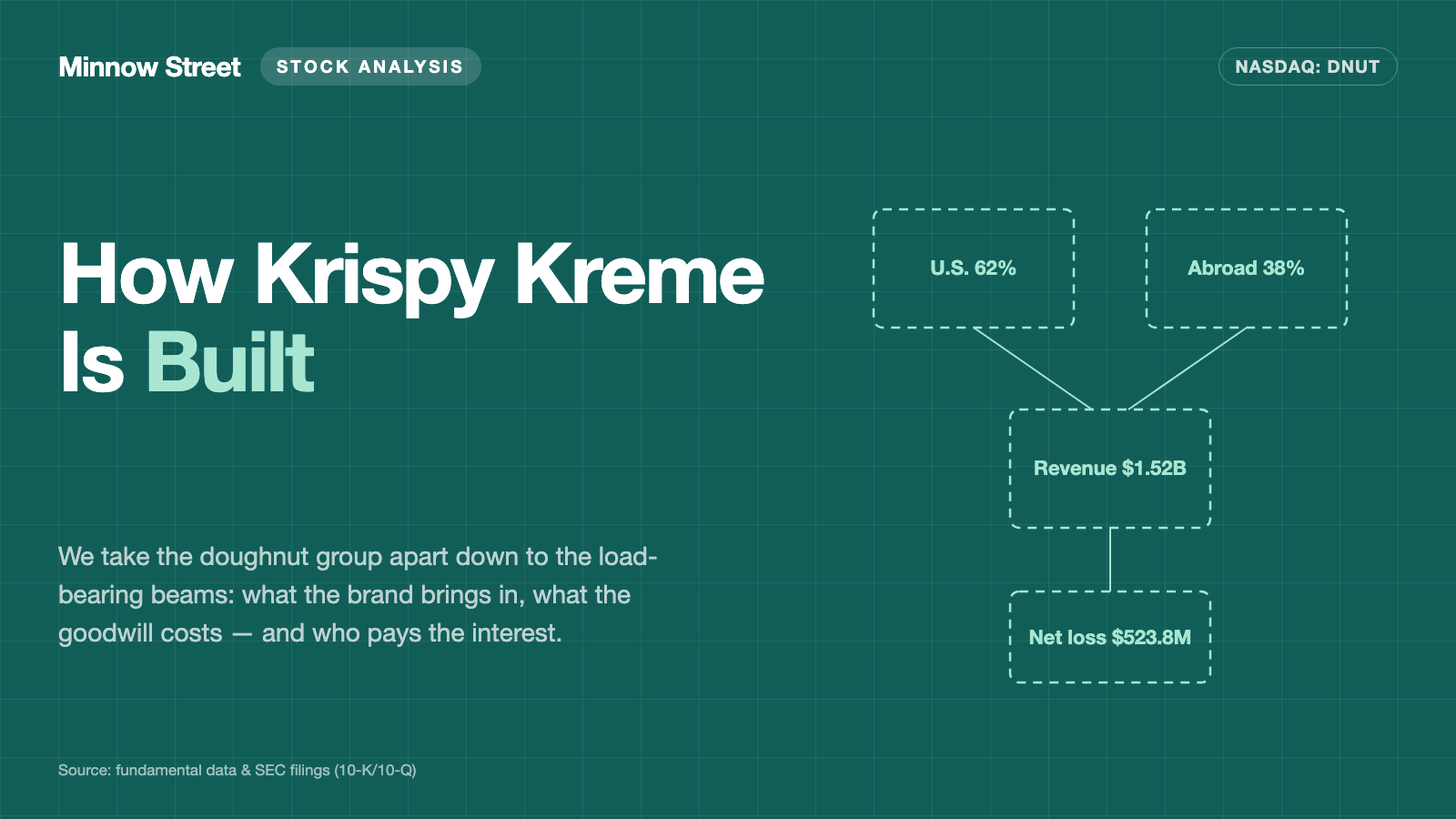
In fiscal 2025 the $1,522.6 million of revenue broke down by origin as follows: $937.7 million in the United States (about 62 percent), $159.5 million in the United Kingdom, $125.2 million in Mexico, $117.9 million in Australia and New Zealand, and $182.4 million in all other countries — $584.9 million outside the United States, or about 38 percent. Roughly 17,000 people were employed as of December 28, 2025.
One note on the calendar that matters later: Krispy Kreme does not report in calendar years but on a 52- or 53-week year that ends in late December. Fiscal 2025 ran to December 28, 2025 and had 52 weeks; fiscal 2024 ran to December 29, 2024. Anyone comparing two years should glance at the week count first — an extra week is worth several percent of revenue.
How the Stock Reached Our Desk
With Krispy Kreme it was not a momentum hit and not a Reddit surge, but simply a mismatch: a group with more than $1.5 billion of annual revenue is worth only a fraction of that on the market. How small that fraction is can be read off a mandatory filing, without using a single daily price. The cover page of the fiscal 2025 annual report (Form 10-K) cites a closing price of $2.65 as of the end of the second quarter of fiscal 2025, together with the aggregate market value of shares held by non-affiliates: $248.9 million. Applied to the 171.2 million shares reported on the cover of the quarterly report filed August 8, 2025, the whole group was worth roughly $454 million at that moment. Against $1,522.6 million of revenue that is a price-to-sales ratio of about 0.30 — for every dollar of annual revenue the market paid about 30 cents.
Numbers like that are a wake-up call, not a buy signal. They always mean one of two things: either the market is missing something, or it is seeing something that does not appear on the revenue line. With a company this recognizable the question is especially worth asking, because the familiarity trap nudges us toward the first explanation ("the market is too pessimistic") and lets us skip the second entirely. So let us not skip it.
By the way: we saw exactly this pattern — strong brand, weak earning power — with another American heritage name recently. Our analysis of Carter’s asked how much an undisputed market leadership is worth when operating income falls four years running. At Krispy Kreme the answer is less friendly — and it sits in the balance sheet.
The Numbers Over the Years — Honestly Appraised
Let us start with what genuinely works. The franchise business is a small gem: in the first quarter of fiscal 2026 the Market Development segment produced $20.2 million of revenue and $11.6 million of adjusted EBITDA from it — a margin of 57.5 percent. No surprise: nobody bakes here, royalties flow. The international business also runs more soundly than the home market — with two definitions worth keeping apart. By origin, $584.9 million, or about 38 percent, of fiscal 2025 revenue came from outside the United States. The separately reported International segment is narrower — it covers only the company-operated businesses in the United Kingdom, Ireland, Australia, New Zealand, Mexico and Canada — and posted $535.1 million in fiscal 2025; in the first quarter of fiscal 2026 it produced $14.5 million of adjusted EBITDA on $125.3 million of revenue.
And the turnaround the company announced in August 2025 is working. In the first quarter of fiscal 2026 (13 weeks to March 29, 2026):
- Adjusted EBITDA rose 38.0 percent to $33.1 million, and the margin went from 6.4 to 9.0 percent.
- Cash from operating activities swung from negative $20.8 million to positive $20.2 million.
- Capital expenditures fell to $8.8 million, or 2.4 percent of revenue — down 66 percent from the year-ago quarter.
- The net loss narrowed from $33.4 million to $22.7 million.
- 26 new shops opened, nearly all of them franchised.
That is not cosmetics, that is real progress. But one quarter does not reverse a multi-year series — and the series looks like this:
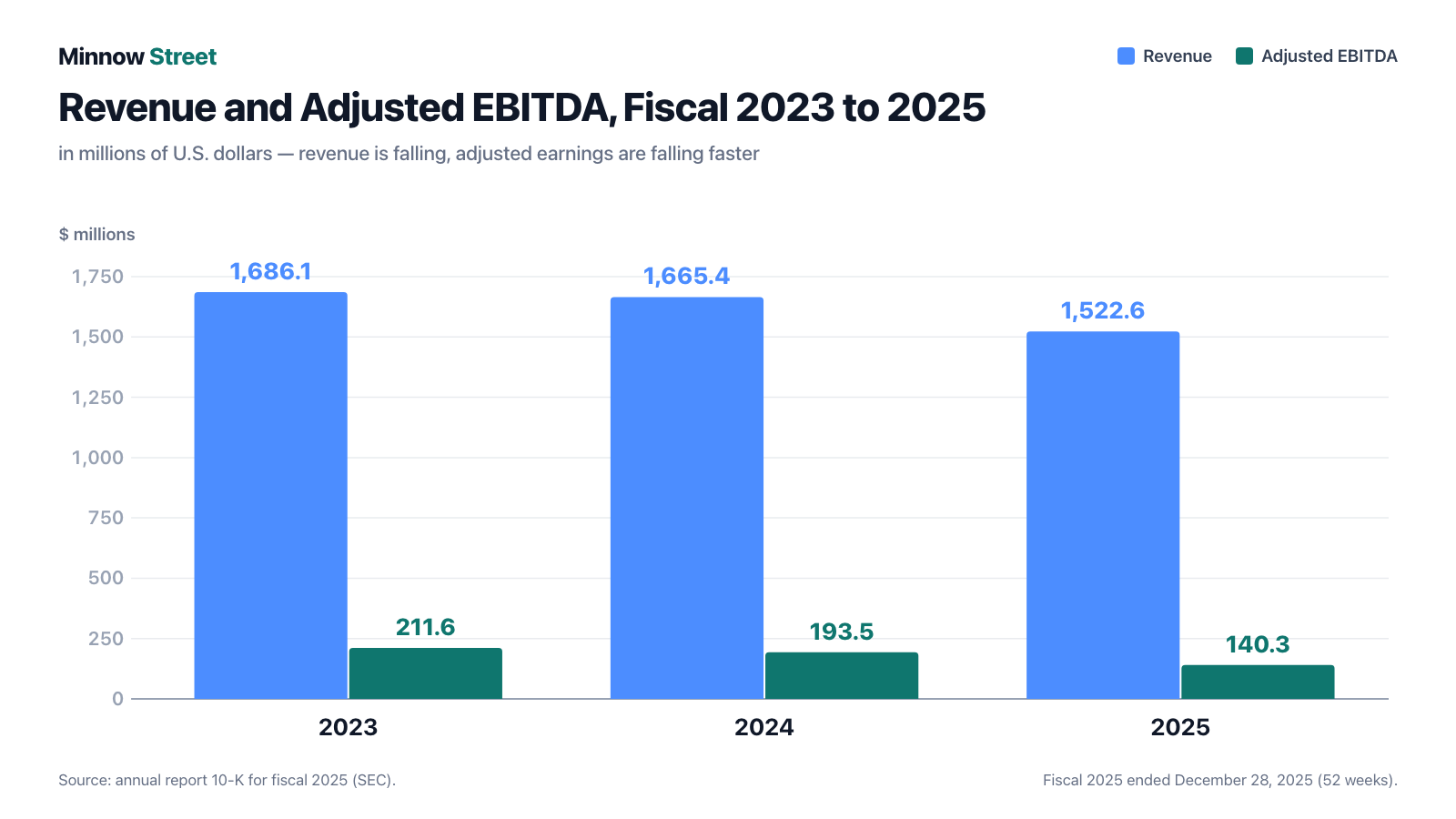
In fairness: part of the revenue decline from 2024 to 2025 was intentional. The annual report shows that of the $142.8 million decline, $138.5 million came from the divestiture of a controlling interest in the cookie brand Insomnia Cookies in the third quarter of 2024; organic revenue fell "only" $20.0 million, or 1.3 percent. But adjusted EBITDA fell proportionally three times as fast as revenue, and that cannot be defined away: points of access dropped 13.5 percent to 15,194 during 2025, and fewer points mean lower utilization of the same production hubs.
Remember this ratio: revenue down ten percent, adjusted earnings down a third. When a business loses earnings disproportionately as it shrinks, it has high fixed costs — and high fixed costs are dangerous company for debt. Which brings us to the uncomfortable truths.
What the Filings Say — the Uncomfortable Truths
Uncomfortable truth no. 1: $432.4 million written off — the McDonald’s dream cost the goodwill
Krispy Kreme listed in 2021, and in 2024 came the announcement an investor could only love: the doughnut goes to McDonald’s. Nationwide, into thousands of restaurants. The company built capacity, extended delivery routes, invested. By the summer of 2025 the dream was over. The annual report puts it plainly:
"On June 24, 2025, the Company and McDonald’s USA announced that the companies had jointly decided to terminate the Business Relationship Agreement effective July 2, 2025 (the "Termination Effective Date")."
— Krispy Kreme, Inc., SEC annual report 10-K for fiscal 2025, Note 1

The consequences follow a page later. Roughly 2,400 fresh delivery doors disappeared in the third quarter of fiscal 2025 — about 1,900 McDonald’s doors alone had been in the base at the end of 2024. Global points of access fell 13.5 percent to 15,194. And because the company had to cut its forecasts while its market capitalization was falling, an out-of-cycle goodwill test became necessary. The result:
"After completing the quantitative impairment test, management concluded that the estimated fair values of the U.S., Krispy Kreme Holding U.K. Ltd. ("KK U.K."), and Krispy Kreme Holdings Pty Ltd. ("KK Australia") reporting units had declined below their carrying values, and management recognized a cumulative, non-cash, partial goodwill impairment charge of $356.0 million (gross of income taxes) in the second quarter of fiscal 2025."
— Krispy Kreme, Inc., SEC annual report 10-K for fiscal 2025, Item 7 "Critical Accounting Estimates — Goodwill and Other Intangible Assets"

Together with $39.4 million against fixed assets and $37.0 million against leases, the fiscal 2025 write-offs added up to $432.4 million — after $4.5 million the year before. Goodwill on the balance sheet fell from $1,047.6 million to $712.3 million. What is goodwill? The premium a buyer paid above tangible value because it believed in the future. Writing it down is the accounting admission that the belief was too large.
And it did not stop at the bookkeeping. Since May 2025 a consolidated federal securities class action has been pending in the Western District of North Carolina against the company, its chief executive and its former chief financial officer; plaintiffs allege misleading statements about the McDonald’s agreement. Briefing on the motion to dismiss was scheduled to be complete on May 21, 2026 according to the quarterly report. How it ends is open — the filing itself says it is too soon to estimate any damages.
Uncomfortable truth no. 2: there are two leverage ratios — and a wall in March 2028
As of March 29, 2026 the balance sheet carried $888.4 million of debt: a $732.4 million term loan, $95.0 million drawn on the revolving facility, $1.1 million on short-term lines and $62.5 million of finance leases, less $2.6 million of unamortized debt issuance costs. Against that stood $74.2 million of cash; the company itself reports net debt of $816.7 million (after $938.3 million as of December 28, 2025). The effective rate on the term loan was roughly 6.00 percent, with $550.0 million hedged by interest rate swaps. And then comes the sentence worth underlining: the term loan and revolving balances are due in full at maturity in March 2028.
Debt comes with covenants. The most important one is in the quarterly report:
"Under the terms of the 2023 Facility, we are subject to a requirement to maintain a leverage ratio of less than 5.00 to 1.00 as of the end of each quarterly Test Period (as defined in the 2023 Facility) through maturity in March 2028. […] Our leverage ratio was 3.9 to 1.00 as of the end of the first quarter of fiscal 2026 compared to 4.4 to 1.00 as of the end of fiscal 2025."
— Krispy Kreme, Inc., SEC quarterly report 10-Q as of March 29, 2026, Item 2 "Capital Resources and Liquidity"

At first glance reassuring: 3.9 against a limit of 5.00, and falling. At second glance it gets interesting. Because in the earnings release of May 7, 2026 — one day before the quarterly report — the same company puts net leverage at 5.5x for the same date. Two numbers, one date, a gap of 1.6 turns.
This is not a contradiction, and nothing is hidden: the quarterly report states expressly that the credit agreement uses a defined calculation of Adjusted EBITDA. But the two calculations can be laid side by side. The earnings release shows its own arithmetic openly: $816.7 million of net debt divided by trailing-four-quarter adjusted EBITDA of $149.4 million gives 5.5. For the credit agreement to arrive at 3.9, its denominator has to sit near $209 million. That last figure is our own back-of-the-envelope arithmetic, but it shows the leverage of the definition: the cushion against the covenant rests on an earnings measure roughly $60 million more generous than the one the company itself uses when it speaks to the market.
Put in everyday terms: your bank checks whether your debt exceeds five times your income — but counts an income your accountant would not recognize. As long as the ratio is comfortable, nobody cares. It matters at exactly the moment things get tight. And things could get tight on a specific date: March 2028, when $888.4 million has to be refinanced at once.
Uncomfortable truth no. 3: strip out brand and goodwill and equity is $769 million in the red
Here is the part that breaks the familiarity trap open. Look at the balance sheet as of March 29, 2026:
- Total assets: $2,386.6 million
- of which goodwill: $669.3 million
- of which other intangibles (essentially the brand and franchise rights): $733.1 million
- Equity: $633.3 million
- Accumulated deficit: $844.2 million
Goodwill and intangibles together come to $1,402.4 million — that is 58.8 percent of total assets and more than twice the equity. Subtract both and tangible equity is negative $769.1 million. Spread across 172.4 million shares: minus $4.46 per share.
What does that mean in practice? Picture a house carried at $2.4 million in the books — but $1.4 million of that is the value of the family name on the doorbell. As long as everyone likes the name, the math holds. The moment they stop, it does not, and that is exactly when you need the money. Krispy Kreme demonstrated in 2025 how fast that can happen: $356.0 million of goodwill vanished in a single quarter.
A second look at the same balance sheet does not help. Current liabilities of $446.0 million exceed current assets of $186.9 million by $259.1 million. For a cash business with daily takings that is not automatically dramatic — customers pay immediately, suppliers later. But it is not a cushion either. On top sit $91.2 million of "structured payables": supplier payments routed through bank card products, which the company itself reports outside its debt.
For contrast: what a balance sheet looks like when cash and debt roughly cancel each other out, we saw in our analysis of Tilray — a billion-dollar goodwill write-down had marked the prior year there too, but there was no debt wall behind it. At Krispy Kreme both arrive together.
Uncomfortable truth no. 4: for three years more cash went out than the business brought in
Profit is an opinion, cash is a fact. So let us compute the simplest honest measure there is — free cash flow: what comes in from operations, less what goes into property and equipment. Krispy Kreme defines it exactly the same way in its own earnings release.
A word on comparability before the bars: every annual figure in this analysis — revenue, adjusted earnings and cash flow — appears exactly as the group reported it, on a total-company basis. Insomnia Cookies sits inside the numbers through the third quarter of fiscal 2024 and not afterwards; Krispy Kreme did not restate the cookie brand as a discontinued operation. Where that switch distorts a comparison, the size of the effect is stated alongside it in the text.
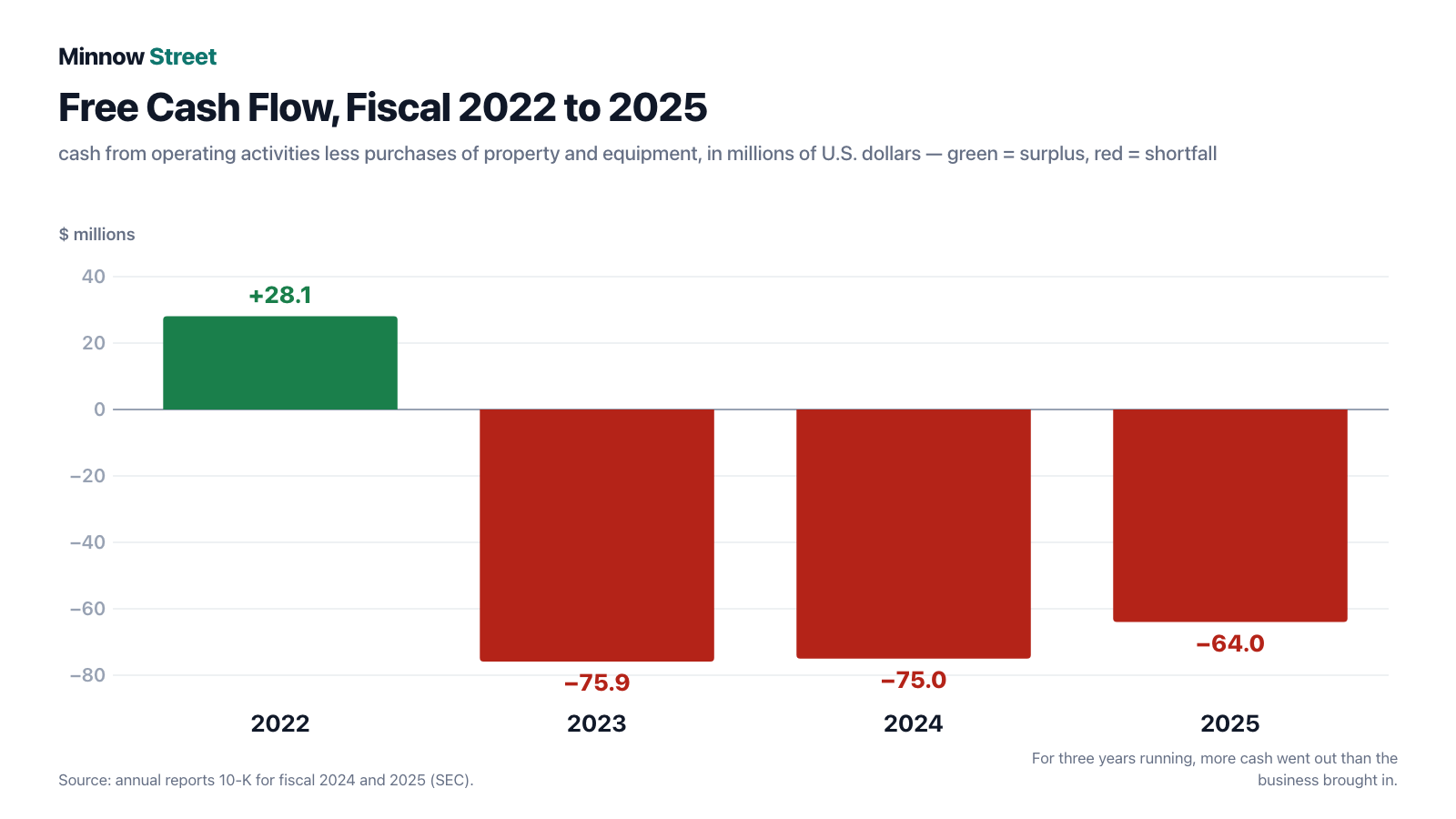
The underlying figures are in the annual reports: operations produced $139.8 million (2022), $45.5 million (2023), $45.8 million (2024) and $33.9 million (2025). Over the same period the company invested $111.7 million, $121.4 million, $120.8 million and $97.9 million. For three years that left a gap of $64 million to $76 million a year.
How was it closed? By selling. In 2024 the divestiture of a controlling interest in Insomnia Cookies brought net proceeds of $124.1 million plus $45.0 million from a loan repayment; 2025 added $75.0 million for the remaining stake. In the first quarter of fiscal 2026, $69.3 million of gross proceeds came from the sale of Krispy Kreme Japan and roughly $53.5 million from the repayment of intercompany debt in the Western U.S. business; the cash flow statement reports $111.4 million of net proceeds from refranchising for the two together. That money is why cash still rose from $42.4 million to $74.2 million and debt fell from $977.8 million to $888.4 million.
That is precisely what a turnaround plan is supposed to do — and it is still a pattern worth knowing: you can only sell a business once.
Uncomfortable truth no. 5: California went for a promissory note
One detail of that disposal program deserves its own attention. On March 23, 2026, Krispy Kreme handed its California shops to long-standing partner WKS Restaurant Group and cut its stake in the Western U.S. joint venture from 55 to 20 percent. Purchase price for the California assets: $40.4 million. It was not paid in cash:
"The Seller Note bears interest at a rate of five percent ( 5 %) per annum, payable quarterly in cash or in-kind at the option of the borrower. The Seller Note matures on March 22, 2032, and allows for prepayment without penalty."
— Krispy Kreme, Inc., SEC quarterly report 10-Q as of March 29, 2026, Note 3 "Acquisitions and Divestitures"

Three points in one sentence: the borrower decides for six years whether to pay interest in cash or in more paper. The note does not mature until 2032. And it ranks behind the bank financing the joint venture took on. The overall transaction produced a $33.8 million loss on divestiture, offset by a $42.4 million gain on the Japan sale — a net gain of $8.9 million in the quarter.
Uncomfortable truth no. 6: the incentive plan grows on its own
On June 10, 2026, Krispy Kreme filed a registration statement (Form S-8) registering 13,455,803 additional shares for its 2021 incentive plan: 5,000,000 from a shareholder resolution passed that same day and 8,455,803 added since 2021 through an automatic annual increase written into the plan. The original registration covered 7,361,798 shares.
Dilution is a clumsy word for a simple event: your slice of the cake gets smaller because somebody keeps cutting new slices without the cake growing. Those 13.5 million extra shares equal roughly 7.8 percent of the 172.4 million shares outstanding as of April 30, 2026. It shows up slowly but steadily: the weighted average share count rose from 169.3 million (2024) to 170.9 million (2025) and 172.0 million in the first quarter of fiscal 2026. A total of 300.0 million shares are authorized — there is plenty of room.
The vote of June 10, 2026 is telling: 85,938,583 shares in favor against 21,269,870 opposed. Major holder JAB Indulgence B.V. owns 74,190,990 shares. Subtract that block from the votes in favor and 11.7 million yes votes would remain against 21.3 million no votes — though the record does not disclose how JAB actually voted.
Valuation: cheap against revenue, expensive against the balance sheet
A price-to-earnings ratio cannot be formed — there are no earnings. So let us approach from three sides, all as orders of magnitude and all anchored to a price that appears in a mandatory filing: the $2.65 closing price as of the end of the second quarter of fiscal 2025, cited on the cover page of the annual report. The aggregate market value of shares held by non-affiliates stood there at $248.9 million; applied to all 171.2 million shares shown on the cover of the quarterly report filed August 8, 2025, the whole group comes to roughly $454 million. Daily prices have no place in an analysis — and they would not change the order of magnitude.
First, revenue. A $454 million market value against $1,522.6 million of fiscal 2025 revenue is a price-to-sales ratio of about 0.30. For a world-famous brand that sounds like a bargain. The catch: for 2026 the company itself guides to only $1.25 billion to $1.35 billion of revenue, because the divested businesses drop out. The ratio therefore gets "more expensive" on its own, without the share price moving at all.
Second, debt. Whoever buys a leveraged company buys the debt with it. Market value plus the company-reported net debt of $816.7 million (March 29, 2026) gives an enterprise value on the order of $1.27 billion. Against trailing-four-quarter adjusted EBITDA of $149.4 million, or the fiscal 2025 figure of $140.3 million, that is about eight to nine times. That is no longer a bargain price — it is an ordinary price for a restaurant business, only one whose revenue is shrinking.
Third, book value. Equity stood at $633.3 million as of March 29, 2026; the market value at our price anchor sits roughly 28 percent below it. So the stock traded at a discount to its equity — but to an equity that is more than twice goodwill and brand. Tangible equity is minus $769.1 million. The discount to book is therefore not a safety cushion; it is the market opinion about the quality of that book value.
Deliberately absent from this arithmetic: price targets and analyst ratings. They change weekly, appear in no mandatory filing, and would be the first thing to go stale in a piece meant to hold up two years from now. The question that remains is a different one anyway — and it belongs in the next chapter.
Opportunities and Risks at a Glance
What speaks for Krispy Kreme:
- A globally recognized brand with 15,125 points of access in more than 40 countries (March 29, 2026) — a distribution network that cannot be rebuilt in a few years.
- The franchise business is highly profitable: $11.6 million of adjusted EBITDA on $20.2 million of revenue in the first quarter of fiscal 2026, a margin of 57.5 percent. The franchisee share of systemwide sales is set to rise from about 25 percent (2025) to nearly 50 percent from fiscal 2027.
- The turnaround is measurably working: adjusted EBITDA up 38.0 percent to $33.1 million in the first quarter of fiscal 2026, margin from 6.4 to 9.0 percent, operating cash flow swung from negative $20.8 million to positive $20.2 million, capital expenditures cut to $8.8 million.
- Covenants were met as of March 29, 2026, the credit-agreement leverage ratio fell from 4.4 to 3.9, and available liquidity stood at $303 million ($74 million of cash plus $229 million of undrawn capacity).
- The major owner stays committed: JAB Indulgence B.V. holds 43.03 percent (74,190,990 shares, filing of June 16, 2026) and on June 12, 2026 extended an additional cash-settled long swap of up to $100 million to August 2028 — past the maturity of the debt.
What speaks against it:
- Interest has not been covered by operating income for years: in fiscal 2025 an operating loss of $36.8 million before impairments met $65.8 million of interest expense; in the first quarter of fiscal 2026 it was $3.6 million against $15.6 million.
- The balance sheet is 58.8 percent goodwill and intangibles ($1,402.4 million of $2,386.6 million); tangible equity is negative $769.1 million and the accumulated deficit has grown to $844.2 million.
- $888.4 million of debt comes due in full in March 2028, on terms nobody knows today. The cushion against the covenant rests on a defined earnings calculation more generous than the company own external reporting (3.9 against 5.5 for the same date).
- Free cash flow was negative three years running from 2023 to 2025 (minus $75.9 million, minus $75.0 million and minus $64.0 million); the gap was closed by selling Insomnia Cookies, Japan and the majority of the Western U.S. business — substance that can only be sold once.
- Legal and reporting risks: a pending securities class action against the company, its chief executive and its former chief financial officer over the McDonald’s statements, a shareholder derivative action, a roughly $1.6 million data-breach settlement — and an accounting error for redeemable noncontrolling interests in prior periods conceded in the quarterly report.
- Revenue is guided to fall to $1.25 billion to $1.35 billion in 2026; a company that shrinks with high fixed costs loses earnings disproportionately — from 2023 to 2025 revenue fell 9.7 percent while adjusted EBITDA fell 33.7 percent.
A Human Conclusion
Back to the warm doughnut from the opening. The familiarity trap works so well because it does not lie: Krispy Kreme is a wonderful brand. The shops are busy, the product works, people are happy. That simply answers a completely different question from the one you have to ask as an investor.
Because the filings say something uncomfortable: this brand sits at $1,402.4 million inside a balance sheet with $633.3 million of equity and $888.4 million of debt that comes due all at once in March 2028. It produced a $523.8 million loss in fiscal 2025 and, even before every write-off, did not earn enough operationally to pay its interest. For three years more cash flowed out than in, and the gap was closed by selling parts of the company — most recently California, for a promissory note that runs to 2032.
At the same time, the first quarter of fiscal 2026 is the best argument on the other side: the turnaround delivered there, and clearly so. Anyone investing is therefore not betting on doughnuts. They are betting that a shrinking company becomes profitable fast enough to look like a good borrower in March 2028. That can work. It can also fail, and then what remains on the balance sheet is mostly a name.
So the honest question is not "do I like Krispy Kreme?" but: would you lend money to a neighbor whose largest asset is his good reputation — and whose loan comes due in under two years? If you can answer that with a clear yes, you have a thesis. If you hesitate, you had a good feeling. What you make of it is your decision. And that is exactly as it should be.
Sources
Every original document used in this analysis — for you to read yourself:
- Krispy Kreme, Inc. — SEC annual report 10-K for fiscal 2025 (filed March 6, 2026)
- Krispy Kreme, Inc. — SEC annual report 10-K for fiscal 2024 (filed February 27, 2025)
- Krispy Kreme, Inc. — SEC quarterly report 10-Q as of March 29, 2026 (filed May 8, 2026)
- Krispy Kreme, Inc. — First quarter 2026 earnings release, Exhibit 99.1 to SEC Form 8-K (Item 2.02) of May 7, 2026
- Krispy Kreme, Inc. — SEC Form 8-K of March 24, 2026, Item 1.01 (refranchising of the Western U.S. joint venture)
- Krispy Kreme, Inc. — SEC registration statement S-8 of June 10, 2026 (13,455,803 additional shares for the incentive plan)
- Krispy Kreme, Inc. — SEC Form 8-K of June 12, 2026, Item 5.07 (results of the annual meeting held June 10, 2026)
- JAB Indulgence B.V. and others — SEC Schedule 13D/A No. 15 of June 16, 2026 (43.03 percent, extension of the long swap)
- Krispy Kreme, Inc. — SEC quarterly report 10-Q as of June 29, 2025 (filed August 8, 2025; cover-page share count of 171.2 million)
- Metrics and valuation anchor: fundamental data & SEC filings (annual and quarterly reports, 10-K/10-Q); research as of August 4, 2026.
This analysis is a journalistic contextualization of publicly available information and is not investment advice. It contains no buy or sell recommendation and is not a solicitation to buy or sell securities. Stocks can lose substantial value, up to and including the total loss of the capital invested. All figures are based on the sources named above as of the dates stated; no liability is assumed for completeness or accuracy. Positions held by the operator are disclosed daily; where one exists, it appears as a notice at the top of this deep dive.
Key figures at a glance
All monetary figures in millions of $; earnings per share as reported.
| Metric | 2021 | 2022 | 2023 | 2024 | 2025 |
|---|---|---|---|---|---|
| Revenue | 1,384.4 | 1,529.9 | 1,686.1 | 1,665.4 | 1,522.6 |
| Operating Income (EBIT) | 41.1 | 29.0 | 13.1 | -8.7 | -33.3 |
| Net Income | -24.5 | -15.6 | -37.9 | 3.1 | -515.8 |
| Net Margin | -1.8% | -1.0% | -2.2% | 0.2% | -33.9% |
| Earnings Per Share | -0.15 $ | -0.09 $ | -0.23 $ | 0.02 $ | -3.02 $ |
Source: fundamental data & SEC filings (annual and quarterly reports, 10-K/10-Q)
Our Bottom Line at a Glance
- Brand and reach positive
- Krispy Kreme operates in more than 40 countries and reached 15,125 points of access as of March 29, 2026. International business contributed $584.9 million, or about 38 percent, of the $1,522.6 million of fiscal 2025 revenue; the Market Development franchise segment turned $20.2 million of first-quarter 2026 revenue into $11.6 million of adjusted EBITDA — a margin of 57.5 percent. The brand carries when somebody else pays for it.
- Earning power negative
- Adjusted EBITDA fell from $211.6 million (2023) to $193.5 million (2024) and $140.3 million (2025). Even excluding the $432.4 million of impairments, the fiscal 2025 income statement implies an operating loss of $36.8 million — against $65.8 million of interest expense. In the first quarter of fiscal 2026 an operating loss of $3.6 million met $15.6 million of interest. Interest has not been covered by operating income for years.
- Balance-sheet substance negative
- As of March 29, 2026, goodwill of $669.3 million and other intangibles of $733.1 million made up 58.8 percent of total assets of $2,386.6 million — against equity of $633.3 million. Tangible equity is therefore negative $769.1 million. Current liabilities of $446.0 million exceed current assets of $186.9 million by $259.1 million. The accumulated deficit has grown to $844.2 million.
- Financing and maturities negative
- $888.4 million of debt sits against $74.2 million of cash (March 29, 2026); the term loan and revolving facility are both due in full in March 2028. The covenant requires a leverage ratio below 5.00 to 1.00 — reported at 3.9 after 4.4 at the end of fiscal 2025, so the cushion is a little over one turn. Free cash flow was negative three years running from 2023 to 2025 (−$75.9 million, −$75.0 million and −$64.0 million); the gap was closed by selling parts of the company.
- Turnaround and early effect neutral
- The turnaround announced in August 2025 is working measurably: in the first quarter of fiscal 2026 adjusted EBITDA rose 38.0 percent to $33.1 million, the margin went from 6.4 to 9.0 percent, operating cash flow swung from negative $20.8 million to positive $20.2 million, and capital expenditures fell to $8.8 million. But the progress is paid for with substance: Japan and the majority of the Western U.S. joint venture are sold, and revenue is guided to shrink to $1.25 billion to $1.35 billion in 2026.
- Litigation and reporting quality negative
- A consolidated federal securities class action has been pending since May 2025 in the Western District of North Carolina against the company, its chief executive and its former chief financial officer over statements about the McDonald’s agreement; briefing on the motion to dismiss was scheduled to be complete on May 21, 2026. A shareholder derivative action and a roughly $1.6 million data-breach settlement sit alongside it. The 2026 quarterly report also concedes that the accounting for redeemable noncontrolling interests in prior periods was incorrect.
Krispy Kreme is the familiarity trap in its purest form: a brand almost everyone knows, and a balance sheet almost nobody checks. The group still booked $1,522.6 million of revenue in fiscal 2025, yet earned nothing on it even before $432.4 million of impairments, and reported a net loss of $523.8 million. As of March 29, 2026, $888.4 million of debt maturing in March 2028 rests on a balance sheet whose substance is 58.8 percent goodwill and brand — tangible equity is negative $769.1 million. The turnaround shows genuine early results, but it is funded by selling parts of the company and shrinks 2026 revenue to $1.25 billion to $1.35 billion. Not investment advice.
What Our Rating Means
Substance risk
We found at least one documented issue that threatens the company itself — regardless of how the stock is currently valued.
Red here is about substance, not about the share price. Three documented findings carry the rating. First, interest has not been covered by operating income for years — in fiscal 2025 an operating loss of $36.8 million before impairments met $65.8 million of interest expense, and in the first quarter of fiscal 2026 it was $3.6 million against $15.6 million. Second, equity is positive only in name: after goodwill and intangibles are removed, minus $769.1 million remains, and current liabilities exceed current assets by $259.1 million. Third, free cash flow was negative three years running; the gap was closed by selling Insomnia Cookies, Japan and the majority of the Western U.S. joint venture — substance that can only be sold once. Against that stand a turnaround that truly delivered in the first quarter of fiscal 2026, covenants met, $303 million of available liquidity and no going-concern warning from the auditors. Under the more-cautious rule the lower grade still applies as long as $888.4 million of debt maturing in March 2028 rests on a balance sheet whose hardest asset is its own brand. The decision is yours.
A journalistic assessment by our editorial team at the time of the deep dive, based on public sources — not investment advice and not a solicitation to buy or sell. Your personal circumstances (investment goals, risk capacity, taxes) cannot be taken into account. What our levels mean, how verdicts are formed, and what conflicts of interest exist →
Worth Noting
- Krispy Kreme reached our research list through the valuation screen: more than $1.5 billion of revenue against a market value that, at the only price documented in a mandatory filing ($2.65 as of the end of the second quarter of fiscal 2025), came to roughly $454 million — a price-to-sales ratio of about 0.30. Ratios like that either mean the market is missing something, or the balance sheet is — here it is the balance sheet.
- The fiscal year ends in late December on a 52- or 53-week rhythm, not on December 31: fiscal 2025 on December 28, 2025, fiscal 2024 on December 29, 2024. The first quarter of fiscal 2026 comprised 13 weeks to March 29, 2026. Multi-year revenue comparisons should account for the week count.
- Two leverage ratios for the same date: the quarterly report states 3.9 to 1.00 (the credit-agreement metric, covenant below 5.00), while the earnings release of May 7, 2026 states 5.5x (the company own net definition). Only the first governs the credit agreement; the second is the more conservative read of the debt load.
- Analyses are evergreen, and daily prices are not a buy argument. Every valuation figure in this piece therefore hangs on a single price documented in a mandatory filing: $2.65 as of the end of the second quarter of fiscal 2025 (cover page of the fiscal 2025 annual report), when the aggregate market value held by non-affiliates was $248.9 million. Price targets and analyst ratings are deliberately absent.
Stock Watch
This analysis is as of August 26, 2026. Stock Watch will tell you what's changed at DNUT since then.
Later $1 a month per stock — signing up is free, and you'll be the first to know when it launches.
The full analysis as a PDF for later
We will send you this analysis as a PDF — to print, file away, and read at your own pace. And we will add you to the free Stock Watch list for Krispy Kreme Inc (DNUT), so you hear about it when something material in this analysis changes.
Frequently Asked Questions
Because the company wrote off $432.4 million against goodwill and assets, including $356.0 million of goodwill in the second quarter of 2025. The annual report (10-K) names three triggers: a significantly lower share price and market capitalization, quarterly results below the company plan, and full-year forecasts cut after the Business Relationship Agreement with McDonald’s USA ended. Even excluding those impairments, the income statement still implies an operating loss of $36.8 million.
On June 24, 2025, Krispy Kreme and McDonald’s USA announced they had jointly decided to terminate the Business Relationship Agreement effective July 2, 2025. That removed roughly 2,400 fresh delivery doors in the third quarter of fiscal 2025; about 1,900 McDonald’s doors alone had been in the base at the end of 2024. Global points of access fell 13.5 percent to 15,194 during 2025. The exit now relieves costs, because the annual report puts the partnership drag on the U.S. segment at an estimated $13 million to $15 million.
As of March 29, 2026, debt stood at $888.4 million: a $732.4 million term loan, $95.0 million drawn on the revolving facility, $1.1 million on short-term lines and $62.5 million of finance leases. Cash was $74.2 million. The term loan and revolving balances are due in full at maturity in March 2028. The effective interest rate on the term loan was roughly 6.00 percent, and $550.0 million is hedged with interest rate swaps that mature in March 2028.
Because they are defined differently. The quarterly report (10-Q) puts the leverage ratio at 3.9 to 1.00 at the end of the first quarter of fiscal 2026 — that is the credit-agreement metric measured against the covenant of less than 5.00 to 1.00, and the filing states it rests on a defined calculation of Adjusted EBITDA. The earnings release of May 7, 2026 puts net leverage at 5.5x for the same date. Only the first number governs compliance with the credit agreement.
This analysis deliberately works without daily prices. The only price documented in a mandatory filing is $2.65 as of the end of the second quarter of fiscal 2025 (cover page of the fiscal 2025 annual report, Form 10-K), where the aggregate market value of shares held by non-affiliates was $248.9 million. Applied to the 171.2 million shares on the cover of the quarterly report filed August 8, 2025, that is roughly $454 million for the whole group — a price-to-sales ratio of about 0.30 against $1,522.6 million of annual revenue.
Krispy Kreme reports on a 52- or 53-week year that ends in late December, not on December 31. Fiscal 2025 ran to December 28, 2025 and comprised 52 weeks; fiscal 2024 ran to December 29, 2024. The first quarter of fiscal 2026 ended on March 29, 2026 and comprised 13 weeks. Anyone comparing years should therefore check the week count first: a 53-week year contains one more trading week than a 52-week year.
The largest owner is JAB Indulgence B.V. of the Netherlands, part of the JAB group. Its Schedule 13D/A filed on June 16, 2026 reports exactly 74,190,990 shares, or 43.03 percent of the 172.4 million shares outstanding as of April 30, 2026. Krispy Kreme listed on Nasdaq in July 2021. The aggregate market value of shares held by non-affiliates was $248.9 million on the cover of the annual report, or roughly 94 million shares at the $2.65 price cited there. The company pays no dividend: the last one, $0.035 per share, was declared for the first quarter of fiscal 2025 and paid in May 2025, after which it was halted.
Announced in August 2025, the plan has four parts: refranchise international markets and the Western U.S. joint venture, tie up less capital, widen margins through outsourced U.S. logistics, and cut debt. About 25 percent of systemwide sales came from franchisees in fiscal 2025; from fiscal 2027 the company expects nearly 50 percent. For 2026 it guides to $1.25 billion to $1.35 billion of revenue, $140 million to $150 million of adjusted EBITDA and more than $15 million of free cash flow.
Found an error?
Did you spot a factual error, an outdated number, or a typo in this deep dive? Let us know briefly — your report goes straight to the editorial team.