Volatus Aerospace: 5,000 Drones in the Headline, 100 in the Contract — What the Filings Behind the Defence Pitch Show
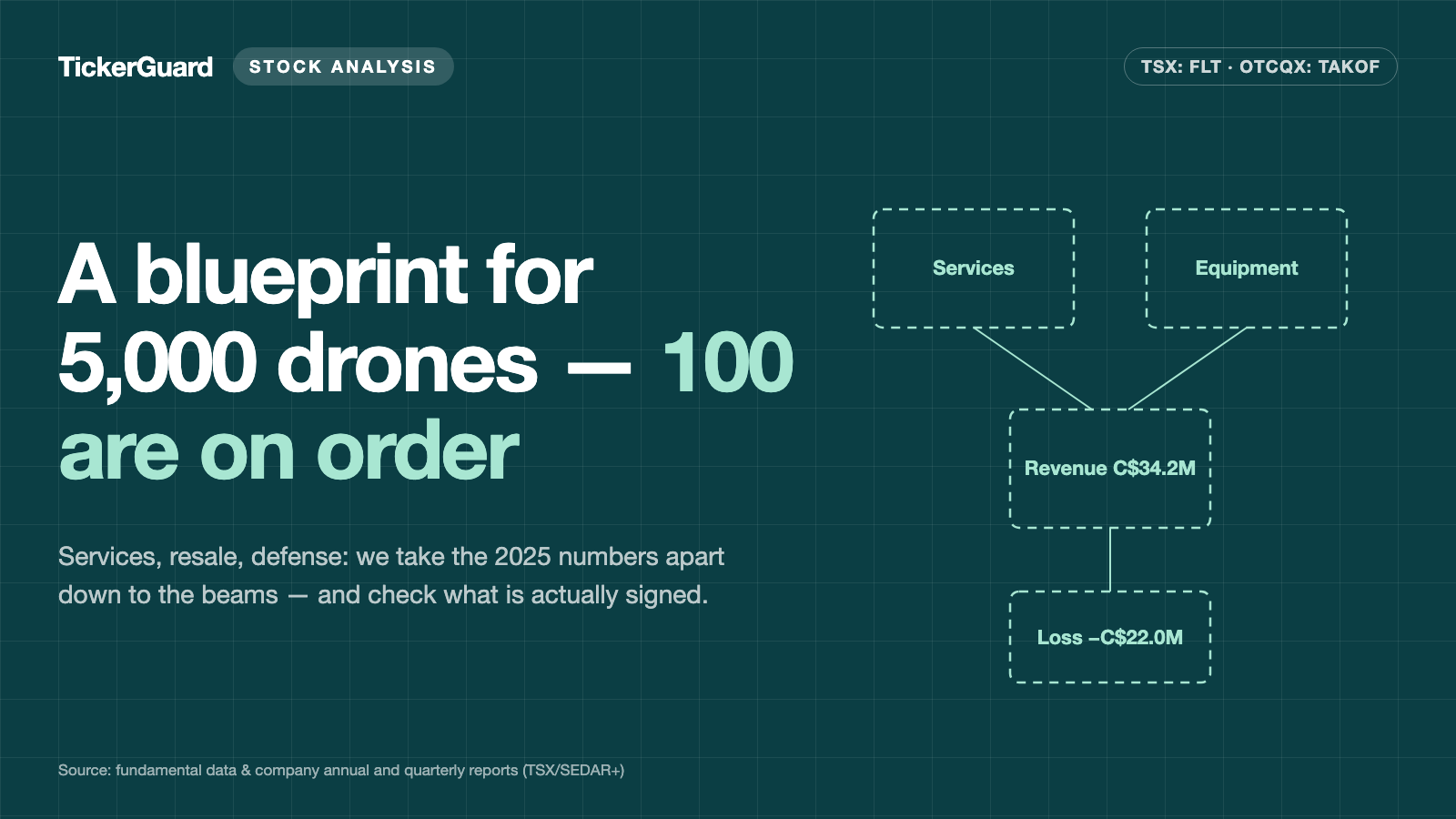
Up to 5,000 reconnaissance drones for Canada's armed forces, Volatus Aerospace (TSX: FLT, OTCQX: TAKOF) announced on September 10, 2026 — the firm order is 100, at no more than C$5,000 apiece. The company's own reports show revenue stuck at about C$34 million since 2023, a net loss that has more than doubled, and a cash pile filled by 57 percent more shares. The headline quotes the ceiling; the contract sets the floor.
 Thomas Mücke
Founder & Publisher
Thomas Mücke
Founder & Publisher
Chart
Interactive price chart (TradingView).
Note: pure fact-based analysis, not investment advice and not a solicitation to buy or sell. All figures without guarantee.
There is an investor weakness hiding in two small words: “up to.” Read “contract for up to 5,000 drones,” and the 5,000 sticks. The brain skips the “up to,” and the big number becomes the yardstick for everything that follows. Psychologists call it anchoring. Here we will call it the up-to trap: mistaking the ceiling of a promise for what has actually been signed.
Volatus Aerospace is a good place to practice, precisely because the company is real and so are its opportunities. It flies inspection missions over pipelines and power lines, sells and services drones, trains pilots, has run its own factory since June 2026 and supplies NATO defence organizations and allies. At the same time its communication is full of “up to”: up to 5,000 systems, up to $9 million, up to $250 million. So let’s make a deal: we read what is in the financial statements and the management’s discussion and analysis — the places where an auditor or a securities regulator reads along. At the end, you decide.

What Volatus Aerospace actually does
Volatus Aerospace Inc. is a Canadian corporation — incorporated in British Columbia in 2011 and continued under federal law (the Canada Business Corporations Act) since September 30, 2025 — with offices in Vaughan near Toronto and manufacturing in Mirabel near Montreal. Today’s company was formed on August 30, 2024 by merging two drone businesses: listed Drone Delivery Canada acquired Volatus Aerospace Corp. and took its name. For accounting purposes it ran the other way — Volatus Corp. is treated as the acquirer, and its numbers form the group’s history. That is why the comparatives go back to 2023 even though the group has only existed in this form since 2024.
The business stands on three legs. First, aerial services: inspection, mapping and surveillance for oil and gas pipelines, power grids, infrastructure and forestry, partly with drones, partly with crewed aircraft and helicopters. A framework agreement with a North American power utility covering about 100,000 miles of lines runs through August 2028. Second, equipment: Volatus resells and services drones and sensors made by others and develops its own aircraft — from the Canary cargo drone and the Condor XL heavy-lift helicopter to the V100, V200 and V300 long-endurance drones. Third, training: pilot courses in Canada, the U.S. and the U.K.
Then there is the story that drives the stock: defence. Volatus supplies training and reconnaissance systems to NATO defence organizations and allies, has sold a counter-drone planning software called SKYDRA since March 2026, and in May 2026 unveiled V-Cortex, its own AI flight controller. In June 2026 it put a 53,000-square-foot hall at Montreal-Mirabel airport into operation for manufacturing and systems integration; the official opening followed on September 29, 2026. Revenue mix in the first half of 2026: 56 percent services and training, 44 percent equipment; 65 percent came from Canada, 28 percent from the U.K., 7 percent from the U.S.
That names the central tension of this analysis: the market values Volatus as a future defence supplier with its own factory and its own technology. The financial statements so far show a service provider and reseller whose revenue is not growing and whose losses are.
Company history for investors
-
2024
Merger with Drone Delivery Canada
On Aug 30, 2024 today’s Volatus Aerospace Inc. was formed; each Volatus shareholder received 1.785 new shares. At year-end 2024 there was only C$1.6M of cash.
-
2025
Capital for a fresh start
Several placements between C$0.12 and C$0.60 raised C$44.8M net; the share count rose to 668.2 million by year-end and the loss to C$22.0M.
-
2026
Covenant waiver and move to the TSX
On Feb 3, 2026 EDC waived the covenant breached at year-end 2025; on Mar 20, 2026 the stock moved from the TSX Venture to the Toronto Stock Exchange.
-
2026
C$34.5M and a factory of its own
In June 2026 Volatus placed 53.1 million shares at C$0.65 and put a plant in Mirabel into operation — cash rose to C$59.2M by Jun 30, 2026.
-
2026
First Canadian armed-forces order
On Sep 10, 2026 Canada firmly ordered 100 reconnaissance drones with options for up to 4,900 more; the closing price rose 22 percent within three trading days.
Why there is no annual report with the U.S. regulator
One point up front, because it shapes the whole evidence base: Volatus files no annual report on Form 10-K and no quarterly report on Form 10-Q, nor the 40-F annual report large Canadian issuers often use, with the U.S. securities regulator, the SEC. Its EDGAR database does hold an entry under CIK 0001547452 — with the former name Asher Resources Corp. from before Drone Delivery Canada — but underneath are only three Form D notices dated April 19, 2012, March 19, 2013 and January 2, 2026: short filings on private placements to U.S. investors, with no financial statements. The only market listed there is “OTC.”
For a Canadian company that is normal and not a red flag. Since March 20, 2026 Volatus has traded on the Toronto Stock Exchange under the symbol FLT, having moved up from the smaller TSX Venture Exchange. It reports under Canadian rules (National Instrument 51-102): audited IFRS annual financial statements with a management’s discussion and analysis, or MD&A, and quarterly statements with their own MD&A. Everything goes through Canada’s filing system SEDAR+. BDO Canada LLP issued a clean audit opinion on the 2025 statements on March 30, 2026. The latest report covers the half-year to June 30, 2026; its MD&A is dated August 13, 2026.
Every number in this analysis therefore carries “Source: fundamental data & the company's annual and quarterly reports (TSX/SEDAR+).” Both the accounts and the stock are in Canadian dollars (C$); all amounts in this article are Canadian dollars unless stated otherwise.
How the stock landed on our desk
Honestly: not through a hit in our in-house stock scanner. Volatus came onto our research list under its U.S. symbol TAKOF. Three symbols, one stock: FLT on the Toronto Stock Exchange, the home market where the price is actually set; TAKOF on the U.S. OTCQX market, an over-the-counter venue without the listing requirements of a regulated U.S. exchange; and ABB.F in Frankfurt. We carry the company under its home listing.
The scanner-universe data are still telling. The Piotroski score, a 0-to-9 checklist of financial health, stood at 3 out of 9 as of August 11, 2026 (balance sheet as of March 31, 2026) — a truly healthy company scores 8 or 9, and a 3 means most tests of profitability, leverage and efficiency fail. Return on equity was deeply negative at minus 57 percent. On the other side stands an equity ratio of 75 percent: after the large equity raises, the balance sheet is well cushioned.
A recency check: between the half-year report of August 13, 2026 and September 29, 2026, Volatus announced its admission to Canada’s drone supplier pool (September 3 and 8), the armed-forces contract (September 10), a GPS-free V-Cortex test flight (September 22) and the official opening of the Mirabel plant (September 29, with no new figures). No new results, financings or share consolidation were among them. A transcript of the second-quarter conference call was not available to us as a primary source; we relied instead on the interim financial statements, the MD&A and the company’s releases. Anything stated here in the present tense about a condition rests on June 30, 2026 or later.
The numbers over the years — a fair look
Let’s start with what genuinely impresses — and that is the balance sheet. At the end of 2024 Volatus had just C$1.6 million of cash; in 2025 the CFO personally advanced money to the company to bridge gaps until the next financing. By June 30, 2026 cash was C$59.2 million. Current assets exceed current liabilities by C$63.8 million, and interest-bearing borrowings excluding leases and the convertible fell to C$9.7 million. Management says cash is sufficient for at least twelve months. That turnaround is real, and it is the product of equity raises the market was happy to fund — most recently C$34.5 million at C$0.65 per share in June 2026.
There are operating bright spots too. Gross margin, the share of revenue left after direct costs, holds at about a third: 32.5 percent in 2025, 31.6 percent in the first half of 2026. Second-quarter 2026 revenue of C$8.4 million was almost 50 percent above the first quarter. And in July 2026 the Canary cargo drone became, according to the company, the only drone accepted by Transport Canada to fly beyond visual line of sight over populated areas using onboard detect-and-avoid alone.
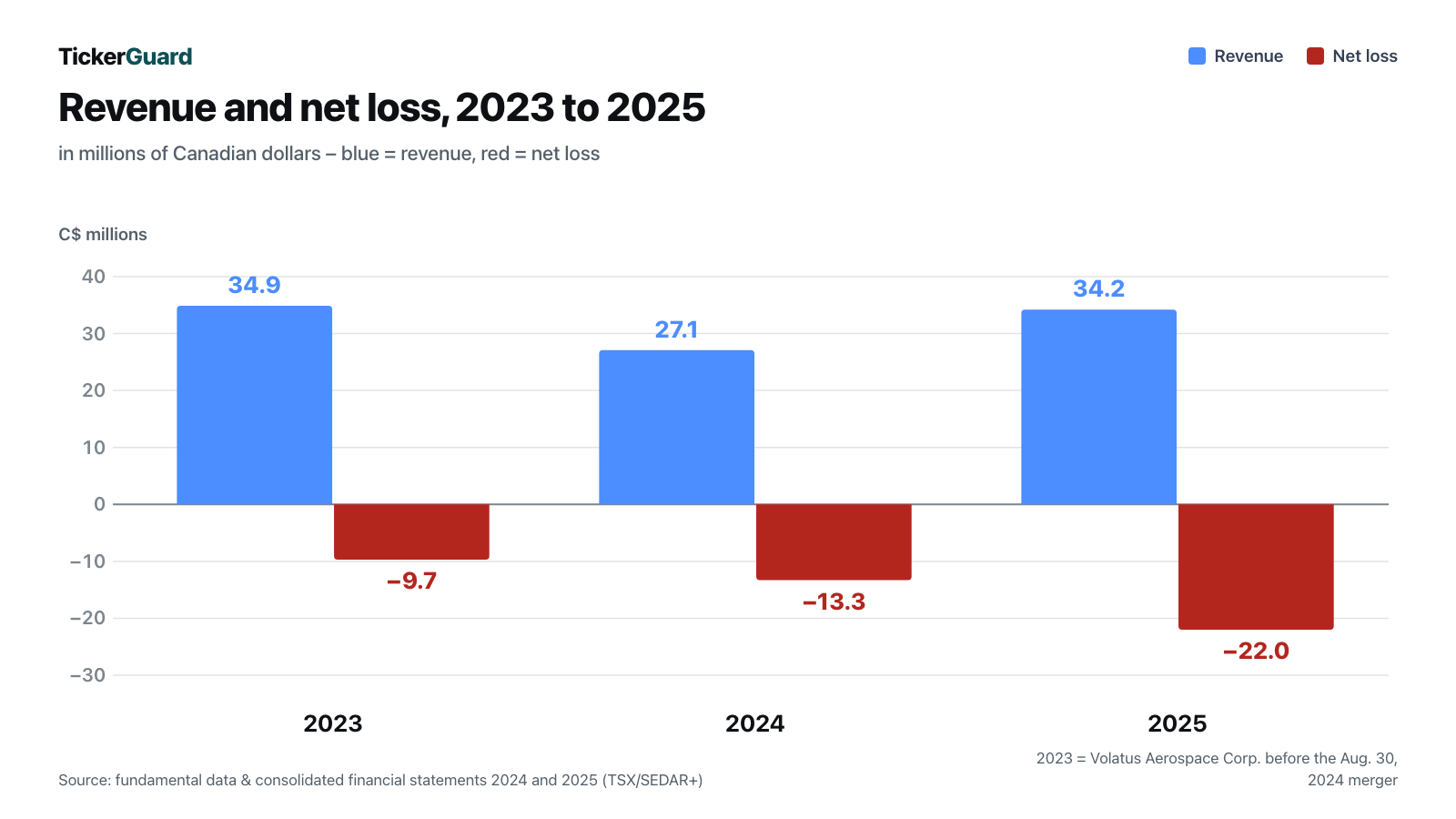
Now the other half of the picture. 2025 revenue of C$34.2 million sat almost exactly where it was in 2023 (C$34.9 million); in between it fell 22 percent in 2024 to C$27.1 million because, according to the company, it lacked the capital to stock inventory. In the first half of 2026 it declined again, by 13.8 percent to C$14.0 million. The net loss, by contrast, more than doubled from C$9.7 million in 2023 to C$22.0 million in 2025, and the first half of 2026 added another C$14.1 million. Even the adjusted figure management puts front and center — earnings before interest, taxes, depreciation and one-offs, or “Adjusted EBITDA” — slipped to minus C$4.4 million in the second quarter of 2026 from minus C$0.3 million a year earlier.
What the filings say — the uncomfortable truths
Now for the passages no headline quotes. All of them come from the company’s own documents.
Uncomfortable truth No. 1: The headline says 5,000, the contract says 100
On September 10, 2026 Volatus announced a five-year Canadian government contract for low-cost reconnaissance drones for the armed forces, headlined “for up to 5,000 systems.” Further down, the release says what is firmly ordered: 100 systems. The procurement framework set a maximum price of C$5,000 per system. Do the math: the firm portion is worth at most C$0.5 million, about 1.5 percent of 2025 revenue. And about the rest, the company itself writes:
“The optional systems are not committed purchases, backlog or revenue.”
— Volatus Aerospace Inc., company release of September 10, 2026

That is cleanly disclosed, and a foothold in Canadian military procurement is a real step for a company this size. The market reacted to the headline anyway: from September 9 (C$0.54) to September 14, 2026 (C$0.66), the closing price rose 22 percent. On 735 million shares, that is about C$88 million of added market value for a firm order worth half a million at most.
The largest defence contract shows the same pattern: a training system for a NATO ally, awarded in December 2025, for “up to” $9 million. The firm part is a first tranche of about $4.5 million. Its delivery was planned for the first quarter of 2026, slipped into the second — and now reads like this in the MD&A for June 30, 2026:
“The defence pipeline now includes the up to $9 million NATO ISR training system contract awarded in December 2025 (with the initial $4.5 million tranche expected for late 2026 delivery)”
— Volatus Aerospace Inc., MD&A for the period ended June 30, 2026, Strategic Priorities
A few pages earlier, the same report says delivery has already begun; the company attributes the second-quarter revenue decline to a defence contract of about $2.6 million that is now to be delivered in the third and fourth quarters of 2026. Whether that is the same contract, the report does not say. Rule of thumb: with Volatus, ask of every number whether it is firm or “up to.”
Uncomfortable truth No. 2: More cost, not more revenue
The defence pivot costs money before it makes any. In the first half of 2026 operating expenses rose 48 percent to C$17.0 million while revenue fell. The biggest items: personnel (C$6.5 million versus C$4.8 million), advertising and marketing including investor and government relations (C$1.5 million versus C$0.6 million), professional fees (C$1.7 million versus C$0.7 million) and travel (C$0.6 million versus C$0.1 million). Compensation for officers and directors more than doubled to C$1.16 million. Operating cash outflow was C$10.9 million for the half-year, against C$7.5 million for all of 2025. How long this lasts, the MD&A answers itself:
“As a result of the Company’s business plan for the development of its products and services, the Company expects cash flow from operations to be negative until revenues increase to offset its operating expenditure.”
— Volatus Aerospace Inc., MD&A for the period ended June 30, 2026, Liquidity and Capital Resources

A rough calculation: operating outflow plus capital spending came to about C$12.6 million in the first half of 2026. At that pace, the June 30, 2026 cash balance lasts a little over two years — enough time, but not forever, especially since much of the announced “in excess of $10 million” investment in Mirabel still lies ahead. One setback comes from the U.S.: revenue from U.S. customers fell 68 percent to C$1.0 million in the first half of 2026. The MD&A cites expanding U.S. federal restrictions on drones from non-allied countries and “Made in America” procurement priorities as headwinds.
Uncomfortable truth No. 3: The bill is paid in new shares
Dilution simply means your slice of the pie gets smaller because more people are eating the same pie. At Volatus the pie has been cut hard since the merger:
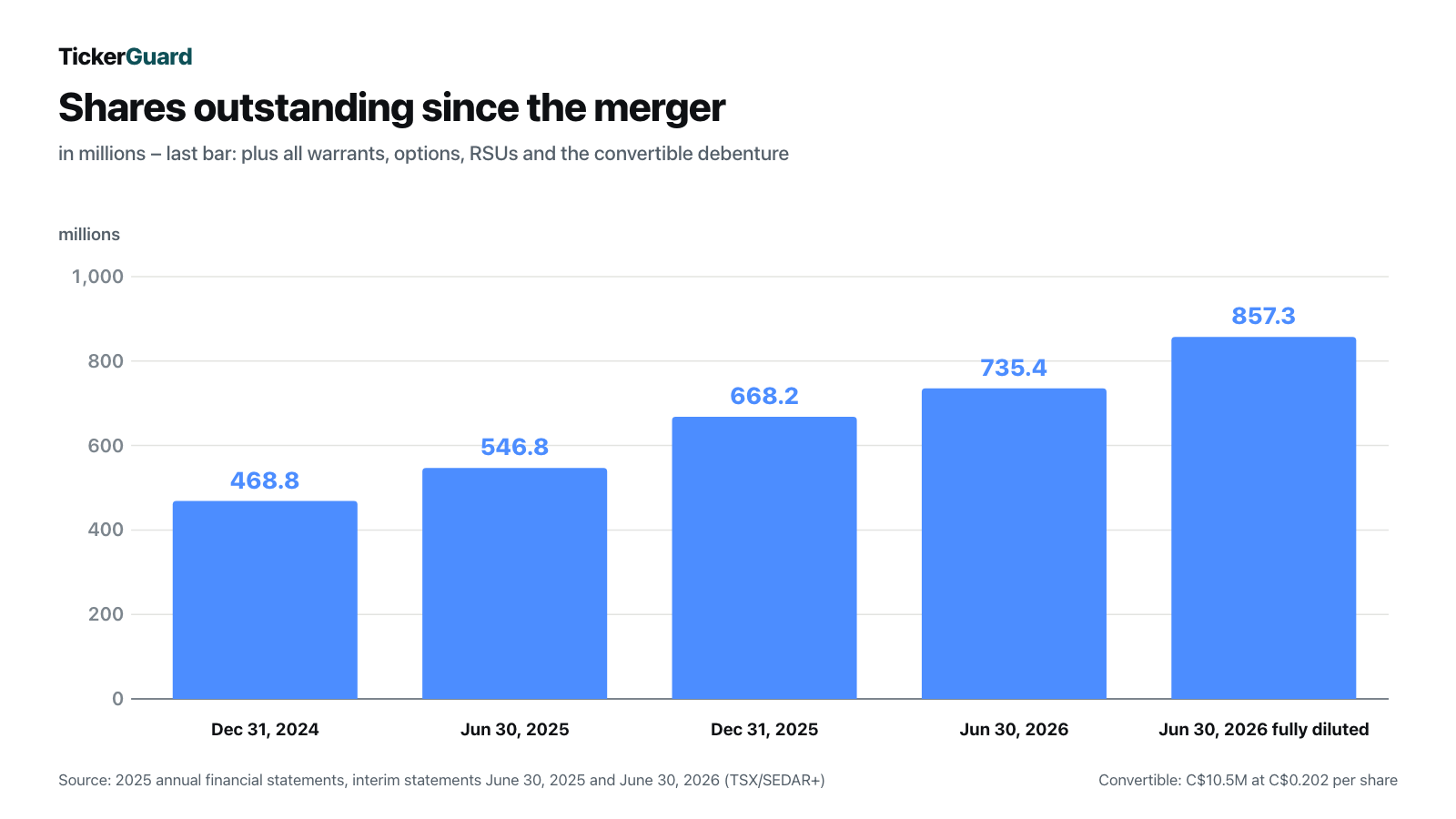
From 468.8 million shares at the end of 2024 the count went to 735.4 million on June 30, 2026. The 2025 equity raises brought in C$44.8 million net, and exercised warrants and options another C$9.2 million; in the first half of 2026 the June offering added C$32.4 million and warrants C$2.3 million. The prices of those rounds tell the stock’s story: C$0.12 per unit in May 2025, C$0.20 in June, C$0.52 in July and August, C$0.60 in November 2025 and C$0.65 in June 2026.
And more shares are waiting. At June 30, 2026 there were 42.2 million warrants outstanding, most of them at C$0.20 to C$0.30 — far below the market price — plus 17.1 million employee options and 10.7 million restricted share units. On top comes a secured convertible debenture from the development bank Investissement Québec of C$10.5 million, convertible at C$0.202 per share, or about 52 million shares. All told, that would be about 857 million shares. We have also logged the debenture as a side find. According to the MD&A for June 30, 2026, shareholders at the May 2026 annual meeting authorized the board to consolidate the shares at a ratio of up to 20 to 1. That changes nothing about your stake; it just makes the share count look smaller.
Uncomfortable truth No. 4: A broken covenant and a leftover drafting note
Volatus has a C$6.75 million term loan from Export Development Canada, the state export lender, priced at the Canadian banks’ prime rate plus 8 percentage points. The agreement requires a minimum EBITDA. At the end of 2025 Volatus missed it:
“The Company was in breach of its EBITDA covenant as at December 31, 2025, and received a formal waiver from EDC subsequent to year-end.”
— Volatus Aerospace Inc., MD&A for the period ended June 30, 2026, Covenant Compliance and Debt Obligations
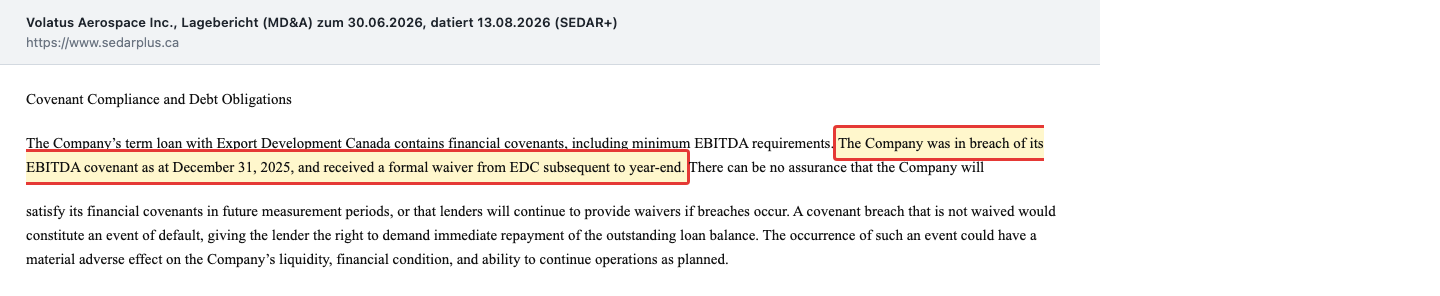
A covenant is a condition in a loan agreement, such as a minimum profit; breach it, and the lender may call the loan immediately. EDC waived the breach on February 3, 2026. At June 30, 2026, however, the interim statements confirm compliance only with the covenant tested quarterly, a minimum working-capital requirement. The breached covenant is tested once a year — and for the next test date the company writes:
“Based on management’s current forecasts, the Company does not expect to satisfy the fixed charge coverage ratio at December 31, 2026.”
— Volatus Aerospace Inc., interim financial statements for June 30, 2026, note 13
Without another waiver or an amendment, that would be an event of default: the lender could call the C$6.75 million immediately. With C$59.2 million of cash, that is not an existential issue. But it shows that management itself does not expect an earnings turnaround by year-end 2026 strong enough to meet a loan covenant.
The second finding in this chapter is smaller but says a lot about care. In the MD&A for June 30, 2026 — a mandatory document — a sentence worded recognizably as an internal drafting instruction sits in the middle of the text:
“Adjusted EBITDA loss for the three months ended June 30, 2026, was $(4,352,154), compared to $(291,460) in Q2 2025, and the reconciliation table below requires correction and the addition of six-month columns.”
— Volatus Aerospace Inc., MD&A for the period ended June 30, 2026, Adjusted EBITDA

The table below it does show only the quarter. And it does not stop there. The same report compares first-half operating cash outflow with $1,656,788 in the prior year — the cash flow statement says $1,418,635; the larger figure is in fact the current half-year’s investing outflow. It reports the share consolidation authority as approved at an annual meeting “held on May 7, 2026” — the information circular had called that meeting for May 22, 2026 — while announcing the same vote in two other places for the “upcoming” annual meeting. And the 2025 financial statements give June 18, 2028 as the earliest date for early repayment of the convertible debenture, while the 2025 MD&A says October 21, 2027. Even the breached covenant is called an “EBITDA covenant” in the MD&A for June 30, 2026, but a “fixed charge coverage ratio” covenant in the accompanying interim financial statements. None of this changes the cash balance. But the June 30, 2026 statements are, as usual for Canadian interim reports, unaudited — and care in the small things is what you have to rely on with unaudited numbers.
Valuation: what you pay for a drone story
Now let’s add it up. On September 25, 2026 the stock closed on the TSX at C$0.58. With 735,393,892 shares (June 30, 2026) that gives a market value of about C$427 million. The cross-check fits: at the June 2026 offering price (C$0.65) it would have been about C$478 million. Subtract cash and add borrowings and the convertible, and enterprise value comes to about C$386 million.
What do you get for that?
- Revenue: Over the last four reported quarters (third quarter of 2025 through second quarter of 2026) Volatus booked C$32.0 million. Market value equals 13.3 times that, enterprise value 12.1 times. For a service provider and reseller with a one-third gross margin that is a lot — the price bets on the defence future, not on today’s business.
- Earnings: There are none. A price-to-earnings ratio cannot be calculated; the loss over the last four quarters was C$25.1 million.
- Book value: Equity was C$88.6 million at June 30, 2026, of which C$35.3 million is goodwill and intangibles from acquisitions. The market pays almost five times book. Incidentally, the company tests its C$20.7 million of goodwill using revenue multiples of comparable listed companies — rising sector valuations support the balance sheet, falling ones weigh on it.
An honest read: the stock has come a long way. According to the company, the share price rose 279 percent in 2025. In the twelve months to September 25, 2026 the highest close was C$0.88 (March 2026, around the move to the TSX) and the lowest C$0.46 (July 30, 2026). A price of C$0.58 assumes the pipeline turns into firm orders, the Mirabel plant gets busy and Volatus steers its losses toward breakeven. None of that is impossible — none of it is proven as of June 30, 2026. To see how another drone maker handles defence orders, read our Red Cat analysis; we examined a counter-drone and autonomous-systems provider in our Ondas analysis.
Upside and risks at a glance
What speaks for the company:
- The cash box is full. C$59.2 million at June 30, 2026, C$63.8 million of net working capital, interest-bearing borrowings of only C$9.7 million; the company says that covers at least twelve months, and at first-half pace it lasts a little over two years.
- Political tailwind. Canada’s defence industrial strategy of February 2026 aims to award 70 percent of procurement to Canadian firms and names drones explicitly; Volatus is qualified in all five streams of the government’s drone supplier pool.
- Own manufacturing and approvals. A plant in Mirabel, operating since June 2026 and officially opened on September 29, 2026, a cargo drone with a rare Transport Canada acceptance, first orders from Canada’s armed forces and NATO allies.
- A stable core business. Inspection and training services with a gross margin of about one-third, including a framework agreement covering about 100,000 miles of power lines through August 2028.
- Management with skin in the game. CEO Glen Lynch and Chairman Ian McDougall each held a little over 13 percent of the shares then outstanding, according to the April 2026 circular.
What speaks against it:
- No growth. 2025 revenue of C$34.2 million at the 2023 level, first half of 2026 down 13.8 percent; U.S. business down 68 percent.
- Widening losses. Net loss up from C$9.7 million (2023) to C$22.0 million (2025), C$14.1 million in the first half of 2026; operating expenses up 48 percent.
- Dilution. 57 percent more shares in 18 months, about 857 million fully diluted, a convertible debenture deep in the money.
- “Up to” instead of firm. Of the army contract for up to 5,000 systems, 100 are firm; the first tranche of the NATO contract has been pushed back twice.
- Covenant and reporting care. A missed loan covenant at year-end 2025 and another breach management itself expects at year-end 2026, a leftover drafting note and several inconsistencies in the unaudited half-year report.
A human conclusion
Remember the up-to trap from the start? With Volatus it would be too easy to say: it is all headlines. The company has real customers, a real factory, a full cash box, and it sits in a market into which Canada and its allies are steering a lot of money. That sets it apart from many stocks that climb the rankings on similar announcements.
The trap lies elsewhere. The headlines speak of up to 5,000 drones, up to $9 million and a platform for national sovereignty. The financial statements show three years without revenue growth, a loss that has more than doubled, 57 percent more shares and a half-year report that still contains a working note. Both are true. But only one of them is signed.
The next hard test has a date: the quarterly report for September 30, 2026. It will show whether the delayed defence deliveries reach revenue, whether costs rise more slowly than sales, and whether Canada uses its options.
What you make of it is your decision. And that is how it should be.
Sources and data as of
- Interim financial statements for June 30, 2026 (IAS 34, unaudited) and MD&A for June 30, 2026, both dated August 13, 2026 (copies of the SEDAR+ filing)
- Second-quarter 2026 results release (August 13, 2026)
- MD&A for March 31, 2026 (dated May 14, 2026)
- 2025 annual financial statements with BDO Canada LLP audit opinion of March 30, 2026, and 2025 MD&A
- 2024 annual financial statements (2023 comparatives, merger of August 30, 2024)
- Management information circular dated April 13, 2026
- Company releases of September 8, 2026 (drone supplier pool), September 10, 2026 (armed-forces contract), September 22, 2026 (V-Cortex) and September 29, 2026 (official opening of Mirabel)
- The company’s mandatory filings on SEDAR+ and its financial reports page; at the SEC, CIK 0001547452 holds only Form D notices
- Price data: Toronto Stock Exchange closing prices through September 25, 2026; scanner-universe metrics: source fundamental data, as of August 11, 2026
Data as of: Company figures as of June 30, 2026 or the date stated; price and market-value figures as of September 25, 2026. The company’s releases were last checked on September 29, 2026; the most recent one, dated September 29, 2026, covers the official opening of the Mirabel plant. All amounts in Canadian dollars (C$).
Disclaimer: This article is a journalistic contextualization of publicly available information and is not investment advice. It contains no buy or sell recommendation and is not a solicitation to buy or sell securities. Shares in small, loss-making technology and defence companies are especially volatile; a total loss of the capital invested is possible. Positions held by the operator are disclosed daily; where one exists, it appears as a notice at the top of this deep dive.
Our Bottom Line at a Glance
- Cash and balance sheet positive
- Cash stood at C$59.2 million at June 30, 2026, up from C$1.6 million at the end of 2024; net working capital was C$63.8 million and interest-bearing borrowings C$9.7 million. The company says cash covers at least twelve months.
- Defence market positive
- Canada’s defence industrial strategy of February 2026 favors Canadian suppliers and names drones explicitly. Since September 2026 Volatus has been qualified in all five streams of the government’s drone supplier pool and holds a first armed-forces contract.
- Revenue trend negative
- 2025 revenue of C$34.2 million matched the 2023 level (C$34.9 million) and fell 13.8 percent in the first half of 2026; U.S. revenue dropped 68 percent.
- Losses and cash burn negative
- The net loss rose from C$9.7 million (2023) to C$22.0 million (2025) and was C$14.1 million in the first half of 2026; operating expenses grew 48 percent and operating cash outflow was C$10.9 million. An EDC loan covenant was breached at December 31, 2025, and management expects the next breach at December 31, 2026.
- Dilution negative
- Shares outstanding rose from 468.8 million (December 31, 2024) to 735.4 million (June 30, 2026). Including all warrants, options, RSUs and the convertible at C$0.202, the count would be about 857 million.
- Reliability of disclosures neutral
- The unaudited MD&A for June 30, 2026 contains a leftover drafting note and several inconsistencies; contract announcements lead with ceilings (“up to 5,000 systems”), while the firm order on September 10, 2026 was 100 systems. The 2025 annual statements carry a clean audit opinion.
After the 2024 merger, Volatus Aerospace filled its cash box with a lot of new equity: C$59.2 million at June 30, 2026. The business itself is not growing — 2025 revenue matched 2023, the loss has more than doubled, and the share count rose 57 percent in 18 months. The defence story is real but small so far: of the army contract for up to 5,000 drones, 100 are firm. The next test is the quarterly report for September 30, 2026. Not investment advice.
What Our Rating Means
Open questions
The business works in principle, but one material question is open. As long as it stays open, our findings do not carry a quality verdict.
Yellow, because the business basically works but the decisive operating question is open: whether the defence pipeline turns into revenue before the money runs out. Red would be wrong: C$59.2 million of cash at June 30, 2026 lasts a little over two years at first-half pace; equity is positive, the C$6.75 million EDC loan could be repaid from cash if necessary, the 2025 statements carry a clean audit opinion, and there is no going-concern warning. Green would be just as wrong: revenue has stalled since 2023, the loss has more than doubled, the cash came from 57 percent more shares, a loan covenant was breached at year-end 2025, management expects another breach at year-end 2026, and the latest half-year report shows carelessness. At about 13 times revenue, the market is pricing in a future the financial statements do not show yet. The decision is yours.
A journalistic assessment by our editorial team at the time of the deep dive, based on public sources — not investment advice and not a solicitation to buy or sell. Your personal circumstances (investment goals, risk capacity, taxes) cannot be taken into account. What our levels mean, how verdicts are formed, and what conflicts of interest exist →
Worth Noting
- This analysis was triggered by the U.S. OTCQX symbol TAKOF; we carry the company under its home listing FLT on the Toronto Stock Exchange (record FLT.TO). There is no hit from our in-house stock scanner.
- Volatus is not an SEC reporting company. All company figures come from Canadian mandatory filings via SEDAR+: 2024 and 2025 annual financial statements, MD&As for 2025, March 31, 2026 and June 30, 2026, interim statements for June 30, 2026, the circular of April 13, 2026 and releases through September 29, 2026. The half-year documents were read as copies of the SEDAR+ filing because SEDAR+ blocks automated access.
- The 2023 comparatives are those of Volatus Aerospace Corp. before the merger of August 30, 2024; for accounting purposes it is the acquirer of Drone Delivery Canada. Share counts before the merger are not comparable because of the 1.785 exchange ratio and are therefore left out of the chart.
- As usual for Canadian interim statements, the June 30, 2026 statements are unaudited. Where the MD&A and the cash flow statement disagree, this analysis follows the cash flow statement.
The full analysis as a PDF for later
We will send you this analysis as a PDF — to print, file away, and read at your own pace.
Frequently Asked Questions
Volatus Aerospace is a Canadian drone and aerial-services company based in Vaughan near Toronto, with a factory in Mirabel near Montreal. It flies inspections for pipelines and power grids, sells and services drones, trains pilots and supplies reconnaissance and training systems to NATO defence organizations and allies. It generated C$34.2 million of revenue in 2025.
It is the same stock on three venues. FLT is the symbol on the Toronto Stock Exchange, the home market where the price is set in Canadian dollars; Volatus moved there from the TSX Venture Exchange on March 20, 2026. TAKOF is the symbol on the U.S. OTCQX market, and ABB.F is the Frankfurt listing.
Because Volatus is not a U.S. reporting company. It was incorporated in British Columbia in 2011, has been governed by Canadian federal corporate law since September 30, 2025, is listed on the Toronto Stock Exchange and reports under Canadian rules through SEDAR+: audited annual statements with an MD&A and quarterly statements with an MD&A. At the SEC, CIK 0001547452 holds only Form D notices without financial statements.
Canada firmly ordered 100 tactical reconnaissance drones. The procurement framework caps the price at C$5,000 per system, so the firm portion is worth at most C$0.5 million. The options for up to 4,900 more systems are, according to Volatus, not committed purchases, backlog or revenue; whether they are exercised is up to Canada alone.
No. The net loss was C$9.7 million in 2023, C$13.3 million in 2024 and C$22.0 million in 2025, plus another C$14.1 million in the first half of 2026. Operating cash outflow was C$10.9 million in the first half of 2026. The company itself expects negative operating cash flow until revenue covers operating expenses.
Shares outstanding rose from 468.8 million at the end of 2024 to 735.4 million on June 30, 2026, up 57 percent. On top come 42.2 million warrants, 17.1 million employee options, 10.7 million restricted share units and a C$10.5 million convertible debenture at C$0.202 per share — about 857 million shares in total.
C$59.2 million at June 30, 2026, up from C$1.6 million at the end of 2024. The money came from equity raises, most recently C$34.5 million at C$0.65 per share in June 2026. At the first-half 2026 burn rate, the cash would last a little over two years.
Found an error?
Did you spot a factual error, an outdated number, or a typo in this deep dive? Let us know briefly — your report goes straight to the editorial team.