Commerzbank: The Best Half-Year in 156 Years — and Milan Will Soon Cast the Deciding Vote
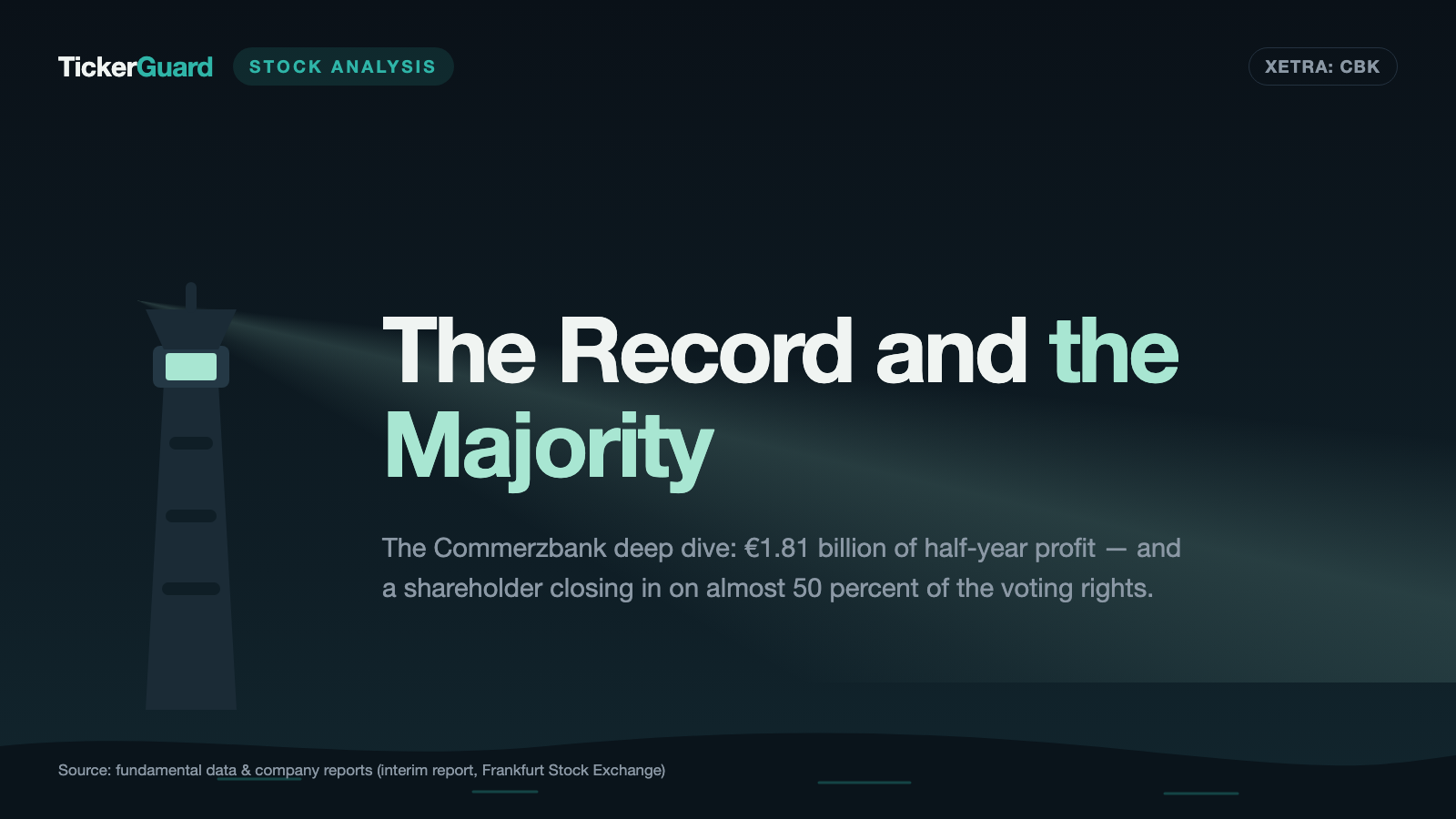
Commerzbank earned €1,810 million in the first half of 2026, the highest profit in its history; net return on tangible equity climbed to 12.6 percent and the CET 1 ratio stands at 14.4 percent. In the same summer, Italy's UniCredit holds more than 25 percent of the shares outright, with a further 17.6 percent tendered to it and waiting only for regulatory clearance. The German state holds just over 10 percent, all retail investors together about 16. Not a buy or sell recommendation — just the question of who the next record actually belongs to.
 Thomas Mücke
Founder & Publisher
Thomas Mücke
Founder & Publisher
Chart
Interactive price chart (TradingView).
Note: pure fact-based analysis, not investment advice and not a solicitation to buy or sell. All figures without guarantee.
There is an investor weakness that feels particularly good and is therefore rarely questioned: the co-owner illusion. You buy a share, read the record announcement and think, "my company is doing well." The feeling is even legally correct — you are a co-owner. It is just that ownership of a stock corporation consists, at its core, of votes, and votes can be collected. Whoever holds enough of them decides who sits on the supervisory board, which strategy is pursued and what happens to the profit. The company then keeps running — only according to somebody else's plan.
At Commerzbank you can watch both happen at once in 2026, which is exactly what makes it such an instructive case. On 6 August 2026 the bank reported the best half-year in its 156-year history. Four weeks earlier, on 8 July 2026, UniCredit's takeover offer came to an end — with a result that has effectively flipped the majority at the annual general meeting. So let us make a deal: we read the bank's original releases line by line, redo the arithmetic ourselves, and look at both — the record and the majority. Because one number is in the headline and the other is in the fact sheet.
What Commerzbank actually does
Commerzbank AG, headquartered at Kaiserplatz in Frankfurt am Main, is a universal bank — it does not do one thing but almost everything a bank can do. Put in everyday terms: it is at the same time the house bank of a machinery maker in Swabia, your neighbour's current account, the broker behind an ETF savings plan and the partner that hedges a mid-sized exporter's payments from Vietnam.
It reports in two segments. Corporate Clients is the core: the bank describes itself as the leading bank for the German Mittelstand, serves around 24,000 corporate client groups and, by its own account, supports around 30 percent of German foreign trade; the segment's average loan volume rose 16 percent to €123 billion in the second quarter of 2026. The Private and Small-Business Customers segment operates under two brands: "Commerzbank" with around 400 locations and "comdirect" as a digital bank and broker — around 21 million securities trades were executed there in the first half of 2026 alone, 5 percent more than a year earlier. On top of that sits Polish subsidiary mBank S.A., a digital bank with roughly 6 million customers in Poland, the Czech Republic and Slovakia — more important for this analysis than it first sounds.
As of 30 June 2026 the group employed 40,110 people (full-time equivalents including trainees; 31 December 2025: 39,867). Total assets stood at €619 billion, up from €590 billion at the end of 2025.
Why there is no SEC filing here — and where the numbers come from instead
One point up front, because it shapes the entire evidence base: there is no 10-K and no 10-Q for Commerzbank. The bank is not a U.S. reporting company. Anyone searching the SEC for the ticker "CBK" ends up at an entirely different firm — Commercial Bancgroup, Inc. on Nasdaq. An SEC identifier does exist under the name "Commerzbank Aktiengesellschaft /FI" (CIK 0000852933), but its filing history contains nothing but investor filings: quarterly reports on securities holdings (Form 13F), beneficial-ownership statements and proxy-voting records. Not a single periodic report. The two remaining hits are ADR registrations filed by a depositary bank.
Commerzbank's mandatory reporting runs instead through the regulated market of the Frankfurt Stock Exchange: an audited IFRS consolidated annual report, a half-year financial report (interim report as of 30 June) and short quarterly statements as of 31 March and 30 September. Every figure in this analysis therefore carries the line "Source: fundamental data & company reports (interim report/quarterly statement, Frankfurt Stock Exchange)", not "SEC filings". The underlying logic is the same: a German interim report is also a document the management board is personally answerable for — under European capital-markets law rather than U.S. law.
This constellation — DAX constituent but not an SEC registrant — is shared by many German names. In our analysis of Deutsche Telekom the entire evidence chain likewise ran through the company's own annual and interim reports rather than through sec.gov.
How the stock landed on our desk — and what a screener does to a bank
Our in-house stock screener runs 155 evaluations across the whole universe. Commerzbank shows up (as of 11 August 2026) in exactly two of them — and both need translating before you believe them.
The first is "EPS acceleration": earnings per share growing faster in the latest quarter than in the one before. That is genuinely true here, and by a wide margin. In the first quarter of 2026 the consolidated result rose 9.4 percent to €913 million; in the second quarter it rose 94.2 percent to €898 million. The catch: the second-quarter jump is largely a base effect. In the second quarter of 2025 the bank booked €493 million of restructuring expenses for its transformation, which pushed the result down to €462 million. A comparison against a deliberately burdened prior-year quarter always looks like acceleration.
The second is the "EBIT margin ranking" — every stock with an operating margin of at least 40 percent. Commerzbank comes in at around 44 percent in the fundamental data, placing it between software and luxury-goods makers. It sounds sensational but it is an apples-and-oranges measurement error: at an industrial company "revenue" is the gross figure, from which materials and production costs still have to come. At a bank, "revenues" are already a net number — net interest income is what is left after paying interest on deposits and funding. On that basis a bank almost inevitably shows a high "margin". It says nothing about quality.
Which brings us to the underlying issue you should keep on the table for any bank analysis: the standard metrics built for industrial companies are partly meaningless and partly misleading when applied to a bank. Three examples from our own Commerzbank data set as of 11 August 2026:
- Altman Z-score of 0.33. At an industrial company that would be a distress alarm. The score was developed in 1968 on manufacturers and works, among other things, with current assets relative to total assets. A bank by its very nature carries an enormous balance sheet of loans and deposits — it always fails this formula. Informative value: none.
- Enterprise value of minus €46.8 billion. The usual "market capitalisation plus debt minus cash" treats customer deposits as borrowings and central-bank balances as surplus cash. At a bank both are operating assets. A negative enterprise value here is not a bargain, it is an artefact.
- Return on assets of 0.57 percent. Looks catastrophic, is perfectly normal for a bank: it earns little on a very large balance sheet and a lot on a small amount of equity. That is why banks are measured on return on equity — which in the first half of 2026 was 12.6 percent.
What actually counts at a bank comes down to four figures: the CET 1 ratio (how much genuine equity stands behind the risks taken?), the NPE ratio (how many loans have stopped performing?), the cost-income ratio (how much expense does one euro of revenue cost?) and the net return on tangible equity. We go through all four in turn.
The numbers over the years — given their due
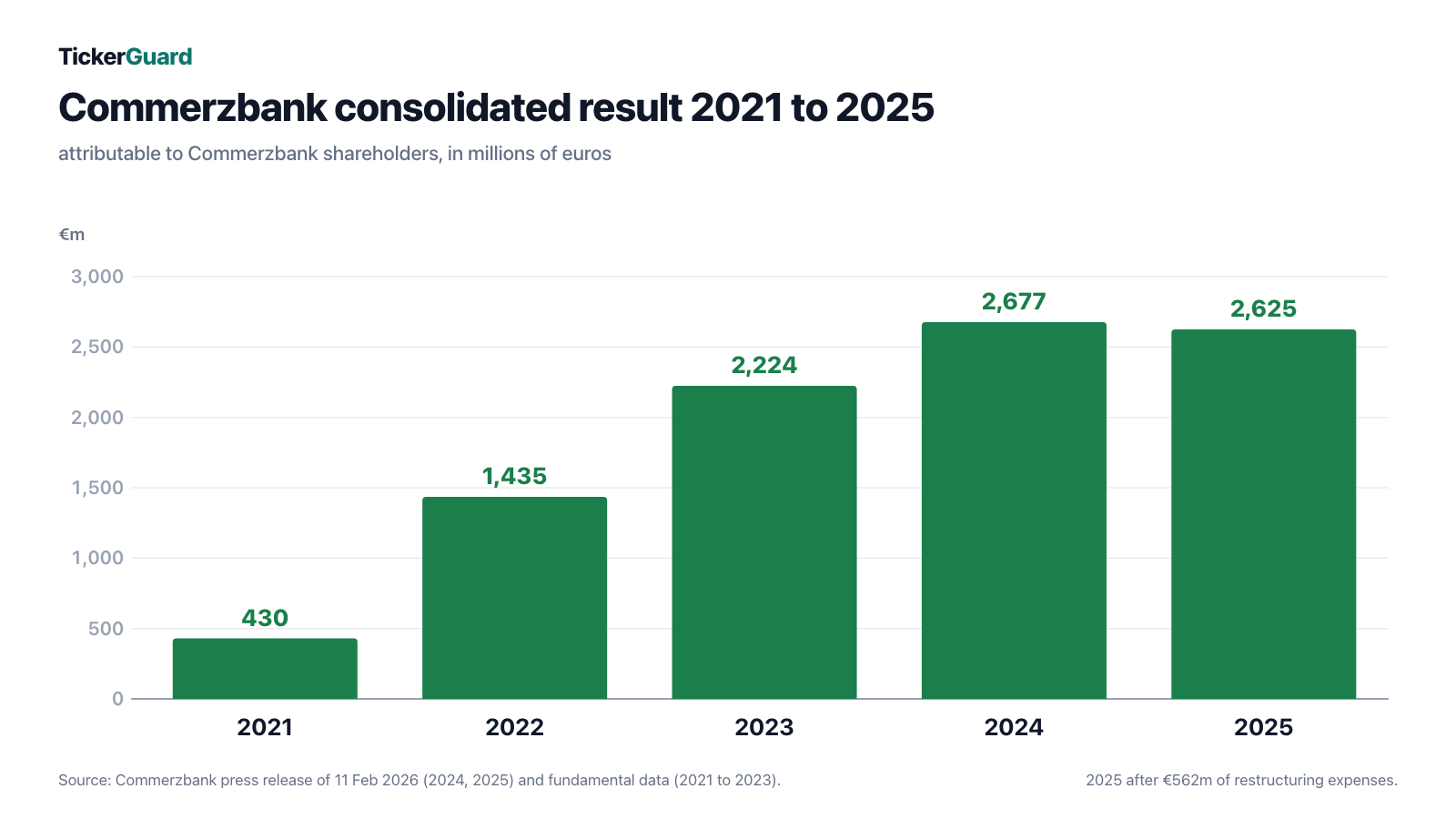
First the part that genuinely impresses, and there is plenty of it. Commerzbank is coming out of a deep hole. 2020 ended in a loss; 2021 produced a consolidated result of €430 million. After that it went up year after year: €1,435 million (2022), €2,224 million (2023), €2,677 million (2024) and €2,625 million (2025) — the slight dip in the last year came entirely from €562 million of restructuring expenses; the operating result rose 17.5 percent in 2025 to a record €4,509 million.
And 2026 added another step. In the first half, revenues rose 7.0 percent to €6,518 million, the operating result 13.8 percent to €2,725 million and the consolidated result 39.6 percent to €1,810 million. The cost-income ratio including compulsory contributions fell from 55.8 to 52.9 percent — the bank now needs 53 cents of expense per euro of revenue, down from 56 cents a year earlier. Net return on tangible equity reached 12.6 percent, the best figure the bank has ever reported. CEO Bettina Orlopp summed it up in the release of 6 August 2026:
"We delivered another record result in the first half of the year. This demonstrates the strength of our business model. With our strategy, we are reliably creating value for all stakeholders. We are growing profitably, investing in our future and proving the strength of our business with clients every day. On this basis, we are planning our next share buyback."
— Bettina Orlopp, CEO, in the press release on the first half of 2026 (6 August 2026)
The balance sheet holds up too. The CET 1 ratio — the single most important figure at a bank, because it says how much genuine equity stands behind the risks taken — was 14.4 percent as of 30 June 2026. The regulatory floor at which supervisors can stop dividends and buybacks currently sits at around 10.3 percent:
“Die harte Kernkapitalquote (CET-1-Quote) der Bank lag zum 30. Juni 2026 bei 14,4 % (31. März 2026: 14,5 %; 30. Juni 2025: 14,6 %). Der Abstand zur regulatorischen Mindestanforderung (MDA-Schwelle), die derzeit bei rund 10,3 % liegt, war mit 409 Basispunkten weiter komfortabel.”
Translation: "The Bank's Common Equity Tier 1 (CET 1) ratio stood at 14.4% as of 30 June 2026 (31 March 2026: 14.5%; 30 June 2025: 14.6%). The buffer above the minimum regulatory requirement (MDA threshold) of currently around 10.3% remained comfortable at 409 basis points."
— Commerzbank AG, press release of 6 August 2026 (German original)

Then there is credit quality: the non-performing exposure ratio was unchanged at 1.1 percent in the second quarter of 2026 — the same as in the previous quarter and the prior-year quarter. The risk result, the provision for loans that go bad, came to minus €344 million in the first half; for the full year the bank expects around €850 million. In a German economy that has been sputtering for years, that is a remarkably quiet loan book.
What the reports say — the uncomfortable truths
Uncomfortable truth No. 1: part of the record is borrowed tailwind from Poland
This one rewards careful reading. Polish subsidiary mBank spent years lending in Swiss francs to Polish property buyers. Polish courts have voided such contracts in large numbers, and mBank had to provide for it — a charge that directly reduces group revenues. That charge has been shrinking rapidly for two years:
- 2024: €1,002 million
- 2025: €483 million — a relief of €519 million in a single year
- Second quarter of 2026: just €29 million, after €128 million in the prior-year quarter
This is not accounting sleight of hand — Commerzbank discloses it and even strips the effect out itself. But it materially changes how the record should be read:
“Die polnische Tochter mBank verzeichnete im zweiten Quartal ein Ertragsplus von 15 % auf 672 Mio. Euro (Q2 2025: 585 Mio. Euro). Dazu trugen vor allem die gesunkenen Vorsorgen für Rechtsrisiken aus Fremdwährungskrediten bei, die mit 29 Mio. Euro deutlich unter den Belastungen im Vorjahresquartal lagen (Q2 2025: 128 Mio. Euro).”
Translation: "Polish subsidiary mBank recorded a 15 percent increase in revenues to €672 million in the second quarter (Q2 2025: €585 million). This was driven above all by lower provisions for legal risks from foreign-currency loans, which at €29 million were far below the charges in the prior-year quarter (Q2 2025: €128 million)."
— Commerzbank AG, press release of 6 August 2026 (German original)
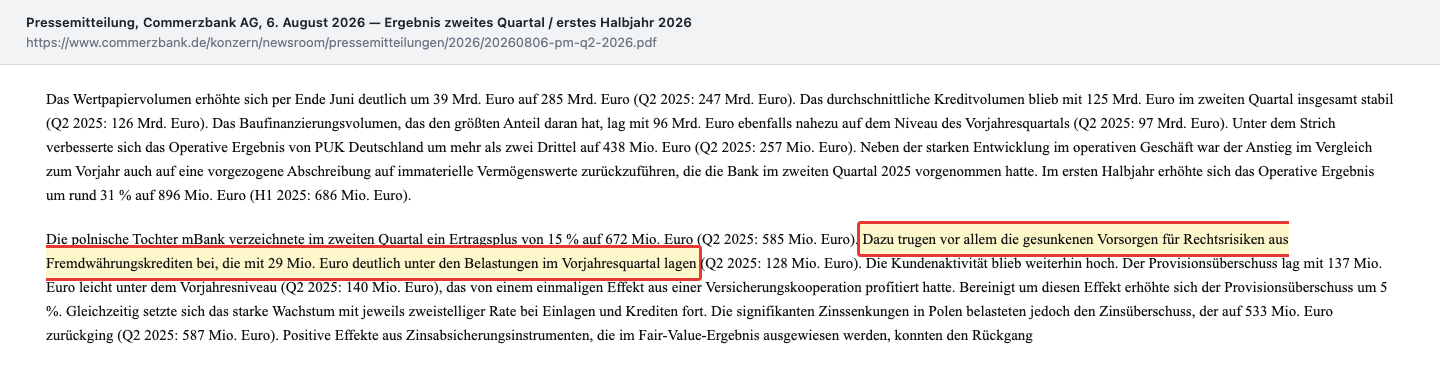
One sentence later the bank adds that revenues rose 6 percent year on year even excluding this exceptional item. The reported figure was 9.3 percent. For you as an investor that means: the business grows without the Polish tailwind too — just about a third more slowly than the headline suggests. And because a provision cannot fall below zero, this tailwind is a finite resource. It has roughly one to two years of air left.
Uncomfortable truth No. 2: net interest income has been flat for six quarters
A bank classically earns on interest: it pays savers little and charges borrowers more. That difference is net interest income, and at Commerzbank it accounted for a good 63 percent of all revenues in the first half of 2026, at €4,106 million. After the rate turn of 2022/23 it was the source of the entire turnaround.
Only: that source is no longer flowing harder. It is flowing at the same rate. For six quarters net interest income has been around €2.05 billion per quarter — with a spread of just €27 million between the highest and the lowest reading. In the first half of 2026 it was even 0.6 percent below the prior year. Net commission income, by contrast, is climbing, up 8.1 percent to €2,178 million.
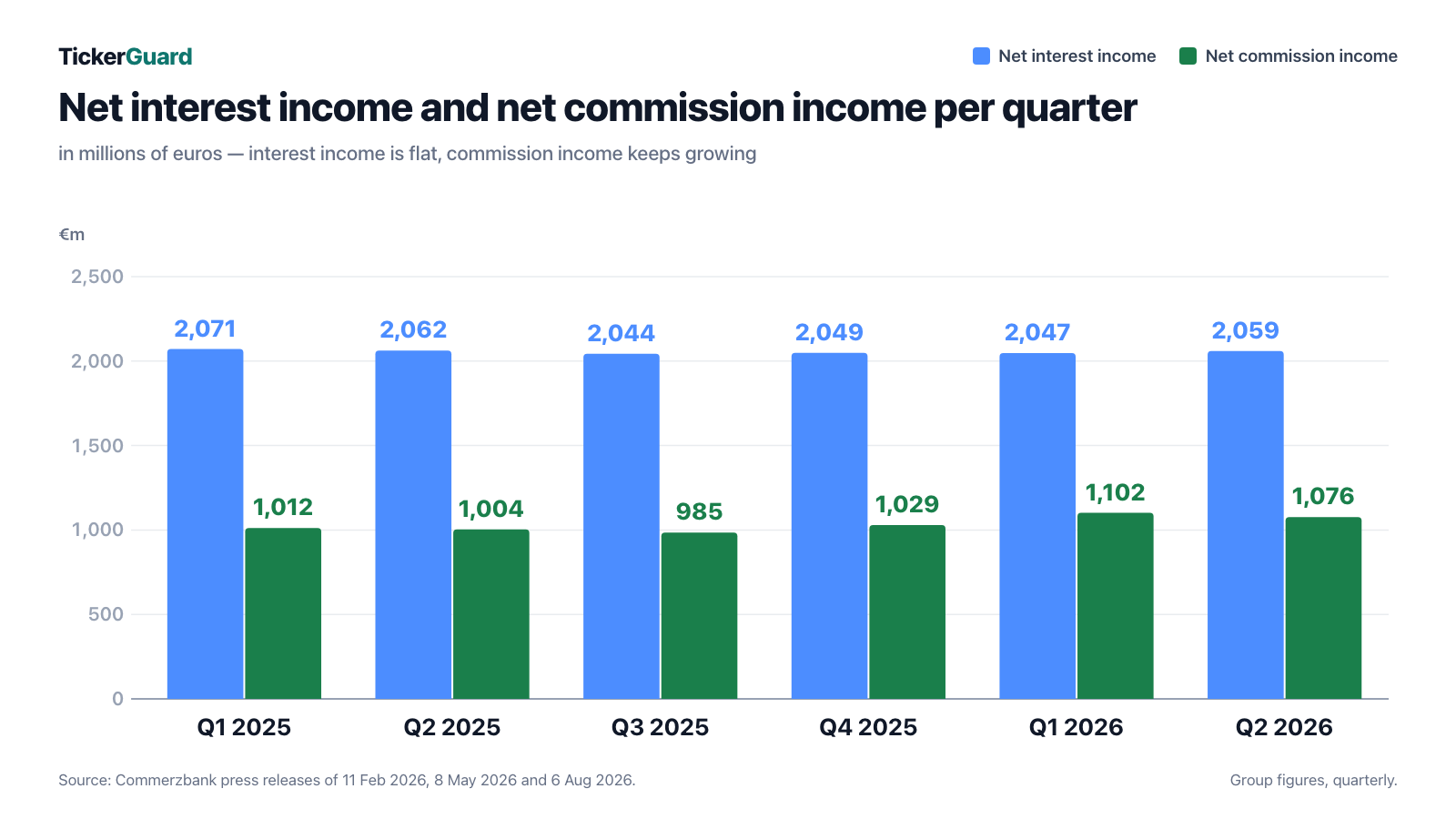
This is deliberate and the bank says so openly: away from interest dependence, towards securities, payments and capital-markets business. For 2026 Commerzbank plans net interest income of around €8.6 billion and commission growth of about 7 percent. The honest part of the arithmetic: by 2030 net interest income is meant to reach €11.2 billion — up around 30 percent from today, in an environment of falling policy rates. That is not a given, it is an ambitious assumption resting on loan and deposit growth.
Uncomfortable truth No. 3: the 2030 targets demand almost a doubling of returns
On 8 May 2026 Commerzbank presented its refined "Momentum 2030" strategy. The targets are striking: net return on tangible equity of around 17 percent by 2028 (previously 15 percent) and around 21 percent by 2030; a consolidated result of €4.6 billion (2028) and €5.9 billion (2030); revenues of €15.0 billion and €16.8 billion respectively; cost-income ratios of 48 and 43 percent.
Put in proportion: the return currently stands at 12.6 percent. Reaching 21 percent means lifting it by two thirds in four years. The consolidated result would have to rise from €3.4 billion (the 2026 target) to €5.9 billion — up 74 percent. The lever, named explicitly in the bank's own presentation, is artificial intelligence: around €600 million of cumulative investment between 2026 and 2030, an expected value contribution of around €500 million a year from 2030, around 10 percent of capacity freed up — and a gross reduction of around 3,000 jobs.
Whether that works out, nobody knows today, and that is not an accusation: four-year plans are plans. But the valuation of the share already contains a slice of that expectation. Anyone who considers the price cheap should ask whether they are paying for today's numbers or for 2030's.
Uncomfortable truth No. 4: the largest shareholder is a competitor — closing in on almost half the votes
And now back to the co-owner illusion. UniCredit S.p.A. of Milan has been building a stake in Commerzbank since 2024 and put a public takeover offer on the table in 2026. The acceptance period ended on 3 July 2026 and the result was published on 8 July 2026: 17.6 percent of Commerzbank shares were tendered.
The interesting part is by whom. As the issuer, Commerzbank continuously receives shareholder data from custodians, and it wrote:
“Basierend auf den von der Commerzbank kontinuierlich erhobenen Informationen zur Aktionärsstruktur, die ihr als Emittentin von Verwahrstellen zur Verfügung gestellt werden, beläuft sich die Summe der von institutionellen und privaten Anlegern angedienten Aktien auf weniger als 2 %. Die angedienten Aktien stammen überwiegend von mit der UniCredit verbundenen Banken und Parteien.”
Translation: "Based on the information on the shareholder structure continuously collected by Commerzbank and made available to it as issuer by custodians, the total of shares tendered by institutional and retail investors amounts to less than 2 percent. The tendered shares mainly originate from banks and parties affiliated with UniCredit."
— Commerzbank AG, press release of 8 July 2026 (German original)

So the offer was effectively rejected by free shareholders — and still achieved its purpose. Because after the offer the shareholder base looks like this (as of 5 August 2026, from the bank's own fact sheet):
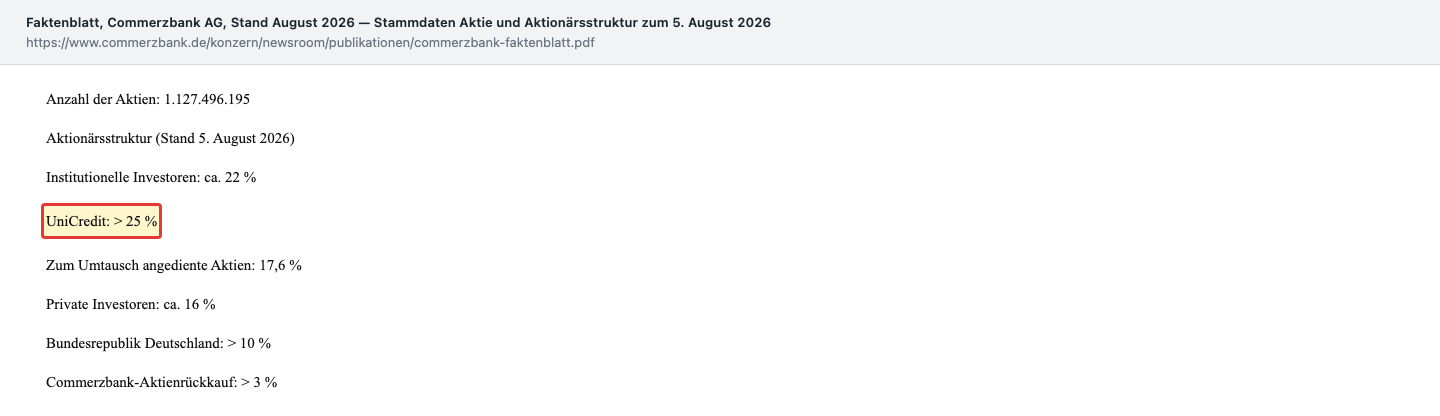
Do the arithmetic: more than 25 percent held directly plus 17.6 percent tendered is more than 42 percent of the share capital in one pair of hands — as soon as the supervisors clear the transfer. The bank states the consequence plainly on its information page: once that has happened, UniCredit has access to just under 50 percent of the voting rights. Because not every shareholder shows up at an annual general meeting, that is enough for a de facto majority. CEO Orlopp put it this way on 6 August 2026: even though UniCredit will command a majority at the next annual general meeting, it cannot decide on material structural measures on its own.
That second half matters and it holds: a domination agreement requires 75 percent of the capital represented, a squeeze-out at least 90 or 95 percent — and UniCredit is a long way from either. Nobody holding Commerzbank shares today will be squeezed out overnight. But they hold a stake in a company whose supervisory board and strategy will in future be co-determined by a majority shareholder that is also a competitor. The German state, the second-largest shareholder with more than 10 percent, has taken a clear position; the federal finance ministry is quoted on the bank's information page as saying it supports Commerzbank's strategy of independence.
And there is a practical side effect that is easy to miss: the planned share buyback of up to €1.2 billion has been approved by the European Central Bank but is still waiting for the consent of the German Finance Agency — that is, of the state as a shareholder. A material part of the capital return therefore depends on a co-owner that is itself a party to the takeover question.
Valuation: solidly earned, fairly paid for
As of 11 August 2026, Commerzbank shares traded at €39.20 (Xetra). Share capital consists of 1,127,496,195 shares, of which the bank holds more than 3 percent as treasury shares from completed buybacks according to its own shareholder structure; that leaves roughly 1,081 million shares outstanding, for a market capitalisation of around €42.3 billion.
The price-earnings ratio can be checked cleanly by hand. The four most recently reported quarters add up to 591 + 737 + 913 + 898 = €3,139 million of consolidated result. Divided by roughly 1,081 million shares outstanding that is €2.90 per share — at €39.20 a P/E of about 13.5. Measured against the 2026 target (at least €3,400 million, equal to about €3.15 per share) it is about 12.5. Both before deducting the coupons on Additional Tier 1 capital, which the bank subtracts in its own payout calculation.
On book value it is worth looking at tangible substance: equity stood at around €30.3 billion as of 30 June 2026; less intangible assets of around €1.8 billion, roughly €28.5 billion remain — about €26.30 per share outstanding. The share price therefore equals about 1.5 times tangible book value. That calculation is consistent with the bank's reported net return on tangible equity of 12.6 percent: €1,810 million of half-year profit on roughly €28.5 billion of tangible equity annualises to exactly that order of magnitude. For a sense of how differently banks can be valued, our analysis of Byline Bancorp, a U.S. regional bank, arrived at a very different answer using the same method.
That leaves the capital return, which is the real lever for shareholders. For financial year 2025 the bank returned around €2.7 billion: two share buybacks worth about €1.5 billion combined, plus a record dividend of €1.10 per share (prior year €0.65), approved at the annual general meeting on 20 May 2026. For 2026 around €3.2 billion is planned — against a market capitalisation of €42.3 billion that would be a total yield of roughly 7.6 percent. The 100 percent payout ratio (after AT 1 coupons, before exceptional items) is to remain in place until the CET 1 ratio falls from today's 14.4 percent to the 13.5 percent target. On the €1.10 dividend alone, the dividend yield is about 2.8 percent.
Opportunities and risks at a glance
What speaks for Commerzbank:
- Record profitability on a solid capital base: consolidated result of €1,810 million in the first half of 2026 (up 39.6 percent), net return on tangible equity of 12.6 percent, CET 1 ratio of 14.4 percent against a minimum requirement of around 10.3 percent.
- The loan book is quiet: NPE ratio unchanged at 1.1 percent across six quarters, risk result of minus €344 million in the first half — despite a weak German economy.
- Costs are moving the right way: cost-income ratio including compulsory contributions down from 55.8 to 52.9 percent half-year on half-year; the bank decommissioned 10 percent of its IT systems in the first half of 2026 alone.
- High, plannable capital returns: around €2.7 billion for 2025 and around €3.2 billion planned for 2026 (roughly 7.6 percent of the market capitalisation as of 11 August 2026), with a 100 percent payout ratio until the CET 1 ratio reaches 13.5 percent; the next buyback of up to €1.2 billion has ECB approval.
- A growth source beyond interest: net commission income up 8.1 percent to €2,178 million in the first half of 2026, driven by securities business, bond issuance and payments; corporate loan volume rose 16 percent to €123 billion in the second quarter.
What speaks against it:
- A noticeable share of the earnings jump comes from a shrinking burden rather than more business: provisions for legal risks on foreign-currency loans at mBank fell from €1,002 million (2024) to €483 million (2025) and to €29 million in the second quarter of 2026. Excluding that effect, second-quarter revenue growth was 6 percent instead of 9.3 percent.
- Net interest income, still a good 63 percent of revenues, has been stuck at around €2.05 billion per quarter for six quarters and in the first half of 2026 was even 0.6 percent below the prior year — with policy rates falling, especially in Poland.
- The 2030 targets are ambitious: net return on tangible equity from 12.6 to around 21 percent, consolidated result from at least €3.4 billion to €5.9 billion. A material part is meant to come from AI-driven efficiency (around €600 million invested, around €500 million of annual value from 2030) — a promise, not a result.
- Ownership is unresolved: UniCredit holds more than 25 percent directly, 17.6 percent is tendered and awaiting regulatory clearance; after that, according to Commerzbank, it has access to just under 50 percent of the voting rights. Which strategic plan gets executed after clearance will then no longer be the management board's decision alone.
- Two units hang on somebody else's politics: mBank on Polish court rulings and Polish policy rates, the corporate business on the German economy. With rates falling in Poland, mBank's net interest income slipped to €533 million in the second quarter of 2026 (prior-year quarter €587 million).
- The planned buyback of up to €1.2 billion needs, alongside ECB approval, the consent of the German Finance Agency — that is, of the state, which is itself a party to the takeover question.
A human bottom line
Back to the co-owner illusion. Commerzbank delivers what you want from a bank: a record profit, a thick capital cushion, a quiet loan book, falling costs and a distribution that can hold its head up. Anyone who has held the stock since 2021 has watched a comeback that few thought possible at the time. That is real, it is in the original releases, and nobody should talk it down.
And in the very same summer in which that record is produced, the answer to the question "who does this actually belong to?" quietly changes addressee. Not through a capital increase, not through a collapse, not through a scandal — but through an offer that almost no independent shareholder accepted and that was nevertheless enough. Less than 2 percent came from institutional and retail investors; the rest, according to Commerzbank, came mainly from banks and parties close to UniCredit. It turns out you can secure a majority even when hardly anybody wanted to give you one.
Both belong together, and both are in the same set of documents — just on different pages. The profit is on page one, the shareholder structure is in the fact sheet. Whether one interests you more than the other depends on whether you are buying a number or a company. The decision is yours.
Sources
Every original document used in this analysis — read them for yourself:
- Commerzbank AG — press release on the second quarter and first half of 2026 (6 August 2026, German) and its English version — the most recent periodic report and the source of all 2026 figures
- Commerzbank AG — press release on financial year 2025 (11 February 2026) — full-year figures for 2025 and 2024, quarterly figures for Q3/Q4 2025, mBank legal risks
- Commerzbank AG — press release on the first quarter of 2026 and the "Momentum 2030" strategy (8 May 2026, English) — targets for 2028 and 2030, AI investment
- Commerzbank AG — press release on the end of the UniCredit acceptance period (8 July 2026)
- Commerzbank AG — "Our position on the UniCredit offer" and "Questions and answers on the UniCredit takeover offer" (retrieved 11 August 2026)
- Commerzbank AG — fact sheet, as of August 2026 — share master data, shareholder structure as of 5 August 2026, financial calendar
- Commerzbank AG — base presentation "This is Commerzbank" (6 August 2026) — shareholder structure and Momentum 2030 targets
- Commerzbank AG — press release on the completion of the sixth share buyback (9 March 2026)
- Commerzbank AG — "Facts and figures" corporate page (as of 6 August 2026) — headcount and total assets
- U.S. Securities and Exchange Commission — EDGAR company search for "Commerzbank" and the submissions index for CIK 0000852933 — evidence that there is no periodic reporting to the SEC
- Fundamental data (price, market capitalisation, balance-sheet and valuation metrics; data as of 11 August 2026), reconciled against the original press releases and the fact sheet.
Transparency & disclaimer: this analysis is journalistic commentary on publicly available information. It is not investment advice, not a financial analysis in the regulatory sense and not an invitation to buy or sell securities. Equity investments carry substantial risk up to total loss. All information without warranty; the as-of date for each figure is noted in the text, and the overall as-of date for this version is 11 August 2026. The next quarterly statement (as of 30 September 2026) is scheduled for 5 November 2026. Positions held by the operator are disclosed daily; where one exists, it appears as a notice at the top of this deep dive.
Our Bottom Line at a Glance
- Earnings power positive
- The consolidated result rose 39.6 percent to €1,810 million in the first half of 2026 and the operating result 13.8 percent to €2,725 million. Net return on tangible equity reached 12.6 percent, the best figure ever reported, while the cost-income ratio including compulsory contributions fell from 55.8 to 52.9 percent.
- Capital and credit quality positive
- The CET 1 ratio stood at 14.4 percent as of 30 June 2026 — 409 basis points above the regulatory distribution threshold of around 10.3 percent. The non-performing exposure ratio has been unchanged at 1.1 percent for six quarters and the risk result came to minus €344 million in the half-year.
- Quality of earnings neutral
- A noticeable part of the increase comes from a shrinking burden: provisions for legal risks on foreign-currency loans at mBank fell from €1,002 million (2024) to €483 million (2025) and to €29 million in the second quarter of 2026. Excluding that exceptional item, second-quarter revenue growth was 6 percent instead of 9.3 percent.
- Revenue mix neutral
- Net interest income, a good 63 percent of revenues, has been running at around €2.05 billion per quarter for six quarters and in the first half of 2026 was 0.6 percent below the prior year. All the growth comes from net commission income (up 8.1 percent to €2,178 million). By 2030, net interest income is nevertheless meant to reach €11.2 billion.
- Capital return positive
- Around €2.7 billion went to shareholders for 2025 (a €1.10 dividend per share plus two buybacks worth about €1.5 billion). Around €3.2 billion is planned for 2026 — roughly 7.6 percent of the €42.3 billion market capitalisation as of 11 August 2026. The next buyback of up to €1.2 billion has ECB approval; the German Finance Agency has yet to consent.
- Ownership structure negative
- As of 5 August 2026 UniCredit held more than 25 percent of the shares directly, with a further 17.6 percent tendered and awaiting regulatory clearance; afterwards, according to Commerzbank, it has access to just under 50 percent of the voting rights. Less than 2 percent of the tendered shares came from independent institutional and retail investors. That is not enough for a domination agreement or a squeeze-out, but it is enough for a majority at the annual general meeting.
Commerzbank delivered the best result in its history in the first half of 2026: a consolidated result of €1,810 million, a 12.6 percent net return on tangible equity, a CET 1 ratio of 14.4 percent and an NPE ratio unchanged at 1.1 percent. A noticeable part of the increase, however, comes from a shrinking burden at Polish subsidiary mBank, and net interest income has been flat for six quarters. In parallel, UniCredit holds more than 25 percent of the shares and is waiting for clearance on a further 17.6 percent. Not investment advice.
What Our Rating Means
Open questions
The business works in principle, but one material question is open. As long as it stays open, our findings do not carry a quality verdict.
Yellow here is explicitly not about a threat to substance. The balance sheet as of 30 June 2026 is strong: a CET 1 ratio of 14.4 percent against a minimum requirement of around 10.3 percent, a non-performing exposure ratio of 1.1 percent for six quarters running, €619 billion of total assets, no sign of capital or liquidity trouble and no accounting or governance breach. And the business is visibly carrying better than a year ago: consolidated result up 39.6 percent in the first half, cost-income ratio improved from 55.8 to 52.9 percent, net return on tangible equity at the highest level ever reported. Yellow stands because two operating questions remain open. First, the quality of earnings: a noticeable part of the increase comes from falling provisions for legal risks at Polish subsidiary mBank — from €1,002 million (2024) to €483 million (2025) to €29 million in the second quarter of 2026. The bank strips the effect out itself: without it, second-quarter revenues grew 6 percent instead of 9.3 percent. Because a provision cannot fall below zero, that tailwind is finite. Second, the revenue mix: net interest income, still a good 63 percent of revenues, has barely moved for six quarters and in the first half of 2026 came in below the prior year; all the growth comes from fees. The 2030 targets — a net return on tangible equity of around 21 percent, a consolidated result of €5.9 billion, net interest income of €11.2 billion — require a turn at exactly that point which the last six quarters have not anticipated. On top of that, as context rather than as a defect of the business, comes the unresolved ownership question: after regulatory clearance, according to Commerzbank, UniCredit has access to just under 50 percent of the voting rights, leaving it open whose plan is executed from then on. The next verifiable checkpoint is the quarterly statement on 5 November 2026. The decision is yours.
A journalistic assessment by our editorial team at the time of the deep dive, based on public sources — not investment advice and not a solicitation to buy or sell. Your personal circumstances (investment goals, risk capacity, taxes) cannot be taken into account. What our levels mean, how verdicts are formed, and what conflicts of interest exist →
Worth Noting
- Commerzbank is not a U.S. reporting company: there is no 10-K and no 10-Q. The only SEC identifier under the company name (CIK 0000852933, "Commerzbank Aktiengesellschaft /FI") contains investor filings such as Form 13F, SC 13G and N-PX, no periodic reporting; the U.S. ticker CBK belongs to Commercial Bancgroup, Inc. on Nasdaq. All figures in this analysis come from Commerzbank's own releases and its fact sheet.
- Standard industrial metrics carry no information at a bank and are therefore named in the article rather than adopted: an Altman Z-score of 0.33, a reported enterprise value of minus €46.8 billion and a return on assets of 0.57 percent (all from fundamental data as of 11 August 2026) are artefacts of a bank balance sheet. What matters instead are the CET 1 ratio, the NPE ratio, the cost-income ratio and the net return on tangible equity.
- Share count and market capitalisation were cross-checked: the fact sheet dated August 2026 states share capital of 1,127,496,195 shares, and the shareholder structure as of 5 August 2026 shows more than 3 percent held as treasury shares from completed buybacks. Fundamental data report 1,080,847,095 shares outstanding — the difference of about 46.6 million shares matches that treasury holding exactly. 1,080.8 million shares at €39.20 gives €42.4 billion against €42.3 billion from the fundamental data.
- On the takeover context only documented positions are reproduced: the offer result of 8 July 2026 (17.6 percent tendered, of which according to Commerzbank less than 2 percent came from institutional and retail investors), the shareholder structure as of 5 August 2026 from the fact sheet, and the bank's statement that after regulatory clearance UniCredit has access to just under 50 percent of the voting rights. The timing and outcome of the ongoing supervisory review are deliberately not speculated about.
- Note on ticker confusion: the CBK.DE code used in this analysis is shorthand for "Commerzbank, listed in Germany". The share trades as Xetra: CBK (WKN CBK100, ISIN DE000CBK1001) and on other German venues. The identically spelled U.S. ticker CBK on Nasdaq belongs to a different company.
The full analysis as a PDF for later
We will send you this analysis as a PDF — to print, file away, and read at your own pace.
Frequently Asked Questions
Commerzbank AG of Frankfurt am Main is a universal bank with two segments: Corporate Clients — by its own account the leading bank for the German Mittelstand, serving around 24,000 corporate client groups — and Private and Small-Business Customers under the Commerzbank and comdirect brands. Polish digital bank mBank sits alongside them. As of 30 June 2026 the group employed 40,110 people and held €619 billion of total assets.
It was the best half-year in the bank's history. Revenues rose 7.0 percent to €6,518 million, the operating result 13.8 percent to €2,725 million and the consolidated result 39.6 percent to €1,810 million. Net return on tangible equity reached 12.6 percent and the cost-income ratio including compulsory contributions fell from 55.8 to 52.9 percent. The second quarter alone contributed €898 million.
According to Commerzbank's fact sheet, UniCredit held more than 25 percent of the shares directly as of 5 August 2026. A further 17.6 percent was tendered to it in the takeover offer whose acceptance period ended on 3 July 2026; the transfer of those shares and their voting rights is subject to regulatory approvals. Commerzbank states that afterwards UniCredit will have access to just under 50 percent of the voting rights. The German state holds more than 10 percent.
Not at its current stake. A domination agreement requires 75 percent of the capital represented at the annual general meeting; a squeeze-out requires at least 90 or 95 percent of the share capital, each with protective rights for minority shareholders. Commerzbank itself points out in its Q&A that UniCredit cannot decide on material structural measures alone. De facto majorities at the annual general meeting are a separate matter.
Because a noticeable share of the revenue increase comes from a shrinking burden: provisions for legal risks on foreign-currency loans at Polish subsidiary mBank fell from €1,002 million (2024) to €483 million (2025) and to €29 million in the second quarter of 2026 (prior-year quarter €128 million). The bank strips the effect out itself: without it, second-quarter revenue growth was 6 percent instead of 9.3 percent. A provision cannot fall below zero — this tailwind ends.
Yes. For financial year 2025 the annual general meeting approved a dividend of €1.10 per share on 20 May 2026 (prior year €0.65), around €1.2 billion in total, alongside two share buybacks worth about €1.5 billion combined. For 2026 the bank plans a capital return of around €3.2 billion, including a buyback of up to €1.2 billion. The aim is a 100 percent payout ratio until the CET 1 ratio falls from 14.4 to 13.5 percent.
Because they were built for industrial companies. An Altman Z-score of 0.33 would be a warning sign at a manufacturer; at a bank it is meaningless, because the formula uses balance-sheet items that mean something entirely different in banking. The same applies to the reported enterprise value of minus €46.8 billion (customer deposits treated as borrowings) and the 0.57 percent return on assets. Banks are measured instead on the CET 1 ratio, the NPE ratio, the cost-income ratio and the net return on tangible equity.
Commerzbank is not a U.S. reporting company. The SEC record filed under "Commerzbank Aktiengesellschaft /FI" (CIK 0000852933) contains only investor filings such as Form 13F and beneficial-ownership statements, no periodic reports; the U.S. ticker CBK belongs to a different company. What is mandatory instead is an audited IFRS consolidated annual report, an interim report as of 30 June and quarterly statements as of 31 March and 30 September under Frankfurt Stock Exchange rules.
Found an error?
Did you spot a factual error, an outdated number, or a typo in this deep dive? Let us know briefly — your report goes straight to the editorial team.