Deutsche Telekom: Profit Fell 17.7 Percent — and Rose 8.8 Percent
For the first half of 2026 Deutsche Telekom reports net profit of €4.5 billion, down 17.7 percent year on year. The very same report shows adjusted net profit of €5.4 billion, up 8.8 percent. Both numbers were reviewed, both were published on August 6, 2026 — and between them sit a weak dollar, €1.6 billion of special factors and a U.S. subsidiary that hands a good third of its profit to outside shareholders. We put both figures side by side and ask which one ever reaches your account.
 Thomas Mücke
Founder & Publisher
Thomas Mücke
Founder & Publisher
Chart
Interactive price chart (TradingView).
Note: pure fact-based analysis, not investment advice and not a solicitation to buy or sell. All figures without guarantee.
The stock on which a whole country learned what a loss feels like
Hardly any share carries more emotion in German portfolios than this one. In 1996 the T-share came to market as the "people's share", with television campaigns, a beloved actor as its face and a promise that equities were nothing to be afraid of. Four years later the promise was in pieces, and millions of first-time investors had learned their first — and for many their last — lesson in losing money.
That memory still works today, as an anchor. Anyone who was there measures Telekom not by its business but by an entry price from a generation ago. Anyone who came later measures it by the dividend. Both are feelings, not numbers.
And that is exactly the point here. Because in its latest report Telekom does not deliver one profit figure but two — and they tell two different stories about the same six months. We will read both, slowly, with the original report open beside us.
What Deutsche Telekom actually does
Deutsche Telekom AG runs networks and sells access to them. That is the whole core. It lays fiber in the ground, puts up masts, sells mobile and fixed-line contracts, and adds television, cloud services and IT projects for businesses.
It is organized in five operating segments: Germany, United States, Europe, Systems Solutions (T-Systems) and Group Development. That sounds balanced. It is not. In the first half of 2026 group revenue of €59,804 million broke down like this:
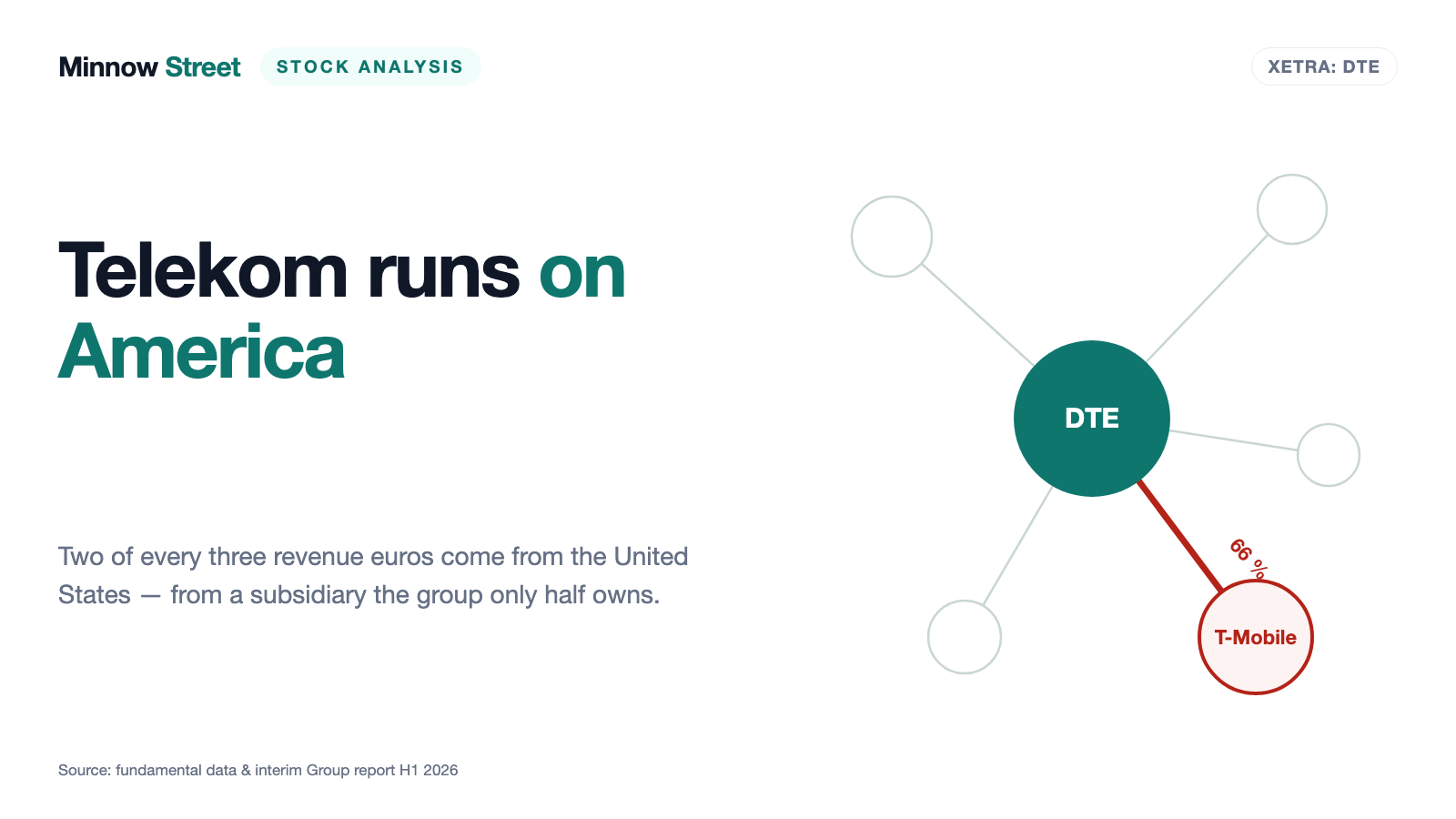
- United States: €39,306 million — around 66 percent
- Germany: €12,846 million — around 21 percent
- Europe: €6,253 million — around 10 percent
- Systems Solutions: €2,102 million — around 4 percent
- Group Development, headquarters and intersegment revenue: the small remainder, less €1,753 million of intersegment revenue
The group says it plainly itself: the international share of revenue was 77.9 percent in the first half of 2026, the domestic share 22.1 percent. Telekom is a German company mainly by name, by its Bonn headquarters and by its largest single shareholder — the Federal Republic and the state development bank KfW.
The American business runs through T-Mobile US, Inc., separately listed on Nasdaq. In Germany, the 5G network reached around 99 percent of the population as of June 30, 2026, and 13.6 million households and businesses can order a fiber connection. In Europe the averages are 93.9 percent 5G coverage and 11.7 million households with fiber access.
One field is new to the portfolio and not what you would expect from a network operator: artificial intelligence. In February 2026 Telekom put the first industrial AI cloud for European manufacturers on German soil into operation together with NVIDIA. Two more building blocks followed in the first half of 2026 — a major federal contract awarded to T-Systems and SAP for a sovereign AI platform for federal, state and municipal government, and the service "Sovereign Cortex with T Security", launched with Palo Alto Networks, which combines AI cybersecurity with European data sovereignty.
How the stock landed on our desk
Not through a screen, but through a conversation. On August 5, 2026 the Telekom share sat high in the forum rankings of wallstreet-online, among the stocks German retail investors discuss most. That is not a buy signal and not a metric — it is a hint about where a lot of people are making a decision right now.
The trigger was obvious. One day later, on August 6, 2026, the group published its report for the first half of 2026 and raised full-year guidance for free cash flow again. That same evening, at 6:30 p.m., an ad-hoc notification followed: the Board of Management increased the running 2026 share buy-back by up to €3 billion, to up to €5 billion.
Before that, Handelsblatt had reported on June 29, 2026, citing insiders, that chief executive Timotheus Höttges was having plans drawn up for a full combination with T-Mobile US — a story that had first surfaced on April 23, 2026. T-Mobile US called it speculation; Deutsche Telekom declined to comment. Then, on July 31, 2026, the U.S. news outlet Semafor reported that the subsidiary's management no longer supports the combination, valued in reports at around US$300 billion. That too is press reporting, not a company statement.
So we take the report that is the most recent reviewed one: the Interim Report H1 2026, published August 6, 2026, reflecting events through August 4, 2026. Everything alongside it we name with its date for what it is — partly company announcement, partly press reporting.
The numbers across the years — given their due
Let us start with what genuinely impresses. Over six years Telekom has grown by almost half: from €80,185 million of revenue in 2019 to €119,081 million in 2025. The biggest jump came in 2020 through T-Mobile US's acquisition of Sprint — but the line kept climbing year after year afterwards.
More important still is the cash. Net cash from operating activities reached €40,627 million in 2025, cash capex was €19,256 million. Together they produced free cash flow after leases of €19,546 million in 2025 — the money that pays the dividend, the buy-backs and the debt service.
That is why Telekom is distributing again. For 2025 the shareholders' meeting resolved a dividend of €1.00 per share on April 1, 2026. On top of that comes a buy-back that has been running since January 5, 2026 and was increased by ad-hoc notification on the evening of August 6, 2026 from up to €2 billion to up to €5 billion — around 42.1 million shares had already been repurchased for roughly €1.2 billion by August 5, 2026. On April 29, 2026, 55.4 million previously repurchased shares were cancelled, so the cake is not merely divided evenly, it is cut into fewer slices. In figures: the weighted average number of shares fell from 4,887 million in the first half of 2025 to 4,822 million a year later.
And the first half of 2026 itself? The group reports adjusted EBITDA AL of €23,342 million at a margin of 39.0 percent, after 38.2 percent in the prior-year period. Free cash flow was €10,714 million. Guidance for 2026 was raised again: instead of "more than €19.8 billion" it is now around €20.0 billion of free cash flow, with adjusted EBITDA AL unchanged at around €47.5 billion. And there was an external vote of confidence: Standard & Poor's and Fitch upgraded the rating to A− with a stable outlook in May and June 2026.
That is good news, and it should stand here as such. Now the other side.
Uncomfortable truth no. 1: two growth rates for the same half-year
The earnings release says "organic 4.0 percent". The income statement says "2.4 percent". Both refer to the same group revenue for the same six months. The report explains the difference itself:
"In the first half of 2026, we generated net revenue of EUR 59.8 billion, which was up EUR 1.4 billion or 2.4 % year-on-year. In organic terms, revenue increased by 4.0 % against the prior-year level, with exchange rate effects having a net decreasing effect of EUR 2.5 billion and effects of changes in the composition of the Group an increasing effect of EUR 1.6 billion."
— Deutsche Telekom AG, Interim Report H1 2026, results of operations of the Group

What does that mean in everyday terms? Imagine you work in Switzerland and are paid in francs. Your boss gives you a five percent raise. If the franc weakens against the euro at the same time, less money still arrives in your German account. Both sentences are true: you earned more — and you have less.
At Telekom the effect is enormous, because two thirds of the business is generated in dollars. The United States segment shows it most clearly: plus 2.4 percent as reported, plus 4.8 percent organic. A difference of 2.4 percentage points, created purely by translation and acquisitions. In the first quarter of 2026 the gap was even wider: minus 0.3 percent as reported against plus 6.1 percent organic.
The counter-check confirms the mechanism: where there are hardly any dollars, there is hardly any gap. Germany grew 2.7 percent as reported against 2.9 percent organic, Europe 1.3 against 1.5 percent — around two tenths of a percentage point each, instead of the 2.4 points in the United States.
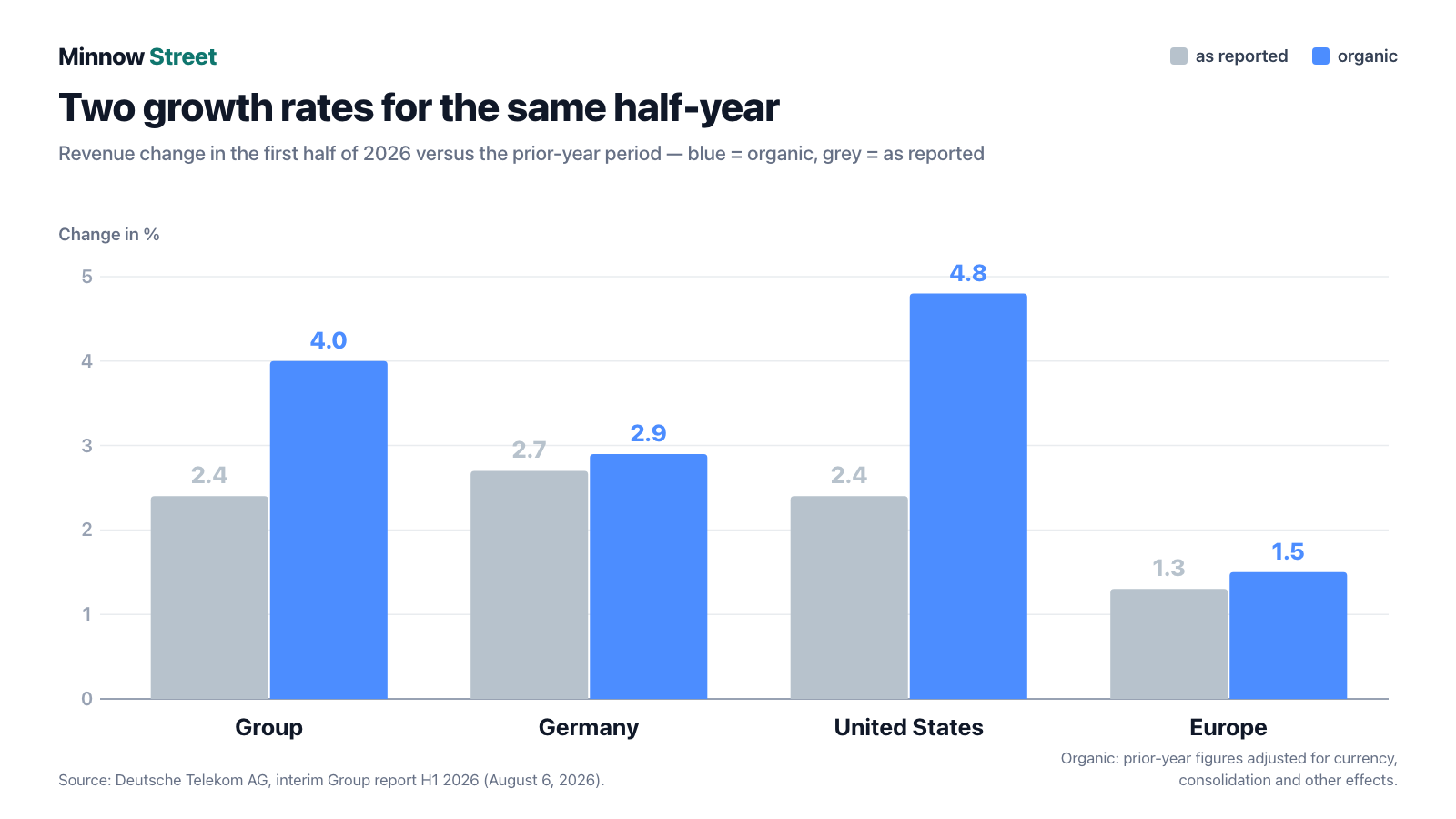
To be fair: the organic calculation is not a trick. It is standard practice and it is useful. It answers the question "how is the business doing?". It simply does not answer the question "how much money arrived?". For an investor who counts in euros and receives a dividend in euros, the second question is the more important one. The group itself plans 2026 at an unchanged rate of US$1.13 per euro — every deviation shifts the reported figures again.
Uncomfortable truth no. 2: a third of the profit is not yours
This is the finding that surprised us most in this analysis — and it is not hidden away, it sits in the last line of the consolidated income statement.
The path there is short: from operating profit of €12,705 million, €3,235 million of financial result and €2,525 million of income taxes are deducted. That left the group with total profit of €6,945 million in the first half of 2026. Of that, €4,493 million is attributable to the owners of the parent — that is "net profit", the figure behind earnings per share of €0.93. The remaining €2,452 million, around 35 percent, belongs to other shareholders. Predominantly the minority shareholders of T-Mobile US.
"Net profit decreased year-on-year by EUR 1.0 billion to EUR 4.5 billion. […] Profit attributable to non-controlling interests decreased by EUR 0.5 billion to EUR 2.5 billion. This decline was primarily attributable to the United States operating segment. Adjusted net profit amounted to EUR 5.4 billion compared with EUR 4.9 billion in the prior-year period."
— Deutsche Telekom AG, Interim Report H1 2026, net profit

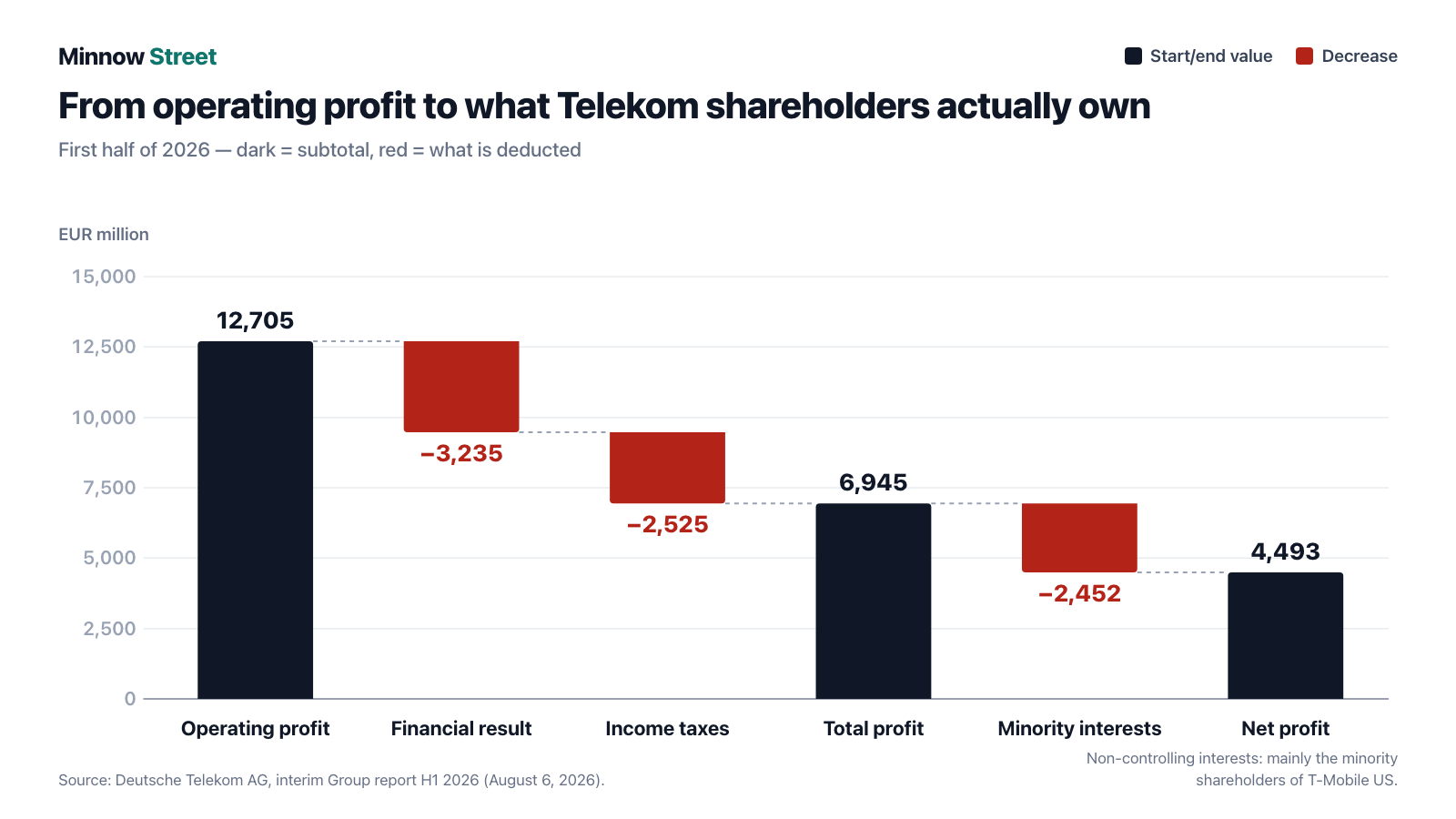
The balance sheet says the same. Of €88,783 million of equity as of June 30, 2026, €60,242 million is attributable to Telekom shareholders and €28,541 million to other shareholders — a good 32 percent.
Why is that? Because Telekom does not own its most important subsidiary anywhere near as fully as the consolidated accounts suggest:
"As of June 30, 2026, Deutsche Telekom's stake in T-Mobile US amounted to 45.5 %. Taking the treasury shares held by T-Mobile US into account, Deutsche Telekom had a 54.2 % ownership stake in T-Mobile US as of June 30, 2026."
— Deutsche Telekom AG, Interim Report H1 2026, other transactions that had no effect on the composition of the Group

The voting majority — 55.1 percent as of June 30, 2026 — comes on top, from a proxy agreement with SoftBank concluded when Sprint was acquired. For accounting purposes that is enough for full consolidation: revenue, costs and assets of T-Mobile US appear at 100 percent in Telekom's accounts. Economically, though, only a good half of that belongs to Telekom shareholders.
The rule of thumb: consolidated accounts show what Telekom controls. They do not show what it owns. Anyone holding market value against group revenue is comparing a price for half the company with the output of all of it.
This is exactly where the merger reports come in — Handelsblatt on April 23 and again on June 29, 2026: combining the two companies under a new holding would close this gap. On July 31, 2026, however, the U.S. news outlet Semafor reported that T-Mobile US management had told the parent it no longer supports the roughly US$300 billion combination, citing resistance from institutional minority shareholders and conditions expected from the U.S. investment screening body CFIUS. Neither company has confirmed any of it, and the half-year report of August 6, 2026 mentions neither the plan nor its retreat. For an analysis that is an open question, not a number to work with.
Uncomfortable truth no. 3: the adjusted number leaves out €1.6 billion
Telekom steers on adjusted EBITDA AL — operating profit before depreciation, after lease expense ("after leases") and excluding special factors. In the first half of 2026 it came to €23,342 million, up 4.7 percent.
Without the adjustment it looks different: EBITDA AL fell 1.4 percent to €21,710 million. The difference is the special factors — and they jumped from €282 million in the prior-year period to €1,632 million. Almost six times as much.
The report lists where the jump comes from: roughly €0.5 billion more staff-related restructuring, mostly from T-Mobile US's 2025/2026 personnel transformation program; roughly €0.3 billion more amortization of right-of-use assets after the useful lives of certain assets taken over in the UScellular deal were shortened; roughly €0.1 billion more from acquisitions and disposals, mainly integration costs from the same deal. On top, other special factors swung from plus €0.2 billion to minus €0.3 billion — the prior year still contained gains from the sale of spectrum licenses and insurance recoveries for the 2021 cyberattack on T-Mobile US.
In everyday terms: a restaurant reports a record month, "adjusted for the new kitchen". The kitchen was really bought and really paid for. Special factors are not an accounting trick — they are real costs that simply fall out of the number that gets advertised first.
And they are not the only cause of the profit decline. The financial result deteriorated by €1.0 billion to minus €3,235 million, because the prior-year period contained reversals of impairment losses of €0.5 billion and €0.2 billion on the stakes in GD Towers (the tower business) and GlasfaserPlus — book gains that do not repeat. Depreciation and amortization added another €0.6 billion. The bottom line: operating profit down 5.2 percent, net profit down 17.7 percent, earnings per share from €1.12 to €0.93.
Fairness demands the counter-argument here too: part of these special factors is integration work after the UScellular deal and will eventually run out — and the second quarter of 2026, at €603 million, was already far calmer than the first at €1,030 million. Anyone who wants to know whether that continues has a concrete test: the line "special factors affecting EBITDA AL" in the next report. For the full year 2025 it stood at €1,792 million; the first half of 2026 has already used up a good 91 percent of that.
Uncomfortable truth no. 4: the debt is as big as the whole company
As of June 30, 2026 Telekom reported net debt of €138,387 million, after €132,518 million at the end of 2025 — up 4.4 percent in six months. For comparison: the group's entire market value on August 6, 2026 was around €139 billion. Buy the stock and you buy a company with roughly the same amount again standing behind it in debt.
For a network operator that is not unusual — fiber, masts and spectrum are financed over decades, not paid for out of current earnings. And the figures behind it hold up: the equity ratio was 30.5 percent, interest expense in the half-year €3,233 million against operating profit of €12,705 million. Operating profit therefore covers interest around 3.9 times. This is nowhere near over-indebtedness — and the rating agencies see it the same way: Standard & Poor's and Fitch upgraded Deutsche Telekom AG to A− with a stable outlook in May and June 2026.
Still, the price of that debt is worth a look. Every bond maturing out of the low-rate era and refinanced at today's rates costs more than before. The dividend yield was around 3.4 percent as of August 6, 2026 — the same order of magnitude at which the group refinances itself. How heavily interest and build-out costs can weigh on a network balance sheet also shows in our analysis of Nokia, which looks at the same industry from the equipment maker's side.
A second item that appears in no presentation sits in the risk chapter: Vodafone has updated its claims in the dispute over charges for the shared use of cable ducts and puts the demand at around €1,057 million plus interest for the period from January 2012 to December 2025.
"Vodafone Deutschland now puts its claim at around EUR 1,057 million plus interest for the period from January 2012 to December 2025. It is currently not possible to reliably estimate the financial impact."
— Deutsche Telekom AG, Interim Report H1 2026, corporate risks

"Not possible to reliably estimate" means: no quantified provision. For comparison — net profit for the first half of 2026 was €4,493 million. The claim therefore equals roughly a quarter of it, before counting interest for up to fourteen years. The group itself rates its aggregate risk position as stable and sees no risks threatening its existence.
What the stock costs — and what the professionals expect
We quote no daily prices here, only orders of magnitude as of August 6, 2026. On roughly 4.78 billion shares outstanding and a closing price of €29.15, market value comes to around €139 billion — and from that follow these ratios:
- Price/earnings: around 16 on the last twelve months, around 12 on current-year earnings estimates
- Price/sales: around 1.1
- Price/book: around 2.1
- Enterprise value to EBITDA: around 5.4 — this is where the debt load shows, because enterprise value, at roughly €264 billion, is almost twice the market value
- Dividend yield: around 3.4 percent on the €1.00 per share paid for 2025
For a network operator with a 39.0 percent adjusted margin and around €20 billion of expected annual free cash flow, that is not a stretched valuation. It is no longer a bargain either — and for price/book the caveat from truth no. 2 applies: book value per share rests on the €60,242 million attributable to Telekom shareholders, not on total equity of €88,783 million.
Notably, the group shares that view — in writing. The ad-hoc notification of the evening of August 6, 2026, which raised the buy-back by up to €3 billion to up to €5 billion, states the reason explicitly: the share price had recently been "trading at the lower end of its historical valuation range in terms of the price-to-earnings ratio" and had frequently been highly volatile; Telekom intends to use the buy-back to capitalize on that volatility, reduce the share count further and lift earnings per share. A company buying its own stock because it considers it too cheap is a signal — but not one to lean on: buy-backs are paid out of the same cash flow as the dividend and the debt service.
The professionals' view: the average analyst price target as of August 6, 2026 was around €37, noticeably above the closing price of the same day. Such consensus figures are snapshots, not forecasts — mainly they say that the analyst majority weights the organic and adjusted arithmetic more heavily than the reported one. How differently the same valuation logic works out at another German heavyweight can be seen in our analysis of Vonovia.
One point on timing to close this chapter: the half-year report already contains T-Mobile US's second-quarter 2026 figures — translated into euros and fully consolidated. Anyone who wants to know how much of that reaches Telekom shareholders still has to read down to the line "profit attributable to non-controlling interests".
Opportunities and risks at a glance
Opportunities
- Dependable cash. €19,546 million of free cash flow (AL) in 2025, and around €20.0 billion expected for 2026 after the increase of August 6, 2026 — enough to serve dividend, buy-backs and debt service at the same time.
- Better credit standing. Standard & Poor's and Fitch upgraded Deutsche Telekom AG to A− with a stable outlook in May and June 2026 — cheaper refinancing follows directly.
- Rising distributions with a falling share count. €1.00 of dividend for 2025, a buy-back program raised to up to €5 billion on August 6, 2026, 55.4 million shares cancelled on April 29, 2026; the weighted share count fell within a year from 4,887 to 4,822 million.
- Margin trending up. The adjusted EBITDA AL margin rose to 39.0 percent in the first half of 2026, from 38.2 percent in the prior-year period.
- A second leg being built. The industrial AI cloud with NVIDIA, the federal contract for a sovereign AI platform awarded to T-Systems and SAP, and the AI security service with Palo Alto Networks open a business field beyond selling connections.
- Possible structural clean-up. Should the reported combination with T-Mobile US come about after all, the gap between consolidated earnings and what belongs to Telekom shareholders would disappear — though after the Semafor report of July 31, 2026 that is more open than ever.
Risks
- Currency risk on a group scale. A weaker dollar cost €2.5 billion of revenue in the first half of 2026 versus the organic view; the 2026 plan assumes an unchanged US$1.13 per euro.
- Concentration in the United States. Around 66 percent of revenue and a good two thirds of adjusted group EBITDA AL come from a single market with three large competitors.
- Earnings leaking to minorities. €2,452 million of the €6,945 million of half-year profit and €28,541 million of the €88,783 million of equity belong to outside shareholders (June 30, 2026).
- Special factors at a high level. €1,632 million in the first half of 2026 alone, against €1,792 million for all of 2025.
- Rising debt. Net debt grew by €5.9 billion within six months to €138,387 million, while the equity ratio fell from 31.8 to 30.5 percent.
- Litigation without a provision. Vodafone is claiming around €1,057 million plus interest; the report says the impact cannot be reliably estimated.
- Unconfirmed structural plans. The merger reports of April 23 and June 29, 2026 and the contrary report of July 31, 2026 are press coverage, not company announcements — timing, form and exchange ratio are open, and the half-year report is silent on all of it.
A human conclusion
We started with the anchor: the T-share of 1996, an entry price from a generation ago, a feeling instead of a number. Anchoring is one of the most stubborn traps in investing — it makes us measure a company against a price only we know, rather than against what it earns today.
If you leave this analysis with a single insight, let it be this one: Deutsche Telekom publishes two honest profit figures for the same six months, and both are correct. The adjusted one shows how well the business is running — and it is running well, up 8.8 percent. The reported one shows what is left after all the costs that actually occurred — and there it is minus 17.7 percent. On top comes a third layer many people miss: of what is left, roughly a third does not belong to Telekom shareholders at all, but to the minority shareholders of a subsidiary in Bellevue, Washington.
That does not make the stock bad. A group that generates around €20 billion of free cash a year, distributes part of it, retires shares and has been upgraded by two rating agencies has solid arguments. It only makes it more complicated than it looks. And it means that anyone investing here is betting not only on networks, but also on an exchange rate and on an ownership structure whose future is currently being negotiated in the newspapers.
The next test is already fixed: on November 5, 2026 the group reports its figures as at September 30, 2026. All three numbers will stand side by side in the same table again — the organic one, the adjusted one and the reported one. This time, look at all three.
What you make of it is your decision. And that is exactly as it should be.
Sources
- Deutsche Telekom AG: Interim Report H1 2026 (January 1 to June 30, 2026), published August 6, 2026
- Deutsche Telekom AG: Interim Report H1 2026 — results of operations of the Group
- Deutsche Telekom AG: Interim Report H1 2026 — consolidated income statement
- Deutsche Telekom AG: Interim Report H1 2026 — consolidated statement of financial position
- Deutsche Telekom AG: Interim Report H1 2026 — consolidated statement of cash flows
- Deutsche Telekom AG: Interim Report H1 2026 — reconciliation for the organic development
- Deutsche Telekom AG: Interim Report H1 2026 — other transactions that had no effect on the composition of the Group (stake in T-Mobile US, share buy-backs)
- Deutsche Telekom AG: Interim Report H1 2026 — corporate risks (litigation and anti-trust proceedings)
- Deutsche Telekom AG: Interim Report H1 2026 — forecast for 2026
- Deutsche Telekom AG: Interim Report H1 2026 — highlights (rating, AI projects, network build-out)
- Deutsche Telekom AG: Interim Report H1 2026 — events after the reporting period
- Deutsche Telekom AG: ad-hoc notification of August 6, 2026, 6:30 p.m. CEST — the 2026 share buy-back program is increased by up to €3 billion to up to €5 billion
- Deutsche Telekom AG: investor relations — financial calendar and capital market announcements
- Handelsblatt: "Deutsche Telekom examines merger with U.S. subsidiary T-Mobile", April 23, 2026 (press reporting, unconfirmed by the company)
- Semafor: "T-Mobile, Deutsche Telekom merger stalls over US, shareholder concerns", July 31, 2026 (press reporting, unconfirmed by the company)
Transparency & disclaimer: this article is journalistic analysis of publicly available company reports and market data. It is not investment advice, not a recommendation to buy or sell, and not a solicitation to buy or sell securities. Equity investments carry substantial risk up to total loss. All figures come from the sources named above and carry the reporting date stated there; market-linked metrics have a data cut-off of August 6, 2026. The most recent period report evaluated is the Interim Report H1 2026 of August 6, 2026, together with the ad-hoc notification of the same evening. Positions held by the operator are disclosed daily; where one exists, it appears as a notice at the top of this deep dive. The next period report is due on November 5, 2026 and may update individual statements.
Our Bottom Line at a Glance
- Operating performance positive
- In organic terms revenue grew 4.0 percent in the first half of 2026 and adjusted EBITDA AL 7.4 percent. All four large operating segments improved, the adjusted EBITDA AL margin rose from 38.2 to 39.0 percent, and guidance for 2026 free cash flow was raised to around €20.0 billion on August 6, 2026.
- Quality of earnings negative
- Net profit fell 17.7 percent to €4,493 million in the first half of 2026. Special factors weighing on EBITDA AL rose from €282 million to €1,632 million — in six months a good 91 percent of the entire 2025 figure. The number the group steers by is therefore markedly friendlier than the number in the income statement.
- Dependence on the United States negative
- Around 66 percent of group revenue and a good two thirds of adjusted group EBITDA AL came from the United States in the first half of 2026. The 2026 plan assumes a rate of US$1.13 per euro; translation alone cost €2.5 billion of revenue in the half-year versus the organic view.
- Balance sheet and financing neutral
- Net debt rose to €138,387 million as of June 30, 2026, roughly the size of the market value. Against that stand an equity ratio of 30.5 percent, interest expense of €3,233 million versus €12,705 million of operating profit (around 3.9 times cover) and free cash flow of €10,714 million in the half-year. Standard & Poor's and Fitch upgraded the rating to A− with a stable outlook in May and June 2026.
- Shareholder returns positive
- €1.00 per share was paid out for 2025 in April 2026; €5,848 million of dividends flowed out in the first half of 2026, including payments to minorities in subsidiaries. The 2026 buy-back program was increased by ad-hoc notification on August 6, 2026 from up to €2 billion to up to €5 billion; around 42.1 million shares had been repurchased for roughly €1.2 billion through August 5, 2026, and 55.4 million shares were cancelled on April 29, 2026. At the subsidiary T-Mobile US the 2026 shareholder return program was raised to up to US$18.2 billion on April 23, 2026.
- The open structural question neutral
- Press reports of April 23 and June 29, 2026 described plans for a full combination of Deutsche Telekom and T-Mobile US under a new holding company; on July 31, 2026 Semafor reported that U.S. management no longer supports the roughly US$300 billion transaction. The companies have confirmed neither version, and the Interim Report H1 2026 of August 6, 2026 does not mention such a project at all. For investors this is an open fork in the road that cannot be quantified — and it is currently priced on press reports alone.
Deutsche Telekom is a soundly growing infrastructure company with high distributions and a freshly upgraded rating — and at the same time a group that earns two thirds of its result in a foreign currency and hands a good third of its profit to outside shareholders. Anyone judging the stock should know both profit figures and be clear about which of the two carries their own expectation. Not investment advice.
What Our Rating Means
Open questions
The business works in principle, but one material question is open. As long as it stays open, our findings do not carry a quality verdict.
The business model works and the balance sheet holds despite €138.4 billion of net debt: interest cover of around 3.9 times, an equity ratio of 30.5 percent, and Standard & Poor's and Fitch even upgraded the rating to A− in May and June 2026. There is no accounting or governance breach. What remains open is a material operating question: two thirds of revenue and earnings hang on a single foreign market and on an exchange rate, reported net profit fell 17.7 percent in the first half of 2026, and special factors reached a good 91 percent of the prior full-year figure in six months. Hence amber rather than green — not because the stock is expensive, but because the quality of earnings is not yet proven without translation and adjustment. The decision is yours.
A journalistic assessment by our editorial team at the time of the deep dive, based on public sources — not investment advice and not a solicitation to buy or sell. Your personal circumstances (investment goals, risk capacity, taxes) cannot be taken into account. What our levels mean, how verdicts are formed, and what conflicts of interest exist →
Worth Noting
- The hook for this analysis is the forum ranking of wallstreet-online (the stocks German retail investors discuss most) as of August 5, 2026 — a popularity measure, not a quality measure.
- The data basis is the Interim Report H1 2026 of August 6, 2026 — the most recent published period report; it reflects events through August 4, 2026. The ad-hoc notification of the same evening (6:30 p.m. CEST) on raising the buy-back to up to €5 billion has been evaluated as well. The report as at September 30, 2026 follows on November 5, 2026 and may update individual statements.
- Easy to confuse: this analysis covers the parent company Deutsche Telekom AG (Xetra: DTE), not the separately Nasdaq-listed subsidiary T-Mobile US, Inc. (TMUS). It also does not cover the U.S. depositary receipts DTEGY and DTEGF.
- Deutsche Telekom AG is a German issuer in the Prime Standard of the Frankfurt Stock Exchange and not an SEC reporting company: there is no 10-K and no 10-Q. The chain of evidence is the group reports themselves; quotes are taken verbatim from the official English edition of the interim report, while the marked screenshots show the German original of the same passages.
The full analysis as a PDF for later
We will send you this analysis as a PDF — to print, file away, and read at your own pace.
Frequently Asked Questions
Because they measure different things. The reported rate shows what actually arrives in the income statement in euros: revenue up 2.4 percent in the first half of 2026. The organic rate strips out exchange rates, acquisitions and disposals and shows how the business developed without them: up 4.0 percent. The gap of roughly €2.5 billion comes almost entirely from translating U.S. dollars into euros.
A great deal. In the first half of 2026, €39,306 million of the €59,804 million of group revenue came from the United States operating segment — around 66 percent. In adjusted EBITDA AL it was €15,707 million of €23,342 million, a good two thirds. Germany contributed €12,846 million of revenue, Europe €6,253 million and Systems Solutions €2,102 million.
Only narrowly, and only on paper. As of June 30, 2026 Deutsche Telekom's capital stake in T-Mobile US was 45.5 percent per the interim report. Counting the treasury shares held by the subsidiary, it is 54.2 percent. Through the proxy agreement with SoftBank from the Sprint acquisition, Telekom can exercise 55.1 percent of the voting rights. That is why T-Mobile US is fully consolidated — and why the income statement carries a large line for outside shareholders.
The report gives two reasons. First, the financial result deteriorated by €1.0 billion to minus €3,235 million, because the prior-year period contained reversals of impairment losses of €0.5 billion and €0.2 billion on the stakes in GD Towers and GlasfaserPlus that did not recur in 2026. Second, special factors affecting EBITDA AL rose from €282 million to €1,632 million, mainly restructuring at T-Mobile US. Adjusted net profit rose 8.8 percent.
Net debt stood at €138,387 million as of June 30, 2026, after €132,518 million at the end of 2025. That is roughly the size of the market value of about €139 billion as of August 6, 2026. Interest expense in the half-year was €3,233 million against operating profit of €12,705 million — so operating profit covers interest around 3.9 times. The equity ratio was 30.5 percent.
For the 2025 financial year the shareholders' meeting resolved a dividend of €1.00 per dividend-bearing share on April 1, 2026, paid in April 2026. In total €5,848 million of dividends flowed out in the first half of 2026 per the cash flow statement, including payments to non-controlling interests in subsidiaries. On top of that, a buy-back program running since January 5, 2026 was increased by ad-hoc notification on August 6, 2026 from up to €2 billion to up to €5 billion.
Yes. In the first half of 2026 T-Systems and SAP were awarded a major federal contract for a sovereign AI platform for Germany's federal, state and municipal administrations. Together with Palo Alto Networks the group launched Sovereign Cortex with T Security, combining AI cybersecurity with a data-sovereign architecture. Back in February 2026 Telekom put an industrial AI cloud into operation in Munich with NVIDIA.
The interim report as at September 30, 2026 is scheduled for November 5, 2026. The annual press conference for the 2026 financial year and the 2026 annual report are announced for February 25, 2027, and the 2027 shareholders' meeting for April 14, 2027. All dates come from the financial calendar in the Interim Report H1 2026 and are subject to change.
Found an error?
Did you spot a factual error, an outdated number, or a typo in this deep dive? Let us know briefly — your report goes straight to the editorial team.