Vonovia: EUR 85.7 Billion of Property Value — and the Rate Behind It Never Moved
Vonovia is the most predictable company in the DAX: 528,370 owned apartments, a vacancy rate of 2.3 percent, rent that rises every single year. And yet the largest item on the balance sheet rests on an assumption the company makes itself — the discount rate its own valuation team uses to calculate EUR 85.7 billion of property value. The half-year report of August 5, 2026 answers the most interesting question in this analysis: the entire portfolio was remeasured as of June 30, 2026, EUR 848.1 million of write-ups came through — and the rate stayed at exactly 5.1 percent. Not investment advice — just the question of how solid a number is when nobody can measure it.
 Thomas Mücke
Founder & Publisher
Thomas Mücke
Founder & Publisher
Chart
Interactive price chart (TradingView).
Note: pure fact-based analysis, not investment advice and not a solicitation to buy or sell. All figures without guarantee.
There is an investor weakness that disguises itself as diligence: trusting the appraisal. We see a figure carried to one decimal place, sitting inside audited group accounts, and the questioning stops right there. Numbers with decimals feel measured. At Vonovia SE (Frankfurt Stock Exchange: VNA, ISIN DE000A1ML7J1) that figure reads EUR 85,675.7 million — the fair value of the property portfolio as of June 30, 2026. Let us make a deal: we go and look at where it comes from. Not to tear it down, but to understand what it rests on.
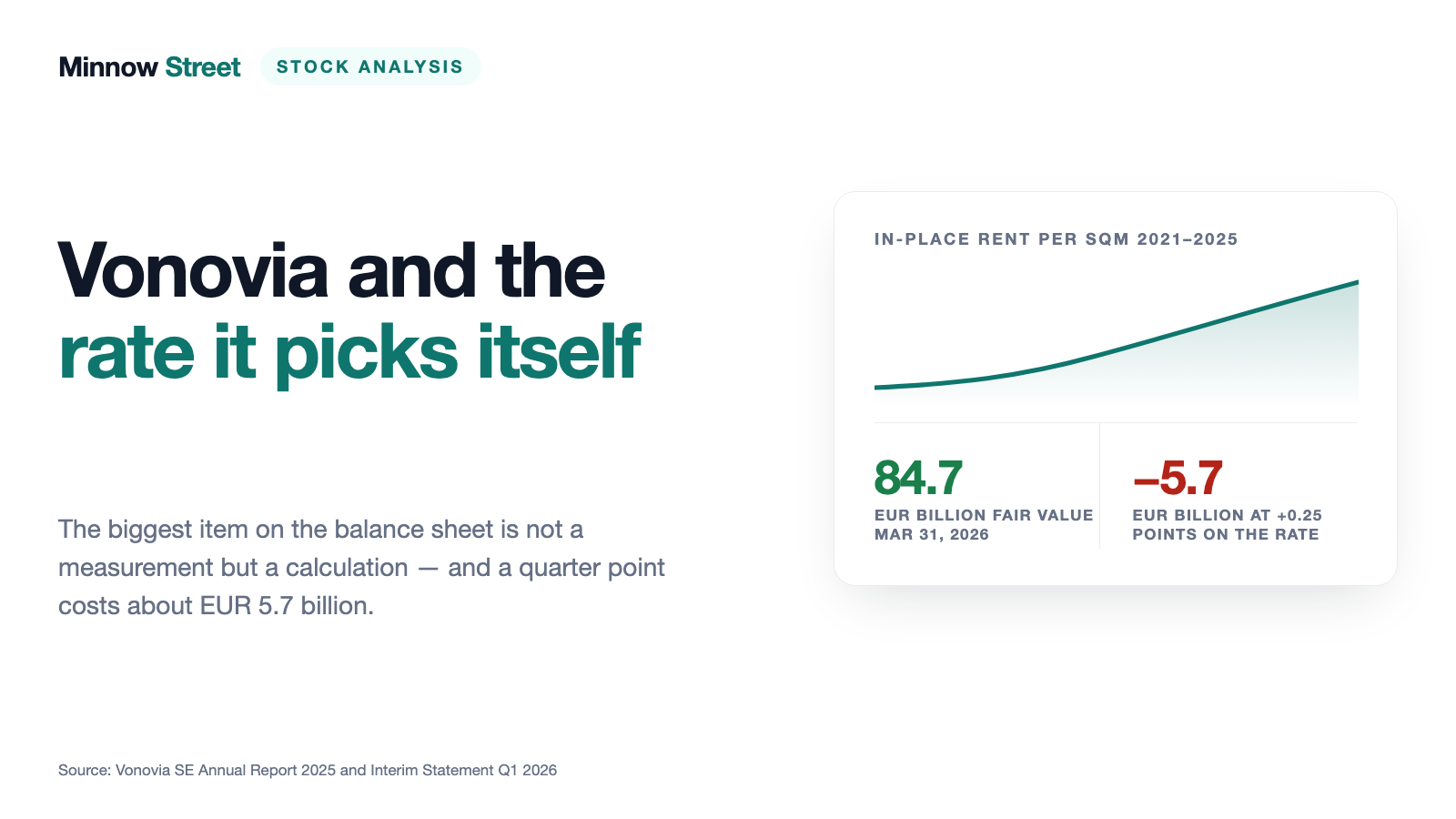
That names the central tension of this analysis, and it runs through every chapter: Vonovia’s operating business is about as predictable as anything in the DAX — rent arrives, vacancy stays low, rental income rises every year. The largest item on the balance sheet is nonetheless not a measurement but a calculation. And the decisive input into that calculation, the interest rate, is chosen in-house. The stock market has been using a different one for years.
What Vonovia actually does
Vonovia is a landlord. That sounds banal, but it is the whole truth about the core of the business: as of June 30, 2026 the group managed 603,518 units, of which 528,370 were its own apartments — the rest belong to third parties and are managed under contract. The portfolios sit in Germany, Sweden and Austria. The company is headquartered in Bochum; the shares have traded on the Frankfurt Stock Exchange since July 11, 2013 and have been in the DAX since September 2015.
Around that rental business Vonovia has built three smaller segments. Value-add bundles the residential services — the in-house craftsmen organization, the energy business, metering services. Recurring Sales is the steady sale of individual apartments to owner-occupiers and private investors. Development builds new units, partly for the group’s own portfolio and partly for sale to third parties. In the first half of 2026, of Adjusted EBITDA Total of EUR 1,456.5 million, EUR 1,268.6 million came from rentals alone — roughly 87 percent. Anyone who wants to understand Vonovia has to understand the rent first.
And the rent is working. Organic rent growth in the first half of 2026 was 3.6 percent, of which, per the company release of August 5, 2026, 2.1 percentage points came from market rent development, 1.2 points from modernization investments and 0.3 points from new construction. The vacancy rate was 2.3 percent and the collection rate — the share of rent actually received — 99.6 percent. For a company with more than half a million apartments, that is a remarkably calm set of numbers.
How the stock landed on our desk
Not through a scanner but through other people’s attention: on August 4, 2026 Vonovia sat on the wallstreet-online forum ranking of the stocks most discussed by German retail investors. That is not a buy signal; it is a sign that a lot of people are asking the same question at the same time. With a stock whose reported book value per share has for years been roughly twice its market price, the question is obvious: who is right?
The timing was fortunate, and that belongs up front rather than in a footnote. The very next day, on August 5, 2026 at 7:00 a.m. CEST, Vonovia published the half-year report 2026 — and with it the first full remeasurement of the entire portfolio since the 2025 annual accounts. We rolled this analysis forward to the June 30, 2026 reporting date on the same day. The chapter devoted to it sits right behind the multi-year figures.
The numbers over the years — what genuinely impresses
Start with what is actually strong. Adjusted EBITDA Total, the group’s headline operating measure, rose over five years from EUR 2,254.4 million (2021) through EUR 2,606.1 million (2022), EUR 2,583.8 million (2023) and EUR 2,641.8 million (2024) to EUR 2,800.8 million in 2025. That is not rocket growth, but it is a result that never broke down through an interest rate shock, a war and two property downturns.
The rent line is calmer still. Monthly in-place rent per square meter climbed from EUR 7.33 (2021) through EUR 7.49, EUR 7.74 and EUR 8.01 to EUR 8.38 (2025), and stood at EUR 8.51 on June 30, 2026. The vacancy rate moved between 2.0 and 2.3 percent over the same period. Translated: in no single year did more than three out of a hundred apartments stand empty. That is why Vonovia never wobbled in the hard years.
And then there is the other line. It sits in the same income statement, and it has nothing to do with rent.
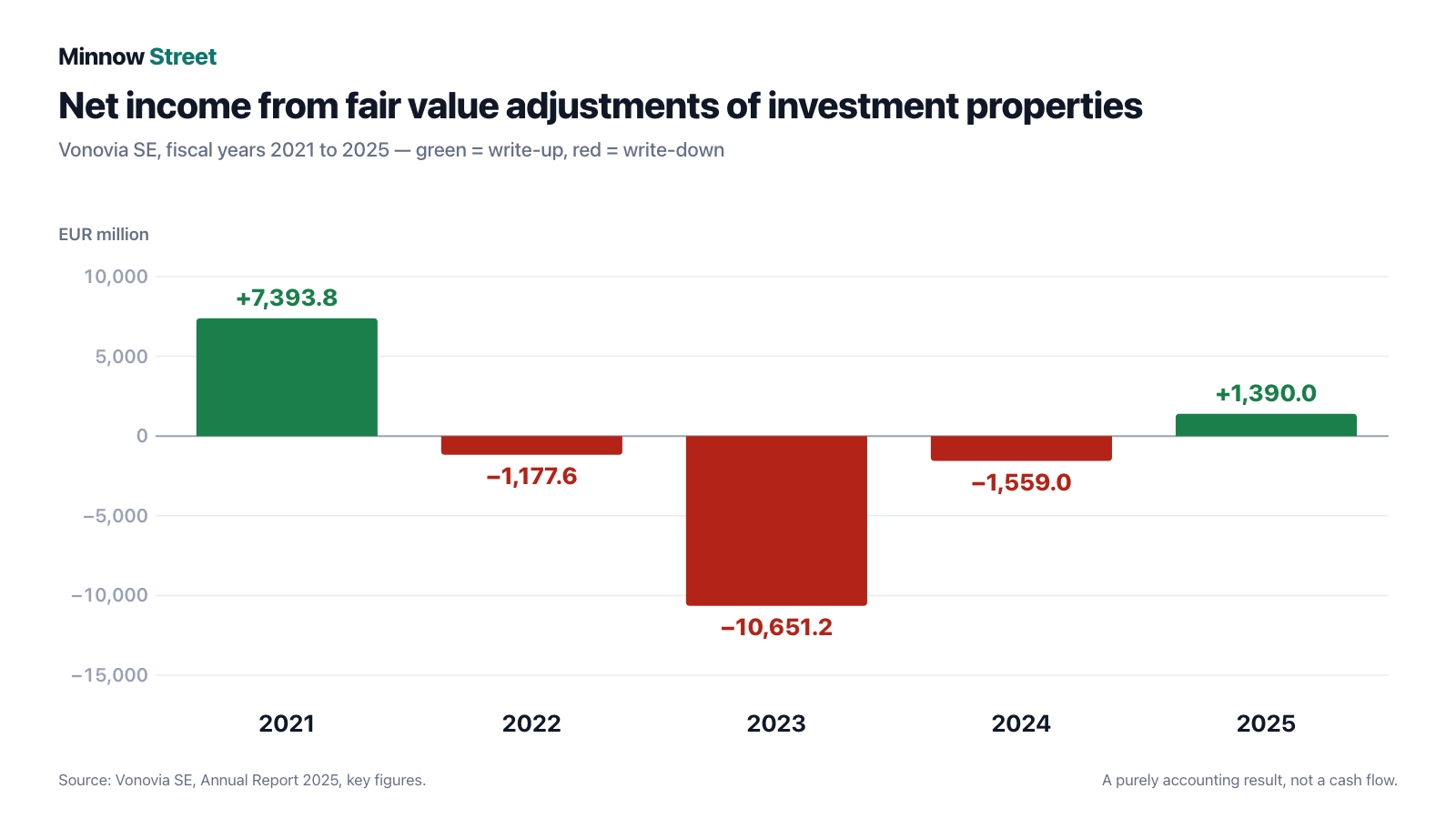
Net income from fair value adjustments of investment properties was plus EUR 7,393.8 million in 2021, minus EUR 1,177.6 million in 2022, minus EUR 10,651.2 million in 2023, minus EUR 1,559.0 million in 2024 and plus EUR 1,390.0 million in 2025. Between 2021 and 2023 that is a swing of roughly EUR 18 billion in reported earnings, on a portfolio of apartments that barely changed. No tenant moved out, no roof caved in. What changed was the calculation.
Which is why the bottom line at Vonovia always needs a second look. In 2025 profit for the period was EUR 4,185.5 million; in the first quarter of 2026 it was only EUR 250.3 million, down 51.4 percent. Operationally nothing collapsed between those two periods. The valuation was simply missing.
The half-year report of August 5, 2026 — the remeasurement is in
Which brings us to the date this whole analysis revolves around. On August 5, 2026 Vonovia published the half-year report 2026, signed by the Management Board "Bochum, July 29, 2026." It contains what no quarterly report of the year did: the full remeasurement of the entire portfolio as of June 30, 2026.
The result in one line: net income from fair value adjustments of investment properties for the first half of 2026 came in at plus EUR 848.1 million, after plus EUR 520.3 million in the prior-year period — up 63.0 percent. The fair value of the entire portfolio rose from EUR 84,448.2 million (December 31, 2025) to EUR 85,675.7 million, or 1.5 percent. Vonovia puts the like-for-like value growth at 1.1 percent excluding and 1.8 percent including investments (prior-year period: 0.7 and 1.3 percent).
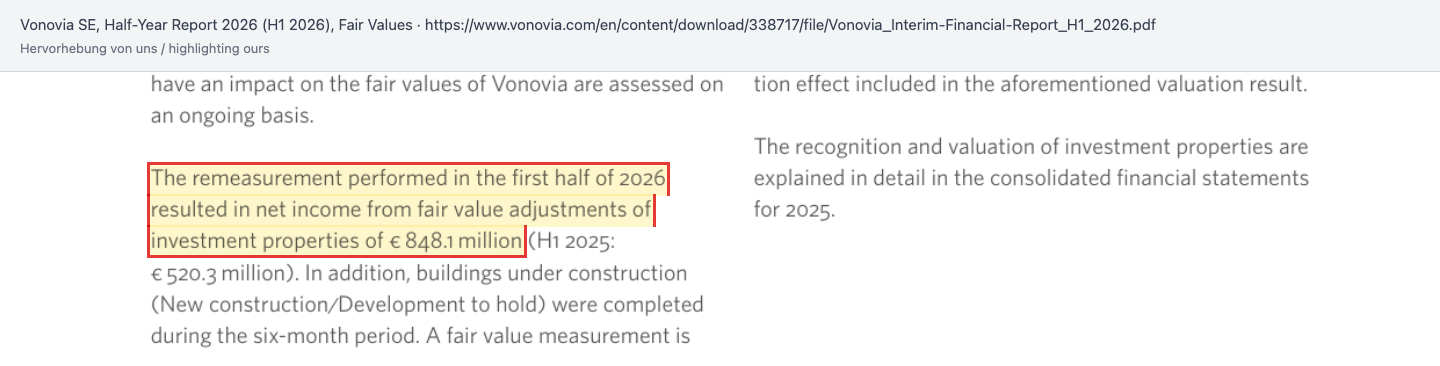
Now comes the part that really counts — and it is not in the press release but in the parameter table in the notes. Because a write-up can have two entirely different causes: either rents went up, or the interest rate was set more generously. One is the market; the other is a decision taken in-house.
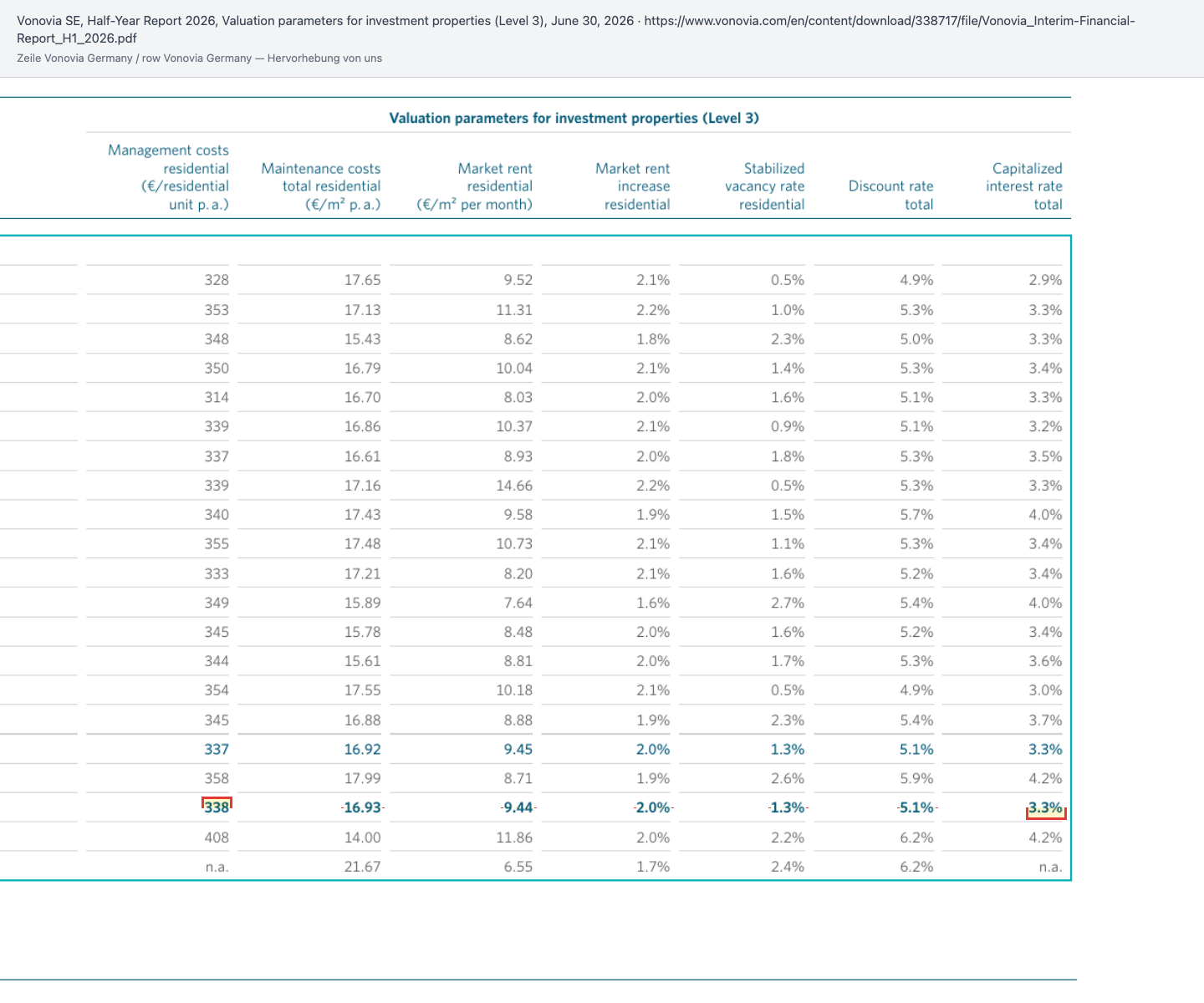
The rate did not move. For Vonovia Germany the discount rate as of June 30, 2026 stands at 5.1 percent and the capitalized interest rate at 3.3 percent — both unchanged against December 31, 2025. Two other inputs did move: residential market rent rose from EUR 9.28 to EUR 9.44 per square meter per month, and the stabilized vacancy rate fell from 1.4 to 1.3 percent. Assumed market rent growth stayed at 2.0 percent, as did the inflation assumption.
That is the cleanest possible resolution for this chapter: the write-up came out of the rental market, not out of a softer rate. On top of that, the external appraisers CBRE GmbH and Savills Sweden SE checked the portfolio value as of June 30, 2026 and, per the report, confirmed it as "plausible and consistent with the market." Anyone who distrusts the valuation after this half year has to argue with the rental market, not with the interest rate.
Operationally the half year reads as quietly as expected. Adjusted EBITDA Total rose 2.4 percent to EUR 1,456.5 million, carried by the Rental segment (up 3.5 percent to EUR 1,268.6 million) and by the small but fast-growing Value-add segment (up 27.6 percent to EUR 128.5 million). Development was the brake: EUR 20.1 million instead of EUR 57.4 million, because the prior-year period contained the sale of a large plot of land worth roughly EUR 53 million of earnings. Adjusted EBT fell 2.6 percent to EUR 962.3 million — the cause is higher financing costs, more on that shortly.
The chief executive frames the half year like this in the company release:
"In the first half of the year, we continued our strong core Rental and Value-add performance. This compensated for the slower progression in our sales-related segments for which the market environment remains challenging for now. While much of our sales activities are more back-end loaded in 2026, our focus remains unchanged: reliable earnings growth from our core business plus increasing growth from our non-rental activities on our path towards a stronger balance sheet."
— Luka Mucic, Chief Executive Officer of Vonovia SE, company release on the half-year figures 2026 of August 5, 2026
The 2026 guidance was confirmed for every earnings measure: Adjusted EBITDA Total of EUR 2.95 to 3.05 billion, Adjusted EBT of EUR 1.9 to 2.0 billion, adjusted shareholder earnings of EUR 1.4 to 1.5 billion, Rental segment rental income of EUR 3.45 to 3.55 billion. Exactly one line was cut, and you have to read the guidance table column by column to find it: organic rent growth is now expected at around 4 percent instead of the around 4.2 percent in the Q1 statement. Vonovia attributes that to a "balanced approach" in implementing the Berlin rent index. Twenty basis points are not a catastrophe — but they are the only number in the table that moved the wrong way in half a year.
And one line that is not a forecast but a fact deserves more attention than the release gives it: operating free cash flow fell 45.4 percent to EUR 607.5 million in the first half of 2026. Full-year guidance still reads "at the prior-year level" — and prior-year level means EUR 1,778.5 million. After six months roughly 34 percent of that has been earned; a year earlier the halfway mark stood at roughly 63 percent. The report offers two explanations, and they carry weight: net working capital absorbed EUR 61.1 million this time instead of releasing EUR 283.0 million as it did a year earlier, and payments to minority shareholders rose from EUR 175.1 million to EUR 256.0 million. Strip out the working capital effect — guidance explicitly applies before it — and the decline runs from EUR 830.1 million to EUR 668.6 million, or 19.5 percent. What cannot be argued away: cash and cash equivalents fell within six months from EUR 3,574.1 million to EUR 2,172.7 million, down 39.2 percent.
A third theme did not make the headline but stands alongside rent and valuation: the disposal program. The earnings call presentation of August 5, 2026 files it under the heading De-Leveraging through Disposals. In the first half of 2026 Vonovia realized roughly EUR 700 million: about EUR 330 million of German non-core assets, about EUR 160 million from the steady apartment sales business and about EUR 20 million of signed land sales. Included is an agreement on the preferred redemption of a minority stake in the Dutch residential fund Vesteda worth roughly EUR 200 million — the same participation the half-year report carries at EUR 199.4 million under other participations.
Considerably more is meant to follow through 2028: roughly EUR 1.8 billion of remaining German non-core assets (of which roughly EUR 0.3 billion each in nursing and commercial assets), a newly defined Swedish portfolio of roughly EUR 0.8 billion and roughly EUR 0.5 billion of apartment sales a year, some EUR 1.5 billion in aggregate. That adds up to roughly EUR 4.1 billion, plus opportunistic disposals out of the core portfolio whose volume Vonovia leaves explicitly open — it depends, the company says, on how much is still required to hit the 2028 leverage targets. So there is the answer to the question of how loan-to-value gets from 46.0 percent toward the roughly 40 percent the company aims at. And there, too, is the dependency: it rests on a transaction market that Vonovia itself describes in the same release as one where "the market environment remains challenging for now."
Uncomfortable truth no. 1: the biggest balance sheet item is a calculation
As of June 30, 2026 Vonovia reported EUR 83,261.1 million of investment properties — the real estate held as a financial investment; on December 31, 2025 it was EUR 82,392.8 million. The large majority of that is carried at fair value under the option in accounting standard IAS 40.30 (at the end of 2025: EUR 81,268.7 million of EUR 82,392.8 million). In plain terms: the balance sheet does not show what the properties cost, it shows what they are estimated to be worth today — and every change in that estimate runs through the income statement.
The value is determined by the group’s in-house valuation department using a discounted cash flow method. The everyday picture: estimate how much rent an apartment will throw off over the coming decades, deduct administration and maintenance, then discount that future stream back to today — using an interest rate. The lower the rate, the more that future rent is worth now. In addition, the independent appraisers CBRE GmbH and Savills Sweden SE run a plausibility check on the result; as of June 30, 2026 they confirmed the portfolio value as "plausible and consistent with the market," and as of December 31, 2025 their market value was "at the level of the internal valuation result."
The auditor, PricewaterhouseCoopers, declared this a key audit matter — the section of the auditor’s report reserved for the issues that gave the auditor the most trouble. Its reasoning is the single most important sentence in this analysis.
"The measurement of investment properties is based on a large number of relevant parameters which are normally subject in some respects to uncertainties with regard to estimates and judgments by the executive directors. Even small changes in the measurement parameters can result in material changes in fair value."
— PricewaterhouseCoopers GmbH Wirtschaftspruefungsgesellschaft, Vonovia SE, Annual Report 2025, Independent Auditor’s Report — key audit matter "Measurement of investment properties"
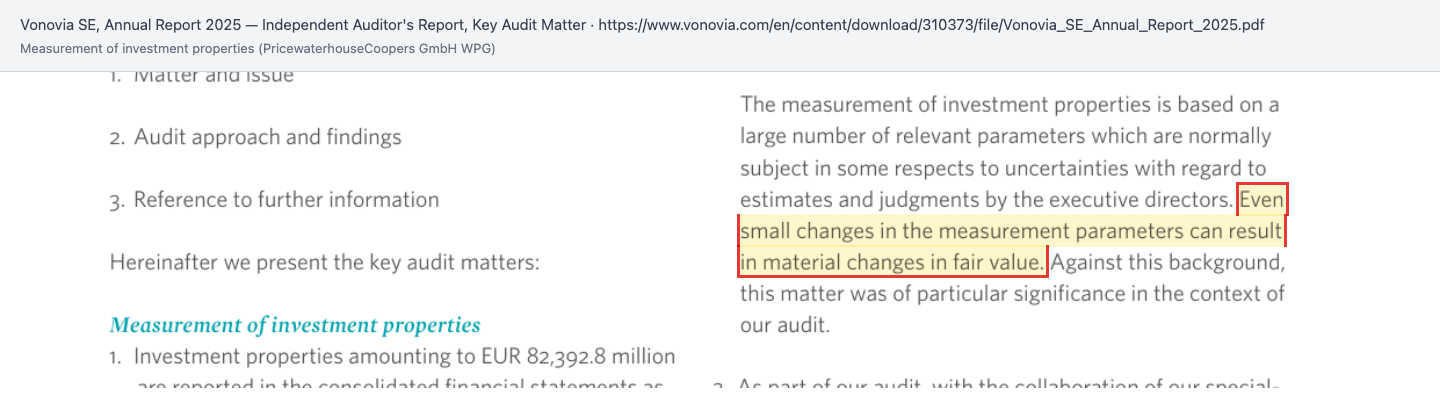
For balance, in both directions: this is not a qualification. The audit opinion is unqualified. PwC assessed the valuation models, the completeness of the portfolio data and the appropriateness of the parameters, recalculated samples and inspected selected properties. A key audit matter is not a warning sign; it is a pointer to the place where judgment is involved. That place is exactly what we look at next.
Uncomfortable truth no. 2: a quarter point of interest moves EUR 5.8 billion
For Vonovia Germany the discount rate as of June 30, 2026 is 5.1 percent — exactly as on December 31, 2025, and after 5.2 percent at the end of 2024 — and the capitalized interest rate is unchanged at 3.3 percent. The other assumptions as of June 30, 2026: market rent growth of 2.0 percent, a stabilized vacancy rate of 1.3 percent, inflation of 2.0 percent and residential market rent of EUR 9.44 per square meter per month. None of these are arbitrary — they are derived from the property market, cross-checked externally and carried forward consistently over years. But they are not measurements either.
Vonovia itself has calculated how much rides on them. The notes contain a sensitivity table, and its fourth column is the one that matters.
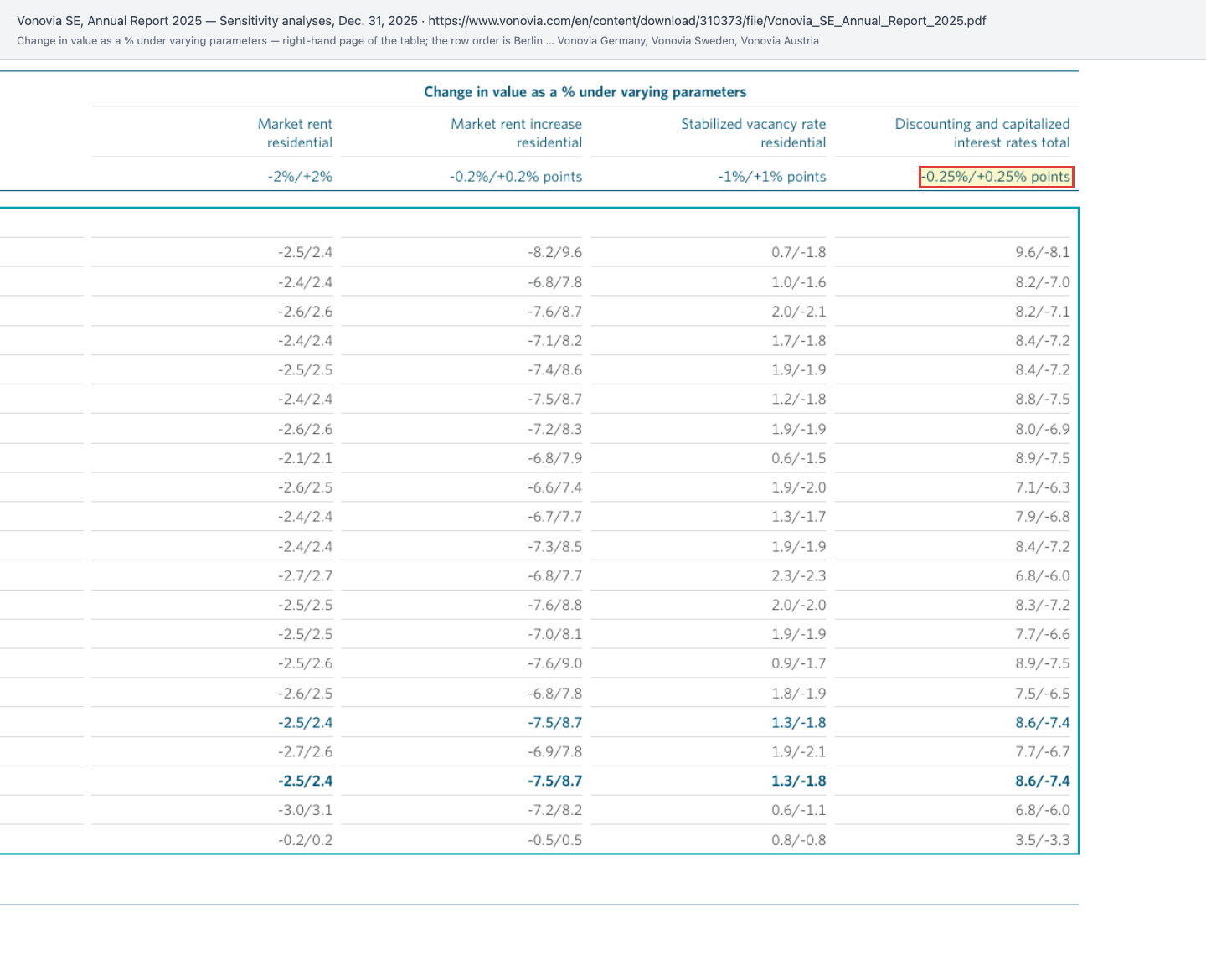
A quarter of a percentage point more or less changes the value of the German portfolio by plus 8.6 or minus 7.4 percent, the Swedish one by plus 6.8 or minus 6.0 percent and the Austrian one by plus 3.5 or minus 3.2 percent (each as of June 30, 2026; identical to the 2025 year end for Germany and Sweden, where the Austrian downside figure still read minus 3.3 percent). The report explains how to use it: the absolute impact on values is calculated by multiplying the percentage impact by the fair value of the investment properties.
So let us do that. As of June 30, 2026 the fair values of the investment properties were EUR 71,337.9 million (Germany), EUR 6,950.5 million (Sweden) and EUR 2,749.6 million (Austria). A quarter point more interest produces roughly EUR 5.8 billion of lost value; a quarter point less produces roughly EUR 6.7 billion of gain. For comparison: group equity stood at EUR 31,897.9 million on June 30, 2026. A quarter point is therefore about a sixth of equity — and, on 848,435,623 voting rights at the end of July 2026, roughly EUR 6.82 per share.
And now the proportions the half year delivered: six months of rental market — rising market rents, a lower vacancy assumption, all the capital spending — produced EUR 848.1 million. A single quarter point of interest would have been roughly seven times as powerful. That is the real lesson of this chapter: rent works slowly, the interest rate works fast.
Worth remembering: where the interest rate makes the valuation, the balance sheet is an opinion with decimal places. That is not an accusation aimed at Vonovia. It is how IAS 40 works, and every large European landlord reports this way. It is simply something other than a bank statement.
Uncomfortable truth no. 3: between two valuation dates the book value is an old photograph
This truth did not go away with the half-year report; it merely changed its window. Vonovia remeasures the entire portfolio twice a year — at the half-year and the year-end accounts. The report says so itself: to reflect changes in value during the year, Vonovia performs a new valuation of the existing residential portfolio at the time of the interim financial statements. In the income statement of the interim statement for the first quarter of 2026, the line "net income from fair value adjustments of investment properties" therefore showed a dash for both comparative periods. No gain, no loss — no valuation. Exactly the same will apply to the third quarter of 2026. The quarterly report explained it itself.
"The entire portfolio will be fully remeasured for the interim consolidated financial statements as of June 30, 2026, taking into account the updated portfolio data, market developments and, in particular, the discounting and capitalized interest rates."
— Vonovia SE, Interim Statement for the First Quarter of 2026, Fair Values (reporting date March 31, 2026, published May 7, 2026)
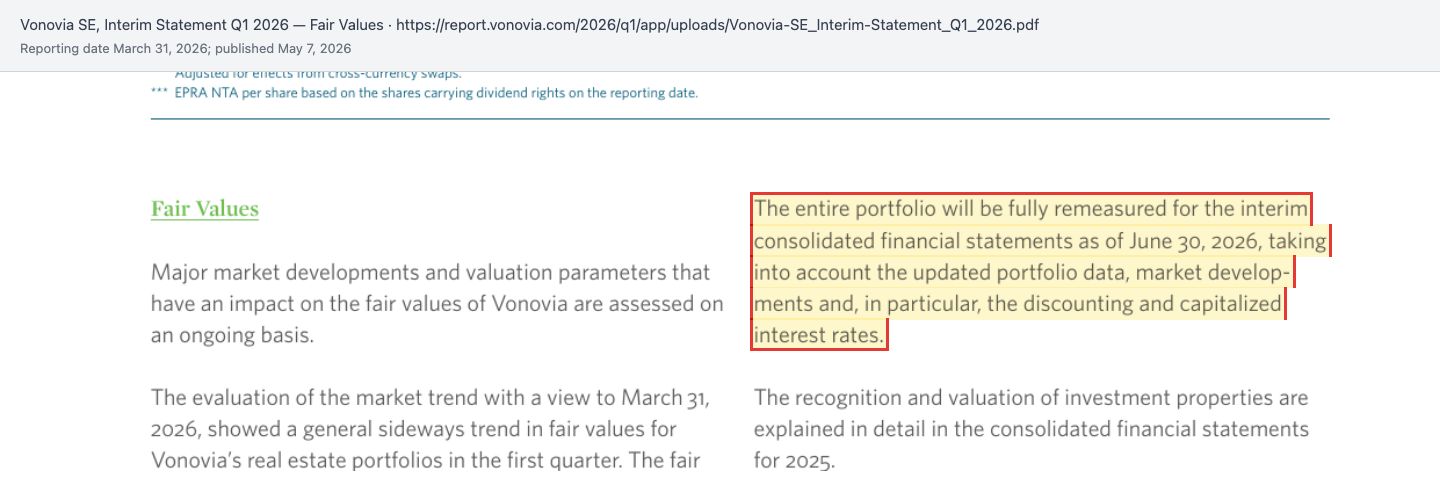
That is why the fair value rose only from EUR 84,448.2 million to EUR 84,698.1 million in the first quarter of 2026, up 0.3 percent — and almost all of that increase came from capital spending rather than a fresh assessment. The report put it plainly: the evaluation of the market trend with a view to March 31, 2026 showed a general sideways trend, and the fair values calculated at the end of 2025 "have been adjusted to reflect the investments made up to March 31, 2026." Management’s expectation from the same release — that the positive trend in property values would continue in the first half of 2026 — was borne out by the EUR 848.1 million of June 30, 2026.
Book value per share is nonetheless more interesting than the write-up suggests. EPRA NTA — net tangible assets as defined by the European Public Real Estate Association, loosely: the property value net of debt — was EUR 46.28 per share on December 31, 2025, EUR 46.57 on March 31, 2026 and EUR 46.22 on June 30, 2026. Despite EUR 848.1 million of write-ups, book value per share therefore sits 0.1 percent below the level at the start of the year. The reason is unspectacular and instructive all the same: after the annual general meeting of May 21, 2026, EUR 1,060.5 million of cash dividend flowed out — more than the remeasurement brought in. The half-year report names precisely that distribution as the main reason group equity fell from EUR 32,167.7 million to EUR 31,897.9 million even though the same half year produced EUR 1,065.3 million of profit.
So the point of this chapter stands: between two valuation dates, the number that shows up in every data sheet as "book value" carries about as much news as an old photograph. Anyone looking at EPRA NTA in October 2026 is looking at the position on June 30.
Uncomfortable truth no. 4: the share count grows quietly
Dilution means your slice of the cake gets smaller because new slices keep being cut. At Vonovia this does not happen through big capital raises but in small, unremarkable steps.
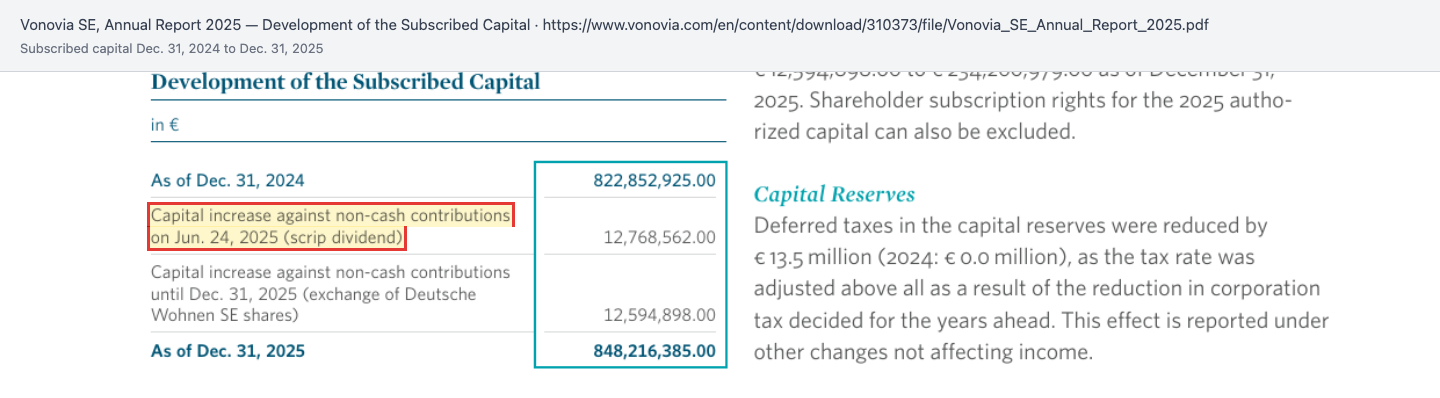
From 822,852,925 shares on December 31, 2024 the count went to 848,216,385 on December 31, 2025 — plus 25,363,460 shares, or 3.1 percent, in a single year. Where they came from: 12,768,562 shares from the scrip dividend of June 24, 2025, chosen by 35.53 percent of shareholders instead of the cash dividend, and 12,594,898 shares from the 2025 authorized capital, exchanged for shares in Deutsche Wohnen SE. At the end of July 2026 Vonovia reported 848,435,623 voting rights under Section 41 of the German Securities Trading Act; the balance sheet as of June 30, 2026 shows subscribed capital of EUR 848.4 million after EUR 848.2 million at the year end — and since every share has a notional value of one euro, that is the share count.
The bigger step came on June 23, 2026. Vonovia announced by ad-hoc release the placement of convertible bonds totaling EUR 850 million — upsized from the EUR 750 million announced earlier the same day. The bonds run to June 30, 2031, pay no periodic interest and are redeemed at 109.78 percent of par, equivalent to a yield to maturity of 1.875 percent a year. The initial conversion price is EUR 28.0402 — a conversion premium of 37.5 percent over the reference share price of EUR 20.3929, the volume-weighted average price on XETRA during the placement. Existing shareholders’ subscription rights were excluded.
Do the arithmetic: EUR 850 million divided by EUR 28.0402 is roughly 30.3 million shares, a good 3.5 percent of the current count, if every bond converts. Under the terms Vonovia may also settle in cash, which is why the half-year report records the convertible entirely as debt. And the headroom is bigger still: the 2025 authorized capital stood at EUR 234,260,979 on December 31, 2025 — roughly 27 percent of the share count, with shareholders’ subscription rights excludable.
Growth paid for with fresh shares is never entirely free. At Vonovia the effect has so far been moderate and well argued — the scrip dividend preserves cash, the share exchange integrated an entire group. But anyone comparing EPRA NTA per share over the years is comparing a number whose denominator is growing.
Uncomfortable truth no. 5: the 1.37 percent interest rate is running out
Vonovia financed itself exceptionally cheaply during the low-rate years. Nominal obligations from financial liabilities stood at EUR 42,633.3 million on December 31, 2025, and the largest block within that is EMTN corporate bonds of EUR 14,993.3 million at an average interest rate of 1.37 percent. Convertible bonds from earlier years cost 0.88 percent, the bond inherited from Deutsche Wohnen 1.18 percent, and mortgage loans 2.55 percent.
What new money costs appears in both reports. On January 23, 2026 Vonovia issued a CHF 150 million bond with a coupon of 1.5516 percent — 3.797 percent after currency hedging. On February 5 came SEK 1,500 million at 3.052 to 3.53 percent, and on February 18 a JPY 10 billion private placement at 2.94 percent, 4.08 percent after hedging. Year to date Vonovia reports roughly EUR 4.4 billion of refinanced volume with an average tenor of eight years and an average euro coupon of roughly 3.2 percent — an average flattered by the convertible, which pays no periodic coupon at all. The gap between 1.37 percent and roughly 3.2 percent is the real headwind of the coming years.
The sharpest price tag sits in the subsequent-events note. On July 6, 2026 Vonovia issued a bond of EUR 2,000.0 million in three tranches with maturities of 5, 8.5 and 12 years — the five-year tranche in social format, the 8.5-year one in green format. The average coupon: 3.87 percent a year. That is the most recent figure the report gives for the price of new money, and it sits above the half-year average. In the same month Vonovia repurchased EMTN bonds with a nominal volume of EUR 1.2 billion, called the remaining EUR 297.1 million of one of those bonds early for repayment on August 27, 2026, and repaid a EUR 542.8 million bond on schedule. For the syndicated credit line of EUR 3,000.0 million, the first extension option was exercised on July 7, 2026; it now runs to 2031.
The pressure is already visible. Interest expenses on original financial liabilities rose in the first half of 2026 from EUR 405.8 million to EUR 443.2 million, up 9.2 percent, and the adjusted net financial result deteriorated from minus EUR 363.3 million to minus EUR 406.3 million, up 11.8 percent. Vonovia itself cites higher financing costs as the main reason Adjusted EBT fell 2.6 percent to EUR 962.3 million despite higher rental income. Per the maturity schedule in the annual report, EUR 4,063.3 million falls due in 2026, EUR 4,801.4 million in 2027 and EUR 4,899.9 million in 2028 — although liability management of roughly EUR 1.5 billion in the half year has already pulled forward a significant part of the 2027 and 2028 maturities.
The chief financial officer frames it like this:
"Our capital structure remains solid, and the higher financing costs are within our planning assumptions. Considering ongoing market uncertainties, we frontloaded our financing activities and found comparatively attractive windows for our convertible bond, corporate bonds across different currencies - all fully hedged- and liability management to take some risk off the table."
— Philip Grosse, Chief Financial Officer of Vonovia SE, company release on the half-year figures 2026 of August 5, 2026
The counterweight: the balance sheet can carry it. As of June 30, 2026 the loan-to-value ratio was 46.0 percent, up from 45.4 percent at the year end — the report attributes the rise to the dividend payment in the second quarter — with adjusted net debt to Adjusted EBITDA at 14.0x and interest coverage at 3.6x. All four contractually agreed financial covenants were met, several with plenty of room: LTV under the bond definition of 45.4 percent against a 60 percent limit, secured LTV of 13.7 against 45 percent, interest coverage of 3.9x against 1.8x, unencumbered assets of 173.4 against 125 percent. Four rating agencies place Vonovia in investment grade: S&P at BBB+ (stable, August 19, 2025), Moody’s at Baa1 (stable, December 8, 2025), Fitch at BBB+ (stable, December 23, 2025) and Scope at A-, where the outlook was raised from negative to stable on June 16, 2026.
What the stock costs
Deliberately as an order of magnitude and explicitly dated, because daily prices are not an argument. The 2025 year-end share price was EUR 24.54 and market capitalization on December 31, 2025 was roughly EUR 20.8 billion. EPRA NTA per share on the same date was EUR 46.28. The half-year report 2026 supplies the next dated anchor first-hand: the stock ended the first half of 2026 at EUR 21.59 — down 12.0 percent year to date — and market capitalization on June 30, 2026 was roughly EUR 18.3 billion.
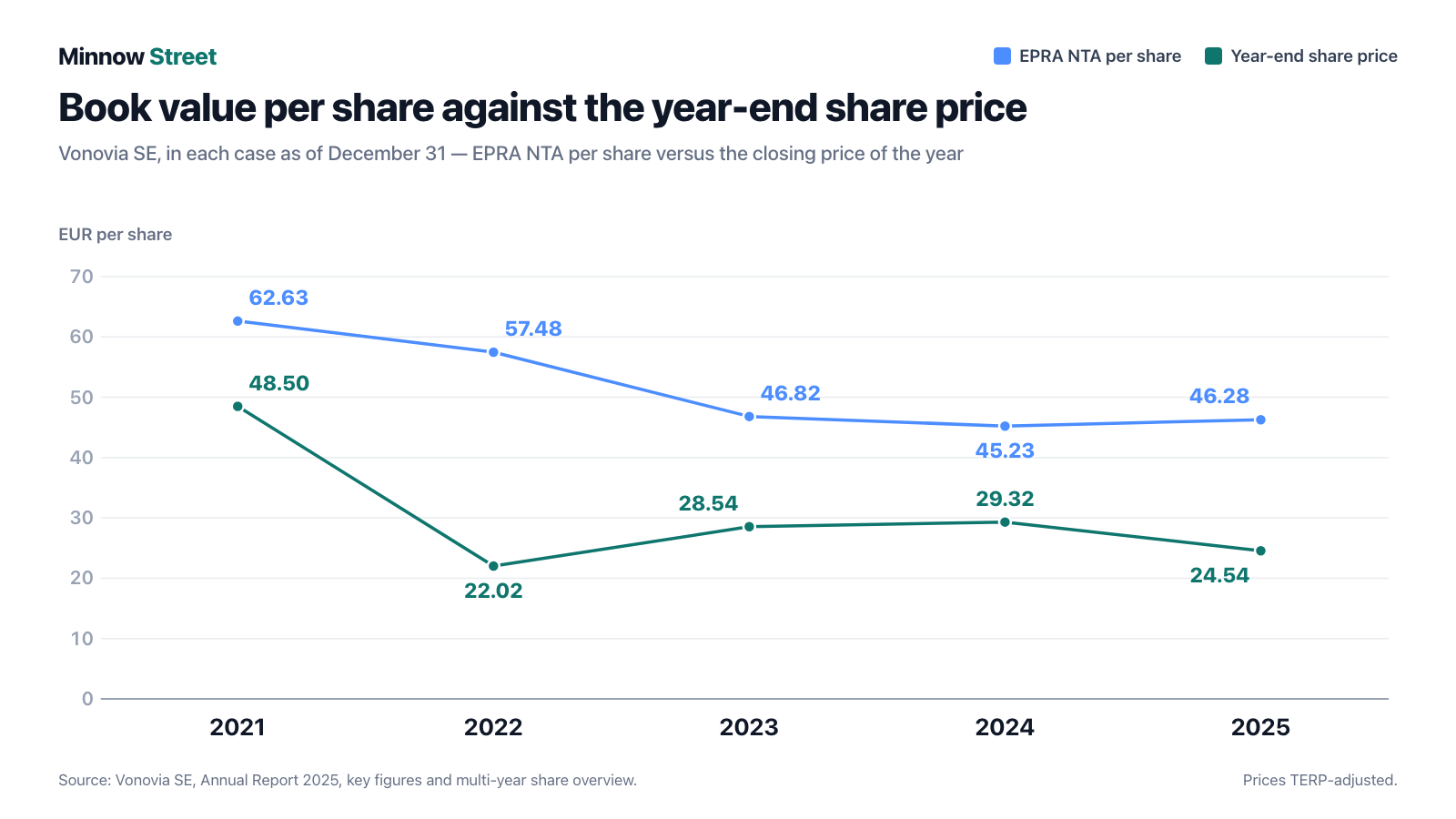
The chart shows the central tension of this analysis in two lines. EPRA NTA per share fell from EUR 62.63 (2021) through EUR 57.48, EUR 46.82 and EUR 45.23 to EUR 46.28 (2025). The year-end share price moved from EUR 48.50 through EUR 22.02, EUR 28.54 and EUR 29.32 to EUR 24.54. In none of those five years did the lines meet. The market has not accepted the book value since 2022 — it is using a higher interest rate than the valuation department. The first half of 2026 changed nothing about that; if anything the opposite: EUR 21.59 of share price against EUR 46.22 of EPRA NTA per share, both as of June 30, 2026.
You can boil that down to one question. Take the book value and the stock traded at the 2025 year-end price at a discount of roughly 47 percent; as of June 30, 2026 the discount is roughly 53 percent. What is striking is the direction: the remeasurement confirmed the book value, and the share price fell anyway. A discount is not proof of undervaluation, though — it is the market’s opinion about the valuation assumptions. And either side can be wrong.
The professionals’ view, also dated: as of December 31, 2025, 23 analysts covered Vonovia regularly, the average target price was EUR 34.39 per share, 61 percent had a buy rating, 17 percent a hold and 22 percent a sell. The consensus therefore sits well above the share price and well below the book value. The annual general meeting on May 21, 2026 approved a dividend of EUR 1.25 per share for 2025 (prior year EUR 1.22), a yield of 5.1 percent on the 2025 year-end price; EUR 1,060.5 million of that was paid out in cash.
The same caution has paid off before: at Gerresheimer the decisive statement was not in the press release either, but in the auditor’s report. At Vonovia it sits in the notes — except this time it is not a warning but a sensitivity calculation.
Opportunities and risks at a glance
Opportunities
- The core business is unusually stable: 528,370 owned apartments, a vacancy rate of 2.3 percent and a collection rate of 99.6 percent (first half and June 30, 2026 respectively). In-place rent rose 3.5 percent to EUR 8.51 per square meter and Rental segment Adjusted EBITDA 3.5 percent — on a portfolio roughly 5,000 units smaller.
- The 2026 guidance was confirmed on August 5, 2026 for every earnings measure: Adjusted EBITDA Total of EUR 2.95 to 3.05 billion, Adjusted EBT of EUR 1.9 to 2.0 billion, adjusted shareholder earnings of EUR 1.4 to 1.5 billion and Rental segment rental income of EUR 3.45 to 3.55 billion. The medium-term targets for 2028 are unchanged as well.
- The remeasurement as of June 30, 2026 confirmed the book value without leaning on the interest rate: plus EUR 848.1 million of fair value result at an unchanged 5.1 and 3.3 percent, externally confirmed by CBRE and Savills as plausible and consistent with the market.
- The balance sheet ratios have room: loan-to-value of 46.0 percent, interest coverage of 3.6x and an equity ratio of 34.3 percent (June 30, 2026); all four covenants met and investment-grade ratings from four agencies — Scope raised its outlook from negative to stable on June 16, 2026.
- The small Value-add segment is growing fast: up 27.6 percent to EUR 128.5 million of Adjusted EBITDA, carried by the craftsmen organization and the energy business. Customer satisfaction hit a record 77.3 percent in the second quarter of 2026.
- The gap between price and book value is wide: EUR 21.59 at the half-year close against EPRA NTA of EUR 46.22 per share (both June 30, 2026), a discount of roughly 53 percent. The dividend for 2025 was EUR 1.25 per share.
- Deleveraging has a concrete plan: roughly EUR 700 million of disposals in the first half of 2026, plus roughly EUR 1.8 billion of German non-core assets, roughly EUR 0.8 billion in Sweden and roughly EUR 0.5 billion of apartment sales a year through 2028 — by our addition roughly EUR 4.1 billion, supplemented by opportunistic core disposals.
Risks
- The largest balance sheet item hangs on a self-set assumption: 0.25 percentage points of rate change equals roughly EUR 5.8 billion of write-down or EUR 6.7 billion of write-up per the company’s own sensitivity calculation as of June 30, 2026 — against EUR 31.9 billion of equity. A single quarter point would have been roughly seven times as powerful as the entire fair value result of the half year.
- Cash is shrinking faster than earnings: operating free cash flow fell 45.4 percent to EUR 607.5 million in the first half of 2026 (19.5 percent adjusted for working capital effects) and cash 39.2 percent to EUR 2,172.7 million. Full-year guidance still reads "at the prior-year level" (EUR 1,778.5 million).
- Refinancing is getting more expensive: EUR 14,993.3 million of EMTN bonds at an average 1.37 percent face new issues at roughly 3.2 percent average euro coupon — and the EUR 2,000.0 million bond of July 6, 2026 costs 3.87 percent on average. Interest expenses rose 9.2 percent to EUR 443.2 million in the first half of 2026 and pushed Adjusted EBT down 2.6 percent.
- Leverage has risen: adjusted net debt of EUR 39,804.8 million equals 14.0 times Adjusted EBITDA Total, and loan-to-value climbed from 45.4 to 46.0 percent (June 30, 2026) — the stated long-term target is roughly 40 percent.
- The share count is rising: up 3.1 percent in 2025 alone, plus a EUR 850 million convertible bond with a conversion price of EUR 28.0402 and 2025 authorized capital of EUR 234,260,979 with subscription rights excludable.
- A growing share of earnings does not belong to Vonovia shareholders: EUR 118.0 million of the EUR 1,065.3 million profit for the first half of 2026 went to non-controlling interests, adjusted minority earnings rose 33.3 percent to EUR 101.2 million, and EUR 256.0 million was paid out in cash (up 46.2 percent).
- Regulation is the permanent factor in this business: the guidance for organic rent growth in 2026 was cut on August 5, 2026 from around 4.2 to around 4 percent — attributed to a balanced approach in implementing the Berlin rent index.
- The planned deleveraging depends on the transaction market: Vonovia itself calls the environment for its sales-related segments challenging, Development segment Adjusted EBITDA fell 65.0 percent to EUR 20.1 million, and the volume of opportunistic core disposals through 2028 is left explicitly open.
A human conclusion
We started with trusting the appraisal — with the reflex of treating a figure as measured simply because it looks precise and has been audited. Vonovia’s reports show both sides very clearly: the business is real, the rent arrives, Adjusted EBITDA has grown through five difficult years. And the largest item on the balance sheet is still a calculation whose most important input is chosen afresh every six months.
This time something rarer happened: the test came immediately. On August 5, 2026 the curtain went up — and behind it stood a number that does the company credit. EUR 848.1 million of write-ups, produced by higher market rents and a lower vacancy assumption, at a completely unchanged interest rate. Anyone who feared Vonovia would flatter its balance sheet with a friendlier discount rate got a clear answer for this half year: no.
What follows is not a recommendation but a reading aid. There are two separate stories inside one company here. One sits in the Rental segment and is about as quiet as a DAX stock gets. The other sits in a single line of the income statement and can move ten billion euros in a single year. Anyone buying the stock buys both — even if only the first one was on their mind.
And because a good half year is not a blank check, the other line belongs in the same paragraph: the rate did not fall, but it did not rise either — and if it did, 0.25 percentage points would be roughly seven times as powerful as the entire fair value result of this half year. At the same time the cash pile emptied by almost 40 percent in six months while cash flow guidance still reads "at the prior-year level." The next date to check that against is already in the calendar: November 4, 2026, the Q3 2026 interim report. What you make of it is your decision. And that is exactly as it should be.
More deep dives are collected in our research section.
Sources
- Vonovia SE — Half-Year Report 2026 (German and English editions), reporting date June 30, 2026, signed by the Management Board "Bochum, July 29, 2026," published August 5, 2026 at 7:00 a.m. CEST: key figures, Vonovia SE on the capital market, results of operations by segment, fair values, net asset value (EPRA NTA), financial position and financing, covenants, outlook with the 2026 forecast table, condensed interim consolidated financial statements and notes (investment properties, Level 3 valuation parameters, sensitivity analyses, financial assets, equity, events after the balance sheet date)
- Vonovia SE — company release "Attractive growth in the core business and positive value development in the portfolio" of August 5, 2026: segment results, portfolio valuation, refinancing, confirmed 2026 guidance and 2028 outlook, verbatim quotes from Luka Mucic (CEO) and Philip Grosse (CFO)
- Vonovia SE — "H1 2026 Earnings Call Presentation" of August 5, 2026, the deck for the analyst call at 2:00 p.m. CEST the same day: half-year summary, segment key figures, financing overview, the slide "De-Leveraging through Disposals" with the disposals realized in the first half and the targets through 2028, and the "2026 Guidance & 2028 Objective" table
- Vonovia SE — Annual Report 2025 (356 pages, German and English editions), PDF dated March 18, 2026, published with the full-year figures on March 19, 2026: key figures, letter from the Management Board, report on the economic position, notes (investment properties, Level 3 valuation parameters, sensitivity analyses, development of the subscribed capital, authorized capital, call options, summarized financial information for the Deutsche Wohnen Group), independent auditor’s report
- Vonovia SE — Interim Statement for the First Quarter of 2026, reporting date March 31, 2026, signed by the Management Board on April 29, 2026, published May 7, 2026: key figures, fair values, financial position, financing, covenants, outlook, condensed interim consolidated financial statements
- Vonovia SE — Investor Relations, corporate news and ad-hoc announcements: quarterly release of May 7, 2026 ("Good start to the year — 2026 guidance confirmed"), annual general meeting release of May 21, 2026 (dividend of EUR 1.25, attendance 58.91 percent, PwC appointed as auditor), ad-hoc announcements of June 23, 2026 on the announcement and the placement of the EUR 850 million convertible bonds, publication of the total number of voting rights under Section 41 WpHG of July 31, 2026 (848,435,623 voting rights)
- Hook: wallstreet-online forum ranking of the most discussed stocks among German retail investors, as of August 4, 2026
This analysis is journalistic commentary based on publicly available documents. It is not investment advice, not a solicitation to buy or sell securities, and not a personal recommendation. Shares can lose substantial value, and a total loss of the capital invested is possible. Every figure carries the reporting date of its source; the most recent periodic report evaluated is the half-year report 2026, with a reporting date of June 30, 2026, published on August 5, 2026. The first edition of this analysis, dated August 4, 2026, stood on the interim statement for the first quarter of 2026 and was fully rolled forward to the half-year report on August 5, 2026. The next periodic report is the Q3 2026 interim report on November 4, 2026. Positions held by the operator are disclosed daily; where one exists, it appears as a notice at the top of this deep dive.
Our Bottom Line at a Glance
- Core rental business positive
- As of June 30, 2026 Vonovia managed 603,518 units, of which 528,370 were its own apartments, at a vacancy rate of 2.3 percent and a collection rate of 99.6 percent. Monthly in-place rent rose from EUR 7.33 per square meter (2021) to EUR 8.38 (2025) and EUR 8.51 (June 30, 2026), with organic rent growth of 3.6 percent in the first half of 2026. Rental segment Adjusted EBITDA grew 3.5 percent to EUR 1,268.6 million — on a portfolio roughly 5,000 units smaller.
- Property valuation positive
- The full remeasurement as of June 30, 2026 produced a fair value result of plus EUR 848.1 million (H1 2025: plus EUR 520.3 million); fair value rose 1.5 percent to EUR 85,675.7 million. What matters is where it came from: the discount rate for Vonovia Germany was unchanged at 5.1 percent and the capitalized interest rate at 3.3 percent — the write-up came from market rent (EUR 9.28 to EUR 9.44 per square meter) and a lower stabilized vacancy rate (1.4 to 1.3 percent). CBRE and Savills confirmed the portfolio value as plausible and consistent with the market.
- Interest rate sensitivity negative
- The company's own sensitivity table as of June 30, 2026 puts the effect of a 0.25 percentage point rate change at plus 8.6 or minus 7.4 percent (Germany), plus 6.8 or minus 6.0 percent (Sweden) and plus 3.5 or minus 3.2 percent (Austria). Applied to the fair values of the investment properties, that is roughly EUR 6.7 billion of write-up or EUR 5.8 billion of write-down, against equity of EUR 31,897.9 million. A single quarter point would therefore have been roughly seven times as powerful as the entire fair value result of the half year.
- Cash flow and liquidity negative
- Operating free cash flow fell 45.4 percent to EUR 607.5 million in the first half of 2026 while full-year guidance still reads "at the prior-year level" (2025 actual: EUR 1,778.5 million). Adjusted for the change in net working capital — guidance applies before it — the decline runs from EUR 830.1 million to EUR 668.6 million, or 19.5 percent. Cash and cash equivalents fell 39.2 percent within six months, from EUR 3,574.1 million to EUR 2,172.7 million; payments to minorities rose from EUR 175.1 million to EUR 256.0 million.
- Balance sheet and covenants positive
- As of June 30, 2026 the loan-to-value ratio was 46.0 percent (Dec 31, 2025: 45.4 percent), the equity ratio 34.3 percent and the interest coverage ratio 3.6x. All four contractually agreed financial covenants were met, several with plenty of room (LTV 45.4 against 60 percent, secured LTV 13.7 against 45 percent, ICR 3.9x against 1.8x, unencumbered assets 173.4 against 125 percent). Four agencies rate Vonovia investment grade: S&P BBB+, Moody's Baa1, Fitch BBB+ and Scope A-, where the outlook was raised from negative to stable on June 16, 2026.
- Refinancing negative
- EMTN bonds of EUR 14,993.3 million carry an average coupon of 1.37 percent. Year to date Vonovia refinanced roughly EUR 4.4 billion with an average tenor of eight years at an average euro coupon of roughly 3.2 percent. Interest expenses on original financial liabilities rose from EUR 405.8 million to EUR 443.2 million (up 9.2 percent) and pushed Adjusted EBT down 2.6 percent to EUR 962.3 million. After the reporting date, on July 6, 2026, came a EUR 2,000.0 million bond in three tranches at an average coupon of 3.87 percent. EUR 4,063.3 million falls due in 2026, EUR 4,801.4 million in 2027 and EUR 4,899.9 million in 2028; liability management of roughly EUR 1.5 billion has already pulled part of that forward.
- Share count and minorities negative
- The share count rose 3.1 percent in 2025 to 848,216,385 and stood at 848,435,623 voting rights at the end of July 2026; the convertible bond of June 23, 2026 amounts to EUR 850 million and, at a conversion price of EUR 28.0402, to roughly 30.3 million additional shares, and is carried entirely as debt. Of the EUR 1,065.3 million profit for the first half of 2026, EUR 118.0 million went to non-controlling interests; adjusted minority earnings rose from EUR 75.9 million to EUR 101.2 million, up 33.3 percent.
Vonovia is two companies inside one balance sheet. One lets 528,370 apartments at a vacancy rate of 2.3 percent and grew Adjusted EBITDA Total 2.4 percent to EUR 1,456.5 million in the first half of 2026 — about as predictable as anything in the DAX. The other sits in a single line of the income statement: net income from fair value adjustments of investment properties swung between plus EUR 7,393.8 million (2021) and minus EUR 10,651.2 million (2023) without a single apartment changing hands. The full remeasurement as of June 30, 2026 produced plus EUR 848.1 million and a fair value of EUR 85,675.7 million — at an unchanged discount rate of 5.1 percent; the write-up came from market rent, not from the rate. A quarter point of rate change equals roughly EUR 5.8 billion per the company's own sensitivity table, roughly seven times as much. What remains open is costlier refinancing (EUR 14,993.3 million of legacy bonds at 1.37 percent against roughly 3.2 percent on new issues) and operating free cash flow, which fell 45.4 percent to EUR 607.5 million. Not investment advice.
What Our Rating Means
Open questions
The business works in principle, but one material question is open. As long as it stays open, our findings do not carry a quality verdict.
Yellow here does not stand for a risk to the substance of the business — none is documented. The audit opinion on the 2025 accounts is unqualified, all four contractual financial covenants were met as of June 30, 2026, interest coverage stands at 3.6x, the equity ratio at 34.3 percent, four rating agencies place the company in investment grade, and Scope even raised its outlook from negative to stable on June 16, 2026. The biggest open question of the first edition has been answered positively too: the full remeasurement as of June 30, 2026 produced EUR 848.1 million of write-ups at an unchanged discount rate of 5.1 percent — the write-up came out of the rental market, not out of a friendlier assumption. Yellow stands for two open operating questions. First, the cheap legacy financing is running out: EUR 14,993.3 million of EMTN bonds carry an average 1.37 percent while roughly EUR 4.4 billion was refinanced year to date at an average euro coupon of roughly 3.2 percent, and the EUR 2,000.0 million bond of July 6, 2026 cost 3.87 percent; interest expenses rose 9.2 percent and pushed Adjusted EBT down 2.6 percent even though rental income grew. EUR 13.8 billion falls due through 2028. Second, the cash pile has emptied: operating free cash flow fell 45.4 percent to EUR 607.5 million and cash 39.2 percent to EUR 2,172.7 million, against unchanged full-year guidance of "at the prior-year level" (2025 actual: EUR 1,778.5 million). Structurally, the largest balance sheet item is calculated rather than measured: a quarter point on the discounting and capitalized interest rates moves roughly EUR 5.8 billion per the company's own sensitivity table. Green would be the rating if the refinancing gap were closed and cash flow were back on track to the company's own guidance. That the stock traded at a discount of roughly 53 percent to EPRA NTA is a price question and does not drive this rating.
A journalistic assessment by our editorial team at the time of the deep dive, based on public sources — not investment advice and not a solicitation to buy or sell. Your personal circumstances (investment goals, risk capacity, taxes) cannot be taken into account. What our levels mean, how verdicts are formed, and what conflicts of interest exist →
Worth Noting
- Vonovia came onto the research list through the wallstreet-online forum ranking of the stocks most discussed by German retail investors, as of August 4, 2026 — not a scanner hit and not a buy signal, but an attention signal.
- Data status and timeliness: the most recent periodic report evaluated is the half-year report 2026 (reporting date June 30, 2026, signed by the Management Board on July 29, 2026, published August 5, 2026 at 7:00 a.m. CEST). This analysis was fully rolled forward to it on August 5, 2026; the first edition of August 4, 2026 stood on the interim statement for the first quarter of 2026. Also evaluated: the company release on the half year of August 5, 2026 with quotes from the CEO and CFO, and the presentation for the analyst call the same day. Reviewed from the period before: the annual general meeting of May 21, 2026, the voting rights notifications under Section 41 WpHG of May 29, June 30 and July 31, 2026, and both ad-hoc announcements of June 23, 2026 on the convertible bond. Next date: the Q3 2026 interim report on November 4, 2026.
- On the valuation method: Vonovia carries investment properties at fair value under the option in IAS 40.30. Changes in that value run through the income statement without any cash moving. That is why profit for 2025 of EUR 4,185.5 million was far above the operating result — and why earnings before taxes jumped to EUR 1,664.8 million in the first half of 2026 even though Adjusted EBT fell 2.6 percent.
- Remeasurement rhythm: Vonovia remeasures the entire portfolio twice a year — at the half-year and the year-end accounts. In the quarterly reports as of March 31 and September 30, the line "net income from fair value adjustments of investment properties" is therefore nil; fair values there are merely rolled forward for investments.
- The "roughly EUR 5.8 billion" figure is our own calculation and follows the instruction in the report: the percentage sensitivity multiplied by the fair value of the investment properties per country (Germany EUR 71,337.9 million, Sweden EUR 6,950.5 million, Austria EUR 2,749.6 million as of June 30, 2026). It is an order of magnitude, not a forecast.
- On the disposal program: the first-half volumes (roughly EUR 700 million) and the targets through 2028 are not in the half-year report but in the presentation for the analyst call of August 5, 2026 ("De-Leveraging through Disposals"). The roughly EUR 4.1 billion is our own addition of the individual targets named there (roughly EUR 1.8 billion of German non-core assets, roughly EUR 0.8 billion in Sweden, roughly EUR 1.5 billion of apartment sales); opportunistic disposals out of the core portfolio are not included, because Vonovia leaves their volume open.
- After the reporting date: the subsequent-events note of the half-year report lists the EUR 2,000.0 million bond of July 6, 2026 (three tranches of 5, 8.5 and 12 years, average coupon 3.87 percent), the repurchase of EMTN bonds with a nominal volume of EUR 1.2 billion in July 2026, the early call of a remaining EUR 297.1 million for August 27, 2026, the scheduled repayment of a EUR 542.8 million bond and the extension of the EUR 3,000.0 million syndicated credit line to 2031. The roughly EUR 4.4 billion of refinanced volume Vonovia reports is a year-to-date figure and includes that July issue.
- No current market capitalization is quoted deliberately. All price and valuation figures come from primary documents: the half-year closing price of EUR 21.59 and market capitalization of roughly EUR 18.3 billion as of June 30, 2026 from the half-year report, and the 2025 year-end share price (EUR 24.54) and market capitalization (roughly EUR 20.8 billion) from the Annual Report 2025. Cross-check: 848.4 million shares times EUR 21.59 equals roughly EUR 18.3 billion, which confirms the market capitalization the company reports.
The full analysis as a PDF for later
We will send you this analysis as a PDF — to print, file away, and read at your own pace.
Frequently Asked Questions
Vonovia, headquartered in Bochum, Germany, is Europe's largest residential real estate company and a member of the DAX 40. As of June 30, 2026 the group managed 603,518 units, of which 528,370 were its own apartments in Germany, Sweden and Austria. Alongside rentals, Vonovia runs the Value-add segment (craftsmen organization, energy business), Recurring Sales (apartment sales) and Development (new construction). In the first half of 2026, EUR 1,268.6 million of EUR 1,456.5 million Adjusted EBITDA came from rentals.
Published on August 5, 2026, it contains the first full remeasurement of the portfolio since the 2025 annual accounts: net income from fair value adjustments of investment properties came in at plus EUR 848.1 million (H1 2025: plus EUR 520.3 million), and fair value rose to EUR 85,675.7 million, up 1.5 percent. Adjusted EBITDA Total grew 2.4 percent to EUR 1,456.5 million while Adjusted EBT fell 2.6 percent to EUR 962.3 million. The 2026 guidance was confirmed for every earnings measure.
The in-house valuation department uses a discounted cash flow method: expected net cash inflows from managing the properties are estimated and discounted to the reporting date using a discount rate and a capitalized interest rate. For Vonovia Germany those rates stood at 5.1 and 3.3 percent as of June 30, 2026, exactly as on December 31, 2025. In addition, the independent appraisers CBRE GmbH and Savills Sweden SE run a plausibility check; they confirmed the portfolio value as of June 30, 2026 as plausible and consistent with the market.
From rent. The discount rate for Vonovia Germany was unchanged at 5.1 percent as of June 30, 2026 and the capitalized interest rate unchanged at 3.3 percent. What changed were the assumed residential market rent (from EUR 9.28 to EUR 9.44 per square meter per month) and the stabilized vacancy rate (from 1.4 to 1.3 percent). Market rent growth stayed at 2.0 percent, as did the inflation assumption.
The half-year report 2026 gives the figures itself: if the discounting and capitalized interest rates move by 0.25 percentage points, the value of the German portfolio changes by plus 8.6 or minus 7.4 percent, the Swedish one by plus 6.8 or minus 6.0 percent and the Austrian one by plus 3.5 or minus 3.3 percent. Applied to the fair values of the investment properties as of June 30, 2026, that is roughly EUR 6.7 billion of write-up or EUR 5.8 billion of write-down — against equity of EUR 31,897.9 million.
As of June 30, 2026 net debt was EUR 40,024.0 million, or EUR 39,804.8 million on an adjusted basis. The loan-to-value ratio was 46.0 percent after 45.4 percent at the end of 2025 — the report attributes the rise to the dividend payment in the second quarter. Adjusted net debt to Adjusted EBITDA stood at 14.0x and interest coverage at 3.6x. All four contractually agreed financial covenants were met; four rating agencies place Vonovia in investment grade, among them S&P at BBB+ and Moody's at Baa1.
Through disposals. The earnings call presentation of August 5, 2026 files the program under "De-Leveraging through Disposals": roughly EUR 700 million was realized in the first half of 2026 (about EUR 330 million of German non-core assets, about EUR 160 million of apartment sales, about EUR 20 million of land), including an agreement on the preferred redemption of a Vesteda minority stake worth roughly EUR 200 million. Through 2028, roughly EUR 1.8 billion of German non-core assets, roughly EUR 0.8 billion in Sweden and roughly EUR 0.5 billion of apartment sales a year are meant to follow. The volume of additional core disposals is left open.
The share count rose from 822,852,925 on December 31, 2024, to 848,216,385 on December 31, 2025 — up 3.1 percent through the scrip dividend of June 24, 2025 and the exchange for shares in Deutsche Wohnen SE. At the end of July 2026 Vonovia reported 848,435,623 voting rights, and subscribed capital stood at EUR 848.4 million as of June 30, 2026. The convertible bond placed on June 23, 2026 amounts to EUR 850 million and, at a conversion price of EUR 28.0402, works out at roughly 30.3 million additional shares.
EPRA NTA per share was EUR 46.22 on June 30, 2026 against a half-year closing price of EUR 21.59 — a discount of roughly 53 percent. The book value rests on internal valuation assumptions, in particular a discount rate of 5.1 percent. The market is evidently applying a higher rate, or lower property values. A discount is therefore not proof of undervaluation but a differing opinion about the valuation assumptions.
Found an error?
Did you spot a factual error, an outdated number, or a typo in this deep dive? Let us know briefly — your report goes straight to the editorial team.