CPI Aerostructures Stock (CVU): An 18-Point Margin Jump, But Only 5 Points Are Real
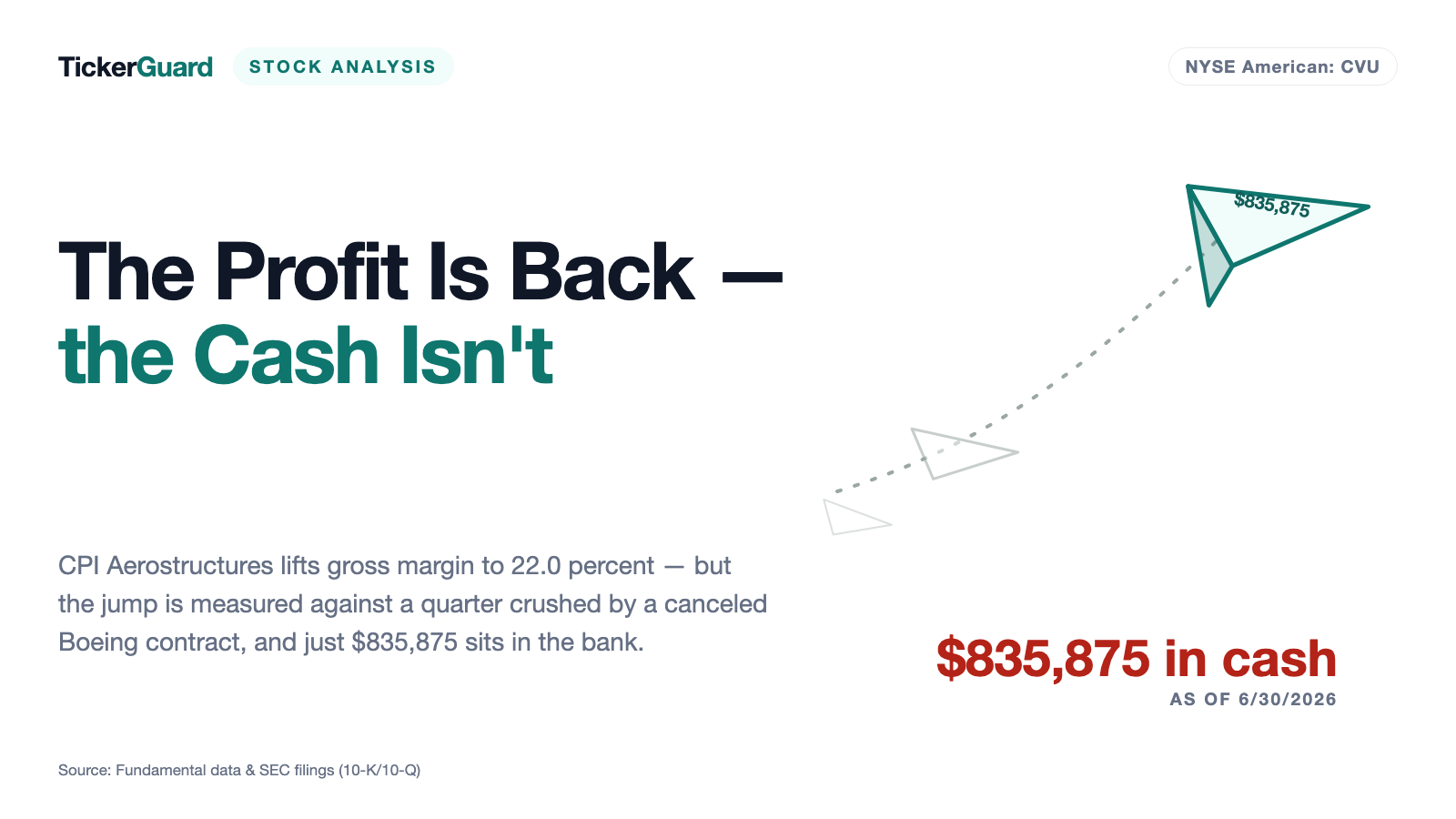
CPI Aerostructures has very nearly tripled from its 52-week low of $2.02 to $5.66 (as of August 13, 2026) — the small-batch supplier of fuselage sections, jammer pods and welded titanium tubing for Lockheed Martin, Northrop Grumman and RTX is profitable again, gross margin jumped from 4.4 percent to 22.0 percent in the second quarter of 2026, and a forward P/E of 6.8 looks like an overlooked comeback. But the filings CPI is required to make to the U.S. securities regulator, the SEC, tell a more complicated story: most of the margin jump is a prior-year base effect from a collapsed Boeing A-10 contract, not new strength — and while the company reports profit, its cash is nearly gone: $835,875 in cash, a credit line 92 percent drawn, and a $17 million stock-sale program loaded and ready to fire. We ran the numbers to see how much of the comeback is genuinely new — and how much of it just looks better than what came before.
 Thomas Mücke
Founder & Publisher
Thomas Mücke
Founder & Publisher
As of Today
As of: September 30, 2026
- Closing price
- 5.20 $ 0.00%
- Market Capitalisation
- 0.1 $B
- P/E
- 42.5
- Growth Score
- 2/10
- AAQS
- 0/10
This analysis has a cut-off date. The Stock Guard tells you when something material changes in the numbers. Reserve your free spot
Chart
Interactive price chart (TradingView).
52-week range: 2.10 $ to 5.90 $ · Last price: 5.20 $ (As of: September 30, 2026)
Note: pure fact-based analysis, not investment advice and not a solicitation to buy or sell. All figures without guarantee.
There is an investor trap that springs shut exactly when a stock has already turned itself around: the comeback reflex. You see a price that has nearly tripled off its low, a profit that is finally black again after years of red, and a price-to-earnings ratio that looks laughably cheap at first glance. Your head whispers: "Buy it now, before everyone else sees it." That is exactly the state CPI Aerostructures (NYSE American: CVU) puts you in as of August 2026: the stock climbed from a 52-week low of $2.02 to $5.66 (as of August 13, 2026) — nearly tripling, and it trades practically at its 52-week high. Gross margin in the second quarter of 2026 jumped from 4.4 percent to 22.0 percent. The forward price-to-earnings ratio sits at 6.8. It sounds like an overlooked turnaround. So let's make a deal: before you pay for the comeback reflex, let's read together what CPI reported to the U.S. securities regulator, the SEC — the latest quarterly report (10-Q) as of June 30, 2026, filed August 13, 2026, plus the annual report (10-K) for 2025 and the three earnings releases of the current year. A filing to the SEC is honest under penalty of law. And this one tells a story more complicated than "turnaround complete": part of the margin jump is real, a larger part is comparison-base arithmetic — and while profit is back, cash is nearly gone. What you make of it in the end is your call.
What CPI Aerostructures Actually Does — The Subcontractor Behind The Subcontractor
CPI Aerostructures does not build its own aircraft and does not sell its own brand. The company is a Tier-1 subcontractor — picture it like a supplier that builds the doors and seats for a car manufacturer: CPI builds structural metal assemblies for the big defense primes — outer-wing kits for the E-2D Advanced Hawkeye reconnaissance aircraft (Northrop Grumman, cumulative orders since 2008 exceeding $210 million), rudder and drag-chute canisters for the F-16 (Lockheed Martin, total contract value roughly $60 million), welded titanium tubing for the CH-53K King Stallion helicopter, and complete sensor and jammer housings — so-called "pods" — for example for the ALQ-249 Next Generation Jammer (RTX/Collins Aerospace, total program value exceeding $254.4 million through 2030). Roughly 80 percent of revenue flows through subcontracts to these defense primes, 11 percent comes directly from the U.S. Department of Defense, and 9 percent comes from commercial aviation — mainly engine inlets for Embraer's Phenom 300 business jet (fiscal 2025 figures, annual report 10-K, pp. 4–5). Manufacturing is done almost entirely under fixed-price contracts: CPI carries the cost risk, not the customer. And revenue is booked under the "over time" rule (U.S. accounting standard ASC 606) — CPI is allowed to book revenue during production, based on percentage of completion, long before it is allowed to send an invoice. That explains why CPI carries a huge "earned but not yet billed" position on its balance sheet despite razor-thin cash — more on that shortly. The entire operation sits at a single site in Edgewood, Long Island, with 192 full-time employees as of December 31, 2025 (prior year 212). After the 2018–2021 accounting scandal — multiple restatements, a temporary trading halt, trading on the small-cap OTC Pink market — CVU has traded regularly on NYSE American again since 2023. Other aerospace suppliers have attempted turnarounds of their own in recent years; how different the starting conditions can be is visible in our Astronics analysis — there, a diversified product portfolio carries the rebuild, while at CPI the rebuild rests essentially on one program portfolio with a handful of large customers.
Where The Stock Landed On Our Desk — A Contradiction In The Scanner
On our in-house stock scanner, CVU did not stand out for a growth signal but for a contradiction: the Altman Z-Score — a metric that combines five balance-sheet ratios into a single bankruptcy-risk warning, much like a health check that rolls several readings into one traffic light — sits at 1.23, well below the 1.81 threshold below which balance sheets are considered to be in "distress territory." The Piotroski F-Score, a nine-point checklist covering profitability, leverage and efficiency (comparable to a nine-point car inspection), stands at 1 of 9 — the worst possible category. At the same time, the stock trades 0 percent below its 52-week high, is up 50.9 percent over three months and 42.9 percent year-to-date (all figures as of August 13, 2026). Translated: the balance sheet looks like a patient in the intensive care unit while the price is partying like it's already fit again. Add a warning you shouldn't skip over: average trading volume over the last 50 days is only about 70,000 shares, or roughly $0.4 million per day — an extremely thin, illiquid stock where even small buy orders can move the price. Hold onto this tension, because it runs through the whole analysis: profit is back, but two things temper it at once — the prior-year comparison flatters the number, and the cash balance is practically empty.
The Numbers Over The Years — Honestly Appraised
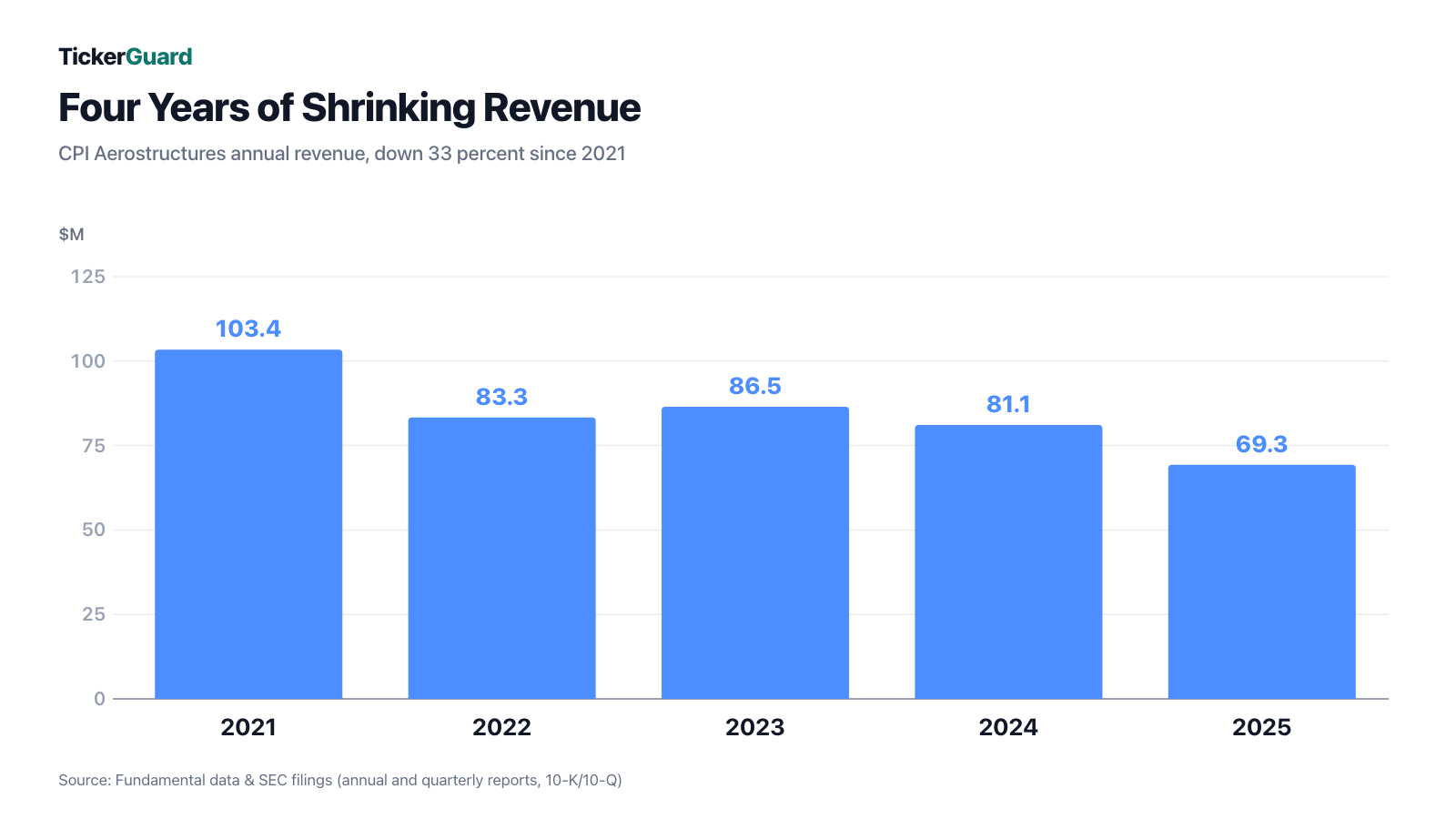
Let's start with what genuinely impresses. After four years of shrinking — revenue $103.4 million (2021) → $83.3 million (2022) → $86.5 million (2023) → $81.1 million (2024) → $69.3 million (2025), a total of -33.0 percent — revenue is growing again in 2026: the first half of 2026 brought in $34.9 million, 14.3 percent more than the first half of 2025. Net income returned: $685,615 in the second quarter of 2026, $1.92 million combined for the first half — following a loss of $843,361 for full-year 2025. And gross margin, the share of revenue left over after direct manufacturing costs, climbed to 22.0 percent in the second quarter of 2026 and to 23.9 percent for the first half — both the best readings in years.
The Box You Need To Read Before You Celebrate The Margin
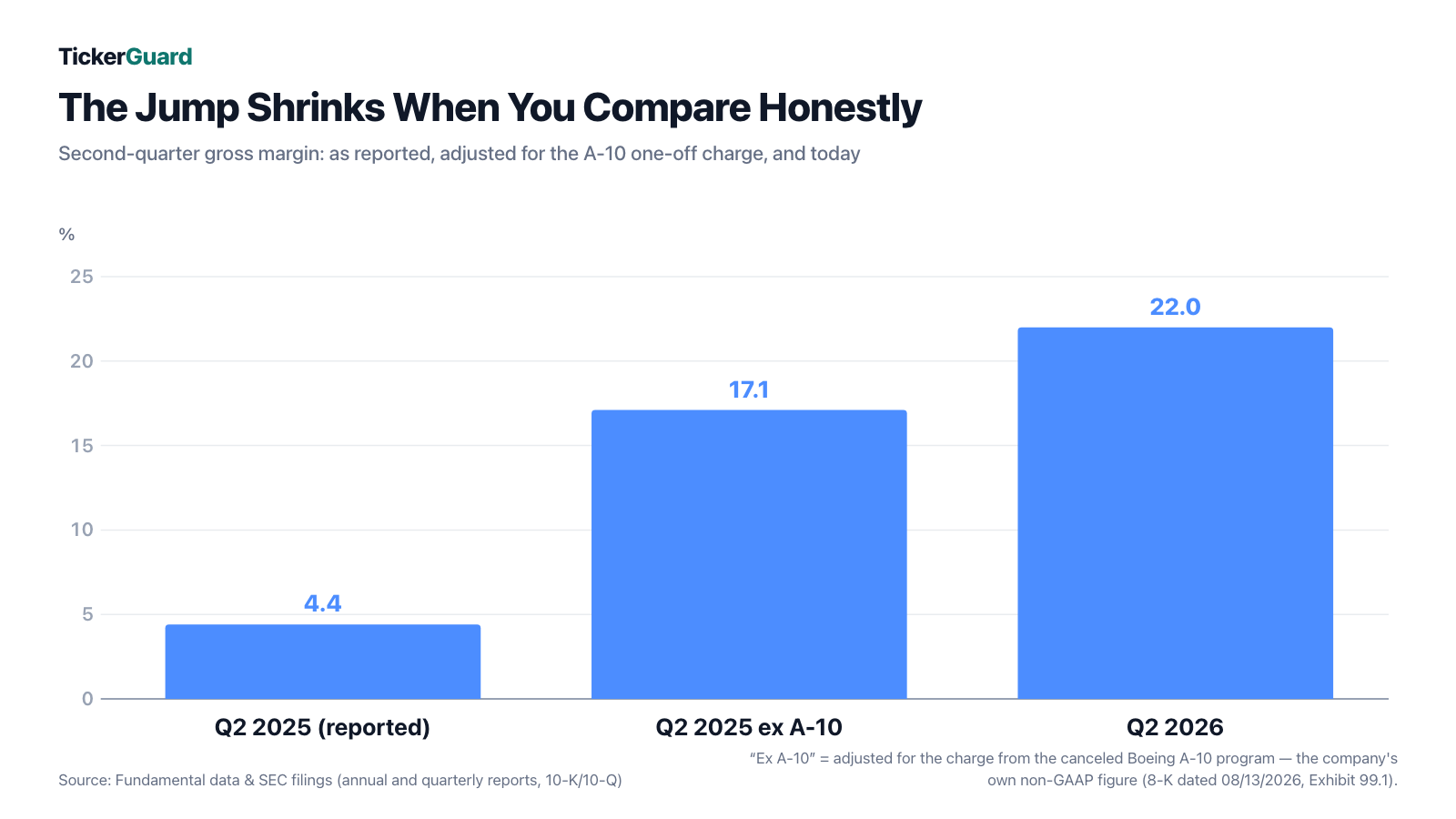
Now comes the part that almost always gets skipped on a quick read of the headline numbers — and it is the single most important finding of this analysis for CPI. Gross margin jumped from 4.4 percent to 22.0 percent in the second quarter of 2026 — that reads like an 18-percentage-point improvement, like a wholesale restart of the business. But the company's own report explains where the jump actually comes from:
"The increase in gross margin for the three and six months ended June 30, 2026 compared to June 30, 2025 was primarily driven by adjustments made in the prior year associated with the termination of our A-10 Main Landing Gear Pods program."
— CPI Aerostructures, Inc., SEC quarterly report 10-Q as of June 30, 2026, MD&A (sec.gov)
Translated, the prior-year quarter (Q2 2025) was distorted downward by a $2,322,831 one-time charge from the collapsed Boeing A-10 termination (first half of 2025: -$4,468,528). Strip out that one-time hit, and gross margin in the prior-year quarter was not 4.4 percent but 17.1 percent — and in the prior-year half not 7.6 percent but 19.3 percent. The genuine improvement in 2026 therefore runs about 4.9 percentage points for the quarter and 4.6 percentage points for the half — meaningful, but a fifth of what the raw GAAP number suggests.
The good news in all this: the current quarter itself is not dressed up. Quite the opposite — Q2 2026 carries a negative adjustment of $676,503 from two other programs:
"The net adjustment of $0.7 million and $1.4 million for the three and six months ended June 30, 2026 respectively, is driven primarily by unfavorable adjustments on our Embraer Phenom-300 Engine Inlet Assemblies program and Sikorsky UH60 Gunner Windows."
— CPI Aerostructures, Inc., SEC quarterly report 10-Q as of June 30, 2026, Note 2 (sec.gov)
So hold two things in mind at once: the turnaround is real, but smaller than the headline number suggests — and it is not dressed up with hidden one-time gains; if anything, the opposite. You may recognize similar comparison-base distortions from our AAR analysis — there too, the second look at what "adjusted" actually means pays off.
What Management Promised — And What Showed Up
Three earnings releases trace the path here. On March 31, 2026, CPI published its results for fiscal 2025 — a year that officially ended in a loss and stayed weak even adjusted for the A-10 effect: adjusted EBITDA for 2025 was $5.5 million, down from $7.8 million in 2024 — a 29 percent decline even excluding the A-10 charge. On May 18, 2026 came the release for the first quarter of 2026: "Revenue of $17.4 million," "Gross profit margin of 25.8%," "Net income of $1.2 million" — the first clearly profitable quarterly report after the weak 2025. On August 13, 2026, alongside the quarterly report as of June 30, 2026, CEO Dorith Hakim delivered the high point of the story so far:
"Our six months performance showcases the results of a focused growth strategy and disciplined execution, delivering year-over-year gains across every major metric."
"Demand across our core defense platforms remains strong, and the combination of a more favorable product mix and operational efficiencies drove a $6.0 million increase in gross profit and a $4.6 million increase in net income. Adjusted EBITDA of $3.5 million represents a clear inflection point for the business, even when normalizing for the A-10 program impact."
— Dorith Hakim, Chief Executive Officer, CPI Aerostructures, Inc., earnings release furnished with the 8-K dated August 13, 2026 (sec.gov)
That's a bold claim — "a clear inflection point, even normalized for A-10." The box above shows what "normalized" actually means here: yes, there is an improvement without the A-10 effect — but it runs about 5 margin points and a 76.5 percent gain in adjusted EBITDA ($589,370 to $1,368,401 for the quarter), not the 18 points the headline margin suggests. The CEO's statement isn't false — but it describes a real, and much smaller, improvement than the first glance at the number implies. And what is missing from that same release: not a word on the cash position, not a word on operating cash flow. Now for the uncomfortable truths.
What The Filings Say — The Uncomfortable Truths
Uncomfortable Truth No. 1: Cash Is Nearly Empty — And The Credit Line Is 92 Percent Drawn
As of June 30, 2026, CPI Aerostructures had just $835,875 in the bank — roughly 4.4 days of revenue. The quarterly report itself states the decline plainly:
"At June 30, 2026, we had cash of $835,875 compared to $899,199 at December 31, 2025, a decrease of $63,324 or 7.0%."
— CPI Aerostructures, Inc., SEC quarterly report 10-Q as of June 30, 2026, MD&A (sec.gov)
The second line of defense, a $10.0 million revolving credit line with Western Alliance Bank, is already drawn to $9,173,672 (92 percent) — leaving about $826,000 available to draw. Combined with cash on hand, that's roughly $1.66 million in immediately available liquidity. And the cushion could shrink further: a stock-sale program of up to $17 million — 22.7 percent of today's roughly $75.0 million market cap — has sat loaded since April 2026 but was completely unused through the end of June 2026: the cash flow statement shows only $123,221 in paid issuance costs for the first half, and not a single dollar of proceeds. Dilution means your slice of the pie gets smaller every time new slices get cut — here, the cutting plan is already drawn up; only the knife hasn't moved yet.
Uncomfortable Truth No. 2: Profit Yes, Cash No — Operating Cash Flow Stays Negative
Net income of $1.92 million in the first half of 2026 sounds like a company making money again. On paper, it is — but not in the bank:
"Accordingly, it is possible that we may have a shortfall in our cash flow and may need to borrow money or take steps to defer cash outflows until the reported earnings materialize into actual cash receipts."
— CPI Aerostructures, Inc., SEC quarterly report 10-Q as of June 30, 2026, MD&A Liquidity (sec.gov)
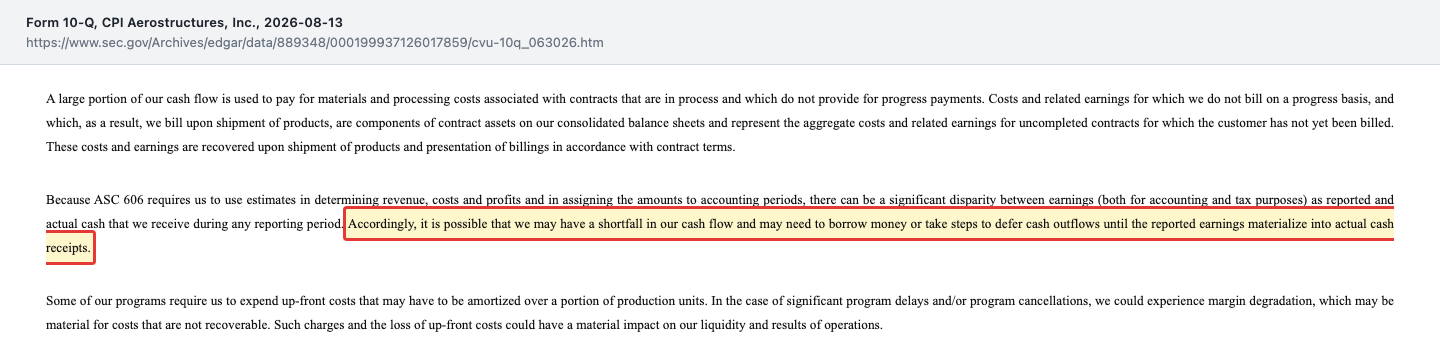
The numbers behind it: operating cash flow for the first half of 2026 was -$425,705, despite the $1.92 million profit. For fiscal 2025 it was even starker: -$5,200,025 in operating cash outflow on a loss of just $843,361. Combined, that's roughly $5.6 million of cash burned from operations over 18 months, even though the same period showed roughly $1.1 million of reported net profit. The reason: receivables and not-yet-billable-but-already-booked revenue are growing faster than cash is coming in — the flip side of the "over time" accounting described in the business model chapter. Picture it like a contractor who writes invoices before the customer has paid: the books can look good while there's still no money in the account to pay the supplier at month's end.
Uncomfortable Truth No. 3: One Customer Is More Than Half Of Quarterly Revenue — And The Biggest Dispute Is Still Open
In the second quarter of 2026, more than half of revenue came from a single counterparty:
"During the three months ended June 30, 2026, our two largest customers accounted for 53% and 10% of revenue."
— CPI Aerostructures, Inc., SEC quarterly report 10-Q as of June 30, 2026, Note 8 "Major Customers and Vendors" (sec.gov)
How fast a relationship like that can turn is shown by the same report, elsewhere — the open dispute with Boeing over the terminated A-10 program:
"Subsequently, on July 14, 2025, the Company received a Termination Notice from The Boeing Company with respect to the Boeing A-10 program directing the Company to scrap and return materials and tooling to the Air Force prior to August 15, 2025 when funding would no longer be available, as well as a claim for damages incurred by Boeing as a result of the alleged contract default. The Company disputes Boeing's claim and maintains its position for an Equitable Pricing Adjustment related to the Boeing A-10 program."
— CPI Aerostructures, Inc., SEC quarterly report 10-Q as of June 30, 2026, Note 11 "Commitments and Contingencies" (sec.gov)
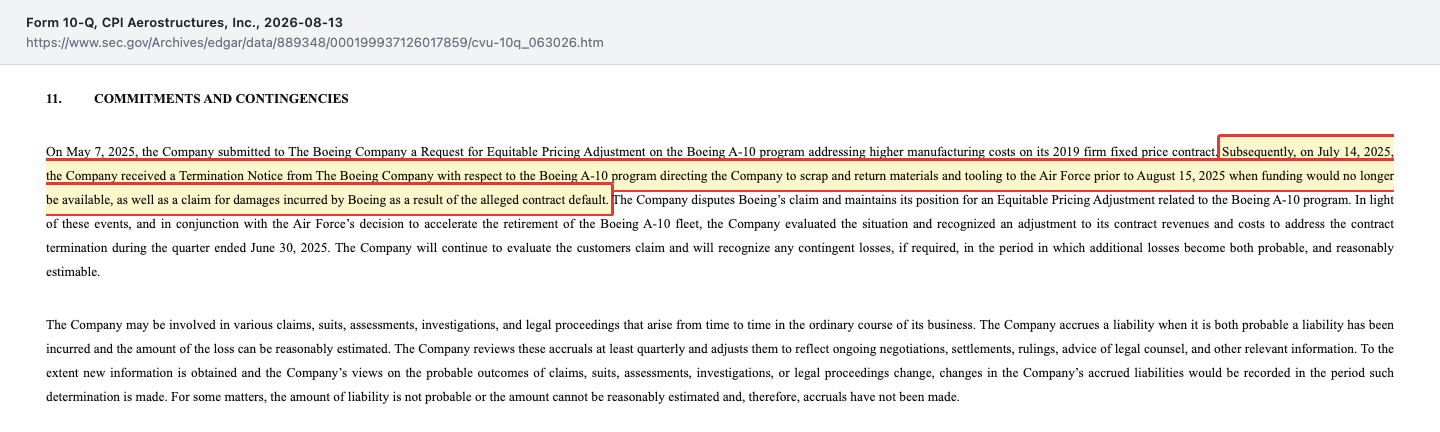
Boeing's damages claim carries no reserve to this day — the company records "contingent losses" only once they are "probable and reasonably estimable." Translated, customer concentration means: if your neighbor tells you his business is doing great, but half his revenue hangs on one single client he's currently in a legal fight with — would you pause before believing him?
Uncomfortable Truth No. 4: A $533 Million Backlog, But Only 18.8 Percent Funded — And A-10 Is The Precedent
CPI's backlog sounds impressive: $533.1 million as of June 30, 2026, up from $504.5 million at year-end 2025 — supported by $62 million in new contract awards in 2026 alone. But the report itself warns how little that number can be relied on:
"Substantially all of our backlog is subject to termination at will and rescheduling, without significant penalty. Funds are often appropriated for programs or contracts on a yearly or quarterly basis, even though the contract may call for performance that is expected to take a number of years. Therefore, our funded backlog does not include the full value of our contracts."
— CPI Aerostructures, Inc., SEC quarterly report 10-Q as of June 30, 2026, MD&A "Backlog" (sec.gov)
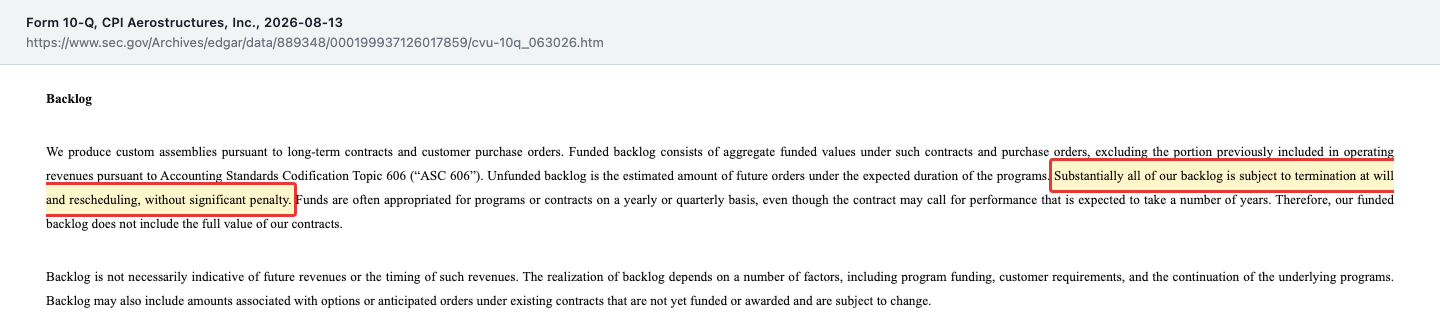
Of the $533.1 million, only $100.0 million (18.8 percent) is "funded" — the rest is a statement of intent, not secured business. Exactly this kind of "unfunded," terminable contract was the A-10 program that Boeing ended overnight in July 2025. Backlog at CPI is therefore not a promise about the future but a snapshot — with a built-in example of how fast it can change.
Uncomfortable Truth No. 5: The Past Isn't As Distant As The Rally Suggests
Anyone looking at CPI for the first time today sees a turnaround story. Anyone who flips through the annual report sees a company with a history. Between 2019 and 2021, CPI had to restate its financial statements multiple times:
"We have restated our consolidated financial statements during the past three years, including the restatement included in our 2020 Comprehensive Form 10-K/A. These restatements have affected and may continue to affect investor confidence, our stock price, our ability to raise capital in the future, and our reputation with our customers, have resulted and may continue to result in stockholder litigation and may reduce customer confidence in our ability to complete new contract opportunities."
— CPI Aerostructures, Inc., SEC annual report 10-K for 2021, Item 1A Risk Factors (sec.gov)
The stock traded for a stretch on the small-cap OTC Pink market — the 2022 annual report cites a closing price of $1.69 from that period — before its regular listing was restored on March 17, 2023. And the story isn't only from the early 2020s: in the second quarter of 2025, CPI breached its credit covenants — financial ratios contractually promised to the bank — because of the financial force of the A-10 termination, needed a waiver from the bank, and had to disclose a new material weakness (a significant gap in internal controls):
"Due to the financial impact of the Boeing A-10 program, the Company was not able to meet the financial covenants for the second quarter and therefore obtained a waiver to remediate the non-compliance. Because the waiver did not extend for twelve months from the date of the Company's financial statements, there was a potential misclassification of short-term and long-term debt."
— CPI Aerostructures, Inc., SEC annual report 10-K for 2025, Item 9A (sec.gov)
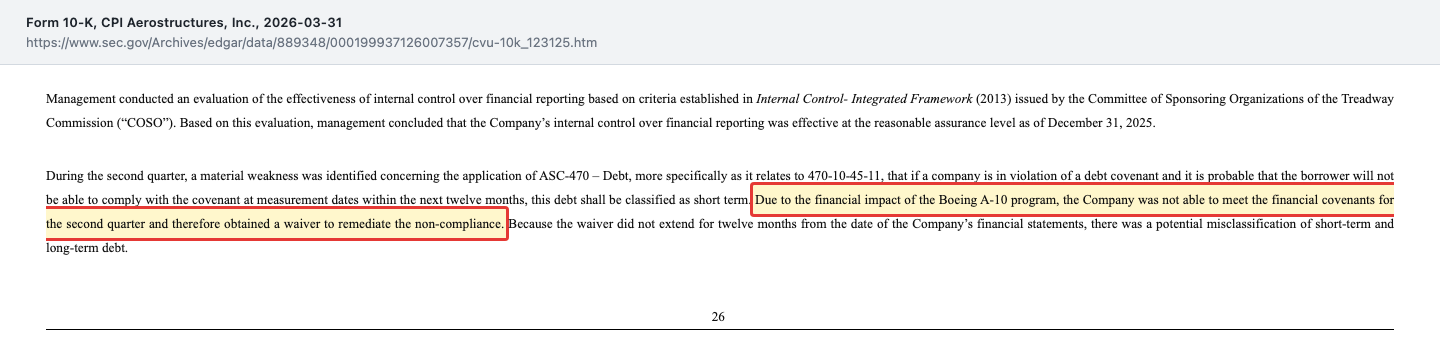
As of December 31, 2025, the company declares this weakness remediated. Balance-sheet trouble is not a footnote from the distant past at CPI, then — it's a pattern that most recently repeated just over a year ago.
Valuation: Cheap At First Glance — More Expensive On The Second
As of August 13, 2026, CPI Aerostructures' market capitalization stood at roughly $75.0 million, at a price of $5.66 — practically at the top of its 52-week range of $2.02 to $5.734. The price-to-sales ratio is 1.05, unremarkable for a defense supplier. The price-to-earnings ratio is where this analysis's core question opens up: the forward P/E of 6.8 — calculated on expected future earnings — looks like an overlooked bargain. The trailing P/E of 47.2 — calculated on the actual earnings reported over the past twelve months — tells a different story: expensive, because the comparison base (the weak 2025 year) still keeps reported earnings small. The enterprise-value-to-EBITDA ratio sits at 31.2, price-to-book at 2.55. And book value is exactly where the second look pays off: of shareholders' equity, $19,472,988 is a deferred tax asset — a bookkeeping entry, not cash in the bank. Strip it out, and tangible equity is only about $6.85 million — against a $75.0 million market cap. The analysts covering the stock are more cautious than the price, too: the average price target sits at $4.00 (as of August 13, 2026) — about 29 percent below the current price, not above it. Remember this picture: a low forward P/E is not proof of a bargain when the denominator (expected earnings) is itself flattered by a weak comparison base.
Opportunities And Risks At A Glance
What speaks for CPI Aerostructures:
- A genuine operating recovery: H1 2026 revenue of $34.9 million (+14.3 percent versus H1 2025), gross margin genuinely about 5 percentage points better (not just 18 on paper), adjusted EBITDA in the second quarter of 2026 up 132 percent versus the adjusted prior-year figure.
- A broad customer base among the major defense primes: Lockheed Martin/Sikorsky (F-16, UH-60, CH-53K), RTX/Collins (ALQ-249 jammer pods, over $254.4 million program value through 2030), Northrop Grumman (E-2D, over $210 million cumulative orders).
- A growing backlog: $533.1 million as of June 30, 2026, supported by $62 million in new contract awards in 2026 alone.
- The current quarter carries no disguising one-time gains — Q2 2026 even absorbs a negative adjustment of $676,503, not a flattered result.
- Credit line and term loan contractually secured through 2030 (Western Alliance Bank, signed December 12, 2025), no near-term maturity.
What speaks against it:
- Cash of only $835,875 plus about $826,000 of undrawn credit line — a combined $1.66 million — against continuing operating cash outflow (H1 2026: -$425,705; FY2025: -$5.2 million).
- A $17 million stock-sale program (22.7 percent of market cap) loaded and ready to draw at any time, even though unused so far.
- Customer concentration: 53 percent of quarterly revenue from a single customer; Boeing's A-10 damages claim remains open, with no reserve booked.
- Backlog 81.2 percent unfunded and, by the company's own account, terminable at will — the A-10 precedent shows what that means in practice.
- A balance-sheet history with three restatements from 2019 to 2021, an OTC Pink stint, and a renewed covenant breach with a material weakness in the second quarter of 2025.
- A trailing P/E of 47.2 and tangible equity of only about $6.85 million temper the seemingly cheap forward P/E of 6.8; the analyst price target of $4.00 sits about 29 percent below the current price.
A Human Conclusion
Back to the comeback reflex from the opening. It isn't baseless: CPI Aerostructures genuinely made a leap in 2026, revenue is growing again, the margin is really better, and the current quarter is clean, with no hidden cosmetics. But the reflex wants to sell you a simple story — "turnaround complete, cheaply valued, buy now" — and the numbers tell a more complicated one: a real but much smaller step forward than the 18-point headline suggests, a cash balance that barely covers a week, a credit line 92 percent drawn, a stock-sale program that can dilute your stake at any moment, an open lawsuit with no reserve behind it, and a history that isn't even ten years old yet. So the honest question for you isn't "Is the turnaround here?" — it partly is — but rather: is it enough for you to hold a company that is genuinely making operating progress but is running on financial fumes, with cash nearly empty and a dilution tool loaded in the drawer? What you make of that is your decision. And that is exactly as it should be.
Sources
All original documents used in this analysis — for you to read yourself:
- CPI Aerostructures, Inc. — SEC quarterly report 10-Q as of June 30, 2026 (filed August 13, 2026)
- CPI Aerostructures, Inc. — Earnings release furnished with the 8-K dated August 13, 2026 (second quarter 2026)
- CPI Aerostructures, Inc. — SEC annual report 10-K for 2025 (filed March 31, 2026)
- CPI Aerostructures, Inc. — SEC quarterly report 10-Q as of March 31, 2026 (filed May 15, 2026) and earnings release dated May 18, 2026
- CPI Aerostructures, Inc. — Prospectus supplement 424B5 for the ATM stock-sale program (April 14, 2026)
- CPI Aerostructures, Inc. — SEC annual report 10-K for 2021 (restatement history)
- CPI Aerostructures, Inc. — SEC proxy statement DEF 14A 2026 (filed July 31, 2026)
- Complete SEC filing history for CPI Aerostructures, Inc.: EDGAR overview (sec.gov)
- Fundamental data (metrics, valuation, scanner readings; data as of August 13, 2026), reconciled against the SEC filings.
Transparency & Disclaimer: This analysis is a journalistic contextualization of publicly available information and is not investment advice, not a financial analysis in the regulatory sense, and not a solicitation to buy or sell securities. Stock investments carry substantial risk, including total loss. All figures are provided without guarantee; data cut-off dates are noted in the text. Positions held by the operator are disclosed daily; where one exists, it appears as a notice at the top of this deep dive.
Key figures at a glance
All monetary figures in millions of $; earnings per share as reported.
| Metric | 2021 | 2022 | 2023 | 2024 | 2025 |
|---|---|---|---|---|---|
| Revenue | 103.4 | 83.3 | 86.5 | 81.1 | 69.3 |
| Operating Income (EBIT) | 3.2 | 4.9 | 6.3 | 6.7 | -0.2 |
| Net Income | 6.8 | 9.2 | 17.2 | 3.3 | -0.8 |
| Net Margin | 6.6% | 11.0% | 19.9% | 4.1% | -1.2% |
| Earnings Per Share | 0.56 $ | 0.74 $ | 1.38 $ | 0.26 $ | -0.07 $ |
Source: fundamental data & SEC filings (annual and quarterly reports, 10-K/10-Q)
Our Bottom Line at a Glance
- Operating recovery positive
- Revenue grew to $34.9 million in the first half of 2026 (+14.3 percent vs. H1 2025), gross margin genuinely improved by about 5 percentage points (Q2 2026: 22.0 percent vs. an adjusted 17.1 percent in the prior-year quarter), and adjusted EBITDA in the second quarter of 2026 rose 132 percent versus the adjusted prior-year figure. A real, if smaller, step forward than the headline jump from 4.4 to 22.0 percent suggests.
- Liquidity negative
- Cash of just $835,875 as of June 30, 2026, with the revolving credit line 92 percent drawn (about $826,000 available) — a combined $1.66 million immediately available. A $17 million stock-sale program (22.7 percent of market capitalization) is loaded as a further capital source, but was unused as of June 30, 2026.
- Cash flow quality negative
- Despite net income of $1.92 million in the first half of 2026, operating cash flow stayed negative at -$0.43 million; in fiscal 2025 it was -$5.2 million on a loss of just -$0.84 million. Over 18 months, about $5.6 million of operating cash burn against roughly $1.1 million of reported profit — profit is not arriving as cash.
- Customer concentration & legal risk negative
- A single customer accounted for 53 percent of revenue in the second quarter of 2026. Boeing's damages claim from the A-10 program termination (July 2025) remains open and carries no reserve; the company disputes the claim and the outcome is uncertain.
- Backlog resilience negative
- The $533.1 million backlog (June 30, 2026) is only 18.8 percent funded and, by the company's own account, "subject to termination at will" — the A-10 case shows concretely how fast such a contract can disappear, damages claim included.
- Balance-sheet and governance history neutral
- Three restatements from 2019 to 2021, an OTC Pink stint until March 2023, and a renewed covenant breach with a material weakness in the second quarter of 2025 (declared remediated as of December 31, 2025). No open SEC enforcement action, but a history that isn't even ten years old and most recently repeated just over a year ago.
CPI Aerostructures shows a genuine, but much smaller, operating recovery in 2026 than the headline gross margin (4.4 to 22.0 percent) suggests — adjusted for the Boeing A-10 base effect, roughly 5 percentage points of real improvement remain. But the reported profit isn't arriving as cash: operating cash flow has been negative throughout the past 18 months, cash sits at $835,875, the credit line is 92 percent drawn, and a $17 million stock-sale program (22.7 percent of market capitalization) stands ready as a dilution tool. Add an open Boeing damages claim with no reserve and a backlog that is over 80 percent unfunded. Not investment advice.
What Our Rating Means
Substance risk
We found at least one documented issue that threatens the company itself — regardless of how the stock is currently valued.
The quality light is red because several documented substance risks compound each other: operating cash flow has been negative throughout the past 18 months (FY2025: -$5.2 million, H1 2026: -$0.43 million) despite reported profits — exactly the pattern the traffic-light rules classify as persistently negative operating cash flow despite reported profit. Cash and available credit combined sit at only about $1.66 million against continuing outflow — a cash runway far short of the roughly four quarters the rules cite as a threshold. On top of that, Boeing's damages claim remains open with no reserve, tied to an existentially significant customer relationship (one customer, 53 percent of quarterly revenue). This is a judgment on the company's balance-sheet substance, not on the stock price or the timing of an entry — that call belongs to the scanners, not this light. The decision is yours.
A journalistic assessment by our editorial team at the time of the deep dive, based on public sources — not investment advice and not a solicitation to buy or sell. Your personal circumstances (investment goals, risk capacity, taxes) cannot be taken into account. What our levels mean, how verdicts are formed, and what conflicts of interest exist →
Worth Noting
- CVU landed on our research list through a contradiction in our in-house stock scanner: an Altman Z-Score of 1.23 (distress territory below 1.81) and a Piotroski F-Score of 1 of 9 (the worst possible category) on a stock trading practically at its 52-week high and up 50.9 percent over three months (data as of August 13, 2026).
- Valuation figures are dated and evergreen: a market capitalization of roughly $75.0 million at a $5.66 price (52-week range $2.02 to $5.734), analyst price target $4.00 — each as of August 13, 2026, not a buy argument for the future.
- The base effect (the A-10 termination in the prior-year quarter) is the central caveat on the margin jump; the current quarter (Q2 2026) itself contains no profit-flattering one-time items, but rather a negative adjustment of $676,503.
Stock Watch
This analysis is as of August 26, 2026. Stock Watch will tell you what's changed at CVU since then.
Later $1 a month per stock — signing up is free, and you'll be the first to know when it launches.
The full analysis as a PDF for later
We will send you this analysis as a PDF — to print, file away, and read at your own pace. And we will add you to the free Stock Watch list for CPI Aerostructures Inc (CVU), so you hear about it when something material in this analysis changes.
Frequently Asked Questions
CPI Aerostructures, Inc. (NYSE American: CVU) of Edgewood, Long Island, is a Tier-1 aerospace subcontractor: it builds structural aircraft assemblies — outer-wing kits, fuselage sections, welded titanium tubing — plus complete sensor and jammer pods for Lockheed Martin/Sikorsky, RTX/Collins Aerospace, Northrop Grumman and L3Harris. Roughly 80 percent of revenue runs through subcontracts to these defense primes (fiscal 2025 figures).
Gross margin jumped from 4.4 percent to 22.0 percent in the second quarter of 2026 — that reads like an 18-percentage-point improvement. In reality, the prior-year quarter was distorted downward by a one-time charge from the Boeing A-10 termination; adjusted, it stood at 17.1 percent. The genuine 2026 improvement is therefore about 5 percentage points, not 18 (quarterly report 10-Q as of June 30, 2026).
Less secure than the total suggests: of the $533.1 million (June 30, 2026), only $100.0 million (18.8 percent) is actually funded. The rest, per the annual report, is terminable at will without significant penalty — exactly what happened to CPI in July 2025, when Boeing ended the A-10 program with immediate effect.
Tight: as of June 30, 2026, CPI had only $835,875 in cash, and its $10 million revolving credit line was 92 percent drawn (about $826,000 available). Despite net income in the first half of 2026, operating cash flow stayed negative at -$425,705; a $17 million stock-sale program stands ready as a further, but dilutive, source of capital.
In July 2025, Boeing terminated the 2019 fixed-price contract for the A-10 landing gear pods program and demanded that CPI scrap and return materials and tooling by August 15, 2025 — Boeing also filed a claim for damages over the alleged contract default. CPI disputes the claim; no reserve has been booked for it to date (quarterly report 10-Q as of June 30, 2026, Note 11).
It depends on the metric: the forward P/E of 6.8 (as of August 13, 2026) looks cheap, but the trailing P/E of 47.2 shows how small recently reported profit actually is. Strip the deferred tax asset out of equity, and only about $6.85 million of tangible substance remains against a $75.0 million market cap; the analyst price target sits at $4.00, about 29 percent below the current price.
Yes: between 2019 and 2021, CPI had to restate its financial statements multiple times, the stock traded for a time on the small-cap OTC Pink market, and its regular NYSE American listing wasn't restored until March 17, 2023. In the second quarter of 2025, CPI again breached its credit covenants because of the A-10 charge and had to disclose a new material weakness, declared remediated as of December 31, 2025.
Found an error?
Did you spot a factual error, an outdated number, or a typo in this deep dive? Let us know briefly — your report goes straight to the editorial team.