Southern Copper posts record after record — and mines less copper today than in 2019
Sales up 40.6%, profit up 71.6%: the second quarter of 2026 reads like a triumph. Mined copper output fell 3.5% over the same period. We went looking for who actually paid for that record.
 Thomas Mücke
Founder & Publisher
Thomas Mücke
Founder & Publisher
As of Today
As of: October 15, 2026
- Closing price
- 201.80 $ +0.50%
- Market Capitalisation
- 179.1 $B
- P/E
- 33.1
- Growth Score
- 8/10
- AAQS
- 10/10
Price change since August 31, 2026: -3.4%
This analysis has a cut-off date. The Stock Guard tells you when something material changes in the numbers. Reserve your free spot
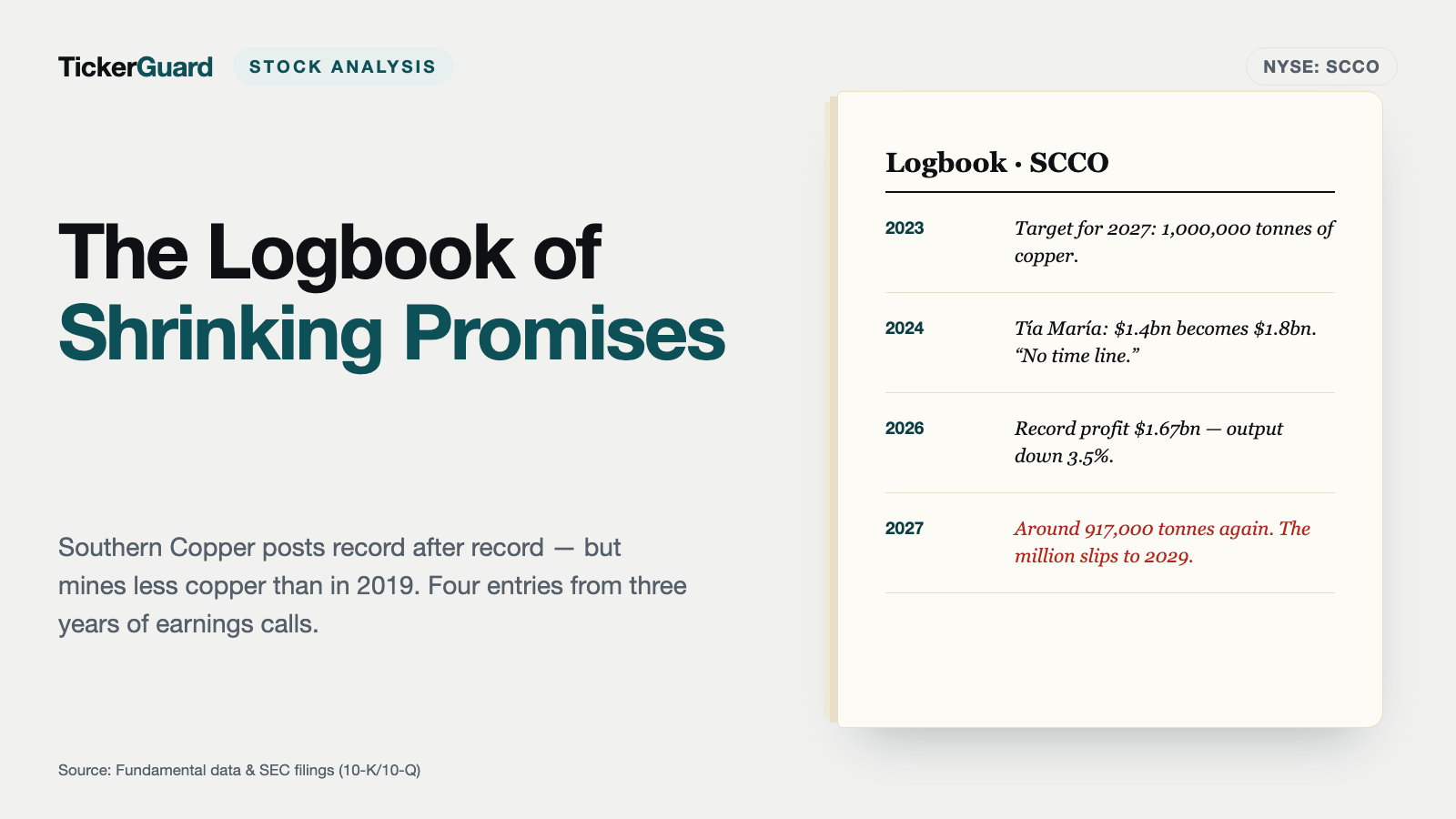
Chart
Interactive price chart (TradingView).
52-week range: 117.90 $ to 219.70 $ · Last price: 201.80 $ (As of: October 15, 2026)
Note: pure fact-based analysis, not investment advice and not a solicitation to buy or sell. All figures without guarantee.
There is a word that opens a door in your head instantly: record. When a company announces it has sold more and earned more than ever before in its history, the brain stops checking. It already has an answer. That is exactly what makes the word dangerous — it sounds like achievement when it is often just a measurement.
Southern Copper reported two such records for the second quarter of 2026. And the stock had more than doubled over the preceding twelve months. Anyone buying in at that point is, as a rule, buying the word rather than the number.
So we asked the question the word conceals: who actually produced this record? The answer is in the filing — just not in the headline. It sits three lines below, and it reads: not the mines.

What Southern Copper does and what its profit depends on
Southern Copper Corporation is a US company incorporated in Delaware in 1952, mining copper since 1960 and listed in New York and Lima since 1996. Until 2005 it was called Southern Peru Copper Corporation; acquiring Mexican sister company Minera Mexico from its parent turned it into today's two-country group.
The business has three parts. Peru holds the two open pits Toquepala and Cuajone. Mexico holds the large open pits Buenavista and La Caridad. On top of that sits IMMSA, a set of smaller Mexican underground mines. In the first half of 2026 the Mexican operations together contributed roughly 63% of revenue, Peru roughly 37%.
One thing above all gets sold: copper. In the second quarter of 2026, according to the quarterly report, 72.7% of revenue came from copper, 11.1% from molybdenum, 8.8% from silver, 3.5% from zinc and 3.9% from other products. That split is the key to everything that follows — because the four metals do not move in step.
A mining group, unlike a software house, has no pricing power. It sells a fungible good at a price set by an exchange in London or New York. The company writes as much, unmistakably, in the risk factors of its annual report:
“Our financial performance is highly dependent on the price of copper and the other metals we produce.”
— Southern Copper Corporation, SEC annual report on Form 10-K for 2025, Risk Factors
A sentence like that appears in many filings and is usually skimmed past. At Southern Copper in the summer of 2026 it is the single most important line in the whole document.
Company history for investors
-
1996
Listing in New York and Lima
Listed on both exchanges since 1996 — back then still as Southern Peru Copper Corporation, that is, a pure Peru play.
-
2005
Acquisition of Minera Mexico
Buying the Mexican sister company from its own parent turned the Peru producer into today's two-country group — and cemented the role of Grupo Mexico.
-
2007
Start of the permanent IMMSA strikes
The Taxco mine has stood idle ever since. San Martin stood idle for eleven years and cost roughly $90.5 million to restore — labour disputes are a structural cost factor here.
-
2014
Copper sulfate in the Sonora river
Solution escaped from the Buenavista mine into the river. Criminal and civil proceedings continue to this day; a further criminal complaint by the environmental authority followed in 2023.
-
2024
Switch to stock dividends
Since the second quarter of 2024 a growing share of the distribution has consisted of treasury stock rather than cash — and that holding is finite.
-
2026
$1.25 billion bond for Tia Maria
Issued in June 2026 at 5.350%, due 2036, proceeds earmarked for Peru. Funding for the growth project is therefore secured — the timetable remains the open question.
How the stock landed on our desk
The trigger was the fresh quarterly report: on July 31, 2026 Southern Copper filed its report for the period ended June 30, 2026 with the US securities regulator. Nine days earlier, on July 22, 2026, the earnings release had already been filed as a current report — with the press release dated July 21 as an exhibit.
Both documents say the same thing: new highs. And both contain, a few lines later, the explanation for them. That explanation is why we looked at the company more closely in the first place.
There is plenty of comparison material: we have already examined the largest listed US competitor — see our analysis of Freeport-McMoRan. And for a mining group where the metal price likewise outshines everything else, see our analysis of Barrick Mining.
The numbers over the years — fairly acknowledged
Let us start with what is unambiguously good. Southern Copper makes a great deal of money, and has done so for years. Net sales rose from $7,285.6 million in 2019 to $13,420.0 million in 2025. Net income attributable to shareholders climbed over the same period from $1,485.8 million to $4,334.9 million. That is a net margin of 32.3% for 2025 — a figure most industrial companies can only dream about.
The first half of 2026 then delivered $8,540.4 million in sales and $3,246.8 million in net income. Operating income came in at $5,103.6 million, operating cash flow at $3,683.0 million — more than double the prior-year half.
The balance sheet is in remarkably good shape too. As of June 30, 2026, long-term debt of $7,994.4 million was set against $5,665.0 million in cash and a further $1,664.9 million in short-term investments. That leaves $664.5 million in net debt — against equity of $12,632.2 million. At the end of 2023 net debt still stood at $4,503.8 million. The company has cut its leverage by more than four fifths in two and a half years without scaling back investment.
For anyone wondering whether this group could run into financial trouble: on the current balance sheet, no. That belongs up front, before things get uncomfortable.
And now the other side of the same coin.
The record came from the price, not from the mine
Net sales in the second quarter of 2026 came to $4,289.0 million, 40.6% above the prior-year quarter. Net income reached $1,670.0 million, up 71.6%. The company expressly calls both a new high in its press release.
Immediately afterwards, the same release states where the increase came from:
“Growth was primarily fueled by an increase in metal price variances for copper (LME, +39.8%; COMEX, 30.5%), molybdenum (+43.1%), zinc (30.8%) and silver (+118.6%). These positive variances were partially offset by a decrease in sales volumes for copper (-1.5%) and our main by-products.”
— Southern Copper Corporation, Exhibit 99.1 to the earnings release (Form 8-K), filed July 22, 2026

Mined copper output fell 3.5% in the second quarter of 2026 to 230,662 tonnes; across the half-year it came to 461,206 tonnes, 3.8% less than a year earlier. Molybdenum was down 11.0% in the quarter, zinc 14.5%, silver 3.8%. All four metals, in other words, lower.
The company's explanation is unspectacular and therefore credible: the Peruvian mines produced 12.0% less because the ore got poorer. The technical term is ore grade — how much copper sits in a tonne of mined rock. When it falls, you have to move more rock for the same metal. You work harder for less.
This is not an accident but the basic law of mining: every mine gets poorer over the years. A mining group therefore has to open up new deposits permanently just to stand still. Southern Copper is doing that too — only more slowly than announced three years ago. More on that shortly.
Cash costs below zero — what is really behind them
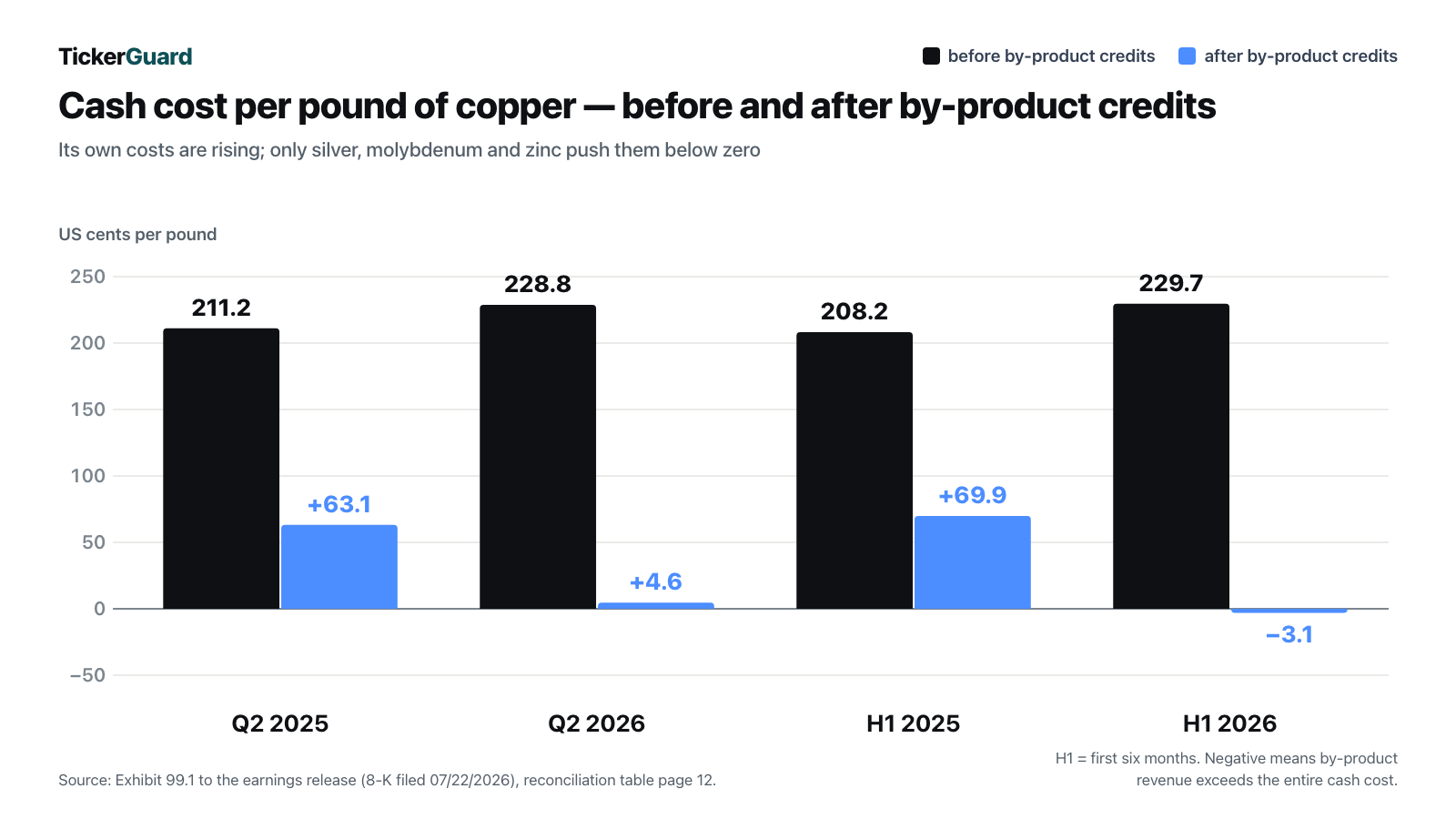
The most striking number in the half-year report is a cost figure with a minus sign in front of it. In the first half of 2026, cash cost per pound of copper net of by-product credits was minus $0.03. A year earlier it was plus $0.70.
“In 6M26, the operating cash cost per pound of copper, net of by-product revenue credits, was -$0.03. This represents a decrease of 104.4% compared to the $0.70 reported in 6M25.”
— Southern Copper Corporation, Exhibit 99.1 to the earnings release (Form 8-K), filed July 22, 2026

What does that mean? A copper mine never produces only copper. The same rock holds silver, molybdenum and zinc. These by-products are sold alongside, and in this industry metric their revenue is deducted from the copper cost. If the figure turns negative, it means the by-products pay for the entire copper operation — with something left over.
That sounds like outstanding cost control. It is not. The reconciliation table on the last page of the earnings release shows both figures side by side, and the second one never makes a headline: before by-product credits, cash cost rose from 208.2 to 229.7 US cents per pound — up 10.3%. The company's own cost base is getting more expensive, not cheaper.
What pushed it below zero was solely by-product revenue, which jumped from 138.4 to 232.7 US cents per pound. The biggest driver was the silver price, which more than doubled in the half-year comparison.
Put differently: anyone praising Southern Copper's cost discipline is in truth praising the silver market. If silver retreats, the metric jumps back into positive territory without a single thing having changed at any mine.
What dresses up the record profit
Before judging a profit figure, it helps to know what one-off items sit inside it. We searched the income statement, the notes and the earnings release systematically. The result first: there is no large one-off gain and no tax special effect. In that respect the record is honest. Three smaller items dress it up nonetheless, and one of them is bigger than it looks.
First, provisionally priced sales. Copper is often shipped before the final price is fixed — settlement follows later at the exchange price then in force. Until then the sale sits on the books at a provisional price and is remeasured at each reporting date. As of June 30, 2026, 188.7 million pounds of copper, 14.1 million pounds of molybdenum and 49.9 million pounds of zinc were open in this way. The remeasurement produced positive adjustments of $13.1 million on copper, $50.1 million on molybdenum and $2.9 million on zinc — $66.1 million in total.
That is roughly two per cent of the half-year profit. Not dramatic, but it is a one-way street only for as long as prices rise. When prices fall, the same item turns negative. For the full year 2025 it stood at plus $197.8 million — another tailwind that can become a headwind at any time.
Second, a good third of the cash flow jump is a prior-year burden that did not recur. Operating cash flow rose 116.9% in the half-year to $3,683.0 million — an increase of $1,984.8 million. The company names a $718.5 million easing from working capital within that; a good 36% of the increase. What matters is how that easing arises: nothing was released in 2026 — on balance, working capital actually tied up $24.2 million. The difference sits in the prior year. In the first half of 2025, tax and profit-sharing payments plus a build-up of receivables tied up $742.7 million between them. That burden was absent this time. It is not repeatable operating strength but a comparison base that sat low.
Third, a flattered comparison base. The 2025 half-year contained a $9.9 million impairment on the Tia Maria project; 2026 instead brought income from sales of fixed assets in Mexico. Together these amount to less than one per cent of profit, but they make the prior-year comparison look somewhat better than it is.
Strip out the $66.1 million from provisional pricing alone and roughly $3.18 billion of half-year profit remains instead of $3.25 billion. So the record stands. It simply stands on metal prices — and those are not a one-off effect but something worse: a recurring effect with an unknown sign.
Three years of earnings calls — promised and delivered
The interesting part of a quarterly call is never the prepared statement. It is the question-and-answer section afterwards, when analysts push back. We read nine transcripts from the third quarter of 2023 to the second quarter of 2026 looking for a single pattern: what was promised, and what arrived?
The first thing that stands out is formal. Essentially one person ever speaks: chief financial officer Raul Jacob. The chief executive sits alongside and says next to nothing across three years — nor does the new chief executive in office since the second quarter of 2026.
The output target that shrank call by call
In the autumn of 2023 the company named one million tonnes of copper for 2027 — verbatim, “1 million tons of copper production”. By the summer of 2026 that had become roughly 917,000 tonnes. The decline did not come as one big correction but in many small steps, each of them individually unremarkable.
The first of those steps only became visible because an analyst did the arithmetic:
“I just wanted to clarify on the guidance. And you said 946,000 tons next year. In my notes, I had that last quarter that, that guidance was 1,026,000 tons, which is a 80,000-ton cut to that guidance. Am I correct?”
— Alex Hacking, Citi, on the third-quarter 2023 earnings call
The CFO's reply confirmed the calculation and supplied the explanation that has recurred in every call since:
“It's basically ore grade because the operations are at full speed, all the time, 24/7.”
— Raul Jacob, Chief Financial Officer, on the third-quarter 2023 earnings call
The statement is honest, and it is bitter: if the plants are already running flat out, there is no lever left. The rock alone decides. In October 2025 the CFO put a possible expansion of Cuajone at $600 million to $700 million for roughly 40,000 tonnes of copper a year — expressly without board approval. In January 2026 he named the reason: Cuajone had reached a new, structurally lower ore grade.
While the near-term target shrank, the distant one grew. From the third quarter of 2025 a new number appears in the calls: 1.6 million tonnes, at some point in the 2030s. And the one-million mark, promised in 2023 for 2027, is now named for 2029.
Tia Maria: from “ready to go” to a construction site with residual risk
Tia Maria in the Arequipa region is the group's most important growth project: 120,000 tonnes of copper cathode a year. Its path through the calls is a lesson in how a timetable disappears.
In the autumn of 2023 the message was that the company was ready and the engineering was in place. February 2024 brought:
“We expect to begin the construction phase of the project in the near future.”
— Raul Jacob, Chief Financial Officer, on the fourth-quarter 2023 earnings call
When an analyst asked a few months later about the concrete timetable, the answer was terse enough to stick in the memory: “No time line. No time line. We're doing progress.”
The autumn of 2024 then brought the number that named the real price of the delay:
“The ballpark number that we're seeing is about $1.8 billion, but we still are looking into this number to be sure that that's the one that we want to execute.”
— Raul Jacob, Chief Financial Officer, on the third-quarter 2024 earnings call
$1.4 billion had become $1.8 billion — 29% more, without a single additional pound of copper being planned.
In fairness, the other half belongs here too: since mid-2024 the project has delivered measurable progress. Physical completion climbed from 23% in the autumn of 2025 to 42% as of June 30, 2026. In October 2025 the Peruvian ministry granted the mining permit. And in June 2026 the company issued $1,250 million of notes at 5.350% due 2036, the proceeds of which, according to the quarterly report, are expressly earmarked for the Peruvian branch and the Tia Maria project. The financing is therefore in place.
Even so, one very specific yes-or-no question went unanswered on the latest call. A Goldman Sachs analyst wanted to know whether the order for the desalination plant — no water, no mine — had already gone out:
“We are putting purchase orders and doing the proper contacts to different suppliers of the major parts of equipment, among them, the desal plant. For now, we don't expect a delay in the project.”
— Raul Jacob, Chief Financial Officer, on the second-quarter 2026 earnings call
The question was: has the order been placed? The answer was: we are in discussions. That is not a lie, but it is not an answer either. Production start is scheduled for the second half of 2027.
Los Chancas: three years of the same promise
At the second large Peruvian project, Los Chancas, nothing has moved in three years. Illegal miners occupy the concession area. Since the third quarter of 2023 every call has said the company is working with the authorities to remove them. In the autumn of 2024 the CFO named a timeframe for the first time — removal was expected by the first quarter of 2025, expressly phrased as an expectation.
What came instead was reported by the CFO himself in the spring of 2025:
“Sadly, between March 12 and 14 of this year, a group of illegal miners attacked the project facilities and set fire to our camps in Mazopampa and Patahias, damaging both equipment and facilities.”
— Raul Jacob, Chief Financial Officer, on the first-quarter 2025 earnings call
By the summer of 2026 the position is unchanged: the illegal miners remain on site despite state enforcement efforts and are holding up progress. The planned production start now sits in 2031.
The most honest line in three years
The El Pilar project in Mexico was bought out of a bankruptcy in 2015. In the summer of 2026 the board finally approved it: $551 million, 36,000 tonnes of cathode a year, production start in the second half of 2029. On the call an analyst worked out that eleven years had passed between purchase and approval, and asked for an explanation of the delays. He closed with a sentence that sums up this company's whole story in one line:
“I just -- I wait many years, and I hope God gives me enough years to see everything get built.”
— John Tumazos, Very Independent Research, on the second-quarter 2026 earnings call
Where management stays silent
Two places stand out because there is no evasion but an explicit refusal to answer. One concerns the price gap between the London Metal Exchange and the New York commodity exchange, from which the company has benefited since 2025 — asked about it twice, the reply amounted to: we do not comment on that. The other concerns the Rio Sonora legacy: in 2023 the answer was that there were no comments; in 2025, that for the company the matter was already settled.
And a third observation worth keeping in mind when weighing market forecasts: the house view on the copper market flipped repeatedly over three years — from surplus in 2023 to deficit in 2024, back to surplus, then to deficit again in 2025. Anyone treating such forecasts as a reason to buy should know how short their half-life is.
One shareholder decides almost everything
For most stocks the ownership structure is a footnote. Here it is a chapter. The annual report lists it among the risk factors itself — under a heading that leaves nothing to interpretation:
“We are controlled by Grupo Mexico, which exercises control over our affairs and policies and whose interests may be different from yours. As of December 31, 2025, Grupo Mexico owned indirectly 88.9% of our capital stock.”
— Southern Copper Corporation, SEC annual report on Form 10-K for 2025, Risk Factors
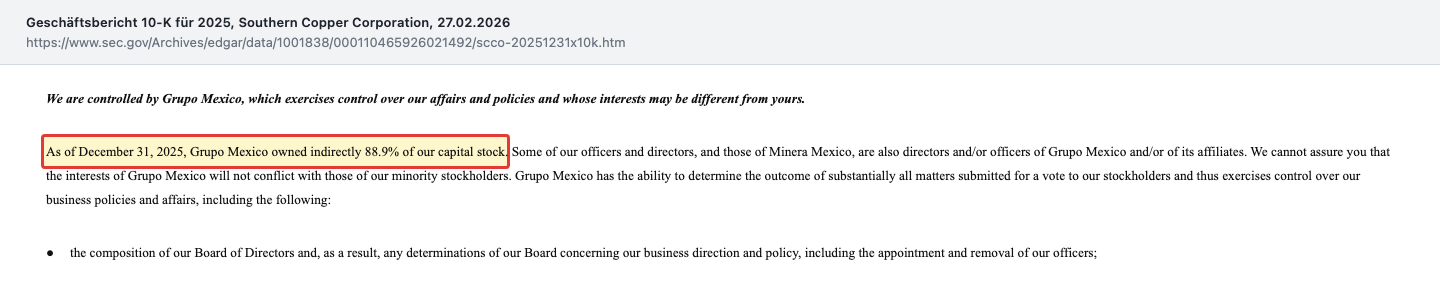
The report then lists what this single shareholder decides alone — including, explicitly, whether dividends are paid and in what amount. And it puts on record a thought one rarely reads so openly: should the financial obligations of the parent companies increase, it cannot be ruled out that they obtain loans, higher dividends or other funding from the subsidiary.
For a retail investor this simply means: at every annual meeting the outcome is known before the votes are counted. Whoever buys this stock buys a minority stake in a company whose price is made on the exchange but whose decisions are made elsewhere.
On top come ongoing transactions within the group's orbit: power supply contracts with sister companies running to 2032 and wind farm contracts over twenty years, plus office leases, air transportation and entertainment from companies owned by the majority owner's family. None of it is improper, all of it is disclosed — but every one of these arrangements is struck between parties that share the same owner on both sides of the table.
Peru and Mexico: the bills still outstanding
Three conflicts have accompanied the company for years and appear unchanged in the filings.
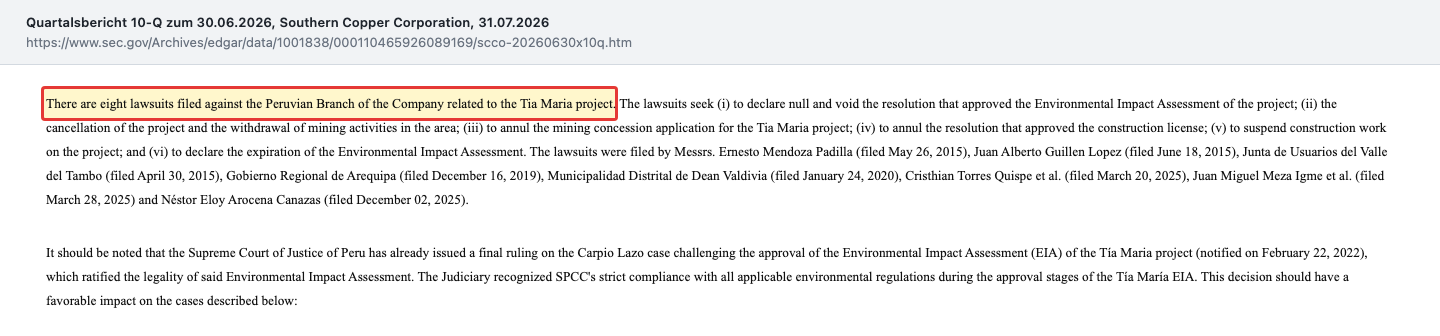
Tia Maria. The quarterly report for the period ended June 30, 2026 gives the number of pending suits against the Peruvian branch:
“There are eight lawsuits filed against the Peruvian Branch of the Company related to the Tia Maria project. The lawsuits seek (i) to declare null and void the resolution that approved the Environmental Impact Assessment of the project; (ii) the cancellation of the project and the withdrawal of mining activities in the area …”
— Southern Copper Corporation, SEC quarterly report on Form 10-Q for the period ended June 30, 2026, Note 10
Rio Sonora. In 2014 copper sulfate solution escaped from a leaching pond at the Buenavista mine into the Sonora river. Criminal and civil proceedings are ongoing; in October 2023 the Mexican environmental authority filed a further criminal complaint, arguing that remediation was incomplete and compensation insufficient. On July 24, 2026 — after quarter end — the company paid 500 million Mexican pesos, roughly $29 million, as a “Solidarity contribution” for social and development programmes in the state of Sonora.
Labour disputes. The Taxco mine in Mexico has been on strike since July 2007 and has stood idle ever since. The San Martin mine stood idle for eleven years, from July 2007 to August 2018; restoring it cost roughly $90.5 million. As of June 30, 2026, roughly 49.2% of the 5,643 employees in Peru were unionised; for Mexico the annual report gives around 71% as of December 31, 2025.
Two thirds of the dividend are shares, not cash
Southern Copper has a reputation as a reliable dividend payer. That picture deserves a closer look.
On July 16, 2026 the board declared a cash dividend of $1.10 per share plus a stock dividend of 0.0120 shares per share, payable August 27, 2026. In the press release this becomes a total value of $3.23 per share — with the share component valued at a price of $177.32.
Two thirds of that distribution, in other words, is not money but paper. And that paper comes from a holding of treasury shares the company bought back years ago. The holding is visibly shrinking: from 65,497,804 shares as of December 31, 2025 to 50,267,580 as of June 30, 2026 — 15.2 million shares in a single half-year.
There is barely any resupply. The 2025 annual report records that no buybacks have been made since the third quarter of 2016 and that the remaining authorised volume covers only around 0.6 million shares. At the pace of the first half of 2026 — 15.2 million shares in six months — the holding lasts about three more half-years, that is until roughly the start of 2028. The pace is rising, though: the rate grew from 0.0085 shares per share in February 2026 to 0.0100 in May and 0.0120 in August. If that continues, the holding runs dry sooner.
Economically a stock dividend is initially neutral for an existing shareholder: everyone receives new shares pro rata, the same cake is cut into more slices. The share count accordingly grew from 804.1 million as of June 30, 2025 to 834,331,706 as of July 30, 2026, up 3.8% in twelve months. The question is what happens once the holding is exhausted.
How serious that question is was answered by the CFO himself when an analyst asked about the purpose of the share component:
“We wouldn't be able to pay the dividends that we have been paying without using a portion of the shares. So $0.90 in cash is what the company can pay out.”
— Raul Jacob, Chief Financial Officer, on the third-quarter 2025 earnings call
That is a remarkably candid answer. It says: the optically high distribution is not earned in full, it is partly property being handed out. The annual report also warns expressly that future distributions may be lower than the levels seen in recent years. The cash distribution did in fact swing considerably: $4.00 per share in 2023, $2.10 in 2024, $3.10 in 2025.
What the stock costs
At the end of August 2026 Southern Copper was valued at roughly $176 billion — calculated from 844,343,686 shares outstanding and the closing price of $208.87 on August 31, 2026. The share count itself follows from the quarterly report: 834,331,706 shares as of July 30, 2026 plus the 1.2% stock dividend paid on August 27, 2026 to holders of record on August 11.
On trailing twelve-month earnings of $6.46 per share that works out at a price-to-earnings ratio of roughly 32. The price-to-book ratio stands at about 14.5, enterprise value at roughly 18 times earnings before interest, taxes, depreciation and amortisation (metrics as of August 30, 2026).
Those figures need context. A price-to-earnings ratio of 32 is unremarkable for a software house with recurring revenue. For a commodity producer it is high — precisely because the earnings being divided into here sit at a record level driven by metal prices. If the copper price falls, earnings fall, and the ratio rises instantly without the share price having moved at all. The annual report cites a copper price range from $1.96 per pound in 2016 to a record $5.68 in 2025. That is the frame within which everything happens.
The stock more than doubled in the twelve months to the end of August 2026: the low of the fifty-two-week range was $90.57, the high $221.67. At the reporting date it traded roughly 6% below that high.
Tradability is also notable. Of the 844 million shares, only around 93 million are freely floating according to data providers — about 11%. Such a narrow float amplifies moves in both directions: it takes little money to move the price.
The dividend yield, based on the pure cash distribution of $1.10 per quarter and the closing price of August 31, 2026, comes to roughly 2.1%. Include the share component and the figure is higher — but you should then know that this part comes from a finite holding.
Opportunities and risks at a glance
What speaks for the company:
- The company describes itself as holding the largest copper reserves in the industry. In mining, reserves are the real asset — they cannot be manufactured at short notice.
- Profitability is exceptional: a 38.0% net margin in the first half of 2026 and 32.3% for the full year 2025.
- The balance sheet is robust: $664.5 million in net debt against $12,632.2 million in equity as of June 30, 2026.
- The project pipeline is real and funded. Tia Maria was 42% complete as of June 30, 2026, El Pilar has been approved, and the investment programme for the decade exceeds $20.5 billion according to the company.
- Copper is needed for power grids, electric motors and data centres. Long-term demand is not a narrative but physics.
What speaks against it:
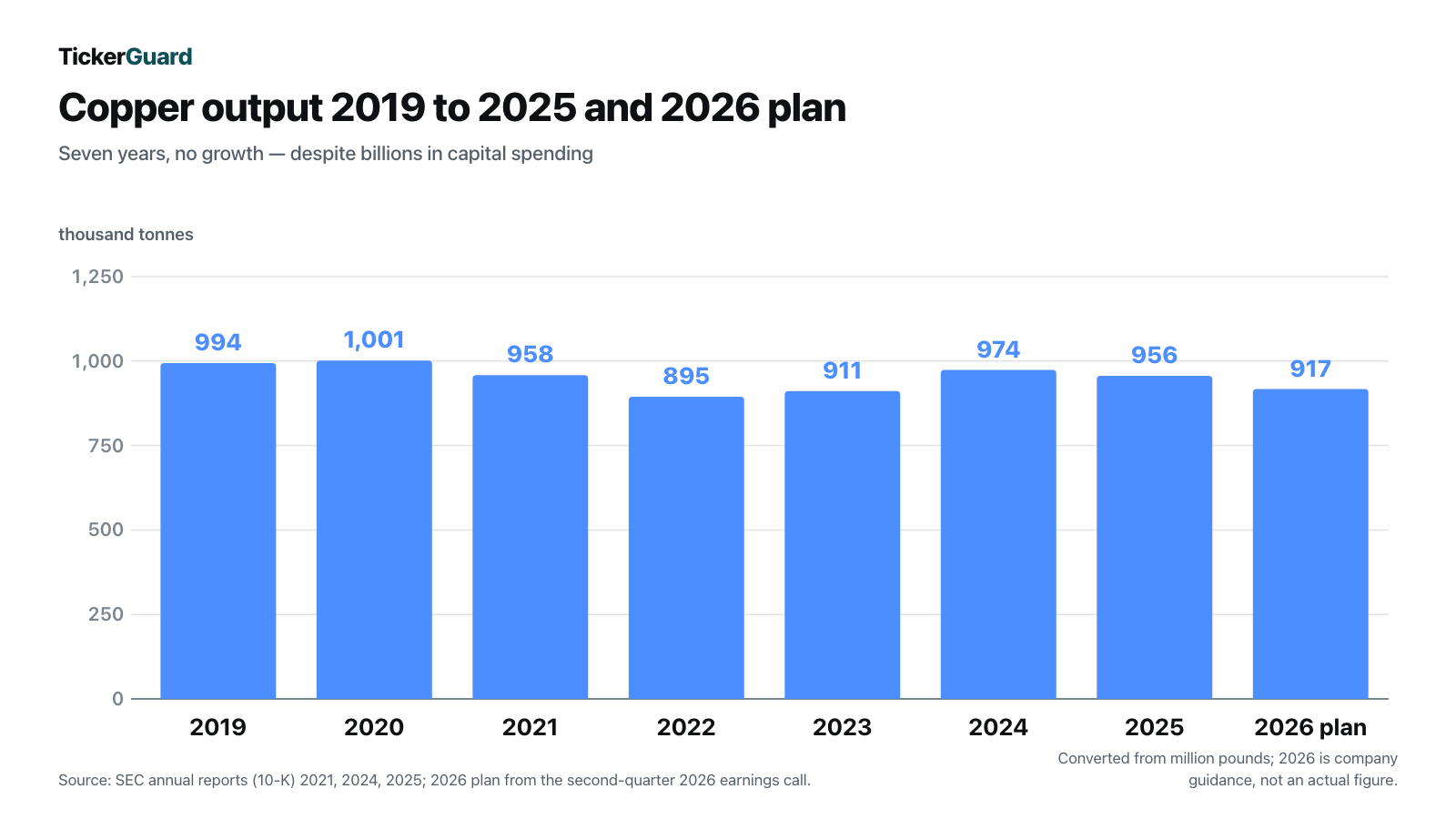
- Output is falling. In 2025 it was below the 2019 level, and the company's own 2026 plan is lower still. The cause — declining ore grades — cannot be fixed by management.
- Earnings depend on prices the company does not influence. That applies to copper and now equally to silver, which carries the cost calculation.
- Its own cost base is rising: 229.7 instead of 208.2 US cents per pound before by-product credits, on a half-year comparison.
- One shareholder holds 88.9% and, per the annual report, decides the dividend alone. Minority shareholders carry no effective voting weight.
- Political and legal risks in both countries: eight lawsuits over Tia Maria, an operation on strike since 2007, ongoing Rio Sonora proceedings, a project in Los Chancas blocked for three years.
- Part of the distribution comes from a share holding that, at the pace of the first half of 2026, lasts until roughly the start of 2028 — sooner if the issuance rate keeps rising.
- A free float of roughly 11% leaves the price exposed to sharp swings.
A human conclusion
Back to that word from the beginning. Record is not a lie — the numbers are correct, we read them in the original. But a record describes an outcome, not its cause. And at Southern Copper the cause sits two lines further down, where hardly anyone reads.
What we found is not a scandal. It is something quieter: a very well-run, exceptionally profitable mining group whose mines are slowly getting poorer, whose growth projects arrive years later than announced, and whose latest headline figures are carried by metal prices that may look different tomorrow. The company never hid any of it. It simply wrote it at the end of the press release instead of the beginning.
For an investor that means: whoever buys this stock is buying a bet on the copper and silver price — wrapped in a company with a first-class balance sheet and an owner who alone decides what gets paid out. You can want that. You should just know that you are doing it, and not confuse it with a bet on operational improvement. On that improvement, output has said the same thing for seven years: nothing.
Whether that is a good trade at this price is for you to judge. All we did was look at what the filings actually say — and at what quietly disappeared between two record announcements.
This is not investment advice and not a recommendation to buy or sell. All figures come from the sources listed below and carry the reporting date stated there.
Sources
- Southern Copper Corporation, quarterly report on Form 10-Q for the period ended June 30, 2026, filed July 31, 2026 (SEC EDGAR, CIK 0001001838)
- Exhibit 99.1 to the earnings release (current report on Form 8-K, Item 2.02), filed July 22, 2026
- Annual report on Form 10-K for 2025, filed February 27, 2026
- Annual report on Form 10-K for 2024, filed March 3, 2025
- Annual report on Form 10-K for 2021, filed March 7, 2022 (series for 2019 to 2021)
- Transcripts of the quarterly earnings calls, third quarter 2023 to second quarter 2026 (nine transcripts; none were available for the fourth quarter of 2024, the second quarter of 2025 and the first quarter of 2026)
- Source: fundamental data & SEC filings (annual and quarterly reports, 10-K/10-Q) — price as of August 31, 2026, metrics as of August 30, 2026
Key figures at a glance
All monetary figures in millions of $; earnings per share as reported.
| Metric | 2021 | 2022 | 2023 | 2024 | 2025 |
|---|---|---|---|---|---|
| Revenue | 10,934.1 | 10,047.9 | 9,895.8 | 11,433.4 | 13,420.0 |
| Operating Income (EBIT) | 6,065.1 | 4,435.8 | 4,192.3 | 5,554.7 | 7,001.6 |
| Net Income | 3,397.1 | 2,638.5 | 2,425.2 | 3,376.7 | 4,334.9 |
| Net Margin | 31.1% | 26.3% | 24.5% | 29.5% | 32.3% |
| Earnings Per Share | 4.39 $ | 3.41 $ | 3.09 $ | 4.30 $ | 5.17 $ |
Source: fundamental data & SEC filings (annual and quarterly reports, 10-K/10-Q)
Our Bottom Line at a Glance
- Profitability positive
- A net margin of 38.0% in the first half of 2026 and 32.3% for the full year 2025. Operating cash flow in the half-year was $3,683.0 million. That is exceptional for a commodity producer.
- Balance sheet positive
- Net debt of $664.5 million against equity of $12,632.2 million as of June 30, 2026 — at the end of 2023 net debt still stood at $4,503.8 million. No solvency risk is derivable from this.
- Output negative
- Mined copper output in 2025, at roughly 956,000 tonnes, was below the 2019 level, and the company plans for about 917,000 tonnes in 2026. The cause is declining ore grades, above all in Peru — a problem that cannot be managed away.
- Cost structure neutral
- Cash cost after by-product credits fell to minus $0.03 per pound in the first half of 2026. Before credits, however, it rose from 208.2 to 229.7 US cents. The change of sign is a silver price story, not a cost achievement.
- Ownership negative
- Grupo Mexico indirectly held 88.9% as of December 31, 2025. The annual report itself states that this shareholder alone decides on dividend levels, indebtedness and capital expenditure, and that its interests may differ from those of minority shareholders.
- Reliability of guidance negative
- The 2027 output target fell from 1,000,000 to roughly 917,000 tonnes between autumn 2023 and summer 2026. The Tia Maria budget rose from $1.4 billion to about $1.8 billion in 2024. The Los Chancas project has been stalled for three years by illegal miners.
Southern Copper is a highly profitable copper producer with a first-class balance sheet whose record second-quarter 2026 figures were, by its own account, carried by higher metal prices while output declined across all four metals. The sub-zero cash cost is a silver price effect; the company's own cost base rose. On top of that sit a majority owner holding 88.9% who, per the annual report, decides distributions alone, and a dividend that is two thirds treasury stock from a finite holding. Not investment advice.
What Our Rating Means
Open questions
The business works in principle, but one material question is open. As long as it stays open, our findings do not carry a quality verdict.
The business unquestionably works: high margins, a robust balance sheet, real reserves, a funded construction programme. The rating sits at yellow because of two open operational questions. First, output has been falling for years for geological reasons, and the growth projects arrive later and cost more than announced — earnings are currently carried entirely by prices the company does not steer. Second, the report's most spectacular metric, the negative cash cost figure, depends wholly on the silver price while the company's own costs rise. Both are operating questions, not solvency risks — there is no finding that would justify red, and no evidence of self-generated growth that would justify green. The decision is yours.
A journalistic assessment by our editorial team at the time of the deep dive, based on public sources — not investment advice and not a solicitation to buy or sell. Your personal circumstances (investment goals, risk capacity, taxes) cannot be taken into account. What our levels mean, how verdicts are formed, and what conflicts of interest exist →
Worth Noting
- The trigger for this analysis was the quarterly report for the period ended June 30, 2026, filed July 31, 2026, together with the earnings release of July 22, 2026.
- All filings after that date were reviewed: through September 1, 2026 there was only one notice of proposed sale and two insider filings by a single board member, totalling roughly $59,000 — economically immaterial.
- Price as of August 31, 2026, metrics as of August 30, 2026. The share count comes from the quarterly report (834,331,706 as of July 30, 2026); the differing provider figure of 844,343,686 is fully explained by the 1.2% stock dividend paid on August 27, 2026 (record date August 11, 2026).
- Risk of confusion: Southern Copper Corporation is a US company incorporated in Delaware and files annual and quarterly reports (10-K/10-Q) despite its Mexican parent. Until 2005 it operated as Southern Peru Copper Corporation.
Stock Watch
This analysis is as of September 1, 2026. Stock Watch will tell you what's changed at SCCO since then.
Later $1 a month per stock — signing up is free, and you'll be the first to know when it launches.
The full analysis as a PDF for later
We will send you this analysis as a PDF — to print, file away, and read at your own pace. And we will add you to the free Stock Watch list for Southern Copper Corporation (SCCO), so you hear about it when something material in this analysis changes.
Frequently Asked Questions
Because revenue is price times volume — and the price rose more than the volume fell. The company itself attributes the growth in the second quarter of 2026 to higher metal prices: copper up 39.8% on the London Metal Exchange, silver up 118.6%. Copper sales volume fell 1.5% over the same period, mined output 3.5%.
A copper mine always produces silver, molybdenum and zinc alongside. In this industry metric their sales revenue is deducted from the copper cost. If the result is negative, the by-products cover the entire cash cost and leave something over. Before those credits, however, cost rose from 208.2 to 229.7 US cents per pound in the first half of 2026 — the company's own cost base is getting more expensive, not cheaper.
Mexico's Grupo Mexico, which indirectly owned 88.9% of the capital stock as of December 31, 2025. The annual report lists this among its risk factors and enumerates what this shareholder decides alone — including the composition of the board, mergers, indebtedness and, explicitly, whether dividends are paid and in what amount. Only around 11% of the shares are freely floating according to data providers.
The cash distribution swung considerably in recent years: $4.00 per share in 2023, $2.10 in 2024, $3.10 in 2025. Since the second quarter of 2024 the company has additionally paid stock dividends out of treasury holdings. Of the distribution declared in July 2026, valued at $3.23 per share, only $1.10 was cash. The annual report warns expressly that future distributions may be lower than recently.
In the second half of 2027 according to the company. As of June 30, 2026 the project was 42% complete, the mining permit has been in place since October 2025, and in June 2026 the company issued $1,250 million of notes whose proceeds are expressly earmarked for this project. For context: the original budget of $1.4 billion was raised to about $1.8 billion in 2024, and eight lawsuits are pending against the project.
It names roughly 917,000 tonnes for 2026 and about the same amount for 2027. For comparison: in the autumn of 2023 one million tonnes had been named for 2027. The company now names the one-million mark for 2029. The reason given throughout for the downgrades is declining ore grade, above all at the Cuajone mine in Peru.
The quarterly report for the period ended June 30, 2026 names eight pending lawsuits against the Peruvian branch over the Tia Maria project, the oldest from 2015. In Mexico, criminal and civil proceedings over the 2014 escape of copper sulfate solution into the Sonora river are ongoing; a further criminal complaint was filed by the environmental authority in October 2023. The Taxco mine has also been on strike since July 2007 and stands idle.
On trailing twelve-month earnings of $6.46 per share and the closing price of $208.87 on August 31, 2026, the price-to-earnings ratio is roughly 32. Important for context: earnings currently sit at a record level and depend on metal prices. If the copper price falls, that ratio rises without the share price having moved at all.
Found an error?
Did you spot a factual error, an outdated number, or a typo in this deep dive? Let us know briefly — your report goes straight to the editorial team.