Better Home & Finance: The Founder Lost the CEO Job — and Took the Company Back
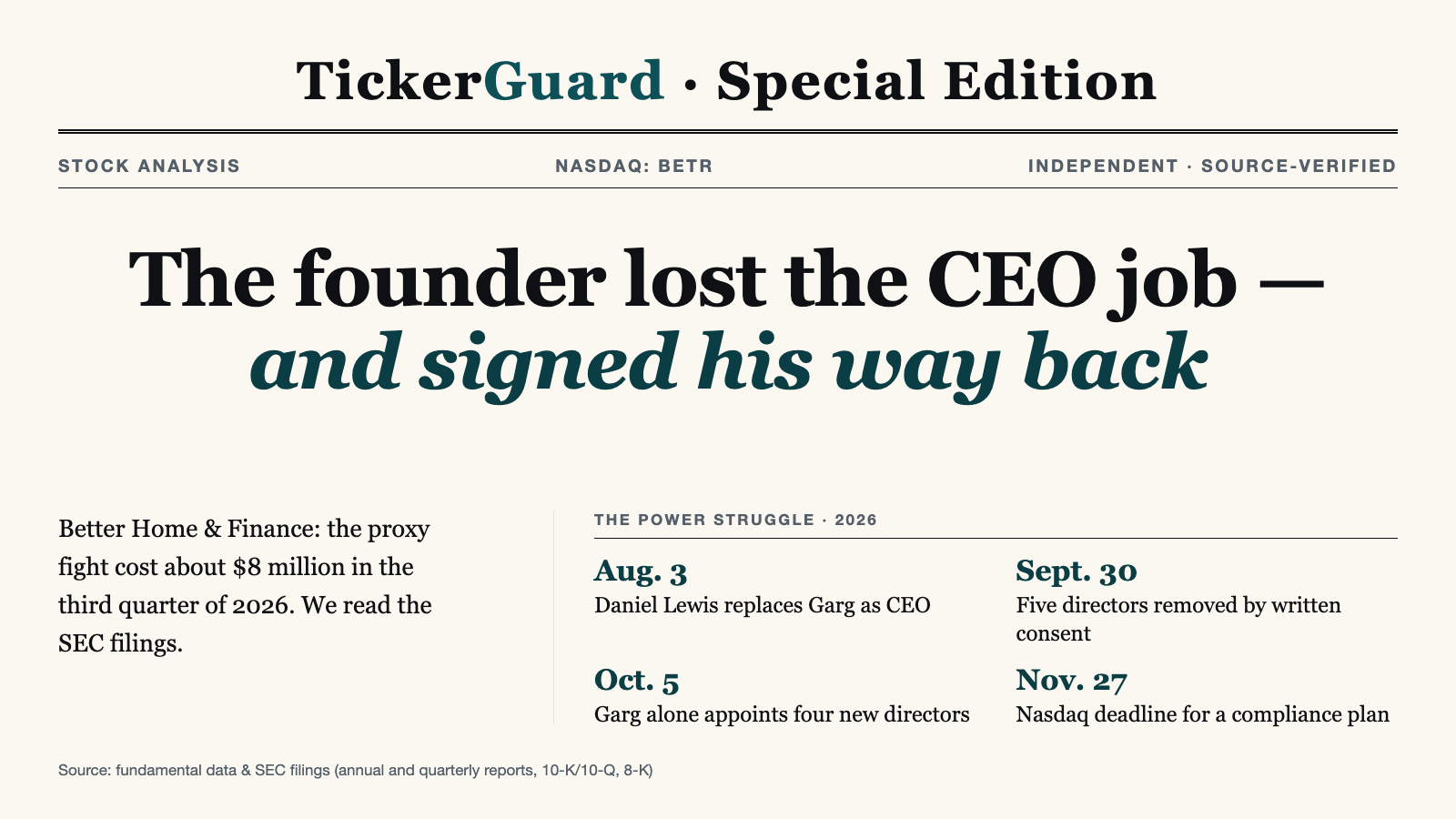
On August 3, 2026, founder Vishal Garg lost the CEO job at digital mortgage lender Better Home & Finance — nine weeks later, five directors had been removed by written shareholder consent, two more had resigned, and Garg, as the sole remaining director, had appointed four new ones. Then came a Nasdaq deadline of November 27, 2026. All shareholders pay the bill for the fight: about $8 million in a single quarter, according to the company — including those who are not a party to this power struggle.
 Thomas Mücke
Founder & Publisher
Thomas Mücke
Founder & Publisher
As of Today
As of: October 15, 2026
- Closing price
- 10.76 $ +32.51%
- Market Capitalisation
- 0.2 $B
- Growth Score
- 3/10
- AAQS
- 2/10
This analysis has a cut-off date. The Stock Guard tells you when something material changes in the numbers. Reserve your free spot
Chart
Interactive price chart (TradingView).
52-week range: 8.10 $ to 86.10 $ · Last price: 10.76 $ (As of: October 15, 2026)
Note: pure fact-based analysis, not investment advice and not a solicitation to buy or sell. All figures without guarantee.
The camp trap: when you pick a side in a boardroom fight
There is an investor trap that feels like conviction: the camp trap. A company fights in public — founder against board, press release against press release. And you notice yourself picking a side. The founder built the company! Or: finally someone is cleaning house! What slips out of view: as a shareholder, you are not a party to this fight. You are the one paying for both sides.
Better Home & Finance is a textbook case. On August 3, a board member took over as CEO and founder Vishal Garg had to hand over the job. The company’s filings say Garg “stepped down” as CEO; Garg himself called August 3 “the day I was fired” in the company’s release of October 14. By the end of September, Garg had gathered written consents from a majority of the voting power and removed five directors, and two more directors resigned. In early October he was the only director left and appointed four new ones. It was not the first time Garg was at the center of attention: according to the 2023 merger prospectus, Better began a series of workforce reductions in early December 2021 that significantly reduced its headcount (in June 2023 the prospectus still listed about 950 team members); the first round alone “resulted in significant negative media coverage.” Garg then stepped away from full-time engagement until late January 2022. That names the central tension of this analysis: Better has a platform built to make mortgages cheaper and faster, and real volume growth — but the company burns cash, and the fight broke out in exactly the months when every dollar counts. Let’s read together what the filings with the U.S. securities regulator, the SEC, actually say. No recommendation, no forecast — just the documents.
Company history for investors
-
2022
$877.1 million loss
In the year of sharply rising rates, revenue falls to $378.0 million and the loss reaches $877.1 million. For shareholders, the start of a run of loss years that continues to this day.
-
2023
Listing via the Aurora shell
On Aug. 22, 2023, Better merges with Aurora Acquisition Corp.; since Aug. 24, 2023, the stock has traded on Nasdaq as BETR (annual report 10-K for 2023).
-
2024
1-for-50 reverse split
On Aug. 16, 2024, every 50 shares are combined into one to meet Nasdaq’s minimum price rule. Equity is negative at year-end at −$58.2 million.
-
2025
SoftBank exchange, stock at $86
In April, SoftBank swaps a $532.5 million convertible note for $155.0 million of new notes and $110.0 million in cash. On Oct. 23, 2025, the stock closes at $86.07.
-
2026
Offering, power struggle, Nasdaq deadline
Offering at $32 in April, CEO change in August, five directors removed by written consent on Sept. 30, two resignations, new board appointed by Garg on Oct. 5, Nasdaq deadline of Nov. 27, 2026. The stock falls to $8.12 by Oct. 14, 2026.
What Better actually does
Better Home & Finance Holding Company, headquartered at One World Trade Center in New York, originates mortgages — loans to buy a home or to refinance — and HELOCs, lines of credit secured by the value of the borrower’s home. Think of Better as a loan factory. It takes the application, underwrites it, funds the loan with short-term bank credit (warehouse lines, $454.3 million drawn as of June 30, 2026) and then sells it on to a network of loan buyers, including the government-sponsored enterprises Fannie Mae and Freddie Mac. The money is made on the sale. According to its annual report (10-K), Better was founded in 2015; as of Dec. 31, 2025, the group had about 1,329 team members, roughly 869 of them in the U.S. and roughly 426 in India.
At its core is the in-house software Tinman, which the company markets as an AI platform, along with the voice assistant Betsy. Better reaches customers two ways: directly through its own website (direct-to-consumer) and through partners that embed Tinman in their own offerings (platform channel) — for example Intuit Credit Karma, with which Better said in a current report of July 30, 2026, it also plans to offer HELOCs to Credit Karma’s customer base. In the second quarter of 2026, 55 percent of the $1.67 billion in loan volume came through the platform channel. The group also owns a UK bank, Birmingham Bank; it is up for sale and has been reported as a discontinued operation since the first quarter of 2026.
Better did not go public through a classic IPO but through a blank-check company (SPAC) — an empty shell that raises money and then merges with a real business. On August 22, 2023, Better merged with Aurora Acquisition Corp., sponsored by Novator Capital; that is why the SEC lists the former name “Aurora Acquisition Corp.” until August 18, 2023, and why some report files still carry the “aurcu” prefix. The stock has traded on Nasdaq as BETR since August 24, 2023 (annual report 10-K for 2023). On August 16, 2024, a 1-for-50 reverse stock split followed — needed to regain compliance with Nasdaq’s minimum price rule. The fiscal year is the calendar year.
How the stock landed on our desk
Better caught our eye with a price jump on October 15, 2026: the stock closed at $10.76, 32.5 percent above the prior day ($8.12), on 3.39 million shares traded — about 4.4 times the average daily volume of the last 50 trading days including that day (about 775,000 shares according to the fundamental data, as of Oct. 16, 2026; 3.39 divided by 0.775). Average here means all daily volumes added up and spread evenly; a few very busy days pull it up. Two releases with preliminary third-quarter figures (October 13 and 14) and Garg’s announcement of a stock buyback without a dollar amount (release of October 13) came first. So the 32.5 percent jump happened on the trading day of October 15, 2026; all prices in this analysis refer to that close.
A one-third jump sounds like a turnaround. The longer view puts it in context: on October 23, 2025, the same stock had closed at $86.07; on October 14, 2026, it closed at $8.12 — a drop of about 91 percent in just under a year. The line for the rest of this analysis: At Better, the fight moves the stock — the cash decides its value.
The numbers over the years — an honest look
First, what genuinely impresses. Loan volume is growing fast: in 2025 Better funded $4.7 billion of loans, 32 percent more than in 2024. In the second quarter of 2026 it was $1.67 billion (+38 percent), and in the third quarter $1.395 billion according to preliminary figures (+15 percent), while industry volume fell 37 percent over the same period, according to the company. Volume through the Tinman platform rose 64 percent in the third quarter to about $790 million. Revenue grew 52 percent in 2025 to $164.9 million, and the loss is shrinking year after year. The chart shows revenue and net income since 2022:
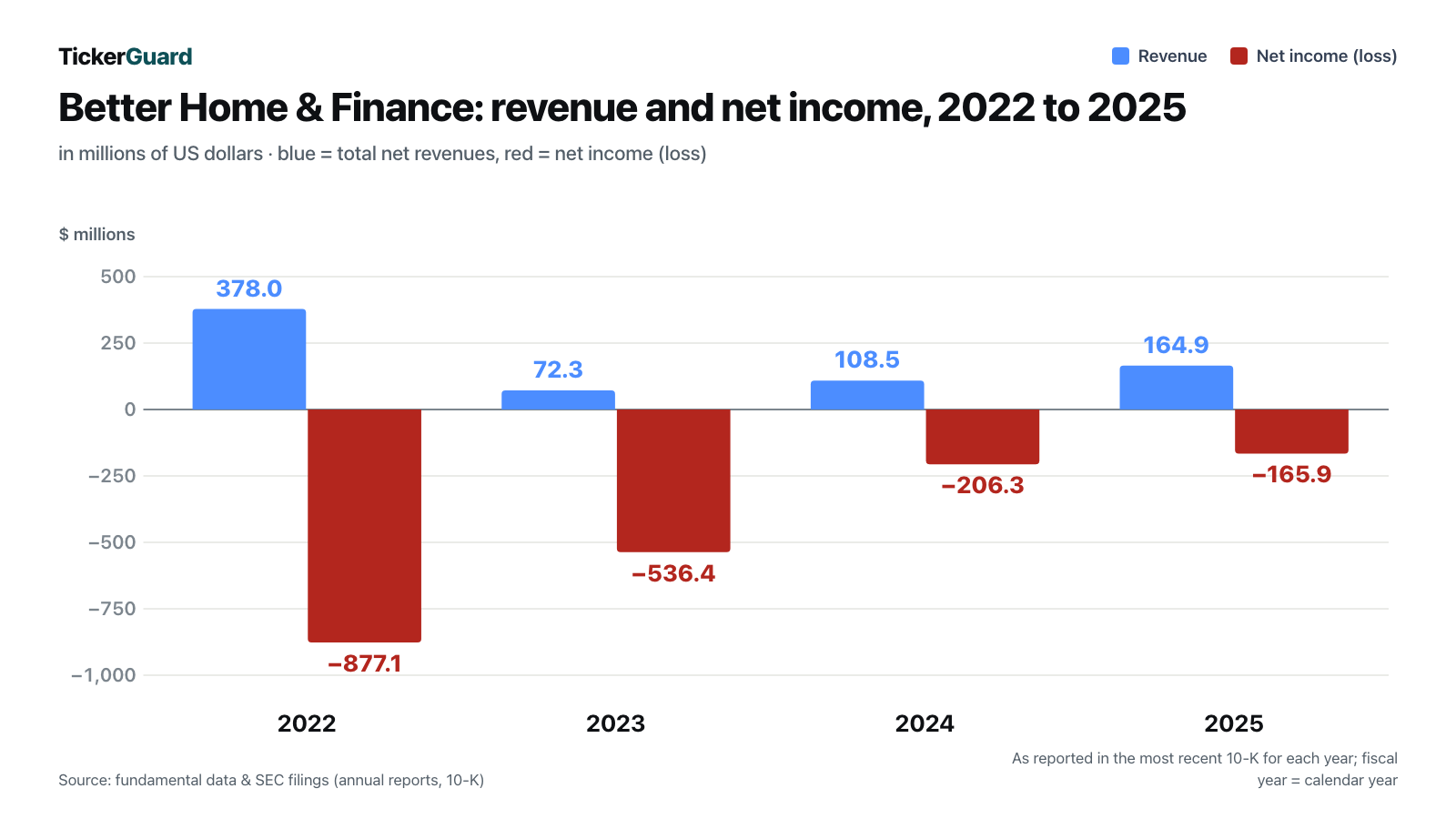
The chart shows both sides: the loss has shrunk from $877.1 million (2022, the year of sharply rising rates) to $165.9 million. But in none of these four years was it smaller than revenue. 2026 continues the pattern: in the first half Better lost $100.9 million, including $20.1 million from the UK bank, and operating cash outflow from continuing operations was $98.5 million. In the second quarter of 2026, the adjusted EBITDA loss narrowed to $14.0 million — but that included a one-time $6.5 million release of a reserve for older loans. Keep this picture in mind: Better is growing volume, but so far each additional loan has not earned enough to pay for the factory.
What the filings say — the uncomfortable truths
Uncomfortable truth No. 1: A board appointed by a single man
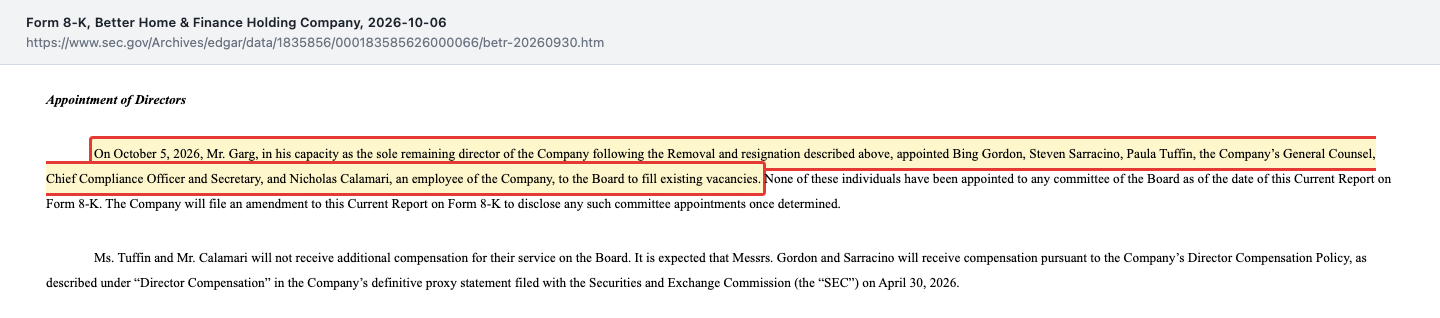
A board of directors is supposed to oversee the CEO. At Better, that relationship flipped in 2026. On August 3, director Daniel Lewis replaced founder Vishal Garg as CEO (8-K of Aug. 4, 2026); Garg stayed on the board. On August 20, Better adopted a so-called rights plan — a defense mechanism that makes further buying expensive for shareholders at 15 percent ownership or voting power and above. Garg gathered signatures anyway: on September 30, his group delivered written consents from shareholders holding a majority of the voting power that removed five directors without cause. Two more directors resigned: Michael Farello on September 28 (8-K of Oct. 2, 2026) and Hugh Frater on October 1 — according to the filing, as a result of the outcome of the consent solicitation (8-K of Oct. 6, 2026). Of the eight board members listed in the quarterly report of August 11, only Garg was left: eight minus five removed minus two resignations. What happened next is in the current report of October 6:
“On October 5, 2026, Mr. Garg, in his capacity as the sole remaining director of the Company following the Removal and resignation described above, appointed Bing Gordon, Steven Sarracino, Paula Tuffin, the Company’s General Counsel, Chief Compliance Officer and Secretary, and Nicholas Calamari, an employee of the Company, to the Board to fill existing vacancies.”
— Better Home & Finance Holding Company, current report 8-K of Oct. 6, 2026, Item 5.02
The same day, the new board removed interim CEO Lewis; according to the filing, a successor is being sought. Two of the four new directors are employees, and Bing Gordon has had a consulting agreement with Better since December 2025, under which he received 20,000 restricted stock units worth $582,200 in February 2026 (8-K/A of Oct. 9, 2026). Garg himself carries the title “Founder & Head of Product, Platform & Innovation” according to the release of October 13. The voting power behind this is laid out in the annual report:
“Vishal Garg, our CEO, owns shares of our Class B common stock that, as of March 2, 2026, entitled him to approximately 19% of the voting power of our outstanding common stock.”
— Better Home & Finance Holding Company, SEC annual report 10-K for 2025, Item 1A (Risk Factors)
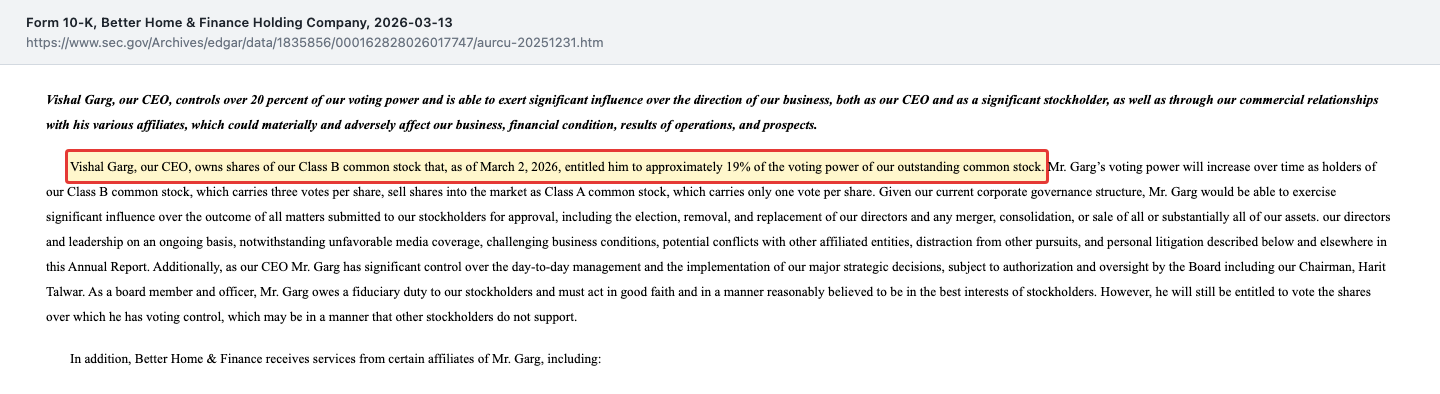
Class B shares carry three votes, Class A shares one, Class C shares none. The annual report itself warns that Garg’s voting share rises when other Class B holders convert to Class A and sell. And it flags another point: Garg faces civil lawsuits from earlier business ventures; in one of them a jury returned a verdict against him in April 2024, and according to the report no judgment had been entered as of March 13, 2026. Picture it this way: the person who is supposed to be overseen picked his own overseers. That can work out. But it is not what independent oversight looks like.
Uncomfortable truth No. 2: The exchange has set a deadline
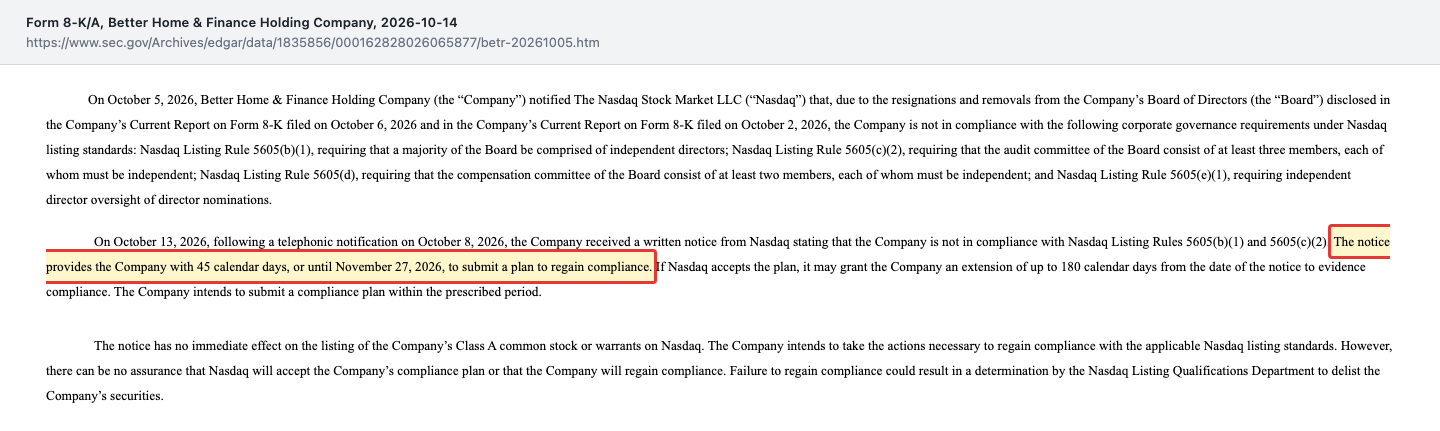
Nasdaq requires that a majority of a listed company’s board be independent and that the audit committee have at least three independent members. Neither has been the case at Better since the shake-up — back in its quarterly report of August 11, Better had already disclosed that after the CEO change only four of eight directors qualified as independent. On October 13, the exchange’s written notice arrived:
“The notice provides the Company with 45 calendar days, or until November 27, 2026, to submit a plan to regain compliance.”
— Better Home & Finance Holding Company, current report 8-K/A of Oct. 14, 2026, Item 3.01
To be fair: according to Better, the notice has no immediate effect on the listing, and independent directors can be appointed. No delisting has been announced. But the rule being broken covers exactly the part that is meant to protect shareholders: independent oversight of the books. Add to that a string of management departures — the president of the lending unit Better Mortgage left on September 2, the chief operating officer on September 4 (8-K of Sept. 8, 2026). That does not establish a direct link to the fight: according to the same filing, separation talks with both began in early summer 2026, before the CEO change. Better had already changed auditors in March: Deloitte out, BDO in; according to the filing without disagreements, and the previously reported material weaknesses in internal controls were considered remediated as of year-end 2025.
Uncomfortable truth No. 3: The fight comes with a bill
On August 6, Better had guided third-quarter revenue of $49 million to $52 million and an adjusted EBITDA loss of $15 million to $18 million. The preliminary figures of October 14: $45.1 million in revenue, an adjusted EBITDA loss of $24.8 million to $25.8 million and a net loss of $33.1 million to $34.1 million. Part of the explanation is in the same document:
“The preliminary result includes approximately $8.0 million of proxy-related legal and PR and other expenses.”
— Better Home & Finance Holding Company, preliminary third-quarter 2026 results, exhibit 99.1 to the 8-K of Oct. 14, 2026
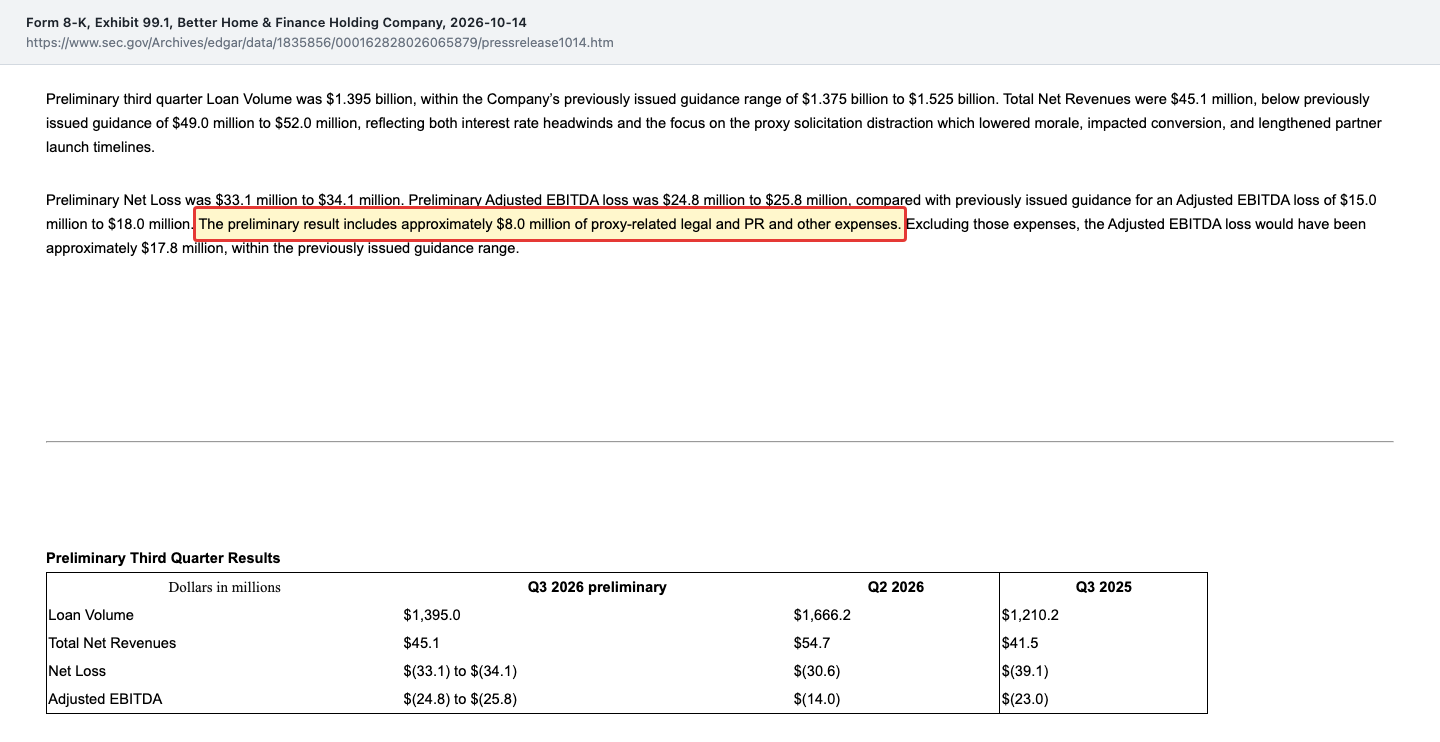
Note how the release tells the story: in it, Garg accuses the former board and the interim CEO of dragging down volume and revenue with an “unnecessary” proxy fight. The other side no longer gets a word in this release — it is no longer on the board. For you as a shareholder, who is to blame matters less than the size: $8 million equals about a tenth of the cash at quarter-end. All shareholders paid for it, whichever side they were on. Garg said he will close the gap with savings: about $13 million a year implemented, another $51 million planned (release of Oct. 13, 2026) — targets, not results. In the same release, Garg said the savings would also fuel an “aggressive stock buyback program”; the release gives no dollar amount. For context: with $81 million in cash and an adjusted EBITDA loss of about $25 million in the third quarter, every dollar spent on buybacks shrinks the cushion that has to absorb the losses.
Uncomfortable truth No. 4: Fresh shareholder money, barely more cash
Better raised a lot of money from shareholders in 2026: through June 30, $77.7 million came in from new shares and $5.7 million from exercised warrants, $83.4 million in total. Most of it came from an April offering at $32.00 per share — the last price before the deal had been $44.84 (424B5 prospectus supplement of April 9, 2026). The share count rose from 15,996,907 at year-end to 18,981,789 on June 30, an increase of 18.7 percent. In plain terms: your slice of the pie shrank by just under a sixth (about 16 percent) in half a year (1 − 1/1.187 ≈ 15.8 percent). And the cash?
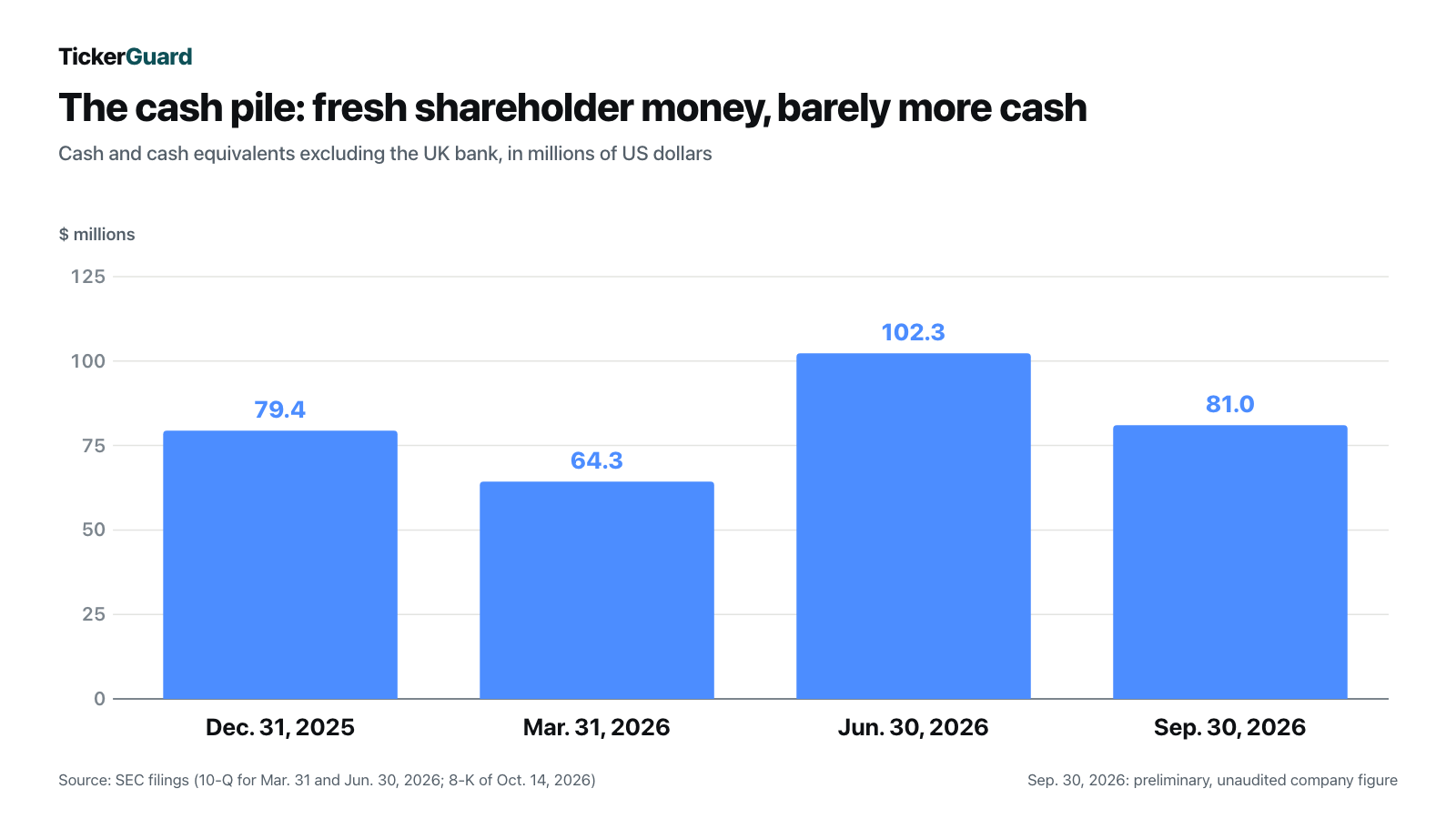
The chart makes the pattern visible: between the start of the year and September 30, cash rose only from $79.4 million to $81.0 million, even though $83.4 million of fresh equity came in (our side-by-side comparison; other cash flows, such as loan funding, also sit in between). In the third quarter alone, cash fell by $21.3 million. With an adjusted EBITDA loss of about $25 million in the third quarter, $81 million lasts a little over three quarters on paper. Using the actual third-quarter cash decline of $21.3 million instead, it is just under four quarters (our calculation; both are rough: the adjusted loss is not a cash flow, and the cash decline also mixes in loan and financing flows). As recently as its quarterly report of August 11 — before the third quarter — Better wrote that its funds would be adequate “for at least the next 12 months under current operating conditions.” To gain room, the company plans two steps: a loan against the UK bank and its sale, which according to the release of Oct. 14, 2026, is expected to bring in about $65 million in the first quarter of 2027.
Equity shows how thin the cushion is. As of March 31, 2026, it stood at just $8.6 million; only the offering lifted it to $57.9 million by June 30. And there is debt that ranks ahead of all shareholders: notes held by SoftBank entity SB Northstar with a carrying amount of $198.8 million, secured by substantially all assets, due December 31, 2028. They stem from an April 2025 exchange in which SoftBank swapped a $532.5 million convertible note for $155.0 million of new notes and $110.0 million in cash. Since July 2025, Better has paid the 6 percent interest in additional notes rather than cash.
Uncomfortable truth No. 5: “AI-native” — but the money comes from selling loans
In its quarterly report as of June 30, 2026, Better describes itself like this:
“We are an AI-native home finance company on a mission to make homeownership cheaper, faster, and more accessible for all Americans.”
— Better Home & Finance Holding Company, SEC quarterly report 10-Q as of June 30, 2026, Item 2 (MD&A)
The income statement in the same report shows where revenue actually comes from: of $54.7 million in the second quarter of 2026, $51.5 million — 94 percent — was gain on the sale of loans. That is the classic business of a mortgage lender, just with better software. That need not be bad; the platform can lower the cost per loan, and the annual report names partners that pay fees for processing through Tinman. But if you see the stock as an AI play, you are really buying a rate-sensitive mortgage business. The annual report itself says portions of loan production still require human involvement. How a large, established competitor in the same business fares is the subject of our analysis of Rocket Companies.
Valuation: about $200 million for a platform, a bank and open questions
At the closing price of October 15, 2026 ($10.76), Better had a market value of about $204 million, based on 18,998,579 shares across all three classes (as of July 31, 2026). That is about 1.2 times 2025 revenue ($164.9 million) and roughly 3.5 times stockholders’ equity as of June 30, 2026 ($57.9 million). There is no price-to-earnings ratio, because Better has no earnings.
The more interesting math concerns the UK bank. As of June 30, 2026, it sits on the balance sheet with $825.4 million of assets and $762.1 million of liabilities, so $63.3 million net (our calculation) — more than the group’s entire equity. Without the bank, the U.S. business would have slightly negative equity on paper. Anyone buying the stock is largely buying the sale proceeds of a UK bank plus a mortgage platform that has so far lost money. How another digital real estate platform has fared since going public is covered in our analysis of Opendoor.
Upside and risks at a glance
What speaks for Better Home & Finance:
- Volume growth against the market: $4.7 billion of funded loans in 2025 (+32 percent), $1.395 billion in the third quarter of 2026 (+15 percent) while industry volume fell 37 percent, according to the company.
- The platform is gaining traction: Tinman volume rose 64 percent in the third quarter of 2026 to about $790 million, roughly 57 percent of total volume; partners such as Intuit Credit Karma are set to distribute HELOCs.
- The loss is shrinking: from $877.1 million (2022) to $165.9 million (2025); announced savings of about $64 million a year in total.
- An asset to sell: the UK bank is expected to bring in about $65 million in cash in the first quarter of 2027.
- The founder is back and, according to the release of Oct. 13, 2026, has announced a stock buyback; he himself reconstituted the board that decides on his strategy on Oct. 5, 2026. The release names no dollar amount for the buyback.
What speaks against it:
- Governance breakdown: five directors removed by written consent, four new ones appointed by the sole remaining director, two of them employees; Nasdaq deadline for a plan of Nov. 27, 2026.
- Persistent losses: $100.9 million in the first half of 2026, $33.1 million to $34.1 million in the third quarter (preliminary); in no year since 2022 was the loss smaller than revenue.
- Thin cash: $81 million on Sept. 30, 2026 (preliminary) against an adjusted EBITDA loss of about $25 million per quarter; fresh capital raised in 2026 has largely been used up.
- Dilution and senior debt: 18.7 percent more shares in the first half of 2026, an offering at $32 below the last price; secured SoftBank notes carried at $198.8 million, with interest paid in additional notes.
- Rate sensitivity: 94 percent of second-quarter 2026 revenue came from loan sales — the business lives off the mortgage market, not AI licenses.
A human conclusion
Back to the camp trap from the beginning. Its core is not that one side of the fight is right. Maybe Garg really is the right person to scale the platform — Tinman volume grew even in the quarter of the fight. Maybe the old board had good reasons. The core is this: while the fight went on, the cash kept draining, lawyers and PR cost about $8 million, and the exchange set a deadline. The departures of the chief operating officer and the head of the lending unit fell in the same weeks — although, according to the filing, their separations had been under discussion since early summer. All shareholders pay that bill together, and none of them ordered it.
So the honest question for you is not “Are you for Garg or against him?” but: Would you hold this stock if you didn’t know the CEO’s name — only the losses, the cash and Nasdaq’s deadline? If yes, you have a thesis. If you only picked a camp, you have an opinion. What you do with it is your decision. And that is how it should be.
Sources
All original documents used in this analysis — so you can check them yourself:
- Better Home & Finance Holding Company — SEC quarterly report 10-Q as of June 30, 2026 (filed Aug. 11, 2026)
- Better Home & Finance Holding Company — SEC quarterly report 10-Q as of March 31, 2026 (filed May 11, 2026)
- Better Home & Finance Holding Company — SEC annual report 10-K for 2025 (filed March 13, 2026)
- Better Home & Finance Holding Company — SEC annual report 10-K for 2024 (filed March 19, 2025)
- Better Home & Finance Holding Company — SEC annual report 10-K for 2023 (filed April 8, 2024; trading start Aug. 24, 2023)
- Better Home & Finance Holding Company — preliminary third-quarter 2026 results, exhibit 99.1 to the 8-K of Oct. 14, 2026 and exhibit 99.1 to the 8-K of Oct. 13, 2026
- Better Home & Finance Holding Company — current report 8-K/A of Oct. 14, 2026 (Nasdaq notice, Item 3.01)
- Better Home & Finance Holding Company — current report 8-K of Oct. 6, 2026 (removal, Frater resignation and appointment of directors), 8-K of Oct. 2, 2026 (Farello resignation), 8-K/A of Oct. 9, 2026 and 8-K of Oct. 8, 2026 (rights plan terminated)
- Better Home & Finance Holding Company — CEO change release, exhibit 99.1 to the 8-K of Aug. 4, 2026 and second-quarter 2026 earnings release, exhibit 99.1 to the 8-K of Aug. 6, 2026
- Better Home & Finance Holding Company — 8-K of Aug. 20, 2026 (rights plan), 8-K of Sept. 8, 2026 (management departures) and 8-K of March 19, 2026 (auditor change)
- Better Home & Finance Holding Company — 424B5 prospectus supplement for the offering (filed April 9, 2026)
- Aurora Acquisition Corp. (now Better Home & Finance) — 424B3 merger prospectus (filed July 27, 2023)
- Full SEC filing history: EDGAR overview (sec.gov)
- Fundamental data (prices, trading volume; as of Oct. 16, 2026), cross-checked against the SEC filings and the SEC’s XBRL data.
Transparency & disclaimer: This analysis is a journalistic assessment of publicly available information. It is not investment advice, not a financial analysis in the regulatory sense and not a solicitation to buy or sell securities. Investing in stocks involves substantial risk, up to and including the total loss of capital. All information without guarantee; data dates are noted in the text. Positions held by the operator are disclosed daily; where one exists, it appears as a notice at the top of this deep dive.
Key figures at a glance
All monetary figures in millions of $; earnings per share as reported.
| Metric | 2021 | 2022 | 2023 | 2024 | 2025 |
|---|---|---|---|---|---|
| Revenue | 1,311.6 | 395.1 | 88.5 | 120.1 | 191.4 |
| Operating Income (EBIT) | -239.7 | -858.9 | -291.3 | -188.0 | -123.0 |
| Net Income | -301.1 | -877.1 | -536.4 | -206.3 | -165.9 |
| Net Margin | -23.0% | -222.0% | -606.1% | -171.8% | -86.7% |
| Earnings Per Share | -0.41 $ | -1.19 $ | -2.10 $ | -13.65 $ | -10.82 $ |
Source: fundamental data & SEC filings (annual and quarterly reports, 10-K/10-Q)
Our Bottom Line at a Glance
- Platform & growth positive
- Loan volume is growing against the market: $4.7 billion in 2025 (+32 percent), $1.395 billion in the third quarter of 2026 (+15 percent, preliminary). Volume through the Tinman platform rose 64 percent in the third quarter to about $790 million; partners such as Intuit Credit Karma are set to distribute HELOCs.
- Earnings power negative
- Since 2022, the net loss has not been smaller than revenue in any year (2025: $165.9 million loss on $164.9 million revenue). In the first half of 2026 Better lost $100.9 million, and $33.1 million to $34.1 million in the third quarter of 2026 (preliminary); revenue missed the company’s own guidance.
- Cash & funding negative
- Cash excluding the UK bank of $81 million on Sept. 30, 2026 (preliminary) — barely more than at the end of 2025, even though $83.4 million of fresh capital came in through June. On paper, at an adjusted EBITDA loss of about $25 million per quarter, the cash lasts a little over three quarters, or just under four measured by the actual third-quarter cash decline ($21.3 million); the bank sale and a loan against the bank are meant to create room.
- Governance negative
- Five directors removed by written consent on Sept. 30, 2026, four new ones appointed on Oct. 5, 2026, by the sole remaining director Vishal Garg, two of them employees. Nasdaq found that its independence rules are not met and set a deadline of Nov. 27, 2026.
- Balance sheet & dilution negative
- $57.9 million of equity (June 30, 2026) against $198.8 million of secured SoftBank notes whose interest is paid in additional notes. The UK bank sits on the balance sheet at $63.3 million net; the share count rose 18.7 percent in the first half of 2026.
Better Home & Finance is the camp trap in its purest form: a public fight between founder Vishal Garg and the board ended on Oct. 5, 2026, with a board appointed by Garg as the sole remaining director and a Nasdaq deadline of Nov. 27, 2026. Underneath is a mortgage lender with growing volume but persistent losses ($100.9 million in the first half of 2026), $81 million in cash and about $8 million of costs for the fight in a single quarter. Not investment advice.
What Our Rating Means
Substance risk
We found at least one documented issue that threatens the company itself — regardless of how the stock is currently valued.
The platform is growing, and the Tinman volume is real — but here cash and control decide the quality question. Documented are a governance breakdown (a board appointed by a single director, Nasdaq independence rules not met) and cash that, at the current rate of outflow, lasts a little over three quarters on paper (just under four measured by the actual third-quarter cash decline). The filings contain no going-concern warning; in August, Better considered its funds adequate for at least twelve months, and the bank sale is expected to bring in about $65 million. If you are waiting, check: does Better submit a plan to Nasdaq by Nov. 27, 2026, with how many independent directors, what does the quarterly report as of Sept. 30, 2026, show about cash, and does the bank sale close? The decision is yours.
A journalistic assessment by our editorial team at the time of the deep dive, based on public sources — not investment advice and not a solicitation to buy or sell. Your personal circumstances (investment goals, risk capacity, taxes) cannot be taken into account. What our levels mean, how verdicts are formed, and what conflicts of interest exist →
Worth Noting
- Better caught our eye with the price jump on Oct. 15, 2026 (+32.5 percent to $10.76 on 3.39 million shares traded). The latest periodic report is the 10-Q as of June 30, 2026 (filed Aug. 11, 2026, after an NT 10-Q extension); all current reports through Oct. 15, 2026, have been reviewed. The Q3 figures are preliminary and unaudited; the quarterly report as of Sept. 30, 2026, was not yet available on Oct. 16, 2026.
- Market value (about $204 million) calculated from 18,998,579 shares across all three classes (as of July 31, 2026) and the closing price of Oct. 15, 2026; the figure in the fundamental data ($204.6 million) matches. The last price cited in a filing ($44.84 on April 7, 2026, 424B5 prospectus supplement) predates the share price collapse and is not usable as a cross-check. Net bank ($63.3 million) = assets minus liabilities of the discontinued operation per the 10-Q, our calculation.
- Cash runway is our own calculation: $81 million of cash (Sept. 30, 2026, preliminary) divided by the third-quarter adjusted EBITDA loss ($24.8 million to $25.8 million); adjusted EBITDA is a company measure without a U.S. GAAP definition and not a cash flow. Cross-check with the actual third-quarter cash decline ($102.3 million to $81 million = $21.3 million): about 3.8 quarters. Note: the report files carry the “aurcu” prefix of the former blank-check company Aurora Acquisition Corp.
- Trading volume: 3.39 million shares on Oct. 15, 2026, against an average daily volume of about 775,000 shares over the last 50 trading days including that day (fundamental data, as of Oct. 16, 2026) — about 4.4 times. Board: eight members per the 10-Q as of June 30, 2026, minus five removed (Sept. 30, 2026), minus the resignations of Michael Farello (Sept. 28, 2026, 8-K of Oct. 2, 2026) and Hugh Frater (Oct. 1, 2026, 8-K of Oct. 6, 2026) — leaving Garg.
Stock Watch
This analysis is as of October 16, 2026. Stock Watch will tell you what's changed at BETR since then.
Later $1 a month per stock — signing up is free, and you'll be the first to know when it launches.
The full analysis as a PDF for later
We will send you this analysis as a PDF — to print, file away, and read at your own pace. And we will add you to the free Stock Watch list for Better Home & Finance Holding Company (BETR), so you hear about it when something material in this analysis changes.
Frequently Asked Questions
Better Home & Finance Holding Company (Nasdaq: BETR) of New York originates mortgages and home equity lines of credit (HELOCs) through its software platform Tinman — directly to consumers and through partners such as Intuit Credit Karma. The loans are sold to buyers including Fannie Mae and Freddie Mac. In 2025, Better funded $4.7 billion of loans; at the end of 2025 the group had about 1,329 team members. Its UK Birmingham Bank is up for sale.
On Aug. 3, 2026, director Daniel Lewis replaced founder Vishal Garg as CEO. On Sept. 30, 2026, Garg’s group delivered written consents from a majority of the voting power that removed five directors; two more resigned (Michael Farello on Sept. 28, Hugh Frater on Oct. 1, 2026). On Oct. 5, 2026, Garg, as the sole remaining director, appointed four new members, including the general counsel and an employee. Lewis was then removed as interim CEO.
No delisting has been announced. On Oct. 13, 2026, Nasdaq notified Better that it does not meet the rules on an independent board majority and on the audit committee. Better has until Nov. 27, 2026, to submit a plan; if Nasdaq accepts it, the exchange can grant up to 180 days from the notice to regain compliance. According to Better, the notice has no immediate effect on the listing.
According to a preliminary figure of Oct. 14, 2026, cash and cash equivalents stood at $81 million on Sept. 30, 2026, plus $9 million of restricted cash, excluding the UK bank. At the end of 2025 it was $79.4 million, even though $83.4 million from new shares and warrants came in through June. The sale of the UK bank is expected to bring in about $65 million in the first quarter of 2027.
Better reached Nasdaq on Aug. 22, 2023, by merging with the blank-check company (SPAC) Aurora Acquisition Corp., sponsored by Novator Capital. That is why the SEC lists the former name “Aurora Acquisition Corp.” until Aug. 18, 2023; the stock has traded as BETR since Aug. 24, 2023. On Aug. 16, 2024, every 50 shares were combined into one to regain compliance with Nasdaq’s minimum price rule.
At the closing price of Oct. 15, 2026 ($10.76), the market value was about $204 million on 18,998,579 shares (as of July 31, 2026). That is about 1.2 times 2025 revenue and roughly 3.5 times stockholders’ equity as of June 30, 2026. There is no price-to-earnings ratio because of the losses; the UK bank sits on the balance sheet at $63.3 million net.
Found an error?
Did you spot a factual error, an outdated number, or a typo in this deep dive? Let us know briefly — your report goes straight to the editorial team.