Kosmos Energy: The Stock Nearly Quadrupled — the $2.7 Billion Debt Pile Stayed
From a closing low of $0.87 in late December 2025 to $3.27 in early May 2026: shares of deepwater oil producer Kosmos Energy have had a run that is drawing attention on Reddit. The filings with the U.S. securities regulator, the SEC, show the other end of the lever: almost four dollars of debt for every dollar of equity, covenants loosened twice, a share offering below the market price — and hedges that cost money exactly when oil prices rose. Not investment advice — just the question of who is really holding the lever at Kosmos.
 Thomas Mücke
Founder & Publisher
Thomas Mücke
Founder & Publisher
As of Today
As of: October 14, 2026
- Closing price
- 2.70 $ -2.50%
- Market Capitalisation
- 1.6 $B
- Growth Score
- 3/10
- AAQS
- 3/10
Price change since October 14, 2026: -0.4%
This analysis has a cut-off date. The Stock Guard tells you when something material changes in the numbers. Reserve your free spot
Chart
Interactive price chart (TradingView).
52-week range: 0.8707 $ to 3.30 $ · Last price: 2.70 $ (As of: October 14, 2026)
Note: pure fact-based analysis, not investment advice and not a solicitation to buy or sell. All figures without guarantee.
The leverage trap: when a stock nearly quadruples
There is an investor trap that feels like skill: the leverage trap. You see a stock that has multiplied in value within a few months, and your mind draws a comfortable conclusion: some force is pushing it up, so it will keep pushing. What you overlook is that a lever is a bar with two ends. The same force that lifted the price can push it down just as fast. And a company that works with borrowed money has an especially long lever.
Kosmos Energy is the textbook case right now. The stock closed at $0.87 on December 26, 2025 — and at $3.27 on May 4, 2026, nearly four times as much. On October 14, 2026 it stood at $2.71. Anyone who only looks at this curve misses the previous one: at the end of 2023 the same stock cost $6.71, at the end of 2025 only $0.91 — a decline of 86 percent in two years. That defines the central tension of this analysis: Kosmos is a bet on oil prices with a debt lever — and the same lever that yanked the stock up in 2026 had pushed it down 86 percent before. Let’s read what the company has filed with the U.S. securities regulator, the SEC. No recommendation, no forecast — just the filings.
Company history for investors
-
2007
Jubilee field discovered offshore Ghana
With the Mahogany-1 well, Kosmos finds, according to its annual report, one of the largest oil fields offshore West Africa of the decade; oil flows from 2010. Jubilee is still the company’s most important source of cash.
-
2015
Greater Tortue Ahmeyim gas discovery
Offshore Mauritania and Senegal, Kosmos discovers, according to its annual report, one of the largest gas fields offshore West Africa. It takes a decade until first LNG, during which the project ties up a lot of capital.
-
2025
First LNG — and a $699.8 million loss
First LNG flows in February 2025. The year still ends with a $699.8 million loss, lenders loosen the covenants, and the stock falls to $0.91 by year-end.
-
2026
Share offering, asset sale, profitable quarter
Second covenant relief in February, 112.1 million new shares at $1.90 in March, sale of Equatorial Guinea in June. Q2 brings $184.8 million of net income; the bank facility is to be refinanced by the fourth quarter.
What Kosmos Energy actually does
Kosmos Energy Ltd., based in Dallas, Texas, explores for and produces oil and gas in deep water off the coast of West Africa and in the U.S. Gulf. The company was founded in 2003, according to its annual report, “to find oil and gas in under‑explored or overlooked parts of West Africa.” Two large discoveries still define it, both among the largest offshore West Africa according to the annual report: the Jubilee oil field offshore Ghana (discovered 2007; according to the annual report one of the largest finds offshore West Africa of that decade) and the Greater Tortue Ahmeyim gas field on the maritime border of Mauritania and Senegal (discovered 2015; according to the annual report one of the largest gas discoveries ever offshore West Africa). As of December 31, 2025, Kosmos had just 216 employees — the production facilities themselves are mostly run by partners such as Tullow in Ghana and BP at Greater Tortue.
Today the business rests on three pillars. First, Ghana: Kosmos holds 38.6 percent of Jubilee and 20.4 percent of the TEN fields; in the second quarter of 2026 they contributed about 36,300 barrels of oil equivalent per day (net). Second, liquefied natural gas (LNG): at Greater Tortue, gas is turned into LNG on a floating liquefaction vessel (the “Gimi”) and sold by tanker; Kosmos holds about 27 percent, and the first deliveries started in 2025. Third, the U.S. Gulf (called the “Gulf of America” in the filings, formerly the Gulf of Mexico) with several smaller oil fields. Kosmos sold its stake offshore Equatorial Guinea to Panoro Energy on June 16, 2026. In total, Kosmos produced about 71,400 barrels of oil equivalent per day in the second quarter of 2026, up about 12 percent from a year earlier. Proved reserves stood at 249 million barrels of oil equivalent at the end of 2025, 13 million of them in Equatorial Guinea.
The fiscal year is the calendar year. And artificial intelligence? According to the 2025 annual report, Kosmos uses AI and machine learning for internal processes and has set up a dedicated committee for it. It earns nothing from it — Kosmos sells oil, gas and LNG, nothing else.
How the stock landed on our desk
Kosmos landed on our desk in October 2026 through our in-house Reddit hype scanner — a list of the stocks that investor forums are talking about unusually often. That alone is not a mark of quality; if anything it is a warning light: where there is a lot of talk, people tend to discuss the chart, rarely the balance sheet. And the chart at Kosmos is spectacular. From the closing low on December 26, 2025 ($0.87) to the high on May 4, 2026 ($3.27), the stock gained about 276 percent. Over the same period, the price Kosmos realized per barrel of oil equivalent rose: an average of $55.81 in the first quarter of 2026, $86.68 in the second.
Kosmos is listed on the New York Stock Exchange and the London Stock Exchange, both under the symbol KOS. The one sentence for the rest of this analysis: At Kosmos, oil prices set the mood — and the debt decides how the story ends.
The numbers over the years — an honest look
First, what genuinely impresses. By its own account in the annual report, Kosmos made two of the largest discoveries offshore West Africa and brought both into production — Jubilee from 2010, Greater Tortue with first LNG in February 2025. The second quarter of 2026 shows what the portfolio can do at high prices: $607.3 million of revenue (prior-year quarter: $392.6 million), $184.8 million of net income (prior year: a $87.7 million loss), production costs cut by about 26 percent to $179.4 million, $175.0 million of operating cash flow and $88.9 million of free cash flow — the money left after capital spending. Net debt fell by $419.1 million in the first half of 2026 to $2,563.4 million.
Over the years, the picture is choppier. The chart shows revenue and net income since 2019:
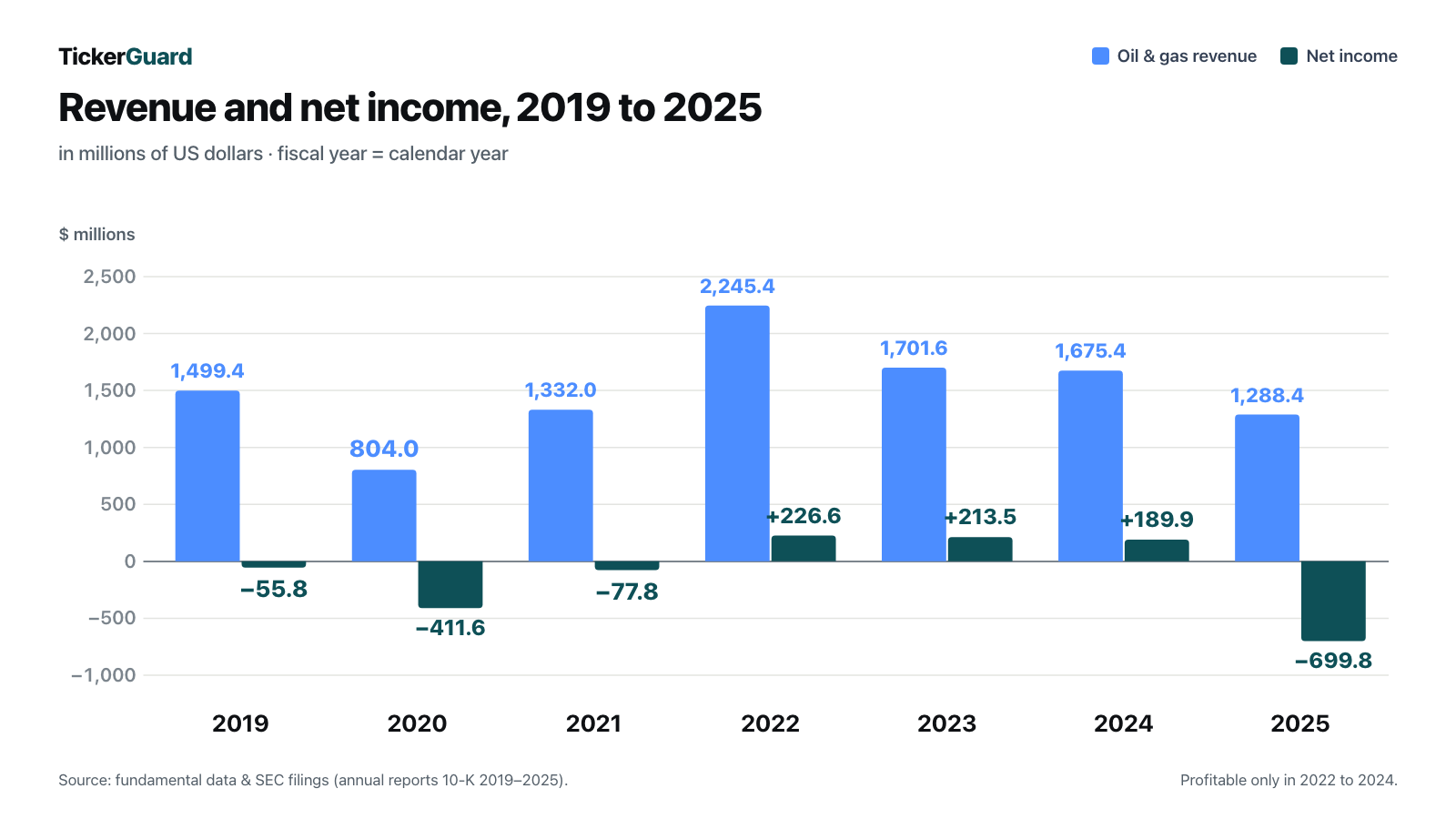
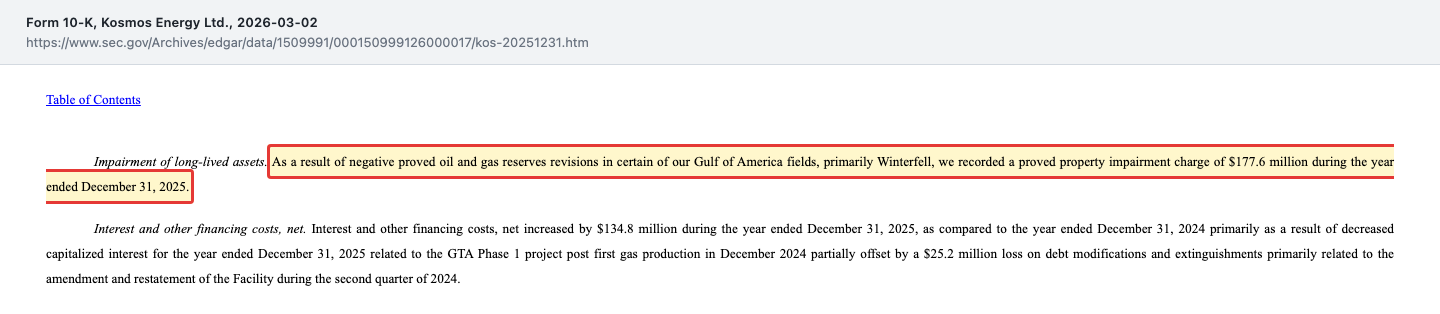
Over seven years, four loss years face three profitable ones. In 2025, revenue fell 23 percent because the realized price per barrel of oil equivalent dropped from $71.27 to $57.48 and Jubilee delivered less. But the $699.8 million loss had a second cause: write-downs. Kosmos booked $223.6 million of exploration expense — including $143.7 million of previously capitalized costs for the Yakaar and Teranga gas discoveries offshore Senegal that Kosmos wrote off, and $58.5 million for the Winterfell-4 well in the U.S. Gulf, which was plugged and abandoned. On top came an impairment of producing fields:
“As a result of negative proved oil and gas reserves revisions in certain of our Gulf of America fields, primarily Winterfell, we recorded a proved property impairment charge of $177.6 million during the year ended December 31, 2025.”
— Kosmos Energy Ltd., SEC annual report 10-K for 2025, Item 7 (results of operations)
And then there is one number that sums up the company’s whole life: the accumulated deficit — all profits and losses since inception added up — stood at negative $1,823.1 million as of June 30, 2026. The reason the balance sheet still shows $704.9 million of equity is the $2,758.6 million that shareholders have paid in over the years. Keep the picture in mind: Kosmos has made big discoveries — but so far it has spent more money than it has earned.
What the filings say — the uncomfortable truths
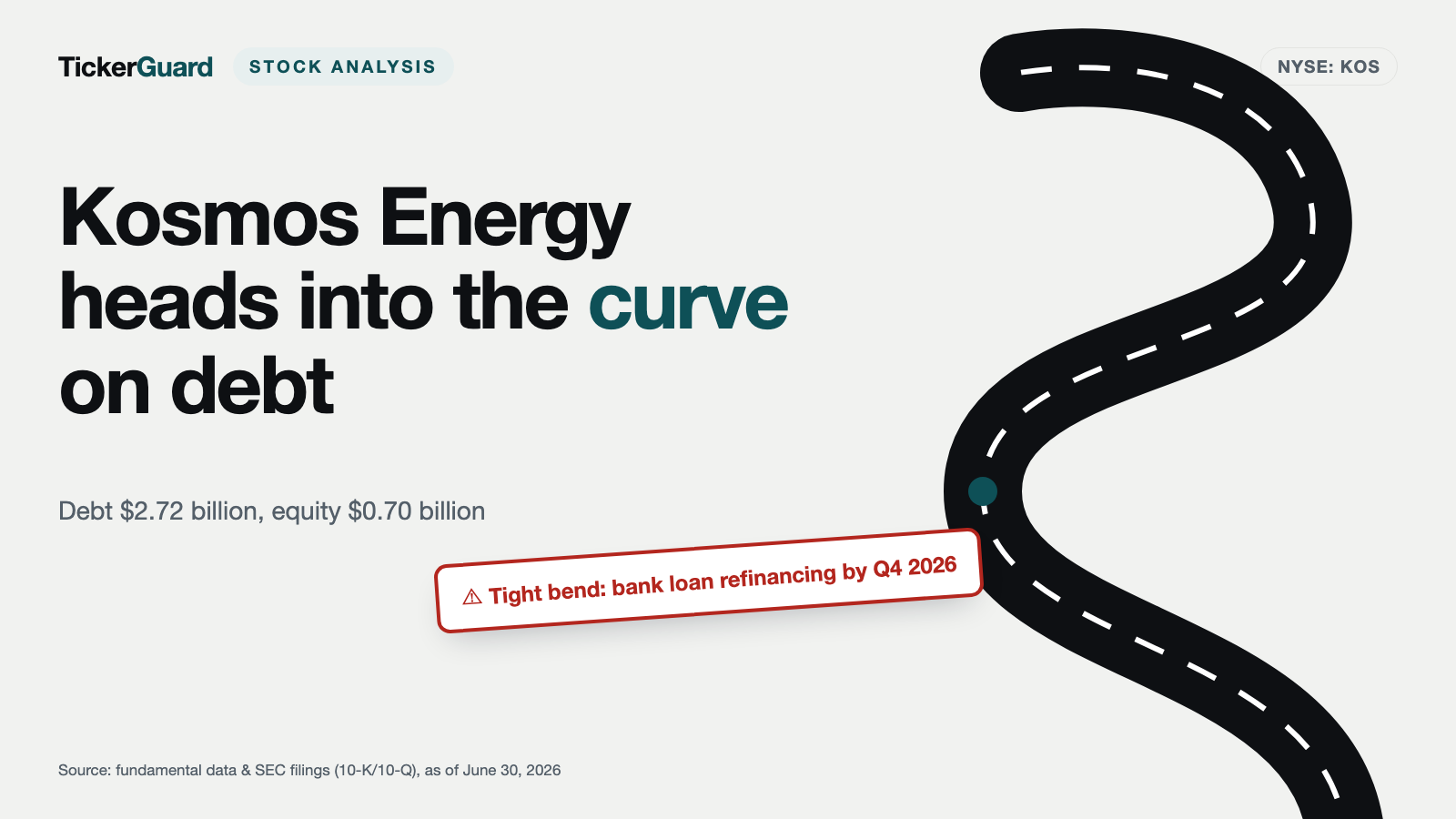
Uncomfortable truth No. 1: Debt is almost four times equity
As of June 30, 2026, Kosmos owed its lenders $2,719.7 million (principal of all loans and notes). Equity stood at $704.9 million. For every dollar that belongs to shareholders, there are almost four dollars of debt. The chart shows how the ratio has developed:
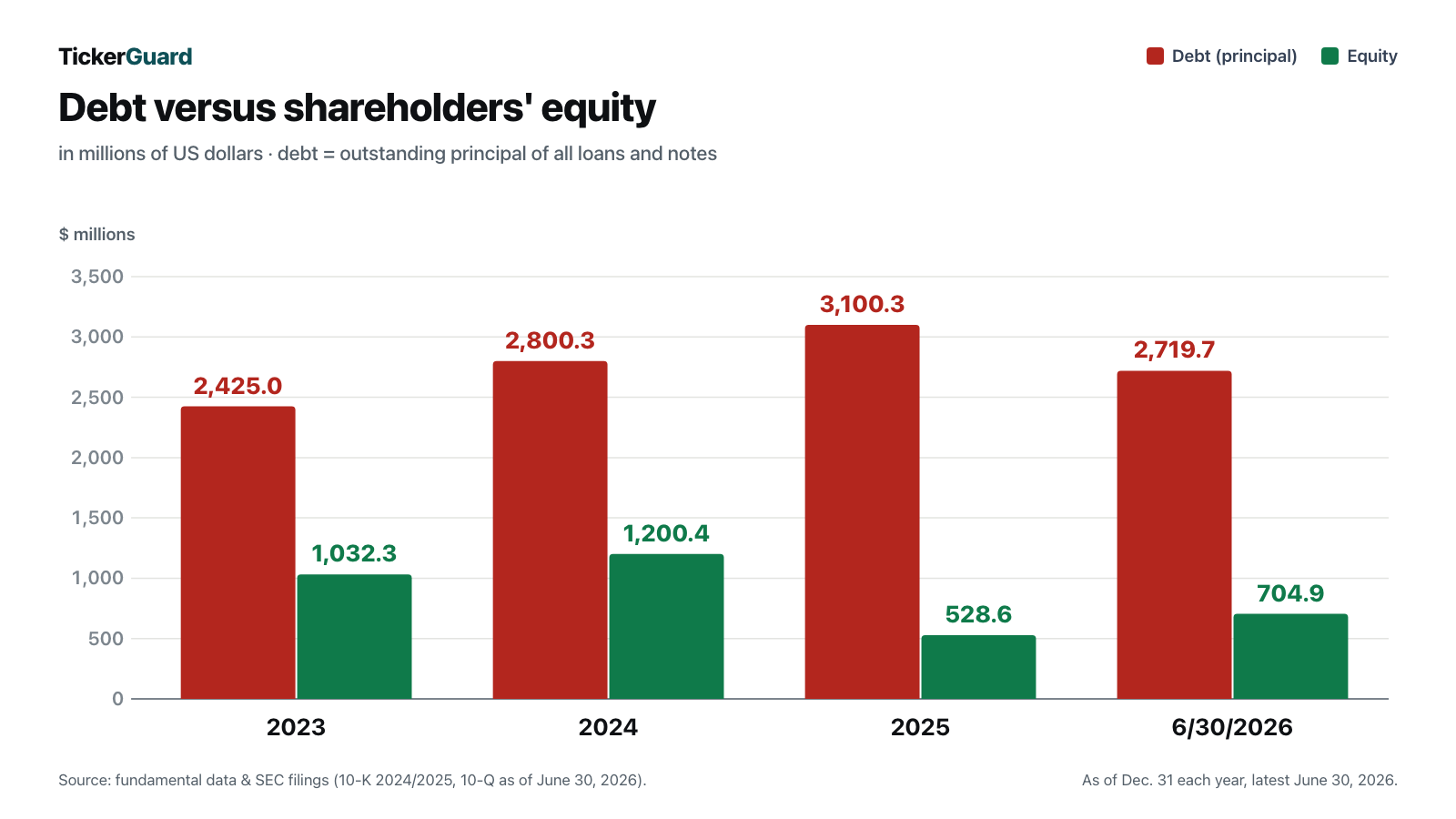
Debt is normal in the oil business — production vessels and LNG plants cost billions before they bring in a dollar. What matters is whether the ongoing business carries the interest. In 2025 it did not: earnings before interest and taxes were about negative $411 million, interest costs $223.4 million. In the twelve months to June 30, 2026, earnings before interest and taxes (our calculation: about negative $206 million) again failed to cover interest costs of $229.3 million. To be fair: before depreciation, exploration costs and valuation effects — the EBITDAX measure oil companies like to show — Kosmos earned $789.7 million over the same period, a little more than three times its interest. For 2026, Kosmos expects $220 million to $240 million of interest expense. The annual report names the risk itself:
“A high level of indebtedness increases the risk that we may default on our debt obligations.”
— Kosmos Energy Ltd., SEC annual report 10-K for 2025, Item 1A (risk factors)
And the maturities are getting closer. According to the quarterly report, about $304.8 million of principal comes due in 2027 and about $718.9 million in 2028 — including the $400.3 million of notes carrying a 7.5 percent coupon. In September 2026, Kosmos announced two partial redemptions of $25 million each on the notes due 2027 (8-Ks of Sept. 8 and Sept. 21, 2026). These are first steps — but the scale shows that the real wall comes in 2028.
Uncomfortable truth No. 2: The banks have loosened the rules twice
Kosmos’ most important source of funding is a bank facility secured by its producing fields. As of June 30, 2026, $773 million of it was drawn. Such loans come with covenants — here mainly a ceiling on the ratio of net debt to operating earnings (the “debt cover ratio”). Think of it this way: the bank says your debt may not exceed three and a half years of salary. Kosmos has twice asked its lenders to raise that limit temporarily; the filings do not disclose the actual ratio. The quarterly report describes the background like this:
“Leverage was elevated in 2025 given lower oil prices and the impact of operation costs during the ramp-up of the GTA Phase 1 project combined with lower company production.”
— Kosmos Energy Ltd., SEC quarterly report 10-Q as of June 30, 2026, Item 2 (liquidity)
In July 2025, the lenders loosened the limit a first time, to a maximum of 4.0x and 4.25x. The annual report explains the change as an effort “to align the covenant calculation with recent business operations, lower potential oil prices” and the costs of the GTA ramp-up. The second relief followed in February 2026:
“In February 2026, we further amended the debt cover ratio calculation through September 2026. This most recent amendment makes the covenant less restrictive for the following two scheduled financial covenant assessment dates, up to a maximum of 4.5x and 4.25x respectively, and for purposes of the financial covenant assessment date in March 2026, the calculation was made excluding the Company’s Mauritania and Senegal business unit. The debt cover ratio returns to the originally agreed upon ratio of 3.5x for assessment dates thereafter.”
— Kosmos Energy Ltd., SEC quarterly report 10-Q as of June 30, 2026, Item 2 (liquidity, “Facility”)
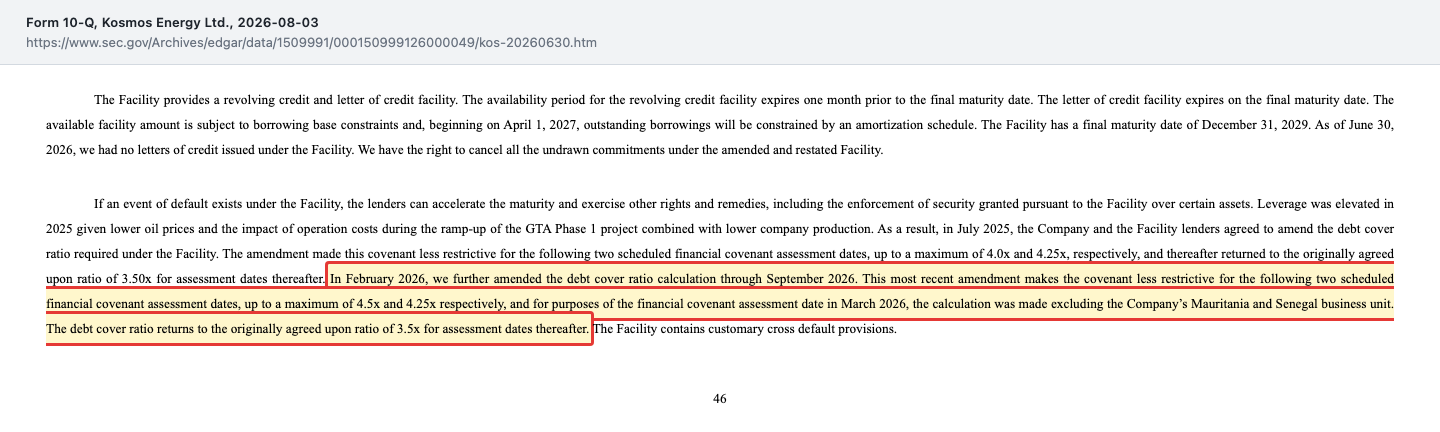
The subordinate clause is especially telling: for the March 2026 test date, the entire LNG business was taken out of the calculation. On top of that, lenders waived an interest reserve until March 2026 and then halved it until the September 30, 2026 test date. According to the quarterly report, Kosmos complied with the covenants — explicitly “as amended,” in other words in the loosened version. The bar was lowered. For the September 30, 2026 test date the loosened 4.25x limit still applies, then 3.5x again. Whether Kosmos met the September test will only show in the quarterly report as of September 30, 2026; through October 15, 2026, Kosmos had filed no current report (8-K) on it, nor on the refinancing. At the same time, the facility is to be renegotiated; the earnings release of August 3, 2026 says: “The process to re-finance the facility with our lending banks has now commenced, targeting completion by the fourth quarter.” In short: Whether the refinancing succeeds on similar terms is an open question.
Uncomfortable truth No. 3: Shareholders helped pay down the debt
A large part of the debt reduction in the first half of 2026 came not from the oil business but from shareholders. In March 2026, Kosmos issued new shares:
“On March 10, 2026 the Company launched and priced a registered underwritten public offering of 112.1 million shares of common stock, par value $0.01, resulting in net proceeds to Kosmos of approximately $206.4 million.”
— Kosmos Energy Ltd., SEC quarterly report 10-Q as of June 30, 2026, Note 13 (earnings per share)
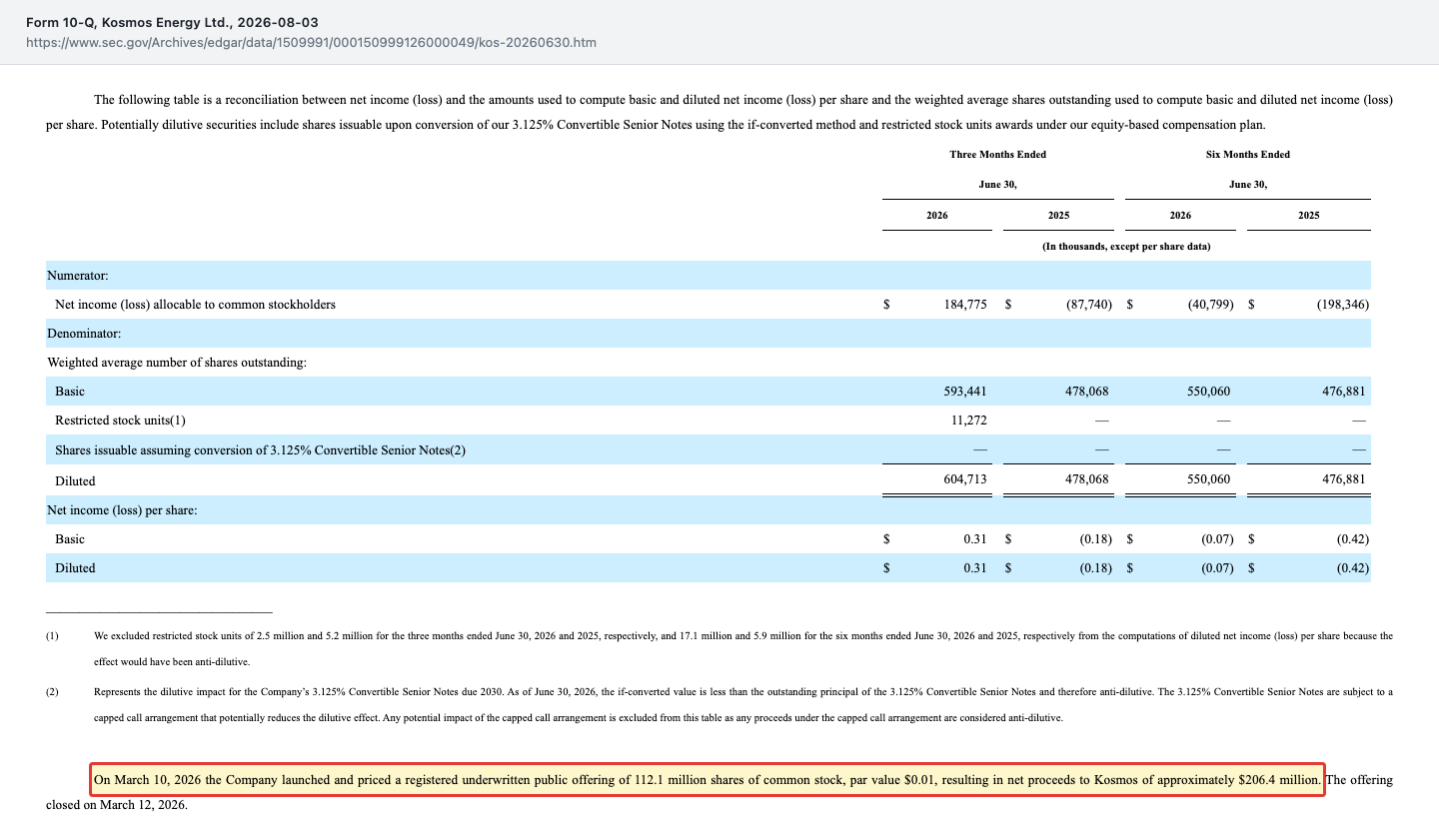
According to the prospectus supplement, the price per new share was $1.90 — 21 percent below the last reported price of $2.41 on March 10, 2026. The proceeds were explicitly earmarked for repaying debt. For you as an existing shareholder, that means your share of the company shrank — and the new shares went out 21 percent below the last market price. Debt did fall, but a good part of that repayment was paid for by the shareholders. The number of shares outstanding rose from 478.3 million on December 31, 2025 to 595.5 million on July 30, 2026 — about 24 percent more. To be fair: according to the prospectus, directors and officers had agreed to buy about 3.7 million of the new shares at the same price. And the quarterly report does not rule out more steps of this kind:
“We may seek to sell assets, equity or debt securities or obtain additional bank credit facilities. The sale of equity securities could result in dilution to our shareholders.”
— Kosmos Energy Ltd., SEC quarterly report 10-Q as of June 30, 2026, Item 2 (capital expenditures)
In the background sits a $400 million convertible note due 2030. It can be converted into shares at about $7.02 per share — far above the current price, which is why it does not currently count as dilutive.
Uncomfortable truth No. 4: The hedges cost money exactly when oil prices helped
Oil producers hedge part of their future production against falling prices — like insurance. Kosmos does that too. The catch: insurance costs money when the damage never comes. As oil prices rose in the first half of 2026, the hedges went deep into the red:
“During the six months ended June 30, 2026 and 2025, we recorded a loss of $200.2 million and a gain of $14.8 million, respectively, on our outstanding hedge positions.”
— Kosmos Energy Ltd., SEC quarterly report 10-Q as of June 30, 2026, Item 2 (results of operations, “Derivatives, net”)
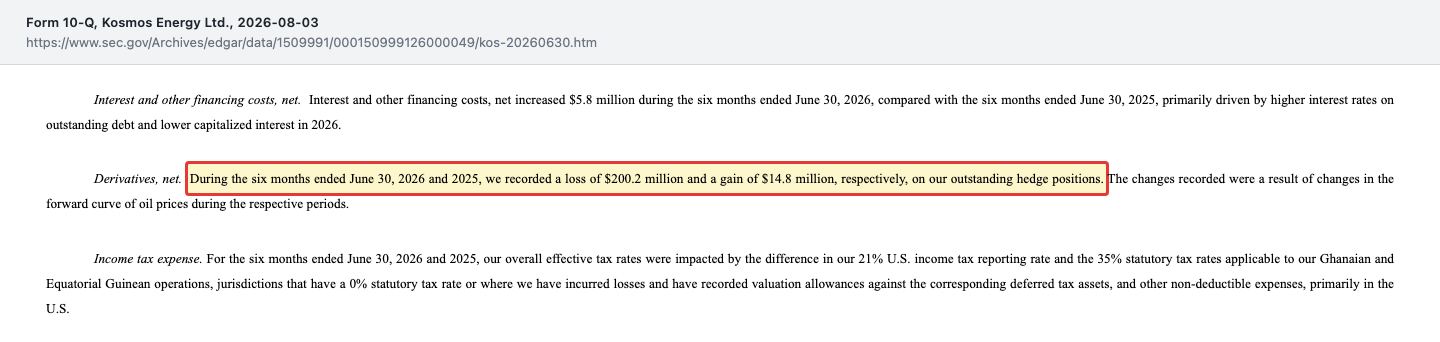
This is not just an accounting entry: $135.7 million actually went out the door in cash in the first half of 2026, $105.4 million of it in the second quarter. In the second quarter, Kosmos realized an average of $108.57 per barrel of oil; after hedge payments, revenue per barrel of oil equivalent was $71.64 instead of $86.68. And Kosmos used the high prices to add hedges for 2027: 7.0 million barrels are hedged with a floor of about $67 and a ceiling of about $84. In the first quarter of 2026, the hedges even pushed Kosmos to a net loss of $225.6 million — including a $252.0 million loss on hedges (line “Derivatives, net”). Keep in mind: If you buy Kosmos as a pure oil price bet, you are buying a bet whose upside the company has partly sold off itself.
Valuation: cheap on operations, expensive on debt
At the closing price of October 14, 2026 ($2.71), Kosmos was worth about $1.61 billion on the stock market, based on 595.5 million shares (as of July 30, 2026). But anyone buying the whole company would also have to take on net debt of $2.56 billion. That puts enterprise value at about $4.2 billion — debt accounts for about 61 percent of it. Measured against EBITDAX for the twelve months to June 30, 2026 ($789.7 million), the market pays about 5.3 times — on its own not a figure that looks stretched. A price-to-earnings ratio cannot be calculated meaningfully, because Kosmos lost $542.2 million on the bottom line over those twelve months. Book value per share is about $1.18; the stock trades at about 2.3 times that.
Here the leverage trap shows its other side: because the debt is fixed, every change in enterprise value hits the stock more than two and a half times as hard. If enterprise value rises 10 percent (about $420 million), the entire gain goes to shareholders — on a $1.61 billion market value that is mathematically about 26 percent more (4.2 divided by 1.61 gives a factor of 2.6). And vice versa. Wall Street is split: of 13 analysts whose ratings appear in the fundamental data, 6 rate the stock a buy, 4 a hold and 3 a sell; the average price target is about $3.01 (as of October 15, 2026). An average means all targets added up and spread evenly — a single very high or very low target pulls it noticeably. That is a third-party figure for context, not a price target of ours. How another small, indebted oil producer handles its dependence on oil prices is something we looked at in our analysis of Ring Energy.
Upside and risks at a glance
What speaks for Kosmos Energy:
- Strong production base: about 71,400 barrels of oil equivalent per day in the second quarter of 2026 (up 12 percent); new Jubilee wells are expected to lift the field’s gross output above 90,000 barrels per day (company statement of Aug. 3, 2026).
- LNG as a second pillar: Greater Tortue lifted 18.5 gross cargos in the first half of 2026; operating costs per barrel are on track to fall by more than half in 2026.
- Leverage to the upside: the second quarter of 2026 brought $607.3 million of revenue, $184.8 million of net income and $88.9 million of free cash flow; net debt fell by $419.1 million in the half year.
- A cleaner portfolio: sale of the Equatorial Guinea fields (about $127 million in cash plus up to about $40 million of contingent payments), a partner found for the Tiberius project in the U.S. Gulf.
- Moderate valuation of the operations: enterprise value of about 5.3 times trailing twelve-month EBITDAX.
What speaks against it:
- Heavy debt: $2,719.7 million of principal against $704.9 million of equity (June 30, 2026); earnings before interest and taxes did not cover interest in 2025 or in the twelve months to June 2026.
- Covenants loosened twice, a return to 3.5x after Sept. 30, 2026, refinancing of the bank facility targeted by the fourth quarter; a maturity wall of $718.9 million in 2028.
- Dilution: 112.1 million new shares at $1.90 in March 2026, about 24 percent more shares; further capital raises are possible according to the report.
- Hedges cost money when prices rise: a $200.2 million loss in the first half of 2026, and 7.0 million barrels are capped for 2027.
- Exploration risk: write-downs and exploration expense of more than $400 million combined in 2025 (Winterfell, Yakaar-Teranga); the accumulated deficit since inception stands at $1,823.1 million.
A human conclusion
Back to the leverage trap from the beginning. Its core is not that the rally is wrong — it has real reasons: higher oil prices, more production from Ghana, LNG that is finally flowing and a quarter with $184.8 million of net income. Its core is that a rising curve makes you forget that the lever works both ways. At Kosmos this lever is especially long: almost four dollars of debt for every dollar of equity, covenants that were loosened twice, and a shareholder base that was just diluted by a quarter so the debt could shrink.
So the honest question for you is not “Will oil keep rising?” but: Would you hold this stock even if oil prices fall while Kosmos is negotiating its credit facility with its banks? If you can justify a yes, you have a thesis. If all you have in mind is the near-quadrupling, you had a chart. What you do with it is your decision. And that is how it should be.
Sources
All original documents used in this analysis — so you can check them yourself:
- Kosmos Energy Ltd. — SEC quarterly report 10-Q as of June 30, 2026 (filed Aug. 3, 2026)
- Kosmos Energy Ltd. — SEC quarterly report 10-Q as of March 31, 2026 (filed May 5, 2026)
- Kosmos Energy Ltd. — SEC annual report 10-K for 2025 (filed March 2, 2026)
- Kosmos Energy Ltd. — SEC annual report 10-K for 2024 (filed Feb. 24, 2025)
- Kosmos Energy Ltd. — Q2 2026 earnings release, exhibit 99.1 to the 8-K of Aug. 3, 2026
- Kosmos Energy Ltd. — 424B5 prospectus supplement for the share offering (filed March 12, 2026)
- Kosmos Energy Ltd. — Release on the sale of the Equatorial Guinea fields, exhibit 99.1 to the 8-K of Feb. 24, 2026
- Kosmos Energy Ltd. — 8-K of Sept. 8, 2026 and 8-K of Sept. 21, 2026 (partial redemptions of the 2027 notes)
- Full SEC filing history: EDGAR overview (sec.gov)
- Fundamental data (prices, analyst ratings; as of Oct. 15, 2026), cross-checked against the SEC filings and the SEC’s XBRL data. Another oil producer in our archive: our analysis of APA Corporation.
Transparency & disclaimer: This analysis is a journalistic assessment of publicly available information. It is not investment advice, not a financial analysis in the regulatory sense and not a solicitation to buy or sell securities. Investing in stocks involves substantial risk, up to and including the total loss of capital. All information without guarantee; data dates are noted in the text. Positions held by the operator are disclosed daily; where one exists, it appears as a notice at the top of this deep dive.
Key figures at a glance
All monetary figures in millions of $; earnings per share as reported.
| Metric | 2021 | 2022 | 2023 | 2024 | 2025 |
|---|---|---|---|---|---|
| Revenue | 1,332.0 | 2,245.4 | 1,701.6 | 1,675.4 | 1,297.8 |
| Operating Income (EBIT) | 355.5 | 1,106.0 | 718.7 | 471.2 | -270.9 |
| Net Income | -77.8 | 226.6 | 213.5 | 189.9 | -699.8 |
| Net Margin | -5.8% | 10.1% | 12.5% | 11.3% | -53.9% |
| Earnings Per Share | -0.19 $ | 0.48 $ | 0.44 $ | 0.40 $ | -1.46 $ |
Source: fundamental data & SEC filings (annual and quarterly reports, 10-K/10-Q)
Our Bottom Line at a Glance
- Production base & projects positive
- About 71,400 barrels of oil equivalent per day in the second quarter of 2026 (up 12 percent); new Jubilee wells and the Greater Tortue LNG project (18.5 gross cargos in the first half of 2026) support production; proved reserves of 249 million barrels of oil equivalent as of Dec. 31, 2025.
- Earnings power neutral
- Heavily dependent on oil prices: since 2019, profits only in 2022 through 2024, a $699.8 million loss in 2025 (including a $177.6 million impairment and $223.6 million of exploration expense); in the second quarter of 2026, by contrast, $184.8 million of net income and $88.9 million of free cash flow.
- Leverage & interest coverage negative
- $2,719.7 million of debt against $704.9 million of equity (June 30, 2026). Earnings before interest and taxes did not cover interest in 2025 (about −$411 million versus $223.4 million) or in the twelve months to June 30, 2026 (our calculation about −$206 million versus $229.3 million).
- Covenants & refinancing negative
- Lenders loosened the debt cover ratio in July 2025 and February 2026, and in March 2026 the test even excluded the LNG business; after Sept. 30, 2026, 3.5x applies again. The bank facility ($773 million drawn) is to be refinanced by the fourth quarter of 2026; $718.9 million comes due in 2028.
- Shareholder base & dilution negative
- Share offering in March 2026: 112.1 million shares at $1.90, 21 percent below the last price, proceeds used to repay debt; share count up 24 percent to 595.5 million. The accumulated deficit since inception stands at $1,823.1 million.
Kosmos Energy is the leverage trap in its purest form: the stock rose from a closing low of $0.87 (Dec. 26, 2025) to $3.27 (May 4, 2026), carried by higher oil prices, more production and a quarter with $184.8 million of net income. Underneath sit $2,719.7 million of debt against $704.9 million of equity, earnings before interest and taxes that did not cover interest in 2025, covenants loosened twice and a share offering that increased the share count by 24 percent. Not investment advice.
What Our Rating Means
Substance risk
We found at least one documented issue that threatens the company itself — regardless of how the stock is currently valued.
The fields are real and the second quarter of 2026 was strong — but here the balance sheet decides the quality question. Interest coverage below 1 is documented: earnings before interest and taxes did not cover interest costs in 2025 or in the twelve months to June 2026, the covenants were loosened twice and, according to the report, met in their loosened form, and debt is almost four times equity. The filings contain no going-concern warning; liquidity stood at more than $500 million as of June 30, 2026. If you are waiting, check the quarterly report as of Sept. 30, 2026: Did Kosmos meet the loosened 4.25x limit at that test date, how close is the ratio to the 3.5x that applies afterwards, does the bank facility refinancing succeed, and how much do the hedges cost? The decision is yours.
A journalistic assessment by our editorial team at the time of the deep dive, based on public sources — not investment advice and not a solicitation to buy or sell. Your personal circumstances (investment goals, risk capacity, taxes) cannot be taken into account. What our levels mean, how verdicts are formed, and what conflicts of interest exist →
Worth Noting
- Kosmos Energy made our research list through the in-house Reddit hype scanner (flagged in October 2026). The latest periodic report is the 10-Q as of June 30, 2026 (filed Aug. 3, 2026); all current reports through Sept. 21, 2026 have been reviewed. The quarterly report as of Sept. 30, 2026 was not yet available on Oct. 15, 2026.
- Market value (about $1.61 billion) calculated from 595,487,651 shares (as of July 30, 2026) and the closing price of Oct. 14, 2026 ($2.71); cross-check: the last price cited in a filing ($2.41 on March 10, 2026, 424B5 prospectus supplement) is of the same order of magnitude. Enterprise value = market value plus net debt of $2,563.4 million (excluding the $73.2 million lease liability for the TEN production vessel).
- Earnings before interest and taxes (EBIT) are our own calculation from the SEC filings: 2025 pre-tax loss of −$634.6 million plus interest expense of $223.4 million; twelve months to June 30, 2026 pre-tax loss of −$435.4 million plus interest expense of $229.3 million. EBITDAX ($789.7 million) is a company measure without a U.S. GAAP definition. Note: the filings call the U.S. Gulf the “Gulf of America.”
- The analyst ratings (13 ratings, average price target about $3.01, as of Oct. 15, 2026) are a third-party figure for context, not a price target of ours.
Stock Watch
This analysis is as of October 15, 2026. Stock Watch will tell you what's changed at KOS since then.
Later $1 a month per stock — signing up is free, and you'll be the first to know when it launches.
The full analysis as a PDF for later
We will send you this analysis as a PDF — to print, file away, and read at your own pace. And we will add you to the free Stock Watch list for Kosmos Energy Ltd (KOS), so you hear about it when something material in this analysis changes.
Frequently Asked Questions
Kosmos Energy Ltd. (NYSE: KOS) of Dallas, Texas, produces oil and gas in deep water: offshore Ghana (Jubilee at 38.6 percent, TEN at 20.4 percent), LNG from the Greater Tortue Ahmeyim project offshore Mauritania and Senegal (about 27 percent) and oil in the U.S. Gulf. Production averaged about 71,400 barrels of oil equivalent per day in the second quarter of 2026. Kosmos was founded in 2003 and had 216 employees at the end of 2025.
The stock rose from a closing low of $0.87 (Dec. 26, 2025) to $3.27 (May 4, 2026). Over that period the realized price per barrel of oil equivalent climbed from $55.81 in the first quarter to $86.68 in the second quarter of 2026, production grew and Kosmos cut net debt by $419.1 million in the first half. In the second quarter of 2026, net income was $184.8 million.
As of June 30, 2026, Kosmos had $2,719.7 million of debt (principal) and $2,563.4 million of net debt, against $704.9 million of equity. The largest items are the bank facility ($773 million drawn), notes with 7.5 and 8.75 percent coupons, a $400 million convertible note and $350 million of secured bonds at 11.25 percent. About $718.9 million comes due in 2028.
Yes. In March 2026 Kosmos sold 112.1 million new shares at $1.90 each, 21 percent below the last price of $2.41. The net proceeds of about $206.4 million went toward repaying debt. The share count rose from 478.3 million (Dec. 31, 2025) to 595.5 million (July 30, 2026), about 24 percent more. According to the prospectus, directors and officers had agreed to buy about 3.7 million of the new shares.
Kosmos hedges part of its production against falling oil prices. When prices rise, these hedges lose value. In the first half of 2026, Kosmos booked a $200.2 million loss on them, and $135.7 million was paid in cash. For 2027, 7.0 million barrels are hedged with an average ceiling of about $84 (as of Aug. 3, 2026).
At the closing price of Oct. 14, 2026 ($2.71), the market value was about $1.61 billion and enterprise value including net debt about $4.2 billion. That is about 5.3 times EBITDAX for the twelve months to June 30, 2026 ($789.7 million). There is no price-to-earnings ratio because of the $542.2 million loss over that period; the stock trades at about 2.3 times book value.
Found an error?
Did you spot a factual error, an outdated number, or a typo in this deep dive? Let us know briefly — your report goes straight to the editorial team.