Ring Energy: what is left of the oil price once the bank and the hedges are paid
Ring Energy pumps around 20,000 barrels of oil equivalent a day in the Texas Permian Basin, with 111 full-time employees. In the second quarter of 2026 it realized $95.45 for every barrel of oil, the best price in years. In that same quarter it lost $18.5 million on settled hedges, paid $5.20 per thousand cubic feet to get rid of its natural gas, and had just issued 51.1 million new shares at $1.35 — 18 percent below the last reported market price. The half year ended with a $155.8 million loss and a retained earnings line wiped out. No recommendation — only the question of how much of $95 a barrel actually reaches a shareholder.
 Thomas Mücke
Founder & Publisher
Thomas Mücke
Founder & Publisher
As of Today
As of: September 17, 2026
- Closing price
- 1.50 $ -1.40%
- Market Capitalisation
- 0.4 $B
- Growth Score
- 3/10
- AAQS
- 4/10
Price change since September 8, 2026: -1.3%
This analysis has a cut-off date. The Stock Guard tells you when something material changes in the numbers. Reserve your free spot
Chart
Interactive price chart (TradingView).
52-week range: 0.8378 $ to 2.00 $ · Last price: 1.50 $ (As of: September 17, 2026)
Note: pure fact-based analysis, not investment advice and not a solicitation to buy or sell. All figures without guarantee.
There is a calculation lodged in the head of every commodity investor, and it is so simple that it rarely gets questioned: if the oil price jumps by half, a small oil stock has to go through the roof. Call it the leverage fantasy. It has a true core — small producers carry fixed costs and really do respond more sharply to price than the majors do. It also has a blind spot. Between the price the exchange quotes for a barrel of oil and the money that reaches a shareholder sit three parties who get paid first.
Ring Energy is an unusually clear illustration. In the second quarter of 2026 the company received an average of $95.45 for every barrel of oil — a price oil producers had dreamed about for years. In that same quarter it lost $18.5 million on settled hedges, paid $5.20 per thousand cubic feet to have its natural gas taken away rather than being paid for it, and had weeks earlier issued 51.1 million new shares at $1.35, while the last reported market price stood at $1.65.
The deal for this piece: we read the actual filings to the U.S. securities regulator, the SEC — the annual report on Form 10-K for 2025 and the quarterly report on Form 10-Q for the period ended June 30, 2026 — and find out exactly where the oil price gets diverted on its way to the shareholder. By the end you will know what this company earns and who gets paid from it first. What you do with that is your business.
What Ring Energy actually does — 111 people, 919 wells and a single basin
Ring Energy, Inc. is an oil and gas producer in the simplest form imaginable: no refinery, no filling stations, no pipeline arm, no chemicals division. The company owns production rights, drills holes, pumps oil out and sells it. That is the whole business.
All of it happens in the Texas portion of the Permian Basin, the region in West Texas and New Mexico that supplies a substantial share of American oil output. Ring works two areas there: the Central Basin Platform (Crane, Winkler, Ward, Ector and Andrews counties) and the Northwest Shelf (Yoakum County in Texas, Lea County in New Mexico). As of December 31, 2025 the company held rights to 111,714 gross acres — 96,234 net of third-party interests — and interests in 919 gross producing wells, operating the large majority itself.
One number from the annual report puts the scale in perspective: Ring employed 111 people full time at that same date. Just over a hundred employees plus independent contractors move roughly 20,000 barrels of oil equivalent a day. This is not a corporation, it is a mid-sized operation with a very large balance sheet.
A quick word on the unit that recurs throughout this piece. A barrel of oil equivalent (Boe) converts oil, natural gas and natural gas liquids into one common energy measure — six thousand cubic feet of natural gas count as one barrel of oil. At Ring, second quarter 2026 production was 63 percent oil, 20 percent natural gas liquids and 16 percent natural gas — calculated from the volumes in the quarterly report for the period ended June 30, 2026 (1,154,147 barrels of oil, 1,764,659 thousand cubic feet of natural gas and 370,819 barrels of natural gas liquids, 1,819,076 barrels of oil equivalent in total). That is an oil-heavy mix, which is fortunate, because as we will see the natural gas in this region is currently not a business but a burden.
The reserve base is solid: 153.3 million barrels of oil equivalent proved as of December 31, 2025, up 14 percent year over year. Measured against 2025 production of roughly 7.4 million barrels of oil equivalent, that is a reserve life of a little over two decades. The independent petroleum engineers Cawley, Gillespie & Associates put the pre-tax value of those reserves, discounted at 10 percent, at $1,318.2 million.
That frames the central tension of this analysis, and it runs through every chapter: an operation with its costs under control that, by its own account, has taken in more than it spent for 27 straight quarters — set against a capital structure that hands every upswing first to the banks and then to new shareholders.
Company history for investors
-
2019
Entry into the Northwest Shelf
Ring bought 49,754 gross acres in Yoakum County and Lea County. A one-area producer became a two-area producer — and the debt load started to climb.
-
2022
Stronghold acquisition (August)
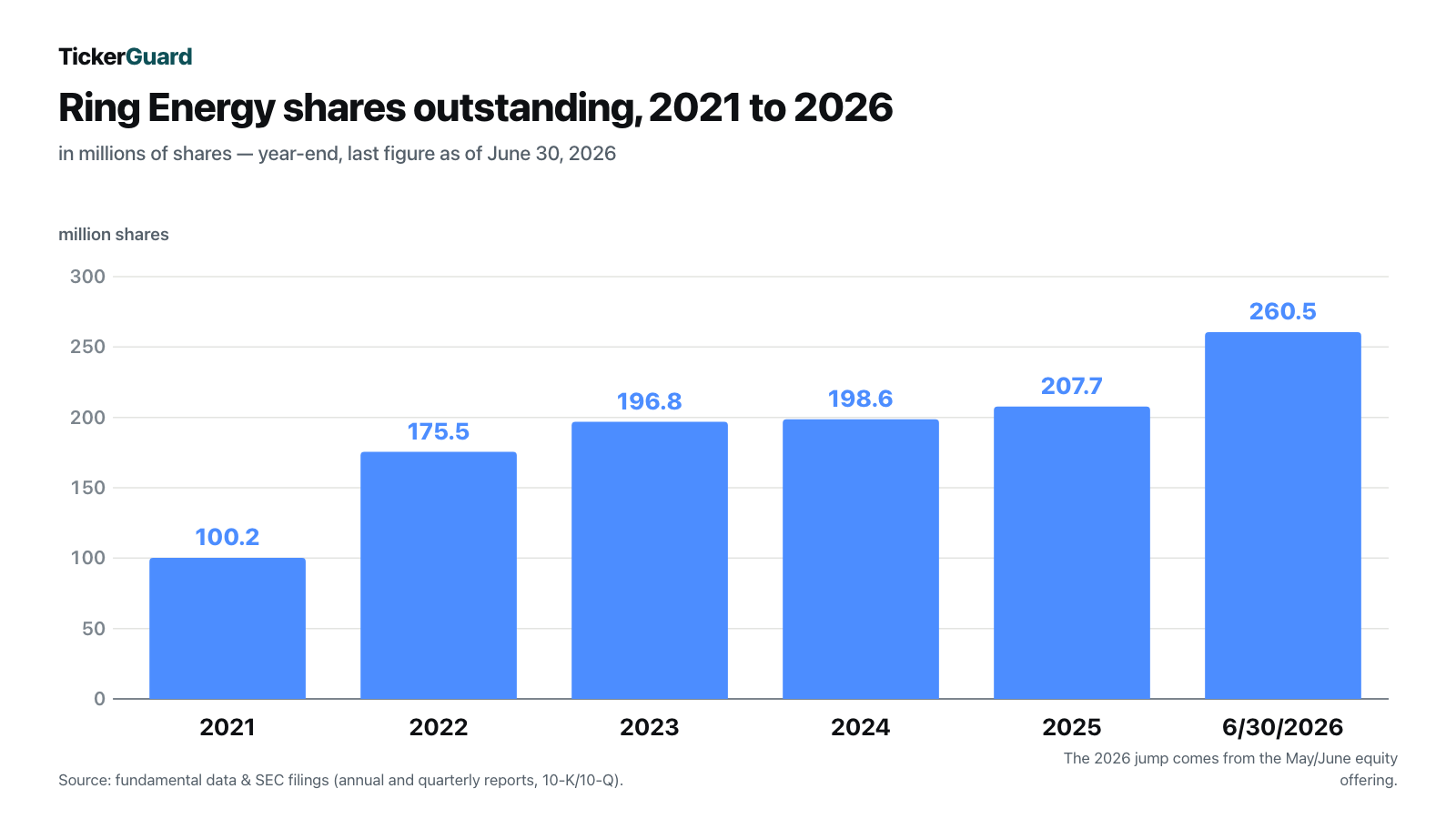
Roughly 37,000 net acres on the Central Basin Platform, paid partly in stock. Shares outstanding jumped from 100.2 million to 175.5 million within a year — the first big dilution step.
-
2025
Lime Rock acquisition (March 31)
For $88.7 million, of which $78.7 million in cash and 6,452,879 shares. For holders that meant more acreage in Andrews County, but also more debt and a few percent less ownership.
-
2025
New credit facility with Bank of America (June 18)
A $585 million borrowing base running to June 2029. Maturity risk was pushed out for years — the price is a covenant package, including a duty to hedge.
-
2026
First annual loss since 2020 (March 4)
The 2025 annual report showed a $34.7 million loss after a $108.8 million write-down on the properties. Five profitable years ended in a break of trend.
-
2026
Equity offering at $1.35 (May 14 and June 12)
51,111,111 new shares, 18 percent below the last reported market price. Anyone already invested owned roughly a fifth less of the company for the same money afterwards.
-
2026
Quarterly report at $95.45 per barrel (August 5)
The highest realized oil price in years and borrowings cut to $360 million — alongside an $18.5 million loss on settled hedges in the very same quarter.
How the stock reached our desk — through a Reddit list, not a screening metric
Ring Energy did not arrive on the research list through a valuation or momentum hit from our in-house stock scanner, but through a watchlist built on a decidedly unscientific criterion: the scanner “Reddit Hot Stocks”. It collects smaller U.S. stocks between $50 million and $2 billion of market capitalization that are discussed unusually often in investor forums. An entry there is explicitly not a buy signal — it is a sentiment signal: a lot of people are looking here right now.
Why that is still a good reason to open the filings becomes clear when you line the price up against the numbers. The stock closed at $1.52 on September 8, 2026, roughly 75 percent above where it started the year; the twelve-month range ran from $0.83 to $2.00 (data as of September 8, 2026). In the same calendar year the company reported a $155.8 million loss for the first half. When price and result diverge that far, either an expectation is running ahead of the figures or an accounting entry is distorting them. Here it is both, and both can be looked up.
A second data point belongs alongside, because it shows how contested the name is. As of September 8, 2026, 10.15 million shares were sold short, roughly 4.0 percent of the float. Selling short means borrowing shares, selling them and hoping to buy them back cheaper later. Four percent is not an extreme reading — but it says the opposite view exists. Readers who follow commodity producers will find a related pattern in our analysis of SandRidge Energy, another small American oil and gas producer.
The numbers over the years — given their due
Start with what genuinely works, and at Ring that is more than the loss line suggests.
The operation brings money in. Cash from operations was roughly $198.2 million in 2023, $194.4 million in 2024 and $150.8 million in 2025. The first half of 2026 added $66.7 million, against $61.7 million a year earlier. That is real money, not an accounting entry. Chief executive Paul D. McKinney spoke in the August 5, 2026 earnings release of the 27th consecutive quarter of positive adjusted free cash flow.
Costs are falling. Lease operating expense — everything it takes to keep an already drilled well running — fell from $11.11 to $10.26 per barrel of oil equivalent in the first half of 2026, down 8 percent. In the second quarter of 2026 it stood at $10.12, near the low end of the company's own guidance. For a producer working mostly older conventional reservoirs, that is a good number.
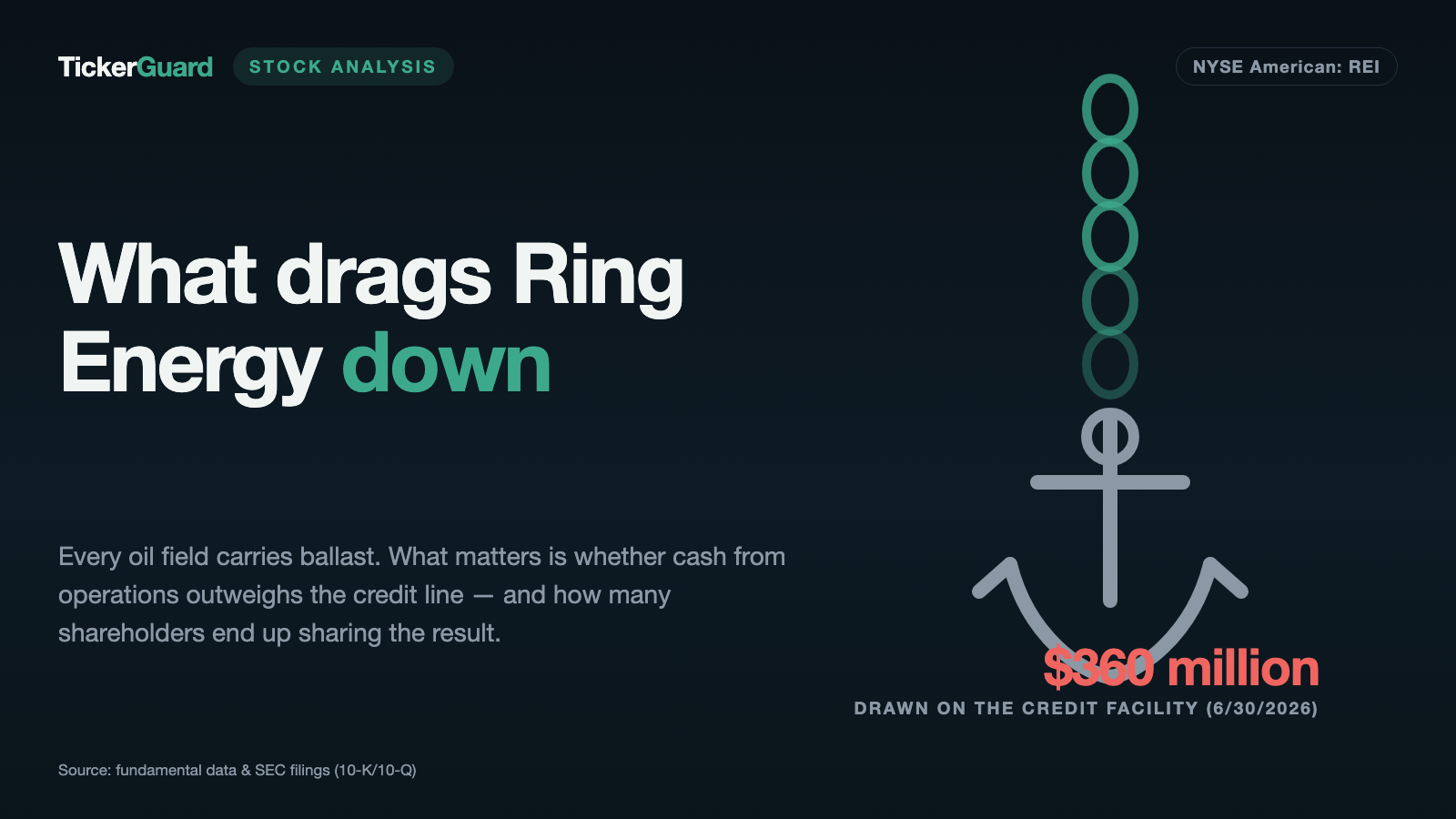
Debt came down. Borrowings under the credit facility stood at $420 million on December 31, 2025 and even $426 million on March 31, 2026 — and at just $360 million on June 30, 2026. In the second quarter of 2026 alone, $66 million was repaid.
And then there is the other side.
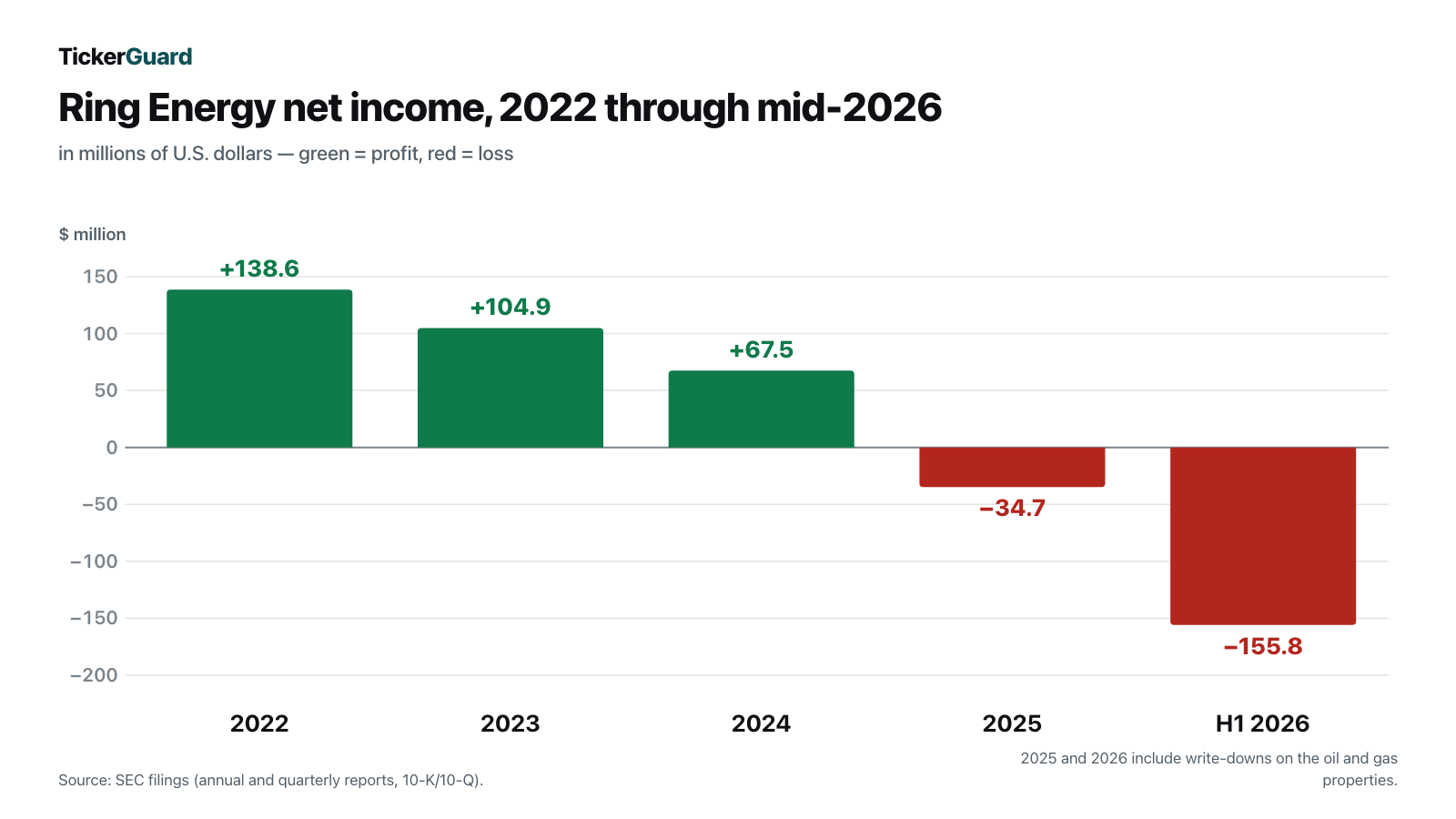
Revenue was remarkably stable for years: $347.2 million (2022), $361.1 million (2023), $366.3 million (2024) — and then just $307.2 million in 2025, down 16 percent. The reason was price, not volume: Ring actually produced slightly more in 2025 than the year before and received less for it.
That lower average price is exactly what triggered the first write-down, and the mechanism behind it is central to understanding this stock. Ring reports under the American full cost method: all acquisition, exploration and development costs are capitalized into the balance sheet. That carrying value may not exceed a calculated ceiling — the present value of future net revenues discounted at 10 percent, computed with the unweighted average price of the preceding twelve months. When that trailing average falls, the ceiling falls, and everything above it has to be written off.
An everyday picture: imagine your house being revalued every quarter, not at today's price but at the average price of the past year. If the market surges today, that only helps you with a delay. If it drops, it hits you with a delay. That is precisely what happened to Ring in 2025 and early 2026: $108.8 million of write-downs in fiscal 2025 and $162.1 million in the first quarter of 2026, $270.9 million over fifteen months. In the second quarter of 2026, when the realized oil price jumped to $95.45, there was no write-down at all.
It matters to read this correctly: no cash leaves the company in such a write-down. It reduces book value and equity, not the bank account. But it is not a costless accounting quirk either — it says the properties were bought or developed too expensively relative to what they could earn at the prices then prevailing.
One figure makes the effect visible. Retained earnings — the profit accumulated over the company's life, less all distributions — stood at positive $29.0 million on December 31, 2025. By June 30, 2026 it had become an accumulated deficit of $126.8 million. Put plainly: everything Ring has ever earned has, on paper, been consumed. Its $753.4 million of equity therefore consists almost entirely of capital paid in by shareholders, not of profits earned.
What the filings say — the uncomfortable truths
Uncomfortable truth no. 1: the lender demands exactly the hedging that caps the upswing
This is where the leverage fantasy comes apart. Ring realized $95.45 per barrel of oil in the second quarter of 2026, after $68.97 in the prior quarter and $62.69 a year earlier — a 52 percent jump in twelve months. And in that same quarter the income statement carried a realized loss on derivative contracts of $18.5 million; for the first half of 2026 it was $23.7 million.
Why? Because a large share of production had long been sold forward at lower prices. The hedge table in the Form 10-Q for the quarter ended June 30, 2026 lists swaps covering 263,400 barrels for the third quarter of 2026 at an average of $61.77 and 529,000 barrels for the fourth quarter at $65.34. On top of that sit two-way collars whose ceilings stand at $76.19 and $80.00. Above those levels Ring earns nothing more on the barrel in question. The earnings release sums it up as of August 4, 2026: roughly 1.7 million barrels of oil hedged for July through December 2026, about 70 percent of the company's own guidance midpoint, at an average upside protection price of $71.47.
You might read that as a management error. It is not — it is a lender's requirement. The credit agreement says so in as many words:
“The Company is required to maintain on a rolling 24 months basis, hedging transactions in respect of crude oil and natural gas, on not less than 50% of the projected production from its proved, developed, and producing oil and gas.”
— Ring Energy, Form 10-Q for the quarter ended June 30, 2026, Note 8
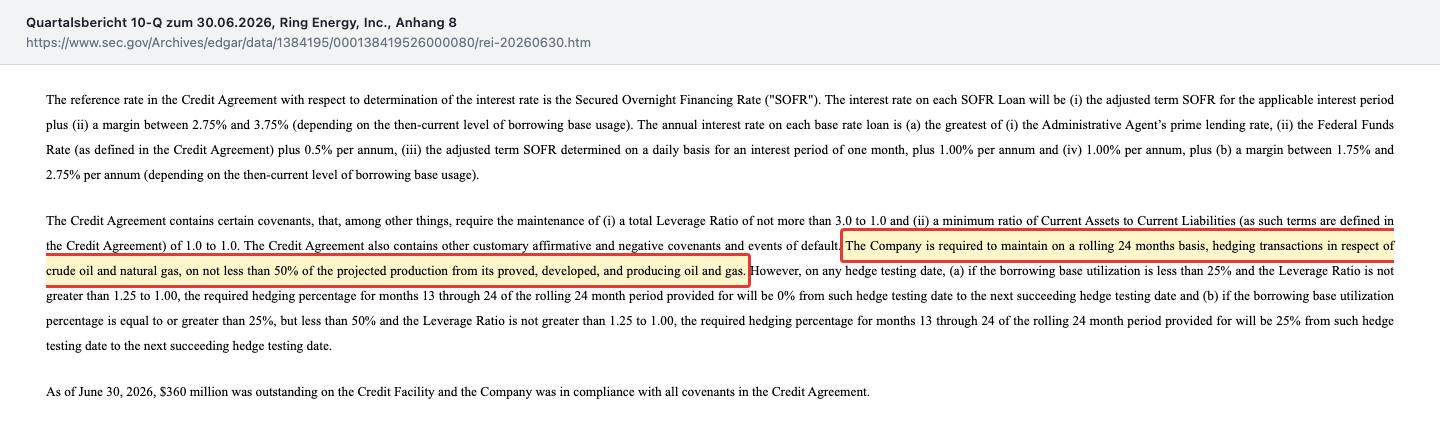
Hold on to that link, because it applies to every leveraged small producer: whoever needs a bank's credit facility sells part of the price upside along with it. Hedging protects the interest payment in bad years — and costs exactly the upswing that many investors bought the stock for in good ones.
A second price effect compounds it, and this one is worse because it has nothing to do with hedging. The average realized price for natural gas in the second quarter of 2026 was minus $5.20 per thousand cubic feet, after minus $2.54 in the prior quarter and minus $1.31 a year earlier. A negative price means literally that Ring pays for someone to take the gas. The cause is location: in the Permian Basin natural gas arrives as a by-product of oil production, takeaway capacity is scarce, and the regional benchmark regularly slips below zero. On 1,764,659 thousand cubic feet of gas sold in the quarter, that works out to a drag of roughly $9.2 million — against quarterly revenue of $104.7 million.
Uncomfortable truth no. 2: 51 million new shares below market, and the money went to the lenders — affiliates of the underwriters among them
On May 12, 2026 Ring announced an equity offering. On May 14 it placed 44,444,445 shares at $1.35 each; on June 12 the underwriters exercised their option for a further 6,666,666 shares at the same price. Together that is 51,111,111 new shares, $69.0 million gross and $64.5 million net.
The prospectus supplement names the yardstick on its own cover page: the last reported sale price was $1.65 on May 11, 2026. The placement went out at $1.35 — an 18 percent discount. Dilution in everyday terms means your slice of the cake gets smaller even though the cake stays the same size. Here the slice not only shrank, it was also sold below the market price.
Where did the money go? The prospectus is unambiguous: to repay borrowings under the revolving credit facility. And it says one more thing that is easy to skim past, in a paragraph headed “Conflicts of interest”:
“Affiliates of certain underwriters will receive at least 5% of the net proceeds of this offering as a result of the repayment of borrowings we incurred under our credit facility.”
— Ring Energy, Prospectus supplement 424B5 of May 14, 2026, “Use of Proceeds”

Take it soberly: this is entirely legal, it is disclosed, and on credit facility paydowns it is the rule rather than the exception. But it describes the pecking order this analysis is about very precisely. Shareholders put in $69 million of fresh money, and it did not land in the drill bits — it landed with the creditors. The chief executive described it openly in the earnings release: the raise let the company strengthen the balance sheet and invest in development at the same time, instead of having to choose.
One forward-looking note belongs here: 450 million shares are authorized. After the placement, 260,539,607 were issued (as of August 5, 2026). That leaves roughly 189 million shares the board could issue without a new shareholder vote. This is not a forecast — only the observation that the room is very wide.
Uncomfortable truth no. 3: the book value was marked down twice in fifteen months
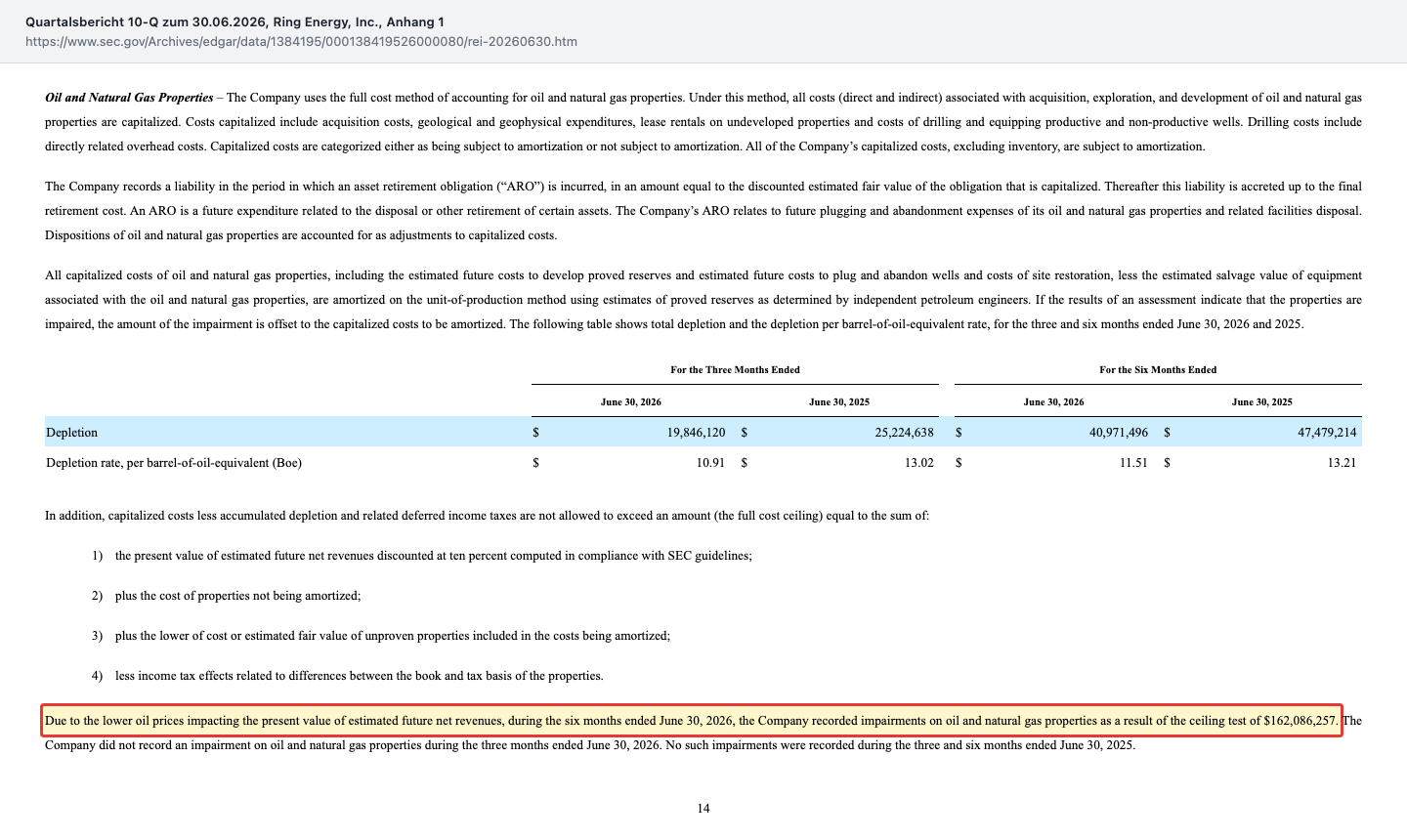
The write-downs are explained above; here is the citation so the claim can be checked. The Form 10-Q for the quarter ended June 30, 2026 puts it this way:
“Due to the lower oil prices impacting the present value of estimated future net revenues, during the six months ended June 30, 2026, the Company recorded impairments on oil and natural gas properties as a result of the ceiling test of $162,086,257.”
— Ring Energy, Form 10-Q for the quarter ended June 30, 2026, Note 1
The net carrying value of properties and equipment — oil and gas properties plus facilities, after accumulated depreciation, depletion and amortization — fell from $1,329.5 million to $1,201.6 million between December 31, 2025 and June 30, 2026. That is the central balance sheet item of this company: 94 percent of total assets of $1,281.6 million.
Uncomfortable truth no. 4: for nine fiscal years, revenue sat in the wrong column
This finding appears in no press release, but in a paragraph of the notes that is easy to turn past. While preparing the first quarter 2026 figures, the company found an error covering fiscal years 2017 through 2025:
“We determined that certain revenues held in suspense deriving from operations during the annual and interim periods for fiscal years 2017 through 2025 were done so in error, and as such the Company made corrections to the prior period financial statements resulting in a decrease to Accounts payable of $7.3 million as of December 31, 2025, an increase to Retained earnings (Accumulated deficit) of $5.7 million as of December 31, 2024 and 2025, and an increase to Deferred income taxes of $1.5 million as of December 31, 2025.”
— Ring Energy, Form 10-Q for the quarter ended June 30, 2026, Note 1 (“Correction of an Immaterial Error”)
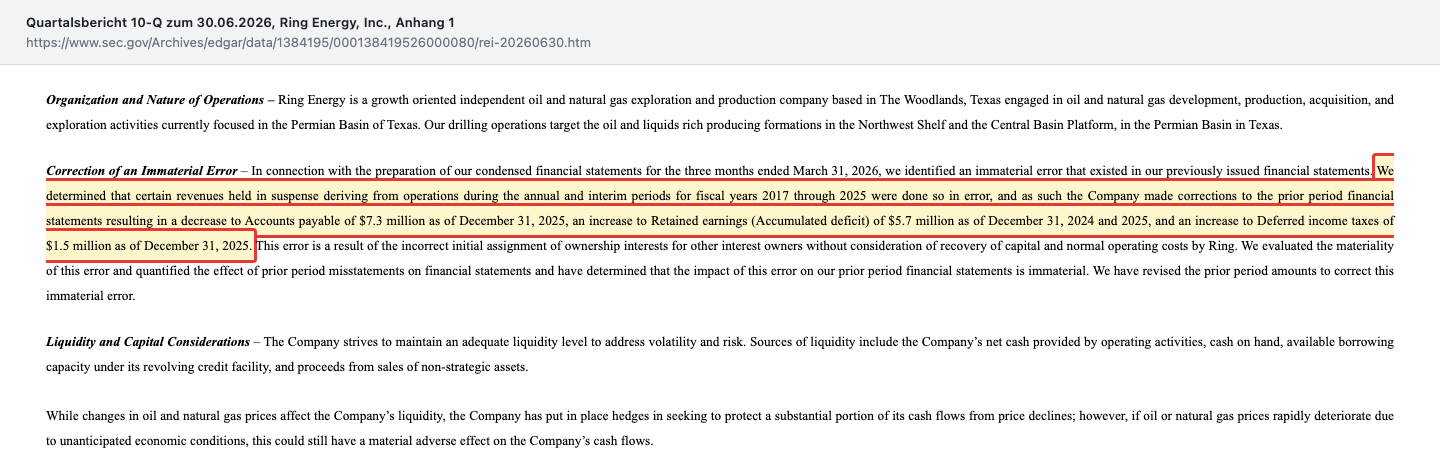
The amounts are small in themselves — Ring explicitly classifies the error as immaterial, and auditor Grant Thornton had issued an unqualified opinion including internal control over financial reporting as of December 31, 2025. Something else is the interesting part: the timing. New chief financial officer Sundip “Sonu” S. Johl took office on February 27, 2026; before that the company had run with an interim finance chief since September 2025. The error surfaced in the first quarterly close under new responsibility. That speaks for the new man rather than against the company — but it also says the error went undetected for nine years.
Valuation — why a price-to-book ratio of 0.5 tells two stories
Every figure in this chapter refers to the price anchor of September 8, 2026 — $1.52 per share — and is deliberately meant as an order of magnitude, not a daily valuation.
At 260,539,607 shares outstanding that gives a market capitalization of roughly $396 million. Adding net debt — $360 million drawn on the facility less $1.1 million of cash at June 30, 2026 — produces an enterprise value of roughly $755 million. That is the price for the whole company, regardless of who financed it.
Against that stands stockholders' equity of $753.4 million, or $2.89 of book value per share. The price-book ratio is therefore about 0.52: the market pays a little over half of what the books say. For an asset play that sounds like a bargain — and this is where the second story begins.
Because that book value is 94 percent oil and gas properties, and those very properties had to be marked down twice within fifteen months, by a combined $270.9 million. A book value that demonstrably depends on the oil price is not a fixed anchor but a snapshot. Anyone reading 0.52 as a margin of safety should know that the same margin shrank twice in 2025 and early 2026.
A third yardstick helps, because it does not depend on book value: the PV-10, the pre-tax present value of proved reserves discounted at 10 percent. It stood at $1,318.2 million as of December 31, 2025. The enterprise value of roughly $755 million therefore equals about 57 percent of that figure. Handle it with care, though: PV-10 uses the same trailing twelve-month average price that triggers the write-downs, and it includes reserves that still have to be developed — 32 percent of the volume is undeveloped and requires future capital that PV-10 deducts but also merely estimates.
There is no price-earnings ratio, because both fiscal 2025 and the first half of 2026 ended in a loss. The trailing price-sales ratio is about 1.3.
And the professionals' view? For this name it barely exists: as of September 8, 2026 the fundamental data carried exactly one recorded analyst rating — a hold, with a price target of $2.08. One voice is an opinion, not a consensus. For a company with just under $400 million of market capitalization that is normal: small companies are barely covered — and what is barely covered moves more when somebody does look.
Upside and risks at a glance
What speaks for Ring Energy:
- Reserves for roughly two decades. 153.3 million barrels of oil equivalent proved as of December 31, 2025, up 14 percent year over year, 68 percent of it already developed. A producer expanding its base rather than depleting it.
- Falling cost per barrel. Lease operating expense fell 8 percent to $10.26 per barrel of oil equivalent in the first half of 2026; company guidance is $10.00 to $10.60 for the second half of 2026 and $9.80 to $10.60 for 2027.
- Dependable cash from operations. $150.8 million in 2025 and $66.7 million in the first half of 2026; by management's account the 27th consecutive quarter of positive adjusted free cash flow.
- Financing secured to June 2029. The borrowing base is $585 million, $360 million is drawn and $226.1 million was available at June 30, 2026; all covenants were met at the reporting date. Nothing falls due before June 2029.
- The shift to longer laterals. Wells longer than 1.5 miles are set to make up roughly 70 percent of the 2026 program, against about 42 percent in the original plan. For 2027 the company plans 20 to 30 such wells and $135 million to $165 million of capital spending, with production growth of roughly 10 percent.
What speaks against it:
- The oil price arrives only muted. Roughly 70 percent of expected second-half 2026 oil sales were capped at an average of $71.47 as of August 4, 2026, while the second quarter realized $95.45. The hedging is a covenant of the credit agreement, not a negotiable choice.
- A negative gas price. Minus $5.20 per thousand cubic feet in the second quarter of 2026 — a drag of roughly $9.2 million in a single quarter, caused by takeaway constraints in the Permian Basin.
- Dilution as a pattern, not an exception. From 100.2 million shares (end of 2021) to 260.5 million (June 30, 2026), most recently at a price 18 percent below the market. 450 million shares are authorized.
- Book value under reservation. $270.9 million of write-downs in fifteen months; retained earnings swung from positive $29.0 million to negative $126.8 million. Further write-downs follow mechanically if the trailing twelve-month average price falls.
- Almost no cash. $1.1 million of cash and equivalents at June 30, 2026. The $226.1 million of liquidity is therefore almost entirely a lending commitment — $225.0 million of undrawn borrowing capacity against $1.1 million of actual money — and the borrowing base is redetermined semi-annually each May and November.
- One basin, two prices, no diversification. There is no second business to cushion a weak oil price. And no dividend either: the 2025 annual report rules out a cash dividend explicitly.
A human bottom line
Back to the leverage fantasy. It is not wrong — it is incomplete. Ring Energy really did benefit from the high oil price in the second quarter of 2026: revenue rose 27 percent year over year, company-adjusted EBITDA rose 42 percent quarter over quarter to $54.5 million, and there was no write-down. The leverage works.
It just does not work where many people expect it to. Part of the upswing went first to the hedge counterparties ($18.5 million in the quarter), then part to the creditors ($66 million of repayment in the same quarter, plus $8.4 million of interest) — and the share reaching each individual legacy holder had by then already been divided across 51.1 million new shares.
A single line sums it up. Ring realized $57.55 per barrel of oil equivalent in total in the second quarter of 2026. After lease operating expense, general and administrative costs, taxes, interest, hedge losses and capital spending, $2.42 of that remained as adjusted free cash flow — $4.4 million spread across 1,819,076 barrels of oil equivalent sold (own calculation from the earnings release of August 5, 2026). Roughly four percent of the revenue.
None of this is an accusation. Every one of those decisions was defensible: hedging carried the company through 2025, and the equity raise relieved the credit facility and funded the shift to longer laterals. A management team that cuts debt and squeezes costs in a loss-making year is doing its job.
But it answers the question of why an oil stock at $95 a barrel does not go where you would have expected. Buying Ring Energy is not buying the oil price. It is buying what is left after the bank, the hedge counterparty and your fellow shareholders — at a price of roughly half of book value, because the market has priced exactly that in.
How much that remainder is worth hangs on a single open question: whether the shift to longer horizontal wells lifts returns on capital far enough that the next price decline does not end in another write-down and another equity raise. The first three two-mile wells in Crane County are being completed in the third quarter of 2026. Their production figures land in the next quarterly report.
What you make of that is your decision. And that is exactly as it should be.
Sources and disclosures
- Ring Energy, Inc. — Form 10-Q for the quarter ended June 30, 2026 (filed August 5, 2026)
- Ring Energy, Inc. — Form 10-Q for the quarter ended March 31, 2026 (filed May 6, 2026)
- Ring Energy, Inc. — Form 10-K for 2025 (filed March 4, 2026)
- Ring Energy, Inc. — Form 10-K for 2024 (filed March 5, 2025)
- Ring Energy, Inc. — second quarter 2026 earnings release (Form 8-K of August 6, 2026, Exhibit 99.1, Item 2.02)
- Ring Energy, Inc. — prospectus supplement 424B5 for the equity offering (May 14, 2026)
- Ring Energy, Inc. — Form 8-K of March 3, 2026, Item 5.02 (change in the finance function)
- All SEC filings of Ring Energy, Inc. (CIK 0001384195)
- Metrics, price series and market data: source fundamental data, as of September 8, 2026
Disclosure: This article is journalistic commentary on publicly available company filings. It is not investment advice, not a research report in any regulatory sense, and not a solicitation to buy or sell securities. Shares of small commodity producers are volatile and can lose their entire value; a total loss of invested capital is possible. All figures come from the primary documents linked above and carry the as-of dates stated there. Positions held by the operator are disclosed daily; where one exists, it appears as a notice at the top of this deep dive.
Key figures at a glance
All monetary figures in millions of $; earnings per share as reported.
| Metric | 2021 | 2022 | 2023 | 2024 | 2025 |
|---|---|---|---|---|---|
| Revenue | 196.3 | 347.2 | 361.1 | 366.3 | 307.2 |
| Operating Income (EBIT) | 95.8 | 191.7 | 145.8 | 132.9 | 74.5 |
| Net Income | 3.3 | 138.6 | 104.9 | 67.5 | -34.7 |
| Net Margin | 1.7% | 39.9% | 29.0% | 18.4% | -11.3% |
| Earnings Per Share | 0.03 $ | 0.98 $ | 0.54 $ | 0.34 $ | -0.17 $ |
Source: fundamental data & SEC filings (annual and quarterly reports, 10-K/10-Q)
Our Bottom Line at a Glance
- Business model neutral
- A pure commodity producer with no second leg: 919 gross producing wells across 111,714 gross acres, all in the Texas Permian Basin (December 31, 2025). It is a simple, transparent business with 153.3 million barrels of oil equivalent of proved reserves — but the price at which it sells is set nowhere inside the company.
- Operating trend positive
- Lease operating expense per barrel of oil equivalent fell 8 percent to $10.26 in the first half of 2026, proved reserves grew 14 percent in 2025, and company-adjusted EBITDA rose 42 percent quarter over quarter to $54.5 million in the second quarter of 2026. Management describes it as the 27th consecutive quarter of positive adjusted free cash flow.
- Earnings quality negative
- Both the quarterly and the half-year 2026 figures are driven by valuation effects. The $64.8 million second quarter profit contains a $42.2 million non-cash mark-to-market gain on derivatives; the $155.8 million half-year loss contains a $162.1 million write-down on the properties. Company-adjusted net income for the quarter was $24.0 million.
- Dilution negative
- Shares outstanding rose from 100.2 million (end of 2021) to 260.5 million (June 30, 2026) — up 160 percent in four and a half years. In May and June 2026 alone 51,111,111 shares were sold at $1.35, 18 percent below the last reported price of $1.65 on May 11, 2026. With 450 million shares authorized, 189.5 million remain unissued.
- Balance sheet and financing neutral
- Stockholders' equity is comfortably positive at $753.4 million, 59 percent of total assets (June 30, 2026). Borrowings were cut from $420 million to $360 million in six months, the facility runs to June 2029 and all covenants were met at the reporting date, with $226.1 million of liquidity available. Against that stands a cash balance of just $1.1 million — the liquidity is almost entirely a lending commitment.
- Price risk and hedging negative
- The credit agreement obliges Ring to hedge at least half of its proved developed producing volumes on a rolling 24-month basis. As of August 4, 2026 roughly 70 percent of expected second-half 2026 oil sales were capped at an average of $71.47, while the second quarter of 2026 realized $95.45. The realized loss on settled hedges was $23.7 million in the first half of 2026.
Ring Energy is a case study in the gap between a commodity price and what reaches the shareholder. The operation runs cleanly: cost per barrel down, proved reserves up 14 percent, $150.8 million of cash from operations in 2025, borrowings cut from $420 million to $360 million. And still the first half of 2026 closed with a $155.8 million loss, because the properties had to be written down by $162.1 million, settled hedges cost $23.7 million and the natural gas left the field at a negative price. In between sit 51.1 million new shares at $1.35 whose proceeds went into repaying the credit facility — to a lending group that, per the prospectus, includes affiliates of the placing banks. Buying here means buying cheap reserves — and a capital structure that hands the next upswing first to the lenders and then to the hedge counterparties. Not investment advice.
What Our Rating Means
Open questions
The business works in principle, but one material question is open. As long as it stays open, our findings do not carry a quality verdict.
Yellow judges the company, not the share price. The open question is this: does the shift to longer horizontal wells lift returns on capital far enough that the next price decline does not end in another write-down and another equity raise? Why not green: Ring had to write down its properties twice in fifteen months — $108.8 million in fiscal 2025 and $162.1 million in the first quarter of 2026. Fiscal 2025 brought the first annual loss since 2020, and in May 2026 equity had to be raised 18 percent below the market price to relieve the credit facility. Its own leverage target of 1.25 is explicitly not yet reached. Why not red: every single red criterion fails. No going concern doubt anywhere in the filings. Stockholders' equity of $753.4 million against $528.1 million of liabilities. Cash from operations of $150.8 million in 2025 and $66.7 million in the first half of 2026. Full covenant compliance at June 30, 2026, $226.1 million of available liquidity and no maturity before June 2029. An unqualified Grant Thornton opinion including internal control as of December 31, 2025, and a NYSE American listing with no visible delisting process. Price, price-book ratio and the 2026 share price move played no part in this rating — those are price arguments, not quality arguments. A covenant breach, a sharply reduced borrowing base or a going concern warning would make red the right level. The decision is yours.
A journalistic assessment by our editorial team at the time of the deep dive, based on public sources — not investment advice and not a solicitation to buy or sell. Your personal circumstances (investment goals, risk capacity, taxes) cannot be taken into account. What our levels mean, how verdicts are formed, and what conflicts of interest exist →
Worth Noting
- REI reached our research list through the platform scanner "Reddit Hot Stocks", which collects smaller U.S. stocks discussed unusually often in investor forums. An entry there is not a buy signal but a sentiment signal — a reason to read the primary filings.
- Every figure in this analysis comes from SEC primary documents (Form 10-Q for the quarter ended June 30, 2026, filed August 5, 2026; Form 10-Q for the quarter ended March 31, 2026; Forms 10-K for 2025 and 2024; Forms 10-Q for September 30, 2025 and June 30, 2025; Form 8-K of August 6, 2026 with Exhibit 99.1; prospectus supplement 424B5 of May 14, 2026; Form 8-K of March 3, 2026). After the latest quarterly report only the earnings release and two beneficial ownership reports were filed up to the data cut-off; the earnings release has been reviewed. The $1.52 price anchor is the closing price of September 8, 2026 and deliberately not a live quote.
- The December 31, 2025 comparatives used here are the revised figures from the Form 10-Q for the quarter ended June 30, 2026. Ring corrected an error it classified as immaterial covering fiscal years 2017 through 2025 in the first quarter of 2026; retained earnings at December 31, 2025 therefore differ from the 2025 annual report ($29.0 million versus $23.3 million), as does stockholders' equity ($842.0 million versus $836.3 million).
- Avoiding confusion: the company described here is Ring Energy, Inc., registered with the U.S. securities regulator, the SEC, under CIK 0001384195 and trading as REI on NYSE American. All reserve and price figures refer to barrels of oil equivalent (Boe), where six thousand cubic feet of natural gas count as one barrel of oil equivalent.
Stock Watch
This analysis is as of September 9, 2026. Stock Watch will tell you what's changed at REI since then.
Later $1 a month per stock — signing up is free, and you'll be the first to know when it launches.
The full analysis as a PDF for later
We will send you this analysis as a PDF — to print, file away, and read at your own pace. And we will add you to the free Stock Watch list for Ring Energy Inc (REI), so you hear about it when something material in this analysis changes.
Frequently Asked Questions
Ring Energy, Inc. (NYSE American: REI), headquartered in The Woodlands, Texas, produces oil and natural gas exclusively in the Texas portion of the Permian Basin. Its two core areas are the Central Basin Platform (Crane, Winkler, Ward, Ector and Andrews counties) and the Northwest Shelf (Yoakum County in Texas and Lea County in New Mexico). As of December 31, 2025 the company held 111,714 gross acres and interests in 919 gross producing wells, with 111 full-time employees.
Because much of the production is already sold forward at lower prices. In the second quarter of 2026 Ring realized $95.45 per barrel of oil, yet booked an $18.5 million loss on settled hedges in the same quarter. As of August 4, 2026, roughly 70 percent of expected second-half 2026 oil sales carried an average upside protection price of $71.47. The credit agreement obliges the company to hedge at least half of its proved developed producing volumes.
As of June 30, 2026, $360 million was drawn on the secured revolving credit facility, down from $420 million at December 31, 2025 and $426 million at March 31, 2026. The borrowing base is $585 million and is redetermined semi-annually each May and November; the facility matures in June 2029. The weighted average annual interest rate was 7.3 percent in the first quarter of 2026. Total liquidity at June 30, 2026 was about $226.1 million, of which $1.1 million was cash.
To repay debt. The prospectus supplement of May 14, 2026 names repayment of outstanding borrowings under the revolving credit facility as the use of proceeds. Ring sold 44,444,445 shares at $1.35, plus a further 6,666,666 shares on June 12, 2026 when the underwriters exercised their option — 51,111,111 shares in total, for $69.0 million gross and $64.5 million net. The last reported sale price before the offering was $1.65 on May 11, 2026.
Ring accounts for its properties under the U.S. full cost method. Under that method the carrying value may not exceed a calculated ceiling: the present value of estimated future net revenues discounted at 10 percent, using the unweighted average price of the preceding twelve months. When that trailing average falls, the ceiling falls and the excess must be written off. That was $162.1 million in the first quarter of 2026, after $108.8 million in fiscal 2025. No cash leaves the company — the charge reduces book value and equity, not the bank account.
No. The 2025 annual report states that the company does not pay cash dividends on its common stock and does not anticipate doing so; future earnings are intended for debt reduction and business expansion. The credit agreement permits restricted payments only under conditions, among them a pro forma leverage ratio of no more than 2.00 to 1.00 and borrowing base utilization of no more than 80 percent.
Proved reserves stood at 153.3 million barrels of oil equivalent as of December 31, 2025, up 14 percent year over year, with 68 percent already developed. Measured against 2025 production of roughly 7.4 million barrels of oil equivalent, that is a reserve life of a little over two decades. The pre-tax PV-10 value is $1,318.2 million and the standardized measure of discounted future net cash flows $1,123.5 million. The reserve report was prepared by the independent petroleum engineers Cawley, Gillespie & Associates.
On book value yes, on earnings hard to say. At the September 8, 2026 anchor of $1.52 the market capitalization is roughly $396 million, the price-book ratio about 0.52 and the enterprise value including debt roughly $755 million. There is no price-earnings ratio, because both fiscal 2025 and the first half of 2026 ended in a loss. The discount to book value is the market pricing in caution about properties that were written down twice within fifteen months.
Found an error?
Did you spot a factual error, an outdated number, or a typo in this deep dive? Let us know briefly — your report goes straight to the editorial team.